





Introduction
Sustainably supporting human communities is challenging for cities and islands, in part, because of the enormous volume of waste that is produced (Hoornweg and Bhada-Tata, Reference Hoornweg and Bhada-Tata2012; Mohee et al., Reference Mohee, Mauthoor, Bundhoo, Somaroo, Soobhany and Gunasee2015). Cities worldwide collectively produce over two billion tons of solid waste annually and this is expected to rise to 3.4 billion tons annually by 2050 (Kaza et al., Reference Kaza, Yao, Bhada-Tata and Van Woerden2018). Over 12% of the municipal solid waste in the USA in 2018 was from yard trimmings, which include grass, leaves, and trimmings from shrubs and trees (EPA, 2018). The percentage of yard trimmings composted or turned into woody mulch exceeds 60% of the total volume of yard trimmings in the United States (EPA, 2018). Making compost and woody mulch is one solution for repurposing organic waste instead of discarding it. In many regions, however, waste is not sustainably managed. For example, there is evidence from small developing island states, where waste production per capita is high, that sustainable waste treatment through measures such as composting, recycling, and anaerobic digestion is low compared to discarding waste in landfills or burning it (Mohee et al., Reference Mohee, Mauthoor, Bundhoo, Somaroo, Soobhany and Gunasee2015).
Compost is often mixed into soil, whereas woody mulch is usually spread on top of soil, although the latter has potential for other applications, such as a material to fill embankments (Imteaz et al., Reference Imteaz, Altheeb, Arulrajah, Horpibulsuk and Ahsan2017). Woody mulch is also commonly used in landscaping and ornamental gardens to increase water infiltration and retention by preventing sealed mechanical crusts and runoff, prevent soil erosion, reduce salinization and pesticide contamination, add nutrients to the soil through decomposition, modulate soil temperature, reduce disease pressure, improve plant establishment and growth, control weeds, and improve aesthetics (Harrell and Miller, Reference Harrell and Miller2005; Chalker-Scott, Reference Chalker-Scott2007; Stavi, Reference Stavi2020; Rafi and Kazemi, Reference Rafi and Kazemi2021; Gumbrewicz and Calderwood, Reference Gumbrewicz and Calderwood2022). Woody mulch is used infrequently for food production at large scales but smaller-scale food production using woody mulch has resulted in the same benefits reported for landscaping and ornamental gardens, such as reducing weeds and retaining soil moisture (Splawski et al., Reference Splawski, Regnier, Harrison, Bennett and Metzger2016). Additionally, woody mulch may increase fruit weight and harbor beneficial fungi and bacteria that are biocontrol agents (Casale et al., Reference Casale, Minassian, Menge, Lovatt, Pond, Johnson and Guillemet1995; Splawski et al., Reference Splawski, Regnier, Harrison, Bennett and Metzger2016). However, fields covered with organic mulch could increase pest insects and lead to more variable soil temperature than if the plots were left bare or covered with a different ground cover (Splawski et al., Reference Splawski, Regnier, Harrison, Bennett and Metzger2016).
Our work had two primary objectives. First, we wanted to determine the current use of WM as a soil cover, barriers to use, benefits, and possible motivations for adopting the use of woody mulch from organic waste (hereafter WM) by home and commercial growers for cultivating crops in Barbados and the Baltimore-Washington, DC metropolitan region (hereafter ‘DC region’) in the United States. We accomplished this objective by administering a survey to growers in both regions. Second, we wanted to determine the benefits of using WM in agricultural production in these two geographic areas. Specifically, we measured whether WM influenced plant survival, plant yield, plant nutrients, weed mass, and soil characteristics (moisture, temperature, organic matter, pH, cation exchange capacity, and minerals). We accomplished this second objective by first partnering with farmers in Barbados in 2019 to grow sweet potatoes (Ipomoea batatas (L.) Lam.) in replicated plots covered with a layer of WM or left bare. We then expanded field trials by partnering with farmers in the DC region in 2021 to grow sweet potatoes and Hungarian hot wax peppers (Capsicum annuum L.) in replicated plots covered with a layer of WM or left bare. We selected Barbados and the DC region for their similarities as well as their differences. There are parallels between the sustainability challenges the island country and the DC region face. Barbados is the sixth most densely populated island in the world and Washington, DC is a large, densely populated city embedded in a densely populated region of the USA. This high population density means that both geographic areas have challenges in trying to feed the populations with locally sourced and nutritious food and dealing with waste. The two geographic areas differ in terms of their climate, the average size of a cultivated property, and cultural methods of crop production, which allows us to compare the regions. We selected sweet potatoes and hot peppers for our study to have a comparison of belowground vs aboveground crops, their popularity as specialty crops, and their nutritional benefits (Neela and Fanta, Reference Neela and Fanta2019; Hernández-Pérez et al., Reference Hernández-Pérez, Gómez-García, Valverde and Paredes-López2020). Lastly, we selected fine-textured woody mulches because we wanted them to decompose more quickly than coarse woody mulches, which would potentially add nutrients more quickly to the soil.
Methods
Survey
The survey consisted of 16 (Barbados) or 18 (DC region) multiple-choice questions (S1 Appendix). The number of questions varied because two demographic questions were included in the survey for the DC region that were not applicable to Barbados. Questions sought to ascertain some characteristics of the grower (i.e., demographic questions), the operations of their farm or growing space, current and prior methods for covering soil during agricultural production, whether they have previously used WM, perceived or realized benefits of using WM, why they do not use WM, and benefits from using WM that would convince them to use it. We recruited participants from lists of growers maintained by the University of the District of Columbia, USA and the University of the West Indies, Cave Hill, Barbados. Growers in the DC region were predominantly urban or peri-urban farmers. We surveyed adults aged 18 yrs old and older between June and August 2019 via phone or in person on their property. We read survey questions aloud and entered growers' responses into a tablet. A total of 30 people in Barbados and 43 in the DC region completed the survey. Each question in the survey was optional, so the number of responses to a question may be lower than the total number of people. The sample size is indicated when the number of responses is lower than the total number of people in the survey.
Site set-up and ongoing data collection in Barbados
We obtained WM from the Sustainable Barbados Recycling Center, Inc. (St. Thomas parish) and 50% of the mulch particles by volume were less than 3 mm in size and the size distribution of the rest of the mulch was roughly equal between the size classes 3–6, 6–9, 9–12 mm, and above 12 mm. The WM was made from a 5:1 ratio by volume of woody material (from landscapers, tree trimmers, property maintenance, and roadside trimmings and cuttings) to coconut shells (post-consumer material mainly from street vendors). The combined material was pulverized using a hammer mill grinder, screened via a 1.9 cm trommel, and aged for 12 weeks prior to being available to customers.
Farmers granted us access to 10 sites throughout Barbados on which to set up experimental plots. At each site, we selected three adjacent field rows spaced 1.5–1.8 m from ridge to ridge and marked a length of 13.7 m in each row for our research plot. In each row, we selected a 6 m section for WM, a 6 m section to remain as bare ground, and a 1.7 m section in between the two 6 m sections as a buffer. Only the middle row was used for collecting data, whereas the two outer rows were buffers (Fig. 1). Hereafter the 6 m sections used for data collection will be referred to as ‘experimental units.’ We erected two 1-m2 quadrats in each experimental unit (Fig. 1).
Site layout for growing sweet potatoes at 10 sites in Barbados, with potatoes in the foreground planted in mulch from organic waste and potatoes in the background in bare ground. Only the middle row was used for collecting data, whereas the two outer rows were buffers.

We next covered half of each row with approximately 7.62 cm of WM whereas the other half of each row was left bare. We selected this depth of mulch (1) because it has been shown to inhibit weeds (Greenly and Rakow, Reference Greenly and Rakow1995), (2) to avoid introducing too much carbon into the sites, and (3) to keep barriers related to application (i.e., cost, ease of application) lower. The WM also covered half the length of the furrows between the three rows and half the length and width of the furrows on the outside of the research plot. We planted 44 or 46 sweet potato slips in each row, half of which were in WM and half in bare ground (Fig. 1). Two slips on either end of each experimental unit were buffer plants and were not used for data collection. Slips for five sites were the variety ‘C-104’ provided by the Barbados Ministry of Agriculture and slips at the other five sites were an unknown variety provided by Redland Farm. We planted slips between July 2 and July 22, 2019 at a depth of 16 cm and a spacing of 30.5 cm. Plants at two sites received drip irrigation, but plants at the other sites received rainwater only.
We visited each site within 7–10 days after establishment and counted the number of living plants in each experimental unit. Any plants that died within the first two weeks after planting were replaced with new slips. We also collected weeds within each quadrat and weighed the total fresh mass collected from the two quadrats in each experimental unit.
We collected WM monthly in an 8.8-liter bag between June 2019 and February 2020 from the Sustainable Barbados Recycling Center. Samples were dried at room temperature and were then shipped to Waters Agricultural Laboratories, Inc. where their percent nitrogen (N), phosphorus pentoxide (P2O5), potassium oxide (K2O), and carbon (C) were measured. Even though WM was applied only once at our sites, the source of organic waste may change seasonally, so we included this analysis to determine whether the nutrients in the mulch varied over time.
Harvesting and final data collection in Barbados
Sweet potatoes were harvested between November 28, 2019 and January 9, 2020. Prior to harvesting, we collected weeds rooted within each quadrat and weighed the total mass collected from each experimental unit. The number of living sweet potato plants was counted in the entirety of each experimental unit. We then harvested all storage roots from the entirety of each experimental unit and weighed them to determine total yield, excluding soft, rotten, and small storage roots with a width of less than 2.54 cm. We selected one large potato from each quadrat and a plant between the two quadrats in each experimental unit for nutrient analysis. These potatoes were taken to the University of the West Indies at Cave Hill where they were thinly sliced before being frozen at −80°C in a plastic bag. In August 2021, we thawed them overnight in a refrigerator, diced them into 5–10 mm pieces, and dried them for 48–72 h at 80°C until they reached constant mass. Samples were removed from the oven, cooled in a desiccator, packaged in plastic bags, and shipped to New Age Laboratories (South Haven, MI, USA). Samples were analyzed for their content of 12 minerals, including boron (B), calcium (Ca), copper (Cu), iron (Fe), potassium (K), magnesium (Mg), manganese (Mn), sodium (Na), phosphorus (P), sulfur (S), and zinc (Zn), by inductively coupled plasma optimal emission spectrometry (AOAC International, 2012). Results are presented on a dry matter basis.
Site set-up and ongoing data collection in the DC region
We obtained WM from the Prince George's County Organics Composting Facility (Upper Marlboro, MD, USA) and approximately 50% of the mulch particles by volume were less than 3 mm in size, 33% were between 3 and 6 mm, 15% were between 6 and 9 mm, and 3% were between 9 and 12 mm. The WM was composed of a mixture of hardwood and softwood trees from the local area and included branches with leaves in warmer months. The composting facility ground the material approximately once per month and screened it to remove larger particles and trash. The mulch was aged onsite for 1 month to 3 months prior to being available to customers.
We partnered with 12 farms, of which 11 grew sweet potatoes and 10 grew Hungarian hot wax peppers. The size, shape, and type of growing space varied between participating farms, but at each site, half the growing space was covered in WM, whereas the other half was left as bare ground (Fig. 2). Sweet potatoes were grown in field rows (between one and three rows) at eight farm sites and in raised beds at three sites (one on a rooftop). Hungarian hot wax peppers were grown in field rows (between one and three rows) at six farm sites and in raised beds at four sites (one on a rooftop). We erected two 0.5 m2 quadrats in each experimental unit from PVC pipes and twine, as previously described. We collected a composite soil sample from sites with field rows by including soil from the center of each unit quadrat at a depth of 15 cm. We mixed the soil from the two quadrats in a bucket and measured 0.24 liter into a soil bag. Grab samples were used rather than composite samples in cases where the crops were grown in discrete raised beds. We mailed all soil samples to Waters Agricultural Laboratories, Inc. where organic matter, pH, cation exchange capacity, phosphorus, potassium, magnesium, calcium, sulfur, boron, zinc, manganese, iron, and copper were measured.
Examples of sites in the Washington, DC, USA region used to grow sweet potatoes and hot peppers in mulch from organic waste or bare ground. (A) Field rows in Washington, DC; (B) raised beds in Washington, DC; (C) field rows in Gaithersburg, MD; (D) field rows in Baltimore City, MD.

We next covered half of the growing space at each site with approximately 7.62 cm of WM between May 10 and May 20, 2021. At sites with field rows, WM also covered furrows, as described for Barbados sites. At two sites with raised beds, each bed contained either WM or bare ground. At the other two sites with raised beds, one box was divided in half to fit both treatments with a buffer space in between. Sites were fully weeded in the experimental units before applying WM. We planted 28–102 sweet potato slips per farm, with half in WM and half in bare ground. Slips were the variety ‘O'Henry’ (Slade Farms, City, Town, USA) and were planted between June 4, 2021 and June 6, 2021 at a depth of 16 cm and spacing of 30.5 cm. Extra slips were kept in damp sand and used to replace slips that died within the first two weeks of establishing a farm site. Slips were manually watered daily for the first two weeks after planting, then as needed at each site. Field rows were watered through drip irrigation and raised beds were hand watered. Irrigation needs were site-specific, but both treatments within a site received the same irrigation regime. On July 5 we then set HOBO® Pendant MX 2201 Data Loggers (Onset, Bourne, MA, USA) to record temperature every hour, sealed them individually in a plastic bag, and buried one each in the experimental units at a depth of approximately 7.6 cm from the top of the soil.
Hungarian hot wax pepper seeds (Johnny's Selected Seeds, Waterville, ME, USA) were germinated in a high tunnel at the University of the District of Columbia's Firebird Farm (Beltsville, MD, USA). We planted seeds on April 23, 2021 in 72-cell trays with Vermont Compost Fort Vee Potting Soil (Montpelier, VT, USA), transferred them to individual 10.2 cm × 10.2 cm pots on May 27, and then transplanted seedlings to all sites between June 23 and June 24, 2021. We planted 16–36 seedlings per site at 45.7 cm spacing, with half in WM and half in bare ground. Seedlings were manually watered 2–3 times per week after planting for two weeks, then as needed at each site using the same methods as described for sweet potatoes. Extra seedlings were retained in pots and used to replace seedlings that died within the first two weeks of establishing a farm site.
We visited sites biweekly beginning June 25 for sweet potatoes and July 9 for hot peppers to track plant survival and measure soil moisture and weed mass. We measured soil moisture in each quadrat using a SM150T Soil Moisture Sensor (Delta T Devices, Ltd, Cambridge, UK). In quadrats with WM, the WM was moved aside to ensure a reading from the soil itself. To determine weed mass, we collected weeds rooted within each quadrat and weighed the total fresh mass from each experimental unit. Once all quadrats with sweet potatoes were 100% covered by sweet potato vines, we only collected weeds that protruded above the vine canopy. During these biweekly visits, we also fertilized hot pepper plants when they exhibited nutrient deficiencies. Fish emulsion (Alaska Fish Fertilizer 5–1–1) was used as the fertilizer and was always applied at equal rates on both experimental units within a site. In some cases, mammalian herbivores necessitated adding a cloth row cover over sweet potato plants to exclude pests and allow plants to recover.
To detect seasonal variation of nutrients in WM, we collected an 8.8-liter bag of WM monthly from April 2021 through April 2022 at the Prince George's County Organics Composting Facility, storing samples at −18°C until we shipped them to Waters Agricultural Laboratories, Inc. where the percent N, P2O5, K2O, and C were measured.
Harvesting and final data collection in the DC region
We harvested hot peppers from all plants within an experimental unit weekly beginning 15 July and stopped harvests at the farm sites between September 20 and October 25, 2021. Harvesting was discontinued at a site when peppers no longer fully ripened or when the quality of plants was low due to disease or lack of fruiting. We harvested all peppers that were completely lemony yellow, orange, or red in color during weekly harvests and weighed the total mass per experimental unit, excluding peppers that had damage to one-quarter or more of their surface from diseases or pests. Some peppers from each site and an experimental unit that we harvested during peak production between August 9 and August 23, 2021 were prepared and sent for nutrient analysis. Peppers for nutrient analysis were collected from both treatments within a site on the same day, were lemony yellow, and had no signs of disease or pest damage. At each site, we collected one composite sample for each treatment, which consisted of 5–6 peppers (>100 g) from at least three different plants. We rinsed dirt and detritus off the peppers using tap water, dried them with a paper towel, and cut off the caps. Peppers were then frozen at −18°C until they were shipped to New Age Laboratories on August 24, 2021 where they were analyzed for their content of 11 minerals, including B, Ca, Cu, Fe, K, Mg, Mn, Na, P, S and Zn, by inductively coupled plasma optimal emission spectrometry (AOAC International, 2012). Results are presented on a dry matter basis.
We harvested sweet potatoes between 116 and 140 days after planting slips (September 28 to October 18, 2021). Harvest dates for each site were determined based on three factors, including storage root exposure, pest pressure, and signs of rotting storage roots. We counted the number of living sweet potato plants within each experimental unit prior to harvesting and measured the soil moisture. We then harvested all storage roots and weighed them to determine the total yield of an experimental unit, excluding soft, rotten, and small storage roots with a width of less than 2.54 cm. We selected three storage roots for nutrient analysis from each treatment and site, as previously described. The selected storage roots met the U.S. commercial standard (United States Department of Agriculture Agricultural Marketing Service, 2005) and were collected from separate non-contiguous plants across the full growing space. We rinsed storage roots in tap water, dried them with a paper towel carefully to keep the skin intact, cut them into 1.3 cm cubes, and froze them at −18°C. Frozen storage root samples were then dried for 72 h at 80°C at the Smithsonian National Zoological Park's Nutrition Laboratory (Washington, DC), cooled at room temperature, packaged in plastic bags, and shipped to New Age Laboratories on January 11, 2022. Samples were analyzed for their content of 11 minerals, including B, Ca, Cu, Fe, K, Mg, Mn, Na, P, S, and Zn, by inductively coupled plasma optimal emission spectrometry (AOAC International, 2012). Results are presented on a dry matter basis.
We collected a soil sample from each site and treatment on the final harvest day for each crop, as previously described, and mailed it to Waters Agricultural Laboratory, where the percent N, P2O5, K2O, and C were measured.
Analysis of data from Barbados and the DC region
Each site is a replicate in the statistical analyses. The number of replicates in each analysis may be fewer than the initial number of sites. In Barbados, sweet potatoes were not successfully grown at many sites for multiple reasons, including accidental application of an herbicide, pests, and lack of storage root formation. We indicate the sample sizes in the results.
We used separate paired t-tests to compare most soil characteristics (organic matter, pH, cation exchange capacity, and minerals) and cumulative weed mass from the entire growing season between experimental units with and without WM. We also used separate paired t-tests to compare survival, yield, and plant nutrients of sweet potatoes and hot peppers in WM and bare ground. To analyze nutrients in mulch, we first grouped the samples into seasons: early rainy season (June, July, August), rainy season (September, October, November), and dry season (December, January, February) for Barbados; and spring (March, April, May), summer (June, July, August), fall (September, October, November), and winter (December, January, February) for the DC region. We next determined whether nutrients varied seasonally with separate general linear models when data were normally distributed (PROC GLM; SAS Institute, 2020). However, some data were not normally distributed, so these were analyzed with the F-approximation of the Friedman test and the associated rank-sum multiple comparison test (Ipe, Reference Ipe1987). To determine whether soil moisture differed between WM and bare ground, we used separate repeated measures analysis (PROC MIXED; SAS Institute, 2020), blocked by the site. We also used separate repeated measures analysis (PROC MIXED; SAS Institute, 2020) to determine whether soil temperature differed between experimental units with and without WM, but we additionally used the GROUP = treatment option in the REPEATED statement to account for unequal residual variance across the treatments. We used all hourly readings to determine the mean temperature throughout the measurement period. We also separately analyzed day and night temperatures. From 07:30 to 18:15 was considered day and from 21:30 to 05:15 was considered night and hourly readings from other times were excluded from these analyses. We used the shortest night and shortest day during our study to determine the range of times for day and night. Means ± one standard deviation for statistical analyses are reported in the results.
Results
Survey
Survey participants in the DC region were diverse in gender, age, and their years of experience in farming (Table 1). They also tended to be highly educated with advanced college degrees and farmed on small plots of land less than an acre in size in urban areas (Table 1). Survey participants in Barbados were men predominantly over the age of 50 yrs old with plots of farmland over 5 acres and more than 20 yrs of experience farming, although they had fewer years of formal education (Table 1).
Demographics of 43 people surveyed in the Washington, DC, USA region and 30 in Barbados

Some people did not answer every question.
Survey participants grew multiple crops in the DC region and Barbados, particularly other vegetable crops, although hot peppers, sweet potatoes, and fruit were also commonly grown (Table 2). In the DC region, cut flowers, and other crops, especially ornamental or horticultural crops, were commonly grown, whereas in Barbados sugar cane was commonly grown. Eighty-four percent of urban growers in the DC region commonly used a soil cover for their crops, especially WM (Table 2). Growers in Barbados were unlikely to use a soil cover and, of the ones that did use a soil cover, only a couple used WM (Table 2). In addition to growers that currently use WM, an additional eight growers from Barbados previously used it, but mostly (five of eight growers) abandoned it due to the expense. In the DC region, four growers previously used it, but abandoned it for no primary reason. Growers that have never used it in Barbados cite the expense (53% of respondents) as well as unavailability (42%) as reasons and growers in the DC region lacked a primary reason for not using it.
Crops grown, and types of soil cover used, by people surveyed in the Washington, DC, USA region and Barbados

Growers were asked the top three reasons that would convince them to use WM to grow crops and the responses were primarily from growers that have never used the material or have not used it recently. The top three reasons to try WM were similar between growers from the two regions: (1) conserves soil moisture and reduces watering; (2) prevents weed growth; and (3) improves plant yield (Table 3). Growers in the DC region also said they would try it if it were readily available.
The top reasons that growers in the Washington, DC, USA region and Barbados reported that may convince them to try mulch from organic waste to grow crops

Each person selected their top three reasons.
Of the growers that currently or previously used WM, they produced crops in this material that is reflective of the overall diversity of the crops they grew at their site (Table 4). There were many perceived or measured benefits to using WM and growers in Barbados commonly reported that WM conserved soil moisture and reduced watering, prevented weed growth, improved soil fertility, and improved plant yield and/or nutrients (Table 4). In addition to these four benefits, growers in the DC region also commonly reported that WM reduced soil erosion, reduced compaction from heavy rain, and maintained soil temperature (Table 4). The benefits of WM perceived or measured by growers include the top three reasons why non-users of WM may be convinced to try it so that informed the methods for our field trials in the DC region.
Crops grown in mulch from organic wood waste and perceived or measured benefits from using mulch as reported by people surveyed in the Washington, DC, USA region and Barbados

Plant survival, yield, and nutrients in Barbados and the DC region
Sweet potato plants in Barbados had almost 7% greater survival in WM than in bare ground (t = 2.27, df = 10, P = 0.047), but there were no differences in survival of sweet potatoes (t = 0.08, df = 9, P = 0.94) or hot peppers (t = 0.37, df = 10, P = 0.72) in the DC region (Fig. 3).
Percent survival ± standard deviation of sweet potatoes and hot peppers grown in mulch from organic waste or bare ground at eight sites in Barbados and 10 sites in the Washington, DC USA region. Means with different letters within a pair of bars are different (t-test, P < 0.05).

Yield of sweet potatoes in WM was approximately 1.6 and 1.4 times greater in WM than bare ground in Barbados and the DC region, respectively (Fig. 4). However, there were no differences in the yield of hot peppers in the DC region (Fig. 4). The 12 minerals we tested in sweet potatoes from four sites in Barbados and sweet potatoes from 11 sites and hot peppers from 10 sites in the DC region mostly did not differ in samples collected from WM and bare ground (all P-values >0.12). The exceptions were: (1) Na was higher in sweet potatoes grown in bare ground (1144 ± 937 mg kg−1) than in WM (615 ± 133 mg kg−1) in the DC region (t = 2.27, df = 10, P = 0.047) and (2) Na was higher in hot peppers grown in bare ground (138 ± 15 mg kg−1) than in WM (121 ± 13 mg kg−1) in the DC region (t = 2.27, df = 9, P = 0.0496).
Mean mass ± standard deviation per plant of sweet potatoes and hot peppers grown in mulch from organic waste or bare ground at three sites in Barbados and 11 (potatoes) or 10 sites (peppers) in the Washington, DC USA region. Means with different letters within a pair of bars are different (t-test, P < 0.05).

WM nutrients and weed mass in Barbados and the DC region
The nutrients in mulch samples collected monthly from suppliers did not vary across seasons in Barbados (all P-values >0.19) or the DC region (all P-values >0.37). The mean (±SD) percentages of N (1.4 ± 0.95), P2O5 (0.31 ± 0.06), and K2O (0.75 ± 0.38) were relatively low throughout the year in Barbados, whereas C (18.6 ± 1.3) was relatively high. Similarly, the mean (±SD) percentages of N (0.55 ± 0.14), P2O5 (0.15 ± 0.10), and K2O (0.30 ± 0.19) were relatively low throughout the year in the DC region, whereas C (21.7 ± 4.6) was relatively high.
Although the average mass of weeds appeared higher in bare ground than in WM at farm sites in Barbados, the variation in weed mass among sites was very high, meaning that we cannot conclude that weed mass differed between treatments (P = 0.07; Fig. 5). In the DC region, however, weed mass was approximately 10 and 5.9 times heavier in bare ground than WM in sweet potato (t = 3.56, df = 10, P = 0.005) and hot pepper (t = 3.82, df = 9, P = 0.004) plots, respectively (Fig. 5).
Cumulative fresh mean mass ± standard deviation of weeds pulled from plots covered in mulch from organic waste or bare ground and growing sweet potatoes or hot peppers at seven sites in Barbados and 11 (potatoes) or 10 sites (peppers) in the Washington, DC USA region. Means with different letters within a pair of bars are different (t-test, P < 0.05).

Soil moisture, temperature, organic matter, pH, cation exchange capacity, and minerals in the DC region
Soil moisture in plots with WM, regardless of crop, was approximately 6% higher, on average, than in plots with no WM (Table 5). Soil temperature averaged approximately 1°C higher in plots with WM across all hourly readings, but this difference with bare plots was largely driven by average temperatures nearly 2°C higher at night in plots with WM. Daytime temperatures were only 0.1–0.2°C different between plots with WM and bare ground, with the latter slightly cooler with sweet potatoes and slightly warmer with hot peppers. The organic matter, pH, cation exchange capacity, phosphorus, potassium, magnesium, calcium, sulfur, boron, zinc, manganese, iron, and copper in soil did not change from when the first samples were taken prior to applying mulch and when the second set of soil samples were collected during final harvesting of sweet potatoes and hot peppers (all P-values >0.07).
Mean (±SD) soil moisture (%) and temperature (°C) of bare soil or soil covered with mulch from organic wood waste (WM) in the Washington, DC, USA area used to grow sweet potatoes (11 sites) and hot peppers (nine sites)
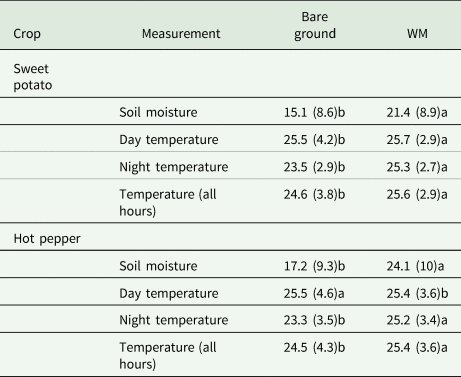
Means with different letters within a row are different (all P-values <0.001).
Discussion
Growers were less likely to use soil covers of any kind in Barbados than the DC region, so growers in the DC region were more likely to have experience using WM. This difference in usage may be due to single or combined factors, including demographic differences between the populations we surveyed, differences in farm attributes, and variations in typical farming practices between the two regions. Our survey was not designed to determine why the use of WM varied between the regions. Future work could see if gender, age, education, and size of the farm, all factors that noticeably differed between growers in Barbados and the DC region and are known to influence farming practices (Kuwabara and Ueki, Reference Kuwabara and Ueki2016; Sharma, Reference Sharma2016; Larson et al., Reference Larson, Dray, Cornioley, Thephavanh, Thammavong, Vorlasan, Connell, Moglia, Case, Alexander and Perez2020), influence the likelihood of using soil covers generally and WM specifically. In addition to these factors, expense, availability, and ease of application may be barriers to using WM as these were reported by growers and observed by us during field trials with farmers. We procured WM from the only source we could find in Barbados and the most convenient and least expensive source in the DC region, so this may create a problem of availability and increase costs for growers that opt to transport the material from the source to their farm. Applying the material is then an intensive manual job because of the lack of farming equipment that can spread it over fields, which may be one reason why growers in the DC region are more likely to use it on their smaller urban land and growers in Barbados are less likely to use it on their larger farms.
Despite the barriers, many growers were using WM during our study, or had previously used it, and reported myriad benefits, including improving plant yield and/or nutrients, preventing weed growth, maintaining soil moisture and reducing watering, improving soil fertility, reducing soil erosion, reducing compaction from heavy rain, and maintaining soil temperature. We had predicted some of these benefits from using WM and these predictions, as well as earlier work on mulch demonstrating some of these benefits (Splawski et al., Reference Splawski, Regnier, Harrison, Bennett and Metzger2016), is what led us to quantify some benefits through field trials. Of the prospective benefits conferred by using WM, growers indicated they would consider using it if WM conserved soil moisture and reduced watering, prevented weed growth, and improved plant yield.
We did find multiple differences between plots with WM and those left bare in field trials in Barbados and the DC region (Table 6). WM in some cases may promote higher survival of a crop, lead to a higher yield, suppress weeds, conserve soil moisture, and maintain higher and less variable soil temperature. Manufactured black plastic mulch is widely used, in part, because of some of these same benefits (Seyfi and Rashidi, Reference Seyfi and Rashidi2007; Liu and Siddique, Reference Liu and Siddique2015; Haque, Jahiruddin and Clarke, Reference Haque, Jahiruddin and Clarke2018). Some benefits of using WM vs a plastic mulch is that WM is made from natural recycled materials, its production likely has a lower carbon footprint, and it may confer benefits longer. Also, even though we saw no difference in nutrients in crops or soil when using WM, it may be more likely to increase nutrients after several growing seasons. Release of nutrients through decomposition may be slow and happen over a longer time scale than our study since WM is a coarse woody material. The field research in Barbados was initially planned for two growing seasons with cassava being planted immediately following the harvest of sweet potatoes, but the pandemic caused by COVID-19 prevented the execution of those plans. However, one farmer did plant cassava and found that the mass of cassava harvested per plant was 127% heavier in field rows with WM than in bare ground. Also, in June 2022 we planted edible hibiscus at one site in the DC region that had been used for research in 2021 and still had the original WM. Plants in WM were noticeably larger and darker green in color and WM still suppressed weeds more than a year after spreading it on the site. Also, soil samples collected in August 2022 revealed the two largest differences between the WM plot and the bare ground plot were that Mg increased 203% in the WM plot vs 138% in bare ground and organic matter increased 133% in the WM plot vs 127% in bare ground from when we took the first soil samples in 2021. The data from the cassava crop and the site in the DC area are anecdotal but indicate the possibility that WM has extended benefits.
Summary of differences between plots where sweet potatoes or Hungarian hot wax peppers were grown with mulch from organic wood waste (WM) as a soil cover or no soil cover in the Washington, DC, USA region and Barbados

We only focused on one root crop and one fruit crop, but our results suggest that mulch may be most beneficial for root crops. Weeds were suppressed, and soil moisture and soil temperature were mostly increased (in the DC region), by WM in all plots but influenced survival and yield for sweet potatoes and not hot peppers. We are unable to determine why survival and yield were higher in sweet potatoes planted in WM, but prior research suggests that root growth is highest in soils that are highly saturated (Belehu and Hammes, Reference Belehu and Hammes2004) and a deficit of water can inhibit initiation and development of storage roots (Gajanayake et al., Reference Gajanayake, Reddy, Shankle and Arancibia2013). Prior research also suggests that initial root growth and storage root mass are influenced by temperature, with growth and mass being highest in soils that have an average daily temperature of approximately 24°C and less at lower and higher temperatures (Belehu and Hammes, Reference Belehu and Hammes2004; Gajanayake, Reddy and Shankle, Reference Gajanayake, Reddy and Shankle2015). The plots with sweet potatoes in the DC region without WM were closer to an average temperature of 24°C across the study period, whereas plots with WM were slightly warmer, so prior research may lead us to expect greater yield in the plots without WM. However, we think the mass of sweet potatoes may have benefited from the warmer nighttime soil conferred by WM and/or the more stable soil temperature. Sweet potatoes in bare ground experienced colder nights and more variation in soil temperature from day to night.
We observed a potential drawback to using WM for crop production: some hot pepper plants suffered from a nitrogen deficiency shortly after transplanting seedlings to plots with WM and had to be supplemented with fertilizer at some sites. Microorganisms use nitrogen to decompose the WM, so nitrogen is depleted within a shallow zone near the surface of the soil. This resulted in the deficiency we observed. We did not observe a similar deficiency in sweet potatoes, possibly because of their deeper planting depth. Sweet potatoes are also generally a crop that does not need much nitrogen (Hill et al., Reference Hill, Hortense, Hahn, Mulongoy and Adeyeye1990), although this is variety-dependent (Duan et al., Reference Duan, Wang, Zhang, Xie, Li, Hou, Dong, Wang, Qin and Zhang2018), so it is also possible that they are better suited to woody mulches than crops with high nitrogen requirements. The initial nutrient deficiency of hot peppers did not influence their growth or fruit output likely due to the fertilizer we added. Nitrogen deficiency in shallow-rooted crops may be avoided if a buffer is added between WM and soil, such as nutrient-rich compost, aging the WM so that it is at an advanced stage of decomposition (i.e., more like compost), adding fertilizer, or adding wood chips after the crop's roots are more developed. Also, WM would also likely be of the most benefit in no-till agriculture where it remains on top of the soil to decompose. If tilled into the soil, the high carbon content of WM could immobilize soil nitrate-nitrogen.
Conclusions
WM is an underused resource as a sustainable soil cover in food production, likely because of some of the barriers that we identified through the survey of growers and our experience cultivating crops in it. However, there is also potential to expand the use of WM, in part, by communicating its benefits. Growers indicated that they would be most likely to use WM if it conserved soil moisture and reduced watering, prevented weed growth, and improved plant yield. Our work demonstrated that these benefits can potentially be conferred by WM, so these results should be communicated to home and commercial growers, especially those cultivating root crops. Understanding which crops benefit the most from WM and the longer-term effects of WM on crops and soil are deserving of future study.
Acknowledgments
We are grateful for the large number of people who helped with many aspects related to this project. In Barbados, that includes Jabarry Belgrave, Jeff Chandler, Clyde Craigg, Rontia Crichlow, Raphael Gustave, Andrew Harewood, Ron Hope, Lisa Howell, Michael James, Shirley Jones, Egbert Maloney, Dwight Miller, A.T. Nicholls, Amy Richardson, Anna Richardson, David Richardson, Susanne Ryan, Devon Slater, Mark Steele, Lennox Ward, and the many growers that completed our survey. In the USA, that includes Steven Birchfield and the team at the Prince George's County Organics Composting Facility, Ekaterina Lopez-Bondarchuk, Matthew Gardine, Gayle George, Victoria Mirowski, Michael Power, Thomas Wheet, many volunteers that helped with harvesting crops, the growers that completed the survey, and all our partnering farms and farmers, including Civic Works & Real Food Farm (Stuart Jones), Plantation Park Heights Urban Farm (Farmer Chippy, Farmer Tiara), Black Yield Institute & Cherry Hill Urban Community Garden (Myeasha Taylor), Whitelock Community Farm (Kimberly Raikes), Passion to Seed Gardening (Tanya Spandhla), Arcadia Center for Sustainable Food and Agriculture & WoodBox Farm (Marcus Roberson), George Washington University & GroW Garden (Kimberly Williams, Brooke Giffin, Samantha Proulx-Whitcomb), Gathering Springs Farm (Sarah Waybright, Pamela Jones). We also thank Jill Tao for her assistance with our statistical models. This research was approved by the Institutional Review Board at the University of the West Indies at Cave Hill (IRB#190406–B).
Author contributions
M. L. R. contributed to conceptualization, methodology, investigation, formal analysis, writing—original draft, visualization, supervision, and funding acquisition. C. G. A. contributed to methodology, investigation, data curation, writing—review and editing, and project administration. F. B. L. contributed to conceptualization, methodology, investigation, writing—review and editing, and funding acquisition.
Funding statement
This work was supported by a Fulbright Scholarship (to M. L. R.) and the USDA-AMS Specialty Crop Block Grant AM180100XXXXG010 (to M. L. R. and F. B. L.).
Competing interests
None.


 Open access

