




Introduction
Perennial grain crops have the potential to produce staple foods and forage for livestock while mitigating many of the environmental externalities of annual grain production (Pimentel et al., Reference Pimentel, Cerasale, Stanley, Perlman, Newman, Brent, Mullan and Tai-I Chang2012; Crews et al., Reference Crews, Carton and Olsson2018). Kernza® is a variety of intermediate wheatgrass (Thinopyrum intermedium Barkworth & Dewey) bred for grain production by researchers at The Land Institute, Salina, Kansas, USA (DeHaan et al., Reference DeHaan, Christians, Crain and Poland2018). Intermediate wheatgrass is a rhizomatous perennial grass native to the Caucasus region of Eurasia that has historically been used as a forage crop due to its high biomass production and good forage quality (Vogel and Jensen, Reference Vogel and Jensen2001; Hendrickson et al., Reference Hendrickson, Berdahl, Liebig and Karn2005). Intermediate wheatgrass was selected for domestication as a perennial grain crop because of its relatively large seed size, favorable agronomic characteristics (i.e., lower shattering, more uniform height, more synchronous maturation) and better flavor profile than other candidate perennial grasses (Wagoner, Reference Wagoner1990).
Increasing crop diversity in agroecosystems can restore ecosystem services and improve production efficiency (Asbjornsen et al., Reference Asbjornsen, Hernandez-Santana, Liebman, Bayala, Chen, Helmers, Ong and Schulte2014). This approach is viewed as an important component of broader changes to food systems that are necessary to ensure global nutritional security while maintaining or enhancing the natural capital that sustains agricultural production (Foley et al., Reference Foley, DeFries, Asner, Barford, Bonan, Carpenter, Chapin, Coe, Daily, Gibbs, Helkowski, Holloway, Howard, Kucharik, Monfreda, Patz, Prentice, Ramankutty and Snyder2005). Development of intermediate wheatgrass as a perennial grain crop is largely motivated by its ability to contribute ecosystem services including enhanced soil health and water quality (Culman et al., Reference Culman, Snapp, Ollenburger, Basso and DeHaan2013; Jungers et al., Reference Jungers, DeHaan, Mulla, Sheaffer and Wyse2019), and the potential for soil carbon storage to mitigate anthropogenic climate change (Sprunger et al., Reference Sprunger, Culman, Robertson and Snapp2017, Reference Sprunger, Culman, Peralta, DuPont, Lennon and Snapp2019; Pugliese et al., Reference Pugliese, Culman and Sprunger2019). These characteristics have also motivated food industries to develop products that incorporate Kernza as part of their corporate sustainability strategy (Lubofsky, Reference Lubofsky2016; Karnowski, Reference Karnowski2017).
Despite advances in the development of Kernza as a perennial grain crop, low grain yields compared to annual small grains continue to be a potential barrier to adoption (Hunter et al., Reference Hunter, Sheaffer, Culman and Jungers2020a). While adoption may not be wholly dependent on economic returns for farmers motivated by innovation and environmental benefits, crop productivity and profit margins are major factors in farmer decision-making (Marquardt et al., Reference Marquardt, Vico, Glynn, Weih, Eksvärd, Dalin and Björkman2016; Lanker et al., Reference Lanker, Bell and Picasso2019; Wayman et al., Reference Wayman, Debray, Parry, David and Ryan2019). Currently, Kernza grain yields range between 500 and 1700 kg ha−1 at first harvest and then decline in subsequent years (Culman et al., Reference Culman, Snapp, Ollenburger, Basso and DeHaan2013; Jungers et al., Reference Jungers, DeHaan, Betts, Sheaffer and Wyse2017; Dick et al., Reference Dick, Cattani and Entz2019; Pugliese et al., Reference Pugliese, Culman and Sprunger2019; Hunter et al., Reference Hunter, Sheaffer, Culman and Jungers2020a). Farmers report that developing crop management techniques that maintain yields over time is a top priority for research (Lanker et al., Reference Lanker, Bell and Picasso2019). Management interventions to improve grain yield in young stands and maintain yield as stands age have included crop defoliation after harvest, either by mowing (Pugliese et al., Reference Pugliese, Culman and Sprunger2019; Hunter et al., Reference Hunter, Sheaffer, Culman and Jungers2020a) or grazing (Dick et al., Reference Dick, Cattani and Entz2019), intercropping with legumes (Tautges et al., Reference Tautges, Jungers, DeHaan, Wyse and Sheaffer2018; Favre et al., Reference Favre, Munoz Castiblanco, Combs, Wattiaux and Picasso2019), and increasing row spacing (Hunter et al., Reference Hunter, Sheaffer, Culman and Jungers2020a). These efforts have had mixed results, with most showing yield benefits for the first few harvests but little progress toward sustaining yields in more mature stands. A recent study by Bergquist (Reference Bergquist2019) examined the use of banded herbicide applications, inter-row cultivation, inter-row burning and mowing to manage a Kernza stand in its third and fourth years of growth. Inter-row cultivation during the fall and herbicide applications during the spring after the second and third harvests resulted in the highest grain yields at the fourth harvest, but these yields were not statistically different from the control treatment.
Based on observations from previously cited research on Kernza stand management, it is likely that yield decline in Kernza stands over time is at least partially due to intraspecific competition that causes reduced seed production. Possible mechanisms for yield declines include (a) density-dependent interactions in the rhizosphere that decrease resource allocation to seed production (Tautges et al., Reference Tautges, Jungers, DeHaan, Wyse and Sheaffer2018), (b) changes in light quality at the crown that reduce reproductive tiller initiation or trigger light avoidance syndrome (Jungers et al., Reference Jungers, DeHaan, Betts, Sheaffer and Wyse2017), and (c) water or nutrient limitation during critical periods of growth and reproduction (Tautges et al., Reference Tautges, Jungers, DeHaan, Wyse and Sheaffer2018; Hunter et al., Reference Hunter, Sheaffer, Culman, Lazarus and Jungers2020b). Alternatively, shifts in whole-plant resource allocation from competitive to stress-tolerant strategies as plants age (Jaikumar et al., Reference Jaikumar, Snapp and Sharkey2016) may impose physiological limits on seed production in older stands, but stand-thinning could overcome these limits by stimulating new growth. These observations also suggest that yield declines with stand age are not caused by resource limitations across the entire stand, because total biomass production is generally maintained or increases from season to season, while harvest index declines.
Mechanical stand thinning can maintain seed yield over five harvests in intermediate wheatgrass forage varieties (Canode, Reference Canode1965) and there have been calls for management research to focus on reducing intra-stand competition (Bergquist, Reference Bergquist2019; Hunter et al., Reference Hunter, Sheaffer, Culman and Jungers2020a). Here we report on an experiment using deep, narrow strip-tillage to disturb the root zone of a Kernza stand at two different times between the third and fourth grain harvests: in late fall when plants are entering dormancy and in early spring prior to stem elongation. The objective of this research was to determine whether strip-tillage increases grain yield of Kernza at the subsequent harvest. We hypothesized that strip-tillage would reduce tiller density but would increase resource allocation to seed production, measured as harvest index. Total biomass production and yield components were also measured.
Methods
Experimental design
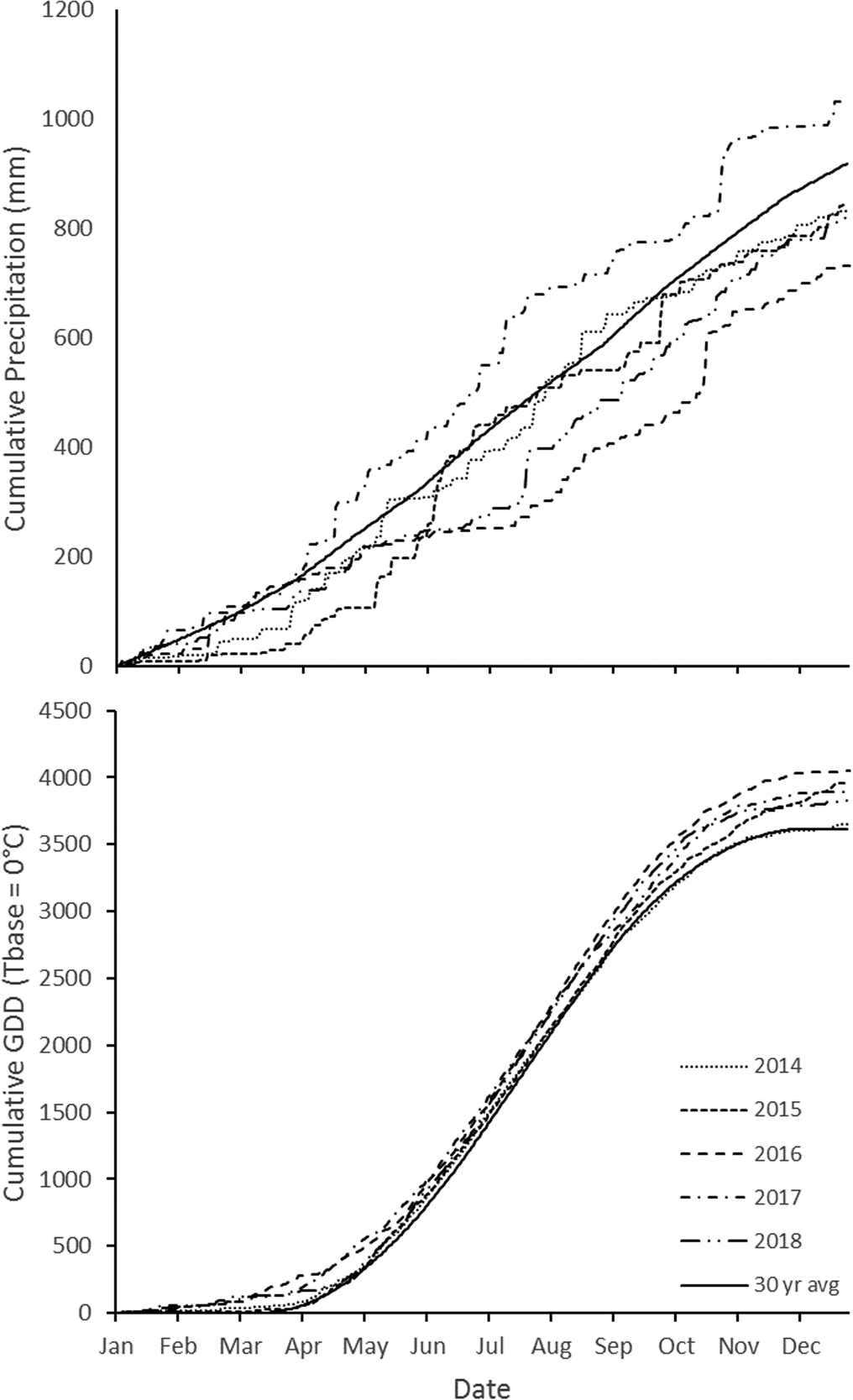
This experiment was established in a field of Cycle 3 Kernza® intermediate wheatgrass from The Land Institute's breeding program, planted on August 26, 2014 at the Musgrave Research Farm in Aurora, New York, USA (42.7222N, 76.6636W). Field operations conducted between the field being planted and data collection are summarized in Table 1. Soil type at the site is Honeoye silt loam with a pH of 7.5 and 3.2% organic matter. Mean annual temperature was 9.1°C and mean annual precipitation was 918 mm for the most recent NOAA 30-yr climate averages (1981–2010), but annual temperatures tended to be higher and precipitation lower between 2014 when Kernza was planted and 2018 when the experiment was conducted (Fig. 1). The field was planted at a seeding rate of 16.8 kg ha−1 in 19-cm rows using a John Deere No-Till Grain Drill model 1590. A tank mix of Harmony Extra SG (11.7 g ha−1 thifensulfuron-methyl and 5.8 g ha−1 tribenuron-methyl), Banvel (140.1 g ha−1 dimethylamine salt of dicamba) and Barrage (288.1 g ha−1 2,4-D ester) was applied to the entire field on April 24, 2017 to manage an expanding population of Canada thistle [Cirsium arvense (L.) Scop.]. Grain was harvested and straw removed between late August and early September in 2015, 2016 and 2017.
Cumulative growing degree days (Tbase = 0°C) and precipitation for each of the 5 yrs between Kernza planting in 2014 and the fourth grain harvest in 2018 reported in this study. The most recent NOAA 30-yr climate averages (1981–2010) are included to provide context.
Field operation dates from Kernza planting in August 2014 to sampling in August 2018
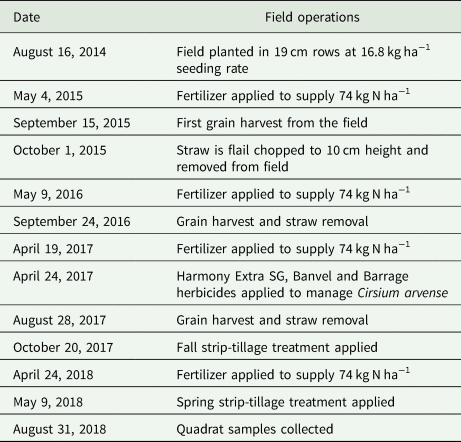
The experiment was set up as a randomized complete block design with three treatments replicated five times. Strip-tillage treatments were applied using an Unverferth Zone-Builder Subsoiler Model 122 (Figs. 2 and 3). Treatments were: (1) strip-tillage on October 20, 2017 after substantial post-harvest regrowth (‘fall strip-tillage’); (2) strip-tillage on May 9, 2018 after green-up but prior to stem elongation (‘spring strip-tillage’), (3) and an untreated control that had not been tilled or cultivated since the field was planted (‘control’). Plots measured 4.6 m wide by 24.4 m long. The entire field was top-dressed with a 50:50 mix by weight of ammonium sulfate (21-0-0) and urea with nitrogen inhibitor (45-0-0) at a rate of 224 kg ha−1 on April 24, 2018. Similar fertilizer applications were made from 2015 through 2017.
Strip-tillage treatment being applied using Unverferth Zone Builder Subsoiler Model 122.

Soil disturbance after strip-tillage with Unverferth Zone Builder Subsoiler Model 122.

Data collection
Data were collected during August 2018 at physiological grain maturity, coinciding with the fourth grain harvest from the field. Biomass was harvested by hand from two 0.5 m2 quadrats in each plot on August 31. One quadrat was placed in a representative location in each of the north and south halves of the plot selected to avoid edge effects. Within each quadrat, all plant tissue was clipped at the soil surface and separated into crop or weed in the field. Weed species present were recorded for each plot. Crop biomass was separated into stems and seedheads in the field and both were counted. All biomass samples were then dried at 65°C for a minimum of 5 days before weighing. Seedhead samples were further processed to assess hand-harvested yield and components of yield. Twenty seedheads were randomly selected from each sample to be hand threshed and the grain dehulled, with seedhead length, spikelet count, floret count and seed count all recorded for these subsamples. The remaining seedheads from each sample were then threshed and dehulled with a hand deawner/debearder (Hoffman Manufacturing Inc., Corvallis, Oregon, USA). From these data, the percentage of tillers that were fertile (i.e., produced a seedhead), harvest index and thousand kernel weight were also calculated. Non-seed biomass separated from seedheads during this process was added to stem biomass to obtain a value for total aboveground vegetative biomass for each sample. All grain yields reported were dehulled and corrected to 13% market moisture content.
Data analysis
All data were analyzed using one-way ANOVA in R version 3.5.3 (R Core Team, Reference R Core Team2019). The lmer function from the lme4 package was used for linear mixed-effects models for each response variable with tillage treatment as the fixed effect and block as a random effect. ANOVA assumptions were checked using the leveneTest function from the car package to confirm the homogeneity of variance and the shapiro.test function from the stats package to confirm that residuals were normally distributed. Pseudo R 2 values and likelihood-ratio tests were calculated to assess model goodness-of-fit using the nagelkerke function from the rcompanion package. Post-hoc comparisons of marginal means using Fisher's protected LSD were conducted using the marginal, CLD and pairs functions from the lsmeans package. All tests used α = 0.05 as the cutoff for significant effects.
Results
Fall strip-tillage increased grain yields compared with spring strip-tillage and control treatments (Table 2). Dehulled grain yield from the fall strip-tilled treatment increased 61% (P = 0.025) relative to the control treatment. Total tiller density m−2 was marginally reduced by 24% in the fall strip-tillage treatment when compared to the control treatment (P = 0.058). Spring strip-tillage reduced tiller density to a greater extent, with tiller counts 29% lower (P = 0.030) than the untilled control. Stand density was similar between fall and spring strip-tillage treatments (P = 0.679). Fertile tiller density (i.e., tillers bearing mature seedheads m−2) was highest in fall-tilled plots, 43% higher than the control (P = 0.035) and 86% higher than the spring-tilled plots (P = 0.005). Thus, the overall effect of the fall strip-tillage treatment was to increase tiller fertility (i.e., the percentage of tillers that produced a mature seedhead) from 19% in the control treatment to 35% in the fall strip-tillage treatment (P = 0.003), leading to an increased grain yield after fall strip-tillage. Tiller fertility in the spring strip-tillage treatment was similar to the control treatment (P = 0.9067).
Summary of ANOVA results for mean (s.e.) components of yield from fourth-year Kernza intermediate wheatgrass harvested in the season following fall, spring or no (control) management disturbance from strip-tillage
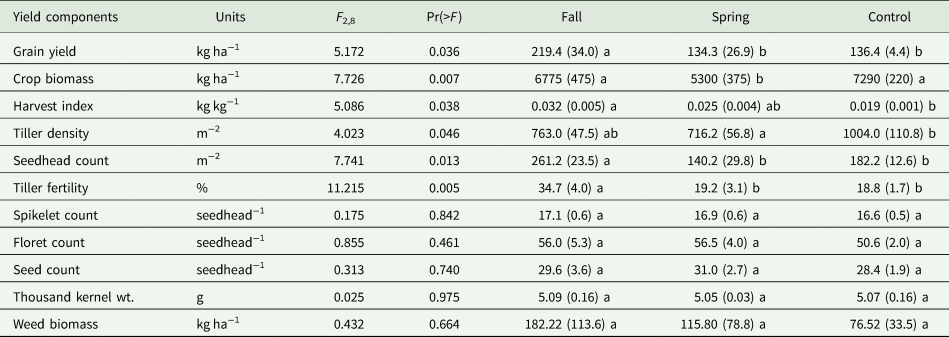
N = 5. Treatment means within each yield component sharing the same letter are not significantly different at α = 0.05.
Total crop biomass was similar between fall strip-tillage and control treatments (P = 0.3579) at around 7000 kg ha−1. Spring strip-tillage reduced crop biomass by 27% (P = 0.005) compared to the control treatment. There were no differences between treatments for yield components including counts of spikelets, florets or seeds per seedhead, or thousand kernel weight (Table 2). Harvest index was higher in the fall strip-tillage treatment than the control treatment (P = 0.0129) due to the combination of higher grain yields and marginally lower total crop biomass production. Harvest index for spring-tilled plots was intermediate between, and similar to, the harvest index for both the fall-tilled and the untilled control plots. Weed biomass was low across the experiment and no differences were observed between treatments.
Discussion
Strip-tillage in the fall substantially increased grain yield in the subsequent harvest, demonstrating that stand thinning can improve grain yields in older Kernza stands. Reducing overall stand density, and likely intraspecific competition, appears to have allowed the remaining Kernza plants to grow more vigorously and produce more seedheads per unit area given enough time between disturbance and harvest. Strip-tillage treatments did not affect spikelet and floret counts per seedhead at harvest, however, indicating that differences in seed production were not driven by differences in inflorescence size that have been reported in other perennial grasses (Abel et al., Reference Abel, Gislum and Boelt2017). Even strip-tillage in the spring reduced competition between reproductive tillers as there was no difference in yield despite lower stand density compared to the control. Similar effects on seedhead density were reported in previous work using stand thinning to stimulate seed production of other perennial cool-season grasses. In a study using Kentucky bluegrass (Poa pratensis L.), Evans (Reference Evans1980) found edge effects affecting panicle density, with higher panicle density closer to areas where sections of row had been removed after seed harvest and lower density in areas further from disturbance, suggesting competition for light and space decreased floral induction. The disturbance caused by strip-tillage is likely to have altered some environmental conditions, including light quality, that influence floral induction, but other factors such as photoperiod and temperature are more seasonally dependent (Kalton et al., Reference Kalton, Barker, Welty, Moser, Buxton and Casler1996). Stand-thinning via strip-tillage after harvest could also increase seed production in the following year by stimulating new growth that has a higher capacity for photosynthesis and carbon assimilation during seed development, but may have lower tolerance of extreme cold and other abiotic stress (Jaikumar et al., Reference Jaikumar, Snapp and Sharkey2016). Tillage practices may also influence soil nutrient availability by altering soil conditions and stimulating decomposition of soil organic matter (Gómez-Rey et al., Reference Gómez-Rey, Couto-Vázquez and González-Prieto2012), but this effect was not examined in this experiment.
Differences between the fall and spring strip-tillage treatments indicate that the timing of disturbance used for stand thinning is important. In this experiment, spring-tillage reduced overall stand density by a similar amount as fall-tillage, but crop biomass production, tiller fertility and grain yields were lower after spring-tillage indicating lower crop vigor after disturbance in the spring. Previous research on the impact of spring forage harvest timing on intermediate wheatgrass tiller persistence found that disturbance prior to stem elongation was associated with lower tiller mortality than disturbance later in the growing season (Hendrickson et al., Reference Hendrickson, Berdahl, Liebig and Karn2005). It is possible that disturbance after plants break dormancy in the spring is not conducive to seed production, either due to added stress during a critical period of growth or incompatibility with plant phenology. The annual reproductive cycle of intermediate wheatgrass begins with tiller development during regrowth after harvest, followed by reproductive tiller induction during overwintering, and floral development the following spring (Majerus, Reference Majerus, Johnson and Beuler1988; Heide, Reference Heide1994; Cattani and Asselin, Reference Cattani and Asselin2018). Disturbance at later stages of this process would therefore have greater potential to reduce fertile tiller density as there would be less opportunity for reproductive tiller replacement even if resources were otherwise abundant. Some perennial grasses are able to produce new reproductive tillers in the spring after vernalization, but these tillers tend to be smaller and produce fewer seeds and disturbance after this secondary induction would only stimulate regrowth of vegetative tillers (Abel et al., Reference Abel, Gislum and Boelt2017). Moreover, any tillers that are newly established in the spring may compete for resources with larger tillers produced the previous fall, potentially reducing seed yield via reduced inflorescence size or reduced seed set (Aamlid et al., Reference Aamlid, Heide, Christie, McGraw, Fairey, Hampton, Fairey and Hampton1997). It is also plausible, however, that disturbance during spring in our experiment, which did not negatively impact grain yields relative to the control, might have a positive effect on yield at the second harvest after treatment.
Fourth-year Kernza grain yields obtained in our study are comparable to yields reported in two recent field experiments in Minnesota. In a study examining the effects of row spacing and crop defoliation on grain yield, Hunter et al. (Reference Hunter, Sheaffer, Culman and Jungers2020a) reported a mean grain yield of 276 kg ha−1 across all management treatments, slightly higher than the 219 kg ha−1 from our fall strip-tillage treatment. The Minnesota study utilized Cycle 4 Kernza seed, and thus genetic improvement may be partly responsible for higher average grain yields. Increased row spacing also had a positive effect on grain yields in their study, with an average fourth-year yield for their 15-cm row spacing treatment of 244 kg ha−1, a yield similar to our fall strip-tillage value. In a study examining the effects of inter-row cultivation, herbicide application, burning, and mowing on Kernza yield, Bergquist (Reference Bergquist2019) reported fourth-year Kernza grain yields ranging between 50 and 300 kg ha−1. Grain yield after fall inter-row cultivation averaged 231 kg ha−1, which is similar to yields for our fall strip-tillage treatment but was not statistically different from their control treatment yield of 208 kg ha−1.
Prior to this experiment, Kernza grain yields measured in a separate part of the same field but not within the area of this experiment exhibited steady decline from 930 kg ha−1 in 2015, the first year after planting, to 600 kg ha−1 in 2016, and 315 kg ha−1 in 2017, the third year after planting and the harvest just before strip-tillage was implemented (data not shown). These grain yields show a similar pattern of decline in seed production as other reports in the literature. Hunter et al. (Reference Hunter, Sheaffer, Culman and Jungers2020a) report first-year Kernza grain yields of 775 kg ha−1 declining to 300 kg ha−1 by the third year of their experiment, and Bergquist (Reference Bergquist2019) report average grain yields of 340 and 50 kg ha−1 in their second and third years, respectively. Total crop biomass measured in the same field as our experiment averaged 5000 kg ha−1 yr−1 for each of the first three growing seasons (data not shown), which is on the low end of the typical range of 5000–11,000 kg ha−1 reported in the literature (Bergquist, Reference Bergquist2019; Dick et al., Reference Dick, Cattani and Entz2019; Hunter et al., Reference Hunter, Sheaffer, Culman, Lazarus and Jungers2020b; Jungers et al., Reference Jungers, DeHaan, Betts, Sheaffer and Wyse2017; Tautges et al., Reference Tautges, Jungers, DeHaan, Wyse and Sheaffer2018). Total crop biomass did increase to ~7000 kg ha−1 in the fall strip-tillage and control treatment plots in 2018, which is consistent with many reports of total biomass production increasing as Kernza stands age.
The intensity of disturbance may be an important factor in determining whether management aids or hinders Kernza grain yields. While our study did not vary the type of disturbance or disturbance intensity, other research has demonstrated that higher-intensity disturbance using banded herbicide applications or more intense tillage have not improved or maintained Kernza grain yield (Bergquist, Reference Bergquist2019). Striking a balance with management interventions that optimize reproductive sink capacity by reducing competition between tillers without causing excessive damage that hinders crop vigor is an important stand management goal that warrants further research (Hunter et al., Reference Hunter, Sheaffer, Culman and Jungers2020a). Moreover, other types of targeted disturbance that differ in intensity and their effect on the crop should be assessed as options for managing Kernza and other perennial grains. For example, burning straw and stubble after harvest of intermediate wheatgrass was more effective than mechanical thinning at maintaining high seed yields in one early study (Canode, Reference Canode1965). Clearly, there are many types of cultivation and chemical thinning strategies that require research attention.
Limitations and recommendations for further research
As this experiment was not replicated in time or space, we encourage further investigation of stand-thinning using strip-tillage before proposing broader recommendations for utilizing strip-tillage in Kernza production. Based on these results and evidence from other published studies, future research on using strip-tillage to maintain Kernza yields should focus on the specific timing and intensity of disturbance during the fall, including treatments implemented soon after grain harvest. Moreover, data should be collected over multiple growing seasons to better understand any longer-term effects of the disturbance. We also recommend research into the effects of strip-tillage after the first and second grain harvests from Kernza stands when grain yields are still relatively high. For example, would strip-tillage after the second grain harvest increase grain yield of the third harvest similar to the increase we observed from strip tillage between the third to fourth grain harvests in this study?
Conclusion
Kernza intermediate wheatgrass has the potential to improve the sustainability of cereal grain production by contributing additional ecosystem services including soil health improvement, water quality protection and potential for soil carbon storage. Improving grain yield of Kernza through optimized crop management will facilitate the adoption of the crop, allowing these environmental benefits to be gained across a wider range of agricultural systems. In this experiment, strip-tillage of a Kernza stand in late fall after the third grain harvest increased grain yield of the fourth harvest the following year. This effect was likely due to a reduction in intraspecific competition between reproductive tillers after tillage. Strip-tillage applied in early spring reduced stand density but did not impact yields. Further research into different types, timings and intensities of disturbance should be a priority in developing management recommendations for Kernza and other perennial grain crops.
Acknowledgments
We would like to acknowledge that this research was conducted on the traditional homelands of the Cayuga Nation and we are grateful for the opportunity to work on these lands and for the continued stewardship of the Cayuga people. We thank Dr. Cynthia Bartel, Dr. Troy Beldini, Ann Bybee-Finley, Uriel Menalled, Matthew Spoth, Danilo Pivaral and Pauline Mouillon for assisting with data collection. This research was funded by the United States Deparment of Agriculture Northeast Sustainable Agriculture Research and Education Program Graduate Student Grant GNE17-156-31064, the United States Department of Agriculture National Institute of Food Food and Agriculture Hatch Project 2016-17-252, and the New York State Environmental Protection Fund for the New York Soil Health Initiative administered through the New York State Department of Agriculture and Markets Contract No. C00178GS-3000000.


 Open access

