


Misdiagnosis is one of the major concerns in Disorders of Consciousness (DoC).Reference Schnakers, Vanhaudenhuyse and Giacino 1 Confounding factors in the behavioral evaluation of overt responsiveness include comorbidities,Reference Estraneo, Loreto and Masotta 2 extreme motor deficits and severe spasticity,Reference Thibaut, Chatelle and Wannez 3 diffuse pain,Reference Formisano, Contrada and Aloisi 4 neuropsychological deficits, such as aphasia,Reference Formisano, Toppi and Risetti 5 psychomotor agitation,Reference Formisano, Bivona and Penta 6 oppositive attitudes, and inertia, such as in akinetic mutism,Reference Formisano, D’Ippolito and Risetti 7 as well as iatrogenic effects (anti-epileptics, sedative drugs, anti-spastic agents, etc.).
The Coma Recovery Scale-Revised (CRS-R)Reference Giacino, Kalmar and Whyte 8 is the gold standard of responsiveness assessment in patients with DoC, as it has also been recently reported by the American guideline on this topicReference Giacino, Katz and Schiff 9 ; its advantages are the international validation of the scale, the diagnostic validity, the outcome prediction ability, and the standardization of the proposed stimuli. Conversely, its limitations might be considered the marginal role of the caregiversReference Sattin, Giovannetti and Ciaraffa 10 in the evaluation of patients’ responsiveness, the poor emotional salience of the proposed stimuli, and the scarce motivational efficacy of standardized stimulations.
Sensory regulation and emotional stimulation have been previously proposed as a method to improve awareness in patients with altered states of consciousness.Reference Moattari, Shirazi and Sharifi 11 , Reference Salmani, Mohammadi and Rezvani 12
The principal aim of our study is to search for the possible efficacy of the caregivers’ involvement in the evaluation of responsiveness in patients with DoC, in order to investigate a possible role of the caregiver in the improvement of the arousal, the interaction with the environment, and the functional communication recovery.
Fifteen patients (10 males and 5 females) with a mean age of 37.1 ± 16.1 years (range 15–60 years), diagnosed with DoC, according to the CRS-RReference Giacino, Kalmar and Whyte 8 were consecutively enrolled in this study. Etiology was distributed as follows: 6 traumatic brain injury (TBI), 5 cerebral hemorrhage (CH), 3 anoxia (A), and 1 cerebral ischemia (CI). All patients enrolled had normal auditory evoked potentials as an inclusion criterion. Responsiveness assessment was performed by two speech therapists (GF and SS) with long-term expertise in the evaluation of patients with DoC; both therapists have been involved in the Italian validation of the CRS-RReference Estraneo, Moretta and De Tanti 13 and administered CRS-R at least five times during the first 2 weeks after admission, choosing the best scores obtained. The mean interval between coma onset and the first CRS-R assessment was 3.7 ± 2.0 months (range 1–8). The two speech therapists administered CRS-R, without and with the emotional stimulation of the same primary caregiver, at study entry (T0: number of patients N = 15), after 1 month (T1: 4.6 ± 2.0 months, N = 13), after 2 months (T2: 5.0 ± 1.91 months, N = 12), and at 1-year follow-up (T3: 12.3 ± 4.1 months, N = 7). The same items of the CRS-R were assessed by the speech therapist (professional alone) and by the speech therapist with the active participation of the “significant other” (caregiver) in different sessions.
Data were reported in terms of means and standard deviations. Comparisons between the CRS-R scores without and with the caregiver were performed using the Wilcoxon signed rank test, setting the alpha level of significance at 5%.
Analyzing all 47 assessments independently by the assessment timing, the presence of caregiver implied 17 changes (36%). The differences ranged from 0 up to 5 points of CRS-R being never negative, and those positive were mainly related to auditory and motor domains. The mean CRS-R was 8.3 ± 5.0 without the caregiver and 9.2 ± 5.8 with the caregiver, highlighting a statistically significant difference (p = 0.001). Analyzing each assessment timing, the CRS-R score was higher when the caregiver was present in 3 patients at T0 (p = 0.102), in 5 at T1 (p = 0.121), in 4 at T2 (p = 0.039), and in 4 at T3 (p = 0.068), as shown in Figure 1.
Box and whiskers plot of the total CRS-R scores assessed without (left bars) and with (right bars) the caregiver for the four assessment times (the above p-values were obtained comparing data obtained without and with caregiver for each assessment). The extremes of whiskers represent the minimum and maximum score, the limit of the box represents the first and third quartiles, and the bold line is the median score. Above p-values are related to the comparison.
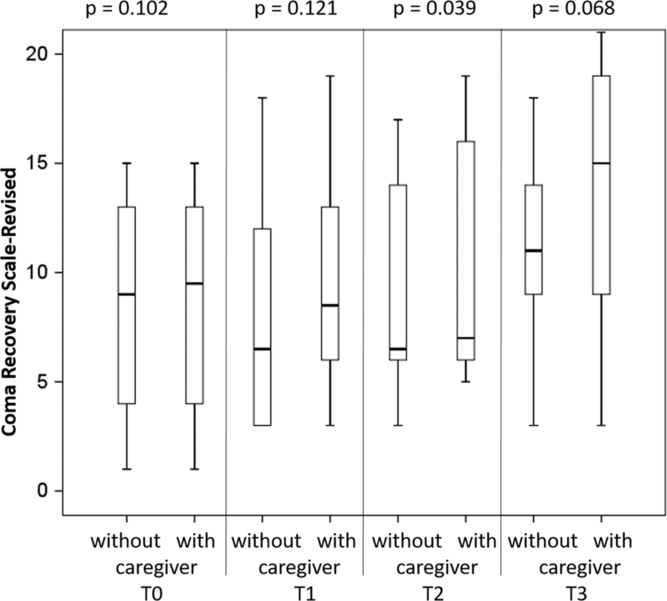
Recent studies demonstrated the need to repeat CRS-R several times to patients with DoC in order to establish the responsiveness in the most appropriate and reliable way.Reference Wannez, Heine and Thonnard 14 Although our sample was progressively reduced by deaths or transfers, our preliminary findings seem to suggest that the inclusion of the caregiver during CRS-R assessment may give better responsiveness scoring than by professional alone, likely due to the emotional valence of the familiar voice, as previously reported.Reference de Pasquale, Caravasso and Péran 15 It should be noted that only at T2 we found a significant difference between the CRS-R scores assessed with and without the caregiver, whereas no significant differences were noted at T0, T1, and T3. However, it is also worth noting that the presence of caregiver led to obtain higher CRS-R in 3, 5, and 4 patients also at T0, T1, and T3, respectively; and the CRS-R score assessed with the caregiver was never lower than that assessed without the caregiver. Thus, the involvement of caregivers in the evaluation of responsiveness in patients with DoC may enhance the efficacy of CRS-R and might reduce the misdiagnosis rate in patients with DoC.Reference Schnakers, Vanhaudenhuyse and Giacino 1
Funding
This work has received funding from the European Union’s Horizon 2020 research and innovation programme under the Marie Skłodowska-Curie grant agreement no. 778234.
Disclosures
The authors have no conflicts of interest to declare.
Statement of authorship
RF has supervised the whole Project, since the beginning, and has written the paper with MC and MA; MC, GF, SS, and MA have participated in the data collection; and MI has performed the statistical analysis.



