

Introduction
Public hostility toward religious outgroups is often attributed to a perceived lack of “cultural fit.” For many Americans, certain religious groups are associated with culturally alien traditions, customs, or practices. Patterns of dress or hairstyle, foods to be eaten or avoided, or particular rituals and celebrations come to define a particular religion in relation to broader society (Campbell et al. Reference Campbell, Green and Quin Monson2014; Whitehead and Perry Reference Whitehead and Perry2020). Unfamiliarity with religious practices or beliefs, which is widespread in the United States (Prothero Reference Prothero2007), often results in an “othering” of minority religious groups and adherents, activating a sense of cultural (or symbolic) threat that drives negative attitudes. For instance, Kalkan et al. (Reference Kalkan, Layman and Uslaner2009) posit that Americans' antipathy toward Muslims is driven less by fears of terrorism or general ethnocentrism than by an overarching dislike of groups that fall outside the cultural mainstream. Likewise, some scholars attribute increasing favorability toward Catholics and Jews to “growing cultural similarities” of these groups and other Americans over time (Bolce and De Maio Reference Bolce and De Maio1999a, 30). More generally, there is compelling evidence that symbolic threats and antipathy toward cultural outgroups play decisive roles in determining people's attitudes concerning religious minorities, political candidates, or relevant public policies (Berinsky and Mendelberg Reference Berinsky and Mendelberg2005; Kalkan et al. Reference Kalkan, Layman and Uslaner2009; Campbell et al. Reference Campbell, Green and Quin Monson2012; Hainmueller and Hopkins Reference Hainmueller and Hopkins2014; Bilodeau et al. Reference Bilodeau, Turgeon, White and Henderson2018; Whitehead and Perry Reference Whitehead and Perry2020).
While numerous studies examine the role of cultural threat on public attitudes, fewer have examined the process by which certain practices come to be perceived as culturally different or threatening in the first place (Rios et al. Reference Rios, Sosa and Osborn2018). Objectively comparable religious practices—such as a Catholic nun wearing a habit and a Muslim woman wearing a hijab—are associated with vastly different cultural meanings. When a French secularism law banning religious clothing in public spaces was used to deny a septuagenarian nun's place in a retirement home because of her veil, Father Florent Belin wrote in opposition saying, “I don't think a nun's veil is disturbing because it's not a sign of submission but of devotion” (Willsher Reference Willsher2019). The unstated counterpoint is that the hijab is a sign of submission and thus antithetical with French values, norms, and identity. Despite their material similarities, the habit and the hijab have distinct cultural connotations and thus political significance.
Which cultural practices register as threatening, and what kinds of political or social factors influence this perception? In this paper, we conduct an original survey experiment to examine how political relationships between groups shape perceptions of religious practices and support for religious accommodation in public policy. We propose and test two main theoretical arguments. First, while hostility toward religious outgroups is often linked to socially incongruent practices, religious practices alone are insufficient to explain perceptions of symbolic threat (Rios et al. Reference Rios, Sosa and Osborn2018). In other words, religious practices are semiotically indeterminate; they are not inherently imbued with social meaning or significance that is consistent across contexts and readily communicated. Rather, certain practices are interpreted through the lens of larger social and political conditions, where they play either innocuous or threatening roles depending on the actors involved (Karpowitz et al. Reference Karpowitz, Quin Monson and Patterson2016; Bilodeau et al. Reference Bilodeau, Turgeon, White and Henderson2018). While differences in religious practices do not automatically engender symbolic threat, these differences can be combined with broader political narratives to provide evidence of cultural otherness and thus used to reinforce symbolic boundaries between social groups.
Second, we theorize that part of this semiotic construction depends on the perceived political alignment between social groups. Variation in the cultural meaning attached to a specific practice is partly based on the religious sect to which that practice is attributed, as well as the partisan relationship between that religion and the person evaluating the practice. We show that pre-existing political alignments shape the narrative frames through which people observe and interpret religious practices, which in turn condition their support for identical political accommodation claims made by different religious denominations.
We corroborate these arguments using an original survey experiment featuring a multi-sectarian religious practice: gender segregation. The experiment exposes participants to a policy proposal for women-only swim times at a local public pool, while randomly varying the religious affiliation (Muslim, Jewish, or Pentecostal Christian) of the citizens advocating for this policy. Using both quantitative measures of support and respondents' open-text justifications, we find that, even without any explicit partisan cues, people are more supportive of public accommodations for culturally specific practices when the requesting religious group is aligned with their partisan coalition. For Republicans, gender segregation among Muslims engenders less policy support and evokes concerns about national identity and belonging, while identical practices among Jewish and Pentecostal communities are viewed in less threatening terms. Meanwhile, Democrats report less support for the practice among Pentecostal Christians, and support that position using arguments about separation of church and state. This suggests that socially incongruous practices per se cannot fully account for the activation of symbolic threat or negative affect toward religious groups; rather, such threats emerge from pre-existing—and overtly political—group conflict.
This paper makes several contributions. First, we add to the growing research on attitudes toward religion in the American public sphere by demonstrating the contingent impact of cultural fit on public attitudes. Importantly, the presence of cultural differences alone does not inevitably generate a sense of symbolic threat or reduce support for religiously justified policies. Second, we make a theoretical contribution to the understanding of symbolic boundaries between social identity groups by reevaluating the relationship between cultural differences and political alignments. Specifically, we demonstrate the role of political coalitions and group conflict in the generation of symbolic threats and their relation to public attitudes. One implication is that the assimilation of religious minority groups (such as Muslims) into “American culture” would do little to change public opinion toward such groups and related policies among certain segments of the population.
Attitudes Toward Religious Outgroups: The Role of Symbolic Threat
A large literature in Political Science emphasizes the role of “symbolic threats” or “cultural outgroup antipathy” in structuring people's attitudes toward racial, ethnic, or religious minorities. Drawing from Social Identity Theory (SIT; Tajfel and Turner Reference Tajfel, Turner, Hatch and Schultz1979) and Intergroup Threat Theory (ITT; Stephan et al. Reference Stephan, Ybarra, Morrison and Nelson2015), this approach starts from the well-substantiated observation that people categorize themselves into social “ingroups” and “outgroups.” Individuals tend to view the social-political world through the lens of group categories, viewing members of the outgroup more negatively and more homogenously than members of their ingroup.
Expanding this basic framework, students of American politics argue that hostility toward racial, ethnic, and religious outgroups is driven primarily by a sense of cultural or symbolic threat. Unlike so-called “realistic threats”—which are rooted in concerns for one's material self-interest—symbolic threats concern violations to a group's core set of beliefs, norms, or identities (Citrin et al. Reference Citrin, Reingold and Green1990; Stephan et al. Reference Stephan, Ybarra, Morrison and Nelson2015). From an SIT perspective, cultural norms and practices function to demarcate ingroups from outgroups and uphold feelings of ingroup belonging. People interpret behaviors that deviate from ingroup norms as alien and thus threatening (Schildkraut Reference Schildkraut2005).
Empirical research provides compelling evidence that hostility toward outgroups is rooted in perceptions of symbolic threat, more so than realistic threats or general ethnocentrism. Despite standing at the forefront of public debates, explanations based on realistic threats—such as concerns about job loss, crime, or terrorism—achieve surprisingly little empirical support. Indeed, this “primacy of cultural over economic concerns” (Hainmueller and Hopkins Reference Hainmueller and Hopkins2014, 231) is remarkably durable across contexts, and can be observed in European (Sniderman et al. Reference Sniderman, Hagendoorn and Prior2004; McLaren and Johnson Reference McLaren and Johnson2007; Sides and Citrin Reference Sides and Citrin2007), Canadian (Bilodeau et al. Reference Bilodeau, Turgeon, White and Henderson2018), and American (Burns and Gimpel Reference Burns and Gimpel2000; Lay Reference Lay2012; Craig and Richeson Reference Craig and Richeson2014; Sides et al. Reference Sides, Tesler and Vavreck2019) settings. Symbolic threats on the basis of immigration and gender have been shown to impact candidate preferences, partisanship, and opinions about public policy (Craig and Richeson Reference Craig and Richeson2014; Carian and Sobotka Reference Carian and Sobotka2018).
Further, it is not simply that Americans have a general aversion toward any racial, religious, or social outgroup (what is termed “ethnocentrism”). Rather, hostility is reserved for those groups that are “defined by behaviors or values that many find unusual or offensive,” such as illegal immigrants, welfare recipients, atheists, and sexual minorities (Kalkan et al. Reference Kalkan, Layman and Uslaner2009, 848). For instance, immigrants who refuse to assimilate into American society—e.g., by not speaking English—are seen as more threatening than those who blend in (Hainmueller and Hopkins Reference Hainmueller and Hopkins2014, 235).
While most of the literature on symbolic threats concerns immigrants and ethnic minorities, similar mechanisms explain attitudes toward religious outgroups. Muslims are an oft-cited example. Indeed, public opinion data reveal growing anxiety about Islam's compatibility with “Western” values such as tolerance, equality, and civility (Panagopoulos Reference Panagopoulos2006, 613; Sides and Mogahed Reference Sides and Mogahed2018), and concerns over Muslims' cultural fit are more prevalent than concerns about Muslim-perpetrated terrorism (Sides and Mogahed Reference Sides and Mogahed2018, 10). Similarly, people who hold stronger anti-Semitic stereotypes (e.g., Jews are greedy or have too much influence on Wall Street) are more likely to believe that Jews are un-American and a threat to the moral character of America (Tobin and Groeneman Reference Tobin and Groeneman2003).
Uncertainty about the compatibility of minority religious denominations with “American” values such as democratic governance, religious tolerance, and gender equality may activate perceptions of symbolic threat, with direct impacts on party, policy, and candidate preferences. For example, antipathy toward cultural outgroups reduces support for political candidates from minority religious denominations (Berinsky and Mendelberg Reference Berinsky and Mendelberg2005; Campbell et al. Reference Campbell, Green and Quin Monson2012; Kalkan et al. Reference Kalkan, Layman and Green2018). Likewise, endorsement of negative stereotypes about the beliefs and practices of Christian fundamentalists is associated with negativity toward both the religious group and Republicans, the associated political party (Bolce and De Maio Reference Bolce and De Maio1999b). There is also evidence that symbolic threats are salient in situations where the outgroup makes accommodation demands on scarce public resources (Michalowski and Behrendt Reference Michalowski and Behrendt2020).
In all, the existing evidence demonstrates the influence of symbolic threats on both attitudes toward religious minorities as well as related political opinions and behaviors. However, while compelling, these insights raise important questions about the ways symbolic threats are formed and activated in the public imagination. Indeed, one critique of SIT applications in Political Science has been the lack of attention to how the symbolic boundaries between groups—markers separating “us” and “them”—are constructed in the first place (Huddy Reference Huddy2001). Why are some social practices converted into salient symbolic boundaries and viewed in threatening terms, while others are relatively insignificant and thus have little importance for political attitudes?
Gender Segregation in Religious Contexts As a Symbolic Threat
To examine the construction of symbolic threats, we focus on one practice that is particularly salient to public attitudes toward religious groups: gender segregation. Our study compares support for a public policy facilitating gender segregation practices in three religious traditions: Muslim, Jewish, and Pentecostal. Specifically, we look at accommodation of gender-segregated swimming in local public pools through the provision of women-only swim times. This substantive case is particularly well-suited for our inquiry in several respects.
First, gender-segregated swimming is an established (but not universal) practice in Islam, Judaism, and Pentecostal Christianity. Of course, not all (or even most) practitioners of these three religions follow or endorse gender segregation. The important point is that all three faiths contain sects or denominations—typically conservative or Orthodox in character—that do mandate gender segregation.Footnote 1 Further, the doctrinal rationale is similar for each group, emphasizing traditional norms around modesty, sexual propriety, and the avoidance of unnecessary intergender mixing. This allows us to make plausible comparisons of public reactions to different religious groups without making misleading claims about any particular faith.
Second, women-only swim times as a religious accommodation are a common enough occurrence as to provide a plausible scenario for all respondents, while not sufficiently high-profile that we expect people to have readily available cues or crystallized attitudes about it. Over the past decade, debates about women-only swim times have received some media coverage in Tukwila, WA (Turnbull Reference Turnbull2013); San Diego, CA (Burks Reference Burks2012); Brooklyn, NY (Chandler Reference Chandler2016); Lakewood, NJ (Dilday Reference Dilday2019); Toronto, Canada (Levin Reference Levin2016); Luton, England (Carr Reference Carr2016); Sydney, Australia (Sullivan Reference Sullivan2021); and throughout Germany (Michalowski and Behrendt Reference Michalowski and Behrendt2020), among others. Furthermore, there are no clear partisan or status quo cues for people to rely on; in some cases, public debate led to the continuation of women-only swim times (as in Tukwila, WA), while in others the policies were removed (as in Lakewood, NJ).
Third, gender segregation is a salient and oft-cited practice in the politics surrounding religious minorities in the United States. As Wald and Calhoun-Brown note, “Looking at the relationship between religion and the politics of women … gives insight into the reciprocal nature of the interaction between religion and politics” (Reference Wald and Calhoun-Brown2014, 318). It is a particularly prominent theme surrounding antipathy toward Muslim-Americans. As the literature on Islamophobia makes clear, American public discourse surrounding Islam foregrounds the trope of the passive, oppressed Muslim woman who is subjugated by her native patriarchal culture (Abu-Lughod Reference Abu-Lughod2001; Terman Reference Terman2017; Yegenoglu Reference Yegenoglu1998). This image plays a significant role in shaping American attitudes toward their Muslim compatriots. Indeed, the most widespread negative stereotype about Muslim Americans is that they are sexist—a belief held by both Democrats and Republicans (Sides and Mogahed Reference Sides and Mogahed2018).
For other religious traditions, clashes between ideas of gender equality and religious reinforcement of traditional gender roles have historically been a defining force in partisan politics in the United States (Wald and Calhoun-Brown Reference Wald and Calhoun-Brown2014, 317). Some scholars argue that conflict over gender-related roles and policies is the defining boundary of American evangelicalism (Brasher Reference Brasher1998; Gallagher Reference Gallagher2003). Additionally, while Jews are most likely to report aggregate support for gender equality (approximately 85%, compared to just over 70% of Evangelicals; Wald and Calhoun-Brown Reference Wald and Calhoun-Brown2014, 191), questions of gender equality and gender roles are widely present in Judaism, especially in Orthodox communities (Dufour Reference Dufour2000; Kaufman Reference Kaufman1985). Both among adherent women and in perceptions of the religion from the outside, relationships between religion and gender are salient, complex, and nuanced.
Fourth, debates over gender segregation are multidimensional, ambiguous, and relatively cross-partisan. Gender and religion are both highly salient identities that intersect to shape partisanship and political participation (Cassese and Holman Reference Cassese and Holman2017). Furthermore, the topic lends itself to a wide variety of arguments and discursive frames, including those related to religious rights, separation of church and state, equitable allocation of public resources, gender equality, women's rights and safety, and cultural or religious values. Even the New York Times has been criticized for supporting women-only swim times for Muslim women in Toronto, but opposing them for Jewish women in Brooklyn (Rosenberg Reference Rosenberg2016). This discursive flexibility provides a rich opportunity for analyzing the way people describe their own support or opposition that goes beyond straightforward cue-taking related to gender, religion, party, or ideology.
The Relational Construction of Symbolic Threats
While rarely stated explicitly, many studies in Political Science presume that symbolic threats emerge naturally from objective cultural differences (e.g., Renteln Reference Renteln2004), an assumption often found in ITT (Rios et al. Reference Rios, Sosa and Osborn2018). On this view, relatively stable mores and practices that differ from those of the ingroup generate feelings of alienation and hostility, while those that align with the ingroup generate feelings of affinity and affection. For example, Berinsky et al. (Reference Berinsky, Rizzo, Rosenzweig and Heaps2018) propose that shared attributes along salient dimensions of identity can generate a sense of positive affect and ingroup attachments, leading to more favorable evaluation of immigrants by natives—a process they call “attribute affinity.” Kalkan et al. (Reference Kalkan, Layman and Uslaner2009, 849) reference similar notions of cultural affinity and distance, arguing that “mainstream” society views Muslims as a cultural outgroup because of the perception that their “religious practices and teachings are clearly ‘strange’ from the standpoint of the Judeo-Christian tradition” and “many Muslims are reluctant to accommodate themselves to American secular society.”
In contrast, sociological theories of symbolic boundaries stress a processual approach emphasizing the active construction of the “symbolic boundaries” separating “us” and “them.” Instead of presuming the existence of reified group-specific norms and cultural differences, the literature on symbolic boundaries emphasizes the ways in which cultural distance and affinity are constructed in the first place (Bail Reference Bail2008, 39). Relationality is central to this process. That is, feelings of communal identity—and its constitutive norms and practices—emerge in relation to the perceived identity of outsiders (Lamont and Molnár Reference Lamont and Molnár2002, 174).
The literature on symbolic boundaries contributes two critical insights on the origins of symbolic threat. First, it is necessary to distinguish objective, material practices or differences (such as wearing a hijab or habit) from the symbolic meaning or normative evaluations attached to those practices and differences (such as perceptions of religious devotion or women's suppression). Here, it is helpful to refer to Lamont and Molnár's (Reference Lamont and Molnár2002) distinction between social boundaries and symbolic boundaries. Social boundaries are “objectified forms of social differences … [that] manifest themselves as groupings of individuals” (Lamont and Molnár Reference Lamont and Molnár2002, 168). Social boundaries include observable behaviors or traditions that are practiced as a direct consequence of religious group membership.
Symbolic boundaries, by contrast, are “conceptual distinctions made by social actors … [that] separate people into groups and generate feelings of similarity and group membership” (Lamont and Molnár Reference Lamont and Molnár2002, 168). Symbolic boundaries encompass the cultural meanings and normative judgments attached to the social boundaries as people use them to distinguish between ingroups and outgroups. For example, wearing the hijab reflects one (contested and uneven) social boundary distinguishing Muslim from non-Muslim American women as demographic categories, whereas a relevant symbolic boundary assigns perceptions of women's suppression to the hijab, marking Muslim-Americans as culturally incompatible with, and threatening to, “mainstream” America.
Second, symbolic boundaries (and threats) do not emerge naturally or inevitably out of the presence of objective cultural differences, i.e., social boundaries. The same social practice or cultural difference may vary in meaning across contexts (Bail Reference Bail2008; Bonikowski and DiMaggio Reference Bonikowski and DiMaggio2016; Michalowski and Behrendt Reference Michalowski and Behrendt2020). Social and political actors use religious practices as a tool to designate cultural distinction and otherness in religious adherents for political purposes (Whitehead and Perry Reference Whitehead and Perry2020). For example, Michalowski and Behrendt (Reference Michalowski and Behrendt2020) describe how complaints about burqinis (modest swimwear worn by some hijabi women) are greater in German locales with higher concentrations of right-wing populism. Likewise, Whitehead and Perry (Reference Whitehead and Perry2020) describe an overtly political strategy used by Christian nationalists to codify Christian religious practice, such as prayer before legislative sessions, for the purpose of defining symbolic boundaries that systematically advantage Christians relative to other religious groups.
To sum up, symbolic boundaries—and by extension symbolic threats—are not reducible to objective cultural differences, but also depend on the political and social relationship between the specific groups who embody cultural practices. It is only through its designation as a symbolic boundary, in part through political rhetoric and processes, that unfamiliar practices assume a threatening posture. Thus, insofar as perceptions of symbolic threat affect attitudes, a complete account of hostility toward religious minorities requires an appreciation of both cultural practices as well as their interpretation and use in political conflicts. Symbolic threats, in other words, have political roots.
Partisan Alignment and Evaluations of Religious Groups
We argue that partisan coalitions of identity groups condition the process of evaluating particular cultural practices as symbolically threatening. In doing so, we follow a growing body of research that describes the central role of partisanship in defining symbolic boundaries between social groups in contemporary American politics (Mason Reference Mason2018; Mason and Wronski Reference Mason and Wronski2018; Robison and Moskowitz Reference Robison and Moskowitz2019; Rothschild et al. Reference Rothschild, Howat, Shafranek and Busby2019; Westwood and Peterson Reference Westwood and Peterson2020). As Sides, Tesler, and Vavreck explain:
[Hostility] can also arise not out of any objective competition but because group leaders identify another group as a competitor or even the enemy. Both the “us” and the “them” of group politics depends on what political leaders do and say. (Reference Sides, Tesler and Vavreck2019, 4)
Religious identities are increasingly aligned with party coalitions. Specifically, Republicans are increasingly likely to be non-Hispanic, white, non-immigrant, Christians, whereas Democrats increasingly encompass non-white, immigrant, non-Christian religious, or non-religious identities (Mason Reference Mason2018; Mason and Wronski Reference Mason and Wronski2018). According to the 2014 Pew Religious Landscape study, 64% of Muslims, 62% of Jews, and 28% of Evangelical protestants identify as or lean Democratic (Pew Research Center 2014).
Moreover, scholars have shown that the link between political identity and religious identity is bidirectional: religion is both a cause and consequence of politics (Campbell et al. Reference Campbell, Layman, Green and Sumaktoyo2018; Egan Reference Egan2020; Margolis Reference Margolis2018a, Reference Margolis2018b; Patrikios Reference Patrikios2008). For example, Margolis (Reference Margolis2016) shows that partisans are more likely to attend religious services when the opposite party wins a Presidential election. Likewise, the rise in the Christian Right in American politics may have increased rates of “religious exit,” driving moderates and liberals away from organized religion (Djupe et al. Reference Djupe, Neiheisel and Sokhey2018; Hout and Fischer Reference Hout and Fischer2002; Patrikios Reference Patrikios2008). More generally, politics play an important role in shaping partisans' religious identity and choices.
Partisanship also shapes Americans' attitudes toward different religious dominations. Republicans are least warm toward Muslims of any religious group, with a mean thermometer rating of 39 degrees, while Democrats rate Muslims substantially higher at 56 degrees (Pew Research Center 2017). Republicans are more likely to associate Muslims with negative stereotypes such as being sympathetic to terrorism, willing to engage in terrorist acts, and lacking respect for American law (Sides and Mogahed Reference Sides and Mogahed2018). While Democrats also have concerns over Muslims' “cultural fit” (specifically, believing that they have outdated views about women, gays, and lesbians), Democrats are more favorable to Muslims and—importantly—associate Muslims with their partisan coalition (Sides and Mogahed Reference Sides and Mogahed2018). In a survey experiment, Democrats—and not Republicans—reported unease about media use of disparaging comments about Muslims (Karpowitz et al. Reference Karpowitz, Quin Monson and Patterson2016).
Likewise, white Evangelical Christians are increasingly aligned with the Republican Party (Mason and Wronski Reference Mason and Wronski2018), and Republicans are stereotyped as religious and Christian (Rothschild et al. Reference Rothschild, Howat, Shafranek and Busby2019). Evangelical Christians are the most warmly rated religious group by Republicans, at 71 degrees, while they rate only 53 degrees among Democrats (lower than every group except for Mormons; Pew Research Center 2017). Republicans were also more likely than Democrats to respond negatively to media commentators saying negative things about Evangelical Christians (Karpowitz et al. Reference Karpowitz, Quin Monson and Patterson2016).Footnote 2
While Jews have historically aligned themselves with the Democratic Party (Uslaner and Lichbach Reference Uslaner and Lichbach2009; Uslaner Reference Uslaner2015), Republicans have made a concerted effort in recent years to win Jewish votes by brandishing their support for Israel. They have been particularly successful in wooing Orthodox Jews, the majority of whom, according to one survey, voted for Donald Trump (Sales and Adkins Reference Sales and Adkins2020; Shimron Reference Shimron2017). Norms prohibiting anti-Jewish rhetoric are deeply engrained into both parties, with both Republicans and Democrats expressing a high degree of discomfort with disparaging comments (Karpowitz et al. Reference Karpowitz, Quin Monson and Patterson2016). Further, while warmth toward Evangelicals and Muslims varies quite a bit across parties, Republicans and Democrats feel similarly warmly toward Jews, at 68 and 66 degrees, respectively (Pew Research Center 2017). In short, both parties try to claim Jews as part of their political ingroup. As a result, we should not expect strong partisan differences in the evaluation of Jewish religious practices.
When faced with a specific instance of cultural incongruence—such as gender segregation—we expect partisan identity alignments to moderate the interpretation of a potential symbolic threat. Specifically, we expect that Republicans will report greater opposition to public accommodation of gender segregation in Muslim communities compared to identical practices occurring among Jews and Pentecostals. We also expect that respondents who are threatened by Muslim gender segregation practices will interpret them through a particular narrative—one centering the purported conflict between American identity and Muslim identity—and refer to these narratives when justifying their opposition to these practices among Muslims. On the other hand, when gender segregation is attributed to Pentecostal Christians, we expect Democrats will exhibit a negative response because of the increasing alignment between Evangelical Christianity and the Republican Party. Finally, we expect minimal partisan treatment effects when gender segregation is practiced by ultra-Orthodox Jews.
In sum, we hypothesize that the activation of symbolic threat, manifest in opposition to group-relevant public policies, does not arise from cultural practices alone, but from the configuration of malleable and mutable symbolic boundaries. We expect variation in support for practices of gender segregation based on the social alignments between the respondent and the religious group requesting cultural accommodations.
Experimental Design and Data Collection
We evaluate our arguments using an original online survey experiment. Between June 29 and July 6, 2018, 1,300 respondents were recruited through Cint, an online survey panel aggregation firm, to complete a 15-minute online survey. Using a quota system in the recruitment process, the sample was matched to the Census distribution of gender and age (18 and up), and was distributed among Republican (40%), Democratic (40%), and Independent (20%) party identifiers.Footnote 3 While this is not a truly nationally representative sample, it is intended to be more representative than many convenience samples and to provide sufficient power to examine partisan dynamics within each treatment condition.
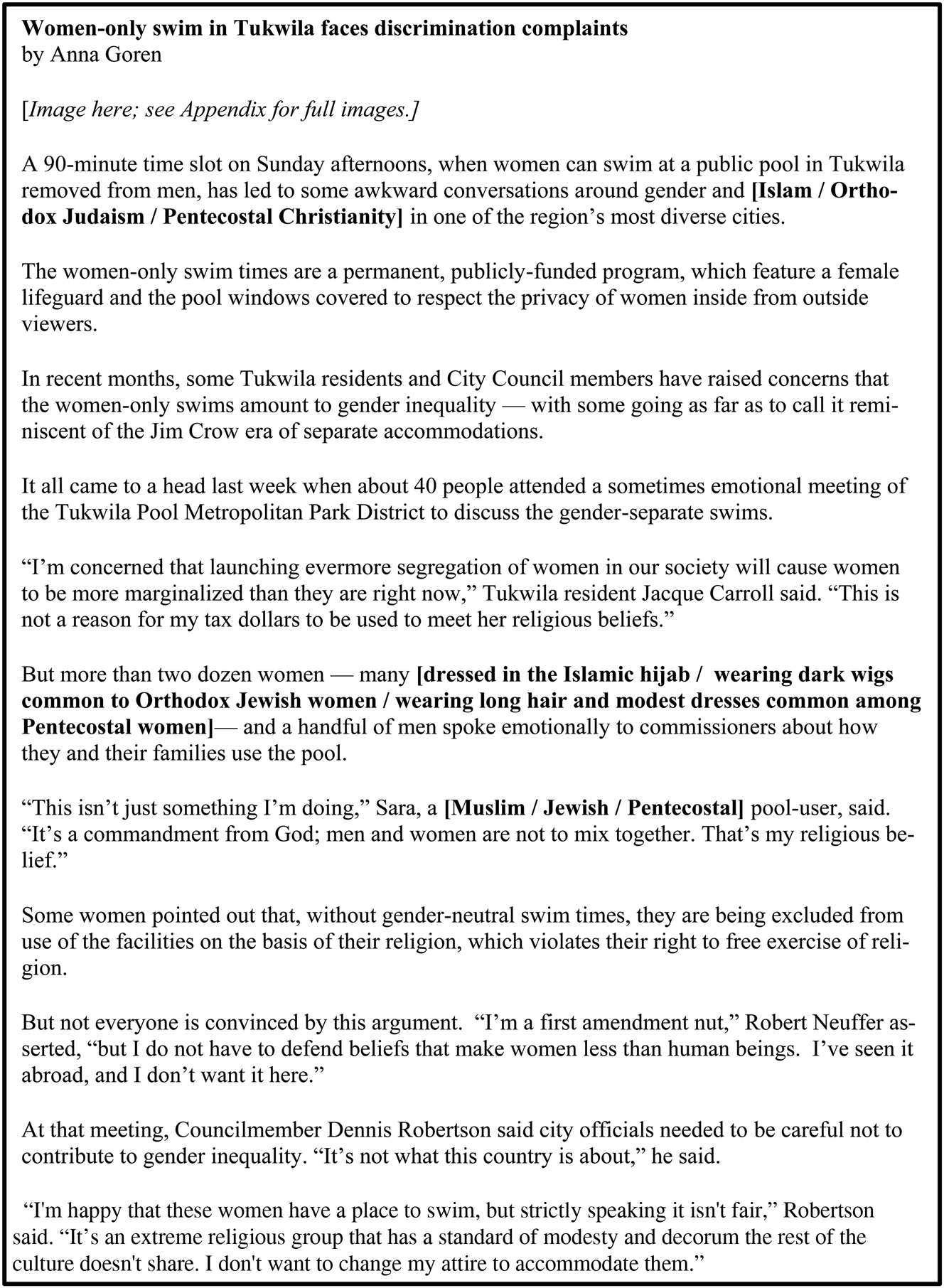
Respondents were assigned to one of four conditions: a control condition, Muslim treatment, (Orthodox) Jewish treatment, or Pentecostal treatment. In each treatment condition, respondents read a brief news article reporting on a controversial municipal meeting regarding the provision of women-only swim times in the local public pool. In the Muslim treatment, the news article describes Muslim women speaking at the community meeting to advocate for the women-only swim times due to their religious objections to mixed-gender swimming; in the Jewish treatment, the speakers are described as Orthodox Jewish women; and in the Pentecostal treatment, they are Pentecostal women. Prior research demonstrates that symbolic threat can be induced in experimental settings using news articles that emphasize cultural differences (Rios et al. Reference Rios, Sosa and Osborn2018).
The text of the treatment is an abridgment of an actual news article published by the Seattle Globalist in November 2013; as such, the place names and quoted speakers are all accurate reporting (with the exception of “Sara,” whose name was changed so that it was common to all three religious heritages; see Figure 1 for the full text). The article contained quotes representing multiple viewpoints on the issue—both supporting and opposing—using different arguments, so as to avoid channeling the reader toward one interpretation. This allows plenty of opportunity for respondents to select a range of justifications for their own position as they write their open-text responses. The treatment article was accompanied by an image of women who are identifiably members of each religious tradition participating in a public forum (images available in the online Appendix). Respondents in the control condition did not read an article and went straight to the questions.
Treatment text
Following the treatment (or no treatment, in the control condition), respondents were asked: “Would you support or oppose the creation of women-only swim times at your local, public community pool?” Respondents reported their answers on a 101-point scale, where 0 is strongly oppose, 100 is strongly support, and 50 is neither support nor oppose. We then asked participants to write a couple of sentences explaining why they would support or oppose women-only swim times at their local public pool, which we coded for analysis.
Results
Support and Opposition of Women's Only Swim Times
Overall, participants were generally supportive of the idea of women-only swim times. Of the Democrats and Republicans in the sample, 61% of respondents selected a rating of 51 or higher, with an overall mean rating of 56.6 and median of 61. In the control condition, the mean support among Democrats is 57.4 and the mean support among Republicans is 60.6. Neither a comparison of means nor Wilcoxon rank-sum test of the partisan difference in the control condition is statistically significant. This confirms that there are not strong a priori partisan cues driving divisions on this policy issue, prior to the introduction of religious groups.
Figure 2 presents the distribution of support for women-only swim times, by partisanship and experimental condition. Using the Kurskal–Wallis test we confirmed that, among Democrats, there is a difference between the experimental conditions (d.f. = 3, p = 0.035).Footnote 4 To identify which condition(s) produce the observed difference, we conducted additional pair-wise comparisons between the control and each of the religious conditions. Democrats in the Pentecostal treatment condition were on average approximately nine points less supportive of women-only swim times than Democrats in the control condition (difference in means p = 0.022, Wilcoxon rank-sum p = 0.044); differences in the Muslim and Jewish conditions are not statistically distinguishable from the control. Furthermore, the change among Democrats represents a shift from being on average supportive (mean 57.4 in the control condition) to on average opposing women-only swim times (mean 48.8 in the Pentecostal treatment condition).
Distribution of women-only swim support with continuous outcome variable. Notes: Plots show density distributions of policy support thermometer scores by treatment condition and respondent's party ID. Vertical lines on the distribution indicate median values. N is approximately 140 per distribution

Looking at the right-hand panel of Figure 2, Republicans have median values that are all slightly lower for the treatment conditions than for the control condition, but statistically all distributions were similar (Kruskal–Wallis test, d.f. = 3, p = 0.61). Comparing the shape of the distributions, Republicans see the most substantial movement when the policy is framed as benefitting Muslim women.
The analysis using the full 101-point scale can hide meaningful differences between conditions and parties. Particularly because most responses are concentrated in the high end of the distribution, mean differences may mask important substantive changes from relatively neutral attitudes to negative attitudes. To more closely examine the change from the substantive ranges of opposition or support in the distributions, Figure 3 presents the difference in proportion of respondents who selected a value in the relevant range (Oppose: 0–33, Neutral: 34–65, Support: 66–100) in each treatment condition relative to the control condition. Error bars represent 95% confidence intervals, as calculated from difference in proportions tests.
Support for women-only swim times by treatment condition and party. Notes: Point estimates represent the difference in proportion of respondents in each treatment condition choosing a value in each range of policy support, compared to the control condition. Error bars are 95% confidence intervals around the difference in proportion. Oppose = 0–33, neutral = 34–65, support = 66–100. Valid N = 1,121

The results for Democrats are in the left panel. Compared to the control condition, 17.5 percentage points more Democratic respondents who read the news article about Pentecostal women advocates selected a value in the “oppose” range (0–33; p < 0.05). A substantial portion of this shift comes from Democrats who would otherwise have been expected to pick a neutral, mid-range value. Neutral values decline by 12 percentage points in the treatment condition relative to the control condition (p < 0.05). Looking at the right-hand panel of Figure 3, in the Muslim condition among Republicans, there is a substantial 11.6 percentage point increase in opposition compared to the control (p < 0.05).
These results support the hypotheses that public accommodations for religious practices will receive less support when they are attached to religious groups that are not a part of the respondent's in-party coalition. Specifically, relative to the control condition, Democratic respondents have sizeable increased opposition to women-only swim times when the advocating religious women are Pentecostal, and Republican respondents have substantial increased opposition when the advocating religious women are Muslim. Consistent with expectations, we also note that, for both parties, no significant change was found when comparing the Jewish and control conditions.
Furthermore, we note that the framing does not significantly reduce the proportion of respondents who support the policy for any condition or party. Rather, the main effect for both Republicans evaluating Muslims and Democrats evaluating Pentecostals is in the movement from neutral ambivalence or uncertainty to opposition. This suggests that boundary-constructing rhetoric may have the most impact in situations where people experience uncertainty, rather than in persuading people with positive views about a group or practice.
This experiment adds important nuance to our understanding of the mechanisms by which symbolic threats are constructed. By design, the news article treatment provides reasons to both support and oppose the policy and does not provide an exclusive narrative of symbolic threat. As such, readers in the treatment condition have the opportunity to construct their own narrative regarding whether the practice of gender segregated swim times is threatening. We find evidence that both Democratic and Republican respondents are more likely to come to an oppositional viewpoint when the requesting group is not a typical member of their political party coalition. We next turn to the open-text responses to examine evidence of boundary-constructing narratives among respondents.
Open-Ended Responses
Why are Democratic respondents more hostile toward accommodations for Evangelical women, while Republican respondents are more hostile toward accommodations for Muslim women? To explore this question, we asked respondents to write a couple of sentences about why they support or oppose women-only swim times at their local public pool. These qualitative responses supplement the quantitative evidence in at least two ways. First, these responses help us validate the treatment and outcome measures by demonstrating understanding of the arguments surrounding the policy issue. Second, while brief, the responses provide additional insights into the rationales that guide respondents' thinking. In doing so, they shed light on mechanisms driving quantitative outcomes, especially as they relate to the process of symbolic boundary creation.
Two coders, blind to main hypotheses and treatment condition, read and coded each open-ended survey response.Footnote 5 We then analyzed these open-ended responses in three steps. First, we coded each response based on whether it generally supports or opposes the policy of women's only swim times. Unsurprisingly, this code corresponds reasonably well with the ordinal 0–100 response given by survey-takers described above.Footnote 6
Second, we coded responses based on whether the overall argument is predominantly about religion or predominantly about gender (mutually exclusive, with an infrequently used “neither” category). Overall, gender is a much more common theme in the justifications for both support and opposition to the policy, compared to religion (by approximately a 2:1 ratio). However, participants in all three treatment conditions discussed religion more than participants in the control, regardless of whether they supported the policy or not (Figure 4). We interpret this as a validation check on the strength of our treatments. The increased use of religious argumentation following the detailed and specific discussion in the treatment article text indicates compliance with the treatment condition. Respondents assigned to read an article were thinking about religious identity when evaluating the policy of women-only swim times to a greater extent than those who were not assigned to a religious condition.
Effects of treatment condition on uses of religious identity arguments. Notes: Point estimates represent coefficients in a linear probability model to predict the use of religious identity reasoning based only on binary indicators of treatment condition. Baseline condition is the control. Error bars are 95% confidence intervals. Sample limited to respondents who gave a valid open-text response (total N = 1,022, religious argument N = 303). “Support” is respondents with policy support scores above 65; “oppose” is below 34

Finally, we coded the specific reasons given by respondents in support or opposition to the policy. Using an inductive process that accounts for observations of the data, and guided by our theoretical knowledge on the topic, we generated a series of codes reflecting broad themes of justification for support or opposition. We describe some of these coded justifications and their prevalence in more detail in the online Appendix. While these justifications do not map directly on support or opposition, most lean in one direction or the other. We find that respondents use a wide variety of arguments to justify their support or opposition to women-only swim times. Because of this range, the use of any one argument is relatively rare, and the resulting sample sizes are small in some cases. Therefore, the content analysis of responses presented here should be understood as a qualitative exploration of the kinds of reason-giving and justification people engage in when creating symbolic boundaries. Here, we compare two themes that emerged from the coding process as arguments that are used differentially when addressing Pentecostal versus Muslim women-only swim times: (1) private/public distinction; and (2) American identity/culture.
We labeled the first theme “public/private distinction,” although it could also be called “separation of church and state.” These arguments highlight the public nature of the pool, and the importance of tax dollars used to support it. Respondents appealing to this argument expressed concern that public resources were being used to support the specific needs of a particular group. Examples include
• I'm all about religious freedom, but using tax dollars to publicly fund activities or buildings that further a single religion's standards doesn't seem right. By having public swimming pools that use local tax dollars mandate a women-only swim time based surely on a religious belief is doing just that, and it's wrong. [Republican, Pentecostal condition]
• I think the public pool should serve the largest segment of the public's interest. If women-only swim times only appeals to a small percentage of the community, then the pool is not serving the needs of the community as a whole. [Republican, Jewish condition]
• I think it is awful to only allow specific times for women to swim or do anything for that matter. If it is a public pool/place—then anyone and everyone should be welcome at ANY time. [Republican, Muslim condition]
As demonstrated in Figure 5, we observed a higher prevalence of arguments based on a private/public distinction among respondents in the Pentecostal condition. The emphasis on separation of church and state in the Pentecostal condition is understandable, given the policy debates and frames that have historically surrounded public services rendered by and for Christian interests in the United States. Such frames provide the “linking information” that connects specific groups (Evangelicals) with specific policy debates (separation of church and state).Footnote 7 Among those participants for whom this linking information is particularly salient, gender segregation in Pentecostal communities is associated with the political debate surrounding separation of church and state, driving opposition toward the policy of women's only swim times. Indeed, 59% of the 34 people who used a public–private argument to oppose women-only swim times in the Pentecostal condition were Democrats (6% Independent, 35% Republican).Footnote 8
Effects of treatment condition on uses of “public/private” arguments. Notes: See Figure 4. Total N = 1,022; public/private argument N = 152

By contrast, the public/private arguments were less common when the relevant religious group is Muslim. Instead, we observe in Figure 6 a more frequent use of justifications that appeal to American identity and culture. Here, the emphasis was on American culture, and the otherness of the Muslims in the United States. That is, responses positioned Muslims not as citizens of the United States, but rather as visitors who should abide by the shared cultural norms in the United States. Thus, instead of fitting Muslims into a narrative frame commonly used for Christians that would function within a typical process of American politics, we observe opposition due to a threat to the meaning of what it is to be American. For example:
• This is America. We stand for inclusion not exclusion. [Democrat, Muslim condition]
• Assuming this is in the USA, its rediculous [sic], there is no sharia law here, end this bull.it [sic] now. [Democrat, Muslim condition]
• I would strongly oppose a women-only swim time at my local public pool due to the fact that I live in a free country called America. Supporting such a measure would support gender inequality, extreme religious beliefs that this country was not founded on, and taking away from other people's time swimming at the local pool. [Republican, Muslim condition]
• It shouldn't be an issue in America because this isn't our beliefs. We go by what we believe where we live. It isn't fair. Everyone should be able to use facilities. [Republican, Muslim condition]
Effects of treatment condition on uses of “American identity” arguments. Notes: See Figure 4. Total N = 1,060, American identity reasoning N = 49

These arguments are more common among Republicans; 69% of the 13 respondents who used an American identity frame to justify opposition in the Muslim condition were Republican (31% Democrats, 0% Independent).
Interestingly, we observed American identity arguments used to both support and oppose the policy. We hesitate to draw strong conclusions about the use of American identity to support women-only swim times for Muslim women because of the small number of cases in which this occurs (7). Furthermore, these respondents portray quite a bit of ambivalence: although they chose a numerical option indicating support, two explicitly say they would oppose the swim times in their response, and two more give negative arguments that imply—but do not explicitly state—opposition to the policy.
However, one plausible interpretation might be that respondents continue to view Muslims as culturally distinct, even as they value such differences under the discursive rubric of “diversity” or a “cultural melting pot.” Recall that stereotypes surrounding Muslim women are prevalent even among Democrats and others who hold generally favorable views of Muslims. For these respondents, gender segregation among Muslims may not rise to the level of “threat,” but it continues to represent an essential symbolic boundary attributed to Muslim culture and identity.
In all, we find that Democrats and Republicans react more negatively to religious outgroups that are not a part of their political coalition. In the case of Muslims, gender segregation invokes concerns about national identity and cultural difference—particularly among Republicans. By contrast, Democrats evaluating gender segregation in Pentecostal communities appear to construct symbolic boundaries invoking concerns over process and fairness. Thus, the same gendered religious practice is imbued with different cultural significance depending on the overt political relationship between practitioner and observer.
More comprehensive data would allow a detailed study of additional characteristics relevant to the phenomena and potentially correlated with party affiliation, such as personality characteristics. Online Appendix 4 examines some of these characteristics separately, but overlap between partisanship and other demographic traits makes it hard to definitively distinguish these effects.
Conclusion
Using an original survey experiment, we examined the political origins and policy consequences of symbolic threat regarding religion in the American public sphere. We theorized that the mere presence of a cultural difference does not account for the perception that outgroups—such as religious minority groups—pose a symbolic threat. Supporting this conjecture, we find variation in the support for identical accommodation requests based on the religion with which the requesters are affiliated. Furthermore, we find evidence that the experience of symbolic threat results from an active process of symbolic boundary-making, in which particular norms—e.g., gender segregation—are viewed as more or less threatening based on the partisan relationship between the observer and practitioner. The results challenge the view that symbolic threat arises from group-specific attributes or cultural norms per se. Practices such as gender segregation can be viewed as cultural or political, threatening or benign, depending on the group enacting them and their relationship to the observer.
This project makes two main contributions. First, our findings add to growing scholarship on religion in the American public sphere by demonstrating the contingent and conditional role of symbolic threat in shaping attitudes toward religious minority groups. Second, we make a theoretical contribution to theories of social identity and symbolic boundaries by providing evidence that symbolic threats can be constructed and activated on the basis of political partisan coalitions. In contrast to the view holding that symbolic threats stem from cultural difference, we show that cultural practices alone cannot account for experiences of symbolic threat, as identical cultural practices evoke different responses when attributed to different religious denominations. Instead, cultural differences are situated in larger political narratives, where they assume a “threatening” role through the work of symbolic-boundary making. Indeed, perceptions of cultural distance may be a result—rather than a cause—of intergroup conflict.
The results of this study cast doubt on the notion that minority group assimilation into American “culture” would vanquish negative affect toward the group. For example, and acknowledging that the stereotype of Muslim-Americans oppressing women is overblown, even if Muslims adopted identical gender practices as non-Muslim Americans, there is no guarantee that another symbolic boundary would not take its place. This suggests that students of intergroup relations must pay greater attention to the political roots of cultural difference.
Supplementary material
The supplementary material for this article can be found at https://doi.org/10.1017/S1755048322000086.
Replication Data
Replication data, analysis code, online appendices, and preregistration are available at https://osf.io/dw9g2/
Financial Support
Funding for this project was generously provided by the Russell Sage Foundation, via the 2017 Summer Institute in Computational Social Sciences.
Conflict of Interest
None.
Dr. Lisa P. Argyle is an Assistant Professor in the Department of Political Science at Brigham Young University. She studies interpersonal political conversations and political persuasion using tools from political psychology and computational social science. Her recent work examines the relationship between political dialogue, public opinion, and polarization in the United States.
Dr. Rochelle Terman is an Assistant Professor in the Department of Political Science at the University of Chicago. Her research explores international norms, gender, and the Muslim world. She is currently working on a book project that examines the geopolitics of international human rights pressure.
Dr. Matti Nelimarkka leads the Helsinki Social Computing Group, a group at the intersection of computers and society. Their research domain spans from politics in the digital to politics of the digital. The group also examines computational techniques in social sciences, especially workflows and connections between social science theories and code.


 Open access

