


There has seemingly been a surge in populism throughout the world. Examples are plentiful of the electoral success of populist figures and movements. For intance, there is the victory of Trump in the 2016 US presidential election and of Brexit. Populist parties have in many countries found new success; Greece and Italy have recently been governed by coalitions made up of populist parties. The populist wave is not confined to the West, as can be attested by, for example, the victories of Jair Bolsonaro in Brazil and Rodrigo Duterte in the Philippines.
However, one country has often been portrayed as a bulwark against the global rise of populism: Canada. While much of the world was attracted by the siren calls of populists, in the 2015 Canadian federal election, Canadians elected Justin Trudeau and his centrist Liberal Party of Canada (LPC). As other countries delved into dark, scary political messages, Trudeau preached the sunny ways of positivity and inclusion. As was noted in the New York Times, Canada's secret to resisting the populist wave was more than just about a charismatic leader; it was “a set of strategic decisions, powerful institutional incentives, strong minority coalitions and idiosyncratic circumstances” (Taub, Reference Taub2017). Essentially, Canada is described as having been able to resist the surge of global populism because it lacks the social factors that have led to the rise of populism in other countries (Adams, Reference Adams2017).
Nevertheless, the feting of Canada has led to some Canadians wondering why populism had not had an impact on politics in Canada similar to what is found in the United States and Europe (Béland, Reference Béland2017). Canada's political history is rife with populist political movements that attained a certain level of popularity, yet somehow Canada was portrayed as a rampart against populism.
The perception of Canada resisting populism seems to stem from the fact that the country does not have a major federal party that is overtly populist.Footnote 1 Moreover, while the New Democratic Party (NDP) of Canada is traditionally decribed as being left-populist (Laycock, Reference Laycock, Laycock and Erickson2015), the party had distanced itself from populism during the leadership of Thomas Mulcair (Hébert, Reference Hébert2012). Additionally, Canada was not in 2015 in the grasp of any major socio-cultural or economic crisis, and populist rhetoric was arguably not salient in the election campaign. Therefore, there was clearly a lack of populism on the supply side of electoral politics in the 2015 federal election. Yet what about the demand side? In other words, did Canadians hold populist attitudes and did these impact their vote choice when there was little or no fuel for populism?
Since populist attitudes have predominantly been conceptualized from a supply-side perspective, and thus commonly viewed as sparked by socio-economic crises or activated by political discourse (Canovan, Reference Canovan, Mény and Surel2002; Rico et al., Reference Rico, Guinjoan and Anduiza2017; Rooduijn et al., Reference Rooduijn, van der Brug and de Lange2016), we would expect populist attitudes to not have had an impact on the 2015 Canadian federal election. However, there is no empirical evidence supporting this assumption, and to the best of my knowledge, studies have so far only explored the influence of populism in cases in which populism actively manifests itself. The scholarship thus contains an important gap regarding populist attitudes and their impact on politics.
From this perspective, the 2015 Canadian federal election provides a novel opportunity to explore populist attitudes and to address an important gap in the scholarship. When supply-side factors are not salient enough to spark, activate or fuel populism, can populist attitudes still have an impact on political behaviour?
The present article argues that populism should be conceptualized as an attitudinal dimension and thus should impact political behaviour regardless of supply-side factors. The results of empirical analyses support this argument in two ways. First, populism is shown to form an attitudinal dimension independent not only of nativism and authoritarianism but also of social and economic ideological dimensions. Second, populist attitudes are shown to have had an impact on vote choice in the 2015 Canadian federal election, which was an election lacking the factors to activate or fuel populism. The findings indicate that populism is a demand-side attitudinal dimension that matters even when the supply-side factors to promote it are not salient.
A (Non-Thin) Populist Ideology
The success of populist parties has led scholars to seek to understand voters’ attraction to these political movements. Yet the focus of electoral research on populism has traditionally not been on populism; rather, it has concentrated on populist radical right movements (Bakker et al., Reference Bakker, Rooduijn and Schumacher2016; Mudde, Reference Mudde2013). Mudde (Reference Mudde2007) defines such movements as a combination of nativist preferences for members of the native group; an authoritarian inclination for robust law and order policies; and populism, which he defines as a Manichean belief that opposes the pure people versus the corrupt elite and argues that politics should be an expression of the general will of the people. While nativism, authoritarianism and populism have been shown to form three distinct, orthogonal attitudinal dimensions (Blanchet and Medeiros, Reference Blanchet and Medeiros2019; Rooduijn, Reference Rooduijn2014), the focus of the media and scholarly work on the nationalistic exclusionism of the populist radical right, often in the form of anti-immigrant and Islamophobic rhetoric, has led to nativism being incorrectly attributed as a core characteristic of populism (Rooduijn, Reference Rooduijn2019). Yet the surge of leftist populist parties, such as Syriza in Greece and Podemos in Spain, has forced scholars to explore vote choice for populist parties on a wider optic—a strand of electoral research into populist parties, rather than just populist radical right parties, that is still relatively nascent.
Rooduijn (Reference Rooduijn2018) explores the determinants of vote choice for 15 populist parties in 11 Western European countries and does not find a common thread to explain electoral support for these parties. However, he doesn't investigate the influence of populist attitudes, only looking at preferences toward referendums. Stanley (Reference Stanley2011) looks specifically at the impact of populist attitudes on vote choice in Slovakia. Yet he explores populist items individually, and his results show that some items have an impact on vote choice while others do not. Still, more recent studies have used multi-item populism scales, which capture a range of populist attitudes in a dimensional manner, to explore vote choice. Akkerman et al. (Reference Akkerman, Mudde and Zaslove2014) and Akkerman et al. (Reference Akkerman, Zaslove and Spruyt2017) examine the Dutch case, Hawkins et al. (Reference Hawkins, Kaltwasser and Andreadis2020) look at Greece and Chile, while Van Hauwaert and Van Kessel (Reference Van Hauwaert and van Kessel2018) investigate the phenomenon in nine Western European countries. The results of these studies show that populist attitudes lead to, unsurprisingly, a significant and positive impact on voting for populist parties. Even in a context with moderately populist parties, such as Portugal, populist attitudes correlate with voting for relatively populist parties (Santana-Pereira and Cancela, Reference Santana-Pereira and Cancela2020). However, populist attitudes do not just have an impact on populist parties. Akkerman et al. (Reference Akkerman, Mudde and Zaslove2014) demonstrate that populist attittudes also lead to a signficant and negative impact on voting for some non-populist parties.
In explaining the manner in which populism can affect vote choice, the scholarship undescores the importance of context. Specifically, populist attitudes have been described as being sparked by socio-economic crises (Canovan, Reference Canovan, Mény and Surel2002; Rico et al., Reference Rico, Guinjoan and Anduiza2017), activated by a specific political environment (Hawkins et al., Reference Hawkins, Kaltwasser and Andreadis2020) or fuelled by partisan political discourse (Rooduijn et al., Reference Rooduijn, van der Brug and de Lange2016). Such a conceptualization of populism places the emphasis on the factors that fuel populism—a characteristic of what Elchardus and Spruyt (Reference Elchardus and Spruyt2016) describe as the supply-side focus of the populism scholarship. Thus, it would be imperative to broaden research and explore the demand side of populism.
Yet the manner in which populism has traditionally been conceived has arguably hindered scholarly interest in its demand side. First, Hawkins et al. (Reference Hawkins, Kaltwasser and Andreadis2020) indicate that populism lacks coherent programmatic positions and hence should not be defined as a consistent attitudinal dimension. However, if the will of the people is not to be distorted, there needs to be a direct connection between the people and policies (Barney and Laycock, Reference Barney and Laycock1999). This is why populism has often been associated with direct democracy (Canovan, Reference Canovan1981; Jacobs et al., Reference Jacobs, Akkerman and Zaslove2018). Thus, populism is a vision of society that wants power to reside as close to the people as possible, which is due ultimately to a distrust of elites and their ability to adequately represent the people. Second, populism is often described as a thin-centred ideology that needs to be combined with a host ideology (Bakker et al., Reference Bakker, Rooduijn and Schumacher2016; Mudde, Reference Mudde2004). Thus, the focus is often on other attitudinal dimensions, in which populism is akin to a junior partner. This phenomenon can be seen to manifest itself in the classification of populist parties as left or right, as if the populist label by itself would not be sufficient. Yet we don't know if populist attitudes are actually independent of socio-economic ideological attitudes. While my review of the literature found examples of studies that investigated the independence of populism in terms of its relationship to authoritarianism and nativism (Blanchet and Medeiros, Reference Blanchet and Medeiros2019; Rooduijn, Reference Rooduijn2014), I did not come across any study that has empirically tested populism's orthogonality with social and economic attitudinal dimensions. Nonetheless, since Hawkins et al. (Reference Hawkins, Kaltwasser and Andreadis2020) show that populist attitudes have an independent impact on vote choice in two countries, while adjusting for social and economic ideologies, populism does have a stand-alone aspect to it. Addtionally, recent studies on the stability of populism point to it being more than an attitudinal dimension reliant on another ideological dimension (Manucci and Weber, Reference Manucci and Weber2017; Voogd and Dassonneville, Reference Voogd and Dassonneville2020).
The scholarship has, in fact, recently moved toward an ideological conception of populism. For instance, the ideational approach toward populism establishes it as a common vision, which is shared by elites and citizens, of the political world (Hawkins and Kaltwasser, Reference Hawkins, Kaltwasser, Hawkins, Carlin, Littvay and Kaltwasser2018; Kaltwasser, Reference Kaltwasser2014). Canovan (Reference Canovan, Mény and Surel2002) takes this conceptualization a step further and renders it clearer by stating that it is an ideology that espouses popular sovereignty and majority rule. Thus, those who hold populist attitudes—who are, in fact, populist ideologues—seek to implement a vision of the political world that emphasizes these characteristics. It is, as Knopff (Reference Knopff1998) remarks, a vision of society that confronts the deliberative tradition of liberal democracy.
Even so, to truly be considered an ideology, populist attitudes need to be independent of crises and specific political contexts that promote them (Bélanger et al., Reference Bélanger, Lewis-Beck, Chiche and Tiberj2006; Jost et al., Reference Jost, Federico and Napier2009; Medeiros and Noël, Reference Medeiros and Noël2014). Yet even an ideational approach limits its vision of populist attitudes “as motivating people to mobilize and support populist forces” (Hawkins and Kaltwasser, Reference Hawkins, Kaltwasser, Hawkins, Carlin, Littvay and Kaltwasser2018: 2). The scholarship has so far only explored contexts in which supply-side factors of populism are salient.Footnote 2 This gap in the literature limits our understanding of populist attitudes and leaves us to wonder: Can populist attitudes have an impact on political behaviour when supply-side factors are not salient enough to activate and fuel populism?
The 2015 Canadian federal election provides an opportunity to address this gap and answer this question.
Canada: A History of Populism, and an Election without It
The feting of Canada as a bulwark resisting the surge of global populism somewhat obscures the country's political hisitory. Populist movements historically played an important political role in Ontario (Conway, Reference Conway1978; Laycock, Reference Laycock and Panizza2005), in the Prairies (Mayer et al., Reference Mayer, Kaymak and Justice2000; Wiseman, Reference Wiseman, Gagnon and Brian Tanguay2017) and in Quebec (Boily, Reference Boily2014, Reference Boily2002). The Conservative Party of Canada (CPC) finds its roots in the Reform Party, which espoused individualistic populism and plebiscitarianism (Barney and Laycock, Reference Barney and Laycock1999; Laycock, Reference Laycock1994; Sawer and Laycock, Reference Sawer and Laycock2009). The NDP regularly promoted left-populism, a blend of collectivist, agrarian populism and populist unionism (Laycock, Reference Laycock, Laycock and Erickson2015). The height of its electoral success was in 2011, when it was able to form the official opposition, under the leadership of the left-populist Jack Layton (Tufts and Thomas, Reference Tufts and Thomas2014).
While populism has clearly been a regular political force in Canada, the 2015 Canadian federal election balked at this pattern. The election, held on October 19, was preceded by an 11-week campaign. For the first time in history, the polls at the start of the campaign indicated there was a three-way race between the NDP, the CPC and the LPC. The lenghty campaign saw tremoundous movement in voting intentions. In the end, the LPC won enough seats to form a majority government and return to power; the nine-year reign of the CPC came to an end, as it became the official opposition; the NDP returned to its traditional (pre-2011) third place; the independentist Bloc Québécois (BQ) had its worst showing in terms of voting percentage but nearly tripled its number of seats; and the Green Party of Canada (GPC) maintained its only seat.
As Mayer et al. (Reference Mayer, Kaymak and Justice2000) argue, electoral success, and the quest for it, tends to make parties distance themselves from populism. The CPC and the NDP seemed to have followed this rule. The successor of the Reform Party, the Canadian Alliance, merged in 2003 with the Progressive Conservatives (PC), in the hope of attracting a greater number of voters, to form the CPC. The new party pushed aside the populist impulses of its predecessors and became more moderate and mainstream (Ellis, Reference Ellis2005). As for the NDP, Jack Layton died a few months after the “orange crush” of 2011. The NDP selected Thomas Mulcair to be its new leader. Mulcair was not a traditional NDPer and did not come from the party's ranks. Mulcair moved away from Layton's populist approach as he attempted to turn the NDP into the government in waiting (Hébert, Reference Hébert2012). In the case of the BQ, while it rails against the federal government in the hope of convincing Quebecers to secede, it does not attack the political establishment per se or promote direct democracy other than pushing for a referendum on Quebec secession. Concerning the GPC, though green parties have been described as having a tendency to take on populist tones (Mudde, Reference Mudde2004; Taggart, Reference Taggart1996), the GPC arguably has not under the leadership of Elizabeth May, its only MP since 2011, adopted a clear type of populist rethoric. The LPC, for its part, is the traditional target of anti-elitist rhetoric. As the natural governing party that is friendly to the arts and to minorities, it arguably attracts elites from business, academia and the media. Ultimately, there was no major party in the 2015 federal election that fit the criteria for promoting populism.Footnote 3
Furthermore, a review of campaign advertisements did not reveal populist messaging—specifically, as defined by Nai (Reference Nai2021), alleging to be the true representatitives of the people and/or attacking the political systems or the elites that represent it.Footnote 4 The campaign also did not have a major party that proposed policies to promote direct democracy or to give power back to the people.
Although the campaign did not feature populism, it was marked by a nativist turn. The niqab, and the right to wear it or not while taking the citizenship oath, came to the forefront of the debates, after a court decision during the campaign.Footnote 5 The CPC and the BQ instantly jumped on this opportunity. The CPC attempted to position itself as the defender of Canadian values, even promising to set up a police hotline to report barbaric cultural practices. This was a sharp reversal from the pluralist message that the Conservatives had cultivated under Stephen Harper (Ellis, Reference Ellis, Pammett and Dornan2016). The BQ also played on the risks of cultural diversity and failed integration, including using the issue of the niqab in a campaign advertisement.
Furthermore, and unlike many other countries that year, Canada was not in the grasp of any major socio-economic crisis; it had actually weathered the great recession quite well in comparison to many Western countries. Nor was Canada facing a wave of immigration. Thus, the conditions that usually fuelled angry populism—austerity measures and immigration—were not present in Canada (Adams, Reference Adams2017).
Despite a 2015 federal election campaign in which populism was arguably not salient and which led to Canada receiving international praise, Canada has a history of political populism in which populist attitudes could have formed. But during the 2015 federal election campaign, the country was not facing a socio-economic crisis and no party utilized overt populist rhetoric. Therefore, the 2015 Canadian federal election offers a strong test of the ideological conception of populist attitudes, as well as the impact of these attitudes on vote choice, in an election in which supply-side factors of populism were not salient.
While the lack of research into the impact of populist attitudes on vote choice in Canadian federal elections makes it difficult to propose formal hypotheses, it is nevertheless credible to expect that populist attitudes would have a positive relationship with voting for parties that have a history of populist rhetoric: specifically, the CPC and the NDP. Furthermore, since populist attitudes have also been found to negatively correlate with voting for non-populist parties (Akkerman et al., Reference Akkerman, Mudde and Zaslove2014), it is also reasonable to expect that populist attitudes would have a negative relationship with the likelihood of voting for the LPC, a party historically labelled as elitist and the natural governing party.
Data and Results
In order to explore the question that was put forward, survey data from the 2015 Canadian Election Study (CES) were utilized (Fournier et al., Reference Fournier, Cutler, Soroka and Stolle2015).Footnote 6 To aid with interpretability, all scales were made to run on a negative to positive range, or progressive to conservative. “Don't know,” “Refuse to answer” or “Left blank” answer choices were coded as missing. All continuous variables were converted into a 0 to 1 scale. All analyses were performed with data weighted on population counts post-stratified by age and gender. More details on the survey questions that were used are subsequently presented or can be found in the Appendix.
Populist attitudes were explored through the construction of a multi-item variable formed with three items, all on a 4-point scale, that measure respondents’ perceptions about politicians’ readiness to lie, parliamentarians losing touch with the people, and the government not caring about what the people think. Principal component factor analysis confirmed that these three items loaded onto the same factor. However, the Cronbach's α score was below 0.7 (0.59). Thus, instead of creating a multi-item scale, factor scores were predicted—after using varimax rotation to improve factor score loadings—with a regression scoring method.Footnote 7
Recognizing that the confusion between populism and nativism is rife (Rooduijn, Reference Rooduijn2019), even in the Canadian case, I first compare populist attitudes to nativism. The nativism variable is formed by combining four questions—all on a 100-point scale—measuring respondents’ feelings toward Aboriginal groups, racial minorities, immigrants and Muslims in Canada. Principal component factor analysis was performed, and the results showed that the variables loaded onto a single factor. In terms of reliability, the Cronbach's α score was 0.87.
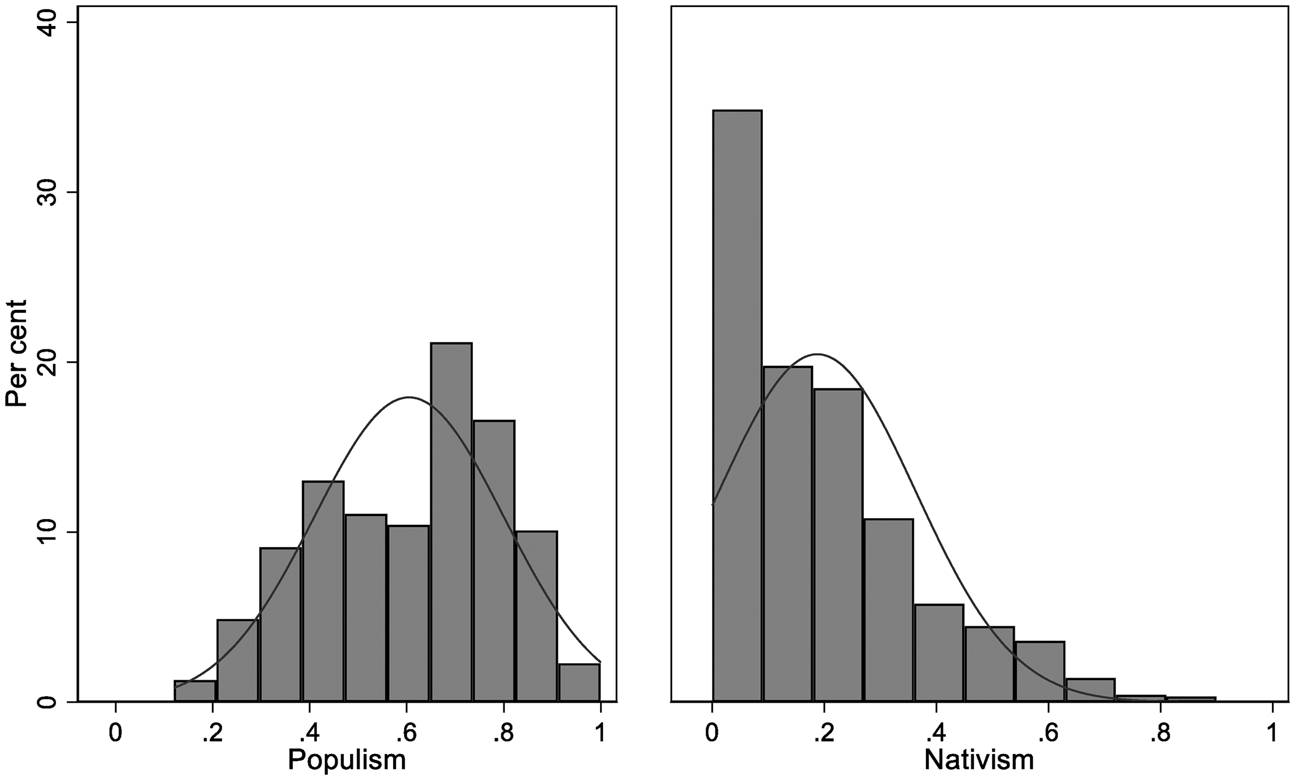
Figure 1 displays the distribution of the populism and nativism variables. The variables are clearly distributed in a widely different manner. Canadians do not seem to be very nativist, as the variable is quite skewed to the low end of the scale and the median is only at 0.20. This result matches Adams’ findings (2017) and demonstrates, as Mudde (Reference Mudde2016) has remarked, Canada's multiculturalist exceptionalism in comparison to other Western democracies. Yet Canadians seems to be much more populist—even when supply-side factors are lacking—as the variable is relatively normally distributed with a median at 0.66. The findings show that news stories that label Canada as resisting the populist wave (see, for example, Taub, Reference Taub2017) are inaccurate. This inexactitude demonstrates, as Rooduijn (Reference Rooduijn2019) warns, the risks of confusing populism and nativism. While Canada might be exceptional in an era of seemingly growing nationalist populism, it isn't because its citizens don't hold populist attitudes.
Distribution of Populist and Nativist Attitudes
Note: Variables distributed into 10 bins.
As is commonly done in the scholarship, I examined the independence of populist attitudes from nativism and authoritarianism. The variable of authoritarianism was formed by combining four items that measure attitudes toward fighting crime at the expense of rights (4-point scale), spending on crime and justice (3-point scale), how to deal with young offenders (3-point scale) and whether respondents agreed or not with the death penalty. Principal component factor analysis was performed, and the results showed that the variables loaded onto a single factor. The Cronbach's α score for the scale was 0.75.
However, since the review of the literature indicated a frequent conceptual confusion between populism and socio-economic ideology—leading to the belief that populism is dependent, or hosted, by the latter—the independence of populist attitudes compared to social and economic ideological dimensions was also verified. Thus, the empirical framework regarding independent social and economic ideologies adopts the theoretical argumentation made by Albright (Reference Albright2010) that a unidimensional ideological axis limits information and follows recent methodological practices studying populism (Hawkins et al., Reference Hawkins, Kaltwasser and Andreadis2020; Van Hauwaert and Van Kessel, Reference Van Hauwaert and van Kessel2018). The social dimension is formed by combining four questions measuring respondents’ attitudes toward abortion, gay marriage, the place of women in the workforce and the type of couples that should adopt children; the first two items are binary, and the latter two are on a 4-point scale. Principal component factor analysis was performed, and the results showed that the variables loaded onto a single factor. In terms of reliability, the Cronbach's α score for this scale was 0.74. As for the economic dimension, it was ascertained through three questions on attitudes toward the level of corporate taxes, businesses’ success affecting the whole of society, and confidence in unions; the first item is on a 3-point scale, while the other two are on 4-point scales. Since the Cronbach's α score was below 0.7 (0.51), factor scores were predicted—after using varimax rotation to improve factor score loadings—with a regression scoring method.
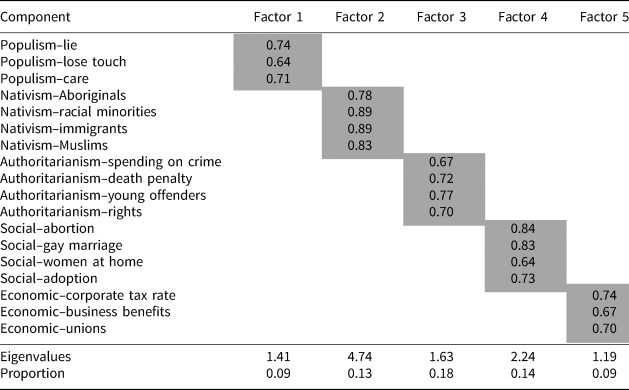
The results of principal component factor analysis (see Table A1 in the Appendix) demonstrate not only that the different items load onto five factors in the way that was expected but that the items for populist attitudes are orthogonal to all the other items. Therefore, not only are populist attitudes independent of nativism and authoritarianism, as the scholarship has already demonstrated, but they are also independent of social and economic ideologies. These findings give support to the idea that populism is not simply a tag-along to long-term socio-economic ideological dimensions; it is independent of them.
To verify if populist attitudes could determine vote choice in an election campaign lacking a socio-economic crisis and with no overtly populist party, or even what could be clearly considered a populist discourse, a multinomial logistic regression was performed. The analyses adjust for standard demographic variables: gender, age, mother tongue, country of birth, education, and the region of the respondent. The age of the respondents was divided into 11 ranked groups in order to form an 11-point continuous variable. The education question ascertains respondents’ highest completed level of education on an 11-point continuous scale. The mother tongue of the respondents, an important demographic variable to determine political attitudes in Canada (see Medeiros, Reference Medeiros2019), was divided into anglophones, francophones and allophones. Recognizing the importance of populism along regional lines, the models also adjust for the five Canadian regions: the Atlantic Provinces (Newfoundland and Labrador, Prince Edward Island, Nova Scotia and New Brunswick), Quebec, Ontario, the Prairies (Manitoba, Saskatchewan and Alberta) and British Columbia. Last, the models also adjust for the partisan identities (PID) of the respondents.
Since Quebec has a distinct party system because of the BQ, it has become common practice to explore Quebec and the Rest of Canada separately (Blais et al., Reference Blais, Gidengil, Nadeau and Nevitte2002; Fournier et al., Reference Fournier, Cutler, Soroka, Stolle and Bélanger2013) or to simply exclude Quebec altogether (Blais, Reference Blais2005; Medeiros and Noël, Reference Medeiros and Noël2014). The latter option omits important information, considering the history of populism in Quebec. However, due to several of the variables used in our analysis being from the mailback survey of the CES, the number of observations would be quite low for analyses only with data from respondents in Quebec. Thus, the choice was made to exclude the BQ voters from the analysis. Because past research has found a relationship between those who hold populist attitudes and support of the BQ (Mayer et al., Reference Mayer, Kaymak and Justice2000), as well as a recent positive relationship with support for Quebec independence and voting for the independentist Parti Québécois (Blanchet and Medeiros, Reference Blanchet and Medeiros2019), it is doubtful that populist attitudes would determine voting for the BQ differently.
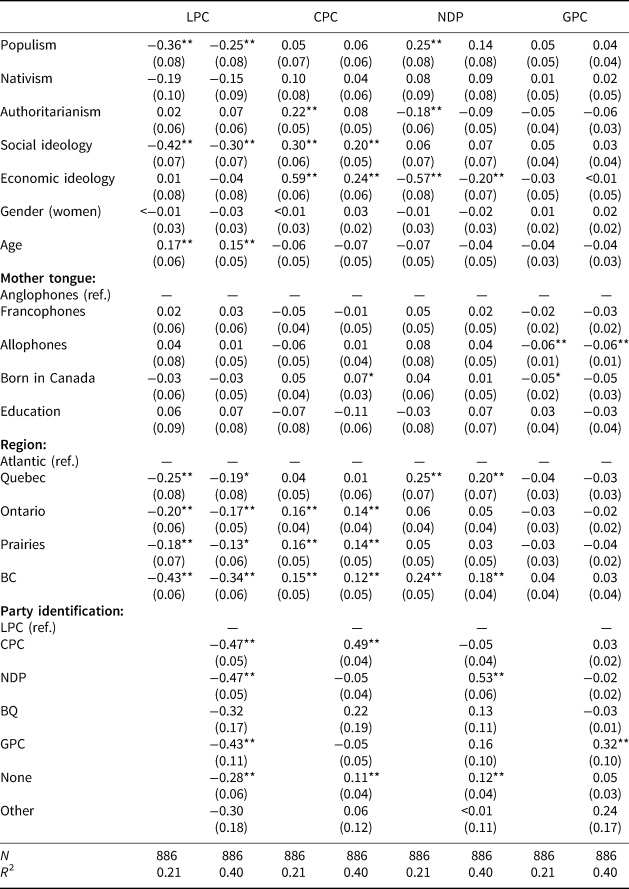
The results, displayed in Figure 2, demonstrate that populism did, in fact, have an impact on vote choice. Specifically, it significantly, and strongly, hampered voting for the LPC. Once again, this is not surprising, considering the party is historically portrayed as elitist and as the party of the establishment. Populism is actually shown to have a relatively strong impact on the likelihood of voting for the LPC—comparable to, but slightly less than, the negative impact of social ideology. It is, in fact, one of the strongest determinants of voting for the LPC; see Table A2 in the Appendix. Populism also displays a positive relationship with voting for the NDP, just missing crossing the significance threshold (p = .059). As in the case of the LPC, populist attitudes are also shown to be one of the strongest determinants of voting for the NDP; see Table A2 in the Appendix. These results support our claim that populist attitudes constitute an ideological dimension that does not need to be activated by a crisis or fuelled by politicians to have an impact on vote choice. As for the relationship between populism and the two other parties, populism shows positive impacts that are rather weak with voting for the CPC and the GPC, and these relationships do not cross a standard significance threshold.
Determinants of Vote Choice
Note: Markers represent average marginal effects (95%) estimated from a multinomial regression (excluding BQ voters). The model also includes gender, age, mother tongue, country of birth, education, regions and PIDs; see Table A2 in the Appendix for full results.
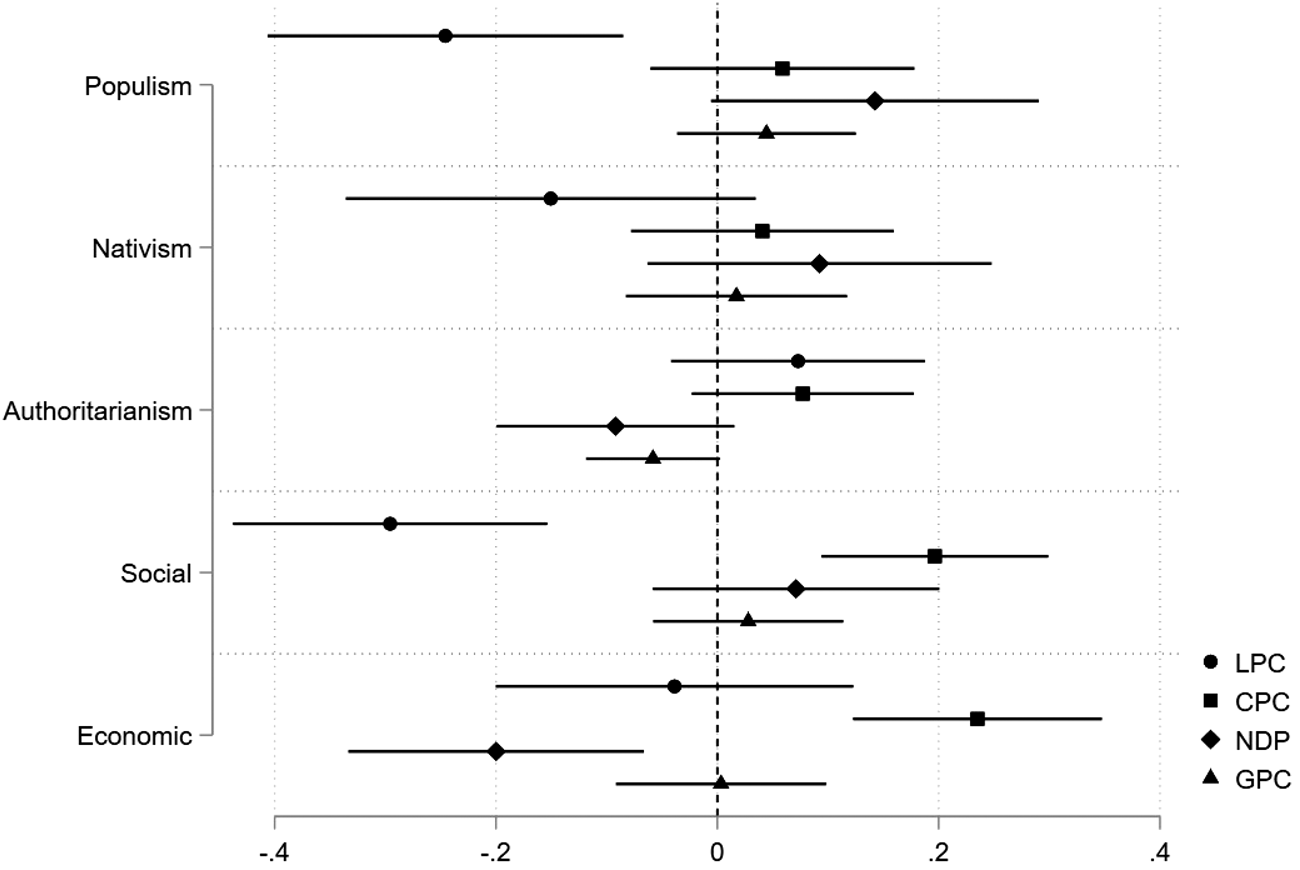
As for the other variables presented in Figure 2, nativism, first, demonstrates some surprising results. The focus on immigration and values by the CPC during the campaign does not seem to have fuelled a nativist impact on voting for the party. As for the NDP, nativism shows a positive, though not significant, impact on voting for it. While it might seem counter-intuitive that nativists would be attracted to voting for a social-democratic party, it matches what has been described as anti-immigrant sentiments espoused by the working class and some in labour unions in relation to job security (Tufts and Thomas, Reference Tufts and Thomas2014). Furthermore, while the NDP has not adopted rhetoric seeking to limit immigration, other Western social-democratic parties (for example, the New Zealand Labour Party and the Socialdemokratiet in Denmark) have made such a turn. Also, the results show that social ideology helps divide LPC and CPC voters, but economic ideology is the main cleavage between the NDP and CPC voters—highlighting the importance of exploring socio-economic ideology in a multidimensional manner instead of simply using the unidimensional left/right axis. For more information on the determinants of vote choice, see Table A2 in the Appendix.
Due to the conventionally strong correlation between party identification and vote choice, which might be mediating some important relationships in the results displayed in Figure 2, the analyses were also performed without party identification in the model. The results, shown in Table A2 in the Appendix, are robust, as they are essentially the same as those displayed in Figure 2. The main difference between the models with and without the PIDs relates to the strength of the average marginal effects that are estimated, notably leading to the positive impact of populism on voting for the NDP as clearly significant.
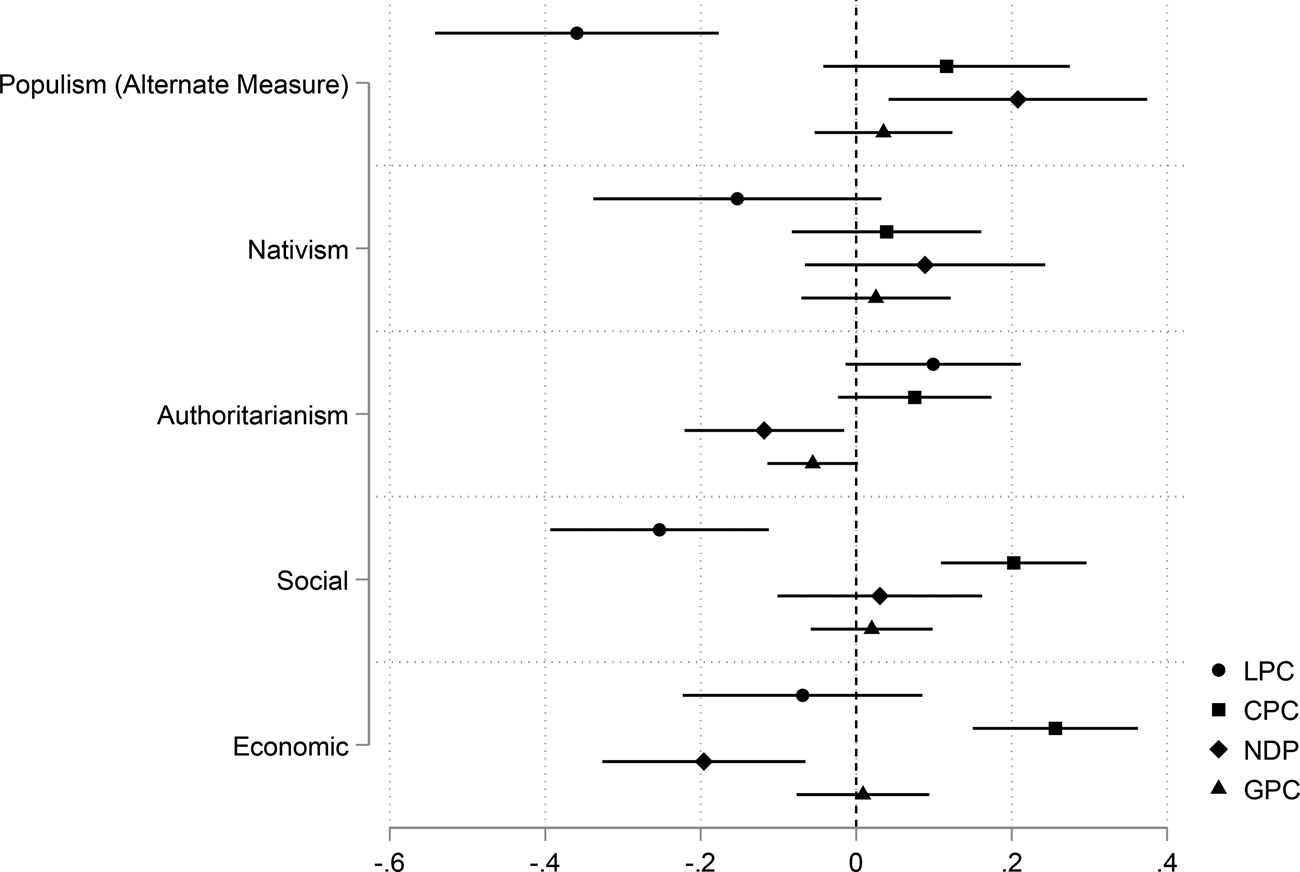
Furthermore, while the populist attitudes variable that I use captures a Manichean division between elites and the people, as well as a concern for the locus of decisional power between these two groups, it is a somewhat more limited measure of populism than the inventory of populist questions developed by others (see Castanho Silva et al., Reference Castanho Silva, Jungkunz, Helbling and Littvay2020). Nevertheless, the CES also includes two additional questions, also on a four-item scale, that measure trust in experts versus the people and the ability for people at the grassroots level to make decisions and solve problems. However, these two items did not load onto the same factor as the three other populism items. While some studies bypass validity and rely only on scale reliability as presented by a Cronbach's α score to build populist scales (see, for example, Plescia and Eberl, Reference Plescia and Eberl2021), both aspects are important to determine the consistency and quality of a multi-item variable. Still, for robustness purposes, a populist attitudes scale with the five items, which displayed a Cronbach's α score of 0.65, was also created and the analyses were run with it. The results, displayed in Figure A1 in the Appendix, are relatively similar to the three-item populist attitudes variable. However, the five-item populist variable shows a stronger structuring impact on vote choice, with a greater negative substantive relationship with voting for the LPC and a positive significant (at p < .05) impact on voting for the NDP. The three-item populist attitudes variable is thus a more conservative measure. This analysis was also performed with the PIDs excluded from the model; the results are essentially the same for the variables of concern. Regardless of the populism variable that is used, the results indicate consistent relationships between populism and vote choice in the 2015 Canadian federal election.
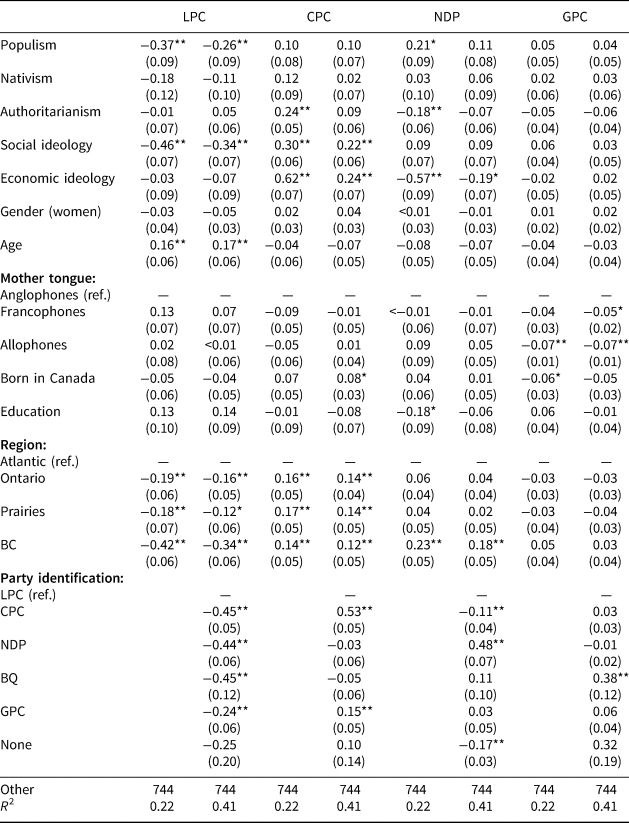
Finally, the analyses with and without the PIDs were also performed in a more traditional manner by excluding all Quebec respondents. The results, in Table A4 in the Appendix, show very little difference for our variables of interest compared to the results in Table A2.
Ultimately, the findings support the notion that populist attitudes can exist in settings without socio-economic crises to activate them or partisan rhetoric to fuel them and that populist attitudes can even have an impact on vote choice in contexts in which the supply-side factors of populism are not salient.
Conclusion
The global populist surge has paralleled a major global economic crisis, as well as, in many cases, a cultural crisis created by significant waves of refugees. The recent electoral success of populist parties and candidates has also been linked to the apparent growth of a rabble-rousing populist political discourse. These facts have led many scholars to conceptualize populism as activated or fuelled by supply-side socio-political factors (Canovan, Reference Canovan, Mény and Surel2002; Hawkins et al., Reference Hawkins, Kaltwasser and Andreadis2020; Rico et al., Reference Rico, Guinjoan and Anduiza2017; Rooduijn et al., Reference Rooduijn, van der Brug and de Lange2016). The present article diverges from this conception of populism.
Based on previous conceptualizations of populism as an ideology advocating for popular sovereignty and majoritarianism (Canovan, Reference Canovan, Mény and Surel2002; Hawkins and Kaltwasser, Reference Hawkins, Kaltwasser, Hawkins, Carlin, Littvay and Kaltwasser2018; Kaltwasser, Reference Kaltwasser2014), I reason that populist attitudes constitute an ideological dimension that should not need crises or rhetoric to be activated in order to have an impact on individuals’ political behaviour. More specifically, I argue that populist attitudes should be conceived of as an attitudinal dimension, similar to social and economic ideologies. Because studies that have explored the impact of populist attitudes have done so only in cases that were in the midst of socio-economic crises and/or enthralled by populist political discourse, we do not know much about populism when these supply-side factors are not prominent.
The 2015 Canadian federal election was a context in which the supply-side factors of populism were, arguably, not salient, and it thus offers the opportunity to address this gap and extend our understanding of populism's impact on political behaviour. The analyses presented here, using survey data from the CES, lead to two important findings. First, populist attitudes are shown to be independent not only of nativism and authoritarianism but also of social ideology and economic ideology. While populism's orthogonality with nativism and authoritarianism has been demonstrated in previous research, its independence from social and economic ideologies is a novel finding and a result that calls into question the conception of populism as a thin-centred ideology dependent on a socio-economic host ideology. Second, the findings reveal that populism had an impact on vote choice in an election lacking the regular supply-side factors of populism. Specifically, populism is shown to have negatively and significantly had an impact on voting for the LPC and positively had an impact—while just missing crossing the significance threshold (at p < .05)—on voting for the NDP.
These findings support the conception of populism highlighted in this article, which presents it as an attitudinal dimension. Populism affects vote choice in an election lacking the supply-side factors to activate or fuel it. Moreover, the clearest impact of populism on vote choice is in reference to the LPC, following the conventional perceptions of the party as establishmentarian and elitist. These findings support the idea that populist attitudes are shaped through a long-term process and produce a long-term impact on political behaviour, rather than arising through short-term contextual events.
Specifically relating to the Canadian case, the findings demonstrate that Canadians are not as resistant to populism as some reports imply. Rather, the data support Canadians being low on the nativism scale, in line with the interpretation of Canada's exceptionalism (Adams, Reference Adams2017; Mudde, Reference Mudde2016). This finding is also in line with Rooduijn's warning (2019) about the risks of confusing populism and nativism, since the data demonstrate that Canada is not, in fact, a bastion against populist attitudes.
While the lack of salience of populism in the 2015 Canadian federal election allowed an investigatation into the impact of populist attitudes in a context in which supply-side factors are noticeably muted, this situation diverges from Canada's history of populist politics. Furthermore, populism has had a resurgence in the Canadian political landsape since 2015. At the provincial level, recent elections have seen the People's Alliance of New Brunswick rise to prominence, both Québec solidaire (QS) and the Coalition Avenir Québec (CAQ) obtain electoral success in Quebec's provincial election (with the latter forming a majority government), and the populist Doug Ford become premier of Ontario (Erl, Reference Erl2021; Medeiros and Gauvin, Reference Medeiros and Gauvin2019). Additionally, the 2019 Canadian federal election saw populism have a prominent role, notably with the openly populist People's Party of Canada (Nanos, Reference Nanos2020). While the scope of this research is limited to the context of the 2015 Canadian federal election, future reasearch should explore the impact of populist attitudes on vote choice in a longitudinal manner and also comparatively at the provincial level. Such scholarly endeavours would allow for a deeper understanding of the impact of the demand side of populism on Canadian politics. A longitidinal perspective would also allow for a better understanding of the impact of demand-side factors as the socio-political context changes, notably in regard to the populist rhetoric utilized by political actors.
There is no evidence to indicate that these findings are specific to the Canadian context. Therefore, the findings that populist attitudes do not manifest themselves uniquely when the supply-side factors of populism are salient should apply more widely. Broadly, this would mean not only that populist attitudes held by citizens are having an impact on electoral outcomes independent of the level of saliency of populism but that there is likely an audience for populist policies and rhetoric in most, if not all, democracies. Essentially, the findings do not align with the idea that populism needs the right context to materialize itself in a society. It may simply be waiting for political entrepreneurs to attract it, with potentially important consequences for governance and policy making (Stoker, Reference Stoker2019).
Yet comparing the results of this study with other cases might be a complicated venture. Not only do most populism scales seem to have limited cross-cultural validity (Castanho Silva et al., Reference Castanho Silva, Jungkunz, Helbling and Littvay2020), but the battery of questions used in the current study is dissimilar to other, more prominent scales employed to investigate populist attitudes. Nevertheless, scholars should endeavour to explore the presence and impact of populist attitudes in cases in which populism and the factors that fuel it lack salience. Though the different populism scales might make precise comparisons difficult, broadening the cases that are explored beyond those with prominent populist movements, as Santana-Pereira and Cancela (Reference Santana-Pereira and Cancela2020) and the current study do, would nevertheless allow us to better isolate the determinants of populist attitudes as well as further our knowledge of populism's impact on socio-political phenomena.
Ultimately, this article should encourage scholars to rethink the manner in which populism has been conceptualized and explored, since the findings call for populist attitudes to be utilized in electoral research in contexts without evident supply-side populist socio-political factors. Studying the impact of populism only in cases that have notorious populist movements has limited our understanding of populism's impact on political behaviour. I thus mirror the call made by Plescia and Eberl (Reference Plescia and Eberl2021) to explore the impact of populist attitudes in a broader manner.
Acknowledgments
I am grateful to Daniel Béland, Alessandro Nai, Matthijs Rooduijn and Levente Littvay for their helpful advice. I would also like to thank this journal's anonymous referees for their insightful comments and suggestions.
Appendix
Questions Used
Populism
Politicians are ready to lie to get elected.
Those elected to Parliament soon lose touch with the people.
The government does not care much about what people like you think.
Item in alternate measure: It is better to trust the down-to-earth thinking of ordinary people than the theories of experts.
Item in alternate measure: We would probably solve most of our big problems if decisions could be brought back to the people at the grass roots.
Nativism
How do you feel about aboriginal peoples?
How do you feel about racial minorities?
How do you feel about racial immigrants?
How do you feel about Muslims living here (in Canada)?
Authoritarianism
We must crack down on crime, even if that means that criminals lose their rights.
Should the federal government spend more, less, or about the same as now on the following areas: crime and justice?
What is the best way to deal with young offenders who commit violent crime?
Do you favour or oppose the death penalty for people convicted of murder?
Social Ideology
Should abortion be banned?
Do you favour or oppose same-sex marriage, or do you have no opinion on this?
Society would be better off if fewer women worked outside the home.
Only people who are legally married should be having children
Economic Ideology
Should corporate taxes be increased, decreased, or kept about the same as now?
When businesses make a lot of money, everyone benefits, including the poor.
Please indicate how much confidence you have in the following institutions: Unions.
Determinants of Vote Choice (Alternate Measure of Populism)
Note: Markers represent average marginal effects (95%) estimated from a multinomial regression (excluding BQ voters). The model also includes gender, age, mother tongue, country of birth, education, regions and PIDs; see Appendix Table A3 for full results.
Rotated (Varimax) Factor Loadings
Determinant of Vote Choice (Excluding BQ Voters)
Determinant of Vote Choice (Excluding BQ Voters)

Determinant of Vote Choice (Excluding Quebec Voters)


 Open access

