

Introduction
Public approval of political leaders is an essential element in democratic accountability. Most democracies rely on a system by which authority and decision-making are delegated to a select group of representatives. Within such representative democracies, public approval of leadership is considered an important check on the misuse of power, as members of the public can express their dissatisfaction with politicians who refuse to take their opinions seriously. Research shows that public approval can affect the efficacy of government, the ability to define policy, set agendas, and build consensus within or between groups of representatives to meet objectives (Arceneaux & Vander Wielen, Reference Arceneaux and Vander Wielen2017). The state of public opinion, therefore, also plays a critical role in the activities of democratic government.
Understanding what factors affect the public’s approval of incumbent political leaders is of interest to political science and related disciplines (Fowler & Hall, Reference Fowler and Hall2018). Traditionally, political scientists studying the relationship between public opinion and accountability focus on concepts that democratic theorists consider relevant to the operation of politics, such as voter competency, ideology, knowledge, perceived accountability, and interests (Alt et al., Reference Alt, Bueno de Mesquita and Rose2011; Becher & Brouard, Reference Becher and Brouard2022; Hirano et al., Reference Hirano, Lenz, Pinkovskiy and Snyder2015; Lenz, Reference Lenz2012). Recently, however, research on public opinion has realized that psychological factors like voice pitch, attractiveness, and candidate physical appearance exert significant influence on the public’s view of incumbent leaders’ efficacy and, therefore, affect democratic function (Bahamonde & Sarpila, Reference Bahamonde and Sarpila2023; Milazzo & Mattes, Reference Milazzo and Mattes2016; Murray & Schmitz, Reference Murray and Schmitz2011; Tigue et al., Reference Tigue, Borak, O’Connor, Schandl and Feinberg2012). There has also been considerable research on how emotional appraisal influences political habits, deliberations, or information processing (see Marcus et al., Reference Marcus, MacKuen and Neuman2011, Reference Marcus, Valentino, Vasilopoulos and Foucault2019). This shift in the literature highlights the previously unappreciated significance of humanity’s psychological toolbox—our evolved heuristic decision-making systems—on politics (Barkow, Reference Barkow2005; Gigerenzer, Reference Gigerenzer2008; Gigerenzer & Gaissmaier, Reference Gigerenzer and Gaissmaier2011; Giphart & Van Vugt, Reference Giphart and Van Vugt2018; Hibbing et al., Reference Hibbing, Smith and Alford2013; Petersen, Reference Petersen2015).
A body of research in political science examines the relationship between politics and anxiety. Studies suggest that anxiety can increase political information seeking while reducing reliance on heuristic decision-making (Wagner & Morisi, Reference Wagner and Morisi2019). Although anxiety and stress are often closely linked, the American Psychological Association (APA) distinguishes them: stress is “caused by an external trigger,” whereas anxiety involves “persistent, excessive worries that don’t go away even in the absence of a stressor” (APA, 2022). This distinction highlights ongoing methodological challenges, as stress and anxiety frequently produce nearly identical symptoms (APA, 2022; Barrett et al., Reference Barrett, Gendron and Huang2009). Building on this work, we examine the relationship between stress and incumbent leadership approval ratings using data from the COVID-19 Monitor dataset, a repeated cross-sectional survey of public attitudes and opinions collected during the coronavirus disease 2019 (COVID-19) pandemic.
The COVID-19 pandemic is a useful case to study the effect of stress on leadership evaluations because the pandemic conditions produced widespread variation in stress experiences over time and across the public (Liu et al., Reference Liu, Lithopoulos, Zhang, Garcia-Barrera and Rhodes2021; Zacher & Rudolph, Reference Zacher and Rudolph2021). Repeated studies demonstrate that pandemic conditions adversely affected the lives of most people in countries across the globe (Kowal et al., Reference Kowal, Coll-Martín, Ikizer, Rasmussen, Eichel, Studzińska and Ahmed2020; Lakhan et al., Reference Lakhan, Agrawal and Sharma2020). Studies also show that during the pandemic, levels of government approval declined in many countries, and that this decline was not exclusively the result of partisan competition (Altiparmakis et al., Reference Altiparmakis, Bojar, Brouard, Foucault, Kriesi and Nadeau2021; Johansson et al., Reference Johansson, Hopmann and Shehata2021; Lupu & Zechmeister, Reference Lupu and Zechmeister2021). Complicating the interpretation of the public opinion during the pandemic, in some countries, public approval of the government increased during the same period (Bol et al., Reference Bol, Giani, Blais and Loewen2021; Esaiasson et al., Reference Esaiasson, Sohlberg, Ghersetti and Johansson2021). This suggests that the pandemic itself is not the cause of declines in public opinion, but that the changes in public opinion during COVID-19 depend on secondary factors. To better comprehend the trends in incumbent leadership approval, we investigate the relationship between the approval of incumbent leaders and personal stress (Bohlken et al., Reference Bohlken, Kostev, Riedel-Heller, Hoffmann and Michalowsky2021). Specifically, we investigate the following question: Do higher levels of self-reported stress correlate with lower levels of incumbent leadership approval?
While the use of a Canadian sample is arbitrary to this research question, there are compelling reasons to justify the Canadian case. Canada has significant regional diversity, where each region has a unique culture, identity, and politics. Furthermore, the public healthcare system in Canada is a provincial responsibility, with each province having its own policies and regulations within a federal health policy framework. In our view, this significant within-country variation increases the likelihood that these findings should be generalizable to other countries.
Canada’s institutional structure creates variation in institutional accountability while maintaining a common (national) context. Federal oversight, combined with provincial control of healthcare delivery, makes a unique division of responsibilities. Therefore, this case provides unique analytical leverage for understanding how stress affects political evaluations at different governmental levels.
An important limitation of this study is that it cannot rule out the alternative causal relationship between stress and leadership approval of whether stress causes declines in approval or vice versa. Given that stress is typically defined as a response to external factors and that our data were collected during the pandemic, which affected stress levels globally, our theoretical framework favors the stress effects leadership model. We comment on this further in the discussion.
Theoretical framework
Stress affects the lives of people globally, across political contexts, and throughout modern and historical periods. The World Health Organization (WHO) defines stress as “a state of worry or mental tension caused by a difficult situation” (WHO, 2023). The effects of stress on individuals are associated with a wide range of profound psychological and biological consequences, including altering memory, reward-seeking and gratification, impaired immune function, and decision-making (Cohen et al., Reference Cohen, Janicki-Deverts and Miller2007 ; Stephens & Wand, Reference Stephens and Wand2012). Socially, stress exacerbates competitive, aggressive, and inflexible social behaviors between individuals or groups (Nickels et al., Reference Nickels, Kubicki and Maestripieri2017).
While small or short-term experiences of stress can have benefits, excessive or chronic stress can result in significant harm to individuals, including increased risk of strokes, heart attacks, ulcers, impaired memory, or decision-making. Chronic stress also increases risks of mental illnesses such as depression and anxiety (Kessler, Reference Kessler2003; Van Praag, Reference Van Praag2004). If not managed effectively, the effects of stress become more pronounced over time, resulting in declining levels of health (Halliburton et al., Reference Halliburton, Hill, Dawson, Hightower and Rueden2021; McEwen, Reference McEwen2008; Souto-Manning & Melvin, Reference Souto-Manning and Melvin2022). However, to our knowledge, no previous studies have investigated the relationship between stress and incumbent leadership approval.
Previous investigations into the relationship between stress and politics find that stress significantly affects political engagement and is an important predictor of public opinion (Both and welch, Reference Booth and Welch1978). A self-report study by Smith et al., Reference Smith, Hibbing and Hibbing2019) finds that political participation is linked with significant physical, social, and emotional costs, including the stress of lost friendships. French et al. (Reference French, Smith, Alford, Guck, Birnie and Hibbing2014) demonstrates that lower baseline levels of cortisol, a stress hormone, better predict voting behavior and are more reliable than self-report. A longitudinal study of the stress in the 2020 US election finds that deteriorations in individuals’ physical health coincide with the election, especially among youth or the politically engaged (Smith, Reference Smith2022). Blanton et al. (Reference Blanton, Strauts and Perez2012) find that exposing partisans to political messages from political outgroups corresponds to increases in physiological but not self-reported indicators of stress.
While no studies directly link stress and incumbent political leadership evaluations, there are important theoretical reasons to expect a relationship between stress and leadership approval. Psychologically, stress is an adaptive response to environmental conditions (Bijlsma & Loeschcke, Reference Bijlsma and Loeschcke2013; Sapolsky, Reference Sapolsky and Gazzaniga2004a, Reference Sapolsky2004b). Stress’s function is to prompt us to address challenges and threats to our well-being. Motivationally, stress encourages individuals to pursue changes in their lives, which may be personal or social in nature. Stress conditions people to change their attitudes and behaviors, making stress a potentially significant influence on individuals’ political views and interests (Warren, Reference Warren2022). Consistent with our argument that stress is highly relevant to the study of incumbent leadership evaluations, a study by Bartusevičius et al. (Reference Bartusevičius, Bor, Jørgensen and Petersen2021) finds that in multiple democratic countries, the stress of the pandemic is associated with dissatisfaction with the social and political order. Critically, our theory is agnostic about whether individuals view leaders’ policies as too strict or too lax, or how this perception contributes to their level of stress. All that matters for our theory is that individuals experience stress.
The 2019 COVID pandemic serves as an opportune case to study the effects of stress on incumbent leadership evaluation. Where life changes may not be possible, such as during the pandemic, effective stress management depends on several factors: routine, sleep, socializing, healthy diet, exercise, and avoiding overconsuming news, television, and social media (WHO, 2023). Critically, the conditions of the pandemic, such as social isolation, loss of sleep, routine disruption, the overconsumption of media, and government-mandated closures of public spaces, also interfered with effective stress management—exacerbating its effects across the general population (Kar et al., Reference Kar, Kar and Kar2021; Liu et al., Reference Liu, Lithopoulos, Zhang, Garcia-Barrera and Rhodes2021). This implies that during the height of the pandemic, the population experienced a strong psychological need for change, while simultaneously having a restricted ability to implement this need or manage the consequences of continued stress (Saalwirth & Leipold, Reference Saalwirth and Leipold2021). At the same time, political leaders were obvious across media platforms, providing daily updates on the government’s policy, which may have increased the salience of their executive powers to the public. We postulate that the combination of both serves as a suitable context to test our hypotheses on stress and leader evaluations. We orient this around two questions: How does the average person respond politically, given their experiences during this challenging time? And how might the experience of stress influence individuals’ evaluations of incumbent political leaders?
Previous work in political science finds that in times of stressful national emergencies, countries often experience a “rally-around-the-flag” effect where citizens put aside social and political differences and unite to defend against external threats to their common good. During these experiences, incumbent leaders often enjoy a boost in public approval (Baum, Reference Baum2002; Lee, Reference Lee1977; Oneal & Bryan, Reference Oneal and Bryan1995). This suggests that stress could be beneficial for political leaders’ public image, raising the possibility that life stress experienced during the COVID-19 pandemic might result in increases in support for incumbent political leaders.
Critically, however, the conditions surrounding “rally-around-the-flag” effects are different from those of the COVID-19 pandemic. These “rally” effects tend to involve threats to the existence of the social group, such as war or terrorism, which are perpetuated by easily identifiable agents, usually an individual or an out-group (Chowanietz, Reference Chowanietz2011; Hetherington & Nelson, Reference Hetherington and Nelson2003; Lambert et al., Reference Lambert, Schott and Scherer2011). By comparison, the risk of contracting COVID-19 is, first and foremost, a threat to personal well-being and not the security of the social group. Additionally, while stress can cause social affiliative bonding, this typically involves moderate or intermittent stress exposure. When stress does cause social bonding, it is typically between individuals in close social approximation along with a collective response stressor (e.g., individual cooperation for mutual benefit and support) (Buchanan & Preston, Reference Buchanan and Preston2014). While national leaders play major roles in managing countries and political groups, these activities during the pandemic did not bring them into close social approximation to the average individual experiencing stress. Lastly, rally-around-the-flag effects typically refer to short-term increases in popularity; given the duration of the pandemic, it is unlikely that the long-term experience of stress will be associated with a prolonged increase in popularity. Research has explored the causes of declines in rally-around-the-flag effects during COVID-19 (Johansson et al., Reference Johansson, Hopmann and Shehata2021).
Psychologically, it is therefore unlikely that individuals would develop deeper affiliative bonds with leaders exclusively because of stress experienced during the pandemic period. Consequently, we expect the stress of life experiences to trigger a different psychological response than affiliative bonding. Specifically, we theorize that, as a coping strategy for stressful and restrictive conditions, individuals may direct their aggression toward incumbent political leaders—resulting in decreased approval. Baekgaard et al. (Reference Baekgaard, Christensen, Madsen and Mikkelsen2020) show an alternative outcome based on the effect of COVID-19 on institutional trust.
A wide array of literature in human and non-human sciences demonstrates a connection between stress and competitive social behavior (Summers & Winberg, Reference Summers and Winberg2006). During the pandemic, government-imposed restrictions on large public spaces significantly increased social crowding, the degree to which individuals are forced to share living space (e.g., the amount of time they are confined at home with others). In nonhuman primates, social crowding results in increases in stress hormones, aggression, and anxiety while simultaneously decreasing social bonding activities (Honess & Marin, Reference Honess and Marin2006). Although less studied, humans experiencing social crowding exhibit similar stress responses, including impaired cognitive performance, lower tolerance of frustrations, elevated pulse and blood pressure, the adoption of defensive postures, increases in the verbalization of frustration, and greater self-reported discomfort and hostility (Evans, Reference Evans1979).
Consistent with quality-of-life research conducted over the pandemic by Ballonoff Suleiman et al. (Reference Ballonoff Suleiman, Till Hoyt and Cohen2022) and Jo et al. (Reference Jo, Harrison and Gray2021), these findings suggest that stress from crowding weakens affiliative social behaviors and attachments either directly because of increases in antisocial behaviors, or indirectly as individuals focus their attention on maintaining their closest relationships. This is especially true for social attachments or group identities, which are stress-inducing. For example, during the pandemic, individuals who belong to minority cultures experienced strong pressures to conform to group norms. This strong pressure had the adverse effect of weakening their affiliative bonds and attachment to their group identity (Tei & Fujino, Reference Tei and Fujino2022). Given the established relationship between politics and stress, it is conceivable that this weakening of group affiliations could include political attachments; however, no study we are aware of offers a direct test of this hypothesis to date.
Social aggression is also strongly affected by the availability of resources. Due to supply chain disruptions—interruptions in the flow of materials and goods—the conditions of the pandemic were marked by resource scarcity. Multiple studies of human and nonhuman primates find that low resource availability increases aggression and the competition for leadership, which increases as individuals fight for status and control over those limited resources (Arnocky et al., Reference Arnocky, Davis and Vaillancourt2022; Durham, Reference Durham1976).
While the relationship between scarcity and competition is only indirectly linked to the evaluation of incumbent political leaders, it points to a pattern of behavior across species that the frequency of leadership competition increases as resources become scarcer (Roux et al., Reference Roux, Goldsmith and Bonezzi2015). Relevant to our theory is that leadership challenges can take several forms, including reputational attacks on opponents’ credibility. For example, in humans, as social competition increases, so does our tendency to gossip about and slander social rivals. While reputational attacks like partisan rhetoric, campaign messages, or attack ads are common in politics, they belong to a family of strategic behaviors intended to damage the reputations of rival individuals or groups to increase the chances of securing desired resources (Budesheim et al., Reference Budesheim, Houston and DePaola1996; Fernandes, Reference Fernandes2013; Fridkin & Kenney, Reference Fridkin and Kenney2008; Hess & Hagen, Reference Hess and Hagen2021). When there are difficult times evaluations of political leaders become more critical as competitors seek to damage their reputation to secure more resources.
A further reason to expect that incumbent leadership evaluations may suffer as a response of pandemic stress is the tendency in humans, and other animal species, to redirect their aggression toward others (Barash & Lipton, Reference Barash and Lipton2011). Distinct from revenge or retaliation, redirected aggression involves the passing of pain and suffering onto others as a strategy to cope with stress. Redirected aggression is most common in situations where it is either impossible or unwise to redirect aggression toward the source of stress.
A robust literature finds association between redirected aggression and sexism (Cohn & Zeichner, Reference Cohn and Zeichner2006; Mansell & Gatto, Reference Mansell and Gatto2023; Vandello et al., Reference Vandello, Bosson, Cohen, Burnaford and Weaver2008), familiar abuse (Hoobler & Brass, Reference Hoobler and Brass2006), and racism or xenophobia (O’Shea et al., Reference O’Shea, Watson, Brown and Fincher2020).
Redirected aggression is linked to a variety of social contexts, such as work-related stress, failure to meet social expectations, and low levels of efficacy and self-esteem (Barash & Lipton, Reference Barash and Lipton2011). Redirected aggression can be physical or verbal and includes name-calling or reputation destruction (Barash & Lipton, Reference Barash and Lipton2011). Critically, because the relationship between stress and aggression is exacerbated by threatened or compromised immune systems (Takahashi et al., Reference Takahashi, Flanigan, McEwen and Russo2018), it is possible that the conditions of the pandemic, being threatening to an individual’s health, exacerbated the tendency for redirected aggression toward political leaders.
Psychologically, cursing a political leader, such as the prime minister, is not just performative behavior, but part of a suite of adaptations to help individuals manage conditions of stress. In the context of stress experienced during a global crisis, aggression toward incumbent political leaders in the form of negative evaluations makes sense because the exogenous nature of the pandemic means that there is no animate target to which individuals can send aggression directly. The psychological function to direct pandemic stress toward political leaders is to reduce the individual’s stress. Whether or not this redirection makes analytic sense is not a feature of the system’s operation. Its sole feature is to reduce an individual’s experience of stress. Importantly, psychophysiology and self-report measures consistently show that these acts of aggression do temporarily alleviate the effects of stress for the perpetrators (Bosson et al., Reference Bosson, Vandello, Burnaford, Weaver and Arzu Wasti2009; Reference SapolskySapolsky, 2004b). Psychologically, redirected aggression temporarily satisfies a key function of stress, the motivation to remove or minimize harm to personal well-being.
Based on our theory about the effects of stress, we test the following hypotheses:
-
1. Greater levels of self-reported stress will correlate with lower levels of federal leadership approval.
-
2. Greater levels of self-reported stress will correlate with lower levels of provincial leadership approval.
Additionally, because the psychological effects of stress can damage social affiliations, we investigate whether the effects of stress on incumbent leadership approval are conditioned by political affiliations. Political affiliation is one of the strongest predictors of public approval of incumbent leadership (Arceneaux & Vander Wielen, Reference Arceneaux and Vander Wielen2017). Observing that stress affects political leadership evaluations among different types of partisan-affiliated individuals—particularly among a given politician’s co-partisans—would be significant to the study of politics because leadership evaluations are important predictors of future voting. We hypothesize the following relationships:
-
3. Among individuals who share an affiliation with the same party as the federal leader, greater levels of self-reported stress will correlate with lower levels of federal leadership approval.
-
4. Among individuals who share an affiliation with the same party as the provincial leader, greater levels of self-reported stress will correlate with lower levels of provincial leadership approval.
Our aim in hypotheses 3 and 4 is not to compare the impact of stress between the partisan in-group and out-group. Rather, our goal is to evaluate whether the impact of stress is detectable even in a group (namely, in-partisans) whom we might otherwise expect to be among the most stable supporters of the incumbent. Put another way: Do we find evidence of the impact of stress even among unlikely segments of the population?
We investigate our theory and hypotheses using a series of statistical models. While correlations are necessary but not sufficient to establish causal relationships, they provide a reasonable starting point for scientific investigation into a causal relationship. We aim to apply additional methods in future studies to further explore causality.
Methods
Sample
We use the Vox Pop Labs COVID-19 Monitor data. The COVID-19 Monitor dataset is a multiwave, repeated cross-sectional survey of public attitudes and opinions commissioned by the Federal government and administered to Canadians during the COVID-19 pandemic. The COVID-19 Monitor data were collected in 47 separate waves, between March 20, 2020, and February 16, 2022, where each wave was fielded to its own prestratified and independent sample of Canadians. Participants were recruited by the survey company Vox Pop Labs, and the survey was administered using Qualtrics. Participants received no monetary compensation for their participation in the COVID-19 Monitor survey.
As Vox Pop Labs permits survey participants to skip questions, the number of observations in our statistical models changes slightly with the adjustment of our independent variables or control variables due to this item’s nonresponse. Given our large sample size, small changes in the number of observations are unlikely to meaningfully affect our outcomes. Consequently, we did not standardize the number of observations in our dataset. Additionally, each wave of the COVID-19 Monitor contained a slightly different combination of questions, such that not all variables were asked in each wave of the COVID-19 Monitor. As a result, we are not able to assess the effect of all variables in a single statistical model. We are also unable to assess intercorrelations of the independent measures of stress. To minimize loss of observations, we run separate analyses for the key explanatory variables. The number of observations in our final models ranges from 56,722 to 57,064. To ensure the integrity of our results, duplicate and incomplete responses are excluded from the analyses.
The COVID-19 Monitor design, as a cross-sectional survey, means each wave sampled different individuals rather than tracking the same respondents over time. The varied questions are set across waves, resulting in not all variables being available in every wave.
Analysis
To evaluate H1 and H2, we use an ordinary least squares regression. Covariates include population sociodemographic weighting for age, birthplace (Canada versus other), education, region, sex, and previous federal and provincial vote choice. The widespread practice for political research with Canadian data is not to control for ethnicity. To evaluate H3 and H4, we add an interaction term between the measures of stress and whether participants voted for the incumbent leader’s party during the previous federal or provincial election. This interaction model specification will allow us to directly estimate the impact of stress among the leader’s in-partisans, net of the other variables in the model. The results do not meaningfully change if the analysis is run as a series of models conditioned by partisanship. Previous votes are used as a proxy for political affiliation because the COVID-19 Monitor dataset does not contain an explicit measure of party identification. In the Supplementary Material, we report the results of models that incorporate epidemiological controls for seasonality, vaccine availability, and intensive care unit bed capacity. Our results remain significant after accounting for these factors. We also evaluated the results with a control for the 16-month duration of the COVID-19 Monitor dataset; again, the duration did not meaningfully affect our results. We report our results with standardized dependent and independent variables, transforming the variables to have a standard deviation of 1 and a mean of 0.
Dependent variables
Our models use two dependent variables: the approval of (a) federal and (b) provincial incumbent leaders’ handling of the COVID-19 crisis. Federal approval is assessed using the question “Do you approve or disapprove of the way that Prime Minister Justin Trudeau is handling the COVID-19 crisis?” Provincial approval is assessed using the question “Do you approve or disapprove of the way that Premier X is handling the COVID-19 crisis?” The identity of the provincial leader varies according to each respondent’s declared province of residence. Each question is assessed on a 5-point Likert Scale from 1 = “Strongly approve” to 5 = “Strongly disapprove”; this scale is reversed-coded during the analyses such that higher numbers indicate greater approval. The standardized scale runs from −1.84 to −1.13 for approval of the Prime Minister and from −1.63 to 1.11 for approval of the Premiers.
Our dependent variable captures citizens’ overall evaluation of leadership performance during the pandemic rather than support for specific policies. This broad measure allows us to examine how stress affects general satisfaction with crisis management, independent of whether respondents preferred stricter or more relaxed policies.
Independent variables
We assess stress using four measures: (1) affective stress, (2) socioeconomic stress, (3) mental and physical stress, and (4) COVID-19 stress.
Affective stress is constructed using feeling thermometers that ask respondents, “On a scale of 0 to 10, where 0 means “not at all” and 10 means “all the time,” how often have you experienced the following feelings within the last week?” The dataset includes items asking about anxiety and stress. We combine these two items, asking about stress and anxiety, into a single composite scale. The standardized scale runs from −1.79 to +2.04. While some studies treat these as discrete emotions, we combine them for two reasons. First, the items are highly related, showing a Pearson’s correlation r = 0.74, a single-item factor loadings >0.70, and a coefficient alpha of 0.85. Second, the professional and academic distinctions between these emotions may not be widely recognized by the general public, as these two emotions are closely related.
The socioeconomic and COVID-19 stresses are constructed using items asking, “How concerned would you say you are right now about each of the following?” The items range from “0 = Not at all concerned” to “4 = Extremely concerned.” The dataset includes nine items assessing concern. There is no formal psychological definition of concern; however, concern colloquially refers to a state of troubled awareness, care, or worry about something that holds personal interest or is a tangible issue (Merriam-Webster, 2025). Following the APA definition that stress is “caused by an external trigger,” and the context of a survey about the effects of the global pandemic, we treat these measures as indicators of stress (APA, 2022). To create the measure of socioeconomic stress, we combine six items related to socioeconomic disruptions including “your ability to pay your bills,” “job security,” “the availability of food and supplies in your area,” “the ability of the public health care system to provide adequate care in the event of illness or injury,” “the Canadian economy,” and “the global economy.” The standardized scale runs from −2.15 to +3.50. The six items display an average Pearson’s correlation of r = 0.28, single-item factor loadings >0.30, with an average factor loading >0.50, and a coefficient alpha of 0.70.
To create the measure of COVID stress, we combine the three items “personally contracting COVID-19,” “a friend or family member contracting COVID-19,” and “a member of your community contracting COVID-19.” The standardized scales run from −2.24 to +2.10. The three items display an average Pearson correlation of r = 0.64, a single-item factor loadings >0.70, and a coefficient alpha of 0.84.
Mental and physical stress are constructed using two items asking, “At present, how would you characterize your physical health?” and “At present, how would you characterize your mental health?” Both items are assessed on a 5-point scale (poor, fair, good, very good, and excellent). The standardized scales run from −1.93 to +2.12. The two items display a Pearson’s correlation of r = 0.44, a single-item factor loadings >0.70, and a coefficient alpha of 0.61.
Previous votes are assessed by asking each participant which party they voted for in the most recent federal elections (2019 or 2021) or provincial elections (2016–2021). The variable is recorded as a binary response, 1 if the participants voted for the incumbent and 0 otherwise. When evaluating H3 and H4, we reverse this variable to simplify the interpretation of the main effects and interaction terms. Two federal elections are used because an election was called partway through the pandemic. As a conservative test of our theory, we include responses on vote choice in the 2020–2021 federal and provincial elections, which occurred midway through the pandemic. Omitting these observations from our model has no meaningful effect on the results, but decreases the total observations.
Results
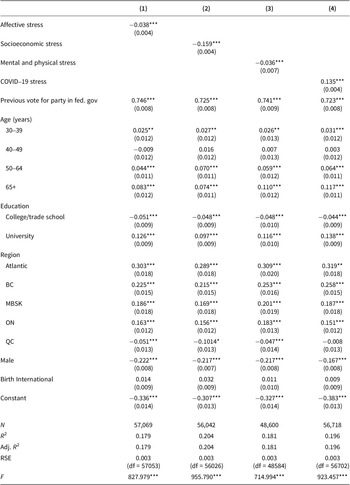
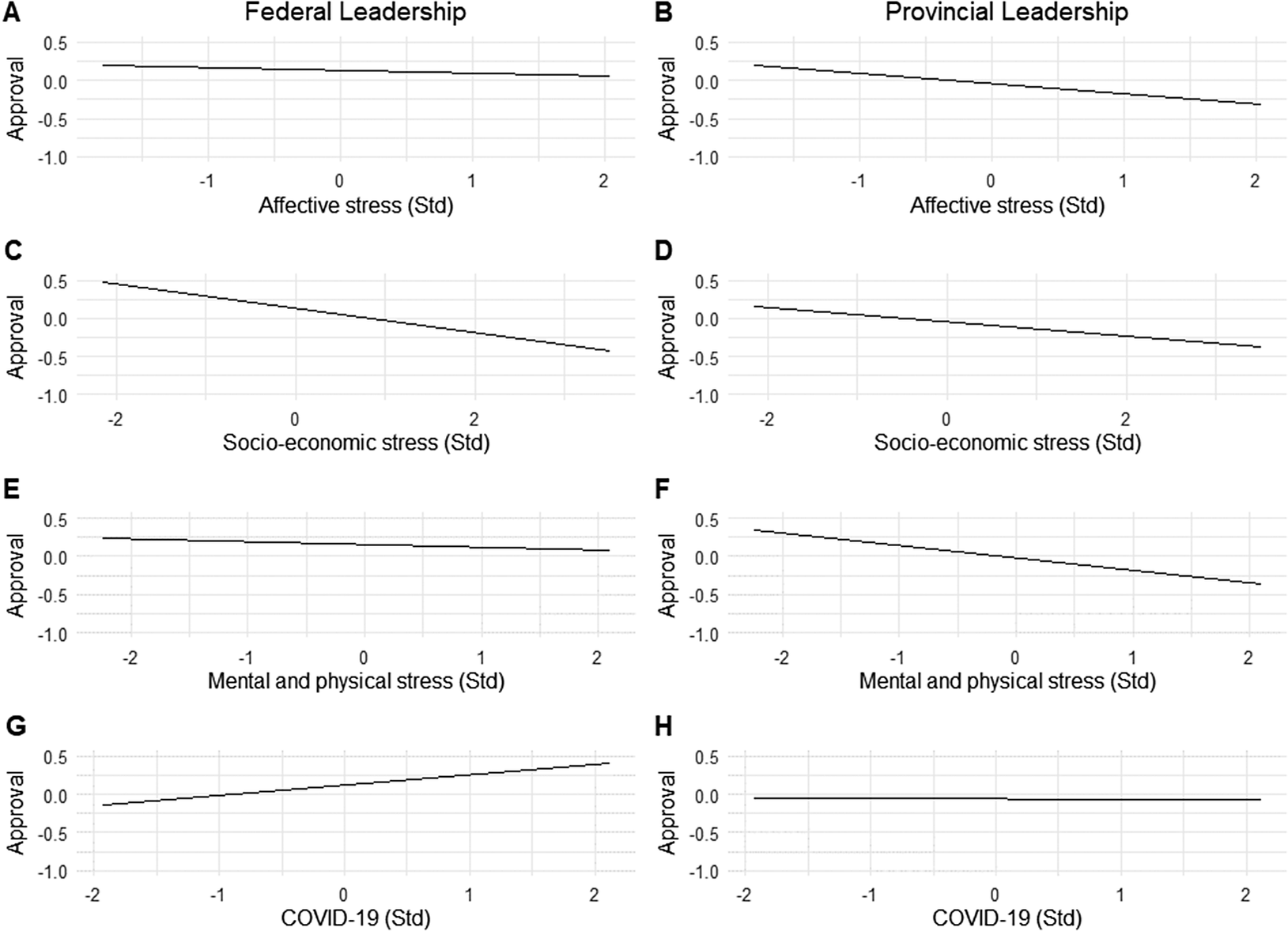
We find modest but mixed support for H1 that greater levels of self-reported stress will correlate with lower levels of federal leadership approval (Table 1). We observe significant negative correlations between the measures of affective, socioeconomic, and mental and physical stress and incumbent leadership approval. The effect sizes for affective stress (r = −0.038) and mental and physical stress (r = −0.036) are small, suggesting that these measures are weak predictors of incumbent approval. However, the effect size for socioeconomic stress is negative and significant at r = −0.159, indicating that it is a moderate but meaningful predictor of incumbent approval. Unexpectedly, however, the effect size for COVID-19 stress is positive and significant at r = 0.133. This correlation is opposite to the hypothesized direction, indicating that stress from fears of contracting COVID-19 is associated with greater incumbent approval. In Figure 1, looking at each measure from low to high, affective, socioeconomic, and mental and physical stresses result in 5, 30, and 5% decreases in approval, while COVID-19 stress results in a 19% increase in approval. Consequently, for H1, we reject the null, but with the caveats that the correlations of affective and mental and physical stress are small, and that the correlation of COVID-19 stress is opposite to the hypothesized direction.
The standardized correlation between approval of the prime minister’s handling of the COVID-19 pandemic and greater self-reported stress

Reference categories: Previous vote (nonincumbent party), region (Alberta), age (18–29) years, education (high school or below), and birthplace (Canada).
*p < 0.1; **p < 0.05; ***p < 0.01.
The standardized marginal effect of self-reported stress on the approval of political leaders.

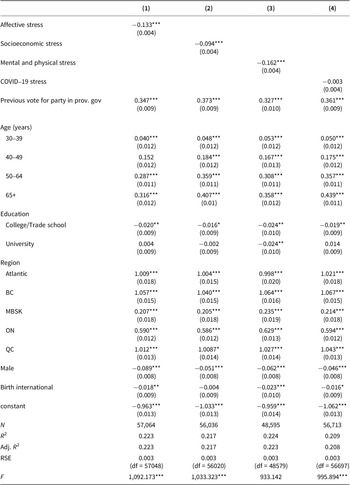
In contrast to H1, we find stronger support for H2 that greater levels of stress will correlate with lower levels of provincial incumbent leadership approval (Table 2). Across affective, socioeconomic, and mental and physical stress, we observe significant correlations, ranging from 0.162 to 0.094. The measure of COVID-19 stress, however, fails to reach significance. Looking at Figure 1, moving from low to high affective, socioeconomic, and mental and physical stress results in 19, 19, and 24% decreases, respectively, in provincial leadership approval. For H2, we reject the null.
The standardized correlation between approval of the provincial premiers’ handling of the COVID-19 pandemic and greater self-reported stress

Reference categories: Previous vote (nonincumbent party), region (Alberta), age (18–29) years, education (high school or below), and birthplace (Canada).
*p < 0.1; **p < 0.05; ***p < 0.01.
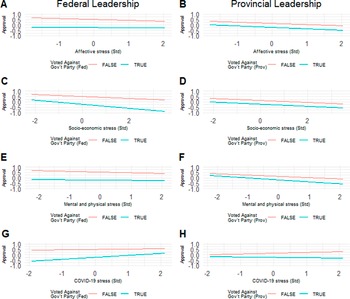
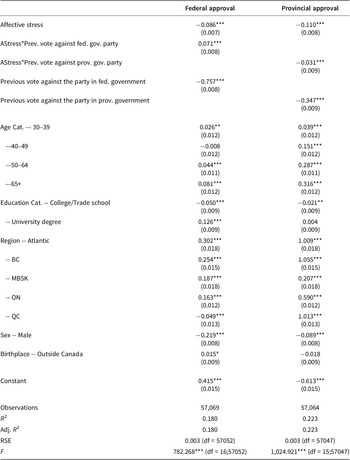
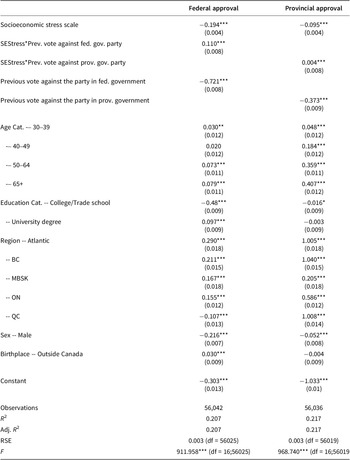
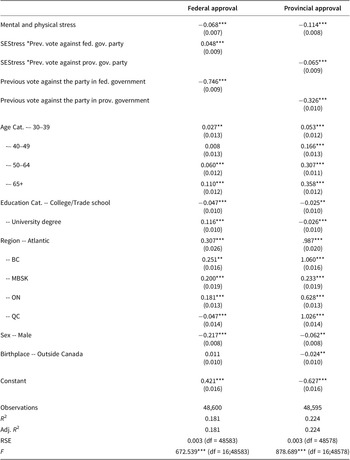
We also find support for H3 and H4, which propose that higher stress is negatively correlated with political leadership approval among individuals affiliated with the incumbent’s political party. As shown in Figure 2, consistent with the previous models, the effects on approval are observed for federal and provincial leadership. Overall, the absolute sizes of effects range from 0.015 to 0.194 for federal approval and from 0.030 to 0.179 for provincial approval. For simplicity of interpretation, the measure of party affiliation is reverse-coded, indicating that individuals who voted for the incumbent’s party in the previous election are the reference category. As observed in Table 3, the effects of stress on federal and provincial leaders are similar but differ according to each measure of stress. Consistent with the results of H1 and H2, the effect is negative for the socioeconomic, affective, and mental and physical measures of stress, but positive for the measure of COVID-19 stress. For ease of interpretation, Table 3 represents the effect of stress on leadership as a percentage change. Worth noting is that for the measures of socioeconomic and affective stress, the decline in leadership approval is equal to or larger among affiliated voters than nonaffiliated voters. Consequently, for H3 and H4, we reject the null and find support that among individuals who share an affiliation with the same party as the federal or provincial leader, reporting greater levels of self-reported stress correlates with lower levels of leadership approval. The full results for H3 and H4 are presented in Tables 4–7.
The standardized marginal effect of stress on leadership approval according to past vote for the incumbent party. Results are grouped by voter choice.

The effect of stress on leadership evaluations as a percentage

The standardized correlation between approval of leaders’ handling of the COVID-19 pandemic and the interaction between greater affective stress and voting decisions in the previous election

Reference categories: Previous vote (incumbent party), region (Alberta), age (18–29) years, education (high school or below), and birthplace (Canada).
*p < 0.1; **p < 0.05; ***p < 0.01.
The standardized correlation between approval of leaders’ handling of the COVID-19 pandemic and the interaction between greater socioeconomic stress and voting decisions in the previous election

Reference categories: Previous vote (incumbent party), region (Alberta), age (18–29) years, education (high school or below), and birthplace (Canada).
*p < 0.1; **p < 0.05; ***p < 0.01.
The standardized correlation between approval of leaders’ handling of the COVID-19 pandemic and the interaction between greater mental and physical stress and the vote in the previous election

Reference categories: Previous vote (incumbent party), region (Alberta), age (18–29) years, education (high school or below), and birthplace (Canada).
*p < 0.1; **p < 0.05; ***p < 0.01.
The standardized correlation between approval of leaders’ handling of the COVID-19 pandemic and the interaction between greater COVID-19 stress and voting decisions in the previous election

Reference categories: Previous vote (incumbent party), region (Alberta), age (18–29) years, education (high school or below), and birthplace (Canada).
*p < 0.1; **p < 0.05; ***p < 0.01.
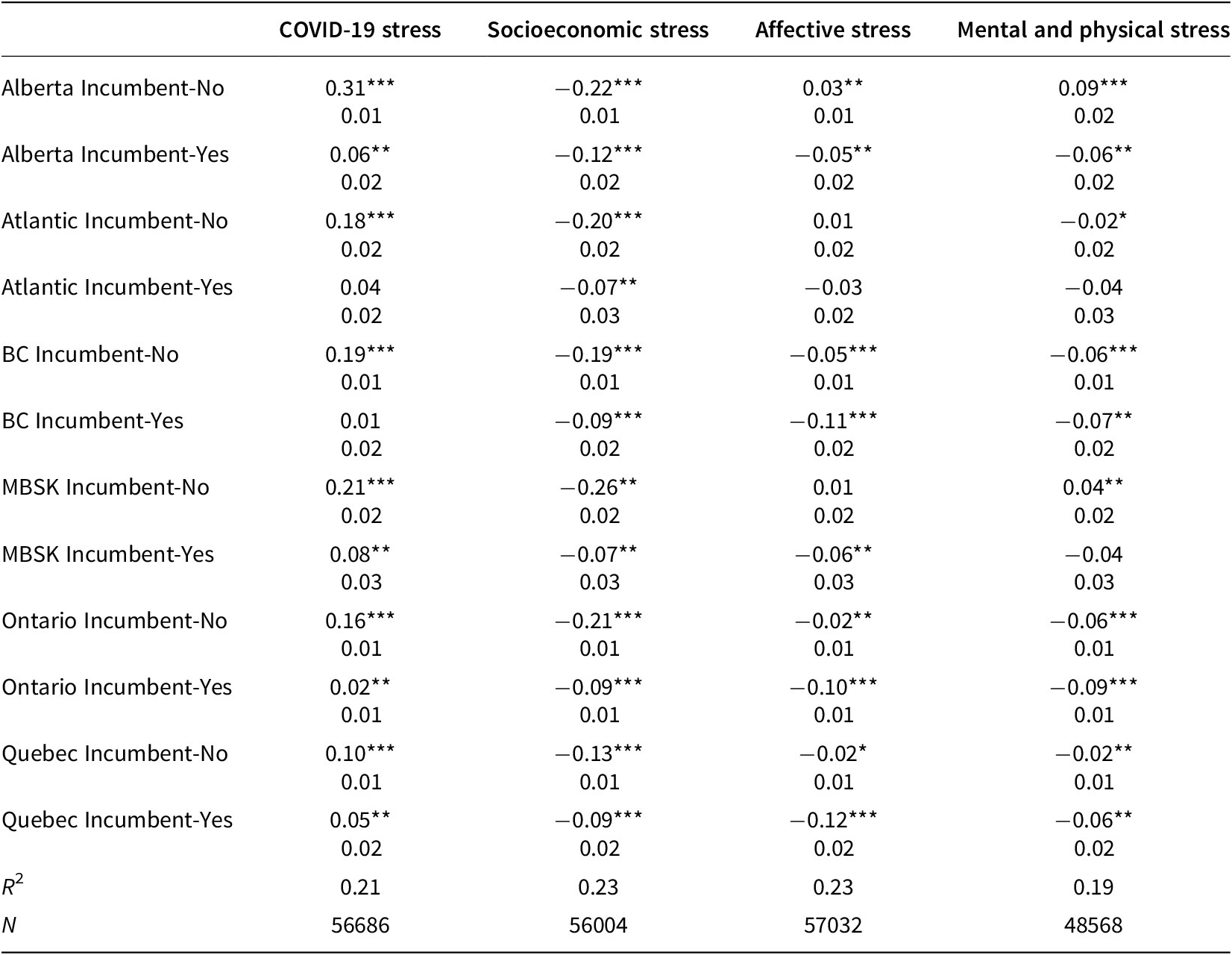
The linear marginal effects (slope) of the three-way interaction between the measure of stress, province of residence, and voting for or against the incumbent party on Provincial leadership approval. The full statistical results for each model are provided in the online materials. Incumbent-Yes refers to participants who voted for the incumbent party in the previous election

*p < 0.1; **p < 0.05; ***p < 0.01.
The linear marginal effects (slope) of the three-way interaction between the measure of stress, province of residence, and voting for or against the incumbent party on Federal leadership approval. The full statistical results for each model are provided in the online materials. Incumbent-Yes refers to participants who voted for the incumbent party in the previous election

*p < 0.1; **p < 0.05; ***p < 0.01.
Additional analyses
To better understand the relationship between the COVID-19 measure of stress and leadership approval, we ran additional post-hoc analyses with a three-way interaction between all four stress measures, province of residence, and whether someone voted for the incumbent party. Healthcare in Canada is the responsibility of provincial governments. This means that key decisions around the delivery of medical services and regulations during the COVID-19 pandemic, such as masking mandates and lockdowns, were made at the provincial level of government. Because the public healthcare system in Canada is a highly politicized issue and is highly regulated by provinces, Canadians are widely aware that it is a provincial responsibility. Unfortunately, studies that directly test whether Canadians hold provincial versus federal governments more accountable for public health or the spread of COVID-19 during the pandemic are limited in number or rely on indirect assessments (Kennedy et al., Reference Kennedy, Sayers and Alcantara2022). However, media coverage and public opinion polls over the pandemic’s duration support the position that Canadians understand that each province is responsible for its COVID policies (Allin et al., Reference Allin, Fitzpatrick, Marchildon and Quesnel-Vallée2022; Reid, Reference Reid2021; CBC, 2020; CBC, 2022; Ipsos, 2020). Furthermore, during the pandemic, the Canadian federal government maintained a consistent and daily narrative about the importance of public safety and the need to prevent further COVID-19 infections (Stewart, Reference Stewart2023). By comparison, the policies and narratives by the provinces differed significantly—with some provinces, like British Columbia, Quebec, and the Atlantic Region, implementing public lockdowns or restricted travel in response to rising COVID numbers. Other provinces, like Alberta, Saskatchewan, and Manitoba, left public spaces unrestricted, while Ontario imposed a mixed policy, locking down and reopening public spaces on an ad-hoc basis (Cameron-Blake et al., Reference Cameron-Blake, Breton, Sim, Tatlow, Hale, Wood and Tyson2021; Cyr et al., Reference Cyr, Mondal and Hansen2021). It is noteworthy that Alberta, Saskatchewan, Manitoba, and Ontario were also governed by conservative political parties at the time of the pandemic.
Figure 3 and Table 8 display the marginal effects of the three-way interaction. These results show several trends. In provinces that had strong COVID-19 regulations (the Atlantic provinces, British Columbia, and Quebec), the effects are positive in individuals who did and did not vote for the incumbent party. In other words, in provinces where leaders took more steps to limit the spread of COVID-19, the measure of COVID-19 stress predicted increasing support. In provinces with weak or mixed COVID-19 regulations (Alberta, Manitoba, Saskatchewan, and Ontario), there are negative effects on individuals who did not vote for the incumbent party. Complicating the interpretation, in Manitoba and Saskatchewan, there is also a negative effect on individuals who voted for the incumbent party. In comparison to the COVID-19 stress measure, the other stress measures are consistently negative. Finally, as displayed in Figure 4 and Table 9, the marginal effects of the three-way interaction with COVID-19 stress on Federal leadership are positive for all cases. On the remaining measures of stress, the effects on Federal leadership are negative in nearly all cases. Exceptions to this trend fall into two categories: they are in provinces with weak COVID-19 regulations, in individuals who did not vote for the incumbent party (they voted for a conservative party), or they fail to reach significance.
The standardized marginal effect of the three-way interaction between stress, region of residence, and past vote for the incumbent party on provincial leadership approval. The results were grouped by region of residence and voter choice.

The standardized marginal effect of the three-way interaction between stress, region of residence, and past vote for the incumbent party on federal leadership approval. Results grouped by region of residence and voter choice.

Discussion
Overall, the results from our study are consistent with H1 and H2 that higher levels of stress correlate with lower levels of approval for incumbent political leaders. However, an important caveat to the findings is that some of these effect sizes are small. A closer examination of the results using a three-way interaction shows that the effect of stress on leadership is often moderated by regional and partisan considerations. After accounting for these moderators, a pattern with meaningful effect sizes emerges. A key finding of our results, therefore, is that the causal relationship between stress and leadership is more complicated than proposed by our theoretical model. Given the large number of variables at play during the pandemic, we believe further research with a more controlled data environment is needed. As demonstrated by our results, critical to this research will be controls for interaction with partisanship and regional or contextual factors. A limitation of our study, therefore, is that it relies on data not designed to assess the relationship between stress and leadership.
Unlike socioeconomic, affective, and mental and physical stresses, which all negatively correlate with leadership approval, stress about contracting COVID-19 positively correlates with the approval of federal leaders and does not significantly correlate with the approval of provincial leaders. After running the three-way interaction between COVID-19 stress, province, and past vote, we see that COVID-19 stress positively associates with leadership approval in provinces with strong COVID regulations. In provinces with weak or mixed COVID-19 regulations, we see that positive and negative effects are partially moderated by past vote choice. In other words, provinces with more active policy responses saw different correlations between the COVID-19 stress measures and leadership approval than those taking more limited action. Looking at the four stress measures, the COVID-19 measure, which assesses concerns about yourself and your friends and family contracting COVID, is most affected by provincial public health policy and leadership decisions such as stay-at-home orders, masking mandates, and other restrictions.
Our original hypothesis is that stress generally motivates individuals to seek changes, and this motivation will decrease incumbent support. However, with the measure of COVID-19 stress, the results suggest that the effect of stress may also be moderated by environmental factors, which interact with the source of stress. In this case, the actions or policy leaders. While we believe this is a probable explanation of the results, the complexity of the social environment during COVID-19 and limitations of our data mean that further study is required before strong conclusions can be drawn.
The effects of mental and physical stress on leadership approval are meaningfully larger among provincial leaders than federal leaders. This may be idiosyncratic to COVID-19 as a national health crisis. Again, as provincial leaders bear greater responsibility for health, and because these data are collected during the COVID-19 pandemic health emergency, it is reasonable that mental and physical stress have a larger effect on the approval of provincial leaders. Provincial leaders and public health officials maintained consistently greater visibility in their respective jurisdictions. Frequent briefings and updates presented to the public could be a substantive reason for the differing effect sizes between federal and provincial leaders.
Our results are also consistent with H3 and H4, indicating that the effect of stress on leadership approval is observed in individuals who did and did not previously vote for the incumbent leader’s party in the previous election. Past votes are one of the most reliable predictors of support for incumbent leaders (Rogers & Aida, Reference Rogers and Aida2014). While our study does not directly assess the effect of stress on change in vote, the effect of stress on incumbent support is meaningful, given established tendencies toward partisan sorting, partisan bias, and party loyalty observed in contemporary democracies (Arceneaux & Vander Wielen, Reference Arceneaux and Vander Wielen2017; Baldassarri & Gelman, Reference Baldassarri and Gelman2008; Fiorina & Abrams, Reference Fiorina and Abrams2008; Miller, Reference Miller1991). In practical terms, a vote change of 3–5% is enough to change the outcome of an election. For example, the 2025 Canadian election saw multiple recounts, several of which overturned the original electoral results (Global, 2025). In Canada, recounts are triggered automatically when the difference between the winner and the runner-up is within 0.1% of the total votes (CBC, 2025). The average population of a riding in Canada is 121,891 (Elections Canada, 2021). Furthermore, after incorporating the three-way interaction, we see a similar pattern of results in which stress is consistently associated with lower approval, and pattern deviation is linked with weak provincial COVID-19 regulations in provinces with conservative governments. Consequently, stress, as its own variety of retrospective evaluation, may be an important and undervalued factor in the study of politics precisely because it disrupts established trends in political behavior.
Critically, this study focuses on measuring self-reported stress during a specific temporal period, the COVID-19 pandemic, and its effects on citizens’ judgments of how political incumbents handled the pandemic. However, this is only one of several ways to investigate the role of stress in politics. Future research should examine the relationship between stress and leader approval outside of a health crisis, including how stress may serve as a mediator of other, more distal, macro factors—such as economic conditions—previously identified by researchers as impacting incumbent approval. Research links numerous contemporary social activities, such as working longer hours, longer commutes, increased costs of living, and social media usage, with higher stress and higher stress with corresponding changes in positive social behavior (Deatherage et al., Reference Deatherage, Servaty-Seib and Aksoz2014; Ladis et al., Reference Ladis, Gao and Scullin2023; Margittai et al., Reference Margittai, Strombach, van Wingerden, Joels, Schwabe and Kalenscher2015; McLaughlin et al., Reference McLaughlin, Gotlieb and Mills2023). With societal sources of stress on the rise, our results indicate that political scientists need to pay greater attention to the various sources and potential significances of stress for politics.
Furthermore, the results of this study are also consistent with findings from research on economic voting that support for incumbent candidates declines when economic conditions decline (Lewis-Beck & Paldam, Reference Lewis-Beck and Paldam2000). This is hardly surprising given the long-standing association between economic hardship and stress (Viseu et al., Reference Viseu, Leal, de Jesus, Pinto, Pechorro and Greenglass2018).
A critical feature of our results comes from the use of a Canadian sample. Canada has a multiparty political system. At the time of this study, the 10 Canadian provinces were governed by a cross-section of different political parties, representing a mix of policy and ideological views. Given these diverse cases, our results provide strong evidence for the generalizability of these findings across political contexts and the relevance of stress to the larger study of politics.
It is important to acknowledge several study limitations, however. This study relies on secondary data collected by the Vox Pop Labs. The purpose of these data was to provide governments with a snapshot of public opinion on various COVID-19 policies over the duration of the pandemic. Because the COVID-19 Monitor data are not tailored for measuring the effect of stress on the public approval of incumbents, it includes only a single-item measure of approval for a given leader. We recommend that future studies on the effect of stress on public opinion include multiple measures of leadership assessment.
Conclusion
In this article, we test the hypotheses that higher levels of stress will negatively correlate with approval of incumbent political leadership. Confirming our hypotheses, across multiple models with multiple assessments of stress, we find that higher levels of stress correlate with lower approval of political incumbents and that this relationship holds even among incumbents’ political supporters. Finally, we find that the domain of stress significantly influences the direction of the effect on leadership approval, positive or negative, and the target of the effect, federal versus provincial.
Supplementary material
The supplementary material for this article can be found at http://doi.org/10.1017/pls.2025.10013.
Competing interests
The authors declare none.





 Open access

