


1 Introduction
The hypothesis that constraints on contrast are a necessary component of the phonological grammar (Flemming Reference Flemming2002) has received a significant amount of support. Recent work has argued that appealing to constraints on contrast leads to desirable results, including the ability to accurately predict contextual restrictions on various segment types by taking into consideration the perceptibility of contrasts that they enter into in different contexts (e.g. Steriade Reference Steriade1997, Flemming Reference Flemming, Hayes, Kirchner and Steriade2004), the potential to achieve a unified explanation of certain types of co-occurrence restrictions that otherwise appear contradictory (e.g. Gallagher Reference Gallagher2010), and the potential to explain certain apparently opaque generalisations, e.g. vowel chain shifts in Finnish (Łubowicz Reference Łubowicz2012; see also Sanders Reference Sanders2003).
The present article contributes to this growing body of research by presenting a novel set of empirical arguments that constraints on contrast are an essential part of the speaker's phonological grammar. The arguments come from the typology of environmental shielding (hereafter just shielding), as established through a large-scale survey of South American languages (described in §2). In languages that exhibit shielding, the phonetic realisation of a nasal consonant depends on its local vocalic context. In Karitiâna (Tupí), for example, where vocalic nasality is contrastive (e.g. [opi] ‘earring’ vs. [opĩ] ‘to cut’; Storto Reference Storto1999: 14), a nasal consonant acquires a brief oral phase at any position in which it is directly adjacent to an oral vowel, as in (1) (from Storto Reference Storto1999: 25–26).Footnote 1
-
(1)


To understand what motivates the alternations in (1), consider the alternative: if a pure nasal consonant were realised as such before an oral vowel, e.g. /ma/ → [ma], the oral vowel would likely have some degree of perseveratory nasal coarticulation (see Everett Reference Everett2007: 140–142 on variation between shielding and vowel nasalisation in Karitiâna). Since a major perceptual cue to the contrast between oral and nasal vowels is a difference in the duration of acoustic nasality (see Whalen & Beddor Reference Whalen and Beddor1989), nasalisation of an oral vowel in a given context presumably reduces the perceptibility of the contrast between it and a nasal vowel in that same context. Shielding, which involves raising of the velum prior to the onset of the oral vowel, prevents coarticulatory nasalisation from occurring. When shielding occurs, then, the contrast between oral and nasal vowels is rendered maximally distinct.
The hypothesis that shielding preserves contrasts in vocalic nasality is due to Herbert (Reference Herbert1986), and has since been adopted by many others (e.g. Steriade Reference Steriade1993a: 448, Ladefoged & Maddieson Reference Ladefoged and Maddieson1996: 103–106, Flemming Reference Flemming, Hayes, Kirchner and Steriade2004: 256–258, Wetzels Reference Wetzels2008). In what follows, I formalise a contrast-based analysis of shielding in Dispersion Theory (Flemming Reference Flemming2002), identify several of its predictions and show that they are borne out. For example, if shielding is a strategy to preserve contrasts in vocalic nasality, then it should only be attested in languages that license a contrast in vocalic nasality. §2 presents results of a large typological survey that verify this prediction. In addition, the contrast-based analysis predicts that if a language exhibits shielding in a context where the contrast between oral and nasal vowels is relatively distinct, it should exhibit shielding in all contexts where the contrast is less distinct; §3 shows that this prediction, too, is correct (to the extent that contextual asymmetries in the perceptibility of nasality can be indirectly quantified). §4 shows that the contrast-based analysis developed in this article makes correct predictions, beyond the typology of shielding, about the larger typology of vowel-nasalisation contrasts. In §5 I discuss three potential alternative analyses that do not explicitly reference contrast, and show that they face problems in accounting for the generalisations presented here. Given the lack of a clear alternative, I conclude that environmental shielding is contrast preservation: alternations like those in (1) occur to preserve contrasts in vocalic nasality. More broadly, contrast and the constraints that reference it are essential components of the phonological grammar.
Readers may wish to note that while the generalisations established here are based on a large number of languages (422), this sample is not geographically balanced. The survey of 324 languages reported in §2 is composed entirely of languages indigenous to South America; the smaller survey of 98 reported in §5 is composed mainly of languages whose grammars are on the shelves at the Hayden Library at MIT, and have call numbers in the PL5000–PM7875 range. The decision to restrict the survey in §2 to South American languages was due to a desire to conduct a large survey that would include as many languages with shielding as possible, as well as a suspicion, based on pre-existing literature, that South American languages would provide such a sample. The decision to restrict the survey in §5 to PL5000–PM7875 was essentially arbitrary: surveying all grammars in the library would have taken an extraordinary amount of time, and this region houses the highest concentration of modern descriptive grammars in the library.
Narrowly, then, the conclusions drawn here hold only for the collection of languages under investigation in this study. While I expect that further work would support this study's implicit prediction that all generalisations established here are universal, this has yet to be verified.
2 The typology of shielding
This section addresses a basic prediction of a contrast-based approach to shielding: that shielding should occur only in languages that license a contrast in vocalic nasality. §2.1 presents the results of a large typological study suggesting that this prediction is correct, and discusses a couple of apparent counterexamples. §2.2 lays out what the successful criteria for an analysis of the typology are, and formalises an analysis in Dispersion Theory (Flemming Reference Flemming2002).
2.1 Survey methodology and results
The contrast-based approach to shielding sketched above makes a basic prediction: if shielding occurs to protect a contrast in vocalic nasality, it should be found only in languages that license this contrast. In other words, while the Karitiâna pattern is predicted by a contrast-based analysis, we do not expect Karitiâna′ in (2), where there is no contrast in vocalic nasality, but nasals are realised as (partially) oral consonants when adjacent to oral vowels.Footnote 2
-
(2)

Herbert (Reference Herbert1986: 219–220), following Haudricourt (Reference Haudricourt and Graur1970), claims that this prediction is correct: shielding processes ‘are perceptually conditioned and never obtain in languages which do not oppose nasal and non-nasal vowels'. To test the prediction more thoroughly, I surveyed languages in the South American Phonological Inventory Database. As of November 2016, when the survey was conducted, inventories and references for 363 languages (hailing from 76 different language families, including 36 isolates) were included in the database. Of these, I was able to locate at least one of the cited sources for 324 languages. These languages were divided into four groups, according to two parameters: whether or not they license a contrast in vocalic nasality, and whether or not they exhibit shielding. The criteria used to classify each language along both of these parameters are described below.
(i) Does a language license a contrast in vocalic nasality? Whether or not a language licenses a contrast in vocalic nasality was primarily determined by consulting the inventory in the source, as well as any additional discussion regarding the role of vocalic nasality in the language's phonology. Of the 149 systems in which nasality was claimed to be lexically contrastive, for 81 I was able to verify this claim by locating minimal or near-minimal pairs. For 62, (near-)minimal pairs were not easy to find, but I was able to locate at least one example of a nasal vowel transcribed in a non-nasal consonantal environment (e.g. forms like [kã]). For the remaining six systems, additional evidence of this sort was difficult to find, due to a lack of data in the description. For information on what kind of additional evidence was available for which language, see the online appendices.Footnote 3
(ii) Does a language exhibit shielding? Whether or not a language exhibits shielding was determined by examining the allophonic realisations of its nasal consonants. A language has shielding if its nasal consonants (e.g. [n]) appear as oral (e.g. [d]) or partially oral (e.g. [nd]) voiced stops when directly adjacent to an oral vowel. In the minority of cases where spectrograms were available, I used these to confirm the author's description – the spectrograms for Krenak nasals (Pessoa Reference Pessoa2012: 92–97), for example, are consistent with the presence of shielding; the spectrograms for Shipibo nasals (Elías-Ulloa Reference Elías-Ulloa2010: 160–165) are consistent with its absence.
A note is necessary here regarding the relationship between [+nasal] spreading and shielding. In a language that licenses a contrast in vocalic nasality and exhibits complementary distribution between nasal and oral stops according to the nasal vs. oral quality of the surrounding vowels ([mã] and [ba], but *[ma] and *[bã]), there are two possible analyses. In the first, the nasal stop is an allophone of the oral stop, conditioned by a following [+nasal] vowel (/b/ → [m] / __ [+nasal]). In the second, the oral stop is an allophone of the nasal stop, conditioned by a following [−nasal] vowel (/m/ → [b] / __ [−nasal]). This article is concerned with cases of the latter variety, where a nasal stop licenses an oral allophone when adjacent to an oral vowel. In languages where the nasal and oral allophones are in complementary distribution, however, it can be impossible to determine which of the above analyses is correct, as explicitly noted by some authors (e.g. Cathcart Reference Cathcart1979: 11 on Kakua). The survey takes an inclusive approach towards what counts as ‘shielding’, providing as many chances as possible for the contrast-based hypothesis to be falsified. A language counts as having shielding, or exhibiting variation between a nasal and its oral allophone conditioned by a neighbouring vowel, in all cases where this is a plausible interpretation of the data.Footnote 4 Thus languages like Kakua, where it is unclear if the alternations are due to shielding or to nasal harmony, ‘have shielding’. By contrast, cases where it is more likely that the alternations are due to [+nasal] harmony do not count as having shielding, as is clear for Desano (Tucanoan; Silva Reference Silva2012), for example, where [+nasal] harmony targets all segments except voiceless stops (e.g. [pĩr̃ũ] ‘snake’, [nÛʰkÛ] ‘forest’; Silva Reference Silva2012: 74). All ‘shielding’ languages for which there is a question of analysis are identified as such in Appendix B; all ‘non-shielding’ languages that display allophonic variation (due to [+nasal] harmony) in Appendix C.
Note that even if the use of these criteria has led to a misclassification of a language as ‘having shielding’ when it does not, or vice versa, this does not affect the generalisations drawn here. The prediction explored here is that ‘if a language displays shielding, it must license a contrast in vocalic nasality’. All languages for which there is a question of analysis license a contrast in vocalic nasality; the theory does not predict whether or not they should exhibit shielding.
As shown in Table I, with three potential exceptions, all languages with shielding license a contrast in vocalic nasality (a V–Ṽ contrast). For more information on the 66 languages that exhibit shielding and a V–Ṽ contrast, see Appendices A and B. For a list of the remaining 255, see Appendix C.
Results from the shielding survey.
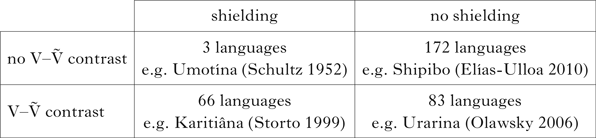
As is clear from Table I, the prediction of the contrast-based approach is largely borne out. In the following subsections I argue that the three apparent counterexamples – attested in Umotína and two dialects of Ese Ejja – are only apparent. For discussion of other apparent counterexamples that fall outside of the range of languages surveyed here, see §6.2.
2.1.1 Shielding in Umotína
Umotína (Macro-Ge; Lima Reference Lima1995), which does not license a contrast in vocalic nasality, exhibits variation between [m] and [b] in the form [iremo’to] ~ [irebo’to] ‘I find’. Lima (Reference Lima1995: 43) writes that ‘although the fluctuation is extremely restricted and [b] is widely represented in the corpus, [she] decided to consider [b] an allophone of /m/’. Lima notes that this analysis lines up with the observations of Schultz (Reference Schultz1952: 86), who writes that ‘all of the ‘m's and ‘b's vary between a definitive pronunciation of ‘m’ and ‘b’, depending on the individual in question’.Footnote 5
Further discussion by Lima (Reference Lima1995: 43) suggests it may be possible to predict the distribution of [m] and [b] by appealing to the [±syllabic] value of the following segment: [b] appears before [−syllabic] /w/ and /j/, and [m] appears before all vowels. If this is correct, there is an analysis available under which the [m~b] variation is conditioned by syllabic position. Under this analysis, the [m–b] contrast is neutralised in all positions, with [m] as the default allomorph that appears before vowels (perhaps to maximise the contrast with voiceless /p/). In onset consonant–glide clusters, however, /m/ is realised as [b], perhaps in order to maximise the cluster-internal sonority rise (see Zec Reference Zec and de Lacy2007: 188–189 on minimal sonority distance in clusters). As shielding is variation between voiced stops and nasals depending on the quality of a neighbouring vowel, Umotína (where variation is conditioned by the syllabicity of the following segment) does not exhibit shielding.
2.1.2 Shielding in Ese Ejja
The remaining two systems that exhibit shielding despite not allowing a contrast in vocalic nasality are both dialects of Ese Ejja (or Ese Eja) (Tacanan; Chavarria Reference Chavarria2012, Vuillermet Reference Vuillermet2012). Chavarria's description of Peruvian Ese Ejja notes that, for speakers of the Palma Real dialect, ‘the phonemes /m/ and /n/ … are realised as [b] and [d], but lightly nasalised’ (Reference Chavarria2012: 23). Vuillermet's description of shielding in Bolivian Ese Ejja is similar – the bilabial and alveolar nasal consonants vary allophonically with oral consonants at the same place of articulation, as illustrated in (3) (data from Vuillermet Reference Vuillermet2012: 169). Vuillermet notes that the variation is conditioned by speech register: nasal allophones are more common in hyperarticulated speech, while oral allophones are more common in fast speech.
-
(3)
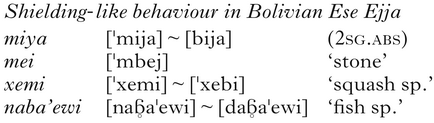
Given the available data, there is an alternative analysis: [n] and [m] are not underlying phonemes, but rather allophones of oral /(n)d/ and /(m)b/. The /(n)d/ → [n] and /(m)b/ → [m] processes occur in order to maximise cues to the contrast between the non-laryngealised stop series (e.g. /b/) and a coexisting laryngealised series (e.g. /ʉ̃/; see Vuillermet Reference Vuillermet2012 on voicing in implosives): a [m–ʉ̃] contrast is presumably perceptually more distinct than a [b–ʉ̃] contrast. The hypothesis then is that Ese Ejja does not exhibit shielding (where an underlying nasal stop can be realised as oral), but rather a different form of contrast enhancement (where an underlying oral stop can be realised as nasal).
2.1.3 Local summary
This subsection has verified that if shielding exists in a given language, so does a V–Ṽ contrast. An anonymous reviewer raises the concern that this finding could be an artefact of descriptive bias: if a linguist were to encounter a language that exhibits shielding, but no contrast depends on it, would the linguist be likely to note that shielding occurs? While it is impossible to rule out this situation – very few of the references provide acoustic measurements, meaning that in the vast majority of cases the reader must blindly trust the author's description – it seems at odds with the fact that many of the descriptions referenced in the South American Phonological Inventory Database do discuss non-contrastive details about the realisation of nasality. For example, in a number of descriptions, the authors provide somewhat detailed description of allophonic nasalisation, conditioned by nasal consonants in certain contexts (see Zariquiey Reference Zariquiey2011 on Cashibo-Cacataibo, Pachêco Reference Pachêco2001 on Ikpeng and Dos Anjos Reference Dos Anjos2011 on Katukina, among many others).
Vocalic nasality is not contrastive in any of the languages cited in the previous paragraph, yet the authors make a point of transcribing allophonic nasalisation of vowels. Thus, in order to maintain the claim that the asymmetry in Table I is an artefact of descriptive bias, there would have to be a good reason why a linguist would be more likely to overlook the existence of shielding than the existence of allophonic nasalisation. Especially given that the vast majority of these descriptions are by linguists who natively speak a language with allophonic nasalisation and not shielding – most, perhaps all, cited sources appear to be written by native speakers of English, French, Portuguese or Spanish – I find this unlikely. One would naively expect that, when describing a language, a linguist would be more likely to notice (and transcribe) those features of the target language that differ from those of their native language.Footnote 6
2.2 Analysis
We can now outline several desiderata for a successful analysis of shielding. First, in order to correctly predict that it should only occur in languages that license a contrast in vocalic nasality, the analysis of shielding must be able to reference facts about a language's phonemic inventory. Second, phonology must be able to ‘see’ the output of the phonetic grammar (see Jun Reference Jun1995, among others). Presumably, the duration and extent of coarticulatory nasality are controlled by a language's phonetic grammar; for shielding to be motivated, the phonological grammar must be aware that oral vowels in nasal environments are nasalised.
These desiderata exclude an analysis of the typology under which shielding is motivated by constraints of the form *NV and *VN (‘a nasal consonant must not be adjacent to an oral vowel’), as *NV and *VN are not sensitive to the structure of a language's larger vocalic inventory. A claim that *NV or *VN motivates shielding predicts that shielding could occur in any language – regardless of whether or not it licenses a contrast in vocalic nasality. Since this prediction is incorrect, *NV and *VN cannot be the right constraints to motivate shielding.Footnote 7
In this article I adopt a version of Dispersion Theory (Flemming Reference Flemming2002), which satisfies both of the criteria described above. To show how the theory provides an account of the typology of environmental shielding, I begin with an analysis of the Karitiâna pattern in (1) above.
I assume that shielding is motivated by a MinDist constraint that requires the contrast between oral and nasal vowels to be sufficiently distinct. MinDist constraints are markedness constraints that set thresholds of distinctiveness for a given contrast, and assign violations to contrasts that are insufficiently distinct (see Flemming Reference Flemming2002). For example, we might imagine that in Karitiâna there is a MinDist constraint requiring oral and nasal vowels to be maximally different: for sufficient distinctiveness, an oral vowel must be fully oral and a nasal vowel must be fully nasal. This MinDist constraint is formalised in (4) as NasDur 1 0 0 %.
-
(4)

A contrast that satisfies NasDur 1 0 0 % is the fully oral vowel in [mba] (5a) vs. the fully nasal vowel in [mã] (5c): the oral vowel is fully oral and the nasal vowel is fully nasal, so the contrast between them is sufficiently distinct. A pair that violates NasDur is the nasalised oral vowel in [mãa] (5b) vs. the fully nasal vowel in [mã] (5c): the oral vowel is marked by some degree of acoustic nasality, so the contrast between it and a nasal vowel is not sufficiently distinct. (Throughout, coarticulatory nasalisation is denoted with a superscripted nasal vowel.)
-
(5)
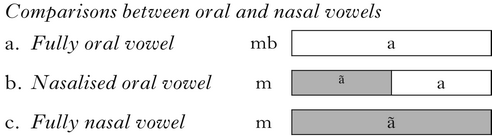
Whether or not (5b–c) is modified in order to satisfy NasDur 1 0 0 %, and how, depends on the ranking of other constraints. One way to satisfy NasDur 1 0 0 % is through neutralisation: if both /ma/ and /mã/ are realised as [mã], there is no V–Ṽ contrast, and NasDur 1 0 0 % is vacuously satisfied. I assume that neutralisation violates Max[−nas] in (6).Footnote 8
-
(6)

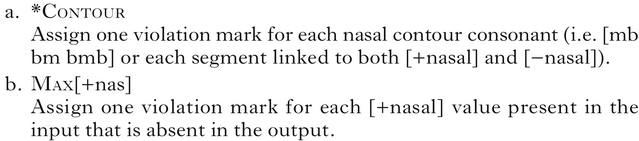
Another way to satisfy NasDur 1 0 0 % is through shielding. By oralising part of a nasal consonant (as in (5a)), the neighbouring oral vowel is rendered fully oral, which satisfies NasDur 1 0 0 %. I assume that shielding results in the violation of either a markedness or a faithfulness constraint, depending on the allophone that is produced: a nasal contour segment (e.g. /ma/ → [mba]) violates *Contour (7a), and a fully oral segment (e.g. /ma/ → [ba]) violates Max[+nas] (7b).
-
(7)
As shown in (8), when NasDur 1 0 0 % is high-ranked, whether or not shielding occurs depends on the relative ranking of the constraints that disprefer shielding (for brevity, only *Contour is shown) and those that disprefer neutralisation (Max[−nas]). Note that in (8) I also assume the activity of Nasalise, an undominated markedness constraint that requires vowels adjacent to nasal consonants to be nasalised in the vicinity of the nasal. When a nasal vowel is adjacent to a nasal consonant (e.g. /mã/), Nasalise is automatically satisfied, as the entire vowel is nasal; when an oral vowel is adjacent to a nasal consonant, Nasalise is satisfied if coarticulatory nasalisation is present. For now I leave aside the question of how much coarticulation is necessary to satisfy Nasalise. For further discussion, see §3.3.
-
(8)
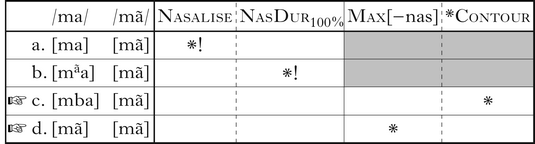
Candidate (8a) fatally violates Nasalise, as the nasal-adjacent oral vowel does not bear any nasal coarticulation. Candidate (b) fatally violates NasDur 1 0 0 %, as the nasalised oral vowel is insufficiently distinct from a nasal vowel (as per the definition in (4)).Footnote 9 For concreteness, I assume that the introduction of coarticulatory nasalisation does not violate any faithfulness constraints, i.e. Max[−nas] or Ident[±nas]. More generally, I assume throughout that input–output faithfulness constraints only regulate contrastive properties. As coarticulatory nasalisation is cross-linguistically non-contrastive (no known language contrasts [ma] with [mãa]), its introduction is not penalised by any faithfulness constraint. Presumably, restrictions on the distribution of coarticulatory nasalisation are regulated by other constraints: in (8), for example, if NasDur 1 0 0 % ≫ Nasalise, coarticulatory nasalisation would be avoided, to render contrasts in vocalic nasality sufficiently distinct.
Candidate (8c), the enhancement candidate, violates *Contour; candidate (8d), the neutralisation candidate, violates Max[−nas] (as /ma/ maps to [mã]). In order for the enhancement candidate to win, as in Karitiâna and other shielding languages, *Contour (and other constraints that penalise shielding) must be ranked beneath Max[−nas]. The other repair – neutralisation of the insufficiently distinct contrast – is discussed further in §4.
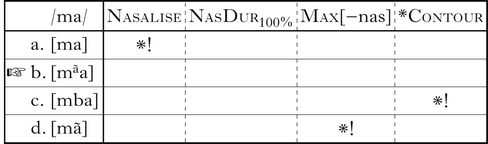
For speakers of languages that lack a contrast in vocalic nasality, NasDur 1 0 0 % is irrelevant: the constraint can only be evaluated when oral and nasal vowels contrast. As shown in the tableau in (9), modification of NV sequences in languages without a contrast in vocalic nasality is not motivated by NasDur 1 0 0 %, and therefore blocked by other constraints that disprefer the result. It is impossible, then, to generate a system in which shielding occurs in the absence of a contrast in vocalic nasality. This is a desirable result, as such systems are unattested.Footnote 10
-
(9)
Up to this point, I have assumed that oral vowels adjacent to fully nasal consonants have some degree of nasalisation. While the phonetics of coarticulatory nasalisation do vary by language (see §3.1), there are regularities. In most of the world's languages, oral vowels adjacent to nasal consonants are reported to be nasalised to some degree (though see Butcher Reference Butcher, Ohala, Hasegawa, Ohala, Granville and Bailey1999 on Australian languages). By contrast, oralisation of nasal vowels adjacent to oral consonants is rarely described, and in the one case I know of, French (Cohn Reference Cohn1990), oralisation is brief. For this article, then, I make two simplifying assumptions: (i) oral vowels adjacent to nasal consonants are always nasalised, and (ii) nasal vowels adjacent to oral consonants are fully nasal. While a full version of the overall theory would build language-specific variation into the analysis, this is not currently feasible, as we do not know what the range of variation is. Note, however, that incorporating language-specific phonetic detail into the analysis would not change in any way the overall predicted typology: in languages where coarticulatory nasalisation is absent, for example, shielding would simply not be motivated.
3 Asymmetries in the typology
Looking beyond Karitiâna, we find that languages differ in unpredictable ways as to the sets of allophones that shielding can produce. The only generalisation apparent in (10) is that if a language licenses medionasals (e.g. [bmb]), it also licenses other contours.
-
(10)
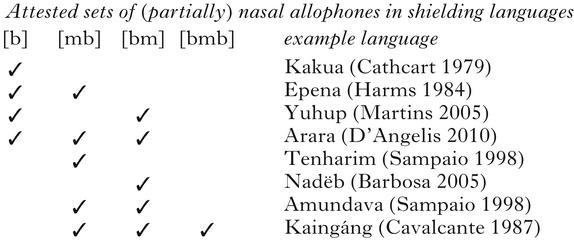
There are, however, predictable asymmetries in the typology of shielding that mirror cross-linguistic asymmetries in the direction and extent of nasal coarticulation. This section shows that asymmetries in the typology of shielding are correctly predicted by the phonetic asymmetries. The major generalisation that emerges is the following: if a language licenses shielding in a context where contrasts in vocalic nasality are expected to be relatively distinct, it also licenses shielding in all contexts where contrasts in vocalic nasality are expected to be less distinct. §3.3 shows that this cross-linguistic generalisation is predicted by a contrast-based analysis, and §3.4 suggests that the generalisation also holds within the grammars of individual languages.
3.1 The phonetics of nasal coarticulation
It is well-known that languages display asymmetries in the direction and extent of nasal coarticulation. In Table II, I summarise data from a variety of phonetic studies that illustrate the known asymmetries. The discussion here focuses on three contexts where coarticulation occurs: perseveratory (NV), tautosyllabic anticipatory (VN]σ) and heterosyllabic anticipatory (V]σN). To the best of my knowledge, further contextual asymmetries (i.e. between word-initial perseveratory (#NV) and word-medial perseveratory (VNV)) have not been discussed. This survey draws mostly on work by Diakoumakou (Reference Diakoumakou2004) and Jeong (Reference Jeong2012), though I have verified all facts with the original sources wherever possible. The cases below include only those languages where there is a claimed asymmetry. Languages like Bengali, where anticipatory and perseveratory coarticulation are claimed to be equally extensive (Diakoumakou Reference Diakoumakou2004: 145), are not included.
Coarticulatory nasalisation survey.
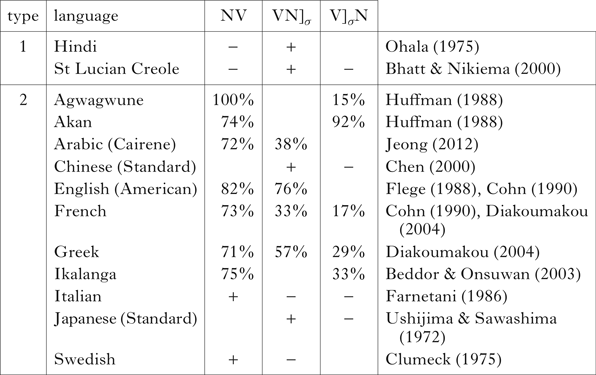
For contexts in Table II where no data is available, the cell is blank. For contexts where data is available, the notation used depends on the source. If the source provides percentages (i.e. how much of an oral vowel is nasalised in a given nasal context), the percentages are given. In cases where the source provide multiple percentages for a given context, I give only the overall average.Footnote 11 When exact percentages are not provided, I did not try to measure them; instead, I use plus/minus notation. For each language, contexts where there is a plus (+) exhibit more nasalisation than contexts where there is a minus (−); if two minuses are listed, it is not clear which context exhibits less nasalisation. As what is important to this argument is only the asymmetries among the contexts considered below, this notation is sufficient.
The data in Table II can be characterised by two generalisations.Footnote 12 First, perseveratory coarticulation is more extensive than heterosyllabic anticipatory coarticulation. The sole apparent exception to this generalisation is Akan; in the cited study (Huffman Reference Huffman1988), the durations of anticipatory and perseveratory nasalisation were roughly equivalent. Because the stimuli are of the form V1NV2, however, and V2 in these tokens is longer than V1, V1 is comparatively more nasalised than V2. Further work is required to determine if the asymmetry found in Huffman's study is in fact due to a difference in the amount of anticipatory vs. perseveratory nasalisation, or rather to a durational asymmetry between word-final vowels and vowels in other positions. The second generalisation characterising Table II is that tautosyllabic anticipatory coarticulation is more extensive than heterosyllabic anticipatory coarticulation. While only four languages in Table II demonstrate this, the tautosyllabic vs. heterosyllabic asymmetry has been documented more widely (see e.g. Schourup Reference Schourup1973, Herbert Reference Herbert1986, Krakow Reference Krakow1993).Footnote 13
These two generalisations appear to hold for all languages: languages displaying the reverse asymmetries have not, to the best of my knowledge, been documented. But whether perseveratory coarticulation is more extensive than tautosyllabic anticipatory coarticulation depends on the language. In Type 1 systems (see Table II), tautosyllabic anticipatory coarticulation is more extensive. In Type 2 systems, either perseveratory coarticulation is more extensive or the data necessary to determine this is not available.
Given these generalisations, we expect there to be two types of system that display asymmetries in nasal coarticulation. In Type 1 systems, as shown in (11), the amount of nasal coarticulation in the tautosyllabic anticipatory context is greater than the amount in the perseveratory context, which is in turn greater than in the heterosyllabic anticipatory context. In (11) and the examples that follow, the precise breakdown of a vowel into percentages of oral and nasal is for illustrative purposes only. What matters is only the asymmetries among the different contexts.
-
(11)
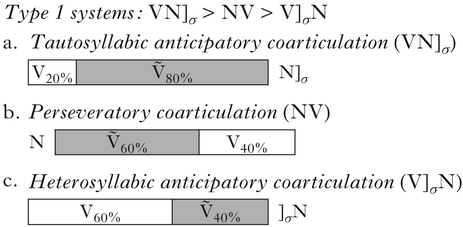
In Type 2 systems, the amount of nasal coarticulation in the perseveratory context is greater than the amount in the tautosyllabic anticipatory context, which is greater than in the heterosyllabic anticipatory context, as shown in (12).
-
(12)
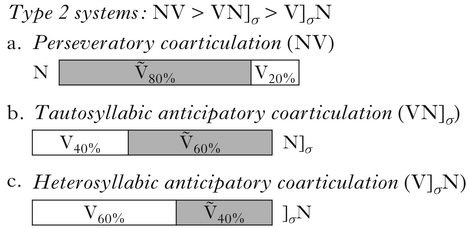
Assuming that the greater the degree of nasal coarticulation on an oral vowel, the less distinct it is from a nasal vowel, we can translate the phonetic asymmetries in (11) and (12) into predictions about where contrasts in vocalic nasality are more and less distinct. In all systems, we expect contrasts in vocalic nasality to be more distinct in the heterosyllabic anticipatory context than in either the perseveratory or tautosyllabic anticipatory context, as oral vowels are less nasalised in the heterosyllabic anticipatory context (ΔV]σN − Ṽ]σN > ΔNV − NṼ, ΔVN]σ − ṼN]σ, where, Δx − y = ‘the perceptual distance between x and y’). In Type 1 systems, we expect contrasts in vocalic nasality to be more distinct in the perseveratory context than in the tautosyllabic anticipatory context (ΔNV − NṼ > ΔVN]σ − ṼN]σ); in Type 2 systems, we expect these contrasts to be more distinct in the tautosyllabic anticipatory context than they are in the perseveratory context (ΔVN]σ − ṼN]σ > ΔNV − NṼ), as in (13).
-
(13)

If shielding is a strategy to maximise cues to contrasts in vocalic nasality, we would expect the phonetic asymmetries outlined above to yield an implicational generalisation regarding the contexts in which shielding occurs: if a given language licenses shielding in a context where a contrast in vocalic nasality is more distinct, it must license shielding in all contexts where the contrast is less distinct. For example, in both Type 1 and Type 2 systems, shielding in the heterosyllabic anticipatory context should imply shielding in both the perseveratory and tautosyllabic anticipatory contexts, because we expect contrasts in vocalic nasality to be more distinct in the heterosyllabic anticipatory context than in the perseveratory or tautosyllabic anticipatory contexts. We do not expect to find systems in which shielding applies in limited contexts, to preserve only the more distinct contrasts in vocalic nasality (e.g. in the V]σN context only).
3.2 Testing the predictions
The predicted and non-predicted shielding patterns are given in Table III, where a checkmark indicates the presence of shielding in the given context. Note that while Table III represents predictions about the typology of shielding, the asymmetries in nasal coarticulation that generate these predictions come from a set of languages that do not license shielding. The assumption is that the phonetic asymmetries documented above represent the full range of possible variation in coarticulatory patterns; while they are only visible in non-shielding languages, the grammar more generally is constrained to generate only these asymmetries.
Predicted and non-predicted shielding patterns.

Pattern (a), with shielding in the tautosyllabic anticipatory (VN]σ) context, is predicted because in Type 1 systems the tautosyllabic anticipatory context is where contrasts in vocalic nasality are the least distinct. Pattern (b), with shielding in the perseveratory (NV) context, is predicted because in Type 2 systems the perseveratory context is where contrasts in vocalic nasality are the least distinct. Pattern (c), with shielding in the tautosyllabic anticipatory and perseveratory contexts, is predicted as these are the two contexts in which vocalic nasality contrasts are least distinct, for both Type 1 and 2 systems. And finally, pattern (d), where shielding occurs in all contexts, is also predicted; in these languages, contrasts in vocalic nasality must be maximally distinct.
All four predicted patterns are attested. Seven of the languages surveyed shield in the tautosyllabic anticipatory context only (14a), 45 shield in the perseveratory context only (14b), eight shield in both contexts (14c) and six shield in all contexts (14d).Footnote 14 Recall that the exact allophones produced by shielding vary by language in unpredictable ways: for example, while Chiriguano (Tupí; Dietrich Reference Dietrich1986) and many other languages use [mb] to shield in NV contexts (/m/ → [mb] / __ V), others (like Kakua; Cathcart Reference Cathcart1979) use [b] (/m/ → [b] / __ V). The specific patterns given in (14) are the allophones from the languages cited in the examples. For more details on the other languages, see Appendix B.
-
(14)
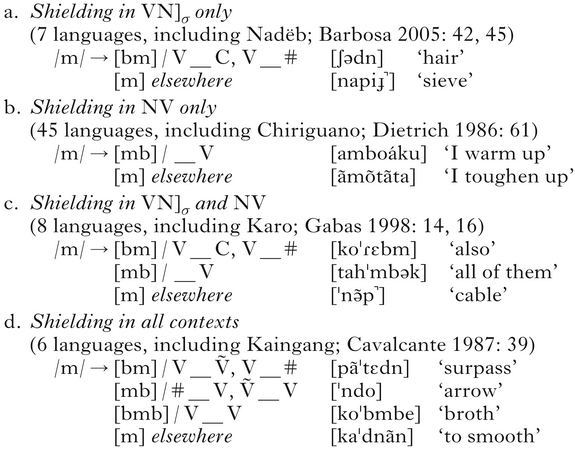
The patterns in (e)–(g) in Table III are predicted not to occur, as shielding occurs in the heterosyllabic anticipatory context only. As contrasts in vocalic nasality are expected to be relatively more distinct in the heterosyllabic anticipatory context, languages that shield in the heterosyllabic anticipatory context should also shield in the other two contexts. As predicted, these patterns are unattested.
3.3 Incorporating the asymmetries into the analysis
For the sake of analysis, I assume that the phonetics of Type 1 and Type 2 languages are as described in (11) and (12). These schematic figures are summarised in (15). Throughout, I assume that phonemically nasal vowels are fully nasal, regardless of the segmental context they occur in.
-
(15)
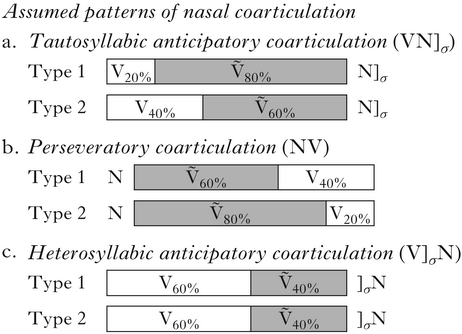
The difference between the Type 1 and Type 2 patterns is due to a difference in the patterns of coarticulatory timing, which are themselves likely due to the activity of more general constraints on the coordination of gestures. While ultimately it would be desirable to build a theory that lays out the possible and preferred ways of coordinating velic gestures with other kinds of gestures, for present purposes it is sufficient to assume that there are only the two possible kinds of coarticulatory pattern in (15), and that they arise due to a difference in the definition of Nasalise (see §2.2). The constraint responsible for the Type 1 pattern is Nasalise T y p e 1 in (16a); the Type 2 pattern is compelled by Nasalise T y p e 2 in (16b).
-
(16)
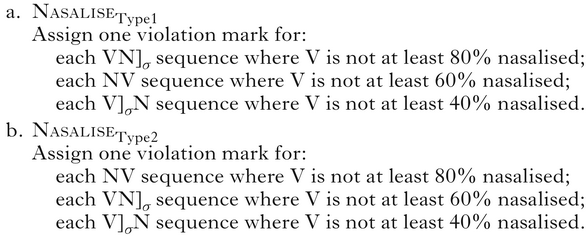
In what follows, I assume that one Nasalise constraint is active in each language; the specific amounts of nasal coarticulation required in each context are parameterised on a language-specific basis. It is worth emphasising at this point that Nasalise is meant to function as a shorthand for whatever constraints compel nasal coarticulation, and is not meant to function in any way as a claim about how those constraints are defined. Presumably, any successful theory of the grammar of coarticulation needs to explain why certain contextual asymmetries are universal (e.g. more coarticulation in VN]σ than V]σN) and others are not (e.g. language-dependent amounts of coarticulation in NV and VN]σ). Nasalise does not do this – it would be possible, for example, to define a version of the constraint that requires more nasalisation in V]σN than in VN]σ. But as our interest is not in how to derive universals of nasal coarticulation, but in what can be derived from them, the constraints in (16) are sufficient.
The attested typology of shielding patterns can be derived by defining MinDist constraints that set varying thresholds of distinctiveness for contrasts in vocalic nasality. A constraint that requires oral vowels to be at least 50% oral to be distinct from nasal vowels, for example, penalises only the contrasts between oral vowels in (15a, b) and nasal vowels in those same environments.
A question arises here: when we talk about partially nasalised vowels, should they be described in terms of percentage or absolute duration of acoustic nasality? I will assume here that referring to the ratio of nasality in a vowel is relevant: although this has not been shown, it seems reasonable to believe that a longer vowel that is 50% nasalised will be perceived as less nasal than a shorter vowel that is 75% nasalised, even if the absolute duration of vocalic nasality in the two vowels is the same. There is some evidence, however, that the absolute duration of acoustic nasality is also relevant to the perception of vocalic nasality. For example, Whalen & Beddor (Reference Whalen and Beddor1989) provide experimental evidence that the longer the duration of a vowel with an intermediate level of nasalisation, the more likely listeners are to identify it as nasal. This preference for long nasal vowels is reflected by a typological asymmetry: of the twelve languages in Maddieson (Reference Maddieson1984) that license contrasts in both vowel length and nasality, several license a contrast in nasality for long vowels only (e.g. Breton), but none license it for short vowels only.Footnote 15
The analyses presented here make reference to ratios of nasality, not absolute duration. Once we better understand the roles that absolute and relative duration of nasality play in the perception of vocalic nasality contrasts, it is to be hoped that both of these factors can be integrated into the analysis.
3.3.1 Languages with shielding in all contexts
To analyse systems in which shielding occurs in all contexts, we need a MinDist constraint that requires an oral vowel to be fully oral, and a nasal vowel to be fully nasal, for the contrast between them to be sufficiently distinct. This constraint is NasDur 1 0 0 % in (4) above. When the constraint is high-ranked, all contrasts in vocalic nasality adjacent to a nasal consonant are dispreferred, as oral vowels are nasalised in these environments (see (15)). Thus shielding is motivated even in the heterosyllabic context, as shown in (17). (Nasalise T y p e 1 / 2 is referred to as such because either Nasalise T y p e 1 or Nasalise T y p e 2 would derive the intended result.)
-
(17)
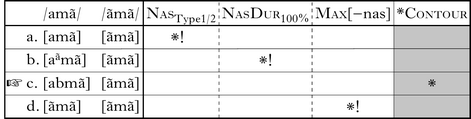
3.3.2 Languages with tautosyllabic anticipatory and perseveratory shielding
To analyse systems where shielding occurs in the tautosyllabic anticipatory and perseveratory contexts, I assume that some languages place less strict requirements on vocalic nasality contrasts. For example, a language might only require oral vowels to be 50% oral to be distinct from nasal vowels. A constraint enforcing this less stringent requirement is NasDur 5 0 % in (18).
-
(18)

In both Type 1 and Type 2 systems, NasDur 5 0 % is satisfied in the heterosyllabic anticipatory context only. This is because the heterosyllabic anticipatory context is the only context of the three in which vowels are more than 50% oral; see (15). The result is that shielding is motivated in both the perseveratory and the tautosyllabic anticipatory contexts, as illustrated in (19). Because the oral vowel must be more than 50% nasal (as required by Nasalise T y p e 1 / 2; cf. (19a.ii), where a lesser amount of nasal coarticulation violates Nasalise T y p e 1 / 2), the contrast between it and a nasal vowel does not satisfy NasDur 5 0 %. In the tableaux below, a subscripted percentage either preceding or following the vowel denotes how much of the vowel is oral.
-
(19)
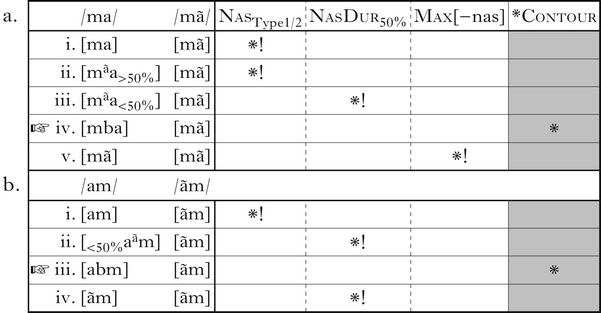
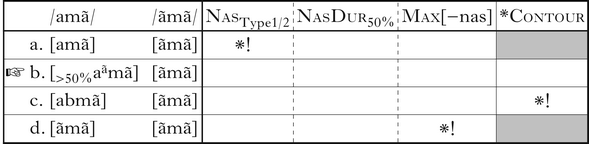
In the heterosyllabic anticipatory context, contrasts between less nasalised (>50% oral) vowels and fully nasal vowels do not violate NasDur 5 0 %, so shielding is not motivated, as illustrated in (20).
-
(20)
3.3.3 Languages with either perseveratory or tautosyllabic anticipatory shielding
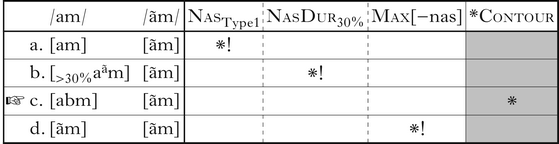
To analyse systems in which shielding occurs in only one context, either perseveratory or tautosyllabic anticipatory, we have to assume that there are languages that place even less strict requirements on the distinctiveness of vocalic nasality contrasts. For example, a language might require its oral vowels to be only 30% oral for them to be sufficiently distinct from nasal vowels, as specified by the constraint in (21). While this sounds minimal, it is not uncommon. For example, vocalic nasality is contrastive in the perseveratory context in French, even though oral vowels are significantly nasalised following nasal consonants (see Table II).
-
(21)

Which contrast violates NasDur 3 0 % depends on system type. For Type 1 systems, contrasts in the tautosyllabic anticipatory context violate NasDur 3 0 %, as oral vowels in this context are less than 30% oral. Contrasts in the perseveratory and heterosyllabic anticipatory contexts do not violate NasDur 3 0 %, as oral vowels in these contexts are more than 30% oral. Thus for Type 1 systems, NasDur 3 0 % motivates shielding in the tautosyllabic anticipatory context only, as in (22).
-
(22)
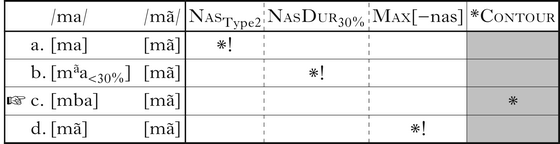
For Type 2 systems, only contrasts in the perseveratory context violate NasDur 3 0 %, as oral vowels in the perseveratory context are less than 30% oral (see (23)). Contrasts in the tautosyllabic and heterosyllabic anticipatory contexts do not violate NasDur 3 0 %, as oral vowels are less nasalised.
-
(23)
At this point it is worth reiterating that the percentages used in all NasDur constraints, as well as the finer points of the representations they assess, are not crucial. What is crucial are the cross-linguistic asymmetries in coarticulation documented in Table II. Regardless of the exact extent of coarticulatory nasalisation or the exact point at which nasalisation in an oral vowel renders it indistinguishable from a nasal vowel, setting thresholds of distinctiveness with MinDist constraints allows us to derive those and only those shielding patterns that obey the existing implicational laws.
3.3.4 Local summary
In sum, the contrast-based approach makes a set of accurate predictions regarding contextual asymmetries in the typology of shielding. Specifically, it correctly predicts that shielding in some context C1 implies shielding in some context C2 if a contrast in vocalic nasality is more distinct in C1 than it is in C2. MinDist constraints naturally capture this generalisation, because they set thresholds at which contrasts are sufficiently distinct. If some contrast x–y violates a given MinDist constraint in some context C1, then x–y will also violate that MinDist constraint in all contexts in which x–y is as distinct as or less distinct than it is in C1. As it is impossible to define a MinDist constraint that penalises only relatively distinct contrasts, there is no way to derive the unattested patterns in which shielding targets only the more distinct contrasts in vocalic nasality.
3.4 Language-internal asymmetries
The contrast-based analysis correctly predicts that when shielding is limited to certain contexts in a language, it occurs in those contexts where vocalic nasality contrasts are the least distinct. This subsection provides further evidence for this prediction from asymmetries in Krenak (Pessoa Reference Pessoa2012), Aguaruna (Overall Reference Overall2007) and Karajá (Ribeiro Reference Ribeiro2012).
3.4.1 The role of stress in Krenak
In Krenak (Macro-Ge; Pessoa Reference Pessoa2012), shielding occurs in all contexts, but more frequently in unstressed syllables than in stressed syllables. Examples are given in (24), from Pessoa (Reference Pessoa2012: 114–121): (a) illustrates shielding in the perseveratory context before an oral vowel vs. its absence before a nasal vowel, and (b) illustrates shielding in the tautosyllabic anticipatory context vs. its absence after a nasal vowel.
-
(24)

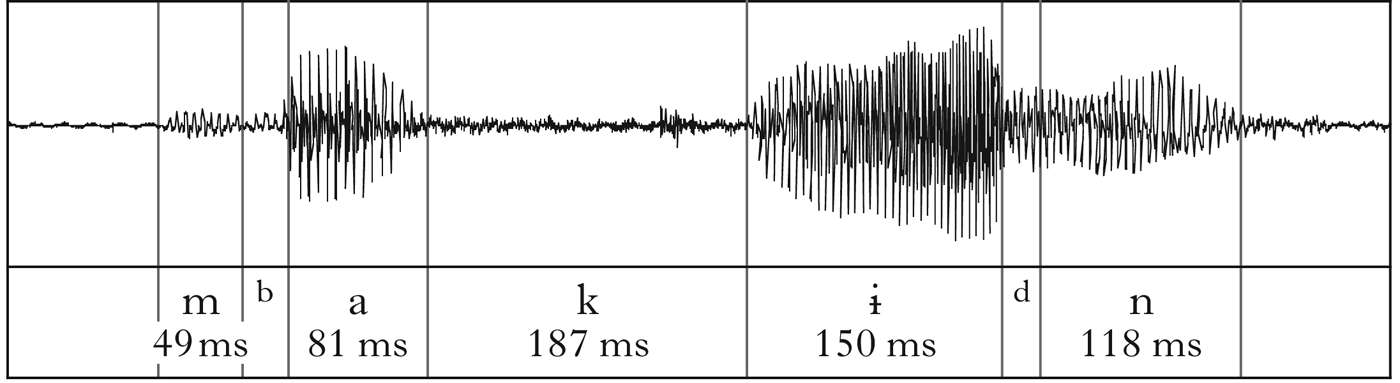
Why should a shielding process preferentially apply in stressless syllables? One answer appeals to a potential link between stress and duration: perhaps stressed vowels are longer than stressless vowels. Primary stress in Krenak is word-final (Pessoa Reference Pessoa2012: 113), and some evidence for final lengthening comes from the few phonetic measurements provided of disyllabic words, where there is a substantial difference between the durations of the word-initial and word-final vowels. This is illustrated by the waveform in Fig. 1, from Pessoa (Reference Pessoa2012: 96): at 150 ms, word-final [ɨ] in [mbakɨdn] is almost twice as long as non-final [a]. This difference likely cannot be traced to an inherent durational asymmetry between [ɨ] and [a], as low vowels are generally longer than high ones (Lehiste Reference Lehiste and Lass1976).
Waveform and segmental durations for Krenak [mbakɨdn] ‘little bird’, from Pessoa (2012: 96).
If we assume that the amount of nasal coarticulation induced on a vowel adjacent to a nasal consonant is consistent regardless of the vowel's length (i.e. the velic gesture is frequently longer than the oral closure of the nasal consonant, but does not depend on the length of other gestures that coincide with and/or surround it), we would expect contrasts in vocalic nasality to be less distinct for short vowels than they are for long vowels. While a given amount of nasal coarticulation might only take up 50% of a long vowel, for example (25a), that same amount of nasal coarticulation will take up comparatively more of a shorter vowel (25b).
-
(25)
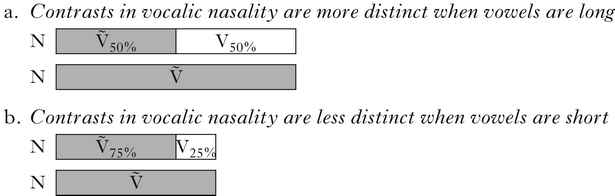
It is possible to motivate shielding in only (25b) by defining a MinDist constraint that considers the contrast in (25a), but not the one in (b), to be sufficiently distinct. NasDur 5 0 % in (18) suits this purpose. As the oral vowel in (a) is only 50% nasal, NasDur 5 0 % is satisfied, as shown in (26). (In (26) and (27), I assume that Nasalise compels the patterns of coarticulation diagrammed in (25).)
-
(26)
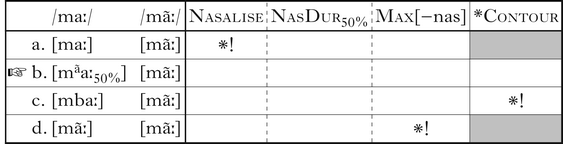
The contrast in (25b) violates NasDur 5 0 %, however, as the oral vowel is only 25% nasal. Shielding is therefore motivated for short, but not long, vowels.
-
(27)
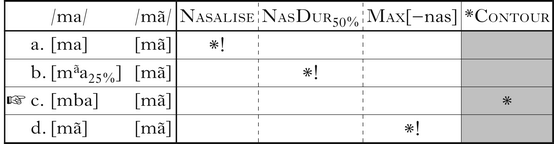
The fact that Krenak exhibits greater frequency of shielding in stressless syllables is predicted by a contrast-based account: a given amount of nasal coarticulation will render a stressless (or shorter) oral vowel comparatively less distinct from a nasal vowel than it will a stressed (or longer) oral vowel. As was the case for the contextual asymmetries documented above, when shielding targets only some contexts, it targets those contexts in which contrasts in vocalic nasality are less distinct.
3.4.2 The role of vowel quality in Aguaruna and Karajá
In Karajá (Macro-Ge; Ribeiro Reference Ribeiro2012), shielding occurs only in the perseveratory context.Footnote 16 It is also dependent on the quality of the following vowel: shielding largely does not occur before /a/. A similar pattern is attested in Aguaruna, where shielding is generally more likely when preceding high vowels, and almost entirely absent preceding a word-final /a/ (examples in (28) from Overall Reference Overall2007: 53).Footnote 17
-
(28)
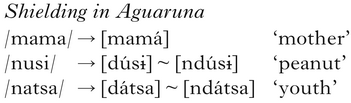
The vocalic inventories of Karajá (Ribeiro Reference Ribeiro2012: 86) and Aguaruna (Overall Reference Overall2007: 40) are provided in (29). Note that, in both languages, /a/ is the only low vowel.
-
(29)
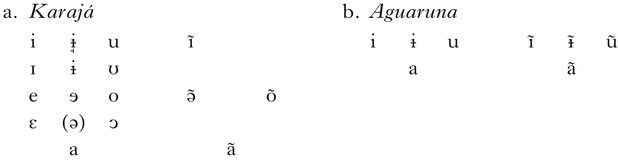
Generally speaking, we know that low vowels are longer than higher vowels (Lehiste Reference Lehiste and Lass1976). In Karajá, it may be the case that shielding does not occur adjacent to oral [a] because it is longer than the other oral vowels: in nasal contexts, assuming a fixed amount of nasal coarticulation, we would predict the contrast between [a] and its nasal counterpart to be the most distinct. In Aguaruna, the same general principles apply; although the context-specific ban on pre-[a] shielding in final position cannot be linked to any other known facts about Aguaruna's phonology, it is not surprising, given the general prevalence of word-final lengthening in the world's languages (Lehiste Reference Lehiste and Lass1976, Lunden Reference Lunden2014). If word-final [a] is longer than other [a]’s in Aguaruna, a word-final [a–ã] contrast in a nasal context will be more distinct than non-final [a–ã] in that same nasal context, and therefore less in need of enhancement. Here too, the subset of contexts targeted by shielding in Karajá and Aguaruna are those contexts in which contrasts in vocalic nasality are expected to be less distinct.Footnote 18
4 Extensions: the typology of neutralisation
Faced with an insufficiently distinct contrast, a language has two options: preserve the contrast through enhancement, or neutralise it. This article has focused only on enhancement, but the analysis of enhancement makes predictions regarding the typology of neutralisation as well. Under a contrast-based analysis, shielding and neutralisation of vocalic nasality contrasts are motivated by the same set of MinDist constraints. If Max[−nas] dominates *Contour (or other constraints that disprefer shielding), the language will shield (as shown throughout §3); if *Contour dominates Max[−nas], the language will neutralise, as in (30).
-
(30)
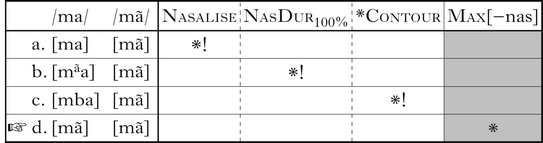
Under a contrast-based analysis, shielding and neutralisation are two sides of the same coin: both are strategies to avoid insufficiently distinct contrasts in vocalic nasality.
Given that shielding and neutralisation are motivated by the same set of MinDist constraints, the contrast-based analysis predicts that the same implicational laws should govern both. Recall that if shielding targets a vocalic nasality contrast in some context where the contrast is more distinct, it also targets this contrast in all contexts where it is less distinct. As a corollary, if neutralisation targets a vocalic nasality contrast in some context where it is more distinct, it should also target this contrast in all contexts where it is less distinct (see Steriade Reference Steriade1997 and others cited in the introduction for evidence that this is true in other domains). More generally, if two contexts C1 and C2 differ in that some contrast x–y is better-cued in C1 than it is in C2, then both enhancement and neutralisation targeting x–y in C1 must also target x–y in C2 (see also Flemming Reference Flemming2008: 32ff).
To test this prediction, I conducted a survey composed of all descriptive grammars from PL5000–PM7875 available in the MIT Hayden Library, as well as various online sources. Of the languages in the sample, 98 licensed contrasts in vocalic nasality. In 32, contextual restrictions on the distribution of these contrasts were explicitly discussed in the source. Asymmetries in the typology of neutralisation, for the most part, directly mirror asymmetries in the typology of shielding, as shown in Table IV. For a list of languages surveyed, and information about the contexts of neutralisation (where applicable), see Appendix D.
Results from the neutralisation survey.
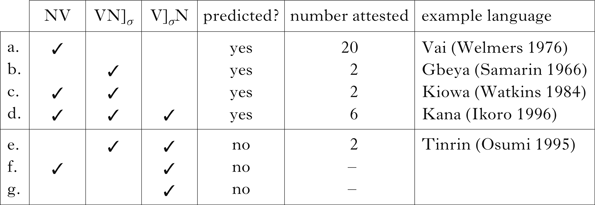
The two attested systems in (e) are predicted not to exist, but it is possible to show that these counterexamples are only apparent. There is substantial evidence that Tinrin (Osumi Reference Osumi1995) has (or had) a process of regressive nasal spreading. While sequences of oral (VV) and nasal (ṼṼ) vowels are possible, there are restrictions on sequences of oral and nasal vowels (Osumi Reference Osumi1995: 24): a nasal vowel can precede an oral vowel (ṼV), but an oral vowel cannot precede a nasal vowel (*VṼ). This is exactly what we expect from a language that licenses regressive [+nasal] spreading. Further evidence for a process of regressive nasal spreading comes from restrictions on vowel sequences across approximants ([w], [r~ɾ] and [ɽ]). Across these segments, vowels agree for nasality in the vast majority (91%, or 305/335) of cases. The existing mismatches are almost exclusively ṼRV (26/30): the general absence of VRṼ is again consistent with the activity of regressive [+nasal] spreading.
Across voiceless obstruents, the rate of matches is lower (65%, or 43/66), suggesting that spreading applies less consistently (if at all) across stops. More frequent application across sonorants is consistent with implicational laws governing the typology of nasal spreading (cf. Schourup Reference Schourup1973, Walker Reference Walker2000). The other language with neutralisation of vowel nasality contrasts in both anticipatory contexts is Xârâcùù (Lynch Reference Lynch, Lynch, Ross and Crowley2002), a relative of Tinrin. While there is less data available, the counts largely resemble Tinrin: vowels match for nasality in most VRV sequences (96%, or 48/50), but they are less likely to match across voiceless stops (72%, or 23/32).Footnote 19
Neutralisation of all pre-N vocalic contrasts in nasality in these two languages is not a reaction to insufficiently distinct contrasts, but a consequence of an unrelated process of unbounded regressive nasal spreading.Footnote 20 As progressive nasal spreading would be indistinguishable from neutralisation of all postnasal vocalic nasality contrasts, the pattern that we find in Tinrin and Xârâcùù is the only one that the possibility of nasal spreading adds to the predicted typology of neutralisation.
In the current survey, the prediction that the typologies of shielding and neutralisation should parallel one another appears to be borne out: all apparent counterexamples have a plausible reanalysis. (To verify the prediction more fully, a larger sample size would of course be necessary.)
5 Are there alternatives?
So far, this article has shown that analysing environmental shielding as contrast preservation makes a set of strong and accurate predictions. But is it possible to account for the existing set of generalisations without appealing directly to constraints on contrast? This section considers three alternative analyses. The first, discussed in §5.1, claims that shielding arises from spreading of [−nasal] (e.g. Storto Reference Storto1999: 26–31). The second, discussed in §5.2, uses Cue constraints (e.g. Boersma Reference Boersma, Boersma and Hamann2009) instead of directly referencing contrast; the third, discussed in §5.3, treats shielding as a byproduct of channel bias (Ohala Reference Ohala, Masek, Hendrick and Miller1981, Blevins Reference Blevins2004, Moreton Reference Moreton2008). While these alternatives are capable of analysing portions of the shielding typology, it is unclear how any of them in their current form could be extended to cover the full range of generalisations presented in this article. A general failing of all these alternatives is that they fail to link the possibility of shielding to facts about the set of contrasts that a language licenses: they do not recognise that shielding is a form of contrast enhancement.
5.1 Spreading of [—nasal]
The only existing alternative analysis of shielding claims that it arises due to local spreading of [−nasal] from an oral vowel onto (part of) a nasal stop (e.g. Storto Reference Storto1999: 26–31, Eberhard Reference Eberhard2004), perhaps motivated by a ban on nasal consonants followed by oral vowels (*NV). A case of shielding in the perseveratory context, for example, is analysed as (31). (Below, A0 denotes the closure phase of the stop, and Am a x the release; see Steriade Reference Steriade1993a on aperture positions.)
-
(31)
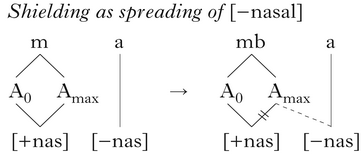
A spreading-based analysis, however, does not predict the link between facts about the inventory (i.e. the existence of a contrast in vocalic nasality) and facts about the phonotactics (i.e. the possibility of shielding). As shown above, this is crucial to the analysis. While it is possible to solve this problem by allowing [−nasal] to spread only if [±nasal] is contrastive for vowels, this analysis has no explanation for contextual asymmetries in the shielding typology (§3), nor does it predict that the typologies of shielding and contextual neutralisation should mirror one another (§4). (For additional arguments that [−nasal] cannot spread, see Steriade Reference Steriade1993b.)
5.2 Cue constraints
The proposed analysis of shielding claims that it is crucial to explicitly reference contrast by appealing to acoustic properties that cue phonemic contrasts. Other approaches appeal to acoustic properties that cue the presence of individual feature values or segments, and do not reference contrast. Here I explore how one such model, Boersma's (Reference Boersma, Boersma and Hamann2009) Parallel Bidirectional Phonology and Phonetics (BiPhon) model, might account for the data in this article. We focus here on Cue constraints, which penalise correspondences between abstract phonological units and their phonetic realisations.Footnote 21 A schematic Cue constraint is given in (32); this constraint penalises a correspondence between a vowel that is [−nasal] and a vowel that is ≥X% nasalised.
-
(32)

As Cue constraints interact with more traditional markedness and faithfulness constraints, instances of (32) can motivate shielding and neutralisation. Violations of */V/[≥60% nasalised], for example, can be ameliorated through neutralisation (mapping the nasalised oral vowel to a nasal one) or shielding (eliminating the nasalisation), depending on the ranking of the relevant constraints.
While a model that incorporates Cue constraints might be capable of accounting for the existing contextual asymmetries in shielding, as well as their parallels in the typology of neutralisation, it cannot account for the generalisation that shielding only occurs in languages that license a contrast in vocalic nasality. Cue constraints do not make reference to contrast: (32) is applicable to all languages, regardless of whether or not they license a contrast in vocalic nasality. Although there are hints that the range of cues referenced by Cue constraints is dependent on the language's phonemic inventory (Hamann & Downing Reference Hamann and Downing2017: 93, 101), this aspect of the theory has not been spelled out. Further developments may change this conclusion, but at present the inability to refer to contrast renders the BiPhon model unable to account for the full set of generalisations presented in this article.
5.3 Channel bias
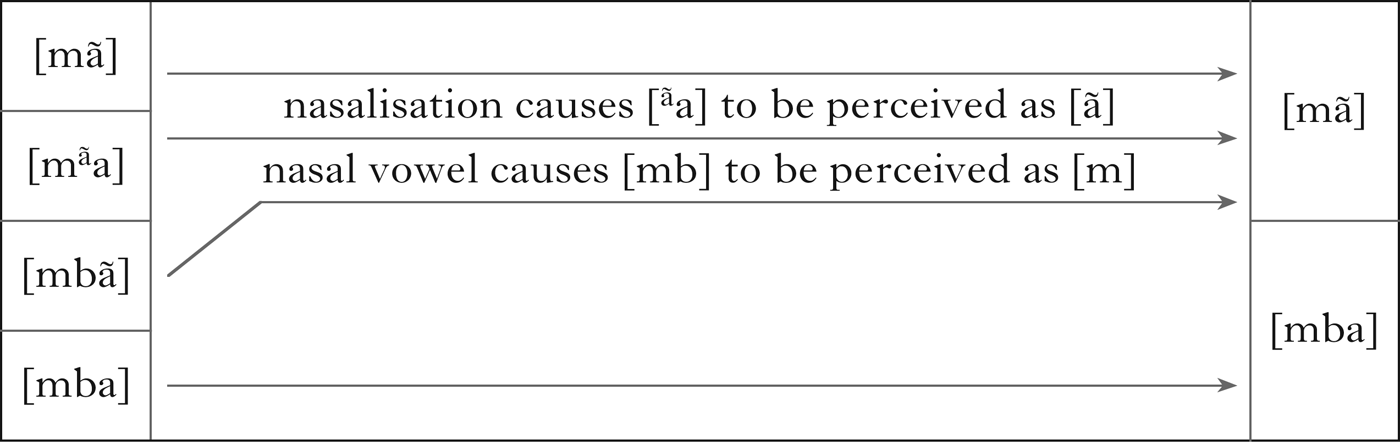
The final alternative I discuss holds that shielding emerges as a byproduct of channel bias, or innocent misapprehension (Ohala Reference Ohala, Masek, Hendrick and Miller1981, Blevins Reference Blevins2004, Moreton Reference Moreton2008). Under this alternative, shielding is not the result of enhancement, but rather of neutralisation processes that have occurred as a result of misperception arising during language transmission. For example, consider the system in (33), in which all syllables are open, and shielding occurs in the perseveratory context only.
-
(33)

The system in (33) could have developed from an earlier stage in which nasal and voiced prenasalised consonants were contrastive. Over time, however, oral vowels following nasal consonants could have been confused with, and reinterpreted as, nasal vowels ([mãa] > /mã/). In addition, prenasalised consonants preceding nasal vowels could have been reinterpreted as plain nasal consonants ([mbã] > /mã/; see Beddor & Onsuwan Reference Beddor, Onsuwan, Solé, Recasens and Romero2003 on cues to the N vs. NC contrast). The resulting system is one in which nasal and prenasalised consonants are in complementary distribution, as in Fig. 2.
Proposed historical source of the distribution in (33).
This account, however, faces a number of problems in accounting for some of the more complex patterns attested in the typology. First, it is unclear how it would be able to account for systems in which shielding occurs in only a subset of the contexts in which it could possibly occur. Consider for example those systems in which shielding occurs in only the tautosyllabic anticipatory context (e.g. Nadëb; Barbosa Reference Barbosa2005). In these systems, both oral and nasal vowels can follow oral and nasal consonants, but shielding results when a coda nasal is preceded by an oral vowel, as in (34).
-
(34)
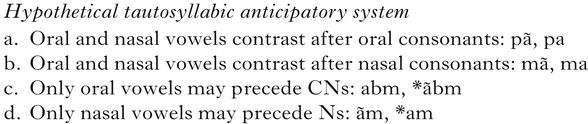
A channel-bias account of these facts would assume that the historical starting point for the system in Fig. 3 was a language in which a contrast between nasal and preoralised nasal consonants coexisted with a contrast in vocalic nasality. Over time, however, oral vowels preceding nasal consonants would be confused with, and reinterpreted as, nasal vowels ([aãm] > /ãm/). Preoralised stops following nasal vowels would be confused with, and reinterpreted as, plain nasals ([ãbm] > /ãm/).
Proposed historical source of the distribution in (34).

But if the system in (34) is one in which nasal and preoralised nasal consonants originally contrasted, why are preoralised segments no longer attested in any context? Why, for example, do we not find an intervocalic contrast between /abmã/ and /amã/ in any language with the shielding pattern in Fig. 3? To explain why a language that displays the shielding pattern in Fig. 3 should ban /bm/ elsewhere, it would be necessary to postulate an additional markedness constraint that bans the occurrence of /bm/ in all prevocalic contexts: a constraint like *CN / __ V in (35), for example, would prevent both [bma] and [abma] from surfacing, but crucially allow [abm] to exist.
-
(35)

But the proposal that * CN / __ V is a part of Con becomes problematic when we consider how preoralised segments pattern in languages where they contrast with other segment types. In the two clear cases discussed by Poser (Reference Poser1979: 32–35) where preoralised and other kinds of stops contrast, preoralised segments are allowed only in prevocalic position. While the data is limited, a constraint banning postnasals from only prevocalic position does not provide an accurate characterisation of the existing typology: it predicts an unattested pattern in which phonemic preoralised segments are allowed in coda position only. The contrast-based analysis presented in §2 and §3 avoids this problem, as it does not need to employ contextual markedness constraints to characterise a pattern like Nadëb: shielding in coda position only results from an interaction between MinDist and context-free *Contour (see §3.3.3). Without appealing to a constraint like *CN / __ V, it is unclear how the pattern in Nadëb – where [bm] and [m] both appear finally, but do not contrast prevocalically – would be derived under a channel-bias account.
A second difficulty becomes apparent when we consider the set of allophones produced by shielding in Karitiâna (Storto Reference Storto1999). In languages like Karitiâna, nasals are realised as medionasals between two oral vowels (/ama/ → [abmba]; though cf. Everett Reference Everett2007 on variation between [bmb], [b] and [mb] in Karitiâna). An analysis in which shielding arises as a result of contextual neutralisation would have to assume that medionasals originally contrasted with plain nasals, and that complementary distribution between medionasals and other kinds of (partially) nasal segments arose through neutralisation of consonantal and vocalic nasality contrasts, in different contexts. As medionasals are unattested outside of shielding phenomena, however, proposing that they contrasted with other stops at any point in any language's history is undesirable. More succinctly, the channel-bias account of shielding must assume that all allophones produced by shielding were at one point contrastive. In the case of medionasals, this is not a desirable assumption.
The fundamental problem is that the channel-bias account is only capable of deriving patterns of neutralisation, not patterns of enhancement (though cf. Blevins Reference Blevins2004: 285–289). And while some specific instances of enhancement can be reanalysed as arising via neutralisation, like the prevocalic shielding example in (33), this is not true of the entire typology.
6 Extensions and conclusions
This article has argued that any successful analysis of the typology of shielding in South American languages must explicitly reference contrast. Before concluding, this section provides a brief discussion of two necessary areas of further research: further contextual restrictions (and the lack thereof) on the distribution of shielding (§6.1), and support for the analysis beyond the typological survey discussed in §2 and §3 (§6.2).
6.1 Further asymmetries in the typology of shielding
In many cases, languages do not license vocalic nasality contrasts in all positions within the word: in Wari’ (Chapakuran; Everett & Kern Reference Everett and Kern1997), for example, the vocalic nasality contrast is licensed only in stressed syllables. Under the assumption that MinDist constraints compare only sounds that occur in the same context, the analysis proposed above predicts that the distribution of shielding should track these positional asymmetries where they exist. In other words, shielding should only be licensed in environments where there is a contrast in vocalic nasality to protect. This prediction appears to hold: descriptions are often not clear about contextual limitations on contrasts in vocalic nasality, but in the five surveyed cases where it is extremely likely that contextual restrictions exist, shielding applies only in contexts where the vocalic nasality contrast is licensed (see Appendix B). But there are other ways in which shielding does not track the distribution of vocalic nasality contrasts. In particular, whether or not shielding applies before a given oral vowel is not sensitive to whether or not that oral vowel has a nasal correspondent. In Karajá, for example, shielding applies before [ɪ ɨ ʊ], even though nasal [ĩ ĩ̵ ʊ̃] do not exist (see the examples in Ribeiro Reference Ribeiro2001: 79). More broadly, for 26 of the 66 shielding languages surveyed, the oral vowel inventory is larger than the nasal vowel inventory (see Appendix B); none of the descriptions, however, mention that shielding fails to occur before oral vowels that lack nasal correspondents.
There are at least two potential explanations for this fact. The first is that predictable changes in the vowel quality of nasalised vowels (e.g. Beddor Reference Beddor1983) impact the distinctiveness of contrasts between those vowels and phonemically nasal vowels of different qualities. For example, Karajá [ɪ] contrasts not with nasal *[ĩ], but with nasal [ĩ]. It could be the case, however, that the quality of an allophonically nasalised [ɪ] is similar to [ĩ], thus rendering the contrast between them insufficiently distinct. Whether or not an explanation along these lines can account for the lack of sensitivity to vowel quality more generally is a question outside the scope of this article, as verifying this hypothesis would require careful study of allophonic nasalisation in the 26 languages with fewer nasal than oral vowels. Another potential explanation for this fact is that the MinDist constraints that motivate shielding can refer only to the presence vs. absence of a [±nasal] contrast: they evaluate only the perceptual distance between prototypical oral and nasal vowels (i.e. V vs. Ṽ), rather than each individual contrast between, for example, [i] and [ĩ], or [a] and [ã]. If this latter explanation is correct, it would have substantial implications for the formalisation and implementation of distinctiveness constraints: the claim that the relevant contrast is the one between a prototypical oral and a prototypical nasal vowel implies that distinctiveness constraints are evaluated at a higher level of abstraction than is currently assumed. As it is not clear which of these explanations (if either) is correct, I leave the questions raised here for future research.
6.2 Shielding in other languages
As noted at the outset, the generalisations regarding the typology of shielding established in this article are based on a survey of South American languages. In order for the conclusions to hold universally, evidence that the generalisations hold across a more geographically diverse sample of languages would be required. While the investigation necessary to provide this evidence is beyond the scope of this article, a cursory examination of languages from other regions reveals some that license both shielding and a contrast in vocalic nasality (e.g. Slave, Na-Dené; Rice Reference Rice1989: 58–60), as well as several others that appear to allow shielding without licensing a contrast in vocalic nasality.Footnote 22 These latter cases are discussed below.
6.2.1 Prestopping in Australian languages
Prestopping, attested mainly in Australian and Austronesian languages, appears similar to shielding. Examples of prestopping from Arabana-Wangkangurru (Hercus Reference Hercus1972: 296) are given in (36); where Bāgundji has a nasal, Arabana-Wangkangurru has a prestopped nasal.
-
(36)
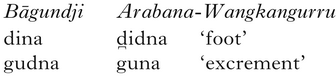
But this is not the whole picture: in Arabana-Wangkangurru, as well as many other languages that exhibit nasal prestopping, laterals are prestopped as well (e.g. Arabana-Wangkangurru madla ‘dog’, bidla ‘name’). This suggests that the alternations in (36) instantiate a process that is distinct from the class of shielding processes discussed above. As defined in §2, shielding targets only nasals; prestopping is capable of targeting a larger class of sonorants. The two kinds of process also clearly have different motivations: prestopping does not appear to be motivated by a desire to protect the orality of a preceding vowel, as we expect vowels preceding laterals to be fully oral. The notion that prestopping has nothing to do with protecting the orality of a preceding vowel is supported by reports that prestopping of nasal consonants can occur after nasal vowels in Stieng (Austro-Asiatic) and Thai (Tai-Kadai) (Poser Reference Poser1979: 43–44).
Following Steriade (Reference Steriade1993b), I hypothesise that prestopping occurs to enhance a syntagmatic sonority contrast between a stressed vowel and the consonant that immediately follows it. In languages that license prestopping, the allophonic variation is frequently or always limited to immediately posttonic position. Steriade (Reference Steriade1993b) links this restriction to Edwards & Beckman's (Reference Edwards and Beckman1988) suggestion that stress ‘induces a hypercharacterization of the sonority contrasts within the syllable’, and proposes that, in processes of prestopping, ‘the sonority contrast is being exaggerated by turning the coda consonant into an obstruent’ (Steriade Reference Steriade1993b: 343).
It is possible to distinguish a case of shielding from a case of prestopping, because they have different typological signatures: prestopping processes share a number of characteristics (outlined by Steriade Reference Steriade1993b: 342) that shielding processes do not. For example, as discussed above, prestopping processes frequently target both nasals and laterals. In addition, prestopping processes target only long or lengthened sonorants, either underlyingly geminate (as in Icelandic; Einarsson Reference Einarsson1945) or predictably lengthened (as in Arabana-Wangkangurru). This is not the case for shielding, where there is no clear link between shielding and the duration of the consonant that it targets. While it is unclear what causes prestopping processes to exhibit some of the characteristics that they do (e.g. the preference to target long consonants; though see Steriade Reference Steriade1993b: 343), these are questions best left for future work. The important point is that while prestopping processes may superficially resemble shielding processes, a closer look at the typology reveals that they are best treated as a different kind of process, with a distinct motivation and a distinct surface manifestation.
6.2.2 Denasalisation in Korean
As documented by a number of scholars, Korean word-initial nasal consonants are partially denasalised, with the resulting segment being acoustically and aerodynamically similar (but not identical) to a voiced obstruent at the same place of articulation (see e.g. Cho & Keating Reference Cho and Keating2001 and Kim Reference Kim2011 on the phonetics of denasalisation). Korean does not license a contrast in vocalic nasality; for further description of Korean phonetics and phonology, see Kim (Reference Kim2011) and references there.
But just as in the case of prestopping discussed above, there is evidence that the word-initial denasalisation process observed in Korean is just one symptom of a more general process. In the case of Korean, Cho & Keating (Reference Cho and Keating2001) show that denasalisation is part of a more general domain-initial strengthening process (e.g. Fougeron & Keating Reference Fougeron and Keating1996) which likely affects the realisation of all obstruents in word-initial position.Footnote 23 Cho & Keating (Reference Cho and Keating2001) show that each of the Korean coronal stops – /n t tʰ t*/, where /t*/ represents a tense, or fortis, stop – undergoes fortition, or obstruentisation, when in word-initial position: the consonants are lengthened, they evidence greater linguopalatal contact, the VOTs for /t/ and /tʰ/ increase, the nasal energy associated with /n/ decreases, and so on (see Cho & Keating Reference Cho and Keating2001 on these and other measurements).
The point here is that, as for the cases of prestopping above, denasalisation in Korean does not require an independent explanation, and should not be given one. Denasalisation merely represents one side-effect of a more general process: here, the fortition of all stops in word-initial position.
6.3 Summary
The major finding of this article is that constraints on contrast are essential to the analysis of environmental shielding in South American languages. In §2–§4, I showed that the contrast-based analysis is capable of predicting three typological generalisations: (i) shielding occurs only in languages with a contrast in vocalic nasality, (ii) if shielding targets a contrast in vocalic nasality that is relatively distinct, it targets all contrasts in vocalic nasality that are less so, and (iii) asymmetries in the typologies of shielding and neutralisation parallel one another. Though this last result is naturally predicted by contrast-based theories such as Dispersion Theory, evidence for parallels between the typologies of neutralisation and enhancement phenomena has previously proven elusive (see Flemming Reference Flemming2008: 32–35).
In §5, I argued that three conceivable alternative analyses of the shielding typology that do not explicitly refer to contrast make unwanted predictions that are avoided under a contrast-based account. Thus, given the apparent lack of a workable alternative, we can conclude two things. First, environmental shielding is contrast preservation: contrast must play a central role in any successful analysis of the typology of shielding. Second, and more broadly, these results provide strong evidence that contrast and the constraints that reference it are an essential part of the phonological grammar. It is hoped that pursuing the areas for further research outlined in §6.1 and §6.2 will serve to strengthen this result.



