

11.1 Introduction
This chapter examines how the concept of disruption has been used and defined in the context of sustainability transition studies. Sustainability transitions have often been described to involve ‘disruptions’. However, many writings in this field have been rather imprecise about what disruption means in the context of transitions, beyond the disruption of status quo. In the literature, references to disruptions have ranged from a discourse on disruptive niche innovations (Wilson & Tyfield Reference Wilson and Tyfield2018) to disruptive landscape influences (Geels & Schot Reference Geels and Schot2007). A systematic literature review conducted in 2020 revealed that the conceptualisation of disruption was often imprecise and empirical studies were oriented to the energy sector (Kivimaa et al. Reference Kivimaa, Laakso, Lonkila and Kaljonen2021). In the review, we defined disruption as a ‘high-intensity effect in the structure of the socio-technical system(s), demonstrated as long-term change in more than one dimension or element, unlocking the stability and operation of incumbent technology and infrastructure, markets and business models, regulations and policy, actors, networks and ownership structures, and/or practices, behaviour and cultural models’ (Kivimaa et al. Reference Kivimaa, Laakso, Lonkila and Kaljonen2021: p. 119).
In this chapter, we build on this definition of disruption and complement the understanding by reviewing the most recent literature on disruption, adding to the initial review comprising 47 articles. While disruption as a concept originates from the literature on disruptive innovation, we can see its recent expansion in transitions studies encompassing whole socio-technical systems. This chapter provides much-needed clarity on the conceptual confusion that has ensued and evaluates the links between the concept of disruption, and the ways in which mainstream technologies, practices and business models in socio-technical regimes need to be phased-out (Johnstone & Hielscher Reference Johnstone and Hielscher2017; Koretsky & van Lente Reference Koretsky and van Lente2020), destabilised (Karltorp & Sandén Reference Karltorp and Sandén2012; Turnheim & Geels Reference Turnheim and Geels2013; Turnheim Reference Turnheim, Koretsky, Stegmaier, Turnheim and van Lente2022) or decline (Koretsky et al. Reference Koretsky, Stegmaier, Turnheim and Lente2022; Novalia et al. Reference Novalia, McGrail, Rogers, Raven, Brown and Loorbach2022; Rosenbloom and Rinscheid Reference Rosenbloom and Rinscheid2020). We end by examining the relevance of the concept of disruption to emerging scholarly and societal debate on just transitions.
11.2 Conceptualising Disruption in Transition Studies
Disruptive innovation emerged in the 1980s and 1990s innovation management literature, which described it as innovation which has industry-changing effects (Christensen Reference Christensen1997; Tushman & Anderson Reference Tushman and Anderson1986). Early definitions also described disruptive innovations to constitute products and services which may perform worse than mainstream products but result in other benefits to customers (Christensen Reference Christensen1997; Christensen & Rayner Reference Christensen and Rayner2003). These were described to contrast sustaining innovations which incrementally improved existing products or processes (Christensen & Rayner Reference Christensen and Rayner2003). Later literature has critiqued early literature of too simplistic arguments but agreed with the interpretation that disruption is related to the activities of incumbent actors (Markides Reference Markides2006) in a way that may force them to change their actions. Disruption, therefore, also connects to how incumbency has often been framed in the transitions literature as something that needs changing (Stirling Reference Stirling2019).
The literature on disruptive innovation has developed since then to a more nuanced direction. For example, more recent argumentation increasingly emphasised that disruption does not mean the loss of all competencies for incumbent firms (Ho & Chen Reference Ho and Chen2018) – as indicated by Abernathy and Clark (Reference Abernathy and Clark1985). Instead, incumbent actors are diverse and are not only passive targets of disruption, destabilisation or regime decline. Therefore, disruptive innovation and broader disruptive influences alike rather create a reason for incumbents to change. This can occur, for instance, in the form of repurposing assets, reconfiguring products or reskilling workforce (Kivimaa & Sivonen Reference Kivimaa and Sivonen2023; Lonkila & Kaljonen Reference Lonkila and Kaljonen2021; Mäkitie Reference Mäkitie2020). Disruption can, in effect, lead to more substantial shifts in the practices of incumbents than more incremental change processes.
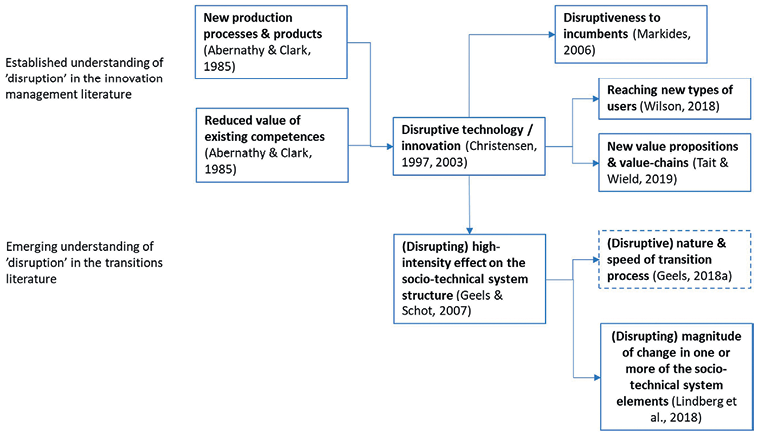
Figure 11.1 shows development in the use of the concept of disruption in innovation and transition studies from the 1980s until 2019. In both fields, one can see branching out to different uses and understandings.
Illustration of the evolution of the concept of disruption in innovation management and transition literatures.

One of the core arguments in the literature on disruption in sustainability transitions is that disruption can happen regarding different system dimensions (Johnstone et al. Reference Johnstone, Rogge, Kivimaa, Fratini, Primmer and Stirling2020). In the Kivimaa et al. (Reference Kivimaa, Laakso, Lonkila and Kaljonen2021) literature review, in addition to (1) technology, we identified four other dimensions regarding where disruptions may take place: (2) markets and business models, (3) regulations, policies and formal institutions, (4) actors and networks, as well as (5) behaviour, practices and cultural models. Table 11.1 provides some explanations regarding what disruption can mean in each of these categories.
| Dimension of disruption | Explanation |
|---|---|
| Technology |
|
| Markets and business models |
|
| Regulations, policies and formal institutions |
|
| Actors and networks |
|
| Practices, behaviour and cultural models |
|
A second argument is that disruption can be characterised in terms of magnitude and speed of change. The most typical association of disruption, perhaps, is an initially small magnitude of change in the form of disruptive innovation. Examples include e-bikes and solar thermal water tanks and potentially electric vehicles (Wilson Reference Wilson2018). Introduction of plant-based proteins into food systems (Bulah et al. Reference Bulah, Negro, Beumer and Hekkert2023) is an example of gradual small magnitude of change that has not changed the power structures in the food chain. A larger magnitude of change would require major shifts in the relations between farmers, food industry and retail (Lonkila & Kaljonen Reference Lonkila and Kaljonen2021). In a transitions context, large magnitude of change covers multiple elements of systems (see Table 11.2). Such change can be gradual or rapid, the latter more frequently associated with discontinuity, breakdown and replacement. For instance, a large magnitude gradual change can be exemplified by the ways in which the diffusion of wind and solar power have substantially altered the electricity system in many countries (Johnstone et al. Reference Johnstone, Rogge, Kivimaa, Fratini, Primmer and Stirling2020). In turn, more rapid large changes can result from ‘landscape shocks’, such as the COVID-19 pandemic and wars (see Chapter 7). Examples include the rapid and persistent change to telework and hybrid work (Newbold et al. Reference Newbold, Rudnicka, Cook, Cecchinato, Gould and Cox2022; Verma et al. Reference Verma, Venkatesan, Kumar and Verma2022). Harnessing such disruptive landscape events for large changes has also been called for (Markard & Rosenbloom Reference Markard and Rosenbloom2020). The Kivimaa et al. (Reference Kivimaa, Laakso, Lonkila and Kaljonen2021) review argued that it is not only rapid changes which should be accounted for as disruption but also gradual changes of large magnitude that result in whole system reconfigurations.
| Gradual change | Rapid change | |
|---|---|---|
| Large magnitude of change, covering multiple system elements or dimensions of disruption | Disruption associated with gradual transformation and subtle reconfiguration of the whole system | Disruption characterised by discontinuity, breakdown and replacement, stretch-and-transform of the whole system |
| Small magnitude of change, covering a single system element or dimension of disruption | Non-disruptive incremental change, sustaining existing system configurations | Disruption associated with disruptive innovation, fit-and-conform, survival and return |
Overall, in Kivimaa et al. (Reference Kivimaa, Laakso, Lonkila and Kaljonen2021), we emphasised that a multi-dimensional understanding of disruption is important, and it needs to go beyond technological change and high-tech innovation. Moreover, disruption in one system dimension can lead to a cascade of disruptions where, for instance, a technological disruption leads to business model disruption and a disruption in practices. For instance, technological advances in data sharing and programming created new business models around mobility-as-a-service with potential for broader transport transitions (Carbonara et al. Reference Carbonara, Messeni Petruzzelli, Panniello and De Vita2024; Kivimaa & Rogge Reference Kivimaa and Rogge2022). Or, alternatively, a disruption in actor-networks can create a regulatory or technological disruption. This is not, however, always the case. A technological disruption can also support established practices, such as in the case of biofuels or electric vehicles that maintain established private car-based mobility practices. There are many ways in which disruption in transitions unfold. In essence, disruption as a phenomenon is unpredictable and unruly, and, for instance, technological disruption can lead to changes to more unsustainable practices (Kivimaa et al. Reference Kivimaa, Laakso, Lonkila and Kaljonen2021).
11.3 New Understandings and Specifications
The research on disruption in transitions has expanded since late 2020, when the Kivimaa et al. (Reference Kivimaa, Laakso, Lonkila and Kaljonen2021) review was conducted. In 2020, a search of terms ‘disrupt*’ AND ‘sustainability transition*’ OR ‘socio-technical transition*’ OR ‘socio-technical transition*’ OR ‘societal transition*’ resulted in 47 relevant articles (Kivimaa et al. Reference Kivimaa, Laakso, Lonkila and Kaljonen2021: p. 112). In September 2023, the same search on Web of Science, for the years 2021–2023 resulted in 36 articles published as scientific articles (excluding our review article). The articles were published in a wide variety of sources, in 30 academic journals and over a dozen empirical contexts. The energy sector dominated with about a quarter of articles, followed by agriculture and food, COVID-19, urban development and circular economy. About a third did not have a specific country focus, while Germany was most often mentioned.
As an overview, it can be stated that no coherent interpretation of disruption still exists in the sustainability transitions’ literature. In general, the term ‘disruption’ or ‘disruptive’ are often used as regular descriptive words. In our updated light review, 20 articles out of the 36 articles found were discarded due to only using disruptive as descriptive term. A few discussed disruptions as transition phenomena but did not delve deeper into it empirically or conceptually. We analysed the remaining 13 articles more closely for the purposes of this book chapter to update the insights derived from the Kivimaa et al. (Reference Kivimaa, Laakso, Lonkila and Kaljonen2021) literature review. We identified how recent uses of the concept of disruption link to our previous categorisation in terms of technology, markets and business models, regulations, policies and formal institutions, actors and networks and practices, behaviour and cultural models (Table 11.1). The new articles especially addressed disruption in relation to niche or incumbent actors, the COVID-19 pandemic as a landscape disruption and the nature of disruption. We will sum up these insights below.
11.3.1 Actors and Disruption
Several of the new articles strengthen the understanding of niche actors in altering and disrupting existing practices and cultural models. For example, analysing institutional work related to plant-based protein innovations, Bulah et al. (Reference Bulah, Negro, Beumer and Hekkert2023) show that niche actors actively work to disrupt cultural norms and values upholding the meat regime. Disruptive actors also work to undermine the institutions upholding the regime and work to disrupt, for example, policy or monetary support to dominant regime technologies and practices. Also, Bobbins et al. (Reference Bobbins, Caprotti, de Groot, Pailman, Moorlach, Schloemann and Siwali2023) highlight the role of practices, community dynamics and lived experience of actors in enabling the disruptiveness of innovations, underlining that disrupting innovations never exist beyond and ‘apart from’ existing socio-technical systems and cultural dynamics but as integral parts of them.
Looking at the role of prosumers in the energy transition, Weigelt et al. (Reference Weigelt, Lu and Verhaal2021) show the active role of disruptive actors by illustrating that disruption emerges not only from disruptive technologies but also their application by actors. They found that prosumers applied niche innovations in a novel and disruptive manner, especially in relation to incumbent actors’ business models, showcasing an example of a ‘stretch-and-transform’ process (see Smith & Raven Reference Smith and Raven2012). Thus, recent research using the concept of disruption strengthens the understanding of disruptions as forces undermining regime institutions and their practices, and potentially accelerating transition to more sustainable practices. This is in accordance with the understanding of transition strategies by Smith and Raven (Reference Smith and Raven2012) and shows that niche actors can deploy innovations in disruptive or conforming ways in relation to the existing socio-technical regime.
In contrast to our earlier review of disruption (Kivimaa et al. Reference Kivimaa, Laakso, Lonkila and Kaljonen2021), recent work has paid more attention to the increasingly complex role of incumbents as agents in both promoting and resisting transition. While the traditional take on disruption regarding incumbent actors has been the reduced value of (i.e. a disruption to) existing skills and resources held by the incumbents (e.g. Abernathy & Clark Reference Abernathy and Clark1985; Turnheim & Geels Reference Turnheim and Geels2013), new research has revealed the opportunities for incumbents to repurpose their skills and resources in response to disruptions (Mäkitie Reference Mäkitie2020; Nemes et al. Reference Nemes, Chiffoleau, Zollet, Collison, Benedek, Colantuono and Dulsrud2021). Kivimaa and Sivonen (Reference Kivimaa and Sivonen2023) have interpreted this as a process of ‘disruption to and repurposing skills and assets’ in the context of regime decline (see chapter 11.4 on decline). While facing disruption of skills and assets, incumbents are in a rather passive position, repurposing them shows a more active reaction to the ongoing transition.
There are other possible actions too. In this vein, two papers highlight the multifaceted role of disruptive incumbent actors. Interestingly, Galvan et al. (Reference Galvan, Cuppen and Taanman2020) show, by analysing grid operators, that incumbent regime actors can engage in both disruptive and maintaining practices simultaneously. Incumbents’ work in disrupting institutions that create barriers for their interests may also open space for the growth of niches. In turn, Loehr et al. (Reference Loehr, Chlebna and Mattes2022) foreground that along disruptive actions of incumbents, it is also crucial to analyse defensive institutional work that aims to resist and prevent transition. Defensive work resists disruptions and is geared at maintaining existing practices of the regime. It can take the shape of delegitimising novel practices, rules and technologies (Lehmann et al. Reference Lehmann, Graf-Vlachy and Koenig2019; Loehr et al. Reference Loehr, Chlebna and Mattes2022). Defensive work may in its turn have a disruptive effect towards the transition process (Loehr et al. Reference Loehr, Chlebna and Mattes2022), in other words a disruption of disruption. This understanding of disruption as impeding ongoing developments towards sustainability offers a novel perspective on the dimensions of disruptive actors and disruptive behaviour and practices. We suggest that a more nuanced understanding of disruptive incumbency can open avenues for harnessing the role of incumbency in accelerating transition, while also offering conceptual tools for navigating the various forms of regime resistance as well as disruption.
11.3.2 The COVID-19 Pandemic and Disruption
Recent articles on disruptive landscape events, especially on the COVID-19 pandemic, highlight the usefulness of categorising different dimensions of disruption and a detailed analysis of what is being disrupted and by whom. While landscape-level shocks open an opportunity for rapid change on a large scale, recent research underlines the complexities and resistances faced by such disruptive processes. Nemes et al. (Reference Nemes, Chiffoleau, Zollet, Collison, Benedek, Colantuono and Dulsrud2021) emphasise how the COVID-19 pandemic is exceptional in its large-scale influence on all-encompassing disruption on supply chains, so essentially a substantial landscape shock (see Kanda & Kivimaa Reference Kanda and Kivimaa2020). They note that the pandemic revealed the need to develop more resilient socio-technical systems against future disruptions.
Markard and Rosenbloom (Reference Markard and Rosenbloom2020) argue that the disruptive power of landscape-level shocks, such as the COVID-19 pandemic, must be actively harnessed to accelerate the decline of carbon-intensive technologies, industries and practices. Disruptive landscape events have potential to break ‘carbon lock-ins’ and open and accelerate low-carbon pathways, but this must be coupled with long-term processes of destabilisation and phase-out, to prevent a return to the preceding status quo once the initial landscape disruption has passed. This indicates that disruption on the level of institutions and regulations is needed to realise the disruptive potential of landscape shocks, again pointing out the interrelatedness of different spheres of disruption and the limits of one dimension alone. Indeed, Hirth et al. (Reference Hirth, Oncini, Boons and Doherty2022) have criticised the expectation that disruptive events kick-start systemic change towards sustainability. They showed that the COVID-19 pandemic did not disrupt regime practices in the context of different food provision sectors, because routinised and non-deliberative practices hindered transformation. This underlines that, other disruptions, influencing practices and behaviour, are needed to realise the disruptive potential of landscape shocks. Landscape disruption alone seems insufficient to stimulate sustainability transitions.
11.3.3 Nature of Disruption: Outcome Versus Process
Novel work on disruption continues to address the debate on whether disruption should be understood as a transition process or its outcome. For instance, Lazarevic et al. (Reference Lazarevic, Salo and Kautto2022: p.5) present dealignment and destabilisation as processes within the sustainability transition that facilitate “the development of disruptive policy frameworks and governance arrangements that challenge existing systems”. Hence, they indicate, too, that destabilisation is the process and disruption the outcome and the means to achieve transitions. This matches the definition presented above (and in Kivimaa et al. Reference Kivimaa, Laakso, Lonkila and Kaljonen2021) that portrays disruption as transition-related change. Also, Simoens et al. (Reference Simoens, Fuenfschilling and Leipold2022) associate disruption as an outcome, describing disruptive discursive change that can unlock previously unchallenged values and beliefs, creating openings for alternative discourse.
Contrary to this understanding, Blomsma et al. (Reference Blomsma, Bauwens, Weissbrod and Kirchherr2023) regard disruption as a process with three phases: release, reorganisation and eruption. They associate ‘circular disruption’ to a formation of a new paradigm which differs from the linear model of innovation and economy and which refers to systemic, widespread and fast change. This understanding is in partial contradiction to our previous proposal (Table 11.2), where certain types of disruptions are also associated with gradual transformative change and reconfiguration. Blomsma et al. (Reference Blomsma, Bauwens, Weissbrod and Kirchherr2023) also call for increased reflexivity among the transition studies community, to move from describing historic disruptions to outlining the conditions necessary for accelerating systemic change in close collaboration with other actors. On the other hand, Heiges and O’Neill (Reference Heiges and O’Neill2022) highlight the value of descriptive policy analysis when evaluating the impacts of past and existing disruptive or destabilising policies. They show that in the case of plastics recycling in the US, existing niches were not mature enough to become dominant regime actors when a major policy event took place. This opened space for the emergence of multiple co-existing regimes as a novel transition pathway, which can create further understanding for transition dynamics and governance. In other words, examining past and ongoing policy developments can reveal unexpected transition dynamics and add to existing understanding of potential transition pathways (Heiges & O’Neill Reference Heiges and O’Neill2022).
11.4 Disruption in Relation to Destablisation, Decline, Phase-out and Just Transition
Destabilisation, decline and phase-out are closely linked concepts to that of disruption in sustainability transition studies. In this literature, the concepts of disruption and destabilisation share some similar characteristics but differ in their origin (Kivimaa et al. Reference Kivimaa, Laakso, Lonkila and Kaljonen2021). While the concept of disruption originates from innovation and management studies as something contrary to incremental innovation (see Christensen Reference Christensen1997), the concept of destabilisation originates from the changes affected by or initiating from the socio-technical regime (see Turnheim & Geels Reference Turnheim and Geels2012, Reference Turnheim and Geels2013). Therefore, destabilisation is an original concept of transition studies, whereas disruption is an ‘imported’ one. Moreover, destabilisation is mostly used in the context of the Multi-level perspective (MLP) (see Chapter 2), while disruption is used more broadly in transition studies (Kivimaa et al. Reference Kivimaa, Laakso, Lonkila and Kaljonen2021). As the understanding of disruption has expanded from radical niche innovations to landscape events and regime changes in different dimensions, the two concepts have clearly moved closer to one another. Their intertwining is needed to understand the broader societal processes linked to disruptions.
Turnheim (Reference Turnheim, Koretsky, Stegmaier, Turnheim and van Lente2022: p. 45) defines destabilisation as “a longitudinal process by which otherwise relatively stable and coherent socio-technical forms (systems, regimes, institutional arrangements, sets of practices and networks) become exposed to challenges significant enough to threaten their continued existence and their “normal” functioning, triggering strategic responses of core actors within the frame of existing commitments (preservation) and in some circumstances away from such commitments (transformation).” Also, Ghosh et al. (Reference Ghosh, Kivimaa, Ramirez, Schot and Torrens2021: p. 17) define destabilisation as reducing alignment between the different system elements “resulting in a process in which regime actors abandon behaviors, beliefs and values constituting the [socio-technical] regime”. Destabilisation is hence mostly understood as a process (Martínez Arranz Reference Martínez Arranz2017; Turnheim & Geels Reference Turnheim and Geels2013), which is caused by rapid or gradual disruption(s). One could argue that the process of destabilisation that creates disalignment between system elements may then be followed by disruptive changes within these system elements, leading to disruptive outcomes.
Decline, in contrast, relates to often a more objectifiable or quantifiable degradation of system performance (e.g. size, economic viability, population, hegemonic power, legitimacy), which can (but rarely does) lead to total decline (Turnheim Reference Turnheim, Koretsky, Stegmaier, Turnheim and van Lente2022: p. 45). In this sense, it comes closer to understanding of disruption as an outcome. Deliberate decline (Rosenbloom & Rinscheid Reference Rosenbloom and Rinscheid2020) and phase-out (Johnstone & Hielscher Reference Johnstone and Hielscher2017; Koretsky & van Lente Reference Koretsky and van Lente2020), in turn, relate to deliberate interventions seeking partial or total discontinuation of a socio-technical form that is deemed undesirable (Turnheim Reference Turnheim, Koretsky, Stegmaier, Turnheim and van Lente2022). This perspective also relates to disruption in terms of regulations, policies and institutions. Deliberate decline and phase-out, hence, are best understood as governance objectives, forms of intervention and as processes including several temporal phases. Lonkila et al. (Reference Lonkila, Lukkarinen, van Oers, Feola and Kaljonen2024) talk also of deliberate destabilisation (see also Kivimaa & Kern Reference Kivimaa and Kern2016; van Oers et al. Reference van Oers, Feola, Moors and Runhaar2021). However, similarly to how the concept of disruption is understood, there are also different interpretations of decline and phase out. For instance, Koretsky & van Lente (Reference Koretsky and van Lente2020) describe phase-out as a disruption, or unravelling, of the linkages between materials, competencies and meaning (see Shove et al. Reference Shove, Pantzar and Watson2012). Since phasing out implies the disruption of links between the materials-meanings-competences triad, they underline that losing one of them would not be enough (Koretsky & van Lente Reference Koretsky and van Lente2020). Most often, however, phaseout has been a narrower concept than disruption, destabilisation or decline. It has mainly focused on technology (Andersen & Gulbrandsen Reference Andersen and Gulbrandsen2020; Koretsky & van Lente Reference Koretsky and van Lente2020) or discourses (Rosenbloom Reference Rosenbloom2018; Trencher et al. Reference Trencher, Healy, Hasegawa and Asuka2019).
Turnheim (Reference Turnheim, Koretsky, Stegmaier, Turnheim and van Lente2022) underlines destabilisation as a dynamic context of action, involving pressures, strategic responses, varying commitments to prevailing commitments and for navigating the changing opportunities. In this way, the concept of destabilisation aims to capture the political dynamics related to transitions in a much more thorough way than the literature concerning disruptions. As also van Oers et al. (Reference van Oers, Feola, Moors and Runhaar2021) and Lonkila et al. (Reference Lonkila, Lukkarinen, van Oers, Feola and Kaljonen2024) highlight the way in which destabilisation challenges the positions of those in power; the political nature of destabilisation cannot be escaped. Incumbent responses to destabilisation may focus on resisting, hindering and slowing down phase-out policies because they not only pose a threat for their vested interests (van der Ploeg Reference van der Ploeg2020) but also more change-oriented responses are possible as illustrated by empirical studies (e.g. Mäkitie Reference Mäkitie2020). Furthermore, the strategic defensive work of incumbents can in turn be disruptive in a negative manner (Lehmann et al. Reference Lehmann, Graf-Vlachy and Koenig2019; Loehr et al. Reference Loehr, Chlebna and Mattes2022), as noted above. Resistance-oriented responses have been shown to emerge within the processes that unsettle technical competency, but are likely to be even more poignant when they touch upon regionally embedded livelihoods, practices, behaviours and cultural models of people (Cha Reference Cha2020; Janssen et al. Reference Janssen, Beers and van Mierlo2022; Lonkila et al. Reference Lonkila, Lukkarinen, van Oers, Feola and Kaljonen2024).
Recent research on destabilisation has called attention to a more plural understanding of incumbency beyond the focus on the most powerful (Andersen & Gulbrandsen Reference Andersen and Gulbrandsen2020; Stirling Reference Stirling2019; Turnheim & Sovacool Reference Turnheim and Sovacool2020). Local communities, workers and civil society organisations also embody attributes of incumbency with strong cultural, material and financial ties to existing regimes. Deliberate destabilisation and disruption should recognise such plurality and complexity of the incumbent ties, from which the different incumbent groups benefit. Addressing the existing injustices within the regime can assist in finding alternative pathways forward (Kuhmonen & Siltaoja Reference Kuhmonen and Siltaoja2022; Lonkila et al. Reference Lonkila, Lukkarinen, van Oers, Feola and Kaljonen2024). Andersen & Gulbrandsen (Reference Andersen and Gulbrandsen2020) show how realising the potential of recombinations and diversification of diverse incumbent firms and actors may dampen the possible negative effects of transitions such as loss of jobs and bankruptcy of firms.
The recent political and academic discussion on just transition also aims to capture and navigate the repercussions caused by destabilisation, decline, phase out or disruption (Kaljonen et al. Reference Kaljonen, Kortetmäki, Tribaldos, Huttunen, Karttunen, Maluf and Niemi2021; Newell et al. Reference Newell, Geels and Sovacool2022; Williams & Doyon Reference Williams and Doyon2019). In this literature, however, disruption as a concept is seldom referred to. The recent developments within this realm are nevertheless helpful for capturing and navigating the broader societal effects and tensions arising from disruption and/or destabilisation (Turnheim Reference Turnheim, Koretsky, Stegmaier, Turnheim and van Lente2022). We want to especially highlight two lines of conceptual development, where the first concerns navigating the inherent tensions between rapid and just transitions (Newell et al. Reference Newell, Geels and Sovacool2022) and environmentally and socially just transitions (Ciplet & Harrison Reference Ciplet and Harrison2020; Heffron & McCauley Reference Heffron and McCauley2022; Huttunen et al. Reference Huttunen, Tykkyläinen, Kaljonen, Kortetmäki and Paloviita2024; Stevis & Felli Reference Stevis and Felli2020). The second line of development aims to bring together the recent understanding on deliberate destabilisation and transformative policy mixes (see Chapter 14) together for finding ways forward, towards more active and emancipatory just transition policies, in contrast to policy measures focusing solely on distributive outcomes (Kaljonen et al. Reference Kaljonen, Paloviita, Huttunen and Kortetmäki2024). This debate emphasises issues of interest for managing disruptive outcomes: as transitions embody winners and losers, how should the effects of disruption be lessened or compensated and to whom and how should the resulting benefits and disadvantages be assessed and valued, across different scales (from local to global) and between different socio-economic and cultural groups of societies.
As the discussion on disruption moves gradually closer to the debates on regime destabilisation, decline and phaseout, a more nuanced understanding of incumbents, niche actors and just transitions are important for broadening the discussion. Importantly, it can open novel avenues for addressing the existing injustices and power relations within the regime. Here the perspective on restorative justice can be helpful as a counterforce for disruption. Restorative justice gives attention to the management of severe injustices that have already occurred and examines avenues for mitigating those harms, both on individual and communal levels (McCauley & Heffron Reference McCauley and Heffron2018). Restorative justice introduces a historical and anticipatory temporal dimension to destabilisation and assists in moving away from sole reactive approaches to more emancipatory approaches in addressing existing injustices and creating just alternative future pathways (Hazrati & Heffron Reference Hazrati and Heffron2021; Kuhmonen & Siltaoja Reference Kuhmonen and Siltaoja2022; Lonkila et al. Reference Lonkila, Lukkarinen, van Oers, Feola and Kaljonen2024).
11.5 Conclusions and Future Research Needs
Disruption is a term often used in sustainability transition studies but with differing meanings from a more descriptive approach to an analytical concept increasingly related to conceptualisations of regime decline, destabilisation and phaseout. Whereas the concept originated from studies of disruptive innovation, it has broadened its use in transition studies covering niche innovations, regime dynamics and a descriptor of landscape influence. This chapter highlighted the definition and dimensions of disruption presented in an earlier review (Kivimaa et al. Reference Kivimaa, Laakso, Lonkila and Kaljonen2021) and added new discussion from more recent literature and in relation destabilisation, decline and just transitions.
Disruption can be defined as a high-intensity outcome in the structure of the socio-technical system, which includes more than one system dimension. These dimensions include technology; actors and networks; markets and business models; regulations, policies and formal institutions; behaviour, practices and cultural models. Whereas the first studies addressed mainly technological disruption, more research has oriented to disruption in the context of actors (niche actors and incumbency) and in policy and institutional interventions as well as the role of the COVID-19 pandemic as a landscape-level disruption. As noted above, when the disruption concept has expanded from disruptive innovation to deal with system-level transitions, it has become more closely associated with other concepts oriented to socio-technical regime transformation: destabilisation, decline and phase out. This perhaps means that the added value of the concept of disruption is becoming reduced. However, whereas, for instance, phaseout has oriented mainly to technologies and discourses, disruption is attempting a broader coverage of different system dimensions affecting whole socio-technical systems. In addition, whereas destabilisation places focus on process, disruption is often oriented to the magnitude of change as an outcome of transition-related processes.
The definition of disruption provided in Kivimaa et al. (Reference Kivimaa, Laakso, Lonkila and Kaljonen2021), hence, still holds its place. In the future, the processual, and political, understanding of destabilisation can strengthen the understanding of large and small magnitude of disruptions further. Here, especially the more nuanced understanding of incumbents is critical in understanding their varying roles in disruptions, which may also be positive. Moreover, as the urgency of achieving a system-wide sustainability transition increases, it is critical to link the concept of disruptions to the understanding of the ‘flipside’ transitions and its strategic resistances in order to accelerate the needed just transitions. Likewise, the ability to survive and quickly recover from extreme and unexpected disruptions deserves further attention in transitions studies. Although resilience is closely related to disruptions, in particular in the current era of large landscape disruptions, resilience as a concept did not feature prominently in our literature review. Hence, connections between disruptions and resilience in transition processes should be a focus of future research (Jasiūnas et al. Reference Jasiūnas, Lund and Mikkola2021). Paying deliberate attention to restorative justice (Hazrati & Heffron Reference Hazrati and Heffron2021) can also provide a counterforce to disruptions. In a turbulent world, with many overlapping disruptive developments, transition studies should start to analyse more carefully what are the technologies, actors and networks, business models, regulations and policies, practices and cultural models that we want to save from disruption – and what require rapid disruption to address the increasing environmental sustainability challenges.

 Open access