




Introduction
Mulch films are a crucial tool in the global production of high-value specialty crops, particularly vegetables and small fruits. When properly managed, mulch films improve growing conditions by optimizing soil temperature, maintaining soil moisture, preventing nutrient leaching, modifying crop development, and suppressing weed growth—benefits that are especially important in organic systems (Kasirajan and Ngouajio, Reference Kasirajan and Ngouajio2012; Miles et al., Reference Miles, DeVetter, Ghimire and Hayes2017). Polyethylene (PE) mulch films, introduced to commercial agriculture in the 1950s, are widely used because of their effectiveness, ease of application, and affordability (Somanathan et al., Reference Somanathan, Sathasivam, Sivaram, Mariappan Kumaresan, Muthuraman and Park2022). However, PE mulch contributes to plastic pollution due to its fossil fuel-based composition and non-biodegradability. According to the Food and Agriculture Organization (FAO, 2023), approximately 12.5 million tonnes of agricultural plastics are produced globally every year. Within the United States, annual plastic consumption in agriculture is estimated at 1.56 million tonnes (Malarkey and Babbitt, Reference Malarkey and Babbitt2025). Of this global total, an estimated 2.5 million tonnes of PE mulch were used in 2017 alone, and utilization continues to expand worldwide (Abbate et al., Reference Abbate, Scavo, Pesce, Fontanazza, Restuccia and Mauromicale2023). In the United States, mulch films composed of linear low-density PE represent 17% of the annual plastic use by mass in agriculture, ranking after horticultural containers (42%) and silage storage (19%) (Malarkey and Babbitt, Reference Malarkey and Babbitt2025).
Organic agriculture is often regarded as a more sustainable approach to farming because it emphasizes soil health, ecosystem services, and the minimization or elimination of synthetic inputs. The United States Department of Agriculture’s National Organic Program (USDA NOP) establishes and enforces federal standards for certified organic agriculture in the United States. Producers who comply with these standards can sell their products as certified organic and receive a price premium (Northen, Reference Northen2021). Beyond regulatory definitions, organic farming is also closely tied to broader social movements centered on sustainability and environmental justice (Northen, Reference Northen2021; Wilson, Hendrickson and Myers, Reference Wilson, Hendrickson and Myers2025). Despite environmental sustainability concerns with regard to plastic use in agriculture, PE mulch is allowed in organic agriculture in the United States, provided that it is completely removed from the field at the end of the growing season to prevent it from being considered a farm input (USDA NOP, 7 CFR 205.601). In practice, however, complete removal is rarely achieved. Throughout the growing season and during hand or mechanical removal, natural weathering, rips, and tears cause plastic fragments to remain in soils, where they can persist for centuries, contributing to long-term macro- and microplastic accumulation (Li et al., Reference Li, Ding, Flury, Wang, Xu, Li, Jones and Wang2022; Roy, Mohanty and Misra, Reference Roy, Mohanty and Misra2022). This persistence, combined with limited recycling infrastructure and undesirable disposal methods such as landfilling, stockpiling, or burning, contributes to plastic pollution within agroecosystems and beyond, including microplastic accumulation in soils (Goldberger, DeVetter and Dentzman, Reference Goldberger, DeVetter and Dentzman2019; Huang et al., Reference Huang, Liu, Jia, Yan and Wang2020; Liu, He and Yan, Reference Liu, He and Yan2014; Zhang et al., Reference Zhang, Liu, Hu, Qin, Ma, Yan and Wang2016).
Soil-biodegradable plastic mulches (BDMs) were developed in the 1990s as an environmentally friendly alternative to PE mulch (DeVetter et al., Reference DeVetter, Zhang, Ghimire, Watkinson and Miles2017; Hayes et al., Reference Hayes, Wadsworth, Sintim, Flury, English, Schaeffer and Saxton2017; Kasirajan and Ngouajio, Reference Kasirajan and Ngouajio2012). Commercial BDMs are formulated from blends of biobased and synthetic feedstocks designed to be metabolized by soil microorganisms as they degrade (Bonhomme et al., Reference Bonhomme, Cuer, Delort, Lemaire, Sancelme and Scott2003; Gu, Reference Gu2003). Although these films offer many of the same agronomic benefits as PE mulch, grower adoption has been limited (Dentzman and Goldberger, Reference Dentzman and Goldberger2020; Goldberger et al., Reference Goldberger, Jones, Miles, Wallace and Inglis2015; Tofanelli and Wortman, Reference Tofanelli and Wortman2020). The high purchase price of BDMs is an adoption barrier, even though they can offset end-of-season labor and disposal costs associated with PE mulch removal (Marí et al., Reference Marí, Pardo, Cirujeda and Martínez2019; Velandia et al., Reference Velandia, Smith, Wszelaki, Galinato and Marsh2018, 2019). Growers have also expressed concerns regarding the unpredictable breakdown of BDMs (Goldberger et al., Reference Goldberger, Jones, Miles, Wallace and Inglis2015). In contrast, because PE mulch is non-biodegradable, it must be removed after harvest, resulting in added labor, transportation, and tipping-fee expenses. Once collected, PE mulch is typically transported to landfills, though some growers resort to stockpiling or open burning (Goldberger, DeVetter and Dentzman, Reference Goldberger, DeVetter and Dentzman2019). BDMs are instead designed to be tilled into the soil at the end of the growing season, eliminating removal costs and reducing agricultural plastic waste. However, field degradation is gradual: studies report that BDMs may require 21–58 months to reach 90% degradation, depending on climate, soil type, and other environmental factors (Griffin-LaHue et al., Reference Griffin-LaHue, Ghimire, Yu, Scheenstra, Miles and Flury2022). Regardless of degradation time, BDM use inevitably results in the temporary presence of visible plastic fragments in field soils.
Previous research suggests that growers’ hesitancy to adopt BDMs is partly due to concerns that BDM fragments left in the fields may be perceived as unsightly plastic waste and a reflection of ‘bad farming’ practices (Dentzman and Goldberger, Reference Goldberger, DeVetter and Dentzman2019). Dentzman and Goldberger (Reference Goldberger, DeVetter and Dentzman2019) examined the relationship between BDMs and the aesthetics of ‘good farming’, finding that unpredictable degradation poses an aesthetic issue because BDMs resemble conventional plastic to uninformed observers. Growers in their study emphasized maintaining neat, clean operations; residual mulch fragments conflicted with that image by evoking ‘trash’ or ‘garbage’ and creating an appearance of disorder. More specifically, conventional farmers viewed fragments as signs of ‘bad farming’ due to untidy field aesthetics. Alternative farmers disliked BDM fragments because they looked like PE mulch and thus undermined their identity as environmentally conscious producers. Consequently, BDMs may conflict with dominant aesthetic norms of ‘good farming’, as visible mulch scraps can lead others to label a grower as a ‘bad farmer’.
Sociological work on farming identity supports this interpretation. Sutherland and Burton (Reference Sutherland and Burton2011) found that farmers who fail to meet social standards such as cleanliness risk being perceived as ‘bad farmers’ (i.e., unskilled or disorganized), threatening their social standing and access to community resources. These findings highlight how aesthetic and social factors shape technology adoption in agriculture. Although research continues on the sociocultural and structural influences affecting BDM adoption, insights into growers’ and stakeholders’ perceptions provide important guidance for mulch manufacturers, extension agents, and policymakers working to reduce agricultural plastic waste and promote BDM adoption.
An important missing perspective, however, is that of food consumers, who can influence agricultural practices through their purchasing decisions (Dumitru et al., Reference Dumitru, Sterie, Rodino and Butu2023; Guthman and Brown, Reference Guthman and Brown2016; Hunt, Reference Hunt2007; Priya and Singh, Reference Priya and Singh2024). While evidence of public concern over mulch fragments in farm fields is lacking, research on consumer attitudes toward BDMs remains limited and has largely focused on willingness to pay (WTP) studies. Chen et al. (Reference Chen, Marsh, Tozer and Galinato2019) found that consumers (particularly women) with higher income, greater knowledge of BDMs, and environmentally friendly attitudes were willing to pay about 10% more for strawberries (Fragaria × ananassa) grown with BDMs. Further, Chen et al. (Reference Chen, Galinato, Marsh, Tozer and Chouinard2020) reported that both farmers and crop advisors were willing to pay substantially more for BDMs, driven by concerns about soil health and the persistence of plastic fragments in soils after crop harvest. Their study also showed that while cost was the main constraint for non-farm consumers, agricultural professionals prioritized environmental benefits. Moreover, when the proportion of BDM residue after harvest increased from 5% to 30%, WTP decreased from $93 to $87 per 305 m, assuming the residues did not pose a risk to soil health.
Consumer studies in related contexts reinforce these trends. Thilmany, Bond and Bond (Reference Thilmany, Bond and Bond2006, Reference Thilmany, Bond and Bond2008) found that individuals who regularly purchased food through direct-market channels were motivated by product quality and a desire to support local producers. These consumers emphasized attributes such as vitamin content, nutritional value, pesticide-free practices, and traceability. Some participants included in this research were less inclined to purchase organic or nutritionally targeted produce, yet expressed willingness to support direct-market vendors as a way to endorse local agriculture. In contrast, occasional direct-market shoppers were more influenced by food safety, visual appeal, and convenience. Yue et al. (Reference Yue, Hall, Behe, Campbell, Lopez and Dennis2010) found that consumers were willing to pay a 9.2 cent premium for recycled plant pots and significantly more for biobased pots made from wheat ( Triticum spp.) starch, rice ( Oryza sativa ) hulls, straw, or peat, over plastic containers, as long as they performed similarly or better than non-biodegradable products. The only significant variable impacting WTP in their study was gender, with women showing higher WTP for environmentally friendly alternatives, which is consistent with previous studies (Chen et al., Reference Chen, Marsh, Tozer and Galinato2019; Hirsh, Reference Hirsh2010). Additionally, Notaro, Lovera and Paletto (Reference Notaro, Lovera and Paletto2022) found that young, educated, high-income women preferred biodegradable cup alternatives, especially those made from 100% wood feedstocks that degrade within six months. Similarly, Zwicker et al. (Reference Zwicker, Brick, Gruter and van Harreveld2021) found that consumer education on biobased plastics improved perceptions and increased WTP by 8%–30% for biobased versus conventional plastic products.
While several studies have examined growers’, manufacturers’, and other stakeholders’ views on BDMs (e.g., Goldberger et al., Reference Goldberger, Jones, Miles, Wallace and Inglis2015; Madrid et al., Reference Madrid, Goldberger, Miles and DeVetter2022), research has yet to explore consumer perceptions of BDM fragments in farm fields. Growers report barriers to BDM adoption, including limited access to information, perceived high cost, unpredictable breakdown, and uncertainty regarding the impacts of BDMs on the soil ecosystem (Goldberger et al., Reference Goldberger, Jones, Miles, Wallace and Inglis2015). Bridges to adoption included the ability of BDMs to reduce agricultural plastic waste, environmental support, and growers’ interest in further learning. Looking further into the concepts of risk and uncertainty regarding mulch adoption, Madrid et al. (Reference Madrid, Goldberger, Miles and DeVetter2022) found that raspberry ( Rubus ideasu ) growers in Washington State, as well as research and outreach specialists, felt that PE was less risky than BDMs because of its proven horticultural performance. Greater uncertainty was associated with BDMs because of their unpredictable durability and degradation. Some growers were particularly reluctant to use BDMs because of the perceived impacts of degrading fragments on field aesthetics.
Taken together, this literature suggests that the public may view biodegradable plastics in agriculture (including BDMs) more positively than conventional plastics and may be more likely to pay more for produce grown with BDMs. However, major knowledge gaps remain regarding public understanding of agricultural mulching practices and perceptions of BDM degradation in the field.
Accordingly, this study begins to address these gaps by examining food shoppers’ knowledge and perceptions of BDM use and their preferences regarding biodegradable versus non-biodegradable plastics in agriculture. The overarching goal of this project is to expand agro-sociological research by providing insights into public understanding of agricultural plastic use among two different types of food shoppers. Specifically, this study asks:
-
• What is the general knowledge of food shoppers regarding current mulching practices?
-
• What are food shoppers’ perceptions of BDM fragments in agricultural fields?
-
• Do food shoppers prefer biodegradable options over non-biodegradable plastics in agriculture?
Research methods
A mixed-method approach was employed, combining rapid market assessment (RMA) and semi-structured interviews at two locations in the urban setting of Bellingham, Washington, USA. Data were collected from shoppers at the Bellingham Farmers Market in November 2024 and from shoppers at a bargain-market grocery store in April 2025. The grocery store’s name is withheld at the retailer’s request. The study was certified as Exempt (IRB #20701-001) by Washington State University’s Human Research Protection Program.
The two sampling sites were selected to capture variation in consumer awareness and attitudes. Farmers market shoppers (hereafter, direct-market shoppers) were expected to have greater awareness of where their food comes from and higher acceptance of aesthetic imperfections in food and farming practices. In contrast, bargain-market grocery store shoppers (hereafter, indirect-market shoppers) were expected to have less familiarity with agricultural production but to place more emphasis on product packaging and marketing. These categories are not intended to imply exclusivity or reinforce assumptions, but rather to facilitate comparison between distinct shopper perspectives.
After obtaining approval from the managers of both locations, a research booth was set up during regular business hours with a shared display for RMA. As outlined by Lev, Brewer and Stephenson (Reference Lev, Brewer and Stephenson2008), the RMA approach is a rapid, visual elicitation method that allows participants to express preferences or attitudes by placing stickers directly onto a shared display. This format is designed to encourage quick engagement, reduce respondent burden, and make patterns in group responses immediately visible. Passive recruitment was used at each site: shoppers were invited to participate voluntarily as they approached the booth, where a large poster board displayed the RMA survey. Participants self-selected into the study by placing stickers directly on the board in response to survey questions. This approach followed the method outlined by Lev, Brewer and Stephenson (Reference Lev, Brewer and Stephenson2008) with minor modifications, including the use of unique stickers to link specific RMA responses to individuals who completed the interviews while maintaining anonymity (Fig. 1). Additionally, research volunteers monitored the booth to ensure participants did not provide repeated responses.
Direct- (left) and indirect-market (right) shopper rapid market assessment poster boards deployed at a farmers’ market and discount grocery store in 2024–2025. Each sticker represents an individual shopper’s response to the prompt on the poster board.

Figure 1. Long description
The left panel represents direct-market shoppers, the right panel indirect-market shoppers. Each panel has six horizontal rows, each row a question with a colored background and a Likert scale from left to right. The questions, from top to bottom, are: 1. I associate plastic use with growing produce, 2. Plastic use is essential in modern agriculture, 3. I do not like seeing plastic waste on farms, 4. I have previous experience with or knowledge of biodegradable plastics, 5. I prefer biodegradable alternatives to non-biodegradable agricultural plastics, 6. The visual cleanliness of a farm impacts my direct support. Each row is divided into four or two labeled segments: Strongly Disagree, Disagree, Agree, Strongly Agree (or Yes/No for question 4). Stickers, each representing a shopper’s response, are scattered across the segments. In both panels, most stickers cluster toward Agree or Strongly Agree for disliking plastic waste, preferring biodegradable alternatives, and valuing farm cleanliness. For ‘plastic use is essential,’ responses are more evenly distributed, with a slight lean toward Disagree in the left panel and toward Agree in the right. Experience with biodegradable plastics is mixed, with more Yes in the left panel. Decorative elements like leaves, flowers, and butterflies are placed throughout for visual interest.
The RMA consisted of six closed-ended questions or statements regarding plastics in agriculture (see Table 1). The general term ‘plastic(s)’ was used rather than ‘polyethylene (PE)’ or ‘PE mulch’, as some respondents may have been unfamiliar with the latter terms. The interviews, however, introduced the terms ‘plastic mulch’, ‘PE mulch’, and ‘biodegradable mulch’. Questions 1, 2, and 6 used a four-point agreement scale (strongly disagree, disagree, agree, strongly agree), while Questions 3, 4, and 5 used a two-point binary scale (disagree, agree). A five-point scale with a ‘neutral’ option was not used to elicit non-neutral responses. The binary-scale questions were designed to capture either preexisting beliefs or emerging perceptions (e.g., ‘I prefer biodegradable alternatives to non-biodegradable plastics in agriculture’). Given limited public familiarity with agricultural plastics, this design encouraged participants to take a position without requiring degrees of certainty. Participants used stickers to answer the questions, and responses were later tabulated to generate descriptive statistics. In cases where participants placed stickers between categories to indicate uncertainty, researchers reminded them that their responses would be assigned to the category most closely aligned with their selection.
Direct- and indirect-market shopper rapid market assessment survey statements and responses

Table 1. Long description
From the top row downward, the left column contains six statements: ‘I associate plastic use with growing produce’, ‘Plastic use is essential in modern agriculture’, ‘I do not like seeing plastic waste on farms’, ‘I have previous experience with or knowledge of biodegradable plastics’, ‘I prefer biodegradable alternatives to non-biodegradable agricultural plastics’, and ‘The visual cleanliness of a farm impacts my direct support’. The right column lists response options for each statement. The first, second, and sixth statements offer ‘Strongly Disagree’, ‘Disagree’, ‘Agree’, or ‘Strongly Agree’. The third and fifth statements offer ‘Disagree’ or ‘Agree’. The fourth statement offers ‘Yes’ or ‘No’.
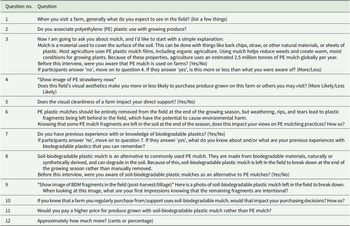
Follow-up semi-structured interviews were conducted on-site using convenience sampling. RMA participants were invited to complete a short interview prior to placing their stickers. Interviews consisted of general and informed questions (see Table 2) with photo-elicitation techniques based on Collier (Reference Collier1957). After obtaining verbal consent, 10–15-minute interviews were conducted. For some questions, participants were shown photographs intended to evoke emotional or cultural reflections on plastic use in agriculture. Responses were recorded on paper, and when permission was granted, audio recorded using an iPhone (Apple, 2024). All interviews were transcribed manually and analyzed using a basic content analysis. Responses were coded into three sentiment categories: (1) positive (e.g., ‘yes’, ‘more likely’, ‘good’), (2) neutral, and (3) negative (e.g., ‘no’, ‘less likely’, ‘bad’). Shifts toward more favorable views after photo elicitation or discussion were coded as positive; unchanged opinions were coded as neutral; continued disapproval was coded as negative. This simplified coding scheme enabled a clear and consistent summary of participants’ sentiments, appropriate for an exploratory study with a modest sample size.
Semi-structured interview questions posed to farmers market and bargain-grocery store shoppers

Table 2. Long description
The table has two columns: ‘Question no.’ on the left and ‘Question’ on the right. The header row is followed by twelve rows, each numbered from 1 to 12. Row 1 asks what participants expect to see in a farm field. Row 2 asks about associating polyethylene plastic use with growing produce. Row 3 introduces mulch, explains its use and prevalence, and asks about awareness of polyethylene mulch. Row 4 references an image of polyethylene strawberry rows and asks if the field’s aesthetics affect purchasing likelihood. Row 5 asks if farm cleanliness impacts direct support. Row 6 explains that polyethylene mulch fragments may remain after the season and asks how this affects views on mulching practices. Row 7 asks about previous experience or knowledge of biodegradable plastics, with a follow-up for those who answer yes. Row 8 introduces soil-biodegradable plastic mulch as an alternative and asks about prior awareness. Row 9 references an image of soil-biodegradable mulch fragments post-harvest and asks for impressions knowing the fragments are intentional. Row 10 asks if knowing a farm uses soil-biodegradable mulch would impact purchasing decisions. Row 11 asks if participants would pay a higher price for produce grown with soil-biodegradable mulch. Row 12 asks how much more participants would pay, in cents or percentage.
Fourteen interviews were conducted in total—eight at the farmers’ market and six at the grocery store. Based on typical qualitative theoretical saturation thresholds for small, exploratory photo-elicitation studies (Dentzman and Goldberger, Reference Goldberger, DeVetter and Dentzman2019), 14 interviews were deemed sufficient to identify major themes. Overall, 102 shoppers (51 per location) participated in the RMAs, with slight variation due to skipped questions.
No demographic data were collected to maintain participant anonymity, though several respondents casually mentioned gardening or agricultural experience, which was noted by the researchers. Survey responses (i.e., sticker placements) were summarized as percentages of total answers for each question. Because the RMA method does not generate probability samples, inferential statistical analyses were not used; results are presented as descriptive averages only.
Results and discussion
Rapid market assessments
Public awareness of agricultural plastics
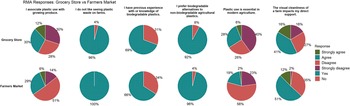
Over half (65%, n = 33) of direct-market shoppers disagreed that plastic use is associated with agricultural production, including 6% who strongly disagreed (Fig. 2). Slightly fewer indirect-market shoppers (58%, n = 30) disagreed that plastic is associated with agricultural production, with 30% strongly disagreeing. Several direct- and indirect-market shoppers noted familiarity with plastic packaging for produce in transport or retail settings but were less familiar with plastic use on farms.
Direct-market (Grocery Store, top) and indirect-market (Farmers Market, bottom) shoppers’ RMA responses to six statements: (1) ‘I associate plastic use with growing produce’, (2) ‘I do not like seeing plastic waste on farms’, (3) ‘I have previous experience with or knowledge of biodegradable plastics’ , (4) ‘ ‘I prefer biodegradable alternatives to non-biodegradable agricultural plastics’, (5) ‘Plastic use is essential in modern agriculture’, and (6) ‘The visual cleanliness of a farm impacts my direct support’. Data were collected at a farmers’ market and a discount grocery store in 2024–2025.

Figure 2. Long description
From left to right, each column represents a survey statement. The top row shows grocery store shoppers, the bottom row shows farmers market shoppers. First column, ‘I associate plastic use with growing produce’: grocery store—12 percent strongly agree, 30 percent agree, 28 percent disagree, 30 percent strongly disagree; farmers market—6 percent strongly agree, 29 percent agree, 14 percent disagree, 51 percent strongly disagree. Second column, ‘I do not like seeing plastic waste on farms’: grocery store—4 percent no, 96 percent yes; farmers market—100 percent yes. Third column, ‘I have previous experience or knowledge of biodegradable plastics’: grocery store—31 percent yes, 69 percent no; farmers market—34 percent yes, 66 percent no. Fourth column, ‘I prefer biodegradable alternatives to non-biodegradable agricultural plastics’: grocery store—8 percent no, 92 percent yes; farmers market—4 percent no, 96 percent yes. Fifth column, ‘Plastic use is essential in modern agriculture’: grocery store—6 percent strongly agree, 28 percent agree, 40 percent disagree, 26 percent strongly disagree; farmers market—2 percent strongly agree, 19 percent agree, 23 percent disagree, 56 percent strongly disagree. Sixth column, ‘The visual cleanliness of a farm impacts my direct support’: grocery store—16 percent strongly agree, 41 percent agree, 27 percent disagree, 16 percent strongly disagree; farmers market—12 percent strongly agree, 51 percent agree, 2 percent disagree, 35 percent strongly disagree. Legend at bottom right: strongly agree (green), agree (blue), disagree (red), strongly disagree (purple), yes (teal), no (pink).
A large majority (79%, n = 38) of direct-market shoppers disagreed that plastic use was essential in modern agriculture, with 23% strongly disagreeing (Fig. 2). Two-thirds (66%, n = 34) of indirect-market shoppers also disagreed that plastic is an essential part of modern agriculture, including 40% who strongly disagreed. Several participants mentioned that it is possible to grow food without the use of plastic because food cultivation existed long before plastics.
Overall, almost all respondents did not like seeing plastic waste on farms (Fig. 2). All (100%, n = 49) of the direct-market shoppers agreed that they do not like seeing plastic waste on farms, while a small number (4%, n = 2) of indirect-market shoppers disagreed. For some participants, seeing plastic was bad enough, while others articulated ‘waste’ as the keyword in their decision-making by associating the word ‘waste’ with something undesirable and disposable, like trash. This response may reflect a degree of tolerance for plastic waste in agricultural production settings. This tolerance for plastic among those familiar with agricultural materials aligns with Dentzman and Goldberger (Reference Goldberger, DeVetter and Dentzman2019), who found that conventional growers required less information to overcome the negative aesthetics of BDMs in the field because of their familiarity with plastic in farming. In contrast, alternative growers tended to adopt more anti-plastic views, associating BDM fragments with waste. Similarly, Stevens et al. (Reference Stevens, Lea-Cox, Black and Abbott2007) found that some u-pick volunteers disliked the appearance of plastic mulch on farms, associating it with negative environmental impacts.
Shoppers’ perceptions of biodegradable alternatives
Approximately two-thirds of direct-market shoppers (66%, n = 30) and indirect-market shoppers (69%, n = 34) indicated they had previous experience with biodegradable plastics (Fig. 2). This familiarity was primarily with products such as biodegradable utensils, takeout containers, and dog waste bags. The remaining one-third reported no prior experience or knowledge of biodegradable plastics.
Nearly all direct-market shoppers (96%, n = 47) and most indirect-market shoppers (92%, n = 46) preferred biodegradable agricultural plastics to their non-biodegradable counterparts (Fig. 2). Only a small minority (10%) disagreed with the statement favoring biodegradable alternatives to non-biodegradable plastics. Those who disagreed generally had previous experience in agriculture.
Farm visual cleanliness
Over half of direct-market shoppers (63%, n = 32) and indirect-market shoppers (57%, n = 30) agreed that a farm’s visual cleanliness influences their likelihood of providing direct support, with 2% and 16% strongly disagreeing, respectively (Fig. 2). This finding connects directly to prior research on how field aesthetics can influence the development of social capital. In general, shoppers preferred farms that appeared neat, which aligns with perspectives in previous research (Dentzman and Goldberger, Reference Goldberger, DeVetter and Dentzman2019; Stevens et al., Reference Stevens, Lea-Cox, Black and Abbott2007).
Semi-structured interviews
General awareness and expectations
When asked to describe what one might see when visiting a farm, only three of the 14 interviewees mentioned plastic mulch. Most instead listed non-plastic features such as livestock, vegetables, plants, harvested crops, machinery, and farmworkers. Before the interview, most indirect-market participants (5/6) were aware that PE mulch is used on farms, whereas only half of direct-market participants reported similar awareness. This contrasts with the RMA findings, where many respondents did not associate plastic with agriculture, suggesting that conversational prompting during interviews may elicit deeper recollection than RMA sticker responses.
Reactions to PE mulch and field aesthetics
During the photo-elicitation stage, participants viewed an image of a conventional strawberry field with PE mulch crop beds and bare soil between rows. Half of the direct-market participants said they would be more inclined to purchase produce from a farm with that appearance, whereas only one indirect-market participant expressed similar interest. Half of the indirect-market participants responded negatively to the image, and two remained neutral. When asked, ‘Does this field’s visual aesthetic make you more or less likely to purchase produce grown on this farm or others [like it] you may visit?’, one indirect-market participant replied:
Less. I like to see organic mulch, less plastic. It ends up going into the soil, and we are eating so much of it already. You know, it’s in mothers’ milk, it’s everywhere. It’s made out of petroleum!
(Indirect-market interviewee 1).Other participants inferred herbicide use from the bare inter-row spaces, indicating that visual cues shaped broader assumptions about a farm’s environmental practices.
Shifts in perception after learning about PE fragmentation
After researchers explained current PE mulching practices and the difficulty of fully removing mulch at the end of the growing season, all direct-market participants said the information changed their views on mulching practices:
Microplastics in foods can be slurped up and then … fed down the food chain … we are constantly consuming microplastics, and I think that is a big [issue].
(Direct-market interviewee 6)
Yes, I would say it’s even worse. I would be less receptive to buying those things. It has a bigger impact, so that’s bad.
(Direct-market interviewee 8)Similarly, most indirect-market interviewees (5/6) reported that their views were affected by this information:
Yes, well, it makes me not want to … eat it. I mean they can’t say that this is organic if they’re using plastic.
(Indirect-market interviewee 2)
I would be concerned about it breaking down and leaching more microplastics and whatever other chemicals that are involved into the soil. (Indirect-market interviewee 3)
I think in all practices, we should be trying to limit plastic use, as well as limiting the plastic that is escaping us. I would not like to know that after I’m done going to this berry farm that the land is more polluted than what it was in history. (Indirect-market interviewee 5)
These insights underscore a disconnect between shoppers and the realities of organic agricultural practices, revealing that many do not associate plastic use with organic production. This highlights the ambiguity of buzzwords such as ‘organic’ or ‘sustainable’ and their sociocultural significance beyond regulatory, political, and economic definitions (Howard, Reference Howard2021; Northen, Reference Northen2021; Wilson, Hendrickson and Myers, Reference Wilson, Hendrickson and Myers2025).
Awareness and interpretation of soil-biodegradable mulch
Most direct-market (6/8) and indirect-market (4/6) participants were not aware of BDM as an alternative to PE mulch. When shown a photograph of BDM fragments in the field after tillage, over half of the direct-market participants and most of the indirect-market participants responded positively once they learned the fragments were biodegradable. One direct-market interviewee stated:
They do look like plastic, but it’s not going to harm the environment, so I’m all for this.
(Direct-market interviewee 3).This image also prompted a recurring suggestion: labeling. Five out of the 14 interviewees proposed placing signs at the edge of fields using BDMs, such as one direct-market participant who said:
I would think it would help to counteract the visceral sensation of a response that I have to that if the farmer had a sign out [saying] biodegradable plastic.
(Direct-market interviewee 5).This finding aligns with Chen et al. (Reference Chen, Marsh, Tozer and Galinato2019), who reported that labeling produce grown with BDMs can create social incentives that translate into economic benefits for growers.
Impact on purchasing decisions and willingness to pay
When asked whether the use of BDMs would affect their support for farms they (hypothetically) regularly purchase from, most direct-market (7/8) and indirect-market (5/6) participants said they would prefer produce grown with BDMs rather than PE. As one direct-market participant explained:
I think that even though sometimes we come up with solutions and they’re not perfect, and then people who don’t understand the scientific method are just like ‘oh, it didn’t work’. Attempts at doing things better and more sustainable … having good intentions is huge for me. It’s something we should foster in humanity in general. (Direct-market interviewee 5)
Indirect-market interviewees shared similar sentiments:
Well, yeah, if I have a choice between bad plastic and good plastic. They should advertise it at the farmers market if they use it. (Indirect-market interviewee 2)
I would support them more because I suspect it costs more than the other plastic does. (Indirect-market interviewee 6)
However, BDMs were sometimes viewed negatively, particularly when participants felt they sustained existing plastic-dependent practices instead of promoting more fundamental shifts. One direct-market participant articulated this perspective:
This looks almost identical to what we’ve been using for commercial agriculture before. It feels like it’s giving permission to keep [using plastic] … It’s almost like accepting the fact that we couldn’t possibly change and use something completely different, we just have to use kind of the same thing. (Direct-market interviewee 7)
Despite this variation, all direct-market and most indirect-market participants said they would pay more for produce grown with BDMs. Direct-market participants varied in how much more they were willing to pay, with one indicating 60 cents more, others suggesting 10%–20% more, and some saying they would potentially pay double for produce grown using BDMs rather than PE mulch. Indirect-market participants were willing to pay 8%–50% more. Overall, most interviewees expressed WTP for a premium for produce grown with BDMs, supporting Hunt’s (Reference Hunt2007) finding that consumers often use their purchasing power to support farmers, local communities, and rural economies.
Integrated summary of findings
Together, the RMA and interview findings demonstrate low public awareness of plastic use in crop production, generally negative reactions to visible plastic waste, strong preference for biodegradable alternatives once informed, nuanced but flexible aesthetic expectations, and meaningful WTP for BDM-grown produce. These results help bridge the gap between documented grower concerns about field aesthetics and consumer reactions: while BDM fragments may initially resemble waste, informational context substantially shifts perceptions. This suggests that consumer-oriented outreach, including signage, certification, labeling, or market messaging, may play an important role in supporting broader BDM adoption.
Conclusion
Growers’ reluctance to use BDMs, often due to perceived barriers such as fear of being seen as a ‘bad farmer’, can perpetuate reliance on PE mulch, other non-biodegradable films, and herbicides (Dentzman and Goldberger, Reference Goldberger, DeVetter and Dentzman2019; Goldberger et al., Reference Goldberger, Jones, Miles, Wallace and Inglis2015). Awareness of consumers’ perspectives may influence growers’ willingness to adopt new practices (Dumitru et al., Reference Dumitru, Sterie, Rodino and Butu2023; Guthman and Brown, Reference Guthman and Brown2016; Hunt, Reference Hunt2007), including BDMs. This study builds upon previous work on consumer preferences, WTP, and public understanding of organic practices and plastic use in agriculture. It extends existing knowledge by comparing food shoppers assumed to have differing levels of agricultural and market engagement, direct- versus indirect-market shoppers, yielding nuanced insights into how awareness of agricultural plastic (e.g., PE mulch) and its alternatives shape attitudes and purchasing intentions. Furthermore, this study addresses gaps in consumer awareness of BDMs by integrating quantitative RMA findings with qualitative interview data, offering a geographically focused yet comprehensive perspective on public understanding and behavior.
Prior research has shown that consumers are willing to pay a premium for alternative products or produce made with biodegradable or biobased plastics, despite inconsistencies regarding the biodegradability of biobased products (Chen et al., Reference Chen, Marsh, Tozer and Galinato2019; Hirsh, Reference Hirsh2010; Notaro, Lovera and Paletto, Reference Notaro, Lovera and Paletto2022; Yue et al., Reference Yue, Hall, Behe, Campbell, Lopez and Dennis2010). This study also reinforces the findings of Thilmany, Bond and Bond (Reference Thilmany, Bond and Bond2006, Reference Thilmany, Bond and Bond2008), showing that producers can successfully differentiate their products to appeal to values such as locality and environmental stewardship. Consistent with these findings, interview results from this study suggest that signage and labeling can enhance consumer acceptance of BDM-grown produce.
Both direct- and indirect-market shoppers in northwest Washington preferred BDMs over PE mulch once they understood their biodegradability. Signage and labeling were seen as effective tools to educate consumers about BDMs and mitigate aesthetic concerns about visible fragments in farmers’ fields. Shoppers further indicated a WTP for higher prices for produce grown with BDMs. This finding is consistent with Chen et al. (Reference Chen, Galinato, Marsh, Tozer and Chouinard2020), who found that agricultural stakeholders (e.g., farmers, crop advisors, educators) in the Pacific Northwest assign the greatest value to BDM attributes that provide opportunities for price premiums.
This study explored three main questions: (1) What is the general knowledge of food shoppers regarding current mulching practices? (2) What are food shoppers’ perspectives toward BDM fragments in agricultural fields? and (3) Do food shoppers prefer biodegradable options over non-biodegradable plastics in agriculture? Results show that most direct- and indirect-market shoppers participating in the RMAs did not associate plastic use with crop production, nor did they view plastic as essential in modern agriculture. In contrast, most interviewees were aware of PE mulch use, although relatively few interviewees expressed a preference for produce grown in a conventional system. Nearly all interviewees said that learning about the challenges of removing PE mulch negatively affected their perception of plastic use in agriculture. Almost all RMA participants reported disliking plastic waste on farms. While approximately two-thirds of shoppers at both locations had prior experience with or knowledge of biodegradable plastics, few were aware of BDMs specifically. Once informed, however, nearly all direct- and indirect-market shoppers preferred biodegradable agricultural plastics. Similarly, most interviewees responded positively to an image of BDM fragments in an agricultural field after learning that they biodegrade. Although over half of the RMA participants valued visually clean fields, most interviewees prioritized environmental benefit over appearance, preferring produce grown with BDMs. Nearly all interview participants indicated WTP for a premium ranging from 8% to 50% more for produce grown with BDMs.
While this study demonstrates that consumers generally view BDMs positively and express WTP more for labeled BDM-grown produce, certain limitations should be noted. The study’s small scale and single geographic focus limit generalizability to other regions with different agricultural systems and sociocultural contexts. The sample may also overrepresent individuals predisposed to environmentally conscious behaviors, particularly within the urban setting where the study was conducted. Additionally, self-reported perspectives and hypothetical willingness-to-pay responses may not perfectly reflect real-world purchasing patterns. Future research should address these limitations by expanding sample sizes, including diverse regions and demographics, and conducting analyses to quantify how consumer preferences influence grower adoption and market demand for BDMs.
Future research should also move beyond stated preferences to examine actual public behavior. Studies that examine how communication strategies influence purchasing decisions and how the public’s awareness and support for BDM use in agriculture affects grower adoption to deepen our understanding of the potential of BDMs as an alternative to PE mulch. Together, these lines of inquiry could help unpack how public-facing information translates into meaningful support for sustainable production practices.
Acknowledgements
The authors acknowledge the occasional use of ChatGPT to assist with sentence clarity during manuscript preparation. After using this tool, the authors reviewed and edited the content as needed and take full responsibility for the final contents of this work.
Funding statement
This work was funded by the Agriculture and Food Research Initiative (Award No. 2023-68016-38933) and Specialty Crop Research Initiative (Award No. 2022-51181-38325) programs from the United States Department of Agriculture National Institute of Food and Agriculture (USDA NIFA). Additional support was provided by the USDA NIFA Hatch Project 1014527. We would also like to acknowledge Emma Rogers, Ben Weiss, and Heather Pedroza for their assistance with the rapid market assessments. Any opinions, findings, conclusions, or recommendations expressed in this publication are those of the author(s) and do not necessarily reflect the view of the USDA.
Competing interests
The authors declare that they have no known competing financial interests or personal relationships that could have appeared to influence the work reported in this article.



 Open access

