


Substance use disorder (SUD) incurs substantial harm to individuals and society, where opioid use disorder (OUD) and especially fentanyl is the central driver of over 107,000 fatal overdoses in the USA and 10,000 in Canada in 2022 alone.1,Reference Volkow and Blanco2 Despite existing treatments encompassing pharmacological, social and psychological approaches, OUD relapse rates remain high at approximately 70%.Reference Volkow and Blanco3 Deep brain stimulation (DBS) is an untapped neuromodulation modality that provides precise electrical stimulation of otherwise inaccessible neural targets that are critical in addiction, such as the nucleus accumbens (NAc) and anterior limb of the internal capsule (ALIC) of the mesolimbic reward system.Reference Volkow and Blanco2 Moreover, DBS has been performed over 250,000 times and is the standard of care in appropriately selected patients with movement disorders and epilepsy.Reference Ranjan, Mahoney and Rezai4 Though DBS addiction research is growing, only 1 in 12 studies on OUD included fentanyl, which is 50–100 times more potent than heroin and has effectively replaced all other illicit opioids in North America.Reference Volkow and Blanco3,Reference Rezai, Mahoney and Ranjan5 Given the unprecedented lethality of fentanyl addiction, its treatment refractoriness and the lack of research on DBS for this substance, further investigation is critical. The present study describes a fentanyl user who received DBS of the NAc and ALIC, marking the first case of DBS for OUD performed in Canada, and is contextualized by a review of DBS for SUD (Prospero: CRD42024575719).
The patient is a 46-year-old male with a 20-year history of SUD, beginning with alcohol, then prescription opioids, heroin, cocaine and most recently, illicit intravenous fentanyl. His medical history includes alcohol-induced pancreatitis and attention deficit hyperactivity disorder. Since his OUD diagnosis 10 years prior, he has undergone extensive treatment, including full trials of methadone (up to 130 mg daily), oral buprenorphine (up to 32 mg daily), long-acting injectable buprenorphine (up to 300 mg monthly), several in-patient detoxification periods, social interventions (e.g., sober living housing) and counseling. Despite these, he struggled with abstinence, with the longest period being only 2 weeks while hospitalized, and continued to experience numerous overdoses. Due to the severe health, financial and social repercussions of his OUD, he sought further therapies.
Following a multidisciplinary review, DBS was offered on compassionate grounds, given his treatment refractoriness. Boston Vercise Genus™ P16 implantable pulse generator and DB-2201 electrodes were implanted bilaterally using a single trajectory with contacts in the NAc and ALIC (Figure 1a–c). The DBS coordinates for the left target were 8.42 mm lateral, 5.42 mm anterior and 5.99 mm ventral and for the right target were 8.72 mm lateral, 16.71 mm anterior and 3.80 mm ventral, relative to the mid-commissural point in the anterior commissure-posterior commissure plane. The left target was oriented at 25° from the mid-sagittal plane and 81.6° from the axial plane, while the right target was oriented at 25° from the mid-sagittal plane and 79.8° from the axial plane. Device programming was conducted according to a monopolar review, whereby each contact was tested in random order with sham stimulations, assessing for acute changes in craving, mood and energy (Supplementary Table 1). From week 1 post-implantation to 30 weeks, settings (Figure 1d) were contacts 5/13 at 5.0 mA and 1/9 at 3.0 mA (60 μs and 130 Hz), and at 30 weeks, an additional programming session due to relapse led to changing to contacts 4/12 at 5.0 mA (60 μs and 130 Hz, where the monopolar review method was utilized again. Preoperatively, he was admitted to an inpatient medical detoxification unit for 7 days at a tertiary care hospital. As he was already on opioid agonist therapy, no additional opioid medications were provided, and his usual scheduled medications were not changed during this period. Postoperatively, DBS was augmented with regular psychiatric and addiction medicine support as an outpatient, where pharmacological and psychosocial supports were provided. Throughout most of the follow-up phase, the patient continued his sublingual buprenorphine 32 mg daily. When he experienced his relapse at 7 months, he was provided with a short course of diazepam (2 tabs of 5 mg) to manage his benzodiazepine withdrawal (a common contaminant of his illicit fentanyl supply). Due to ongoing periodic substance use, we decided to rotate his opioid agonist treatment from buprenorphine to slow-release oral morphine 500 mg daily.
Neuroimaging of deep brain stimulation electrodes: (A) postoperative axial T1-weighted and (B) coronal T2-weighted MRI demonstrating adequate positioning of the electrodes in the nucleus accumbens (NAc) and the anterior limb of the internal capsule (ALIC) and (C) co-registration of MRI (T1- and T2-weighted sequences with a voxel size of 1 mm³), automated brain segmentation to outline the NAc (blue) and ALIC (orange), as well as electrode detection were executed using Brainlab Elements software (Brainlab, Munich, Germany). (D) Electrodes indicating device programming configurations. For weeks 1–30 (green), settings were contacts 5/13 at 5.0 mA as well as 1/9 at 3.0 mA (60 μs and 130 Hz). For weeks 30–48 (blue), contacts 4/12 were used at 5.0 mA (60 μs and 130 Hz). Clinical outcomes are also reported at the various follow-up time points where percentages indicate improvement from baseline. DBS = deep brain stimulation; GAD-7 = Generalized Anxiety Disorder 7-item scale; PHQ-9 = Patient Health Questionnaire 9-item scale; and QOL = Flanagan Quality of Life Scale.

The patient experienced no complications related to DBS and was abstinent from illicit substances for 30 weeks postoperatively (Figure 1). Furthermore, he reported improved cognition as well as markedly reduced impulsivity and drug craving. At 30 weeks, the patient relapsed due to interpersonal conflict and subsequently used illicit substances intermittently over the next 18 weeks, albeit with reduced frequency and dosage compared to baseline (from 3.0 g/day to 0.57 ± 0.33 g/day) as measured using the validated timeline follow-back method. Comparing baseline to averages across the 1-year follow-up (Supplementary Table 2), urinalysis was negative on 11/14 tests (78.6%), fentanyl consumption decreased 95.7% from 3.0 g/day in the 30 days preceding DBS to 0.13 g/day (± 0.29), opioid craving decreased 84.7% from 9/10 to 1.38/10 (± 2.56), Patient Health Questionnaire-9 improved 86% from 24 to 3.4 (± 3.10), Generalized Anxiety Disorder-7 improved 90% from 21 to 2.0 (± 2.42) and Flanagan Quality of Life (QOL) Scale improved 76.4% from 40/100 to 70.54 (± 14.91).
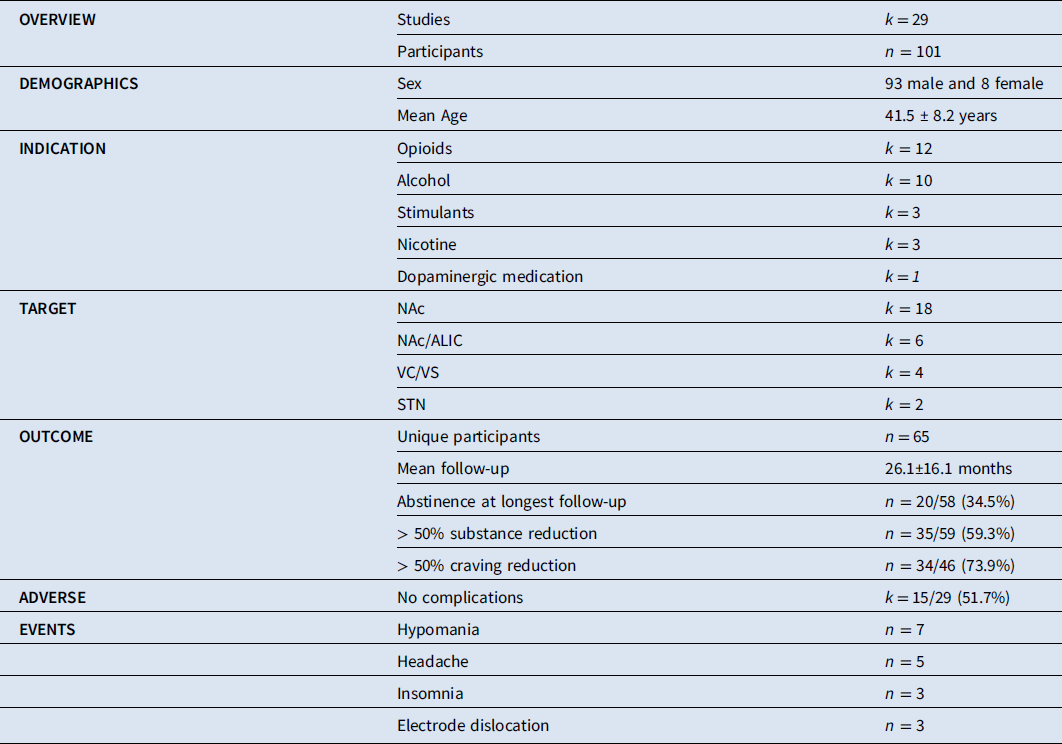
A literature review (Supplementary Figure 1 and Supplementary Table 3 for search strategy) was conducted to contextualize our case, which identified 29 studies of DBS for SUD (Table 1) and 101 participants (93 males, 8 females, average age: 41.5 ± 8.2 years). The most common substances were opioids (k = 12), alcohol (k = 10) and stimulants (k = 3). The most used DBS targets were NAc (k = 18), as well as the combinations of NAc/ALIC (k = 6), and ventral capsule/ventral striatum (k = 4). Considering non-duplicate participants (n = 65), the average follow-up was 26.1 ± 16.1 months, where 20/58 participants (34.5%) remained abstinent and 35/59 (59.3%) reduced their substance use by more than 50% at the longest reported follow-up. Moreover, 34/46 participants (73.9%) experienced a reduction in craving greater than 50% from baseline. No DBS complications were reported in 15/29 (51.7%) studies, and the most reported side effects were hypomania (n = 7), headache (n = 5), insomnia (n = 3), which were transitory, and electrode dislocation (n = 3) that correlated with relapse.
Summary of literature review of deep brain stimulation for substance use disorder

ALIC = anterior limb of the internal capsule; k = studies; n = participants; NAc = nucleus accumbens; STN = subthalamic nucleus; VC = ventral capsule; VS = ventral striatum.
In the present study, the patient experienced no DBS-related complications, achieved abstinence for 30 weeks and demonstrated notable reductions in fentanyl use and craving. This study marks the second DBS report that includes fentanyl, with the other study including two participants, where one experienced significantly reduced drug consumption and the other required DBS removal due to not adhering to study protocol.Reference Rezai, Mahoney and Ranjan5 Our patient reported reduced craving but relapsed after interpersonal problems arose, suggesting that DBS could be effective at reducing acquired incentive salience but less effective at mitigating stress-induced substance-seeking. This aligns with the understanding that the NAc and ALIC are key components of the mesolimbic reward circuitry that underlie incentive salience, which were the DBS targets in the present case, rather than neurocircuitry associated with stress and negative affect, such as the amygdala.Reference Volkow and Blanco2 Moreover, the patient’s relapse suggests that DBS could improve, potentially through neural biomarkers. For instance, a critical innovation is devices that can capture long-term intracranial electrophysiology recordings, an approach that has identified a biomarker for major depressive disorder.Reference Alagapan, Choi and Heisig6 As biomarkers become increasingly validated, DBS is further advancing toward adaptive neuromodulation – stimulating precisely when a pertinent state arises (e.g., craving) to avoid tolerance to constant stimulation and enhance efficacy, which is an emerging approach for Parkinson’s disease.Reference Oehrn, Cernera and Hammer7
The limitations of the present study include its focus on a single individual, follow-up was 1 year and several measurement methods are affected by subjectivity, such as assessing the amount of fentanyl used and QOL. Moreover, the literature consisted of predominantly open-label protocols with small samples. Larger studies with improved study design are required to elucidate potential efficacy and mechanisms. Moreover, if DBS proves to be a viable option for SUD treatment, it will need to be embedded in a multidisciplinary strategy encompassing pharmacological, psychological and rehabilitative dimensions with stringent ethical regulations.Reference Lo, Mane and Kim8 Given the findings from the present case and the literature, further investigation of DBS for SUD may be warranted.
Supplementary material
The supplementary material for this article can be found at https://doi.org/10.1017/cjn.2025.12.
Acknowledgments
We thank the patient for their willingness to publish their case.
Author contributions
Data collection: AZY, JM, AB, AV, CS, BS, DAH, SV, AML and VMT.
Writing: AZY, JM, AB, AF, AV, MES, CS, BS, DAH, JG, SV, IS, LM, BD, SKK, TAV, AML and VMT.
Editing of the final version of the manuscript: AZY, JM, AB, AF, AV, MES, CS, BS, DAH, SV, JG, LM, IS, BD, SKK, TAV, AML and VMT.
Funding statement
This study was not supported by any sponsor or funder.
Competing interests
The authors no competing interests to declare.
Disclosures
AML is the scientific director of Functional Neuromodulation Ltd and a consultant for Medtronic, Abbott, Boston Scientific and Insightec. JM is a principal in Beam Diagnostics, Inc., has consulted with Clairvoyant Therapeutics, Inc. and is supported by the Peter Boris Chair in Addictions Research and a Canada Research Chair in Translational Addiction Research. JM also receives external funding from the Canadian Institutes of Health Research (CIHR), National Institutes of Health, Juravinski Research Institute and Health Canada that were unrelated to this study. MES receives research funding from the CIHR and the Centre for Addiction and Mental Health Discovery Fund. MES is also supported in part by an Academic Scholar Award from the Department of Psychiatry, University of Toronto. SKK has consulted or received honoraria or support from Abbott, Bluerock, Boston Scientific, Medtronic and Novo Nordisk. VMT has received research support through the Brain & Behavior Research Foundation, CIHR (SCT – 191291), the National Institute on Drug Abuse (R21DA061350), the Centre for Addiction and Mental Health Discovery Fund and the Department of Psychiatry at the University of Toronto.



 Open access

