




Introduction
In the call for papers (CFP), it is noted that Critical Forest Studies (referred to hereafter as CFS) is a growing field “dedicated to critical, creative, and relationally embedded practices with forests.” Our contribution extends the focus to kelp forests in the ocean, and more specifically, to our own thinking and co-affective encounters with the Great African Seaforest (referred to hereafter as Great African Seaforest) in Cape Town, South Africa. While CFS has paid attention to land forests, less is known about the seaforest, and the entanglement between territorial and marine forests (Mathai, Reference Mathai2025). Unfortunately, the Great African Seaforest, in particular, has been under-researched from marine biology, oceanography, environmental and blue humanities perspectives (Bolton & Blamey, Reference Bolton and Blamey2017; Prew et al., Reference Prew, Reddy, Mehta, Dyer and Smit2024). It is our contention in this paper that we have a great deal to learn from the Great African Seaforest, and it is immensely important to include these learnings in the newly emerging field of CFS.
While the kelp forest is a familiar habitat for us as freedivers, the CFP has inspired us to pay closer attention to how swimming and thinking-with the Great African Seaforest might contribute to environmental education around CFS (Rousell & Tran, Reference Rousell and Tran2024). We diffractively read Blue Humanities and oceanographic marine biology texts through critical posthumanism and our writings and depictions of our embodied co-affective encounters of swimming and diving in the kelp. As expanded on in the CFP, we think-with the four areas of focus identified in the CFP, namely forest sentience, imaginaries, regeneration and pedagogies in order to develop propositions for kelp forest pedagogies and consider how they might contribute to environmental education. As part of the hydrological cycle which connects all bodies, human/more-than-human, in their transcorporeality – in a planetary watery becoming (Alaimo, Reference Alaimo2025; Neimanis, Reference Neimanis2017), we consider the Great African Seaforest, as a Global South “sentient interspecies learning community” (CFP), in the broader global politico-ethico-onto-epistemological practices and relations (Barad, Reference Barad, Keller and Rubenstein2017).
We are both interested in how seaswimming and freediving as forms of embodied learning can help us develop alternative practices, pedagogies and sensibilities in higher education in relation to the planetary crisis. For the purposes of this paper, we scheduled four swims throughout the month of August 2025. During these encounters, we documented our swims with photos and videos, followed by freewriting sessions in nearby coffee shops. Interspersed with the swims we read marine biology and social science texts about kelp forests and the vegetal turn. We share excerpts of writings and visual images to explore what these encounters with the Great African Seaforest might bring to the four areas of focus identified in the CFP.
Swim 1 (9 August 2025) and 3 (16 August 2025) took place at Beta Beach, Bakoven, along the Atlantic Seaboard of Cape Town (see coordinates 33° 57 ‘25.2″S latitude and 18° 22′ 30.0″E longitude). For Swim 2 (10 August 2025) and Swim 4 (23 August 2025), we swam at Windmill beach in Simonstown, False Bay (see coordinates 4°12′07.2″S latitude and 18° 27′ 39.6″E longitude). Sea temperatures ranged between 14°C and 16°C.
The kelp forest and the Great African seaforest
Kelp emanates from the group of algae known as cyanobacteria, one of the oldest living organisms of our planet whose ancestors date back 2.3 billion years (Hazekamp & Lykke, Reference Hazekamp and Lykke2022; Swinimer, Reference Swinimer2021). These tiny single-celled algae with no nucleus, invisible to the human eye, were responsible for creating earth’s life-nurturing environment by converting sunlight into energy, a process that released oxygen and carbon, the basis of life as we know it today (Hazekamp & Lykke, Reference Hazekamp and Lykke2022).
Besides producing between 50% and 80% of earth’s oxygen, algae are autotrophs. They are the base of the food chain, using energy from sources such as sunlight to produce their own food from inorganic substances like carbon dioxide and water, and provide energy and nutrients for other organisms.
Kelp forests are rich yet vulnerable marine ecosystems occurring largely in shallow, subtidal rocky habitats in temperate regions (Katharoyan et al., Reference Katharoyan, Peer, Landschoff, Griffiths, Samaai and Beeslaar2024; Reed & Brzezinski, Reference Reed, Brzezinski, Laffoley and Grimsditch2009; Steneck et al., Reference Steneck, Graham, Bourque, Corbett, Erlandson, Estes and Tegner2002). They are large brown seaweeds which are scientifically classified as part of the order Laminariales. These forests grow along 25% of the world’s coastlines where water temperatures are cold and nutrient rich (Wernberg et al., Reference Wernberg, Krumhansl, Filbee-Dexter and Pedersen2019). Like land forests, the kelp forest is a “world where many worlds fit” (Blaser & de La Cadena, Reference Blaser and De La Cadena2018; Escobar, Reference Escobar2018). These biodiverse hotspots support over 1000 plant and animal species (Katharoyan et al., Reference Katharoyan, Peer, Landschoff, Griffiths, Samaai and Beeslaar2024), making them a fecund space for multispecies flourishing.
Kelp is sturdy and able to withstand powerful oceanic surges. However, during storms and fierce tides, kelp can be dislodged, becoming a source of nutrition for other species in the ocean and on the beach. Giant kelp rafts on the beach, known as wrack, provide food for land grazers along the rocky shores (Schiel & Foster, Reference Schiel and Foster2015).
The etymology of ‘kelp’ is traced to the Middle Ages English word “culpe,” derived from the Latin “culpa” meaning “fault” or “blame.” Although contested, this widely accepted etymological root links kelp to glassmaking processes when it was burned to create soda ash used to lower the temperature of molten sand, transforming it into glass. The murky effect produced by soda ash was considered faulty (Åsberg et al., Reference Åsberg, Holmstedt, Radomska, Cahoon, Mehti and Wolfsberger2020; Kennedy & Murdoch, Reference Kennedy and Murdoch2024).
There are a diverse species of kelp, which differ significantly morphologically (Reed & Brzezinski, Reference Reed, Brzezinski, Laffoley and Grimsditch2009). Ecklonia maxima, known commonly as sea bamboo, is the scientific name for the dominant species of kelp that forms the Great African Seaforest that covers approximately 1000 km of coastline (Blamey & Bolton, Reference Blamey and Bolton2018; Katharoyan et al., Reference Katharoyan, Peer, Landschoff, Griffiths, Samaai and Beeslaar2024). As is the only giant bamboo kelp forest on our planet, it seems to be one of the few kelp forests that is actually growing (Bolton & Blamey, Reference Bolton and Blamey2017; Filbee-Dexter & Wernberg, Reference Filbee-Dexter and Wernberg2018; Katharoyan et al., Reference Katharoyan, Peer, Landschoff, Griffiths, Samaai and Beeslaar2024; Mehta et al., Reference Mehta, Wynberg, Ramcharan-Kotze and Smit2023; Sea Change Project, 2023), although some evidence of abiotic degradation has been reported (Dunga, Reference Dunga2020).
Like all kelp forests, the Great African Seaforest is foundational and central to the flourishing of its ecosystem. It simultaneously provides food, shelter, protection and nurseries for many species of fish, and invertebrates, like abalone and cephalopods, as well as a variety of marine mammals (Smale et al., Reference Smale, Burrows, Moore, O’Connor and Hawkins2013, p. 4023). Historically, the Great African Seaforest was used for subsistence by Indigenous coastal dwellers, specifically the Khoisan peoples, also known as ‘strandlopers’ and San hunter-gatherers in South Africa for subsistence. However, there is “limited academic literature to quantify and/or detail the specifics of this historical use” (Mehta et al., Reference Mehta, Wynberg, Ramcharan-Kotze and Smit2023, p. 3). More recently, Ecklonia maxima is harvested for commercial use in South Africa. Its nutrient-rich properties support the abalone aquaculture industry in the Western Cape and provides the base in the production of liquid agricultural growth stimulants.
Structure of the great African seaforest
The Great African Seaforest’s unique structure provides a three-dimensional habitat for thousands of marine species. Considered the coral reefs of cold and temperate waters, kelp forests are important biodiverse ecosystems that play a critical role in maintaining a stable climate and like coral reefs, are vulnerable to climate change. Protecting these areas is crucial for maintaining healthy oceans and biodiversity. The Ecklonia maxima has a distinct and easily recognisable structure: the holdfast, the stipe, the blades/fronds, the pneumaticist and the canopy. We discuss each of these below.
The holdfast
Holdfasts are biodiverse habitats where a variety of marine creatures such as brittle stars, sea stars, small crustaceans, nudibranchs and sea snails find food and shelter from predators, extreme temperatures and strong currents. The complex form of a single holdfast provides home to hundreds of different species. It is particularly nurturant of juvenile marine life, being a safe place to lay and hatch eggs and for larvae to metamorphose into juvenile form (Branch & Branch, Reference Branch and Branch2018; Katharoyan et al., Reference Katharoyan, Peer, Landschoff, Griffiths, Samaai and Beeslaar2024; Lewis, Reference Lewis, Shefer, Bozalek and Romano2023). Unlike plant roots that penetrate the earth to absorb nutrients, the sole function of the holdfast’s stubby branches, the haptera, is to attach to the rocky substrate by means of a strongly adhesive glue-like substance, alginate, anchoring it against the swirling currents. As new haptera grow over old ones, more spaces open up in which creatures take refuge. Groups of kelp tend to share intermingled holdfasts as juvenile holdfasts grow on older ones (Branch & Branch, Reference Branch and Branch2018). Sometimes creatures of the community also eat the older inner haptera, causing the holdfast to become dislodged.
The kelp stipe
The kelp’s long flexible stem-like stipe links the holdfast to the canopy above. Unlike in other kelp forests, the Great African Seaforest stipe is a single strong and supple hollow tube that allows it to bend and sway within the ocean. The stipe carries sugar produced during the photosynthesis process from the canopy to the holdfast, encouraging rapid growth. In the Great African Seaforest, Ecklonia maxima’s stipes can grow more than 10 m, sometimes as rapidly as 1 cm per day (Rothman et al., Reference Rothman, Bolton, Stekoll, Boothroyd, Kemp and Anderson2017, p. 2629). Stipes are also home to a variety of sessile animals such as sponges and immobile invertebrate fauna. Narrower at the base the stipe widens, to culminate in a single, large, Great African Seaforest-filled bladder, known as the pneumatocyst. The pneumatocyst protrudes above the water level in low tides, holding the kelp upright, keeping the canopy afloat to ensure maximum absorption of sunlight for photosynthesis.
Blades/Fronds
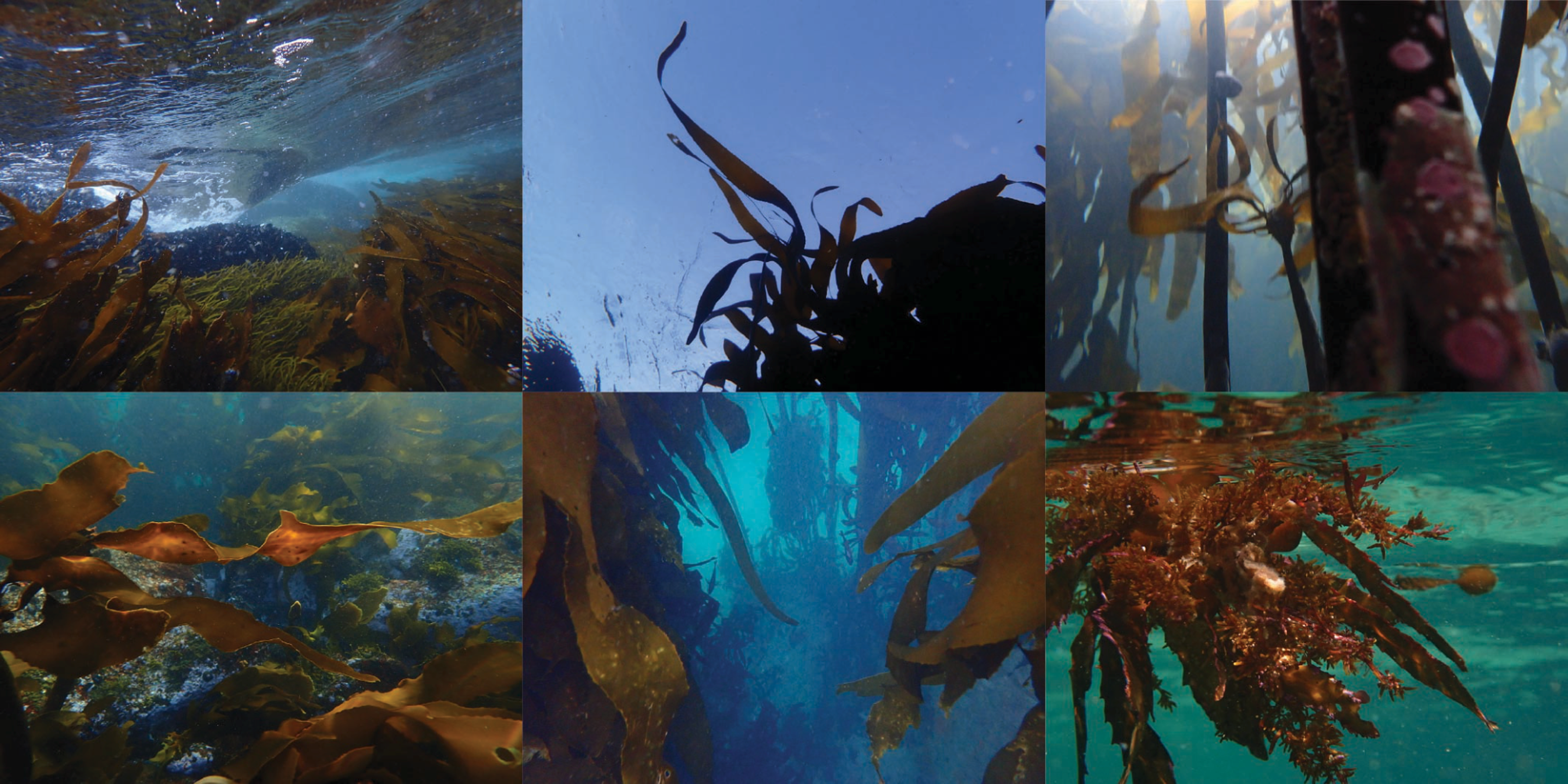
The flattened blades or fronds are the real workplace of kelp (See Figure 1 for photographs of kelp fronds). Cells in the blade absorb water, carbon dioxide and other chemicals from the ocean surrounding and, using energy from sunlight, convert these simple chemicals into oxygen and food compounds – sugar alcohols, amino acids and other building blocks of the plant. These compounds provide nourishment for the entire plant. Surplus food is stored in kelp cells, making nutritious meals for countless fishes and invertebrates who eat the kelp plant.
Collage of kelp frond images from our swims.
Ecklonia maxima remains fertile throughout the year, reproducing through the release of millions of zoospores developed in sporophytes on the blades of mature plants (Joska & Bolton, Reference Joska and Bolton1987). The zoospores have tails called flagella, that propel them downwards to the sea bed where they settle near the parent kelp’s holdfast. Zoospores germinate into sperm-bearing male and egg-producing female gametophytes which are tiny microscopic filamentous structures. Pheromones attract sperm to the egg. Once fertilised, the egg, or zygote, develops its own holdfast, stipe and blades, marking the beginning of the visible sporophyte stage that eventually grows into a mature plant.
The canopy
The kelp forest’s canopy is vital to the structure and function of the ecosystem. Comprising the fronds and pneumatocyst, the canopy expands across the water’s surface, maximising surface area to increase sunlight absorption for photosynthesis.
The canopy also mediates the quality and quantity of light and shade for organisms living below, creating distinct zones of life from the canopy down to the holdfasts on the reef. The entangled mass of fronds influence the forest environment by calming the ocean’s surface and the underlying water column, offering protection for marine life inhabitants in the forest, including sea birds and mammals such as the Cape clawless otter.
Kelp forests play a crucial role in mitigating the environmental crisis, contributing to solving some of our greatest challenges, including food security, climate change, and biodiversity loss (Filbee-Dexter, Reference Filbee-Dexter2020, p. 400 – 1). Kelp is also a good source of nutrients for human and nonhuman animals, and is used as a healing aid because of its numerous nutritional elements (Swiminer, Reference Swinimer2021). Environmentally, it is cultivated to produce “a biodegradable replacement for single use plastics, [and] livestock feed that reduces methane emissions and more” (Mehta et al., Reference Mehta, Wynberg, Ramcharan-Kotze and Smit2023, p. 1). There is also growing interest in the potential of large-scale harvesting and culturing of kelps to produce non-fossil-fuel-based biofuels (Smale et al., Reference Smale, Burrows, Moore, O’Connor and Hawkins2013).
Kelp forest sentience
In a sentient world, the world speaks. Its great story is that it speaks, and our great story is that we are part of its speaking (Rose, Reference Rose2013, p. 107).
In this section we explore the specificities of kelp forest sentience and our own attunement to it. We challenge traditional perceptions of intelligence being located in, and the prerogative of, a single human mind, and explore how sentience is expressed relationally within the Great African Seaforest. Collective and connected attunement, communication and response-ability are crucial for the continued survival of the forest’s rich biodiverse ecosystem and its ever-changing environment.
The CFP refers to Trewavas et al.’s (Reference Trewavas, Baluška, Mancuso and Calvo2020) notion of sentience which “denotes any organism’s particular mode of ecological awareness and relationality and underscores the capacity to experience, express, react, remember, and undertake intelligent behaviours” (CFP). Kelp intra-acts using a sophisticated chemical language that is useful in a number of ways. Firstly, it deters attack by herbivores such as sea urchins, by discharging chemical compounds that render it toxic and less tasty, and warn nearby kelp of the onslaught. Secondly, pheromones are released to attract male gametes to female gametes to ensure fertilisation in the reproduction process. Thirdly, kelp emits chemicals that inhibit the growth of competing seaweeds and other nearby organisms to ensure that light, space and nutrients are more available to it.
In addition to chemical signals, the Great African Seaforest’s response-ability to discern the intensity and direction of sunlight through its photoreceptors maximises the potential for photosynthesis. The anchored holdfast and suppleness of the stipe and fronds enable kelp to withstand powerful ocean surges, influencing reproduction and growth patterns.
As humans who immerse ourselves in the Great African Seaforest, we are reminded of Whitehead (Reference Whitehead1978) who noted that very little of the process of the world is perceptible through human senses. We struggle to attune to the sentience as it is often imperceptible and incomprehensible to human sense-abilities, as Nike noted “I was trying to see the sentience today … but it is invisible”. Viv also noticed the frustrations and limitations of human sense-abilities.
Kelp sentience is not immediately available to the human - we have to read about it to understand how it happens, but we humans can use our sentience to attune to and become-with kelp. We feel the warmth being in the middle of the kelp forest, we hear the clicking sounds of the snapping shrimp, we hold the stipes and crawl down them and see them bobbing in and out of the ocean, we see the fronds swaying hither and thither with the oceanic swells, we see the different colours of the stipes, fronds and holdfasts. We also see all the creatures moving in and out of the forest. We see the holdfast in its sessile stance anchoring the stipe which enables the movement of the stipe and fronds/blades.
As radical botanist Gibson (Reference Gibson2018, p. 37) reminds us, a human exceptionalist prioritisation of sensory perception over other life forms reinforces nature/culture binaries, concealing that humans have affinities with other life. This is evident for example, in the way plants and humans remember past stresses, while the stressors may differ, for plants (procedural) and humans (emotional), the electro-chemical activities produced are the same. Opening ourselves to nature’s own “expressive voice” (Plumwood, Reference Plumwood2014) and understanding the limitations of conflating human language with communication (Bencke & Bruhn, Reference Bencke, Bruhn, Bencke and Bruhn2022) encourages a focus on listening as an art of attentive noticing (Tsing, Reference Tsing2010).
Far from being mute, the Great African Seaforest actively expresses and communicates through multiple registers, in which certain parts of the forest are made intelligible to other parts (Barad, Reference Barad2007; Brits & Gibson, Reference Brits, Gibson, Gibson and Brits2018). Given that we find it difficult to “read” seaforest sentience, we practice Slow and care-full listening, attuning to the forest’s multiplicity of expressions. In shared kinship we are entangled and co-affected by the distributed “creature-languages” (Rose, Reference Rose2013, p. 103) of the seaforest, eschewing Western concepts of Cartesian dualistic hierarchies and essentialist human-centric knowledges’ preoccupation with filling epistemological gaps. The Great African Seaforest is a dynamic field of forces and intensities that has the capacity to affect and be affected, in which “affective reciprocity constitutes empirical bodies … as subjects and objects by virtue of their significance for each other” (Cullen, Reference Cullen2021, p. 13). The rhythmic seaforest provides countless organisms with a capacity for attunement (See Figure 2 for photographs of some of the multispecies creatures supported by the kelp forest). A klipvisFootnote 1, for example, holds perfectly still to remain hidden amongst the stipes. Its stillness is a direct, bodily response to the motion that surrounds it. The emphasis here is not on the klipvis or the stipe, but on the affective forces enabling their capacities, their manners or ways of being (Deleuze, Reference Deleuze1980 lectures on Spinoza; Despret, Reference Despret, Benckee and BruhnB2022), that make them significant for each other. As Viv writes
Affect is related both to the affordances of the kelp and the indeterminacy of what might happen. Nothing is set in stone but the being of kelp becomes-with and makes various becomings possible.
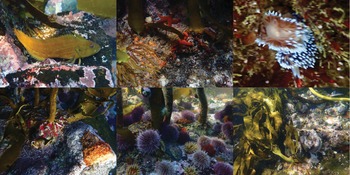
Collage of kelp forest creatures and multi-species community.

Rather than engage with the kelp forest from a distant representational stance, we swim with Marder’s notion of vegetal performativity as an ongoing mode of being, through which plants, as artists, “create themselves and their environments […] moulding themselves and their world through forms inseparable from vegetal matter” (Gibson & Baylee, Reference Gibson and Baylee2018, p. 28). In other words, through our transcorporeal intertwinement in the kelp forest we become wit(h)ness (Boscacci, Reference Boscacci2018) to how it is continuously affecting and being affected by its place of growth (Alaimo, Reference Alaimo2025).
Swimming with Kelp forest imaginaries
Our collaborative reading-writing-photographing-swimming encounters with the Great African Seaforest create possibilities for immersive ethico-onto-epistemologies (See Figures 1–3 for collages of the Great African Seaforest from our photographs). In what follows, we share freewriting excerpts that surface particular ways of being and becoming-with the Great African Seaforest, and explore how these upwellingsFootnote 2 might be generative for CFS imaginaries.
Collage of holdfast inhabitants.

Attending to the materiality of frothy bubbles on the water’s surface, Viv considers how common-sensical notions about intertidal zones and the Great African Seaforest leads to erroneous perceptions regarding affordances and ways of being and becoming-kelp forest.
What does the nutritious soup of foam generated by kelp mucilage mean for our ways of being or our manners of being in the world? It shows that commonsense understandings of what is happening in a kelp forest are problematic. This foam is often seen to be a sign of pollution, but in fact it’s high energy content is very rich in proteins and nutrients that are important for kelp forest animals to consume. ∼ Viv
The Great African Seaforest, as a whole, is a figuration of relationality and the impossibility of individualising any one part of the forest from another.
Driving here, listening to Marder’s podcast about Plant Thinking (Marder, Reference Marder2013), I was struck by how plants are modular, or replicants, that subjectivity is not singular. Plants are formed by and inform their environment. Viv’s comment that the kelp forest includes the rocks and the shore is helpful in understanding how the Great African Seaforest is a world to many worlds, how the forest is more than the kelp even though it exists because of the kelp. My attention was drawn to the forest as assemblage rather than on the individual “trees”, how everything moves together … like Glissant’s consent not to be singular. Land trees keep their distance, they do not join hands and become enmeshed. Observing the kelp from afar is like observing wildlife from afar … kelp as herd, kelp as community. ∼ Nike
The suppleness and sentience of kelp, its ability to respond to oceanic currents enacts a vital onto-ethical stance of response-ability.
Kelp is very much living in response to the sea and its movements as well as making life possible for many plants and creatures. ∼Viv
The Great African Seaforest absorbs the surging waves and quietens them, as an intertidal buffer in turbulent seas. At times, we cling to stipes, grateful for the affordances of the holdfast’s ability to adhere to the rocks, anchoring us within the forest. This allows a pause within the greater rhythms of waves, wind, and all that is happening around us. After our first swim in the big swells at Beta Beach, Viv expressed appreciation for kelp’s support:
The kelp forest peeping above the surface because of the low tide seemed to calm the sea. It looked daunting to immerse oneself. I was literally sucked into the sea - the force of the backwash taking me out. The kelp was comforting, not only did it tame the sea, it provided stability to hang onto in the moving waters. On making my way out, I again was grateful towards the kelp as I clung onto it to prevent me from being sucked back into the current. ∼ Viv
Our writings return to kelp’s flexibility and suppleness, as well as its sessility and emplacement, in response to the shifting tides.
The holdfast fixes the stipe to the rock, everything else moves within and around it like dancers in alignment … graceful, flowing, following the direction of the current in a slow, swirling, sweeping movement. Dancing as a way of being in the world, going with the flow. ∼ Nike
Kelp forest regeneration
Kelp forest under threat
Multiple concurrent threats whose cumulative detrimental effects impact kelp forests’ survival synergistically (Crain et al., Reference Crain, Kroeker and Halpern2008). Climate related threats include rising sea water temperatures and increasing seastorm intensities. With warming waters, physiological thresholds are surpassed, overall growth slows, resulting in tissue loss and possible mass mortalities (Bolton & Blamey, Reference Bolton and Blamey2017). Raging storms destroy canopies and uproot holdfasts, leading to less sunlight and habitat for other organisms.
Non-climate related threats caused by increased human activity directly impacts the health of kelp forests (Smale et al., Reference Smale, Burrows, Moore, O’Connor and Hawkins2013, 4030). Discharge of effluents and industrial waste impacts forest health in relation to pollutants, nutrient levels and sedimentation (Reed & Brzezinski, Reference Reed, Brzezinski, Laffoley and Grimsditch2009). Further kelp deforestation is brought about by food web disruption by overfishing and the decline of apex predators such as sea otters, who eat sea urchins, which in turn feed on kelp. When the ecosystem’s balance is thrown out, population explosions of invertebrate herbivores like sea urchins cause overgrazing, rendering forests barren (Scales, Reference Scales2024; Steneck et al., Reference Steneck, Graham, Bourque, Corbett, Erlandson, Estes and Tegner2002).
Reversing or mitigating stressors to kelp ecosystems through active restoration of kelp ecosystems is a newly emerging field that needs further development (Eger et al., Reference Eger, Marzinelli, Gribben, Johnson, Layton, Steinberg, Wood, Silliman and Vergés2020). Recovery of kelp forests can be relatively quick - usually in about three years, but the existence of multiple chronic and acute stressors negatively affects the resilience of kelp forests (Smale et al., Reference Smale, Burrows, Moore, O’Connor and Hawkins2013).
In contrast to the global decline of kelp forests, the Great African Seaforest seems to be growing. However, it is under threat. Swathes of South Africa’s oceans have been set aside for mining exploration. Poaching of abalone and rock lobsters has caused urchin populations to increase and, like the Pacific North West kelp forest, there is risk here of overgrazing. Pollution and effluent are major concerns as we share in our freewritings after encountering unprecedented plastic pollution at Beta Beach.
I am sickened by our swim this morning - felt like we were witnessing and swimming through the apocalypse. This swim stripped away any sentimentalism that I was feeling. Mingled and mangled and diffracted through what we have read and listend to. ‘Is a River Alive?’ by Robert MacFarlane beautifully describes the animacy of rivers and how certain humans have literally killed them with their greed and insensitivity to the natural world. And also Leslie Petrik’s research regarding effluence released into the Cape Atlantic Seaboard. My body feels tainted. Usually I am renewed by seaswims fully giving myself to the experience, but today I was aware of holding back trying my best to bypass or keep a distance from the surrounding debris. I feel both angry and helpless - angry at human greed and the assumption that getting rid of what we don’t want or can’t accommodate into the ocean will not affect anything. Helpless at the sheer volume of ecocide. ∼ Viv
They say “you never regret a swim”, however today I did. I was overwhelmed by the bits of foreign objects … chip packets, sanitary towel strips, a toothbrush, a soap dish. I viscerally recoiled. I found a black shopping bag and started to fill it with plastic bits. However, there was a hole and much of what was funnelled in escaped. It all felt very futile. While I love what we do … swimming and writing … what are we going to do about this mess? Will our paper affect people who read it? How can we bring about human behaviour change? ∼ Nike
Great African seaforest as a regenerative habitat
The Great African Seaforest plays a crucial role in regeneration both within the ocean and on land. Kelp provides life-giving opportunities, underpinning the foodweb through its nutrients for a myriad of creatures, where upwelling ‘fuels their phenomenal productivity’ (Branch & Branch, Reference Branch and Branch2018, p. 151). The flourishing of life through energy flows, not only happens in the ocean but on the rocky shores and sandy coastline. The holdfast, is a safe protective nursery for gestation of macroinvertibrates and filter feeders such as black mussels, sea cucumbers and sponges (Branch & Branch, Reference Branch and Branch2018; Katharoyan et al., Reference Katharoyan, Peer, Landschoff, Griffiths, Samaai and Beeslaar2024). Holdfasts are ideal gestational sites providing protection from extreme temperatures by creating microclimates, which also makes them more resilient to climate change. Kelp reduces the amount of CO2 in the water significantly “carbon sequestered by kelp forests is comparable to that of mangroves, salt marshes, and seagrass meadows combined” (Sea change project 2023 https://seachangeproject.com/great-african-seaforest/). This also helps reduce acidification in the ocean. The Great African Seaforest also protects coastlines from erosion through its slowing down of sea currents and buffering sea storms. In the excerpts below, Viv was inspired by the forest’s fecundity and its inspiration for imagining alternative ways of being and doing and thinking otherwise.
I noticed a lot of creatures in the holdfast - and even found a Great African Seaforest flame nudibranch which was moving quite quickly around the holdfast. How do a hundred creatures know to get to that holdfast? What chemicals or messages are happening in these multispecies intra-actions? I also spied a corkscrew kelp, the pink lichen on many of the stipes, a rockfish the colour of kelp, languishing around the holdfast, and a school of very tiny fish. There were urchins eating kelp that I photographed. I thought all this is made possible by kelp! ∼ Viv (See Figure 3 for a collage of creatures in the holdfast).
Kelp forest pedagogies
I see the neatly planted trees in the carpark, placed equidistant from one another. Unlike human-made forests, Indigenous forests defy human’s obsession with geometric logics. The seaforest has no discernable exterior logic or concerns with measurement … its growth is immanent to its environment, its environment is immanent to it. All of it is a whole, all of it is responsive to its environment. We are part of the forest for the duration of our visits. What do you call a constant structure that is always evolving, attuning, that is there but not fixed. It does not move around but it does not stay still. It has no fixed boundary but it does end. While you cannot differentiate the wood from the trees, you can differentiate the forest from the areas around it. ∼ Nike
Visiting the wild spaces of kelp habitats helps us understand how we are part of the “worldly entanglements” (Tsing, Reference Tsing2015, p. 153), where the Great African Seaforest “does not subscribe to human boundaries” (Spriggs, Reference Spriggs, Petitt, Tonnaer, Servais, Notermans and Fijn2025, p. 76). Through curious but care-full swimming-writing-reading, we practice a diffractive methodology, continuously learning the arts of paying close attention to the details of happenings in and around the forest, sensitising ourselves to kelp as teacher (Stengers & Savransky, Reference Stengers and Savransky2018; Tsing, Reference Tsing2015). In this part of the paper we re-turn to insights diffracted through kelp sentience, imaginaries and regeneration to consider what these understandings might mean for a kelp pedagogy.
Great African seaforest as slow pedagogy
The Great African Seaforest enables the slowing down and stilling of oceanic currents. However, a Slow pedagogy is not just about a slowing down of activity, it is also about an openness to immersion and depth of engagement (Bozalek, Reference Bozalek2025) as experienced in our care-full forest freedives. How else might the Great African Seaforest provide fresh insights for what has already been written about Slow pedagogy (Payne & Wattchow, Reference Payne and Wattchow2009)? Slow attentive pedagogy is about attuning to the participatory field of the forest, where all parties are paying attention without drawing attention to themselves (Rose, Reference Rose2013). Attentiveness to the lively abundance and diversity of the Great African Seaforest microhabitats is an essential pedagogical move for decolonising the curriculum and escaping from normopathy and neurotypicality (Manning & Bozalek, Reference Manning and Bozalek2024). Our thinking-with the Great African Seaforest emphasises the importance of transdisciplinarity for teachings of kelp forest and what this might activate for CFS. As in the Great African Seaforest, a regenerative Slow pedagogy needs to acknowledge the toxic effects of neoliberal higher education. Our immersive Great African Seaforest pedagogy undoes clock time, where our non-innocent imbrications in colonial violences are saturated through porous encounters with hauntological histories (Barad, Reference Barad, Keller and Rubenstein2017; Pierce, Reference Pierce2025).
On the walk backward I saw the iron railings from the Boer war camp where they used to bring to prisoners to wash here. Such sights in the water always leaves a bitter taste in the mouth. It is both a reminder of the cruelty of groups of humans towards each other and their obliviousness about doing damage generally on our planet. ∼ Viv
A sessile pedagogy of emplacement and resilience
The Great African Seaforest helps us understand the relationship between emplacement and resilience differently. As a sessile organism, kelp’s being and becoming is inseparable from its emplacement. Attached to the rock on which it was born, kelp is always reciprocally entangled with other organisms “losing its individuality and blurring the boundaries of specificity” (Cantera, Reference Cantera2024, p. 21). As a methodology, Cantera proposes a sessile poetics that eschews Western binary logics and hierarchies, unfurling local imaginaries that problematise Global North notions of territory. Sessile poetics evinces “porous and undefined zones” (Cantera, Reference Cantera2024, p. 21) that enact situated ways of thinking and foreground crucial Global South Great African Seaforest narratives.
Although attached to a substrate, kelp’s supple configuration withstands and moves in response to the watery rhythms of the ocean. It is important for pedagogy to be both anchored and flexible. A flexible pedagogy responds to the environment, nurtures the whole, whereas a pedagogy of rigidity is siloed and stuck, limiting the flourishing and potential for becoming-seaforest.
Being able to bend and twist and swirl, the kelp adapts to, and dances with the flows of the water around it, and the bodies it bumps up against. Its ability to give makes it less fragile. There is an acceptance, a surrender to the forces and flows and this is how it derives its strength and resilience. ∼ Viv
Conclusion
“I can only compare these great aquatic forests of the southern hemisphere with the terrestrial ones in the intertropical regions. Yet if in any country a forest was destroyed, I do not believe as many species of animals would perish as would here from the destruction of kelp”. ∼ Darwin, Reference Darwin1839
Learning from kelp as “not just objects of manipulation but participants in the effort to imagine new worlds and to envision new futures” (Meeker & Szabari, Reference Meeker and Szabari2020, p. 2) is an important political gesture. For, as part of Southern ethico-onto-epistemologies it generates an openness to hesitating, pausing or even arresting the hegemony of dominant Global North forms of logic which permeate academia. This kind of slowing down which the kelp forest enacts so well contributes to an “anti-capitalist praxis” (Barad, Reference Barad, Keller and Rubenstein2017, p. 65), attuning to reparative techniques and methods of care so important for Global North-South relations (Pierce, Reference Pierce2025) in CFS and other disciplinary fields in higher education. The sheer abundance of life and diversity of species, as noted by Darwin (Reference Darwin1839) have much to teach humans, as sentient kin of the forest about alternative life forms and diverse transmaterial forces in an age of climate change and ecological crisis. Our co-affective encounters and indepth, care-full immersions with the Great African Seaforest signal a tentative toe in the water for exploring generative ways of reconfiguring/reconsidering sentience, imaginaries, regeneration, pedagogies, a “becoming-forest of thought” (as referred to in the cfp).
Today the sea was alive, abundantly so. There is something about kelp’s proximity to the land … how it hovers or inhabits the space of overlap between land and sea, between water and air. The movement of the fronds evokes the infinity symbol, to and fro, up and down, repeating itself, returning on itself. Was today’s swim an event … did it shock us to new thought? ∼ Nike
The insights gleaned from the Great African Seaforest (Great African Seaforest) offer profound implications for environmental education, providing propositions that are informed by place-based, sensory, seasonal and tidal relations. Expanding on kelp pedagogies and the concept of Great African Seaforest as Slow and sessile pedagogies can offer clear guidance for practitioners, scholars, teachers and educators in environmental education.
In what follows, we offer kelp pedagogy propositions which we hope are useful for environmental education that seeks to move towards a more holistic, ethical and engaged form of learning. Our propositions are drawing from our co-affective learnings with the Great African Seaforest where we attempted to cultivate our sensibilities to attune more deeply and response-ably to the oceanic more-than-human world.
Cultivate attentiveness and situated listening
Co-affective encounters with the Great African Seaforest enable a shift from humancentric perception through a care-full attentiveness to the more-than-human world. This involves the cultivation of situated and deep listening (Loveless et al., Reference Loveless, Rennie, Søndergaard and Zinovieff2025) to seaforest “creature-languages” (Rose, Reference Rose2013), recognising that communication extends beyond human linguistic forms. Practitioners are encouraged to design activities attuned to sensory engagement with natural environments.
Embrace relationality and intra-action
Kelp pedagogies foreground the relationality within ecosystems, eschewing Cartesian notions of individual entities, where any one part of the forest pre-exists and is distinct from another. An attunement to a relational ontology emphasises the interconnectedness of all life forms for Environmental education. The Great African Seaforest provides a clear understanding of how biodiverse species co-exist and co-affect each other.
Foster response-ability and ethical engagement
The sessility, suppleness and resilience of kelp in responding to oceanic currents offers a vital onto-ethical stance of “response-ability.” Educators can guide learners to recognise the kelp forest as a sentient response-able ecological system. This recognition requires a move beyond passive observation towards an active, ethical engagement with the Great African Seaforest. This also necessitates an acknowledgement of human non-innocence in advocating practices towards kelp forest regeneration.
Decolonise and challenge dominant logics
By foregrounding Global South narratives and challenging Western binary logics and the associated “toxic effects of neoliberal higher education”, Great African Seaforest kelp pedagogies contribute to decolonising the curriculum. When environmental education incorporates southern knowledges and local vegetal and multispecies perspectives, diverse ways of knowing and being in the world are made possible.
Practice place-based immersion
Prolonged and repeated immersion in local natural environments, similar to the scheduled swims and freediving in the Great African Seaforest that we practiced for this Special Issue, enabled a deep, embodied understanding of place. We learned that by moving beyond superficial encounters, it became possible to foster genuine connection and co-affective attunement with the Great African Seaforest.
Recognise the limits and possibilities of human sentience
As we have mentioned, our swims and free dives activated all our senses, the sounds of the ocean, the feel of kelp, the visual diversity of marine life, and even the “nutritious soup of foam generated by kelp mucilage.” However, in trying to understand how kelp sentience works, we recognised that very little of the process of the world is perceptible through human senses alone.
Attune to dynamism, seasonal and tidal relations
Understanding of the rhythms of seasons and tides fosters a deeper appreciation of the dynamic and ever-changing nature of the Great African Seaforest in its rocky coastal environment. Freewriting after swims and dives can help document the rhythms, dynamism and indeterminism of the kelp forest.
Our swimming and freediving entanglements with the Great African Seaforest enacted a diffractive methodology that continuously re-turned to insights from various sources – scientific texts, personal narratives, artworks, and embodied experiences. While marine science, evolutionary theory, affect studies, personal narratives, pedagogical reflections, etc might be seen by some scholars as incommensurable, swimming diffractively through such texts, our free writings and images have potentialised diverse ways of thinking, feeling and understanding the Great African Seaforest. It is our contention that these diffractive immersive encounters of transdisciplinary approaches and creative expression can enliven embodied environmental learning in Critical Forest Studies in novel ways.
Acknowledgements
We appreciate the opportunity to be part of the special issue on CFS and would like to thank the editorial team for their valuable feedback and the journal for their support in getting this article to publication.
Financial support
This research received no specific grant from any funding agency, commercial or not-for-profit organisation.
Ethical standard
Nothing to note.
Author Biographies
Vivienne Bozalek is an Emerita Professor in Women’s and Gender Studies at the University of the Western Cape, and Honorary Professor in the Centre for Higher Education Research, Teaching and Learning (CHERTL) at Rhodes University. Her research interests and publications include the political ethics of care and social justice, posthumanism and feminist new materialisms, hydrofeminism, Slow scholarship, innovative pedagogical practices in higher education, post qualitative and participatory methodologies. She has authored numerous articles in local and international journals and book chapters. Her most recent co-edited book is Hydrofeminist thinking with oceans: Political and scholarly possibilities with Tamara Shefer and Nike Romano (Routledge, 2024).
Nike Irene Romano is a lecturer in applied design at the Cape Peninsula University of Technology. She holds a PhD from Utrecht University and the University of the Western Cape. Her research interests include new materialism, posthumanism and arts-based research. She has authored numerous articles in local and international journals and book chapters. She is co-editor of Hydrofeminist thinking with oceans: Political and scholarly possibilities with Tamara Shefer and Vivienne Bozalek (Routledge, 2024).



 Open access

