


In Finland, the idea of a free school lunch was introduced during the Second World War. Children's poor nutrition emerged as a social and public health problem, when war led to food shortages and brought women into the labour force. Finland was the first country in the world to serve free school lunches when free school catering started in 1948(1).
Nowadays, free school lunches are offered to all schoolchildren undergoing basic education each school day(1, 2). According to recommendations, the school lunch must be properly organized, supervised and nutritionally balanced. It is also an important part of nutritional education, aiming at demonstrating to children how to put together a nutritionally balanced meal. The Finnish National Nutrition Council has issued recommendations for school meals(2). According to these recommendations, the school lunch should cover one-third of the child's daily energy intake and should be composed according to the plate model. Half of the plate should be filled with vegetables, one-quarter with potatoes, rice or pasta and the last quarter with meat, chicken or fish. The school lunch should also include bread with vegetable oil-based margarine and skimmed or semi-skimmed milk or sour milk. The school lunch is considered balanced when all these components of a meal are included.
Studies on school lunches are rather scarce, since free hot meals at school are common only in a few Western countries such as Finland and Sweden. Raulio et al.(Reference Raulio, Roos and Prättälä3) examined the association of lunch-eating patterns with overall food habits and nutrient intakes in school-aged children in Finland. Consumption of school lunches was associated with higher consumption of vegetables, fruit, rye bread, milk, sour milk and cheese. On the other hand, skipping school lunches was associated with higher consumption of French fries, potato chips, hamburgers, pizza, meat pies, ice cream, candy and chocolate. Hastert and Babey(Reference Hastert and Babey4) examined the relationship between dietary behaviour and frequency of eating packed lunches among adolescent students. They observed that adolescents who brought a packed lunch from home each school day ate fast food, soft drinks, fried potatoes and high-sugar-sweetened foods less frequently and ate fruit and vegetables more often compared with adolescents who never consumed packed lunches at school. In general, children and adolescents in Finland and in many other countries consume fewer fruit and vegetables than recommended, and their diet contains considerably large amounts of candies, soft drinks, cookies and salty snacks(Reference Cohen, Sturm and Scott5, Reference Hoppu, Lehtisalo and Tapanainen6). Consequently, the intake of dietary fibre is considerably low and that of sugar significantly high. High consumption of soft drinks, energy drinks and candies is associated with overweight(Reference Berkey, Rockett and Field7–Reference Phillips, Bandini and Naumova9), whereas consumption of vegetables and fruit is inversely associated with overweight(Reference Roseman, Yeung and Nickelsen10, Reference Hassapidou, Fotiadou and Maglara11).
High meal frequency is positively associated with an overall healthier diet(Reference Siega-Riz, Carson and Popkin12). For example, those consuming meals more frequently also consume vegetables more often(Reference Roos, Hirvonen and Mikkilä13, Reference Lien, Jacobs and Klepp14). In addition, high regularity of eating breakfast was found to be positively associated with a healthier diet, such as lower consumption of sweet and salty snacks, soft drinks and juices(Reference Vågstrand, Barkeling and Forslund15). Several studies have also observed an association between frequency of family meals and healthy diet(Reference Gillman, Rifas-Shiman and Frazier16–Reference Utter, Scragg and Schaaf18). High frequency of family meals has been found to be inversely associated with overweight(Reference Utter, Scragg and Schaaf18–Reference Tavernas, Rifas-Shiman and Berkey20).
The aim of the present study was to explore the manner in which the quality of the school lunch consumed reflected the overall eating pattern among school-aged children.
Methods
Data collection
Data for the present study were collected in the spring of 2010 from all primary and middle schools in Sotkamo, a town of approximately 11 000 inhabitants in eastern Finland. There are eleven primary schools and one middle school in the town. Several of the primary schools are small village schools. The study was conducted after obtaining permission from the school principals and with the consent of the parent or guardian.
Children in grades 5–9 (aged 11–16 years) were asked to fill in an Internet-based questionnaire about their eating patterns and consumption of different kinds of food. They were also asked to report their height and body weight. A total of 531 of 629 schoolchildren completed the questionnaire. It was filled in at school and the teachers assisted the children when needed.
The questionnaire consisted of two parts. Part 1 contained thirteen questions about eating patterns and part 2 contained thirty-seven questions about the frequency of consumption of different food items. Of the questions, forty-seven were structured and three were open. Some of the questions were derived from the questionnaires used in the Health Behavior of School Aged Children study conducted by WHO(21) and some from the School Health Promotion Study conducted by the National Institute for Health and Welfare in Finland(22).
Part 1 included questions about the type (breakfast (more than a glass of milk or juice), lunch, afternoon snack, dinner, evening snack) and frequency (never, 1–2 times/week, 3–4 times/week, daily) of meals consumed during school days and weekends, as well as about the meal components (main dish, salad, bread, margarine, milk/sour milk) consumed in a typical school lunch. The question about the reasons for skipping school lunch included the following options: not hungry; does not like the food; queue too long; noisy environment; friends do not eat; ate during home economics; eats packed lunch; spends lunch time doing something else; eats somewhere else; and some other reason. Open questions were related to opinions about the school lunch and how it should be improved.
The questionnaire also evaluated the frequency (≥4 times/d, 3 times/d, 1–2 times/d, do not eat snacks daily, hardly ever eats snacks) and type (candies or chocolate, fruits or berries, vegetables, ice cream, buns, cookies or doughnuts, salty snacks, bread, soft drinks or energy drinks, dairy products, something else) of typical snacks. Family eating patterns were evaluated by questions including statements about shared meals, regular meal times, availability of vegetables, fruit, salty snacks, sweet snacks and soft drinks, the possibility of influencing food choices and children taking part in cooking. The frequency of shared family meals was evaluated by the following scale: never; rarely (1–2 times/week); 3–4 times/week; almost every day (5–6 times/week); and daily.
Part 2 evaluated the frequency of consumption of foods in the following groups: fast foods; cereal products; dairy products; salty and sweet snacks; vegetables and fruit; and drinks. The frequency options were from never to several times per day.
Children were classified as normal weight or overweight according to international BMI cut-off points for children(Reference Cole, Bellizzi and Flegal23). According to the Centers for Disease Control and Prevention criteria, children with BMI <5th percentile were classified as underweight(24).
Analysis of the eating pattern of school lunches
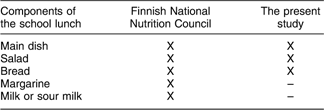
Children were divided into ‘balanced’ and ‘imbalanced’ school lunch eaters. Only forty-five of 514 (8·8 %) children ate all components of a meal meeting the criteria of a well-balanced school lunch set by the Finnish National Nutrition Council(2) (Table 1). Because of this small number of respondents considered as well-balanced school lunch eaters, a less-strict definition was used to indicate a balanced school lunch, reflecting the nutritional quality of children's school lunches (Table 1). In the present study, a school lunch was considered to be balanced if it included always or often (3–4 school days/week) a main dish, salad and bread. Those schoolchildren who never or rarely ate a school lunch containing all the above-mentioned components were considered as ‘imbalanced eaters’. Eating patterns and consumption of different foods were compared between those who regularly ate a balanced school lunch and those who did not.
Definition of a balanced school lunch according to the Finnish National Nutrition Council(2) and by the present study
Statistical analyses
Statistical analyses were conducted using the Statistical Package for the Social Sciences statistical software package for Windows version 14·0 (SPSS Inc., Chicago, IL, USA). Frequencies generated by cross-tabulations were tested using the χ 2 test for statistical significance. In a few cases, the number of observations in a cell was too low to fulfil the minimum requirements for normal distribution of the χ 2, and therefore the non-parametric version of the χ 2 was used (i.e. Fisher's Exact test). P value <0·05 was regarded as statistically significant.
If needed, the answer options described above were combined for statistical analyses to increase the number of respondents in each subgroup.
Results
The final study sample consisted of 531 schoolchildren, of whom 53·5 % were girls and 46·5 % were boys. The prevalence of overweight or obesity among the children was 20·8 %, and 4·5 % of children were underweight. Altogether, 514 children could be classified as either well-balanced or imbalanced school lunch eaters: 46·5 % ate a balanced lunch and 53·5 % an imbalanced lunch. Of the balanced eaters, 59 % were girls and 41 % were boys; this difference was significant (P = 0·037). Girls ate salad in school lunches significantly more often than did boys. Altogether, 75 % of girls and 63 % of boys ate vegetables often in their school lunches (P = 0·005). Consumption of a main dish and bread did not differ between girls and boys. The balanced and imbalanced eaters did not differ in age or in prevalence of overweight, obesity or underweight. The characteristics of the study population are presented in Table 2.
Descriptive characteristics of the study population

†Those schoolchildren who always or often (at least 3–4 school days/week) ate a school lunch containing a main dish, salad and bread.
‡Those schoolchildren who never or rarely ate a school lunch containing a main dish, salad and bread.
Meal frequency
Most of the children had regular meal frequency on school days and on weekends. Altogether, 61 % of the children ate breakfast (more than a glass of milk or juice) every day but 24 % had breakfast rarely (1–2 times/week) or never on school days. Altogether, 82 % of the children ate lunch, 72 % dinner and 56 % an evening snack every school day. Breakfast and evening snack were eaten more often and lunch and dinner less often on weekends than on school days. Altogether, 71 % of the children ate breakfast, 63 % lunch, 71 % dinner and 70 % evening snacks on weekends. Snacks were also eaten less often on weekends. A total of 58 % of the children ate an afternoon snack daily or often on school days and 43 % on weekends. Eating a balanced school lunch was more strongly associated with regularity of meal times both on school days and on weekends than was eating an imbalanced school lunch. The meal frequencies of the balanced and imbalanced school lunch eaters on school days and weekends are presented in Fig. 1 and Table 3, respectively. Children who ate a balanced school lunch more often ate breakfast (P = 0·001), an afternoon snack (P < 0·001), dinner (P = 0·017) and an evening snack (P < 0·001) on school days than did children who consumed an imbalanced school lunch. In addition, on weekends, balanced school lunch eaters ate breakfast (P = 0·008), an afternoon snack (P = 0·010), dinner (P < 0·001) and an evening snack (P < 0·001) more often than did imbalanced school lunch eaters. The frequency of eating lunch on weekends did not differ between the groups.
Meals consumed 3–4 d/week or more often among balanced ( ) and imbalanced (
 ) school lunch eaters on school days (percentage of balanced and imbalanced eaters; n 497–514). Frequencies were generated by cross-tabulations using the χ 2 test for statistical significance (*P < 0·05, **P < 0·01, ***P < 0·001)

Number of meals eaten during weekends among balanced (n 234–239) and imbalanced (n 263–274) school lunch eaters

*Frequencies were generated by cross-tabulations using the χ 2 test for statistical significance.
The most common reasons for skipping school lunches were: the children did not like the foods offered (22 %); they were not hungry (14 %); they had already eaten during their home economics class (8 %); they felt that the eating environment was unpleasant (7 %); or their friends did not eat a school lunch (3 %). To improve school lunches, the children suggested that: it should be planned more according to the children's taste preferences; the lunch menu should be more variable; a larger variety of breads should be offered; fruit should be offered more often (e.g. as afternoon snacks); and vegetables should be offered as individual components instead of in mixed salads. They also wished to have more desserts, such as fruit or berry fool. The children reported that the eating environment should be pleasant and cosy, with background music, and that the foods should be served attractively.
Snacking
Most of the children (54 %) ate one to two snacks between main meals (breakfast, lunch, dinner and evening snack); 28 % had three or more snacks per day and 16 % did not eat any snacks. The frequency of snacking was the same among balanced and imbalanced school lunch eaters. Most of the children ate healthy snacks, such as bread (63 % of the children), dairy products (51 %) and fruit or berries (49 %). However, unhealthy snacks were also quite common: candies or chocolate (27 %) buns, cookies or doughnuts (27 %), soft drinks or energy drinks (20 %), ice cream (18 %) and salty snacks (11 %). Only 12 % of the children ate vegetables as snacks. The balanced school lunch eaters consumed healthier snacks compared with imbalanced school lunch eaters. The snacks consumed most often by the balanced and imbalanced school lunch eaters are presented in Table 4. The balanced school lunch eaters ate fruit or berries (P < 0·001) and dairy products (P = 0·008) more often and salty snacks (P = 0·026) less frequently. They also consumed fewer soft drinks or energy drinks (P = 0·010) as snacks compared with the imbalanced school lunch eaters. The consumption of candies or chocolate, vegetables, ice cream, buns, cookies or doughnuts and bread did not differ between the groups.
Usually consumed snacks among the balanced (n 239) and imbalanced (n 275) school lunch eaters

*Frequencies were generated by cross-tabulations using the χ 2 test for statistical significance.
Family dinner and eating pattern at home
The majority of children (58 %) had family dinner every day or almost every day (5–6 times/week), whereas 21 % had family dinner sometimes (3–4 times/week) and 16 % rarely (≤2 times/week). The frequency of family dinners did not differ between the balanced and imbalanced school lunch eaters. However, the eating pattern at home was healthier among children who ate a balanced school lunch. Their family meals included vegetables in every meal (P = 0·002); fruit was offered daily (P = 0·007) and soft drinks were offered less often at home (P = 0·006). The balanced school lunch eaters also took part in cooking more often (P = 0·014) and their parents paid more attention to the quality of the diet (P = 0·021). The availability of sweet or salty snacks at home and the possibility of influencing the type of food eaten at home did not differ between the groups.
Food choices
Only 34 % of children ate rye bread or crisp bread, and 15 % ate wheat bread ≥1 time/d. Porridge was eaten at least 5 times/week by only 17 % of the children. Altogether, 22 % of the children ate vegetables and 23 % ate fruit or berries every day. A total of 70 % of the children drank milk or sour milk, 22 % ate yoghurt with sugar and 9 % consumed natural yoghurt at least 5 times/week. Of the fast foods, pizzas and French fries or fried potatoes were eaten at least 1–2 times/week by 5 % of the children, and hamburgers, hot dogs or kebabs and meat pies or pastries were consumed by 6 % of children. The consumption of other unhealthy products was quite common: 22 % of the children ate candies or chocolate, 19 % consumed buns, cookies or doughnuts, 16 % consumed ice cream, 12 % consumed salty snacks and 11 % ate puddings at least 2–4 times/week. Juice and hot chocolate were consumed daily by 16 %, soft drinks by 8 % and energy drinks by 4·4 % of the children.
Eating a balanced school lunch was associated with healthier food choices (Table 5). The children who reported eating a balanced school lunch not only ate pizzas (P = 0·010) and meat pies or pastries (P = 0·001) less frequently but also drank soft drinks (P = 0·004) and energy drinks (P < 0·001) less often. The balanced school lunch eaters consumed porridge (P = 0·045), rye bread or crisp bread (P < 0·001), milk or sour milk (P = 0·021), yoghurt with sugar (P = 0·001), vegetables (P < 0·001) and fruit or berries (P < 0·001) more often. The consumption of hamburgers, hot dogs or kebabs, French fries or fried potatoes, wheat bread, natural yoghurt, pudding, ice cream, salty snacks, candies or chocolate, buns, cookies or doughnuts, hot chocolate and juice did not differ between the groups. The frequencies of consumption of vegetables, fruit or berries, soft drinks and energy drinks are not presented in Table 5, because of different consumption categories for these food items. Vegetables were eaten daily by 29·9 % and fruit or berries by 30·4 % of the balanced school lunch eaters, whereas the percentages among the imbalanced school lunch eaters were 18·6 % and 19·6 %, respectively. Vegetables and fruit or berries were eaten rarely by 36·8 % and 35·3 % of the imbalanced school lunch eaters, whereas among the balanced school lunch eaters only 17·8 % rarely consumed vegetables and fruit or berries. Soft drinks and energy drinks were consumed ≥5 times/week by 5·6 % and 1·7 % of balanced school lunch eaters, whereas the respective percentages among the imbalanced school lunch eaters were 11·3 and 7·4.
Frequencies of consumption of different foods among the balanced (n 231–239) and imbalanced (n 258–266) school lunch eaters

Consumption of hamburgers, hot dogs or kebabs, French fries or fried potatoes, wheat bread, natural yoghurt, pudding, ice cream, salty snacks, candies or chocolate, buns, cookies or doughnuts, hot chocolate and juice did not differ between the groups.
*Frequencies were generated by cross-tabulations using the χ 2 test and in a few cases by the non-parametric version of the χ 2 (i.e. Fisher's Exact test) for statistical significance.
Discussion
The present study suggests that eating a balanced school lunch is associated with overall healthier eating patterns. Children who ate a balanced school lunch seemed to eat more healthily both at school and at home, and they had a more regular meal pattern. Therefore, eating a balanced school lunch could be seen as an indicator of the overall eating pattern of young children and adolescents.
In the present study, only a minority of the children (8·8 %) consumed all components of the school lunch offered as recommended by the Finnish National Nutrition Council. In other studies, the percentages have been somewhat higher; 10–35 % of schoolchildren have reported eating all components (main dish, salad, bread with vegetable oil-based margarine and milk or sour milk) of the school lunch(Reference Raulio, Pietikäinen and Prättälä25–Reference Urho and Hasunen27). The reason for the lower percentages in the present study is not known; however, on the whole, it is surprising and somewhat alarming that a well-balanced school lunch offered in Finnish schools is not accepted by a high percentage of schoolchildren.
Because of the less number of children consuming a meal that fulfilled all criteria of a well-balanced school lunch, we modified the criteria in the present study so that those consuming the main dish, salad and bread almost every day were regarded as consuming a balanced school lunch. With this criterion the number of children in each group was more comparable, that is, 46·5 % in the balanced group compared with 53·5 % in the imbalanced group. An interesting finding was that even with these less-strict criteria clear differences in eating patterns and in the quality of the overall diet could be observed.
Only 41·5 % of boys and 50·7 % of girls usually ate a balanced school lunch. This is explained by the fact that girls ate salad more often compared with boys. The higher proportion of girls with a better diet is in accordance with the findings of other studies(Reference Mikkilä, Räsänen and Raitakari28). Raulio et al.(Reference Raulio, Pietikäinen and Prättälä25) observed that obese children ate school meals less often compared with children with normal growth. Skipping breakfast and not having dinner with the family in the evenings were also associated with less-frequent eating of school lunch. However, in our study, the balanced and imbalanced school lunch eaters did not differ in their prevalence of overweight or underweight. Body weight and height were self-reported, which may have reduced the reliability of the anthropometric data. Eating a family dinner did not differ between the balanced and imbalanced school lunch eaters, but the balanced school lunch eaters had healthier eating patterns at home and they ate breakfast more often. The age of the children had no effect on whether they ate a balanced or an imbalanced school lunch. Irrespective of age or weight, consuming a balanced school lunch is important for every child.
In order to persuade children to eat balanced lunches more often, schools need to continue to develop the content of the lunch offered, as well as the eating conditions. The most common reason for skipping school lunches was the fact that the children did not like the food offered. The school lunch menu should be planned according to children's taste preferences and the menu should be more variable. Many studies have reported that school lunches can promote healthy eating by making healthy choices easy during the school day(Reference Raulio, Roos and Prättälä3, Reference Hoppu, Lehtisalo and Tapanainen6, 29).
Moreover, one of the most common nutritional problems among children in relation to their diet is low consumption of vegetables, fruit and wholegrain products(Reference Cohen, Sturm and Scott5, Reference Hoppu, Lehtisalo and Tapanainen6). According to the present study, school lunches could offer a way of balancing the diet by serving a larger variety of breads, salads and vegetables. In addition, at least some of the vegetables could be provided as individual components instead of in a mixed salad. School lunches could also include more fruit in the form of desserts or as snacks. Increased availability of vegetables and fruit has been found to enhance their consumption(Reference Hoffman, Franko and Thompson30).
One common reason for skipping lunch that was reported by the participants in the present study was an unpleasant eating environment. This is something that schools should also pay more attention to. It is a well-known fact that a pleasant eating environment and serving food in an attractive manner enhance enjoyment of the meal(Reference Wansink31). Another quite common reason cited by children for skipping school lunches was that they were not hungry. Although the reason for this was not specified, it could be suggested that more attention should also be paid to scheduling of the lunch time. Another possible explanation for children not being hungry during lunch time might be that they consume snacks during the morning hours. For some of the children, the reason for skipping lunch was that their friends did not eat lunch either. Eating is a social occasion in which the eaters influence each other's eating behaviour and thereby the development of food preferences and eating pattern(Reference Birch and Fisher32).
Data were collected using Internet-based questionnaires that the children filled in at schools, with teachers assisting the children when needed. The response rates were very high, that is, 83 %. Moreover, as questionnaires were filled in at all primary and middle schools in Sotkamo, the data represent the dietary habits of the school-aged children in that part of Finland well. Of course, we cannot rule out the possibility that the results would have been different had the data been collected from some other area of Finland. However, there is no reason to make allowances for such a possibility. Moreover, the main findings were well in line with the earlier literature(Reference Raulio, Roos and Prättälä3, Reference Cohen, Sturm and Scott5, Reference Hoppu, Lehtisalo and Tapanainen6). Instead, one of the major weaknesses of the study was that the data were only qualitative and we do not have quantitative information about how much the children actually eat. Collecting quantitative information in an accurate and reliable manner would, however, have made the study much more demanding for the children and, as a consequence, the response rates would likely have been lower.
In conclusion, the results of the present study indicate that school lunches consumed by children aged 11–16 years also reflect their overall eating patterns outside the school. Eating a balanced school lunch is associated with more regular meal patterns, the availability of healthier foods at home and an overall healthier diet, suggesting that healthy eating patterns are learnt at home. School lunch intake could thus be considered as a marker of overall dietary patterns, making it possible to identify those children at an increased risk for poor diet. The results also confirm earlier findings that Finnish schoolchildren rarely consume all components of a school lunch even though the lunch is freely offered. Future research is needed to clarify whether collaboration between schools and parents could contribute to the development of healthier eating patterns among school-aged children.
Acknowledgements
Financial support for K.P. was provided by the Academy of Finland and for J.L. by the Raisio Plc Research Foundation. The authors have no conflict of interest to declare. T.T.-T. implemented the study and wrote the article; S.P., J.L. and L.K. assisted with data analyses and with writing of the manuscript; K.P. and H.M. assisted with study implementation and with writing of the manuscript. The authors thank the participants of the Liikkumisesta kansalaistaito project for making the study possible.



