




In August 1904, after contentious negotiations at the Amsterdam international socialist congress of the Second International, leaders of European socialism took a boat excursion around Amsterdam harbor. Dutch delegate and later prominent international trade union leader Jan Oudegeest recalled the following scene:
During the International Socialist Congress in Amsterdam in 1904, three little men sat around a small round table on a steamer that was taking a tour of the Amsterdam harbor.
One was more theorist than a parliamentarian or diplomat: that was Karl Kautsky. The other was more of a parliamentarian than a theoretician or diplomat: that was August Bebel. The third was a parliamentarian, diplomat and also theoretician: That was Victor Adler […] They just talked to each other about the question of the day: the dispute between the German and French views on parliamentarism and the ministerial question.
I was a young man at the time, listening intently and enjoying the spirit, vision and in-depth knowledge of these three. But it finally became clear to me that one would progress further with the finer conception, the gentler method, the stronger adaptation to foreign tradition and history, as represented by the diplomatic Adler, than with the strong, violent intervention represented by Bebel. And I learned at this little table from the three little men that an International can only be built very slowly, very carefully and only in the accommodating way that Adler wanted.Footnote 1
Oudegeest’s account offers key insight into the difficulty of forging socialist internationalism between and within national delegations during the period of the Second International, 1889–1914. He praised Austrian socialist Victor Adler’s approach of using diplomacy, knowledge of “foreign tradition and history”, and gentle methods. The International could not be constructed through the heavy-handed tactics of German socialist leader August Bebel or the ideological rigidity of Marxist theoretician Karl Kautsky. Oudegeest affirmed a “careful” and “accommodating” path that Adler embodied to navigate the International through its most important and complicated debates on socialist policy and principles.
Crucially, Oudegeest did not present socialist internationalism in 1904 as a given or fixed entity. Indeed, the project of international socialism – symbolized by Karl Marx’s famous 1848 dictum “Workers of all nations, unite!” in the Communist Manifesto – was fraught with pitfalls and setbacks, often caused by disunity and ideological discord. The first serious attempt at international fraternity – the International Working Men’s Association or First International (1864–1876) – was dissolved in part due to the internecine conflict between Karl Marx, who envisioned a centralized, politically oriented International, and non-centralist forces, including anarchist Mikhail Bakunin and supporters of Pierre Proudhon’s mutualism, who insisted on a federative arrangement and pursuit of socialist goals focused on economic rather than political struggle.Footnote 2 Efforts in the 1880s by English and French socialist reformers and European Marxists to resuscitate the International resulted in the convening of two competing international socialist congresses in Paris in 1889.Footnote 3 The unstable beginnings of the Second International persisted through the 1890s until the turn of the twentieth century when, according to French socialist Jean Longuet, it entered its “organic” period.Footnote 4
In 1900, the International set up a central office called the International Socialist Bureau (ISB), located at the Maison du Peuple (The People’s House) in Brussels, Belgium.Footnote 5 Belgian socialists Victor Servy and Camille Huysmans served as the ISB’s secretary, and Emile Vandervelde was president of the International until 1918. By 1914, on the eve of World War I, the International could rightfully claim to be Europe’s largest social and political movement with over 3 million members, with connections to socialist groups and parties on five continents.Footnote 6
As Oudegeest pointed out, the International nonetheless grappled with fundamental questions of policy and socialist principles from 1900 until 1907. Paris 1900 involved primarily Le Cas Millerand or the question of when a socialist decides to join a liberal or bourgeois national government in defense of or expansion of democratic rights and social legislation. Amsterdam 1904 was partly an extension of the dominant topic at Paris, now clearly couched within the ideological challenge of socialist revisionism (or reformism) versus Marxist orthodoxy. That contest over socialist ideology had ramifications across Europe. Stuttgart 1907 is famous for the International contending with the possibility of war and what its response would be, which simultaneously brought to the forefront the complex question of the relationship between socialism and the nation and concomitantly between socialist parties and the International. The Stuttgart congress issued an impactful antimilitarist resolution that framed socialist responses to World War I.
At the Paris, Amsterdam, and Stuttgart congresses, we should, therefore, not take for granted the ability of the International to maintain its unity when national, ideological and tactical differences between and within socialist parties could have splintered the movement as occurred from the First International through the 1890s and again after 1914 with the schism between Social Democracy and Communism throughout the twentieth century. Instead, it is pertinent to examine closely the practice of achieving compromise on congress resolutions and the individuals most responsible for that outcome. The purpose of this article is to historicize and analyze how Belgian Emile Vandervelde and Austrian Victor Adler collaborated effectively in these pivotal years to uphold and sustain socialist internationalism – the Adler-Vandervelde dynamic. In doing so, they advanced an International that articulated broad socialist principles and ideals, while permitting tactical autonomy to member parties within their domestic politics, a delicate yet ultimately successful arrangement until 1914.
The traditional historiography of the Second International, written predominantly from 1945 to 1989 against the backdrop of the Cold War, sheds light on the fissures within the international socialist movement: anarchism versus Marxism in the 1890s, socialist revisionism versus orthodox Marxism in the early twentieth century, and disputes over tactics to wage campaigns against the prospect of war, mainly 1905 to World War I.Footnote 7 This scholarship is valuable insofar as it deepens knowledge of the national, ideological, tactical, and organizational diversity within the Second International, hence the gist of Oudegeest’s insight. Often, this literature centered on the labor and socialist organizations and parties of England, France, and Germany, resulting correspondingly in a plethora of political biographies of their leaders. Thus, social and political historians of the Left are familiar with August Bebel, Karl Kautsky, Rosa Luxemburg, Keir Hardie, Jules Guesde, Wilhelm Liebknecht, Eduard Bernstein, and Jean Jaurès to name the most notable. Most of them have been deemed important enough to merit a stand-alone English-language political biography. In fact, some like Bebel, Kautsky and Bernstein can claim several.Footnote 8 Yet, there are certainly drawbacks to these studies. Reflecting a “methodical” nationalism in perspective – the core template of most political biographies – most of these studies did not consider enough the transnational dimensions of international socialism.Footnote 9 The clear exception would be Christina Morina’s innovative collective biography of the founding generation of Marxism.Footnote 10 Taken together, this literature did not assess the outsized influence and role of “lesser” parties and their leaders in international socialism.Footnote 11
Our understanding of the Second International has shifted considerably over the last fifteen years, moving away from the conventional historiography focused on socialist ideology and putative movement ineffectiveness.Footnote 12 Instead, historians such as Laura Polexe, Elisa Marcobelli, and Pierre Alayrac have shown how international socialism was able to forge at times an impressive social and cultural movement, at least within Europe.Footnote 13 Most recently, viewing socialist internationalism from a global perspective, scholars like Sebastian Schickl, Lorenzo Costaguta and Lucas Poy have put into sharper relief the predominantly Eurocentric orientation of the Second International, which itself served as an integrative force among European socialist and labor movements vis-à-vis non-European peoples, which clearly points out the “limits” of socialist internationalism.Footnote 14
With the possible exception of Janet Polasky and Jan Hunin and Wim Geldolf’s research on Belgian Camille Huysmans’ activity during World War I, scholars have not yet provided a close examination of the most important leaders of the Second International, who, through their diplomatic skills and overarching goal to promote unity, were able to keep the diverse elements of international socialism together.Footnote 15 Polasky has convincingly shown the pivotal role of Emile Vandervelde in uniting the International through conciliation and compromise.Footnote 16 Polasky’s characterization of Vandervelde is both correct and incomplete. To understand fully how contentious topics within international socialism were handled, it is important to consider how Vandervelde and Victor Adler together played vital and complementary parts to forge resolutions that garnered strong support from most parties involved. In his memoir, Vandervelde fondly recalled that special dynamic with Adler in the International: “At the same time, in what concerns the German-speaking countries, Victor Adler was one of the two or three greatest friendships of my life. They called us in the International socialist Siamese twins.”Footnote 17
The activity of Adler and Vandervelde is part and parcel of the “practice” and “mechanics” of internationalism within the context of the Second International.Footnote 18 Adler and Vandervelde were pivotal individuals, who inhabited the social space of international socialist congresses to form networks and facilitate an exchange of ideas over socialist ideology and tactics with the aspiration to create and sustain socialist internationalism. Morina aptly uses the term “field worker” to characterize Adler (and Jean Jaurès and Eduard Bernstein) because they “base their engagement (not exclusively, but primarily) on firsthand experiences. They are on site, in the middle of things: they take note of personal encounters and reflect empathetically: they act as equalizers. They understand Marxism rather as a moral principle than as dogma”.Footnote 19 Adler and, by extension, Vandervelde brought these traits and Marxist orientation to the congresses of the Second International to forge socialist internationalism. Understanding the Adler-Vandervelde dynamic requires an account of what happened at the congresses and analysis of their efforts in context to bring the different ideological and tactical positions together in widely accepted resolutions.
This article is organized into three parts. The first section provides an overview of the emerging friendship between Adler and Vandervelde during the 1890s and how they developed skills in their domestic politics and ideological views that served them well in their roles as mediators within international socialism. The second section spotlights the Adler-Vandervelde dynamic at the Paris 1900 and Amsterdam 1904 congresses, which confronted the related questions of socialists entering bourgeois national governments and the notion that the path to socialism can occur gradually and predominantly through democratic means. Focus will also be given to the role and fate of French socialist Jean Jaurès. The final section takes up the negotiation of the International’s principal leaders at the 1907 Stuttgart congress, where Adler and Vandervelde were instrumental in helping craft the International’s famous Militarism and International Conflict resolution. The conclusion assesses the Adler-Vandervelde dynamic beyond 1907 and the contours of the International that they were pivotal in constructing.
Adler and Vandervelde in the 1890s: Bilateral Socialist Internationalism between Austrian and Belgian Socialism
To understand the collaboration that Adler and Vandervelde brought to the international arena within the Second International from 1900 to 1907, it is important to sketch their development as political leaders of Belgian and Austrian socialism in the 1890s. Neither of them just appeared on the scene ready to assume the mantle of leadership or to be granted leadership status by other socialists by 1900. Some combination of personal affinity for each other, shared circumstances and ideological viewpoints, and a common vision on the purpose of the International positioned them well to emerge as international socialism’s principal mediators.
Adler and Vandervelde may have gravitated toward each other due to common backgrounds.Footnote 20 Both came from upper-middle-class families and faced firm resistance from their bourgeois parents about entering socialist politics. Out of deference to his father, Adler held back from joining the socialist movement to preserve the bourgeois reputation of the family. Vandervelde’s parents viewed his inclination toward socialism with indignation. According to the journalist Sorgue, following his father’s death, Vandervelde “threw himself into political activity with a youthful ardor, tempered however, with an imperturbable composure – which has become legendary – and sound judgment”.Footnote 21 Similarly, Adler claimed that: “Through the death of my father […] I became master of my own life.”Footnote 22 Indeed, sound judgment and unflappable temperament amid a diverse set of complex situations characterize Adler and Vandervelde well. Ideologically, both stood – to borrow Polasky’s formulation – “between reform and revolution” or were simply “revolutionary reformers”.Footnote 23 We do not know whether Adler and Vandervelde had personal interactions at the international socialist congresses in the 1890s. Adler was already a renowned figure within international socialism when Vandervelde emerged as a prominent figure at the 1896 London congress.Footnote 24
We do know that Adler and the Austrian socialist party followed closely the Belgian socialist campaign to attain universal male suffrage. Just as the Austrian movement was the forerunner of introducing the May Day demonstrations in the early 1890s,Footnote 25 the Belgian socialist party stood at the center of international socialist attention for its use of the general strike to pressure King Leopold and the propertied classes to widen the franchise, a tactic soon known among socialist circles as parler belge (“to speak Belgian”). For May Day 1891, Belgian miners went on strike in support of an eight-hour workday and the introduction of universal suffrage. The party leadership, including Vandervelde, were initially skeptical of pressing the issue beyond legal channels; yet, by its annual June 1892 party congress, Vandervelde had formulated a flexible position that paralleled Adler’s own view. Vandervelde expressed the urgency to attain universal suffrage and “to win it, come what may, we are resolved, if and when it is necessary, to declare a general strike”.Footnote 26 The Belgian campaign escalated in April 1893, when the party declared a general strike after parliament rejected a proposal for universal suffrage. Feeling the pressure, parliament conceded with a system of plural suffrage, some progress from the former franchise. Leaders deemed the campaign a success. With the new voting system in place, Vandervelde launched his own parliamentary career as a socialist delegate from Charleroi in the 1894 national election.Footnote 27
For Adler and the Austrian socialist movement, their expansive May Day campaigns in 1890 and 1891 mirrored their Belgian counterparts’ demand for an eight-hour workday and universal suffrage, with a view to reforming the Reichsrat’s antiquated electoral system. Emboldened by the events of April 1893 in Belgium, the party turned May Day 1893 into an enormous demonstration for universal suffrage – an instance of socialist internationalism in practice, as the activism of one party transcended national borders to inspire another. Adler’s official report to the international socialist Zurich congress captured the impact:
This was how things were when, in April 1893, our Belgian party comrades were able to wrest universal suffrage through a heroic move by the parliament. This event had the effect of a flash of lightning in Austria […] Under these circumstances, the May Day celebrations in 1893 turned out to be magnificent throughout the empire, not only for the eight-hour day but also for universal suffrage. In Vienna, 150,000 men and women marched in ordered military ranks.Footnote 28
As in the Belgian case, the prospect of electoral reform operated at several levels, with twists and turns. Adler found himself in challenging circumstances, from balancing pressures within his own party to call for a general strike to exercising patience in allowing Prime Minister Eduard Taaffe to shepherd a reform package. Mass agitation peaked in the summer of 1893, yet no progress was ultimately made.Footnote 29 We can discern Adler’s political acumen, tactical flexibility, and gifts as a mediator – attributes he would employ prominently within international socialism.
Like Vandervelde, Adler preferred exerting pressure on political authorities within legal channels through orderly extra-parliamentary activism such as demonstrations, marches in front of parliament, petitions, use of the socialist press, and the distribution of subversive flyers. Adler surmised that the party and movement were unable to offer serious resistance to the power of the military, a position he had stated publicly at the 1893 Zurich congress with respect to the question of calling for a general strike to fight militarism. Instead, socialist parties should remain on the “solid ground of facts”.Footnote 30
Given the impetus from Belgium in April 1893, elements of the movement’s rank-and-file believed that Adler’s approach of disciplined confrontation was a tepid response in the pursuit of universal suffrage. The forum to hash out publicly that dispute was the fourth Austrian Social Democratic Party congress, held in Vienna in 1894. The Belgian suffrage campaign influenced how Austrian militants thought about their own battle. For example, during the opening session, Adler motioned to send a telegram of thanks to the Belgian socialist congress convening in Mons, which recognized “the comrades from Belgium as role models and champions for the general, equal and direct election campaign”.Footnote 31
Debate on the agenda item universal suffrage and the general strike spanned several days and involved dozens of speakers. Anton Hueber accused Adler and the party leadership of suppressing debate about the possibility of a general strike.Footnote 32 Other delegates opposed Hueber’s viewpoint and characterization of the actions of the party executive. Speaker Hanich expressed that the tactic of a general strike was possible in Belgium precisely because it possessed a highly developed industrial economy, in contrast to Austria, which remained an agricultural state.Footnote 33 After two long days of debate, Adler spoke and gave his clearest formulation of the conditions under which a general strike might be appropriate, while beginning the process of consensus building. He justified inaction with the release of the Taaffe reform package: its substance was far from universal, equal, and direct suffrage, nor could the party appear to endorse the Prime Minister, which would obscure for the working class the imperative of the class struggle. Adler also downplayed Hueber’s use of the term Parteiverrat (“party treason”), which had caused a stir among many speakers. With respect to the mass strike, Adler was clear that he would not exclude any tactic when the life of the party was at stake. However, he would only support such a tactic under three conditions:
We must not use these means until we can say that it is our conviction that
firstly, the chances of the means having an effect are as great as possible, and secondly, that we have no other means left, and thirdly, that the price of the application would be halfway equal to the remedy.Footnote 34
Adler then proposed a resolution to bridge the differences between the various viewpoints. Two key passages in Adler’s resolution are worth sharing: the party is resolved to fight for universal suffrage by all means at its disposal, including “propaganda, organization and also the mass strike”. Thus, Adler showed a willingness to accept the viewpoint of the majority of delegates. Furthermore, closer to the spirit of his own view, he inserted the phrase “the mass strike will only be used as a last resort at the appropriate time”.Footnote 35 The resolution thus paralleled Vandervelde’s position. Within Austrian socialism, Adler managed to propose the key language that broke the impasse on a question that could have splintered the party. Several resolutions were put to a vote, but all except Adler’s failed to get a majority.Footnote 36 In order to emphasize publicly and to the party members complete solidarity, the congress proceedings record the final act of the session: “Thereafter, the resolution of Comrade Dr. Adler along with the additional motion (with respect to the eight-hour day), which had received the most votes, was put up to the vote again and was approved with all against one. (Lively long-lasting applause and clapping of hands).”Footnote 37
In September 1896, Vandervelde appeared with Adler in Vienna at one of the four meetings Austrian socialism organized on the topic of “Militarism and the People” to protest the state visit of Tsar Nicholas II. When comrade Leissner informed the 1500 people in the audience that Vandervelde was present, the crowd cheered.Footnote 38 Adler wrote likewise to Kautsky about Vandervelde’s visit: “I have spent a lot of time with Vandervelde since his arrival on Saturday. I always looked upon him fondly and now even more so. A lot of what he has shared with me about Belgium is valuable.”Footnote 39 Thus, no later than September 1896, we have evidence of a personal relationship between them.
Beyond holding similar political views, emerging as leaders of their own socialist movements, and displaying political acumen and tactical flexibility with respect to campaigns for universal suffrage, Vandervelde profited from this close collaboration with Adler because he had limited knowledge of German.Footnote 40 In contrast, Adler was a polyglot, fluent in the French language and culture and proficient in English and Italian. Vandervelde enjoyed deep ties with French socialists such as Jaurès; one French newspaper introduced him to the public as “the Jaurès of the Belgian socialist party”.Footnote 41 For his part, Adler maintained life-long friendships with German socialist leaders including Liebknecht, Bebel, and Kautsky. Together, Vandervelde and Adler presented a formidable team, repeatedly helping to bridge intractable differences within the International, frequently within and between French and German socialism at Paris 1900, Amsterdam 1904, and Stuttgart 1907.
The Millerand Affair and Socialist Revisionism at Paris 1900 and Amsterdam 1904
Disunity within French socialism, which at times overlapped with anarchism, was the source of rancor and consternation at the first four international socialist congresses in Paris 1889, Brussels 1891, Zurich 1893, and London 1896.Footnote 42 After the debacle of London, which socialists themselves characterized as an “international farce” and “fiasco”, leaders had little appetite to convene another congress quickly. French socialism attempted to settle quarrels amongst their different factions by bringing them to the attention of the International. The French Marxist Raymond Lavigne expressed this logic well less than a year before the 1900 Paris congress:
The Grand Congress approaches and we are all preparing for it a lot. This agitation is good. It is certain that this circumstance will make a lot for the rapprochement and appeasements. But I do not believe that it [the congress] will leave a true and durable unity; it [the unity] will hold only in order to receive the congress members with dignity. But after!Footnote 43
The most important agenda item for the 1900 Paris international socialist congress was the topic of “ministerialism”, i.e. when socialists would be allowed to become ministers of national governments with bourgeois parties. The specific flashpoint occurred when French independent socialist Alexandre Millerand, without consulting other French socialist organizations, accepted the cabinet position of Minister for Trade and Industry in the republican-led government of René Waldeck-Rousseau.Footnote 44 French Marxists such as Guesde and Blanquists including Eduard Vaillant opposed Millerand’s decision, in part because they believed it violated the principle of class struggle and symbolically because a member of Waldeck-Rousseau’s cabinet was General Gaston Gallifet, known to many socialists as the “butcher” of the Paris Commune. Conversely, independent socialists like Jaurès backed the principle of rallying to the French Republic and standing up for human rights (during the Dreyfus Affair), meaning support for a republican government was permissible under exceptional circumstances.
Le Cas Millerand was given more urgency due to developments within German socialism in 1899, when Eduard Bernstein offered a critique of key tenets of classical Marxism in his book Evolutionary Socialism, arguing that the socialist road to political power could be a democratic and evolutionary one, not the result of a violent overthrow of the existing order. Opponents of Bernstein castigated his interpretation as an attack on the principle of class struggle. Bernstein’s revisionism was soundly rejected at the SPD’s Hanover national party congress, yet it provided French Marxists such as Guesde the opportunity to build on that resolution and have the topic debated at the international level at the 1900 Paris congress.
Shortly after the Millerand Affair erupted, Adler offered a nuanced position in the daily socialist organ Arbeiterzeitung. Adler believed it was impossible and unwise to create an absolute principle to hamstring the tactical options of socialist parties in domestic politics. From afar, he would be unable to determine the right course of action for French circumstances. Millerand’s entry into the government was a “political mistake”, although real gains in terms of labor legislation for French workers were achieved. French Marxist outrage and public condemnation of Millerand and his ally Jaurès was unhelpful; what was needed was French socialist unity.Footnote 45 Adler’s stance was shared and praised by Liebknecht for being “strictly neutral”.Footnote 46 On the eve of the 1900 Paris congress, Adler anticipated that French unity would be a challenge, so the International should promote a united party without taking sides in the French conflict.Footnote 47
To the chagrin of Adler and many other socialists, the French proved unable to manage their differences in a civil manner, bickering from the first day of the congress over who should represent them on the congress bureau. As one of the first speakers during the opening session, Adler had the opportunity to play the note of socialist unity. Using humor to ingratiate the audience, Adler began: “We also have in Austria a ‘small International’ – we know the best the difficulties that are to be overcome.”Footnote 48 Achieving unity was difficult, Adler proclaimed, but socialists in Austria came together for the common interests of all workers, putting aside differences of opinion, doctrines, and theories. The clear implication was that if his party could achieve unity, others could as well. In conclusion, Adler stressed that the congress would express the unity of social democrats of all countries and would serve as the starting point for an irresistible force to bring about French socialist unity. The congress response was, as during other parts of his speech, “thunderous repeated applause”.Footnote 49
After Adler finished, Vandervelde delivered a similar message. He used the example of how the early Christians had been divided among various sects until they overcame their differences through the bonds of love. He twice rephrased Marx’s dictum “workers of all nations, unite!” to “French socialists, unite!”Footnote 50 From the outset, Adler and Vandervelde endeavored to set the tone of the congress by promoting French socialist unity for the greater cause of the international socialist movement.
The Paris congress proceeded to create commissions to debate each agenda item and present a resolution for possible adoption to the plenary session. The principal leaders of the International – Kautsky, Adler, Vandervelde, Jaurès, Guesde, and the Italian Enrico Ferri – were appointed to work in the commission for the agenda item “The conquest of State power and the alliance with bourgeois parties”. Representatives were entrusted to relay the gist of the commission work and resolutions to the plenary session and, when necessary, an individual speaking for the majority and minority positions. Adler and Vandervelde were also selected to jointly preside over the congress on the fourth day, when the work of the commission was presented in plenary session.Footnote 51 While Vandervelde summarized the majority position of the commission to the congress, Adler presided (Figure 1).
Rosa Luxemburg, Victor Adler, Emile Vandervelde, Enrico Ferri and other delegates at the 1900 Paris congress.

Three resolutions were discussed in the commission but, ultimately, only two were forwarded to the plenary session – one by Kautsky, another by Guesde and Ferri. Vandervelde reported that the commission was united that socialist parties could only form alliances with bourgeois parties under exceptional circumstances. The main difference resided in whether a socialist could become a member of a ruling government. The Kautsky resolution, which the majority of the commission supported, stipulated that such participation was possible but only under exceptional circumstances. Furthermore, such an action would not be seen as a violation of socialist principles, but rather a matter of tactics for a national party, over which the International has no jurisdiction. The key part of the Kautsky resolution stipulated that a socialist could only accept a ministerial position in a bourgeois government if the party itself approved that course of action, precisely what did not happen with Millerand. Vandervelde made it clear that the International’s task was not to render a verdict on the specific incident of Millerand. That decision was for the French delegation to resolve for itself.Footnote 52 Nor did the International see Millerand’s act of entering a bourgeois government a breach of socialist principles, only a question of tactics (Figure 2).
Emile Vandervelde’s speech on the Kautsky resolution at the 1900 Paris congress.

Ferri spoke in favor of the minority resolution, which would under no conditions allow a socialist to enter a government of the ruling party, since such participation undermined the class struggle of the workers. Ferri chided the Kautsky resolution for being vague, thus allowing individuals and parties to interpret it according to their own needs. With humor, he predicted that the International had closed the door on the Millerand case while leaving the window open for others.Footnote 53 Ferri joined Adler’s and Vandervelde’s call for the factions within French socialism to reconcile, so that there would be no victors and vanquished. The debate continued through the next day with prominent speakers both in favor of and against the Kautsky resolution. Jaurès and the Belgian Eduard Anseele highlighted the strengths of the majority position, while Guesde and Vaillant offered arguments in favor of the Ferri-Guesde resolution. Building on the theme of unity, which Vandervelde and Adler had stressed on the first day of the congress, German Ignaz Auer expressed his regret regarding the pandemonium within French socialism and stated that they could resolve their disputes if they had a united party, like the SPD.Footnote 54 When put to a vote, the majority won the day – twenty-nine for and nine against – the French delegation predictably splitting its two votes.
In Paris in 1900, Adler and Vandervelde contributed to framing the issue of ministerialism as a French matter, with the vague Kautsky resolution as a result. According to Adler, direct intervention would have exacerbated the French feud, while philosophically he believed the International should grant national socialist parties considerable tactical autonomy. At the same time, Adler and Vandervelde collaborated to promote the message of French socialist unity, a theme that Adler continued to advance in the public arena after the congress.Footnote 55
Ferri’s warning that the ambiguity of the Kautsky resolution would not settle the issue of when socialists might support liberal governments proved correct. In 1903, in Italy, Filippo Turati was asked to join the cabinet of liberal Prime Minister Giovanni Giolitti, which the Italian Socialist Party rejected so Turati turned down the request.Footnote 56 The ideological debate of revisionism versus orthodox Marxism continued throughout Europe in newspapers, socialist journals, and at party congresses. After the SPD’s stunning electoral victory in national elections in June 1903, Bernstein argued at the Dresden party congress that electoral success was a result of the party’s focus on social and political reforms. Bebel, Kautsky, and others rejected Bernstein’s views, overwhelmingly passing a resolution condemning revisionism and reaffirming the primacy of class struggle. As at Paris 1900, the French Socialist Party – an amalgam of Guesdists and Blanquists – adopted the SPD Dresden resolution at its party congress and forwarded it to the ISB so it became the central agenda item at the 1904 Amsterdam congress.
Differences of opinion over socialist ideology sometimes spilled over into personal and uncharitable judgments of individual socialist leaders. In most instances, Adler sought to mend fences among and within socialist movements instead of imposing an ideological litmus test, which could result in the exclusion of party members. For example, in 1899, August Bebel threatened to have Bernstein expelled from the SPD, to which Adler responded that Bebel was too rigid in his treatment of Bernstein. He implored him to change tactics so as to avoid proving that a “man like Ede (Bernstein) would have no place in the party”.Footnote 57 Adler also advised Bernstein to exercise political tact in conveying his views publicly in Germany.
Privately, Adler admonished German socialists for their prejudicial views of foreign socialists. For example, Kautsky directed pointed criticism at Vandervelde after the failure of the Belgian general strike in 1902 to bring about election reform, calling him a “hollow poser” tainted by revisionist ideas. Adler responded to Kautsky that it was both indecent and unwise to judge Vandervelde in this way and would hardly make good “international politics”.Footnote 58 A similar dynamic occurred with Jaurès, who was becoming the most popular French socialist leader after the 1900 Paris congress. Adler and Kautsky had respect for Jaurès’s immense political gifts, particularly his oratory, yet Kautsky feared his lack of Marxist conviction was a danger to French socialism. Kautsky looked forward to the Amsterdam congress where Jaurès would be politically defeated in front of socialist parties, including the Italians, who were enamored with Jaurès’s idealistic political speeches and reformism.Footnote 59 Kautsky captured the difference between himself and Adler in early 1903: “Well, that is our peculiarity. You must always stress the unifying moments, whereas I find lack of clarity the most unbearable.”Footnote 60
In this regard, Kautsky was correct because Adler and Vandervelde teamed up again at Amsterdam to mitigate disunity within French socialism and the International. Before the congress, the two corresponded about Jaurès’s fate. Vandervelde shared his frustration that foreign socialists saw Millerand and Jaurès in the same way, by implication revisionists.
The majority of our foreign comrades think that there’s not much of an appreciable difference between Jaurès and Millerand from a socialist point of view. I don’t share that view at all. When it comes down to it, Millerand is not, and has never been, a socialist. I am convinced, however, that Jaurès is so with all his heart.Footnote 61
Adler was concerned about a scenario at Amsterdam in which Jaurès and his supporters might be expelled from the French socialist movement or leave of their own volition. Vandervelde reassured Adler that, based on conversations with Jaurès, he did not share that fear. “There will likely be some painful scenes in Amsterdam, but I don’t think it will finish in a secession: Jaurès and his friends don’t want to leave, and we don’t want them to leave”.Footnote 62 Nonetheless, according to Vandervelde it was “our socialist duty” to make sure that this did not happen. Substantively, Adler and Vandervelde agreed that the International must respect the profound differences among socialists when devising a tactic. They also recognized the value of a resolution similar to the Dresden resolution, which stressed the primacy of class struggle.
The sixth international socialist congress took place in Amsterdam, the Netherlands, from 14 to 20 August 1904. Against the backdrop of the Russo–Japanese War, the opening ceremony featured the spontaneous action of Russian delegate George Plekhanov shaking the hand of Japanese delegate Sen Katayama, conveying to the public that international socialism was unified in its opposition to war. That memorable scene was proof that the International was increasingly effective at managing differences among national sections for the purpose of displaying international socialist unity (Figure 3). In this effort, Adler and Vandervelde contributed to a political culture where intractable divisions were smoothed over in order not to weaken the international movement or exacerbate sectarianism within parties. Adler reiterated his understanding of internationalism, formulated in the early 1890s, that the International should articulate the broad principles of socialism, yet not require tactical restrictions given the diversity of circumstances in which socialist parties operated. “More than ever, it is necessary to allow those things that divide us to fade into the background and to emphasize what unites everyone and brings us closer together.”Footnote 63
Opening Session of the 1904 Amsterdam congress with banner “Proletarians of all lands, unite”.

The central issue of the Amsterdam congress was the ideological and tactical debate around revisionism.Footnote 64 Whereas in Paris in 1900, the entry of a socialist into a liberal government was debated largely as a French domestic question, at Amsterdam it gained international significance. As at Paris, SPD leaders such as Bebel were disinclined to confront French reformist socialists directly. Because Guesde had cleverly maneuvered to have the Dresden resolution become the center of debate, the SPD felt compelled to defend its own tactics. In this situation, Adler and Vandervelde steered the International as far as possible toward an outcome where, as both often publicly insisted, there would be neither “victors” nor “vanquished” in the movement.
The commission on International Tactics took up the issue of revisionism based on Guesde’s proposal, which was modeled after the Dresden resolution. The commission comprised Europe’s most notable socialist leaders, including Guesde, Jaurès, Bebel, Vandervelde, Ferri, Kautsky, Rosa Luxemburg, Plekhanov, and Adler. Guesde and Jaurès started the discussion, outlining, respectively, their support and opposition to the Dresden resolution.Footnote 65 Thereafter, other speakers offered their views. From the outset, Adler put into practice what he preached. He explained that he supported in principle the Dresden resolution with its emphasis on class struggle but said that it was vital to respect the varied circumstances in different countries. Furthermore, Adler said: “I accept open discussion of the congress, but I do not want that the congress sets itself up as a tribunal and excommunicates. I accept the Dresden resolution in its affirmative parts, without its character of condemnation.”Footnote 66 Vandervelde echoed Adler, reiterating the points his “friend” had made: “In agreement with Adler, I refuse to issue condemnations and to promulgate excommunications […] Condemnation will weaken and divide us: affirmation will rally us and make us even stronger in our common fight against capitalism.”Footnote 67
After the first session on Monday, Vandervelde and Adler must have conferred because they arrived Tuesday morning with an amendment to the Dresden resolution, called the Vandervelde-Adler amendment. As their correspondence prior to the congress shows, they both prioritized an inclusive approach to settling differences between and within delegations and were particularly sensitive to the fate of Jaurès. Their amendment retained the language on class struggle, removed condemnatory phrases and mention of the word revisionism, and reaffirmed the 1900 Paris Kautsky resolution.Footnote 68 The Adler-Vandervelde amendment resonated with many delegates, including the Swede Branting and the Dane Knudsen, who stated that the term revisionism was simply a “hollow slogan” without substance,Footnote 69 while the Germans Bebel and Luxemburg insisted on ideological clarity. Adler displayed his skill of repartee and humor in response to other delegates. As the last major speaker on the Tuesday afternoon session, he exclaimed:
I am surprised that Bebel and Plekhanov regard me as a closet revisionist. (Plekhanov: I did not say that!) No, you wrote it instead. (Great laughter) (Plekhanov: It was only a prognosis) Oh yes, a false prognosis doesn’t always hurt the patient, but it always embarrasses the doctor. (Great laughter!) Bebel criticizes Vandervelde and me because we want to formulate the Dresden resolution even better, even for the Jaurèsists (Jaurès – Pooh – ecstatic laughter).Footnote 70
After going back and forth with supporters and opponents of the Adler-Vandervelde amendment for several days, the Dutchman Pieter Jelles Troelstra, who presided over the commission, accepted a proposal signed by Ferri, Bebel, Adler, Vandervelde, Troelstra, and Kautsky in favor of party unity. The resolution stated that there should only be one socialist party in each country, all comrades ought to strive to achieve that result, and the ISB and unified parties could assist in the process. While it did not single out the French movement, the intended target was clear.Footnote 71
The Thursday morning session brought the work of the commission to a conclusion. The concern among some delegates about exacerbating divisions remained, and the Argentinian delegate Ugarte stated that he would abstain from voting on that basis. Ramsey MacDonald interjected that the English delegation did not feel it could vote and urged the commission to reject deciding on internal party disputes caused by the principles of the Dresden resolution. The Adler-Vandervelde motion was defeated by a vote of twenty-four to sixteen. The Dresden resolution was then passed with an overwhelming majority of twenty-seven for and three against with ten abstentions. The unity resolution was passed unanimously.Footnote 72
It is essential to view these motions in tandem. The efforts of Adler and Vandervelde to revise the Dresden resolution language failed in the commission, yet their consistent message of fostering international socialist unity and warning against the divisive effects of rigid international decrees, contributed to a new motion on party unity being added to the congress agenda. The sponsors of Ferri, who had argued against the Kautsky resolution at the 1900 Paris congress, and Bebel, spokesperson for German socialism and supporter of the Dresden resolution, gave the unity resolution considerable weight, affirming that renowned foreign socialists were rallying behind French socialist unity. French delegates Vaillant and Jaurès likewise pledged their commitment to the unity resolution in the commission.Footnote 73
Vandervelde was entrusted to report on the commission’s work before the plenary session on 19 August. Three resolutions were to be discussed and voted on: the Dresden resolution, the Adler-Vandervelde amendment, and the party unity resolution. Vandervelde delivered an incisive speech, recounting the arguments in favor of the Dresden resolution articulated in the commission, while making it clear that he supported his amendment because the rigidity of the Dresden resolution could exacerbate divisions within socialist movements, leading to curses, exclusions, and intra-party strife. He shared the content of the party unity resolution and concluded his speech urging Guesde and Jaurès to extend the hand of brotherhood to each other as Plekhanov and Katayama had done on the first day of the congress. His words were spoken against the backdrop of the large banner, “Workers of all nations, unite”.Footnote 74 Thereafter followed the historic speech duel between Jaurès and Bebel.Footnote 75 Adler spoke next, against the Dresden resolution, which he said reflected the national character of German socialism, whereas his motion retained its “affirmative” principles without condemning socialists. Adler mentioned how the Dresden resolution had upset Jaurès and other individuals. Their integrity as socialists was called into question. “The international congress is meant to unite, not erect barriers.”Footnote 76 He called on socialists to regard the Jaurès contingent as friends and party comrades, to whom “we shout: ‘Come back, you are in danger!’ Not, ‘get out, you are branded!’”Footnote 77 Adler pressed on, addressing Jaurès’s primary challenger and likewise the strongest party of the International, Bebel and the SPD.
In Dresden, Bebel meant that the resolution would give the revisionists a lesson. Good: Lessons may also be good for home use, although there are enough reasons against them, I doubt, though, that this new policy of international lessons would be useful. Just as we don’t want lectures, we also don’t want to give a lesson for the tactics that will cost us the trust of the French proletariat.Footnote 78
Adler utilized his personal prestige and powerful oratory to undermine Bebel’s stance in defense of Jaurès. So powerful were his words that militants later recalled precisely this part of Adler’s speech after his death in 1918.Footnote 79
Adler wrapped up his plea for French socialist unity with an analogy to Austrian socialism. Both sides, he said, were culpable for the disunity in French socialism. Here, we note Adler’s finesse. On the one hand, he defended Jaurès’s socialist conviction; on the other, he remained impartial with respect to the clash within French socialism. If his movement, which encompassed ten languages and a rich diversity of cultures and peoples, could come together as one party, so could his French comrades with a single language and history.Footnote 80 In a direct appeal to the sense of international socialist solidarity among the delegates, Adler remarked: “I would rather make a mistake, in agreement with my brother, than to be right, separated from my brother.”Footnote 81
The sincerity of Adler’s speech seems to have resonated with many delegates in the congress hall. For example, during a subsequent speech by Ferri, the German delegation withdrew to hold a special session; it returned with an amendment to modify the language of the Dresden resolution. Perhaps responding directly to Adler’s plea, the SPD showed a willingness to make the Dresden resolution less denunciatory by replacing the word “condemn” (verurteilen, condamner) with the word “reject” (zurückweisen, repousser) in relation to revisionism.Footnote 82 The French Marxists also affirmed the change. After a marathon day, the congress voted first on the unity resolution, which passed by acclamation. The Adler-Vandervelde amendment drew an exact split – twenty-one votes for it and twenty-one against it; with no majority achieved, it was rejected. Even so, the efforts of Adler and Vandervelde in the plenary session swayed some minds, since their amendment received more support than it had in the commission. In the final analysis, Adler and Vandervelde were one vote short. It is conceivable their amendment would have carried the day had the SPD not softened – with the support of the French Marxists – the wording of the Dresden resolution, which in its revised form was affirmed by a strong majority of twenty-five to five, with twelve abstentions.Footnote 83
Adler believed he and Vandervelde had done, as Vandervelde put it, their “socialist duty” to affect a positive outcome of the congress. As he expressed at a public meeting in September in Vienna, the amendment “enabled a discussion that was conducted in a more civil manner than if only the harsh Dresden Resolution and the ‘accused,’ as Jaurès always called himself, had faced each other”.Footnote 84 We know that Jaurès was exhausted during the congress. One Dutch delegate recalled how, one evening, when Adler, Jaurès, and other comrades were sitting together at the American Hotel, Jaurès excused himself and went to bed early. That same recollection illustrates Adler’s own wisdom in treating his colleagues with the utmost respect. When asked directly by the young militant what the French delegation should do the following day, Adler responded: “Oh, my dear comrade. I never say what someone must do: I only hope that they will do something good!”Footnote 85
A common interpretation of the outcome of Amsterdam congress was that Jaurès suffered a political defeat and the French Marxists and Bebel emerged the victors within the International.Footnote 86 The French newspaper Le Figaro framed its entire coverage as Le Cas Jaurès, which resulted decisively in his defeat.Footnote 87 Jaurès felt he had paid a personal price as well.Footnote 88 Had he decided to leave French socialism and, by extension, the International, his stature ensured that thousands of his supporters would have joined him, let alone the repercussions at the International level. Jaurès carried a heavy burden after Amsterdam, yet the argument of political defeat is overstated. The truth is more nuanced. Witnesses after Amsterdam noted Jaurès’s mood was far from despondent: he felt he had advanced his case persuasively in front of his international comrades in spite of the final vote for the Dresden resolution.Footnote 89 Adler unabashedly conveyed his view about Amsterdam in an editorial titled “Agreement”.Footnote 90 Newspapers, including the Frankfurter Zeitung, offered a measured judgment: Bebel was the apparent winner but Jaurès had also solidified his support among some delegates.Footnote 91 The French Minister of the Interior concurred with this assessment; although Jaurès was formally defeated at Amsterdam, his socialist views had won new adherents.Footnote 92 In fact, as a result of Amsterdam, Jaurès’s speeches were translated into several languages across Europe, including a Russian-language brochure published in Odessa.Footnote 93
Arguably, the Amsterdam congress was successful for international socialism. Scholars concur that Amsterdam was a turning point in the International’s history; henceforth, international socialist congresses were impressive political spectacles.Footnote 94 Moreover, Adler’s fear that Jaurès would leave French, and thus international, socialism was unfounded; yet the underlying concern was not without basis: Alexander Millerand left the socialist movement in 1902, and Aristide Briand likewise exited French socialism in 1906. Kautsky was furious with Adler’s actions at the Amsterdam congress and blamed him for preventing Jaurès’s marginalization in socialist circles: “Amsterdam was an excellent opportunity to isolate Jaurès in international socialism and with that to reduce his influence on the French working class. You and Vandervelde spoiled that beautiful chance.”Footnote 95 To the contrary, Jaurès’s stature increased within international socialism.Footnote 96 Kautsky argued that French socialist unity could only come about without Jaurès. Kautsky was incorrect and herein lies another reason to consider Amsterdam a success. Thanks in part to Adler and Vandervelde’s efforts to cultivate socialist unity throughout the congress, the seemingly impossible goal of French socialist unity, dating back to the early 1880s, occurred in April 1905, when the new party name – Section Française de L'Internationale Ouvrière (SFIO), acknowledged its debt to international socialism.Footnote 97
Socialist Antimilitarism at Stuttgart in 1907
The seventh international socialist congress convened in Stuttgart, Germany, from 18 to 24 August 1907, and was by far the largest in terms of delegate attendance and country representation. Held on the home soil of the International’s largest socialist and labor movement, after earlier attempts to hold a congress in Germany were scuttled by the German government,Footnote 98 the congress transpired under different circumstances than at Paris and Amsterdam. Whereas domestic politics and ideology predominated at the latter, international affairs took center stage at Stuttgart. The first agenda item “Militarism and International Conflicts” and other topics such as the “Colonial Question” and the “Immigration and Emigration of Workers” spotlighted the global dimensions of the congress.Footnote 99
The Stuttgart agenda reflected larger events within Europe. The Russian Revolution of 1905, the Moroccan conflict of 1905–1906, and European powers’ attempt to promote stability, as reflected in the 1899 and 1907 Hague Peace conferences, prompted the International to formulate its own policy with respect to international conflicts. During these years, in addition to serving as president of the International, Vandervelde championed the cause of the indigenous peoples of Congo.Footnote 100 For Adler, domestic policy was paramount. Elected to the Austrian parliament for the first time in 1905, he spearheaded a fervent campaign to achieve universal suffrage in 1905 and 1906. Given his connection to Vandervelde, Adler understood that the Belgian movement had launched general strikes in 1893 and 1902 to bring about electoral reform, with mixed results. While he opposed the use of the mass strike to confront militarism at the 1891 Brussels and 1893 Zurich congresses,Footnote 101 Adler recognized that mass political mobilization could be an effective tactic, with the labor movement occupying public spaces peacefully and projecting its power as a threat to the government. The unmistakable message was that a mass strike could potentially spill over into revolutionary upheaval. This is precisely the tactic Adler pursued successfully in mass mobilizations in 1905 and 1906, pressuring the government to institute universal male suffrage in 1907.Footnote 102 In short, Adler was not afraid to invoke mass political action in critical situations, albeit reluctantly.
When it came to the International’s ability to shape foreign affairs, Adler was even more cautious and skeptical. His views were mostly aligned with Bebel and the SPD, as evidenced by the outbreak of tension between France and Germany over Morocco in 1905. In that conflict, Englishman Henry Hyndman and French leaders Vaillant and Jaurès urged the ISB to convene and coordinate a common response, whereas Bebel and Adler believed that movements had sufficiently demonstrated their opposition in impressive bilateral actions, so an ISB meeting was unnecessary.Footnote 103 In part due to the SPD’s unwillingness to mount an international response during the Morocco crisis, French and English socialists pressed for the International to examine the issue further.Footnote 104
The Stuttgart congress opened with fanfare and an imposing display of the growth of international socialism. Adler and Vandervelde joined other leaders of the International delivering speeches to 50,000 to 60,000 people at a “mass meeting” on Cannstatt Field (Figure 4). As had become the pattern at prior congresses, a commission was created for each agenda item to deliberate and hammer out a resolution to be brought back to the plenary session. The members of the commission for “Militarism and International Conflicts” included familiar faces: Bebel, Guesde, Vaillant, Jaurès, Adler, Vandervelde, Luxemburg, and the French antimilitarist Gustav Hervé.Footnote 105 Similar to Amsterdam, the debate over the socialist response to war occurred mainly between French and German socialism. The major point of contention over the issue of antimilitarism existed between Hervé and the German delegation. Hervé wanted a resolution stipulating that all socialist parties were obligated to start a general strike and, if necessary, an armed insurrection, in the case of war breaking out. The German delegation did not want to grant the International so much authority over the actions of national parties. Furthermore, the SPD did not want to commit itself to a position where the party would not have the flexibility to support the fatherland in a war. Finally, many SPD and trade union leaders, especially Bebel, feared the consequences of state repression. Bebel thus offered a resolution that summarized prior resolutions passed at international socialist congresses, including language that socialist parties should endeavor to prevent the outbreak of war with the most effective means at their disposal. Bebel’s motion emphasized the obligation to try to prevent war but it was vague on the means to do so. The French majority agreed with the opinion of Vaillant and Jaurès. Both defended the right of a nation to protect itself and wanted the International to stipulate that the working classes were obligated to prevent a war through acts of national and international resistance, ranging from parliamentary intervention to a general strike.Footnote 106 Although not the sponsor of a resolution, Rosa Luxemburg (and, by extension, Lenin) was crucial to this debate, insisting that, if war broke out, socialists should commit themselves to the cause of social revolution through specific measures. Bebel’s resolution contained language on the socialist obligation to bring an end to the fighting, without the pointed demand of revolution.
Adler speaking at the 1907 Cannstatt mass meeting. Rosa Luxemburg, August Bebel and Henriette Roland Holst are at the table.

With such divergent positions as reflected in multiple resolutions, Horst Lademacher notes: “It is somewhat amazing that the changes to the Bebel resolution were accepted, not only in the subcommission but also in the plenary session.”Footnote 107 Indeed, overcoming these intractable differences presented the International with a serious challenge, one in which we can recognize the deft hand of Adler and Vandervelde in facilitating a constructive outcome. The first few days of the commission consisted of sponsors of resolutions delivering long speeches in defense of their positions (Figure 5). The main themes addressed by Bebel, Hervé, Vaillant, Jaurès, and Vollmar involved the utility of mass action and socialism’s relationship with the nation.Footnote 108
Group portrait of the 1907 Stuttgart congress, with Emile Vandervelde (1), Victor Adler (2), and other delegates.

Vandervelde and Adler were given the floor consecutively in the Wednesday session. It is worth hypothesizing whether this speaking order was intentional – whether the International understood that these two individuals had the experience, trust and stature to start the process of consensus building for the sake of international socialist unity. Vandervelde stated his support in principle of Vaillant’s resolution, yet the most critical goal was to come to an agreement. If the International passed a resolution that committed the French to a general strike while German socialists were unwilling to agree to that same measure, it would create “an impossible situation for the international congress”.Footnote 109 Vandervelde turned his focus to the SPD, praising all that he had learned from German socialism, yet challenging the party to learn from other countries. By declaring his support for the Vaillant resolution while setting a common outcome as the priority, his appeal to the German delegates to demonstrate flexibility carried more weight. Vandervelde understood the context of their deliberations. The second Hague Peace Conference was in session during the Stuttgart congress, and he was cognizant that the International could not project an image of weakness.Footnote 110
Adler began his speech by agreeing with most of what Vandervelde had stated. He maintained that antimilitarism could not be reduced to a single act or tactic at a specific moment, but rather the educational work of the party regularly served as true antimilitarist action, not just words. He validated the SPD’s antimilitarist actions in response to what Hervé had called into question: “Bebel doesn’t need to take a lesson from Hervé or anyone else.”Footnote 111 He also challenged the SPD’s wholesale rejection of the general strike. Adler stressed that, although he was not a strong supporter of the mass strike, he did not see the wisdom of excluding it as a tactic. In the early 1890s, Adler had managed to gain consensus within his own party on the use of the general strike in pursuit of universal suffrage, cleverly delineating the possible forms of action as “propaganda, organization and also the mass strike”.
Adler repeated Jaurès’s point that the European powers meeting simultaneously in The Hague were in part doing so out of fear. The lesson of the 1904 Russo–Japanese conflict was that war begets revolution and jeopardizes the very existence of the working class. In terms of resolutions under consideration, Adler indicated that the Austrian delegation leaned toward Bebel’s viewpoint, while he also understood the French reluctance to engage in antimilitarist propaganda without the SPD behind them. To bridge their differences, Adler argued that the two sides differed only in their style of doing things:
We Germans have a peculiarity. We would rather do nothing than talk. We do not like the method of too much talk and too little action. We Germans have no sense of decorative politics. (Vaillant: We don’t either). You, comrade Vaillant, are in your thinking half-German yet are often forced to speak in your native language. (Laughter). Please allow us then to speak in our sober German.Footnote 112
Adler said that he could not know in advance how movements would react in the future, so the resolution should express at this moment what the working class can do. “We need a unanimous resolution of the international proletariat concentrating all its strength in the sense of the solidarity of the peoples.”Footnote 113 French delegate Jean Longuet later noted: “In a remarkable speech, Adler showed all the complexity of the issue.”Footnote 114
The final speaker of the session was Luxemburg, representing the Russian and Polish delegation. Taking issue with Hervé, Bebel, and Vollmar, she invoked the Russian Revolution, undermining Bebel’s contention that a mass strike was impossible and disavowed Kautsky’s Marxist philosophy that resulted in a fatalistic inaction of the socialist parties. She supported the Vaillant-Jaurès resolution, proposing, along with the Russian delegates Lenin and Martov, an amendment clarifying the obligation to use the conflict to hasten the collapse of the class system. In the afternoon session, since agreement on a common resolution seemed impossible, Bebel moved to create a subcommission of thirteen members, with the six large nations – France, Germany, England, Italy, Russia and Austria – each having two delegates and Vandervelde representing the “small countries” and serving as referee.Footnote 115 The principal leaders of the commission served in the subcommission: Bebel, Guesde, Vollmar, Luxemburg (for Russia), Jaurès and Adler. Because the work of the subcommission was not public and no official minutes were published, we are limited in what we can say about the nature of the exchanges that did bring forth a compromise resolution. We do know that Adler was very engaged in the task of careful drafting to find a formulation that would satisfy all as evidenced by his handwritten markups of the various draft resolutions.Footnote 116
The subcommission reported to the commission two days later with a new resolution that contained much of Bebel’s version, with expansion of the activities socialist parties had taken to demonstrate their activism against war. That part of the revised resolution came from the Jaurès-Vaillant proposal. The final resolution did not prescribe specific tactics to resist war such as a mass strike, nor exclude them either, a point stressed by Adler. Significantly, the Luxemburg-Lenin-Martov amendment made it in the final version: the language was strengthened in terms of socialist obligation to bring about an end to war and to bring about the downfall of capitalist society.
Repeating the pattern of recent international socialist congresses, Vandervelde reported the work of the commission to the plenary session with Adler at his side, translating Vandervelde’s French into German and speaking himself to the plenary session.Footnote 117 Vandervelde spoke first, then Adler, before Vandervelde concluded. No one else spoke. In essence, they delivered a common speech as a team, with each elaborating specific points, a visual display of the Adler-Vandervelde dynamic and a powerful image of unity. Their speeches reiterated the main points of the commission: the importance of absolute unity in agreeing to a resolution, the inability to establish a specific tactic for all countries, the firm belief that socialist internationalism occurs within the framework of socialist devotion to their nation, the centrality of educating the young to avert a future war, and the warning that war begets social upheaval and revolution.
Leon Trotsky acknowledged Adler’s great gift of diplomacy:
He knows to perfection how to reach a compromise and how to force his party opponents to meet him halfway. He plays a major role of this sort at both the Austrian congresses and also at the international congresses.Footnote 118
This skill was on full display with the final version of the antimilitarist resolution at Stuttgart: every movement could recognize parts that reflected their own priorities. Adler articulated the art of compromise to the congress: “all the objections made by the comrade delegates were taken into account. We have rounded off the angles and thus obtained unanimity which alone can exert the moral influence necessary to achieve a tangible result”.Footnote 119 The aim of Vandervelde’s actions and speech was, as Polasky explains, “to submerge the potentially divisive impact of the concrete provisions”.Footnote 120
The International put into practice Vandervelde and Adler’s pleas for complete solidarity among congress delegations. The resolution was affirmed unanimously without debate in both the commission and the plenary session. As the German delegate Paul Singer brought the congress to a close, Hervé interjected, exposing the discrepancy between the final resolution and the substance of some of the speeches. Notwithstanding Hervé’s remarks, achieving unanimity was an impressive feat given the complexity of the issue, the protocol recording the resolution’s final passage as “tumultuous, long and continuously repeated applause, with particular enthusiasm from the French delegation”.Footnote 121
Socialists with different ideologies, historical experiences, movement circumstances and homelands (including a delegate from India) departed Stuttgart uplifted to be a part of international socialism.Footnote 122 Adler conveyed that common sentiment in the title of his Arbeiterzeitung editorial “The Triumph of the International”.Footnote 123 Privately, Adler revealed his own thoughts on the negotiations. He went to Stuttgart concerned but the outcome surpassed his expectations. He rightly gave credit to Jaurès who saved his reputation at Stuttgart in a delicate situation in spite of the difficulty of the German delegation, which was ill informed of French domestic circumstances.Footnote 124 Jaurès faced significant pressure for his strong public support of German socialism, while carving out a middle position between Hervé and Guesde. The SFIO had passed a resolution stating that the party’s position aligned with the Jaurès-Vaillant resolution, while also granting their leaders flexibility to agree to a different resolution if needed for the sake of unity, which is precisely what happened. As Oudegeest observed about Adler at Amsterdam in 1904, he had a keen sense of “foreign tradition and history” and brought that knowledge to bear in the crafting of the International’s most important resolutions.
Most scholars have emphasized the final outcome as a victory for the revolutionary wing of the International, since the Luxemburg-Lenin-Martov amendment made it into the final resolution,Footnote 125 an interpretation based in part on Lenin’s account a month later.Footnote 126 This interpretation makes sense when trying to explain why most socialist movements rallied to the flag in August 1914. Some scholars question whether socialists understood at the time the importance of the final clause about social revolution since they gave it little attention after the congress.Footnote 127
If we shift the focus to the Stuttgart congress itself, another picture emerges. Three factors are most compelling to explain the result: the imperative of the International to display publicly its unity, the practice of forging compromise resolutions dating back to the 1900 Paris Kautsky resolution, and the mediating roles of Adler and Vandervelde. Adler and Vandervelde had stressed that the meeting of the Hague Peace Conference made it vital that the International present a united front with respect to the question of war and peace to avoid the appearance of division before European governments. By this measure, they succeeded as the Austrian Ministry of Interior reported: “The international socialist congress in Stuttgart was a notable demonstration in its external form in light of the great number of participants.”Footnote 128 Like the 1900 Paris Kautsky resolution, the Stuttgart resolution did not settle the debate over what actions socialist parties were obliged to take to prevent the outbreak of a European war. The resolution was cumbersome and imprecise on formulating a clear and common policy. Rather, its strength resided in the fact that each movement could read aspects of it and find its own priorities present. As seen in the presentation of the resolution to the plenary session and its unanimous adoption, Vandervelde and Adler essentially functioned as a team and managed to bring together diverse views so that all delegations of the International were able to leave Stuttgart satisfied or even jubilant by the outcome. Beyond their words, the optics of Adler and Vandervelde together must have made an impact. A Francophile Belgian and German Austrian speaking before the plenary session was a powerful visual reinforcement that the differences between and within the French and German delegations, between Vaillant, Hervé, Bebel, Jaurès, and Luxemburg were reconciled. The Austrian Ministry of Interior credited Adler and Vandervelde with the creation of consensus on the resolution, further evidence of the Adler-Vandervelde dynamic in forging socialist internationalism.Footnote 129
Conclusion
Talbot Imlay in his magisterial study of European socialist internationalism from 1914 to 1960 reminds us that:
it is more useful to treat internationalism not as a fixed entity, goal or destination but as a practice. For European socialists, this means focusing on their prolonged efforts to cooperate with one another on international issues […] Socialist internationalism as a project cannot be abstracted from its practice since the latter helped to define – and continuously redefine – the project’s content and meaning for socialists.Footnote 130
Such was the case with pre-World War I socialist internationalism. Victor Adler and Emile Vandervelde were adept practitioners of socialist internationalism. Their full impact was most evident at the Paris, Amsterdam, and Stuttgart congresses, as the International transitioned from its internecine squabbles in the 1890s to its “organic” stage until 1914. Vandervelde’s analogy of “socialist Siamese twins” conjures an image of two leaders with distinct personalities, yet likewise symbiotically connected, elevating their effectiveness beyond the actions of just one or the other.
What type of International did Adler and Vandervelde contribute to creating? Unlike the First or Communist International, which in theory if not always in practice, stood for centralized leadership and ideological and tactical conformity, the Second International from 1900 until World War I remained a loose structure of primarily national working-class parties and movements, unified by the ideals of Marxist internationalism. This arrangement successfully, if delicately, fused the disparate movements of European socialism. Core to that structure were overarching socialist principles combined with tactical flexibility. In the case of Paris 1900, Adler and Vandervelde’s mediating efforts along with the vague Kautsky resolution prevented Millerand from being branded as a non-socialist and permitted member parties to support liberal governments in times of crisis. At Amsterdam, although the International prohibited socialist participation in governing coalitions to assert the primacy of class struggle, in reality, Adler and Vandervelde managed to prevent the exclusion of reform socialists within the International, while advocating for the unification of French socialism. Once again, unity prevailed over condemnation, sectarianism, or inflexible ideological positions. Jaurès remained in the camp of international socialism and made his own contribution to the success at Stuttgart armed with his party’s tactical flexibility. The famous Stuttgart resolution on Militarism was a compromise that brought together the diverse positions within the International.
Did the Adler-Vandervelde dynamic continue after Stuttgart? A review of their interactions after 1907 suggests it did not. Their collaboration waned, even though their common vision of the imperative of unity within the International remained. Adler’s attention was mainly absorbed by the centrifugal forces between Czech centralists and separatists within his own party and labor movement, which became an agenda item at the 1910 Copenhagen international socialist congress. At that same congress, Vandervelde found himself as the chief mediator over the tactic of the anti-war strike, the Hardie-Vaillant amendment designed to revise the Stuttgart militarism resolution. Given lack of agreement between the French and English delegation on the one hand and the SPD and many other parties on the other, Vandervelde moved to table the debate for further study at the next congress. Adler, of course, signed on to Vandervelde’s motion, which carried the day.Footnote 131 At the 1912 Basel extraordinary international socialist congress, Adler played a decisive role and Vandervelde was absent due to sickness. They would have had a chance to reprise their roles as mediators at the 1914 Vienna congress, but that event was eclipsed by the outbreak of the First World War. As a result, Adler and Vandervelde saw each other for the last time at the ISB conference in Brussels on 29–30 July. During the war, they were on opposite sides of the conflict, Vandervelde accepting a position in the Belgian government and Adler supporting the Central Powers. Their friendship, nonetheless, endured and they nearly met each other in the summer of 1917 at the Stockholm socialist peace conference. Adler sought a meeting with Vandervelde through ISB secretary Camille Huysmans, but Vandervelde declined given his official role as a member of the Belgian government.
It is deeply painful to me to think that I will not be able to see you there […] I am forced to make this sacrifice for my country, to this country that you loved so much, at the time when Austrian socialists prided themselves on “parler belge”. I would not want to leave Stockholm without saying to you, my dear Adler, that I think of you and that the most cruel political sentiments would not be able to alter the profound and respectful friendship that I have for you.Footnote 132
There is, however, another way to consider the continuing impact of the Adler-Vandervelde dynamic beyond the Stuttgart congress. We can appreciate the specific details associated with the crafting of each congress resolution. Yet, if we expand our vision beyond a specific issue, it is possible to discern a remarkable consistency of the template of the final resolutions crafted by or mediated by Adler (and in part Vandervelde) going back to the 1880s. Adler had found common cause between different socialist groups to establish a united Austrian Socialist Democratic Party in 1888–1889. Influenced by the 1893 Belgian campaign for universal suffrage and Vandervelde’s approach, he threaded the needle at the 1894 party congress with respect to the use of the general strike. At the international level, Adler and Vandervelde collaborated to craft resolutions to reflect their common vision of the practice of socialist internationalism: the articulation of socialist principles as seen in “positive” or “affirmative” resolutions devoid of condemnation of individuals or ideological positions, while permitting tactical flexibility for member parties to uphold those principles. This template can be seen in the 1900 Kautsky resolution, the 1907 Stuttgart resolution, and their desired outcome not fully achieved for the 1904 Amsterdam Dresden resolution. Even without Vandervelde’s presence, we can see this formula reflected in the 1912 Basel “War on War” resolution passed unanimously to counteract the threat of a European conflagration emanating from the First Balkan War.Footnote 133 We can only speculate whether the Adler-Vandervelde dynamic would have bridged the differences within the International with respect to the Hardie-Vaillant amendment had the Guns of August not roared, halting abruptly but certainly not destroying the project of socialist internationalism.
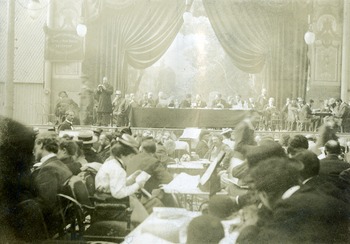
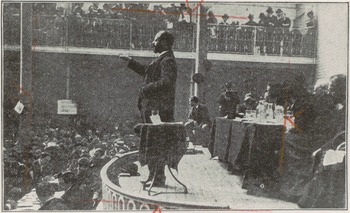
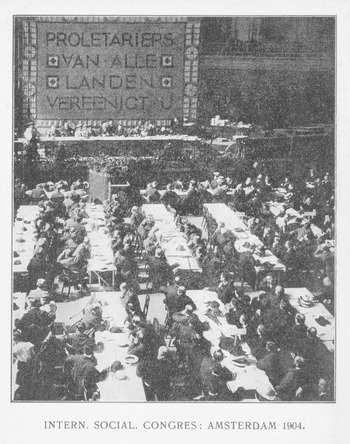
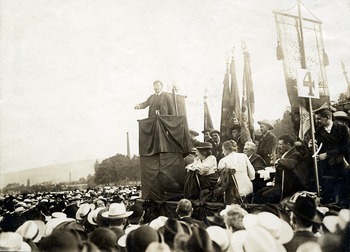
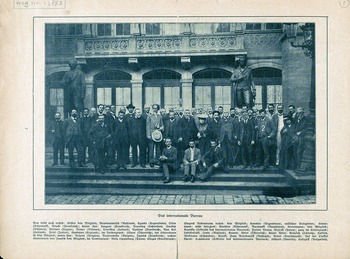

 Open access

