The tiger Panthera tigris is categorized as Endangered on the IUCN Red List (IUCN, 2007) and the population in the Sundarbans of Bangladesh and India, the second largest unfragmented tiger population (IUCN/SSC, 2007; Khan, Reference Khan2007), is of particular importance for the long-term conservation of the species. Human deaths from tigers, however, make people hostile towards the species and this is the biggest challenge for tiger conservation in the Sundarbans. Reducing such casualties is crucial for the welfare of both people and tigers but a number of techniques have been applied and failed (Gallagher, Reference Gallaghar1983; Chowdhury & Sanyal, Reference Chowdhury and Sanyal1985; V. Rishi, unpubl. data).
The c. 10,000 km2 Sundarbans is the largest tidal mangrove forest (Fig. 1), comprising c. 6% of mangroves globally. People living at the fringes of the Sundarbans depend either partially or completely on the area's natural resources. These people have little choice but to go into the Sundarbans, either legally (with the necessary permit from the Forest Department) or illegally. When people and tigers roam in the same area conflicts occur, and the level of tiger-human conflict in the Sundarbans is higher than anywhere else within the tiger's range (Hendrichs, Reference Hendrichs1975; Nowell & Jackson, Reference Nowell and Jackson1996; Khan, Reference Khan and Thapar2004a,Reference Khanb).
Domestic dogs are used for various purposes, including wildlife research and management (Zwickel, Reference Zwickel and Giles1971; Hunt, Reference Hunt2000, Reference Hunt2003; Kerley, Reference Kerley2004) but recommending their use to reduce the risk of being attacked by tigers requires experimental evidence that it is effective. I tested this possibility in the Sundarbans of Bangladesh. The effectiveness of keeping one domestic dog with each group of people was tested with 50 groups of local people of various professions (Bawalis or plant-product harvesters, honey gatherers and fishermen). Each group consisted of 5–7 people.
The dogs were local breeds, available in the villages on the fringes of the Sundarbans. Many people keep these dogs at home both as pets and to ensure safety from intruders at night. Dogs were taken individually into the forest in an exploratory visit to test their ability to detect any wild animals observed, and 40 dogs were thus selected out of a total of 67. Before being used experimentally the dogs were taken to smell tiger trails and were shown any wild animal observed, with dry food given to the individual dogs immediately after any successful detection of a tiger or other wild animal.
In the Sundarbans people do not go into the forest for lengthy periods of time and therefore 40 dogs were sufficient to accompany 50 separate groups of people at various times. This reduced the cost of maintaining the dogs. The dogs were fed mainly on the residual food of humans, which is normal practice in Bangladesh. The extra cost of keeping an individual domestic dog is thus negligible, amounting to c. BDT 60 (USD 0.9) per dog per month. During the 18-month study (August 2005–January 2007) all 40 dogs could not be sent to the Sundarbans and observed at the same time because of limited manpower, and thus the observations presented here took place in different seasons in different parts of the Sundarbans.
In the forest the dogs were almost always more excited than usual and were therefore tethered at all times, hand-held by the owner so that the dog could move with the group but not run away or attack wildlife. The signals made by the dogs were recorded as (1) for any wild animal, including the tiger, characterized by sudden excitement, together with quick and haphazard movements, and often with barks or grunts, or (2) apparently for tiger, characterized by fear and low noise, and moving close to the owner but not barking. The signals were verified either immediately, by observing the animals or their signs, or the next day (to avoid the risk of encountering any tiger) by observing pugmarks or scats. Observations were made either by myself or by my research assistants (there was always one of us accompanying each group). Each dog was taken to the forest for a total of 18 times in 18 months, for a few days each time.
The mean number of signals apparently made in response to presence of wildlife (including tiger) by the 40 dogs was 81.9 ± SE 26.7, of which 76.2 ± SE 26.3 (92%) were verified as being in response to a wild animal. Of a mean 12.4 ± SE 5.5 signals apparently made in response to presence of a tiger 8.0 ± SE 4.0 (62%) were verified as accurate. This suggests that the presence of domestic dogs reduced the risk of being attacked by tiger. In response to the dogs' signals people had time to assemble and shout and, if necessary, climb trees or return to their boat. The dogs' signals are, of course, their natural response, used by people as a warning. The dogs were particularly useful for honey gatherers, because when they smoke the honeycomb visibility becomes poor and they thus become especially vulnerable to attack by tiger. However, the dogs could not always distinguish tiger from wild boar Sus scrofa or spotted deer Axis axis. In general the success of the dogs in signalling the presence of tiger gradually improved with time.
I also interviewed 126 adults in and around the Sundarbans during the fieldwork to establish the principal means by which they protect themselves from tigers. I found that 47% of the interviewees used only spiritual protection such as wearing sacred beads or praying, 11% become more careful, 25% carry weapons such as large sticks, axes or guns, 5% shout, run or climb trees, 5% stopped going into the forest forever after having a frightening experience, and 7% were unsure. From the interviews it was clear that raising people's awareness of tigers is crucial. Therefore, other than advocacy for using pet dogs, an awareness campaign was conducted in the local villages to discuss tiger conservation and how to avoid confrontation with tigers. The ensuing discussions indicated that people's livelihoods depend on the natural resources of the Sundarbans, and they believed that without the ever-present threat of the tiger the forest would be cleared by poachers and they would lose their livelihoods.
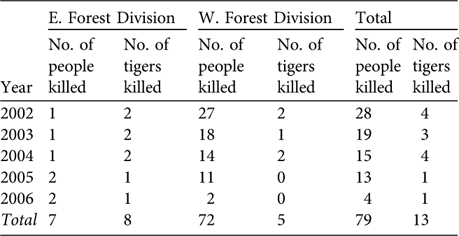
Based on the records of the Forest Department an average of 15.8 people and 2.6 tigers were killed per year during 2002–2006 (Table 1). Notably fewer people were killed in 2006, during this project, possibly because of the introduction of the use of domestic dogs and awareness raising, but there are many other factors (e.g. natural variation and erratic emergence and disappearance of notorious man-eaters) relevant to this. The actual number of human casualties, however, is always higher than the official number (Montgomery, Reference Montgomery1995; Helalsiddiqui, Reference Helalsiddiqui1998; Khan, Reference Khan2004b). Although the number of people killed is high, > 350,000 people work in the Bangladesh Sundarbans every year (Tamang, Reference Tamang1993) and thus, proportionally, tiger attacks on people are relatively rare. The rarity of these attacks mean that it was not possible to compare the risk of tiger attacks on groups that used dogs with those that did not.
The Sundarbans of Bangladesh and India. The rectangle on the inset indicates the location of the main figure across the border of the two countries.

Number of people killed by tigers and tigers killed by people in the Bangladesh Sundarbans over 2002–2006.

Using domestic dogs to save humans from tigers is innovative, although dogs have been used in related ways. In the early 20th century Jim Corbett, the legendary hunter in north-west India, often used his pet dog Robin to track tigers and leopards (Corbett, Reference Corbett1944, Reference Corbett1957). In the Russian Far East trained dogs are used to locate individual tigers by their scents (Kerley, Reference Kerley2004), and trained dogs are also used to drive wild bears into the forest in some areas of the USA (Hunt, Reference Hunt2000, Reference Hunt2003).
Using domestic dogs to save humans from tigers does not mean that humans will be saved by endangering the lives of dogs. Because each of the dogs was tethered the owner always accompanied the dog. It is unlikely that tigers were attracted by the dogs and thus increased the risk of confrontation. In the Sundarbans people almost always work in groups and they intentionally make a lot of noise, supposedly to deter the tiger and to keep their morale high. The additional noise of the dog is negligible. Each person also normally carries a large stick and, as with noise, the sticks raise people's morale.
Use of domestic dogs in the Sundarbans could not only reduce human deaths but, in the long-term, change the hostile attitude of many people towards the tiger and improve local support for tiger conservation. The people we worked with were convinced that it is useful to keep dogs with them, and many have started using the dogs in areas fringing the Sundarbans. However, because of present administrative difficulties they cannot use dogs within the forest when we are not with them. We followed the research reported here with a second project in which we coordinated groups, each consisting of young men with sticks and several dogs, in regular patrols along the forest edge to discourage tigers from going into villages and drive any tigers that enter villages back into the forest.
Acknowledgements
I acknowledge financial support from the Save The Tiger Fund, National Fish and Wildlife Foundation, USA, and administrative support from the Zoological Society of London, UK. I thank the Forest Department of Bangladesh for giving me the permission, and providing the local support, that made this project successful.
Biographical sketch
Monirul Khan is a wildlife biologist working in Bangladesh. He has been involved with a number of wildlife projects but his main interest is the tiger and other wildlife of the Sundarbans. Currently he is at Jahangirnagar University, Bangladesh, and works with the Zoological Society of London, UK, to identify potential tiger-human conflict areas, raise awareness among schoolchildren and coordinate groups of villagers and trained dogs to deal with stray tigers on the fringes of the Sundarbans of Bangladesh.