




Introduction
During the last three decades, numerous studies have discussed the crucial role of visualization in early modern science.Footnote 1 It is now well known that, thanks to the joint development of printmaking and new modes of naturalistic and diagrammatic representations, the epistemic uses of prints and drawings dramatically increased during the sixteenth and seventeenth centuries and partly contributed to the growth of modern science. Moreover, the study of such pictures also helped historians gain a more fine-grained view of early modern scientific practices and practitioners. Pictures might indeed convey some of the social strategies of those who made and used them; they might even reveal some of their ideas about nature, their epistemic values, or their moral stance.Footnote 2
In general, pictures are thus understood as if they could exemplify the intentions of the savant who conceived them. However, this view might neglect whether a picture, as a concrete object, genuinely corresponds to the picture that the savant initially sought to obtain. The question is especially crucial in regard to the fact that the savant was generally not the one who actually made the picture; his task more often involved explaining to a professional draughtsman or engraver what he wanted to represent and supervising the work. In addition to various other causes, the collaborative process could fuel a discrepancy between the savant’s original intention and the resulting picture.Footnote 3
One should thus carefully consider the savant’s attitude toward the pictures he produced. It is well known that prints and drawings were not always praised by those who conceived or used them. Savants also expressed concerns about the potential issues pictures could raise.Footnote 4 For example, they worried that the draughtsman failed to represent things as he should or that the printer distorted a figure by poorly applying ink on the copperplate. They might also have feared that a picture had been made with fallacious motives or that ignorant readers could misinterpret its content. Undoubtedly, such elements could provide crucial insight into the way pictures were conceived and used within early modern scientific circles. It is thus all the more surprising that little focus has been hitherto given to the specific failures a savant could ascribe to his own pictures – or the pictures made under his guidance. Indeed, a savant could be prone to criticize others’ pictures for various reasons that are not always connected to his epistemic values. On the contrary, what he deemed faulty in his own pictures could provide a unique entry point to what he regarded as “correct” for the production and communication of truthful knowledge. Hence, reconstructing the difficulties a savant met when producing a specific picture or identifying what he considered failures in the latter may shed some new light on the epistemic values shared within a defined chronological and geographical context.
It is with this approach in mind that I will attempt to uncover some of the changing values within the early Académie royale des sciences, by focusing on a single picture that has been hitherto widely neglected. During the 1670s, a large engraving of the moon was conceived by one of the young institution’s most prominent members, the astronomer Giovanni Domenico Cassini (figure 1).Footnote 5 Because the print was initially untitled and its function unclear, I have chosen to refer to it by using a conventional title, namely the Grand Selenography. Reconstructing the possible goals that Cassini and other academicians might have initially ascribed to this picture will lead me to discuss the range of issues that it progressively raised, and how these may be connected with some new epistemic concerns developed within the institution.
Giovanni Domenico Cassini, Grand Selenography, 1679. Engraving, diam. 530 mm. Paris, Bibliothèque de l’Observatoire de Paris, Inv.I.1576 (© Observatoire de Paris).

Since the late nineteenth century, the Académie royale des sciences under Louis XIV has generated a substantial literature discussing the relationship between science and politics, notably focusing on the effects of the former’s institutionalization or, more recently, on the relationship between courtly practices and scientific ones.Footnote 6 For this purpose, historians have progressively unveiled the central function of the prints published in the first two grand books of the institution, the Memoires pour servir à l’histoire naturelle des animaux (1671–1676) and the Memoires pour servir à l’histoire des plantes (1676) (cf. Stroup Reference Stroup1990; Guerrini Reference Guerrini2010, Reference Guerrini2015, Reference Guerrini2019; Rabinovitch Reference Rabinovitch2013; Reinhart Reference Reinhart2015; Sahlins Reference Sahlins2017). While this approach has proved highly valuable, the epistemic values developed and defended within the early Académie have remained little studied, especially compared to the recent work on the other foremost institution at the time, the Royal Society of London (Kusukawa Reference Kusukawa2019; Wragge-Morley Reference Wragge-Morley2020; Doherty Reference Doherty2022).
With respect to the main historiographical trend on the Académie, the neglect of the Grand Selenography seems even more surprising: It was undoubtedly one of the most ambitious and expensive prints ever made during Louis XIV’s reign. Moreover, the print is far from being unknown. For more than a century, it has attracted attention because of the fascinating small profile of a woman represented near the Promontorium Heraclides (figure 2), recently identified as a portrait of Cassini’s wife (Launay Reference Launay2003; Launay and Sheehan Reference Launay and Sheehan2010).Footnote 7 While this new interpretation has probably contributed to the print’s growing fame nowadays, it is unfortunately supported by little evidence, as the history of the production and early reception of the print has been barely discussed up to now. For example, most commentators have called the picture a “map,” although there is no clear evidence that it was one.Footnote 8 On the one hand, it lacks a nomenclature – one of the most defining elements of a map.Footnote 9 On the other, while Cassini and his colleagues often talked about “maps of the moon,” the Grand Selenography was usually described as a “figure” or a “plate” (planche) within the Académie and the Bibliothèque du Roi (AAS, Registres, 7, fol. 239v; BnF, Est., Rés., Ye-144 and Ye-160).
The female profile in the Promontorium Heraclides (detail of figure 1).

The absence of any textual information on the print, combined with the scarcity of evidence about its making and function, may have discouraged historians from pursuing further investigation. I shall begin by arguing that the lack of such elements should, in fact, be considered evidence of the print’s failure in the eyes of the contemporaries. In order to explore the possible reasons behind this failure, it is necessary to reconstruct the initial functions attributed to the print. After considering the latter’s place within the broader cultural production dedicated to glorifying Louis XIV, I will discuss its various possible epistemic purposes. Although figures of the moon were often made as an aid for the observation of eclipses, I will show that the Grand Selenography could not have been made with this intent in mind. Instead, its fabrication appears to stem from Cassini’s curiosity about astronomical bodies and his ambition to explore their physical nature. I will then argue that the former aspiration could not, however, be fulfilled by the picture and that the small female profile might have served to express the inherent limitations of the whole endeavor. Lastly, I will suggest that the print faced criticism for its perceived lack of utility, which ultimately led to its abandonment. Hence, the progressive discrepancy between Cassini’s initial intentions and the resulting outcome will enable us to shed light on some notable changes in the epistemic ambitions and values embraced within the early Académie.
Cassini’s print and the Cabinet du Roi: The failure of a grand project
On the night of 14 September 1671, a few hours after he settled in the newly built Paris Observatory, Cassini began to collaborate with the draughtsman and engraver Sébastien Le Clerc to produce drawings of the moonscape seen through a telescope. A year and a half later, Le Clerc had given up this job (Gallay Reference Gallay2021, 244–246). He was replaced by Jean Patigny, who executed numerous drawings up to 1678, seventy of which have been preserved in an album by the astronomer’s great-grandson, Jean-Dominique Cassini de Thury, known as Cassini IV (figures 3–7).Footnote 10 These drawings, almost all of them made with black and white chalk on blue paper, only show specific aspects of the lunar relief, as determined by the limited field of view offered by the long refractive telescopes the astronomer was using.Footnote 11 Cassini and Patigny gathered these drawings to reconstruct progressively the entire visible surface of the moon in several larger drawings (figure 6). Then, they had to combine and select all the data they wanted to retain and transfer them onto the copperplate. To express the outlines, shades, and highlights, Patigny only employed horizontal and parallel lines, meticulously carved with varying thickness. Eventually, on 18 February 1679, the engraving was completed (figure 1), and Cassini presented a proof to the Académie so that the other members could carefully examine it (AAS, Registres, 7, fol. 239v).
Jean Patigny, drawing of the oriental part of the moon based on several observations between 1677 and 1678. Black chalk and white chalk on blue paper. Paris, Bibliothèque de l’Observatoire de Paris, D6/40, fol. 27 (© Observatoire de Paris).

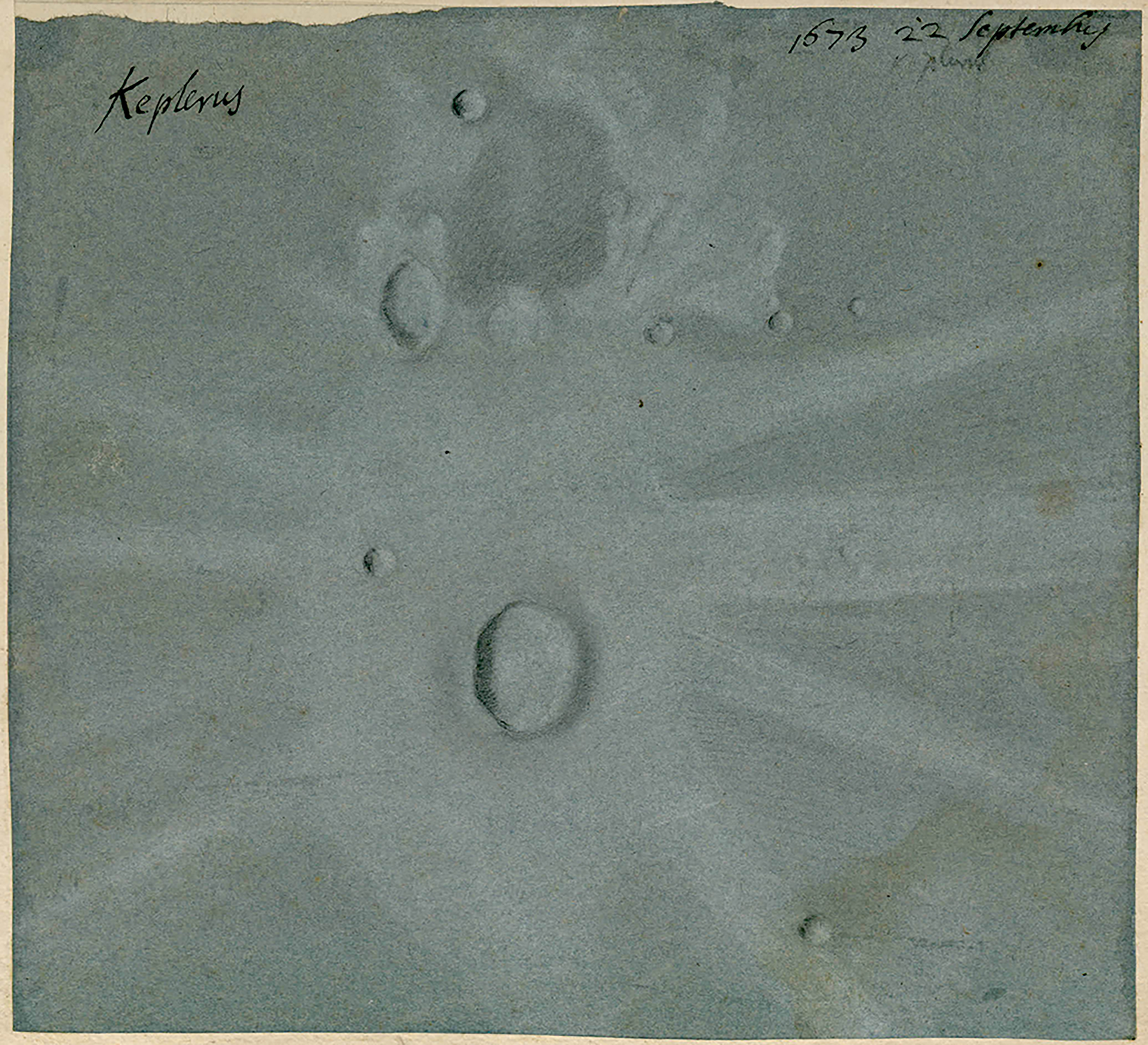
Jean Patigny, drawing of the crater Kepler, as seen on 22 September 1673. Black chalk and white chalk on blue paper. Paris, Bibliothèque de l’Observatoire de Paris, D6/40, fol. 6 (© Observatoire de Paris).
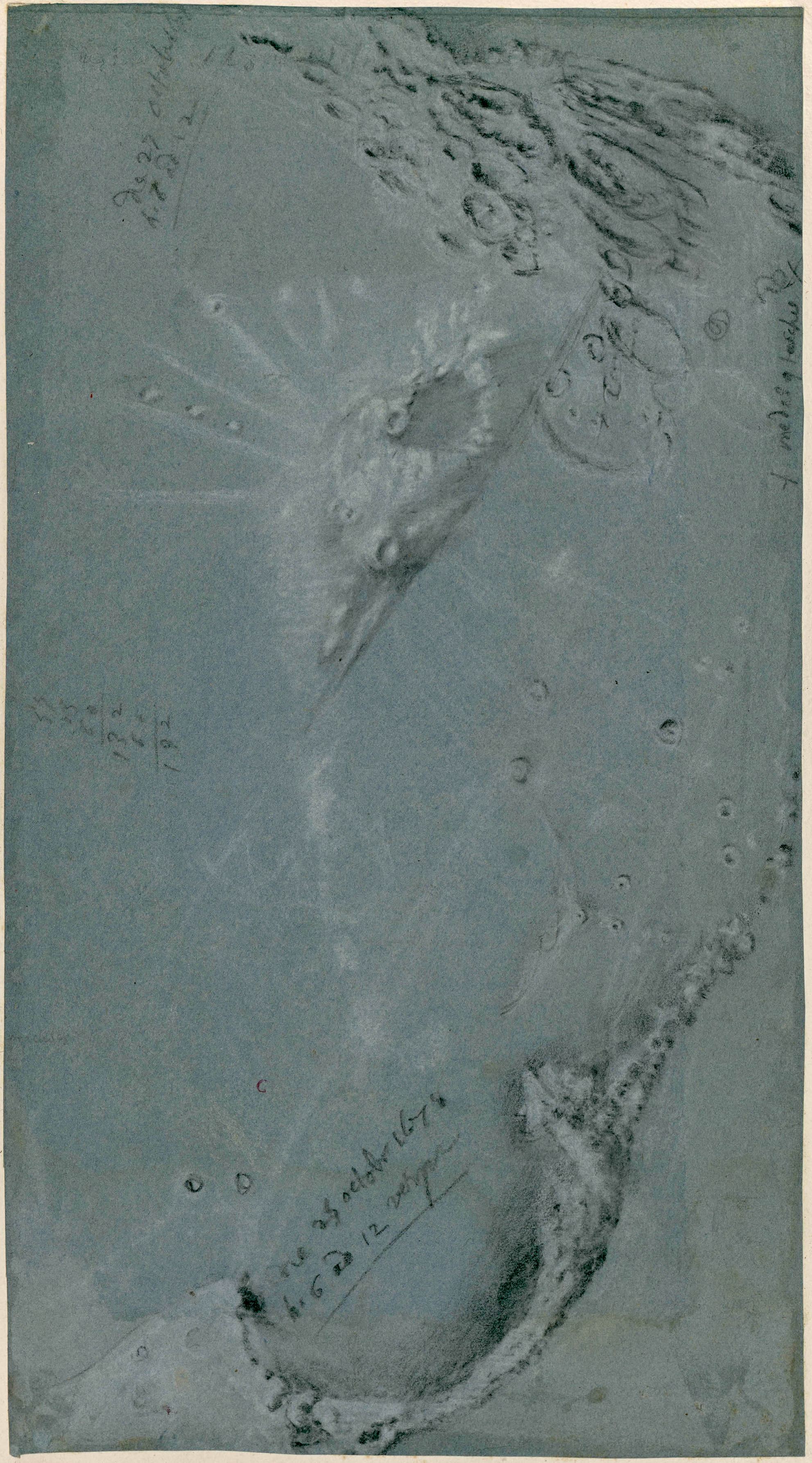
Jean Patigny, drawing of the Promontorium Heraclides based on several observations made in 1676. Black chalk and white chalk on blue paper. Paris, Bibliothèque de l’Observatoire de Paris, D6/40, fol. 13 (© Observatoire de Paris).

Jean Patigny, drawing of the moon based on several observations made in 1675. Black chalk and white chalk on blue paper. Paris, Bibliothèque de l’Observatoire de Paris, D6/40, fol. 56 (© Observatoire de Paris).

Jean Patigny, drawing of Promontorium Heraclides made in 1678. Black chalk and white chalk on blue paper. Paris, Bibliothèque de l’Observatoire de Paris, D6/40, fol. 22 (© Observatoire de Paris).
After this event, the print was quickly forgotten. Only a few impressions were pulled, and the copperplate was left behind in a corner of the Imprimerie royale – only to be rediscovered a century later by Cassini IV, who recognized its historical value and printed 100 new impressions.Footnote 12 In fact, the plate appears to have remained uncompleted: In 1681, Cassini told the young Edmond Halley – who had requested four copies for himself and his colleagues in the Royal Society – that the print was still “not as then finished” (Halley Reference Halley and McPike1932, 51–52). Besides, while the engraving of the figure appears to be complete, it is doubtful that such a lavish picture would have lacked the usual ornaments, not to mention a short inscription such as the outline of the project, the name of the astronomer, or a dedication to the king. At a certain point during the 1680s, Cassini thus decided to interrupt the production of his Grand Selenography.
The astronomer’s decision is highly intriguing, since the print was not some minor project that could be easily set aside. It was the result of exceedingly painstaking work, entirely funded by the Bâtiments du Roi, and most probably intended to serve Louis XIV’s glory.Footnote 13 Indeed, all the prints made under the academicians’ supervision were financed by the Crown, but some of the most prestigious ones were also planned to integrate a set of lavish albums, later called the Cabinet du Roi.
The complex history of the Cabinet du Roi began on 22 December 1667 with the ratification of a royal decree announcing that “the plans and elevations of the royal houses, the painted and sculpted ornaments in those houses, the paintings and antique pieces retained in the cabinet of His Majesty and elsewhere, as well as the figures of plants and animals, and all things scarce and singular” (cited in Deutsch Reference Deutsch2015, 201; all translations are mine unless stated otherwise) should only be engraved by printmakers selected by Louis XIV’s powerful minister Jean-Baptiste Colbert. These various prints were meant to be gathered and bound together thematically (cf. Grivel Reference Grivel1985, Reference Grivel and Hattori2010; Castex Reference Castex2019). For example, “the figures of plants and animals” became the magnificent prints published a few years later in the Memoires pour servir à l’histoire naturelle des animaux and the Memoires pour servir à l’histoire des plantes. The different thematic volumes were then intended to be offered to deserving courtiers, foreign princes, and ambassadors so they could all marvel at the extraordinary magnificence of Louis XIV’s reign (Grivel Reference Grivel1985, 47). Since its very beginning, the print production of the Académie was thus included within a more extensive project entirely devoted to the “fabrication” of the king’s glory (Burke Reference Burke1992).
Although the Grand Selenography could not have been mentioned in the 1667 decree since it was not even conceived, the print was certainly later meant to be included in the Cabinet du Roi, the same way several other enterprises – such as the reproductions of Charles Le Brun’s tapestries and paintings – were later added to the set during the 1670s (Gallay Reference Gallay2021, 162–163). The academicians knew that their position and stipend entirely depended upon Louis XIV’s will, hence their efforts to make their work worthy of the king’s interest (Sturdy Reference Sturdy1995, 65). When Cassini presented his Découverte de deux nouvelles planetes autour de Saturne (1673), he claimed that he did so “in order to respond to some extent to the honor that [the king] gave me,” stressing that “those new planets, which are perpetual and raise beyond all the others […] will carry much further the name of [His] Majesty” (Cassini Reference Cassini1673, n.p. [epistle]).Footnote 14 While the discovery of new astronomical bodies combined with the appropriate rhetoric was undoubtedly an efficient strategy to please a powerful patron, as Galileo’s famous example shows (Biagioli Reference Biagioli2007, 127–134), it was also a rare and unpredictable event. In comparison, the painstaking compilation and modeling of astronomical data on which Cassini worked during most of his life were much more challenging to publicize. Other strategies should thus have been deployed.Footnote 15 The example of the Histoire des animaux might have inspired him: The production of lavish illustrations had proved to be a very successful means to contribute to Louis XIV’s glory while at the same time pursuing laborious empirical research on animal anatomy (Guerrini Reference Guerrini2015, 162–163). In this respect, it seems significant that the astronomer initially hired Sébastien Le Clerc, the engraver of the plates for the Histoire des animaux and the only printmaker to work exclusively for the Cabinet du Roi at this time (Gallay Reference Gallay2021, 134–200).
A detailed and lavish figure of the moon was certainly a good way to demonstrate Louis XIV’s magnificence since it could attest to the kind of achievement that the king’s liberality enabled. Indeed, these observations were made possible by the powerful telescopes that Cassini acquired, largely thanks to Colbert himself, who dedicated considerable time to securing the best lenses available (Wolf Reference Wolf1902, 156–160). Hence, the print could have also functioned at a more symbolic level. In the same way the prints of exotic animals for the Histoire des animaux evoked the ascendancy of the French kingdom over the rest of the world (Guerrini Reference Guerrini2015, 136), the Grand Selenography might have been read as a metaphorical conquest of the moon.Footnote 16 Significantly, Cassini had already used a similar rhetoric in his Découverte de deux nouvelles planetes, arguing “that the right of the discovery already gives two [new worlds] to Your Majesty, whose conquests cannot be limited to the earth, and spread up to the most sublime regions of the Heavens” (Cassini Reference Cassini1673, n.p. [epistle]). To some extent, the extreme level of detail of the print might have been a way to claim a symbolic appropriation of the satellite, made possible through the powerful instruments provided by the Crown.
Why did Cassini disengage from such a promising project, especially when it was so close to completion? One may suggest a connection between this event and the economic crisis that struck in the late 1670s. This did impact the entire print production of the Cabinet du Roi to the extent that the initial encomiastic instrument had to be transformed into a commercial enterprise (Grivel Reference Grivel1985, 47–53). However, this change seems to have had little effect on the print production for the Académie since the plates for the Histoire des animaux and the Histoire des plantes continued to be engraved at a fairly constant rate up to 1691 (Saunders Reference Saunders1980, 66–77; Guerrini Reference Guerrini2015, 228). Moreover, the expense for lettering the Grand Selenography would have been negligible compared to the entire cost of the enterprise.Footnote 17 Hence, it is doubtful that financial restrictions would have impeded such a minor work had completion been wished.
Interestingly, the many objects that the king observed during his two visits to the Académie on 5 December 1681 and 1 May 1682 were duly reported in the institution’s registers, and yet no mention was made of the print (AAS, Registres, 9, fol. 159v and 10, fol. 85r–85v). The official history of the Académie, written a few decades later by Bernard Le Bouyer de Fontenelle, may provide more insight into the reason for this absence. It relates that, during the second visit, the king “paid much attention to the various figures of the moon drawn after M. Cassini’s observations.” Fontenelle then added that such pictures were ascribed a specific function: They should “serve, during the observation of eclipses of this planet [i.e., the moon], to distinguish better the spots [i.e. the craters] and their entry in and their exit from the shadow of the earth” (Fontenelle Reference Fontenelle1733, 1:348). By implicitly including the Grand Selenography within a more extensive set of different pictures of the moon used for eclipse observations, Fontenelle’s narrative denies the extraordinary aspect of the print: It was implicitly presented as a useful tool among others rather than as a singular object of prestige. It seems that this apparent confusion may offer some guidance to explain the print’s incompleteness: Either the Grand Selenography was indeed made for the observation of eclipses and failed to serve its purpose adequately or it was genuinely made for another purpose, for which it was later deemed unworthy.
Pictures of the moon as tools for the accurate measurement of lunar eclipses
First, it should be stressed that the narrative provided by Fontenelle is quite convincing. During the 1670s, the Académie’s astronomers worked hard to bring the many apparent irregularities of the moon’s orbit into a coherent model, and crucial data were obtained through the precise measurement of eclipses (Cassini Reference Cassini1693, 34).Footnote 18 The most obvious way to proceed was simply to record when the earth’s shadow appears on the lunar edge and when it disappears. However, this method was widely deemed inaccurate, and Cassini favored a “new method that had been developed by Mr. Gassendi.”Footnote 19 Around 1635, Pierre Gassendi and Nicolas-Claude Fabri de Peiresc noticed that, instead of observing the eclipse’s beginning and end, they should record each moment the earth’s shadow covers a specific “spot” and use these data in order to extrapolate the precise path of the shadow (Humbert Reference Humbert1931, 195). This method was considered much more reliable, as Cassini pointed out, because the earth’s shadow appears more sharply defined in this way than when it is mixed with the shadowed edges of the moon’s body.Footnote 20 It was thus systematically used during the 1670s and 1680s, and its exactness was frequently stressed.Footnote 21
However, it also requires much more preparation: All the lunar spots used as markers had to be precisely located and referenced. In this context, detailed figures of the moon were a useful aid.Footnote 22 It is no coincidence that, according to the account of the Bâtiments du Roi, Patigny engraved several prints of the satellite well before the Grand Selenography.Footnote 23 While none of these pictures can be identified, this indicates that the Grand Selenography was – as Fontenelle’s statement suggests – not the only print of the moon made during this time.
In fact, the earliest development of lunar cartography was closely connected to the observation of eclipses. Gassendi and Peiresc’s method might have been the main reason for undertaking a series of pictures of the moon to produce an accurate map that different observers could have used to share their measurements. In 1636, they succeeded in convincing the famous printmaker Claude Mellan to produce a figure of each lunar phase, but Peiresc’s death on 14 June 1637 quickly put an end to the project. Mellan only completed three prints, each showing a distinct phase: a full moon, a half-moon, and a waxing gibbous (figure 8).Footnote 24 Cassini was well aware of their work, and he might have initially intended to pursue Peiresc’s project. Indeed, in late 1671 or early 1672, he sought to obtain “some copies of Mellan’s moon that one should have […] to compare [them] with the moon itself, and to observe and draw the phases of the moon.”Footnote 25 This model was clearly in Patigny’s mind, since he borrowed from Mellan his peculiar engraving technique with parallel lines varying in thickness.Footnote 26 But instead of having each phase of the satellite engraved, Cassini eventually favored a single picture of the complete relief of the moon, a choice that might a priori support the hypothesis that the Grand Selenography was intended for the observation of eclipses. Indeed, pictures of the moon’s various phases cannot be used to record the motion of the earth’s shadow through the lunar disc. Only a representation of the visible relief of the full moon could allow for it.
Claude Mellan, A Waxing Gibbous Moon Observed on 7 October 1635. Engraving, 234 × 173 mm. Abbeville, Musée Boucher-de-Perthes, M378 (© Musée Boucher-de-Perthes, Abbeville).

The relationship between Cassini’s Grand Selenography and Mellan’s prints is highly intriguing. Strikingly, Peiresc’s topographical project had already been pursued by other astronomers who had chosen to proceed in a very different way. As early as 1645, the Dutch astronomer Michael Van Langren published a complete figure of the moon (figure 9), whose use for eclipse observations may be inferred from the lengthy inscription on the print.Footnote 27 However, Van Langren favored a style highly different from Mellan’s. While Peiresc and Gassendi wanted their pictures to be verisimilar, Van Langren chose to represent the lunar topography in a more schematic way: The maria are simply figured as dark and uniform zones, and only the most remarkable spots are depicted as small circles of various size, with their central part sometimes shadowed. Moreover, the astronomer developed an entirely new nomenclature for the maria and spots (cf. Pineda de Ávila Reference Pineda de Ávila2025, 628–635). Based on the practices developed for terrestrial cartography, Van Langren’s print was the first representation of the moon conceived as a genuine map (Haddad Reference Haddad2019, 30–34).
Michael Van Langren, Map of the Moon, 1645. Engraving, 500 × 380 mm. Paris, Bibliothèque nationale de France, Cartes et plans, GE D–17925 (© BnF).

Two other lunar maps were then developed simultaneously, one by Giovanni Battista Riccioli and Francesco Maria Grimaldi (figure 10), and the other by Johannes Hevelius, in his famous Selenographia (1647) (figure 11). While the two pictures are very different from each other, they both rely on a highly codified system of representation, as evidenced by the shape of the spots in Grimaldi’s print or by the numerous small mountains in Hevelius’.Footnote 28 Hevelius was exceedingly careful about the way his pictures should be made, and he acknowledged his preference for a system of representation based on conventional signs rather than a more naturalistic depiction of the relief (Müller Reference Müller2010, 372). Although his point extends beyond lunar maps, since it also applies to the figures of the phases, it was fully coherent with the development of codification in terrestrial cartography (cf. Orgeix Reference Orgeix2009).
Unknown artist after Francesco Maria Grimaldi, Map of the Moon for Giovanni Battista Riccioli’s Almagestum Novum (Bologna, 1651). Engraving, 323 × 320 mm. Zurich, ETH Library, Rar 9471 (© ETH Zurich).

Johannes Hevelius (or after), Map of the Moon for his Selenographia (Danzig, 1647). Engraving, 312 × 357 mm. Paris, Bibliothèque nationale de France, Impr., Rés., G-V-508 (© BnF).

Such comparisons not only reinforce the hypothesis that the Grand Selenography was never conceived as a map, but they also raise doubts about its so-called function for eclipse observations. Firstly, as I have pointed out, the names of the various topographical features are lacking, even though Cassini and his colleagues used the nomenclature developed by Riccioli in their records of lunar eclipses.Footnote 29 But more strikingly, eclipse observations simply did not require a complete topography of the moon: During their observations in the 1670s, Cassini and his colleagues indeed recorded no more than a few dozen spots, and when they later used a small map of the moon (figure 12), the astronomer emphasized that he chose to depict “only the spots which seem well defined during the eclipses and which are the most visible, the others being not necessary for this observation” (Cassini Reference Cassini1692a, 112 [emphasis added]). A few main spots were actually enough to measure the various positions of the earth’s shadow. Consequently, the exceptional level of detail and highly verisimilar aspect of the Grand Selenography were not adequate for recording the motion of the earth’s shadow on the moon. On the contrary, the more schematic the map was, the more valuable it proved to be, as Cassini implicitly acknowledged in 1692: This time, he published another small print that shows the various positions of the earth’s shadow and only represents the outlines of the main elements of the moonscape (figure 13).
Unknown artist, after Giovanni Domenico Cassini, Full Moon for the Mémoires de mathématique et de physique tirés des registres de l’Académie (Paris, 1692). Engraving, diam. 165 mm. Paris, Bibliothèque nationale de France, Impr., Rés., R-3770 (public domain license).

Unknown artist, after Giovanni Domenico Cassini, Schematized Figure of the Full Moon for the Mémoires de mathématique et de physique tirés des registres de l’Académie (Paris, 1692). Engraving, diam. 162 mm. Paris, Bibliothèque nationale de France, Impr., Rés., R-3770 (public domain license).

In fact, not only was the extreme detail of the Grand Selenography useless, but it might also have proved counterproductive. In 1675 John Flamsteed had already stressed that there are so many spots on the lunar surface that “it will be an impossible thing to delineate all and indeed needlesse since never more then 30 or 40 are made use of” (Flamsteed Reference Flamsteed, Eric, Murdin and Willmoth1995–2002, 1:376). Cassini’s ambition to obtain a picture of the moon’s entire relief would thus have been deemed futile by the British astronomer. Not only was it impractical, but it was also intrinsically pointless, since there was no way such an ambition could be properly satisfied.
Finally, it is also highly doubtful that the Grand Selenography was used as a model for reduced and simplified maps designed for eclipse observations. Cassini simply mentions that the small print was drawn after “exact observations,” without referring to the large print (Cassini Reference Cassini1692a, 112). Moreover, there are several differences between the two pictures, the most striking being the emphasis on the ray system of crater Tycho in the small print, while the trails are almost invisible in the large one. The position of several craters and maria at the border of the disc also diverge significantly: In the large print, there is a wide surface covered with many craters between the Mare Frigoris and the very bottom of the disc, while in the small one, this surface is much thinner; another example is the large and dark crater named Grimaldi, which is very close to the right border of the disc in the small map, but far enough to leave space for the crater Riccioli in the large print.Footnote 30
Such differences were due to the specific way each picture was produced. The Grand Selenography was the result of a complex process. Most of the drawings made by Patigny only reproduce a discrete part of the relief, situated at the terminator – namely, the zone between the bright side and the dark side of the lunar body – where light grazes the surface (figure 3). It means that all the parts of the moonscape were observed and reproduced under very different lighting conditions so that the representation resulting from their combination is deprived of a single light source. Consequently, to produce a seemingly coherent picture of the whole, the printmaker and the astronomer had to smooth out the figures of the various drawings, that is, to rebalance the highlights and the shadows and distribute them more or less evenly on the entire surface. This process partly explains the disappearance of Tycho’s ray system, since it is not due to the relief but to the high reflective power – or albedo – of the trails. On the contrary, the small map is covered with few spots and shows Tycho’s ray system very clearly, simply because it was made for eclipse observations and thus had to match with the appearance of the full moon – that is when the difference in albedo is more visible than the relief itself.
The small print’s unambiguous function also explains its differences with the large print in the positions of the craters and maria. Indeed, another critical difficulty that Cassini and his printmaker faced when they made the Grand Selenography was due to the slight swaying of the satellite during a lunar month. Because of this apparent motion known as libration, a specific phase may reveal parts of the lunar relief hidden during other phases, meaning that repeated observations enable one to see more than half of the moon’s surface. Since Patigny made drawings of different phases, he reproduced almost all of the visible parts of the relief, and recombined them within the engraved figure. He was thus able to represent parts of the surface – such as the crater Riccioli or the relief beyond the Mare Frigoris – that are invisible during a full moon, and therefore lacking in the small print. These comparisons show that the Grand Selenography was not designed to study eclipses, nor was it used as a model for lunar maps made specifically for this purpose. Consequently, one should now investigate how Cassini came up with this project before he even considered it suitable for the Cabinet du Roi.
Topography and the natural-philosophical study of celestial bodies
To understand Cassini’s initial intention regarding lunar topography, one should return to the model he first had in mind. As we saw, when he arrived at the observatory, he apparently intended to depict the different phases of the moon the same way Mellan had done instead of using the technique of the more widely circulated plates of Hevelius’ Selenographia. This choice attests that he consciously favored the verisimilar aspect of the former over the more schematic style of the latter. In fact, while Hevelius’ prints are remarkable because of the specific “visual language” that the astronomer had developed (Winkler and Van Helden Reference Winkler, Van Helden and Judith1993), they were also criticized for their oversimplified rendering of the relief. In his Micrographia (1665), Robert Hooke compared Hevelius and Riccioli’s pictures of the crater Hipparchus with his own figure so that the reader could appreciate “how far short both of them come of the truth” (Hooke Reference Hooke1665, 242) (figure 14). In this case, Hooke’s main concern was not to obtain a “map” of the moon but an accurate picture of the lunar relief that could help answer fundamental questions about its physical nature, such as the causes of crater shapes or the type of vegetation thought to cover the moon (Zittel Reference Zittel, Rahn and Berns2019, 33–37). Thus, one could suggest that, when using Mellan’s verisimilar model, Cassini also planned to gather precise empirical data about the entire visible moonscape to improve his understanding of the satellite.
Unknown artist, after Robert Hooke, The Figures of Hipparchus Observed by Hooke, Hevelius (Fig. X) and Riccioli (Fig. Y) for the Micrographia (London, 1665). Engraving. Bethesda, National Library of Medicine, inv. 2366075R (© NHL).

Cassini’s adoption of a more natural-philosophical approach to astronomical objects is not implausible. Indeed, while most of his observations on planetary topography were intended to refine the modeling of planetary motions (J.-D. Cassini Reference Cassini1810, 300–304), he also proved to be interested in the physical nature of celestial bodies. For example, his acute study of sunspots led him to speculate that, “like the globe of the earth,” the sun was made of two different matters, the luminous one being liquid and the dark spots being like rocks appearing and disappearing because of tides (J.-D. Cassini Reference Cassini1810, 306). In this case, his approach seems to contrast with the rather instrumentalist position he held in most of his astronomical work. While his epistemological modesty about the genuine configuration of the world system might be ascribed to his cultural and religious background (Heilbron Reference Heilbron1999, 185–187), one may question whether he turned to a more realist approach when speculating on the physical nature of celestial bodies.
In the case of the sun, his curiosity was supported by the explicit analogy with the earth, and it might have been similarly aroused in the case of the moon.Footnote 31 Indeed, seventeenth-century astronomers widely acknowledged that the moon is not the perfect and immutable solid described in Aristotelian physics, but an irregular body, apparently covered with mountains, valleys, and even seas and oceans. Hence, the moon’s uncanny resemblance with the earth raises wondrous thoughts and crucial interrogations about its very nature (Hallyn and Shea Reference Hallyn, Shea and Hallyn2000; Aït-Touati Reference Aït-Touati2011; Bouyre Reference Bouyre2014; Pineda de Ávila Reference Pineda de Ávila2015). Cassini’s curiosity about the physical nature of the moon might have led him to conceive a complete and accurate representation of the satellite.
There is all reason to believe that curiosity was initially considered the main driving force behind this enterprise. In the seventeenth century, curiosity had become a central and virtuous motivation for investigating the natural world (Daston Reference Daston1995; Daston and Park Reference Daston and Park1998, 303–328; Harrison Reference Harrison2001). It led to the recognition and valuation of the pleasure derived from scientific enquiry (Wragge-Morley Reference Wragge-Morley2020). In this respect, investigating the moon’s marvelous appearance could be deemed a fully legitimate endeavor. For example, in 1663, Christiaan Huygens had admired Christopher Wren’s lunar globe made for Charles II (cf. Bennett Reference Bennett1982, 40–41) by emphasizing how “pleasant” it was “with all its little spots and round valleys” (Huygens Reference Huygens1888–1950, 4:369). More strikingly, one of Cassini’s closest colleagues, the mathematician Philippe de La Hire, clearly expressed his fascination for the moon in a 1706 article: While he recognized that the understanding of planetary motions “was enough for the usefulness of life,” he also claimed that the human mind is “never satisfied with what he has” and is naturally tempted to investigate the physical nature of celestial bodies (La Hire Reference La Hire1706, 108).
Interestingly, this discourse was not just rhetorical: It seems that La Hire and Cassini genuinely shared a similar interest in lunar topography. Indeed, the very same day his colleague presented the Grand Selenography in the Académie, La Hire showed a three-dimensional “sample of the relief of the moon” (AAS, Registres, 7, fol. 239v). A few years later, in 1686, he completed nothing less than a four-meter painting of the satellite.Footnote 32 Since this painting was lost in the early twentieth century, we do not know how the moon was represented there, but we can reasonably assume that La Hire tried to emulate Cassini and surpass the accuracy and detailedness of the 1679 print.Footnote 33
The mysterious nature of the moon might have been the driving force of such ambitious works. Animated by a genuine fascination for the moon refashioned into a virtuous curiosity for the lunar relief, Cassini began to gather disparate empirical information on the moonscape and then considered reuniting all the data into a single picture. Consequently, while Mellan’s pictures and Hooke’s enterprise might have been Cassini’s primary sources of inspiration, the astronomer eventually chose a bolder solution. Instead of representing spatial and temporal fragments of the moon’s appearance, he sought to obtain a synoptic picture (cf. Daston Reference Daston2014) of the entire lunar relief. With the serial form of Mellan’s prints, the recognition of the moonscape features still depends upon the user’s mental ability to reconstruct the genuine relief of the satellite. By contrast, the Grand Selenography supposedly allowed the beholder to discover, in one single glance, the entire lunar surface with all its details. Ideally, the examination of the picture would thus replace the examination of the moon itself, since it should immediately provide more information on the lunar relief than any direct observation of the satellite. It is likely that the making of the Grand Selenography was initially supported by a truly natural-philosophical ambition: Contrary to drawings that are simple records of the moon’s appearance at a specific time, the print was intended to show something about the very nature of the lunar relief.
The epistemic endeavor supported by curiosity might thus be combined with the imperialist symbolism that Cassini probably ascribed to the print. It would have been a kind of victory against an object recalcitrant to reveal its true nature. In this respect, the epistemic and encomiastic purposes might have been successfully conflated into the print, one supporting the other. With this hypothesis in mind, it becomes even more difficult to understand why the Grand Selenography failed to be completed. It is thus necessary to clarify the extent to which the figure was really considered an adequate representation of the true appearance of the moon.
The problem of the synoptic image: How to represent the “true form” of the moon?
In the late 1660s, the academicians had already acknowledged the need for pictures directly made after nature. Information recorded by autopsía – by observation through one’s own eyes – was claimed as the only way to get a proper understanding of natural beings and to correct the many errors from the past. This was not a purely rhetorical strategy: Most of the plates for the Histoire des animaux and the Histoire des plantes were indeed based on drawings made after nature.Footnote 34 It is worth mentioning that such awareness was not widely spread at that time. Even though treatises on natural history had emphasized the value of autopsía since the middle of the sixteenth century, savants had often failed to follow their own precepts when it came to pictures.Footnote 35 During Cassini’s time, a similar disparity between discourses and practices can still be observed in works such as Jean-Baptiste Du Tertre’s Histoire générale des Antilles (1667–1671) (cf. Gallay Reference Gallay2021, 205–217) or the Royal Society’s Historia piscium (1686) (cf. Kusukawa Reference Kusukawa2000, 185–186).
The academicians’ commitment toward pictures after nature, however, led them to identify several specific issues raised by the translation between what was seen and what ought to be represented. Some of the figures of the Histoire des plantes thus raised criticism because they did not match the academicians’ expectations (Stroup Reference Stroup1990, 80–82; Gallay forthcoming). More strikingly, the anatomist Joseph-Guichard Duverney recognized some flaws in Claude Perrault’s way of producing anatomical figures, and he chose to work differently, by relying on highly trained draughtsmen and engravers, to whom he gave greater responsibility and recognition (Gallay Reference Gallay, Atlas, Mangili and Rouiller2023, forthcoming).
In this context, the Grand Selenography also raised issues, notably because of its synoptic function. Indeed, nothing a priori guarantees that such a picture may be trustworthy. The more complex the process is, the more different the picture may be from the object’s appearance, and the more difficult it is to verify how accurate the representation is. Besides, the manipulations required to make the Grand Selenography were not based on any geometrical method that could be easily analyzed and reproduced. Not only is there no trace of a grid in Patigny’s drawings, but the libration of the moon would have hampered any attempt to reconstruct the lunar topography with a geometrical method by using a micrometer.Footnote 36 To account for libration, Hevelius and Riccioli simply presented two superimposed circles (figure 10 and 11), while Cassini chose to retain the circular shape of the figure. Hevelius’ and Riccioli’s solution was far from being satisfactory, but Cassini’s was no better since it implies that the surface near the border had to be stretched to fit within the figure.Footnote 37 In the same way Cassini and Patigny had to rebalance the shadows and highlights of the moonscape, they also had to modify the elements of relief to make them fit within a single circle.
Although the astronomer remained silent about the difficulties that he and Patigny met, Robert Hooke’s commentary on the issues raised by microscopic observations might help us understand the complexity of their work:
[…] because of these kind of Objects there is much more difficulty to discover the true shape, then of those visible to the naked eye, the same Object seeming quite differing, in one position to the Light, from what it really is, and may be discover’d in another. And therefore I never began to make any draughts before by many examinations in several lights, and in several positions to those lights, I had discover’d the true form. For it is exceeding difficult in some Objects, to distinguish between a prominency and a depression, between a shadow and a black stain, or a reflection and a whiteness in color. (Hooke, Reference Hooke1665, n.p. [preface], cited in Doherty Reference Doherty2022, 117–118)
As Hooke implicitly suggests, getting the “true form” of a human-scale object was rather unproblematic: The object may be observed very quickly from all its different angles and in various light conditions. However, when working with a microscope, the observer can only access a limited number of points of view, each requiring several manipulations. The process by which one can hope to “discover” the “true form” of microscopical elements was thus much more demanding than in the case of human-scale objects (cf. Doherty Reference Doherty2012).
The similarities between the issues acknowledged by Hooke and those that Cassini and Patigny might have faced are obvious, and yet some significant differences can be identified. Contrary to Hooke, who memorized what he saw before he shifted the lighting and the point of view, Cassini and Patigny were confronted with an object whose appearance only changed once a day without any possible manipulation. Hence, they had to produce a drawing of every single observation. Hooke’s reconstruction was entirely based on mental images, while the making of the “true form” of the moon relied on real pictures. Furthermore, the use of Patigny’s drawings was not so different from some well-known examples of epistemic uses of pictures in astronomical research, such as Galileo’s prints to demonstrate the nature of the sunspots or Huygens’ method to discover Saturn’s rings (Biagioli Reference Biagioli2007, 135–217; Van Helden Reference Van Helden1974). Thanks to a combination of pictures of the same object seen from different angles, one can indeed induce the object’s real nature. Just as one can finally understand that dark spots are actually on the surface of the sun or that the two “anses” of Saturn are part of a single ring, one should be able to determine the nature of the moonscape by observing the shifting pattern of the shadows.
However, this was not as simple as one might think. Despite Galileo’s early demonstration of the irregularities of the lunar surface supported by the interpretation of the changes in the shadow pattern (Cohen Reference Cohen1980; Winkler and Van Helden Reference Winkler and Van Helden1992), the identification of some relief elements was still disputed in the 1670s. For example, in a letter to one of his colleagues, Henry Oldenburg, the secretary of the Royal Society, criticized the scholar Isaac Vossius’ description of spots as mountains by rightly pointing out that their top should be illuminated first if they were mountains (Oldenburg Reference Oldenburg1965–1986, 11:310). More significantly, when La Hire made his three-dimensional sample in 1679, his ambition was to verify his assumptions about the nature of the lunar relief. He was thus able to confirm that “when [the sample] was exposed to the sun in different ways, it gave more or less the same appearance as the part of the moon that it represented” (La Hire Reference La Hire1706, 111).
Not only was the reconstitution of the genuine lunar topography challenging, but its transcription into print was even more complex. Indeed, to depict the relief elements in a verisimilar way, Patigny had to represent their shadows and highlights. As already mentioned, he could not have represented them as resulting from a single light source. The only way to represent the entire lunar topography was thus to overemphasize the relief and neglect the roundness of the satellite. This is why the moon appears flattened and its craters bulky, almost like a disc covered with bubbles.
Such distortions did not remain unnoticed. Edmond Halley acknowledged that the Grand Selenography is “very exact,” but he found “the shaddowes not neer soe well done as those of Mr. Hevelius” (Halley Reference Halley and McPike1932, 52). Flamsteed thought that the pictures he received in 1677 “are neately done [and] the spots better placed and most commonly more like then in Hevelius,” but that Cassini “still exceeds them in the true proportions of the lights and shades” (Flamsteed Reference Flamsteed, Eric, Murdin and Willmoth1995–2002, 1:561). Despite their moderation, the two astronomers’ criticisms suggest that there might have been a broader disapproval of the way Cassini and Patigny represented the moon.
Another issue was raised by the fact that the variation of the shadow pattern was not only due to the relief but also to the differences in albedo. In this respect, the most striking feature is the spectacular ray system of crater Tycho. While we saw that Cassini later chose to depict Tycho’s trails in the small print made for eclipse observations, he necessarily had to consider whether or not he should represent them in the Grand Selenography. Patigny’s drawings indeed show both aspects of Tycho: One of the drawings made during a full moon reproduced the ray system (figure 6), while others, done when Tycho was at the terminator, only show the relief (figure 3). It seems quite likely that Cassini understood that these specific appearances were due to the high reflective power of the trails. In 1665, Hooke had already noticed the difference in albedo between the interior and the rim of Hipparchus, and a few decades later, La Hire clearly set forth that the changes in the appearance of Tycho’s surroundings were due to their high albedo (Hooke Reference Hooke1665, 242; La Hire Reference La Hire1706, 112).
Cassini thus had to choose what aspect should be represented in the print, and he favored the craters around Tycho over the latter’s ray system. However, he still retained some of the trails in the Mare Nubium and the Mare Cognitum. Similarly, he chose to highlight Kepler’s ray system by using Patigny’s drawings made when the sunlight was well reflected by the trails (figure 4). This suggests that while he might have considered the relief to be more significant than the differences in albedo, he would have ideally preferred to represent both aspects of Tycho on the print. The absence of Tycho’s ray system was not supported by a rhetorical or epistemic claim. It was more simply a default choice: The astronomer just felt it was impossible – or at least too difficult – to combine both the relief and the differences in albedo.
Consequently, the pictorial representation of the “true form” of the moon was not something that could have been fully achieved in the Grand Selenography. Following the growing awareness of specific issues raised by the production of pictures after nature, Cassini might have realized the difficulty of interpreting visual cues to reconstruct a real object beyond its appearance. Indeed, while there is no textual evidence that he genuinely acknowledged such limits, a visual element might actually suggest that he eventually considered that getting the “true form” of the satellite was, in fact, illusory. As I will attempt to demonstrate, the small female profile in the Promontorium Heraclides (figure 2) was perhaps conceived to warn beholders about the very limits of the representation.
The lady on the moon, between visual play and epistemological modesty
The figure of the lady on the moon was first observed in the late 1660s, and it quickly grew famous.Footnote 38 In August 1677, Henri Justel told Leibniz that “people of the court have seen it, and everybody agreed” that it “should be an illusion” (Leibniz Reference Leibniz1923–[ongoing], series 1, 2:289–290). In other words, the female profile was widely recognized as what we call today a pareidolic image, resulting from the natural tendency of the mind to interpret random visual cues as significant objects.
Pareidolic images were already well known to Renaissance artists and scholars (Janson Reference Janson and Meiss1961; Findlen Reference Findlen1990) and have remained a source of amazement during the following centuries. In the middle of the seventeenth century, someone like Athanasius Kircher could have still considered that such appearances were meant to express some of the real properties of the object, but this view was entirely abandoned in the early years of the Académie des sciences. For example, the botanist Denis Dodart condemned the “ridiculous affectation” of Abraham Bosse’s figure of the mandragora (figure 15); he required it to be corrected and warned others “not to fall for these visions” (cited in Stroup Reference Stroup1990, 300, n. 43). In this case, he was obviously dissatisfied with the anthropomorphic aspect of the figure, which kept the plant within its occult tradition.Footnote 39 A few decades later, a surgeon named Saint-Donat discovered a tumor shaped like an infant in one of his patients’ testicles, leading to the spread of a fantastic story about the man’s pregnancy. Once again, these tales were immediately dispelled by the Académie’s most distinguished anatomist Joseph-Guichard Duverney, who stressed, after having examined the tumor, that these were just “polypous materials to which the hazard gave a false appearance” (Duverney Reference Duverney1761, 2:553).
Abraham Bosse, Mandragora. Etching, 410 × 300 mm. London, Wellcome Collection, EPB/F/837 (B 380) (public domain license).

While pareidolic images lost their meaning, their mysterious beauty continued, however, to be praised. When reporting Saint-Donat’s discovery, the academicians still considered that “there was no need of such tales to marvel” (ibid., 2:563). In his Description et usages de plusieurs nouveaux microscopes (1718), the naturalist Louis Joblot published a picture of a fascinating animalcule whose “body was covered by a beautiful and neatly shaped mask of a human figure, perfectly well done, as one can judge by the drawing” (pp. 57–58) (figure 16). Here, the description and the print simply aimed to arouse the reader’s curiosity, and the figure’s resemblance to an actual face was emphasized for this purpose.Footnote 40 Similarly, Cassini might have exhorted Patigny to engrave the lady’s hair with curved lines instead of the horizontal lines used in the rest of the print because it was a way to stress the profile’s verisimilitude. The figure would just have been a playful detail meant to amaze those at court who had never heard of the phenomenon or to delight those who had been able to observe it.
Unknown artist, Figure of an Animalcule with a Human Figure for Louis Joblot’s Descriptions et usages de plusieurs nouveaux microscopes tant simples que composez (Paris, 1718). Etching and engraving. Paris, Bibliothèque nationale, Impr., Rés., V–7411 (© BnF).

However, there might have been an additional reason. It seems that Cassini was genuinely struck by the figure. In the album gathered by Cassini IV, the only two remaining drawings focusing on the Promontorium Heraclides show quite clearly the female profile. The vaguely sketched figure made in June 1675 was willingly added to the main drawing in the left part (figure 5), even though it did not precisely fit with the latter because of the size of the paper sheet: At this time, the appearance was probably not expected, and it was quickly added to the drawing. On the contrary, the profile in the second drawing, completed in October 1678 (figure 7), is so neatly done that it could only have been the result of a planned observation. Indeed, because it was due to the angle of the sunlight, the appearance was quite rare: It only happened between the tenth and eleventh days of the lunar cycle (Leibniz Reference Leibniz1923–[ongoing], series 1, 2:289–290; AO, B4/1 (34), p. 396), and, like any astronomical observation, it was entirely dependent on good meteorological conditions. These two drawings thus suggest that Cassini had a particular interest in getting a correct representation of the figure.
Moreover, in a manuscript draft, Cassini detailed the “disheveled girl” with hair like “a chain of very high mountains, whose summits represent the curls.” He seemingly made many observations of the phenomenon since he noticed that “one can see in this head several transformations year after year,” so that “the face which was formerly very well shaped is currently very disfigured.”Footnote 41 This remark led him to discuss, in rather convoluted language, that such changes might have been due “to the various illuminations that the phases of the moon receive, depending on the various exposures to the sun, [these] being very difficult to meet once again exactly because of the apparent libration which slightly turns [the moon] when the latter is at the same distance from the sun.”Footnote 42 Here, the figure was thus a way to introduce a problem regarding the interpretation of the visual cues provided by lunar observations.
It is likely that the reproduction of the profile in print also served a didactic purpose, just as its description in Cassini’s manuscript did. It can indeed be related to a well-known discourse on visual perception that Fontenelle developed in the second edition of his Entretiens sur la pluralité des mondes (Reference Fontenelle1687) by referring to the female profile. By using this example, Fontenelle aimed to show the way pareidolia work in general: He claimed that “everyone conveys on the objects the ideas that he is filled with,” so that “our astronomers see on the moon the faces of ladies, while it is likely that a woman […] would see a man’s handsome face” (pp. 280–281). In his writings, the lady on the moon became a telling example of the way visual perception might be deluded by mental projections.
Fontenelle certainly followed Cassini’s observations, as his description echoes the astronomer’s. He explained that the “young lady seen on the moon with a telescope […] considerably aged.” She had “a fairly beautiful face” but then “her cheeks became hollow, her nose lengthened, her forehead and her chin moved forward so that all her charms waned” (ibid., 279). The connection between his description and Cassini’s print is moreover suggested by Bernard Picart’s vignette published in his 1728–1729 lavish edition of Fontenelle’s Œuvres diverses (figure 17). This small print clearly represents the Grand Selenography with the little female profile.
Bernard Picart, The Globe of the Moon, for Fontenelle’s Œuvres diverses (The Hague, 1728–1729). Etching and engraving, 85 × 138 mm. Geneva, Bibliothèque de Genève, Hf 3535 (public domain license).

One may thus suggest that Cassini already ascribed to the little profile a meaning akin to Fontenelle’s when he asked Patigny to include it on the copperplate. Indeed, Fontenelle’s discourse was not wholly original; it was, in fact, closely connected to a tradition that the astronomer himself could not have ignored. When the moon is seen with the naked eye, it vaguely resembles a human face, and this appearance was at the core of one of the most famous ancient astronomical treatises, Plutarch’s De facie quæ in orbe lunæ apparet. In Cassini’s time, the text had been translated several times from Greek to Latin – notably by Kepler – while the first French version by Pierre Amyot was already a century old (Lesage Gárriga Reference Lesage Gárriga2021, 1–22). Following Plutarch’s model, the face on the moon had become a paradigmatic example of the fallibility of human senses in late seventeenth-century France. The most remarkable reference to the phenomenon may be found in the first volume of Nicolas Malebranche’s Recherche de la vérité (1674). Malebranche indeed mentioned that when some people, especially short-sighted ones, “look at the moon, they ordinarily see two eyes, a nose, a mouth, in a word, they seem to see a face.” He then set forth the illusion by the hypothesis that one is so used to seeing faces that those have deeply impressed their “traces” into the brain (Malebranche [1674] Reference Malebranche1997, 135). In his poem Un animal sur la lune, La Fontaine provided the same example to express a similar yet less sophisticated view: The “woman’s head” that appears “on the moon” is only due to some “irregular places that look like that from afar.” La Fontaine simply emphasized that the illusion may be quickly dispelled by the use of reason: Thanks to the latter, the eyes “can never deceive” since they “always lie” (La Fontaine 1991, 1:284).Footnote 43 This epistemological optimism was shared by Malebranche himself:
And those who believe the moon really is as it seems to them will be easily corrected if they look at it through a telescope, no matter how small, or if they consult the descriptions that Hevelius, Riccioli, and others have given to the public. (Malebranche [1674] Reference Malebranche1997, 135)
It seems that Cassini chose to transpose La Fontaine’s and Malebranche’s discursive use of the face on the moon into the small profile so that he could have visually stressed how delusive perception might be. Indeed, because of the difficulties that the astronomer and his engraver faced when trying to interpret the visual cues they observed and recorded, the lady on the moon might have appeared as a way to warn beholders about the very limits of the figure itself.Footnote 44 Compared to Malebranche, La Fontaine, and even Fontenelle, Cassini thus advocated for a much more modest epistemological position: Reason could not always dispel the illusions of the senses, and the genuine nature of things beyond their appearances was not always accessible. Despite all efforts, the proper interpretation of the lunar relief by observing the variations in the shadow pattern remains uncertain because the empirical data were too limited. A few years earlier, one could have hoped that the magnifying power of refracting telescopes would indefinitely grow and allow observations of tiny details on the moon, such as hypothetical buildings or even animals. However, when Cassini made his print, this hope had already vanished within the Académie. Such telescopes would be so long and their lenses so wide that they were completely unrealizable. The idea that knowledge on lunar topography could constantly improve thanks to technological advances thus appeared fallacious.Footnote 45
Hooke was optimistic enough to think that the “many examinations in several lights” could provide all the information that the mind requires to “discover” the “true form” of microscopical elements because these examinations were always possible – they were just time-consuming. On the contrary, the limited conditions in which the moon can be observed led Cassini to acknowledge that its “true form” could only be reconstructed. Hence, the Grand Selenography was to remain essentially imperfect because it resulted from a subjective process whose delusive potential was recognized. In other words, the making of the print led Cassini to acknowledge that getting the “true form” of an object whose appearances were limited was illusory. To some extent, the maker had to project what he thought there was, without evidence that his mental image matched the properties of the real object. It is at this point that Cassini might have decided to add the small figure of a lady in order to convey his epistemological doubts.
At first, this warning might have been considered good enough, but it soon proved to be insufficient. The fact that the print was never completed indeed suggests that, despite the small figure, it was still regarded as a failure. In 1699, Cassini planned to execute another “exact description of the moon, with the use that one can draw for astronomy and geography” (AAS, Registres, 18, fol. 135v) While the exact nature of this project – if ever achieved – is unknown, the fact that he considered it two decades after he conceived the Grand Selenography attests that he was unsatisfied with the latter. Moreover, it seems that La Hire finally came up with a much more efficient way to represent the moon: After having tried to surpass Cassini with a huge painting of the moon, he endeavored to execute a three-dimensional model (La Lande Reference La Lande1792, 3/1:310). During a joint meeting with the Académie des inscriptions, La Hire discussed the various appearances of the moon: According to Jean-Paul Bignon, the success of the talk urged him “to make a globe of the moon in relief” (BnF, Mss., Clairambault 566, fol. 231v). This was not the first time such a project was completed, since Christopher Wren had made one a few decades earlier. However, in this context, La Hire’s globe was a way to solve the main issue raised by the Grand Selenography: It could provide a view of the lunar relief that was at the same time true and verisimilar.
The abandonment of the print might thus be due to Cassini progressively realizing its inability to offer a proper representation of the moon. However, there might have been a further reason. When the astronomer planned to produce an “exact description of the moon” in 1699, he stressed the latter’s usefulness “for astronomy and geography.” This was not a trivial mention: Indeed, it will now appear that the most serious criticism leveled against the Grand Selenography was not related to its appearance but to its very purpose.
Moon-mapping and the determination of longitudes: The utilitarian justification and its limits
In a 1692 article, Cassini claimed that maps of the moon were used “to mark the exact position of the places on earth and improve geographical and hydrographic maps, without which it is impossible to travel afar and trade with people far away” (Cassini Reference Cassini1692b, 134). The explanation might be surprising but is actually sound. As its title indicates, Cassini’s article focuses on the “method to determine longitudes through several observations of the same eclipse made in different places”. Lunar eclipses were indeed one of the most widely acknowledged methods for measuring longitudes, as Peiresc and all subsequent selenographers had already noticed. It enabled different observers situated far away from one another to synchronize their observations and thus to obtain the meridian difference by the time difference.Footnote 46 Since the determination of longitudes was undoubtedly the most crucial issue for improving travel by land and sea, Cassini could have easily appealed to such an argument to justify the usefulness of moon mapping.
However, such an explanation also attests to Cassini’s discomfort with the original purpose of the Grand Selenography: Obviously, it was of no help for determining longitudes since it could not have been used for eclipse observations. Cassini apparently felt compelled to explain the purpose of pictures of the moon because some people, “who do not consider things thoroughly, deemed [them] to be useless descriptions of an imaginary land.” He then reported that those people “were astonished that someone who has wit and common sense, would amuse himself making such exact maps of the moon, where no one would ever go as if he planned to conquer it and establish colonies there” (Cassini Reference Cassini1692b, 134). In the absence of any other hint, it is impossible to ascertain who were his detractors, but one can reasonably assume that their target was indeed Cassini’s large print and perhaps La Hire’s painting, since both were by far the most detailed representations of the moon completed by this time.
One should now question why Cassini had to resort to a utilitarian argument to defend the value of his work. Indeed, it is far from evident that utility had ever been the primary motivation to depict the moon. After all, Mellan’s prints might have been driven by Peiresc’s large-scale project on the determination of longitudes, but when Gassendi related the origin of the project, he simply confessed his own “ardent desire […] of having the several Appearances of the Moon, and the varieties appearing in each of them […] in their just proportions and scituations [sic].” He then explained that Peiresc immediately agreed that the use of such pictures would be “very considerable, both in natural Philosophy, and in Astronomy” (Gassendi Reference Gassendi1657, 123–124), without mentioning their potential function for improving geographical maps. In Gassendi’s view, there was no better justification than disinterested curiosity.
It must be stressed that the context in which the purpose of the picture was formulated plays a significant role. In the case of Van Langren, his map was explicitly advertised as being of the “greatest utility for mankind” (humano maxime utilia), but such a discourse was probably due to his need to convince a powerful patron.Footnote 47 Van Langren indeed explained that the Infanta Isabella Clara Eugenia had introduced him to Philip IV in order to provide the king with “an astronomical method for the determination of longitudes.”Footnote 48 And indeed, in his request to Isabella, Van Langren stressed that the determination of longitude “was desired by many princes and especially by His Majesty [Philip IV], as it clearly appears from the prize with which His Majesty wants to reward the one that would find the invention of the longitude” (cited in Bosmans Reference Bosmans1903, 134).
Cassini’s development of a utilitarian rhetoric might have been due to similar reasons. In his Mémoires, he relates that he often met with the king and talked “about [his] projects to use astronomy for the improvement of geography and navigation” (J.-D. Cassini Reference Cassini1810, 291). Louis XIV was undoubtedly pleased to hear that astronomical research could have directly impacted the commercial development of the kingdom. However, it does not necessarily mean that the Grand Selenography needed to be useful. The print’s lavish appearance and symbolic power were certainly sufficient for the king. Let us recall that Colbert had initially planned to establish a “Grande académie,” which would have unified the cultural elite in service of the king’s glory (Lux Reference Lux1990). Despite the failure of this project, which partly led to the foundation of the Académie des sciences, the making of the king’s glory was still, in Colbert’s view, the savants’ primary task – and it undoubtedly remained as such for the marquis de Louvois.Footnote 49 It is worth stressing that both utility and curiosity were emphasized as the two purposes of the academicians’ work in the règlement of 1699 (art. xxii, transcribed in Aucoc Reference Aucoc1889, lxxxvii).
In fact, the utilitarian trend was rather the affair of the savants themselves: Even before Cassini arrived in France, several academicians shared a Baconian ideal of science as a way to improve human welfare. The initial project of a Compagnie des arts et des sciences presented to Colbert in 1664 and Adrien Auzout’s plea to the king to build an observatory in Paris both indicate the profoundly utilitarian rhetoric developed in informal scientific circles during the 1650s and early 1660s.Footnote 50 Furthermore, in the record of the eclipse observation performed by future academicians at Colbert’s house on 2 July 1666, it was already stated that such observations “are so useful and their usefulness so well known that one should not be surprised that all astronomers take care to observe them with as much accuracy as possible” because they can serve “to know the difference in meridians, that is the longitude, without which geography and navigation remain uncertain” (AAS, Registres, 2:20, cited in Sturdy Reference Sturdy1995, 74).
However, in the case of the Grand Selenography, it seems very unlikely that the Académie openly pressured Cassini. While the official discourses were clearly driven by a utilitarian concern, the academicians’ practices cannot be reduced to such a view (Briggs Reference Briggs1991). We saw that Huygens and La Hire did not really care about the practical applications of lunar topography. Moreover, in De l’origine et du progrés de l’astronomie et de son usage dans la geographie et dans la navigation, written in early 1684, Cassini argued that pictures of the moon could also enable the recognition of changes that might later occur on the moon’s surface (Cassini Reference Cassini1693, 34).Footnote 51 This non-utilitarian explanation contrasts with the rest of the treatise, which precisely aims to emphasize the numerous uses of astronomy for the improvement of human welfare throughout history. That La Hire himself and the future academician Nicolas Hartsoeker then repeated Cassini’s explanation (La Hire Reference La Hire1706, 113; Hartsoeker Reference Hartsoeker1694, 182) attests that the latter was uncontroversial: There was no need to appeal to utility in such a matter.
Thus, it seems that the charges against the uselessness of exact pictures of the moon that Cassini reported could only be ascribed to some savants who were not directly related to the Académie. Indeed, many criticisms were apparently leveled against the academicians during this period. For example, the scholar Henry Justel wrote to Oldenburg that some people just sought “to make fun of” the academicians’ works (Oldenburg Reference Oldenburg1965–1986, 4:29, 31, cited in Stroup Reference Stroup1990, 205), while Huygens reported that others accused him of having stolen their inventions (Huygens Reference Huygens1888–1950, 7:253–254, cited in Stroup Reference Stroup1990, 210). Interestingly, some of them were based on a utilitarian rhetoric. Already in the mid 1670s, the engineer Bertrand de La Coste accused the academicians of spending the Crown’s money without doing anything useful for the public (Hahn Reference Hahn1971, 143). Two decades later, Fontenelle complained that people were prone to condemn the lack of “usefulness” (utilité) of the institution’s projects (Fontenelle Reference Fontenelle1699, iii–iv). In this sense, it has been rightly pointed out that royal patronage influenced not only its beneficiaries but also those it neglected. Without doubt, the reactions against the academicians can partly be ascribed to the envy provoked by their specific status and financial resources (Stroup Reference Stroup and David1992, 221), but also to the fact that the very purpose of the institution remained entirely unclear before it was more or less settled in the règlement of 1699 (transcribed in Aucoc Reference Aucoc1889, lxxxiv–xciii).
Those criticisms were not ignored by the academicians, who generally attempted to provide adequate replies, as proved by Cassini’s reaction to an argument leveled against the use of eclipse observations for determining longitudes. In the preface of the antiquarian and polymath Pierre Le Lorrain de Vallemont’s Les Élémens de l’histoire (Reference Le Lorrain de Vallemont1696), the procedure was explicitly criticized, the author bragging that one should “not blindly receive a method” only because “the academicians received it themselves and praised it in any circumstance”. While some of the inconsistencies he pointed out are correct, he naively argued that “it would seem odd that one should search in celestial observations for the distance from one place on Earth to another, [since] astronomy is still perhaps more imperfect and less certain than geography” (Le Lorrain de Vallemont Reference Le Lorrain de Vallemont1696, n.p. [preface]). In other words, Vallemont’s arguments were not a real threat. However, only five days after their publication in the Journal des savans on 19 November 1696 (pp. 446–448), Cassini read the article in the Académie; he then presented a short reply to it, and everybody agreed that it should be published in the Journal (AAS, Registres, 15, fols 207r–207v). Although the project was then dropped, Cassini’s prompt reaction attests that he felt it necessary to defend his work against any criticism, however trivial it might be.
Unlike Vallemont’s argument, the attack against the Grand Selenography potentially endangered a whole area of the Académie’s research. While Cassini – like Fontenelle later did – bitterly decried his critics’ lack of knowledge, he was, however, compelled to rely on a utilitarian rhetoric instead of defending the value of his initial motivations. This suggests that curiosity might have become morally reprehensible in this context, not on the ground of Augustinian precepts, but more simply because it was to some extent incompatible with the new status of academicians. While the gentlemen of the Royal Society pursued scientific investigations for leisure, the academicians relied on resources provided by the Crown, establishing them as professional men of science (Stroup 1987, 10–31; Reference Stroup1990, 35–46). For this very reason, they could not have been ascribed similar motivations.Footnote 52 Indeed, pleasure driven by disinterested curiosity could be regarded as the most truthful way to gain knowledge, but it could also be easily assimilated to a kind of entertainment distinct from the pursuit of truth.Footnote 53 The latter view was notably expressed by the scholar Dominique Bouhours in his famous Les Entretiens d’Ariste et d’Eugène (1671): Ariste admits that he “craves to know what savants have said [about the tides], even if it is only for entertainment since most of them usually say pleasant things on subjects they do not understand” (Bouhours Reference Bouhours1671, 11). At a time when academicians were striving to get public recognition of their new specific status, they obviously could not have tolerated being assimilated to such pleasurable and meaningless practices. Moreover, because of their seducing power, pictures would have easily raised such wariness even among those who supported their use.Footnote 54 It seems that Cassini’s print was thus especially vulnerable: Its monumental size and lavish aspect made it an ideal pretext for accusing the academicians of having failed to keep a virtuous path.
In this respect, the criticisms leveled against the Grand Selenography could have been highly detrimental to Cassini: According to the astronomer’s account, the print was seen as a description “of an imaginary land” as if one would have “planned to conquer and establish colonies there” (Cassini Reference Cassini1692b, 134). Strikingly, this quip echoes the rhetorical strategy that the astronomer might have used in this very context, as he did for the satellites of Saturn. Two levels of criticism may thus be identified here. Firstly, the making of such “maps” was accused of being ultimately driven by some foolish dream of visiting the moon – echoing a fictional literature that had developed during the previous decades (cf. Aït-Touati Reference Aït-Touati2011). And indeed, such a fantasy might have been unwittingly spread by those who supported Cassini’s research: For example, Fontenelle noticed in his Entretiens that “the description of the moon is now so exact that a savant who would be there could not go astray any more than [he] would in Paris” (Fontenelle Reference Fontenelle1687, 86). In this case, Fontenelle’s praise of the recent developments in lunar topography might have been easily used against such works. Disinterested curiosity was thus turned into a pure whimsy, which made the enterprise not only useless but also devoid of epistemic value. On the contrary, since the academicians received gratifications that were not commensurate to the utility of their research, utility itself could have potentially become more disinterested and thus more virtuous than it was before.
Secondly, the underlying idea of a “conquest” associated with the extreme lavishness of the Grand Selenography might have raised the suspicion that the print was solely conceived as an object of prestige. This view became incompatible with the purpose of the Académie. Of course, the academicians’ achievements should contribute to the king’s glory, but precisely because their primary purpose was epistemic rather than encomiastic (cf. Licoppe Reference Licoppe1994, 224–229) – just as the Académie française’s task was to create a proper language to celebrate the king and not directly to write eulogies (Zoberman Reference Zoberman1998, 105–125). Even for the Histoire des animaux – without doubt the most successful publication of the young institution – the conflation between epistemic and encomiastic purposes worked well as long as the latter did not subsume the former.Footnote 55 Unlike Cassini, Claude Perrault seems to have been well aware of this potential issue. In his Projet pour les experiences et observations anatomiques presented to the Académie on 15 January 1667, he deliberately emphasized the usefulness of natural history to reduce the encomiastic function of the project:
The truths on which the king wants the academicians to work are not the most remarkable, […] but one can say that they are the soundest ones because they belong to what must be the basis for all the sources of human well-being. (AAS, Registres, 1:22)
Because Cassini’s print could not have been seen as the result of a purely disinterested intention, it could have easily been related to the astronomer’s ambitions – let us recall that, when Cassini arrived in France, he quickly got into a dispute with Claude and Charles Perrault about the plan of the Paris Observatory (Wolf Reference Wolf1902, 19–27; Petzet Reference Petzet2000, 370–391), a situation that probably did not help his reputation. At the time when panegyrists became so prone to develop hyperbolic figures to celebrate the king, men of letters such as Nicolas Boileau or Jean de La Bruyère began to show awareness of the inadequacy of overly flattering encomiastic practices (Ferrier-Caverivière Reference Ferrier-Caverivière1981, 204–209, 246–249). On similar grounds, the criticisms toward the Grand Selenography might have been due to the excessiveness of the print. The latter being too expensive, too large, and too detailed, it would have reflected, in the eyes of its detractors, the excess of Cassini’s own ambitions. For the astronomer to undermine such an idea, the only remaining solution was to offer a convincing counter-argument: By asserting that maps of the moon were essential to the improvement of trade, he could have claimed how self-disinterested he had always been while concealing at the same time the fallacy of his argument. As Fontenelle unintentionally made clear when he related the king’s visit in 1682, the Grand Selenography indeed had to be relegated to a common tool drowned among other pictures of the moon.
Conclusion
As soon as one considers the Grand Selenography as a partial failure, not only does the print become far less mysterious, but it can also provide new insight into the changing epistemic values within the early Académie. When reconstructing the complex history of this unique object, I have attempted to shed light on the range of motives that drove Cassini as well as the specific issues he encountered – during the making of the picture and after it was completed. The way his initial intentions were thwarted reveals two distinct phenomena.
The astronomer’s first problem resulted from the nature of his expectations. The Grand Selenography was a highly promising project, supported by an appropriate encomiastic function combined with Cassini’s growing interest in the physical nature of celestial bodies. Through the meticulous reproduction and recombination of minute details of the lunar relief based on autopsía, the synoptic figure aimed to be at the same time truthful and complete. Its examination was intended to provide more knowledge of the lunar object than could be gleaned from the examination of the object itself. This approach to pictures was not only meaningful in the specific case of the moon – since the latter’s appearances were always partly veiled – but it was also considered, although differently, by another academician, Joseph-Guichard Duverney, in the field of animal anatomy (Gallay Reference Gallay, Atlas, Mangili and Rouiller2023). In a seemingly paradoxical way, one may suggest that some of the pictures produced within the early Académie were not simply conceived as substitutes for textual descriptions – as they were traditionally (Kusukawa Reference Kusukawa2012, 111–113) – but as direct substitutes for the objects themselves.
The way Cassini conducted the making of the print by selecting some elements and dismissing others might echo to some extent the work of savants who, in the field of natural history, attempted to represent the type of a species by selecting, in the various specimens they observed, what they considered to be essential to the species (Daston and Galison Reference Daston and Galison2007, 69–136). However, while this was considered epistemically virtuous by the naturalists who used them, Cassini appeared to have grasped the crucial issue inherent to the process: The peculiar viewing conditions of the moon made clear that its synoptic representation was the result of a construction and not a discovery – something that was not obvious, as we have seen, even for Robert Hooke. In other words, it means that the process – both mental and manual – by which the representation of the lunar relief was made possible was not transparent. It cannot naturally yield the “true form” of the moon.
By possibly turning the small profile of the lady into a warning sign, Cassini not only attempted to show that visual perception can be deceived, but also that the correction of sensory delusion by the use of reason was not always possible. Such a pessimistic view contrasts with the philosophical attitude exemplified by Malebranche and La Fontaine, and could be related to a skeptical position – except that, contrary to most early modern proponents of skepticism (cf. Popkin Reference Popkin2003), Cassini’s position was precisely not built upon literary culture but was rather due to the problems he met in a very concrete situation. The failure of the print was thus partly due to the discrepancy between the astronomer’s initial expectations and the result he eventually obtained. In all likelihood, the three-dimensional representations of the moon developed by La Hire during the same period could have presented a more promising alternative to investigate the nature of the lunar relief.
While those problems were connected to the way the print was made, the issues regarding its function have brought us to another range of questions. The fact that the astronomer came up with a utilitarian argument to justify the existence of the Grande Selenography reveals a change of attitude toward the purpose of scientific inquiry. When Cassini initially conceived the picture, he considered his motives to be virtuous: Although his curiosity might have been partly fashioned by the broader fascination raised by the moon during the previous decades, it remained a valuable motive. Besides, the fact that the print should have served the king’s glory was not to undermine Cassini’s virtuous intentions – after all, the plates for the early projects on botany and anatomy had already been integrated within the Cabinet du Roi. What happened then is the result of a conjunction of different factors. Since a utilitarian trend was already well-spread in Parisian scientific milieus, it had become easy to point out the lack of usefulness of someone’s work in order to question its value. Moreover, because the academicians were granted special privileges and were gathered into a specific institution whose purpose remained little defined at this time, they were potentially more threatened than other savants by such arguments. It is plausible that Cassini was even more vulnerable than any other academician because he was a highly paid foreigner. But more important, because of its extraordinary aspect and ambiguous function, the Grand Selenography might have raised questions about its maker’s intentions, which could easily have been interpreted as self-interested. This specific case study thus shows how the rise of utilitarian research in the Académie was not only the result of a dialectical relationship between the Crown and the academicians: The role of savants outside the institution and the pressures they might have exerted should also be taken into consideration.
Acknowledgments
This work was supported by a postdoctoral fellowship at the Cohn Institute for the History and Philosophy of Science and Ideas, Tel Aviv University. It would not have been possible without the help and guidance of the staff of the Archives de l’Académie des sciences, the Bibliothèque de l’Observatoire de Paris, and the Bibliothèque de Genève. Earlier versions were presented during a research seminar supervised by Jan Blanc at the University of Geneva in 2017, at the 2019 History of Science Society Annual Meeting at the University of Utrecht, and at the 2022 Annual Conference of the Israeli Society for the History, Philosophy and Sociology of Science at Tel Aviv University. I thus wish to thank the participants of those events, as well as Chantal Grell, Dalia Deias, and William Tobin, for the fruitful exchanges we had. I am especially grateful to Oded Rabinovitch and Katie Reinhart for their invaluable help at the final stages of this work. I am also indebted to the two anonymous reviewers for their insightful comments.
Declaration of interest statement
The author reports there are no competing interests to declare.
Antoine Gallay is a postdoctoral researcher at the University of Lausanne. He received his PhD in art history and the history of science in 2021, and subsequently held postdoctoral fellowships at the Cohn Institute for the History and Philosophy of Science and Ideas (Tel Aviv University) and the Zentralinstitut für Kunstgeschichte (Munich). He is currently completing his first book on French printmaker and polymath Sébastien Le Clerc.

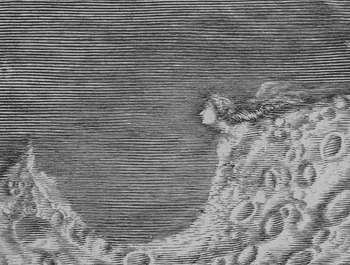
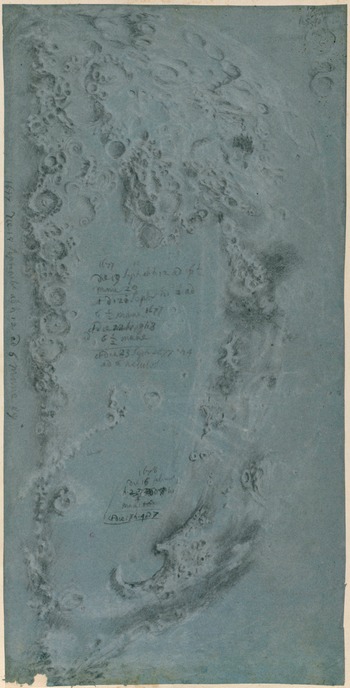
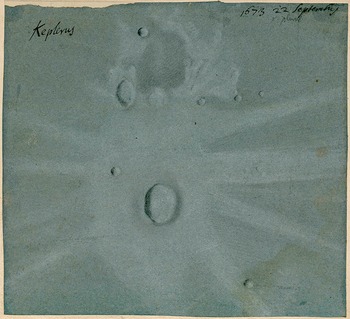

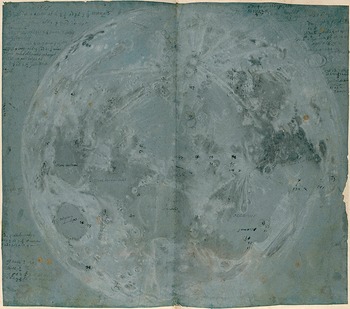

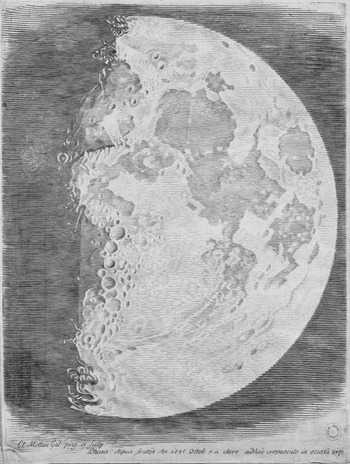
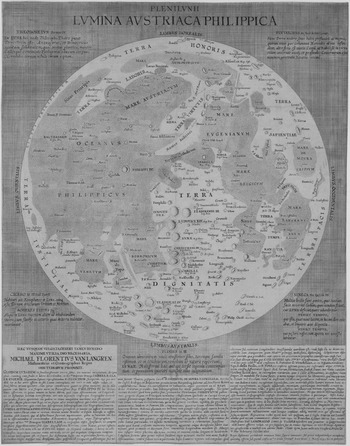

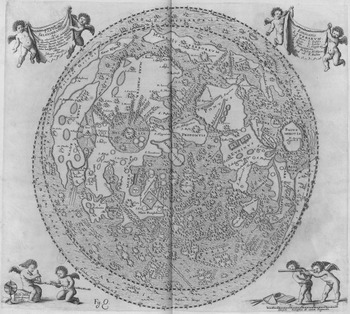


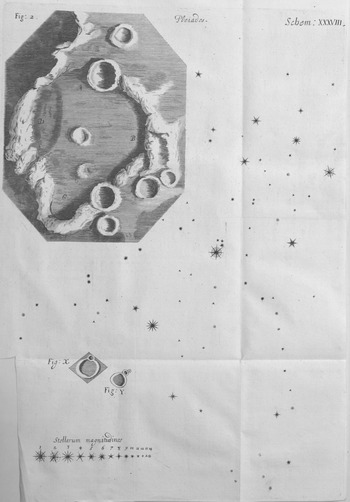


 Open access

