

Between May 2022 and April 2023, a theatre company called Treehouse Shakespeare Ensemble operated in the small town of Staunton, Virginia. Made up of the nineteen students in that year’s Master of Fine Arts (MFA) cohort of the Mary Baldwin University (MBU) Shakespeare & Performance programme, Treehouse produced an eclectic season of early modern plays staged in venues around Staunton and the wider Shenandoah Valley area, with a particular mission to create work with and for the community. And then the company disbanded, its members graduating with their MFA degrees, its life even briefer than that of the arboreal edifice for which it was named.
The legacy of university theatre is notoriously ephemeral, as the contributors to Andrew James Hartley’s Shakespeare on the University Stage repeatedly point out.Footnote 2 Productions which are designed to serve an immediate pedagogical purpose (for some, simply to fill a course requirement) are mounted, burn brightly and then are quickly forgotten, often leaving no archival traces. Students themselves move on, the production line of the education industry rarely slowing its pace enough to reflect on the lasting impact of student work on the immediate university community and the larger communities within which it is contextualized.
For these reasons, the relationship between university theatre and community theatre is deeply vexed. The university community is structurally transient, with even its most enduring traditions and practices complicated by the constant turnover of students and the consequent necessity of re-forming the community each year. Community theatre, on the other hand, is usually understood as meeting the needs of a community – whether of location or of interest, in the terms usefully introduced by Caoimhe McAvinchey – which has relative stability and longevity.Footnote 3 The oft-overstated, but still deeply felt, traditional division of ‘town’ and ‘gown’ is regularly framed in ways that inadvertently sustain typological division between ‘the university’ and ‘the community’, with the short-term needs of students and the long-term needs of others in the locality often even constructed as diametrically opposed. Further, university theatre in the neoliberal institution usually serves predominantly the needs of its (paying) participants for course credit, professional training and artistic expression; can university theatre serve the traditional purposes of a community theatre understood as a theatre serving a broader political, social and identity-forming function within a non-instrumental context?
We believe it can.
Treehouse Shakespeare Ensemble chose a name which aligned with the mission it established during its formation, which we share here to contextualize the work described in this article:
Treehouse Shakespeare Ensemble is a Staunton-based theatre group reaching out with the plays of Shakespeare and his contemporaries to audiences new and familiar, near and far. We create supportive environments for education and performance where we dare to illuminate lesser-known texts and reinvent familiar titles. We engage with audiences through resident and touring shows, workshops and supplemental digital resources to give voice to stories of female agency, sexual identity and communities in peril.
Built on a stable foundation, a treehouse is a safe place for personal development through imagination and exploration. Like building a treehouse in the supportive branches of an old tree, we believe that theatre can build on existing cultural conversations to help inspire creative solutions for communities while encouraging creativity in our audiences. Through our commitment to unifying performance and education, we hope that the seeds of conversation and creativity will continue to flourish within and beyond our found community long after our season.
Treehouse Shakespeare Ensemble is branching out and building up. Come grow with us.
In this article, we seek to explain how the unique ensemble-based MFA training model practised at MBU encouraged and enabled the company to become a full community partner in Staunton. By combining the frugality and flexibility of grassroots theatre practice with the fresh perspectives and joy of discovery characteristic of the student experience, Treehouse was able to build meaningful relationships and take advantage of serendipitous opportunities. We do not claim that the company enacted radical transformation on the community – indeed, such claims for transformation would risk implying change forced upon a community by guests within it. Rather, we argue in this article that the necessary work of community-building which university involves can be intentionally and respectfully inclusive and responsive to the larger ecosystem.
We begin by explaining the grassroots company model practised at MBU and its distinctiveness within normal understandings of university and community theatre, before then going on to discuss the key ways in which Treehouse’s community mission was realized. The first of these was through the dramaturgical work done within the company’s season to ‘give voice to stories of female agency, sexual identity and communities in peril’, in which the personal identities and priorities of company members worked to consolidate a community of interest around core questions and values. Then, we shift to the company’s collaborations and partnerships within Staunton and the wider locality, showing how the grassroots model enabled even temporary residents to become part of a community of location. Our hope is that this article will not only contribute to the neglected archive of university theatre, but also inspire further creative thought about how university theatre can be structurally reimagined to serve both its existing and its aspirational stakeholders.
The MFA Company Model
The three-year graduate programme in Shakespeare & Performance at MBU, in partnership with the American Shakespeare Center (ASC), is structured as a two-year MLitt degree followed by a one-year MFA degree. The MLitt takes a traditional form, with discrete courses covering academic and practical training. The MFA, on the other hand, operates within an innovative holistic ‘company model’, overseen by programme co-director Doreen Bechtol. Beginning with a three-week May Term intensive before the summer break, MFA students are invited to found a theatre company. Under the guidance of faculty members Bechtol and Molly Seremet, they name the company, devise its mission and principles, select a season of plays, and allocate cast and production roles. In August, the company reconvene to create and perform a devised show directed by Bechtol and Seremet, and then go directly into rehearsals for the first of their company-selected productions.
The company model is designed as a pre-professional training programme that privileges entrepreneurship, community-forming and, most importantly, collaboration. As opposed to competitive programmes in which the focus is on the individual’s personal achievements as measured against an elite metric of a particular kind of vocational practice, the company model instead trains students to build work around the skills, priorities and ideologies of the members of a group, and to create their own opportunities for work. Students choose a concentration in either acting, directing, dramaturgy or education, but work collaboratively to create work according to community-oriented and pedagogic briefs which encourage them to think flexibly within a series of constraints. Each year, the company is required to create an education production designed for touring to local middle and high schools; a number of small-scale productions on the model of Actors From The London Stage, in which a company of around five to six actors, along with a director and dramaturg, perform all of the roles; a large-scale production directed by a guest professional artist in the ASC’s Blackfriars Playhouse; and a ‘Renaissance-style’ director-less show using cue-scripts following the conventions of the ASC’s ‘Actors’ Renaissance Season’. At the end of the academic year, the company remount the majority of these productions in a festival, placing high demands on the company to pivot quickly between several different roles and responsibilities.
In addition, throughout the course of the year, the students learn how to run a company. Through committee work, they manage a modest budget, pursue fundraising opportunities, organize touring engagements, oversee publicity and marketing, manage the company’s costume/prop stock and more. More significantly for the purposes of this article, they also take on a number of community responsibilities. These range from taking responsibility for the upkeep of The Wharf – a downtown building owned by the university which is shared by a number of users, and which becomes the MFA company’s home for the year – to mentoring MLitt students working on their thesis projects, to organizing fundraising events and staged readings, to building partnerships with local businesses. We will discuss Treehouse’s approach to this in more detail below.
Treehouse’s season began with a devised show, CQD, directed by Bechtol and Seremet. The Fall education show was an hour-long cut of Macbeth, directed by Treehouse members Andrew Steven Knight and Katelyn Spurgin. For the small-scale season later in Fall 2022, the company split into three groups, performing The Two Gentlemen of Verona (directed by Kelsey Harrison and Beth Somerville), Galatea (directed by Cole Metz) and The Duchess of Malfi (directed by Chase Fowler). Following the winter break, visiting artist Michael Manocchio directed the full company in Edward II at the Blackfriars Playhouse, before the company went into their final week-long self-directed ‘Renaissance-style’ rehearsal period for The Birth of Merlin. All of the shows (apart from CQD) were then performed in repertory during the festival week. Alongside this, the company produced staged readings of Sor Juana Inés de la Cruz’s House of Desires (directed by Beth Harris and Madison Mattfield), The Roaring Girl (directed by Kara Hankard), Ellen McLaughlin’s Lysistrata (directed by Somerville), James Goldman’s The Lion in Winter (directed by Visiting Professor Kelley McKinnon) and Knight’s self-written adaptation of Sophocles’ Theban plays, The Fall of Thebes (directed by Fowler).
This MFA is an academic programme, in which the students are assessed holistically on their work across their primary concentration, production roles, collaborative contribution to company success, and their individually written thesis projects. But it is also an exercise in creating a supported context for a group of theatremakers to establish their own grassroots theatre company. Grassroots theatre, as defined by Robert E. Gard and developed in relation to Shakespeare by William Floyd Wolfgang, is intensely local, amateur, low-budget, and allows a company ‘to shape the work to fit their specific regional perspective, molding it to suit any number of desires’.Footnote 4 This is theatre which is ‘not designed for audiences outside local communities’, and which is thus to some extent necessarily a form of community theatre.Footnote 5 Indeed, it is our argument that the MFA company model offers a bridge between traditional conceptions of university theatre and community theatre.
Treehouse as Community Theatre
Community theatre, as Katherine Steele Brokaw sets out, is an umbrella term describing a wide range of practices and ethos, from middle- or working-class amateur groups providing entertainment to their peers, to forum theatre geared towards direct political action, to theatre designed to serve the needs of specific marginalized groups, to applied theatre directed towards social change.Footnote 6 The aspirations of Treehouse Shakespeare Ensemble, as expressed in a mission statement which makes three explicit references to community/ies, are both local and expansive, concerned with both ‘communities of location’ in the Staunton area and ‘communities of interest’ of activism in relation to gender, LGBTQA+ rights and more, to return to McAvinchey’s terms. But implicit in the mission statement is the sense that the company will discover and form ‘our found community’ through the act of existing and working.
Student theatre created in the context of a degree sits awkwardly within the traditional paradigms of community theatre. As Andrew James Hartley notes:
Student groups may work close to community theatre/amateur dramatics models in terms of shoestring budgets and a non-profit esprit de corps, but they also may have access to grants from specific departments, awards taken from student activity fees, and access to buildings, playing spaces, and other resources lent to them gratis by the school or subsections thereof because their host institutions see such activity as essentially a Good Thing.Footnote 7
This is even without considering the facilities and contexts of Theatre departments, which, depending on a university’s size and scale, may be comparable to large-scale professional theatres. Within the context of MBU’s MFA programme, the work has an instrumental educational function, forming the basis of assessment for students who are mostly training to be professional theatremakers. Participation in the theatre is by default confined to fee-paying students, most of whom have usually already completed two degrees and are completing a third terminal one. And the default audience is ‘demographically quite different from that of the average professional or community theatre model’, incorporating as it does a large proportion of fellow students and theatre specialists.Footnote 8 As such, as community theatre, it does not meet the criteria of ‘efficacy’ and ‘agency’ set out so cogently by Emine Fişek, in which the primary themes of community performance concern political effectiveness and the collaboration of community members in the creation of the art.Footnote 9 The claim of this article is not that Treehouse’s work models a community theatre practice of enabling mass participation in theatre by/for those who would otherwise not have that access. Nor is it a claim of the company that Treehouse’s work models applied theatre – again, a major focus of current scholarship on community theatre.
However, grassroots theatre models a different kind of community-forming experience. As Brokaw puts it, ‘Grassroots and amateur theatre-makers tend to be brought together because they live in the same geographical community and because they share a desire to create, in [Raymond] Williams’s term, “an alternative set of relationships” through their shared love of theatre’.Footnote 10 Indeed, to take another aspect of Fişek’s definitional work, for many, ‘community indicates a social grouping organized around a particular identity or locality; for others, it can encapsulate a desire for a grouping yet to come’.Footnote 11 Fişek’s description applies equally well to university theatre-making, created by people brought together by locality and required to form community with one another. The idea of ‘found community’ is perhaps best epitomized by the transient and temporary nature of university theatre. The community-forming which happens within university, and which is so explicitly integral to Bechtol’s training method of ensemble-building, can generate the ‘activist potential’ which Fişek identifies in community theatre: ‘two themes tend to underline activist potential: first, the political effectiveness or efficacy of community formation in promoting progressive causes, and second, the importance of self-expression and agency for the community in question, as well as the individuals that form its parts’.Footnote 12
It is within this framing, we argue, that Treehouse Shakespeare Ensemble’s work was best understood as community theatre. The student experience is one of developing self-expression and agency; the MFA company model requires the students to form that identity collectively, however, seeing themselves as individuals who are already in community at the point of formation. But the process of community formation with a specific mission in mind led Treehouse to identify its temporary existence as one which would promote progressive causes within its larger community. Thus, Treehouse enacted – or aimed to enact – a progressive community ideal in (and as) the process of discovering who it was itself.
The other key aspect of Treehouse’s grassroots identity was its frugality. As the contributors to Hartley’s volume note, much university theatre is characterized by its large-scale budgets and professional-quality technical resources, which can result in impressive theatre but also necessarily subsumes the identity of any particular cohort of students to that of the institution. Paul Menzer argues that much university theatre – especially that in well-funded Theatre departments – is characterized by surplus in design, technical aspects and, crucially, bodies, while also depending upon free labour.
Campus Shakespeare inculcates the future producers and consumers of Shakespeare to the terms of its rationale and evaluation: the language of labour and capital, surplus and deficit. Above all, Campus Shakespeare ends up offering our students the unsentimental education that capital inheres in institutions and material, but that labour is infinitely fungible.Footnote 13
The MBU MFA model, however, makes a virtue both of economy and of shared (rather than compartmentalized) labour. Part of Brokaw’s definition of grassroots community theatre is that such theatres ‘have only minimal financial imperative, freeing them to direct their energy toward social causes and allowing their art to be unburdened by worries about donor sensibilities’.Footnote 14 Wolfgang pinpoints the dependence on ingenuity: ‘An ambitious organization of resourceful actors can secure rent-free performance spaces and low-cost costuming to mount a production with no external funding.’Footnote 15 As opposed to the large budgets and resources of the dedicated Theatre departments Hartley alludes to, the MFA company runs on a shoestring budget.Footnote 16 Productions employ minimal scenery, and props and costumes are sourced through a combination of loans, recycling and thrift shop purchases. Company members are obviously not paid (indeed, they pay fees to study); tickets to all productions are free, and any donations are used to offset production costs or disbursed to charitable partners. As such, without a financial imperative, the company is freed to pursue its collectively agreed artistic and social mission without the compromises of ensuring income or longevity; more importantly, its aesthetic and ideological identity is entirely defined by the company’s labour and ingenuity. Indeed, the MFA company rarely even performs on campus; the company’s stages are created ad hoc for each new performance, whether at The Wharf downtown or touring to local community venues.
It is important, however, to note that this grassroots model does not constitute an anti-capitalist theatre (although many company members might share principles in that direction). A small grassroots company does not have the luxury or the financial security to attempt to abolish capitalism, and training theatremakers who wish to make a living from their art will need to engage with the financial imperative. What the model instead trains students to do is to create art that is financially sustainable, cost-effective and tailored to the needs of its local community. Rather than eschewing the needs of commerce, Treehouse instead embraced the opportunity to create partnerships with local businesses that would provide an economic boost within the community; a tourist town is reliant on commerce, and thus cross-promotion and shared advertising opportunities become key to building community within a fundamentally capitalist framework. The model gives students a scaffolded structure for founding and building their own community grassroots theatres, and alumni of the programme have gone on to do precisely that, founding companies such as the Flagstaff Shakespeare Festival (Arizona), Starling Shakespeare Company (touring), Pigeon Creek Shakespeare (Michigan) and Silk Moth Stage (Virginia), to name a few. Where Menzer notes that much university theatre trains students for professional disappointment by offering a surplus that few professional theatres can match, the MBU MFA training model actually trains students to create from-scratch work in a sustainable way.Footnote 17
While the MFA company in any given year, therefore, should not necessarily be considered as a community theatre company in its own right (and, indeed, MFA companies in different years may have a greater or lesser interest in pursuing a social mission), part of what distinguishes the programme from other educational theatre models is its structuring around grassroots principles: small-scale, microbudget theatre, generated without financial imperative, with an artistic agenda determined by collective and non-hierarchized agreement between company members. Treehouse’s response to this brief, as articulated in its mission statement, was to orient its work around the ‘found community’ that is the necessary experience of being at a university. Students may come from a diverse range of backgrounds but are united by a common geographical location and contextual situation, and thus necessarily reconstitute themselves as a new community which Treehouse sought to identify with the wider Staunton community and with the communities of identity represented within the ensemble.
In the remainder of this article, we will expand upon the ways in which Treehouse realized its community mission in two major ways. First, we will explore the directorial and dramaturgical choices within the company’s season which aimed to uplift the stories of communities in peril; within this work, Treehouse aimed to expand its own ‘communities of interest’. Then, we will move to the company’s more diffuse work and relationships within the wider ‘community of location’, arguing that the agility and flexibility enabled by the grassroots training enabled the company to take advantage of serendipity and reciprocity, becoming a full-fledged member of the Staunton and wider Shenandoah Valley community.
Communities of Interest: The Season
Kailey remembers that ‘when we arrived in Staunton [in Fall 2020], we were labeled the “pandemic cohort” and out of necessity kept isolated from the rest of the Shakespeare & Performance program, the rest of the MBU campus, and the rest of Staunton. Our entire first year was spent masked, distanced and mostly online.’ The experience of beginning a graduate programme during the early stage of the COVID-19 pandemic shaped the company’s self-formation of its identity:
I think the marks that our first two years of S&P left on our cohort became really apparent in our MFA season selection. We were drawn to stories about communities in peril, of groups of people gathered together to face seemingly insurmountable odds. While we didn’t shy away from tragic titles, Treehouse was invested from the start in stories about people banding together – to work for a better future, to witness the end of an era, to tell a story that needed to be told. Even our name, Treehouse Shakespeare Ensemble, was fueled by our desire to create a physical space where we could play together and invite in as many collaborators as we could.
While the idea of ‘communities in peril’ and ‘people banding together’ was not an overdetermined thematic rationale in Treehouse’s season selection, it was everywhere one cared to look. Treehouse’s season particularly stressed stories in which states and communities were jeopardized by acts of self-interest, and in which the resolution often involved communities needing to reconstitute themselves in order to resolve the situation. This was perhaps most obvious in Macbeth (especially with the replacement of Menteith with Donalbain, allowing for a scene in which Jordan Willis’s Malcolm and George Durfee’s Donalbain reunited in order to take down the tyrant), but recurred at the political level in the tense interpersonal conflicts over the English throne in Edward II and The Birth of Merlin and over the state in The Duchess of Malfi. The staged reading series twice returned to questions of civic duty in the ancient world at the individual and collective level, to comedic effect in Lysistrata and tragic in The Fall of Thebes. And the choice of Lyly’s Galatea was in part driven by that play’s inciting crisis of a community in existential peril, and the choice of two parents (mothers in this production, both played by Harris) to privilege individual survival over collective sacrifice.
The company was particularly, and more specifically, invested in stories that would enable it to uplift LGBTQA+ stories and to speak to challenges faced by the queer community, building on what Chad Allen Thomas points to as the shared ‘critical, pedagogical, and perhaps even political agenda’ of campus Shakespeare and queer Shakespeare.Footnote 18 This most obviously underpinned the choice of Galatea – a rare play which stages two young women falling in love with one another, leading the gods to transform the gender of one of them at the play’s end – and Edward II, a play which generations of theatremakers have found productive as a vehicle for interrogating attitudes towards same-sex relationships.
But a choice of a play alone is not sufficient statement in itself, especially with plays that are inevitably rooted in sixteenth- and seventeenth-century values and which rarely align neatly with the progressive values of the present moment. Brokaw, reviewing the community impact of the Public Works (National Theatre of Great Britain) and Public Acts (New York Public Theater) projects, argues that:
Applying the Public Works and Public Acts values to Shakespearian drama means being intentional and radical in adapting the text, de-emphasizing textual and directorial authority, and considering how the archaic words and often violent or offensive plotlines of these plays are conveyed (or not) to audiences. It means being self-aware and being Shakespeare-aware, and putting one’s community – the cast and team, audience, and surrounded [sic] population – at the very center.Footnote 19
Working in line with these principles, Treehouse staged dramaturgical interventions to take responsibility for and ownership of the details and impacts of the stories it wished to share. The most visible of these occurred in Edward II, during which the company confronted the question of how to stage the murder of Edward without participating in the perpetuation of images of violence against queer persons. Eventually, the company decided not to stage the murder at all, but instead to replace it with the company’s rejection of the mimetic reproduction of queer violence entirely.
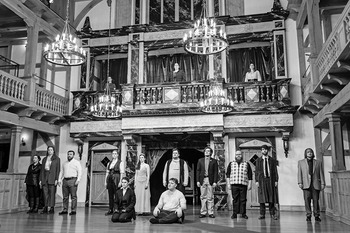
At the point of the murder, the scene between Metz’s Edward and Willis’s Lightborn paused, with the two of them sitting upon the ground (Figure 1). One by one, the rest of the acting company emerged, and spoke a new text compiled and written by Knight, Fowler, and Keith Taylor. The ensemble members neutrally narrated the build-up to the murder as a series of spoken stage directions, interspersed with Metz and Willis delivering lines imported from Richard II 3.1: ‘For God’s sake, let us sit upon the ground … ’. At the point of the murder, ensemble members merely said ‘They bind the king, and kill him in a manner / Which only rumours have brought down to us’. They continued with the lines:

1 The cast of Edward II break from the play to collectively refuse the staging of Edward’s murder.
The new moment aimed to create critical distance between the company and received history, acknowledging that history itself is freighted with homophobia, and that the ‘truth’ of a story is far more ambiguous. Knight, who helped create the structural frame of the intervention, shares that:
the idea was to present the lens through which our company was viewing the scene, both as a grotesque act of homophobia and as an important part of a play that would influence Shakespeare’s writing. The result was a piece written by several voices, including Shakespeare, to be performed by the ensemble. Rather than just my perspective, the final piece came together as the work of a group, in accordance with TSE’s community-oriented approach to theater.
For Fowler,
Edward II is a very personal play to me as a queer person and as someone who comes from a really random groupings of religion in my life. There has always been a slight undercurrent of religion involved in things I’ve written … I wrote a prayer of sorts when Lightborn (a bastardized version of Lucifer) was brought into the text. But I wasn’t interested in giving the image of Edward going to Hell – his life in the play was enough of that. Instead, I was interested in the reunion of faith and queerness.
The act of collaborative writing led to a powerful stage moment in which almost all of the Treehouse company members stood together onstage outside of the diegesis of the text, taking responsibility for commenting on the play it was performing, and in doing so epitomizing the company’s desire to intervene radically and intentionally in classical texts.Footnote 20 As Fowler says, ‘it didn’t take too long for us to find a through-line and mix … into a moment that existed outside of time, that could be felt by not just the queer folks in the room but by anyone who has felt love and pain in their life’.
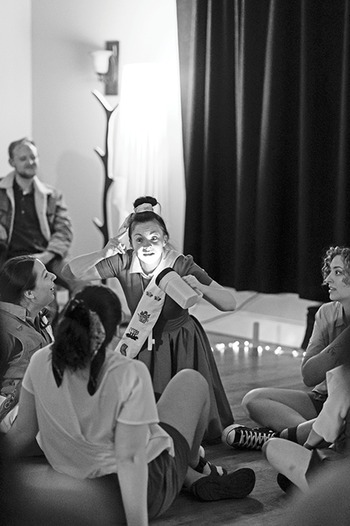
Fowler’s phrasing here is a salient reminder that Treehouse’s mission was one of community-forming; the privileging of LGBTQA+ stories was designed not to segregate the company and its audiences into separate communities of identity, but to bring the community together around the issues which the company prioritized. In contrast to the austere pathos of Edward II, the small-scale production of Galatea directed by Metz achieved a similar impact through joy. This production featured a cast of five (Kara Hankard, Beth Harris, Rosemary Richards, Ariel Tatum, and guest ‘journeyman’ actor Mikaela Hanrahan), all female-identifying or non-binary. A framing device established the five actors as Girl Scouts on a camp, first discovered playing hide-and-seek and singing the Osborne Brothers’ ‘Rocky Top’, before beginning to tell the story of the monstrous Agar’s threat to drown the village as a ghost story, lit by torches (Figure 2).

2 The senior scout (Rosemary Richards) begins telling the story of Galatea.
Throughout the production, the actors played their Girl Scout characters, who created the characters of Galatea using their camp equipment: zips on backpacks served as the mouths of puppeteered gods; conversations between the three brothers Rafe, Robin and Dick were performed by Richards speaking to socks on her hands; and the sashes of the Scouts became the bows wielded by Venus’ nymphs. But in telling this story, the Scouts playing Galatea and Phyllida (Tatum and Hankard) themselves became closer. Tatum’s Scout was initially an outsider, perhaps new to the group and unsure of their place. Galatea served as a vehicle through which the young women could, in the safety of this community, discover who they and who the others were. The production concluded with the Scouts sitting in a circle within the thrust stage space as if around a campfire, belting out a cover of Taylor Swift’s ‘Mine’ as they celebrated the queer love found within their group and their collective solidarity.
Other dramaturgical interventions kept queer stories front and centre even when not the primary focus. Fowler created a framing device for The Duchess of Malfi based on stone-tape theory, in which, as Fowler puts it, ‘ghosts, at least as we think of them, are created by an event or trauma so impactful that it leaves a lasting impression on the physical space around the occurrence’. Five urban explorers broke into a disused theatre, finding costumes and objects, before one of them began reading from a book that turned out to contain the outlines of Webster’s play. As she read, an ancient radio suddenly began playing music, and the young explorers were drawn to pieces of clothing that would temporarily cause them to embody the characters of Malfi. As Rachel, who played the Duchess, points out:
the framing device allowed us to draw a parallel between the trauma experienced by the Duchess and Antonio – persecution for who they chose to love – and the same kind of trauma often experienced by modern queer people. The majority of Treehouse identifies as some form of queer, and so naturally telling queer stories was a vital part of our mission statement: ‘We engage with audiences … to give voice to stories of female agency, sexual identity and communities in peril’. The queer representation the urban explorers set up was perhaps the most purposeful and personal use of our framing device.
In Knight’s The Fall of Thebes, meanwhile, the company added to the Theban plays a relationship between Antigone and Creon’s niece Hermione, and a redemptive epilogue in which Antigone and her sister Ismene were spared from death and left Thebes to travel the world and ‘speak out against the monstrous force / That leads both kings and people into madness’. Dramaturgical choices such as this were aligned by proximity with more ‘traditional’ cross-gendered casting typical of university productions. Macbeth, for instance, toured schools in the western Virginia area with female-identifying actors (Potter and Richards) as both Macbeth and Lady Macbeth. Such casting choices are typical of professional practice in the region, most notably at the ASC (where cross-gendered casting is a standard practice, though not usually the re-gendering of characters), but cannot necessarily be assumed to be uncontroversial, especially in a state which has in recent times pursued aggressive culture war policies in the education sector.Footnote 21
The company’s work to interweave stories of queer love and advocacy against homophobia into its classical repertoire resulted in MBU awarding the company that year’s Lavender Award. Lavender Graduations in the US have, since 1995, served to honour the contributions and achievements of LGBTQA+ students and allies on university campuses.Footnote 22 The award of the 2023 prize to all nineteen members of the ensemble respected the company’s commitment to the idea of shared responsibility and shared agency in the service of its mission. Perhaps most important to the mission of advancing a community of interest, though, was the visibility of the storytelling mechanics being used within the productions. The plays themselves were not sufficient to advance Treehouse’s mission, and the company’s integration of what Nora Williams calls ‘paratheatrical additions’ to ‘complete’ the dramaturgy of the story it wanted to tell also made clear that agency and responsibility for advancing the community’s shared interest lie with the community, not with the text.Footnote 23
Communities of Location: Putting Down Roots in Staunton
Fişek argues that ‘community theatre’s objectives can range from securing recognition for a community’s particular experience to demanding public intervention on a topic of social or political concern to revitalizing the cultural life of a given locality’.Footnote 24 While the company’s onstage storytelling was probably the most prominent arena in which it pursued its community mission in relation to its communities of interest, perhaps more important – because far more optional in relation to the curriculum of the programme, and thus requiring more self-generated labour from company members – was its contribution to the cultural life of Staunton and the wider region. As already noted, university theatre can struggle to bridge the town/gown divide, especially given the short periods for which students are present in a locality; Treehouse, however, made a conscious effort to look outwards.
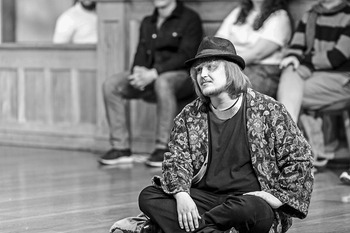
Some aspects of engagement with the culture of the region did appear onstage. Notably, in the director-less ‘Renaissance-style’ production of The Birth of Merlin, the Devil – played by Dylan Mabe, an Appalachian native – was imagined as a regional folk devil in trilby and patterned jacket, who duetted with Joan Go To’t (Hankard) on ‘Didn’t Leave Nobody but the Baby’ (Figure 3). But, rather than co-opting regional culture as an aesthetic within productions, the company instead contributed most to the region’s cultural life both through its commitment to participating in mass community events and in its curation of bespoke relationships with local businesses and community partners.

At the mass participation end of the scale, Treehouse set aside a weekend in late September 2022 to be one of nearly 200 organizations taking part in the October Queen City Mischief & Magic Festival. This annual festival welcomes some 20,000 visitors each year to a one-horse town for a two-day celebration of witchcraft and wizardry which, the organizers are at pain to stress, is absolutely in no way affiliated with Warner Bros, J. K. Rowling or Bloomsbury Publishing. During the festival, the roads are closed and local businesses pour onto the streets to share displays and shows, magic-themed versions of their usual produce, and activities for kids. Jumping on the convenient opportunity to cross-promote the company’s then-in-rehearsal production of Macbeth, members of Treehouse volunteered to be semi-official costumed actors (with an entirely coincidental resemblance to certain Harry Potter characters), mounted stage combat demonstrations on the festival stage, and ran a stall boasting magical tricks, face-painting, trivia games and other magic-themed entertainments for the tourist audience. But what was perhaps interesting was the longevity of the impact of Treehouse’s commitment to this major public event. In the responsibilities and profile that the company took on, they found themselves playing the role of a local community institution, on a par with longstanding businesses and activist groups, and the company committed to continuing to play this role – in line with its mission – for the rest of the year.
The magic theme provided a focal point for much of Treehouse’s Staunton-facing community engagement. One company member, Rachel, found that the local interest in tarot reading was sufficient to enable her to begin a business at the end of the company’s year, continuing to provide readings for people in the Staunton area. The company partnered with candle store Redwood & Co. to sell bespoke season-themed candles alongside the shows. And the company’s final show, The Birth of Merlin, resulted in cross-promotional partnership with Staunton’s Medieval Fantasies Company (home of the Dragon Preservation Society of Staunton (DPSS) VA). This idiosyncratic gyfte shoppe and educational organization, run by Sir Blackwolf and Lady Dawn, has a twenty-year history of community partnerships within Staunton, curating the town’s collection of dragons for the enjoyment and edification of locals and visitors alike. The DPSS liaised with the company to donate the spectacular dragon masks used in the production and give a Welsh blessing to the company on the stage of the Blackfriars Playhouse, all captured in a charming six-minute video put together by the DPSS in order to promote Treehouse’s decision to stage a play with dragons in it.Footnote 25 Connections of this kind are invaluable, we argue, precisely because of their lack of value within any traditional framework. They do not generate revenue (entrance to all Treehouse productions was free to the public); they do not contribute to a definable activist agenda; they do not appear as a line on a CV – Treehouse disbanded only six weeks later at the close of the academic year. But even if the student theatre company itself is transient, its after-effects linger on in the community partners whose own identities evolved in relation to the company’s work.
The mutual benefits of a student theatre ensemble working not within the confines of a university campus, but within the surrounding town, could be felt in various other ways. Positive cross-promotional partnerships enabled the company to call on additional favours, such as Redwood hosting the company’s wrap party at the end of its year, for instance. As another example, Kailey recalls that:
Treehouse members had been enjoying eating at Accordia [a wine bar and bistro one block from the Wharf] for months before we connected with them as a cohort, which happened when they posted our Edward II poster on their business FB page with a positive review of the show. I noticed the post, commented and shared it on TSE’s FB page, and from there the cohort members who had more of a relationship with the business reached out to chat about partnerships, which is how we organized Accordia hosting us for our final night of Festival week.
The company worked to establish a model in which serendipity was answered by reciprocity; community partners were recognized for their donations of labour, goods, even attention, and that recognition led to more opportunities for exchange of resource and goodwill. The company then channelled that into its charitable giving; donations were taken at all three of the company’s Fall small-scale shows, and were donated to charities associated with that production’s particular areas of interest (Galatea to the Girl Scouts Association, The Duchess of Malfi to the Shenandoah LGBTQ Center, and Two Gentlemen of Verona to Shenandoah Valley Animal Services).
One of the more visible community partnerships came, again, towards the end of the company’s existence, when The Duchess of Malfi – first performed at the Wharf in Fall – was restaged in the Arcadia in downtown Staunton. The Arcadia Project is a major non-profit initiative that is transforming and repurposing the derelict historic Dixie Theater (originally built in 1913) into a multipurpose community venue. As of 2023, the main room was a grand, cavernous, damp, and somewhat eerie space, in which Treehouse negotiated permission to stage Malfi. As Cameron Taylor (who played Ferdinand) explains:
Firstly, there was already a crystal clear connection between the theater itself and [director] Chase [Fowler]’s overall framing device of the urban explorers in an abandoned theatre. Theatres, of course, are houses for storytelling, containing the ghosts and echoes of hundreds of different films and plays that have come before. The Arcadia Project is no different: an ‘enchanting old ruin’ (in the words of The Grand Budapest Hotel) that time has not been kind to. Being able to shed some light on the power of theatre spaces through Malfi became so much more powerful within Arcadia. It felt like we were able to, for a few hours, help breathe some life into that beautiful old building.
While the production was not designed with the Arcadia as its intended venue, the production took on new life as a rediscovery of a found space in line with the Arcadia Project’s own mission of restoration, ‘honoring its past and broadening its uses’, while serving as a proof-of-concept of the Project’s larger aims to be a space for the wider community, even before fundraising was complete for the renovation.Footnote 26 A similar partnership set up with Hazy Mountain Vineyards & Brewery – which provided a mountainside venue 25 miles outside town, with spectacular panoramic views, for Treehouse’s production of The Two Gentlemen of Verona – opened up a touring relationship that subsequent MFA companies have been able to take advantage of.
Lastly, the company did not neglect its own university community, and the company’s work within Mary Baldwin is part of its lasting legacy. With faculty encouragement, the company inaugurated the tradition of MFA company members (most of whom had completed their MLitt the previous year) chairing the presentations of the current second-year MLitt students at the annual Thesis Festival, taking on a role previously held by faculty members. The mentoring of the next generation of students was of particular importance, as George argues, in the post-2020 environment: ‘Treehouse set out to reforge many of the usual connections students across S&P enjoy … we craved that camaraderie that so many of our predecessors upheld’. This craving resulted in Treehouse members holding thesis workshops to help MLitt students prepare for their public presentations of their work-in-progress, developing community across the different year groups of the Shakespeare & Performance programme; Katelyn, one of the company’s production managers, notes that the company worked to break down what had sometimes been experienced as the ‘MFA exclusivity’ of the Wharf space to ‘let it be a place where people could just hang out, relax, have a conversation, do homework, or just take a break’. The company also worked hard to bridge the gap with the undergraduate Theatre programme; company member Kelsey Harrison directed the undergraduate production of Emily C. A. Snyder’s Cupid and Psyche, and undergraduate and MLitt students were invited to participate in Treehouse’s season as journeymen actors in staged readings and main stage productions, and as understudies and stage managers.
Looking back on the year of Treehouse’s existence, we would argue that the company fulfilled its mission to its community predominantly through its responsiveness. The dangers of a university-based theatre company which forms for only a short period are that it develops the product which it wants to create, then creates a rationale for why it feels its prospective audiences need it. This is understandable within a compressed framework in which students rarely have the lead-in time to fully research the community which they have only just joined. But Treehouse’s successes in building relationships with its local partners came about through listening and responding to what businesses and audiences brought to the table, to their missions and principles, and then working with those partners to align our values.
Legacy and Conclusions
As Fişek notes, in her summary of Raymond Williams’s definitions of community, ‘community is an existing but also a yearned for grouping, and references to community almost always mix the factual and the ideal’.Footnote 27 Treehouse began with an aspiration that ‘the seeds of conversation and creativity will continue to flourish within and beyond our found community long after our season’, and as we write, a year after the company graduated, what was planted does indeed continue to grow. Indeed, many Treehouse graduates are still in town, tending the branches that the company extended to its community partners: teaching MBU undergraduates, working in local businesses, performing at the ASC, building community in administrative roles. A tree remains even if a treehouse is dismantled; and for many, the found community they found while members of the company has turned into a lasting attachment.
A theatre training model built on grassroots, ensemble principles can, we argue, lead to a student company becoming a meaningful community actor, partly by modelling the values of reciprocal care which underpin the best ensemble ethos. Company member Beth Somerville says that ‘above all else we looked out for each other, took care of our mental and physical well-being, and worked through disagreements with respect and compassion. By fostering a healthy internal community, we were better able to serve the larger S&P, MBU and Staunton communities.’ Key to Beth’s comment here is the word ‘serve’; Treehouse did not necessarily know what it was going to do for and with the communities it found, but the collaborative training model prepared the students to listen and respond to the needs of others. The frugality and flexibility of a grassroots ethos which privileges student ingenuity, collaboration and entrepreneurship, moreover, enabled the company to meet those needs as they emerged.
As McAvinchey argues:
The multiplicity of meanings of, and desires for, ‘community’ reveal it as a term and social process that is fluid and complex … The word can have connotations of unity, consensus and sameness. But community is also a highly charged word and idea: as a form of social organization, it simultaneously prompts a sense of belonging and exclusion. You are either one of us or one of them.Footnote 28
Our hope is that we have laid out here some of the ways in which the grassroots company-building model allows for a simultaneous set of paired processes – becoming a community, and becoming part of a community – in which responsive and collaborative partnerships allow for the lines between ‘one of us’ and ‘one of them’ to be blurred, if not entirely broken down. The metaphor of the treehouse imagines a temporary structure interwoven both with the tree in which it is built and with the larger canopy that defines the ecosystem. We hope that preserving some of our work in this format inspires future models for finding points of connection between university theatre and communities of interest and location, which will look very different from those that we found, but which will be similarly reciprocal and collaboratively built.