

Secrets, rumours, friendships, rivalries, illicit relations, death and disease—the Indian Ocean has been a site for centuries of action and encounter that cannot possibly be captured, in its entirety, in a single chapter. As Sugata Bose rightly said, its history and historiography are like “a seascape artist … [using] broad strokes of the brush” which “dipped in the sources of many archives,” would eventually produce a more “textured and complex picture.”Footnote 1 Amidst this mosaic, Bengal remained one of the steady regions maintaining its “amphibious” connections and contributing to the existent diversity of the Indian Ocean.Footnote 2 Chinese, Malay, Arab, Persian, and African merchants, scholars, and travellers had frequented this region for a long time prior to the arrival of the Portuguese, Dutch, French, English, and other European trading companies.Footnote 3 By the seventeenth century, Bengal had turned into a mosaic of different trading groups, who set up their factories and forts along the banks of the river Ganga and its tributaries.Footnote 4
The Dutch East India Company (Verenigde Oostindische Compagnie or the VOC), too, asserted its presence here. Beginning from the early years of the seventeenth century, the VOC grew steadily in Bengal in contention with the English and the other European companies.Footnote 5 They had factories in Chinsurah (Hooghly), Malda, Kasimbazaar, Dhaka, and other areas of Pipli, Balasore, and Patna, all of which were clubbed under the VOC possessions in Bengal.Footnote 6 These factories were supervised by a director and his council, who resided at the chief factory of Chinsurah (Hooghly).Footnote 7 Chinsurah came to be acquired by the VOC, along with Baranagore and Bazaar Mirjapur in 1656, as a lease from the Mughal emperor.Footnote 8
The nature of the Company’s presence in Bengal has been considered purely commercial in the existent historiography.Footnote 9 Studies on the interactions between the VOC and the local merchants or the Mughal administrators have, therefore, remained mostly confined to a mercantile context. Works of scholars like Om Prakash and F. S. Gaastra have examined these relations for Bengal. While Om Prakash concluded that the Mughal merchant-officials extorted the VOC and the local brokers there, Gaastra argued that the VOC either competed or collaborated with the local merchants.Footnote 10 In a broader Indian Ocean setting, Ashin Das Gupta characterised Indian merchants as being in a “partnership” with the Dutch East India Company.Footnote 11 Subrahmanyam introduced a politico-economic angle by describing the occasional clash between powerful Mughal “portfolio-capitalists” and VOC (and EIC) merchants as “contained conflict.”Footnote 12 New studies of the local-Dutch relations in Bengal have been developed in recent years by scholars like Markus Vink and E. A. Alpers. They have pointed out not only Bengal’s importance in the VOC slave trade in the Indian Ocean but also its extended connection to trans-Atlantic slavery.Footnote 13
These different labels – conflict, partnership, collaboration, competition – created within the existent historiography conform to a neat, binary segregation of two groups: the Indians and the Dutch. But in a fluid setting like Bengal more complex situations arose. For example, one wonders about the position of local brokers who were bound by their contract to the Company’s legal purview while simultaneously being subjected to the Mughal jurisdiction in Bengal. What happened in case of a conflict between them and the Company – was it resolved by the qazi (an Islamic judge) or brought to the Company’s court at Batavia? Or in cases of conflicts among VOC officials, were the brokers getting involved in the Company’s legal processes? Such questions can be answered by going beyond the segregation of the “Indian” and “Dutch” to get a better understanding of the ambiguous worlds of these actors. This article aims to do this by examining two such VOC cases involving extra-Dutch actors with a focus on the way these cases were framed before being forwarded to the courtroom to examine the process of gathering evidences and testimonies. In the process, it becomes apparent that overlapping jurisdictions unleashed a process of legal negotiations, adaptations, rejections, and appropriations that paradoxically eliminated and yet reinforced the binary division of Dutch and Indian.
But before proceeding further, it is imperative to provide a glimpse of the jurisdictional situation of the VOC in seventeenth-century Mughal Bengal. All local inhabitants of the area, irrespective of their religious or ethnic distinctions, were subjected to Mughal jurisdiction for both civil and criminal cases.Footnote 14 The VOC, on the other hand, much like other foreign groups, was allowed to exercise their own jurisdiction over their own employees.Footnote 15 It was in Batavia (modern day Jakarta) that the highest court of justice, the Raad van Justitie (Council of Justice) was located. All Dutch East India Company servants who were working in Asia and the Cape, as well as all the vrijburgers (free-citizens) living in these places, were to be tried in the Raad van Justitie.Footnote 16 The Company was allowed to continue its commercial operations in Bengal only if they abided by the rules of the Mughal firmans. This overlapping legal coexistence was not a problem until conflicts broke out between the Mughal administrators or the local brokers and the Company personnel. It is in this setting of multiple legal dynamics that the following cases unfurl.
Case A: Partners in Crime
In the year 1684, the Heren XVII (the Company’s chief board of seventeen directors) in the Dutch Republic sent an investigating committee to check into corruption among its officials working in the Indian factories of the westerkwartier (western quarters). This included the coast of Coromandel, Malabar, Surat, Ceylon, and Bengal; instructions were given to make special checks in Bengal.Footnote 17 Hendrik Adriaan van Reede tot Drakenstein (1636–1691) was appointed as the commissioner-general of this committee.Footnote 18 His position and power rested above all governors and directors in the places he was supposed to visit and investigate. The instructions, nevertheless, explicitly asked him to forward all allegations reported against any official to the Hoge Regering (High Government), so that the Raad van Justitie had the final say.Footnote 19 Those beyond the Company’s jurisdiction suspected or found guilty of corruption were to be left at Van Reede’s discretion. This possibly included the local brokers and other villagers whose services were used by the Company, but over whom the VOC had no absolute jurisdiction.
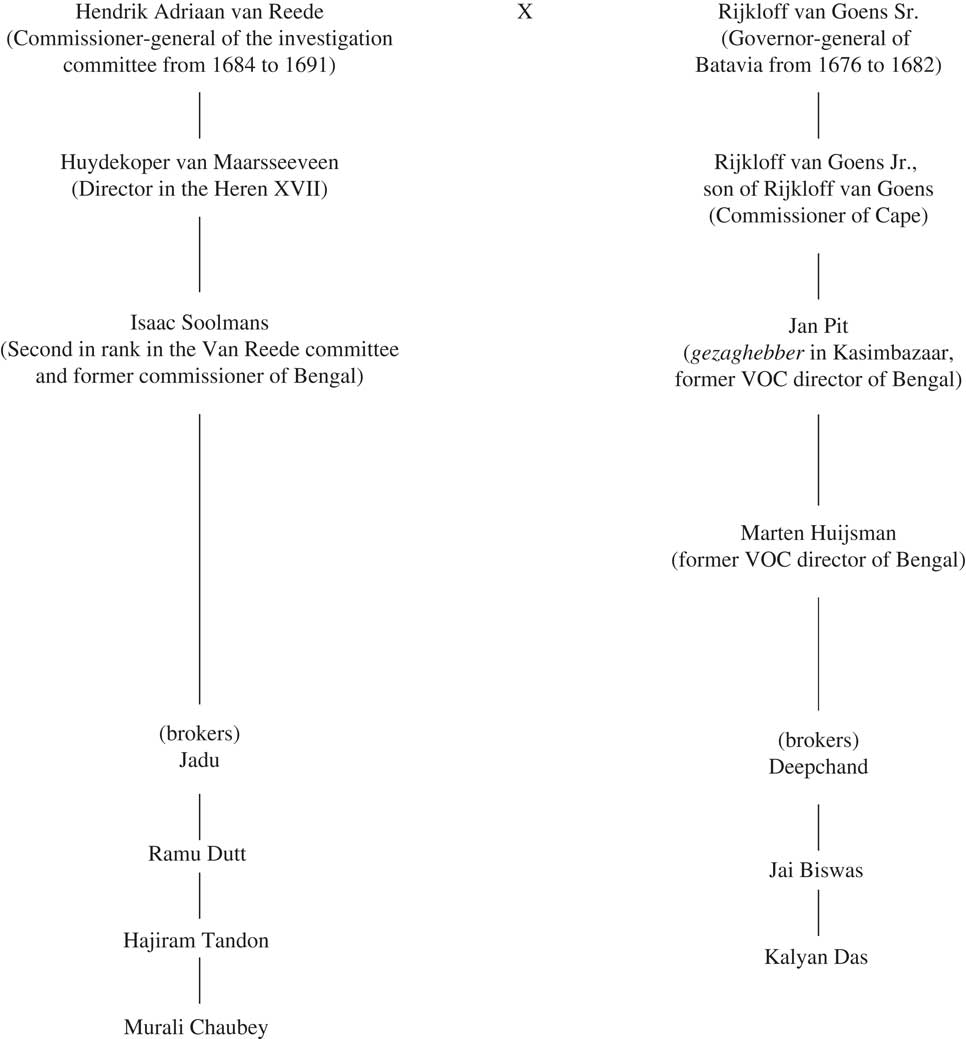
By 1686, the committee had investigated in Bengal and produced extensive reports on persons suspected of corruption. On a quick glance, there was nothing in these names to raise suspicion. There was, however, more to it when examined beyond the surface. On tracing the network of friends and family of the persons accused by Van Reede, a pattern could be immediately discerned. It was evident that only certain people came to be targeted by the committee. The pattern that tied them all together was their connection to the family Van Goens. The story then became much easier to reconstruct. The governor-general of Batavia, Rijkloff van Goens (1678–1681), and his son, Rijkloff van Goens Junior, had been strong political opponents of Van Reede. Their differing opinions and open attacks on each other are apparent in the VOC records that make no attempt to hide this hostility.Footnote 20 It naturally spilled over into the factions of their respective friends and families who were also a part of the VOC administration. For instance, several charges were made against Jan Pit, the gezaghebber (chief) of the factory in Kasimbazaar and assistant to the Company’s director in Bengal. Pit was accused of several offences by Van Reede, from toll evasions to embezzlement of the Company’s treasury to forming a “kleine compagnie” (small company) for illegal trade.Footnote 21 Martin Pit, who was the brother of Jan Pit, happened to be a member of the Raad van Indië (Council of Batavia) at that time. Martin Pit had been recommended for this position by Van Goens Jr., as is evident from a letter written in 1683 to the Heren XVII. It left a vital clue to the close ties between the Pit brothers and the family of Van Goens and explains Van Reede’s targeting Jan Pit.Footnote 22
It is necessary to understand that in the Dutch elite society of the seventeenth century, political factions constituted the core of survival.Footnote 23 Factions were mostly made up of familial relations and close friends. Friendships were often strengthened through intermarriage between families and were secured through distribution of offices among members of the faction. This meant that fathers, sons, brothers, uncles, and sons-in-law were not only family members but also colleagues at work who stuck together. They formed familial-friendly factions that were underlined by common blood ties, similar ideological beliefs, and political affiliations catalysed by shared interests for profit and honour. They recommended each other for appointments and promotions at work and supported each other in times of personal crisis, offering financial help to save social positions. It was thus a mechanism of social defence designed to preserve public image and higher status.Footnote 24 The presence of multiple different factions meant that they often clashed with each other, with most members of a particular faction becoming political opponents of their rival faction. Though not a frequent practice, sometimes disgruntled members could switch sides and change their factions. Factionalism, thus, remained an indispensable tool for climbing the bureaucratic ladder and formed an integral part of the VOC administration in Bengal.
Van Reede and his committee members had the open support of one of the prominent directors of the Heren XVII, Joan Huydekoper van Maarsseveen indicating that they belonged to the same faction.Footnote 25 On the other hand, Van Reede’s allegations were aimed not just against Pit, but also his friends Martin Huijsman (the former VOC director of Bengal) and Nicolaas Schagen (the then-director of the factory at Hooghly), suggesting that they all belonged to the same faction.Footnote 26 The Van Goens were also a part of this faction, as can be ascertained from the names of Huijsman and Schagen appearing as recommendations in the same letter by Van Goens Jr. to the Heren XVII.Footnote 27 What was clearly at play here were factional forces of personal alliance and revenge, under the façade of the larger institutional legal apparatus. It demonstrates the use of institutional facilities and the initiation of legal procedures at a formal level to serve informal ends. The committee under Van Reede was created as an official measure with the intention of finding corruption among the VOC’s servants. But in practice, it was reduced to a political tool designed to catering to personal and factional interests.
To prove their allegations against Jan Pit and his associates, Van Reede and his committee had to provide evidences. Many of these came in the form of testimonies by local brokers working for the Company. In the reports of the committee, Van Reede explicitly named three Indian merchants who had collaborated with Pit and the other officials. They were Deepchand (written as Diepsient), Kalyan Das (as Caljandas), and Jai Biswas (as Siaijwiswas), alias Ramsen (as Ramceen). By using their account books, accompanied by testimonies of other brokers, the committee tried to frame Pit (gezaghebber in 1683), Huijsman (director of Bengal in 1684), and others of fraud in the Company.Footnote 28 These officials were charged with having traded illegally in the name of their Indian brokers, while giving them certain commissions in return.Footnote 29 Another broker named Jadu (written as Satu/Satou) provided his testimony to the committee against Pit and the three brokers, Biswas, Deepchand, and Das. In the sources, his testimony appears to be translated from Bengali to Dutch, and reads as follows:
“I, Jadu, working as a broker in the service of this Honourable Company have, according to the order of the Honourable Lord Hendrik Adriaan van Reede, lord of Mijdrecht, translated with the intention of being committed for the same purpose, the words of Kalyan Das as they have been written in the abovementioned extract from his account books concerning the trade that was conducted between him and the Honourable Company’s servants since the year 1679 to the end of the year 1686 and this has been compared with a corresponding note that has been signed by me, to which I declare to agree as the truth; and I have signed it with my own hands. Hoogli, 15th April 1686 (written below)
This is the signature of Jadu, the broker of the Dutch Company.”Footnote 30
In the same light, the name of Ramu Dutt (written as Rammoedet), a bania (merchant) working as a factoor (gomoshta or agent) for the Company also surfaced in the committee’s reports. Ramu Dutt confessed to being part of the illegal trade dealings in 1683 when Pit used him to sell Pit’s private goods to Jai Biswas.Footnote 31 Van Reede not only praised Dutt for his testimony but also consolidated his position in the Company. Jadu, too, was highly recommended by Van Reede and assigned the task of assisting in the supervision of textile quality control.Footnote 32
The inclusion of these local testimonies was remarkable for two reasons. First, the instructions of the Heren XVII for the committee included the following injunction:
“All the information and evidences should be so provided, that they can help the jurist in making a judgement, by basing his decree or sentence on these available information (as evidences). But if the aforementioned information comprises only of the testimonies given by the moors and the heathens, or extracts from their account books, they should be corroborated by the testimonies of honourable and trustworthy Christians or others who suffice (this criterion).”Footnote 33
The fact that the testimony of brokers like Jadu were inherently untrustworthy, despite the oath that they were required to take when entering the Company’s service, implied a typical legal paradox.Footnote 34 By making the brokers take an oath to adhere to the Company’s rules, they were subtly brought under the Dutch legal purview. But at the same time, creating a hierarchy in their credibility as witnesses led the VOC to resort to what Lauren Reference Benton and JacobBenton called out as the “politics of difference.”Footnote 35 Extending jurisdiction over these brokers indicated their inclusion in the VOC legal structure. But at the same time, demeaning the weight of their testimonies triggered a formal structuring of difference in the Company’s judicial lingo.Footnote 36
A second aspect worth noting is the motive that led the likes of Jadu to actively participate in the VOC’s legal forum. In the year before Van Reede, Isaac Soolmans was appointed as the VOC commissioner for investigating the factories in Bengal. In 1684, a series of testimonies by the brokers revealed that the trio of Biswas, Deepchand, and Das were appointed in the service of the Company from the time Jacob Verburg became the VOC director in Bengal. Soolmans and his secretary, Adriaan van Ommen, reported that this trio of brokers was chosen over Hajiram Tandon (Hasjeram Thenden) and Murali Chaubey (Moereli Sjoebe), despite the two having served the Company faithfully for a long time.Footnote 37 Shortly thereafter, the broker Jadu declared that Jan Pit had made Jai Biswas the most important broker. Biswas’s dominance was so great that he managed to convince the Company to dismiss Jadu from its service by accusing him of fraud.Footnote 38 Soolmans reported that he later discovered that Biswas was not to be trusted, and therefore wrote to Marten Huijsman, the then-director, about his suspicions. Huijsman, who belonged to Pit’s faction, replied to Soolmans by stating that Jadu and Biswas were in the same party and Jadu, therefore, was not a friend of the Company’s.Footnote 39 This earlier conflict involving Jadu and the three brokers led by Biswas made its impact in 1686 (when Van Reede was the commissioner), inducing Jadu to provide his willing testimonies against his fellow brokers to the committee.
This opens up the world of local merchants in Bengal, and paints a picture equally dotted with rivalries and factionalism. Family and friendships here, too, tended to form an essential part of mercantile bonds, as is evident from numerous examples among brokers who worked for the Company. Often brothers, sons, uncles, or friends of a certain broker replaced him, when he could not continue working in his position. One of the brokers mentioned above, Kalyan Das, was the son of Rangordas, who had also worked for the VOC.Footnote 40 The young son of Deepchand named Kamalnayan was already considered to be in line to be hired as a broker by the Company, when he came of age.Footnote 41 The son of the Company’s chief weaver Bolleram, named Ghanashyam (written as Genesam), also worked for the Company.Footnote 42 In the autobiography of a seventeenth-century bania merchant, Banarasidas from Jaunpur, such bonds were further confirmed. Banarasidas’s friend Dharamdas was also his business partner.Footnote 43 That family members could also be trading partners is evident: Banarasidas’s father, Kharagsen, invested in a joint business with his uncle, Sundardas.Footnote 44 Examples from the Bengali literature of the time also provide hints about such familial mercantile bonds.Footnote 45 The fact that local merchants preferred to keep their family ties within their communities and friends is evident from the incident of Dhanapati’s marriage with Khulana, in the Chandimangal.Footnote 46 The author, Mukundaram, narrated how Khulana’s father, himself a merchant from the gondhobanik (perfumes and aromatic commodities trader) community explored all possibilities of a suitable groom for his daughter, keeping in mind the condition that the groom had to be exclusively from the same trading group.
Clearly then, the Indian merchants were also divided among themselves into competing factions that could merge their conflicts with the ongoing factional politics of the Company (see Appendix for Case A). With factions revolving around families and friends on both sides, it is possible to understand why the VOC in Bengal accommodated the local brokers in their legal space and why the brokers, on their part, participated in the Company’s legal trials. Both groups often had overlapping interests that tied them to one stretched network for fulfilling their individual and factional ambitions. This case brings forth this point in the backdrop of the VOC’s pluralistic legal existence. It shows the use of the Company’s formal legal apparatus to serve personal politics while carefully including extra-Dutch actors in its jurisdiction. At the same time, it shows the mechanism of creating differences through reduced credibility of the local brokers’ testimonies in their legal participation. Notwithstanding such differences, the merchants in Bengal actively engaged with the Company’s legal administration to serve their own competitive needs in alliance with the Company’s numerous factions, which dismissed the binary assertions of “Dutch” and “Indian”.
Case B: The Death of Bolleram’s Widow
If ever there was a case in the Company’s legal history that involved all layers of political and judicial authorities – from the Raad van Justitie to the qazi and from the Heren XVII to the Mughal emperor Aurangzeb – then this was it. Both Om Prakash and F.S. Gaastra have written about this case.Footnote 47 But the Indian side of the story was quickly passed over, missing the nuances of this unique legal encounter in 1672. It all began when Bolleram Sjoudhuri (or possibly Boloram or Bhole Ram Chowdhuri), the Company’s masterhaspelaar (seniorHeren XVII in the Republic).
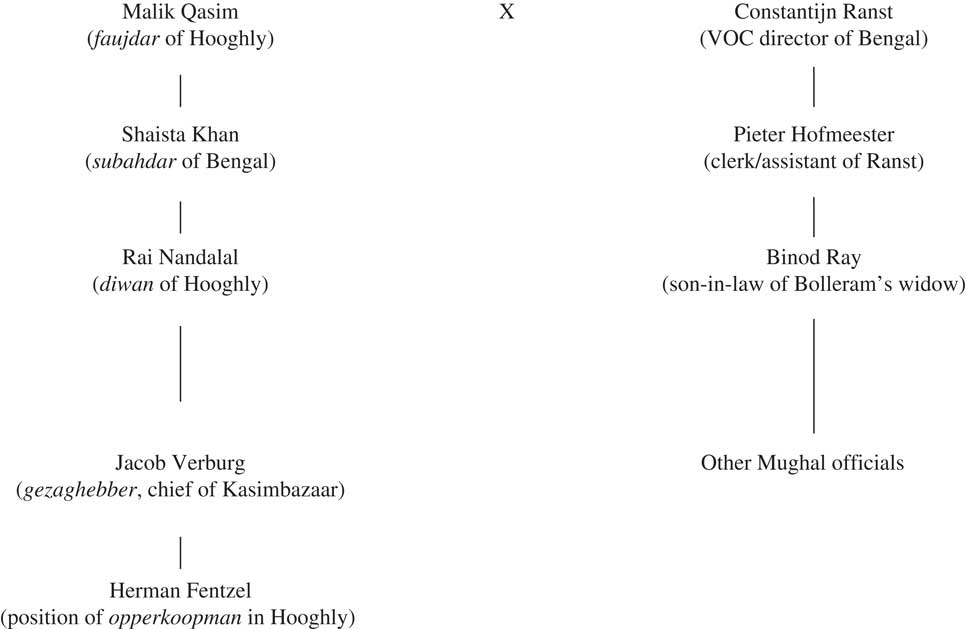
With both the Mughal and the Dutch authorities involved, the case was presented at both the court of the qazi in Bengal and the Raad van Justitie in Batavia.Footnote 48 As the case proceeded to the higher authorities and investigations began things became more and more interesting. The first accusations seem to have come from Herman Fentzel (koopman or official in the rank of a merchant in Hooghly) and Jacob Verburg (gezaghebber at Kasimbazaar), who announced having seen Ranst torturing the woman. Being present during the interrogation, they saw him hanging the widow with her hands tied with ropes for an hour and treating her like a slave. According to their testimony, thus, the widow succumbed to this torture. The fact that allegations were raised against Ranst by Verburg and Fentzel proves that they were not on good terms with the director and presumably belonged to rival political factions. The animosity possibly owed its origin to the days when Ranst first arrived in Bengal in 1669. Between 1671 and 1672, he was openly accused by Fentzel and Verburg of illegal trade, when the commissioner Willem Volger was present there.Footnote 49 But the friendship between Ranst and Volger prevented the latter from bringing any charges against Ranst. Such politics of factional allegations which we saw at play earlier now makes its intrusion in this incident.
At the qazi’s court, Verburg and Fentzel’s allegations were strengthened by the accusations of Malik Qasim and Shaista Khan.Footnote 50 They blamed the Company under Ranst’s authority of being reckless and not paying the due customs. Interestingly, they also accused the VOC of causing damage to the inhabitants of the villages in Bengal.Footnote 51 The diwan (revenue and finance official) of the province, Rai Nandalal, in fact sided with Verburg, claiming that the directors before Ranst had never been such a problem and had not caused so much trouble as Ranst did in Bengal.Footnote 52 In his defence, Ranst provided an apologia where he mentioned that Shaista Khan was anxious to protect his own trade from being hampered by the Company’s presence and, therefore, made these false allegations.Footnote 53 Besides this, he along with his assistant Pieter Hofmeester, sought the help of Binod Ray (written as Binootray), the son-in-law of Bolleram’s widow. Binod Ray said that his sister-in-law had consumed opium because of the disgrace she faced after the interrogation at the Company’s lodge. This caused her death, rather than the allegations of torture. The onderchirurgijn (junior physician) of the Company confirmed to this by claiming to have found traces of poison in the widow’s blood. In addition, some Mughal administrators helped Ranst draft a complaint against Malik Qasim to be sent to the emperor Aurangzeb.Footnote 54 They were possibly, as Gaastra concluded, men waiting for a chance to displace Malik Qasim from his position. This case was eventually settled when the Heren XVII decided to pay the money demnded, freeing Ranst of the charges brought against him.Footnote 55 But they simultaneously sent Johannes Bacharus to the emperor Aurangzeb to plead their case and reclaim the money. (Ranst, nevertheless, had to be removed from his directorship, as fresh charges of financial mismanagement and illegal trade brought against him were proven – a story that is beyond the scope of our current discussion).Footnote 56
This quintessential example of how jurisdictional overlaps led to problems in issuing clear legal pronouncements reveal two common factors, as seen in the previous case also. This includes the interplay of factional forces among Company officials while dispensing formal justice at Batavia, and the use of local agency and factional strife, combined with the Company officials’ own factional politics (see Appendix for Case B). In this incident, the factional struggle of Verburg-Fentzel against Volger-Ranst-Hofmeester determined how and where the allegations were to be made. Mughal administrators like Malik Qasim or Shaista Khan were no ordinary broker but powerful “merchant-officials,” who could force the very Company to bend to their jurisdiction.Footnote 57 Yet factional differences among themselves led some of these men to make room for the Company’s legal politics within the Mughal administrative framework.
But there is another element in this case that needs to be pointed out. This was the refusal of the Heren XVII to accept Ranst’s faults. The Haagse besogne (committee for handling the papers received from Asia) concluded that Ranst was innocent and had been falsely framed by Shaista Khan and his officials.Footnote 58 It revealed the Company’s tendency to minimise the credibility of alternative, contesting legal authorities like the Islamic court relative to the VOC court. This is also clearly reflected in generic VOC discourse about the inefficient administration of justice in the qazi’s court. James Tracy points out how VOC officials regularly denounced the legal system of the Mughal empire as inferior to the Christian ethics and justice manifested in Dutch laws.Footnote 59 A farce was made of these claims when Company officials actually tried to break into the legal machinery of the Mughals by offering bribes to the qazi or the concerned parties. They spoke about this openly, while simultaneously venting their frustrations about their failed attempts to disturb the qazi’s administration.Footnote 60 But their consistent efforts in writing about the “difference” of the Mughal legal system while trying to get a hold on it through informal means unfurled the process of pushing, goading, negotiating, and adapting to assert their formal presence in the midst of plural jurisdictions.
Conclusion
Two cases of the VOC administering justice against its own employees have been examined here, in the backdrop of seventeenth-century Mughal Bengal. The process of their formation and execution with the involvement of extra-Dutch local actors as witnesses and plaintiffs has been studied. Exploring the legal dimensions of the VOC’s presence in Bengal highlights the ambiguities and overlaps in exercising the Company’s laws at a time and space where the Mughal jurisdiction was also simultaneously in operation. Unravelling the way these cases were framed and presented at the VOC court, therefore, helps bring about the nuances of the local and VOC relations. Three major aspects could be discerned from the cases discussed above. First, it was evident that the Company’s formal legal machinery served as a façade for its inner personal factions. In both of the cases analysed here, Company officials remained embroiled in factional strife that culminated in raising allegations against opponent colleagues at the court in Batavia. Initiating a legal procedure in such instances, however, often required bringing in local parties to the story to frame the charges. This, in turn, increased the permeability of the VOC jurisdictional domain and made it more vulnerable to external penetration. But at the same time, non-Dutch actors were not officially allowed to be brought before the Company’s legal forum. Yet there were occasions when their participation was inevitable or when the VOC officials in Bengal could themselves become an involved party in the trials at the Mughal qazi’s court, as exemplified in the second case above. In all these circumstances, the Heren XVII denied the Mughal legal administration and non-Christian Company officials their full credibility on paper. Here we see a second aspect: the Company’s tendency to subtly assert its position in the legal hierarchy above alternative jurisdictional domains and non-Dutch actors. The local brokers nevertheless participated in these legal processes, not just because of their contractual obligations to the VOC but also in their own interests. As has been shown here, they themselves were driven by competitive factional forces that could be merged with the Company’s inner administrative factionalism. Thus, the third aspect of the Company’s presence was this element of local participation, triggered by the brokers’ own personal and factional ambitions. By summing up these arguments, it can be concluded that the legal practices of the VOC in Bengal went beyond the binaries of “Dutch” and “Indian” and were more muddled and dynamic than has been perceived in the historiography so far. And yet it also shows how this encounter formalised “difference” on paper through the informal means of negotiations, adaptations, and confrontations during its plural jurisdictional existence.
APPENDIX FOR CASE A
APPENDIX FOR CASE B

 Open access

