





Introduction
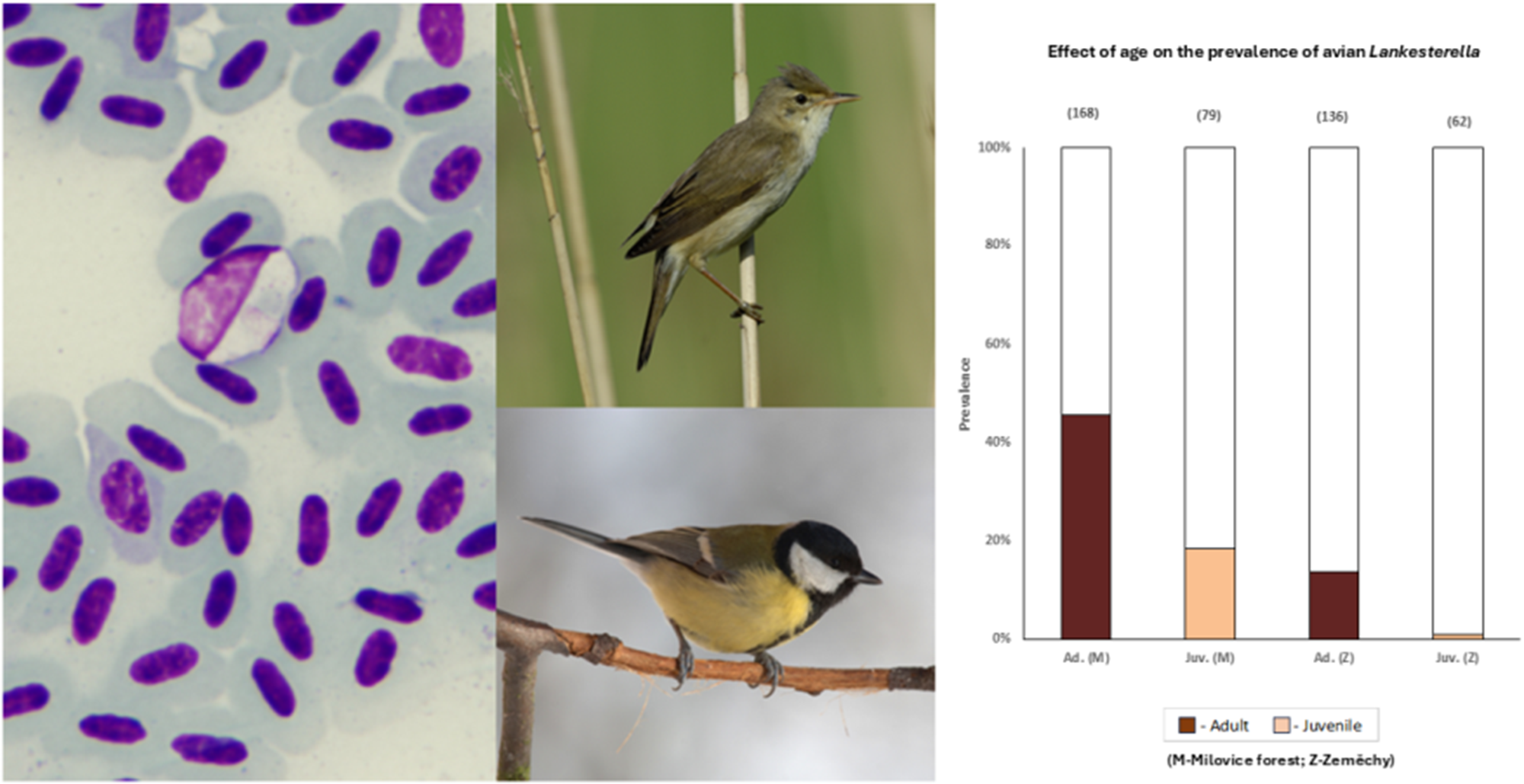
Avian blood protists are frequently found in most species of passerines. Those belonging to Apicomplexa are represented either by intracellular, notorious haemosporidian parasites such as Plasmodium, Haemoproteus and Leucocytozoon, or by neglected coccidian parasites such as Hepatozoon, Isospora and Lankesterella. Based on research done in reptiles and amphibians, the genus Lankesterella is considered heteroxenous (Desser, Reference Desser1993; Megía-Palma et al., Reference Megía-Palma, Martínez, Nasri, Cuervo, Martín, Acevedo, Belliure, Ortega, García-Roa, Selmi and Merino2016). Infective sporozoites circulating in blood cells are taken up by bloodsucking invertebrate vectors (leeches, mites or mosquitoes), but no replication has been observed in the invertebrate hosts (Desser, Reference Desser1993). Lankesterella are reported in blood of various avian species and confirmed by barcoding in several passerine genera (Merino et al., Reference Merino, Martínez, Martínez-de la Puente, Criado-Fornelio, Tomás, Morales and García-Fraile2006; Biedrzycka et al., Reference Biedrzycka, Kloch, Migalska and Bielański2013; Martínez et al., Reference Martínez, Merino, Badás, Almazán, Moksnes and Barbosa2018; Chagas et al., Reference Chagas, Harl, Preikša, Bukauskaitė, Ilgūnas, Weissenböck and Valkiūnas2021a, b; Venkatachalam et al., Reference Venkatachalam, Čepička, Hrazdilová and Svobodová2023). It is evident that Lankesterella is common at least in some populations of passerines, but despite this, we have limited information about its occurrence and prevalence. In a phylogenetic context, Lankesterella does not belong to the well-known haemosporidian parasites (Adl et al., Reference Adl, Bass, Lane, Lukeš, Schoch, Smirnov, Agatha, Berney, Brown, Burki, Cárdenas, Čepička, Chistyakova, del, Dunthorn, Edvardsen, Eglit, Guillou, Hampl, Heiss, Hoppenrath, James, Karnkowska, Karpov, Kim, Kolisko, Kudryavtsev, Lahr, Lara and Le Gall2018). Consequently, avian Lankesterella is somewhat mysterious, and any data concerning this parasite genus are exceptionally valuable.
Host species is an important factor that can influence blood parasite prevalence in birds. Lankesterella lineages from sedge warbler (Acrocephalus schoenobaenus) were found to be highly host specific when compared to the other parasite lineages of warblers; tit genera have been shown to have their own specific lineages (Venkatachalam et al., Reference Venkatachalam, Čepička, Hrazdilová and Svobodová2023). At present, data on Lankesterella prevalences are scarce, let alone the knowledge about the factors that could influence their prevalence. Only a few studies have been done so far, focusing either on a single host species or investigating non-breeding populations. Prevalences can be high: 31% of adult blue tits (Cyanistes caeruleus), 47% of adult sedge warblers and 20% of snow bunting (Plectrophenax nivalis) nestlings were found to be infected (Merino et al., Reference Merino, Martínez, Martínez-de la Puente, Criado-Fornelio, Tomás, Morales and García-Fraile2006; Biedrzycka et al., Reference Biedrzycka, Kloch, Migalska and Bielański2013; Martínez et al., Reference Martínez, Merino, Badás, Almazán, Moksnes and Barbosa2018). Prevalence of Lankesterella in adult (after hatch year) and juvenile (hatch year) migrating warblers (Acrocephalus spp.) was 16% and 7%, respectively, suggesting and effect of age (Chagas et al., Reference Chagas, Harl, Preikša, Bukauskaitė, Ilgūnas, Weissenböck and Valkiūnas2021a). In some species, however, prevalence can be as low as 2% (adult common house martin (Delichon urbicum)), or Lankesterella are not detected at all (Chagas et al., Reference Chagas, Harl, Preikša, Bukauskaitė, Ilgūnas, Weissenböck and Valkiūnas2021a). Hence, studies comparing prevalences in multiple host species and in breeding populations would be valuable to assess the influencing factors. Various factors affect the prevalence of blood parasites in their hosts. Since no studies are available for avian Lankesterella yet, we must rely on other blood protists for assessing the factors potentially influencing its prevalences.
Sampling site may be an important factor, as it may vary in the abundance and species of vectors, or the number of potential hosts. Indeed, significant variations in haemosporidian (Plasmodium, Haemoproteus and Leucocytozoon) prevalence based on sampling site were observed in different avian species (Emmenegger et al., Reference Emmenegger, Alves, Rocha, Costa, Schmid, Schulze and Hahn2020; Grieves et al., Reference Grieves, Balogh, Kelly and MacDougall-Shackleton2023). Haemosporidian infection prevalences can also emerge from regional-scale habitat variation (Fecchio et al., Reference Fecchio, Clark, Bell, Skeen, Lutz, De La Torre, Vaughan, Tkach, Schunck, Ferreira, Braga, Lugarini, Wamiti, Dispoto, Galen, Kirchgatter, Sagario, Cueto, González-Acuña and Wells2021). Parasite infection prevalences often vary with the age of infected individuals (Slowinski et al., Reference Slowinski, Geissler, Gerlach, Heidinger and Ketterson2022). Usually, adults have higher haemosporidian prevalences compared to younger birds, probably due to longer exposure in combination with persistent infections (Valkiūnas, Reference Valkiūnas2005; Fecchio et al., Reference Fecchio, Lima, Silveira, Ribas, Caparroz and Marini2015; Svobodová et al., Reference Svobodová, Weidinger, Peške, Volf, Votýpka and Voříšek2015; Wilkinson et al., Reference Wilkinson, Handel, Van Hemert, Loiseau and Sehgal2016; Huang et al., Reference Huang, Jönsson and Bensch2020; Yang et al., Reference Yang, Peng, Wang, Huang and Dong2023). Sex-biased parasitism is usually attributed to differences in hormone levels. The male sex hormone, testosterone, can suppress humoral immunity in males whereas both testosterone and oestrogen can reduce cell-mediated immunity and at the same time boost humoral immunity (Zuk and McKean, Reference Zuk and McKean1996; McCurdy et al., Reference McCurdy, Shutler, Mullie and Forbes1998). Males were found to be more likely infected with haemosporidian parasites compared to females (Calero-Riestra and García, Reference Calero-Riestra and García2016; Rodriguez et al., Reference Rodriguez, Doherty, Piaggio and Huyvaert2021; Che-Ajuyo et al., Reference Che-Ajuyo, Liu, Deng, Rao, Dong and Liang2023; Grieves et al., Reference Grieves, Balogh, Kelly and MacDougall-Shackleton2023). However, sex-biased parasitism need not be attributed solely to testosterone since its manipulation did not increase infection probability (McCurdy et al., Reference McCurdy, Shutler, Mullie and Forbes1998; Slowinski et al., Reference Slowinski, Geissler, Gerlach, Heidinger and Ketterson2022). Females can have higher prevalences in case of opposite sexual dimorphism (Svobodová et al., Reference Svobodová, Čepička, Zídková, Kassahun, Votýpka, Peške, Hrazdilová, Brzoňová, Voříšek and Weidinger2023). Besides physiological differences between sexes, exposure to parasites may play an important role; e.g. incubating females of species with open nests are more prone to parasites transmitted by flying bloodsucking vectors since not all vectors enter cavities (Votýpka et al., Reference Votýpka, Synek and Svobodová2009). Moreover, natural cavities and nest boxes differ in their microclimate and suitability for potential vectors like avian fleas and mites (Maziarz et al., Reference Maziarz, Broughton and Wesołowski2017).
Julian date can be an important factor that influences blood parasite prevalence in avian species. Specifically, the breeding season can be a period of increased physical demand in birds, causing stress resulting in immunosuppression and thus a higher susceptibility to, or relapses of, previous infections (Norris and Evans, Reference Norris and Evans2000; Valkiūnas et al., Reference Valkiūnas, Bairlein, Iezhova and Dolnik2004; Granthon and Williams, Reference Granthon and Williams2017).
The aim of this study was to determine the factors that influence the prevalence of avian Lankesterella in passerines. For our study, we selected 3 species of cavity nesting, resident/short distant migrant species of tits, i.e. great tit (Parus major), blue tit and marsh tit (Poecile palustris), family Paridae, and 3 species of open nesting, long distance migrating passerines from the family Acrocephalidae, i.e. sedge warbler, reed warbler (Acrocephalus scirpaceus) and marsh warbler (A. palustris) (Storchová and Hořák, Reference Storchová and Hořák2018). All these species feed on insects and other arthropods while tits are also granivorous, and marsh tits feed additionally on fruits (Storchová and Hořák, Reference Storchová and Hořák2018). Tits are primarily woodland species and Acrocephalus warblers mostly inhabit reedbeds or swampland. In the studied model species, both male and female reed and marsh warblers participate in egg incubation, unlike in other species where only females incubate (Storchová and Hořák, Reference Storchová and Hořák2018).
The model species are known for Lankesterella occurrence and were selected based on their abundance and sympatric occurrence in the studied area. Moreover, their blood parasites are readily used as models for studying host–parasite interactions. We hypothesized that (i) adults are more likely to be infected due to prolonged exposure to the parasite which persists in its host after infection, (ii) males are more likely to be infected (e.g. due to higher testosterone levels); alternatively, incubating females might be more prone to infection (due to increased exposure to vectors like mites and mosquitoes at nests) and, (iii) prevalences differ between host taxa (families) at the same sites due to different life history traits of the hosts.
Methodology
Field work and blood sampling
Birds were trapped and ringed during the breeding season (April–July) from 2014 to 2022 using mist nets or in nest boxes as described in Fialová et al. (Reference Fialová, Santolíková, Brotánková, Brzoňová and Svobodová2021) and Venkatachalam et al. (Reference Venkatachalam, Čepička, Hrazdilová and Svobodová2023), at 2 localities in Czechia, namely, Zeměchy (50.230374 N, 14.278040 E, with reed/shrub habitat with a little stream) and Milovice forest (48.825200 N, 16.686286 E, game reserve consisting of dry oak forest with multiple clear-cuts). All bird captures and manipulations were carried out by licensed workers. The species, sex and age were determined for each individual. Blood was taken from the metatarsus vein articulation (vena metatarsalis plantaris superficialis media); 10–20 μl of blood was stored in 96% ethanol for further use. Blood sampling was carried out under permits 50982/ENV/14-2961/630/14 and MZP/2019/630/1081 of the Ministry of the Environment. Tit and warbler species were both caught in Zeměchy using mist nets whereas only tits were caught in Milovice forest, females from nest boxes and both sexes by setting up mist nests at the nest boxes or at watering sites.
Parasite detection methods and host sexing
When available, about 25 yearlings, 25 adult males and 25 adult females from each host species were used for the analysis. In case of more blood samples available in the respective categories, we randomly selected samples from different sampling years and months to avoid bias. DNA from bird blood was isolated, a nested Polymerase Chain Reaction (PCR) protocol targeting the coccidian Small SubUnit (SSU) rRNA gene was used for Lankesterella detection, and positive samples were sequenced using Sanger sequencing and barcoded using the Basic Local Alignment and Search Tool (BLAST) algorithm in the National Center for Biotechnology Information (NCBI) database (Venkatachalam et al., Reference Venkatachalam, Čepička, Hrazdilová and Svobodová2023). To avoid cross-contamination, DNA from a single host species was used in individual PCR runs that contained no more than 16 samples. A negative control (PCR H2O) was used for each PCR run. DNA from blood positive for Lankesterella was used as a positive control. A molecular sexing protocol (Griffiths et al., Reference Griffiths, Double, Orr and Dawson1998) was used in cases where sex could not be assessed (approximately 15% of adult warblers before/after breeding).
Statistical analysis
Statistical analysis was performed using R studio software (version 4.1.2, R Development Core Team, 2021) using the lmerTest package (Kuznetsova et al., Reference Kuznetsova, Brockhoff and Christensen2017). Generalized linear models with binomial response (infection - yes/no) were used to assess the fixed effects of age (adults and yearlings), site (Zeměchy and Milovice forest), sex (males and females), bird species and sampling date entered as centred Julian date (84–205) on Lankesterella infection status. We implemented 2 separate models to test the effect of age and the other for sex, because data on both variables were not simultaneously available to analyse them in a single, comprehensive model. To increase the robustness of the tested dataset, the species were divided into 2 families with different life histories (Paridae and Acrocephalidae). Caught birds were aged and categorized as adults (hatched in the previous year or older) or yearlings (hatched in the current year). A dataset containing a total of 1032 samples including retraps (316 repeatedly sampled individuals) was used for the analysis. To avoid pseudoreplication (retraps), the function ‘Duplicated()’ was used to exclude the repeatedly sampled individuals at a random level.
Results
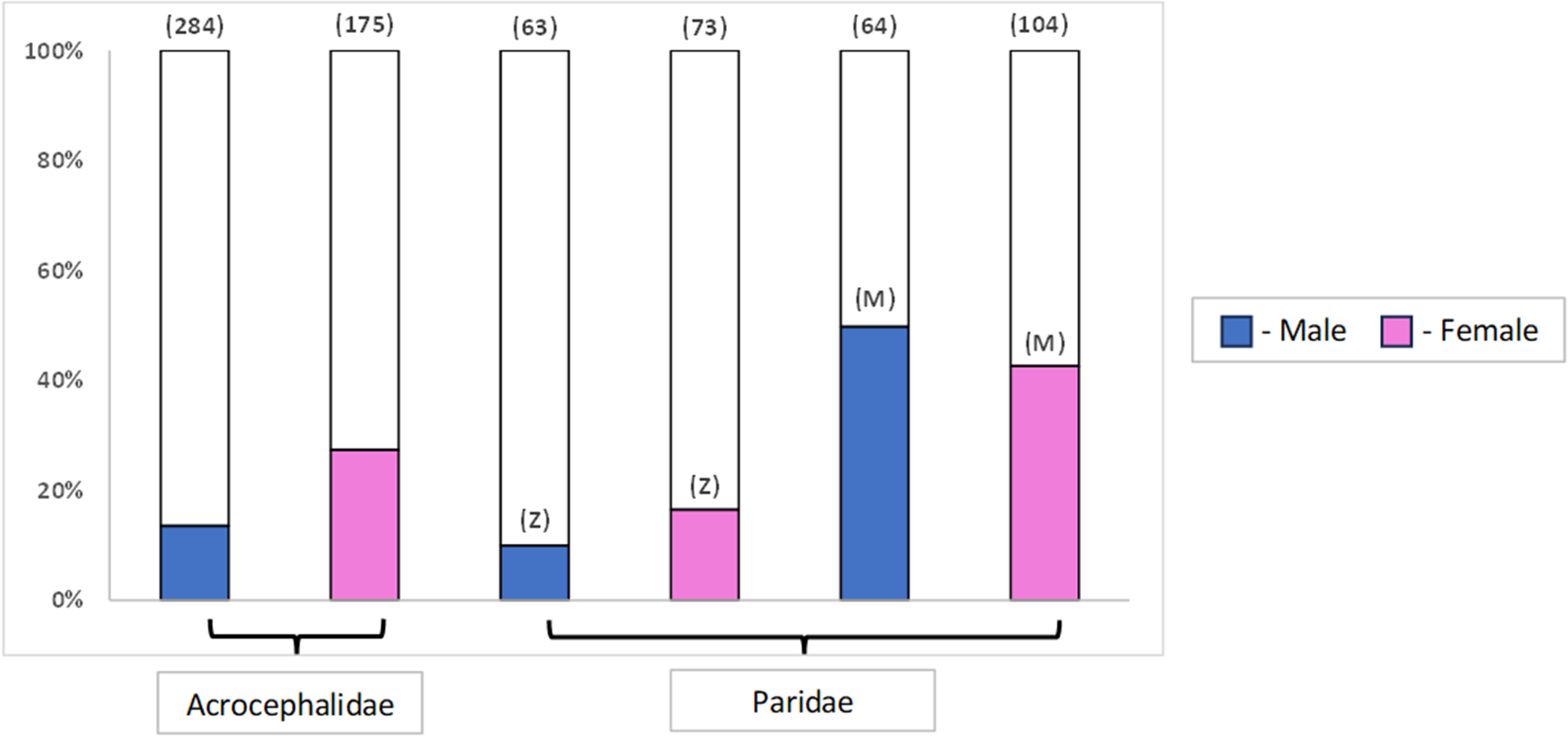
The presence of Lankesterella was tested in 1032 individuals caught between 2014 and 2022. This includes 459 adults (284 males and 175 females) and 128 yearlings of Acrocephalus spp., and 304 adults (127 males and 177 females) and 141 yearlings of Parus s. l. spp. (Parus, Cyanistes, and Poecile). The prevalences of Lankesterella in individual host species, as well as prevalences according to age, sex and site, are given in Table 1. Overall, 6% (62/1032) of the samples were barcoded as Isospora; these samples were treated as Lankesterella-negative. Unresolved sequences were excluded from the analysis.
Lankesterella prevalences in model passerine species, categorized by host species, site, age and sex. Numbers in parentheses indicate infected individuals and the total number of individuals tested
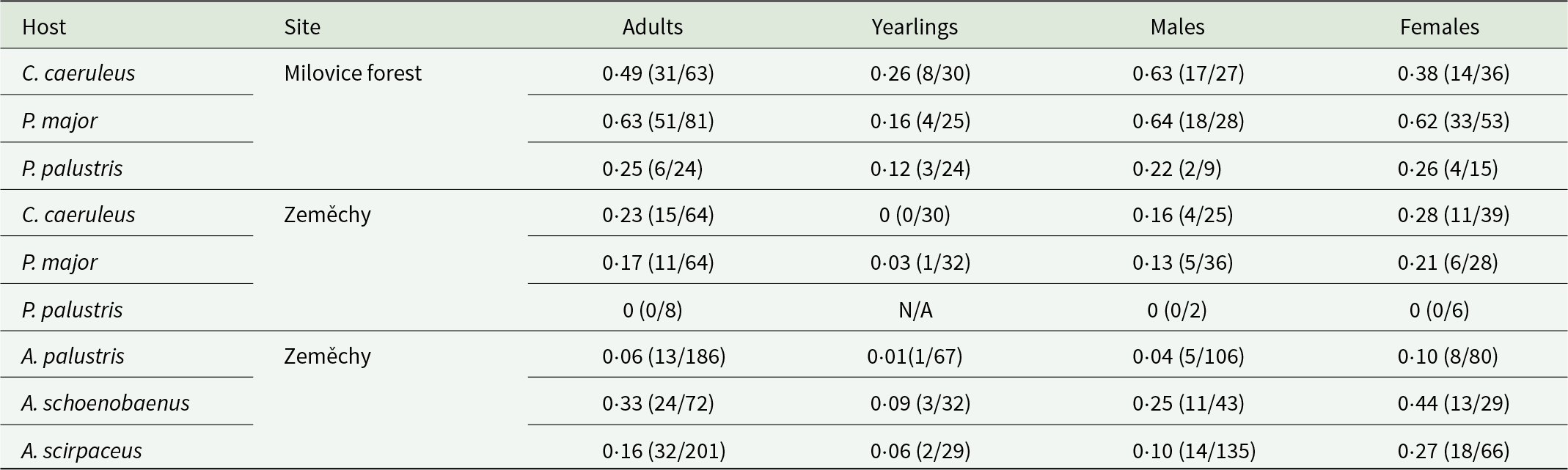
Overall, prevalence in adults was consistently higher than in yearlings in both the respective species or family and site combinations (Table 1; Figure 1). Specifically, the highest prevalence of Lankesterella in adults was found in great tits (63%) followed by blue tits (49%), both in Milovice forest. Among warblers, the prevalence of Lankesterella in adults was the highest in sedge warblers (33%, see supplementary figures (i, ii) for detailed graphs on the species level). As for sex, the prevalences between males and females differed as well. In Zeměchy, female birds from both tested families had a higher prevalence of Lankesterella infections than males, whereas in Milovice forest, the trend was opposite in Paridae (Figure 2), primarily due to the Blue Tit Cyanistes caeruleus (Table 1; see supplementary figures (iii, iv) for detailed graphs on the species level).
Lankesterella prevalences of adults and juvenile individuals in the Acrocephalidae family (A. schoenobaenus, A. palustris and A. scirpaceus) and the Paridae family (C. caeruleus, P. major and P. palustris) from Zeměchy (Z) and Milovice forest (M), respectively. Number of individuals is shown above the columns.
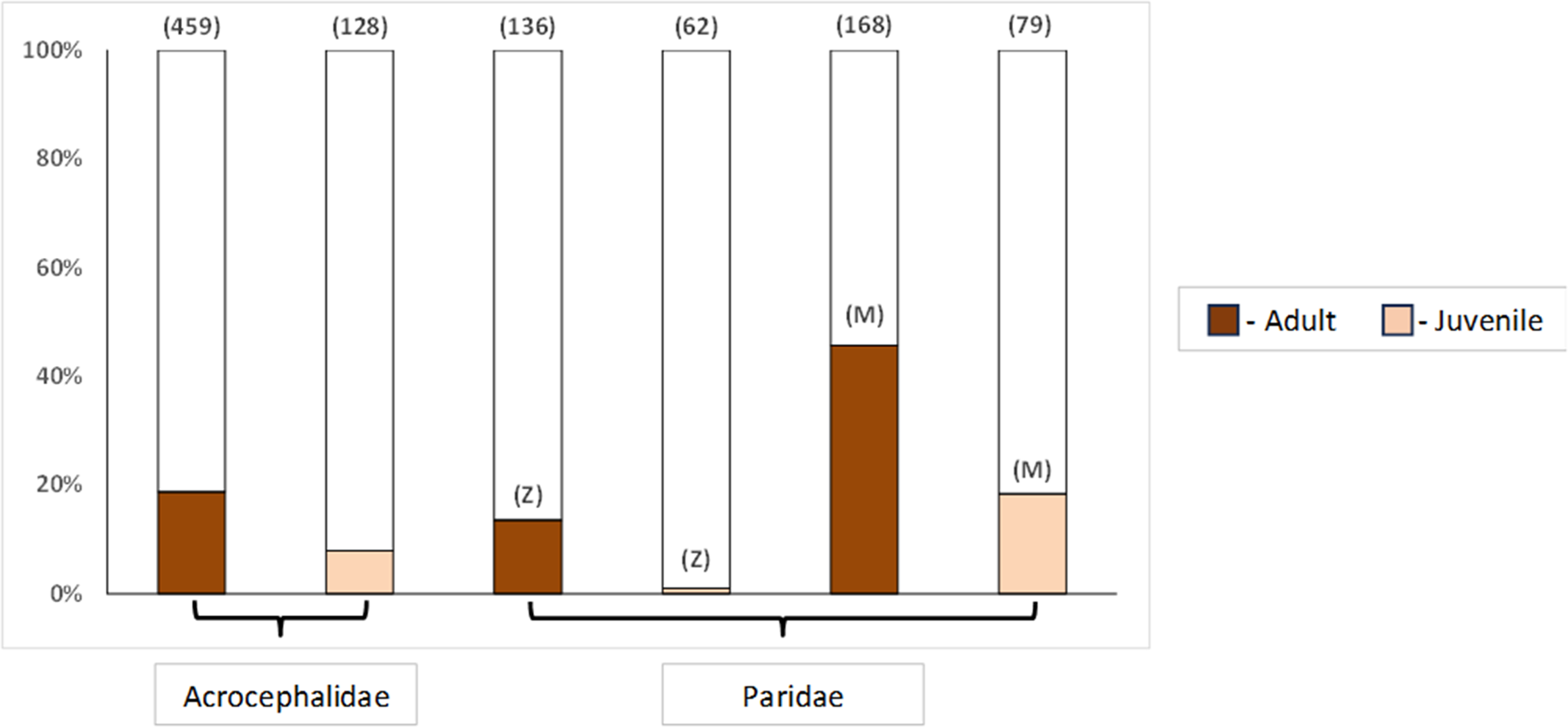
Lankesterella prevalences of male and female individuals in the Acrocephalidae family (A. schoenobaenus, A. palustris and A. scirpaceus) and the Paridae family (C. caeruleus, P. major and P. palustris) from Zeměchy (Z) and Milovice forest (M), respectively. Number of individuals is shown above the columns.
The effect of host site, age, family, Julian date and the interaction of host age and family on Lankesterella infections
We tested the effect of age (adults vs yearlings) in all species and sites (Table 2). Species were merged as families (Acrocephalidae and Paridae) to make the dataset more robust. The model showed that birds from Milovice forest had a higher prevalence compared to Zeměchy (p < 0·001) and adults had a higher prevalence compared to yearlings (Table 1; Figure 1). No significant effect of Julian date was observed. As for the interaction of age and family, adults of the family Paridae are more likely to be infected (Table 2, Figure 1).
The effect of age (adults vs yearlings), site (Zeměchy vs Milovice forest), family, Julian date, and the interaction of age and family on Lankesterella infections in passerine hosts (* indicates statistical significance)

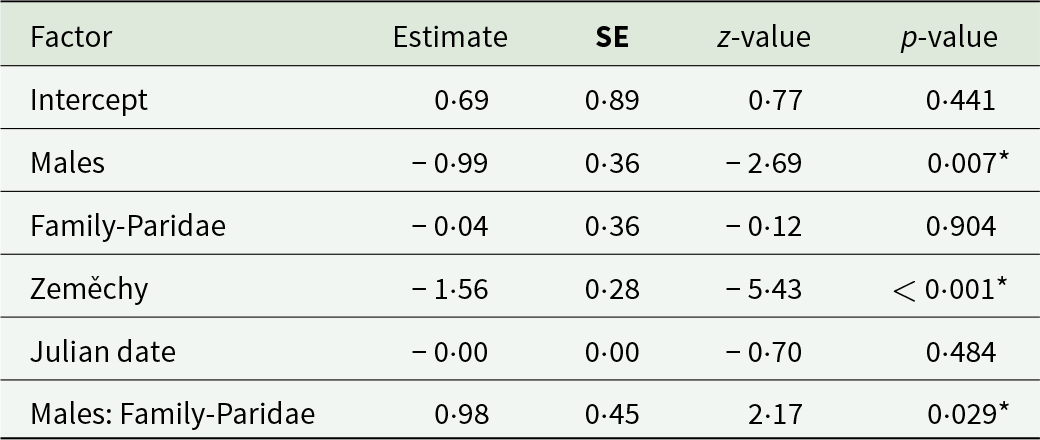
The effect of host site, sex, family, Julian date and the interaction of host sex and family on Lankesterella infections
We tested the effect of host sex (males vs females) and the interaction of sex with family on a subset of adult birds across all genera and sites (Table 3). Birds from Milovice forest have higher prevalences (p < 0·001). Beyond the effects detected by the previous model, the effect of sex in females as an individual level factor was significant in most species (p = 0·007). As for the interaction of host sex and family, we see that males of the family Paridae are more likely to be infected (Table 3, Figure 2).
The effect of sex (males vs females), site (Zeměchy vs Milovice forest), family, Julian date, and the interaction of sex and family on Lankesterella infections in Parus s. l. spp. (* indicates statistical significance)
Discussion
In our study, Lankesterella parasites were readily found in the blood of the studied host populations, but with high variation between tested categories in prevalences. The occurrence of Lankesterella in host blood can considerably differ depending on the host species. At the host family level, Paridae were more infected with Lankesterella than Acrocephalidae, but there were also differences between the species within families. Adult individuals of great tit and blue tit populations in 1 of 2 studied localities had very high prevalences of Lankesterella (63% and 49%, respectively; see Table 1) compared to the third related species (P. palustris), which had surprisingly the lowest prevalence; no other data are available for great tit but the prevalence in Spanish blue tits was 31% (Merino et al., Reference Merino, Martínez, Martínez-de la Puente, Criado-Fornelio, Tomás, Morales and García-Fraile2006). Sedge warbler had the highest prevalence among the adults of Acrocephalus spp. (33%) (Table 1). High prevalence was detected in sedge warbler in other studies as well, reaching 47% in adult birds in Poland, and 33% in Lithuania (Biedrzycka et al., Reference Biedrzycka, Kloch, Migalska and Bielański2013; Chagas et al., Reference Chagas, Harl, Preikša, Bukauskaitė, Ilgūnas, Weissenböck and Valkiūnas2021a). Blood parasite prevalence therefore considerably varies depending on the host species, even in birds that occur at the same sites and have similar exposure to potential vectors.
Host–parasite relationships are influenced by multiple factors (Ellis et al., Reference Ellis, Huang, Westerdahl, Jönsson, Hasselquist, Neto, Nilsson, Nilsson, Hegemann, Hellgren and Bensch2020); since there is a considerable degree of Lankesterella host specificity at the genus level (Venkatachalam et al., Reference Venkatachalam, Čepička, Hrazdilová and Svobodová2023), it is hard to separate the influence of host and parasite life history traits. The most significant factor influencing prevalence in this study was the sampling site, followed by host age and sex to some degree. However, the influences of these factors should be interpreted with caution, as age and sex had to be analysed in separate models. This was since, although yearlings can be sexed by genotype, sex differences are not yet phenotypically pronounced. An interesting pattern was revealed among the studied warbler species; sedge warblers host lineages which are species-specific while other warbler species share a different set of lineages (Chagas et al., Reference Chagas, Harl, Preikša, Bukauskaitė, Ilgūnas, Weissenböck and Valkiūnas2021a; Venkatachalam et al., Reference Venkatachalam, Čepička, Hrazdilová and Svobodová2023). Sedge warbler lineages have the highest prevalence (33%) among warbler species when assessed at the host species level, while prevalence across all Acrocephalus spp. is higher for the generalist lineages (10% vs 5% overall prevalences) (Chagas et al., Reference Chagas, Harl, Preikša, Bukauskaitė, Ilgūnas, Weissenböck and Valkiūnas2021a). The specialist parasite thus reaches higher prevalence in its specific host while the generalist can profit from higher host availability (see Drovetski et al., Reference Drovetski, Aghayan, Mata, Lopes, Mode, Harvey and Voelker2014).
There was a significant difference in prevalences of Lankesterella parasites based on the sampling sites (Tables 1–3); Milovice forest had an overall higher prevalence of Lankesterella in the respective host species. Previous studies on avian haemosporidian parasites showed that location/sampling site is an important factor influencing prevalences (Fecchio et al., Reference Fecchio, Clark, Bell, Skeen, Lutz, De La Torre, Vaughan, Tkach, Schunck, Ferreira, Braga, Lugarini, Wamiti, Dispoto, Galen, Kirchgatter, Sagario, Cueto, González-Acuña and Wells2021; Grieves et al., Reference Grieves, Balogh, Kelly and MacDougall-Shackleton2023; Yusupova et al., Reference Yusupova, Schumm, Sokolov and Quillfeldt2023). A recent comprehensive study focusing on Lankesterella revealed the highest prevalence in sedge warbler among our model species, while prevalences in tits were negligible; however, samples were collected across multiple European localities, parasites were detected in multiple tissues, and the age of the birds was not specified (Keckeisen et al., Reference Keckeisen, Šujanová, Himmel, Matt, Nedorost, Chagas, Weissenböck and Harl2024), making the comparison with our data difficult. The effects of habitat and breeding habits are not mutually exclusive; since the vectors of avian Lankesterella are not known, we can only speculate about the potential impact on transmission.
Age has a significant effect on Lankesterella infection status, with adult individuals consistently more infected than yearlings (Table 2; Figure 1). The positive correlation of host age and parasite prevalence was found in several host–parasite associations (Norris et al., Reference Norris, Anwar and Read1994; Svobodová et al., Reference Svobodová, Weidinger, Peške, Volf, Votýpka and Voříšek2015). Older individuals tend to have a higher risk of parasite infection due to cumulative exposure or potential immunosenescence (Wood et al., Reference Wood, Cosgrove, Wilkin, Knowles, Day and Sheldon2007; Knowles et al., Reference Knowles, Wood, Alves, Wilkin, Bensch and Sheldon2011; Synek et al., Reference Synek, Popelková, Koubínová, Šťastný, Langrová, Votýpka and Munclinger2016; Eastwood et al., Reference Eastwood, Peacock, Hall, Roast, Murphy, da Silva and Peters2019). Although yearlings had lower prevalences in our study, the presence of Lankesterella confirms ongoing on-site transmission. The higher prevalences in adults as a consequence of parasite persistence might explain an apparent discrepancy in prevalences: adult blue tits in 2 Spanish studies had prevalences of 31% and 9%, respectively; however, only after-hatch year birds were sampled in the latter study (Merino et al., Reference Merino, Martínez, Martínez-de la Puente, Criado-Fornelio, Tomás, Morales and García-Fraile2006; Castaño‐Vázquez and Merino, Reference Castaño‐Vázquez and Merino2022).
Sex influenced the prevalence of Lankesterella parasites. The model indicated that females were significantly more likely to be infected with Lankesterella in the majority of cases (Table 3; Figure 2). Sex is usually an important intrinsic factor associated with increased susceptibility to parasite infections (McCurdy et al., Reference McCurdy, Shutler, Mullie and Forbes1998). In various genera of lizards, the occurrence of Lankesterella was higher in females as well (Drechsler et al., Reference Drechsler, Belliure and Megía-Palma2021) (but see the exception of the Western fence lizard (Sceloporus occidentalis) where males were more infected) (Megía-Palma et al., Reference Megía-Palma, Paranjpe, Reguera, Martínez, Cooper, Blaimont, Merino and Sinervo2018). In the case of haemosporidian infections in birds, several studies have found significant influence of host sex based on the parasite species found in the host (Rodriguez et al., Reference Rodriguez, Doherty, Piaggio and Huyvaert2021; Grieves et al., Reference Grieves, Balogh, Kelly and MacDougall-Shackleton2023; Yusupova et al., Reference Yusupova, Schumm, Sokolov and Quillfeldt2023). The prevalence of 3 blood parasite genera was higher in female Eurasian sparrowhawk (Accipiter nisus) supposedly due to higher exposure at nest, either during breeding or already at the nestling stage (Svobodová et al., Reference Svobodová, Čepička, Zídková, Kassahun, Votýpka, Peške, Hrazdilová, Brzoňová, Voříšek and Weidinger2023). Differences like nesting behaviour among the different hosts can lead to different levels of Lankesterella prevalences. Differential exposure of vectors can arise from unequal time spent at the nest during egg incubation and nestling care (Zuk and McKean, Reference Zuk and McKean1996).
No effect of Julian date on Lankesterella prevalences was observed in our study. Although adults may exhibit chronic infections, juvenile prevalence is expected to increase in the course of the season. To exclude the effect of chronicity on parasite infections, we tested the effect of Julian date with juveniles only, and no significant effect was observed (data not shown). The absence of the Julian date effect can thus be caused by a short sampling period confined to the breeding season. Alternatively, transmission can occur mainly at the nestling stage. The prevalence of haemosporidia in nestlings of 2 species of raptors significantly increased with Julian date (Svobodová et al., Reference Svobodová, Weidinger, Peške, Volf, Votýpka and Voříšek2015). There are not many studies that have Julian date as a factor influencing haemosporidian prevalences. However, many studies showed that prevalence of avian haemosporidians increases over the breeding season (Ventim et al., Reference Ventim, Tenreiro, Grade, Encarnaçao, Araújo, Mendes and Ramos2012; Grieves et al., Reference Grieves, Balogh, Kelly and MacDougall-Shackleton2023). This can be due to vector availability and reduced host immunocompetence due to reproduction stress and energy investment (Schultz et al., Reference Schultz, Underhill, Earlé and Underhill2010; Ventim et al., Reference Ventim, Tenreiro, Grade, Encarnaçao, Araújo, Mendes and Ramos2012). A longer sampling period extended to non-breeding season might reveal the effect of Julian date on Lankesterella prevalences in passerine hosts; however, since Czech populations of warblers begin migration already in the second half of July, and yearling tits disperse (Cepák et al., Reference Cepák, Klvaña, Škopek, Schropfer, Jelínek, Hořák, Formánek and Zárybnický2008), this applies rather to the strictly resident species than to our model hosts.
Conclusion
We found substantial variation in Lankesterella parasite prevalence between the 2 families and among 6 model species of these passerine families. From the statistical models, we found that the most important factor influencing Lankesterella prevalence in the hosts was the sampling site, followed by host age and sex. Adult individuals have higher prevalences, probably due to parasite persistence. Moreover, females tend to have a higher prevalence of infection, which may be due to greater exposure to vectors during incubation. No effect of Julian date was revealed. The presence of Lankesterella in yearlings confirms on-site transmission. This study highlights the importance of the various ecological factors shaping avian Lankesterella parasite prevalences; in particular, the most important effect of sampling site warns against uncritical merging of data derived from multiple host populations when assessing prevalence.
Supplementary material
The supplementary material for this article can be found at https://doi.org/10.1017/S0031182025000095.
Data availability statement
Data used for statistical analysis available on request.
Acknowledgements
We would like to thank the ringers František Novák, Oldřich Myška, and all the others for help with bird trapping during CES, and Barbora Chalupová, Lada Janíčková and Lenka Geržová for their help with sample collection in Milovice forest.
Author contributions
AKSBV and MS1 designed the study. AKSBV, AK1, MKF, AK2, JB and MS1 collected samples during field work. AKSBV, AK1, MKF, AK2 and MS1 performed DNA isolations and PCR. AKSBV and MS1 prepared dataset for statistical analysis. AKSBV and MS2 performed the statistical analysis. AKSBV, MS1 and MS2 drafted and revised the manuscript. All authors read and approved the final version of the manuscript.
(Anna Kadlecováa (1), Anna Kapustováa (2), Milena Svobodováa (1) and Miroslav Šálekb (2))
Financial support
This research was funded by Grant Agency of Charles University (GAUK), project number 40224.
Competing interests
The authors declare there are no conflicts of interest.
Ethical standards
Blood sampling was carried out under permits 50982/ENV/14-2961/630/14 and MZP/2019/630/1081 of the Ministry of the Environment.


 Open access

