




1. Introduction: questions and hypotheses
In his 1802 book on insurance, the London Serjeant-at-Law Samuel Marshall made a succinct distinction between bottomry and respondentia: “The one is a loan upon the ship, the other upon the goods.” However, both shared one outstanding characteristic: the debt was repaid to the lender “with the marine interest” only upon the ship’s safe arrival (Marshall, Reference Marshall1802, II, p. 633). In other words, the debt was forgiven if the vessel was lost at sea or captured, which meant the loan also provided insurance to the borrower. Marshall argued that these contracts were of great utility in countries where merchants had insufficient capital to carry on their foreign trade. “Thus is formed a partnership between the lender and the borrower … [t]he one takes upon himself the perils of the sea, and the other compensates him by a share of the profits of the adventure,” he explained. Nevertheless, as he was quick to point out, it was not a partnership: “Except in this respect, this contract has no resemblance to a regular partnership, having in it no community of capital, no community of loss” (Marshall, Reference Marshall1802, II, p. 738).
At the time when Marshall’s book was published, the borrowing of money on bottomry and respondentia, jointly known as sea or maritime loans, was not a common practice in Britain.Footnote 1 In the eighteenth century, the Admiralty judges had adopted a doctrine that considered a sea loan valid only when the master had borrowed in an emergency for the needs of the ship abroad, thus discouraging the broader use of this type of credit (Steckley, Reference Steckley2001, p. 260). The contrast with Spain, particularly its colonial trade, could not be starker. The sea loan was enormously popular in Cadiz, the official gateway to trade with Spanish America for most of the eighteenth century. Between 1760 and 1785, in what may be considered the heyday of this credit instrument, the 25 Cadiz notary offices registered 28,333 deeds for transatlantic trade (1,089 loans a year). The borrowers had undertaken to pay back 152,188,026 pesos fuertes (Bernal, Reference Bernal1992, pp. 386–387), equivalent to approximately 3,750 metric tons of silver. After 1785, however, the sea loan fell into decline. This article explains the success of this credit instrument in the Spanish Atlantic and then its demise.
Why was the sea loan so successful before 1785? Historians have provided reasons that confuse more than clarify.Footnote 2 There is a consensus around platitudes such as the sea loan’s suitability for the Spanish colonial trade because it combined credit and insurance in a single instrument, thus producing higher returns (Bernal, Reference Bernal1992, pp. 174–182; Bustos Rodríguez, Reference Bustos Rodríguez2005, pp. 404–405; García-Baquero, Reference García-Baquero1989, p. 137; Guimerá Ravina, Reference Guimerá Ravina1985, pp. 365–372; Herrero Gil, Reference Herrero Gil2013, pp. 430–432; Le Gouic, Reference Le Gouic2011, p. 300; Pérez Herrero, Reference Pérez Herrero1988, p. 84). Most historians implicitly assume that the marine interest (premio de mar) accounted for the standard commercial rate (the so-called premio de tierra or land interest, which was 6 to 8 per cent a year in the second half of the eighteenth century) and the insurance premium for a specific destination.Footnote 3 True, the comparison between land and marine interest poses an obvious problem: unlike land interest, marine interest was not a percentage of a given time period. As explained in Section 5, it was also influenced by other factors. However, it is safe to say that time was one element merchants had in mind when they loaned or borrowed a riesgo de mar (“at sea risk”), which makes the two interest types comparable. Did the marine interest approximately correspond to the sum of the insurance premium and land interest? This rather obvious question has never been asked, which is surprising considering that there are numerous examples showing that the marine interest was significantly higher. For instance, in January 1767, Benito de Viñas y Freire set off for Buenos Aires as the captain of the San Fernando y San Joseph. He had borrowed 48 respondentias from 46 individuals and firms, with the total debt amounting to a staggering 353,763 pesos fuertes (equivalent to 8.77 silver tons).Footnote 4 I have found that the interest on nine of those loans ranged from 28 to 35 per cent.Footnote 5 If things went well, the navigation would take three to four months, and the repayment periods after arrival ranged from two to twelve months. At that time, the Cadiz insurance premium for the same destination was 5.25 per cent.Footnote 6 Adding the land interest to the insurance premium gives a total of 11.25 per cent a year. The difference between this and the marine interest was therefore very significant.
Why did Captain Viñas not borrow at land interest and buy insurance, instead of burdening himself with such expensive loans? For two reasons: firstly, because no one would lend to him at land interest, and secondly, because he expected the profits to exceed the marine-interest payments. In fact, the relationship between marine interest rates and profit margins is key to understanding the instrument’s popularity. According to a Cadiz lawyer writing in 1763, the sea loan essentially combined three different contracts into one: a loan, a marine insurance policy, and “a kind of sale by which the lender sells the debtor the uncertain portion of the profit for a specific price, which he offers as a capital interest at a particular percentage rate” (Herrero Gil, Reference Herrero Gil2013, p. 347). Historiography has concentrated on the first two, leaving the third unaddressed. This is understandable since the deed did not explicitly state the third contract. However, it was the third element that cut to the essence of the sea loan.
Relatively high marine interest rates were typical in the Spanish Atlantic in the middle decades of the eighteenth century. Indeed, historians consider it an expensive type of credit (Carrière, Reference Carrière1970, p. 244; Lespagnol, Reference Lespagnol2011, p. 563). However, the Spanish colonial trade was its natural home because, as explained in Section 2, it was designed to afford significant profit margins. Lending at 6 to 8 per cent a year to someone who could potentially make a much larger profit in a regulated, license-based colonial trade must have seemed ludicrous. The problem was that until the beginning of the nineteenth century, canon and civil law condemned lending at rates higher than 6 per cent as usury (Quirós, Reference Quirós1986 [1810], pp. 153–154). Alternatively, investors could put their money into multiple forms and durations of private partnerships and receive a larger slice of the profits. However, a partnership entailed both losses and profits. The sea loan bridged the gap between lending at the legal rate and the partnership, because the lender’s sea risk-bearing made it permissible to charge interest rates far above the legal cap (Martínez López-Cano, Reference Martínez López-Cano2019, p. 16). Moreover, it allowed the lender to reap greater returns while remaining contractually immune to lower-than-expected profits or possible losses.
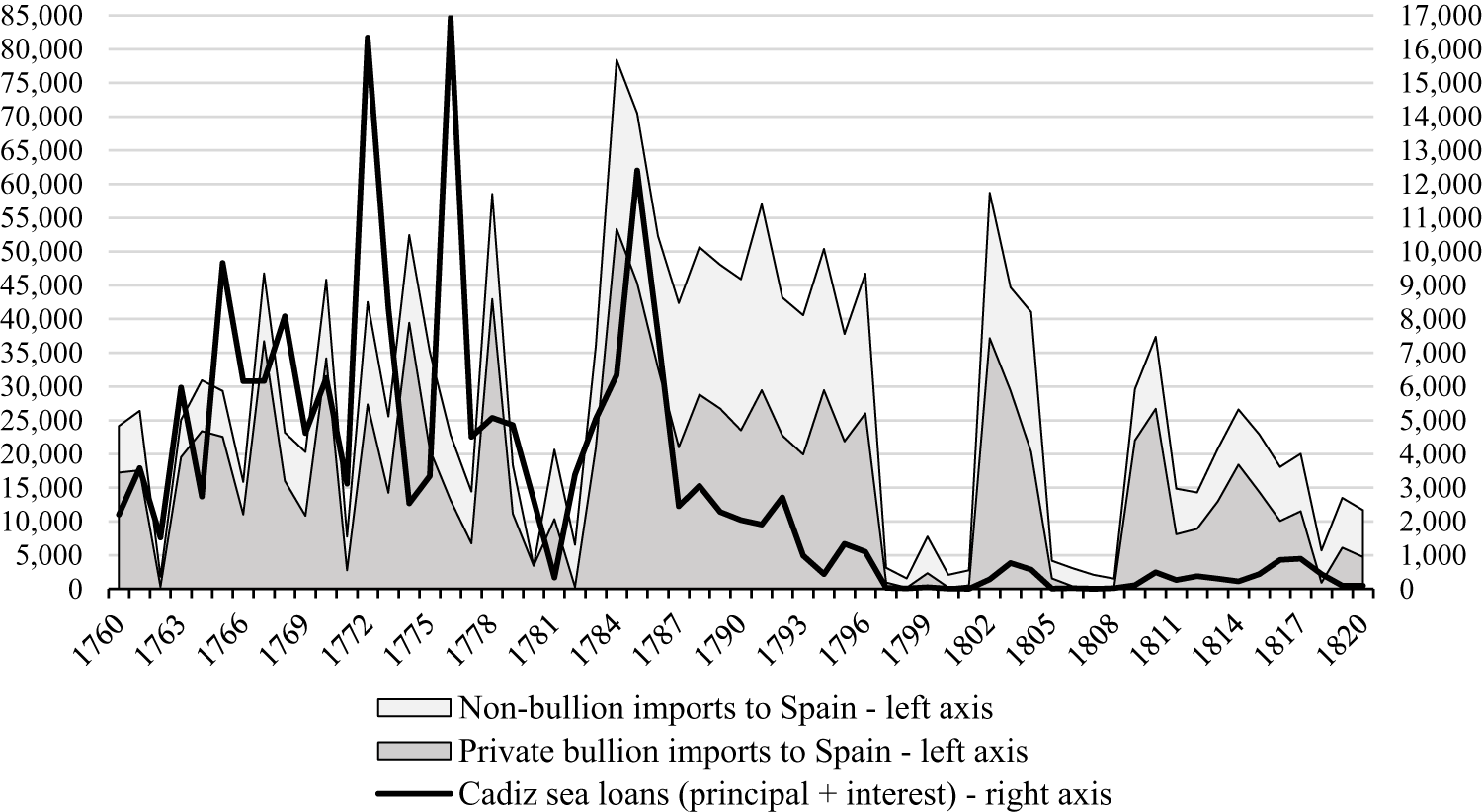
Crucially, the Spanish colonial trade offers a unique opportunity to quantify and evaluate the use of sea loans in conjunction with overall trade. Elsewhere, aggregate quantitative data is hardly provided at all (Costa, Reference Costa and Cavaciocchi2006; Lespagnol, Reference Lespagnol2011; Lo Basso, Reference Lo Basso and Giuffrida2016; Steckley, Reference Steckley2001; Zanini, Reference Zanini, Fusaro, Addobbati and Piccinno2023). Most of the sea-loan contracts that financed Spain’s transatlantic exchanges in the eighteenth century are held in the Archivo Histórico Provincial de Cádiz, but constitute an unfathomable ocean of documents. Luckily, in 1760, the Spanish king ordered all 25 Cadiz notary offices to submit a summary of every sea loan they registered to the Consulado or mercantile court. These summaries allow us to observe the evolution of sea loans from 1760 to 1825.Footnote 7 Figure 1 shows the value of private bullion and non-bullion imports (stacked on top of each other) to Spain and the sea loans registered in Cadiz throughout that period. As discussed in Section 2, the Spanish colonial trade system experienced a profound transformation in 1778: the fleet system was abolished, the license system for single ships became a formality, and 13 Iberian ports were permitted to trade with Spanish America. These measures, known as comercio libre or free trade, were effectively implemented after the war with Britain ended in 1783. Initially, sea loans followed the boom in comercio libre. However, their use declined steeply after 1785, despite the expansion of trade. And it was not because Cadiz lost prominence; it retained about 80 per cent of Spain’s transatlantic exchanges from 1783 to the 1797 British blockade (Fisher, Reference Fisher1985, p. 64). By the time Spain’s transatlantic trade recovered briefly during the Peace of Amiens (1802–1803), the sea loan was only a shadow of its former self.
Private bullion and non-bullion imports to Spain and total value of sea loans registered in Cadiz, 1760–1820 (000 pesos sencillos; non bullion imports in 1778 prices).

Why did the sea loan decline after 1785? Did the instrument cease to be suitable for the Spanish Atlantic? Rather surprisingly, these questions have received relatively little attention. For Carrière (Reference Carrière1970) and Bernal (Reference Bernal1992), the widespread use of sea loans embodied Spaniards’ dependence on foreign capital and goods. Bernal (Reference Bernal1992, p. 389) argues that the system of financing colonial trade and the origin of capital underwent an important transformation between 1778 and 1797: as foreign participation shrank, the Cadiz merchant community’s capital investments increased. As a result, the sea loan went out of fashion and was replaced by credit instruments bearing the standard commercial rate (Bernal, Reference Bernal1992, p. 425). Bustos Rodríguez (Reference Bustos Rodríguez2005, p. 433) and Ravina Martín (Reference Ravina Martín1980, p. 144) share a view similar to Bernal’s. However, this is a rather simplistic explanation for three reasons. Firstly, it does not explain the origin of the Spaniards’ newly found capital. Secondly, it assumes that the Spaniards were content to charge the standard commercial rate instead of the marine interest. And thirdly, it overlooks the fact that Spaniards were important lenders in Cadiz before 1778. Furthermore, Spanish Americans were the creditors of about 25 per cent of the Cadiz sea loans by the 1770s (Lamikiz, Reference Lamikiz2023, p. 19).
Baskes (Reference Baskes2013) proposes a more compelling explanation for the sea loan’s downturn, pointing out that it coincided with the rise of the Cadiz insurance industry. In his opinion, “sea loans became increasingly uncommon because merchants instead chose to buy maritime insurance and obtain their credit elsewhere” (Baskes, Reference Baskes2013, p. 182). He claims that an insurance company could sustain the loss of a ship and its cargo more readily than sea-loan lenders could, because an insurance company dispersed the sea risk among many shareholders while sea loans were extended from one individual to another. Hence the ascendancy of the Cadiz insurance industry. But why did it become ascendant in the mid-1780s and not before? Because of the increasing competition and market risk brought about by the free-trade measures. As a result, “many of the financiers who had been deeply involved in the business of extending sea loans shifted into the insurance underwriting business” (Baskes, Reference Baskes2013, p. 185). However, Baskes’s explanation of the decoupling of credit and insurance ignores two crucial facts. Firstly, marine insurance and the sea loan were not mutually exclusive. As explained in Section 4, they coexisted before the 1780s, when buying insurance for the loan principal had been a customary practice among lenders. Secondly, lenders often divided sea loans into smaller participations, thus spreading the risk among many investors. For instance, the Gilly brothers, a French house established in Cadiz, loaned 254 respondentias and bottomries (using Spanish frontmen and women), worth more than four million pesos, between 1748 and 1767. They divided the 254 loans into 3,688 participations that were then sold to their European correspondents (Chamboredon, Reference Chamboredon1995, pp. 352–360). Unfortunately, no data are available to establish how widespread the practice of dividing loans into smaller participations was, but it was clearly an available option.
If the above explanations are not convincing, then what is? Given the scarce evidence available on critical matters such as interest rates and the factors that affect them, I propose a hypothesis to explain the trajectory of the sea loan in the Spanish Atlantic—a hypothesis I have attempted to test in this article, but for which much more research is needed. Explaining why the instrument succeeded and then declined is essential for understanding not only the Spanish colonial trade but also for gaining insights into the conditions favouring the use of sea loans elsewhere. With this in mind, I focus on the factors that contributed to setting the marine interest and the evolution of the rates in different trading routes before and after 1778. I suggest that the low capitalization of many merchants and the fact that a regulated, predictable trade gave rise to expectations of significant profits were the primary factors in setting the relatively high price of sea loans. However, progressive mild deregulation and trade expansion in the three decades before 1778 brought rates down gradually. The implementation of the free-trade regulations in the 1780s expanded trade and decreased interest rates even further, to the point where the marine interest equalled the sum of the insurance premium and land interest. Lenders saw no added benefit to lending a riesgo de mar, so they began to lend at land interest and invest in insurance companies instead.
On the face of it, therefore, the evolution of marine interest rates is baffling: as market risk and uncertainty increased, the price of credit shrank. This is not how financial markets are supposed to function. How could interest rates be higher when the risk of default was lower, yet lower when trade became riskier in the 1780s? It is by understanding that expectations of profit margins played a big part in setting marine interest rates that we can make sense of the otherwise counterintuitive evolution of rates.Footnote 8
Unveiling the reasons merchants resorted to sea loans, and the intricate factors on which decisions would have been based, poses a significant archival challenge for the economic historian. The scarcity of private records and the huge quantity of official documents held in the Spanish and Latin American archives create an imbalance I have tried to overcome by using material found here and there in several archives over the years. Merchant correspondence and accounts are the most important primary sources that help to examine the ins and outs of business and financial practices in the Spanish Atlantic. I have found letters and accounts in court cases and bankruptcy proceedings held in the Archivo Histórico Nacional (Madrid), Archivo General de Indias (Seville) and Archivo General de la Nación (Mexico City), and, notably, in the large amount of mail that the British Navy intercepted from Spanish ships during the eighteenth-century wars, which is held at the High Court of Admiralty archive in the National Archives (London). I have also employed loan contracts (originals and summaries) from the Archivo Histórico Provincial de Cádiz and Archivo General de Indias. Additional repositories include the British Library (London) and the John Carter Brown Library (Providence, RI).
Besides the introduction, this article is divided into five sections, followed by conclusions. Section 2 lays out the main features and transformations of the Spanish colonial trade system until the early nineteenth century, which serve to contextualize the discussion. Section 3 analyzes the characteristics of the sea-loan deeds registered in Cadiz. Section 4 describes the sea-loan market and its participants. Section 5 examines the main factors affecting marine interest rates and the relationship between rates, the profit margins on sales, and capital availability. In Section 6 I hypothesize the reasons behind the steep decline of the sea loan after 1785.
2. The Spanish colonial trade system
In The Wealth of Nations, Adam Smith explains the economic rationale of the Spanish colonial trade system. Although Spain had never organized the bulk of its colonial trade based on an exclusive company, it had nevertheless confined the transatlantic exchanges to a particular Spanish port “from whence no ship was allowed to sail, but either in a fleet and at a particular season, or, if single, in consequence of a particular license, which in most cases was very well paid for” (Smith, Reference Smith1776, II, p. 171). Because the fleet system encouraged merchants to act in concert, Smith concluded that “the trade which was carried on in this manner would necessarily be conducted very nearly upon the same principles as that of an exclusive company. The profit of those merchants would be almost equally exorbitant and oppressive” (Smith, Reference Smith1776, II, pp. 171–172). Smith used the past tense because partial reform had been introduced in the Spanish Atlantic in 1765, though he did not elaborate. If the sea loan’s popularity was, as I suggest, intimately linked to the potential profit margins afforded by the colonial trade under its traditional arrangement, then a closer look at the commercial system is warranted.
At the risk of oversimplifying, the Spanish system of colonial trade, known as Carrera de Indias, resulted from the need to connect Spain with the two silver-producing American regions: the viceroyalties of Peru and New Spain (modern Mexico). Until the mid-eighteenth century, bullion comprised roughly 80 per cent of the total value of colonial imports to Spain. Spanish exports to America were mainly foreign textile products, comprising more than 80 per cent of the value of exports before 1778 (Stein and Stein, Reference Stein and Stein2003, p. 126). From early in the sixteenth century, the Spanish monarchy left the organization of the transatlantic exchanges and the exploitation of the silver and gold mines to private initiative. At the same time, trade regulations and economic institutions were implemented to reduce market uncertainty in the transatlantic exchanges. They were all to converge in Cadiz by the early eighteenth century. From the outset, it was decided that all communications with America would be conducted from a port complex in western Andalusia. In 1680 Cadiz officially became the sole port of departure. Trade, navigation, and migration were supervised by the Casa de la Contratación (House of Trade), established in Seville in 1503 but transferred to Cadiz in 1717. Another critical, long-lasting economic institution was sanctioned in 1543 when the Spanish merchants of Seville involved in transatlantic trade, the so-called cargadores, were granted royal permission to create a consulado or merchant court. Its governing body was elected every two years, had jurisdiction over commercial disputes and defended the interests of the merchant community in negotiations with other institutions, including the monarchy. Unsurprisingly, it became a powerful lobby, defending the interests of transatlantic merchants and determining the frequency and volume of transoceanic exchanges. In 1717 the Consulado was relocated to Cadiz along with the House of Trade.
Implemented in the 1560s, another crucial economic institution that became a hallmark of Spain’s transatlantic trade was a system of two armed commercial fleets. One fleet was destined for Veracruz (the principal seaport of New Spain), the other for Tierra Firme (the northern coast of the South American mainland). Until 1739, these fleets carried the lion’s share of Spain’s transatlantic exchanges. They were scheduled to depart from western Andalusia every year, although in the eighteenth century they would do so with lapses of three, four, or more years. The Spaniards would trade with their Peruvian counterparts at a fair in the isthmus of Panama. From 1720 to 1776, the merchants travelling in the New Spain fleet, the so-called flotistas, were compelled to meet their Mexican counterparts at a fair in Jalapa, halfway between Veracruz and Mexico City (Stein and Stein, Reference Stein and Stein2000, pp. 8–19).
When it came to determining prices, the amount of silver brought to the fairs was as significant as the cargo transported by the fleets. As the Mexico Consulado explained to the viceroy of New Spain in December 1772, just four months after the New Spain fleet arrived at Veracruz, “no other causes make a fleet happy or unhappy than that its cargo is proportionate to the silver available in this kingdom”.Footnote 9 The practice of leaving longer interludes between fleets was intended partly to allow silver to accumulate in the colonies, which reduced its price and allowed Spanish merchants to maximize profits. There were only six Tierra Firme fleets from 1700 to 1739 (when the system was suspended, as will be explained below) and 12 New Spain fleets from 1700 to 1776 (with a two-decade hiatus between 1735 and 1757). This strategy was combined with limiting the size of the fleets. In the eighteenth century, each fleet comprised 10 to 20 ships, with a total carrying capacity of 3,600 to 8,500 tons, depending on what the Cadiz Consulado considered the appropriate volume to ensure healthy sales (García-Baquero, Reference García-Baquero1976, II, pp. 143–145; Stein and Stein, Reference Stein and Stein2003, p. 126).
Other means of transatlantic communication remained marginal until the 1740s. For navigation to regions outside the fleet system, such as Buenos Aires and Central America, the monarchy sold individual licenses to send navíos de registro, or single-register ships. Before 1700, they accounted for roughly 10 per cent of the total tonnage crossing the Spanish Atlantic. From 1715 to 1738, they became more relevant, accounting for 21 per cent (García-Baquero, Reference García-Baquero1976, I, p. 172). However, things took an unexpected turn in 1739, when a new war with Britain forced the Spanish monarchy to suspend the fleet system temporarily and rely entirely on single ships that would depart from Cadiz for any American destination, including the major ports of Veracruz and Lima (now directly reached sailing around Cape Horn). With this temporary halt to the time-consuming and expensive process of outfitting an entire fleet, transatlantic exchanges became more frequent and dynamic, though rationing licenses remained a fundamental tenet. No quantitative data are available, but according to numerous testimonies, trade and competition increased, and prices fell (Bernal, Reference Bernal1992, p. 367; Lamikiz, Reference Lamikiz2010, pp. 108–115). When the war ended in 1748, Madrid was tempted to make the new navigation system permanent, much to the dismay of merchants. Their bitter complaints, voiced on both sides of the Atlantic, reflect the increased uncertainty brought about by the single ships. Eventually, the monarchy gave in to these protests: it resumed the New Spain fleet in 1757, while register ships were permanently adopted in trade with Peru and other destinations such as Buenos Aires, the Caribbean and Central America. In February 1757, when the viceroy of New Spain announced that a new fleet was about to depart from Cadiz for Veracruz, he also pointed out that the king had decided to resume the old system “to free his vassals … from the increased bankruptcies and arrears to which the provisions of the register ships had given rise”.Footnote 10 Five more fleets would depart in 1760, 1765, 1768, 1772, and 1776, before the system was finally cancelled.
A significant step toward deregulation was taken in 1765 when nine peninsular ports were allowed to trade directly with the Spanish Caribbean islands. More importantly, in 1778, the comercio libre or free-trade regulations opened colonial trade to 13 peninsular and many more American ports. Due to the outbreak of a new war with Britain (1779–1783), free trade was only fully implemented in 1783. New Spain, the wealthiest American possession, was officially excluded until 1789, and the cargo it could receive from Spain was distributed among the enfranchised peninsular ports. However, Veracruz experienced de facto free trade because of this regulation’s inefficiency (Delgado Ribas, Reference Delgado Ribas2007, pp. 403–404; Fisher, Reference Fisher1985, pp. 14–15). The Carrera de Indias had never constituted a monopoly: hundreds of merchants competed with each other at any given time. However, comercio libre considerably increased the number of participants, the frequency of the exchanges, and the level of competition (Baskes, Reference Baskes2013, p. 53; Lamikiz, Reference Lamikiz2010, p. 117). Spanish exports to America surged dramatically, leading to an unprecedented market glut in the colonies in 1785–1787. In April 1786, a horrified Lima merchant warned his brother that 14 ships had arrived from Cadiz with goods worth 28 million pesos, when Peru’s annual exports hardly surpassed six million.Footnote 11
Despite losing its sole-port status, Cadiz retained 84 per cent of the Spanish American imports into Spain and 76 per cent of the Spanish exports to the colonies between 1783 and 1796 (Fisher, Reference Fisher1985, p. 64). Traditionally, non-bullion American commodities, such as cochineal, indigo, cacao, sugar, tobacco, logwood, and hides had comprised around 20 per cent of the annual value of colonial imports. As shown in Figure 1, they gradually gained importance after the mid-century. By the 1780s and 1790s, non-bullion products accounted for 43 per cent of the yearly value of imports, translating into a far larger volume of trade and many more ships crossing the Atlantic (Cuenca Esteban, Reference Cuenca-Esteban2008, p. 349).
The commercial expansion that followed 1783 was truncated by the 1797 British blockade of Cadiz, which marked the beginning of the 25-year decline of the Carrera de Indias. There was a brief recovery during the Peace of Amiens (1802–1803) to 1805, which was yet again put to rest by the British Navy. There was a partial reawakening of the transatlantic trade in the 1810s in the context of the Spanish-American wars of independence. However, this came to a final halt in the early 1820s as the new republics set themselves free from Spanish dominance.
3. The Cadiz sea loan
The wording of the deeds drawn up by the Cadiz notaries was thorough, describing in detail the risks, obligations and enforcement provisions. Contracts usually had around 1,200 to 1,600 words, depending on whether any conditions were included, such as a war clause. The borrower was the deed grantor (otorgante), and the fee for a deed was 30 reales vellón (or 2 pesos sencillos). First, in the case of respondentia loans, the borrower acknowledged that he owed the creditor (acreedor) an amount of money and that the creditor was running the risk (corriendo riesgo) on some numbered/marked bales, crates or trunks (which typically carried textile products, though contracts seldom mention them) aboard a specific ship bound for a specific Spanish American destination. If it was a bottomry loan, the shipowner or master (it could be both) acknowledged owing an amount of money to the lender, who was running the risk on the ship (usually the hull, keel, rigging and earnings of the vessel, though not necessarily all together) in its impending voyage to a Spanish American port. The lender bore the risk of the navigation “from the hour and moment” the ship set sail until it arrived at its destination “and therein cast its first anchor and twenty-four natural hours be elapsed.” The marine risk included “sea, wind, land, fire, friends, enemies and other unfortunate maritime events that may befall the vessel.” The loan covered the marine risk of either the outbound leg (known as “one risk”) or the round trip (“two risks”). As mentioned above, if the loss at sea was total, the restitution of the loan was waived. However, when the loss was partial, lender and borrower became “partakers and partners,” dividing and distributing the costs and charges “as a partnership account.” The repayment period could vary from a couple of weeks after the ship’s arrival to a few months. When the debt was to be redeemed in the colonies, which was usually the case, the contract named the debt collector.
Very often the purpose of the borrowed money was not explicitly stated in the contract. Nevertheless, it can be inferred that the money on respondentia had been employed to buy the goods on which the lender ran the risk, although it could also be a sale on credit, with no exchange of hard money involved. Likewise, the cash on bottomry was used to cover the expenses of outfitting the ship (repairs, wages, victuals, and supplies). These inferences are valid mainly because the goods and the vessel acted as collateral in each case: they were hypothecated to the lender until the debt was fully repaid. However, the borrower declared that if he did not pay back the debt on time and the hypothecated objects were insufficient to redeem it, his current or future property could be seized to secure repayment. The deed that every borrower signed made clear that he submitted “to the judges and justices of his Majesty, of whatever parts they may be, […] to compel me to comply with the aforesaid, as by a sentence passed in res judicata [judged matter].”Footnote 12 Occasionally, creditors requested the inclusion of a guarantor (fiador) in the contract, usually a Cadiz citizen.
These contract-enforcement provisions were designed to ensure the debtor’s compliance. However, there are other critical elements of the instrument that did not appear in deeds; instead, they are found only in merchants’ letters. Three such elements were the prospective debtors’ reputation (an ex-ante measure to ensure his competence and mitigate the risk of opportunistic behavior), the market value of the hypothecated goods compared to the debt (which could be another ex-ante measure if indeed the goods were worth more than the debt, as was customarily stated in the contract), and the orders the lender conveyed to the debt collector (an ex-post expedient to guide the debt collector in case of nonpayment).
The importance of debtors’ reputations has not gone unnoticed (Carrière, Reference Carrière1970, p. 237; Chamboredon, Reference Chamboredon1995, p. 396; Le Gouic, Reference Le Gouic2011, p. 302). Writing from Lima to his main Cadiz correspondent in May 1779, Luis Carrillo ordered his money to be loaned to two specific merchants because both were “totally dependable.”Footnote 13 Surprisingly, however, the other two elements have not received any attention. Were the goods on which the lender ran the risk worth more than the debt, as the formulaic wording of the deeds declares? And if so, how large was the difference between the two? Merchant letters demonstrate that this was a complex question, as it could serve as an added guarantee to the lender.Footnote 14 Notably, providing added guarantees did not reduce the marine interest charged.
Likewise, the lender’s orders to the debt collector still need to be explored. The loan deed gave the debt collector (who charged a 2 per cent commission for his services) full power to foreclose on the debtor if the repayment was not made in time. However, foreclosure was not always advisable. A competent, reliable debtor sometimes could not sell his goods due to a market glut. In these situations, the debt collector had to exercise his leeway judiciously. In Lima, José de Moya collected a debt of 6,516 pesos from two merchants for a Cadiz correspondent a year after the debt had been due in March 1779. Following the lender’s instructions, he charged the debtors an extra 6 per cent on the principal (at 0.5 per cent a month, the land interest).Footnote 15 Other lenders were less flexible with their loan terms. In 1767, Domingo de Basavilbaso, a wealthy Buenos Aires merchant, was commissioned to collect 16 of the 48 sea loans Captain Viñas had borrowed in Cadiz. Basalvilbaso received specific orders from each lender. None was willing to grant Viñas an extension, and only three wanted Basavilbaso to accept the goods as repayment after the debt maturity. More uncompromising, Blanca Manuela de Utrera asked the Buenos Aires merchant to allow “no further consideration.”Footnote 16
In the eighteenth century, contracts specified the silver coinage in which the loan had been given and the silver coinage in which the debt should be redeemed. The Spanish Monarchy adopted a double monetary system in 1686, one for Spain and another for the colonies, following a series of reforms initiated in 1680. These measures sought to end Castile’s several decades of vellón (copper coinage) inflation and stabilize its exchange rate to silver. The Crown hoped the vellón deflation would bring silver back into circulation in Castile, but it did not. Silver remained in hiding (as predicted by Gresham’s law) or left Spain to pay for European imports and the Crown’s military expenditure abroad. In a new attempt to solve this problem, the monarchy debased the silver coinage in Spain by 25 per cent in October 1686, bringing its value close to other European silver coinages (Santiago Fernández, Reference Santiago Fernández2000, pp. 236–237). However, the measure did not apply to the American mints, which continued producing specie with the same silver quantity as before. From that point onwards there would be a silver real de a ocho provincial (or peso sencillo) for Spain and a silver real de a ocho nacional (or peso fuerte) for Spanish America, which was imported into Spain and used in international trade. More adjustments were made between these two silver pesos during the reign of Philip V (1700–1746), particularly in 1728 and 1737 (Santiago Fernández, Reference Santiago Fernández2000, pp. 255–256). By 1740, the peso sencillo was worth 15 reales vellón and the peso fuerte 20. This remained the case until the nineteenth century. It meant that a loan made in Spain in pesos sencillos but paid back in the colonies in pesos fuertes would reap a 33.3 per cent arbitrage without considering the loan’s interest. Most sea loans included that proviso in the eighteenth century (Bernal, Reference Bernal1992, p. 328). However, it is worth noting that the arbitrage gains did not distinguish the sea loan from other credit instruments, as some historians seem to imply (Carrière, Reference Carrière1970, pp. 237–238). Land-interest instruments such as obligaciones llanas (notary deed loans), libranzas (bills of exchange), and pagarés (promissory notes) could also capitalize on the arbitrage.
Almost all sea loans for the Spanish transatlantic trade were registered in Spain, and very few in Spanish America (Lamikiz, Reference Lamikiz2023, p. 12). This fact may seem slightly puzzling initially, but it has a simple explanation. Sea loans were meant to capture a particular commodity: silver and gold specie. The direction of the flow or movement of loans was the opposite to that of precious metals. Historians stress the importance of arbitrage gains in popularising the sea loan (Pérez Herrero, Reference Pérez Herrero1988, pp. 88–89). However, the instrument had been used very often before the 1686 monetary reform, when no arbitrage existed (Carrasco González, Reference Carrasco González1996). Currency arbitrage was, therefore, not the reason for its success.
Trade expansion and increasing competition protracted the repayment period. In the second half of the seventeenth century, borrowers were allowed 8, 15, 20 or 30 days to pay back after arrival in the colonies (Carrasco González, Reference Carrasco González1996, p. 93). In sharp contrast, the average repayment period increased significantly during the eighteenth century: from 25 days in 1700–1706 to 98 days by 1775 (Bustos Rodríguez, Reference Bustos Rodríguez2005, p. 429). Furthermore, most respondentia loans for Buenos Aires and Lima gave borrowers four to six months after arrival to clear the debt in the 1760s and 1770s (Lamikiz, Reference Lamikiz2023, p. 5).
One outstanding characteristic of the Cadiz sea loan deeds was that they very seldom included the interest charged, a noteworthy absence complicating the study of this credit instrument. The amount owed, recorded in the contract, was the sum of principal and interest. In virtually all cases, the borrower assured the rate was “moderate.” On rare occasions, the rate was included in the contract. For instance, Captain Viñas borrowed two of the 48 sea loans for his voyage to Buenos Aires in early 1767 “at 33 per cent, which is the most moderate interest currently available in this city [of Cadiz].”Footnote 17
4. The sea-loan market and its participants
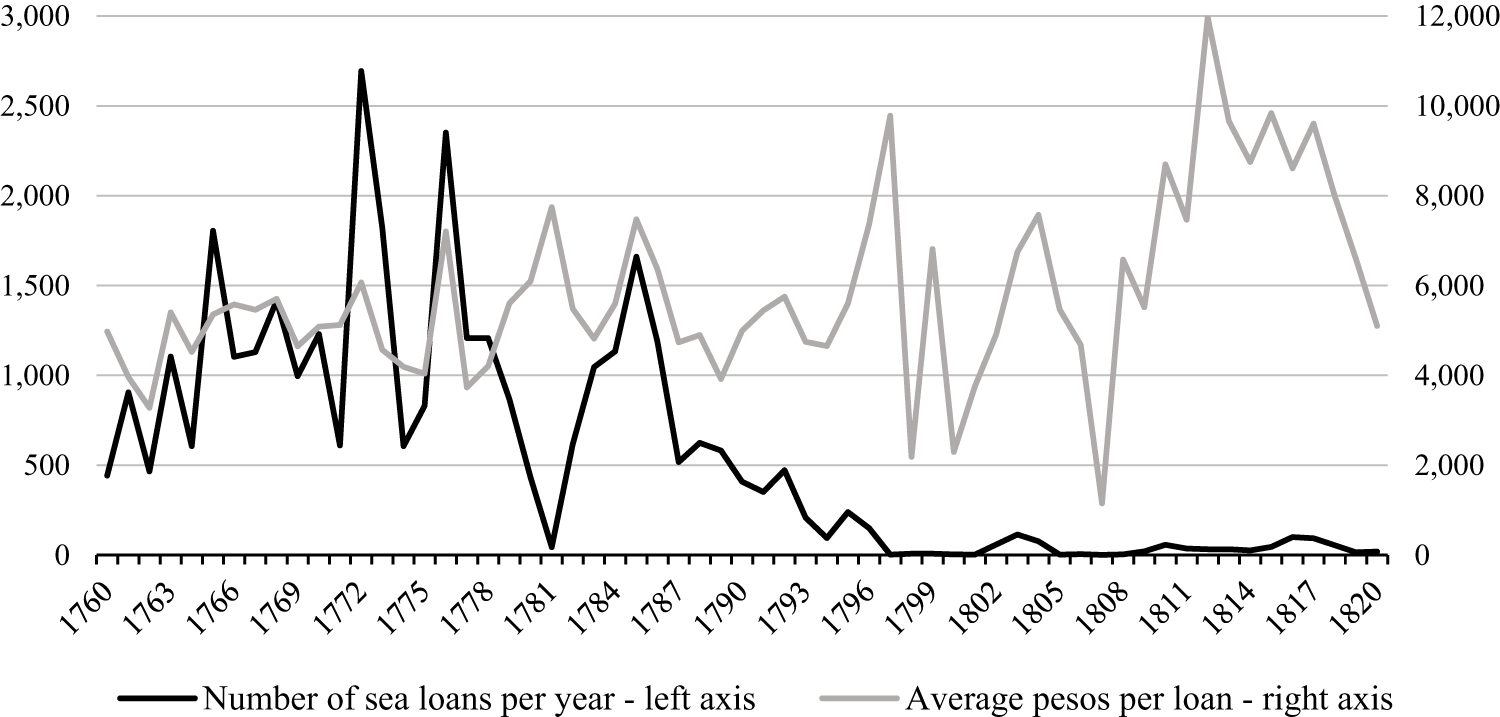
From 1760 to 1825, the Cadiz notaries registered 33,999 sea loans, which involved 2,489 ships and their cargoes. The loans were worth (principal and interest) 184,785,946 pesos fuertes, of which 82.4 per cent correspond to 1760–1785 and 17.6 per cent to 1785–1825 (Bernal, Reference Bernal1992, pp. 387–388). On average, it was 18.8 loans per ship and 5,371 pesos per loan in the first period (although large ships could easily surpass a 100 loans), with 5.8 loans per ship and 5,753 pesos per loan in the second. However, it is important to note that virtually all ships and cargoes involved in sea loans were involved in the first period but not in the second. The averages of the second period correspond only to expeditions at least partly financed with sea loans, excluding those that were not. Figure 2 illustrates the yearly evolution of the number of sea loans and the average amount per loan in pesos. The former followed a similar trend to the loans’ annual value shown in Figure 1, whereas the deviation from the average value per loan was considerable. For instance, of the 1,136 loans on the 1768 New Spain fleet (composed of 11 ships), 856 (75.4 per cent) were each worth 5,000 pesos or less, 189 (16.6 per cent) ranged between 5,001 and 10,000 pesos, and 91 (8 per cent) were worth more than 10,000 pesos (García-Baquero, Reference García-Baquero1989, p. 144).
Number of sea loans and average pesos sencillos per loan registered in Cadiz, 1760–1820.

Respondentias were significantly more important in number and value than bottomries. García-Baquero finds that 82.3 per cent of the sea loans and 91.3 per cent of the total value lent on the 1765 fleet were respondentias, with 89.2 and 91.6 per cent, respectively, in the case of the 1768 fleet (García-Baquero, Reference García-Baquero1989, pp. 146–147). The receipt of sea loans in the Spanish Atlantic was not limited to merchants, shipmasters and shipowners, but also extended, to a lesser degree, to various individuals travelling to the colonies, such as officers, mariners, soldiers, colonial officials, and members of the clergy. Mariners and officers usually borrowed small amounts against free-of-freight goods, known as pacotilla. Under the free-trade regulations, their loans declined even faster than those borrowed by merchants and shipowners. This explains the average pesos-per-loan growth shown in Figure 2, particularly in the 1810s. Among the lenders were merchants, members of the nobility, officials, Andalusian landowners, and other individuals with money who were willing to invest in the colonial trade. Although foreigners were legally excluded from the Spanish Atlantic, they used Spanish frontmen and women to participate in the exchanges and extend sea loans. Historians agree that foreigners who had established businesses in Cadiz were the primary beneficiaries of Spanish colonial trade, particularly dozens of French firms (Bartolomei, Reference Bartolomei2017; Bernal, Reference Bernal1992; Chamboredon, Reference Chamboredon1995; Le Gouic, Reference Le Gouic2011). However, the Spaniards’ role as financiers should not be dismissed. Judging by the last wills of the Spanish merchant elite, buying urban property and lending sea loans were their two most prevalent forms of investment in the middle decades of the eighteenth century (García-Baquero, Reference García-Baquero1976, I, p. 525). Furthermore, colonial creditors must also be considered, as they provided loans in Cadiz through their representatives, to whom power of attorney and instructions had been previously sent (Lamikiz, Reference Lamikiz2023).
How much of the Cadiz sea loan market belonged to foreigners? Captain Viñas’s 1767 example is illuminating. Among his 46 creditors, he confessed, were 24 foreign firms established in Cadiz to which he owed 62 per cent of his astounding debt of 353,763 pesos fuertes. Most of what Viñas borrowed through respondentia from the foreign firms was merchandise on credit, whereas his Spanish creditors lent him mostly hard money, which he then used to buy more foreign merchandise.Footnote 18
As discussed in the introduction, Baskes (Reference Baskes2013) argues that the decline of the sea loan was caused by the rise of insurance companies in Cadiz after 1785. He finds that many of the chief Cadiz lenders, both foreign and Spanish, shifted into the insurance-underwriting business. However, Baskes’s interpretation puts too much emphasis on the insurance provided by the sea loan, when in fact the lenders were not particularly concerned with that. He admits “it is possible that creditors sometimes took out insurance policies with third parties to insure their sea loans” (Baskes, Reference Baskes2013, p. 182). However, reinsurance was more than a possibility. A royal decree issued on April 27, 1768 regulating some aspects of sea loans acknowledged lenders could insure the loan principal “without exposing themselves to losses” (Herrero Gil, Reference Herrero Gil2013, p. 328).Footnote 19 That is what the Mexico merchant Francisco Ignacio de Yraeta did in May 1779 with a respondentia he had loaned in Cadiz for Veracruz to a merchant named Pablo Álvarez. On his orders, Yraeta’s Cadiz representative insured 15,000 of the 20,000 pesos of the loan principal at 3.5 per cent.Footnote 20 How typical was Yraeta’s decision? La Limeña, the first ship to set sail for Lima after the peace with Britain was signed, offers compelling evidence that reinsurance was a common practice and that insurance and sea loans were not mutually exclusive. She departed from Cadiz on December 24, 1783 but was forced to stop in Montevideo due to damages sustained during the navigation. The officials appointed to assess the damage valued the cargo and the ship at 3,080,000 pesos sencillos (Cadiz prices). They found that 136 sea loans had been given on the vessel and cargo for approximately 750,000 pesos (principal and interest). They also learned that the lenders had taken out insurance policies in Cadiz and elsewhere for two-thirds of the loans at an average premium of 3.5 per cent of the principals.Footnote 21 In other words, La Limeña shows that lenders could choose to run the marine risk themselves or buy insurance and forget about the perils of navigation. Either way, they would still make a more significant profit than by lending at land interest.
If the rise of capital stock insurance companies did not cause the demise of sea loans, then what did?
5. Factors behind marine interest rates
Historians agree about the marine interest rates’ gradual decline in the second half of the eighteenth century, although the evidence available is limited and often distorted by wartime premiums (Bernal, Reference Bernal1992, p. 476; Carrière, Reference Carrière1970, p. 246; Chamboredon, Reference Chamboredon1995, pp. 396–397; Guimerá Ravina, Reference Guimerá Ravina1985, pp. 370–371; Quiroz, Reference Quiroz1994, p. 214). For two reasons, plotting the evolution of interest rates with any degree of certainty is enormously tricky. Firstly, the rates were not stated in the loan contracts (with few exceptions), where only the amount owed was noted. Secondly, there is a lack of information about how the interest rates were established.
Bernal (Reference Baskes2013, pp. 185–186) uses a probability model to estimate marine interest rates from the amounts owed. However, its assumptions and accuracy are highly questionable. The model predicts a wide range of rates for the same voyage, whereas the primary sources strongly suggest that the spread for a specific year and destination was relatively narrow. It is hard to believe that over a quarter of the sea loans given for the 1772 New Spain fleet bore an interest of 60 per cent (Bernal, Reference Bernal1992, p. 496). This did not happen. It was already down to around 16 per cent in the 1768 fleet (García-Baquero, Reference García-Baquero1989, p. 145). As the Lima merchant José Santurio wrote to a Cadiz correspondent in May 1779, “money always comes at different prices.”Footnote 22 But how different? In October 1779 the British Navy captured a Lima ship called La Perla in route to Cadiz. She carried dozens of merchant letters (including Santurio’s) showing that Cadiz’s outbound marine interest rates for Peru ranged from 12 to 17 per cent at the time, with no rate either above or below.Footnote 23
The pace at which marine interest rates decreased in the second half of the eighteenth century is hard to establish accurately because much work still needs to be done to build a robust data series. However, the decrease is unquestionable, as evidenced in merchants’ letters. The challenge is to explain why this happened. Historians cite multiple factors, although they are seldom systematically analyzed (Bernal, Reference Bernal1992, pp. 482–497; Carrasco González, Reference Carrasco González1996, pp. 93–96; Guimerá Ravina, Reference Guimerá Ravina1985, pp. 367–368; Herrero Gil, Reference Herrero Gil2013, pp. 342–350; Lamikiz, Reference Lamikiz2023, p. 5; Ravina Martín, Reference Ravina Martín1980, pp. 131–133). Unfortunately, no data are available to perform multiple regressions to elucidate the impact of each factor. Nevertheless, dividing them into three categories makes it easier to understand their effect. Those categories are the opportunity cost of time, the navigation risk, and market conditions. I argue that the prevalence of sea loans in the Spanish Atlantic stems from factors related to market conditions, but let’s look at the other two categories first.
The first category—the opportunity cost of time from the distance to the ship’s destination and the subsequent repayment period—must have played a part in setting the marine interest. Still, it appears to have been of lesser importance. This may seem counterintuitive, since a greater distance meant a longer period in which to settle a loan. However, the difference in marine interest rates between destinations was too great to be explained solely by the difference in repayment times. For instance, the ship San Bruno departed for Peru in January 1755 (peacetime). Her owners had borrowed 50,631 pesos on bottomry at 40 per cent to be repaid in Lima.Footnote 24 Around the same time, in the mid-1750s, the company of Blas Romero secured several outbound bottomries on ships that made the Cadiz-Veracruz route. They borrowed 293,166 pesos at an average marine interest of 18.25 per cent.Footnote 25 Completing the sea route to Lima took five and a half to six months, while Veracruz could be reached in under three months. A three-month difference between the two navigations cannot account for an interest gap of over 20 per cent.
Could it be down to the navigation risk instead? The factors linked to the risk of navigation comprised the difficulty of the voyage, the ship’s fortitude, whether the vessel sailed alone or as part of a fleet, and whether the voyage took place in war or peacetime. The four affected insurance premiums and marine interests similarly, although the one having the most visible effect was war or its threat. When insurance policies included a war clause because of fears that a conflict might be about to break out, sea loans incorporated a similar clause with the same contingent percentage increase. For instance, it was 20 per cent in December 1777 and 40 per cent in September 1803.Footnote 26 War itself increased rates even more. In October 1744 (wartime), José Vélez Moro (shipowner) and Juan Francisco de Landa (master) secured seven respondentias and five bottomries in Cadiz to be repaid in Cartagena de Indias. The total debt was 93,423 pesos, and the marine interest rates were 75 and 80 per cent.Footnote 27 However, although the navigation risk affected marine interest rates, it explained neither the differences between destinations nor the widespread use of sea loans in the Spanish Atlantic. Let’s see why.
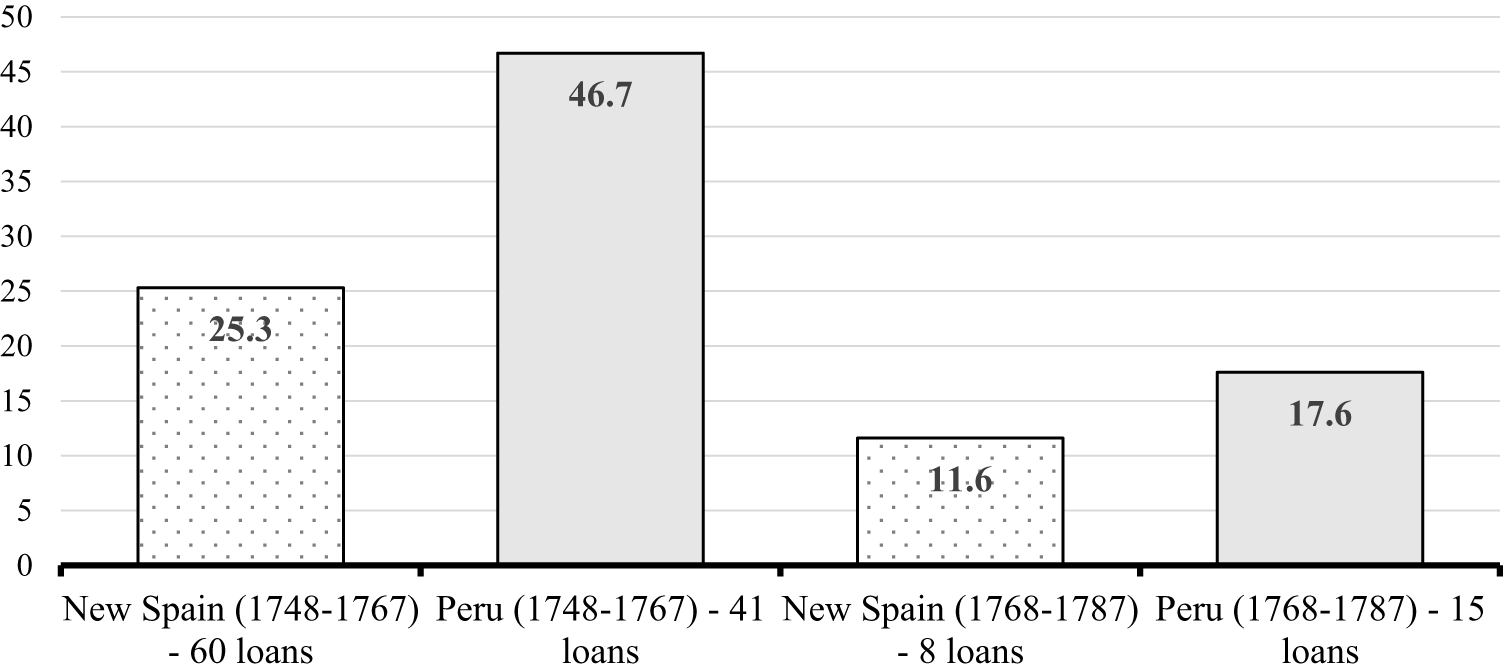
Figure 3 shows the average rates for New Spain (Veracruz) and Peru (Callao, Lima’s seaport) in 1748–1767 and 1768–1787, attesting to the differences between destinations and the general drop in marine interests. Chamboredon has gathered the rates from the private records of two French firms operating in Cadiz. Unfortunately, he does not provide individual rates and years. Nor does he measure the weight of war premiums (if they happen to be included) on the rate averages. For Chamboredon (Reference Chamboredon1995, p. 395), “the passage of Cape Horn alone can explain the generally higher premiums for contracts for Callao.” Le Gouic (Reference Le Gouic2011, p. 303) reaches a similar conclusion by examining the Cadiz-based French firm Rey, Magneval and Dumas’ records. In March 1763, they loaned 1,269 pesos for Callao at 35 per cent to be repaid six months after arrival. In September 1764, they loaned 2,284 pesos for Veracruz at 15 per cent to be redeemed four months after arrival. Just like Chamboredon, Le Gouic attributes the 20 per cent gap to the lower risk presented by Veracruz. This interpretation is odd since insurance premiums measured risk. Insurance policies for New Spain were cheaper than those for Peru in the 1760s, but only by less than three percentage points (Baskes, Reference Baskes2013, Appendix C).
Average interest rates of outbound sea loans for New Spain and Peru lent by the Cadiz-based French firms Gilly Frères et Cie (1748–1767) and Fornier Frerès et Gilly Frères (1768–1787).

Discarding the previous categories means the answer to the difference between New Spain and Peru must be found in unequal market conditions. Two market conditions explain geographical disparities and the general lowering of marine interests in the second half of the eighteenth century: the net profit expectations in the colonial market (a function of the demand for European goods and the accumulation of silver) and the availability of capital in Cadiz.Footnote 28
Profit expectations explain why the sea loan was prevalent in the Spanish Atlantic before the implementation of free trade. As described in Section 2, the colonial trade system was regulated and license-based, designed to reduce uncertainty and afford handsome profit margins before 1778, although it provided no guarantees of success. As the Cadiz merchant Andrés de Loyo put it to the Marquees of Ensenada, King Ferdinand VI’s chief minister, in 1750:
Nothing shows the gains of commerce as the price at which money is loaned at sea risk, which is the rule by which the expected profit on merchandise is to be considered. It is evident that in the last expeditions of fleets and galleons, it did not surpass 30 to 40 per cent; it is therefore clear that this premium is the most that the sales of merchandise could afford on those occasions.Footnote 29
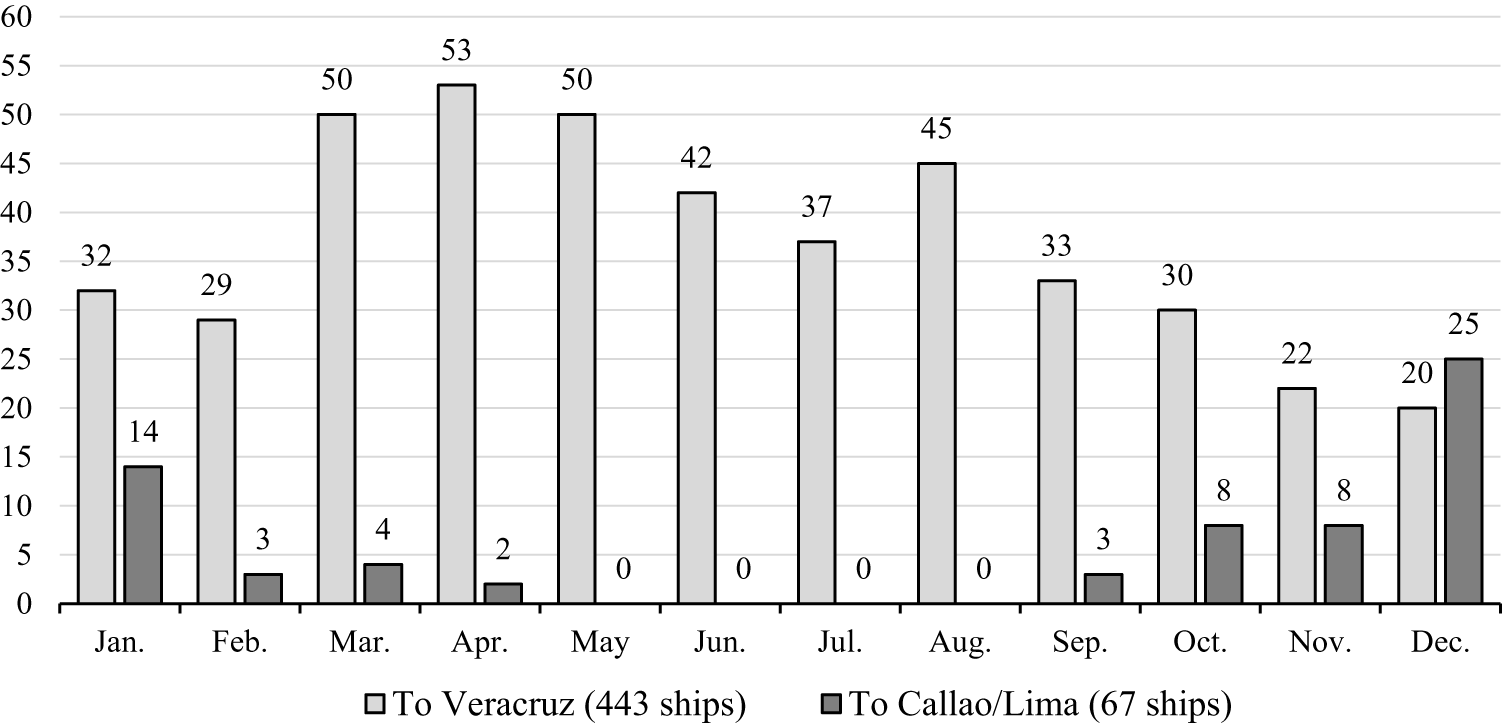
However, profit expectations were not evenly spread throughout the colonies. Some regions were more easily kept undersupplied than others, resulting in higher interest rates for marine shipping. This was the case with Peru in the 1740s and 1750s, when register ships began to reach Callao directly. Compared to New Spain, accessing the Peruvian market was more time-consuming and challenging, as it involved navigating the treacherous Cape Horn only during the austral winter months. Furthermore, only robust ships, relatively few in Spain, could sail to Callao. Hence, modulating the supply of European goods and maintaining profitability was more manageable in the trade with Peru. This pattern continued even after 1778. Figure 4 shows the ships setting off from Spanish ports to Veracruz and Callao from 1785 to 1795, arranged by departure month. Peru and Chile received 21.6 per cent of Spain’s exports to America during that period (virtually all of them from Cadiz), whereas New Spain received more than 40 per cent (Fisher, Reference Fisher1985, p. 55). Still, the differences in the number of vessels and navigability were very significant, rendering the exchanges with Peru less frequent and more manageable to foresee than those with Veracruz.
All ships setting out from Spanish ports to Veracruz and Callao/Lima in 1785–1795, arranged by departure month.

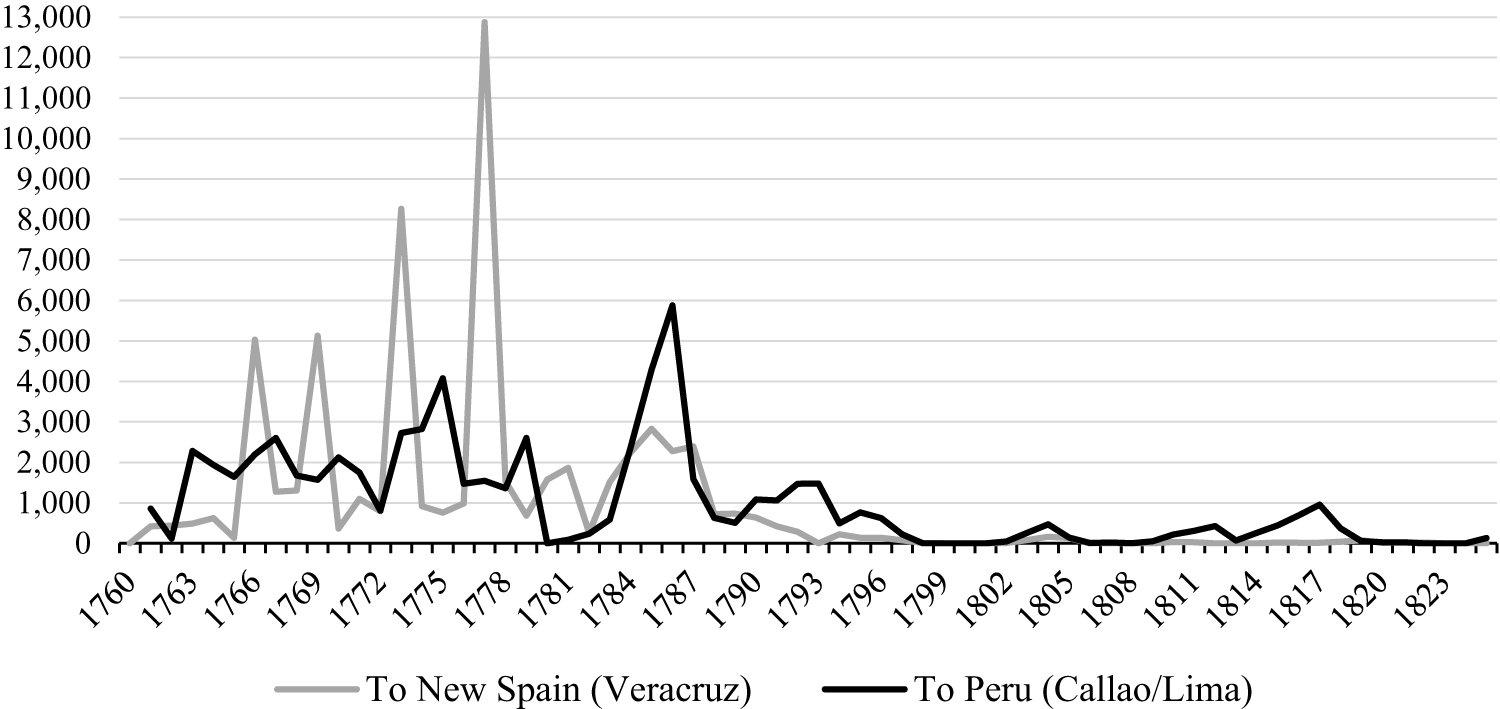
Free trade brought more competition and uncertainty (i.e., increased participation and a higher frequency of exchanges) to Spain’s trade with New Spain than with Peru, meaning that the sea loan declined more quickly in the former than in the latter. Figure 5 illustrates the evolution of the total value of Cadiz sea loans for New Spain and Peru from 1761 to 1825, which accounted for 68.5 per cent of all loans. There were notable differences between the two main Spanish American destinations. The sharp peaks of 1765, 1768, 1772, and 1776 correspond to the departure of the last four New Spain fleets. However, when the fleets disappeared, Peru became a more significant destination for sea loans because trade with Callao continued to be conducted only from Cadiz and on a seasonal basis. Sea loans virtually disappeared in the Cadiz-Veracruz route by 1792, whereas they experienced small resurgences in trade with Peru until the 1810s. From 1792 to 1825, Peru was the destination of 76.7 per cent of the Cadiz sea loans (Bernal, Reference Bernal1992, pp. 752–763).
Annual value of sea loans registered in Cadiz for New Spain and Peru, 1761–1825 (000 pesos sencillos; principal and interest).

How can we explain the overall decline of marine interest rates? The gap in rates between the two main American destinations had narrowed considerably by the late 1770s (10–12 per cent for Veracruz, 12–17 for Callao), indicating that the Peruvian market had become gradually more integrated with Spain since the adoption of the Cape Horn route in the 1740s. However, while geographical differences account for the disparities in market integration, they do not explain the general decrease in marine interest rates. Narrower profit margins were crucial in reducing rates, but capital availability was another decisive factor. “I have no doubt,” wrote a merchant from Lima in March 1779, “that upon arrival of the [New Spain] fleet and the register ships from the South Sea, silver will be plentiful in that city and that my order to lend at 20 to 25 per cent will be impossible to fulfil.”Footnote 30 He was right. As noted above, merchants borrowed in Cadiz for Lima at 12 to 17 per cent in early 1779. So, combining the fleet system and the permanent adoption of single register ships to carry out a substantial portion of the transatlantic exchanges after 1750 made silver more readily available in Cadiz, gradually pushing marine interest rates down. Still, as shown in Figure 1, silver arrived at Cadiz in spikes before 1778, resulting from its accumulation in the colonies and the periodical arrival of fleets. In contrast, silver crossed the Atlantic more steadily in the 1780s and the first half of the 1790s, and, more importantly, it was in exchange for more significant amounts of European goods per unit of silver which lowered prices.
By the late 1770s, crucially, the lower band of marine interest rates had dropped to a point where merchants could now opt for land-interest loans instead of respondentias. This had been impossible in earlier decades because the gap between marine and land rates had been significant. Although little evidence is available, it seems likely that some merchants had access to land-interest loans for their transatlantic operations prior to the 1770s. The majority, however, resorted to sea loans, as evidenced by the sheer number of deeds. By early 1779, things had changed significantly. As a Lima merchant wrote to his Cadiz correspondent, “if the marine interest were expensive over there and you thought it more convenient to borrow at land interest, you will act accordingly.”Footnote 31 Hence, it seems that 12 per cent, the lowest marine interest rate for Peru that was available in Cadiz in early 1779, was the benchmark at which marine interest equalled the sum of land interest and insurance premium. The critical question is whether the sea loan would be equally attractive if the marine interest rate fell to that benchmark on all loans rather than just some. Would this affect lenders’ liking for the sea loan as a lucrative investment opportunity?
6. Why the sea loan declined: a hypothesis
In 1791, the Peruvian jurist and economic thinker José Baquíjano y Carrillo (1751–1817) published an essay on Peru’s commercial history in which he celebrated the expansion of trade with Spain in the previous four decades. Influenced by the English Economist Josiah Child (1630–1699), Baquíjano believed that the lower the price of money, the wealthier a country. What did that yardstick say about Peru’s trade with Spain? For him, it said a lot. He stressed that the marine interest rate had decreased considerably since the adoption of the direct Cape Horn route in the 1740s. The ships arriving at Lima in 1750 (a peacetime year) had brought goods purchased with sea loans bearing a 70 per cent interest, whereas the insurance premium had been 20 per cent. Soon afterwards, the marine interest rate had fallen to 50 per cent and insurance to 15. The trend had been downward for both credit and insurance ever since: by the 1770s, they had been 12 and 5 per cent, respectively. According to Baquíjano, the free-trade regulations had pushed both rates further down: in 1790, the marine interest had been 4 per cent and the insurance premium 2 per cent (Baquíjano Carrillo, Reference Baquíjano Carrillo1791, p. 247). Was he right? The insurance premium had indeed fallen to 1.5–2 per cent by 1791 (Baskes, Reference Baskes2013, Appendix C), but what about the marine interest? Had it dropped to 4 per cent?
As seen in Section 5, historians have been aware of the gradual decrease in marine interest rates in the eighteenth century, but shockingly, they have yet to look past 1778. I have only found one exception in the literature: Bernal finds a sea loan given in Cadiz for Lima at 8 per cent in 1790, only to question its authenticity by suggesting that it most likely concealed a higher rate (Bernal, Reference Bernal1992, p. 485). His reluctance to accept the validity of a low rate stems from his reliance on the method for estimating marine interest rates discussed in Section 5. Bernal estimates that a fifth of the sea loans given in Cadiz between 1783 and 1792 (peacetime years) bore an interest of 60 per cent (Bernal, Reference Bernal1992, p. 496). Considering the level of competition and how much profit margins must have narrowed by then, 60 per cent is inconceivable. The only way to determine the rates is by looking at merchants’ records and writings. I have found four instances showing that marine interest rates dropped significantly after 1785, just like Baquíjano described, at least for a few years. The exact timing and evolution remain blurry, but the evidence is conclusive.
Two of the examples concern the Cadiz-Lima route. The first is La Limeña’s misfortune, discussed in Section 4. The officials assessing the damage suffered by its cargo considered several scenarios to determine how sea-loan lenders and borrowers would share the losses inflicted. To gauge the impact on the lenders, the officials estimated the costs and net profit of an imaginary respondentia loan of 100 pesos to be redeemed in Lima, using 16 per cent as a reference rate. However, some merchants complained about the unsuitability of the reference rate because, by the time La Limeña finally reached Lima in December 1785 (two years after leaving Spain), they insisted that the Cadiz marine interest rate for Peru had shrunk to 6 per cent.Footnote 32
The second piece of evidence is a letter the Lima firm Pedro Moreno and Co. sent to one of their Cadiz correspondents in April 1792. Their correspondent had suggested that lowering the 2 per cent commission for collecting debts in Peru would be in line with the drop in marine interests. The Lima firm disagreed. They explained that their other Cadiz friends were happy with the usual commission despite having “lent money at four, five, and six per cent” for Peru.Footnote 33
The other two examples refer to Cadiz’s trade with Veracruz. The first comes from the responses of several Cadiz merchants in 1787–1788 to a questionnaire that sought to assess the impact of the free-trade regulations.Footnote 34 In January 1788, the prominent merchant and financier Miguel de Iribarren submitted his response to the Cadiz Consulado. Unlike Baquíjano, Iribarren thought that the decrease in marine interest rates was “a convincing proof of the decadence of Spain’s trade [with the Indies]” (García-Baquero, Reference García-Baquero1998, p. 314). Until 1778, rates for Veracruz had ranged from 10 to 12 per cent, but “today they have dropped to par or even two per cent below par, that is, lending here 100 pesos to receive 98 over there” (García-Baquero, Reference García-Baquero1998, p. 314). The currency arbitrage still afforded profits, but the narrower margins, Iribarren argued, favored the merchants operating from Spanish America (whose money was loaned in Cadiz but collected in America by themselves) rather than those established in Spain.
The last piece of evidence is a report the Veracruz merchant Tomás Murphy submitted to the viceroy of New Spain in July 1793. In it, he explained that peacetime interest rates had fallen significantly in the Spanish Atlantic since 1778. Murphy assured that “one risk” marine interests had not gone below 12 per cent and “two risks” 24 per cent at the time of the last New Spain fleet. In stark contrast, merchants in Spain were now lending “at four to six per cent […] for one risk and 12 to 14 per cent for two risks.”Footnote 35
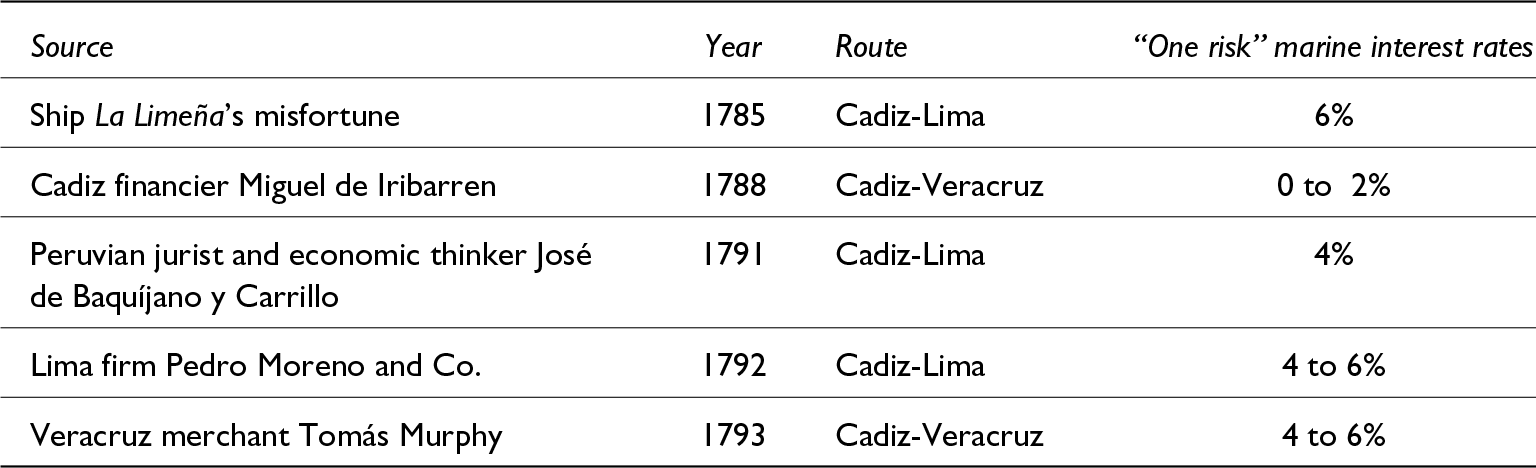
Table 1 contains, in chronological order, a summary of the “one risk” marine interest rates I have found corresponding to the free-trade period. Even though the liberalization of trade caused numerous bankruptcies in Cadiz (Baskes, Reference Baskes2013, pp. 98–107), there can be no doubt that marine interest rates plunged after 1785. At first sight, this appears baffling. More market uncertainty, coupled with business failures, should have prompted lenders to demand higher interest rates, not lower. The fact that the opposite happened is a solid indication that the principal determinant of the marine interest rate was the estimate of future returns, not the perceived degree of risk. As prices plummeted due to increased competition, marine interest rates also shrank. But there was more. Another important contributing factor was the continuous arrival at Cadiz of considerable amounts of silver after the mid-1780s (shown in Figure 1), which precluded past bullion accumulation in the colonies. Therefore, greater capital availability in Cadiz and less silver accumulation in the colonies also pushed marine interest rates down.
Evidence of the marine interest drop after 1785

Sources: Baquíjano Carrillo (Reference Baquíjano Carrillo1791, p. 247) and footnotes nos 31 to 34.
What were the implications for the use of sea loans? My hypothesis, which demands further research to be fully proven, is as follows. The relatively high selling prices behind sea loans’ handsome marine interest rates, which had been afforded by the colonial trade system before 1778 but had been gradually abating since the 1750s, disappeared with the implementation of comercio libre. As marine interest rates decreased, they became comparable to the sum of standard commercial rates and insurance premiums. As a result, the main advantage the sea loan had offered to lenders vanished. It now made little sense for lenders to insure their sea loans anymore. It now made perfect sense to lend at premio de tierra and invest in the insurance industry instead.
7. Conclusions
This article has pursued two objectives: firstly, to elucidate the reasons that made the sea loan the hallmark credit instrument in the Spanish Atlantic until the early 1780s, and secondly, to explain why its use declined dramatically after 1785. To these ends, I have examined the Spanish colonial trade system, the intrinsic features of the sea loan and the factors affecting marine interest rates. Since little quantitative data are available, I have also hypothesized about what prompted the decline of the sea loan. Apart from the loan contracts, I have examined merchants’ letters and accounts, bankruptcy proceedings, and the transatlantic Spanish mail intercepted by the British Navy during the eighteenth-century wars.
Historians stress that Spaniards’ dependence on foreign capital was the main reason behind the widespread use of respondentias and bottomries (the two types of sea loans) in commercial exchanges with Spanish America. In their view, the widespread use of this credit instrument was a sign of foreign dominance, where undercapitalized Spaniards were at the mercy of foreign creditors. In contrast, I have argued that a Spanish-foreign dichotomy does not explain the sea loan’s success. The prevalence of this credit instrument in the middle decades of the eighteenth century (and before) lay in the colonial trade system’s strict regulations, which sought to reduce market uncertainty and secure relatively high profit margins by rationing the transatlantic exchanges and accumulating bullion in the colonies. The sea loan was perfectly adapted to these conditions because lenders could charge interest rates well above the legal cap by bearing the sea risk. This is how they reaped a more significant portion of the profits than was possible with land-interest loans. Indeed, profit-margin expectations were the main driver in setting marine interest rates.
As for why the sea loan declined after the 1780s, most historians argue that Spaniards became more independent in the last quarter of the eighteenth century, with the disappearance of sea loans a reflection of the end of foreign supremacy. More cogently, Baskes contends that increasing competition and market uncertainty caused by deregulation decoupled commercial credit and marine insurance—or in other words, that the rise of the Cadiz insurance industry rendered the sea loan obsolete in the Spanish Atlantic. In contrast, I have shown that insurance and sea loans were not mutually exclusive. Rather, as a result of shrinking profit margins, marine interest rates decreased gradually before 1780 and to a greater extent after 1785, to the point where they eventually equalled the sum of land interest and marine insurance. Once this happened, according to my hypothesis, creditors preferred to diversify risks by lending at land interest and investing in insurance companies. If future research confirms this hypothesis, it would not be the rise of the Cadiz insurance industry that caused the decline of the sea loan, but the decrease in marine interest rates that prompted the rise of capital stock insurance companies in Cadiz.
Acknowledgements
The financial support received from the Spanish Ministerio de Ciencia e Innovación (project entitled “Crisis fiscal y declive económico en la Monarquía Hispánica, 1550-1700”, PID2020-118287GB-100) and the Basque Government (Consolidated Research Group IT897-16 UPV-EHU) is gratefully acknowledged. I thank the referees for their valuable comments and constructive advice. I would also like to thank Benoît Maréchaux, Juan José Rivas Moreno, Catia Brilli, Pilar Nogues-Marco, and Michael Marsden for their incisive comments and suggestions.

 Open access

