





Food is a major contributor to health and well-being and eating is an important part of social life in every culture. Food production and consumption, along the food chain from agriculture to processing, transport, retail, preparation, consumption and waste management, has been throughout history a structuring component of society in its economic aspects. In fact the transitions over time in the way societies deal with food, from hunting and gathering to agriculture, and later the improvement in the food chain enabling urbanisation, have been essential in the evolution of mankind. And mankind now realises that it must quickly change, again, this food chain that is a key aspect of its economic system, in the near future if it wants to mitigate the massive ecological transitions of the Anthropocene (‘the human geological epoch’). Indeed our food provision system is responsible for massive carbon emissions, pollution and reduction of biodiversity (through deforestation, industrial farming, agrochemicals, fertilisers, plastic packaging, etc.), not to mention various negative social and health impacts.
In all the efforts to mitigate the negative externalities of our current food chain and consumption system, the question of how to change human behaviours comes to the fore. Nevertheless the very slow progress and the apparent resistance to change met by public policy campaigns show that the problem is difficult. It is argued here that change is possible, but that there is no silver bullet nor one-size-fits-all solution and that communications campaigns are not enough. It is shown here how to implement change with a systematic and multi-layered approach that analyses the channelling mechanisms of current behaviour and leverages the same mechanisms to modify them.
The multiple determinations of behaviour
Human behaviour is plastic, for eating too. Human subjects can eat very diverse things and in many ways. There have been through history a diversity of food systems coming with cultural and religious systems to orient and control what people eat. These systems were grounded in what food was locally available, in tradition and ideology, in the technology and constraints of production, preservation and retail. In terms more familiar to nutritionists, this means that, as a consequence of these culturally diverse solutions to address the need to eat, human subjects demonstrated that they are able to accommodate a rather diverse range of diets. Therefore this societal diversity shows the extent to which behavioural change is possible.
There have always been deliberate efforts to change behaviour within one given society. Attempts to change the diet for medical reasons are as old as medicine; they are based in the belief that food has a major impact on health, a belief made explicit e.g. by Hippocrates(Reference Jones1). This belief, which pre-exists to, and beyond, scientific evidence provided by nutrition, is present in the folk psychology's incorporation principle (i.e. ‘you are what you eat’). This belief has been demonstrated to exist even in educated modern human subjects; it is consistent with the laws of sympathetic magic, according to which ‘contact transfers properties’: Rozin et al., for example(Reference Rozin, Millman and Nemeroff2), show that people are reluctant to drink orange juice in which a cockroach has been dipped, even if the cockroach was sterilised; people are also reluctant to take sugar from a container labelled ‘poison’, or to eat chocolate in the shape of dog poo (see(Reference Lahlou3) for psychological explanation). This belief is still an active component of attitudes towards food and can be leveraged in persuasion campaigns.
Nevertheless, we know since the seminal works of Kurt Lewin that persuasion alone is not efficient to change eating behaviour. Lewin's research originated in another great motivation behind behavioural change policies: economics. The purpose was to make American households eat more offal in a war-time economy. The research compared various interventions to that effect. Groups of housewives were instructed to cook offal for their family, after having listened to conferences praising their nutritional value and learning recipes(Reference Lewin4). The findings showed that the groups where the participants contributed to discussion and made a social commitment to do so indeed cooked offal, while those who were only exposed to the persuasive discourse of the educators did not cook offal at all. Lewin's work showed two key points still valid today: (1) eating behaviour is not just the result of attitudes, the role of the ‘gatekeeper’ who buys and cooks is essential and (2) social regulation (e.g. norms, group pressure) is paramount in actually transforming intentions into practice(Reference Lewin5). Lewin found, in particular, that it was easier to change the behaviour of a group as a whole than individual behaviours, precisely because of the power of social norms:
‘Experience in leadership training and in many areas of re-education, such as re-education regarding alcoholism or delinquency(Reference Lewin and Grabbe6), indicates that it is easier to change the ideology and social practice of a small group handled together than of single individuals. One of the reasons why “group carried changes” are more readily brought about seems to be the unwillingness of the individual to depart too far from group standards; he is likely to change only if the group changes’(Reference Lewin7)
There have been numerous attempts at models to explain behaviour, and numerous models for behavioural change. Darnton(Reference Darnton8,Reference Darnton9) reviews more than eighty. One recurrent limitation of the classic models is that they mostly focus on one single type of determinant of action: the subject's psychology, or social norms mostly, sometimes (for economic models) external factors such as price or regulation. ‘Nudge’ has recently been in fashion(Reference Sunstein10,Reference Thaler and Sunstein11) . Nudge is an approach that leverages some cognitive processes in the determination of choice, filtered by the principle of libertarian paternalism (i.e. tweak the choice architecture but not force the individual). Recent reviews show limits of the approach(Reference Hummel and Maedche12–Reference Osman, McLachlan and Fenton18) especially the limited size of the effects and the lack of their persistence. Recently Yamin et al. made a meta-analysis of over ninety studies leveraging social norms to change behaviour(Reference Yamin, Fei and Lahlou19): the most promising approaches identified were those that intervened at the point of delivery of behaviour (place and time of action), rather than those trying to persuade the individuals to change their behaviour.
The approach presented here, based on installation theory, addresses the behaviour as a trajectory of the subject within a built environment, and endeavours to channel this trajectory step by step, leveraging all potential determinants rather than focusing only on the subject as the main determinant of his/her own behaviour. In contrast with some other approaches, installation theory does not restrict intervention design with political or economic principles, for example, it considers that regulation and control are part of the toolbox of interventions, and that technology (e.g. designing healthier products, improving modes of delivery) is too.
Installation theory
This section presents the theory behind intervention design. Interventions should leverage a powerful behavioural channelling mechanism that societies use to control individual behaviour: ‘installations’, which combine the three main types of determinants of human behaviour: affordances in the environment, embodied competences in the subject, social regulation. So far interventions tend to leverage only one or two types of determinants (e.g. regulation by law, changing competences with education, making social norms salient); it is proposed here that using installation theory as a design framework provides a more complete and therefore more powerful approach.
Just as biomimetics takes stock of the solutions natural evolution has found to similar problems, here a sociomimetic approach is used for inspiration: interventions using installation theory leverage the very same mechanisms that societies use to channel the behaviour of their members. Societies, and especially large-scale societies, can operate smoothly only if individuals behave in a predictable way. That is because in a society there is a strong interdependence between behaviours. For example, when one drives a car, one expects other drivers respect the rules of the road, and does so oneself. More generally, just about any interaction and transaction in society (e.g. at the dentist, the grocery shop, dinner, etc.) must respect the local conventions of ‘how we do things here’. The loyal members of a given society know how to do this and do it. As Alfred Schütz noted:
‘(…) the member of the in-group looks in a single glance through the normal social situations occurring to him and (…) he catches immediately the ready-made recipe appropriate to its solution. In those situations his acting shows all the marks of habituality, automatism, and half-consciousness. This is possible because the cultural pattern provides by its recipes typical solutions for typical problems available for typical actors.’(Reference Schütz20)
The amazing phenomenon here is that not only people act as they are expected to, but that they do so without feeling strongly constrained. For example, when you travel by aeroplane, your behaviour from the moment you check in at the airport until the moment you retrieve your luggage on the carrousel at the destination airport is predictable all the way (including where you sit), except for some details (e.g. what beverage you drink). You have been channelled all the way, through corridors, doors, security, lounges, customs, etc. The combination of various layers of channelling factors (the corridors which afford you to progress towards your goal, your knowledge of your flight number and boarding gate, the indications of airport staff) create a ‘tunnel of activity’ into which you are gently funnelled. The behavioural path is fluid when you follow this tunnel, and constraints are not felt as dictatorial. Furthermore an important thing to note is that each and every passenger on the aeroplane behaved in a similar way, regardless of age, sex, education, nationality, income, religion, cognitive style, personal experience, political orientation, etc. The channelling system at work is so powerful that it supersedes all classic variables used to ‘explain’ behaviour.
Indeed societies have constructed very powerful systems to channel the behaviours of their members so that they can operate smoothly. The construction of these channelling mechanisms is a necessary evolutionary condition for the survival of societies. Installation theory(Reference Lahlou21) describes these channelling mechanisms, based on the detailed study of hundreds of hours of actual behaviours in natural situations with the subjective evidence-based ethnography technique(Reference Lahlou, Le Bellu and Boesen-Mariani22). In these studies (see(Reference Lahlou, Le Bellu and Boesen-Mariani22) or(Reference Lahlou21) for a list) volunteer participants have worn miniature video cameras at eye level and recorded their ordinary behaviour for hours. Then participants analysed their behaviour with the researchers, by watching together the (high-definition, stereo) recordings and making explicit, step by step, the reasons for their behaviour. This is made possible because reviewing the recording from one's own perspective triggers episodic memory(Reference Tulving23), a multi-sensory and accurate, detailed, memory of one's mental states at the instant on the recording(Reference Lahlou24). Results of the video studies cited earlier show that the channelling system is complex and distributed: it is not only located in the subject, as psychologists often assume in their behavioural models. The components of installation are installed in the subjects themselves, but also in the context: affordances in the built physical environment, regulation in the social system. The distributed components operate as a bundle.
Installations are ‘specific, local, societal setting where subjects are expected to behave in a predictable way’(Reference Lahlou21). Installations can be described as having three layers: physical affordances in the built environment, embodied competences in the subject, social regulations in institutions. Installations operate by offering the subject a limited choice of alternatives, limited by determinants in these three layers, physical (affordances) embodied (competences) and social (institutions). These three types of determinants provide support and control, feed-forward and feed-back; in doing so they create a channel that guides the behavioural path (Fig. 1), as described earlier in the example of the airport. Installations assemble at the point of delivery, where they operate as a behavioural attractor. This assembly of a bundle of components produces a predictable result, as in a chemical reaction or a cooking recipe.
The three layers of an installation simultaneously scaffold and constrain the behavioural path by channelling it with three layers of components: affordances in the environment, competences embodied in the subject and social regulations in institutions.
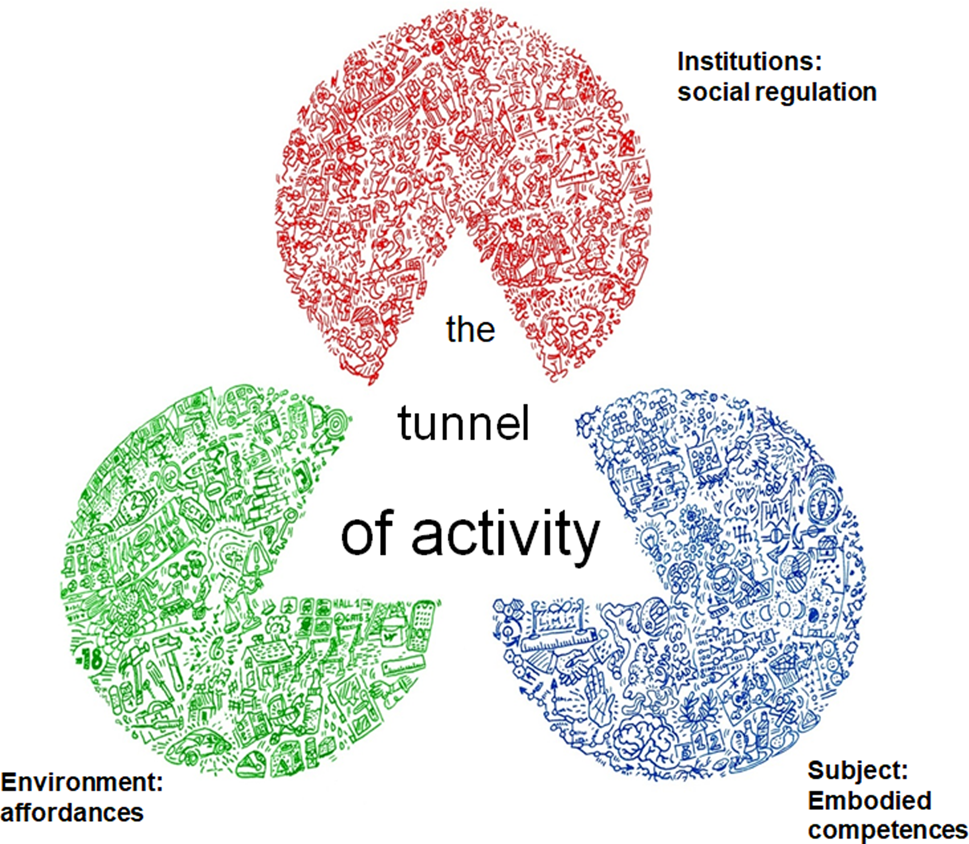
Installations operate at the point of delivery of activity (a shop, a pantry, a kitchen, a restaurant, a dinner …). Usually the physical layer of the installation occupies a specific area of space and time. This ‘place’ is often used as a metonymy to designate the whole installation to where people would go, or in which things would happen (e.g. a restaurant). But an installation is not reduced to the ‘context’: it includes the subject as a key engine, and also other stakeholders and subjects, directly or indirectly, as will be shown later. A restaurant without the personnel and the clients is not the whole operational installation; in fact without these components no eating behaviour can happen. Always remember that an installation is a bundle of components from three layers. Each of these layers will now be described in greater detail.
Layer 1: the material environment and its affordances
This objective layer is in the physical context, the material environment, which is external and provides affordances to the actor. This is a given (‘data’) to the subjects and external to them. Buildings, chairs, refrigerators, cutlery and apples are examples from this layer. Most of these objects are constructed artefacts: ‘the built environment’. They were constructed, with deliberate intention, as a setting or instrument that carries affordances for activity, e.g. a bus, a kitchen, a chocolate bar.
The affordances of physical objects inform, support and constrain activity. For example, a table will signal location for a meal, support the dishes, but also constrain the space where food manipulation takes place. The term affordance was coined by psychologist James Gibson:
‘Roughly, the affordances of things are what they furnish, for good or ill, that is what the afford the observer. (…) they are ecological, in the sense that they are properties of the environment relative to an animal. (…) Affordances do not cause behaviour but constrain or control it. Needs control the perception of affordances (selective attention) and also initiate acts. An observer is not ‘bombarded’ by stimuli. He extracts invariants from a flux of stimulation.’(Reference Gibson, Reed and Jones25)
Affordances are interpreted as connotations of activity by the subjects. Objects can act directly as barriers or scaffolds (a wall, a chair). They also act as bearer of signification and trigger a cascade of interactions coupling the setting and the subject if they bind with a matching receptor in the subject (the interpretive structure or mental representation that matches with the object). Gibson argues, and this has been empirically proved exactingly for some simple objects as stairs(Reference Warren26), that subjects perceive the object directly as a potential for action. For example, when entering a room and looking around for a place to sit one would not perceive ‘chairs’ and ‘sofas’ but possibilities for sitting. Regarding food, a hungry subject would look at the dinner table and perceive some objects as edible – and more subtly, as potential providers of a series of more or less palatable sensory-motor experiences, grounded in one's eating own history. This may seem trivial but is key because the affordances at the point of delivery of the behaviour will constrain what is feasible. So designing affordances is the first step in channelling behaviour: creating a specific tree of possibilities where the subject can only access some branches.
An obvious path using this layer to change behaviour is to offer easy access to the food products one wishes the consumers to eat, and to make them available and easily accessible to the consumers in their habitual abode. Conversely, to make difficult to access other food products which we would wish consumers restrict/avoid. Another recommendation is to ensure the properties of the objects match expectations; for example that food is safe, that it contains few harmful components. That is actually what do regulations/laws limiting the food products' content in additives, pesticides, but also in fat or sugar. Finally, some affordances can be built when they are not naturally obvious on the product: that is the role of front-of-pack labelling that makes visible nutritional qualities, for example with a colour code from green to red(Reference Dubois, Albuquerque and Allais27). Designing good affordances, where the perceived form and actual properties match the user's conceptual model for action, requires empirical studies.
Layer 2: embodied competences
Embodied competences are the behaviours one knows how to perform. The individual body carries a series of interpretive systems, which will process a given situation (perception through the senses, state of the body, object of attention, etc.) into a specific action (emotion, thought, movement, etc.) of the body. Some of these interpretations are automatic, such as the knee-jerk reflex or the understanding of someone speaking in one's own language. This interpretation of the situation into action happens regardless the interpretive systems are innate or learned. Not all the competences are cognitive: for example human subjects have, thanks to their digestive tract and microbiome, the competence to digest certain objects as ‘food’ – that is to extract nutrients from them.
There are many ways embodied competences are constructed. One can of course think of education and instruction, which are deliberate cultural formatting by society in order to make sure individuals behave according to standard. The acquisition of such competences can even be controlled and required (diploma, driving licence) to perform the relevant activity. More generally, competence is constructed through practice and positive feedback, until it becomes an automatic response to certain situations, i.e. a habit.
‘[There] is consensus that habits are acquired through incremental strengthening of the association between a situation (cue) and an action, i.e. repetition of a behaviour in a consistent context progressively increases the automaticity with which the behaviour is performed when the situation is encountered’(Reference Lally, Van and Potts28)
Habits are flexible in the sense that the setting triggering the habit need not be identical but only similar; therefore, competences acquired within a given context can be transferred into a similar one. For example, Vrabcová(Reference Vrabcová29), studying students moving house across continents for their studies, noticed that while some habits based on local foods could not be transferred because of a lack of corresponding affordances in the UK, some other habits remained, e.g. storing the bread in the fridge, a habit transferred from a Chinese kitchen to a UK kitchen when relocating from China to the UK.
The generic mechanisms of acquiring competences by practice is the ‘law of effect’, a fundamental physiological mechanism. According to the law of effect(Reference Thorndike30) responses that produced satisfactory results for the organism (e.g. satiation, good digestion) tend, by mere repeated association with the effect obtained, to progressively become established patterns and to occur again immediately in response to the same. Conversely individuals avoid repeating those responses that produced discomfort. This fundamental law is at the root of the construction of embodied competences and the efficiency of installations.
Indeed, if a behaviour produces the desired effect, for example if obtaining and eating a certain food produces satisfaction (taste, satiation), the sensory-motor spiral which the subject acted to perform that behaviour will be learned and likely repeated when the same opportunity to perform occurs. Individuals learn to buy or prepare a specific food, go to a specific shop or restaurant, etc.
Now comes the crucial part: because the installations are resilient, they will have the capacity to channel the proper behaviour even in novices (individuals who do not have yet the embodied competence) or reluctant individuals (those who do not want to behave as prescribed). This is what happens when there is no other choice to eat, or when the social pressure (as shown later) gently pushes the subject – or forces them – to eat this specific food in this specific manner. If the result is satisfactory, then the subject is imprinted by virtue of the law of effect: the embodied competences have been hence installed in their body, just as an operating system and software are installed in a computer hardware. Habits become the ‘default’ behaviour, the one that is adopted when the subject does not engage in an explicit operation of choice. Habits are positively valued by individuals. As Lewin hypothesised in light of the results of his seminal food study, people come to ‘like what they eat rather than eat what they like’(Reference Lewin4).
Trying to change embodied competences by education or media campaigns and various forms of persuasion are at the core of the classic behavioural change interventions. The reasons are multiple: for a government, media campaigns are an easy, immediate and visible action. More deeply, there is a general attribution bias by which human subjects tend to attribute the causality of action to the subject rather than to the situation(Reference Jones and Harris31,Reference Ross and Berkowitz32) . It seems therefore natural to focus efforts on the subject. And this comes with the belief that, because human subjects are rational subjects, if they knew what they should do, they would act accordingly; therefore if they don't act well that must be because of ignorance. Hence the need to educate. This approach is known as the ‘deficit approach’ in sociology of science, and has proven to be wrong(Reference Cortassa33). In fact most individuals in rich countries do have nutritional knowledge and know how they should change their behaviour; nevertheless they don't behave as they know they should. That is the ‘knowledge-action gap’. Installation theory makes the reason obvious: embodied competences (those targeted by media campaigns) contribute to behaviour, but there are other factors also in the affordances and social regulation layers; all these should be considered.
Layer 3: social regulation
Embodied competences of how to use the affordances are not necessarily sufficient to perform behaviour that is appropriate. Indeed, a behaviour here and now might generate (by ignorance, personal interest, short-sightedness, etc.) negative externalities for the subject or for others. For example, eating too much fat and sugar may lead to poor health, buying some foods can contribute to significant CO2 emissions, etc. Institutions (as a set of rules) are a social answer to limit such undesired behaviours: institutions create and enforce rules to control misuse or abuse; they set common conventions enabling cooperation. For example, motorists should all drive on the same side of the road, restaurants should respect hygiene rules.
Social regulation usually comes with the possibility of sanctions. As described previously for the law of effect, sanctions can, through negative feedback, avoid building bad habits and maladapted competences. Also, because human subjects often think before doing when performing a new behaviour, the awareness of the possibility of a negative sanction usually prevents them engaging into ‘wrongdoings’ in the sense of socially scolded behaviours, and therefore fosters ‘the right path’, leading to the acquisition of ‘proper’ competences.
Installation theory lists several ways through which social regulation operates: (1) imitation, influence and persuasion; (2) role and status; (3) conformity and zeal; (4) instruction and guidance including seeking guidance; (5) force and menace; (6) vigilante effect(Reference Lahlou21). These are classic ways by which the rules are applied, regardless of the nature and origin of the rule (e.g. medical, religious, moral, etc.): they can operate separately or jointly.
(1) Imitation, influence and persuasion: when one is not sure of what should be done (e.g., when eating in a foreign country restaurant or unknown dishes), imitating others can be a guideline. It results in doing what is appropriate. Influence and persuasion cover various other forms of following what the group does in order to belong and not to stick out, and also psychological mechanisms where the subject is induced to act in order to stay consistent with their previous commitments (see Cialdini(Reference Cialdini34) for a detailed discussion), sometimes through rational arguments; for example, one can be persuaded to drink less alcohol at a dinner because it is dangerous for driving back.
(2) Role and status: one's position in society prescribes some specific behaviours; for example, in a restaurant the cook and the client are expected to behave differently, and they know how.
(3) Conformity and zeal in performing correct behaviour are rewarded by positive social feedback, social recognition, and are a way to avoid blame and isolation.
(4) Instruction and guidance are provided professionally during education, training and instruction of human subjects, but are also generously provided by ‘loyal members of society’, for example when a foreigner asks a local for directions, or how to eat a specific food. Interestingly, as in the example afore-mentioned, such guidance is often sought by subjects themselves in case of doubt.
(5) Force and menace are not always top of mind when one thinks of intervention but it is the essence of the law that there would be the possibility of sanctions and enforcing rules (e.g. regarding food safety, black market etc.) Every governance has some kind of police force.
(6) The vigilante effect is an amazing system by which low-key enforcement of the rules is distributed over a population, while spreading ‘good’ practice. The vigilante effect describes how each good member of society (roughly everyone who knows the local culture) tends to act as a controller to other people's behaviour, often in a supportive way (giving indications, advice, e.g. to foreigners and children), but also sometimes in a correcting manner, reminding them the rules (‘this is not the way we do here’). Typically the individuals present in a setting will act as the scaffolding and ringfence the behaviour of others, especially for ‘novices’ in an installation (those who never used it before). Vigilantes corral novices to build the correct competence at their first attempt in the behaviour. In this process, novices become fully competent members of society through practice, and in their turn become vigilantes themselves (that is the most interesting part of this mechanism). For example, table manners will be learned in this way (see example below). The resilience of installations operates as a device for cultural viral diffusion.
Social regulation also can be a form of education that enables individuals to embody the correct competences. Here is for example the way young Adam learns through social regulation how to behave during meals. The rule is that one family member should not take more food at the expense of other family members. Knowing the rule and when and how to apply it is the embodied competence. This episode is illustrated by the interaction below, recorded by Elinor Ochs in her analysis of socialisation in family meals:
‘MOTHER: (quite annoyed) Adam? There are other people at this table. Now you put back two of those peaches! (0⋅6 s pause)
ADAM: Okay okay.’(Reference Ochs and Shohet35)
Redundancy and resilience of installations
The three layers overlap: social regulation is channelling behaviour in the same direction as affordances and embodied competence. Installations are continuously reconstructed, as mentioned with the earlier example of the vigilante. In that process each layer adapts to the constraints of the others. For example, foods are made compliant to regulations by producers, consumers learn how to cook new foods, regulations address technological changes in the way food is processed, etc., in a continuous, and reciprocal, chicken-and-egg evolutionary process. The common rationale of the three layers is to guide a ‘correct’ behaviour, one that is adapted to the general functioning of society. This creates some redundancy between the layers, and this redundancy is what makes installations resilient. For example, as noted previously, if a subject lacks the competence, their own installation is faulty; nevertheless, in the field, at the point of delivery, the affordances will limit what is actually doable, and social regulation (e.g. in the form of a rule, or a fellow consumer who acts as a vigilante) will make sure the subject performs the desired behaviour, and hereby (law of effect) learn the desired competence. Conversely, if an installation is faulty in the affordance layer (e.g. a broken refrigerator lets food rot, or a given ingredient is not available within the supermarket), embodied knowledge of the consumer, or that of a fellow consumer, will warn and suggest alternative foods.
Finally, installations tend to become standardised across a given society (kitchens, supermarkets, etc., tend to be similar across the society). This facilitates distributed learning of consumers and standardisation of behaviours across a culture: one can learn a correct behaviour in any of the many standard installations; and what has been learned in an installation can be performed in any other similar installation. In this way, societies reproduce practice through structure.
How to design behavioural change interventions using installations theory
Now the nature and function (and power!) of installations have been shown, how can one, in practice, design powerful interventions that leverage installation theory? The generic principles are to frame the situations as attractors that guide, step by step, the behaviour. Because powerful interventions are those that operate at the point of delivery of behaviour, and because that point of delivery moves in time and space as the subject progresses in their behavioural tunnel, for example from the supermarket to the kitchen, one needs to follow step by step the behaviour and design for each of these steps by installing the right components where they will positively channel behaviour.
For example, eating behaviour is not simply ruled by a set of principles such as ‘eat five fruit and vegetables per day’ or ‘buy preferably the foods with the “organic” label’. The final food intake during the meal results from a complex chain, complex in that each step in the chain is connected to the others with causal relations that go both ways. A high-level description of these steps, or ‘phases’, in the chain is: procurement, storage, preparation, consumption and waste(Reference Lahlou3). In each of these phases consumers face different sets of constraints, depending on their specific socio-demographic, geographic, etc., situation and this diversity must be taken into account.
The installation must be designed as a distributed set of affordances, competences and social regulation that will be installed at the various points of the trajectory in order to signpost and channel the behaviour. The affordances will be distributed in time and space at the various locations where interaction with the built environment takes place (points of sale, product, kitchen, etc.). The embodied competences will be installed in the consumer and other gatekeepers who influence the various choices (other family members, cooks, etc.) Finally the social regulations will be implemented where guidance and control are possible.
Because this appears to be a complex task, in time and space, one shall follow a procedure that ensures that the problem is addressed in a systematic way. To this effect, one starts with following, step by step, the consumer in their activity. Activity theory(Reference Nosulenko and Rabardel36,Reference Leontiev37) describes activity as a goal-oriented and motivation-driven effort, where the subject moves from an initial state to a consciously represented final desired state (final goal). This trajectory is subdivided into steps which each correspond to a subgoal. For example, to satisfy one's hunger (motive) one will buy food at the market (subgoal 1), cook it (subgoal 2) then eat it (final goal). In practice, each subgoal then subdivides into a succession of sub steps (e.g. going from home to the market, choosing the diverse products, paying, transporting back home, storing, etc.)
Having some visualisation on the timeline of the behaviours to map the steps and possible points of intervention in the behavioural path is very helpful (Fig. 2).
Draw the behavioural path from the initial state (X) to the goal (Y), and points for possible intervention (‘problems’ to be solved to channel the behavioural path to a more desired one).

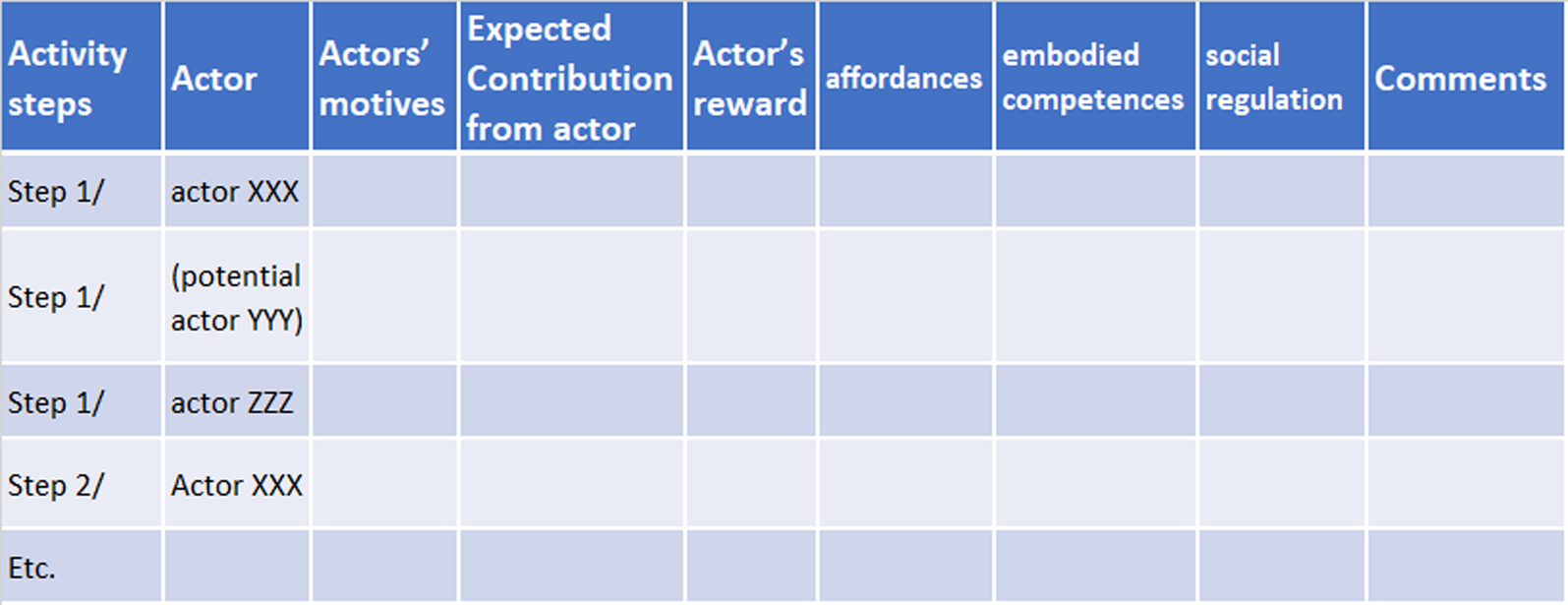
Each sub step is a task to solve for the subject, with the affordances, competences and social regulation present at the point of action. It is possible to intervene on any of these layers to channel the subject's behaviours. In other words there are several possibilities to obtain a similar result. For example, reducing consumption of a given class of products can be obtained by forbidding them to be sold on some specific markets, by influencing their price by taxation, by changing their composition by regulation, by changing their image by advertising campaigns or labelling, by influencing the subject's attitude by information and advertising, by putting social pressure through other stakeholders (e.g. the family doctor, the children). The interventions will depend on the type of consumer, the type of product, etc. At some points, one shall spot some potential need for intervention, for example, when a ‘wrong’ choice is made. One shall understand (often, simply by asking the consumer) what are the main situational factors that influenced that specific behaviour at this step. These factors may be in one or several layers of the installation. One is then, after a first study of the actual behaviour, left with a list of ‘pain points’ (moments experienced as problematic when performing in the behaviour) where one could intervene, and also with a series of factors that are apparently determinant. For example, it may turn out that the packaging is difficult to open for certain consumers, that some consumers cannot find the product in their usual retail point, that some consumers do not store the product in safe conditions, that the portion encourages over-consumption, that some consumers do not know how to cook the product properly, that a large quantity is wasted, that there are misconceptions about the nutritional properties, that cultural or religious beliefs prevent consumption, etc. This can be summarised in a grid, as in Fig. 3.
Installation grid. List step by step the components of the installation and the stakeholders involved.
The choice of where to intervene will often represent a compromise between several dimensions. One factor can be the importance of the problem identified. Another is the capacity to intervene (‘agency’) on the factor that was identified as determinant. Often, it is difficult to have influence on these factors, at least at reasonable cost. Here is where installation theory may be useful. To modify the behaviour at one point, one has three potential layers of intervention. It is not necessary to fix the problem with the layer where the identified determinant is. Often, intervening on another layer is easier and sufficient. For example, making the affordance very visible at the point of delivery of behaviour can compensate a weak intention in the subject. That is what this author and colleagues did to foster water consumption (see example in next section) by making the presence of drinking-water salient. Conversely hiding the affordance can balance a strong desire: if the candies are less visible, less will be eaten. Involving some social control or regulation is also a way to channel consumption. For example, reducing the use of pesticides or enforcing use-by dates on labels will limit cases of food poisoning. The fact one can consider three possible layers of intervention and use them opportunistically and according to one's agency (political windows, budgets, access, etc.) considerably facilitates design by giving more degrees of freedom for intervention.
More precisely, the steps are as follows:
(1) Analyse activity step by step for target stakeholders (by following users as they proceed and asking them why they act as they do).
(2) Spot where to act (see above: select pain points).
(3) Target layer modification (choose in which layer(s) to act, e.g. change affordances and implement regulation).
(4) Check (formal and psychological) contracts with stakeholders.
(5) Simulation/trial/evaluation/probation (reiterate as necessary).
(6) Deployment
The three first steps of design make the installation more functional and fluid to foster the desired behaviour. The next three make sure the installation is durable. Many interventions will require the contribution of other stakeholders than the consumer, such as retailers. These stakeholders will be involved in transactions where they contribute to the behaviour; these transactions must be balanced in the sense that the stakeholders get fair reward for their contribution(Reference Coyle-Shapiro, Pereira Costa and Doden38). This reward can be economic, social, psychological, etc.; its nature does not matter as long as participants feel the ‘psychological contract’ (i.e. the informal contract between parties) is satisfying for them. The ‘psychological contract’ may differ from the explicit formal contract. A classic example is that a work contract may specify one must work from 9 to 5; but the psychological contract often expects that one should stay later if there is an important deadline to meet; and conversely that one could leave earlier if there is a good private reason. In the food domain, understanding such psychological contracts (what individuals understand as what is expected from them) can be illuminating. For example, according to a study on French mothers(Reference Rigal, Champel and Hébel39), while highly educated mothers (postgraduate) tend to feel as part of their role that they must safeguard the long-term health of their child (and therefore resist to serve their child large portions of palatable food), less educated mothers see their role as satisfying the child and yield larger portions when the child expresses appetite arousal. It is essential to understand the motives of the actor at this stage, since which rewards will be considered ‘valuable’ depends on the motives (refer Fig. 3).
Once the interventions are chosen and discussed with the various stakeholders (consumers included) to check that psychological contracts are balanced, tests of the intervention at small scale, in a reversible manner, should be taken before mass deployment. Changing behaviour at one point will have implication for other behaviours of other stakeholders. It is only by testing that the nature and scale of these effects can be understood, perhaps leading to a re-design.
As one can see, even with this very structured and systematic method, intervention design remains an art in the sense that there is no single obvious optimal design. The design not only depends on the behaviour to be channelled and on the socio-technical constraints inherent to the behaviour, it also depends on the agency of the behavioural change designer (what they can actually do in practice considering their position in the system and given the economic, political, technical and social conditions). A national government will have very different agency from a non-governmental organisation or a local government. The benefit of applying installation theory is that it provides a palette of possible interventions using the three layers at each step.
An example: increasing water intake
Leveraging installation theory can yield stronger impact, but it does require a deeper study of the behaviour in order to build the activity timeline and the installation grid (which may vary with consumer segments e.g. rural/urban). One also should be aware that some elements are more or less easy to implement and maintain in time.
Here is a brief illustration with an intervention designed to improve the water intake of Polish children(Reference Lahlou, Boesen-Mariani and Franks40–Reference Bottin, Boesen-Mariani and Guelinckx42). Sufficient water intake is essential, furthermore drinking sweet beverages at an early age is considered to contribute to obesity and diabetes in later life(Reference Ebbeling, Feldman and Chomitz43–Reference Malik, Popkin and Bray45). Therefore it is important that drinking habits in children involve a sufficient water intake and minimise sweet beverages. Poland was chosen as the testbed of this intervention because of the low hydration status of children compared to the rest of Europe, and also their high intake of sweet beverages(Reference Guelinckx, Iglesia and Bottin46).
The intervention consisted of a randomised control trial, where the design delivered information (in order to change the embodied competences of parents and children), affordances (in the form of small water bottles delivered at the home) and some social regulation (by creating an online forum where the parents could exchange their experience).
During a whole year, families with children aged from 3–6 years were followed, their drink intake in six one-week waves of study was monitored to assess short- and long-term impact. In total, 343 participants stayed till the end, with some 30 % attrition. Actual behaviour was also recorded by asking five volunteer mothers to record their day with wearable miniature video cameras. Detailed results are presented in(Reference Lahlou, Boesen-Mariani and Franks40–Reference Bottin, Boesen-Mariani and Guelinckx42). In short, they show a significant increase in water consumption (threefold, see details later), an increase that is the more important the more layers are involved in the intervention (even though the social layer had not much impact, as most of the parents were lurkers rather than active in the online forum). At the peak of intervention (wave 3), when the families were exposed to information, forum and the water bottles were delivered at home, mean water consumption was almost three times higher than in the control group (343 v. 128 ml). But when the affordances disappear, while the difference remains highly significant, with a consumption level almost twofold higher than the control, the size of the effect lowers. The explanation is obvious: since behaviour is the result of the various components, withdrawing a component (here, the small water bottles) lowers the impact. Interestingly, 6 months after the end of intervention the effect of intervention still remains significant as families have acquired new habits. Qualitative analysis of the videotapes with the mothers showed that merely seeing water bottles would remind them to drink. The tapes also showed the strong social regulation of mothers encouraging their children to drink water rather than sweet beverages, influenced by the information they had been given, and the tips exchanged with other parents. These results suggest that induced practice may do more to change habits (and later perhaps attitudes) than persuasion. It suggests, to paraphrase Lewin, that people come to like what they drink rather than drink what they like. So if one sets up installations that channel behaviour long enough to change habits (and if of course the new behaviour has positive results), people may not only change their behaviour but be happy with it.
Conclusion and perspectives
The behaviour of people is channelled by installations. Installations combine components that enable but also limit the possibilities of action. The components are distributed in three different realms: affordances in the built material environment, competences embodied in the subject and social regulation inscribed in society. These components assemble as behavioural attractors that foster, scaffold and control behaviour at each step of the behavioural path. Societies naturally contain vast numbers of these installations, which human subjects can recognise naturally as behavioural settings. These installations make the subject's behaviour predictable, and are powerful enough to supersede most classic variables such as age, sex, social class, education, attitudes, etc.
It is possible to leverage installations in order to produce behavioural change. This can be done methodically by analysing step by step the target behaviour using activity theory to cut activity ‘at its natural joints’ (i.e. at the natural behavioural transition between one subgoal and the next in the course of action), listing at each step the determining components and motives, and intervening in any of the three layers (by design, education or rules) to modify the behaviour at this step(Reference Lahlou, Heitmayer and Pea47). Interventions should be discussed with stakeholders, not only to check that the modified components actually channel the desired behaviour, but also to make sure that the psychological contract is balanced. This method can have powerful and lasting results, nevertheless it is important that the installation remains in place.
The advantage of the approach presented, beyond having stronger impact by combining several layers of intervention instead of one only, is that it offers a range of possible interventions much wider than the classic approaches focused on a limited set of components (typically, psychological or economic); therefore, it provides more degrees of freedom and the possibility to intervene opportunistically according to the agency available (technical, economic, political, etc.) The main limitation of the approach is that it requires a detailed analysis of the behavioural path and a participative approach involving stakeholders. Both are intensive in time and efforts. Involving stakeholders also excludes a purely top-down approach that would be more comfortable for policy makers. But if you want to change behaviour, you should do it with the people, not for the people. Because what you do for the people, you do it to the people. This participative approach is not only ethical; it is also more efficient. Again, as Lewin(Reference Lewin4) showed in 1943, when the target people participate in the decision to change their behaviour, the change is more likely to actually happen.
Acknowledgements
The European Commission EURIAS senior fellowship programme, for a year of invited residence at the Paris Institute for Advanced Studies, with the support of the French State managed by the Agence Nationale de la Recherche, programme ‘Investissements d'avenir’ (ANR-11-LABX-0027-01 Labex RFIEA+).
Financial Support
Not applicable.
Conflict of Interest
None.
Authorship
Saadi Lahlou was the sole author; the water intake intervention studies cited were conducted in collaboration with the authors of the articles referenced.


 Open access

