


Introduction
The Tien Shan mountains, between 40 and 50°N, and 67 and 95°E, extend 2450 km from their western section in the Soviet Union to the eastern section in China. All rivers originating from the Tien Shan mountains are part of an inland river system. Apart from several larger rivers, such as the Ili, Syr Dary, and Aksu Rivers, most are isolated piedmont streamlets (Fig. 1). There are 16 396 glaciers with a combined area of 16427 km2 and estimated volume of 1369 km3 in the Tien Shan mountains.

Fig. 1. Location of glacier observation stations in the Tien Shan mountains. 1. Sary-Τοr, 2. Karabatkak, 3. Tuyuksu, 4. Golubin, 5. Glacier No. 1, 6. Abramov.
Water in this inland arid area comes largely from alpine glaciers. Therefore, glacier variations have an important influence on the water resources. Glacier variations, including their length, area, and volume, are not only the direct result of present climatic change, but also provide an historical record of earlier climatic variations. The climate affects the glaciers through glacier mass gain and loss. This paper tries to elucidate the causes of glacier variations through analysis of Tien Shan glacier changes and the relation between mass balance and climate.
Trend Of Glacier Variations And Regional Characteristics
In the Tien Shan mountains, statistical data from 74 glaciers indicate that the glaciers have tended to retreat since the Litte Ice Age (Reference AnonAnon, 1988; Reference Xiangsong and DeshengZhang and Mi, 1981). However, the retreat can be divided into two stages. From the late 1950s to the early 1970s the number of retreating glaciers was large, as was the magnitude of the retreat, while from the early 1970s to the end of the 1980s fewer glaciers were retreating and the magnitude of the retreats was smaller (Table 1).
Table 1. Recent changes in glaciers in the Tien Shan mountains

In the Akshiyrak Massif, from comparison of aerial photographs taken in 1934 and 1977, it can be seen that 147 glaciers (83%) retreated, 24 (13%) were stable, and 7 (4%) advanced. In this period of 34 years, the glacier area was reduced by 14 km2, or 4% of the 1934 glacier area, and glacier volume decreased 3.57 km3, corresponding to a specific net balance of –256 mm a-1 (Reference Kuz'michenokKuz'michenok, 1989).
The retreat rate of most of the glaciers in the Tien Shan has decreased slightly since the early 1970s. For example, from the late 1950s to the early 1970s, the annual retreat rate of Tuyuksu Glacier averaged 17.5 m a−1, whereas, from the early 1970s to the mid 1980s, the retreat rate averaged 14 m a−1. Glacier No. 1, situated in the eastern Tien Shan, retreated at a mean rate of 6 ma−1 from 1963 to 1973. Thence to the mid 1980s, its annual retreat rate averaged 3.3 m a−1 (Fig. 2). Maritime glaciers that commonly received moisture from the Atlantic, such as those in the Caucasus and Alps, became stable or began to advance in the late 1960s. In contrast, continental glaciers in the Tien Shan mountains continued to retreat, although their retreat rate decreased.

Fig. 2. Cumulative differential curves of the terminus variation of Glacier No. 1 (1) and Tuyuksu Glacier (2). The ordinate is defined by
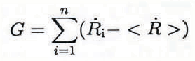
where G is the cumulative variation in retreat rate, Ṙ i is the retreat rate in year i, and <Ṙ> is the mean retreat rate over the period under consideration.
In the Tien Shan mountains, glacier retreat rates decreased with increasing degree of climatic continentality (from western to eastern Tien Shan) and increasing difference in elevation from the highest point on the glacier to the terminus, ΔH. During the last 30 years the annual retreat rate of Tuyuksu Glacier was –20 m a−1, while Glacier No. 1 has had an annual retreat of –4 to –5 m a−1. There was a similar tendency earlier. Tuyuksu Glacier retreated a total of 740 m from 1923 to 1984, exceeding the total retreat of Glacier No. 1, 610 m, since the Little Ice Age.
Glacier Variation And Climate
Analysis of records from Mengyeky Meteorological Station (3014 m a.s.l., 43°05′N, 77°04′E) near Tuyuksu Glacier reveals that, since late in the last century, there have been two periods of high precipitation, namely 1894 to 1914 and 1961 to 1972, when the annual mean precipitation values were respectively 50 and 250 mm higher than the mean for the period from 1879 to 1985. However, the mean summer temperature has increased since the 1920s (Table 2). Only the high precipitation period from 1894 to 1914 was accompanied by a decrease in temperature; at that time most of the glaciers in the Tien Shan advanced and produced terminal moraine ridges before retreat resumed. In comparison with the Alps that receive moisture from the Atlantic, the annual precipitation and mean summer temperature in the Tien Shan varied nonsynchronously (Fig. 3). Taking Reckingen Station (1338 m a.s.l., 46°28′N, 08°15′E) in the Alps and Mengyeky Meteorological Station in the Tien Shan as examples, since the early 1970s the relatively lower temperatures in the Alps were accompanied by an increase in precipitation, whereas the glaciers in the Tien Shan mountains experienced a period of higher temperatures and less precipitation. Glaciers in the Tien Shan mountains thus retreated.

Fig. 3. Five-year moving average curves of annual precipitation (Pa) and mean summer temperature ( Ts) from several meteorological stations in the Tien Shan.
Table 2. Variations of annual precipitation, P a, and mean summer temperature, T s, in the Tien Shan and in the Alps

The synchroneity of annual precipitation and mean summer temperature variations in the Tien Shan becomes weaker with increasing distance between meteorological stations. The correlation coefficients of five-year moving averages in precipitation and mean summer temperature between Mengyeky, Baitik (1579 m a.s.l., 42°19′N, 74°30′E), Tien Shan (3614 m.a.s.l., 41°55′N, 78°14′E), and Daxigou Stations (3539 m.a.s.l., 43°06′N, 86°50′E) varied between 0.7 and 0.4. The Mengyeky and Baitik Stations, situated in the moderately humid belt of northern Tien Shan, are closely related with correlation coefficients of 0.7, but then correlations weaken as distances increase. Tien Shan and Daxigou Stations are closely related again; correlation coefficients are 0.7 ± 0.02. Furthermore, the variability, σ, of annual precipitation and mean summer temperature also decreased with increasing degree of climatic continentality (Table 3). The magnitude of glacier advance or retreat was controlled by the variation in amplitude of the precipitation and mean summer temperature. As the degree of climate continentality increased, retreat rates of glaciers decreased.
Glacier Variaton And Mass Balance
The mass balances of the Golubin, Tuyuksu, and Sary-Tor Glaciers and of Glacier No. 1 are determined by the west and northwest air currents over the Tien Shan mountains, which determine the formation of precipitation. Differences in precipitation are related to glacier location in the mountains. Both the Tuyuksu and Golubin Glaciers are situated in a moderately humid belt on the western margin of the mountains, and the synchroneity of signs of their mass balances was as high as 85%. The synchroneity of signs decreases with increasing distance from the source of atmospheric precipitation. The synchroneity of Tuyuksu arid Golubin Glaciers on the one hand, and of Glacier No. 1 on the other, decreased to 50 and 69%, respectively. But synchroneity of mass balance of Sary-Tor Glacier and Glacier No. 1 increased to 85%.
Table 3. Variability of mean summer temperature, Ts, and annual precipitation, Pa, in the Tien Shan mountains

Cumulative differential curves of mass balance can be used to express the directions and trends of mass balance variation. These curves (Fig. 4) are defined by
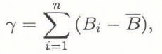
where γ is the cumulative specific mass balance, B i is the mass balance in year i, and B̅ is the mean mass balance over the period under consideration. Reconstructed mass-balance data for Tuyuksu Glacier and Rhonegletscher Glacier in the Alps, from Reference Vilesov and GuzhavinaVilesov and Guzhavina (1988) and Reference Jiyang and FunkChen and Funk (1990), respectively, are used as an example. Rhonegletscher and Tuyuksu Glacier have different directions and trends of mass-balance variation (Fig. 4). Since the end of the last century, the mass balance of Tuyuksu Glacier can be divided into three stages: 1879 to 1914 was a period of positive mass balances, with a mean value of 304 mm a−1 for the period; 1915 to 1973 was a relatively stable period, with small negative mass balances; and from 1973 the mass balance was intensely negative, with a mean value of –577 m a−1. The range, and starting and ending times, of the fluctuations of Rhonegletscher are different. The ending of its early period of above-average mass balance was delayed about 13 years. Shortly thereafter, it entered into a period of intensely negative mass balance (1928 to 1955). The mass loss during this period constituted 70% of the total loss. After the mid-1950s it entered a stable period. Nonsynchroneity of mass-balance variations is the primary cause of these regional differences in glacier variations.

Fig. 4. Cumulative differential curves of mass balance of Tuyuksu Glacier (1) and Rhonegletscher (2).
Table 4. Mass-balance variability of several glaciers in Tien Shan compared with Rhonegletscher

The sensitivity of glaciers to climatic variations is believed to be related to the variability in mass balance. This is suggested by the fact that the amplitude of annual mass-balance variations decreases with increasing degree of climatic continentality and with ΔH (Table 4). The variability in mass balance can be expressed by the standard deviation:
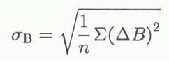
where ΔB is the difference between the mass balance in a given year and the mean value over the period. The mass balance of Tuyuksu Glacier has large variations in amplitude (σB ≈ 42). The variability of glacier mass balance decreases with increasing distance from the Tuyuksu Glacier. However, such a relation is affected by geographic location, altitude, and slope-direction. On average, the annual precipitation of Golubin Glacier is 150 mm less than that of Tuyuksu Glacier, but ΔH is 300 m larger on the former. This greatly decreases year-to-year fluctuations in climatic variation and reduces the variability of the mass balance (σB ≈ 31). The magnitude of advance or retreat of Golubin Glacier is less than that of Tuyuksu Glacier.
Compared with Glacier No. 1, Sary-Tor Glacier has a larger ΔH. In addition, it has lower summer temperatures as a result of the influence of the size of the glacierized region. Therefore, year-to-year fluctuations in its mass balance (σB ≈ 20) are less than those of Glacier No. 1.
In summary, in the interior of the Tien Shan, glaciers tend to be retreating at present. The magnitudes of their retreats are correlated with the variability of mass balance.
The heterogeneity of precipitation in space and time has an even greater influence on accumulation, ablation, and mass balance of glaciers. The relative difference of precipitation, R v, can be expressed by:
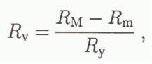
where R M is the monthly maximum precipitation, R m is the monthly minimum precipitation, and R v is annual precipitation. From the margin to the interior of the Tien Shan mountains, precipitation can be divided into two types: a transitional type in the western fringe and a continental type in the middle and eastern Tien Shan. The maximum precipitation in these areas occurs in April to May, May to June and June to July, respectively. The period of maximum precipitation thus seems to be delayed with increasing degree of climatic continentality. In other words, the precipitation tends to be concentrated in the summer. The summer precpitation at the western fringe of the Tien Shan is 35% of the total annual precipitation, while that in the eastern Tien Shan constitutes from 60 to 70%. The regional difference between distribution of annual precipitation and periods of maximum precipitation could affect the glacier accumulation, ablation, and mass balance. As one progresses from the maritime to continental types of precipitation, the winter balance contributes less to the annual mass balance, and accumulation is more concentrated in summer. Therefore, the absolute values of glacier accumulation and ablation are reduced.
The relation between glacier volume, V, mass exchange time, T, and mass input or output, A, can be expressed as follows:

With the same volume, the lower the mass input, the longer the mass-exchange time. Conversely, with the same mass input, the larger the glacier size, the longer the mass-exchange time. In the Tien Shan mountains the mass input decreases with increasing degree of continentality and the mass-exchange time becomes longer. Therefore, the dynamic response of glaciers to the climatic fluctuation is nonsynchronous and glacier advances or retreats occur at different times in different areas. Generally speaking, glaciers with lower mass-balance level and larger size are more stable (Reference ZichuXie, 1980).
Conclusions
Since the Little Ice Age, glaciers in the Tien Shan mountains have tended to retreat, except where there were unusually favourable conditions for the glaciers to remain stable or to advance. In the early 1970s, maritime glaciers in the Alps and Caucasus mountains became stable or began to advance, while most glaciers in the Tien Shan mountains only reduced their retreat rate.
The response of glaciers to climatic variations is through mass balance. From the edges of mountains to the interior, glacier winter balance makes a smaller contribution to the annual balance, total accumulation and ablation are gradually reduced, and the mass-exchange time increases. Therefore, the dynamic responses of glaciers to climatic fluctuations are nonsynchronous. Their advances or retreats occur in different periods, and the magnitudes of their retreat or advance are different, too.



