




Introduction
As in other parts of the world, the transition to sedentism in the Maya Lowlands—beginning around 1000 BC and possibly 1200 BC in a few cases (Inomata et al. Reference Inomata2020; Stemp et al. Reference Stemp, Awe, Marcus, Helmke and Sullivan2021)—is associated with the adoption of ceramic technologies, an increased reliance on agriculture and substantial changes in social organisation. Intensifying research at Middle Preclassic (c. 1000–350 BC) sites across the lowlands has revealed that the process of ‘settling down’ varied across and probably within different regions (e.g. MacLellan Reference MacLellan2024). In northern and central Belize, for example, pottery use began alongside the establishment of small villages that grew over time (Hammond Reference Hammond1991; Lohse Reference Lohse2010). Other lowland sites, including Ceibal and Aguada Fénix, were established as monumental ceremonial centres from the outsets, though a substantial portion of the population may have maintained a semi-mobile lifestyle (Inomata et al. Reference Inomata2015, Reference Inomata2020). Our understanding of the shifting socioeconomic practices of the lowlands is based primarily on permanent architecture, durable artefacts, including pottery, and archaeobotanical studies from early settlements. Human burials can provide crucial data for understanding changing social conditions, migration patterns and subsistence practices, but burials from the Preceramic (pre-1200/1000 BC) and early Middle Preclassic (c. 1000–700 BC) periods are rare throughout the lowlands.
Sites and contexts that span the Preceramic–Preclassic transition (c. 1200–800 BC; hereafter termed the Preceramic-transition) are also rare and, therefore, research on this transition has relied on comparative data from both the Preceramic and Middle Preclassic periods (e.g. Lohse Reference Lohse2010; Awe et al. Reference Awe, Ebert, Stemp, Brown, Stiver and Garber2021; Wrobel et al. Reference Wrobel, Hoggarth and Marshall2021a, Reference Wrobel, López Pérez and Ebert2021b). Most evidence from the Preceramic period, including skeletal data, comes from caves and rock shelters in Belize and the northern lowlands, which were used in various capacities for thousands of years, beginning in the Palaeoindian period (c. 11 500–8000 BC; Kennett et al. Reference Kennett2020; Prufer et al. Reference Prufer, Robinson and Kennett2021; Wrobel et al. Reference Wrobel, Hoggarth and Marshall2021a). The lack of material from the central lowlands may be due to comparatively lower population densities as well as the difficulty in identifying Preceramic sites (Lohse Reference Lohse2010; Awe et al. Reference Awe, Ebert, Stemp, Brown, Stiver and Garber2021).
Burial practices vary across the Maya region in the Middle Preclassic period (see Wrobel et al. Reference Wrobel, López Pérez and Ebert2021b); burials within settlements are uncommon but where they are found they are typically associated with ceremonial architecture and residential areas (e.g. Hammond et al. Reference Hammond, Clarke and Robin1991; McAnany Reference McAnany1995; McAnany et al. Reference McAnany, Storey and Lockard1999; Haviland Reference Haviland2014; Palomo et al. Reference Palomo, Inomata and Triadan2017). For K’axob, McAnany (Reference McAnany1995) suggests that heritable land ownership was established and naturalised through practices related to ancestor veneration, including interring important lineage members in house floors, ritually manipulating the remains of such ancestors and building successively in the same space through time. These practices, she argues, were integral to the emergence of social inequality and served as a template for divine kingship in later periods. Drawing on this seminal work, Brown (Reference Brown, Freidel, Chase and Dowd2017) suggests that Middle Preclassic burials in E Group plazas at Early Xunantunich and other sites in Belize were important individuals whose remains were revisited by later descendants and used in rituals related to the agricultural cycle that commemorated the sun and maize deities, which served to legitimise emergent political institutions. At Ceibal, MacLellan (Reference MacLellan2024) observed that burials in house floors are uncommon until the Late Preclassic period (c. 350–75 BC). Rituals conducted in the Central Plaza of Ceibal, some of which involved elite inhumations and others the caching of sacrificial human remains and exotic objects, are thought to have been important to early community building and differentiating status between those involved in the rituals and the rest of the populace (Aoyama et al. Reference Aoyama, Inomata, Triadan, Pinzón, Palomo, MacLellan and Sharpe2017). In all cases, burials found in association with public or domestic architecture represent specific individuals chosen for interment in these locales, possibly as a marker of social differentiation (Wrobel et al. Reference Wrobel, López Pérez and Ebert2021b: 547). Burial in house floors and patios becomes more frequent in later periods.
Between 2014 and 2023, 26 burials dating to the Preceramic-transition were found at an outlying minor temple complex of Ceibal, Guatemala, called the Amoch Group. These burials reflect a different mortuary practice, one that seems to emphasise social groups rather than individuals. Drawn from a rare transitional context, the skeletal data provide crucial information for understanding the shift to sedentism in the Maya lowlands. Here, we focus on the implications for understanding mortuary practices at the transition to the Middle Preclassic period; the results of ongoing radiocarbon dating and isotopic analyses will be reported separately.
Ceibal
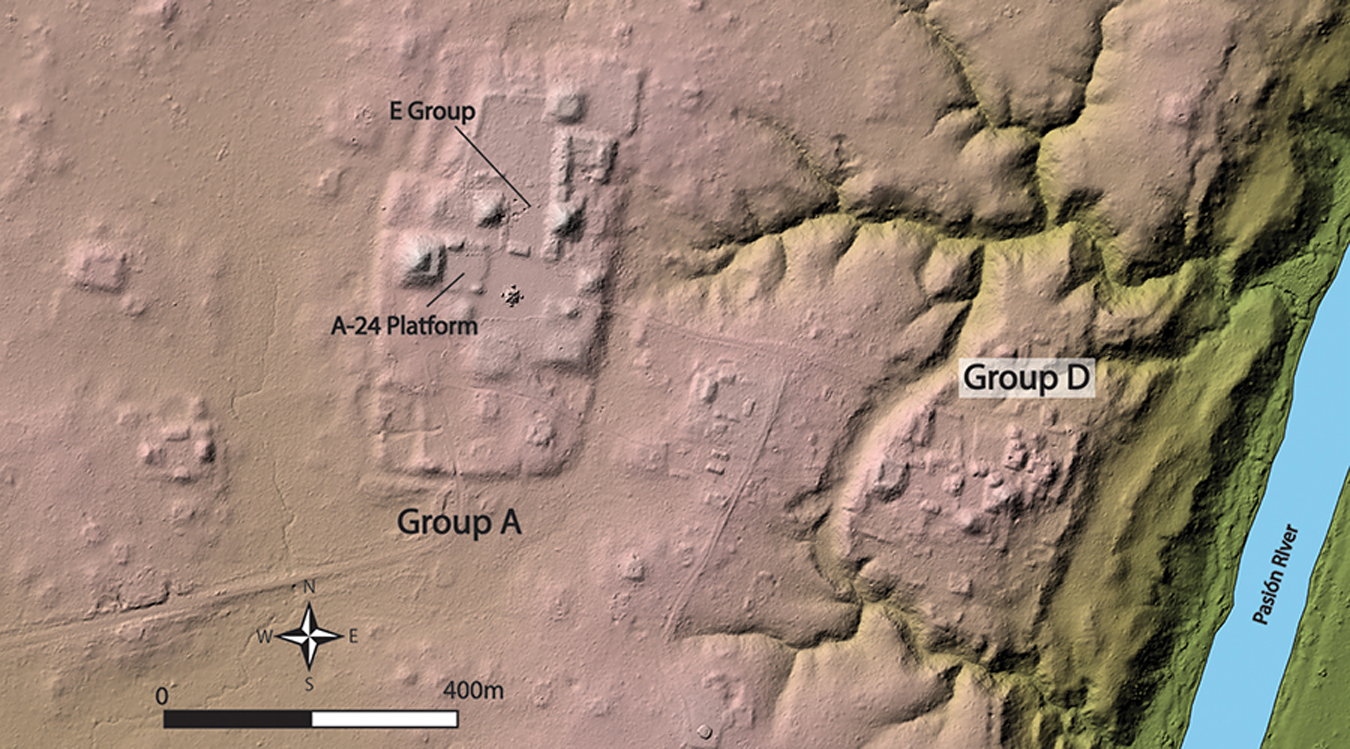
The lowland Maya site of Ceibal is located on a bend of the Río Pasión in the southern Petén District of Guatemala (Figure 1). Following research by Harvard University in the 1960s (Smith Reference Smith1982; Tourtellot Reference Tourtellot1988), Takeshi Inomata and Daniela Triadan of the University of Arizona directed the Ceibal-Petexbatún Archaeological Project (CPAP) between 2005 and 2017, which focused on excavations of the civic-ceremonial epicentre, Groups A and D, to learn about the early foundation of the site (Figure 2).
Map of Pasión Region showing Ceibal in relation to other sites in the area (figure by authors).

Map of Ceibal showing locations of areas mentioned in the text. Map created using data of a lidar survey conducted as part of the CPAP (Inomata et al. Reference Inomata2017b; figure by authors).

In the Central Plaza of Group A, the researchers found a ceremonial architectural complex, called an E Group (see Clark & Hansen Reference Clark, Hansen, Inomata and Houston2001), that was built from modified bedrock around 950 BC (Inomata et al. Reference Inomata, Triadan, Aoyama, Castillo and Yonenobu2013). The earliest fired ceramics found at Ceibal also correspond to this time (the Real 1 phase, c. 1000–850 BC; for detailed descriptions of Real pottery, see Inomata Reference Inomata and Walker2023). With the possible exception of the A-24 platform to the south-west of the E Group (Triadan et al. Reference Triadan2017; see Figure 2), no traces of permanent residential architecture dating to this phase have been found. Although the epicentre and outlying areas of Ceibal have been systematically excavated, the earliest ceramics are found only in the Central Plaza and the A-24 platform. These findings led Inomata and colleagues to suggest that semi-mobile groups had co-existed alongside a small, fully sedentary, ceramic-using population for a couple of centuries following the construction of the E Group (Inomata et al. Reference Inomata2015; see also Lohse Reference Lohse2010). Research at the Amoch Group, conducted between 2013 and 2023 as part of the original CPAP and a second phase of the CPAP, provides more information about the early inhabitants of the Ceibal area.
The Amoch Group
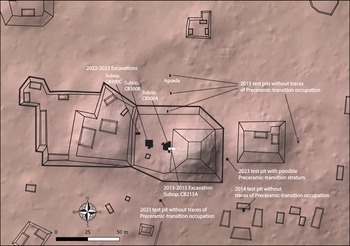
The Amoch Group is a minor ceremonial complex located approximately 570m north-west of the Central Plaza (Figure 2). Between 2013 and 2015, Melissa Burham and her team excavated this location as a sub-facet of the CPAP, uncovering four burials in a thin (>100–150mm) natural layer of sediment overlying the bedrock (Figure 3; Burham Reference Burham2019, Reference Burham2022). No ceramic or stone grave goods were associated with these individuals, nor were any artefacts found in the soil around them. All the burials were uncovered in a 4m2 unit at the foot of Structure 1, the pyramid in the group (Figure 4). A dark floor dating to the Late Preclassic Cantutse 2 facet of Ceibal (c. 300–150 BC) was laid directly over this layer. As such, the burials were initially dated to this sub-period and interpreted as a dedicatory offering like the mass burials of Cuello (Hammond Reference Hammond, Grove and Joyce1999). Samples from three of the burials were later submitted for radiocarbon dating and returned surprisingly early dates, ranging from c. 1200–920 cal BC (Burham Reference Burham2019, Reference Burham2022: sup. inf.; see Figure 5).
Preceramic-transition burials found in the frontal unit of excavation conducted in Structure 1 from 2013–2015 (figure by authors).

Map of the Amoch Group showing the locations of all excavations that reached bedrock, including those without Preceramic-transition traces. The thick black line shows the base of the Amoch Group main complex. Map created using data of a lidar survey conducted as part of the CPAP (Inomata et al. Reference Inomata2017b; figure by authors).

Radiocarbon dates from a sample of Preceramic-transition burials at Ceibal, shown both with and without correction for the freshwater reservoir effect. Samples were tested at Penn State Radiocarbon 14C Laboratory (PSUAMS) and were calibrated using Oxcal 4.4 and the IntCal20 calibration curve (dates and graphic previously published in Burham 2022 and Inomata et al. Reference Inomata2017b, Reference Inomata2022).

However, the carbonate bedrock of the Maya lowlands produces a freshwater reservoir effect (FRE), artificially increasing the radiocarbon ages of aquatic organisms in the area and of the animals, including humans, that consume them (Ascough et al. Reference Ascough2010; Philippsen Reference Philippsen2013). Correction for this effect provides dates of c. 1100–800 cal BC for these burials (Figure 5; see Inomata et al. Reference Inomata2022). Thus, it remains unclear as to whether these burials pre-date the initial E Group by 50–100 years or if they are contemporaneous with it, as the corrected dates have significant error ranges to cover potential variability in FRE offsets that are affected by changes in the aquatic environment over time, variation in feeding patterns and habitats of fish and molluscs, and differences in the diets of their human consumers. Additional radiocarbon dating and Bayesian modelling (currently underway) will help refine these dates further.
The Preceramic cemetery
In 2022 and 2023, we returned to the Amoch Group to investigate the potential Preceramic occupation of the area. We expanded the original excavation at the foot of the pyramid, carried out a large excavation in the plaza farther west, and placed a small trench on the edge of the western platform (see Figure 4). Over the course of our work in the Amoch Group between 2014 and 2023, test pits were placed to the north, south and east of the complex. The 2022–2023 excavations in the plaza uncovered the remains of an additional 22 individuals, buried in the same natural layer of sediment above bedrock in which the previous burials had been found (Figure 6). None of these burials were intrusive from layers above and, with the exception of CB221, none included any durable funerary offerings. Given their stratigraphic relationships with the burials previously excavated and dated, we are confident these new burials also date to the Preceramic-transition.
Locations of Preceramic-transition burials in excavations of the plaza of the Amoch Group (figure by authors).

Most of the burials are primary interments, and few cut into others. Many show signs of disturbance from human activity in later periods, including the exposure, partial destruction and removal of some skeletal elements. In the case of burial CB207, for example, Late Preclassic peoples cut through the left femur apparently to facilitate the deposition of a Velorio Dichrome vase (a ceramic type that is characteristic of the Late and Terminal Preclassic, beginning in the Cantutse 2 phase, see Inomata et al. Reference Inomata2017a: SI) with six exhausted obsidian cores inside. Ceramic ear spools were also placed by the bones of the right hand (Figure 7). The remaining part of the left femur was left in situ. A mark on the right femur was likely made from a digging tool when the vase and ear spools were deposited. The right femur of burial CB 219 was cut below the lesser trochanter and removed along with the proximal ends of the tibia and fibula. The remaining right femoral fragment was observed as angled up and articulated with the pelvis (Figure 8A), suggesting the individual’s legs were in a flexed position. The left leg and arm of the same individual were also removed, and the cranium was badly damaged. These elements were likely disturbed and removed by happenstance when a Late Preclassic round structure was built. Burials CB202 and CB203A were similarly disturbed, with half the skeleton in each case well-articulated and the other half removed (Figure 8B & C). Burials CB218, CB220A and CB220B were partially scattered and folded into the Late Preclassic floor above, while the parts of these burials that were deeper in the natural soil layer remained well articulated (Figure 8D). Burials CB203B and CB220B were represented by only a few cranial elements found near CB203A and CB220A, respectively, possibly indicating that the other bones were removed in antiquity. We also found large fragments of various human bones in the sediment layer and the Late Preclassic floor above.
Burial CB207 shown (A) with and (B) without a Late Preclassic vessel that cut through the left femur. The right femur has a cut mark from a digging tool (C) probably associated with the deposition of the vessel and ear spools near the right hand (figure by authors).

Examples of Preceramic-transition burials disturbed presumably by Late Preclassic activity: A) burial CB219; B) burial CB202; C) burial CB203A; D) burials CB218 and CB220A/B partially disturbed and scattered (figure by authors).

Following its use as a burial ground during the Preceramic-transition, this area remained unoccupied until 300–150 BC (see Burham Reference Burham2022) when levelling of the broader area in preparation for construction likely led the incoming residents to encounter many of the early burials. Such happenstance encounters would explain the variable nature of disturbance, with some burials partially displaced or destroyed and others carefully revisited or left alone. It is possible that the sediment was somewhat deeper prior to construction work during the Late Preclassic, which might explain why many of the Preceramic-transition burials are not heavily eroded despite lying in a thin, natural soil layer overlying bedrock.
Most individuals appear to have been interred in separate events, though it is possible some were buried near or were cut into other burials on purpose. Some burials (CB162, CB209 and CB212) were marked with stones lying directly over the remains, though it is unclear whether these would have been visible on the surface or if they were in turn covered by soil. We did not excavate the natural soil layer in every excavation unit, but in the areas that were excavated to bedrock or deeper, we found at least one burial per 4m2, with some as close as 0.2m from their nearest neighbour and others as distant as 2m (see Figure 6). At least three, but possibly four, burials were cut into others. The cranium of burial CB221, for instance, was placed into the lap of burial CB214 (Figure 9D) and the mandible of burial CB223 was placed on the pelvis of burial CB217. In both cases, the earlier burials were not damaged but seem to have been carefully exposed when interring the later burial. Such care might indicate that the intercutting was intentional, further suggesting that the locations of burials were marked or otherwise known. It is possible that individuals interred close together were from the same lineage or immediate family.
Examples of burials in supine extended or flexed positions: A) CB209; B) flexed legs of CB208; C) CB224; D) CB214 with the cranium of CB221 in the pelvic region (figure by authors).

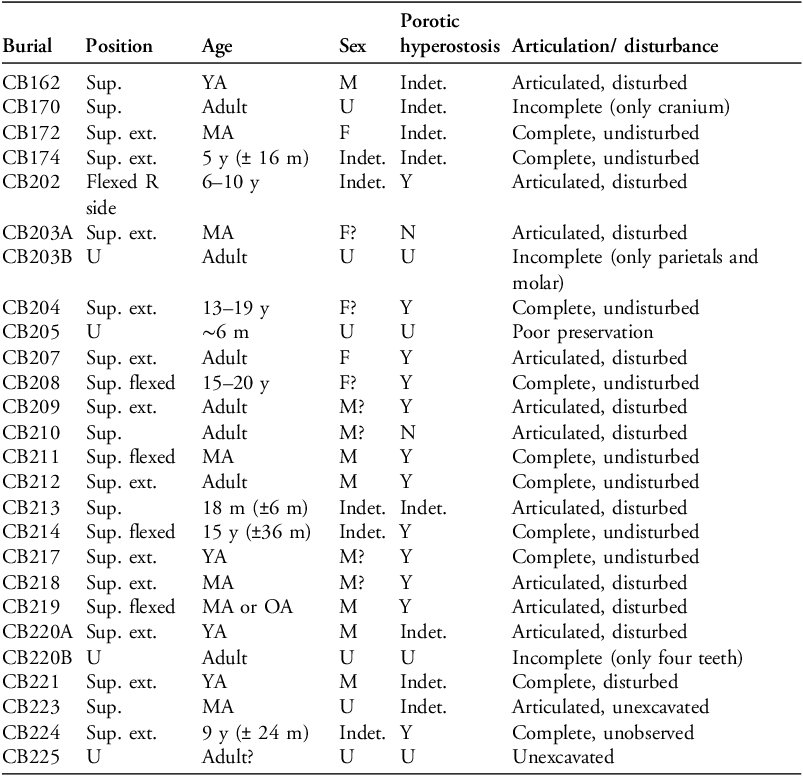
Bioarchaeologist Juan Manuel Palomo conducted osteological analysis of all individuals in the burial group (Table 1). When possible, biological sex was determined and age at death estimated, following established anthropological methods and bioarchaeological studies conducted in the Maya area (e.g. Buikstra & Ubelekar Reference Buikstra and Ubelaker1994; Wrobel et al. Reference Wrobel, Danforth and Armstrong2002; Wright Reference Wright2006; see Palomo Reference Palomo2020: 44–46). Sex was determined primarily from pelvic anatomy, when possible, but determinations were also informed by analysing the morphology of the mastoid processes, nuchal crest and supraorbital ridges. Of the 15 skeletons for which biological sex could be determined, 10 are male (or possibly male) and five are female (or possibly female), though some identifications may change following the analysis of ancient DNA. Estimation of age at death focused on long bone length, development of long bone epiphyses and cranial sutures, dental development and wear, and pubic symphyseal morphology when possible. The buried individuals encompass age categories from infant (six months) to mature or old adult (36–50+ years).
Demographic profiles of Preceramic-transition burials from the Amoch Cemetery.

A position of Sup. (supine) indicates that the legs could not be observed; Sup. ext. = supine with extended legs; Sup. flexed = supine with flexed legs; YA = young adult (aged 20–35 years); MA = mature adult (35–50 years); OA = old adult (50+ years); y = years; m = months; M = male; F = female; Indet. = Indeterminate (not possible to determine); U = unobservable because skeleton was incomplete or unexcavated.
Several individuals showed dental decay and porotic hyperostosis (skeletal lesions, often of the cranial vault; n = 12, see Table 1), the latter of which is a sign of anaemia that could be the result of a diet low in iron, among other potential causes (Wright & White Reference Wright and White1996: 157–62). High levels of dental decay and porotic hyperostosis have been linked to diet changes and nutritional deficiencies in early and established agricultural populations (e.g. Cohen & Armelagos Reference Cohen, Armelagos, Grove and Joyce1984; Wright & White Reference Wright and White1996; Wright Reference Wright2006: 175–76). Analysis of stable carbon and nitrogen isotopes based on bone collagen from three of the burials found in the earlier seasons (CB162, CB172 & 174), conducted as part of a larger study of dietary change over time, suggests this population consumed a moderate amount of maize—and even slightly more than the sedentary populations of the Real phase—alongside large amounts of meat and aquatic resources (Palomo Reference Palomo2020: 115–19, 133). More broadly, the study found that maize consumption at Ceibal remained consistent throughout the Preceramic-transition and Preclassic period, only increasing substantially during the Terminal Preclassic period (c. 75 BC–AD 175; Palomo Reference Palomo2020: 124–27). Pending verification from ongoing isotopic analyses, these data suggest that the earliest populations at Ceibal, including individuals interred in Preceramic-transition burials in the Amoch Group, subsisted on a combination of horticulture and foraging, though it is unclear how intensively these populations were engaging in agriculture (see Clement et al. Reference Clement2021).
Two or possibly three different burial positions were observed (see Table 1). Most (n = 12) individuals were placed in an extended supine position with hands resting at their sides or folded over their pelvis (Figure 9). Four individuals were placed on their backs with legs in a flexed position and arms folded over their chest, abdomen or pelvis (see Figure 9). Four others were supine, but the position of the legs could not be determined, either due to the disturbance or removal of elements (burials CB162 & CB213) or incomplete exposure during excavation (burials CB210 & CB223). Five burials were incomplete, poorly preserved, or unexcavated (burials CB170, CB203B, CB205, CB220B & CB225), so we could not determine positioning. Only one individual (CB202) was found laid on their side in a flexed position, but it is possible that this individual was originally placed in a supine flexed position. No definitive secondary burials have been identified. The only burial with a potential durable funerary offering was CB221, in which two spherical (possibly slingshot) stones were placed on the individual’s chest. No other signs of preferential treatment or status differentiation are apparent.
Currently, it is unclear what the differences in burial position indicate. One possibility is that distinct culture groups with slightly different mortuary traditions used this area concurrently (e.g. Rhodes et al. Reference Rhodes, Mountjoy and Cupul-Magaña2016). Yet, the burial styles share many characteristics (supine, folded arms over pelvis, abdomen or chest) and at least one of the legs-flexed burials (CB214) cuts into a legs-extended burial (CB221). If our assumption that individuals interred close together were related is correct, then it is unlikely that burial styles represent cultural differences. It is possible that the flexed burials were wrapped at the time of their interment, a practice that is common throughout Mesoamerica in later periods, but the positioning of skeletal elements within the burials does not indicate that the bodies were tightly wrapped, like the bundled and flexed burials documented at other sites (e.g. McAnany et al. Reference McAnany, Storey and Lockard1999). Continuing ancient DNA analyses will reveal if and how individuals were related, allowing us to explore the possibility of family plots within the burial ground and to understand if it was used by specific lineages.
Another possibility is that the flexed position indicates an individual who was loosely wrapped or placed in a litter to be transported to the Amoch Group, having died outside the immediate area. In this case, burial position would allude to decreasing mobility and increasing ties to specific places in the landscape. If these populations were not fully sedentary, this pattern could indicate that groups stayed close enough to Ceibal for long enough periods of time to be able to bring deceased members to this locus before the bodies completely decomposed. Individuals from these populations may also have been interred elsewhere when they were too far from Ceibal, as observed ethnographically and in the archaeological records of hunter-gatherer groups (e.g. Littleton & Allen Reference Littleton and Allen2007).
The remains of multiple individuals were uncovered in all excavation units that reached bedrock in the plaza of the Amoch Group (see Figure 4). As such, it is probable that more burials are present in areas that were not excavated or where excavations did not reach bedrock. No evidence of domestic structures or other activities from the Preceramic-transition was identified, and only a few small lithic flakes were found in the soil around the skeletons during the 2022–2023 seasons. The individuals appear to have been interred away from habitation areas, suggesting the Amoch Group was a dedicated cemetery (the Amoch Cemetery) during the Preceramic-transition. Test excavations around the Amoch Group suggest the cemetery did not extend north or south of the main basal platform (see Figure 4). Although we did not encounter any burials in the small test pit to the east of Structure 1, we did find similar stratigraphy near the bedrock, and it is possible that the cemetery extends to this area of the group. The main complex of the Amoch Group (see Figure 4) is approximately 8600m2 in area; assuming the Amoch Cemetery spans the size of the Late Preclassic complex, a substantial number of burials could be in the area.
Discussion
The burials from the Amoch Cemetery at Ceibal can help fill gaps in our understanding of the Preceramic-to-Preclassic transition in the Maya lowlands. Although rock shelters and caves were important mortuary sites in the Archaic though late Preceramic periods (c. 8000–900 BC), the Amoch Cemetery is distinct in being a dedicated burial ground established close to a contemporaneous or near-future ceremonial centre. While mortuary data from the Preceramic-transition are not well documented, the present evidence suggests burial practices of this period differed from the interments under or around residences and ceremonial architecture characteristic of later periods. It is currently unclear if the people buried in the Amoch Cemetery represent a specific group or lineage, or if the cemetery was used by several groups. However, given that a range of ages and both sexes are represented in the burial sample, with no indication of social differentiation among them, we believe this cemetery was equally accessible to all members of the group or groups that used it; it was not reserved for select individuals with special status, or at least any distinctions cannot be detected archaeologically.
This early burial ground prompts a reconsideration of the relationships between the use of cemeteries, the adoption of pottery and the establishment of permanent centres. It is possible that the Amoch Cemetery pre-dates the initial use of ceramics and the construction of the E Group at Ceibal, which could mean this mortuary practice is not connected with those developments. Alternately, the individuals in this cemetery could represent the populations that resided in the area immediately prior to or at the time of E Group construction. It is unclear if these populations lived in temporary camps, ephemeral seasonal settlements or a permanent village at Ceibal that remains undetected due to low archaeological visibility, yet the presence of a cemetery alludes to decreased mobility and long-term ties to this place. The decision to build the E Group at this location may have been influenced by its proximity to the cemetery—a culturally meaningful place—although mortuary practices appear to change alongside or following the construction of the E Group.
In the latter scenario, the absence of Middle Preclassic or earlier ceramics in the Preceramic-transition burials and later construction fills of the Amoch Group (Burham Reference Burham2022) presents two hypotheses regarding the use of ceramics. First, that the group who used the Amoch cemetery did not adopt pottery, even after those closely associated with the E Group began to use ceramics. In this case, aceramic and ceramic-using groups must have co-existed, with the latter possibly consciously resisting the use of ceramics or perhaps simply finding the continued use of gourds or baskets more practical for their semi-mobile lifestyles. The second hypothesis considers that those buried in the Amoch Cemetery adopted ceramics but did not use pottery in funerary rites.
Scholars have debated whether the emergence of early cemeteries is correlated with population growth, increased food availability or the development of territorial groups (Saxe Reference Saxe1970; Rowley-Conwy Reference Rowley-Conwy, Panter-Brick, Layton and Rowley-Conwy2001). The social and environmental conditions in which early cemeteries emerged across the world are diverse, and we do not suggest a universally applicable pattern. Nonetheless, the establishment of the Amoch Cemetery was most likely tied to profound social change, involving decreased mobility, increased reliance on maize and the development of ceremonial complexes. It is possible that other cemeteries and different mortuary traditions existed at Ceibal, in the Pasión region and the lowlands more broadly during this time, but that these have not yet been documented. Nevertheless, the Amoch Cemetery was a place of interment for at least part of the population, where deceased family members could be visited. Burial in a dedicated mortuary space and the development of ceremonies held at the E Group may have been integral to the creation of a persistent place (Schlanger Reference Schlanger, Rossignol and Wandsnider1992) and to the growth of a permanent settlement over the following centuries.
Conclusion
The excavation of 26 burials from the Amoch Cemetery of Ceibal reveals a distinct mortuary tradition, one centred on the use of a specific, non-domestic space, at the transition between the Preceramic and Preclassic periods in the Maya lowlands. Changing mortuary traditions in the centuries following the construction of the E Group and emerging pottery use could reflect the adoption of new beliefs and ritual practices, concomitant with a move to full sedentism and the development of private, heritable land ownership. Alternately, changing sociopolitical dynamics may have emphasised the status of key individuals, entailing continued distinction even after death. The transition to ceramic use and sedentism was a complex process, occurring at different times and in different ways around the world; continuing research at Ceibal and the Amoch Cemetery is providing new insights into this process at what would later become a monumental ceremonial centre.
Acknowledgements
The authors thank Daniela Triadan, Kazuo Aoyama, Ashley Sharpe, Javier Estrada, Ricardo Rojas, other members of the CPAP and all the excavators from the communities of La Felicidad and Las Pozas who have worked at the Amoch Group. Permissions were granted by the Instituto de Antropologia e Historia (IDAEH), Guatemala.
Funding statement
This research was funded by the National Science Foundation (BCS-1950988) and the Alphawood Foundation, with additional support from internal sources at the University of Arizona.





 Open access

