




1. Introduction
During the sixteenth and seventeenth centuries, Seville’s status as the sole Iberian city authorized to trade with the Spanish Indies made it a magnet for European merchants. Generally, foreign presence in the region increased significantly from around 1570 onwards, coinciding with the dynamization of the American economy and the trade connection with Asia, the increment of American silver inflows (∼1570), the Luso-Spanish dynastic union (1580), the broad economic shift in the Baltic and Atlantic markets triggered by the Eighty Years’s War (1568–1648), and the consolidation of the Hispanic-Genoese symbiosis (1575–76) (Stols, Reference Stols1969, p. 366; Fernández Chávez and Pérez García, Reference Fernández Chávez and Pérez García2012; Crespo Solana, Reference Crespo Solana2014; Herrero Sánchez, Reference Herrero Sánchez2005).
Since the early period of Spanish colonization in the Americas, “native” merchants in Seville held considerable influence over the commercial and migratory policies related to the Spanish Indies. However, their authority gained decisive weight with the establishment of the merchant guild in 1543, and even more conclusively after the approval of its regulations in 1556. At this point the “two-way flow of benefits” (Ogilvie, Reference Ogilvie2012, p. 190) materialized, whereby the Consulate gradually secured greater privileges to ensure its members the monopoly of American trade. In return, they provided regular tribute payments, generous donations and loans, and various administrative, financial, and logistical services (Bernal, Reference Bernal1992, pp. 212–228). As the main commercial rivals of the Sevillian “native” merchants, foreigners (i.e., non-citizens in Seville or non-natives of Castile) were expressly excluded from the privilege of trading with the Americas (Herzog, Reference Herzog2003, pp. 94–118).
Institutional constraints on foreigners did not prevent their participation in the Spanish exchange routes. As widely acknowledged, self-organized “informal networks” breached formal trading structures by employing several strategies based on cooperative interactions that transcended imperial borders (Moutoukias, Reference Moutoukias1988; Antunes and Polónia, Reference Antunes, Polónia, Antunes and Polónia2016). For wealthy foreign merchants, however, getting access to legal commerce through the acquisition of a naturalization letter, a license to trade in the Indies, and a membership in Seville’s merchant guild was crucial, as has been observed for other merchant corporations (Ogilvie, Reference Ogilvie2012, pp. 160–250). This increased their competitiveness by facilitaing the mobility of humans, goods, and capital, reducing transaction costs, improving contract enforcement, and, as this study will argue, accelerating market expansion and integration within and beyond the Spanish empire.
As extensively documented, foreign merchant communities in Seville took advantage of a combination of culture, class, and economic traits along with their nations’ political ties to the Spanish Crown to secure local and royal privileges that allowed them to circumvent monopolistic restrictions and participate legally in the Atlantic trade, particularly after the Crown’s bankruptcy of 1589. For instance, the Catholic faith, aristocratic ancestry and financial power of the Genoese made them an essential piece of the Spanish imperial system (Pike, Reference Pike1966; Herrero Sánchez, Reference Herrero Sánchez2005; Sardone, Reference Sardone2019). Likewise, the Flemish and Portuguese merchant communitiesFootnote 1 quickly integrated into the local and imperial economic, social, and political arenas (Stols, Reference Stols1969, p. 366; Fernández Chávez and Pérez García, Reference Fernández Chávez and Pérez García2012; Crespo Solana, Reference Crespo Solana2014).
These nations significantly increased their direct participation in the “Indies monopoly,” extending their agent networks and commercial operations in the Americas since the 1590s (Bernal, Reference Bernal1992; García Fuentes, Reference García Fuentes1997; Oliva Melgar, Reference Oliva Melgar2004; Poggio, Reference Poggio2022). Nations commercializing European goods were particularly drawn to the New Spain axis due to unique economic conditions—such as the increase in silver production and dyes, the growth of domestic commerce, the intensification of Pacific trade, and establishment of the Mexican merchant guild. Together with the reorientation of the Peruvian trade, these developments transformed New Spain into a major entrepôt for European and Asian manufactures between the Atlantic and the Pacific (Bonialian, Reference Bonialian2013, Reference Bonialian2019, Reference Bonialian2022). Other trading nations outside the Spanish monarchy depended on favorable geopolitical relationships with the Spanish Crown to “access” legal commercial routes through Iberian ports. Yet, their enterprises often faced significant barriers in the Americas. While previous research has explored the complex trade and exchange networks of foreign merchants operating from within the Iberian Peninsula, much less is known about “exo—imperial” traders—those from outside the Spanish Monarchy—and their transatlantic networks linking Atlantic markets within the Spanish Indies. This article examines the case of Seville’s French nation from a comparative, transoceanic perspective during the reign of Philip IV.
Although France was a primary commercial partner of Spain and the main supplier of luxury manufactures for the Indies markets, French commercial networks and their involvement in the Indies trade prior to the Treaty of the Pyrenees (1659) remain largely unexplored. Earlier scholarship on French trade in Andalusia during this period has often portrayed their participation in Seville’s monopoly and the American markets as marginal or indirect, typically carried out through intermediaries or by supplying goods to “native” traders (Girard, Reference Girard2006, p. 263; Dominguez Ortiz, Reference Domínguez Ortiz1996, p. 75; Israel, Reference Israel1980, 116-136; Priotti, Reference Priotti, Oliva Melgar and Lobato2013; Crailsheim, Reference Crailsheim2016, p. 20, 177, 142). However, during the 1635 reprisals against French nationals across the Spanish empire, “knowledgeable people in trading matters” from Andalusia alerted the king’s favorite, the count-duke of Olivares, that the returns generated by the French in that year’s Indies fleet could amounted 3 million maravedíes. This revelation sparked the Junta de Represalias’ particular interest in the small but wealthy French merchant community in Seville and their transatlantic enterprises (Poggio, Reference Poggio2024).Footnote 2 In the first months of operation, the Junta confiscated large sums of returns from Perú and New Spain, in addition to the 130 million maravedíes in properties and assets owned by French merchants in Seville (Alloza Aparicio, Reference Alloza Aparicio2006, pp. 90–103). Further investigations in the Indies, particularly in New Spain, reveled large amounts of capital invested in those markets (Poggio, Reference Poggio2024).Footnote 3
This article utilize a combination of novel sources—commission reports, official correspondence, naturalization letters, and ship manifests—collected from Spanish archives but produced on both sides of the Atlantic, to uncover the various factors that enabled French merchants to penetrate the Indies trade and the American markets during the 1620s, particularly between the Peace of Monzón (1627) and the outbreak of the Franco-Spanish War (1635). It argues that, during this period, the French nation of Seville received unprecedented royal support to develop enterprises that had previosly been marginal, informal, or peripheral in the Carrera de Indias. Furthermore, this investigation highlights the crucial role of regal patronage in accelerating the integration—or disjointing—of wealthy merchant communities into the Spanish Atlantic trading system. This process notably involved the expansion of agent and comissioner networks that facilitated direct exchanges in the American axes, which, as shown here, were not peripheral but central to the growth of their transnational enterprises.
By processing records of French trade from the Indies fleet ship manifests alongside data generated by the Reprisals—such as confiscations, transcriptions of Veracruz’s notarial records, and other reports produced in New Spain—this study uses the Network Analysis tool Gephi to reconstruct a detailed representation of the French connections within the Atlantic Spanish trade. To mitigate the single-nation bias, French networks are analyzed in the context of concurrent Flemish and Italian merchant communities operating in New Spain. Together, these three nations controlled a significant share of the cargo legally shipped to and from the viceroyalty during the 1620s and 1630s. The analysis aims to estimate the scale of French commercial activity in the viceroyalty, explore their interactions with both “native” and “foreign” merchant groups, examine the resilience strategies they employed following the reprisals of 1635 to mantain their operations, and, finally, provide broader observations on the reconfiguration of (foreign) trading networks in the Atlantic trade amid the intensified economic and political crises of the 1640s.
2. The tribulations of French merchant migration in Andalusia
When reprisals were ordered in 1635, the trade between France, Spain, and the Indies was flourishing. However, commercial relations between the countries and the presence of French merchants in Andalusia had not always been smooth. Since the mid-sixteenth century, growing economic exchanges with the American territories, combined with favorable diplomatic ties following the Peace of Cateau-Cambrésis (1559), had attracted itinerant traders from northern Brittany (Saint-Malo, Vitré, Morlaix, Pontivy) to establish direct commercial connections and settlements in Jerez de la Frontera, Cádiz, and the ports of Sanlúcar de Barrameda and Santa María, where they were granted various social and economic privileges (Salas Almela, Reference Salas Almela2008a, Reference Salas Almela2008b). French merchants imported grains, cloth, and other manufacturers both locally produced and sourced from abroad, to meet the growing demands of Iberian port cities and the expanding colonial markets. In return, they obtained salt, Iberian goods, and colonial commodities—mainly silver—which, once introduced in French Atlantic ports such as La Rochelle or Saint-Malo, was resold to domestic, English, and Dutch merchants, delivering high economic gains for private traders and the French monarchy (Priotti, Reference Priotti2004; Reference Priotti, Saupin and Priotti2008a, Reference Priotti, Saupin and Priotti2008b).
The decline in the exchange flows between Nantes and Castile around the 1570s along with the simultaneous rise of the commercial axis between Andalusia and Brittany and the consolidation of Seville as the main entrepôt of Atlantic and Mediterranean products, fostered a growing interdependency between these regions drawing merchants from the main French port cities to settle in Seville, where they acted as importers and intermediaries of local and international firms (Girard, Reference Girard2006, pp. 313–411; Casado Alonso, Reference Casado Alonso2000; Priotti Reference Priotti, Saupin and Priotti2008a; Reference Priotti, Oliva Melgar and Lobato2013, pp. 99–125). The social and economic significance of the French colony in the city led to the early establishment of a French consulate in 1578 (Girard, Reference Girard2006, p. 79; Crailsheim, Reference Crailsheim2016, p. 158). However, the tense diplomatic relations during the French Wars of Religion created an unstable period marked by the harsh treatment of French crews and frequent seizures of their ships and goods in Spain. Despite these challenges, trade exchanges continued, particularly in the Atlantic ports of Sanlúcar de Barrameda and Cádiz (Salas Almela, Reference Salas Almela2008a, pp. 33–34, 57, 200–208; Reference Salas Almela2008b). Additionally, the full payment sales preferred by French merchants favored round-trip commercial voyages during the last decades of the sixteenth century (Priotti, Reference Priotti, Oliva Melgar and Lobato2013). It also kept permanent merchant immigration levels remarkably low, especially when compared to the expansion of labor migrants within that community and others. For example, Portuguese migration surged after the dynastic union of 1580, and the Flemish—displaced by the Eighty Years’ War and the resulting economic reconfiguration of the region—experienced notable growth and relatively smooth integration into lower Andalusia (Descimon and Ruiz Ibañez, Reference Descimon and Ruiz Ibañez2013, pp. 150–151; Montojo Montojo and Ruíz Ibáñez, Reference Montojo Montojo and Ruíz Ibáñez2022; Stols, Reference Stols1969, p. 366; Fernández Chávez and Pérez García, Reference Fernández Chávez and Pérez García2012; Crespo Solana, Reference Crespo Solana2014).
This trend did not change after the Peace of Vervins (1598). Although French merchants were granted free access to Spanish ports, they continued to be suspected of transporting Dutch cargo during the embargoes imposed on the Dutch Republic prior to the Twelve Years’ Truce (1609). As a result, French traders were also subjected to an export duty of 30% following the Gauna Decree in 1603, which was reciprocated in France through a series of reprisals, including a total prohibition on French subjects to trade with Spain at a time when Iberian territories were experiencing severe grain shortages (Galabert, Reference Gelabert2007). By the 1610s, the political upheaval following the assassination of Henry IV in France led Maria de Medici to persue closer ties with Spain, culminating in a dynastic marriage between the two royal houses (Bueno Blanco, Reference Bueno Blanco2021, pp. 49–50). Despite positive signs for future international relations, such as the negotiations at Fontainebleau in 1611 and 1612, which settled the details of political alliances, and the celebration of the royal weddings in 1615, only a modest increase in the French merchant communities was observed (Crailsheim, Reference Crailsheim2016, pp. 245–253). While this rise may, once again, seem modest compared to the intensified trade and mobility of other nations in the Iberian territories during the same period, its institutional importance is undeniable. During these years, a protector of the French nation was appointed in Seville (1610) and consular representations proliferated across key Mediterranean and Atlantic entrepôts—including Sanlúcar de Barrameda (1613), Cadiz (1617), Barcelona (1618), Cartagena, and Sevilla (1620) (Girard, Reference Girard2006, pp. 113–115; Sanz, Reference Lorenzo Sanz1986, pp. 92–93; Montojo Montojo and Ruíz Ibáñez, Reference Montojo Montojo and Ruíz Ibáñez2022).
The establishment of a consular support network may have been a main factor behind a significant increase in the number of French merchants in Seville reported during the early 1620s. By that time, the nation had grown to over 50 individuals, although only a small proportion, predominantly those with roots in Rouen, Saint-Malo, and Salers, became well integrated into Seville’s local society. (Girard, Reference Girard2006, pp. 483–486; Crailsheim, Reference Crailsheim2016, pp. 134–136, 269–296). Yet, according to Crailsheim, the cluster remained relatively small over time, which compelled its members to seek connections with Spaniards and other merchant nations, particularly the Flemish, to establish competitive strategic family and business alliances (Reference Crailsheim2016, p. 280, 388). However, this collaboration may also reflect the emergence of new trading links between French merchants and the Dutch communities in Nantes and La Rochelle, which developed as a workaround to the restrictions imposed by Spanish embargoes on Dutch tradein 1621. The Dutch community in Nantes—crucial for transferring bullion derived from French imports and contraband in Spanish ports to the rebellious northern provinces–reached its activity peak between 1627 and 1634 (Bruyn Kops, Reference Bruyn Kops2007, pp. 28–33), aligning with the French merchant hub in Seville’s acquisition of several trading privileges and its increasingly “endogamic” behavior, particularly in the Indies trade, as will be discussed later. Although further research is needed to establish the connections between the Dutch and French communities in Spain, France, and the Low Countries, evidence supporting this hypothesis has already been suggested (Bruyn Kops, Reference Bruyn Kops2007, pp. 265–277; Crailsheim, Reference Crailsheim2016, pp. 363, 371–372).
3. Royal patronage and French penetration in the Indies trade
As was common among foreign traders in Andalusia during the period, French merchants diversified their businesses activities to minimize losses. They served as agents for family and transnational firms, invested in real estate, acquired farmlands to produce wine, vinegar, and oil–primarily for export–and engaged in the financial sector (Girard, Reference Girard2006, pp. 313–368; Crailsheim, Reference Crailsheim2016, Priotti, Reference Priotti, Saupin and Priotti2008a). Regarding the colonial markets, local notary records reveal the French sold large quantities of metalware, haberdashery, paper, books, and iron to Spanish cargadores (loaders) in the Indies fleets. However, the niche in which they, alongside the Flemish and Italians, dominated imports was textiles–one of the most prominent commodities in the Atlantic trade due to its high value, low transportation costs relative to space and weight, and strong demand in the Americas (Lorenzo Sanz, Reference Lorenzo Sanz1986; pp. 427–469; Crailsheim, Reference Crailsheim2016, pp. 269–196; Priotti, Reference Priotti, Saupin and Priotti2008b).
The French engagement in colonial trade has been highlighted as a primary reason for the wealthiest members of the nation to obtain letters of naturalization and licenses to participate in the Atlantic monopoly. Although contraband trade remained an option, the opportunity to conduct at least part of the business legally–thus securing a degree of protection and assurance in retrieving high silver returns–was a significant incentive to acquire these safe-conducts. For French merchants, direct access to silver was an extraordinary advantage, considering its price could increase by 100–250 percent once brought to France (Priotti, Reference Priotti, Saupin and Priotti2008b). Moreover, wealthy foreign merchants leveraged their substantial contributions to the royal treasury as a key to demostrate their comitment to Crown interests to secure benefits from the king. In other words, they used these contributions–even when made illegally and without naturalization letters–to assert their status as stakeholders of the empire (Grafe and Irigoin, Reference Grafe and Irigoin2012; Poggio, Reference Poggio2024, pp. 54–91).
Between 1580 and 1642, the Crown granted twenty-five naturalizations to French traders, with eighteen approved during the reign of Philip IV. This trend coincided with the issuing of similar privileges to all merchant nations during this period (Dominguez Ortiz, Reference Domínguez Ortiz1996, pp. 17–181; Crailsheim 2011; Crailsheim, Reference Crailsheim2016, pp. 71–99). Following Domínguez Ortiz, scholars often interpret this as evidence of a Crown policy liberalizing the granting of naturalization letters by grace (por vía de gracia), whereby the Crown exercised its power in exchange for money or specific service, despite complains from “native” merchants and crown officials. This practice is generally understood to have been driven by the need for revenue to address accumulated unpaid debts in the midst of economic crisis and escalating global warfare (Dominguez Ortiz, Reference Domínguez Ortiz1996, pp. 130–131).Footnote 4
While the interpretation is appealing and generally accurate, especially considering that “no aspect of the country’s life that was not considered as a possible taxable subject” during this period (Ruiz Martín, Reference Ruiz Martín1990, p. 111), Ortiz himself questioned this hypothesis, arguing that the number and cost of naturalization letters were neither suffient not significant to have a meaningfully impact on royal income compared to other revenue sources (Domínguez Ortiz, Reference Dominguez Ortiz and Benito Ruano1998a , p. 123). Many council consultations regarding the introduction of new taxes or temporary levies also indicate that these decisions were carefully deliberated. Thus, while possessing sufficient resources to contribute to the Crown’s finances was an important consideration for obtaining a naturalization letter with permission to trade in the Indies, it was by no means the sole determinant. Domínguez Ortiz suggested that political, economic, or social factors may have been more influential in explaining why individuals from a particular nation were granted these privileges during specific periods (Domínguez Ortiz, Reference Domínguez Ortiz1996, p. 123). More recently, scholars like Ana Crespo have emphazised the importance of tracing and clarifying the actual role and impact of privileges in the development of trading nations (Reference Crespo Solana2014). This calls for a multicausal approach to understanding the complexity behind such concessions, where the Crown, utilizing its authority, frequently bypassed communal practices and agreements reached with corporations, thereby risking strategic domestic relations such as those with the Cortes or Seville’s merchant guild (Herzog, Reference Herzog2003, pp. 76–77).
A closer examination of the timing of naturalization letters granted to French merchants reveals that sixteen of eighteen occurred during two periods: five between 1621 and 1624, and twelve between 1630 and 1634. Broadly, these intervals correspond to phases of relatively stable diplomatic relations between Paris and Madrid–initially from the early reign of Philip IV until Louis XIII’s engagement in the Valtellina War and alliance with the Dutch Republic in 1624, and later from the Peace of Monzón in 1627 until the outbreak of the Franco-Spanish War in 1635. By contrast, the hiatus from 1625 to 1627, reflects a period when the Crown marginalized the French merchant community, withdrawing royal favor due to diplomatic tensions with Louis XIII—particularly following the harsh embargo on their assets as retaliation for the French interception of two vessels carrying silver payments destinated for Spanish troops in Antwerp in 1625 (Alloza Aparicio, Reference Alloza Aparicio2006, pp. 57–75).
While international politics played an important role, they do not fully explain the unprecedented number of royal concessions granted to the French nation during these two periods. To gain a deeper understanding of the motivations, it is necessary to consider the domestic policy changes stemming from ongoing debates about the economic, political, and moral maladies affecting the Spanish kingdoms that started during Philip III’s reign and continued into the 1620s. Two reform policies that emerged from these discussions proved particularly effective in attracting French merchants. The first was rooted in efforts to address the depopulation of Castile, which was widely regarded as the underlying cause of the kingdom’s economic “decadence.” This policy was articulated in the Capítulos de reformación and was even translated and published abroad, at least in France and England, as early as 1623 (Dominguez Ortiz, Reference Domínguez Ortiz1996, p. 130–131; Elliot, Reference Elliot2004, p. 147, Reference Elliot2002, p. 113).
To attract migrants from Catholic countries and stimulate the kingdom’s industry and trade, the king offered several privileges, including fiscal concessions, citizenship grants, access to communal property use, and even housing. Besides targeting laborers, as noted by Dominguez Ortiz (Reference Domínguez Ortiz1996, pp. 76–78), the order also opened opportunities for merchants to become part of the local oligarchies, as it explicitly stated that “other foreigners” (i.e., not craftsmen or farmers) with more than six years’ residence in Castile should be admitted to public offices, with exception of government and ecclesiastical posts.Footnote 5 The initiative significantly increased French migration to Spain, with an estimated 200,000 migrants, the majority of whom were laborers (Girard, Reference Girard2006, pp. 463–486; Dominguez Ortiz, Reference Domínguez Ortiz1996, pp. 76–78).
However, the unprecedented institutional guarantees offered for traders, ensuring they could establish and develop their businesses hinting at future stability for their investments, became the main motivation for many of them to settle in Spain. This was explicitly stated by the French nation of Madrid in a petition submitted to the king several years later, aimed at recovering their privileges lost during the 1635 embargoes.Footnote 6 The unique opportunity not only drew in merchants from different nations but also encouraged those already residing in Spain who met or were close to meeting the requirements to apply for letters of naturalization “through justice”. This process involved adhering to local integration customs and additional regulations agreed with different corporations, such as the strengthening of requirements negotiated with the Merchant guild in 1608 and 1616.Footnote 7 Concurrently, during 1623 and 1624, three out of the five letters of naturalization granted to Frenchmen in the first years of Philip IV’s reign went to wealthy, well-integrated partners in Seville: Pedro Lafarja, Nicolas Blondel, and Alberto Juan Trehuarte (Crailsheim, Reference Crailsheim2016, p. 157).
At the same time, while adhering to mercantilist principles that emphasized international trade as a primary source of royal revenue, attracting foreign merchants and capital was implicitly a strategy to foster transnational commerce and most likely to encourage their investments in public debt (See: Álvarez Nogal, Reference Álvarez Nogal, Lanza García and López Vela2023). This was particularly aimed at addressing unexpected economic challenges that emerged following the enforcement of policies in the early 1620s. As part of this approach, specific issues and debates raised by foreign merchant lobbies during Philip III’s reign were revisited in different councils and juntas convened by the Count-Duke of Olivares, in those years. For example, there was a proposal to establish a “general protector of foreigners” to address the needs of foreign merchants within the court, rather than relying on local or group-appointed protectors designated by the State Council. Additionally, questions regarding trade liberalization were reevaluated, alongside consideration of restructuring the Atlantic monopoly in companies, drawing inspiration from the Dutch model (Elliot, Reference Elliot2004, pp. 186–188; Studnicki-Gizbert, Reference Studnicki-Gizbert2007, pp. 123–150; Recio Morales, Reference Recio Morales2021, pp. 15–38; Molas Ribalta, Reference Molas Ribalta1987, pp. 91–98).
Within this plan, noticeable favoritism towards certain nations became explicit after the King’s trip to Seville in 1623. During this visit, Olivares and other ministers negotiated with Flemish and German merchants to establish the Almirantazgo de Sevilla, an initiative designed to mitigate the domestic impact of blockades against the Dutch while intensifying their economic effects on the enemy (Dominguez Oritiz, Reference Domínguez Ortiz1947; Elliot, Reference Elliot2004, pp. 167–168; Crespo Solana, Reference Crespo Solana, Martínez Millán and Rivero Rodríguez2017; Sánchez-Montes González, Reference Sánchez-Montes González2018). A few years later, by 1625, Olivares established closer ties with Portuguese financers to incorporate competitors, and eventually collaborators, of Genoese bankers when the financial cooperation ties with the Republic began to show signs of strain (Álvarez Nogal, Reference Álvarez Nogal1997, pp. 143–144, Reference Álvarez Nogal2022, pp. 104–108; Elliot, Reference Elliot2004, pp. 340–344; Studnicki-Gizbert, Reference Studnicki-Gizbert2007, pp. 123–150; Herrero Sánchez, Reference Herrero Sánchez2005). Therefore, the battery of concessions and the establishment of administrative negotiation channels were directed to encourage tax payments while simultaneously implementing agressive measures to deter contraband and bullion flight.
Concurrently, during the diplomatic impasse between Spain and France—spanning the French intervention in the Valtellina War (1625) and the Peace of Monzón (1626)—the Crown deemed it “very convenient for the French to find a warm welcome in Spain” (Alloza Aparicio, Reference Alloza Aparicio2006, p. 66). In the context of a broader crisis triggered by the indiscriminate infusion of copper coinage, which led to a rise in silver prices and forced deflation, peaking between 1628 and 1629, and following the Crown´s bankruptcy declaration of 1627 (Serrano Mangas, Reference Serrano Mangas1996; Andrés Ucedo, Reference Andrés Ucendo and Lanza García2023), the king’s generosity towards the French played a crucial role within a wider set of strategies directed at raising royal revenue and trade. The goal was to address a shortage of European manufactured goods, ship supplies, and military equipment caused by disrupted import routes due to simultaneous blockades against the Dutch (since 1621), England (since 1625), and France (between 1625 and 1627). Additionally, the measure adopted by the Junta de Almirantazgo to supervise foreign ships and goods posed a threat to cargo bound for the Indies, an issue repeatedly raised by the House of Trade (Dominguez Ortiz, Reference Dominguez Ortiz and Benito Ruano1998a, pp. 63–69; Israel, Reference Israel1989, pp. 121–156; Girard, Reference Girard2006, 87–89; Alloza Aparicio, Reference Alloza Aparicio2006, pp.119–120).
After securing peace with France in 1627, a gradual return of English traders to Iberian markets following the Treaty of Madrid in 1630 began, although commerce remained largely ineffective until bilateral concessions were confirmed in London in 1635 (Taylor, Reference Taylor1972, pp. 240–248). This coincided with the dismantling of widespread Portuguese contraband networks (Alloza Aparicio, Reference Alloza Aparicio2006, pp. 109–147; López Belinchón, Reference López Belinchón2001). In this context, the role of French merchants, alongside Italian and Flemish traders, became crucial. This was especially true for maintaining the supply of goods essential for Atlantic trade, collecting royal duties, and ensuring the consistent arrival of precious metal remittances earmarked for repaying the floating debt (asientos) contracted with the Crown’s bankers.
There are several indications of the Crown’s patronage toward the French beginning in 1626. That year, Philip IV expressed his willingness to compensate those affected by the reprisals carried out in 1625.Footnote 8 This aligns with French officials submitting reports through diplomatic channels to the courts in Madrid and Brussels, detailing the abuses suffered by French merchants in Spain (Girard, Reference Girard2006, pp. 87–89). Shortly thereafter, Philip IV exempted French merchants residing in Seville from the donativos and other levies imposed between 1629 and 1632 to fund the wars in Italy and Flanders, despite objections from Seville’s House of Trade (Dominguez Ortiz, Reference Domínguez Ortiz and Benito Ruano1998b, p. 126; Crailsheim, Reference Crailsheim2016, pp. 93–99). Additionally, between 1630 and 1635, thirteen letters of naturalization, along with licenses to trade in the Americas, were granted “through grace” (vía de gracia) (Crailsheim, Reference Crailsheim2016, 164–18; Díaz Blanoc and Maillard Álvarez, Reference Díaz Blanco and Maillard Álvarez2008). Concretely, this meant that the Crown explicitly exempted the applicant from fulfilling some or all of the requirements needed to obtain a letter of naturalization “through law”, and that the process was expedited. Concessions by grace are identifiable in the sources by the inclusion of the formula: “supplying any requirements that may be lacking for this, under the decrees and orders that prohibit it,”Footnote 9 or, as noted in previous research, by the complete omission of any mention of those requirements (Díaz Blanco and Maillard Álvarez, Reference Díaz Blanco and Maillard Álvarez2008).
In this context of implicit cooperation between the Crown and French merchants in Seville, individuals such as Lanfran David, Pedro Alogue, Jacques Bules, Nicolas Magon, Alonso Magon, Juan Sandier, Arnao de Foc, Jorge Bernal, Pedro Androin, Diego Grillu, Esteban Trublet, Sebastian Trehuarte, and Pedro de Fuentes requested and were granted letters of naturalization. Except for Pedro de Fuentes, whom Crailsheim identified as “disconnected”, all were part of the same cluster gathered around the Monel family, including Pedro Lafarja, Nicolas Blondel, Alberto Juan Trehuarte, Pedro Alogue, Lanfran David, Pedro Morel, Gil Muneris, and Nicolas Grane, through family or business connections. Conversely, the accumulation of privileges during these years enabled the wealthiest members of the French nation to join Seville’s merchant guild between 1627 and 1635. At least two of them, Pedro Lafarja and Jaques Bules, solidified their positions as prominent members by participating as bidders in the negotiations of the averia asiento in 1630 and 1634 (Crailsheim, Reference Crailsheim, Saupin and Priotti2015, Reference Crailsheim2016, pp. 164–181).
Lastly, while grants were being approved, the Crown was also engaged in tense negotiations with Seville’s merchant guild to secure extraordinary revenues to address ongoing international conflicts (Dominguez Ortiz, Reference Domínguez Ortiz and Benito Ruano1998b, pp. 126–128; Díaz Blanco, Reference Díaz Blanco2012). It is plausible that the Crown employed the granting of naturalization letters, along with the retention and threatening to requisition private silver remittances, as coercive tools to enforce the specific financial demands placed on less cooperative merchant guild members. In other words, rather than ignoring the guild’s complaints or the negative recommendations from the Council of the Indies, the Crown may have deliberately continued favoring “generous” foreigners. This would have served economic purposes, as shown above, but also as a clear signal to uncooperative merchants of its authority to control access to the Indies trade, including the power to open or restrict commercial privileges at will.
4. French direct participation in the Indies trade as Cargadores
Despite the accumulation of all these privileges, Crailsheim concluded, based primarly on Seville’s notarial records collected at twenty-year intervals (1580, 1600, 1620, and 1640), that, although American commodities represented 21% of French shares, their direct links with the Indies remained limited during the 1620s and 1640s (Reference Crailsheim2016, p. 20, 294). Only two families, the Sandier and Magon, were found to have a direct connection to the Indies. The rest appeared to rely on Spanish or foreign intermediaries for access to colonial commodities, particularly the Flemish merchants Pedro, Francisco, and Nicolás Monel (Reference Crailsheim2016, p. 117, 142). Other scholars have also acknowledged the limited direct involvement of French merchants in the Indies (Dominguez Ortiz, Reference Domínguez Ortiz1996, p. 75; Israel, Reference Israel1980; Girard, Reference Girard2006, p. 263, 142; Priotti, Reference Priotti, Oliva Melgar and Lobato2013). Contrary to this viewpoint, the information provided in the ships’ manifests (libros de registro) of the New Spain fleet available in the Archivo General de Indias shows that Alberto Juan Trehuarte and Guillermo de la Grua were already acting as cargadores by 1624.Footnote 10 A further thorough examination of the information provided by French merchants in the entries (partidas) of the ships’ manifests for vessels sailing with the New Spain’s fleet between 1628 and 1635 reveals a markedly different picture of the development of the French merchant community and its business in the Indies during the 1620s and 1630s.
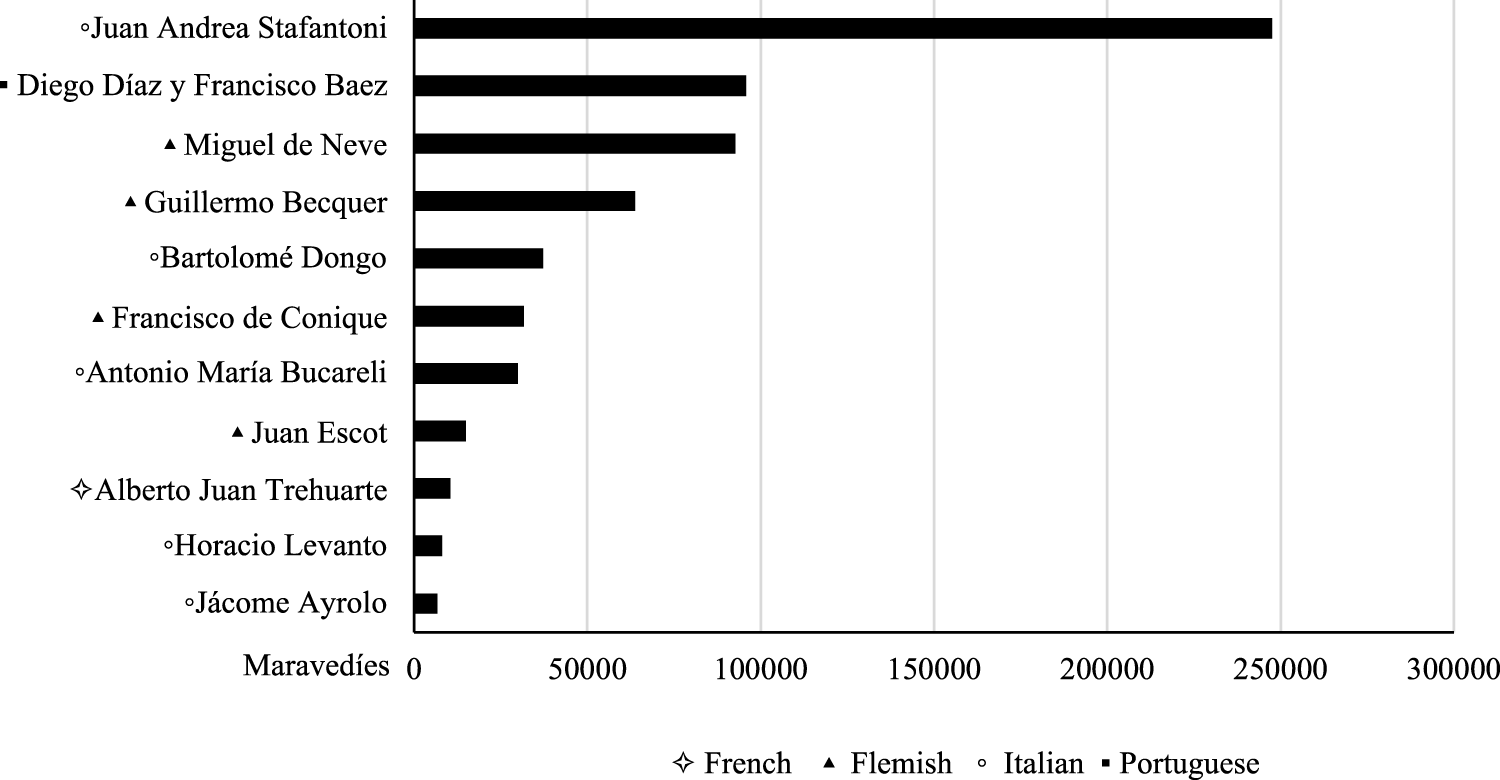
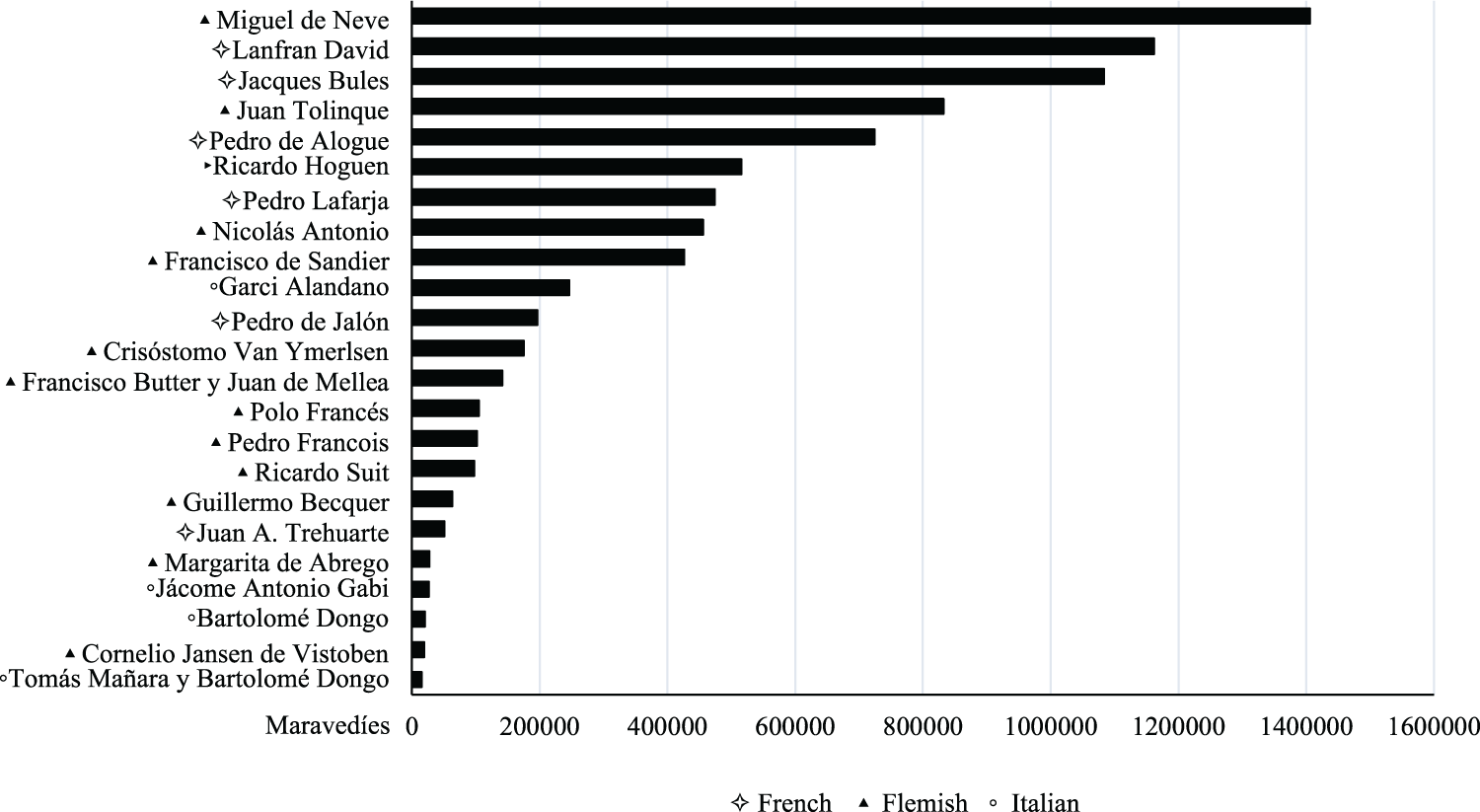
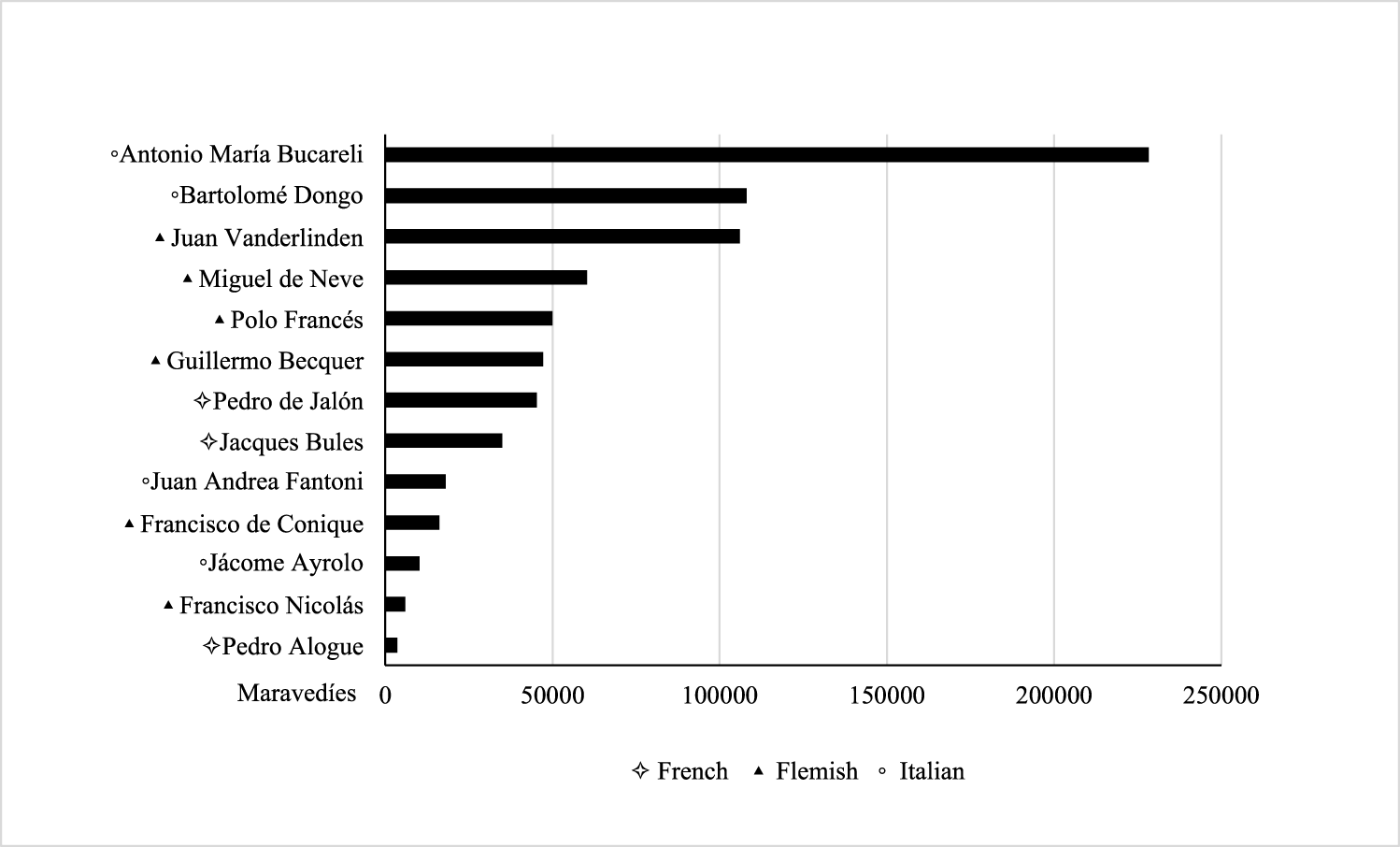
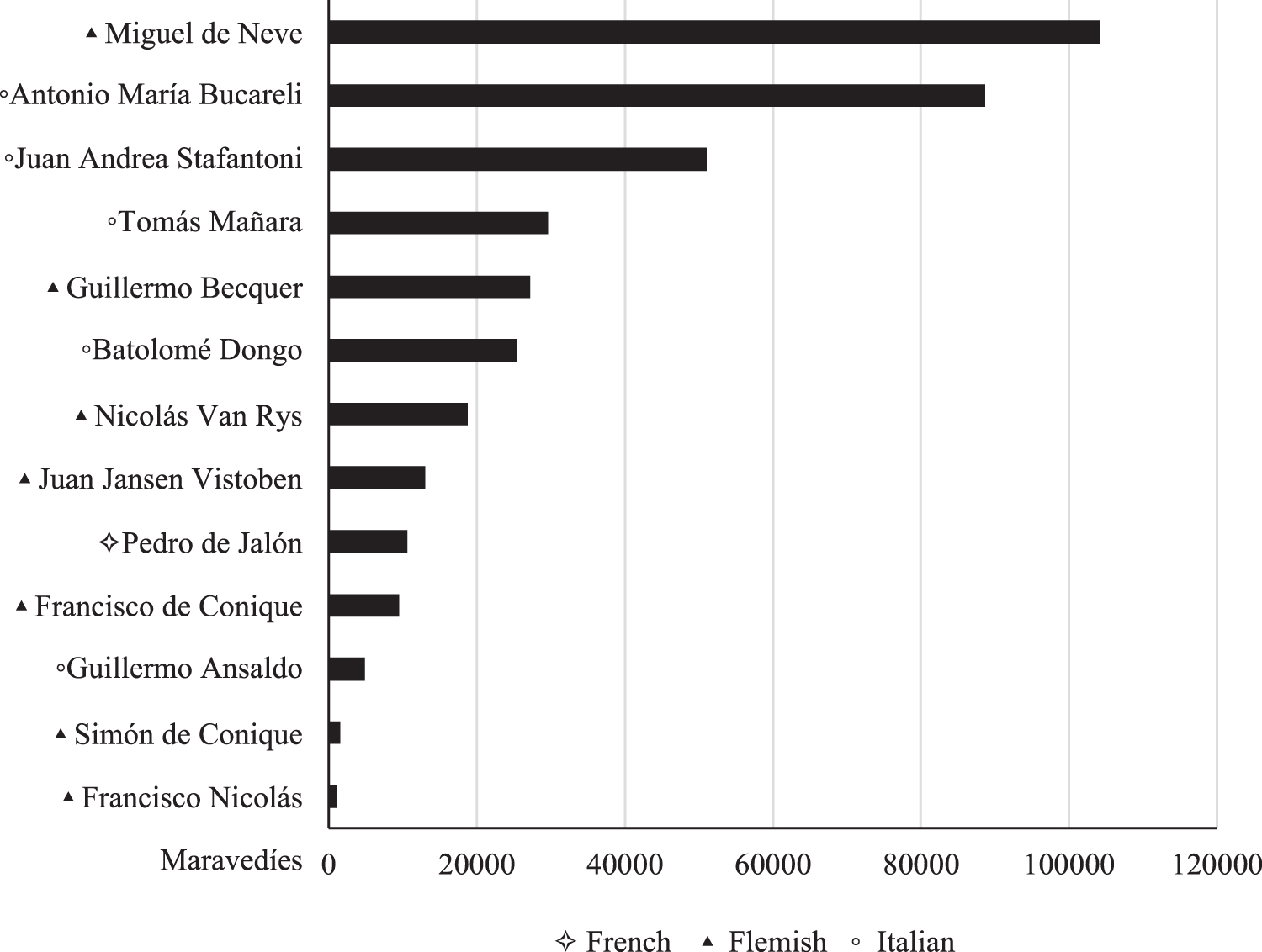
From this source, the names of “foreign” merchant consignors, identified with the aid of previous research, were retrieved from two types of data available for the period: registers containing only export duties for the Indies tradeFootnote 11 for the years 1628, 1630, 1634 and 1635, and the more detailed data found for 1633, which includes the items, and the value of the appraisal of the goods.Footnote 12 The processed data is presented in Figures 1 to 6, illustrating the increasing investments of French merchants in the Indies trade as cargadores.
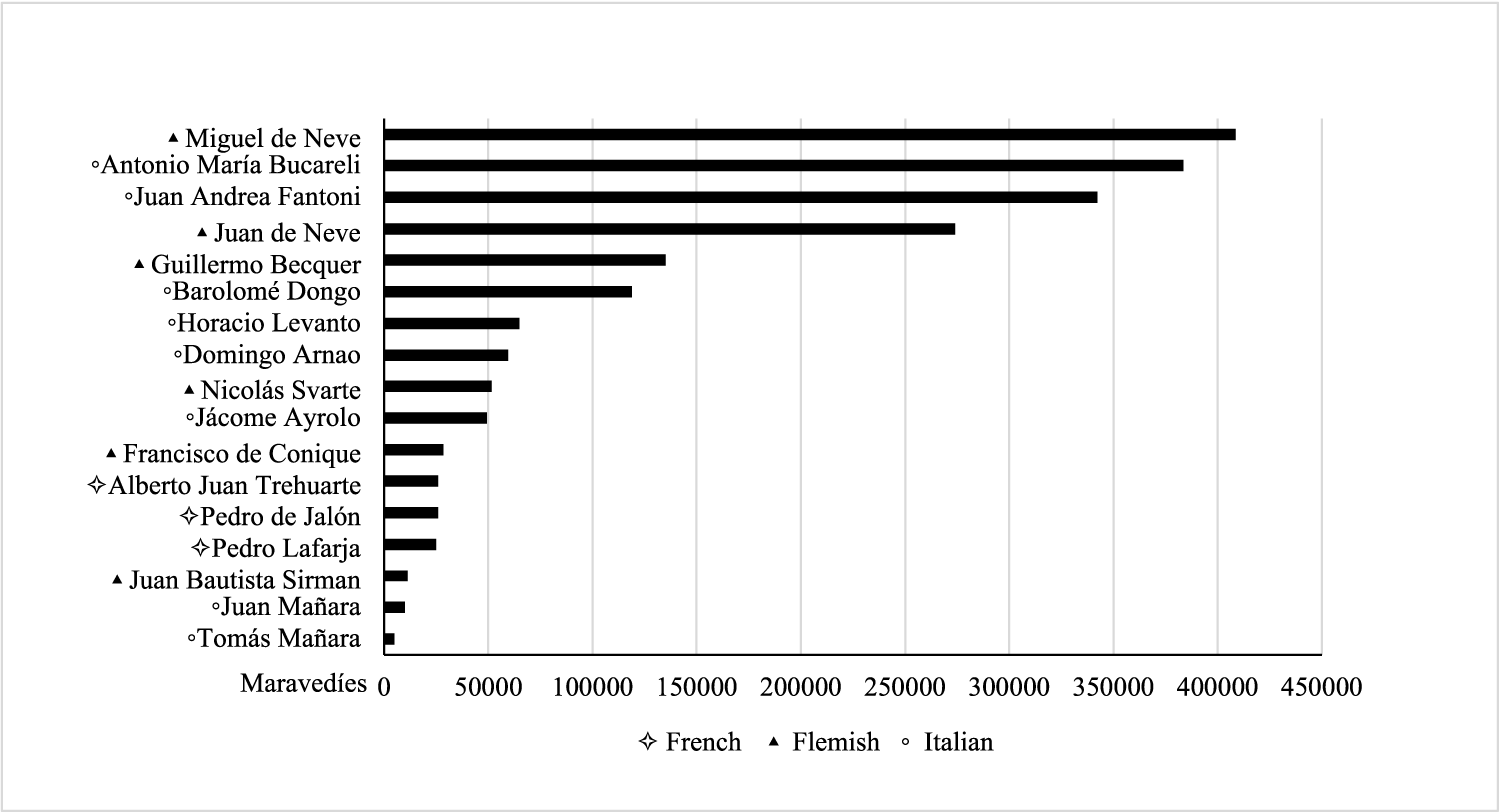
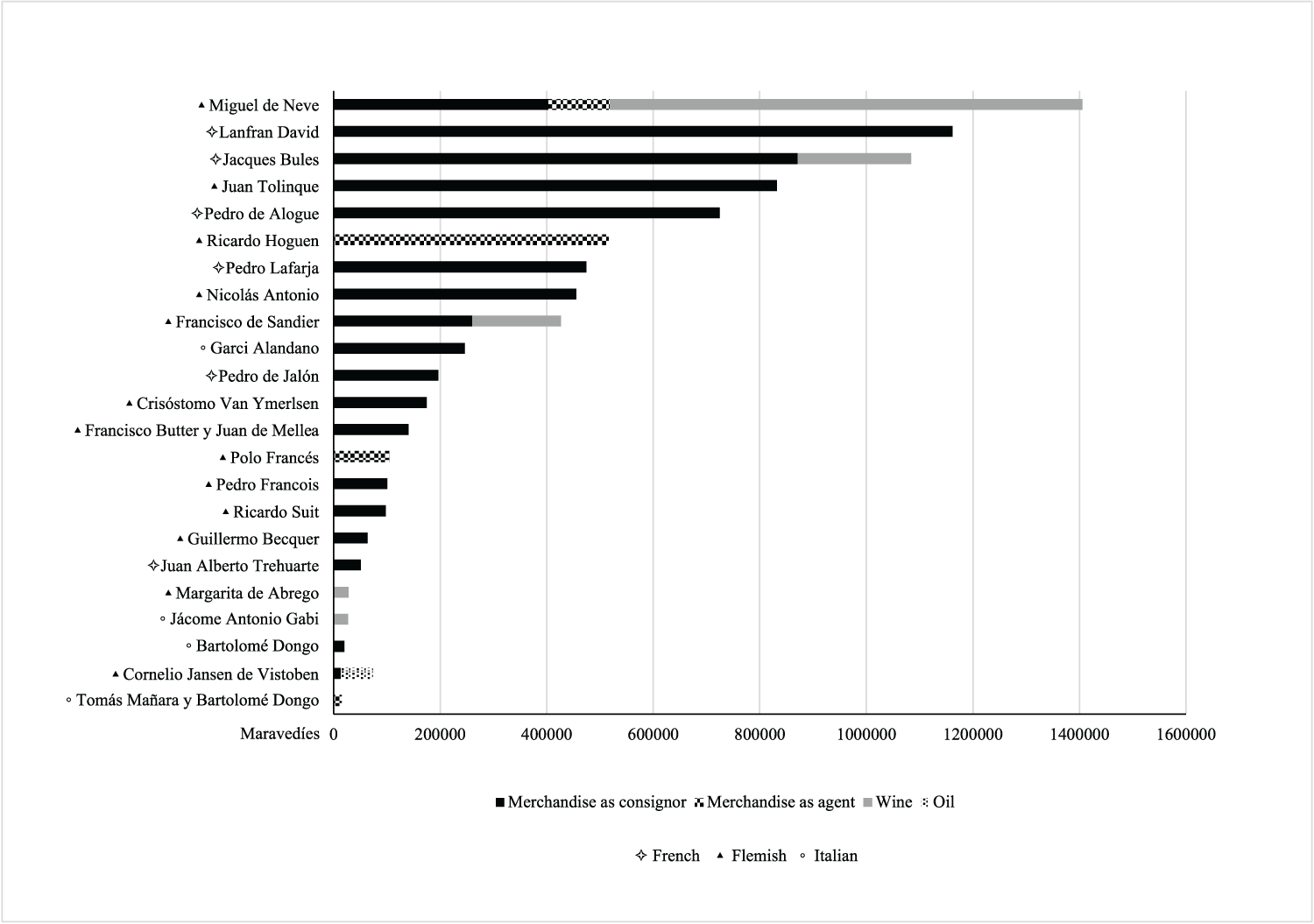
The analysis confirms that during the late 1620s, the wealthiest Frenchmen in Seville—Pedro Jalón,Footnote 13 Pedro Lafarja, and Alberto Juan Trehuarte—began to appear as cargadores alongside their Italian and Flemish counterparts in the records, with modest freights corresponding to duties less than 50,000 maravedíes (Figure 1 and Figure 2). These modest investments may reflect a common strategy among traders to test new markets (Hoberman, Reference Hoberman1991, p. 51). However, by 1633, the number of French merchants involved in the Indies trade had doubled, including Lanfran David, Jacques Bules, Pedro Alogue, Pedro Lafarja, Pedro Jalón and Juan Trehuarte. The value of their consignment—available in the source for that year—was among the highest within the broader group of “foreign” cargadores. Altogether, foreign merchants accounted for approximately 60 percent of the legal freights in the Atlantic trade (Figure 3) (García Fuentes, Reference García Fuentes1997). Following this peak in activity, the Frenchmen’s consignment decreased in 1634 (Figure 4) and disappeared entirely from the records in 1635, coinciding with the implementation of economic reprisals against French nationals (Figure 5). This data corresponds to reports sent to Madrid a few weeks after the confiscation began by “knowledgeable people in trading matters” in Seville, estimating the value of French cargo in the Indies fleets at no less than two million maravedíes, potentially reaching up to three million maravedíes in returns.Footnote 14
Almojarifazgo paid by the wealthiest foreign merchants of Seville in the 1628 New Spain fleet.

Almojarifazgo paid by the wealthiest foreign merchants of Seville in the 1630 New Spain fleet.

Value of foreign merchant consignments in the 1633 New Spain fleet.
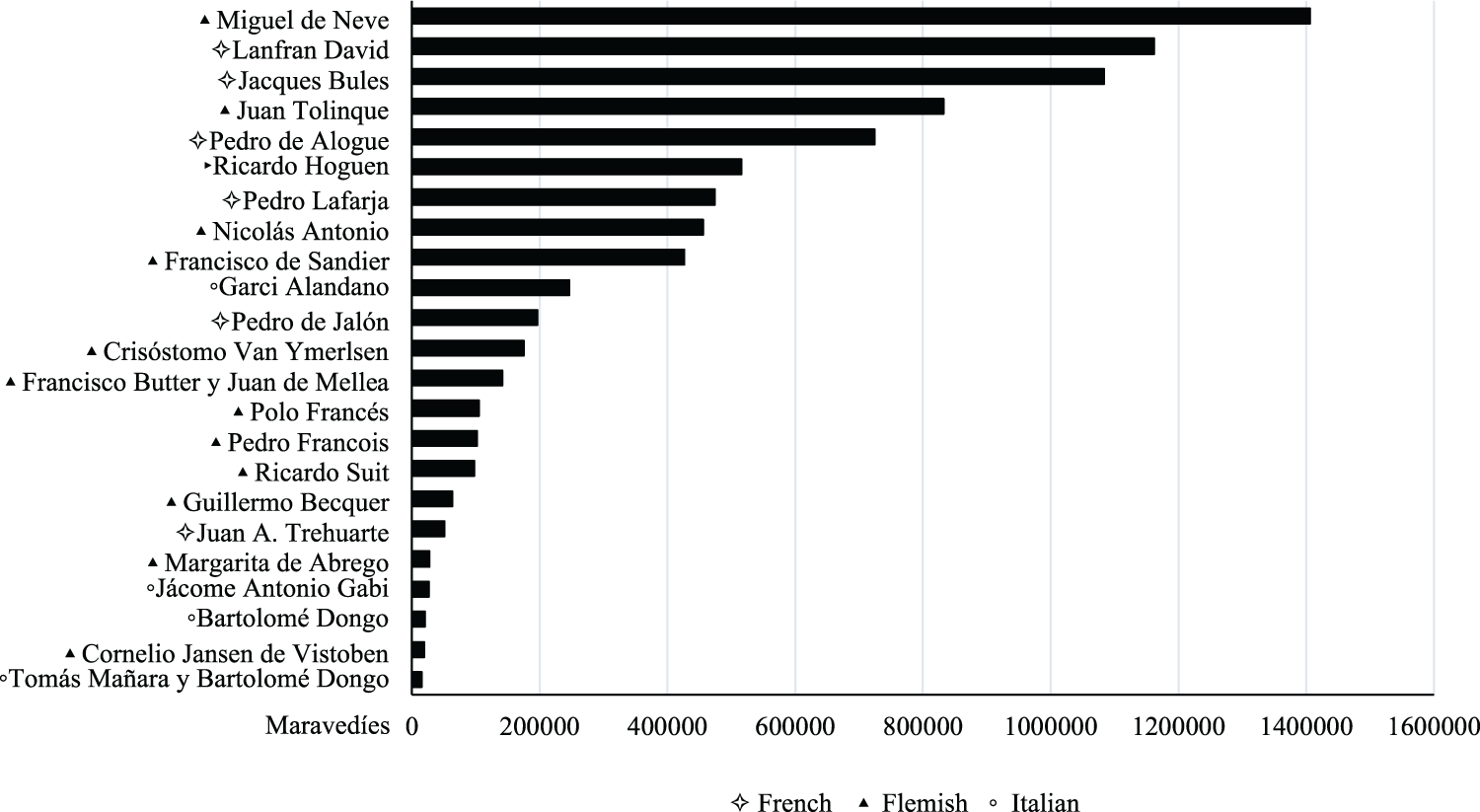
Almojarifazgo paid by the wealthiest foreign merchants of Seville in the 1634 New Spain fleet.

Almojarifazgo paid by the wealthiest foreign merchants of Seville in the 1635 New Spain Fleet.

Examining the detailed recorded freight for 1633 (Figure 6), a clear specialization of foreign merchants in various commodities native to their home countries emerges (Crailsheim, Reference Crailsheim2016; Crespo Solana, Reference Crespo Solana2001, p. 54; Priotti, Reference Priotti, Saupin and Priotti2008b). French merchants, in particular, showed a strong preference for French-produced items, including luxury textiles like ruanes (Rouen cloth), crudos (undyed fabric), melinges (melange), cotenses (cottons), and sayales (wools). Their cargo also included a diverse range of goods like ribbons, paper, knives, scissors, and chamber pots. The records for other merchants similarly reveal significant quantities of silk stockings, gloves, taffeta from Italy, creas from Germany, and products like brabantes, wax of various qualities, and haberdashery from the Low Countries. Equally noteworthy are Andalusian and peninsular produce, some of them sourced from foreign merchant’s own estates. These include wine, olive oil, vinegar, sesame, almonds, lavender, copperas, steel, and cinnamon (likely imported from Southeast Asia via Portugal). Additionally, the cargo contained wicks, glass beads, suede, kidskin, and substantial amounts of white lead (albayalde).Footnote 15 As a rule of thumb, foreign merchants sought to include a diverse range of products in their cargo to minimize losses and receive returns over varying time frames, corresponding to the sale cycles expected for each product.
Breakdown of registered cargo by foreign merchants in the 1633 New Spain fleet.

5. Royal patronage beyond Seville: analyzing French penetration in New Spain’s foreign trading networks
To fully grasp the multiple implications of regal patronage in connection with “exo-imperial” foreign merchant networks, it is necessary to explore the extension of their Atlantic networks in the Americas. This section offers an analysis of the development of French commercial enterprises and networks in the Viceroyalty of New Spain. Building upon data presented in the previous section, as well as various records generated during the embargoes in Perú, Panamá, México, and Seville in 1635, this section highlights, on the one hand, the importance of Crown support in enabling the rapid expansion of French business within the empire, and, on the other hand, the key role that direct access to Indies markets played for French merchants. It also explores the strategies they employed to establish a presence in the viceroyalty despite competition from well-entrenched foreign rivals. To this end, foreign trading networks operating in New Spain were reconstructed using Network Analysis tools. The focus on the Mexican axis is driven by the larger and more detailed body of sources and prior scholarship available at present about México’s merchant elite, Flemish and Italian merchants in that viceroyalty, as well as French and Flemish networks in Seville. Additionally, previous studies have identified a clear preference among French legal traders to invest in the Mexican economic axis (Poggio, Reference Poggio2024). This inclination is explained by the viceroyalty’s emerging role as an entrepôt for European manufactures and Asian imports within inter-colonial trade, particularly with central America and Perú (Bonialian, Reference Bonialian2019, pp. 69–80). By contrast, the lower presence of French merchants in Perú could be attributed to other factors, including contraband and cooperation between French and Portuguese merchants established in Panamá (Poggio, Reference Poggio2024).
By the time French merchants in Seville began gaining trading privileges in the 1620s, two dominant foreign merchant groups—the Flemish and the Italians—were already operating directly from New Spain. Throughout the sixteenth and seventeenth centuries, a merchant elite composed by a reduced number of Spaniards and Criollos settled in the viceroyalty, gaining significant control over México’s international bulk trade (Martínez López-Cano, Reference Martínez López-Cano2006; Hoberman, Reference Hoberman1991). Following the strengthening of commercial and migration policies in Spain and the establishment of México’s merchant guild, Germanic (Dutch, Flemish, and German) and Italian (Florentine and Genoese) merchants based in Seville–already leading import networks from the the North Sea and Baltic and Mediterranean regions in Andalusia–began introducing agents of their respective nations systematically into colonial markets from the late 1590s onwards. This move aimed to secure their long-distance trade transactions, gain firsthand market intelligence, and establish direct connections with potential buyers and suppliers of local, regional and Asian goods (Gasch-Tomás, Reference Gasch-Tomás2018; Poggio, Reference Poggio2022). This move reduced transaction costs and addressed the so-called “principal-agent problem”Footnote 16 in both the Atlantic and the expanding Pacific trade. At the same time, by leveraging their access to capital, control over supply chains of luxury goods and wine, capacity to extend credit, and ability to offer competitive prices in various cities across the monarchy’s territories and beyond—as well as through what would today be considered “unfair commercial practices” (i.e., hoarding, unjust competition, practices resembling dumping)—foreign merchants successfully consolidated their networks. They did so in part by forging alliances with segments of México’s bulk traders (almaceneros), thereby gaining access to their extensive broker networks across the kingdom’s provinces. Tying links with almaceneros was pivotal to the rapid and successful consolidation of foreign firms in the Atlantic trade, facilitating a swift displacement of “native” Spanish merchants in Seville’s entrepôt as the principal intermediaries within the Spanish Atlantic system (Poggio, Reference Poggio2022, pp. 299–354). However, the strength and stability of these connections fluctuated over time, influenced by a variety of reasons.
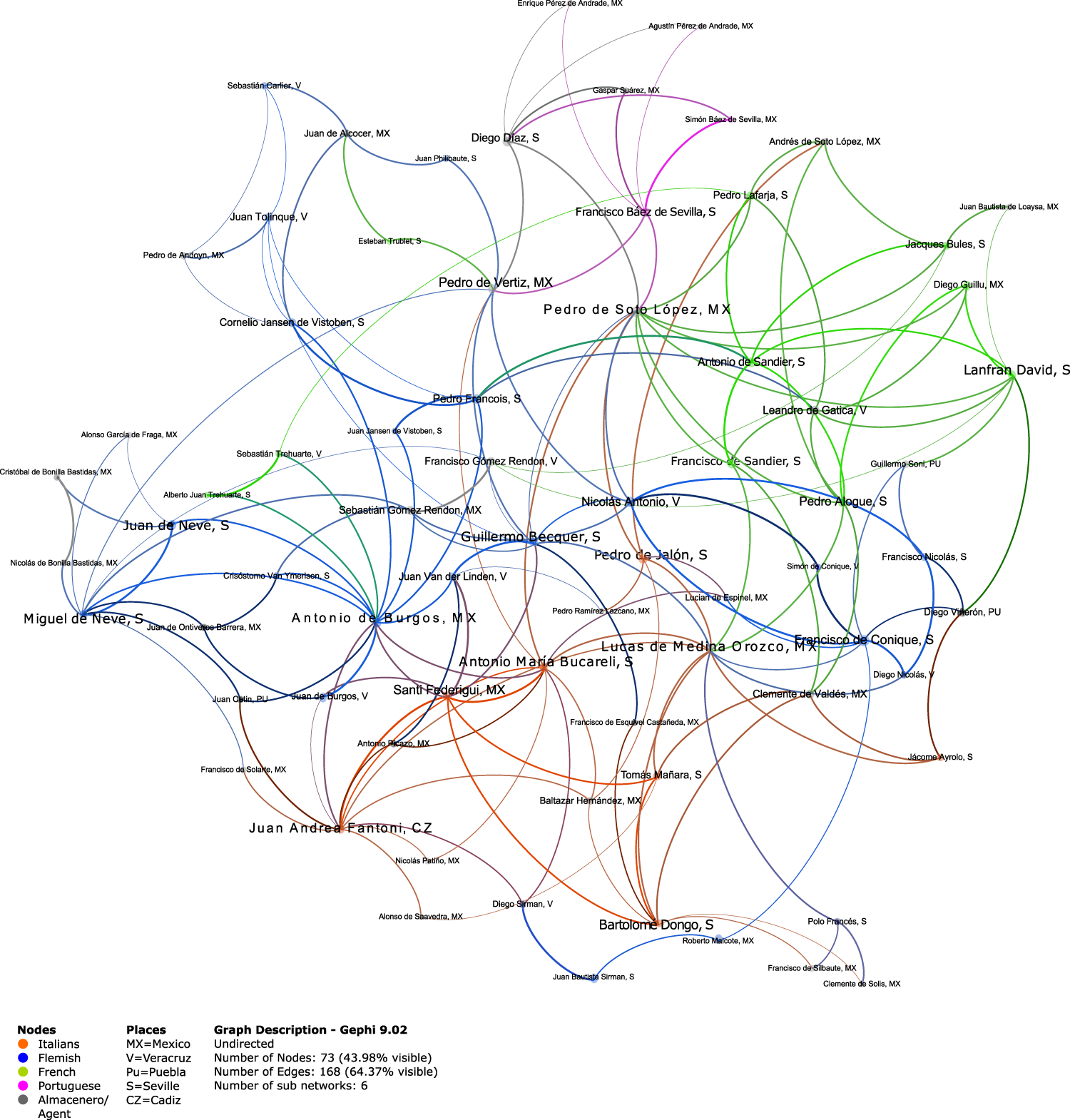
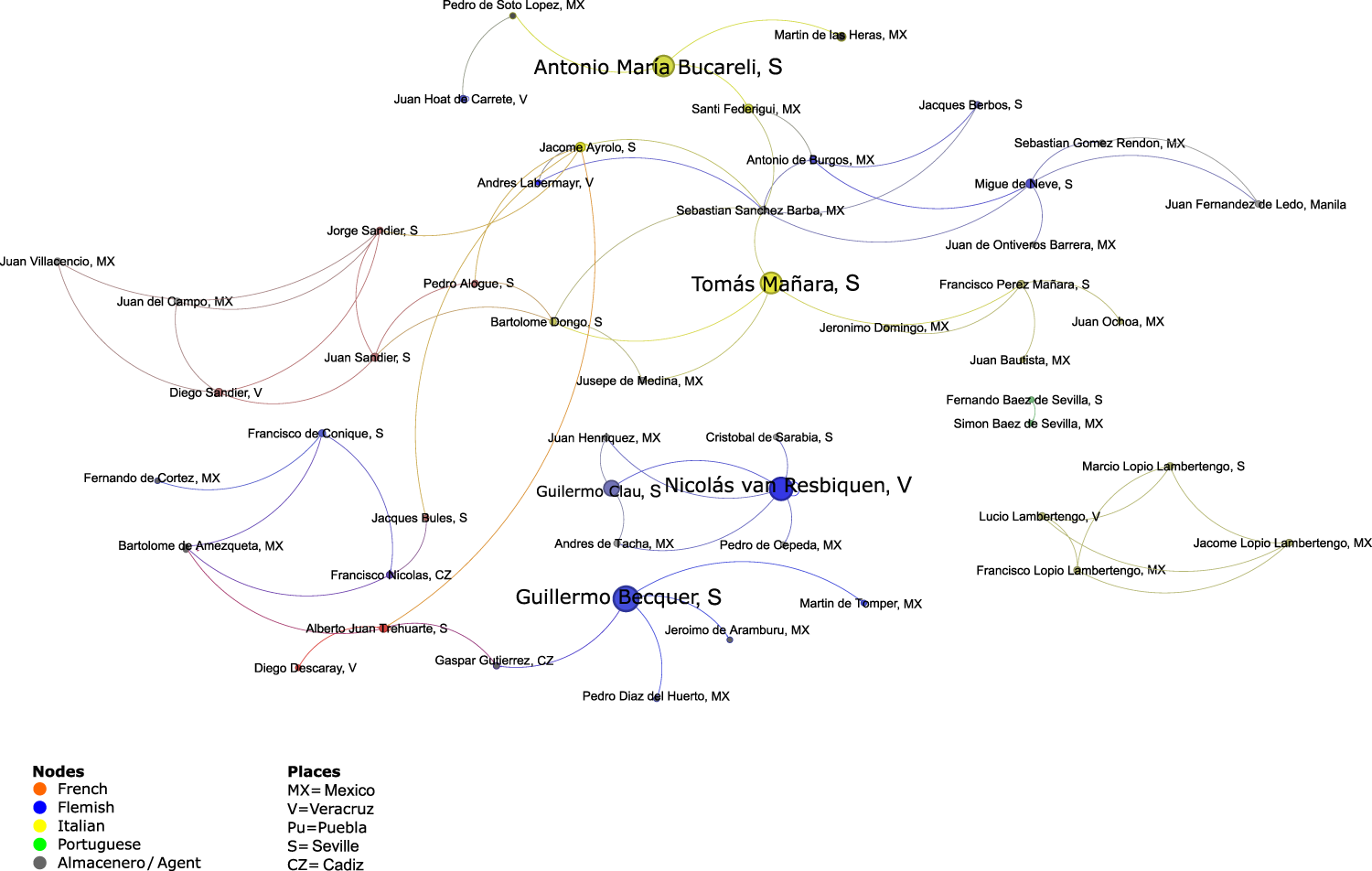
To reconstruct the trading networks operating in New Spain in the 1630s, information from ship manifests— described in the previous section—was analyzed, focusing on foreign consignors in Seville and their consignees in New Spain. Typically, each shipment listed three consignees, with the first generally serving as the primary agent responsible for fulfilling orders unless otherwise specified. By combining this information with an analysis of the instructions found in the ships’ manifest entries using Network Analysis tools, it was possible to create a graph consisting of 73 nodes (Graph 1). This confirms the presence of six distinct clusters of foreign traders operating in México through their agents between 1628 and 1635. Among these, three clusters were predominantly composed of Flemish traders. One primarily consisted of Italians, another of French merchants, and the final cluster comprised Portuguese traders led by the Báez de Sevilla family. Notably, Portuguese commerce showed no visible connections to the other foreign trading networks. As Portugese connections have been thoroughly examined elsewhere (García De León, Reference García De León, Ibarra and Del Valle Pavón2007; Studnicki-Gizbert, Reference Studnicki-Gizbert2007), they will not be discussed in further detail here.
Foreign merchants’ networks through their agents operating in New Spain’s axis, 1628–1635. Font size is related to node interconnectedness.

Degree centrality measures–that is, the importance or influence of a node based on how many direct connections (or edges) it has to other nodes in the network—indicate that three individuals in México managed the business of most Italian and Flemish families in Andalusia, namely Santi Federigui (arrived and married in México in 1619), Antonio de Burgos (settled in México ca. 1615) and Roberto Malcot (who came to Meéxico in 1602) (Gasch-Tomás, Reference Gasch-Tomás2018; Iglesias Rodríguez, Reference Iglesias Rodríguez2022; Poggio, Reference Poggio2022). All three became well-established wholesalers in the viceroyalty, engaging in a wide range of commercial and financial activities, including imports and exports of manufactures along transatlantic and transpacific routes, specialized crops such as cochineal and indigo, wine and paper, and silver. They also coordinated extensive networks of partners and encomenderos (commission agents) strategically located in key ports, cities, mining centers, and production foci across New Spain, Central America, Perú, and Manila.
Federigui, described by Hoberman as “the most prominent dealer in cochineal of his epoch,” was also prior (head) of the Mexican merchant guild and was consequently among the select group entrusted with operating as bankers for the Crown in the Indies (Hoberman, Reference Hoberman1991, p. 41). He lent money to the viceroy Marquis of Cerralbo thereby securing privileges that favored his commercial transactions during the period under study (Hoberman, Reference Hoberman1991, p.178). Additionally, he was the principal agent for the network of the wealthiest Italian merchants settled in Andalusia, which included Antonio María Bucareli (his in-law), Bartolome Dongo, Juan Andrea Fantoni, Tomás Mañara, and the Flemish jenizaro (born in Spain or the colonies to foreign parents) Guillermo Bécquer, one of the founders of Almirantazgo de Sevilla and a member of the Brussels gentry (Graph 1) (Gash-Tomás, Reference Gash-Tomás, Herrero Sánchez and Kaps2017 pp. 129–144). Their encomenderos were primarily the shipmaster Lucián de Espinel—who traveled regularly between Andalusia and Veracruz—Pedro de Vertiz in Veracruz, Juan Cetin in Puebla, Ascanio Guazzoni in Manila, Lucas de Medina Orozco, and the rich wholesaler Clemente de Valdés in México City.Footnote 17
Antonio de Burgos, for his part, was the principal agent and partner of two of the Flemish sub-networks: one integrated by the Neve family—among the wealthiest in Seville and the foremost cochineal importers of the period—and another including families closely connected to the Neve, such as Van der Linden, Vistoben, and Francois (Poggio, Reference Poggio2022, pp. 299–354; Crailshem, Reference Crailsheim2016, pp. 186–190). The hub’s encomenderos were the criollos Sebastian and Francisco Gómez Rendon, protegees of Miguel de Neve.Footnote 18 As an agent of the Neve family, Francisco traveled from Seville to Perú in 1630 and soon after settled in México with his brother Sebastián. There, he quickly established himself as a prominent silver merchant before becoming the royal treasurer in Zacatecas (Hoberman, Reference Hoberman1991, p. 180).Footnote 19 Sebastián acted as encomendero in Veracruz as shown, inter alia, in the partidas of the libros de registros (Graph 1). Other encomenderos appear less central within the Flemish network; for instance, Cristóbal and Nicolás Bonilla Bastidas, father and son, respectively. This might be explained by the fact that the Bonilla family—one of the most prosperous and resilient merchant families in México with strong business ties with Perú—primarily acted as exclusive agents of the Neves (De la Peña, Reference De la Peña1983, pp. 138–139; Hoberman, Reference Hoberman1991, pp. 241–246; Suarez, Reference Suárez2015). Thus, it is highly plausible that they played pivotal functions as intermediaries bridging the Atlantic, transcontinental, and transpacific trade networks, despite their seemingly less connected positions indicated by the Network Analysis.
The agent for the fourth cluster was Roberto Malcot, who operated almost exclusively for the Conique, Antonio, and Sirman families, though with limited involvement, as most of their businesses were handled by younger members of the in-groups who frequently crossed the Atlantic (e.g., Nicolás Antonio and Simón de Conique). While all these hubs exhibited a clear organization based on kinship and “nation” affiliations, they also formed partnerships with individuals of different backgrounds who acted as brokers between the sub-networks, such as Guillermo Becquer for the Italians. These cross-cultural connections were not purely economic; they often involved family ties that fostered collaboration between the French, Flemish-German, and Italian merchants in the Spanish context, where they frequently appeared as witnesses, creditors, facilitators, or guarantors for one another (See: Crailsheim, Reference Crailsheim2016). It is also known that these groups lobbied together in the royal court and in other forums to obtain advantageous trading conditions or privileges for foreign merchants.Footnote 20
Most Flemish merchants in the Indies trade were also involved in the Almirantazgo de Sevilla (1624–1630), where Guillermo Becquer, Nicolás Antonio, Pedro François, and Guillermo Clout held important positions (Alloza Aparicio and Cárceles Egea, Reference Alloza Aparicio and Cárceles Egea2009, pp. 85–128). The prominent role of Flemish merchants as intermediaries between different nations (as illustrated in Graph 1) should be understood within the broader historical context of the community’s remarkable social, political, and economic ascent within the Spanish monarchy beginning in the early seventeenth century. This became particularly evident after 1625, when the Junta de Almirantazgo consolidated a system of certificate offices in strategic points across Europe. Combined with the pressure exerted by the Spanish Armada and pirates in Dunkirk to curb Dutch contraband, this system granted Flemish merchants extraordinary control over Baltic and North Sea imports in Andalusia (Israel, Reference Israel1989, pp. 121–140; Alloza Aparicio and Cárceles Egea, Reference Alloza Aparicio and Cárceles Egea2009, pp. 85–128; Girard, Reference Girard2006, pp. 86–95). From this privileged position, they were able to control import flows and strategically boycott or form alliances with competitors, depending of what best served the interest of the Almirantazgo and their affiliated networks.
In the colonial context, collaboration between the Flemish and Italian merchants appear particularly close, as Federigui, Burgos, and Malcot not only provided products and services to each other but also shared key members in their encomendero (agent) networks from the early 1620s (Poggio, Reference Poggio2022, pp. 332–345). The results produced by Network Analysis suggest that these two nations were complementary in certain commercial areas in the Indies markets as well, and may also have collaborated to maximize their profits through various means, for instance, by hoarding European and colonial commodities. Authorities on both sides of the Atlantic reported this as a common practice among foreign merchants and a major source of frustration for their “native” counterparts (Dominguez Ortiz, Reference Domínguez Ortiz and Benito Ruano1998b, pp. 125–127; Poggio, Reference Poggio2022, pp. 67–92).
Unlike other merchant nations, the French lacked substantial direct associates in the Indies, which placed them at a disadvantage and made their investments particularly risky unless entrusted to reliable hands. For this reason, when wealthy merchants such as Pedro Lafarja, Jacques Bules, Lanfran David, Antonio de Sandier, and Alberto Trehuarte were financially and legally positioned to significantly expand their participation in the Atlantic trade during the 1630s, they had to rely almost exclusively on young Spanish and French agents who travelled as partners aboard the fleets. Following a formula commonly used by foreigners entering the market, they initially commissioned a “native”—in this case, Leandro de Gatica—alongside three young Frenchmen, Diego Guillu, Diego Vineron, and Guillermo Soning in 1633. The following year, they sent two more French juniors, Sebastián Trehuarte and Pedro Fuentes. According to later statements by the French merchants, the choice of Gatica as their commissioner stemmed from the fact that he was a “citizen [of Seville] and corredor (broker) of [Seville’s] merchant guild who approached and persuaded us to give him the title of factor (agent) and encomendero (commissioner)”.Footnote 21 In other words, Gatica was a well-known figure within the merchant community, with strong local ties that enabled him to build trust among the French merchants and convincingly present himself as an expert in managing operations and client portfolios. He was entrusted with selling “various cargoes of goods, including bundles, crates, and barrels, as well as casks of wine and other valuable goods of great importance” and with recovering debts amounting to an impressive total of over 150,000 ducats.Footnote 22 His responsabilities included maintaining transatlantic correspondence, remitting funds, overseeing profitable transactions, and developing local networks in the Indies markets. For their part, the young French agents were not expected to remain in the viceroyalties long-term but were instructed to return to Seville within the same year.
However, both commissions proved problematic. In the first case, although witnesses in Veracruz and México at the time confirmed that the goods were selling well and that profits were being made through smooth credit repayments (i.e., without losses), the consignors ultimately faced serious issues with Gatica’s conduct. He began withholding remittances in 1634—partly due to the absence of a return fleet that year—and stopped sending returns altogether after reprisals were ordered in New Spain in 1635.Footnote 23 In the case of Trehuarte and Fuentes, both died in 1634 in Veracruz while awaiting the unloading of their cargo. As Sebastian had brought a deed from his uncle, Alberto Juan Trehuarte, designating the standard-bearer Julio Cesar as his encomendero in the port from that point onward, the local authorities appointed Cesar as the executor of the deceased’s wills as well. This role included overseeing the sale of a significant consigment: 9,186 yards of cloth, 5,064 pieces of haberdashery, and 1,077,430 pieces of buttons and imitation jewellery, most of which had been provided on credit by Alberto Juan Trehuarte, Pedro Lafarja, and Francisco Campi.Footnote 24 However, the entire cargo was seized and partially auctioned off by Captain Vega Bazán when the reprisals were enforced in Veracruz in 1635.Footnote 25
Moreover, the French established connections with one of México’s most powerful and wealthy wholesalers and encomendero, Pedro de Soto López.Footnote 26 Born in the manor of Anguiano (Castile La Vieja), Soto López traveled to New Spain in 1617 already using the title of “notable merchant” and settled in the territory two years later.Footnote 27 His status quickly rose through the accumulation of several titles and commissions such as familiar of the Inquisition (since 1620), banker of the Crown during administrations of Cerralbo and Cadereyta, and representative of the city of Manila in New Spain (Hoberman, Reference Hoberman1991, p. 50, 123; Alberro, Reference Alberro1988, p. 100). Soto López’s strong social and economic position provided a compelling reason for the French to choose him as a partner, as it ensured a swift access to the Mexican and Pacific trading networks and markets. However, the results obtained through Network Analysis suggest an even more strategic rationale for the alliance. Soto López appears to have mantained peripheral connections to key figures with both the Italian—namely Antonio María Bucareli—and Flemish—Guillermo Becquer and Nicolás Antonio—sub-netwoks. Thus, the partnership may have been mutually strategic, allowing the French to better compete with the two dominant importers of European manufactures, who were already firmly established and, as such, represented their principal rivals in the region, along with prominent Mexican wholesalers (Graph 1). In Soto López’s case, the alliance may have brought him into direct contact with the major importers of luxury cloth and iron in the Atlantic trade, placing him in a uniquely competitive position among his peers in New Spain.
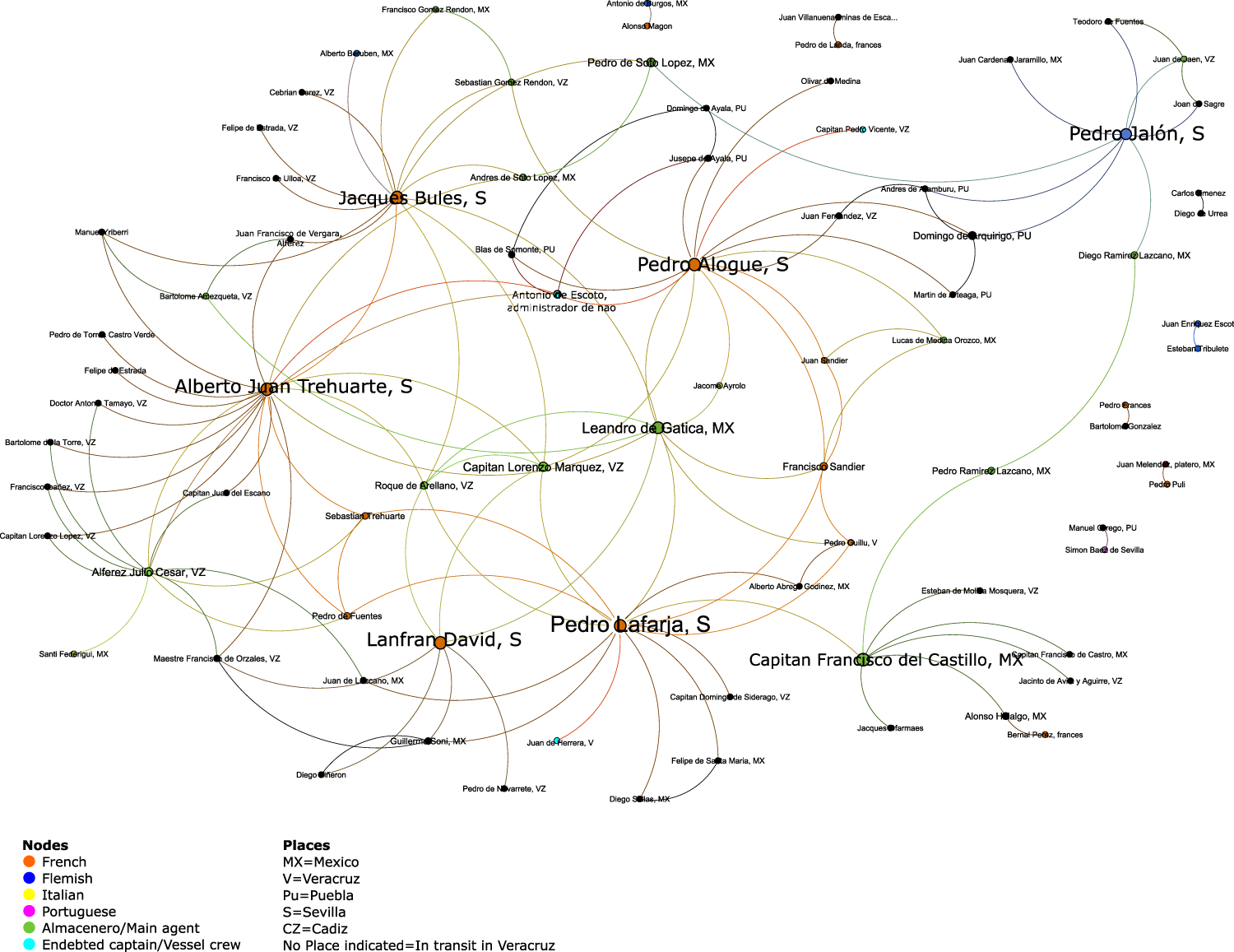
The information drawn from various sources produced during the reprisals in New Spain—including notarial and embargo records, registers of consignments on returning ships, debts and payment reports (in money and kind) recorded in México and Veracruz’s cajas, and the account books and testimonies of Gatica—allows for a more detailed reconstruction of French commercial connections in the viceroyalty by 1635.Footnote 28 The data confirm the general picture outlined in Graph 1 and provide additional specifics about agents and encomenderos acting on behalf of Frenchmen in Veracruz, Puebla and México. These include Francisco and Matías del Castillo for Lafarja, Juan de Jaén for the Flemish sub-network, Pedro Jalón and Lucas de Medina Orozco for Pedro Alogue and the Sandier brothers (Juan and Francisco), and Captain Batolomé Amezqueta for Jacques Bules and Alberto Juan Trehuarte, who were operating as partners (Graph 2). As detailed in the thorough accounts of both Gatica and Amezqueta, they quickly sold significant quantities of French merchandise and wine to local retailers, charging a standard commission of four percent for their services.Footnote 29
French networks in New Spain’s Axis, 1630–1635. Font and node size are related to node interconnectedness.

Not surprisingly, given their familiarity with the cargo’s content and quality, some encomenderos of French merchants became the highest bidders in the public auctions of the seized property following the 1635 reprisals in New Spain. For instance, Julio Cesar won the auction presided over by Captain Amezqueta for part of Jacques Bules’ confiscated merchandise.Footnote 30 Public auctions were widely considered the least favorable method for liquidating seized goods, as the proceeds were typically well below the market value. The local Junta de Represalias acknowledged this limitation. For example, although the merchant guild in Méexico appraised a portion of Alogue and Sandier’s merchandise at 19,412 pesos, it was sold for 12,406 pesos, even though such goods could easily yield twice that amount on the open market.Footnote 31 To mitigate this issue, the local Junta de Represalias, in coordination with the Mexican merchant guild, instructed merchants involved in identifying and seizing French assets to prioritize private sales, collect outstanding debts, and deposit the proceeds into the cajas reales of the viceroyalty. As a result, the peripheral connections depicted in Graph 2 between French merchants and figures such as Santi Federigui, Simon Báez de Acevedo, Lamberto Beruben, and Antonio de Burgos or the Gómez Rendón brothers should not be interpreted as direct commercial partnership. Rather, they underscore the instrumental role these individuals played, either as members of the Mexican merchant guild or agents thereof, in facilitating the Crown’s retaliatory measures across the viceroyalty and beyond. Their involvement likely brought substantial advantages for their own firms and networks. For instance, Federigui oversaw Treguarte’s account, while Burgos managed Alonso Magon’s business operations (see Graph 2).Footnote 32
Furthermore, the sources generated by Vega Bazan’s commission to carry out the reprisals in Veracruz reveal the significant role played by French merchants as financers of shipmasters, captains, fleet officials and other smaller entrepreneurs, primarily through extension of credits on sales.Footnote 33 As highlighted in existing literature, this was a highly profitable practice—ranging from minor to substantial credit operations—that had becomewidespread among solvent wholesalers in Seville by the 1610s, with foreign merchants being particularly prominent in its development and application (Bernal, Reference Bernal1992, pp. 177–203; García Fuentes, Reference García Fuentes1997, pp. 59–76). While these credits stimulated commercial circulation, they also contributed significantly to price inflation, since goods were valued according to their expected sale price in the Indies, rather than their intrinsic worth in Seville (Mercado, Reference Mercado1569, pp. 44–61). In addition, the absence of guarantees enabled lenders to set stringent loan conditions, ofted demanding high-interest repayments in silver or colonial goods upon the fleet’s return. Given the hazardous nature of overseas trade and the narrow window for liquidating cargo before departure, borrowers were, by the 1620s, frequently described as being “forced to sell at a low price and sometimes with significant losses” by the 1620s (Bernal, Reference Bernal1992, pp. 251–252).
These credits facilitated the formation of “informal networks” and enabled foreigners without a licence to trade to participate direclty in the Indies monopoly. They proved highly effective for establishing connections, compensating for the absence of middlemen and encomenderos on-site, obtaining colonial produce at competitive prices, building local networks, and gaining familiarity with the intricacies of Atlantic exchanges. Consequently, credit contracts often involved various types of arrangements between financiers and debtors, which were not always explicitly documented in notarized or written agreements.Footnote 34 For instance, debtors sometimes acted as informal agents for their financiers in the Indies. Some individuals who claimed to have such arrangements with French merchants (colored red in Graph 2) also reported receiving significant quantities of Iberian produce, such as wine, oil, olives, and vinegar, which they were obliged to sell in Veracruz.Footnote 35 Proceeds from these transactions were occasionally reinvested in purchasing commodities, mainly hides and dyes, at production sites or in connecting markets like Puebla and Veracruz. Martín de Arteaga, for instance, had acquired three hundred hides, sixty-five arrobas of wild cochineal, and a hundred and fifteen arrobas of logwood to fulfil a short-term contract with Pedro Alogue for 18,000 reales in Seville.Footnote 36
Due to these and other informal practices (García Fuentes, Reference García Fuentes1997, pp. 70–73), determining the extent to which the cargo registered under any merchant’s name had already been sold on credit in Seville is impossible. Among other reasons, it was a “common practice” for creditors to register freight as their own in the ship’s manifests, as attested by Juan de Herrera, who owed money to Lafarja.Footnote 37 Not surprisingly, a significant portion of the French cargo appears to have been involved in such transactions. For instance, a substantial amount of the initial batch of seized property in Veracruz (i.e., 42,214 pesos out of the 94,579 pesos remitted by Cadereyta on Vega Bazan’s fleet) originated from crew members or informants who claimed to have debts with the French. To avoid legal consequences upon their return, these debtors conveniently sought “certificates of satisfaction and release” of their debts after providing information to the reprisal’s officials in New Spain.Footnote 38
The role as financiers, the growing number of established ties, and the substantial sum resulting from confiscations in Veracruz and México (318,206 pesos) between 1635–37 demostrate that French merchants were not only acting as cargadores in Seville but also rapidly gaining a foothold in major markets in New Spain, especially in Puebla and México. In doing so, French merchants not only followed the footsteps of Italians and Flemish—displacing “native” intermediaries in Seville by establishing direct connections with New Spain’s partners and encomenderos—but also sought to challenge Italian and Flemish competitors already well-established in the Indies’ markets.
6. Royal retaliation and trade resilience: the outbreak of the Franco-Spanish War and the rearrangement of (French) trade
Despite their rapid and effective integration in the Indies trade, French businesses came to a standstill and faced considerable setbacks when embargoes on their properties, both in Europe and the Americas, were enforced following the outbreak of the Franco-Spanish War in July 1635. This section examines how, despite the severity of the economic reprisals, French merchants implemented a successful business diplomacy strategy that was crucial in preserving the privileges they had gained since the 1620s, recovering their property, and maintaining their transatlantic trade despite the ongoing conflict. The analysis further shows the central role of the Indies, particularly New Spain, in the overall comercial activities of the French.
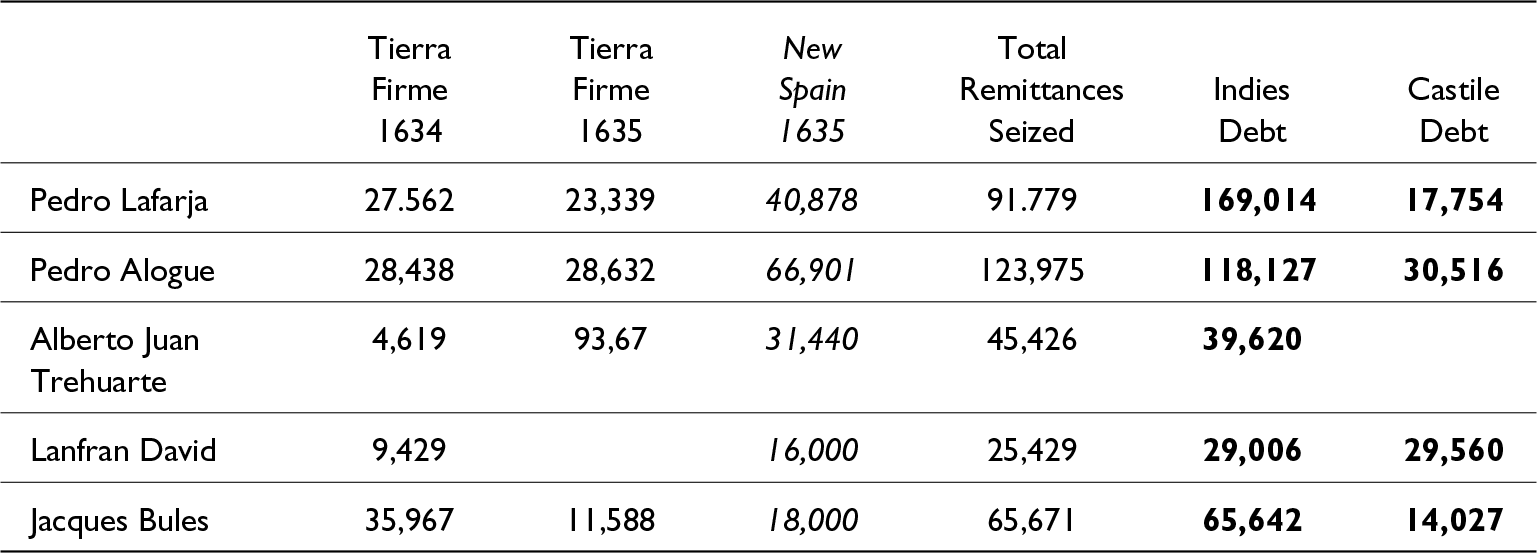
Shortly after the reprisals were enforced, the Crown confiscated an estimated 186,425 ducats in Andalusia and 163,000 pesos in New Spain to Pedro la Farja, Lanfran David, Pedro Alogue, Alberto Juan Trehuarte, and Jacques Bules. The merchants appealed to the Junta de Represalia to reverse the order, citing their letters of naturalization, years of residency in Seville, and services given to the Crown.Footnote 39 After months of dispute between the junta’s prosecutor and the plaintiffs, Philip IV accepted to grant a total release of the seizures, including illiquid assets, account books, and correspondence in exchange for 140,000 ducats from the confiscations in Spain and 94,569 ducats identified as belonging to French merchants seized by Vega Bazán in the first batch confiscated in New Spain on October 16, 1635.Footnote 40 The settlement also involved the restoration of 46,425 ducats in juros, the seized remittances from Tierra Firme in the 1634 and 1635 fleets (see Table 1), and the return of their letters of naturalization. These resolutions led to the issuance of an order addressed primarely to the Reprisal commissioners in Andalusia, the Duke of Medina Sidonia, and the Count of Salvatierra. This order also included a specific clause to the Consejo de Indias, instructing them to immediately “issue the necessary letters” directing authorities in the Americas to return all confiscated assets belonging to the petitioners in the territories.Footnote 41 Thereafter, French merchants presented and won a case before Seville’s merchant guild against their agent in New Spain, Leandro de Gatica, for defaulting on payment. This step was a major success as the French declared to royal accountants that their outstanding debts in the Indies could double the sum of their returns in the fleets of Antonio de Oquendo (1634), Carlos de Ibarra (1635) and Vega Bazan (1635), all recorded in the confiscation records as “Indies debt” for each merchant. Remarkably, these debts in the Indies were significantly higher than those in Castile, indicating that the French had heavily invested in the Indies through different legal and illegal channels, much more than previously believed.Footnote 42 Consequently, leveraging such legal means allowed French merchants to recover property close to the amount retained by the king and to promptly resume their businesses minimizing losses, thereby maintaining market trust.
Confiscated remittances and outstanding debts in the Indies and Castile of French merchants in Seville (1635). Amount in “pesos de a 8 reales”. Estimated conversion rate in 1635–36 provided in the source: 1 ducat equals 1.37 pesos de a 8 reales. Italics show the remittances from New Spain, the only amounts from the Indies kept by the crown as part of the settlement deal reached with french merchants. (see: Poggio, Reference Poggio2024)
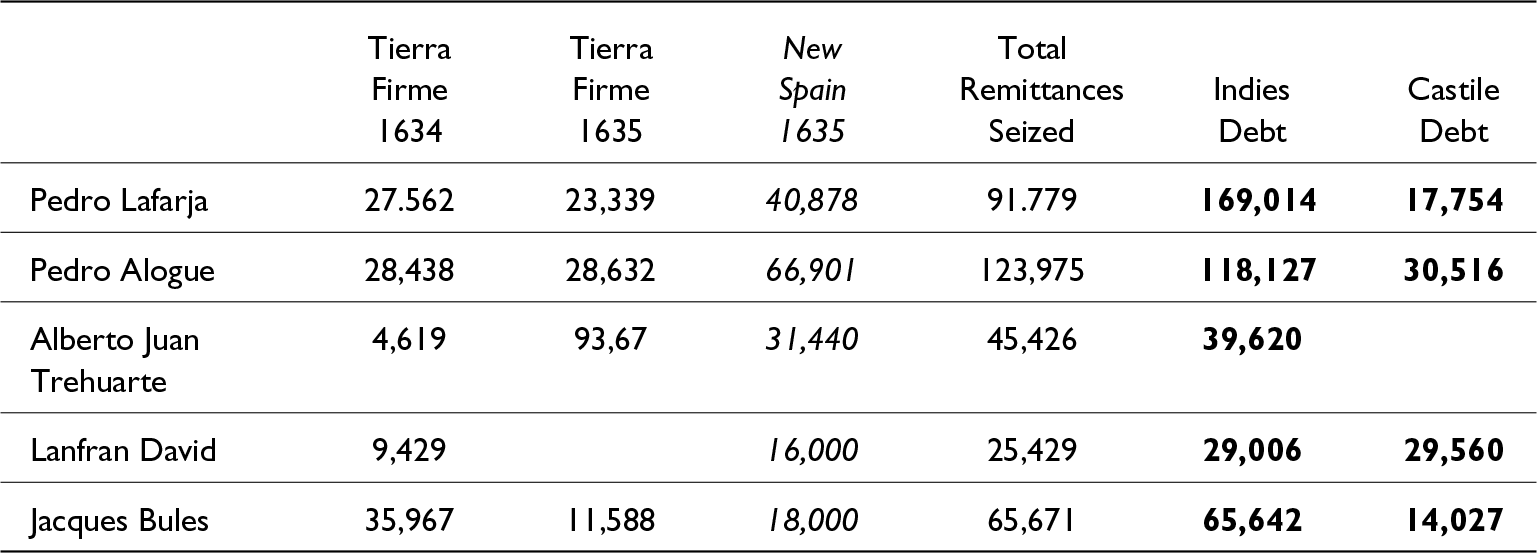
Source: AGS, CSU, SE2 154.
To continue the task of reclaiming their properties in México, the French commissioned the Genoese merchant Jacome Ayrolo, a longtime partner and in-law of Lafarja and Pedro de Alogue. Besides being a reliable agent of non-French origin, thus less vulnerable to reprisals, Ayrolo also had a personal stake in the matter, as he asserted “the many significant businesses to attend to in the Indies, both in collecting debts owed to me by various individuals and in sales and dispatching of merchandise” in his travel license application.Footnote 43 In México, Ayrolo presented the royal orders both to the local junta de represalia and the merchant guild. However, arresting Gatica and confiscating his property was not straightforward, as he had, in a short time, amassed a fortune estimated at over 200,000 ducats and bought a councilman position in México’s Cabildo, which helped him conceal part of his property. Although an agreement between the parties seemed to have been reached before the extradition was carried out, Gatica was sent to Seville, where various trials continued at least until 1640, when he returned to México and resumed his role as councilman.Footnote 44
Based on the available data, it remains uncertain how much property Ayrolo and the French ultimately managed to recover in the Indies. While Crailsheim’s examination of Seville’s notarial records reveals a notable decline in the French community following the reprisal of 1635, he concluded that the wealthiest members continued conducting business, albeit with a shift towards financial transactions, possibly due to the constraints on French trade and imports. However, this picture contrasts with the active role French merchants mantained both in Andalucia and the Indies trade after winning their case against the Junta de Represalia. Research by Alloza Aparicio and Cárceles de Gea sheds light on the involvement of the French merchants’ involvement in acquiring “special licenses” that allowed the introduction of French contraband goods via Sanlúcar de Barrameda and Cádiz. Notably, figures such as Lanfran David, Alberto Juan Trehuarte, Pedro Alogue, and Jacques Brausen, alongside the Florentine Antonio María Burcareli, were beneficiaries of these permits, facilitating the importation of large quantities (approximately 478,000 ducats) of French manufactures between 1638 and 1643 (Alloza Aparicio and Cárceles Egea, Reference Alloza Aparicio and Cárceles Egea2009, pp. 129–152).
Further analysis of ship manifests from 1640 present a new picture of the situation (Graph 3). It reveals a significant decrease in the number of “foreign” actors on both sides of the Atlantic and a clear increase in “native” shippers. Only the economically strongest individuals were able or interested to sustain their operations within the legal trade, such as Portuguese Báez de Sevilla, the Italian partners Bucareli-Federigui and Mañara-Dongo, and the Flemish Bequer-Conique-Nicolás, Neve-Burgos, and Guillen Clau(t) and Niculas van Resbiquen, consul of the Flemish and German Nation of Seville. As seen in the previous section, French actors appear to be integrated with or closely tied to Flemish and Italian hubs, likely reflecting partnerships related to the acquisition of the special licenses and the concentration and commercialization of contraband goods in a few hands. These results coincide with the sharp decline in wholesalers and the general concentration of capital and investments in fewer actors in New Spain, which exacerbated monopolistic practices in the Atlantic and Asian trade during this period (Hoberman, Reference Hoberman1991, p. 265). However, other factors likely contributed to the evolving landscape, such as the passing of central figures within foreign merchant families–such as Neve, Becquer, Bucareli, and Federigui between 1635 and 1640–which potentially affected each hub differently, as new generations assumed control, adapted to changing economic realities, or invested the family’s wealth in different ventures.
Foreign merchants’ networks through their agents operating in New Spain’s Axis, 1640–1645. Font and node size are related to node interconnectedness.

In any case, neither the economic reprisals nor the subsequent restrictions imposed on French trade significantly undermined the wealthiest members of the French nation, who continued securing substantial shares alongside their counterparts in the Indies trade. Thus, as has been shown elsewhere in the case of the Flemish nation (Poggio, Reference Poggio2022), the Indies trade was not marginal but crucial for the French nation’s development and continueity in Seville’s entrepôt. In other words, their participation in the Atlantic monopoly alongside the colonial markets is key to understanding why the nation remained resilient despite facing multiple institutional challenges, and it addresses Crailsheim’s unresolved question of why, despite being fewer in number than the larger but less economically productive Flemish nation of Seville, they demostrated notable strength amid the monarchy’s economic and political challenges during the 1640s (Reference Crailsheim2016, pp. 384–385).
7. Conclusions
This study highlights the significance of regal patronage in both fostering and dismantling foreign merchant networks within the Atlantic “legal” trade system. Contrary to previous assumptions, the economic conditions resulting from the Crown’s economic warfare strategy, especially during the belligerent years between 1625 and 1630, placed significant strain on Seville’s import supply chain for the Indies trade. In this context, and following the peace of Monzon (1627), the French nation became strategically vital for stimulating economic exchange and ensuring the flow of naval supplies and manufactures essential for sustaining the Atlantic trade and a significant portion of the Crown’s revenue in silver. Regal patronage manifested through unprecedented and expedited privileges granting access to the Atlantic “legal” trade routes and institutional support, motivating French merchants to invest substantial capital in Indies fleets and expand their trading networks in New Spain.
Through the examination of various sources employing Network Analysis, six sub-networks of traders operating in México between 1628 and 1635 were identified: one Italian, three Flemish, one French, and one Portuguese. Of these, the first five were analyzed in detail. The initial four networks—Italian and Flemish—with longer periods of activity in the region, demonstrated patterns of cooperation and complementarity. In contrast, French merchants appeared more endogamic, likely adopting this approach as a strategy to expand within colonial markets already dominated by their foreign competitors. The considerable French capital—whether in form of cargo or loans in the Mexican hub—correlates with the rapid proliferation of their networks across the principal cities of Veracruz, Puebla, and México. These investments, together with the central role of almaceneros and encomenderos in linking foreign traders’ business operations across the Atlantic and Pacific, ultimately affirm the critical importance of New Spain in the early globalization process as conceptualized by Bonialian (Reference Bonialian2019).
Lastly, our findings reveal the severe consequences of the Crown’s economic war strategy on the targeted transatlantic foreign trading networks alongside the concurrent benefits derived from the effective business diplomacy pursued by French merchants in negotiating with the Crown. This agreement enabled them not only to recover their assets in Spain but also in the Americas, where the majority of their confiscated shares were held. Contrary to previous hypotheses suggesting French merchants shifted focus to the financial sector after the reprisals due to restricted access to French merchandise around 1640, our data indicates they mantained active participation in the Indies trade as part of the diminished group of wealthy merchants who secured buying licenses to introduce contraband goods from France. Ultimately, this process contributed to a reduction of foreign traders’ involvement in the Carrera de Indias and led—combined with other trade-restrictive policies—to the concentration of capital in fewer hands on both sides of the Atlantic, an issue that calls for further exploration.
Acknowledgements
This work was supported by the Swedish Research Council (grant no. 2017-02394 and 2020-02133). I want to thank Birgit Tremml-Werner, Luis Salas Almela, and the anonymous reviewers, who provided helpful comments on the article manuscript.

 Open access

