


Aetiology of eating concerns is influenced by biological, psychological, intrapersonal and environmental factors(Reference Littleton and Ollendick1). Especially socio-cultural pressures, caring physical appearance in female role, demonstrating women’s extreme slimness as an ‘ideal’ body image and emphasising the physical appearance of individual for social achievement influence their eating behaviour. Media is one of the most important means of communicating this sociocultural transfers to society(Reference Aslan2). As a result of the developments in information and communication technology, internet has become an integral part of daily life. It has been observed that the use of social media tools has increased due to the increase in internet usage(Reference Raacke and Bonds3). In the internet environment, individuals can establish social communication with people from different cultures from all over the world as well as their own countries. Environments where individuals can easily express themselves in virtual environment and establish social communication with different individuals are collected under the name of ‘social network’. The increase in the use of social networks, especially among university students, has shown the necessity of conducting various researches(Reference Ülke, Noyan and Dilbaz4). According to Villanti et al. in 2014, 89·42 % of young adults regularly use at least one social media site. This increased to 97·5 % among young adults in 2016(Reference Villanti, Johnson and Ilakkuvan5). Another study reported that university students spend over 4 h time on the internet each day(Reference Paliszkiewicz, Sawicka and Filipiak6). These results show that social media may have a strong impact on adulthood.
Developing technology responds rapidly to day-to-day growing demands and requirements of individuals, and the traditional means of communication remain behind the scenes with the frequent use of internet and social networking sites. It cannot be realised that social media, which is generally perceived as a chatting and surfing setting in our society, may actually be an information and educational platform(7). Therefore, the use of adverse aspects of social media can lead individuals to experience psychological, social and/or health problems(8). Social media users are often exposed to advices and recommendations on diet and health issues through books, journals and electronic formats supported by a quick exchange of ideas through social media without scientific basis(Reference Morahan-Martin9). However, they may believe in this information without questioning.
The popularity of social media-based healthy nutrition communities is increasing as the access to social media is increasing(Reference Freeman10). It is reported that the use of internet and social media raises awareness about diet, nutrients and healthy nutrition(Reference Koven and Abry11).
The frequent sharing of posts related to foods consumed on social networking sites and platforms, as well as individuals’ emulating the slim ones, especially through social media, may lead to an increase in the desire to consume irrelevant foods. In addition, advertisements for unsanitary foods target especially children and young adults and pose a threat to their health(Reference Anasuri12). Nevertheless, it is also stated that social media encourages healthy lifestyles through various training strategies designed to help individuals adopt healthy eating behaviours(Reference Leak, Benavente and Goodell13). At this point, it is critical to use social media properly to make the right choices(Reference Fernandez-Celemın and Jung14). In addition, media employees (health journalists) have a critical role to produce accurate, intelligible and timely information.
The constant infiltration of social media into our life has necessitated a research on the effects of it on eating behaviour. Owing to the prevalence of social media use, including the sharing photographs and making comments to foods, menus and recipes, it is especially important to identify the potential effects of this behaviour on eating behaviours. For this reason, in this current study, it was aimed to develop a scale, called as the Scale of Effects of Social Media on Eating Behaviour (SESMEB), to examine the effect of social media on eating behaviour.
Methods
Location, time and sampling of the study
The study was conducted between May 2019 and June 2019 with 247 university students. Considering the age group where the use of social media and eating disorders is common, the sample of the study was composed of university students. Posters were placed on the boards of universities to promote the study, and interested students were asked to come to the study area/room in the school. The inclusion criteria were to be a volunteer, to have a healthy communication and to study at any university in Ankara. The exclusion criteria were to study in Department of Nutrition and Dietetics and to have any mental health problems. The convenience sampling method used since the lists of students are not available. To prevent the over-representative or under-representative of the population, the study was conducted with forty-six various departments of five different universities at Ankara in Turkey. In this way, the selection of sample accepted as randomised. Since the ones who voluntarily agreed to participate were included in the study, all participants responded to the questions in full. In total, 27·9 % of the participants were males and 72·1 % were females. The mean age was 21·2 ± 2·0 years. The study was participated by the students from more than thirteen faculties, especially faculties of health, education and engineering, and 89·5 % of them were undergraduate students.
Study design and data collection
The first part of the questionnaire form consists of six questions that was prepared by the researchers to determine the socio-demographic characteristics (age, gender) and education information (faculty, department, state of education and grade) of individuals. These were recruitment criteria. Nutrition and dietetics students younger than 18 years and older than 30 years were excluded from the study. The students who came to the study area/room were informed with informed consent form and the questionnaire was applied. The data were obtained by face-to-face interview technique.
In other part of the survey, the twenty-two-item scale form was administered to the participants in a classroom environment by explaining the purpose of the study. The administration took 10–15 min.
Item pool
At this stage, two nutritionists and a clinical psychologist came together and reviewed the literature. A pool of thirty-eight items established related to eating behaviour and social media. A five-point Likert-type scale (Never ‘1’, Rarely ‘2’, Sometimes ‘3’, Often ‘4’ and Always ‘5’) was used to express the level of participation of the items in the scale.
A flow diagram was shown in Fig. 1.
Flow diagram

Statistical analysis
Content analysis
The content validity index and content validity ratio were examined by consulting eight experts who are studying nutrition and dietetics and have at least 5 years experience by taking into account Lawshe’s method. The item pool includes thirty-eight items.
Item analyses
Item analyses were conducted, and the correlations between the scores obtained from each item of the scale and total scale score were calculated.
Factor analysis and reliability analysis
The theoretical structure of the scale has consisted of only one factor. To test this theoretical structure and construct validity, Confirmatory Factor Analysis was conducted.
For the reliability part, the Cronbach’s alpha value and Spearman–Brown coefficient were observed. Tukey’s nonadditivity test result was evaluated whether or not the total score can be calculated. To investigate the item discrimination, 27 % of the sample of the highest and the lowest total score were compared via independent samples t test. Floor and ceiling effect was also taken into account.
The level of statistical significance was set at P value <0·05. All reported P values are two-sided. Data were analysed using the statistical software package IBM SPSS statistics for Windows v.23.0(15) and AMOS 23.0(Reference Arbuckle16).
Results
Content validity
To develop the SESMEB, the literature was first reviewed; the conceptual/theoretical basis of the features to be measured was defined and the relationships between the structure and the behavioural indicators were determined. The contents of the concepts were generated, and the representative behaviours of the conceptual/theoretical structure were defined. Scales in the literature were used for generating the items containing the specified behaviours, and an item pool was prepared with thirty-eight items which are the indicators of behaviour. The item pool includes thirty-eight items. The items with lower content validity ratio lower than 0·78 were excluded from the scale. Therefore, from thirty-eight items, twenty-two items have remained. The content validity index of twenty-two items was found as 1.
Item analyses
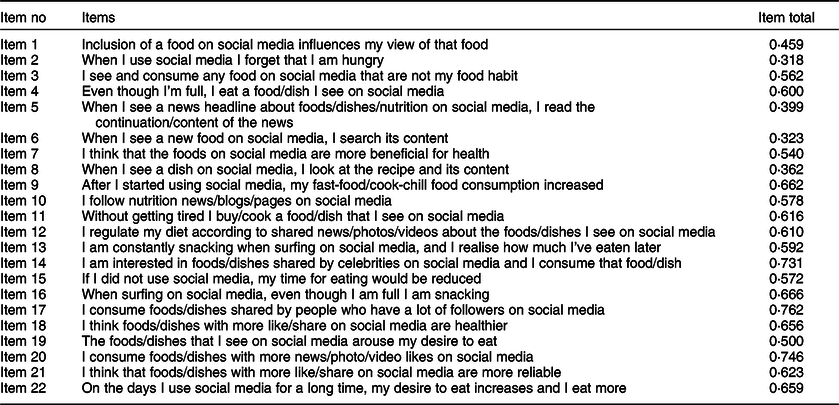
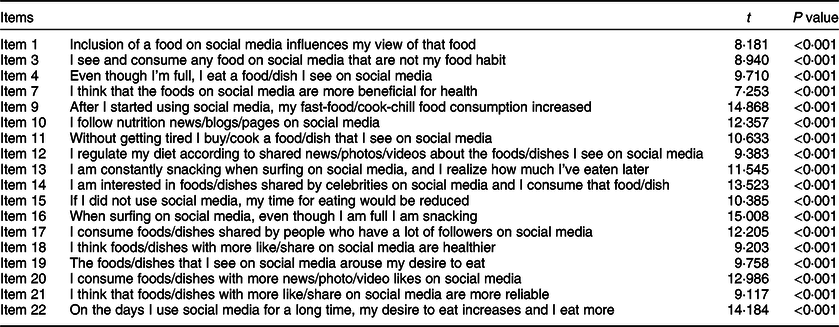
When the item-total correlations in Table 1 are examined, it is observed that the correlations are positive and between 0·318 and 0·762. The items with corrected item-total correlation values lower than 0·40 were excluded from the scale. It is decided to continue with 18. For eighteen items, the result of Tukey’s test for nonadditivity (χ 2 = 0·587, P value = 0·444) shows that the total score might be calculated by adding each item score. The floor and ceiling effect is also searched. There is no floor and ceiling effect. All items are found as discriminative based on 27 % of the sample of the highest and the lowest total score in Table 2.
Scale of effects of social media on eating behaviour item analyses outcomes
The results of comparison 27 % of sample of the highest and the lowest total score
The confirmatory factor analysis was evaluated using data from 247 participants. Kaiser–Meyer–Olkin Measure value (0·928) and Bartlett’s test result (χ 2(153) = 2463·146; P <0·001) show that the sample and correlation matrix of scale is appropriate for factor analysis, respectively. Necessary modifications were to contribute to model-data harmony by reducing the χ 2 value in the analysis process using the maximum likelihood estimation method(Reference Jöreskog and Sörbom17). Figure 2 shows the path diagram of the one-factor scale.
Standardised path coefficients of model

Figure 2 presents a model of a one-factor theoretical structure. When the standardised factor loadings and error variances are examined for the model, it can be seen that the factor loadings range between 0·49 and 0·84. Table 2 shows the standardised factor loadings (λ), t values and P values of the items that were calculated for the theoretical model.
It is found that only factor loading for item 1 is below 0·50 when the factors in Table 3 and factor loadings revealing the relationship between the items clustered under these factors are examined. However, the fact that this value is greater than 0·40 for all items indicates that the items have factor loadings at an acceptable level. It was found that the t values providing information about the explanatory level of the theoretical structure (hidden variable) on the items (observed variables) are significant at the level of 0·1 and range between 6·01 and 7·43(Reference Tavşancıl18,Reference Kalaycı19) . The fit indices (χ 2, χ 2/sd, root mean square error of approximation ‘RMSEA’, standardised root mean square residuals ‘SRMR’, adjusted goodness of fit index ‘AGFI’, goodness of fit index ‘GFI’, comparative fit index ‘CFI’, incremental fit index ‘IFI’ and normed fit index ‘NFI’ were used as a result of CFA.
Factor loadings, t values and variances explained for the model

The χ 2 value (156·21, P < 0·001) in terms of the CFA result is significant. However, it is indicated that the ratio of χ 2/sd can also be used based on sample size(20). The value of χ 2/sd in the current study was calculated as 1·50, which indicates a perfect fit. In addition, RMSEA (0·05) and SRMR (0·04) values also provide a fit model-data fit. While GFI (0·94), AGFI (0·90) and NFI (0·94) values are at acceptable level, CFI (0·98) and IFI (0·98) values indicate perfect fit(Reference Kline21–Reference Hu and Bentler23). Given the fit statistics calculated upon the CFA result, it can be stated that the data model fit is adequate, and the pre-determined one-factor structure shows a good fit with the collected data. Thus, when all the findings from CFA are taken into consideration, it can be concluded that these eighteen items show a good fit with the theoretical structure and the one-factor model is confirmed(Reference Kline21).
Social media, which the person thinks can meet their psychological and emotional needs, becomes an indispensable phenomenon of daily life in many subjects such as socialisation, loneliness removal and leisure activities. In this respect, person wants to meet many psychological, emotional and intellectual needs in social media(Reference Goffman24). Thus, social media has a social impact on users. The social impact is the changes that occur in own as a result of exposure to other people’s social judgement, attitudes and ideas(Reference Kağıtçıbaşı25). One of the dimensions of this effect is oral control. Oral control reflects substances related to providing control of food intake or not being able to resist against food(Reference Raacke and Bonds3). In this context, considering the relationship between eating behaviour and health, this scale developed to evaluate the impact of social media on eating behaviour will provide clinically important data.
Reliability
The Cronbach’s alpha reliability coefficient was calculated to determine to what extent reliable the scores, obtained from the second administration of the SESMEB developed in the context of the study, to distinguish participants in terms of eating behaviour. This coefficient is 0·928. The fact that the Cronbach’s alpha coefficient is greater than 0·80 indicates that the data obtained from the second administration of the SESMEB are highly reliable(Reference Kalaycı19). The correlation among two split parts of items and Spearman–Brown coefficient is calculated as 0·825 and 0·904, respectively. These results indicate high correlation among two split parts of items and high reliability.
Assessment of the scale of effects of social media on eating behaviour
SESMEB consisting of one subscale and eighteen items scale is evaluated with five-point Likert scale. Each item is evaluated as ‘always’ five points, ‘often’ four points, ‘sometimes’ three points, ‘seldom’ two points and ‘never’ one point. There is no reverse coded substance. As it is mentioned in item analysis part, total score can be calculated. According to this, minimum eighteen and maximum ninety points from SESMEB scale can be taken as total point. As a result, the increase in the person’s scale score means that the level of being affected by the eating media increases.
Discussion
These days, the media has become the most important source of information on health and nutrition. People make their daily decisions according to what they hear or see on the mass media(Reference Fernandez-Celemın and Jung14). Unfortunately, the media has important effects on the society in terms of being slim, aesthetic measures and values. Being slim is usually idealised in the media, it is associated with attractiveness, social acceptance, success and self-control for women. It is reported that the greatest influence of the media in terms of body image and eating behaviour lies on adolescents who are not yet confident of their social reality, who are extremely sensitive to the opinions and messages from the society, and information and stimuli from the environment to create their identities and who are in learning, development and identification process(Reference Aslan2). Because young adulthood is a critical time for self-identity construction and in this duration, using of social media is common.
It is believed that an investigation on the relationship between social media as a dependent or independent variable and eating behaviour will contribute to the field. Therefore, the effects of social media on nutrition behaviour should primarily be measured effectively. Otrar & Argın(Reference Otrar and Argın26) developed, ‘The attitude of students’ towards social media’ to determine the attitudes of students towards social media(Reference Otrar and Argın26). However, this scale does not make an assessment of eating behaviour. The fact that national and international literature is lack of a comprehensive, reliable and valid measurement tool reveals the necessity of the current study.
It is seen that people actively share in social media networks and platforms. At the beginning of these sharings are photos and videos with food, menus, plates and recipes. Then, these sharings have how many likes, how many times they have been viewed, become of importance to those sharing. Therefore, with this aspect, social media can be effective on eating behaviours of especially young adults who use social media frequently. In the development process of the SESMEB, literature review and item pool were primarily conducted. The twenty-two-items form prepared by experts was administered to 247 university students. As a result of the analysis, four items were excluded, and the last eighteen-item form of the scale was prepared. The Cronbach’s alpha reliability coefficient of CFA was 0·928.
For the reliability of the scale, the Cronbach’s alpha reliability coefficient was calculated for total scale score. The Cronbach’s alpha reliability coefficient that the scale is reliable and can be used in scientific studies. The weakness of the study was that we cannot use random samples. However, this scale is the first in the literature related to this issue and developed by researchers in different areas of specialists. With these features, it has contributed to the literature as a pioneer and guide for future studies.
Conclusions
There is no comprehensive measurement tool for the effect of social media on eating behaviour in the literature. As a result, it was determined that the psychometric properties of the SESMEB were sufficient for university student sampling. The one-dimensional structure of the scale is thought to be appropriate for measuring the effect of social media usage on eating behaviour. It is thought that the SESMEB will make an important contribution to the field when considering the effect of the social media, which is becoming increasingly widespread especially on the body image which gains importance during adolescence and young adulthood.
Acknowledgements
Acknowledgements: The authors wish to thank Selin Yılmaz, Zübeyde Elif Günaydın and Doğancan Dede for their assistance on preparing the manuscript and support accessing to participants. Financial support: The current study was conducted without support from any institution or organisation. Conflict of interest: All authors declare that they have no conflict of interest. Authorship: All authors contributed to the design of the study, the analysis and interpretation of the data. H.K. had a part in critical role creating scale subscale. All authors approved the final version to be submitted. Ethics of human subject participation: The study has been conducted according to the guidelines laid down in the Declaration of Helsinki. The study protocol was approved by the Research Ethics Committee of Ankara University (protocol number 287, dated 06 November 2017).



