

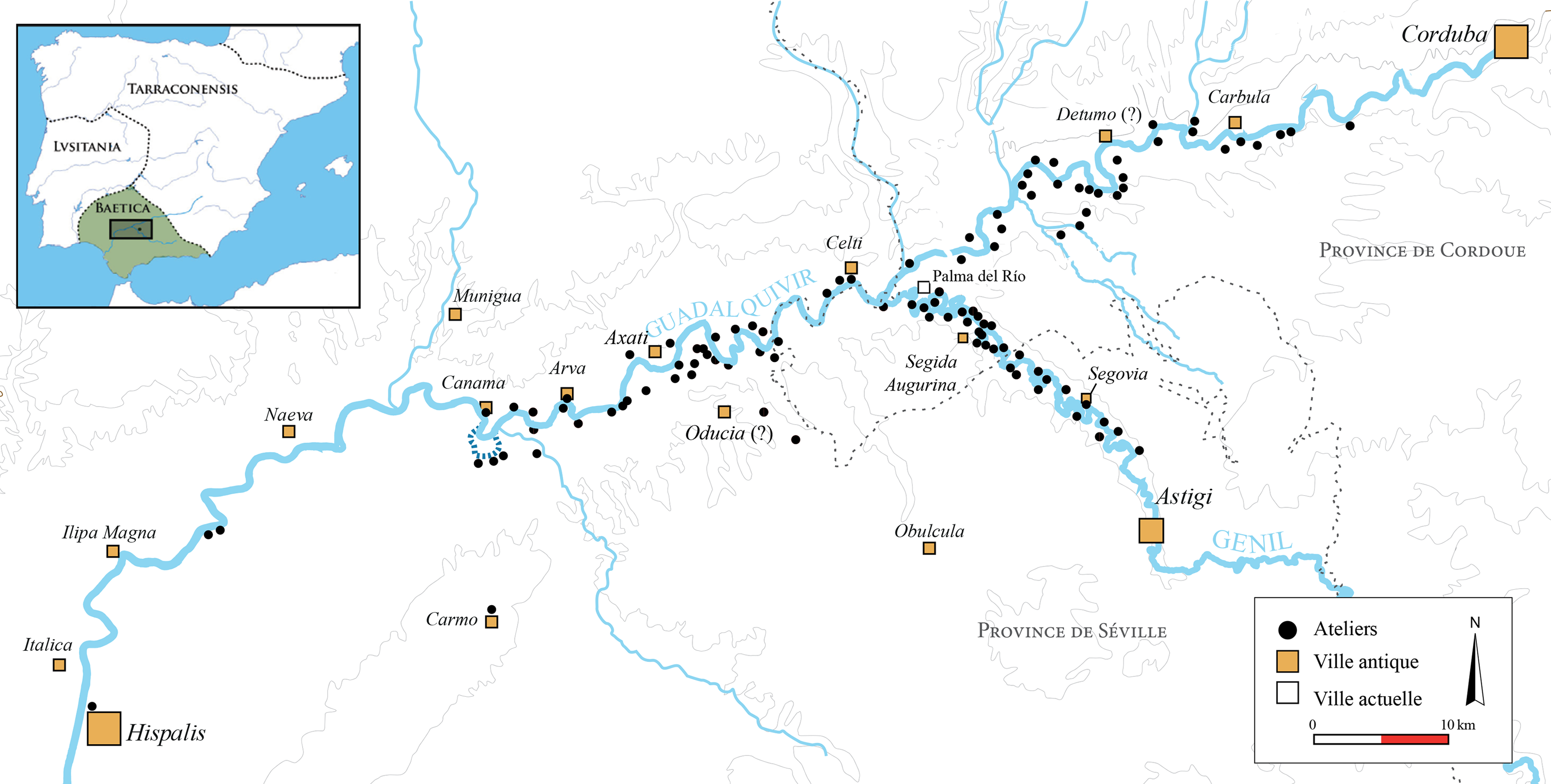
The volume and variety of marking systems observed on Baetican oil amphorae indicates large-scale production, carried out at highly specialized and intricately organized production centers (Fig. 1). Baetican oil was produced over large areas of southern Spain and was transported to the banks of the Guadalquivir and Genil Rivers – located between Hispalis, Corduba, and AstigiFootnote 1 – to be packaged in Dressel 20 amphorae for transport and marketing. These Dressel 20 globular amphorae were exported throughout the Roman Empire, being particularly abundant in Rome and the German/British limes. Thus, large quantities of containers were needed to satisfy the demand for oil.Footnote 2 The production of these containers was quite a lucrative business, which developed into a mass-production phenomenon during the first three centuries CE. The enormous quantities of inscribed pottery that can be found all across Andalucía bear witness to this phenomenon and provide evidence of the importance given to performing quality controls in this economic sector.
The area of Baetican oil amphora production in the Guadalquivir and Genil valleys. (Reference González TobarGonzález Tobar 2022: fig. 1.)

This article introduces an interpretative model that helps us to outline the basic features of the organizational schemes and production processes of Baetican oil amphorae. First, it is important to describe some basic aspects of the amphora stamps; in particular, the contents of the stamps and the basic features of the Dressel 20 sealing system. Next, we will try to answer three basic questions:Footnote 3 Why do the amphorae include stamps? Why are some amphorae stamped and others not? Who is represented in the stamps’ elements? Only then can we try to establish the basic features that indicate how the centers organized their work. Finally, we will present a general hypothesis concerning the production process of the figlinae.
The structure and content of the stamps on Dressel 20 amphorae
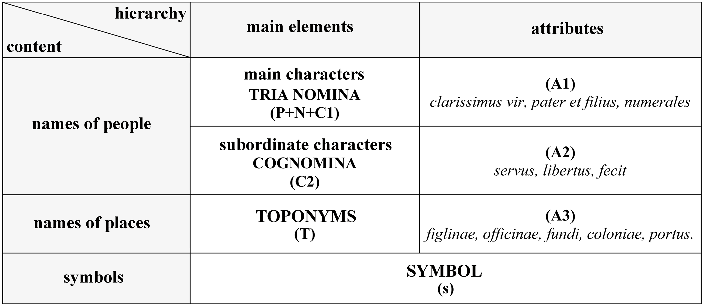
The stamps are composed of one or several simple elements that can be classified by their “hierarchy” and “content.” In sum, by following their hierarchy in the inscription, the stamps’ contents can be divided into main elements and their attributes (columns in Table 1). Given their content, these can be divided in turn between names of people and names of places (rows in Table 1).
Simplified table of the contents of the inscribed stamps.

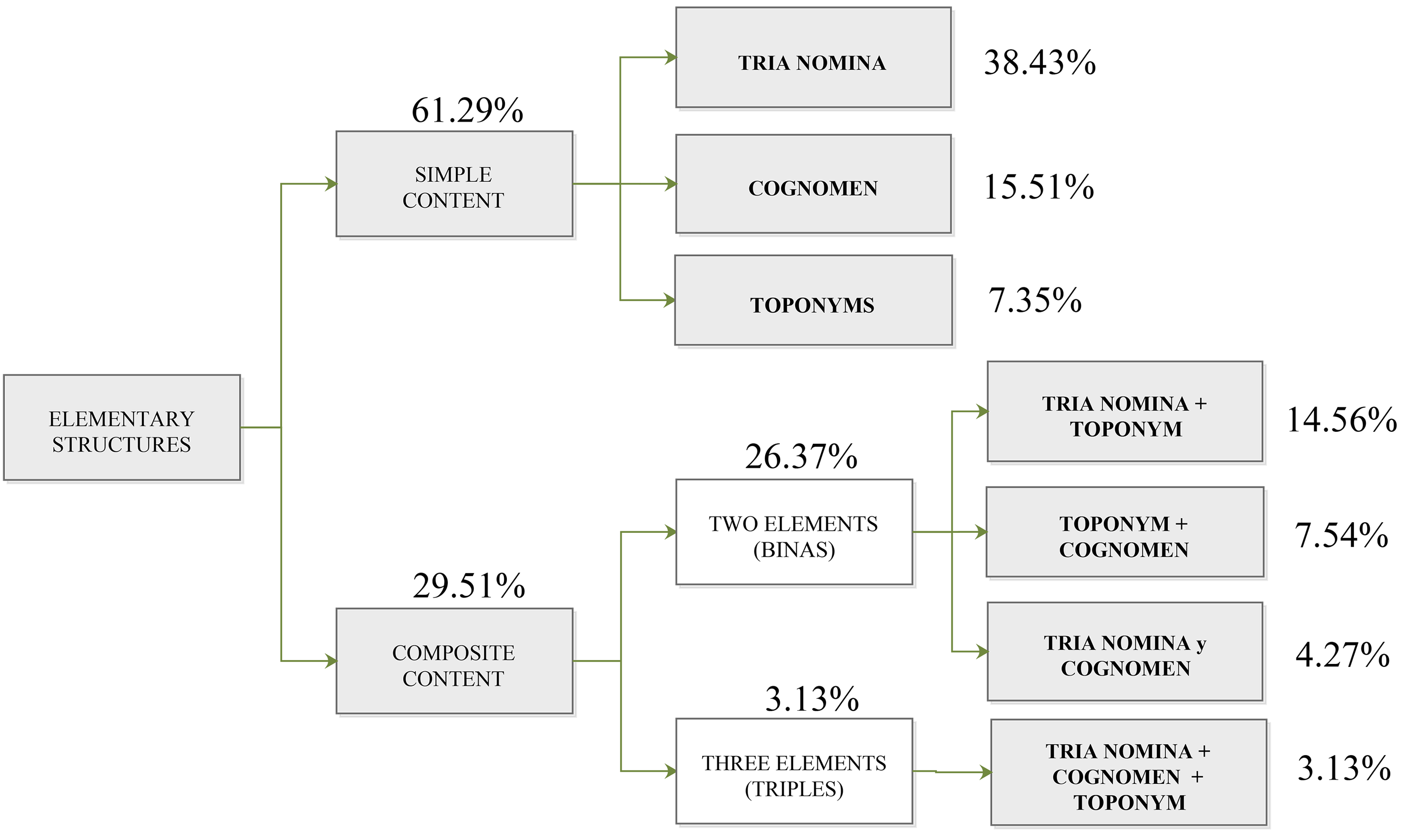
From the start of his research, Heinrich Dressel labelled the main elements of the stamps, known generically as: TRIA NOMINA, COGNOMINA, and TOPONYMS.Footnote 4 While at first glance the inscribed stamps on Baetican oil amphorae may appear to be pure gibberish, they are essentially extremely simple. The three main elements, TRIA NOMINA, COGNOMEN and TOPONYM, can appear alone (as simple elements), in pairs (called binas), or all together (called triples). So, the marking system can be reduced to seven elementary structures, three with simple content and four with compound content.
Figure 2 shows the incidence of each of these elemental structures in the stamp system of the Baetican oil amphorae. These statistics were attained through the study of individual stamps (which have provided more than 2,500 different readings), but a single amphora can bear multiple stamps. The fact that two out of three stamps represent simple content makes us think that it would be relatively common to find several stamps on the same container.
Elementary structures and their occurrence on stamps. (Illustration by Juan Moros Díaz.)

Interpretive basis: hypotheses about the stamps’ function
The main function of the stamps was to identify the specific origin of the manufactured objects within the organizational system that produced them. From this point of view, the stamp would be an “identifier,” generally abbreviated, which situates the manufactured object in a specific branch of the larger tree that represents the internal division of the productive organization at one specific moment of its activity. As we will see later, these productive organizations could develop intra or supra figlinam,Footnote 5 since they can involve several production centers. The advantages of having manufactured objects identified are clear for a productive organization of a certain complexity, especially one engaged in the mass production of objects that are morphologically very similar. In industries of this sort, the identification of objects assisted in the accounting, control, and coordination of batches or firing processes, in the control of production quality, the organization of storage, and so forth.
Not all amphorae bore stamps, because amphora production was organized in batches and each concrete matrix employed on the stamp identified a batch of amphorae produced in one figlina. Production in figlinae was not carried out object by object, but by packages or groups of amphorae (sub-batches); therefore, it was not necessary to stamp all containers but only some of them. In this way, a group was identified within a batch of amphorae. Finally, the stamps’ contents represent the different elements of the organizational system involved in the production of the amphorae.
The organization of the figlinae
The elements of the stamps can be related in different ways (Table 1). We need to know how these relationships developed in the series studied to establish how each element was articulated in the organizational scheme of a production center during one specific phase. The basic features that these organizational schemes display and their definitions appear below:
-
One productive organization can be made up of one or more production centers (figlinae).
-
One productive center (figlina) can be made up of one or more sections (officinae). These sections (officinae) would be productive areas within a figlina; they would occupy part of the facilities, and they would maintain a certain organizational autonomy, although they would be integrated into the general organization of the production center. Each section would be composed of one or more production units. In general, we can infer that a figlina is divided into sections when we have a contemporary series of stamps that present different characters represented by their tria nomina. Footnote 6
-
One production center, or a section thereof, would be made up of several production units.Footnote 7 These productive units were the simplest element of the organizational schemes that can be recorded in the stamps on Baetican oil amphorae. Amphorae were manufactured by potters working in these production units and would then go through the rest of the production process: firing, quality control, accounting, and storage (see Fig. 7 below). Each productive unit comprised a group of workers: clay specialists who produced the mixture, one or several potters, auxiliary personnel for handling containers, etc., managed by the character that appears on the stamp and is identified by a simple name (cognomen, C2).
-
We know from the graffiti ante cocturam, that, in each production unit, one or several potters carried out their activity.Footnote 8 We also know that a potter could manufacture amphorae for different productive units of a figlina.Footnote 9
Beyond these basic arrangements the organization of production sites presented varying degrees of complexity. There are cases in which a production center was made up of a single section, others which had several sections (officinae), and some production organizations that included several figlinae. To understand the model, let us look at some organizational schemes based on real cases, which gradually increase in complexity.
Scheme I: The series of C. Iuventius Albinus from Malpica:Footnote 10 the figlinae’s productive units
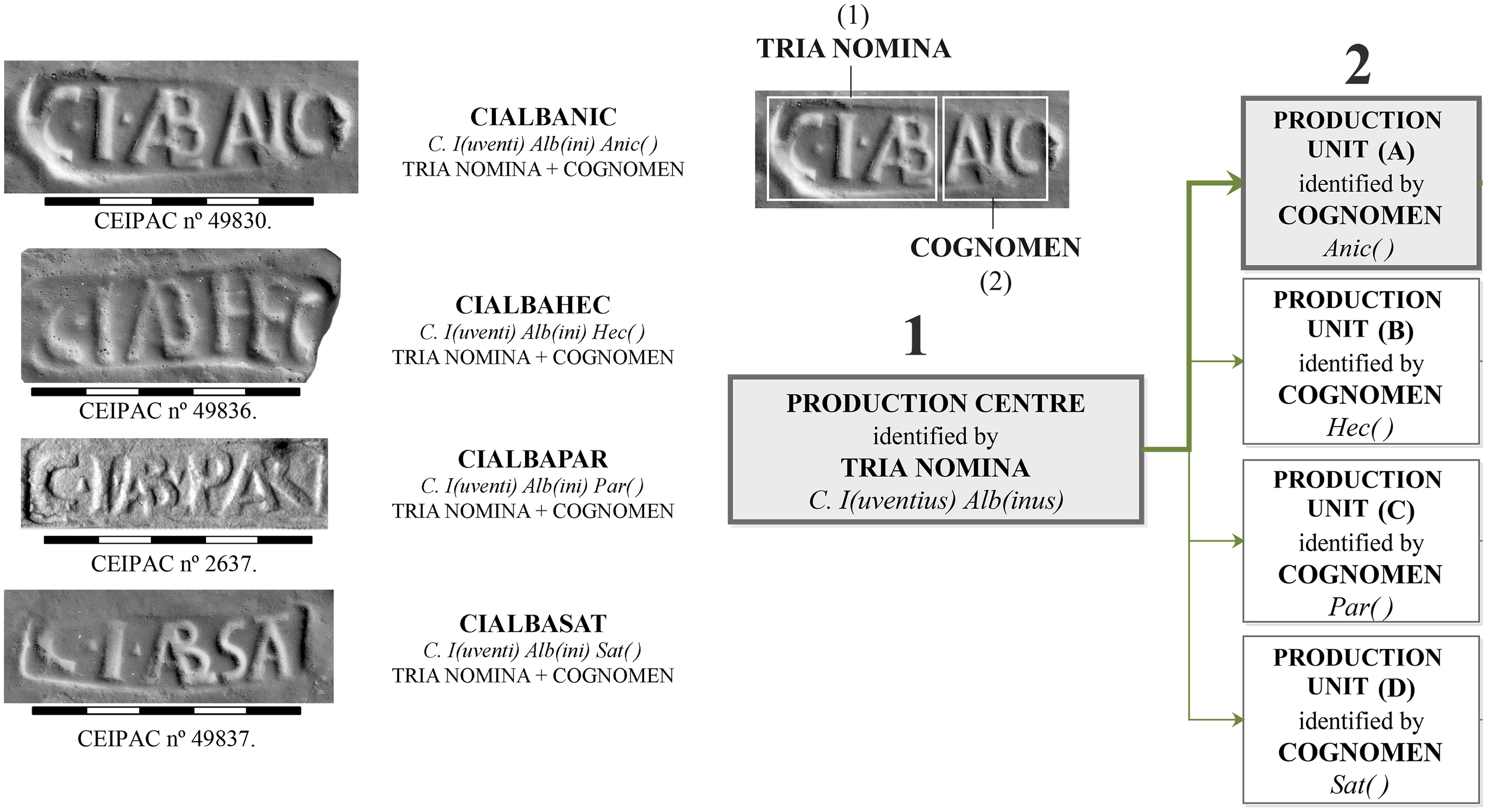
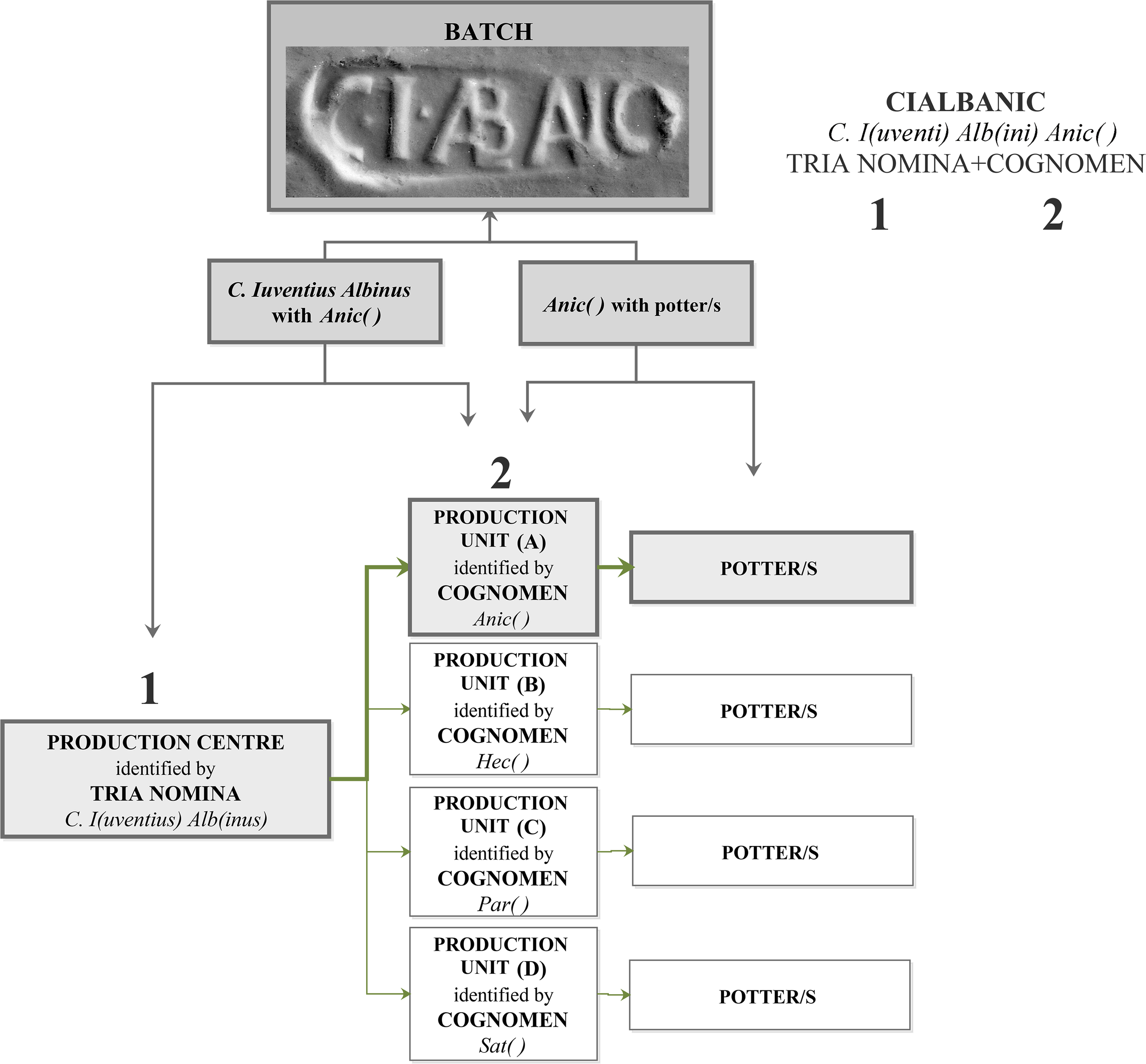
The amphora production of Malpica (Genil) was monopolized during the second quarter of the 2nd c. CE by C. Iuventius Albinus, as can be observed on the available stamps. These stamps, compiled and interpreted in Figure 3, read: CIALBANIC (CEIPAC no. 49830), CIALBAHEC (CEIPAC no. 49836), CIALBAPAR (CEIPAC no. 2679), and CIALBASAT (CEIPAC no. 49837).Footnote 11 All the stamps have the same design and the following structure: TRIA NOMINA + COGNOMEN. In our opinion, the matrices of these stamps were conceived jointly and made by the same hands. They correspond to the sets of matrices that were used at a specific moment in the production cycle of the figlina and attest to the control that the organizational system of Albinus exercised over the marking process. In this case, the organizational scheme would remain: a production center, identified by TRIA NOMINA – C. I(uventius) Alb(inus) – is made up of at least four production units, identified by COGNOMINA: Anic(…), Hec(…), Par(…) and Sat(…).
Basic organizational scheme of the series of C. I(uventius) Alb(inus) from Malpica. (Illustration by Juan Moros Díaz.)

Scheme II: The stamps of M. M(…) R(…) of La Catria: the sections and the productive units of the production centers
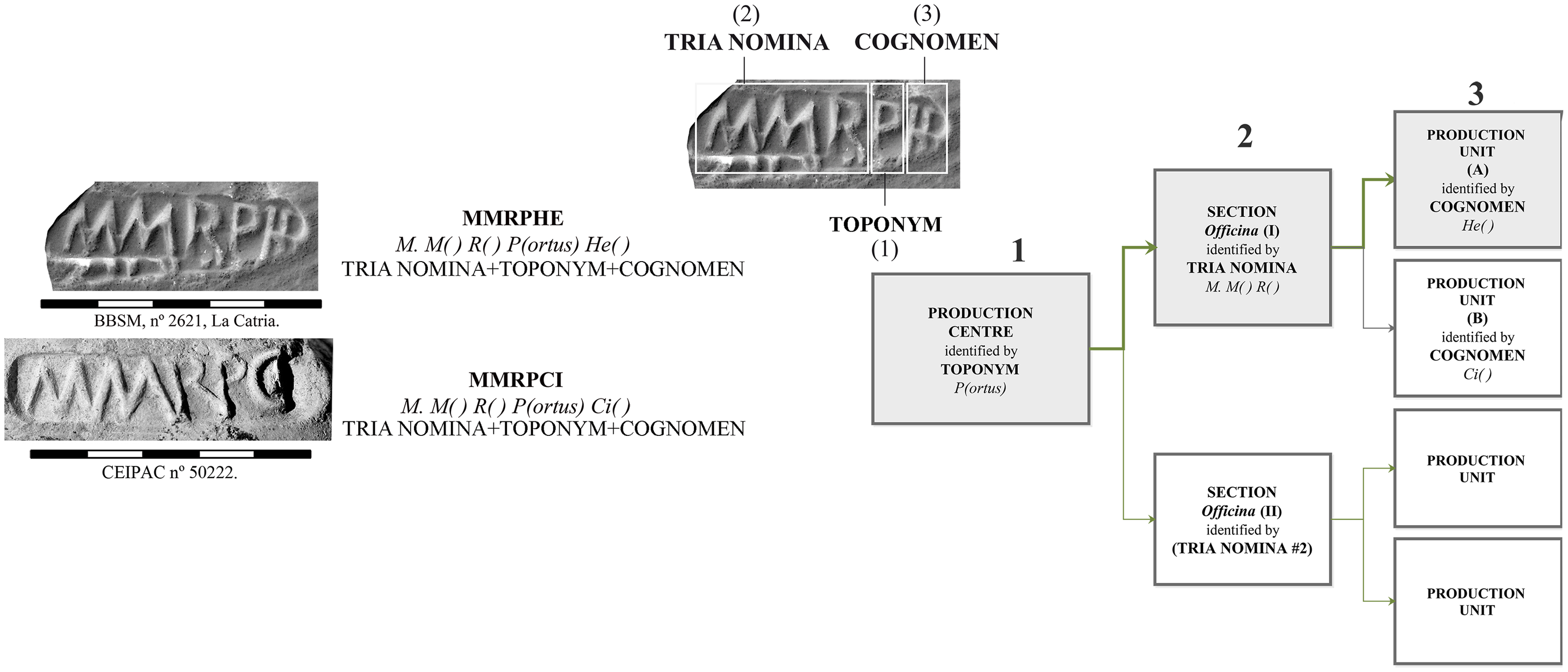
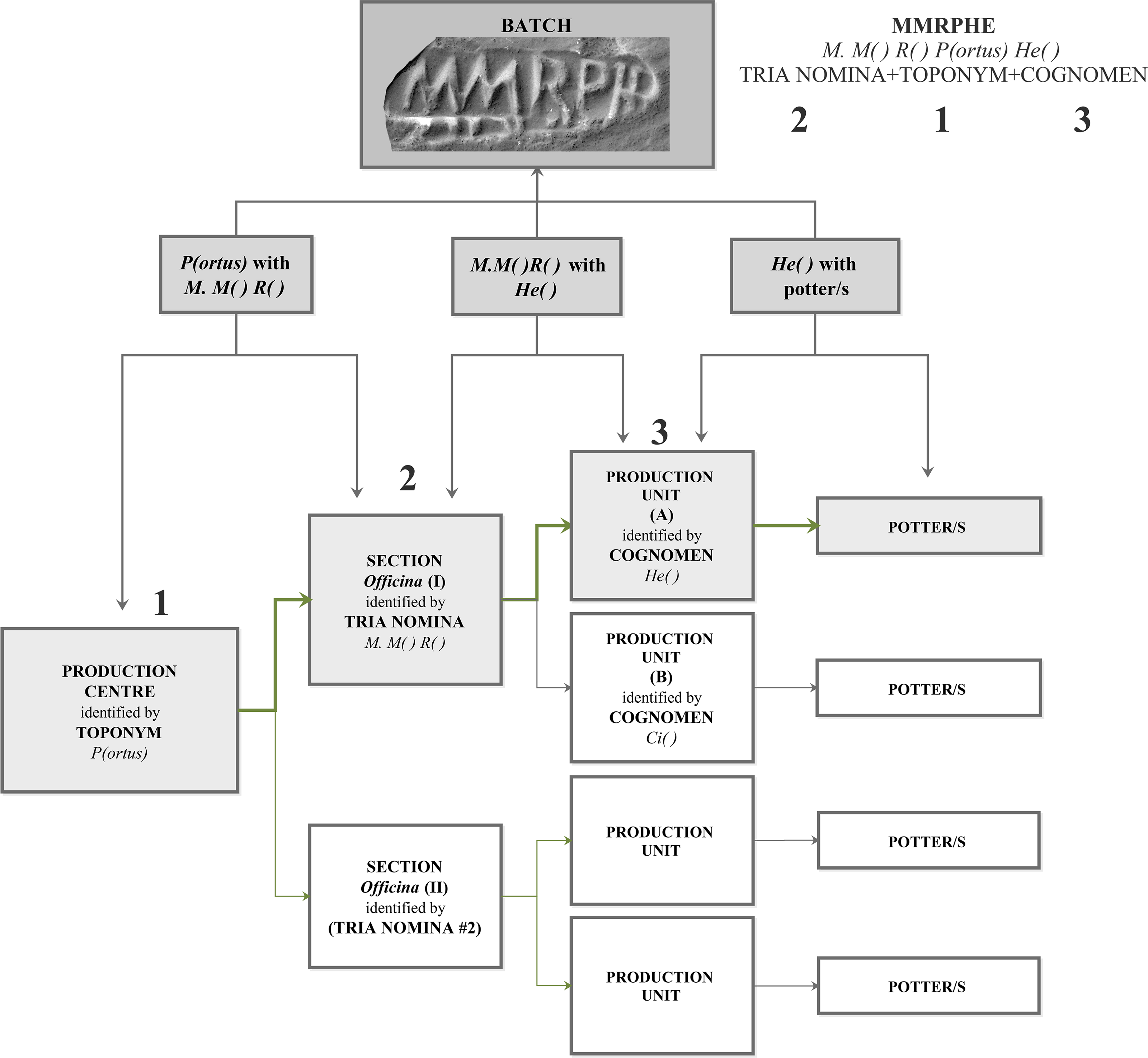
La Catria constitutes the largest and most extensive production center known in all the Guadalquivir valley.Footnote 12 For this paper, we have selected two stamps from the series M. M(…) R(…): MMRPHE (BBSM no. 2621)Footnote 13 and MMRPCI (CEIPAC no. 50222). These stamps have the same design and similar content, which makes us think that they correspond to the same production phase, which occurred at some point in the Flavian–Trajanic period (69–117 CE). Figure 4 illustrates our proposal for the reading, development, and structure of these stamps, which include three elements: TRIA NOMINA + TOPONYM + COGNOMEN.
Basic organizational scheme of the series of M. M(…) R(…) of La Catria. (Illustration by Juan Moros Díaz.)

The epigraphy of La Catria is well known, as it is characterized by the enormous number of subjects identified by their TRIA NOMINA in the series. It is also known that, on many occasions, these subjects formed family groups that remained in the production center for several generations. So, in this productive phase we will have several TRIA NOMINA representing subjects who were active in the workshop accompanying M. M(…) R(…). In this case, the organizational scheme (Fig. 4) is as follows: the production center, identified by a TOPONYM – P(ortus) – would be made up of several sections (officinae), identified by some TRIA NOMINA – M. M(…) R(…) and others – which in turn would comprise several productive units identified by COGNOMINA: He(…) and Ci(…).
Scheme III: The productive organization of Q. Aelius Optatus from La Catria (Portus) and Azanaque
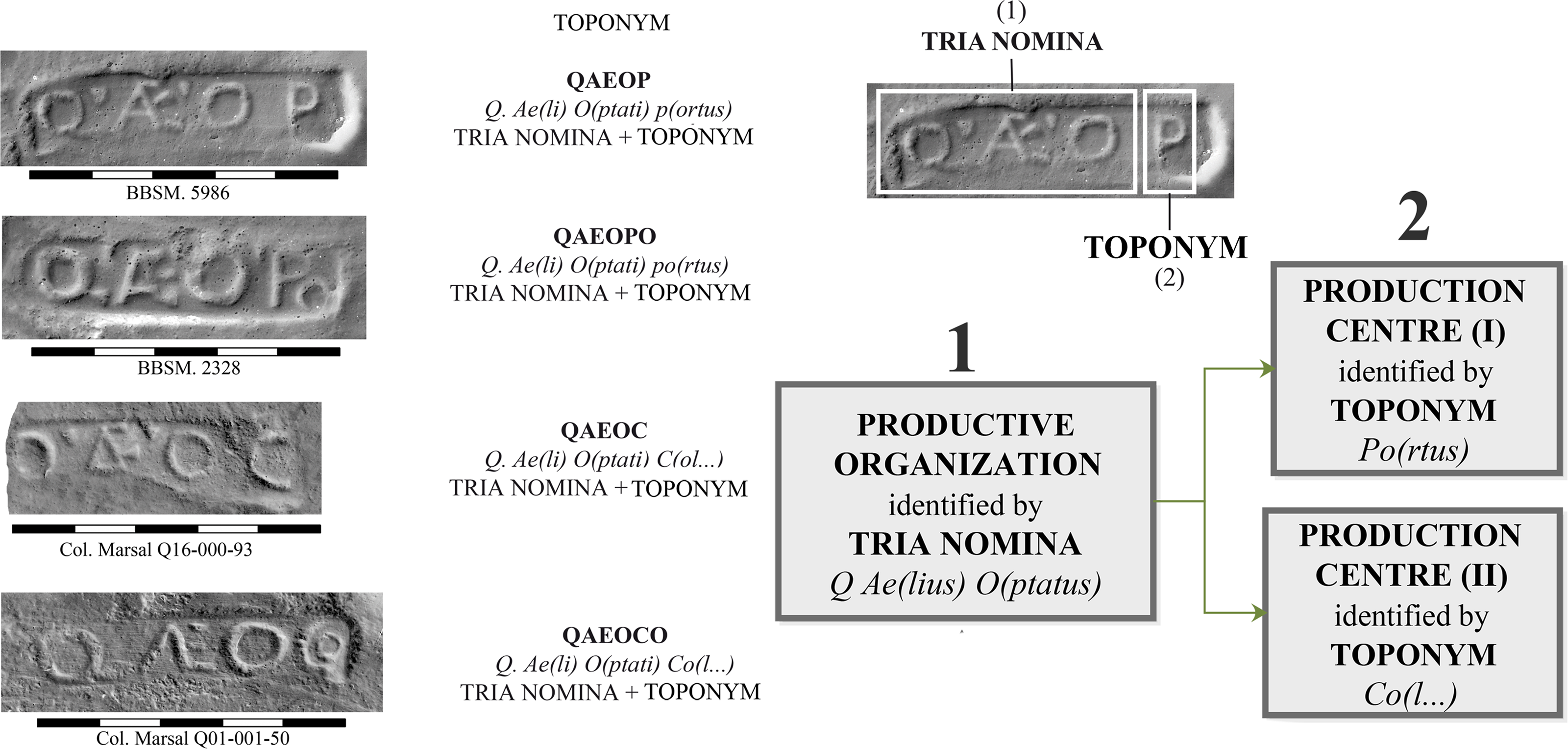
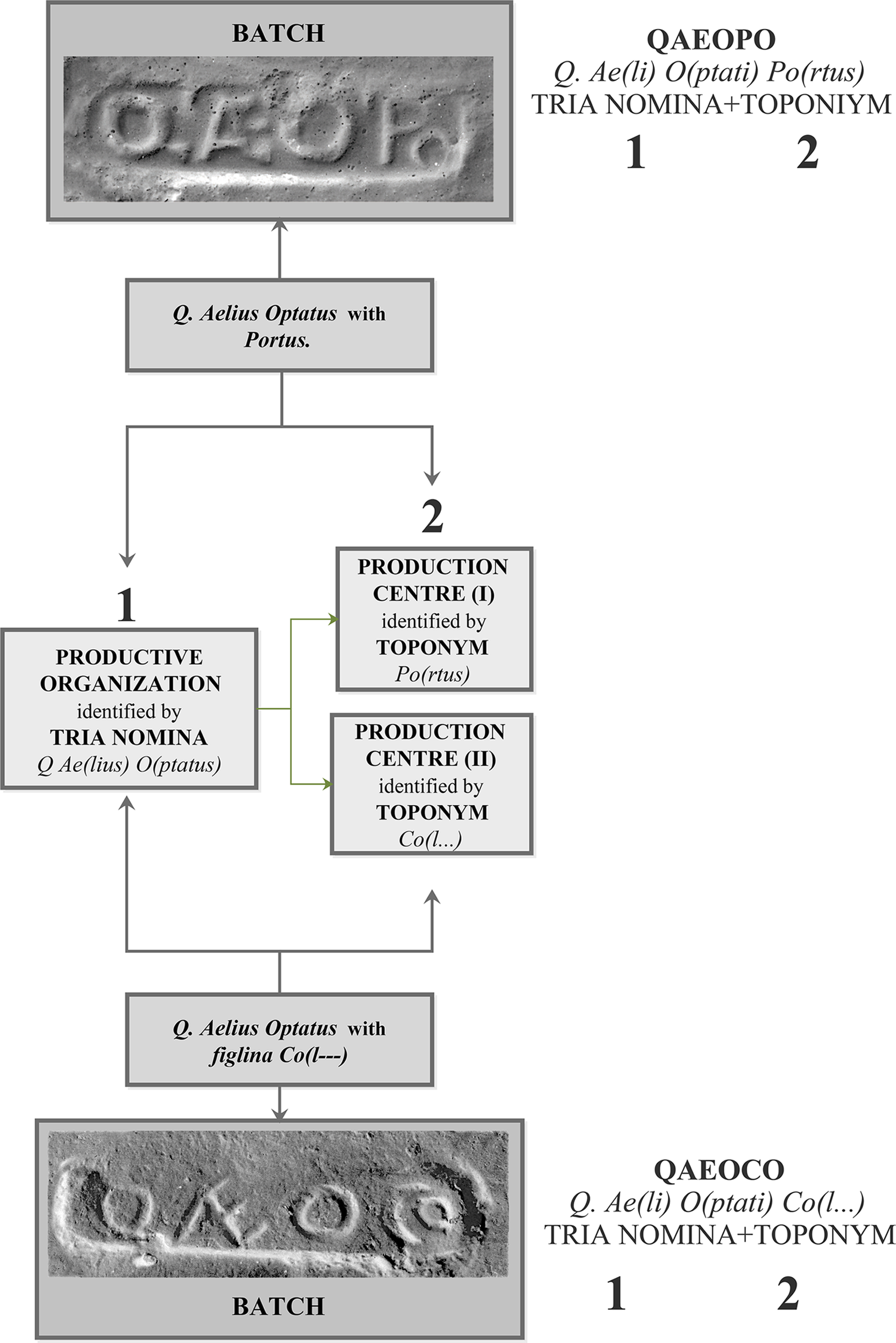
We have selected four stamps from the Q. Aelius Optatus series: QAEOP (BBSM no. 5986), QAEOPO (BBSM no. 2328), QAEOC (col. Marsal Q16-000-93), and QAEOCO (col. Marsal Q01-001-50). All the stamps have similar content and structure: TRIA NOMINA + TOPONYM (Fig. 5). The first two stamps correspond to La Catria productions (vide supra). The last two were produced in Azanaque-Castillejo,Footnote 14 where a Col(…) figlina was located. The activity of the character is dated to the second quarter of the 2nd c. CE. In this case, we understand that the organizational scheme of the series is as follows (Fig. 5): one productive organization, identified by some TRIA NOMINA – Q. Ae(lius) O(patus) – develops its activity in two production centers, identified by their toponyms: P(ortus) and Col(…).
Basic organizational scheme of the series Q. Aelius Optatus from La Catria and Azanaque. (Illustration by Juan Moros Díaz.)

Up till now, we have described the basic characteristics of the internal organization of the Baetican figlinae using some examples based on real cases. Now we will present a general hypothesis concerning the figlinae’s production process. First, we will briefly talk about the batches of amphorae, which in our model represent the basis of the production process of these potteries. Then, we will discuss some basic aspects of the manufacturing process of raw objects in the production units. Finally, we will try to establish the production process of the containers in the figlinae: manufacturing, firing, quality control, accountancy, and storage.
The amphora batches
Control of production in the figlinae was not exercised at the level of the individual object, but by batches. Each individual matrix identifies a batch of amphorae produced in the figlinae. The data compiled from the Testaccio campaigns indicate that up to 50–60% of the containers were stamped during the 2nd and 3rd c. CE; therefore, the number of objects identified from each batch would be considerable.Footnote 15 Still, we do not have an estimate of how many amphorae were included in a batch, nor can we calculate it: we can speculate on the productive capacity of the units, but we do not know how long the matrices were in use for. It seems likely, however, that the batches would have been made up of hundreds, even thousands, of amphoraeFootnote 16 and that the matrices were in use and valid for one or more years.Footnote 17 The composition of the batches could be determined either by a specific number of amphorae that was established prior to their production, or by the number of objects produced within a certain period, the period of the validity of the matrix that identifies the batch.Footnote 18
Hypothesis regarding the manufacturing process of the containers in the production units
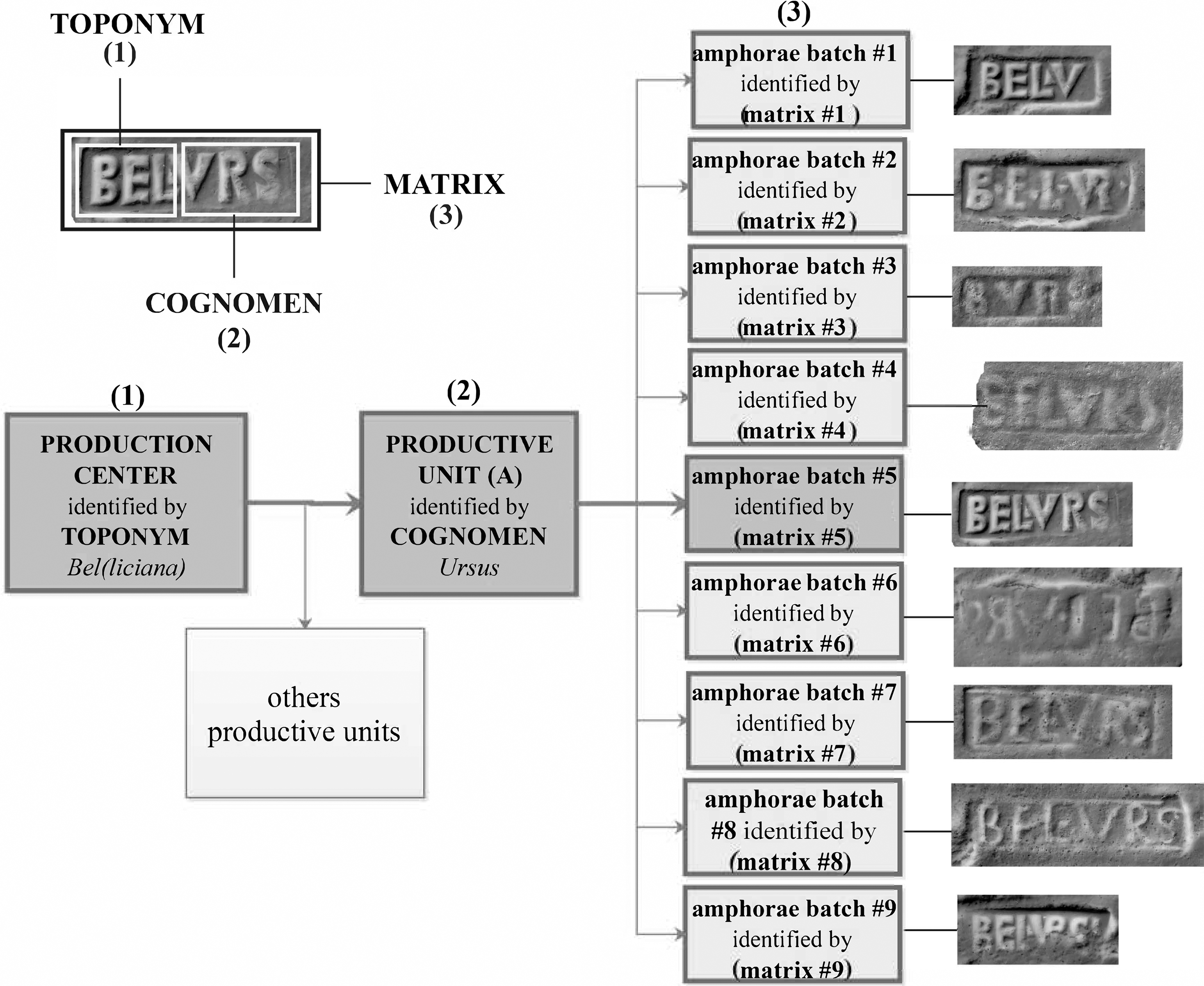
Regarding the production process for the containers in the production units, Figure 6 shows the case of the stamps used in the figlina Belliciana, which displays: one structure, five readings, and nine different matrices. The organizational scheme would have been as follows: one productive unit, identified by a COGNOMEN (Ursus) was active, along with other units, at the figlina Belliciana. The nine matrices included in the series would identify an equivalent number of batches, manufactured during different periods of their activity, by that specific unit (Fig. 6).
Organizational scheme derived from the Ursus group of stamps from the figlina Belliciana. (Illustration by Juan Moros Díaz.)

In practice, the productive process could be summarized as follows. As the production unit manufactured the objects in a batch, one out of every so many objects was marked with a particular matrix. The stamp that identifies the productive unit that uses it, like any of the nine that we have in Figure 6, comes from a specific matrix.Footnote 19 This matrix is what determines to which batch the manufactured objects belong and it should have been used for the marking of the entire batch. The production unit would provide groups of unfired amphorae (sub-batches) to the production process, which included firing, quality control, accounting, and storage (vide infra). When the production unit had manufactured the number of objects, complying with quality control, that were indicated for that specific batch,Footnote 20 or had reached the end of a predetermined period, they would destroy the matrix and begin to stamp with another matrix, which identified the next batch of amphorae. Destroying the matrices would prevent confusion and would also explain why only three stamp matrices of the thousands that may have been used, have reached us. We know about more than 2,500 different readings from Dressel 20 stamps, and each reading was represented by one or several matrices. An example of an extreme case are the stamps reading CIALB, for which we know of 46 different matrices.Footnote 21 The diversity of matrices is enormous, and much is obtained by manipulating the content of the stamp, gradually developing some of the elements. This can be seen in the case of the Ursus series in Figure 6 for the design of the matrix itself when the seals present the same text, as in the case of the seals reading CIALB. The matrices were made of clay, although we believe that metallic ones were also used from the middle of the 2nd c. CE, so it was relatively easy to make new stamps when needed.Footnote 22
Hypothesis regarding the production process of the containers in the figlinae
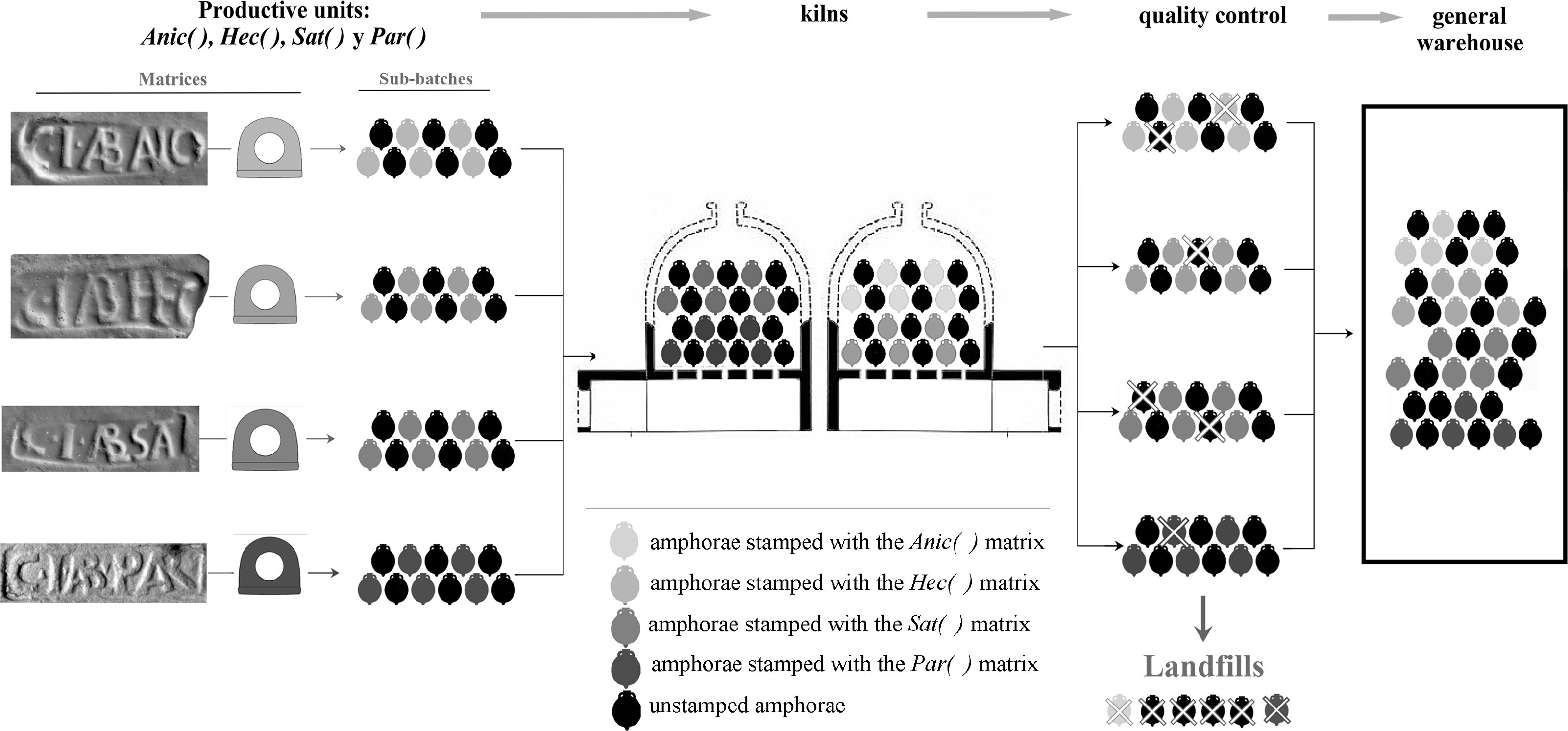
Figure 7 presents a hypothesis concerning the basic organization of container production in the figlinae, using an example taken from the stamp family of C. Iuventius Albinus from Malpica (Genil). As indicated previously (Fig. 3), at that specific moment in its activity, the production center was formed of at least four production units, identified by the names of their managers: Anic(…), Hec(…), Sat (…), and Par(…). Therefore, four groups of amphorae (sub-batches), coming from each of these four production units, could be processed simultaneously in the production center; for example, by using the same kilns.Footnote 23 Once these amphorae were fired and had passed quality control, the amphora groups (sub-batches) would be counted and deposited in a general warehouse of the production center.Footnote 24
Under these conditions, to control and coordinate the production process, each group of amphorae (sub-batch) had to be correctly identified, with one out of every so many objects stamped, to maintain their integrity as a group throughout the production process. The number of amphorae that would make up these groups (sub-batches) would be the number required to facilitate their joint handling throughout the production process, and it could be determined, for example, by the capacity of the kilns. In sum, everything studied to date makes us think that the facilities of the production centers – dryers, kilns, warehouses, etc. – were shared by the different sections and production units into which the production organizations of these figlinae were divided. Given that the objects produced were very similar at a morphological level, the need arose to identify the containers by means of stamps in order to control and coordinate a production process of a certain complexity.
It follows that the wide variety of Dressel 20 stamps refer to the different ways in which the figlinae were organized, and more importantly, to how the subjects involved in container production regulated their productive activities. Roman law provided legal tools to organize the different activities carried out at the figlinae, which also established the duties and responsibilities of the different subjects involved in these proceedings.
Locatio conductio and the production processes of Dressel 20 amphorae
Lease and hire, or locatio conductio, in which the risks of an activity carried out were distributed among different actors, was one of the commonest contracts employed in commerce. The contract belonged to the sphere of ius gentium, so it could be used by Roman and non-Roman citizens,Footnote 25 and was formalized by mere agreement (consensus). It had three essential elements: the object of the lease, the price, and the term of the contract (even if this was estimated).Footnote 26 Locatio conductio was a unitary contract of lease and hire, within which there were three objectives that allowed the judge to precisely determine the circumstances of the case to be evaluated, namely: letting and hiring of movable and immovable property (locatio conductio rei); of services (locatio conductio operarum); and of the completion of a specific task (locatio conductio operis faciendi). In the locatio conductio rei, the lessor permits the lessee to use an equipped workshop for his own benefit in exchange for a fixed rent in money, and the duration of the lease would be established in the agreement.Footnote 27 Locatio conductio operarum (often called operae, meaning “tasks”),Footnote 28 in the context of this paper, implied hiring the services of an operator to work in the figlinae. Finally, the locatio conductio operis faciendi implied that the landlord (locator) provided a contractor with raw material and a salary in exchange for performing a certain task. This, for the present case, would imply hiring someone to produce as many containers as agreed upon by the parties and to keep the amphorae safe until they were taken away for commercialization.Footnote 29
There remains some debate concerning the existence of two differentiated contracts for the fulfilment of a task (opus facere) and the provision of services (operae). Roberto Fiori has argued that the distinction between opus and operae was foreign to Roman legal thought, and that Roman jurists neither distinguished between these two terms in any sense nor saw them as the object of the contract.Footnote 30 Thus, in his view, with which we agree, these terms and the categories which they represent should be abandoned in favor of a single category, broadly defined as “tasks” (operae), which better reflects the Roman jurists’ views on letting and hiring. Following these thoughts, Paul du Plessis analyzed Roman legal texts and identified several “normative” examples. He grouped these into five more refined categories to demonstrate certain underlying ideas that indicate the particularities of each kind of locatio. Footnote 31 In sum, while referring to the contract as operae for the three case studies in the next section, we will also invoke their particularities to better understand the overall nature of the contract analyzed.
What do these contractual schemes have to do with amphora stamps? In a series of articles published between 1982 and 1993, Margareta Steinby put forward a suggestive hypothesis: that the brick stamps produced in Rome, especially those dating from Hadrian to Septimius Severus, constituted the abbreviated form of a locatio conductio operis faciundi. Footnote 32 According to Steinby, the information displayed on the brick stamps summarized all the elements of such a contract: the object (opus, opus doliare, opus figlinum, tegula …), the lessor (dominus), the lessee (officinator), and the place where the activity took place (officinae, figlinae, praedia). Some cases even included the date of the contract through the mention of a consular dating. Before Steinby, Tapio Helen had also devoted a volume to brick stamps and proposed that the regime of the figlinae was managed under a contract of locatio conductio rei, by which the landowner would not manage the business nor market the product.Footnote 33 Jean-Jacques Aubert replied to both hypotheses that, from his point of view, the contractual scheme that fitted better with the brick industry was that of a locatio conductio operarum, since two names appear on the bricks, and there was always a dominus who owned the figlina and therefore, the final product.Footnote 34 All these theories are partly right, but they are too limited to cover the wide variety of phenomena happening at the different figlinae in the area of Rome. Acknowledging this, Jean Andreau published a contribution in which he addressed the three approaches and provided his own thoughts on studying the management of the Roman brick industry.Footnote 35 His views can be summarized as follows: a stamp was not an abbreviated version of the contract, and there were different ways to manage the brick figlinae that could employ different sorts of contractual schemes.Footnote 36
The production and distribution of amphorae, however, involved problems that were substantially different from other types of clay artifacts, such as bricks or tableware. As containers, their value and distribution were determined by their content.Footnote 37 Oil was one of the staple products in Roman trade, and Baetica was its biggest provider during the High Empire (until African produce grew stronger in the market).Footnote 38 There was a steady demand for oil, which explains the enormous number of pottery batches produced and their stamps. Steinby’s approach to brick stamps provides a basis for the study of the Dressel 20 stamps, as there are some similarities in terms of organizational schemes and inscriptional habits,Footnote 39 although the terminology used in the description of each production is different. The common scheme presented by the stamps on the bricks of Rome during the 2nd c. CE would be: PRAEDIA – FIGLINAE – OFFICINAE, which can be replaced in the Baetican case with: FIGLINAE – SECTIONS (OFFICINAE) – PRODUCTIVE UNITS. The absence of properties mentioned on the Baetican stamps, at least explicitly, makes us think that the agrarian structures of the two production areas must have been very different. In addition, the inscriptions stamped on Roman bricks sometimes include consular dates (depending on the period),Footnote 40 something that has never been observed on Dressel 20 stamps, except in their graffiti ante cocturam.Footnote 41 On the other hand, one similarity between the two productions concerns the general evolution of the ownership of Roman brick potteries, which changed from being in the hands of private individuals to falling into those of the imperial elites and the emperors themselves.Footnote 42 These dynamics can also be observed in Baetica.Footnote 43 Notwithstanding these similarities, Andreau’s caution provides manifold possibilities for analyzing the material evidence available, and it is his focus that proves most helpful when dealing with Dressel 20 stamps.
Inscriptions on merchandise, even though denoting commercial production or distribution (as opposed to production for domestic consumption), were aimed at specialists working in a certain business and not at the wider public.Footnote 44 While tituli picti were abbreviated in an intelligible way for a wider audience working in the distribution of a certain product, inscriptions on amphora stamps were so cryptic and abridged that they would only have made sense to the actors who were involved in the production process and not the commercialization of the product.Footnote 45 In that sense, we should recall the concept of “craftsman’s literacy,” first mentioned by William Harris in 1989, Footnote 46 and Harris’s later designation “specialist literacy” to characterize the decoding skills required of those who manufactured, transported, and traded the portable objects known as instrumenta domestica. Footnote 47 The issue of craftman’s specialization connects with the question of whether the marks of the stamps could summarize a contract, to which one may argue that Roman law did not require a written document for a contract of lease and hire to come into existence, since this contract was formalized by agreement between the parties.Footnote 48 Indeed, given the complexity of some of the commercial transactions, re-recording of some provisions of the contract would have been beneficial to the parties involved. Written documents clearly had some evidentiary value, and the way in which they were created and inscribed appears to have been significant,Footnote 49 but the Roman jurists’ conception of the “contract,” that is, the (mostly) written record of the agreement between the parties, is quite different from modern dispositive notions of contract.
Steinby never indicated that the marks constituted contracts in themselves, but suggested instead that they summarized what had been agreed between the parties involved in the production.Footnote 50 We do not think that these stamps literally reproduced the contract agreed upon (as we do not think that these stamps would stand up in court as contracts themselves),Footnote 51 but their inscriptions summarized details about the contract, which in practical terms would had the value of an accounting document. While Dressel 20 stamps were not contracts per se, nor did they summarize them, they mirrored contractual practices. The recording of the details of a commercial transaction could either occur in a rather random fashion with no clear pattern,Footnote 52 or follow some criteria specific to the industry and its context. Many examples of this latter phenomenon can be observed by reading tituli picti written on containers for distribution,Footnote 53 graffiti on lead labels,Footnote 54 or many sorts of inscriptions written on marble blocksFootnote 55 or barrels.Footnote 56 Thus, inscribed merchandise indicates, first, that people working in a certain industry had reached a level of understanding of their daily tasks that allowed them to summarize the results of their agreements in abbreviated and encoded writings.Footnote 57 Second, thanks to these writings, it is possible for us to reconstruct the different processes by which commercial actors organized production and distribution. In sum, stamps would have been used by actors involved in amphora or brick production, acting as accounts of work accomplished and evidencing agreements settled on by the interested parties.
Analyzing some other materials evidencing locatio conductio raises two additional considerations for the study of amphora stamps. The first are the similarities in legal practice between state-owned and privately owned facilities. The second is the existence of general sets of applicable rules tacitly incorporated into individual agreements. Warehouse agreements recorded in the Tabulae Pompeianae Sulpiciorum,Footnote 58 the so-called lex horreorum Caesaris,Footnote 59 and some similar inscriptionsFootnote 60 demonstrate similarities in legal practice between public and private warehouses. Whether warehouses were managed privately or publicly,Footnote 61 both activities were “nested,” and especially in archaeological contexts such as the Baetican figlinae, where there was a state presence, private actors interacted in daily activities.Footnote 62 Comparing an agreement of lease and hire recorded in writing on a wall in Puteoli (lex parieti faciendo puteolana) of 105 BCEFootnote 63 with the evidence from the Puteolian archive of the Sulpicii indicates that there was a large measure of similarity between private and state practice in the letting and hiring of warehouses.
The lex horreorum Caesaris also displayed some practical rules concerning the payment and the general regime of the warehouseFootnote 64 that were meant to be seen by everyone, as was the case with other regulations to manage and organize public infrastructure.Footnote 65 A survey of other Roman legal texts demonstrates that these contractual clauses were often implicit, which suggests that the parties would in most cases probably have agreed on the essentials and specificities of the contract (price, time, the exact place where goods were deposited).Footnote 66 Clauses concerning the elements referred to in a general lex governing the warehouses would be tacitly incorporated into the contract.Footnote 67 Storage lease contracts are not the only place where we can observe the phenomenon of general lex framing agreements; an example from the mines in the Roman province of Dacia (164 CE) provides similar evidence. In that case, an epigraphic inscription of a locatio conductio operarum contains all the necessary details to create a contract of letting and hiring according to Roman law. Adolf Berger has rightly concluded, however, that the absence of detailed rules, such as the hours or kinds of work, suggests that this document should be read against the backdrop of the existence of more general conventions on mining which operated in this type of industry.Footnote 68
Figlinae devoted to the production of amphorae may have operated in a similar way. First, the examples presented in the following section will help demonstrate that the locationes used for both public and private industries may not display evident differences in the inscriptions. It follows that any differences may have depended on specific details of these agreements, which unfortunately we cannot detect through the stamps but must infer from their context. Second, the abbreviated inscriptions on stamps, the fact that locatio conductio was a contract formalized by agreement, the long and continuous timespan over which the figlinae developed their activity, and the particularities of their industry together strongly suggest that many details of work practices were conventional and tacitly accepted by the parties, and therefore would be invisible in the stamp inscriptions. In summary, what we can observe in the inscriptions, or at least what we can try to grasp from them, is who was in control of the means of production and who was providing labor. We can then attempt to evaluate from the seals the degree of organizational dependence of the latter with respect to the former. In that way, we will at least get a broad idea of the kind of lease agreement employed, even if the more concrete details will elude our inquiries.
How stamps served as a tool to manage the production of Dressel 20 amphorae
It is impossible to say which production mode was more common than another. Regardless of what was agreed upon in the contract, the crucial element was determining who owned the means of production and who retained the produce.Footnote 69 Indeed, all three forms of locatio conductio (rei, operae, and operis faciendi) seem to have been used at the different production facilities. Officinatores were at times tenants, contractors, usufructuaries, or business managers. In addition, they brought their assistants with them, who, as well as by means of the locatio conductio contract, could have been managed through other legal schemes such as the mandate, negotiorum gestio, or potestas, which are quite elusive in the epigraphic record.Footnote 70 Nothing compelled the domini to stick to one system of management.Footnote 71
Bearing that in mind, Andreau proposed classifying the inscribed stamps into six different categories, through which one can try to grasp the productive organization and work out the kind of locatio conductio employed.Footnote 72 The problem with Andreau’s scheme, despite its usefulness, is that it only focuses on personal names and leaves aside place names, which appear in stamps on both bricks and amphorae, and in our opinion add a significant amount of information. Even though prosopography has been a helpful tool for unraveling the roles of the subjects mentioned in the inscriptions, it is sometimes insufficient for assessing the kind of contract employed in each case. Comparing amphora stamps with locationes employed in other sectors can be helpful, which is why we will do so for the three case studies introduced previously (Malpica, La Catria, and Azanaque) and further analyzed here. These cases concern two privately owned and one publicly owned figlinae, allowing us to determine whether there were many differences in management between private and public facilities. The information that we can obtain from these brief inscriptions is limited, but together with the reconstruction of the production process detailed above, it at least provides an idea about how a Dressel 20 figlina may have worked.
The series of C. Iuventius Albinus from Malpica:Footnote 73 the figlinae’s productive units
Regarding the productive units, we can cite the case of C. Iuventius Albinus (Fig. 3). The magnitude and variety of stamps from the series of C. Iuventius Albinus from Malpica show us a large-scale production of containers, carried out in a highly specialized workshop with a complex and effective production organization. If we add to this the information that we have been able to gather from the tituli picti, and from the monumental epigraphy of Lora del Río, we can characterize Albinus as one of the wealthy landowners of Baetica dedicated to the production and marketing of olive oil. All these elements considered, this case seems to be the simplest of the three studied here, thanks to the identification of the figlina’s dominus, C. Iuventius Albinus.
As we have seen, at the specific moment of its activity indicated in the diagram in Figure 8, this production center was made up of at least four productive units managed by subordinate characters: Anic(…), Hec(…), Sat(…), and Par(…). It has been suggested that these productive units could have comprised groups of professional artisans who established lease and hire contracts with the owner of the workshop. If the batches of amphorae were composed of a pre-established number of amphorae, this relationship could have been covered by a locatio operis faciundi, where what was contracted for was the work itself; that is, the manufacture of the batch. If the batch consisted of containers produced over a specific period, we could be dealing with a locatio conductio operarum, in which case what was contracted was the labor performed during that period; that is, the period corresponding to the validity of the matrix stamp that served to identify the batch of amphorae through its mark.
Hypothesis concerning the basic organization of the production of containers in the production centers with an example taken from the family of stamps of C. Iuventius Albinus from Malpica (Genil). (Illustration by Juan Moros Díaz.)

Diagram of relations derived from the productive organization of Malpica for the CIALBANIC stamp. (Illustration by Juan Moros Díaz.)

The contract between dominus and productive unit resembled a labor contract (generally referred to as operae, as indicated previously), whereby the units provided no more than technical and managerial skills. The difference between a contract in which the unit lends its services (operae) or the performance of a task (opus faciendi) depended on the degree of control that the dominus wanted to exercise over the manufacturing process and how much interest he had in the good management of the pottery. In this case, it is evident that Albinus’s administration controlled the workshop’s sealing system (see comments on Fig. 1); therefore, it controlled the productive organization. Under these conditions, all the goods produced by the various productive units belonged to and were marketed by Albinus. So, here we could be facing a contract of locatio conductio operae, in which Albinus is hiring the services of the productive units and not the performance of a concrete task. The names in the inscriptions would ensure that these workers were doing their jobs but would also work in terms of identifying the different lots of amphorae produced and fired, thus keeping track of the production. One similar practice, also referring to a large-scale manufacturing industry, is the firing-lists from La Graufesenque in Roman Gaul, which are understood to provide a summary of the sigillata pots going into the kiln during a single firing event. These lists are interpreted as accounting devices, facilitating the calculation of profits and returns, and referring to a social reality (e.g., production organization, language use) beyond themselves.Footnote 74
To finish the discussion of Figure 8, we will now consider the relationship established between the manager of the unit and the potters who carried out their work in it. The productive units would be made up of one or more potters, as the graffiti on the figlina Virgninensia show us, and other auxiliary workers were necessary to carry out a packaging and manufacturing process that involved a certain complexity. We also know that these potters, throughout their activity, were able to do their work in different productive units of the workshop. So, we think that we are dealing with professional potters, and their relationship with the productive units could be resolved through a contract that leased their services (locatio conductio operarum). These contracts could be established by a simple verbal agreement between the parties, where the details of the work practices would be summarized and tacitly accepted by the parties, according to the custom that prevailed in this kind of industry.
Finally, we cannot rule out the possibility that the productive units were made up of Albinus’s slaves, in which case there would be no contract. Instead, the job would fall under the umbrella of the slaves’ commitment to their dominus, and thus we would be facing a case of direct management by Albinus. The fact that two cognomina appear on the stamp of the CIAFLACP series (CEIPAC no. 49838) suggests associations established between those responsible for these productive units; this circumstance, in principle, seems to support the presence of professional artisans.Footnote 75
Another example that is useful for comparing and differentiating between contracts of operae is a lease of a pottery in Roman Egypt.Footnote 76 Two female landowners, acting through their guardian, leased a kiln for a period of two years to one Aurelius Paesis. They agreed to supply the potter with facilities and raw material, while Paesis would bring his own assistants and would deliver to his landladies a certain number of pitched jars of various sizes by the early summer of each year, for which he would receive a fixed price in money and in kind (wine). The lessors reserved the right to buy any additional containers produced in the workshop. In this case, unlike the case of Albinus, the landowners owned the means of production, while Paesis controlled the workshop and not only worked for them but could also produce for himself, which could classify this contract as a lease of operis faciundi. Footnote 77 This comparison requires further evidence to ascertain the different practices of firing and pottery production, and it is to these that we now turn.
The stamps of M. M(…) R(…) of La Catria: the sections and the productive units of the production centers
The epigraphy of La Catria is well known and characterized by the enormous number of subjects identified by their TRIA NOMINA represented in the series. It is also known that, on many occasions, these subjects formed family groups that remained at the production center for several generations. So, in this productive phase we will have several TRIA NOMINA representing subjects who were active in the workshop accompanying M. M(…) R(…). As for the toponym P(…), it refers to portus, the nature of which is still the subject of debate.Footnote 78 Stamps with the indication portus, however, have only appeared in areas close to the navigable flow of the Guadalquivir River and are related to urban centers located nearby.Footnote 79 These stamps may indicate the places of manufacture, storage, control, and export of amphorae (in other stamps, this is designated by the mention of a figlina),Footnote 80 but for a large company of municipal character.Footnote 81 However, if these facilities were controlled by the state, by a municipality or a city, this would not alter the nature of the contract, but would determine if the control of the means of production was in public or private hands.
The scheme is developed from the MMRPHE and MMRPCI stamps. In our opinion, in these stamps at least two levels of relationships may be linked: the one established between the production center, P(ortus), and the office, M. M(…) R(…), and that of the office with the respective production units, He(…) or Ci(…). In addition, we know from the ante cocturam graffiti that one or several potters carried out their work in these productive units. Thus, we can have a third level of relationships, established between the person in charge of the He(…) or Ci(…) production unit and each of the possible potters who participated in the manufacture of the containers. On the other hand, as we have seen, each individual matrix represents a batch of amphorae produced in the figlina. In Figure 9, we include the diagram of relationships corresponding to the batch of amphorae identified by the matrix of the MMRPHE stamp.
Diagram of relations derived from the productive organization of La Catria for the MMRPHE stamp. (Illustration by Juan Moros Díaz.)

The case of M. M(…) R(…) from La Catria indicates that the main difference that we find between the production of Baetican oil amphorae and the construction materials of the Roman environment is the degree of complexity presented by the organizational systems of each one of the productions, at least based on what we can deduce from the associated epigraphy. While in the figlinae around Rome we have two main actors, dominus (owner) and officinator (worker), in Baetica, there can be up to three levels of relationships established between the participants in the production of the containers.
The relationships shown in Figure 9 can be interpreted in different ways, depending on the contractual scheme employed by the parties, and these parties could in turn have organized their relationships through not just one, but two different sorts of leasing contracts. For example, the relationship established between the production center, Portus, and the office, M. M(…) R(…), could have been concluded through a locatio rei (leasing of facilities), as portus was the municipal (public) facilities. In addition, the relationship between the office, M. M(…) R(…), and the productive unit, He(…), could have been established through a locatio operis faciundi (which was the general model proposed by SteinbyFootnote 82 ) if the object of the contract was the number of amphorae contracted in advance, or a locatio operarum if the object of the contract was to hire the workforce of the productive units.
Unfortunately, we know nothing about M. M(…) R(…) except that he was an ingenuus or a freedman, and the stamps do not provide complete information about the contractual schemes employed. For example, the portus organization could have more actively participated in the business than was proposed in the previous paragraph. Thus, the situation would be that the M. R(…) R(…) tria nomina identified the officinatores who leased the facilities, raw materials, and tools from the entity identified as portus to produce the required amphorae. In turn, these officinatores would bring their own productive units or workers to deliver the product contracted. These various groups were evidently eager to record exactly who had produced each set of amphorae, as their leases clearly depended on it. The inscribed stamps, in such a reconstruction, would represent the material that they were contractually obliged to produce, which would then have been credited to their account.
One useful comparison for this case comes from the contracts employed in the exploitation of quarries, which also implied the production of a certain number of blocks and for that reason were inscribed indicating the task performed.Footnote 83 However, the standard nature of products like bricks or Dressel 20 amphorae differs from that of the products extracted from quarries, which could vary from highly valuable (and thus inscribed) to white marble that was only quarried for profit and uninscribed (in the case of Dokimeion in Phrygia).Footnote 84 If not all Dressel 20 amphorae were inscribed, on the other hand, it was because the stamped ones represented whole batches.
Following Du Plessis, another aspect characterizing this sort of locationes would be the assessment of the extent to which the operae had been performed in accordance with the contract, also serving as proof of it (probatio).Footnote 85 In the case of Dressel 20, the painted inscriptionsFootnote 86 – tituli picti – indicate the strict administrative control to which the Dressel 20 were subject, implying in our opinion a strong standardization of the containers, which had to meet certain metric characteristics to be able to market the oil. We believe that compliance with the contract that Du Plessis speaks of was met by accounting for each batch in the figlina, prior to the storage of the amphorae that had passed quality control (see Fig. 7), accepting only containers that met the minimum standards required to market oil in them.
The productive organization of Q. Aelius Optatus from La Catria (portus) and Azanaque
Finally, it is possible to address the case of the officinae through the example of Q. Aelius Optatus of La Catria and Azanaque (Fig. 5). This character is known to us from the monumental epigraphy of the Roman municipium of Celti (Peñaflor, Sevilla). The facilities were located some distance downstream from Celti, and the epigraphic evidence indicates that this case may be like the one of Iuventius Albinus, so that the character was a rich landowner who produced oil and manufactured amphorae from two officinae located in La Catria and Azanaque.
The portus of La Catria could have had a public nature, dependent on the neighboring municipality of Oducia, while the figlina Col(…) of Azanaque seems to have been privately owned. However, in this case the epigraphy associated with both production centers is completely analogous and is resolved with the same elements: TRIA NOMINA + TOPONYM (Fig. 10). Furthermore, when studying the complete series, we observe that the strategy followed to generate different matrices is identical in both production centers and is achieved by developing the different elements of the stamps, particularly the nomen (A, Ae, Aeli), the cognomen (O, Op, Optati), or the toponyms (P, Po, and Por/C, Co and Col), with their combinations.
Diagram of relations derived from the productive organization of Q. Aelius Optatus from La Catria (portus) and Azanaque. (Illustration by Juan Moros Díaz.)

That the sealing system is identical in two such disparate production centers, one private and the other public, seems to indicate that this system was not imposed by each of the production centers involved, but by the production organization of Optatus. In sum, he was the one controlling the production at the specific facility designated by the toponym indicated in the stamps. Under these conditions, it seems to us that Optatus’s business was not to produce for others – Portus or Col(…) – but rather to market his produce and rent the facilities through leases (locatio rei). Following this hypothesis, the private production center – Col(…) – or the municipality on which portus could have depended – Oducia – may have received compensation in cash or in amphorae for the rental of its facilities,Footnote 87 while Optatus organized its production and sold the product.
This case recalls the situation of Aurelius Paesis, mentioned in the first example of this section, featuring Iuventius Albinus.Footnote 88 As narrated in the papyrus, Aurelius Paesis the potter leased one workshop from two landladies, who provided the raw materials in addition to the facilities. However, while the contract included in the papyri indicated that Paesis was giving the landladies some produce of the workshop by the end of each year in exchange for a fixed price in money and in kind (wine), we do not know if that could have been the case for Optatus as well. The truth is that, from the epigraphy of the stamps, it is complicated to assess the level of involvement of the producing center or the municipality in the business: it may well have been more active than in the proposed model. Indeed, when Aubert mentions the example of Paesis in his work, he indicates that, depending on the relationship involved, one could be facing any of the three different kinds of leases that exist.Footnote 89 Indeed, it is even possible that the figlina Col(…) was owned by Optatus himself, in which case there would be no room for leasing facilities that were already his. Be that as it may, at the epigraphic level there is no difference between the relationships that our character could establish with each of the production centers involved, and thus perhaps a locatio rei could still be considered the strongest possibility.
Conclusions
The different cases discussed in this article demonstrate how the organizational schemes of the Baetican figlinae might be resolved in multiple ways, depending on the information that we reckon with for any specific case. The accuracy with which we can assess the kind of contract employed depends not only on the epigraphy of the stamps, but also on external sources, such as monumental epigraphy related to the characters mentioned in the stamps that may give us hints as to their involvement in the production process. That said, the cases analyzed indicate two main things. First, the epigraphy of the amphora stamps provides essential information about the contractual relations involved in the amphorae’s production; however, it is unfortunately not enough to give a precise idea of what the contractual scheme used to manage amphora production was. Thus, we should also rely on other sources such as the archaeological context or monumental epigraphy. Second, the different case studies analyzed demonstrate the adaptable nature of the locatio conductio contracts, which could be employed to manage an immense array of situations. Indeed, and again referring to the limited amount of information that these stamps provide, we should consider not only locatio conductio as the tool to manage all these sorts of situations, but also legal arrangements such as mandates, negotiorum gestio, or potestas, in the cases where the potters at the workshops were slaves and had a relation of dependency with their master.
Finally, and unfortunately, the case of the production of oil amphorae in Baetica does not completely solve the problem raised in this work but adds more questions to the issue studied, as it presents more complex productive organizations than those responsible for construction material in Rome. What seems clear from this study is that there is still much work to be done regarding amphora stamps, and that even though the solutions that have been proposed before for “similar” industries, such as the production of bricks from Rome, open the field to different interpretations, one should stick to the different contexts and the features of the materials produced in order to understand the diversity of scenarios. In sum, we would say that proposing “an interpretative model for the instrumentum in general,”Footnote 90 would not do justice to the wide array of situations that can be found in the economic and legal world of the Romans. The instrumentum domesticum and its epigraphic record bear witness to its complexity and richness.

 Open access

