




Introduction
In the Early Middle Ages (AD800–1100), Pomerania was a central Baltic region benefiting from riverine connections to the Central European Plain. During the formation of the early Piast state (c. AD 950), Pomerania became a crossroads of cultural and political influence, connecting the German Kingdom, Scandinavia, the Baltic territories and Rus. The tenth to twelfth centuries were marked by profound political, religious, economic and social change, including the adoption of Christianity (Rosik Reference Rosik2010) and the emergence of the first state (Rębkowski Reference Rębkowski2020). While the Christianisation of Western Pomerania is well documented, Eastern Pomerania remains less understood, with only brief references to St Adalbert’s mission (AD 997). Archaeological research is therefore crucial for understanding this transitional period. Orzeszkowo-type barrows—rectangular earth mounds with stone enclosures (Łosiński Reference Łosiński, Gąsiorowski, Labuda and Wędzki1996) that contain both inhumation and cremation burials (Bersu Reference Bersu1925; Zoll-Adamikowa Reference Zoll-Adamikowa1975)—appear during the period from the end of the tenth to the early eleventh century; although common in Pomerania (Figure 1), these barrows remain largely underexplored. This article aims to address this gap, providing new insights into the funerary practices of a region at a cultural crossroads.
Distribution of cemeteries with Orzeszkowo-type mounds (drawn by T. Drozdowski & S. Wadyl).

Site
The cemetery in Nowy Chorów (Figure 2B) occupies a small elevation along the edge of a river valley, with an as-yet-unexplored settlement located on the opposite bank. Far from major settlements and nestled within a forested landscape, the cemetery has remained largely intact. Spatial analysis and lidar survey undertaken in 2022 data revealed 16 earthen mounds in two clusters (Figure 2C). In the western cluster, 10 mounds form a north–south axis, while the eastern cluster contains seven mounds, arranged less systematically. Non-invasive geophysical investigations indicate that the mounds contain internal divisions, likely representing individual graves.
The location of Nowy Chorów: A) Poland; B) Wieprza river valley; C) a plan of the cemetery using lidar data (drawn by S. Wadyl).

Results
Excavations commencing in 2022 initially focused on mound K8, where eight burials—six inhumations and two cremations—were uncovered. The cremation graves (1 & 3) were simple pit burials, while the inhumation graves (2 & 4–8) displayed notable diversity in form, ranging from simple pit burials and single enclosures to large structures with double enclosures. The central grave (7) was the largest (5.2 × 3.6m), including a massive double stone setting (Figures 3 & 4). All burials were aligned along an east–west axis, with the head oriented to the east. The eastward orientation of the graves deviates from the traditional Christian practice of burial with the head to the west—intended to face the rising sun on the Day of Resurrection—suggesting a transitional or syncretic nature of the funeral rite.
Layout of the K8 mound showing modelled radiocarbon dates for each grave (drawn by S. Wadyl).

The K8 mound during excavation (scale = 2m) (photograph by S. Wadyl).

Excavations also included mound K4, which showed clear signs of looting. This mound differed in form, being oval with a stone-covered surface. In 2023, the excavation extended to two smaller mounds, K9 and K10. Mound K9 revealed two inhumation burials, while K10 contained a single cremation grave.
Iron knives in leather sheaths were the most numerous artefacts in the graves; temple rings and belt buckles appeared in smaller quantities, and a single coin was found (Saxony, cross denarius, tenth/eleventh century). Only the central grave uncovered in mound K8 stands out in terms of grave goods: although it had been ‘robbed’, a spearhead, with adhering textile remnants likely associated with a banner, and a unique yew bucket with iron fittings remained (Figure 5).
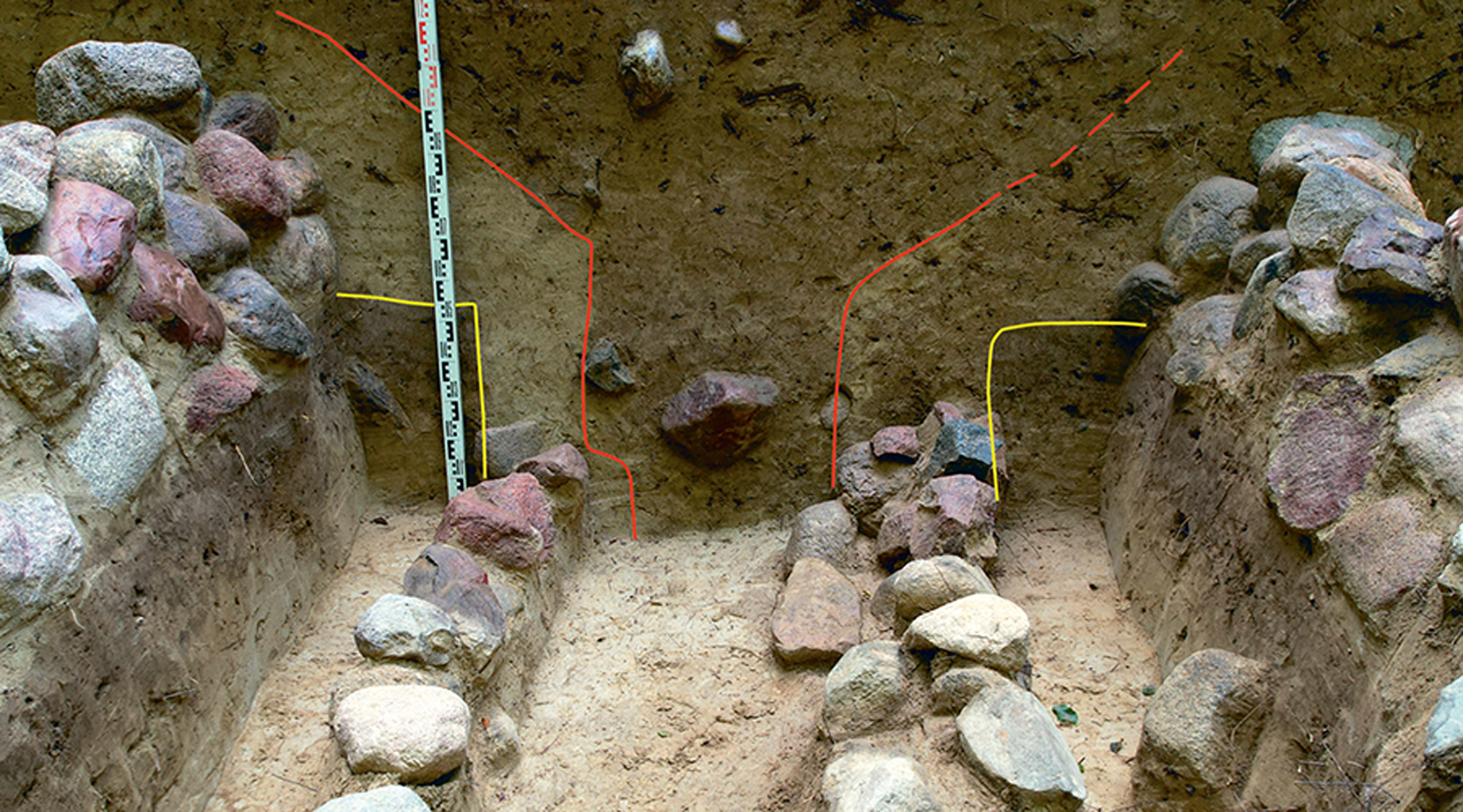
Grave 7 showing the original grave cut (yellow line) and later intrusive cut (red line); A) is a cross-section; B) a plan of the grave (photographs by S. Wadyl).

Grave goods indicated an eleventh-century date for the site. Radiocarbon dating of burials found in mound K8 (five inhumations and two cremations) suggests that the burials occurred in the first half of the eleventh century (Figure 3). The cremation burials are slightly later in date than the inhumations, as is also reflected in their stratigraphic position.
Funeral rites: biritualism and the reopening of graves
Two burials document the reopening of graves. Such a practice is relatively well-represented in other parts of Europe (Klevnäs et al. Reference Klevnäs, Aspöck, Noterman, van Haperen and Zintl2021) but is recognised only to a limited extent in early medieval Poland (Gardeła et al. Reference Gardeła, Kajkowski and Szczepanik2015). The discoveries in Nowy Chorów represent the first well-documented traces of grave reopening in the region, though such practices were likely more common. The two reopened graves were originally inhumations, and the deceased were likely interred in accordance with Christian religious standards (inhumation, east–west grave orientation and limited grave goods; Rębkowski Reference Rębkowski2007: 89–97). At some point after burial, the bodies were exhumed and cremated. During excavations, intrusive cuts and damage to the stone structures of the graves were identified (Figures 5 & 6). Cremation burials were deposited directly above the now-empty inhumation graves (Figure 3). U-shaped fractures observed on the cremated bones may indicate the presence of soft tissues and/or a high collagen content in the bone (Gonçalves et al. Reference Gonçalves, Thompson and Cunha2011), suggesting that cremation occurred before decomposition was complete. This extensive ritual sequence was perhaps intended to allow the deceased’s transition to the afterlife. Reopening graves and interacting with the dead was considered a dangerous act, requiring special rituals (Aspöck et al. Reference Aspöck, Klevnäs, Müller-Scheeßel, Aspöck, Klevnäs and Müller-Scheeßel2020). Archaeological evidence, including three-armed stone symbols found in two mounds (Figure 3), suggests connections to the triquetra, the number three and the underworld, perhaps linking to the three-headed Pomeranian god Triglav (Słupecki Reference Słupecki1994: 71–83), who was regarded as a god of heaven, earth and the underworld (Rosik Reference Rosik2020). Similar symbolism is seen in the Zbruch River dowry (Rosik Reference Rosik2020: 317–18) and other artefacts, such as an eleventh-century fitting from Oldenburg (Szczepanik Reference Szczepanik2017). The use of such symbols in funerary contexts likely reflects pre-Christian beliefs and may have served both as protection and to counterbalance Christian burial rituals.
Artefacts from Grave 7: an iron spearhead with textile remnants and a reconstructed yew bucket with iron banding (photographs by J. Szmit).

Conclusion and further perspectives
Each burial mound in Nowy Chorów tells a unique story, offering valuable insights into the diversity of early medieval funerary practices. Differentiation in funerary rituals during the Christianisation of Pomerania was far more complex than a simple divide between Christianity and paganism. Early medieval rituals were highly diverse, reflecting nuanced cultural transitions.
The next step will involve exploring who was buried in these graves: were specific lineages interred together in distinct mounds, or are there other, more intricate patterns at play? Ancient DNA analyses offer the potential to answer these questions. Continuing investigations at Nowy Chorów will provide further perspectives on early medieval burial practices at the site and across the Baltic region more generally.
Acknowledgements
We would like to thank the entire research team.
Funding statement
Financial support was provided by the Heritage Protection Office in Słupsk and the authorities of the Faculty of Archaeology at the University of Warsaw.


 Open access

