

The study of historical patterns in intergenerational mobility has experienced a resurgence in recent years. The increasing availability of large datasets linking individuals and families over time, coupled with an awareness of declines in social mobility in western countries over the past several decades, has led researchers to investigate the degree to which societies vary in intergenerational mobility, as well as why these differences arise (Chetty et al. Reference Chetty, Hendren, Kline and Saez2014). The bulk of studies on social mobility focuses on the transmission of status between fathers and sons, with status usually measured by occupation. However, this narrow focus could hide interesting dynamics on the role of women and the evolution of this over time. The correlation in status between fathers and sons is a function of both the effect of fathers and mothers on sons. Moreover, most of the work is done for post-industrial societies, with the result that we have an incomplete picture of social mobility in pre-industrial societies, and particularly the importance of the role of women in them.
We use marriage records for the city of Murcia (Spain) during the eighteenth century to study social mobility and assortative mating. The records contain the status of the bride, the groom, and their parents. We investigate the role that fathers and mothers, independently, have in determining the status of their sons and daughters. Very little is known about inequality and social mobility in pre-industrial societies, especially for late-industrializing countries (Espín-Sánchez et al. Reference Espín-Sánchez, Gil-Guirado, Daniel Giraldo-Paez and Vickers2019; Alfani and Di Tullio 2019; Bengtsson et al. Reference Bengtsson, Missiaia, Olsson and Svensson2017). While historians of the family have examined the topic, they have approached it in a less quantitative way, focusing instead on particular case studies and narrative evidence.Footnote 1 By the end of the eighteenth century, Murcia was experiencing important structural economic changes due to the early stages of industrialization (Pérez Picazo, Lemeunier, and Chacón Jiménez Reference Pérez Picazo, Lemeunier and Chacón Jiménez1979). Results from this period could thus shed light on the differences between early industrializing countries, such as the United States and the United Kingdom, and late industrializing countries like Spain.
To measure status, we use whether or not an individual is recorded as a don or doña. These are Spanish honorifics denoting individuals who, while not necessarily noble, are of relatively high status. Alfani and Gourdon (Reference Alfani and Gourdon2016) use a similar measure, monsieur and signore, to ascribe high status to godparents for France and Italy, respectively. We will discuss this measure in detail, but we note here several salient features. First, being recorded as doña measures the status of women directly, as it is not imputed based on the status of husbands or parents. While such imputations are common, they can obscure gender-specific differences in intergenerational mobility. Second, the status can be gained, but not lost, for a particular individual. Once a person is recorded as a don or doña, this will be done so consistently in later records. In this sense, the measure is similar to studies of intergenerational correlations in years of education. Third, the honorific is not strictly hereditary, in that some individuals who have parents who are dons or doñas will have children who are not, and vice versa. The failure of a son to acquire the don status of his father does not appear to be based on birth order, as we find no effect of marriage order, a proxy for birth order, within a family on intergenerational mobility, as we discuss later.Footnote 2
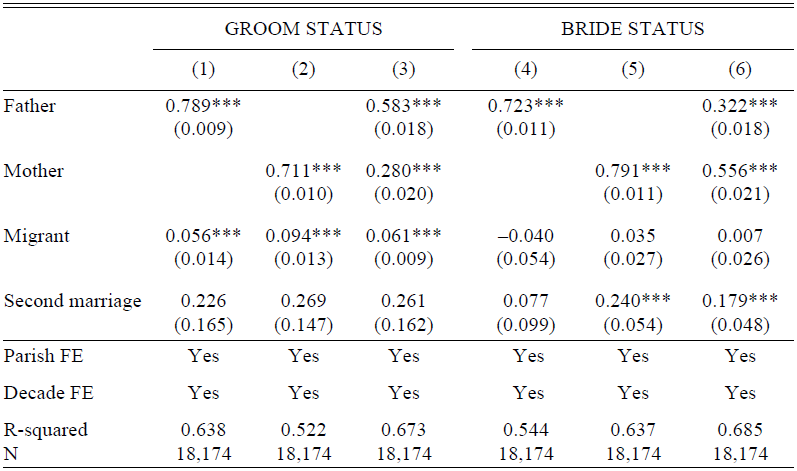
We begin by examining the transmission of status at the age of children’s marriage. Marriage records contain the don and doña status for the bride and groom, as well as all four parents, at the time of the marriage. This avoids issues arising from overrepresentation of rare names and incorrect links, both of which can bias estimates. We regress the standardized status of children on the statuses of both their fathers as well as their mothers and find highly persistent status for both men and women. There are substantial differences across gender in how status is transmitted. For grooms, the predictive power of fathers is about twice that of mothers: When regressing the status of sons on both parents, the coefficient on fathers is 0.59 and that on mothers 0.28. For brides, these respective figures are 0.32 on fathers and 0.57 on mothers. These differences are precisely estimated, with standard errors on the coefficients of about 0.02.
We then link marriage records over time, that is, the marriage record of a couple and the marriage of one of their children. Notice that, given the Spanish naming convention, we are linking four different words when linking two marriage records—groom’s given name and surname, and bride’s given and surname—which improves matching accuracy. This linked sample allows us to do two things, both of which are novel. First, they allow us to study the relations between all four grandparents directly, in addition to that of the parents, to both sons and daughters. The coefficients on fathers and mothers for grooms are not much changed when grandparents are added. We show, consistent with Long and Ferrie (Reference Long and Ferrie2018), that parental grandfathers have predictive status independent of that of parents, with a coefficient of 0.10 when including both parents.
The second key advantage of linking marriage records over time is that it allows us to calculate status transmission at two points in the lifecycle. Our estimate without linking uses the status of parents and children at the same date, but at different points in their lifecycle: children at marriage, and parents at their children’s marriage. With the linked sample, we also study the transmission of status taken at different dates, but at the same point in their lifecycle: young adulthood and middle age. This means we have three measures of status transmission: (1) same date; (2) both at young adulthood; and (3) both at middle age. In other words, when we link two samples, we have a measure of status in each sample for the couple linked, one measure when they married and another measure when their child married. The correlations between the statuses of parents and children are lower than in the specification with status measured at different ages. The correlations are still gendered, particularly when measured young.
This paper contributes to several strands of the intergenerational mobility literature. First, it uses a measure of social status which, to our knowledge, has not been used to measure social mobility before but is available across a variety of places and times and over long periods of time. Second, it studies the transmission of status from (and to) women but using a direct measure of female status, rather than one imputed from the status of women’s husbands. Given relatively low levels of information about female occupation or income in historical records, such information is extremely rare. Third, it generates estimates of social mobility (for men and women) for a time and place about which little is known about social mobility, as it predates modern censuses.
The literature in economic history using linking records has grown immensely since the seminal work of Ferrie (Reference Ferrie1996).Footnote 3 There is also a literature that studies social mobility in European countries using probate records, usually for the nineteenth century.Footnote 4 The research on intergenerational mobility has generally relied on father-son links, largely for reasons of data availability. There are two reasons data availability is much greater for males. First, in societies where women lose their last name upon marriage, it is hard to track the matrilineal lineage. Recent studies, however, are using marriage records to find the bride’s maiden name (Craig, Eriksson, and Niemesh Reference Craig, Eriksson and Niemesh2019; Dribe, Eriksson, and Scalone Reference Dribe, Eriksson and Scalone2019), though these generally rely on the status of women as measured through that of male relatives. Second, even after linking the mother’s family side, individual information on women’s status might not be available because most women did not work in formal labor markets, making their position in them a poor indication of status. Some authors have opted for computing the correlation between the son and his father-in-law (Santiago-Caballero Reference Santiago-Caballero2018; Pujadas-Mora et al. Reference Pujadas-Mora, Brea-Martínez, Jordà Sánchez and Cabré2018). Another solution, particularly associated with Olivetti and Paserman (2015), is to construct pseudo-links, based on first names, between fathers and daughters, in addition to sons.Footnote 5 In this article, however, we use a direct measure of status for women, which allows us to infer individually the relation between each parent for sons and daughters, and also the degree of assortative mating.
In addition to studying the effect of mothers, a number of recent studies have challenged the implicit view that only the parents’ status matters for predicting the status of sons. Long and Ferrie (Reference Long and Ferrie2018) find that parental grandfathers have predictive power independent of that of fathers, and Olivetti, Paserman, and Salisbury (Reference Olivetti, Paserman and Salisbury2018) using pseudo-links, find maternal grandmothers also have predictive power.Footnote 6 Our data allows us to link all four grandparents for grooms and all four grandparents for brides. We are not aware of any study on multigenerational mobility using individual-level data before 1800.
The rest of the paper is organized as follows. The second section provides historical background on the honorifics don and doña, their transmission, and their relation to marriage markets. The third section explains in detail the data sources and how the dataset was created from primary sources. The fourth section presents the main results of the paper. It shows the relation of mothers and fathers on sons and daughters using the unlinked sample. Using the linked sample, it also shows the transmission measured at different points in time, the relation of grandparents, and of household composition. Finally, the fourth section also discusses assortative mating. The fifth section concludes with ideas for future research.
INSTITUTIONAL BACKGROUND
In this section, we provide background on institutions and social customs in eighteenth-century Murcia. We first provide an overview of the terms don and doña, and how they relate to social status. We then show how families in eighteenth-century Murcia used several strategies for upward social mobility and how they tried to become dons and doñas. Finally, we show the role that marriages and dowries played in the strategies for upward mobility.
Dons and Doñas
The social treatment of don and doña was originally meant to distinguish the aristocracy (hidalgos, literally “son of something”) from commoners. Its origins come from the Late Middle Ages, where the king would recognize the value of an individual due to personal merit. In Spain, these merits would typically be linked to some assistance during the Reconquista. Over time, however, hidalgos were associated with social class, not necessarily with the aristocracy (Pita Pico Reference Pita Pico2013). In Spain, the public display of being a don has been linked to the creation of the national identity. Miguel de Cervantes makes his delirious character Alonso Quijano call himself don Quijote, thus elevating himself with the elite, present and past. One could become a don for different causes: lineage, place of origin, wealth (including the purchase of nobility titles), wisdom (such as becoming a doctor), or religion (all priests are automatically dons). Therefore, by the eighteenth century, this relation is not that strong so that some elite people are considered dons despite not holding an aristocratic title (Pita Pico Reference Pita Pico2013). Online Appendix A.1 presents more information about hidalgos and their prevalence in Spain as a whole. Online Appendix A.2 and the included tables show the prevalence of dons and doñas in our data.
Don is a measure of high status in Spain and the Spanish Empire, similar to a Signore in Italy, a Gentleman in England, and a Monsieur in France.Footnote 7 There is not a clear consensus in the literature on how this somewhat informal title is transmitted. The literature that studies the meaning of the title is scarce and, to the best of our knowledge, there are no works studying its transmission from the parents to their children. Pérez León (Reference Pérez León2012) argues that the title transmission in Castile was regulated by the royal decree on 3 July 1611, where King Philip III established that it should be reserved for bishops, counts, the sons of the high nobility (including illegitimate sons), and the wives and daughters of the low nobility, but not their sons. However, these rules changed over time. The financing needs of the Crown meant that a royal decree on 3 July 1664, by Philip IV, established that the title could be used only after paying a fee: 200 reales for one life (the buyer); 400 reales for two lives (the buyer and his first-born son); and 600 reales in perpetuity (the buyer and his patrilineal descendants). A new royal decree on 10 February 1795, raised the fees to have the title in perpetuity to 1,000 reales, raised again to 1,400 reales on 1801 (Bustos Argañarás Reference Argañarás2015). Nonetheless, Soria Mesa (Reference Soria Mesa2004) argues that in practice, the title was always up for sale, including bribes to witnesses to certify a noble family origin. Thus, the title is less rigid than the official laws would suggest, but it is a good measure of social (elite) status. Moreover, Soria Mesa (Reference Soria Mesa2004) argues that the seventeenth and eighteenth centuries in Spain were characterized by high social mobility, where wealth, not birth, played a central role in social status.
One particular case in our data deserves special attention, that of women who appear as doñas when they married even when their parents do not. There are famous cases of women in pre-modern Castile acquiring high status coming from humble origins. Beatriz Galindo, born in 1465, was the first female to get a university degree worldwide. Luisa de Medrano became the first female University Professor in the world. Moreover, she replaced the great Antonio de Nebrija as Grammar Professor at the University of Salamanca in 1508. These are, however, rare exceptions. The most common way for women to climb the social ladder would be to marry a high-status husband or to work after marriage in the family business and earn the respect of her community. Beatriz Galindo, mentioned earlier, was the royal tutor for the daughters of Queen Isabel of Castile. Being a personal tutor for the children of the nobility was another way that a young woman would climb the social ladder. Unfortunately, we do not have much information in this regard. Irigoyen López (Reference Irigoyen López, Alfani and Gourdon2012) argues that one key figure for upward mobility was the clergy. Though they did not have (legitimate) children of their own, they would play a key role in helping their relatives, such as siblings or nephews, to climb the social ladder. Molina-Puche (Reference Molina-Puche2005) emphasizes that this role was particularly relevant for their sisters and nieces. Therefore, some of the cases of upward mobile women that seem paradoxical could be explained by the help they got from a relative in the clergy. Another way, of course, was to become a nun and ascend in the organization of the Catholic Church. Nuns, however, would not appear in marriage records.
We have 84 cases (out of 18,175) of fully upwardly-mobile women in our dataset, that is, brides that appear as doña when both of their parents and the groom are not don. We looked intensively for them in the primary and secondary sources. In 14 of the cases, the parents come from outside the city. Therefore, it is plausible that they were of high status, but the local priest would not know them well enough to classify them of high status, even if he did not hesitate to classify the bride as doña. In eight of the cases, we could not find any information on the parents, but we have found information on the bride. It is uncertain whether the parents were of high status in this case. In 56 of the cases, we could not find any information, in primary or secondary sources, regarding the bride or her parents. For the remaining six cases, we could find detailed information both on the parents and the bride. Two of these cases exemplify this issue in general. The first case is that of Doña Ginesa Martínez, who married José Antonio Oliver on 25 December 1698. She was an important landowner in the neighboring town of Moratalla, due to a previous marriage in 1685 with Don Miguel de Medina (Lisón Hernández Reference Lisón Hernández1989). The second case is that of Doña Tomasa Galiana, who married Antonio Galvache on 27 February 1755. His father, Onofre Galiana, appears as the owner of a flour mill in the city of Murcia in 1753 (Cremades Griñán Reference Cremades Griñán1981). Therefore, it seems that he was wealthy enough so that his daughter would be a doña at marriage but, maybe due to his occupation as a miller, not high status enough to be himself called don.
Social Mobility
The Enlightenment brought important structural changes to Spanish and Murcian society during the eighteenth century (Espín-Sánchez et al. Reference Espín-Sánchez, Gil-Guirado, Daniel Giraldo-Paez and Vickers2019). Bourbon reforms made social status more dependent on personal merit than heritage, especially during the reign of Charles III.Footnote 8 In particular, Charles III appointed the commoner, and Murcian, born José Moñino, as Prime Minister of Spain. This appointment was highly criticized by the high ranks of Castilian nobility, as such positions were typically reserved for important noblemen. José Moñino was named the first Count of Floridablanca and served as the best example of meritocratic upward mobility in eighteenth-century Spain (Muñoz Rodríguez Reference Muñoz Rodríguez2009).
Chacón Jiménez and Molina Puche (2004) document the typical process for upward mobility in pre-industrial Castile. The first step is for a commoner to access the municipal council: a wealthy landowner or merchant acquires a position in the municipal council (rregiduría) by purchasing it from the crown or a previous owner. The second step is to show his merit and value in his position and lobby to be named hidalgo, which automatically confers the honorary don. The final step, which is more ambitious and rarely fulfilled, involves joining a military order, creating a manor, or acquiring a nobility title, as in the case of José Moñino.
Donézar (Reference Donézar1996) argues that people who receive the honorary don do not belong to a particular social class. Rather, they form a melting pot of the elite in a given society. Muñoz Rodríguez (Reference Muñoz Rodríguez2009) showed that three groups enjoyed the honorary don in eighteenth-century Spain: (1) minor nobility and relatives of the high nobility; (2) wealthy families, old members of the local elite, but without ties with the nobility; (3) large landowners and merchants of commoner origin, that were in the process of acquiring the title hidalgo or ties with the nobility.
Hernández Benítez (Reference Hernández Benítez2004) studies the processes of upward mobility in pre-industrial Castile. He finds, across Castilian cities, that a given person can achieve high status and even high nobility, even if born a commoner. However, the more common pattern is that the reward for work and merit is for the children to achieve a higher status than the parents, rather than the parents themselves to change their status. Elite families in pre-industrial Murcia followed several strategies to upgrade and consolidate their social status: wealth accumulation, strategic marriage alliances, military service to the king, and administrative service to the king. Strategic marriage alliances, which Le Roy Ladurie (Reference Le Roy Ladurie1983) called hypergamie fémenine, refer to cases where a wealthy family of commoner origin, offered a daughter and a large dowry to a man of high status. Sanchez Ibáñez et al. (2002) relate dowries and social status for brides in eighteenth-century Murcia, using dowry contracts. Among contracts where one of the spouses was don, in 31 percent of the cases, none of the parents were dons; in 17 percent of the cases, both parents are don; and in 52 percent of cases, only one of the parents is don. García González (Reference García González2000) uses the honorific don to define the elite individuals, in towns of the neighboring Alcaraz Mountains in the eighteenth century. He shows that dowries were higher when the bride’s parents were dons (14.722 reales on average) than when none of the parents were dons (8.431 reales on average). We concur with Bourdieu (Reference Bourdieu and Brown1973), that the use of don in pre-industrial Spain refers to individuals of high status or elite. This group is made of individuals with high status in one of three aspects: economic capital (wealth and income); cultural capital (knowledge, culture, art); or social capital (social relations, honorability, legitimacy).
Marriage Market
As mentioned previously, there was partible inheritance in the Kingdom of Castile. This means that daughters received the same amount of inheritance as sons (Rey Castelao Reference Rey Castelao2009). Dowries were common and in many cases corresponded to the total, or a fraction, of the corresponding inheritance (Chacón Jiménez Reference Chacón Jiménez1987). Sanchez Ibáñez et al. (2002) argue that dowries played an important role in the inheritance system of pre-industrial Mediterranean societies, where the marriage contracts among the families were key. Hence, the size of the dowry was an important consideration for the groom’s family when arranging a marriage. Casey (Reference Casey1990) argues that the dowry served both as a way to transmit wealth across generations, and also to transmit status.
During the eighteenth century in Murcia, large dowries were common among the daughters of wealthy merchants and large landlords of commoner origin. They used the large dowries as a way to marry their daughters with the local aristocracy. Even with large dowries, commoners could not marry into the high nobility. However, their daughters would enter the lower ranks of the elite, maybe marrying into the lower nobility of hidalgos. Their grandchildren could then be able to marry into the high nobility, with enough wealth. On the other hand, daughters of the high nobility had lower dowries, especially if they married wealthy commoners (Miralles Martínez Reference Miralles Martínez2000). Finally, there was variation regarding the origin of the dowry. In most cases, the parents paid for the dowry. In other cases, close relatives paid for the dowry. Among the relatives, grandmothers are the most common. The historical records, however, do not allow to distinguish whether the mother or the father paid for the dowry (Sánchez Ibáñez et al. Reference Sánchez Ibáñez, Azorín, Tenza, Buendía, Gabaldón, de Urbina Montoya, Zambudio, López and Pérez Ortiz2002).
In pre-modern Castile, women’s legal status was determined by their social class. In practice, however, they enjoyed more legal restrictions than men in the same social class (Sánchez García and Riquelme 2000). During the eighteenth century, however, due to the Enlightenment ideas, there was a progressive change in the law that allowed women more independence and freedom regarding marriage, inheritance, and dowry. These changes created many conflicts between the progressive civil authorities and the conservative religious authorities (Aranda Mendíaz Reference Aranda Mendíaz2008). Although there remained several customs that maintained gender inequality, women in eighteenth-century Murcia played an important role in financial affairs. In particular, they played a key role in the transmission of family wealth. García González (Reference García González2000) argues that among the large merchants and landowners, women played an important role in allocating the household assets to the next generation.
The Castilian legal system was more generous towards women than other Iberian or European systems. It allows women to recover their dowry upon their husband’s death; they could enjoy half the rents generated during the marriage; and they could act as legal representatives of their husband due to death or incapacity. We can use the information in the Ensenada Census of 1756 to assess the percentage of households where a widow was the household head. This figure is 4.5 percent for the city of Murcia (Espín-Sánchez et al. Reference Espín-Sánchez, Gil-Guirado, Daniel Giraldo-Paez and Vickers2019), 20 percent for the city of Granada (Vincent and Casey Reference Vincent, Casey and Vilar1987), and 14 percent in the towns of the Alcaraz mountains (García González Reference García González2000).
Assortative Mating
In pre-industrial Europe, individuals tended to marry within their social group. Romantic considerations and individual preferences were not as important, especially for the upper classes, as were other social, cultural, and economic factors. Ortego Agustín (2003) argues that this was indeed the case in eighteenth-century Spain. Geographical considerations also played an important role in social homogamy in pre-industrial Spain. Van Leeuwen and Maas (2019) show that the possibility of traveling further to meet potential spouses increases the pool of potential spouses. Moreover, they show that the further the pool of spouses, the larger is the variation in their characteristics. Therefore, mercantile societies with many traveling merchants would have a greater variation of the characteristics of the grooms and brides. Spatial mobility then would create a decrease in social homogamy during the last centuries. Notice that this theory refers to social characteristics in general. When thinking about status, a decrease on transport cost would likely increase assorta- tive mating, especially for the elites. By expanding the pool of potential mates, mating would be more assortative on status, even if other cultural characteristics might be increasingly different among spouses.
In contrast to van Leeuwen and Maas (Reference van Leeuwen and Maas2019), we can also consider the role that industrialization had in changing the social norms in European societies. Treiman (Reference Treiman1970) argues that, when a society undergoes a structural transformation from an agricultural society to an industrial one, the father’s status loses its relationship with the status of his children. An industrial society is more meritocratic and, thus, personal merit has greater importance on an individual’s social status. Miralles Martínez (Reference Miralles Martínez2000) argues that social homogamy was a key strategy for marriages in preindustrial Murcia. Wealthy families married their children with children of other wealthy families as a way to maintain their estates. This strategy was particularly important in Murcia because of the partible inheritance system in Castile, where all children, sons and daughters, would inherit the same share. Therefore, whereas partible inheritance would tend to increase mobility and decrease inequality over time, its effects are compensated by high social homogamy. This was particularly important to social groups of foreign origin in Murcia, such as Genoese merchants, who would typically marry within the same group and thus preserve their language and customs.
For pre-industrial Murcia, Chacón Jiménez and Molina Puche (2004) argue that the parents of the groom and bride tried to find a match that is suitable to the human and physical capital of their child. In other words, there is an active mechanism for assortative mating. The main factors here are the prospective match family status and prestige as well as the potential inherited wealth. This is consistent with Molina-Puche (Reference Molina-Puche2005), who argues that, for other towns in the region, the local elites used marriages with other families of the elites as a way to consolidate their power.Footnote 9 Doña Irene, a Fernando Reference Fernández de MoratínFernández de Moratín (1801, p. 27) fictional character, puts it best when she says that “to please her mother […] is the first obligation of an obedient daughter.”Footnote 10 The play shows the customs of the time where parents in elite families arranged their children’s marriages. This is not unlike Victorian England, where Lady Bracknell (Wilde Reference Wilde1895) represents the same customs for arranged marriage among the British elites.
DATA
We use data from the city of Murcia, located in southeastern Spain (see Figure 1). Murcia is the historical capital of the Kingdom of Murcia and the current Region of Murcia. Since it is the bureaucratic capital, it has historically drained resources from the rest of the region. Fortunately, Murcia has not suffered much from siege or pillage since the fourteenth century, which means it has excellent historical sources (Espín- Sánchez et al. 2019). The data come from marriage records in Murcia for the eighteenth century. These church records exist for the years 1565 through 1910, and some of them are available at FamilySearch (2016). We collected data from the entire eighteenth century (1700–1800).Footnote 11 We transcribed by hand all the records available for the eighteenth century to create our dataset from scratch by using the pictures of the original data available at FamilySearch (2016). The key point for our purposes is that the records contain six related individuals, all recorded with social status as either a don or doña or not. That is, we observe the names and status of the grooms and brides as well as both of their parents.
The parish records are books created by the local priest of every church/parish. They keep the basic information from the main sacraments performed by the priests in a given parish. The main relevant records refer to death, baptisms, and marriage records. They are useful for genealogical studies and to study social mobility. They are very similar across time and across the Catholic world, especially after the Council of Trent (1563) imposed homogeneity in the sources and made it compulsory for priests to keep accurate records (Chacón Jiménez Reference Chacón Jiménez1987; Pérez Ortíz, González Lozano, and Vivas Moreno Reference Pérez Ortíz, González Lozano and Vivas Moreno2017). While the sources are homogeneous across time and space, their survival is heterogeneous. Even within Spain, the sources have not survived in many cities, as a consequence of thefts, wars, fires, and other hazards (Pérez Ortíz, González Lozano, and Vivas Moreno Reference Pérez Ortíz, González Lozano and Vivas Moreno2017). Nonetheless, the region of Murcia, and in particular the city of Murcia, has one of the best-preserved demographic records in Spain, and in the world. Most of the Murcia parishes preserved most of their data, at least since 1563 (Irigoyen López Reference Irigoyen López, Alfani and Gourdon2012; Chacón Jiménez and Chacón Martínez 2015).
MAP OF MURCIA PARISHES IN 1896
Notes: Because some streets have changed names since 1908, we used historical maps of Murcia from 1896 and 1882 (Archivo General Región de Murcia Reference General Región de Murcia2019).
Source: Own elaboration with information using the Boletín Eclesiástico from the Cargatena Bishopric from 1908, pages 89–94 (Obispado de Cartagena Reference de Cartagena1909).

The city of Murcia, like many medieval cities, was restricted in size by its medieval walls. In addition to the walls, the old city was bounded in the south by the Segura River. Figure 1 shows the “old” parishes: Santa María, San Pedro, Santa Catalina, San Antolín, San Juan, San Lorenzo, San Miguel, San Nicolas, and Santa Eulalia.Footnote 12 Santa María is the name of the cathedral parish, San Bartolomé is the closest church, and the two parishes merged into a single parish for administrative purposes. We refer to the merged parish as Santa María for simplicity. In the summary statistics in Table 1, we can see that Santa María holds a much larger number of records than the other parishes.Footnote 13 The Santa María parish provided sacraments for citizens in the irrigated orchards around the city, before these areas had their own parishes (Henarejos López Reference Henarejos López2011). The “old” parishes are clustered around the cathedral and inside the medieval city walls.Footnote 14
SUMMARY STATISTICS BY PARISH

Notes: Own elaboration. Parish is the church in Murcia in which the marriages were performed. Santa Maria is the main cathedral church. Fraction high status denotes the percentages of grooms and brides who were denoted as having status as a don or doña. Match rate is the percent of marriages for which the marriage of the parents of the groom or bride respectively could be linked to the child’s marriage. Migrant and second marriage are the percent of grooms and brides listed as having originated outside of Murcia and who were previously married.
Source: España, registros parroquiales y diocesanos, 1307—1985.
Marriage records were created by the local priest. This is important because our measure of don does not include people who would claim the title by themselves, but rather those individuals whom the local society would give them the title and certified by the local priest. Marriage records contain the date and place of the marriage, and the full name of the groom, the bride, their parents, and the witnesses. By full name, we mean that the record includes the honorary don or doña, which we use to denote elite status. The marriage records also contain the following information: name of the priest; name of the notary; place of residence of the groom, the bride, and the witnesses (groomsmen and bridesmaids); place of origin of the groom and bride and their parents; whether the groom or the bride are widows, and the name of their deceased spouse; and whether the groom and the bride are relatives, up to third cousins. We also recorded whether or not the groom and/or bride are listed as coming from outside Murcia, which we denote as migrant status, as well as whether or not either had been previously married. Migrants are common in the data, with around 30 percent of grooms and 18 percent of brides having relocated to Murcia, typically from nearby villages and towns. Moreover, we might expect the behavior of migrants to be different from that of locals.
In Figure 2, we can see how a single record contains the links for both the groom and the bride with their parents, and the social status of each individual. For this reason, we do not need to link records to perform the main analysis. Moreover, the marriage records contain the same information for men and women. In this particular example, we can see how assortative mating is not perfect. The groom and bride have different statuses. The same is true for the parents of the groom, but the parents of the bride are both of high status. Notice that, whereas the parents of the bride did transmit their high status to their daughter, the mother of the groom could not transmit her high status to her son.
EXAMPLE OF MARRIAGE RECORD PARISH OF SANTA MARÍA (MURCIA) IN 1761
Notes: Database with images, FamilySearch. Transcription from the original. In the transcription, we have substituted the abbreviations in the original source with the complete words. Our translation to English from the original. Lower figure shows family relationship.
Source: España, registros parroquiales y diocesanos, 1307–1985.

In order to study grandparents and family composition, as well as the transmission of status at different ages, we link marriage records backward one generation, as described in Online Appendix A.3. We perform an iterative matching procedure, first matching exactly, then after performing some standardization of names, and then after a phonetic regularization. In all cases, we require in the match that individuals marry between 18 and 45 years after the marriage of their parents since we do not observe age. In a few cases, we have multiple matches, but in the vast majority of these cases, the relevant variables, that is the statuses of the marrying couple and their parents, were identical between the multiple matches. In this case, we included the information from one of the matches. The great majority of the links are exact. Of the combined 7,017 links for grooms and brides, 6,832 (97.4 percent) are exact. There were 41 (0.6 percent) links after standardizing the spelling of names, and 48 links (0.7 percent) after making phonetic substitutions. Additionally, there were 96 (1.4 percent) multiple links for which the status of all six individuals was identical across multiple links and so could be included in the sample.
This procedure does induce some selectivity in the sample, in that both a child and parents have to have been married in Murcia. Thus, for example, migrants are likely to be undercounted. Note that our overall match rates are somewhat low, at approximately 20 percent.Footnote 15 This number should not be compared directly to historical matching rates in American census contexts, which range depending on method from 28 to 52 percent, with substantial mismatching with the higher numbers (Bailey et al. Reference Bailey, Cole, Henderson and Massey2020). An unknown number of people have parents who married in different areas, for example, and so could not be feasibly linked. Given the rates of migration, at least 30 percent of grooms should fail to match for that reason alone. In addition, we can control for the migrant status of children directly, mitigating the problem of bias induced by a selected sample.
Note that in addition to expanding the set of relatives, linking gives us two measures for parents and children, at different ages. Consider for concreteness a son, whom we label in generation as G3, a father (G2), and a grandfather (G1). We link the son’s marriage record at time T2 to that of his father at earlier time T1. Note this gives us a measure of transmission from fathers to sons recorded when both married; that is, in young adulthood. This measure uses the groom (G3) at T2 and the groom (G2) at T1. Additionally, there is a measure of transmission of status recorded when one of their children married, which we denote as at middle age. This is the father (G2) at T2 and the father (G1) at T1.
RESULTS
We now describe the transmission of social status as measured by being recorded as a don or doña in the marriage records. Several important stylized facts emerge. As mentioned earlier, once an individual becomes a don or doña, they maintain such status all their lives. In that sense, this measure of social status is similar to years of education. We can link together two marriage records for each couple: when they married and when the parents of either the bride or the groom married. This means that for the linked sample, we have two measures of social status at different points in their lifetime, and also that we can measure the effect of grandparents on predicting social status. The replication files for the analysis are stored at Reference Espín-Sánchez, Gil-Guirado and VickersEspín-Sánchez, Gil-Guirado, and Vickers (2021).
Intergenerational Transmission of Status
For all of the following specifications, we standardize the measure of status, a binary indicator for status as a don or doña, to have constant mean and variance. We begin the analysis in Table 2, first examining the transmission of social status to grooms. All regressions throughout contain fixed effects for the parish in which the child was married and decade fixed effects. Standard errors are clustered at the parish level. We also include indicators for whether or not the individuals getting married were migrants to Murcia. We define migrants as those individuals for which the marriage record shows that they were born outside of Murcia. Finally, we add an indicator of whether they were recorded as having had a previous marriage. The first column uses only the status of the father and the controls to predict the status of the son, in line with the most basic test of social mobility. We find an elasticity of 0.79, high but in line with the historical record as suggested by Clark (2014). The equation used in most of the literature, corresponding to the first column, is
STATUS TRANSMISSION: MARRIAGE RECORDS
Notes: Own elaboration. OLS regression for status as a don or doña. Dependent variable is the standardized social status measure, measured at the time of marriage. The independent variables are the standardized social status measures for fathers and mothers, respectively, measured at the time of their child’s marriage. All standard errors are clustered at the parish level. *, **, and *** represent p < 0.1, p < 0.05, and p < 0.01, respectively.
Source: España, registros parroquiales y diocesanos, 1307–1985.
 $${S_i} = \widetilde\beta _F^S{F_i} + \gamma {X_i} + \widetilde\varepsilon _i^S,$$
where Si is the status of the son and Fi is the status of the father, Xi is a vector of covariates, including parish and decade fixed effects, $\widetilde\beta _F^S$
represents the relation between father and son, and γ is a vector of estimated parameters. Unlike most of the literature, we also have information on the status of the mother, denoted as Mi. The coefficient in the second column, using the mother only as the predictor, is slightly lower, at 0.71. Moreover, we can decompose the effect of both the father and the mother using the following equations, where Di. is the status of the daughter:
$\widetilde\beta _F^S$
represents the relation between father and son, and γ is a vector of estimated parameters. Unlike most of the literature, we also have information on the status of the mother, denoted as Mi. The coefficient in the second column, using the mother only as the predictor, is slightly lower, at 0.71. Moreover, we can decompose the effect of both the father and the mother using the following equations, where Di. is the status of the daughter:
 $${S_i} = \beta _F^S{F_i} + \beta _M^S{M_i} + {\gamma ^S}{X_i} + \varepsilon _i^S$$
 $${D_i} = \beta _F^D{F_i} + \beta _M^D{M_i} + {\gamma ^D}{X_i} + \varepsilon _i^D$$
In the third column, we predict the groom’s status using the status of both of his parents to disentangle the relative contributions of each to the social status of the child. Both the mother’s and the father’s status independently predict the social status of the sons, with the effect of the mother about half the magnitude of that of the father. These differences are precisely estimated, with standard errors on the coefficients of about 0.02. In all of these specifications, migrant status is a significant predictor of higher status for grooms. Being in a second marriage is also associated with higher status, however, the low number of individuals for which this information is recorded makes the estimates statistically insignificant.
At this point, it is useful to consider the implied correlation in the status of these models. Note that if the true model of status is the one in Equation (2), but we instead estimate Equation (1), then $\widetilde\beta _F^S = \beta _F^S + \rho \beta _M^S$
where ρ is the correlation in status between fathers and mothers. Therefore, the correlation between the father and son status,
$\widetilde\beta _F^S = \beta _F^S + \rho \beta _M^S$
where ρ is the correlation in status between fathers and mothers. Therefore, the correlation between the father and son status, $\widetilde\beta _F^S = 0.789$
, can be decomposed into the direct effect of the father
$\widetilde\beta _F^S = 0.789$
, can be decomposed into the direct effect of the father $\beta _F^S = 0.583$
and the indirect effect that is equal to the degree of assortative mating ρ = 0.734 times the direct effect of the mother
$\beta _F^S = 0.583$
and the indirect effect that is equal to the degree of assortative mating ρ = 0.734 times the direct effect of the mother $\beta _M^S = 0.280$
. Here, ρ = 0.734 corresponds to the correlation between the parents’ status. The same decomposition is possible when looking at the correlation between mothers and sons, or for either parent and daughters.
$\beta _M^S = 0.280$
. Here, ρ = 0.734 corresponds to the correlation between the parents’ status. The same decomposition is possible when looking at the correlation between mothers and sons, or for either parent and daughters.
We then look at the social status of the daughters, based on the status of their parents, in the fourth through sixth columns of Table 2. Looking only at Column (4), the coefficient is 0.72, relatively similar to that for fathers and sons, though slightly lower. In Column (5), predicting the daughter’s social status based on that of her mother, the figure is 0.79, essentially identical to that of fathers and sons. When the father and mother of the bride are considered separately, in the sixth column, the coefficients are 0.32 and 0.56. That is, for brides the social status of the mother has roughly twice the effect of the father, the opposite of what is held for grooms. For brides, migrant status has no predictive power. We do see evidence that being in a second marriage is associated with higher status for brides. The point estimate is similar to that for grooms, but because of the greater prevalence of second marriages for brides, the estimate here is statistically significant.
Table 2 shows several important facts for social status transmission. Transmission to daughters appears quite similar to that of sons, in the sense that the coefficient is high. However, the relative contributions to the status of children from each parent are different for sons versus daughters. In particular, the same-sex transmission of status is roughly twice as strong as that of the opposite-sex parent. Second, the coefficients when looking at each parent fit a similar pattern of same-sex vs. opposite sex transmission. That is, the father-son coefficient and mother- daughter coefficient are virtually identical. Similarly, the mother-son coefficient and father-daughter coefficients are both very similar. Notice that these measures are not intergenerational elasticities per se. The variables are measured at the same date, but at different points in the life-cycle for the parent and the children. Instead, they show that status as measured at young adulthood is strongly dependent on the status of parents as measured at their middle age. Moreover, the transmission of that status is gendered: Fathers matter more for sons, and mothers for daughters.Footnote 16 In the next subsection, we discuss how the measures change if we look at variables for parents and children at the same point in their life-cycle.
In Figure 3, we show the results from estimating the model for sons and daughters separately by decade. When estimated by itself father-son transmission is steady, that is, the empirical correlation between father and son status is stable. However, we see some evidence for a change in gendered patterns over time, with the mother becoming relatively more important to the status of the son than the father. This is important and underscores our contribution of using a direct measure of status for the mother. Without this direct measure, we would get a biased measure in the effect of the father on the son, as discussed earlier. Moreover, we would also get a biased measure about the evolution of social mobility over time.Footnote 17
COEFFICIENTS ON ß F AND ß M BY DECADE
Notes: Own elaboration. Coefficients from OLS regression for status as a don or doña for brides and grooms, separately by decade. Dependent variable is the standardized social status measure, measured at the time of marriage. The independent variables are the standardized social status measures for fathers and mothers, respectively, measured at the time of their child’s marriage. Plots show 95 percent confidence intervals based on robust standard errors and including parish fixed effects. Date refers to the first year of the decade; that is, 1700 is for 1700–1709. “Short” regression refers to a regression of the status of the groom or bride on the father’s status only, excluding the mother. Assortative mating refers to the coefficient on a regression of the status of the parents for the indicated relative, including fixed effects.
Source: España, registros parroquiales y diocesanos, 1307–1985.
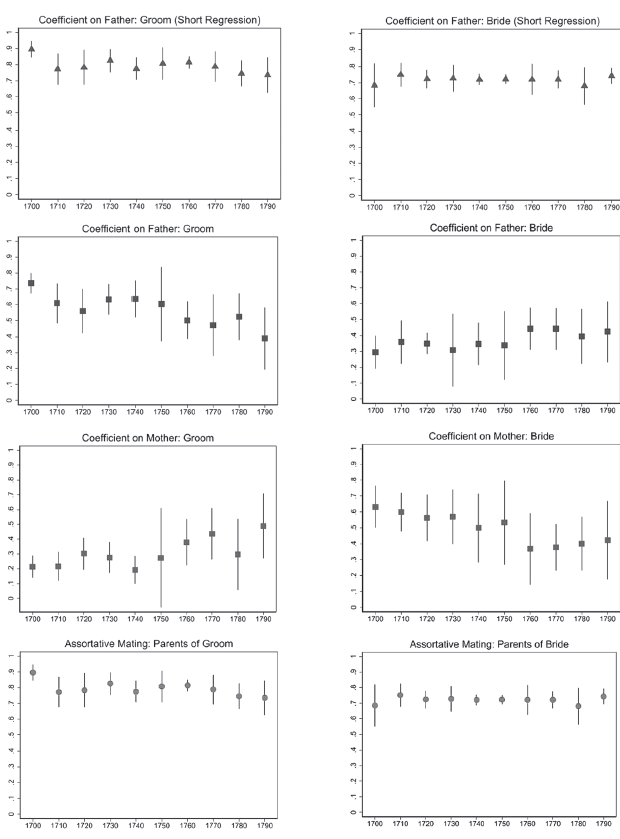
In Figure 3, we see changes over time in the parameters of interest. For grooms, the role of mothers becomes more important over time, but the role of fathers becomes less important. While at the beginning of the century the coefficient on fathers was three to four times larger than that of the mother, at the end of the century the estimated coefficient on the mother is larger, and the difference is statistically insignificant. We can see a similar, but reversed, pattern for brides. The coefficient on the father increases slowly over time, and the coefficient on the mother decreases over time. While the coefficient on the mother was twice as large as the coefficient on the father at the beginning of the century, they are virtually identical by the end of the century. In summary, by the end of the eighteenth century, social mobility is still low and both parents’ statuses are associated with their children’s status. The gendered pattern that we describe previously, however, is virtually gone. One explanation for this pattern is that it is consistent with the process of early industrialization in the city of Murcia during the eighteenth century described in Espín-Sánchez et al. (Reference Espín-Sánchez, Gil-Guirado, Daniel Giraldo-Paez and Vickers2019). In an early-industrial society, money possibly becomes a more important driver of status. Money has no smell (pecunia non olet) and no gender. Therefore, it is possible that as money becomes more important in determining social status, differences by gender decline. In the extreme case, if the status is fully determined by wealth, then the status transmission is essentially wealth transmission. In this case, every real inherited from your mother is worth the same as every real inherited from your father.
TRANSMISSION OF STATUS IN MIDDLE AGE AND YOUNG ADULTHOOD
In this subsection, we analyze the transmission of status from parents to children again, but after having matched the marriage records to the marriage record of a previous generation. In other words, given the parents of a groom or a bride in a marriage record, we link this marriage record to the one in which the parents were married. We discuss the details of the matching process in Online Appendix A.3. Note that the regressions noted earlier consider the relationship between the status of an individual at marriage and the status of his or her parents at the child’s marriage. However, we may be more interested instead in the transmission of status as measured at a consistent age, which we discuss next.
The analysis in the previous subsection has the advantage that the status of the parent and the child are measured at the same date and, more importantly, it does not require linking. In addition to avoiding linking, measuring status for parents and children in the same document has other advantages. By seeing what elements of status are transmitted to children at marriage versus when it is measured later in life, we get further information on the life-cycle nature of this transmission. Such a measure does have some disadvantages as well. First, the ages at which status is measured are different for the parent and the child, in that it is the age of marriage for the children and the age of their children’s marriage for parents. This is somewhat difficult to compare with more traditional measures of intergenerational status transmission. Second, we may be more interested in status during late adulthood. If the status of children is primarily based on that of parents at marriage, but subsequent young and middle adulthood causes the children to develop status independently, then the specifications noted previously will overstate the degree of persistence in status. Rather than viewing either the measures of the transmission at younger or older ages or alternatively measuring at different ages, as the “correct” model of status transmission, we view each of them as providing information about the nature of the intergenerational persistence of status.
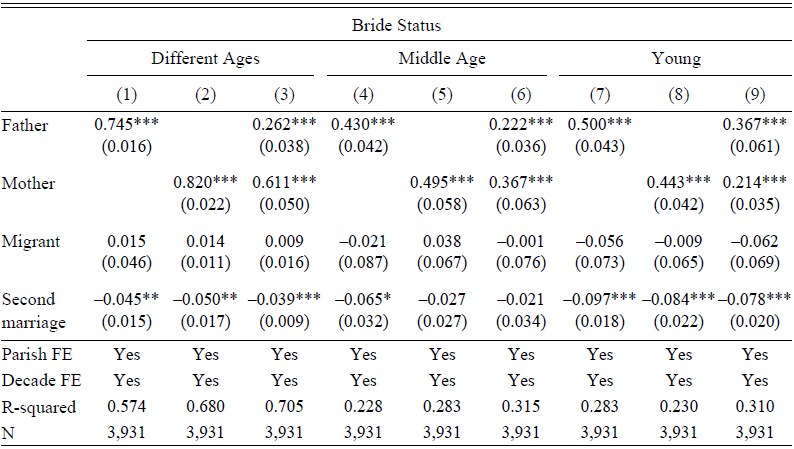
The linked sample provides us with two potential measures of status measured at consistent ages: status of the parents of the marrying couple for both the older and younger generation, that is, in middle age; and the status of the marrying couples themselves for both generations, that is, both at a young age. We do this exercise for both brides and grooms, and this gives a separate estimate of status transmission, as well as replicating the analysis from Table 2 in the first three columns, but for the linked sample only. The results for the status of grooms measured at middle age for both generations are in the fourth through sixth columns of Table 3.A. The coefficient in Column (4) is lower, at 0.62, than in the regression in Table 2, Column (1), in which the coefficient was 0.79. Status thus appears more “persistent” when measured at the time of marriage, in that sons most closely resemble their middle age fathers at the time of the son’s marriage. Perhaps more interestingly, the coefficients on men and women are much more similar to each other when the status is measured at middle age, with a difference of 0.1 (Table 3.A, Column (6)) versus one of 0.3 (Table 2, Column (3)).
STATUS TRANSMISSION IN LINKED MARRIAGE RECORDS

Notes: Own elaboration. OLS regression for status as a don or doña. Dependent variable is the standardized social status measure. The independent variables are the standardized social status measures for fathers and mothers respectively. “Different ages” is as defined in Table 2. “Middle Age” represents status measured for both children and parents at when both generations have a child getting married. “Young” represents status measured for both children and parents at the time of each’s own marriage, respectively. All standard errors are clustered at the parish level. *, **, and *** represent p < 0.1, p < 0.05, and p < 0.01, respectively.
Source: España, registros parroquiales y diocesanos, 1307—1985.
We then perform the same exercise for brides, with the results in Table 3.B. When we look at the transmission of status as measured in middle age, we find somewhat lower coefficients than for grooms and considerably lower than for age-at-marriage transmission. In particular, in Column (1) the father-daughter coefficient is measured to be 0.43, whereas the coefficient for mother-daughter is higher at 0.49. For brides in comparison to grooms, the gendered difference is sharper when the status is measured at middle age. When we estimate both fathers and mothers together in Column (3), the coefficient on the father is 0.22 and that on the mother is 0.37. To summarize these results for both grooms and brides, the “consistent ages” specifications give similar results to the first set of regressions in terms of the relative contributions of fathers and mothers, with somewhat smaller point estimates; that is, greater mobility.
We can perform the same exercise measuring status at age of marriage for both generations, that is, at a young age for both fathers and sons, which we do in the final three columns of Table 3. These results should be interpreted with caution. As explained in the second section, the status is acquired over time. This means that when measuring the status at middle age, all men and women that would eventually become don have likely already done so. When measuring the status of young adults, however, many individuals that would become don have not already done so, and are thus measured as low status. We find that for brides, the relative contribution of fathers is higher in this specification.
STATUS TRANSMISSION IN LINKED MARRIAGE RECORDS
Notes: Own elaboration. OLS regression for status as a don or doña. Dependent variable is the standardized social status measure. The independent variables are the standardized social status measures for fathers and mothers respectively. “Different ages” is as defined in Table 2. “Middle Age” represents status measured for both children and parents at when both generations have a child getting married. “Young” represents status measured for both children and parents at the time of each’s own marriage, respectively. All standard errors are clustered at the parish level. *, **, and *** represent p < 0.1, p < 0.05, and p < 0.01, respectively.
Source: España, registros parroquiales y diocesanos, 1307—1985.
Comparing the results in Tables 2 and 3, we see that the coefficients and the R-squared are always smaller in Table 3. This is consistent with the idea that what is being transmitted is not something intrinsic, but rather something temporary. What matters in determining your status when you married is not so much the status that your parents had when they married, but their status now. Notice that the results in Tables 2 and 3 for status measured at a young age have the same variable for the children and a slightly different variable for the parents. For parents who were always low status, the two measures are the same. For parents who were always high status, that is, were already high status when they married, the two measures are also the same. The only difference between the two variables is then for parents that were not high status when they married, but were high status by the time their children married. Because the coefficients are larger in Table 2, this implies that the transmission is stronger precisely for those parents that changed status.
A criticism of earlier work on social mobility, associated with Clark (2014), is that occupation or income may fail to capture an underlying “status,” or “social competence,” with greater persistence than occupational status. The true trait to be transmitted would be status, and occupation would be an imperfect measure of status, leading to attenuation bias when measuring social mobility. In our sample, surnames are very heterogeneous in their status even among relatively common names.Footnote 18 Our measure of status is more direct than other measures such as income or occupation. Some aristocrats or other wealthy individuals are part of the elite, even if they have no high human capital. Other members of the elite, such as university professors, and high ranks of the military and the clergy are members of the elite, even if their income or wealth is not high. Our measure does not have these issues and properly assigns an elite status to elite individuals, as certified by the local priest. Thus, we believe our measure should produce less attenuation bias than using income or occupation.
In Online Appendix A.4, we calculate the estimates for intergenerational mobility using the surname method of Clark (2014). When including both surnames, we find a coefficient on the father’s surname of 0.65, slightly above that with the individual data. The mother’s surname has no predictive power. Our measure is calculated at the individual, rather than the group level as with names or surnames in Clark (2014), so the results could be interpreted as individual mobility rather than group mobility (Solon Reference Solon2018). Our results suggest that even a direct measure of status may show lower persistence than surname-based measures if information about women’s status is directly available.
Transmission of Status from Grandparents
In this subsection, we examine the effect of the status of grandparents as well as parents by using the matched records mentioned earlier. First, we examine the transmission of status to sons in Table 4. The first column duplicates Table 2, except for the linked sample. There is a slightly higher rate of persistence in these individuals than in the records as a whole. Note that in the specifications here, the status of the child (the dependent variable) is measured at a young age, but the status of the parents, as well as the grandparents are measured at middle age, that is, the same specification as in Table 2.Footnote 19
STATUS TRANSMISSION FROM GRANDPARENTS
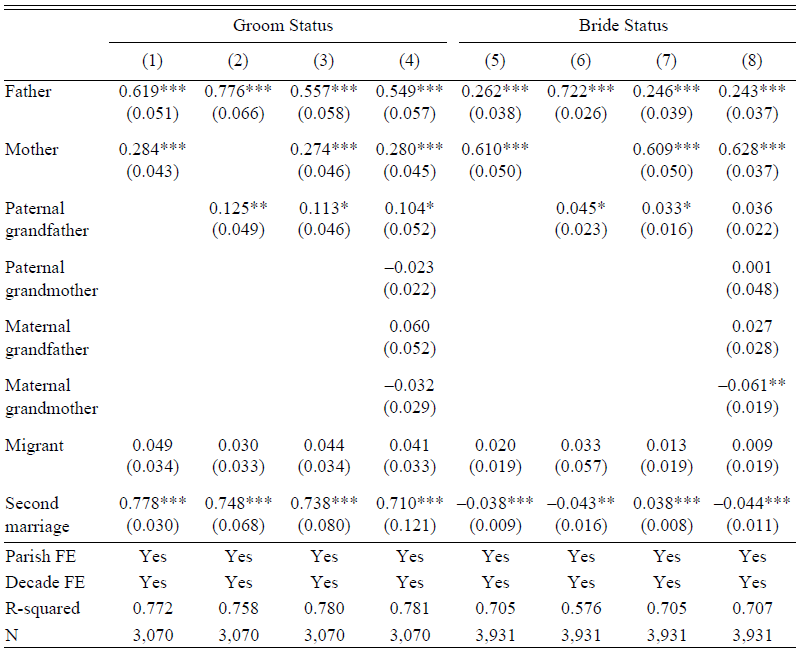
Notes: Own elaboration. OLS regression for status as a don or doña. Dependent variable is the standardized social status measure, measured at the time of marriage. The independent variables are the social status measures for the relatives shown, measured in “middle age” as defined in Table 3. All standard errors are clustered at the parish level. *, **, and *** represent p < 0.1, p < 0.05, and p < 0.01, respectively.
Source: España, registros parroquiales y diocesanos, 1307—1985.
In Column (2), we regress the status of grooms on that of their fathers and their paternal grandfathers. We find evidence for an independent effect of paternal grandfathers on the status of sons. This is consistent with the findings of Long and Ferrie (Reference Long and Ferrie2018), which looks at the transmission of status from fathers and paternal grandfathers. If there are no grandparents’ effects, we would expect a coefficient small and negative (see Becker and Tomes Reference Becker and Tomes1979). If grandparents can directly affect status, then we would expect a positive and significant coefficient. As noted by Solon (Reference Solon2018), group associations could create a spurious positive coefficient on grandparents. We control for parish and decade fixed effects, and there are no racial or religious differences in our population. Thus, we think it is unlikely that group effects are driving the results. Finally, even classical measurement error could create a spurious coefficient on the grandfather. We believe that we are measuring the elite status of individuals, and it is this elite status that is being transmitted. Based on our discussion of life-cycle estimates, we think this is the right mechanism. Thus, we think the coefficient is not artificially created by measurement error. We can see in Column (3) the statistical association with grandparents do not vanish when we control for the status of the mother.
There remains a grandparent effect here even when including the status of the mother in the regression in Column (3), suggesting that the effect of paternal grandparents in Long and Ferrie (Reference Long and Ferrie2018) is not an artifact of missing information about the mother’s status. We then include all grandparents in the regression. To the best of our knowledge, this is the first empirical study in a pre-industrial society that looks at the associations of all four grandparents with grandchild status. The results in Column (4) suggest that among all the grandparents, only the paternal grandfather has a statistically significant effect. Notice that the effect is significant even controlling for the parents and the other grandparents. Moreover, the coefficients on the parents change very little from the previous columns. In Table 4 Columns (5) through (8), we repeat this exercise for brides. Comparing the first column to the corresponding column in Table 2, in the matched sample the coefficients on fathers and mothers are similar to those in the total population. Unlike the results for grooms, there is little evidence of a grandparent effect for brides. This might not be surprising given that the mobility mechanisms for men and women are different in this society. The coefficients for fathers and mothers are virtually unchanged when we add grandparents to the regressions.
To summarize, we find a role for grandparents in explaining the social status of grooms, as measured by status at marriage. We find this is true even when considering the status of women separately, suggesting that this grandfather effect is not capturing some latent variable of “status,” which the status measures for fathers imperfectly captures.
Family Composition
With linked marriages, we can also examine the effect of family composition on the transmission of social status. In particular, we can observe the number of siblings, both their own sex and other, that are in the linked sample, as well as the order in which individuals within the family marry. We note several important caveats to our analysis. First, we only observe linked individuals, so, for example, the “first to marry” among our sample may not actually be the first to marry, if for whatever reason the earlier marrying individual was not linked. Second, we do not observe birth order, only marriage order. While we believe the results are informative about the effect of within-family composition, they are not identical to observing birth and thus the effects of, for example, rules about inheritance. Third, we do not observe individuals who never marry at all, such as sons who enter the priesthood, even setting aside those who fail to link.
MARRIAGE ORDER REGRESSIONS

Notes: Own elaboration. OLS regression for status as a don or doña. Dependent variable is the standardized social status measure, measured at the time of marriage. The independent variables are the standardized social status measures for fathers and mothers, respectively, measured at the time of their child’s marriage. Marriage order based on sample of marriages matched back one generation. All standard errors are clustered at the parish level. *, **, and *** represent p < 0.1, p < 0.05, and p < 0.01, respectively.
Source: España, registros parroquiales y diocesanos, 1307—1985.
We regress the status of grooms on that of their parents as well as various family composition characteristics, with the results in Table 5. In these regressions, we use the status of parents as measured at the time of their child’s wedding, similarly to Table 2. Column (1) in Table 5 just replicates the regression in Column (1) of Table 2, but for the linked sample. In Column (2) of panel A, we see that the number of siblings does not affect the status of the groom. This remains true when splitting the siblings into own or other sex siblings into Columns (3) and (4). In Column (5), being the first groom to marry, an imperfect proxy for being the oldest son in the family, also does not affect the transmission of social status. This remains the case when including the number of siblings in Column (6). This might not be surprising given that Castile has had partible inheritance since the times of the Visigoths. The rules were formalized by the Laws of Toro (1505). Notice that there was an exception to this rule. The mayorazgo was similar to the institution of the manor in England. The testator could then bind all his estate together or attach most of its wealth to the mayorazgo. In such a case, most of the wealth would be inherited by the eldest son. Our results will show that the first son was not more likely than other sons to inherit the title. We believe the mayorazgo did not play a big role for two reasons. First, only a very small fraction of the dons, the only group where the mayorazgo would apply, were of noble origin. Thus, even if among nobles, the firstborn was more likely to inherit the title, the overall effect would not be significant. Second, and more importantly, anecdotic evidence shows that in cases where the firstborn would inherit the estate, the testator wrote explicit provisions for the younger sons, and especially the daughters. The provisions included details of rents created by the mayorazgo to be received by the other siblings for a specific number of years so that the wealth inherited was de facto close to egalitarian.
MARRIAGE ORDER REGRESSIONS

Notes: Own elaboration. OLS regression for status as a don or doña. Dependent variable is the standardized social status measure, measured at the time of marriage. The independent variables are the standardized social status measures for fathers and mothers, respectively, measured at the time of their child’s marriage. Marriage order based on sample of marriages matched back one generation. All standard errors are clustered at the parish level. *, **, and *** represent p < 0.1, p < 0.05, and p < 0.01, respectively.
Source: España, registros parroquiales y diocesanos, 1307—1985.
We perform the same exercise for brides in the latter columns of Table 5. Again, the coefficients on the father and the mother change only slightly, and the results for the new variables are all small in magnitude for family composition variables across all specifications. To summarize, when looking at transmission at own marriage with parents’ status measured at the time of the child’s marriage, there is no evidence of any effect of family structure on social mobility.
Due to the incomplete linking, one might be worried that our sample is selected, and that selection is driving our results. One could be concerned that the youngest sisters in high-status households are less likely to marry, and that would bias the results. In particular, if daughters of high-status parents were likely to enter the Church rather than marry, for example, if families saved resources to increase the eligibility of one daughter, then we would observe only “status preserving” (high status) marriages. The same story could be told for sons, with brothers being pushed into the priesthood, masking downward mobility. In Table 6, we show the number of brothers and sisters within the linked sample for both highstatus and low-status parents. The number of siblings might seem small but this is not the number of births, but the number of siblings who married in the city. This excludes those who died before getting married, those who never married, and those who married outside the city. Note that more brides relative to grooms are linked, which goes against the idea that sisters were less likely to marry than brothers. Moreover, individuals have more sisters than brothers in the linked sample. For the same reason, there are more brothers than sisters linked, in each category. For individuals with low-status parents, there is no difference in the number of either brothers or sisters between grooms and brides. For high-status individuals, however, we have fewer siblings within the linked sample in general. This suggests that high-status individuals have fewer children that married and had children. This result is contrary to the results in Clark (2014) for England which suggest “survival of the richest.” The difference between England and Castile could be due to the difference in the inheritance systems. Whereas Castile had a partible inheritance, England had primogeniture.Footnote 20 Moreover, there is a marked difference by sex in the number of siblings. That is, grooms have fewer siblings, both brothers and sisters, than do brides. However, there does not appear to be much difference in the relative gap between the number of brothers and sisters of high- vs. low-status brides: High-status brides have 0.26 more sisters than brothers, and low status 0.23. This suggests that while family size differs between high and low status, it does not do so in a way that differentially affects “the second sister” of a family. Similarly, highstatus grooms have 0.09 more sisters than brothers, 0.14 for low-status grooms, a relatively small difference, again suggesting a lack of attrition based on individuals leaving a marriage.
NUMBER OF OBSERVED SIBLINGS BASED ON PARENTS’ STATUS
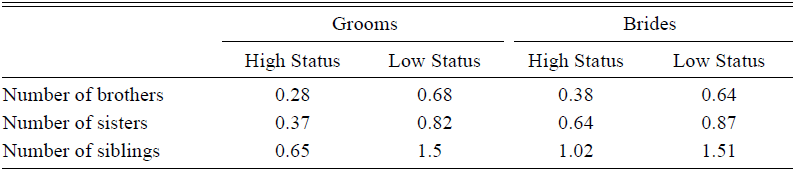
Notes: Own elaboration. Table displays the number of other marriages from children of the same parents based on the status of parents, measured at the time of the parents’ marriage.
Source: España, registros parroquiales y diocesanos, 1307–1985.
Assortative Mating
In addition to the results regarding social mobility, the data allows studying assortative mating. In Table 7, we predict the status of the groom using information about the bride and her parents in a regression, in the same way that the social mobility regressions were defined earlier. The goal of this exercise is to understand the process of assortative mating, that is, how the status of the groom and his parents is correlated with the status of his bride, and whether the other individuals in the family have additional predictive power. In Column (1), we see a high correlation between the statuses of the groom and bride, with the correlation at about 0.80. The degree of assortative mating is high but is far from perfect. This is precisely what allowed us to independently identify the effects of the mother and the father earlier. We now proceed to investigate further the marriage market by looking at the status of the groom and bride’s parents.
ASSORTATIVE MATING
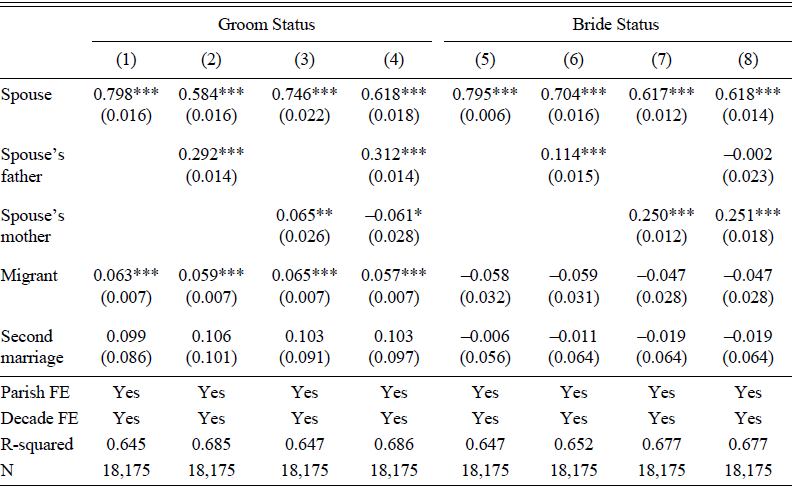
Notes: Own elaboration. OLS regression for status as a don or doña. Dependent variable is the standardized social status measure, measured at the time of marriage. The independent variables are the social status measures for the relatives shown, at the time of the child’s marriage. All standard errors are robust. *, **, and *** represent p < 0.1, p < 0.05, and p < 0.01, respectively.
Source: España, registros parroquiales y diocesanos, 1307—1985.
When we regress the status of the groom on that of the bride and her father, we see a significant effect of the status of the bride’s father on the status of the groom. This might suggest that the status of the previous generation (parents) has predicting power on the status of the bride’s groom. Including the bride’s mother individually shows a smaller effect, which is only marginally significant. The results in Column (4), which include both of the bride’s parents, seem to suggest that, even conditional on the status of the groom, parents play an important role in the “marriage market.” It is important to remark here that, similarly to social mobility, we do see a pronounced gendered pattern. The status of the bride’s father, in addition to the status of the bride, seems to have a high predictive power regarding the status of the groom. The fact that it is the bride’s father’s status, and not her mother’s, which correlates with the groom’s status seems to suggest that there is a social relation between the two men (groom and bride’s father). In other words, as a bride, if your father has high status, you are more likely to marry a high-status groom, even conditional on your own status at marriage. This is consistent with the bride’s father using his network to “find” a suitable husband for his daughter.
We now turn our attention to brides in Columns (5) through (8). The regression here is analogous to the one noted previously: We predict the status of the bride based on the status of the groom and his parents. There we can see a similar picture to the one for grooms. Individually, both the father and the mother of the groom have a significant effect on the status of the bride. Similar to our results earlier, the effect is gendered. Now it seems that is the status of the groom’s mother that affects the bride’s status. Again, this is consistent with a gendered marriage market where the groom’s mother could more easily find a high-status wife for her son, if she herself is of high status.
An alternative approach to studying social homogamy is to look only at the status of the parents of each spouse, ignoring that of the children. To that end, we run a regression of the spouse of each parent on that of the other three parents in the marriage, along with the fixed effects already noted. In the interest of brevity, we omit the table and present the main results. We find a substantial “own-sex” correlation across families. For example, the status of the father of the groom is positively correlated with that of the bride’s father, but not the bride’s mother, and similarly for the father of the bride. Conversely, the status of the bride’s mother positively predicts the groom’s mother, but the bride’s father has no such effect.
The picture here of assortative mating is complex. It shows that the status of the parents affects the status of the spouse, even conditional on the spouse’s status. Moreover, it seems that mothers find wives for their sons and fathers find husbands for their daughters. There are several implications of these results for understanding marriage markets in pre-industrial Murcia. To understand marriage markets, we need to look beyond the status correlation among spouses. Moreover, regarding social mobility, our results raise doubts about whether or not lack of information about women in a study of social mobility can be corrected in an obvious way. Even if one were to have information about the degree of assortative mating as measured by the correlation between husbands and wives, it appears in this data that the status of grooms and brides depends additionally on the parents of the spouses. Given that the status of parents is correlated with children, this is further evidence that grandparent effects may exist, and moreover may exist through the effect of the status of extended families on the parents themselves through marriage, not only through “direct” effects on grandchildren. Understanding better the effects that each relative has on the status of sons and daughters is then an important avenue for future research.
CONCLUSION
In this paper, we use a community-based measure of status that exists in areas with Spanish origins: The use of honorific titles don and doña. This measure, at its core, simply measures whether or not this individual has high status as understood by the community, in this case, Murcia (Spain) in the eighteenth century. What is virtually unique about this measure is that it exists for both men and women, allowing us to study the transmission of status from women and to women. We found that the role of mothers in transmitting social mobility is important, especially for daughters. Women clearly had an important role in transmitting status, at least in Murcia. This suggests that their social role was more important than previously thought, and opens the door to re-assess our knowledge on the role of women in pre-industrial societies. Moreover, we see that the relative importance of mothers and fathers in transmitting their status to their children changed during the eighteenth century so that by the end of the century the effects of mothers and fathers are similar for both sons and daughters. Further research is needed to understand this change.
Although these particular records were not linked to records that contain income or occupation, a natural extension of this research would be to see how well these measures correlate to measures based on occupation or income. Given Spanish naming conventions as well as the relatively large numbers of surviving records from church archives and censuses, as well as increasingly complete family trees from genealogical efforts, it should soon be feasible to compare these measures, and many of these church records will contain information on honorifics. Such comparisons of income or wealth-based measured with “direct” measures of social status can be made across a wide range of places and times, as many societies have honorific titles similar to those we use.
The results in this article applied directly to the society in pre-modern Murcia. Although the amount of work needed to obtain the data used in this article imposes a limitation in its scope, the widespread availability of records containing honorific titles will open up avenues for further study of social mobility, and in particular the role of women in it, in many areas in Spain and Latin America. More systematic studies of status and its effects are feasible and the study of the intersection of race, class, and gender in social mobility based on acquired status seems particularly fruitful as a setting for future work.


 Open access

