


The Tibetan argali Ovis ammon hodgsoni is a wild sheep of the subfamily Caprinae (Bovidae). Although widely distributed over large mountainous tracts of Central Asia, O. a. hodgsoni is in a critical condition with < 7,000 individuals left in the wild (Schaller, Reference Schaller1998). In India the estimated population in the 1990s was c. 200, with most occurring in Ladakh (Fox et al., Reference Fox, Nurbu and Chundawat1991a) and a few in Sikkim (Fox & Johnsingh, Reference Fox, Johnsingh and Shackleton1997). It is listed as a fully protected (Schedule I) species under the Indian Wildlife (Protection) Act of 1972. The Tibetan argali is one of only two subspecies of O. ammon listed on Appendix I of CITES (UNEP-WCMC, 2008), and O. ammon is categorized as Near Threatened on the IUCN Red List (IUCN, 2008).
The range of the Tibetan argali includes the Tibetan Plateau and its marginal mountains, encompassing c. 2.5 million km2 (Shackleton, Reference Shackleton1997), but its population is highly fragmented throughout this vast range (Fox et al., Reference Fox, Nurbu and Chundawat1991a; Schaller, Reference Schaller1998). Argali were the least encountered wild ungulate during extensive surveys on the Tibetan Plateau in the late 1980s and early 1990s (Schaller, Reference Schaller1998). The population in Ladakh is mostly confined to rolling mountains of eastern areas bordering China (Fox et al., Reference Fox, Nurbu and Chundawat1991a) but its precise range is unknown. Using habitat suitability modelling Chundawat & Qureshi (Reference Chundawat and Qureshi1999) identified c. 10,988 km2 in Ladakh as potential habitat for argali. Although argali are present in isolated parts of this area (M. Ranjitsinh, pers. comm.) Bhatnagar & Wangchuk (Reference Bhatnagar and Wangchuk2001) did not observe the species in large tracts of potential range but did locate small populations in three previously unreported areas (Skagzung, Phobrang and Chumur).
Trophy hunting is thought to have contributed to the earlier decimation of the argali population in Ladakh (Ward, Reference Ward1924; Fox et al., Reference Fox, Nurbu and Chundawat1991a), as the animal has large horns coveted by hunters (Adair, Reference Adair1899). The last trophy hunting for the subspecies in Ladakh occurred in 1975 in the Tsabra catchment of the proposed Gya-Miru Wildlife Sanctuary (Namgail et al., Reference Namgail, Fox and Bhatnagar2004a). Nomadic herders, army personnel and some Government officers also hunted the species for meat, and the argali's preference for open areas, often close to human settlements, made it especially vulnerable (Namgail et al., Reference Namgail, Fox and Bhatnagar2004b). Hunting of argali was banned in India in the early 1980s but whether this has led to a population recovery has not previously been evaluated.
We carried out surveys during March–April 2003 in the Gya-Miru Wildlife Sanctuary and the neighbouring Tsokar Basin (Main survey area, Fig. 1), areas known to support a relatively high abundance of argali in Ladakh (Fox et al., Reference Fox, Nurbu and Chundawat1991a). Additionally, we searched for argali in other potential areas (Bhatnagar & Wangchuk, Reference Bhatnagar and Wangchuk2001; Namgail, Reference Namgail2001). We also compiled published data and gathered secondary information from knowledgeable wildlife officials, paramilitary personnel, wildlife researchers and local pastoralists about the occurrence and numbers of argali in areas not covered by surveys.
Current distribution of the Tibetan argali in the Ladakh Trans-Himalaya of India. The Line of Actual Control (LAC) is the effective border between India and China and the Line of Control (LoC) is the effective border between India and Pakistan. The rectangle on the inset indicates the location of the main figure.

Using topographic features such as ridges and streams the main survey area was partitioned into six localities: Puyul, Gya, Kyam-Tsabenama, Tsabra, Tisaling-Shiabuk, and catchments in and around the the Gya-Miru Wildlife Sanctuary and Tsokar Basin. On average we spent 17 hours (over 2 days) surveying each area (on foot, although horses were sometimes used to reach a site). From trails and ridge lines, slopes were scanned with binoculars and spotting scopes. Once a group of argali was located we recorded the time, date, group size and sex/age composition. Males were classified, on the basis of horn size, as class I (2–3 years old), II (3–5), III (5–7) and IV (≥ 7; Fedosenko et al., Reference Fedosenko, Weinberg and Valdez1995). Counts were repeated on 2 consecutive days in all six areas. The possibility of double counting on the same day as well as on consecutive days was prevented by not including any group that was similar to a previously observed group in its size, sex and age composition. Size of surveyed areas were determined from a 1:250,000 digitized map of the survey area using the geographical information system ArcMap v. 9.2 (ESRI, Redmond, California). Argali density was calculated by dividing the total number counted in each block (the higher count of the 2 days) by area. Areas that were not visible from the survey trails or were unusable by argali, such as lakes and glaciers, were excluded.
A total of 127 argali were located in three of the six areas surveyed (Table 1). Mean group size was 7.6 ± SE 0.97 (range = 1–29). Of the 127 counted, 48 were seen in the Tsabra catchment, with 15 males, 20 females, four yearlings and nine lambs. The sex ratio was thus 75:100 in favour of females, and the lamb:ewe ratio was 45:100. There was a preponderance of class III (40%, n=48) and IV (26%) males.
Terrain type and area of the six localities surveyed in the proposed Gya-Miru Wildlife Sanctuary and neighbouring Tsokar Basin (Main survey area, Fig. 1), with estimates of the number of argali counted (see text for further details) and argali density.
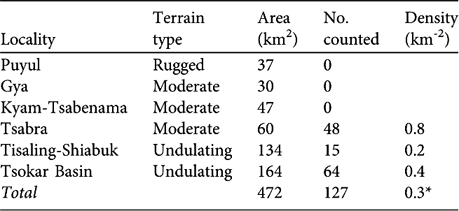
* Calculated only for the blocks where argali were observed
We counted 20 argali in the Hemis National Park in the summer of 2000 (Namgail, Reference Namgail2001) and this population still survives (Rinchen Wangchuk, pers. comm.). In July 2004 we observed a group of three argali in the upper Hanle Valley from where, according to local informants, they were thought to have gone extinct c. 20 years earlier. Interviews with local people and paramilitary forces in the adjacent Kuyul Valley suggested there is a population of 10–15 argali near Demchok, apparently moving between India and China. Although we did not observe any argali in the Chumur Valley during a visit in 2004, interviews with paramilitary personnel suggested that there is a population of 10–20, close to the border with China.
During a 1-week survey in January 2007 around Phobrang and Marsemik La, a mountain pass leading into the Chhang Chhenmo Valley, we saw two males, three females, one yearling and one lamb. Conversations with wildlife officials, local nomadic herders and researchers, however, suggested that 100–130 argali occur in and around the Chhang Chhenmo Valley, historically an important site for argali. Although a small population of 5–10 individuals has previously been reported from the Yaya Tso area (Raghunandan S. Chundawat, pers. comm.), we did not observe any argali during our surveys there in July 2008. According to local informants 10–20 argali survive in Kharnak and c. 15 in the Skagzung area (Fig. 1).
Based on our surveys and secondary information we estimate that the total argali population in Ladakh is 300–360. This includes small subpopulations in areas not previously surveyed and therefore suggests there has been no substantial change in the population of argali in Ladakh since the late 1980s. Given that trophy hunting halted > 20 years ago (Rauf Zargar, Wildlife Warden, pers. comm.) we conclude that, although sporadic poaching for meat might have occurred, factors other than hunting are hindering the recovery of the argali population in Ladakh.
Ladakh is currently undergoing substantial socio-economic change, and populations of wild ungulates such as argali are being affected by development activities that influence habitat use (Bhatnagar et al., Reference Bhatnagar, Mishra and Wangchuk2006; Namgail et al., Reference Namgail, Fox and Bhatnagar2007b). Pashmina (cashmere wool) is a mainstay of the economy of people living within the argali's range, and livestock populations, especially those of cashmere-producing goats, have increased substantially (Namgail et al., Reference Namgail, Bhatnagar, Mishra and Bagchi2007a, Reference Namgail, Bagchi, Mishra and Bhatnagar2008). Studies on the interaction between livestock and argali have shown that livestock grazing not only depletes resources required by argali but also physically displaces argali from productive pastures (Namgail et al., Reference Namgail, Fox and Bhatnagar2007b). Increasing livestock populations, and disturbances created by livestock grazing and collateral activities, are thus the likely factors hindering the recovery of argali. Livestock grazing has negative influences on populations of other argali subspecies in Central Asia (Harris & Bedunah, Reference Harris and Bedunah2001; Maroney, Reference Maroney2005; Wingard, Reference Wingard2005; Schaller & Kang, Reference Schaller and Kang2008).
We conclude that the ban on argali hunting has not been sufficient to protect and enhance argali populations in Ladakh. The relatively high abundance of argali in the Gya-Miru Wildlife Sanctuary and the adjacent Tsokar Basin suggests this area may be the best location in which to protect argali in India but even there the livestock population is increasing because of demand for pashmina. Initial conservation efforts should focus on reducing pressure on the argali population, possibly by freeing some areas from livestock grazing, as has been done for the Tibetan gazelle Procapra picticaudata in Ladakh (Namgail et al., Reference Namgail, Bagchi, Mishra and Bhatnagar2008). The argali population in the Gya-Miru Wildlife Sanctuary and Tsokar Basin could serve as a source population to recolonize adjacent areas, as apparently happened in the late 1970s in Hemis National Park (Fox et al., Reference Fox, Nurbu and Chundawat1991b).
We are initiating a dialogue with the people of Gya-Miru about the possibility of creating an Argali Reserve devoid of livestock grazing. Although there is also a small population of argali in Sikkim (Fox & Johnsingh, Reference Fox, Johnsingh and Shackleton1997) its concentration at the international border, apparently moving back and forth between Indian and Chinese-controlled territory (Chanchani et al., Reference Chanchani, Rawat and Goyalin press), makes it difficult to assure unilaterally its conservation within India. Thus the Gya-Miru and Tsokar areas of Ladakh appear currently to be the areas best suited for the conservation of argali in India.
Acknowledgements
The study was funded by the University of Tromsø-Wildlife Institute of India Institutional Co-operation Program, the Rufford Small Grants Foundation and the Wildlife Conservation Society. Jigmet Takpa and Salim Ul-Haq helped in acquiring the research permit. Lobzang and Tsewang Morup helped in the field and R. Raghunath prepared the map.
Biographical sketches
Tsewang Namgail and Yash Veer Bhatnagar are studying mountain ungulates, pastoralism and human-wildlife conflicts in the Indian Trans-Himalaya. They work closely with local communities, finding mutually acceptable ways to mitigate conflicts between wildlife and pastoralists, and innovative ways for the long-term conservation of threatened species such as the snow leopard and its prey. Joseph L. Fox has been studying wildlife and pastoralism on the Tibetan Plateau and its peripheral areas, including Ladakh, for over 3 decades. He has a particular interest in snow leopard conservation in central Asia and also wide experience in reconciling wildlife conservation and livestock production in Tibet and various Himalayan countries.



