

In August 1979, an artisanal handbill circulated to commemorate the second anniversary of an activist’s disappearance in the Mexican city of Guadalajara.Footnote 1 It was one of hundreds of press bulletins, flyers, and handbills printed and disseminated by the Committee for the Defense of Political Prisoners, Persecuted and Disappeared Persons, and Exiles in Mexico (Comité Pro-defensa de Presos, Perseguidos, Desaparecidos y Exiliados Políticos de México, or Comité), an activist organization dedicated to denouncing extra-legal state practices of kidnapping, imprisonment, torture, and disappearance. Within two years of its 1977 formation, the Comité had compiled evidence of nearly 500 disappearances, which governing officials denied. In the handbill, the authors underscored that, of the various disappearances, “perhaps there is none with such irrefutable evidence as the case of comrade [J. Reyes] Mayoral Jauregui. Despite this, the government stubbornly denies having him in its custody.” The statement captures the epistemic tug-of-war between activists and governing officials over the reality of disappearances. Activists not only sought information regarding the whereabouts and fate of specific victims but also demanded that the state recognize its systematic role in disappearances.
Since the late 1960s, Mexican soldiers and secret police armed a terror campaign against presumed leftist dissidents, ostensibly targeting armed guerrillas and, later, drug cultivators and traffickers.Footnote 2 In practice, the counter-insurgency was far wider in scope, attacking peasants, social and religious movements, and even sexual minorities.Footnote 3 Civilian knowledge about state terror was patchy and geographically uneven. While regional print media and a smattering of artisanal and left-leaning publications in Mexico City covered the violence, national media largely silenced the topic. Governing officials, meanwhile, not only denied the reality of the so-called Dirty War but also cast the one-party state, ruled by the Institutional Revolutionary Party (Partido Revolucionario Institucional, or PRI), as the region’s last bastion against military dictatorships sweeping the region.
Increased state repression emerged in a context of growing challenges to the ruling government. The single-party system consolidated its power in the post-revolutionary period after 1928, but by the 1960s, unchecked urbanization and a stagnating economy frayed state patronage and clientelist networks. Expanding education and mass media had nurtured shifting expectations among a discontented middle class, which increasingly took to the streets in protest, and new popular movements arose demanding tenancy rights, water access, and independent union organizing. State disinvestment and violent displacement further radicalized peasants who mobilized for land. The government responded, in turn, with more coercion and repression, while also unveiling populist measures, including renewed agrarian reform.Footnote 4
Record-high abstentionism in the 1976 presidential elections—the first in which the PRI ran unopposed—preoccupied governing officials and provided the immediate catalyst for a series of democratizing reforms passed the following year.Footnote 5 Commonly referred to as the Political Reform, the 1977 legislative package purported to deliver a peaceful conclusion to the Dirty War by legalizing leftist opposition parties and granting amnesty to armed insurgents. Intended to create just enough space to co-opt dissidents while keeping the PRI comfortably in power, the reforms epitomized the delicate balancing act for which the party had become notorious.Footnote 6 The Political Reform further amended Article 6 of the constitution, adding six words to guarantee the right to know. A lesser-known component of the legislative package, this amendment immediately raised questions regarding how the state would guarantee access to information and who stood to benefit.
Over the following years, Congress held public hearings to discuss a “secondary law,” or regulatory framework needed to make the right to know amendment effective, anticipating by two decades a global wave in which numerous countries adopted such laws. Inviting public participation, the hearings opened a pandora’s box about state secrecy and media responsibility that revealed conflicting ideas about the democratic benefits (and drawbacks) of granting access to sensitive state information. Discussions surrounding the right to know served as foils for the simultaneous mobilizations by the families of the disappeared, highlighting the stakes of such a law, which ultimately failed to pass.
This article brings together two stories of 1970s Mexico that are often narrated separately: the story of the PRI’s attempts to reform itself, specifically through the right to know, and the story of activists’ epistemic struggles surrounding disappearance. I argue that making sense of these contradictory political realities—accommodation and repression, opening and violence—is the central conundrum of post-1968 Mexico historiography. Scholars often analyze the decades after 1968, when state forces repressed a massive Mexico City student movement, as a period of gradual, if idiosyncratic, democratization that witnessed increased electoral competitiveness, the expansion of popular and social movements, and the opening of the public sphere, despite the persistence of state violence.Footnote 7 At the same time, access to declassified intelligence sources in the early 2000s provided new evidence that state repression not only continued after the late 1960s but also expanded in its reach and ferocity.Footnote 8 Offering jarringly contradictory depictions of the Mexican state, these literatures often speak past one another.
This article argues that epistemic struggles surrounding the right to know and disappearances created a shared discursive arena in which activists and state officials contested the nature of information, the authority to produce it, and the seemingly unbridgeable gap between evidence and the state’s recognition of wrongdoing. Debates in the legislative and activist realms often occurred in parallel without necessarily intersecting. Nonetheless, they engaged similar questions: What would it mean to entrust the public and media with sensitive information? What strategies could move state actors to produce information and what effects would doing so have on public life? In essence, conflicts over information and recognition became the central battlefield for negotiating state violence and opening in Mexico. Moving beyond the binary between democratization or concealed state repression, this article reframes the post-1968 moment as defined by high-stakes epistemic conflicts in which truth could circulate without recognition.
Activists quickly learned that presenting evidence was insufficient to gain state recognition. While they submitted documentation of political prisoners and disappeared people, officials typically responded with denials. In some instances, relevant authorities offered concessions, including the release of political prisoners or the provision of information about select individuals. But they framed these as isolated cases, rather than proof of a wider system of state terror. Thus, Comité members expanded their demands from the initial aim of learning of the whereabouts and fate of the disappeared to a broader quest for recognition of the state’s role. Within activist circles, information and recognition operated as vernacular categories, rather than densely theoretical ones. By “information,” they referred to documented evidence and testimonies, while by “recognition” (often framed as knowing, or saber) they referred to the state’s acknowledgement of those facts, and especially of its own responsibility. By distinguishing these terms, activists highlighted the epistemic nature of their political struggle.
In this article, I examine the historical construction of the Comité’s archive, which played a central role in the organization’s activism. To understand the dynamic relationship between the collection’s contents and its reception, I juxtapose Comité archival materials with print media coverage, congressional debates, and reports by the ad hoc Coordination of Social Communication of the Presidency (Coordinación General de Comunicación Social de la Presidencia, or CGCS), which spearheaded the right to know reform. Reading these sources together reveals competing praxis surrounding information and contested ideas about the legitimate interpreters of documents and the role of information in society. Rather than examining the Comité’s archive to evaluate the cases contained therein, I seek to understand how the mobilization of evidence worked in practice. The Comité’s archive was greater than the sum of its files; by assembling smaller pieces, like individual cases, activists amassed a larger body of evidence that enabled a systemic critique of state power.
The Counter-Archive of Disappearance
Family members whose loved ones disappeared encountered persistent denials from state officials. This was the case for Rosario Ibarra de Piedra following the April 1975 arrest and disappearance of her son Jesús Piedra Ibarra. Jesús studied medicine in the northern city of Monterrey, where he also became involved in armed leftist activity. He joined the urban guerrilla cell, the September 23 Communist League (Liga Comunista 23 de Septiembre) and participated in politically motivated bank robberies before collaborating as a lookout during the 1973 assassination of industrialist Eugenio Garza Sada. After the attack, Jesús fled the family home but remained in sporadic contact with his parents.
In April 1974, agents of the repressive Federal Security Directorate (Dirección Federal de Seguridad, or DFS) detained, interrogated, and tortured Rosario’s husband to extract information about their son. A few days later, agents returned her husband alive but with serious spinal injuries, which left him immobile for four months. One year later, DFS agents located and arrested Jesús, then twenty-one years old, and all communication stopped after his detention.Footnote 9
Compared to many families experiencing similar violations, Ibarra de Piedra and her husband enjoyed relative privilege. Her husband was a well-respected doctor within their community. He spoke out publicly against his torturers and filed a formal police report—actions that many victims avoided for fear of retaliation. Still, these complaints went nowhere, and the family struggled to extract the most basic details about their son’s arrest, including where authorities held him.
With public officials refusing to provide information, Ibarra de Piedra eventually reached out to other families with disappeared children, and in April 1977, they founded the Committee of Mothers of Politically Disappeared, Exiled, Imprisoned, and Persecuted Persons (Comité de Madres de Desaparecidos, Exiliados, Presos y Perseguidos Políticos), which they soon renamed the Committee for the Defense of Political Prisoners, Persecuted and Disappeared Persons, and Exiles in Mexico (Comité Pro-defensa de Presos, Perseguidos, Desaparecidos y Exiliados Políticos de México, or Comité). Theirs became one of Mexico’s first national organizations dedicated to searching for the disappeared. The Comité was founded the same month as the Mothers of the Plaza de Mayo (Madres de la Plaza de Mayo) in Argentina, which similarly turned to collective action to denounce disappearances.
Unlike Southern Cone regimes that publicly sought to stamp out communism, Mexico’s presidents of the 1970s maintained a left-leaning discourse and offered refuge to intellectuals, journalists, and artists exiled from right-wing regimes in Argentina, Chile, Brazil, and elsewhere. Indeed, Ibarra de Piedra was particularly close with Laura Bonaparte, a founding member of the Argentine organization in exile, and Bonaparte’s experience influenced Ibarra de Piedra’s own strategies and thought.Footnote 10 While considered a safe haven for many exiles, Mexico continued its own brutal campaign against presumed dissidents, especially marginalized communities in the countryside, though the scale of violence did not approach the some-30,000 disappeared in Argentina.
Narrating her transition into politics, Ibarra de Piedra described herself as “apolitical” prior to Jesús’s disappearance; she was a homemaker dedicated to caring for her husband and their four children in Monterrey.Footnote 11 Yet ample evidence exists of Ibarra de Piedra and her husband’s leftist activities prior to their son’s disappearance. Rosario’s husband belonged to a leftist group comprised of doctors from the same university in Nuevo León, and when their son became involved in armed leftist activities, they allowed him to hold political meetings in the family home.Footnote 12
Ibarra de Piedra’s self-presentation drew upon a long tradition in which women articulated the “moral,” versus self-interested, basis for their participation in public life. In describing how the Mothers of the Plaza de Mayo agitated, for example, Diana Taylor highlights that their strategy involved a “self-conscious manipulation of the maternal role—understood as performative—that makes the movement the powerful and intensely dramatic spectacle that it has been.”Footnote 13 In deciding to enter public life, Ibarra de Piedra strategically deployed a similar language, underscoring that “defending a child is something innate to a mother.”Footnote 14
Under Ibarra de Piedra, the Comité documented myriad cases brought forward by victims’ families, but creating an evidentiary record of disappearance was an uphill battle. Military officials and police held detainees in clandestine prisons and rarely shared arrest warrants or formal charges with families.Footnote 15 Comité members sought the most basic information about disappeared people from government officials: Who had arrested them? On what charges? Where had they been taken and where were they now? The partiality of information itself became a generative space for activism, as knowledge production required a collective effort. In the absence of official information, former detainees became key sources. Ibarra de Piedra showed pictures of missing individuals to released political prisoners, hoping they could confirm the fates of others. One former detainee recognized her son Jesús from a photo that she provided, identifying Jesús as a fellow prisoner in the same clandestine prison. One year after Jesús’s arrest, however, the trail went cold.Footnote 16
Over time, assembling these files created a counter-archive—a collection of documents that challenged official archival practices and narratives—which revealed a systemic pattern of wrongdoing. As director, Ibarra de Piedra painstakingly documented her efforts, which she supported with both personal funds and donations.Footnote 17 She retained correspondence with public officials and formal police reports, transforming documents of social control into tools for justice.Footnote 18 She also transcribed interviews with political prisoners after their release, recording their experiences of illegal detention and gruesome torture. This archival praxis stitched together multiple, incomplete accounts that together painted a more comprehensive picture of state terror.
The Comité’s gathering of testimony coincided with the international growth of research institutes and studies dedicated to the phenomenon of disappearance, a term coined in Latin America.Footnote 19 The military juntas of Argentina and Chile were the most internationally notorious among a wave of dictatorships that came to power in the late 1960s and early 1970s, and human rights organizations like Amnesty International decried state terror tactics. Historian Marco Antonio Ramos traces the emergence of biomedical studies in foreign laboratories and the creation of new databases of the disappeared by Amnesty International’s Medical Group and the Argentine Team for Psychological Assistance (Equipo de Asistencia Psicológica).Footnote 20 Mexico’s Comité contributed to a similar effort by accumulating testimony and documentation on disappearance, converting individual cases into data that could be quantified, systematized, and accessed by others.
Ibarra de Piedra also carefully archived her daily to-do lists, which included calls to be made, flyers and posters to be printed, and invitations to be sent to victims’ organizations and families. Unlike the carefully typed and preserved testimonies, these personal notes betrayed the rush of busy days. She hurriedly scribbled updates in margins and crossed off completed items; she also jotted down personal reminders in a shorthand, which took on greater weight when filed away. This archival praxis highlights the time scale on which Ibarra de Piedra and her counterparts operated; Comité members recognized that their denunciations might not reach the public or receive justice for years or even decades.
This dense archive, which now numbers nearly fifty boxes and 5,000 files, has helped substantiate a growing list of disappeared people included in multiple truth commissions.Footnote 21 Like all archives, though, the Comité’s produced silences that have been amplified in the process of document narration.Footnote 22 Within the growing cultural production on Mexico’s Dirty War, Ibarra de Piedra figures as the key protagonist of numerous documentaries and media articles, a reflection of her prominent presence in the public sphere, which itself produced more documentation, including speeches, bulletins, and media coverage (both national and international). Rosario’s ability to play this public role depended upon her comfortable class position, which not only allowed her to dedicate herself to full-time activism (with the support of her husband’s income) but also gave her access to public officials and provided a greater degree of safety while participating in a dangerous mode of political engagement. The following section will elaborate further upon how the political economy of visibility structures the historiography on disappearances in Mexico.
“They Know Nothing About The Disappeared”
Throughout the fall of 1977, the Comité and its regional counterparts lobbied for the PRI’s reform agenda to include amnesty for guerrillas, arguing that “there cannot be a true political reform without eliminating the climate of repression.”Footnote 23 In August, they met with Secretary of the Interior Jesús Reyes Heroles to discuss the legislative package under debate in Congress. As the liberal architect of the reforms, Reyes Heroles was a respected interlocutor among progressive intellectuals and journalists, but Comité members underscored that the promise of amnesty, while essential, failed to acknowledge the state’s outsized role in the violence.Footnote 24
In constructing their archive, activists both responded to and sought to subvert state technologies of rule. For example, in conversations with Reyes Heroles, activists pressed the issue of disappearances, prompting the secretary of the interior to ask for a “detailed list” of missing people. In doing so, Reyes demonstrated the state’s view, as described by Ann Stoler, that “documents are more reliable than the mouths of their authors.”Footnote 25 Requests for additional evidence spurred the creation of more documentation of disappearance, underscoring as Stoler also does that archives function as process, rather than as “thing.”
By the conclusion of 1977, the Comité had documented hundreds of disappearances, which they submitted as requested by Reyes Heroles, to the Federal Attorney General’s office (Procuraduría General de la República, or PGR). But months passed without any reply. Only when the Amnesty International secretary general, Martin Ennals, visited Mexico in January 1978 did the federal attorney general finally respond, which the Comité dryly described in a press bulletin as a “curious coincidence.”Footnote 26
To disqualify the Comité’s claims, Mexican officials refuted the epistemic value of the materials activists presented.Footnote 27 When the attorney general responded by publicly claiming that there were no political prisoners, the Comité shot back in a press bulletin that authorities “recur to the same affirmations that…they know nothing about the disappeared,” while officials acknowledged the reality behind closed doors.Footnote 28 The claim to “not know” presupposed that officials had not been informed, and the Comité reiterated that they had submitted reports to the PGR. “The Attorney General’s office falsely claims that no denunciation has been presented to them. Not only have we repeatedly denounced the police practice of kidnapping and disappearing…but we also have placed in the hands of Attorney General officials substantial evidence of what we claim”Footnote 29 Here, Comité members signaled the fracture between “information,” or the evidence presented, and the Mexican government’s acknowledgement of disappearances, which implied its own wrongdoing. In denying the existence of political prisoners, the attorney general echoed the depoliticizing rhetoric employed by many repressive regimes in Latin America.Footnote 30
Relative media silence in Mexico City undergirded official claims of ignorance. The tenor and directness of coverage varied significantly by geography, and reporters in the zones most intensely affected by violence were often the very ones delivering the most direct denunciations. By contrast, Mexico City newspapers gave only sporadic mention of disappearances until the early 1980s, signaling the hard limits for a gradually opening national print media. Even Proceso magazine, a left-leaning publication committed to uncovering state corruption, tended to relegate discussions of the disappeared to the magazine’s middle section dedicated to political analysis and opinion.Footnote 31 Even while numerous eyewitnesses to violence and political prisoners testified regarding their state captors, journalists were afraid to report on state terror.Footnote 32 Mexico City journalists developed what Ieva Jusionyte describes, writing on the case of Argentina, as “the social knowledge and skills necessary to recognize where not to look and what not to see.”Footnote 33 Thus, secrets perpetuated “separate spheres of knowledge” that effectively cultivated a genuine ignorance among many urban Mexicans, especially in the capital, regarding the extent of disappearances and state terror.Footnote 34
Despite official denials and relative silence in national media, the international spotlight persisted. On 27 July 1978, the New York Times published a searing article accusing President López Portillo of overseeing the continued practice of state terror, despite claims that the Political Reform had ended them. Reporter Alan Riding, a seasoned Mexico correspondent with deep networks in the country, cited Ibarra de Piedra’s efforts to locate her missing son and referenced “mounting evidence that…the Government has not only stepped up its campaign against the extreme left, but has also moved sharply against militant peasant organizations, urban squatter groups and independent labor leaders who have called ‘illegal’ strikes.” Of particular concern, according to Riding, was “the continuing disappearance of youths allegedly involved in extremist political activities.”Footnote 35
Riding provided the case of Alfredo Salazar Sánchez, a young man who disappeared in February 1977 in Sinaloa, a northern state along Mexico’s Pacific Coast. Underscoring the epistemic value of oral testimonies, Riding quoted Salazar Sánchez’s mother, Tomasa, who desperately searched for her son but received no information from police or government officials. The reporter then highlighted the existence of “overwhelming evidence that such [disappeared] people are frequently held in clandestine prisons or in a military camp in Mexico City,” reinforcing activists’ claims of government culpability in illegal detentions.
The New York Times article formed part of Ibarra de Piedra’s concerted strategy to draw outside attention to disappearances in Mexico. That summer, she traveled to the United States on a speaking tour in political clubs and activist organizations. Her ability to organize and finance international travel, her command of English, and her upper-middle class status allowed her to amplify her demands not only abroad but also in Mexico where her voice, though feminine, still carried weight. Her access highlights the barriers rural and working-class women faced in making their cases visible to state and activist organizations. Many mothers of disappeared children lacked funds to travel to Mexico City to join the Comité’s hunger strikes and organizing efforts. They fundraised support in their communities, but economic difficulties ultimately led many to reduce or end their participation. Rosario, meanwhile, was supported financially by her husband and could thus dedicate her time to activism.
Such inequality also had repercussions for the visibility of certain cases. For example, Salazar Sánchez’s disappearance came to Ibarra de Piedra’s attention in 1978 when his mother, Tomasa, wrote directly to her. Even the ability to write and pay postage on a letter could be inaccessible to members of some rural and marginalized communities. In other instances, traditional gender norms prevented women from continuing their advocacy. Journalist and former political prisoner Simón Hipólito describes the difficulty of gathering information about the disappeared in his home state of Guerrero. As he wrote in Guerrero: Amnistía y represión—among the first books dedicated to the Dirty War when it was first published in 1982—many Guerrerense women remarried after their husbands disappeared, and their new spouses persuaded them to stop their searches.Footnote 36 Even within couples who shared a disappeared child, some women experienced pressure to cease their activism, which violated gendered expectations that they dedicate themselves to domestic labor.Footnote 37 In still other cases, women became heads of household when their male partners disappeared and could not afford to participate in the Comité’s actions in Mexico City.
Gaining recognition of state wrongdoing was not only a matter of archival power but also a deeply raced and classed struggle for political legibility. The southwestern state of Guerrero suffered particularly brutal military repression. In the 1960s and 1970s, thousands of soldiers flooded the state, carrying out a counterinsurgency campaign against guerrillas and their presumed supporters: impoverished peasants. Soldiers prevented shipments of food—destined for subsidized grocery stores—from entering villages in order to punish communities for presumably offering material or moral support to guerrillas.Footnote 38 Often, entire Indigenous villages suffered repression, registered in a community, rather than individual, file in the Comité archive.Footnote 39 This generalized violence in the countryside contrasted against the surgical kidnappings within cities. After torturing and murdering alleged dissidents, soliders then disappeared their victims in “death flights” over the Pacific Ocean.Footnote 40 Officials consistently claimed that this state of siege amounted to a two-sided struggle with criminal elements, and such depoliticizing discourse, alongside repression, continued into the late 1970s and early 1980s under Governor Rubén Figueroa.
Meanwhile, Salazar Sánchez, whose case gained broader attention through its coverage by the New York Times, may have been scooped up by soldiers in Operation Condor, an anti-narcotics campaign that began in January 1977, just one month prior to his arrest.Footnote 41 Carried out in collaboration with the U.S. government, Operation Condor aggressively targeted opium production in the so-called Golden Triangle that connected the northwestern states of Sinaloa, Durango, and Chihuahua.Footnote 42 The fresh infusion of anti-narcotics cash and weaponry breathed new life into the earlier counterinsurgency while providing cover for extra-legal kidnappings of peasant cultivators, leftist guerrillas, and social movement participants. Military and intelligence officials insisted that their targets were common criminals or traffickers, denying the political nature of disappearances.Footnote 43
The New York Times article not only granted Salazar’s case enduring legibility within the Comité’s burgeoning archive but also pressured the Mexican government to respond. It was not uncommon for sensitive news items on Mexican politics to break first in U.S. newspapers. Politicians and activists often sought U.S. reportage of controversial stories, knowing that it would make it easier for Mexico City news directors to amplify later. Because of the desire among federal officials to project a positive image abroad (and to continue receiving anti-narcotics aid), they were more responsive to foreign media criticism. And this was the case for Salazar Sánchez, whom the military released shortly after the article’s publication. In Mexico, the Comité issued a press release criticizing the government for responding only after the Times article came to light: “It is interesting to note that one of the disappeared people mentioned in the article was just released after being illegally kidnapped by the military [and held] in the Military Camp no. 1. This was Alfredo Salazar Sánchez, who after six months of unconstitutional imprisonment has returned to his birth state of Sinaloa.”Footnote 44
The government’s piecemeal response illustrates how officials were willing to concede in select cases, while denying the larger reality of disappearances. The following month, activists called a national hunger strike to take place in front of the National Palace on the eve of the President’s annual address. López Portillo resented the international attention given to the Comité and described the hunger strike as seeded by “outside forces” (estímulos externos) in his memoirs published years later.Footnote 45 Even so, the government responded to their demands, and within two weeks Reyes Heroles sent a proposal for an Amnesty Law (Ley de Amnistía), which Congress promptly signed. Under continuous pressure from the Comité to fully apply the law, the latter resulted in the eventual release of 1,500 political prisoners and the nullification of 2,000 arrest orders. What is more, nearly 150 formerly disappeared people returned home alive. This marked a major victory for the Comité, even while the government avoided an indictment of the larger system.Footnote 46
The Comité’s archive expanded in tandem with government requests for information. The resulting counter-archive encompassed the heterogeneity of the victims and of the tactics developed in response. The archive reflected and reproduced, in some ways, the country’s inequitable power structures, while also working to unravel them. Meanwhile, the partiality of information provided a horizon for activism by generating the need for collectively produced knowledge. The Comité’s orbit expanded as its members learned of more victims and accumulated more cases. As long as the disappeared remained missing, the cries for state accountability remained alive.
Who Is Going To Believe The Government?
Amid activists’ demands to learn about the whereabouts and fate of the disappeared, Congress raised the possibility of passing a “secondary law,” or regulatory framework necessary to make the right to know amendment effective. In December 1978, the Federal Electoral Commission (Comisión Federal Electoral, or CFE) invited journalists, political parties, and activists to participate in public hearings dedicated to the topic.Footnote 47 By making the right to know law functional, the CFE underscored, social communication would be strengthened and, as a result, democracy as well.
The mandate for the hearings came directly from President López Portillo, who instructed his right-hand-man, Reyes Heroles, to find “a fair balance between freedom of expression, as an individual right, and the right to know, as a social right.”Footnote 48 The vision for a right to know law, as part of the broader 1977 Political Reform package, centered on strengthening and providing resources to opposition parties, rather than individuals, so they could effectively communicate with the public.Footnote 49 However, the question of who should have access to state information continued to inflect public debates, creating a confused discussion.
Some activists saw the CFE hearings as mere political performance. Any law, they suggested, was of no use if the government acted in bad faith to uphold it. For example, Heberto Castillo, a leftist opposition leader with a strong media presence, highlighted the glaring contradictions in the CFE’s convocation. Castillo himself was a former political prisoner, released in 1971 after two years of incarceration for his participation as a teacher in the 1968 student movement. He then mobilized to form the Mexican Workers Party (Partido Mexicano de Trabajadores, or PMT), which the government banned from running for elections even after the Political Reform legalized leftist parties, and whose members frequently suffered police repression. Castillo referenced this when commenting on the right to know reforms, writing: “Who is going to believe that [the government] intends to guarantee the right to know for the majority and that it wants to pass legislation requiring that the government accurately give information when it stubbornly refuses to inform on issues demanded in thousands of different ways by broad sectors of public opinion?”Footnote 50 For Castillo, the legitimacy of the regulatory framework rested on the state’s intention to comply with it.
Most damning, Castillo wrote, was the official response to the 1978 hunger strike led by Ibarra de Piedra and the Comité. “The strike was suspended after September first with the presidential promise to provide the requested information [about what happened to six hundred disappeared people]. Three months have passed, and nothing is known (nada se sabe).”Footnote 51 Castillo’s formulation is interesting, invoking a general lack or absence of knowledge, rather than emphasizing the government’s withholding of information. Comité protesters themselves repeated some version of this phrase (“we have no information,” or “we haven’t heard anything”) to denounce a perpetual state of uncertainty. Even in cases in which prisoners were released, the fates of many more remained unclear. Meanwhile, governing officials employed the same language (nothing is known) to deny their own complicity. In each instance, claiming knowledge or ignorance became a way to stake out a political position.
Popular protests, regional news, and artisanal media became the primary avenues for the Mexican public to learn of kidnappings and disappearances. After convening the first hunger strike in 1978, the Comité made it a yearly event, auspiciously held on the eve of the president’s annual speech. Prior to the 1979 event, the Comité circulated a handbill, calling upon others to join the strike and identifying the problem of the “politically disappeared,” which they defined for readers:
That is to say, the fighters (luchadores) kidnapped by the police and the military whose whereabouts are unknown. It is only known the date and place in which they were detained. But we have learned that many of them are in the Military Camp number 1 and in other clandestine prisons, [where] many were seen after being savagely tortured. And today the government response is to deny their existence.Footnote 52
The need to elaborate on the term suggests that the public did not yet understand the language, let alone the reality, of disappearances. The Comité’s definition reveals the fraught struggle to produce knowledge about disappearances. The description toggles between passive and active voice, referencing “what is known” and asserting “what we know.” The Comité confidently claims that the military and the police kidnapped people but deploys passive voice when mentioning that the arrest date and location “is known.” Doing so side-stepped the thorny knowledge politics of disappearance, which divided Mexican society among the majority who did not know (or did not recognize it as a systemic problem) and the victims’ families, intellectuals, and elite journalists who did. Moving back into active voice, the Comité identifies the precise location where the military held prisoners (Military Camp no. 1) but returns to the passive voice when mentioning the source of the information (presumably eyewitness sightings within the prisons). The Comité’s definition of disappearance, then, highlights the blurry contours between what activists knew (that the state was responsible) and what they could not assert confidently (or perhaps for matters of safety).
On 28 August 1979, relatives of 460 disappeared people, alongside hundreds of sympathizers, arrived in Mexico City for another hunger strike. The National Front Against Repression (Frente Nacional Contra la Represión, or FNCR), which Ibarra de Piedra created that year to coordinate more than sixty regional organizations, galvanized a diverse showing of participants who arrived from the cities of Juchitán, Monterrey, and Guadalajara, and states including Chihuahua, Guerrero, Morelos, Puebla, and Sinaloa. Protesters marched under one of Mexico City’s torrential summer downpours to the San Hipólito Church, situated just a few blocks west of the centrally located Alameda Park, where they hung signs and began calling out chants. Their arrival coincided with the festival day for San Judas Tadeo—the patron saint of lost causes—but devotees in the church allowed protesters to enter and store their things where they would stay for four nights.Footnote 53
The simultaneity of protest and archival praxis highlights the centrality of evidence-gathering to the Comité’s mission. Every evening, organizers set up a table for a “public tribunal,” where survivors gave their testimonies.Footnote 54 By taking down these declarations and later organizing them into discrete case files, the Comité transformed oral accounts into “evidence.”Footnote 55 At the same time, one can imagine how groups unable to attend would miss the opportunity to have their testimony inscribed in the archive. Indeed, Ibarra de Piedra mentioned in a speech that unforeseen circumstances kept the Guerrero contingent from arriving on the first day.Footnote 56
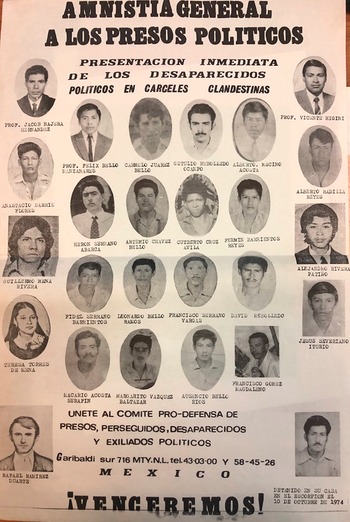
During their protests, participants carried signs demanding the “immediate return” of the disappeared, using their bodies as a medium of communication, in what Marwan Kraidy describes as “a nexus of discourse and action…a linchpin of communication and revolutionary change.”Footnote 57 Many of the banners presented photographs of disappeared people, neatly arranged in rows like some sort of macabre school yearbook (see figure 1). Protesters took these official portraits, a technique of state individuation of its citizens, and reappropriated them to refuse the erasure of these individuals’ bodies, histories, and identities.Footnote 58
Comité poster demanding general amnesty for and the return of political prisoners, undated. UACM, CAMENA, Fondo Comité Eureka, exp. 1614, vol. 2. Author’s photo, March 2020.

With few media allies, the Comité produced its own information about state terror. A press bulletin published during the strike spelled out the stakes of the mobilization, asserting that “there are more than 500 disappeared in our country, a very high number for a government that claims to be democratic and distinct from the military dictatorships of the southern Cone.” Continuing to challenge government silence or denials, the Comité demanded to know “the whereabouts of the disappeared. IT IS THE WORD OF THE STATE AGAINST OURS, against the family and friends of all these kidnapped fighters, against the overwhelming evidence of their existence and detention.”Footnote 59 The legitimacy of their claims, they argued, relied not only on the documentation that they had accumulated but on the credibility of their organization. In the end, they asked the public to consider if the state was a credible source.
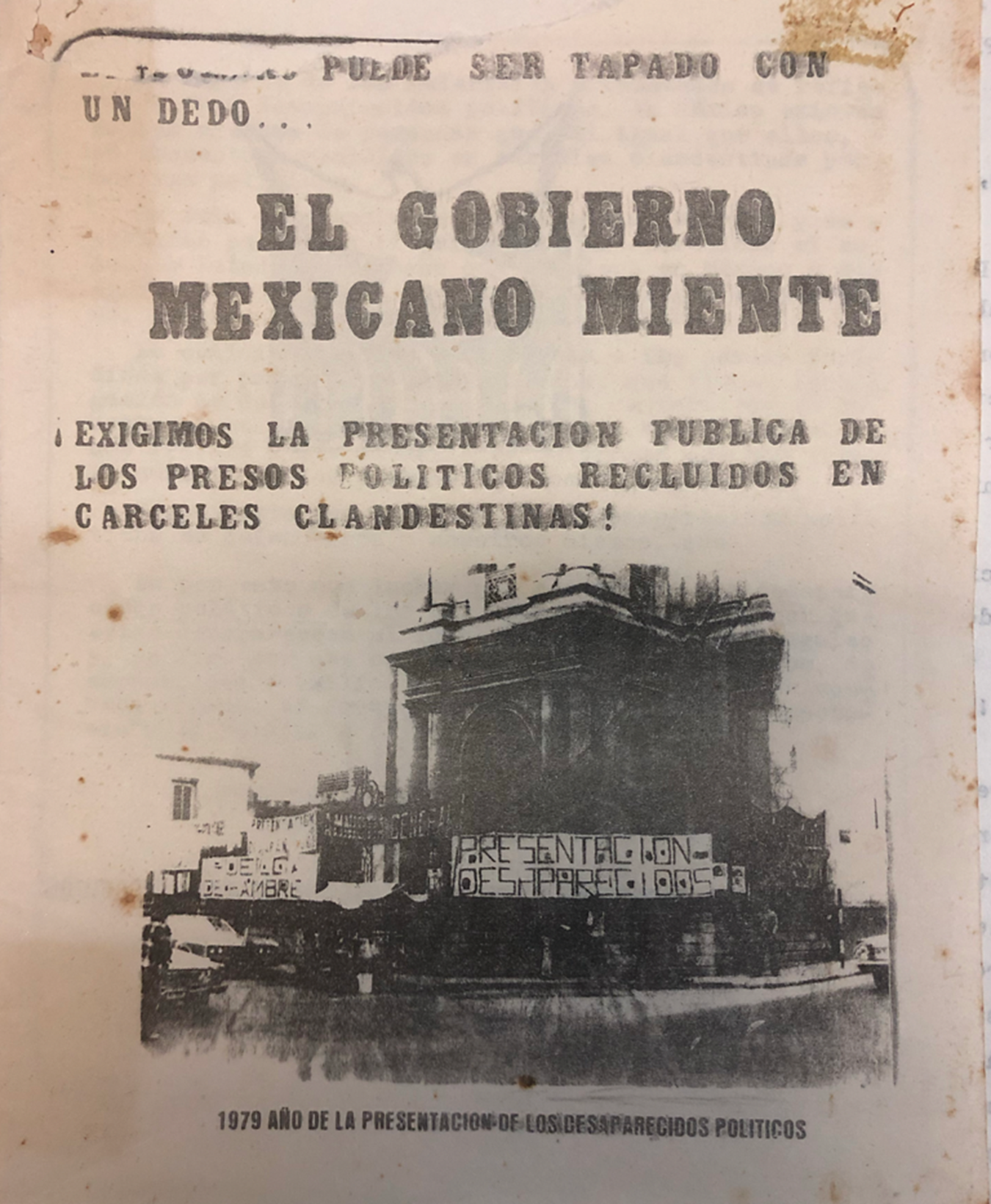
The Comité returned to the question in a small leaflet distributed after the strike concluded. These flyers passed from hand to hand on the street in exchange for the suggested donation of ten pesos. The leaflet included photographs of the strike, including an image of Comité leaders locking arms as they marched.Footnote 60 The first page asserted in large, bolded text: “The Mexican government lies!” and demanded the return of political prisoners (see figure 2). In specifying the “Mexican” government, one wonders whether the leaflet had an international, rather than national, audience in mind. Such print ephemera, like the protests, highlight how the Comité oriented itself not only to the government, but also to a wider audience.
1979 Comité leaflet entitled “The Mexican Government Lies.” UACM, CAMENA, Fondo Comité Eureka, exp. 89, vol. 1. Author’s photo, March 2020.
Getting the public to recognize the political reality of disappearances was an uphill battle, particularly in urban areas where residents associated leftist guerrillas with the unpopular bank robberies and kidnappings of the late 1960s and early 1970s.Footnote 61 In some rural regions, armed leftists maintained a closer and more reciprocal relationship with community members, while in the cities, they remained in hiding only to emerge and wreak havoc. Mexico City media tended to echo state discourse by labeling these groups as “terrorists” or “criminals.” A notable exception was the leftist weekly magazine Por qué?, which delivered sympathetic coverage beginning in 1968 and consistently denounced military repression of students and extrajudicial killings by police. The director, Mario Menéndez, also reported on the guerrilla mobilization in Guerrero, linking the violent struggle to social inequities. But Por qué? reporters and its news office consistently suffered repression, and in 1974 the magazine was forced to close after the government arrested the staff and confiscated the printers.Footnote 62 For years, activists would feel orphaned with few media advocates in Mexico City, leaving them to do the work of persuasion and investigation themselves.
Media and the Question of State Secrets
Intensifying debates about a potential right to know law occurred simultaneously to the hunger strike. While the architects of the amendment imagined political parties as the primary beneficiaries, the hearings raised a wider range of applications for the law, and schisms appeared within the ruling party. Some officials and their advisors voiced concerns that a right to know law would give media carte blanche to irresponsibly smear the government, presumably by mishandling newly accessible state secrets. These fears responded to a political landscape increasingly beset by scandal. On the one hand, a small but increasingly vocal set of publications delivered critical coverage, while on the other, mainstream media continued longstanding practices of extorting politicians with threats to expose damaging information. Many officials suggested that legitimacy required the careful control of information regarding the state’s activities. Rather than enriching democracy, some imagined that the right to know could undermine the public interest by shaking loose government control.
Recent attempts to stage manage print media opening had backfired. Facing mounting opposition from student protesters and intellectuals, President Luis Echeverría (1970–1976) permitted greater criticism within major national newspapers, producing a notable shift in dailies like El Universal and Excélsior, which traditionally had hewed closely to official press bulletins. When Excélsior stretched the limits too far, however, Echeverría intervened in 1976 in a well-publicized instance of censorship that ousted the newspaper’s director. The action prompted the editorial team to found more combative publications in the newsmagazine Proceso and the newspaper, unomásuno. In the late 1970s, Proceso published extensive reportage on state corruption, often relying upon leaked information from disaffected officials, and unomásuno took a similarly critical stance, while also incorporating marginalized voices through chronicles that examined the underbelly of urban life.
While Echeverría’s successor, López Portillo, upheld the right to know as a key pillar of his presidential campaign, he expressed frustration with the scandals that came out during his term and blamed Reyes Heroles for failing to manage press criticism. In part due to these conflicts, the secretary of the interior resigned in early 1979, and the right to know reform lost its most prominent advocate within the cabinet.Footnote 63 His successor, Enrique Olivares Santana, used prominent platforms to lambast media as thuggish and extortionist. Speaking to a group of journalists on Freedom of the Press Day in June 1979, he acknowledged the importance of the right to know, but emphasized that “journalists are public servants as much as ruling politicians” and that “hiding information is just as bad as distorting, amputating, or disguising it.”Footnote 64 While diverting attention away from government responsibility, Olivares Santana underscored that information was only as good as the reporters who delivered and interpreted it.
This idea was echoed in a confidential political analysis, delivered on a weekly basis to career politician Porfirio Muñoz Ledo, Mexico’s representative to the United Nations at the time. Author Gregorio Ortega Molina emphasized that right to know regulations should include requirements of media. If the law compelled the government to provide information, for example, it should also obligate media to accurately report it.Footnote 65 According to his brief, journalists manipulated information for their own personal gain, implying that they took truthful reports and sensationalized or weaponized them. While presumably warning against unethical reporting practices, Ortega Molina also argued that a vacuum of government communication, worsened by state secrecy, produced its own negative consequences. He lamented that “the mass media take advantage of the absence of a true government-citizen communication to make homosexuality fashionable.” In effect, he sustained, the lack of state-directed news had allowed media to steer public debate and flood airwaves with U.S. counterculture, leading to the corruption of the moral fabric of society.
Ortega Molina’s argument was not new, but in fact drew upon a classic nineteenth-century conservative discourse, which blamed outside (in the nineteenth-century case, French) forces for the corruption of Mexican morality.Footnote 66 He saw the right to know law as necessitating a more proactive and engaged government communication alongside media regulations to ensure the responsible delivery of information. While Ortega Molina was not a politician, he was closely aligned with power as an advisor to Muñoz Ledo, and other leaders echoed his concerns that a right to know legislation would amplify journalists’ worst tendencies of scandal mongering, sensationalism, and irresponsibility. At the same time, he suggested that media’s primary role was to effectively pantomime official discourse.
Comité activists frequently expressed frustration that reporters silenced their concerns, but by the early 1980s, Mexico City’s gradually opening press reported with greater frequency cases of disappearances and torture. In January 1980, Proceso affirmed that “The White Brigade Exists and Resides in the Military Camp Number 1.”Footnote 67 The splashy feature article obliquely referenced existing accusations against the secret paramilitary unit that carried out illegal imprisonment, torture, and disappearances. As suggested by the article’s title and a subheading, “The Brigade is not a Myth” (La Brigada no es un dicho), the existence of the White Brigade was not a new revelation. Shortly after its 1977 formation, the Comité declared that human rights abuses “have culminated with the unconstitutional formation of the ‘White Brigade’ and the policy of physically eliminating armed dissidents and popular fighters.”Footnote 68 Reporter Carlos Marín recognized as much, noting that previous knowledge came “only from denunciations by survivors of arrests and interrogations” and from human rights organizations.
While acknowledging the Comité’s denunciations, Marín suggested that survivor accounts were less persuasive or durable than the official reports he cited, underscoring that “the White Brigade reveals itself through official reports signed and sealed by organizations central to its functions,” implying that definitive proof of state wrongdoing had to be written in its own hand.Footnote 69 Marín’s framing might be read as minimizing the evidentiary weight of the Comité’s claims, but the reliance on state documents for journalistic exposés reflected the pressures reporters faced from governing officials. Proceso frequently reproduced scanned official documents alongside articles as a preemptive defense against government retaliation or denials. By showing the existence of an official documentary record, Proceso’s editors could more confidently publish the piece in the face of state reprisals.
The López Portillo administration disbanded the White Brigade later that year. While the precise causality is unclear, it is possible that the public denunciation in a prominent magazine provided the pressure necessary to do so. Even so, torture and illegal detentions continued, as journalist Héctor Gama asserted in a searing op-editorial that November. In the article, he detailed a confrontation that turned violent with DFS agents. As Gama was interviewing patrons of a café in the middle-class Colonia Roma neighborhood, DFS agents demanded he stop and seized his voice recorder. When Gama told them that he was a broadcaster on the public radio program “Right to Know” (Derecho a la Información), the agents became violent, beat him in the café, and then dragged him outside and forced him into their vehicle.
Denouncing the attack as a human rights violation, Gama took the opportunity to issue a broader accusation, asserting that security forces like the DFS were responsible for much graver crimes. “In Mexico there are still secret prisons, torture by electric cattle prod, water torture (el pocito), mock executions, and other well-known [practices].”Footnote 70 Gama challenged government claims to the contrary by emphasizing that these offenses were “well-known.” At the same time, his assertion was fraught with tensions. He did not explain, for example, to whom state terror was well-known, only vaguely referencing a shared common knowledge, presumably among the elite journalists and politicians who read El Universal, where his article was placed. Moreover, his op-editorial highlighted that knowing about illegal detentions did mean that the state acknowledged such practices. For that reason, in the same proverbial breath, he referenced common knowledge about “secret” prisons. In effect, the open secret of illegal prisons and torture centers sustained impunity. Gama’s op-editorial, like the Comité’s archival praxis, highlighted how the struggle for recognition served as the terrain where different groups negotiated Mexico’s state violence and political opening.
The Comité tried to reduce these information imbalances by producing and disseminating flyers, pamphlets, and zines with the testimonies of recently released political prisoners. Defying death threats, former detainees named the government agencies involved and identified other disappeared people whom they last had seen alive in prison. The Comité transcribed and typed these testimonies, then printed and glued them alongside simple illustrations, official documents, and personal letters into rustic handmade booklets that they then photocopied and disseminated.
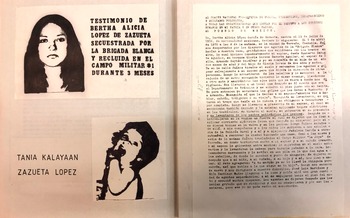
The booklets included descriptions of gruesome torture, including waterboarding, electric shocks to genitals, and having sparkling water forced up nasal passages—the same tactics cited by Gama in his article. The zines also detailed psychological torture, as security forces often kidnapped the family members, including children, of the primary target. This was the case of Bertha Alicia López de Zazueta. One of the Comité’s booklets, published around 1981, includes Bertha Alicia’s transcribed testimony in which she describes the agony of seeing her small child tortured.Footnote 71 Opposite the testimony are black-and-white photos: one of Bertha Alicia staring somber and unsmiling into the camera and a contrasting one of her daughter, appearing innocent and playful (see figure 3). Her head is tipped back and her mouth is open as she gnaws her fist, highlighting the unthinkable state violence against an innocent toddler.
Image from zine entitled, “In Mexico there are political prisoners held in secret prisons and military camps.” UACM, CAMENA, Fondo Comité Eureka, exp. 2230. Author’s photo, March 2020.

The zine reflected the style of testimonio, gaining currency at the time among Latin American human rights movements, in which victims employed first-person narration to levy denunciations against their governments. The same pamphlet included the account of Benjamin Tapia Mendoza, who underscored, “I am making this declaration so that public opinion realizes that it is true that there are political disappeared people that the government denies; that secret prisons do exist; that the repressive body called the White Brigade does exist; that detainees who have the misfortune of falling into the hands of the police are tortured; and in Mexico they violate the most fundamental Human Rights.”Footnote 72 These testimonies interpolated the broader public, pleading that readers bear witness and become part of a small group that recognized state terror, despite government denials. For the Comité and survivors, their struggle not only was for information regarding individual victims, but for a broader acknowledgement of the systematic state terror that underpinned kidnappings and disappearance.
Debating the Right to Know
The reality of disappearances remained silenced in congressional discussions of the right to know. Following the CFE’s hearings, Congress called its own, inviting the public to comment on the proposed regulation. Hearings took place throughout the country in 1980, and the newly created CGCS office took careful notes, providing insight into the overall tenor of the presentations. In some 140 comments, participants expressed their views on the public sphere, airing grievances about the concentration of monopolies in television and radio, the corrupting influence of money in media, impoverished journalistic ethics, a morbid public that wanted only spectacle from its media diet, and government overreach and propaganda.Footnote 73 Rarely did the presenters consider the right to know as a legal lever that would guarantee public access to state information. Instead, they collapsed the right to know with other related matters. While commercial broadcasters warned that a law would undermine freedom of expression, PRI representatives shifted blame for disinformation onto journalists. Both media and PRI officials sowed doubts that right to know regulations would deliver accountability.
Media monopolies, particularly the broadcasting giant Televisa, were over-represented among the presenters, and their spokespersons consistently argued against regulating Article 6 of the Constitution. Media magnates loudly warned that a secondary law would expand state power, limit freedom of expression, and amplify, what they considered to be, already onerous regulations on radio and television. CGCS director Luis Javier Solana and other observers since have blamed Televisa for ultimately killing the right to know regulation.Footnote 74
Political advisors and academics, including the director of the National Autonomous University of Mexico’s (Universidad Nacional Autónoma de México, or UNAM) Department of Political and Social Sciences, concurred, seeing any regulation as a restriction of free speech that could lead to “totalitarianism.”Footnote 75 They argued that freedom of the press was a sufficient guarantee, given that it was media’s task to inform the public. Yet, they downplayed the difficulties journalists faced in accessing information about the government’s inner workings. While disaffected officials increasingly leaked internal documents to trusted reporters, the practice perpetuated an unequal relationship in which journalists had to cultivate and protect government contacts to maintain their access. Moreover, leaks privileged official priorities over reporters’ investigations. Still, journalists at the hearings tended to share fears of government overreach. Only opposition parties consistently argued that the state should guarantee the right to know.
After months of presentations, it became clear that the hearings only generated more confusion regarding what exactly would be regulated. Reflecting a system in which all political initiatives passed through the president, many wondered aloud about López Portillo’s perspective.Footnote 76 The president himself did little to clarify his position, opening his September 1980 state of the union address by highlighting very basic and yet-unanswered questions. He began by stating, “It is necessary to define what the right to know consists of. Is it receiving [information]? Disseminating it? Or both. In either case, who are the beneficiaries and the responsible parties of such a right and how can it be exercised and guaranteed?”Footnote 77 López Portillo then questioned whether any single individual or organization should enjoy the right to know or if there should be responsibilities or obligations attached to it. The consequences were high, he warned, because missteps could lead to anarchy or dictatorship. While the president had convoked the right to know project, the government held no clear dogma regarding information and its role in civic life. Three years after Congress amended the constitution to include the right to know, the president underscored that the primary questions about the beneficiaries, responsible parties, and mechanisms of the regulation remained unclear.
López Portillo described Mexico’s regulatory law as sui generis, something that had to be created out of whole cloth. Without prescribing the path forward, the president encouraged Congress to find answers to the questions he raised. Mexican legislators faced an uncommon, if not entirely unprecedented, context. Few comparable laws existed elsewhere, with limited models available in an Enlightenment-era Swedish law and a 1951 Finnish law. The most recent case came from the United States, where a right to know law was born out of political crisis and competition between Congress and the president. Subsequent reforms to the U.S. law passed in 1974 in the context of the Watergate scandal and executive weakness.Footnote 78 In fact, the U.S. Congress had to overturn a presidential veto to get the reforms through. By contrast, the Mexican presidency remained largely unchallenged by other branches of government, and Congress responded to the right to know initiative at the president’s behest. But in neither the United States nor Mexico did political leaders consider openness and transparency as an inherent good. Exposing information without due consideration and context, some argued, would bring political chaos.
The push for a right to know regulation created strange bedfellows between critical journalists and conservative opposition party members. Mexican Democratic Party (Partido Demócrata Mexicano) representative Gumercindo Magaña won his seat in 1979, running through the newly registered, socially conservative Catholic party. He criticized the president’s convoluted speech, responding that “the right to know is very simple, it does not have as many complications as some try to give it.”Footnote 79 The beneficiary was the “people,” he said, who had the right to be well informed. And the “principal responsible party is the one that has the most information and produces the most information in the country…the Public Sector. As such, the public power is the one that is obliged to adequately and truthfully inform the people.” Meanwhile, as intermediary between the state and the public, he noted, media would be the government’s “appropriate channel for informing” the public. Still, he did not elaborate on how the mechanism for such a guarantee might operate in practice.
Carlos Amaya Rivera, representative from the conservative National Action Party (Partido Acción Nacional, or PAN), echoed Magaña’s calls for state transparency, while underscoring that the government needed to reform its approach to media management. While historically the loyal opposition, the PAN positioned itself in the early 1980s as the PRI’s primary competitor, picking off more congressional and municipal seats over the following years. The state, Amaya Rivera reasoned, was in the “business of information” and should face regulations just like media workers. He suggested that Congress regulate the practice of paid advertising “to avoid pilfering, favoritism, and opportunistic publications at the service of base politicking.”Footnote 80 But the state’s corrupting role did not end there, he argued, and bribing, manipulation, and disinformation should be banned. His party favored concrete regulations that would “limit the concentrated power to inform in few hands; end the distribution of envelopes by public offices, which venal journalists accept in exchange for speaking or shutting up; impede official press offices from becoming factories of smoke in mirrors and manipulative disinformation, and stop newspaper desks and directors from silencing their own contributors.”Footnote 81 Amaya Rivera underscored that any right to know regulation would need to reform the entire state-media ecosystem upon which news dissemination rested.
In July 1981 the CGCS concluded its extensive thirty-volume study, which covered everything from the book publishing industry to primary education to news agencies. The report held no punches and pathologized the country as “chronically under-informed.” On the one hand, authors blamed the citizen-consumer, who failed to “demand ‘serious’ and ‘objective’ information,” leading to an uncompetitive media environment characterized by unprofessional and biased reportage.Footnote 82 On the other hand, the authors highlighted a problem in political culture, in which media served as a mouthpiece for state officials. The government itself, the report suggested, benefited from the limited popular participation, readership, and access to information.Footnote 83 It is remarkable that a government organization, which reported directly to the president, had produced such a critical report.
While diagnosing the problems that plagued public communication and media industries, the lengthy study ignored activism around disappearances and thus avoided considering the high stakes struggles over information access that played out simultaneously. Like the Comité, the CGCS accumulated an extensive archive that both undergirded and emerged out of its lobbying efforts. However, the CGCS archive revealed an understanding of information that was distinct from the Comité’s. Rooted in bibliographic research and formal surveys, the study presented a zero-sum vision in which information was either good or bad in quality, large or small in volume. In this imaginary, information was ontologically stable and transformative, if only citizens could access it. Comité members, by contrast, came to recognize that information itself was an epistemically fraught category. While overwhelming evidence proved insufficient to bring about state recognition or justice, partial information could produce new knowledge, commentary, and alliances.
In August, the CGCS presented Luis Farías, president of the Chamber of Deputies, with a draft of a regulatory law. CGCS director Solana recalls that “when [Farías] read the complete project, he said it was impossible, that it would be too difficult to square the circle” and refused to bring it to Congress for a vote.Footnote 84 “The president [López Portillo], faced with that, no longer dared to continue forward.” Solana’s explanation inverts longstanding wisdom about Congress’s subordinate relationship to the president. But he explains that, by the end of 1981, López Portillo was “worn down” and had little political leverage with only a year left in his term. Vocal opposition from television and radio magnates likely further eroded López Portillo’s willingness to press the matter.
Members of the CGCS leaked the drafted law to the press, and in late September, Proceso published a detailed report, noting that the proposed bill defined the right to know as both the right to access information and the right to produce it.Footnote 85 As such, the regulatory law would guarantee the right to request information from relevant government sources, the right of social organizations and companies to provide information to the public, and the right to receive “truthful, objective, complex, pluralistic, and clear information” from both media and state institutions.
The bill proposed a top-to-bottom reform to how media operated. In line with Amaya’s critiques discussed above, the draft law purported to regulate publicity, beginning with a central registry for all media advertisers. The authors of the law also envisioned a new bureaucratic infrastructure, including five new organizations that would evaluate media coverage to ensure that a certain percentage of all content was produced within Mexico and oriented toward social issues.Footnote 86 Underscoring that media should preserve national sovereignty and defend against racism and discrimination, the draft bill reflected international debates, which grew in intensity in the late 1970s and early 1980s, regarding media and development.
In the United Nations Educational, Scientific and Cultural Organization, the Non-Aligned Movement meetings, and myriad regional gatherings, global South reporters, public officials, diplomats, and intellectuals argued that international news wire services and foreign television programming distorted the realities of Latin American and recently decolonized countries by focusing on natural disasters and political instability, producing a discriminatory coverage that undermined national sovereignty. They called for a New International Information Order (NIIO) that would rebalance access to information technology and reform journalistic ethics to ensure that media served the interests of national economic development rather than capitalist imperialist expansion. There was extensive discussion of the NIIO within Mexico-based conferences and institutes, and a key member on the team that drafted the right to know bill, Argentine journalist Federico Fasano, had been an active participant in regional discussions surrounding the NIIO.
While the Proceso reporter provided little commentary on the draft bill, the article sparked a firestorm of negative media coverage, which centered around arguments that the right to know bill amplified state intervention in media.Footnote 87 With the opposition from the speaker of the Chamber of Deputies and major media monopolies, the draft bill was a non-starter. By February 1982, Solana resigned from his post.
Before the term closed, however, PRI congressman Miguel Ángel Camposeco underscored that an effective right to know law would support the continued progress of the Political Reform by giving opposition parties greater access to media, returning to the original purpose of the reform. To lend legitimacy, elections needed to be robust, and abstentionism remained a problem; only fifty-one percent of registered voters turned out for the mid-term elections in 1979. For Camposeco, the public discussions over the previous years had muddied the original intention of the amendment by focusing on the dangers of granting too much power to the press, which some described as a “payoff” (mordaza).Footnote 88 But the original beneficiary was supposed to be political parties who should be able to communicate effectively to their publics and access relevant information from the government.
Camposeco underscored that this social right remained essential. “Because in the end, information in our times is nothing more than a good that is handled, distributed, stored, manipulated, offered, bought, and sold in accordance with the interests of those who run the media, [and] those with the appetite to receive the information transmitted by media. But be aware, it should be clear, neither the news nor the facts disseminated by social communication media comprise the totality of information. Information is much more complex.”Footnote 89 Camposeco described information as a bundle of data that can be sold and traded like any other commodity, shaped by the forces of supply and demand. And for that reason, he suggested, there should be a lever that made it available to the public. Yet, he also contradicted himself, suggesting a mysterious, intangible quality to information that made it too sensitive to regulate. By the end of 1981, legislators had tied themselves in knots wrestling with the meaning of information in society. They concluded their term by metaphorically throwing their hands in the air and moving on to other matters. The matter was simply too “complex.”
Over the following years, the Comité, later renamed Comité Eureka, continued to collect documentation on forced disappearances, repression, and political prisoners, challenging claims that the Dirty War had concluded. By the early 1980s, the archive’s ambit expanded, following the shifting political concerns of Rosario Ibarra de Piedra and, thus, the Comité’s. In 1981, Ibarra de Piedra transitioned into formal politics, winning a seat in Congress. In 1982, she ran as the first woman presidential candidate on the Trotskyist ticket of the Workers’ Revolutionary Party (Partido Revolucionario de los Trabajadores, PRT). Both bids were made possible by the Political Reform, which opened the door to leftist party competition. Her archival contributions bear this imprint, as they contain texts on broad economic concerns like unemployment and rising gas prices. Yet her political career consistently kept her missing son front and center. The perpetual not knowing would remain a throughline in her politics.
Conclusion: Latin America’s Information Age
In Latin America of the 1970s, the age of information converged with the human rights problem of disappearances. The expansion of computing, television, and satellite technologies in the 1960s and 1970s increased global attention on “information” as both a vehicle for efficiency, democracy, and economic progress, as well as a potential source of subversion, surveillance, and political vulnerability. While some journalists, intellectuals, and officials saw national control over information as central to their countries’ economic development and independence, the problem of state terror and disappearances reoriented activists demands around questions of recognition and, later, truth and reconciliation.
In contrast to activists mobilizing under South American dictatorships, Mexico’s Comité operated within the idiosyncratic context of the Political Reform, in which the electoral field became more competitive and union organizing more independent, even as state security and military forces increased their violent tactics against presumed dissidents. Against this backdrop, the right to know hearings and mobilizations against disappearances became terrains of struggle, where activists and state actors clashed over what information was, who had the right to produce it, and what political goals could be achieved through its mobilization.
In analyzing this contradictory landscape, this article not only underscores the non-linear process of Mexico’s democratization but also highlights the dialectic relationship between authoritarian backlash and political opening. State repression of the late 1960s and early 1970s propelled diverse popular, social, and political movements, which pressed for greater spaces for expression, organizing, and the equitable distribution of resources and land. These social pressures, in turn, became important levers that produced results like the Political Reform. Yet, the judicial system remained unchanged, and state forces continued to wield violence with impunity. In effect, there was a coevolution of authoritarianism and democracy.Footnote 90
While the right to know bill failed to pass, the question of information access remained central to activist and opposition party agendas in the 1980s and 1990s. As the PAN gained momentum in the electoral arena, many of its political candidates made the issue of transparency central to their platform. In 2002 Mexico joined a wave of countries that adopted right to know regulations, following a global trend inspired by the fall of the Soviet Union and the rise and spread of the internet. The law’s passage was made possible by the PRI’s exit from the presidency in 2000. The newly empowered PAN, in addition to adopting the right to know regulation, declassified the archives of intelligence agencies, assigned a special prosecutor to investigate the 1968 Tlatelolco Massacre, and commissioned the CNDH to write a report on human rights violations during the Dirty War. These measures promised to expose the extent of repression under the PRI regime. The new leadership suggested that if the outgoing party had been corrupt and secretive, the PAN would usher in democracy and transparency.
However, the resulting reports carried no consequences for the perpetrators. In 2001, the CNDH produced a study that used government documents to identify 532 cases of disappearances from the 1970s to the 1980s, 275 of which the study attributed to state forces.Footnote 91 By all accounts, the report underestimated the disappearances and the state’s hand in the violence, and it led to no arrests. Then in 2014, the state of Guerrero published its own truth commission report, which found over 500 cases of human rights violations (disappearances among them), the majority of which were committed by state forces.Footnote 92 While both reports uncovered new sources of evidence, neither produced findings that departed significantly from what Comité Eureka had been denouncing over the previous decades.
In October 2021, President Andrés Manuel López Obrador (2018–2024) created a truth commission, which he argued would heal the open wound of the Dirty War. The commission team produced two separate and exhaustive reports, the most recent of which numbers over 3,000 pages long. Extensive documentation includes estimates of around 1,300 disappearances, confirming and expanding upon what was already known. At the same time, the presidency obstructed truth and justice elsewhere, evidenced by its sudden intervention into the Special Investigation and Litigation Unit for the Ayotzinapa Case (Unidad Especial de Investigación y Litigación para el Caso Ayotzinapa), tasked with investigating the notorious case of the 2014 disappearance of forty-three students from the Ayoztinapa teacher training college. This action further resulted in the cancellation of arrest warrants for over a dozen military officials charged with involvement in the disappearances.Footnote 93 Moreover, the López Obrador government reversed course on information access, beginning the process—concluded by his successor Claudia Sheinbaum—of eliminating the National Institute for Transparency, Information Access, and the Protection of Personal Information (Instituto Nacional de Transparencia, Acceso a la Información y Protección de Datos Personales, or INAI), the agency tasked with guaranteeing the functionality of the 2002 right to know and the 2015 transparency laws.Footnote 94
Taking stock of the recent Dirty War truth commission reports, notable scholars from both the United States and Mexico argued in Nexos magazine that, despite the overwhelming documentation of state terror, there is no justice.Footnote 95 The reality is sobering and calls into question years of global enthusiasm regarding the promises of transparency, which presumed information to be an apolitical tool in the service of democratization and, in some cases, reconciliation.Footnote 96
A central question that plagued Mexican activists for the disappeared was: how much information is necessary to achieve justice? How many testimonies, state documents, and gravesites are enough to lead the state to move against perpetrators? It is a question that remains salient today. In the 1970s, Comité leaders distinguished between information and recognition, realizing that one would not necessarily lead to the other. In effect, there may be truth without justice; evidence without reckoning. And so, activists and family members continue accumulating more documentation, compiling forensic data, gravesites, and testimonies that not only assert and enact their right to know what happened to the victims of state terror, but also to demand the state acknowledge its role.
Acknowledgements
I am grateful to Bettina Gómez of the Centro Académico de la Memoria de Nuestra América for her excellent guidance in navigating the Comité Eureka archive. I am also thankful to Alexander Aviña, Jacques Coste, Bianca Premo, Melissa Teixeira, and Corinna Zeltsman for their constructive comments on early drafts of this article.

 Open access

