




In luxury settings in particular, this interactive product is more than ‘service with a smile’; it is, rather, recognition of the customer’s limitless entitlement to the worker’s individualising attention and effort. (Sherman Reference Sherman2007:6)
Introduction
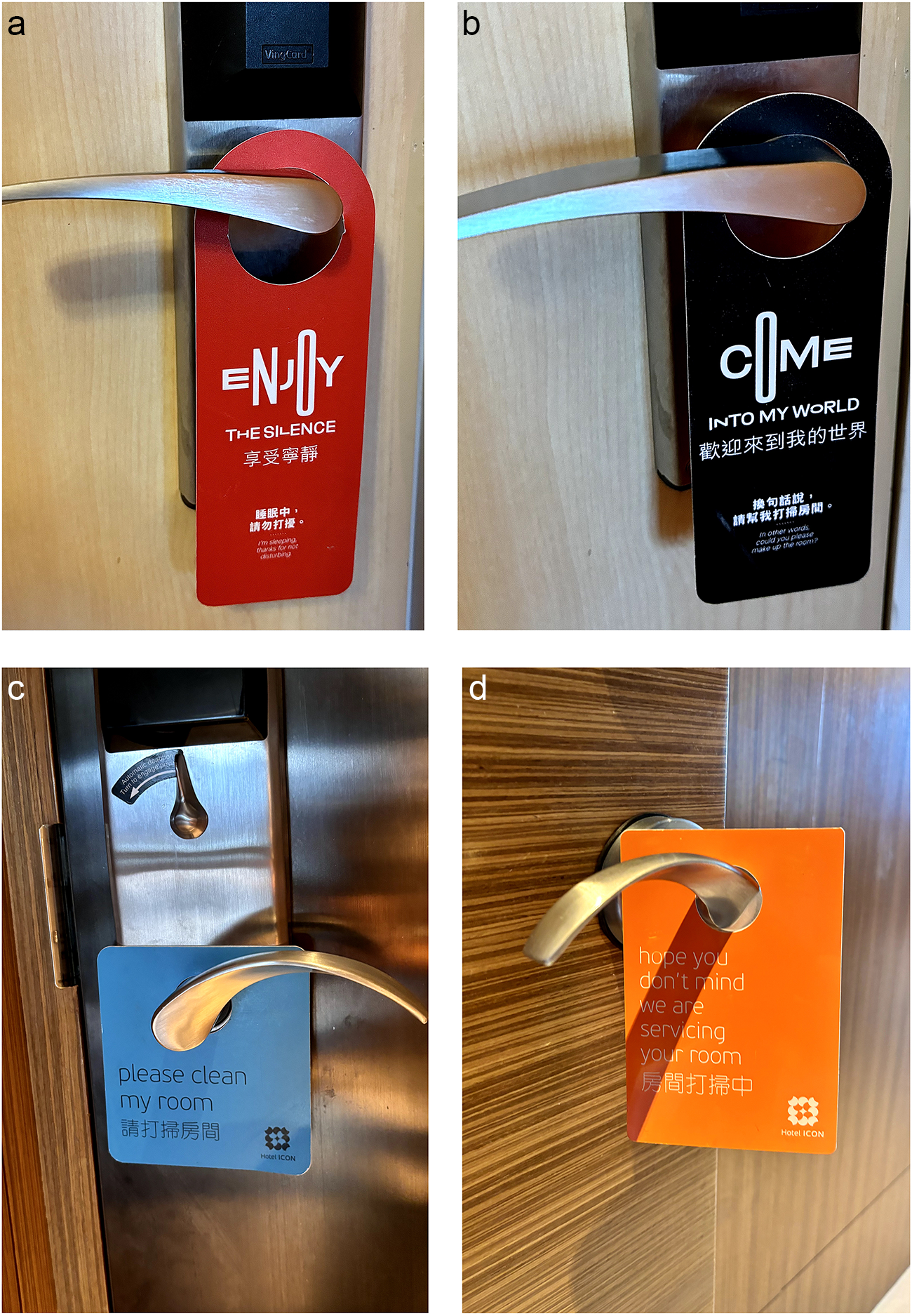
In her study of luxury hotel labour, Sherman (quoted above) foregrounds an inherent inequality in the production and consumption of services: Whereas consumers are socialised to manage guilt around being served, workers are obliged to honour others’ needs. The smooth running of any luxury establishment thus hinges on stratified relations of privilege and subordination. As a neat case in point, the hotel door hangers in Figure 1 manifest this power asymmetry. By draping the Enjoy the silence sign over the door handle (with I’m sleeping, thanks for not disturbing in smaller print; Figure 1a), guests instruct housekeepers to respect their privacy and stay out. Conversely, phrases like Please clean my room (Figure 1c) or the more poetic Come into my world (Figure 1b) issue the opposite directive: orders disguised as requests. While guests are free to exercise choice, housekeepers must uniformly display the same sign which reads—in a notably apologetic tone—Hope you don’t mind we are servicing your room (Figure 1d). Seemingly banal, these signs do more than facilitate communication between guests and workers; they reinscribe a social divide between those who mess and those obliged to tidy up. They also reinforce spatial boundaries, ensuring that luxury workers do their work but remain unobtrusive, preferably unseen and unheard.
Door hangers in Hong Kong luxury hotels.

Against this initial backdrop, my article considers upscale hotels as an epitomic site for examining the discursive organisation of luxury labour (Thurlow & Jaworski Reference Thurlow, Jaworski, Birtchnell and Caletrío2014). As hallmarks of consumer capitalism dedicated to profit creation, hotels are sites of social differentiation centred around an uneven distribution of resources. Following Veblen (Reference Veblen1899), they epitomize both conspicuous consumption and conspicuous leisure. My principal concern here, however, is with their more inconspicuous underside: the marginalised, ‘dirty’ work that sanitizes and sustains them, and without which no profit would be made. In this way, I draw attention to the lived experiences of those who work with/around dirt. For this, my focal point is a specific material practice: laundry work.
Despite its everyday prominence, laundry—both as domestic chore and commercial service—remains largely overlooked. According to Watson (Reference Watson2015:877), this is due to ‘our sense of disgust at body effluent and waste, the simple logic of … expelling things that are seen as abject, or our need to exclude uncleanliness to maintain boundaries’. Yet laundry plays an integral role in shaping the sensory experience of a hotel room; more importantly, it is a key socio-material practice through which meanings of cleanliness are negotiated (Pink Reference Pink2012:ch. 5). Naturally, guests leave behind all sorts of bodily residues or imprints on towels, pillowcases, bedsheets, duvet covers, and other fabrics that caress human skin. To uphold the hotel’s image, every smudge of grime must be banished and washed away before it taints the ‘imaginary of tidiness and order’ (Hawkins Reference Hawkins2006:348). Whether on-site or off-site,Footnote 1 laundry stands out as an important waste practice structured around entrenched binaries of ‘clean’ versus ‘dirty’ which, as Douglas (1966/Reference Douglas2002) famously argued, are cultural categories of classification that inform the social order of things.
Responding to Thurlow’s (Reference Thurlow2022) call for a ‘sociolinguistics of waste’, and taking inspiration from Pink’s (Reference Pink2012:ch. 5) idea of ‘following the laundry’, this article unpacks the social meanings and forms of value generated across different stages of commercial laundry. In mapping the mobile biographies (Kopytoff Reference Kopytoff and Appuadurai1986) of linen items and the workers who handle them, I organize my analysis around three key timespaces (May & Thrift Reference May, Thrift, May and Thrift2001) along the laundry cycle: (i) documentary regimes and frozen actions in hotel rooms; (ii) silent work and human-machine interactions in laundry plants; and (iii) the dis/assembling and re/valuing of ‘condemned’ linen. At each stage, I examine how items like towels, bedsheets, and pillowcases are evaluated. I argue that the classification of laundry as clean/dirty is never neutral nor self-evident, but embedded in discursive projects of value.
Before turning to the empirical focus of the study, I situate my discussion at the intersection of three conceptual cornerstones: the sociolinguistics of waste, language materiality, and value discourse. I then map the object biography of hotel laundry; the overarching goal is to identify the discursive processes that underpin the creation, destruction, and recreation of value. Modelled after Graber’s (Reference Graber2023) work, I pay particular attention to ‘qualic’ transformations enacted through text and talk. I conclude by highlighting the centrality of language and material practices in shaping ideologies of cleanliness within economies of luxury consumption.
Conceptual framework: Language materiality and value discourse
In his sociolinguistic intervention on waste, Thurlow (Reference Thurlow2022) highlights the centrality of language and discourse in constituting waste relations—not only in articulating what ‘rubbish’ means, but in construing social difference through the categorical, disciplinary power of words (cf. Thurlow, Pellanda, & Wohlgemuth Reference Thurlow, Pellanda and Wohlgemuth2022). In short, a ‘sociolinguistics of waste’ examines how people make sense of, and interact with, waste in everyday lives. This perspective frames waste as not simply discarded stuff, but a generative action talked into existence and thus shot through with communicative potential. Rather than viewing discard as straightforwardly disgusting or undesirable, people assign diverse meanings to waste: It can, for example, serve as a semiotic resource to signal good citizenship (Pellanda Reference Pellanda2024) or function as a marker of privilege in sustainable eating practices (Mapes & Ross Reference Mapes and Ross2020).
At times, these waste encounters unfold through language (Cavanaugh Reference Cavanaugh2022); at other times, they manifest through material experiences (Hawkins Reference Hawkins2006). Words alone are not sufficient for understanding how social order is exercised, and this is where Shankar & Cavanaugh’s (Reference Shankar and Cavanaugh2012, Reference Shankar, Cavanaugh, Cavanaugh and Shankar2017) concept of ‘language materiality’ becomes relevant—a heuristic capturing the intersemiotic relationship between words and things in co-creating meaning. This framework can also be traced back to Barad (Reference Barad2003), who recognizes the mutual entailment of discursivity and materiality. Simply put, the value of things depends on how it is talked about, just as language gains meaning from the material substance it describes. While words define what is ‘unpleasant’ and thus to be rid of, sensory traces like stains or odours are equally powerful in communicating waste’s refusal to vanish. Waste, therefore, is both ‘stuff’ and ‘talk’ that exhibits very real material effects.
This ontological inseparability of linguistic and material practices is closely allied with foundational principles of multimodality and is captured elsewhere by Bucholtz & Hall’s (Reference Bucholtz, Hall and Coupland2016) ‘embodied sociolinguistics’, which establishes a more explicit connection between material culture, language, and the body. Taking this further, Thurlow & Jaworski (Reference Thurlow, Jaworski, Cavanaugh and Shankar2017) introduce the paired notions of ‘thing-words’ and ‘word-things’, referring to transmodal processes of signification by which one semiotic mode is translated into another. They argue it is through the ‘thingification of words’ and the ‘wordification of things’ that inequality is instantiated. In this way, language materiality is not only a form of semiotics bearing material essence; it also exists as a politics, a materialising force that exerts tangible social injustices (Thurlow Reference Thurlow2025). Materiality thus operates on two interconnected levels: first, at the level of objects and embodied practices; second, at the Marxian level of political economies.
Expanding on the sensory dimension of materialities, Graber’s (Reference Graber2023) study on cashmere draws on the notion of qualia as a heuristic for understanding how materiality is enregistered. As Chumley & Harkness (Reference Chumley and Harkness2013) explain, the Latin term qualia refers to sensorial experiences like colours and textures, as well as affective states like delight and disgust. Whereas qualities are mere potentials of material occurrences, qualia, writes Gal (Reference Gal2017:132), are the ‘embodied, conventional, and experienceable forms of abstract qualities’. These embodied sensations are not just psychological states that pre-exist semiosis, but cultural norms that are socially conditioned through past experiences, even as they appear innate. This learned character of qualia is central to understanding how properties like the softness of cashmere are interactionally mediated.
Qualia are not only sensed through bodily, cutaneous contact; they are also emotionally felt and affectively experienced (cf. Paterson Reference Paterson2007). In a different context, writing about the cultural politics of tactility, Thurlow (Reference Thurlow2020c) highlights how the sensory materialities of business class airline menus work to produce feelings of distinction. Informed by Sedgwick’s (Reference Sedgwick2003) approach to ‘touching-feeling’, he addresses touch as not merely a haptic practice, but one imbued with affective resonance—for instance, when the tactile design of a menu makes guests feel pleasure. In another article focusing on elitist sleep practices, Thurlow (Reference Thurlow2020a) similarly brings together the tactile, the affective, and the political through what he calls the ‘euphoria of privilege’ as a form of aspirational desire. In this article, I combine these perspectives to conceptualize qualia as a discursive-cum-affective accomplishment whereby people habitually attribute qualities and meaning potentials to objects or experiences in events of evaluation.
Social actors constantly make value-judgements in everyday waste-making practices. In Graeber’s (Reference Graeber2001:88) words, the politics of value is concerned with ‘the power to define what (and who) is worthwhile’. That is to say, nothing is intrinsically ‘wasted’: Waste never settles on a pre-given characteristic; rather, it is intertwined with questions of what people (of unequal status) deem worth pursuing. As Thurlow (Reference Thurlow2022) notes, language plays a prime role in declaring value through acts of labelling and categorising. In this sense, value is not a static form of judgment nor an absolute quality passively waiting to be realised, but an ongoing practice of social negotiation. This conceptualisation bears relevance to Steinert’s (Reference Steinert2023:ch. 4) ‘action-oriented’ perspective in cultural anthropology, which frames value as a relational process of becoming as it emerges through discourse. As Miller (Reference Miller2008:1130) puts it, ‘the creative potential of value lies not in what it is, but rather in what it actually does’.
To date, many scholars have debunked economic conceptions of waste as leftovers of production that are inherently ‘bad’, ‘inefficient’, or ‘unproductive’. In rejecting the ‘waste = valueless’ equation, Thompson (1979/Reference Thompson2017) argues that objects are never fully abandoned, but vacillate between phases of displacement and reintegration as they become retooled for new contexts. More recently, Reno (Reference Reno2009) documents how scavengers transform waste into profit, whereas Greeson, Laser, & Pyyhtinen (Reference Greeson, Laser and Pyyhtinen2020) highlight how discard generates novel possibilities through upcycling. This indeterminacy in value is exemplified by Graber’s study (cited above), where herders, buyers, and sellers ascribe value unevenly at different nodes along the production chain, informed by varied norms and experiences. In all these cases, the value of things is left unsettled and contextually relative.
Building on this relativist perspective, value is discursively constructed and dispersed across the interplay of multiple registers and regimes. Here, value registers are defined as ordinary, domestic ways of assessing or speaking about worth, that is, frames of reference that meaning-making agents mobilize at their disposal (Heuts & Mol Reference Heuts and Mol2013). Typically, value registers follow two avenues: (a) estimation of monetary price, and (b) appreciation of importance, entailing valuations encompassing aesthetic, moral, and ethical grounds. In determining what is beneficial (and to whom), these competing value registers coexist in tension, sometimes overruling one another. Importantly, these local registers operate within, and are inflected by, broader ideologies structuring worth—what Frow (Reference Frow2007) refers to as value regimes. These are cultural discourses institutionally enregistered and organised through unequal systems of capital. Again, such regimes operate in dual ways: (a) as political economies (where institutions manage the tangible diffusion of profit), and (b) as symbolic economies (where neoliberal rhetorics invoke social taste) (Bourdieu Reference Bourdieu1984). In this article, I propose a third value regime by following Ahmed’s (Reference Ahmed2004) thinking around (c) ‘affective economies’, where feelings circulate as capital to perform boundary work. These value regimes are not equally accessible but hierarchically arranged.
Before taking these theoretical perspectives to the ground, I quickly return to the foundational premises of language and waste by briefly touching on discard studies. Going beyond simplistic critiques of ‘wasteful’ lifestyles, Liboiron & Lepawsky (Reference Liboiron and Lepawsky2022) view waste as not merely an ecological challenge but a cultural practice. In doing so, they interrogate the discursive power of institutional structures in dictating which resources are naturally disposable. But apart from material waste, the ‘wasted people’ (Bauman 2004/Reference Bauman2021) who work with it also carry political weight; these are marginalised populations that symbolically inherit the properties of unwanted things (Alexander & Reno Reference Alexander and Reno2012). In short, discard studies ‘decentres’ mythologised wasting systems by recentring the social worlds of waste labour.
In line with discard studies’ goal, the current article disentangles the various forms of value-meaning observable along the commercial laundry cycle. Since value never circulates freely, my concern lies in how hierarchical registers and regimes are selectively privileged and (re)ordered, while focusing on the qualic biographies and evaluations of linen items. Combining these conceptual organising principles, I ask: How are the qualia of hotel laundry discursively framed, and how do its social meanings transform across the value chain? Ultimately, what do these shifting forms of value reveal about ideologies of cleanliness underpinning elite consumption practices?
Research design: Mapping ‘laundry routes’ in luxury hotels
Arising from a broader discourse-ethnographic project (Kong Reference Kong2025), the current article adopts Kopytoff’s (Reference Kopytoff and Appuadurai1986) notion of ‘object biographies’ as its specific methodological framing. Rooted in linguistic-anthropological tradition, this approach offers a lens for tracing the ‘social lives’ of things across time and space (Appadurai Reference Appadurai and Appadurai1986). Rather than treating things as fixed in their present state, object biographies emphasise their dynamic trajectories as they are valued, devalued, and revalued. This framework is thus especially productive for tracking how the qualia of linen items shift across various phases of use.
Kopytoff’s approach is closely allied with adjacent strands of research both within and beyond sociolinguistics, including material culture studies (Miller Reference Miller2005) and the ethnography of commodities (Heller Reference Heller2011). My analysis is also indebted to Thurlow’s (Reference Thurlow2020b) discourse-centred commodity chain approach, which aims to ‘de-fetishise’ commodities (cf. Marx 1867/Reference Marx1976)—that is, render transparent the political-economic relations through which goods/services are brought into being. While economic anthropologists have long studied commodity chains by following material flows, I follow Graber’s (Reference Graber2023) lead in rethinking chains as series of interactions through which inequality is linguistically produced. This is done by examining how social agents give meaning to their local actions in, and contributions towards, an overall production system.
The analysis in this article is empirically grounded in fieldwork conducted in two five-star hotels (hereafter referred to as Hotel Jade and Hotel Pearl) and one commercial laundry company (hereafter referred to as Crystal Linen Services) in Hong Kong. Whereas Hotel Jade runs an in-house facility for towel washing and outsources the remaining items, Hotel Pearl relies fully on Crystal Linen Services, which I also visited briefly. From May to September 2024, supplemented by follow-up fieldwork in April 2025, I conducted semi-structured interviews and observation sessions with two housekeeping department executives, two in-house laundry supervisors, one laundry plant worker,Footnote 2 five hotel room attendants, and one laundry business manager. Interactions with room attendants took place under the watchful eye of a more experienced, senior staff member, enabling room attendants to focus on their tasks as the supervisor mediated the conversation. All personal names and identifying details of informants are anonymised; pseudonyms are used throughout to protect confidentiality.
My fieldwork culminated in two types of discursive evidence. The first comprises discourse about hotel work, drawn from recorded interviews conducted in Cantonese (with key extracts transcribed and translated into English). These interviews provided opportunities for staff to verbalise and describe the value registers entailed in their work; it is in these verbal accounts that linguistic evaluations of cleanliness emerge. The second type of discursive data consists of discourse in hotel work—that is, material practices observed and documented through photographic evidence, fieldnotes, and mediatised data. While often embodied and nonverbal in the moment, these work practices reflect prior interactions and negotiations regarding how they should be performed, as will be made evident in the analysis.
Analysis: More than meets the eye—the feel of clean
To be sure, laundry cycles rarely have a fixed starting point: Laundry is not a static category but a system in motion, with items continually becoming or having been laundry as they circulate at varying speeds. For clarity, however, I briefly outline the technical workflow of commercial laundry, which differs by operational setup, seasonal rhythms, and material biographies of items.Footnote 3 Typically, the cycle begins with bulk linen sourced from suppliers in mainland China, some of which is sold to guests as branded merchandise. Each morning, room attendants collect soiled linen and replenish guest rooms with clean items. Soiled linen is either sent down a chute to an in-house facility or stored for pickup by an external laundry provider. At the laundry site, items are scanned, sorted, and washed using standardised formulas, then dried with hot air before passing through a cooling cycle to soften fibres. The items are then folded and subjected to quality checks; flawed pieces are rerouted for spot treatment or an extra wash. If faults persist, the item is ‘condemned’ for internal use.
Within this context, my analysis pinpoints three representative stages at which value transformations are most critical; these are pivotal moments where the status of laundry items depends on different ways of ranking and toggling value registers. For each illustrative example, I am concerned with how laundry is handled—and its cleanliness evaluated—in/through spoken and written discourse. With this in mind, I first focus on the room attendants who transport dirt/waste away to render these spaces hospitable for guests.
Stage 1: Documentary regimes and frozen actions in hotel rooms
Before guests depart for the day, a truck laden with freshly washed laundry pulls into the car park. This marks the start of a room attendant’s daily routine: They take their linen baskets, offload the soiled items, and retrieve the clean ones. This rhythmic choreography of ‘dirty out, clean in’ unfolds in the hushed hours of dawn; but despite the calm, the linen items awaiting collection are never uncommunicative. In the words of Thurlow et al. (Reference Thurlow, Pellanda and Wohlgemuth2022:826), their ‘spectral presences’ index the interactions which precede and ‘make meaningful the consumption generating waste’. Kept out of the public front, these work patterns evidence what Thurlow & Jaworski (Reference Thurlow, Jaworski, Birtchnell and Caletrío2014) term ‘visible-invisible labour’: While the results of labour are spectacularised, the workers themselves are erased from view.
At Hotel Pearl, following daily briefing sessions, room attendants begin their rounds at 9 a.m. Each worker is tasked with servicing fifteen rooms per day, with forty-five minutes allocated to each. On the surface, housekeeping appears straightforward: Soiled linen is stripped, and fresh replacements are wheeled in on a supply cart. But this task is subject to techniques of separation that are more intricate than they appear, as Hannah attests in extract (1).
(1) Hannah, a senior room attendant, Hotel Pearl
1 Removing linen is not that simple. We have standard operating procedures, and every
2 colleague must learn how each task is done. Stains really stand out against the white
3 fabric: If a sheet is too soiled, it needs to be singled out for special stain treatment.
4 Only then will guests feel that it’s truly clean. Take a pillowcase with blood stains, for
5 example—it would be very troublesome if a guest were to see that.
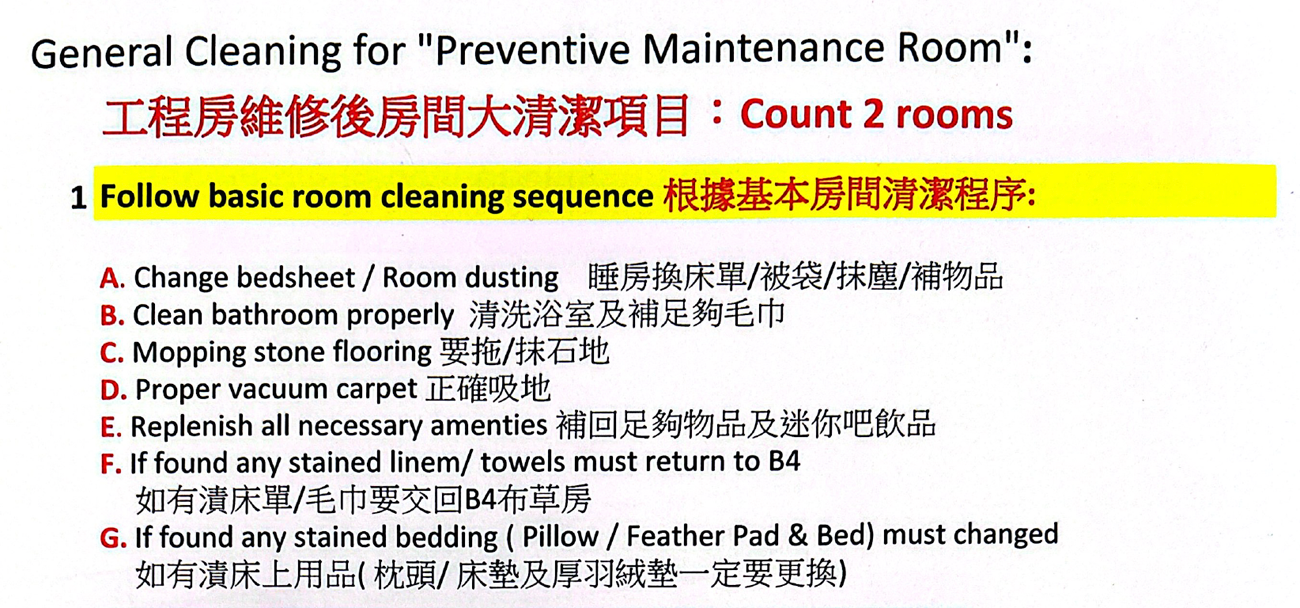
Extract (1) is an example of discourse about hotel work, as Hannah articulates what is often for her merely embodied and not verbalised. Here, she discursively defends the value/skill of her work, claiming that it is “not that simple” (line 1). Elaborating on the standard procedures of housekeeping, she stresses that all staff members must learn how each task is done, thus revealing the tightly regulated, supervised nature of hotel work. This point is further supported by the step-by-step cleaning instructions issued to housekeepers in Figure 2.
Housekeeping guidelines for Hotel Pearl’s room attendants.

These guidelines exemplify the ‘documentary regimes’ that underwrite how waste/dirt is managed behind the scenes. According to Cavanaugh (Reference Cavanaugh2016, 2022), these are written forms of institutional documents and regulatory texts that prefigure work practices. In Figure 2, the lexical repetition of “proper/ly” (e.g. “clean [the] bathroom properly”, “proper[ly] vacuum [the] carpet”) reflects institutional expectations of cleanliness, however semantically vague the word ‘proper’ is. This ambiguity requires workers to engage in the kind of interpretive, gap-filling work that Cicourel (Reference Cicourel1985) identifies as central to how institutional texts function in practice. Of particular interest is line F, which instructs workers to return all stained linen to the storage room. Despite the common stigmatisation of laundry work as ‘unskilled’ and ‘language-less’, the act of removing linen materialises linguistic instructions and protocols delivered to staff a priori. Language and communication thus remain crucial in negotiating and redrawing boundaries between ‘clean’ and ‘soiled’.
Beyond the basic clean/dirty binary, extract (1) reveals a finer distinction between light-soil and heavy-soil items, the latter of which require special treatment. Hannah’s use of evaluative language such as “too soiled” (line 3) reveals a visual register of value, where cleanliness is less about infection control or eradication of germs than the absence of stains, which serves as a key indicator of the hotel’s quality of care (Buse, Twigg, Nettleton, & Martin Reference Buse, Twigg, Nettleton and Martin2018). A single speck of blood on a pillowcase already upsets the orderly appearance Hotel Pearl strives to achieve: It is instantly flagged as substandard and disruptive to luxury imaginaries—or, as Hannah puts it, “troublesome” (line 5) for staff, as it risks offending managerial expectations and triggering guest complaints. Later in the interview, Hannah also listed other intimate traces of dirt like stray hairs, bodily grease, urine, sweat, makeup, and vomit—some of which can be washed easily, others less so.
Hannah’s insistence that stained items be handled separately reframes cleanliness as closely tied to the color white—a visual measure of hygiene and order—and dirtiness (often black) as its chromatic opposite. That hotel linen is invariably white is no coincidence: Whiteness serves as an aesthetic ideal that makes filth immediately noticeable; as Hannah reflects, stains “stand out against the white fabric” (lines 2–3). Here, she reinforces an ideological regime where whiteness equates with cleanliness and luxury (Thurlow & Jaworski Reference Thurlow, Jaworski, Birtchnell and Caletrío2014). On that score, Dyer (Reference Dyer1997) famously critiques whiteness as a technological artefact connected to racial ideologies: Whether as a hue or a skin color category, white is characteristically constructed as unmarked, default, and superior. Echoing Douglas (1966/Reference Douglas2002), this clean/dirty dualism carries moral-cum-religious undertones, positioning whiteness as virtuous while equating dirt with danger, deviance, or uncivilised ways of being.
The symbolic value of whiteness underpins institutional pressures for producing stain-free laundry. Here, whiteness becomes a semiotic resource through which hotels distinguish themselves from competitors but also make their guests feel distinguished and exceptional (Thurlow Reference Thurlow2020a,c). Within this cultural framework, crisp white laundry functions as an enregistered indexical (Agha Reference Agha2007), signifying social status and ‘good taste’ (Bourdieu Reference Bourdieu1984). As Gal (Reference Gal2017) notes, the qualities presumed to reside in objects are transposed onto users: To look refined and “truly clean” (line 4), the items with which guests come into contact must be spotless, with dirt visibly expunged. White laundry thus becomes a performance for stylising eliteness, anchored in moral codes of self-presentation.
I return to a more robust discussion of whiteness in Stage 2, but while visual assessment plays a prominent role in evaluating cleanliness, it is by no means the only sense at work. Social actors not only look at laundry items; they touch and feel them in different ways. Extract (2) surfaces the tactile condition of softness and thickness as another value register; this is also where I reengage the notion of qualia in-depth.
(2) Katie, a room attendant, Hotel Jade
1 We rely on texture to make judgments, feeling each towel one by one. New towels
2 should feel plump, resilient to the touch, and soft to the skin. But after extended use,
3 they feel thinner and rougher—really, it’s an issue of thickness. Just compare it to
4 this one [invites me to touch it]: the elasticity is no longer there. That’s why we rely more
5 on touch than sight; sometimes you just can’t tell by eye alone. It really comes down
6 to experience: The more you touch it, the more familiar you are with the standard.
What is key in extract (2) is the proliferation of ‘qualic’ evaluations (Graber Reference Graber2023). From the outset, Katie underscores the semiotic potential of texture. Where words fall short in describing the tactile sensations of towels, she invites me to touch an old sample and compare it with a new one (line 4). This interaction culminates in her remark that housekeepers “rely more on touch than sight” (lines 4–5). It becomes clear that language and sight, while commonly celebrated as the preferred modes of communication and perception, are sometimes insufficient for judging cleanliness. As it happens, the limits of vision and the importance of touch is also a recurring rhetoric in extract (3).
Returning to extract (2), two tactile markers are at work. The first is thickness or fluffiness: New towels are described as thick and “plump” (line 2), while used towels “feel thinner” (line 3). Paired with thickness is the condition of softness: Whereas new towels are “resilient to the touch” and “soft to the skin” (line 2), used towels are markedly “rougher” (line 3). The repeated use of the verb “feel”—along with Katie’s inviting me to physically touch the towel—points to the inseparability of touching and feeling. These tactile assessments capture Sedgwick’s (Reference Sedgwick2003) point about felt, bodily dimensions of experience emerging as core models of subjectivity. The evaluative actions in this extract also confirm Thurlow’s (Reference Thurlow2020a,Reference Thurlowc) argument that touch is unavoidably tied to affective judgements: A towel must feel clean for a guest to feel good (about themselves); by the same token, this unique feeling of comfort and distinction is generated through its material-tactile qualities.
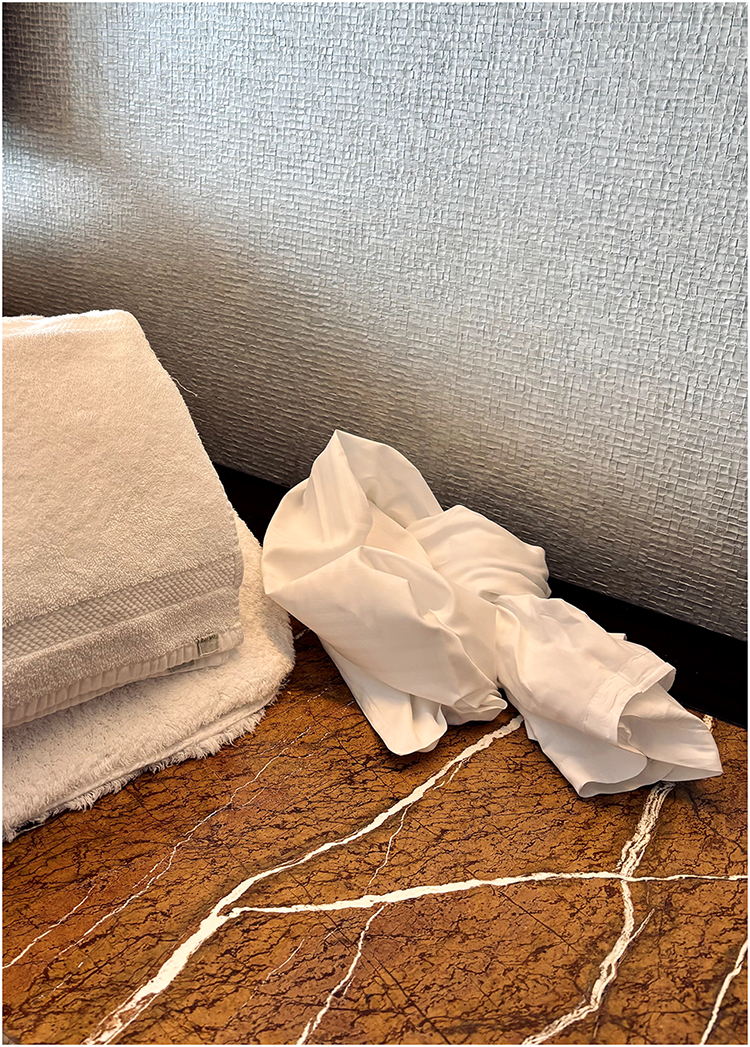
Later in lines 5–6, Katie suggests that their work comes with practice. Room attendants do not rely on visual cues alone when inspecting linen; each item is treated with practiced hands as they plunge their hands into the fabric. These tactile engagements tap into embodied modes of doing, honed through years of repetitive handling. In this way, expertise hinges on a form of foreknowledge or sensory reasoning that is rooted in sensitivity to each item’s qualic biography; this also means that workers’ evaluations are shaped by particular ways of feeling and sustained by routine work practices. These practices, as I observed, often take the form of small-scale, micro actions—some as unremarkable as tying a knot, as shown in Figure 3.
The signature knot as a visual-material marker of dirt.

Upon detecting an almost imperceptible stain on a pillow cover, Katie swiftly tied it into a knot and tossed it aside to signal that the item needs an extra wash. Momentarily devalued, the knot governs the spatiotemporal movement of linen, ensuring that only clean objects remain in circulation. By alerting colleagues that the pillow cover must be rerouted, room attendants participate in a coded form of internal communication. In Norris’ (Reference Norris2004) terms, this signature knot constitutes a ‘frozen action’—an action embedded in the material object that continues to carry meaning to the present and beyond, even in the physical absence of the sign-/knot-maker. As both communicative practice and material artefact, the knot ‘speaks’ of instructions prescribed and imparted to workers through training sessions or internal work documents (recall Figure 2). While room attendants are expected to enact valuation in a quiet, wordless, and embodied manner, they are nonetheless taught in advance—verbally or textually—on how to carry out tasks of categorisation.
Based on the above, the value of any laundry item does not reside solely in its physical properties, but in the labour that legitimises, reactivates, and at times withholds its status as a luxury object. As workers navigate multiple value registers (e.g. visual, tactile, embodied), language strategically comes and goes. Sometimes, it is foregrounded in workers’ verbal accounts (e.g. interviews) and in textualised practices (e.g. the documentary regimes in Figure 2); at other times, words surface in more implicit forms (such as the frozen action of a knot) or are altogether absent, obscured by the solitude of backstage work. As it happens, room attendants often work in lonely silence simply because there is no one to speak to. The semiotics of verbal silence (Thurlow & Jaworski Reference Thurlow and Jaworski2012; Thurlow Reference Thurlow2024) resurfaces again in laundry factories, to which I now turn.
Stage 2: Silent work and human-machine interactions in laundry plants
Stepping out of hotel room confines, I now focus on spaces where the bulk of laundering unfolds. This marks the stage where the interplay of human and more-than-human actors becomes salient; it is also when laundry work emerges most prominently as a semiotic assemblage. Informed by a posthumanist angle (Pennycook Reference Pennycook, Burkette and Warhol2021), I regard laundry plants as settings where language is occasionally centred but often peripheralised vis-à-vis the machine automations and embodied work tasks at hand (Thurlow Reference Thurlow2024). As such, the value of laundry is not exclusively connected to the material per se, but co-produced by an intricate network of human skills, technological instruments, and infrastructural arrangements.
Once soiled laundry reaches the lift loading area, housekeepers preliminarily sort items, separating sheets from towels. At Hotel Jade, soiled towels descend through a chute into an in-house laundry workshop (while sheets are outsourced). At Hotel Pearl, all laundry is stored in the basement to be collected by Crystal Linen Services. Regardless of the route taken, items arrive in a laundry plant, where the inexorable whirring of machines is the only noise to be heard. The contrast in soundscapes is blatant: Whereas hotel rooms are marked by lonely silence, with the unspoken expectation that they be completely controlled and seamless; the workhouse is engulfed by deafening sounds. This makes for what Thurlow (Reference Thurlow2024:22) terms ‘noisy silence’—sound without speech. The unyielding churning of heavy machinery drowns out any possibility of conversation, reducing talk to eye contact or nonverbal gestures of pointing. This apparent ‘wordlessness’ is compounded by the plant’s spatial organisation: Task are confined to designated zones, with workstations segregated from one another. Such a (non)communicative environment exemplifies the Taylorist principle of suppressing speech to enhance productivity (Boutet Reference Boutet2001, Reference Boutet2008). But unlike traditional factory work where supervisors explicitly discipline linguistic behaviour—as in studies of call-centre scripting (Cameron Reference Cameron2000; Duchêne Reference Duchêne2009)—silence here is imposed not by authority but by necessity. In this way, workplace communication is structured not just through verbal talk but equally through its organised absence (Philips Reference Philips, Tannen and Saville-Troike1985).
While initial sorting is done in Hotel Pearl, a more extensive round of categorisation begins once soiled items arrive at the contracted plant. Soiled laundry carts—each labelled with a QR identification code and table chart recording quantities (cf. Cavanaugh Reference Cavanaugh2016 on ‘documentary regimes’)—are scanned before items are sorted by size and linen type. This digital documentation procedure is crucial for devising standardised washing formulas, all managed through a centralised data system. From hotel room to machine, the same work design holds: Pathways of soiled laundry are strictly demarcated from that of clean laundry, a task that is streamlined through technologies of barcode scanning. The plant’s spatial-semiotic arrangement thus evidences the forms of more-than-human support in value creation. As Ibert, Hess, Kleibert, Müller, & Power (Reference Ibert, Hess, Kleibert and Müller2019:44) argue, value is ‘the outcome of proactive and strategic relational work’; here, the word ‘relational’ presupposes the multiple spatialities and practicalities of labour which collectively inform what it means for laundry to be clean.
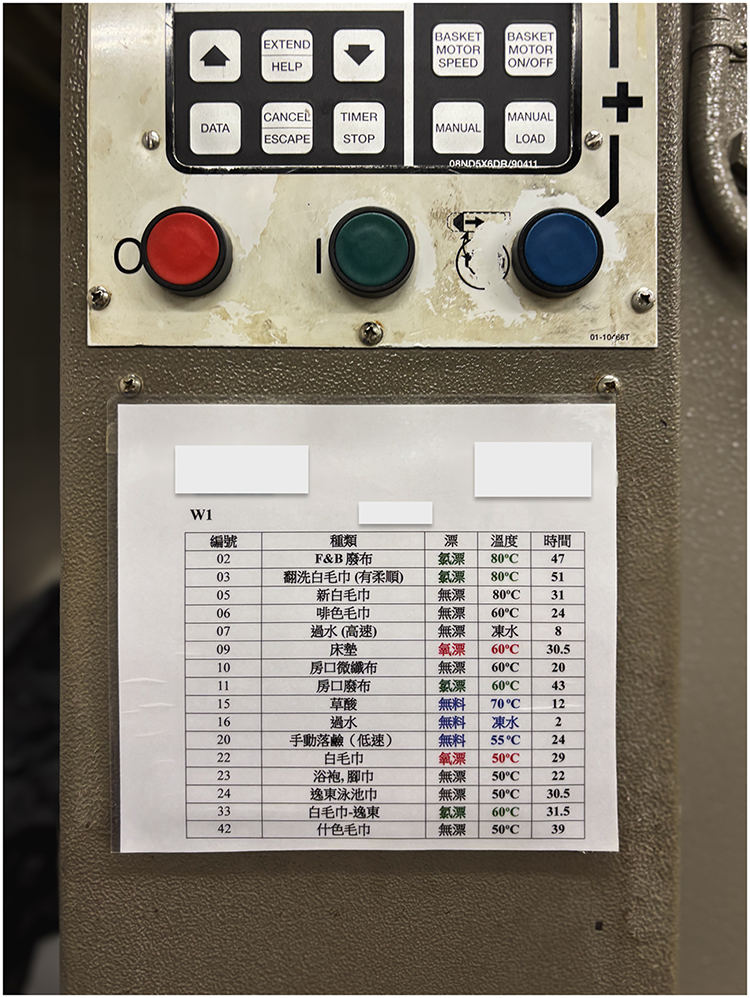
Categorised items are then fed into bulky 250-pound washing machines, with detergent automatically dispensed from a centralised pumper. The sticker label beneath the control panel (Figure 4) outlines specific washing formulas to which different towels are subjected, each varying in bleach type, solvent use, temperature, and wash duration. Though ostensibly banal, these numbers are critical, for the overuse of chemicals may compromise linen health and leave harmful residues. As another example of documentary regimes governing work practices (Cavanaugh Reference Cavanaugh2016), the laminated chart illustrates how language surfaces intermittently in the form of written instructions to regulate labour (cf. Boutet Reference Boutet2001 on washroom cleaning forms as Taylorist tools of regimentation). Clearly, though, words also recede in the face of computerised systems, conveyor belts, and data-driven algorithms. Following Hovens (Reference Hovens2023) who highlights the material affordances of machines in blue-collar workplaces, technologies play an agentive role in washing operations to reduce work injuries and manmade errors. As such, laundry work is fulfilled by a host of bodies, machines, and energy-intensive processes; this also implies that value production is dispersed across a plurality of modes and actants (Heuts & Mol Reference Heuts and Mol2013; cf. Latour Reference Latour2005).
A washing formula chart affixed to the front panel of a washing machine.

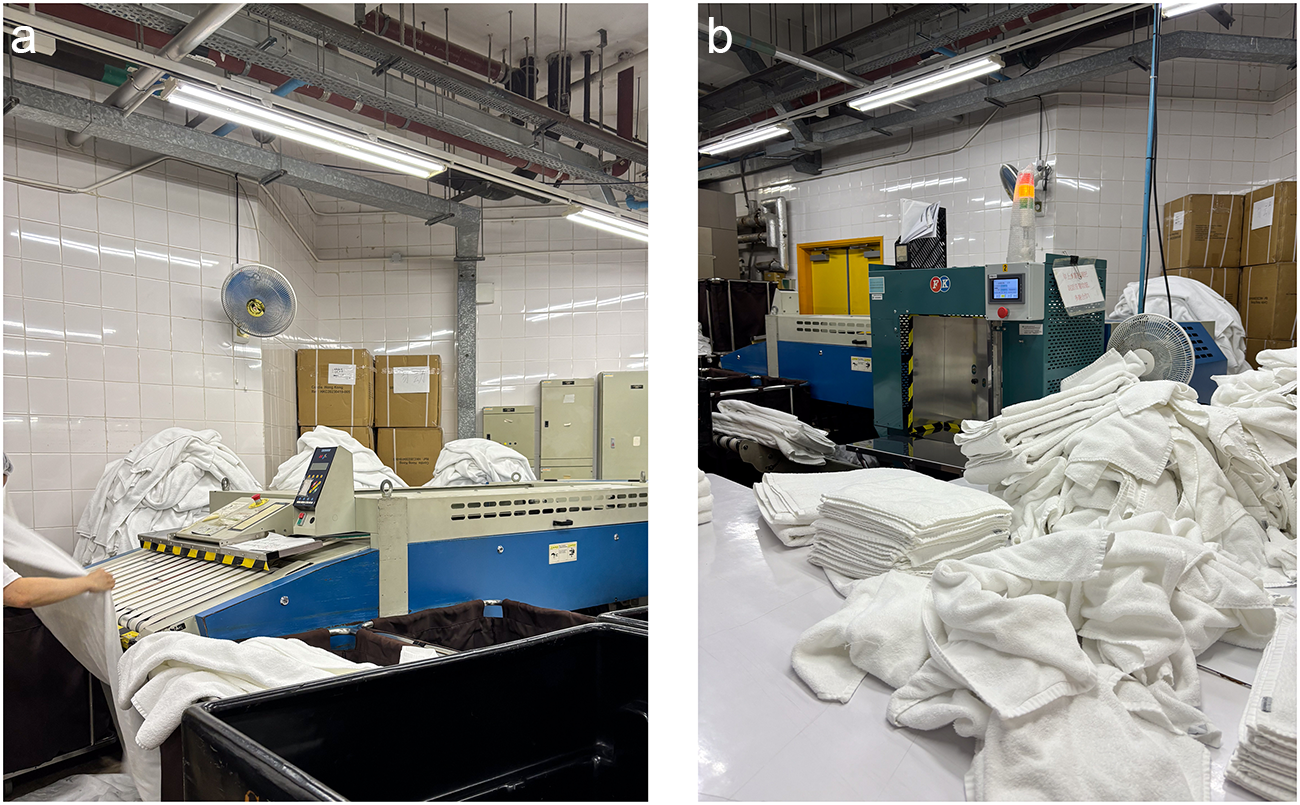
After washing, items are put in drying machines which utilise hot air to remove moisture. Immediately after, cool air is applied to lower the temperature of fibres—a crucial step for restoring fluffiness and producing a smooth finish. This heating-cooling process certainly feeds into the mechanical production of qualia, but returning to value as my analytical focus, I examine the next stage of folding, drawing on Figure 5 for illustration.
Towel folding station in Hotel Jade’s laundry workhouse.

In Figure 5a, large towels of thirty-six inches by seventy inches are folded by an automatic towel folding machine, operated by one worker at the time of observation. The machine serves as a prosthesis that ‘extends and augments human capabilities’ (Bucholtz & Hall Reference Bucholtz, Hall and Coupland2016:188), pointing once again to the busy interdependence between labouring bodies and technologies. On the contrary, smaller hand towels are folded manually (Figure 5b) by workers clad in uniforms, hair nets, gloves, and shoe covers (akin to the hygiene standards in food production industries described by Cavanaugh (Reference Cavanaugh2016)). Here, workers draw on their tactile expertise to detect stains, tears, and other flaws beyond a machine’s capacity. Again, folding might look like less of a word-based assessment than a multisensory judgement; nonetheless, it is shaped by work conventions established and communicated at an earlier time. Like the knot-tying task in Stage 1, this procedure requires workers to rely on tacit, embodied knowledge to supplement what the formal instructions leave unspecified (cf. Cicourel Reference Cicourel1985).
Beyond manual checks during folding, Hotel Jade conducts additional quality control tests. It is here that I revisit the ideological implications of whiteness as an evaluative marker.
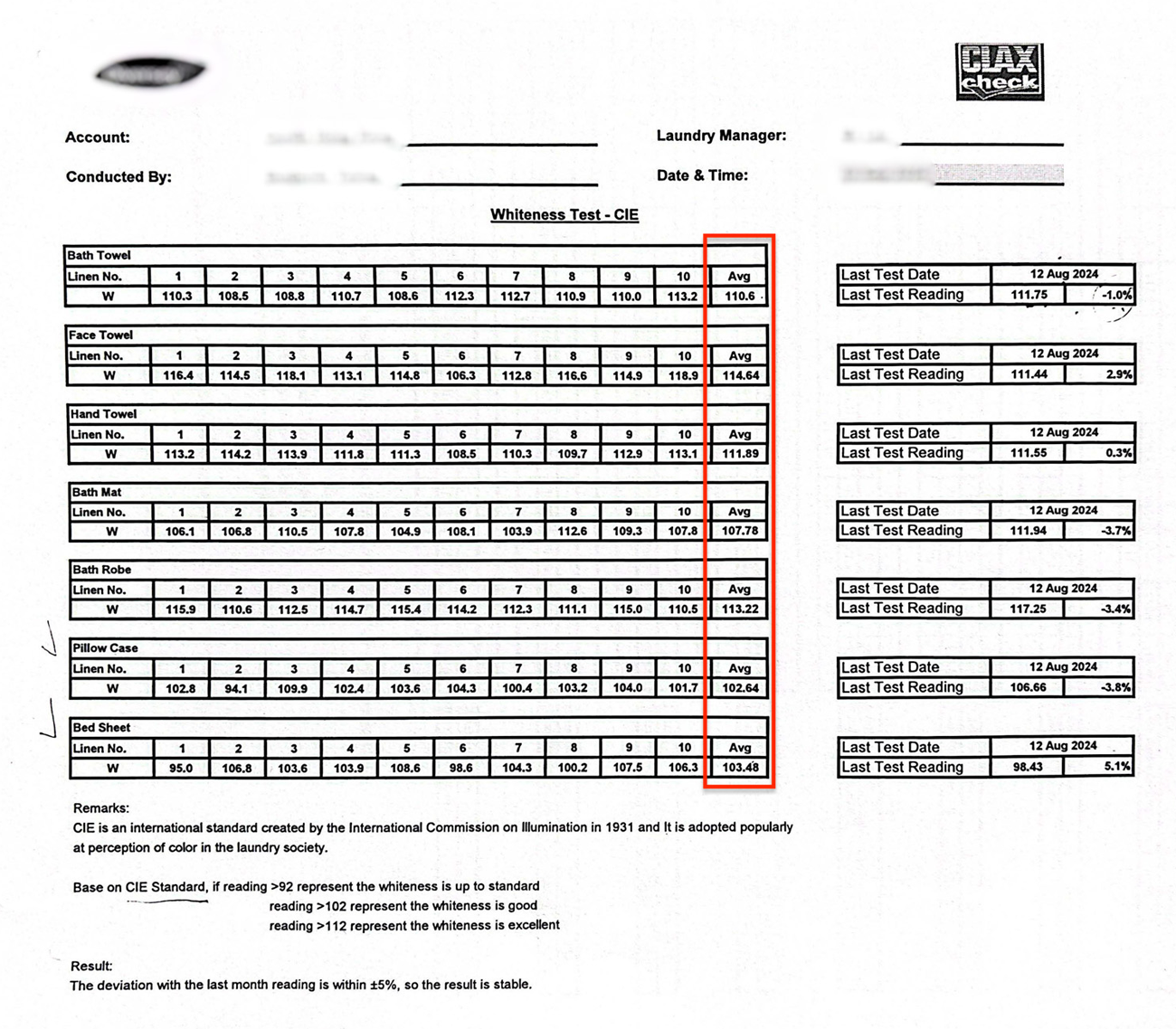
Figure 6 shows the results of a final quality assurance mechanism known as the CIE (Commission Internationale de l’Éclairage) Whiteness Index—a standardised numerical scale adopted in textile industries to assess whiteness under controlled lighting conditions. Inspectors from the chemical supplier use a camera-like device to scan selected items and capture reflected light, then convert each measurement into a score that quantifies how close the colour is to a ‘perfect white’. As the scientific report in Figure 6 shows, ten samples are randomly selected from each linen category. A score of ninety-two or above constitutes a pass, while 112 or above is considered ‘excellent’. The ten scores are then averaged, yielding the final figure (circled in red). Any items that fall below the numerical standard are sent for spot treatment or an additional wash. In extract (3), Joe unpacks the rationale behind this test.
(3) Joe, laundry manager, Hotel Jade
1 We can’t simply rely on our eyes; what looks white to one person might not to
2 another. That’s why we follow international standards and rely on data to ensure
3 consistency: Whiteness can’t be reliably judged by the naked eye.
Whiteness test sample results generated by Hotel Jade’s chemical supplier.

Joe’s opening statement in line 1 and his final comment in line 3 acknowledge the limits of human vision as the primary mode of sensing or knowing. In doing so, he situates laundry work within a broader socio-technical system where numeric data supersedes human perception in the name of consistency. It becomes clear that the assemblage of laundry work encompasses not only human actors and machines, but ‘infrastructural technologies’ (Easterling Reference Easterling2014:11) that formalise, rationalise, and gatekeep what is coherent with luxury. Through precise quantification, the index serves as a form of institutional expertise to ensure product quality, foster customer trust, and lend credibility to the hotel’s five-star branding. In this sense, whiteness/cleanliness is not merely a visual effect, but an institutional outcome controlled by surveillance mechanisms; this also means that the production of luxury and value is always ‘suffused with traces of political and social work’ (Bowker & Star Reference Bowker and Star1999:49).
Contrary to Joe’s claims about its objectivity and transparency, this technical method of measuring whiteness inevitably reproduces and obscures broader ideologies of power. Specifically, the whiteness control mechanism exemplifies two overlapping value regimes. For one, it reflects a raw political economy of value, in which neoliberal audit cultures monitor production cycles and perpetuate circulatory capitalist logics (Cavanaugh Reference Cavanaugh2016). More than that, it also exposes a symbolic economy of value, where semiotic markers of whiteness map onto ideologies of class and privilege. As Duranti (Reference Duranti1997:ch. 3) notes, languages often segment the colour spectrum in ways that privilege white over more differentiated terms. This hierarchy extends into industrial colour technologies like Kodak’s Munsell System which, while designed to be an objective classificatory scheme, is historically calibrated against white skin. From racial norms to linguistic categories and technical metrics, whiteness emerges as an unstable, slippery category—one that derives its hegemonic power from its presumed neutrality and invisibility (Dyer Reference Dyer1997).
To recap the main points of this section, laundry work operates as a semiotic aggregate across bodies and other more-than-human instruments. Further, the qualia of whiteness are semiotically achieved through an institutional formulation that sanctions how clean laundry comes to be produced and experienced. Like Stage 1, words occasionally come to the fore in moments of work disciplining (e.g. the washing machine label in Figure 4); but throughout the laundering process, it is predominantly other discursive technologies (e.g. colour) and embodied infrastructures (e.g. machines) that regulate the dissemination of value. Having traced how value is semiotically constructed, I now transition to the ‘afterlife’ of linen, where value is destroyed and concomitantly reconstituted.
Stage 3: The dis/assembling and re/valuing of ‘condemned’ linen
As indicated, stained linen is sent back to laundries for an extra wash, but if they remain flawed after two rounds of rewash, they are condemned.Footnote 4 Interestingly, ‘condemnation’ refers not to outright disposal, but an indeterminate condition displaced and reinvented in/through processes of devaluing and revaluing (Thompson 1979/Reference Thompson2017). Condemned items thus linger in a strange, ambivalent status of ‘trash-to-be’ or what Hird (Reference Hird2012:454) calls ‘twilight zone’, where their function as luxury objects is suspended in limbo. In this final section, I examine how condemned linen redeems new forms of utilitarian value for working-class communities. This process of revaluation hinges on a series of dis/assembling practices (Greeson et al. Reference Greeson, Laser and Pyyhtinen2020), as extract (4) shows.
(4) Tracy, a room attendant, Hotel Pearl
1 If a towel still appears shabby after washing, we rewash it. If it remains worn even after
2 that, we condemn it. But we don’t just throw these condemned pieces away. Instead,
3 we cut them into smaller pieces and mark them with a stitch to prevent guest use. Only
4 when a cloth has truly reached the end of its life—completely worn out, torn, or
5 mouldy—do we discard it entirely. There’s no need to waste it; we can still use its
6 remaining course of life to the fullest.
Apart from recurring qualic markers like dirtiness/stains and whiteness, Tracy points to the ‘wornness’ of linen as another manifestation of qualia, describing condemned towels as “shabby” (line 1) and “torn” (line 4). The word “mouldy” in line 5 also suggests dullness/brightness as another axis of qualic evaluation (see extract (5) for more evidence). Further, in line 3, Tracy emphasises that workers don’t just discard these condemned pieces but repurpose them for cleaning. Even when disposal occurs, it is justified in pursuit of a cleaner, ‘better’ future. This discursive effort to brand the hotel as ‘green’ reappears again in line 5 (“there’s no need to waste it”). In this way, Tracy reframes ‘condemnation’ practices as acts of sustainable recovery, positioning Hotel Pearl within a zero-waste circular economy and by extension, a ‘green and guilt-free imaginary’ (Kalina Reference Kalina2020:5).
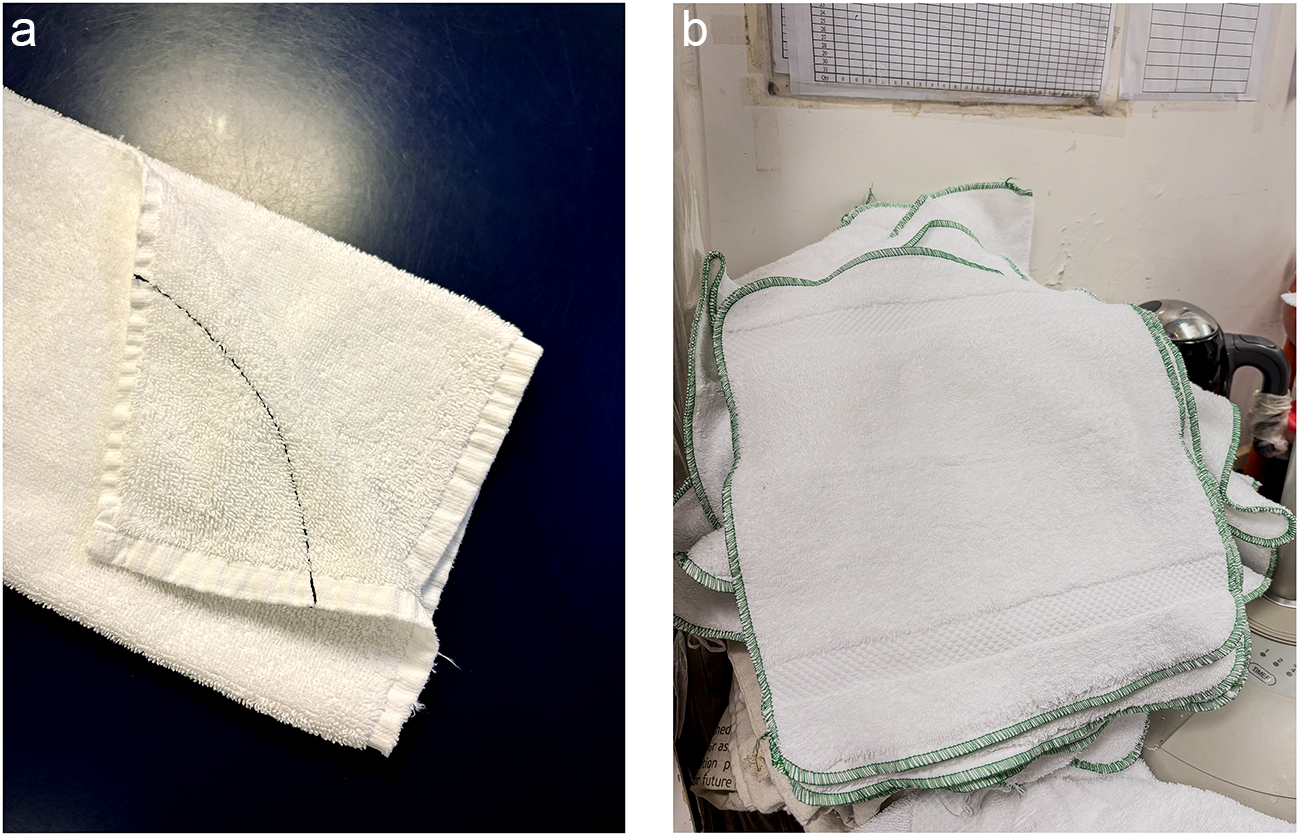
Within this careful framing of sustainability, Tracy describes how value transformation begins with small, performative acts of material deformation. To reconfigure condemned linen into new, functional forms, staff in the uniform and linen room cut them into pieces and sew coloured lines for easy identification. This work is one of productive destruction, echoing Greeson and colleagues’ (Reference Greeson, Laser and Pyyhtinen2020) observation that the (re)assembly of valuable entities necessarily entails the unbecoming of something else. Simply put, things must be dismantled before they are refashioned. Figure 7 serves as visual evidence of these linen fragments as they are reinserted into alternative circuits of work and use.
Samples of condemned towels with different embroideries.

As a visual-material practice, each hotel employs a distinct branded embroidery style to mark towels designated for internal use: Figure 7a features a curved line stitched into the insides of a condemned towel, while Figure 7b depicts a stack of condemned towels marked by green hems to indicate housekeeping use. Demoted in status but not fully discardable, these towels depart from assumptions of linen as stable commodities, interrupting the one-way, linear chain of production-consumption-disposal (Stanes Reference Stanes, Allon, Barcan and Eddison-Cogan2021). The value of these towels is literally regenerated through holes, fissures, and breakages—not as signs of decay, but opportunities for renewed purpose.
Building on this point, I conclude by underlining the fragile, unstable value of towels—a theme that comes through most powerfully in extract (5).
(5) Joe, laundry manager, Hotel Jade
1 Joe: Every towel comes with a ‘birth certificate’—a tag that states the
2 purchase year and month, so we can keep track of its lifespan.
3 Researcher: How do you decide which towels are still usable or not?
4 Joe:The year of purchase is a factor, but not the main one. A towel’s
5 condition starts deteriorating after nine months, so we use that as a
6 reference. But more important is its current state—whether it’s still
7 white, soft, and thick. Just look at this: The threads are coming apart,
8 and edges are fraying. You can feel it just by touching it. … Since
9 chlorine use speeds up damage, these cotton towels don’t last long.
10 Typically after eighty washes, they’re rough and worn. As fibres break
11 down and terry loops loosen; towels feel thinner, duller, and lose their
12 sheen. Once this happens, they feel ‘dead’ to guests and don’t look
13 good anymore. If a towel turns yellowish or grey, we immediately pull
14 it out—it’s unacceptable in the service industry, at least in this hotel.
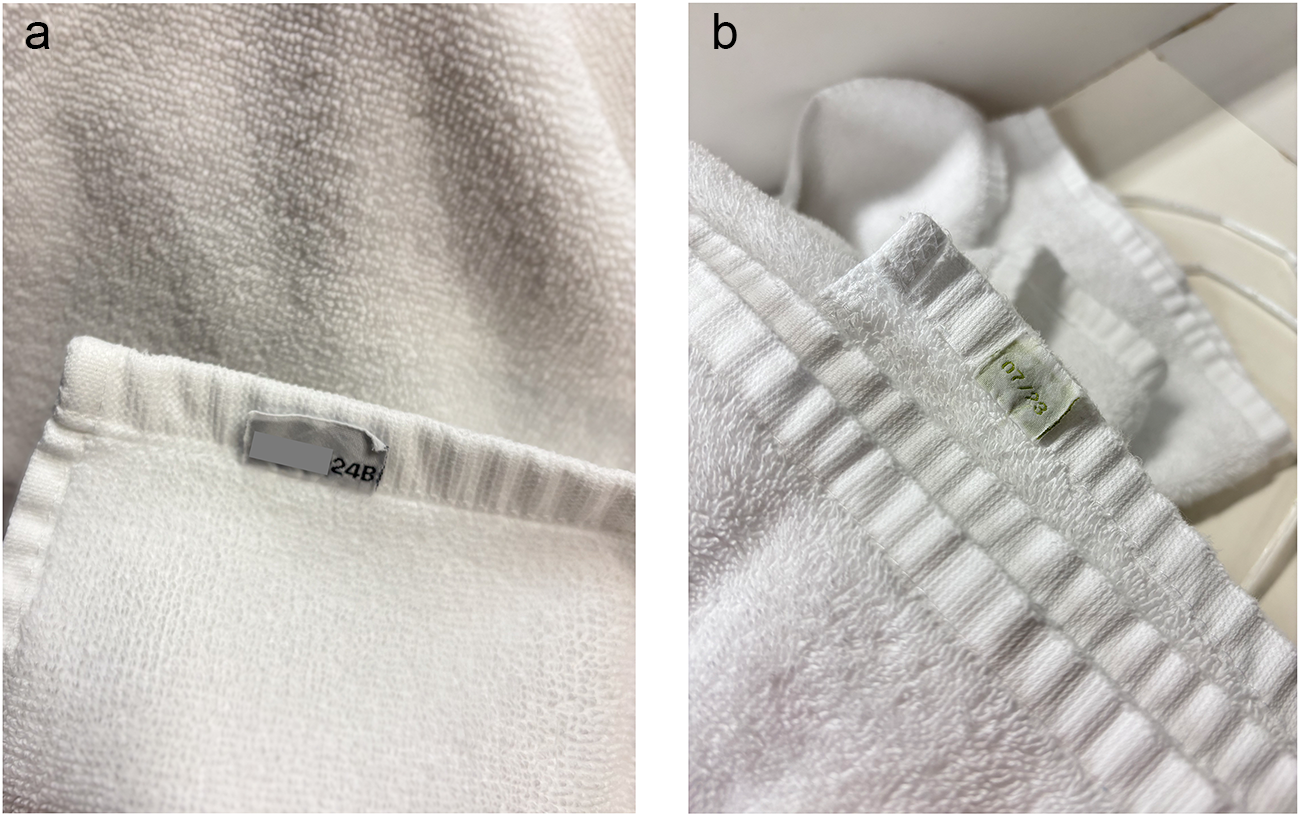
Among the many rich details in extract (5), Joe first introduces time and temporality as a new value register. Echoing the QR-coded laundry carts in Stage 2, he refers to a ‘birth certificate’ assigned to each towel (Figure 8). This is another example of how documentary regimes chart and regulate the biographies of laundry, comparable to sell-by dates on food packaging (Cavanaugh Reference Cavanaugh2016). Since a towel’s condition usually declines after nine months (lines 4–5), the recorded purchase month/year on the tag serves as a temporal tracking device. The entropic passage of time becomes a metric of serviceability, with age taken as an index of a towel’s proximity to being ‘condemned’. In this way, the biographies of laundry are mapped not just spatially but temporally.
Respective ‘birth certificates’ of towels at Hotel Jade and Hotel Pearl.

Further, as with earlier evaluations, Joe draws attention to the qualia (Graber Reference Graber2023) of condemned towels. These include regular mentions of whiteness or its lack thereof (“yellowish or grey”, line 13), along with appeals to thickness (“feel thinner”, line 11), softness (“rough”, line 10), and dullness (“duller”, “[lost] their sheen”, lines 11–12). These assessments are punctuated by references to wear and tear: “threads are coming apart” and “fraying” (lines 7–8), with “fibres break[ing] down” and “terry loops loosen[ing]” (lines 10–11). Such discursive contrasts (new/old, fresh/frayed, thick/thin) exemplify how laundry work plays endlessly with sensory properties. As in extract (2), the co-occurrence of touch and feel (“You can feel it just by touching it”, line 8) illustrates how tactility is tightly implicated in affect (Thurlow Reference Thurlow2020c). A telling instance of this is in line 12, where Joe remarks that old towels “feel ‘dead’ to guests”. Here, a life/death metaphor is alluded to, wherein ‘life’ signals renewal and rebirth of cleanliness, while ‘death’ connotes dirt and irreversible decay (Douglas 1966/Reference Douglas2002). This metaphor is threaded throughout the chain, as staff members speak of a towel’s “lifespan” (line 2), or earlier in extract (4), its “course of life” (line 6).
Based on these observations, my final point concerns how Joe juggles and navigates these value registers when deciding whether a towel should be condemned. While the year of purchase provides a temporal frame of reference for internal operations, it is ultimately the towel’s current material condition that takes precedence, feeding into a value hierarchy where visual, tactile cues outweigh temporal, chronological markers. As Joe notes in lines 13–14, this specific ordering of value registers is driven by the hotel’s core mission to serve. Unlike the purchase date which remains behind the scenes and largely irrelevant or uninteresting to guests, sensory attributes like color and texture are public-facing and instantly perceptible. Any breach of these sensory expectations risks jeopardising the hotel’s aura of opulence, as Joe concludes in line 14: “it’s unacceptable … in this hotel”.
To conclude, the dis- and re-assembling of condemned linen suggests how laundry routes are never neatly bounded (Pink Reference Pink2012:ch. 5). Additionally, practices of material repair and refurbishment expose inequalities embroiled in the value chain (Graber Reference Graber2023). For the privileged few, the consumption of linen is a lifestyle choice; for many others, these objects constitute a practical necessity tied to work survival. Towels whose value is exhausted by guests remain fully functional for workers—their condemnation marking not ‘social death’, but an afterlife with newfound significance. Once representing the height of luxury and pleasure, these items become rudimentary tools that reflect workers’ honest livelihoods built on what others discard.
Conclusion: Decentring waste, recentring work
Thurlow’s (Reference Thurlow2022) call to redress ‘sociolinguistic blind spots’ urges scholars to attend more closely to what remains unsaid and unseen. Hotels, in particular, are sites where luxury is upheld through the ‘invisibilisation’ of labour (Sherman Reference Sherman2007). This article takes up Thurlow’s invitation with a markedly discursive intervention: to show how language and material practice intertwine in enacting or destroying the value of hotel laundry. Underpinning my analysis are two types of discursive sites: (i) discourse about laundry work, where value is linguistically produced; and (ii) discourse in laundry work, where in-situ work practices are observed and analysed to reconstruct the instructional language informing their execution. While the discursive dimension is more apparent in retrospective interviews than in the actual labouring practices that unfold on the ground, in both cases, language and materiality work in tandem to maintain ideologies of cleanliness within contexts of leisure consumption. This is the core argument of the current article.
Specifically, my analysis traces how the qualic biographies of linen items are framed and evaluated across three timespaces. Starting from the hotel room, linen objects are categorised by room attendants, who draw on verbal, visual, and tactile repertoires to construct and contest ideas of cleanliness. Moving to the laundry plant, the value of laundry is co-produced by more-than-human materialities and technologies, with qualic understandings of whiteness/cleanliness being consistently regimented by bureaucratic standards. The third timespace concerns the afterlife of linen, where condemned towels are first disassembled and then revalued as work resources. Throughout these ‘laundry routes’ (Pink Reference Pink2012:ch. 5), this article argues that a linen item’s perceived value (both its monetary price and symbolic worth) is not intrinsic to its physicality, but contingent on the labouring processes that render it fit for guest consumption. It is through such meticulous, incessant work that laundry accrues and retains its status as a luxury object. In this regard, (e)valuation emerges as a joint, relational undertaking, as the social meanings of cleanliness are continuously redefined by workers through everyday interaction and sensory experience.
Returning to the theoretical foundations of this article, the evaluation of laundry reveals a convergence of multiple value registers. These certainly include economic value (in the sense that high-quality laundry is worth more money), but also encompass visual (whiteness), sensory/tactile (softness), aesthetic, temporal, and moral grounds of valuation. These registers are specific evaluative practices that conform to, and are shaped by, three interlocking regimes of value (Frow Reference Frow2007)—which, taken together, complicate the biographies of what might otherwise seem like prosaic objects. The first value regime is political economies of luxury service, concerned with the making and distribution of profit. The second regime lies in symbolic economies of cleanliness, where ‘clean’ (and especially white) laundry serves as a marker of social distinction (Bourdieu Reference Bourdieu1984). These symbolic economies in turn feed into a third value regime—what Ahmed (Reference Ahmed2004) terms ‘affective economies’, in which capital becomes bound up with embodied sensations (e.g. the tactile softness of fabric and visual assurance of whiteness). These affective economies infuse sensory qualities with emotional weight around what feels satisfying and ‘good’—often from the vantage point of elite consumers or their service providers.
Crucially, what feels ‘good’ or ‘valuable’ boils down to perspective, a question of who is looking. Throughout the analysis, commercial laundry is exposed as a site of stratified, multilayered value. For hotel managers, laundry anchors hospitability standards and operates as a source of profit; for guests, it carries aesthetic and moral importance, indexing elite taste and enabling performances of ‘civilised’ identities. For hotel workers, however, its value is purely utilitarian—an opportunity generated from others’ waste that affords them the economic means to survive. This inequality is precisely what Graber (Reference Graber2023) refers to when noting how certain value-meanings readily ‘travel’ across contexts while others remain stagnant. Crucially, the power to define, transfer, and extract value lies disproportionately with the elites. Even when residues of capitalist consumption are revalorised as work tools, the benefits of this added value rarely trickle down to the workers. As O’Brien (Reference O’Brien2012:202) attests: ‘To discard waste … is not to abandon it, divest oneself of it or even throw it away’; it is to relocate, to ‘place it positively in a politically regulated regime that orchestrates who can profit from it’. The same cycle repeats itself: Cleaning more efficiently, only to fuel further consumption—and with it, more kinds of wasting.
Discourse analysts have long recognised language as central to the reproduction of class ideologies and workplace inequalities. However, as Philips (Reference Philips, Tannen and Saville-Troike1985) notes, prescribed silence in contexts like manual labour can also shape interaction as profoundly as speech. This insight reveals the ontological difficulty of drawing boundaries around what is normatively ‘language’ (Thurlow Reference Thurlow2016; Pennycook Reference Pennycook, Burkette and Warhol2021), a difficulty compounded by the epistemological challenge of recognising what is (and is not) communicative about work. These questions are tied to deep-seated communicative conventions that attach unequal values to different semiotic modes, systematically privileging the linguistic over the bodily and affective. This logocentric bias also mirrors what Thurlow (Reference Thurlow2024) critiques as the bourgeois tendencies of sociolinguistics to prioritise analytic attention on explicitly verbal or textual practices, thereby overlooking the rich semiotic potential of other forms of labour. My empirical focus on waste work is precisely an attempt to contest this ideological supremacy of the written/verbal mode, to recentre work practices not conventionally acknowledged as ‘language’.
In hotel laundries, as in many other workplaces, what is naturalised as effortless luxury depends on the tireless labour of ‘wasted humans’ (Bauman 2004/Reference Bauman2021:1–8)—those who sustain the gleaming exteriors of capitalist institutions. This inequality is structured by a stark division between frontstage regimes of visibility (i.e. conspicuous consumers) and backstage regimes of invisibility (i.e. precarious labourers). Beyond the value of things, therefore, this article is equally concerned with the systemic devaluation of people, and our unquestioned acceptance that others will do the work (Alexander & Reno Reference Alexander and Reno2012). In the relentless pursuit of cleanliness and profit, what/who is put at stake? This article extends a call to map more equitable ways of engaging these ‘dirty’ spaces and people, precisely by tracking the ebb and flow of discursive and material practices through which value is assigned, denied, or transformed.
Funding
This article is supported with funding from the Swiss National Science Foundation (SNSF) (Grant No.: # 100015_215102) for the project Articulating Rubbish: A Sociolinguistic Approach to the “Crisis of Waste”.

 Open access

