The origins and development of the Middle Palaeolithic in India are particularly important in the context of debates about the dispersals of modern humans, i.e. the ‘Out-of-Africa’ movement (Bae et al. Reference Bae, Douka and Petraglia2017; Hublin et al. Reference Hublin, Ben-Ncer, Bailey, Freidline, Neubauer, Skinner, Bergmann, Cabec, Benazzi, Harvati and Gunz2017; Brooks et al. Reference Brooks, Yellen, Potts, Behrensmeyer, Deino, Leslie, Ambrose, Ferguson, d'Errico, Zipkin, Whittaker, Post, Veatch, Foecke and Clark2018). Studies show that transitional processes from the Late Acheulian leading to the Indian Middle Palaeolithic began as early as between 385±64 ka and 172±41 ka (Akhilesh et al. Reference Akhilesh, Pappu, Rajapara, Gunnell, Shukla and Singhvi2018), and continued after the Toba volcanic event at ~74 ka (Petraglia et al. Reference Petraglia, Korisettar, Boivin, Clarkson, Ditchfield, Jones, Koshy, Lahr, Oppenheimer, Pyle, Roberts, Schwenninger, Arnold and White2007). It was succeeded by the Late Palaeolithic/microlithic assemblages of India, the earliest dates for which are ~46 ka (Mishra et al. Reference Mishra, Chauhan and Singhvi2013). The Indian Middle Palaeolithic is characterised by small flake tools, the continued production of bifaces, often of small size, and the presence of the Levallois and blade reduction sequences, with preferences for fine-grained quartzites and other siliceous materials (Blinkhorn & Petraglia Reference Blinkhorn and Petraglia2017; Akhilesh et al. Reference Akhilesh, Pappu, Rajapara, Gunnell, Shukla and Singhvi2018). A general lack of studies, however, hampers our knowledge of the Middle Palaeolithic in India.
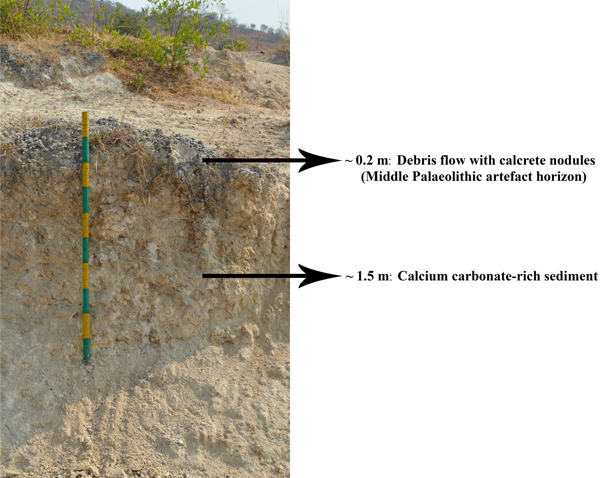
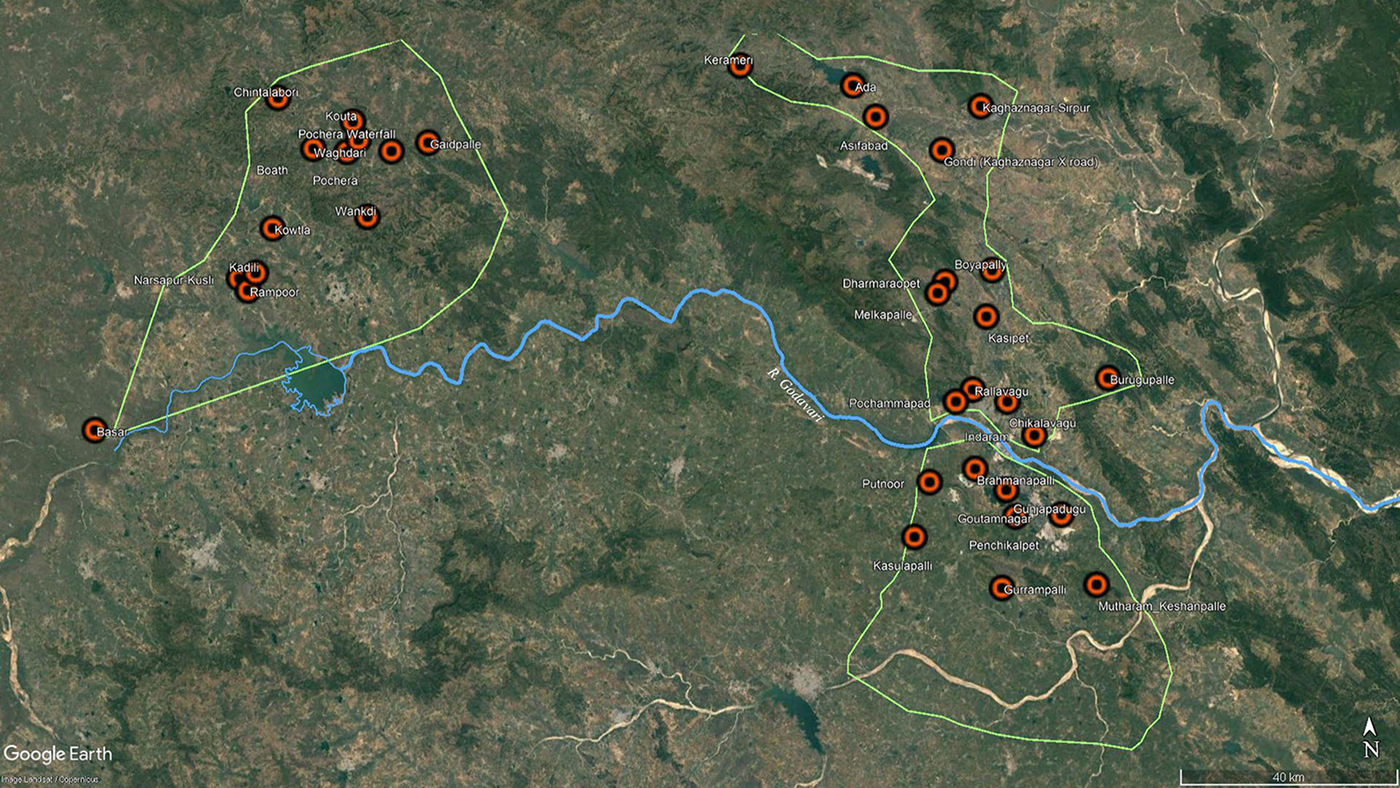
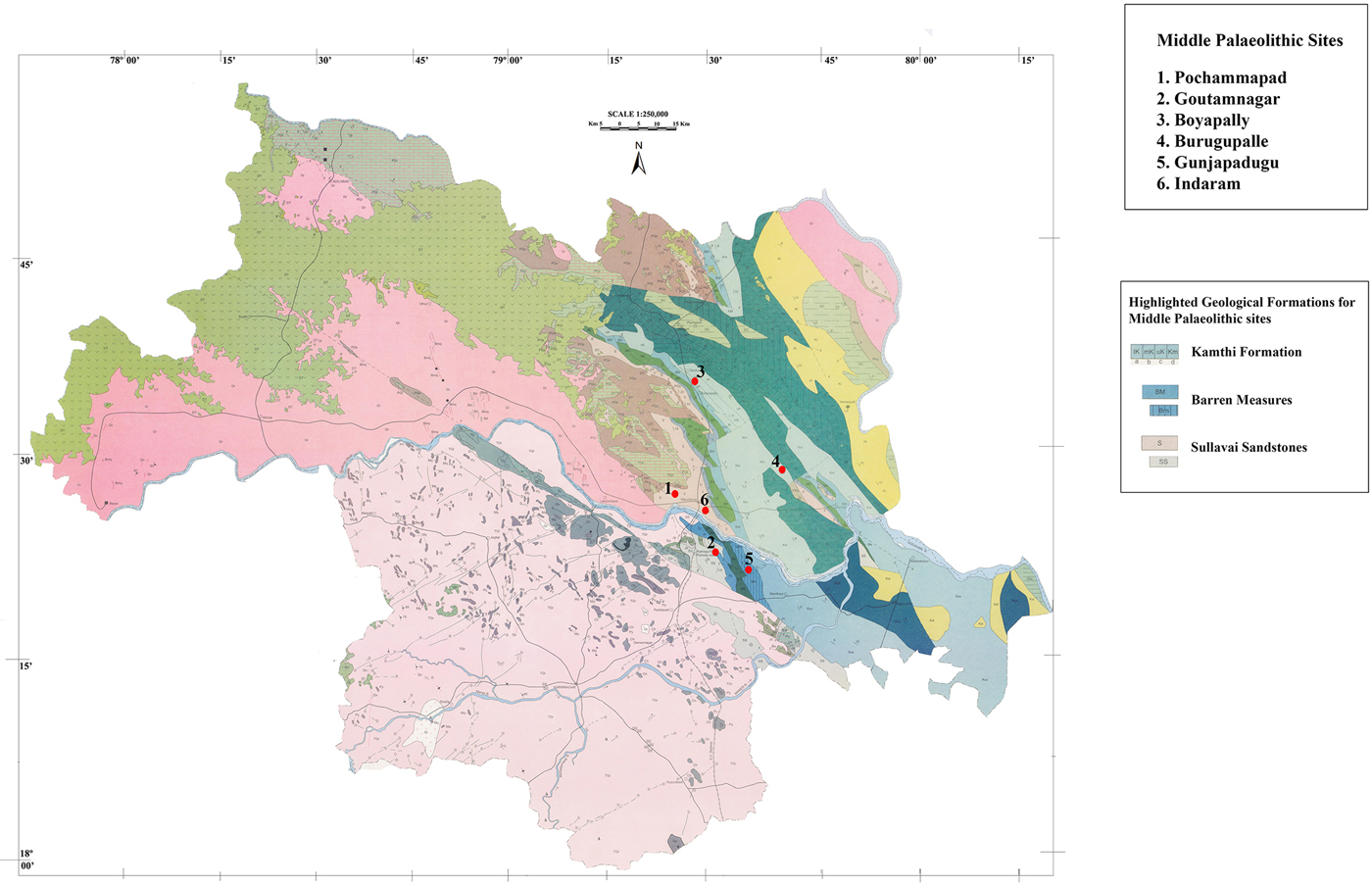
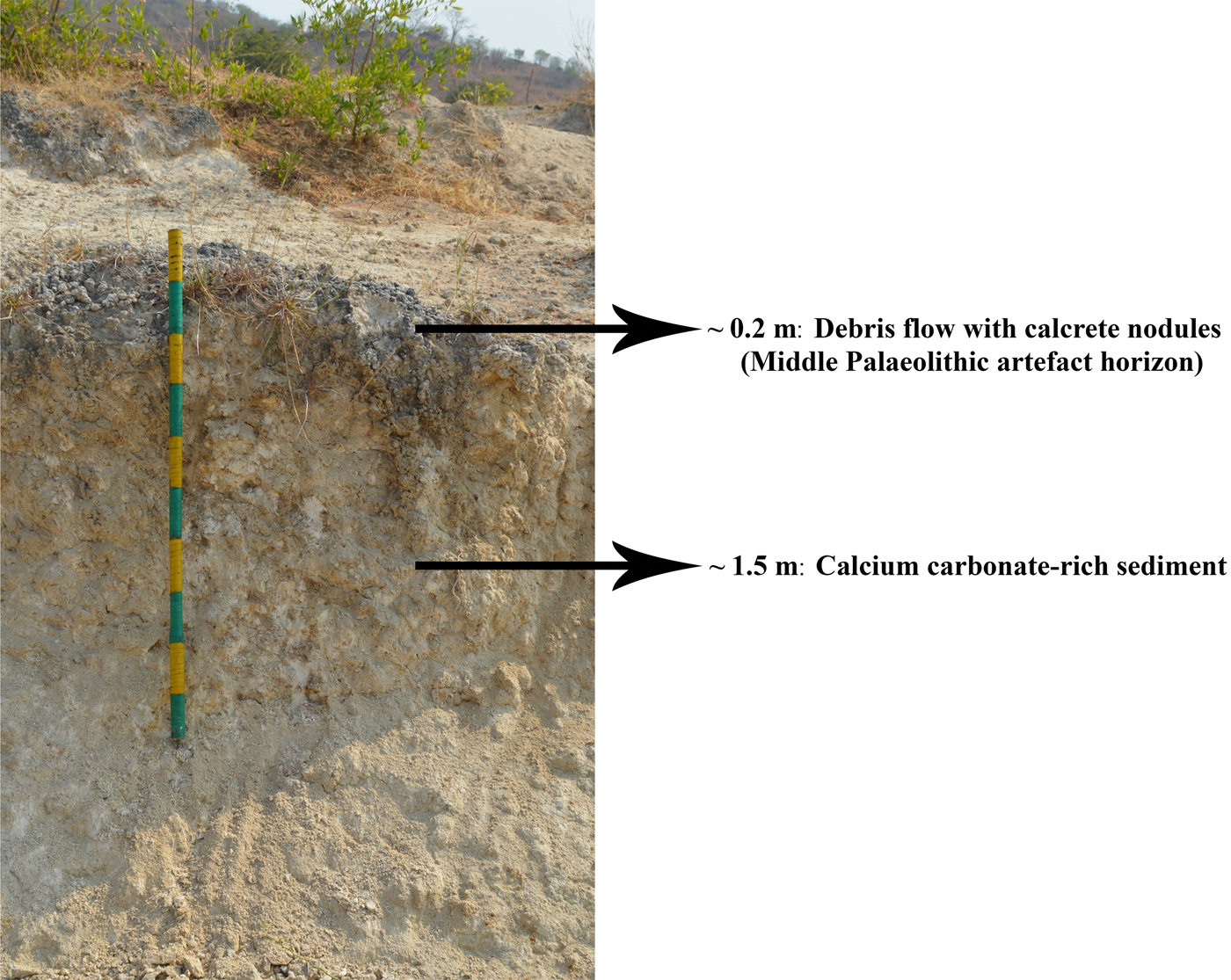
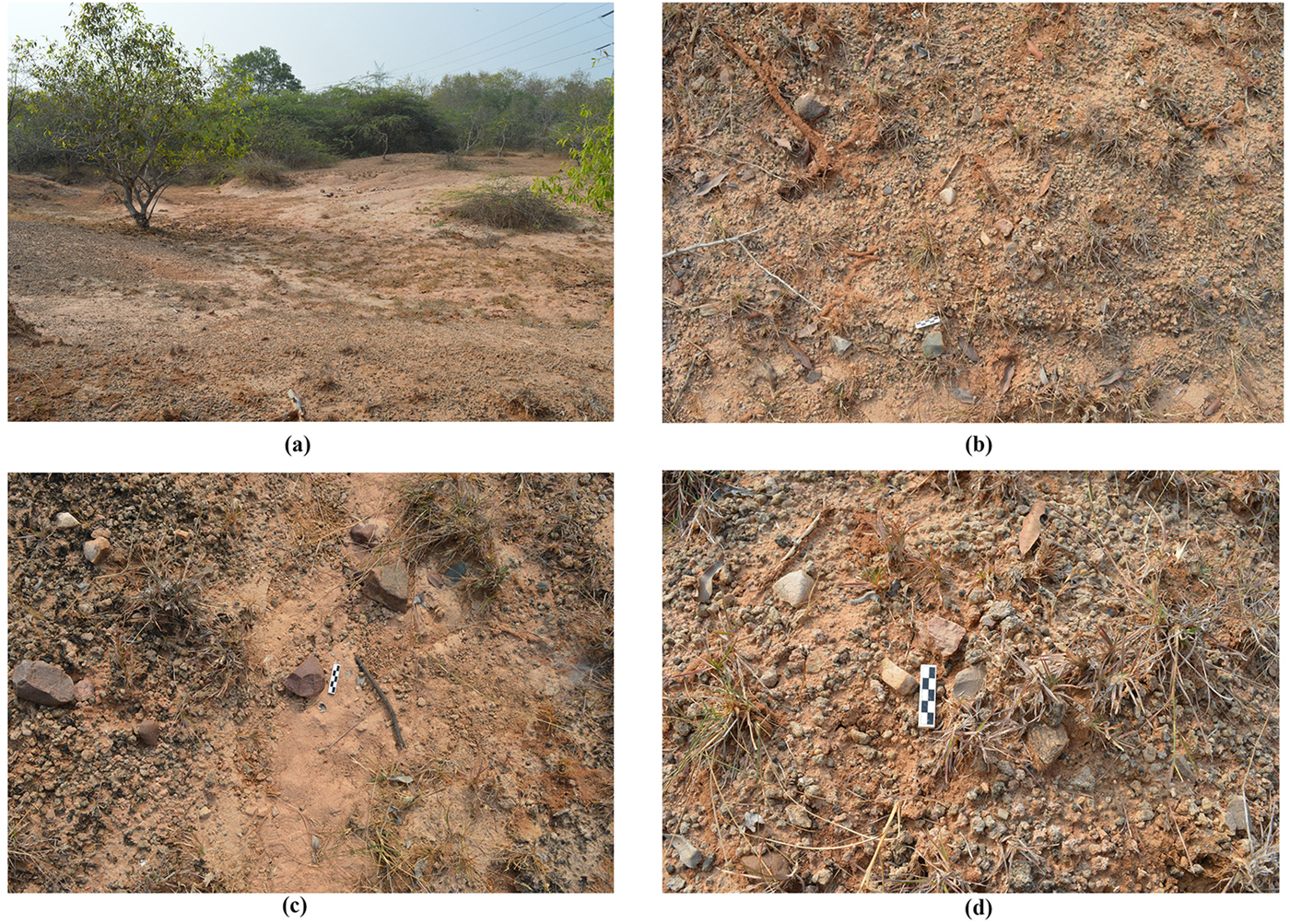
The Middle Godavari basin, south India, is rich in Acheulian, Middle and Upper Palaeolithic sites (see Singh Reference Singh1984), and is therefore an important region for the investigation of cultural adaptations and evolution, as well as for investigating the timing and nature of population dispersals into and across South Asia. Building on a long history of research in this region, recent debates about the Indian Middle Palaeolithic have prompted new investigations (Blinkhorn & Petraglia Reference Blinkhorn and Petraglia2017; Akhilesh et al. Reference Akhilesh, Pappu, Rajapara, Gunnell, Shukla and Singhvi2018). In a recent survey (6491km2), two Acheulian, six Middle Palaeolithic and 13 Late Palaeolithic sites were chosen to study (Figure 1). Here, we focus on the Middle Palaeolithic (six sites, 1302 lithic artefacts). The sites are located primarily in areas marked by Lower Gondwana formations (Geological Survey of India 2002). They occur as surface scatters eroding from sediments overlying bedrock (Figure 2). These comprise debris flows associated with calcareous sediments (Figure 3), regoliths derived from weathered bedrock, and strath gravels and fluvial gravels (Figure 4).
Palaeolithic site distribution in the study region. Green lines = surveyed area; orange circles = sites (image courtesy of Google Earth 2018).
Middle Palaeolithic site distribution concentrated around Gondwana formations (modified after Geological Survey of India 2002).
Section (site: Pochammapad) showing the context of Middle Palaeolithic artefacts associated with debris flow overlying calcareous sediments (scale = 1m).
Artefact distribution within fluvial gravels (site = Goutamnagar (a–d)).
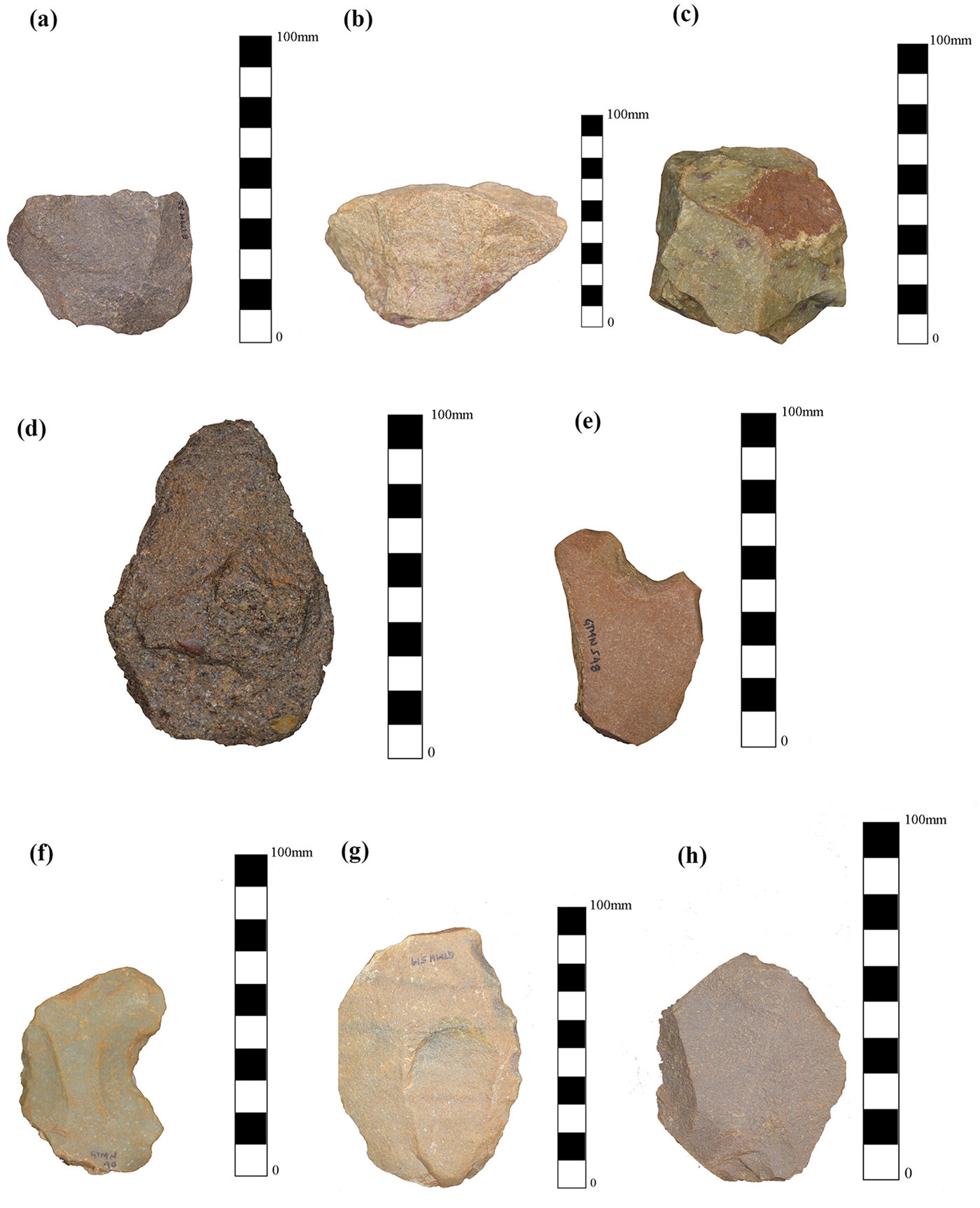
The artefacts recovered are fresh and unabraded, comprising cores, tools and waste products (mean dimensions of all artefacts are 48.61 × 40.11 × 18.44mm). The presence of waste flakes (less than 20mm in size) at three of the sites is indicative of high site integrity with minimal fluvial or other disturbances (Schick Reference Schick1992). Quartzites dominate the assemblage (86.10 per cent), with a few artefacts of chert (12.21 per cent), chalcedony and quartz. Quartzites are inferred to derive from the Talchir boulder beds roughly ~80km from the sites (Geological Survey of India 2002), and thus are non-local; further investigations on this are in progress. Flake cores (n = 151) are generally on quartzite cobbles. Prepared cores (n = 61) include preferential and recurrent Levallois (n = 3) (Figure 5) and discoidal cores (n = 2), among other variants. Other flake cores include laminar cores (n = 18) and multidirectional flake cores (n = 11). The tools (n = 560) are predominantly scrapers and notches, with a few small handaxes and cleavers. Most tools are on flakes, including a few on Levallois blanks. Cortex is generally less than 50 per cent.
Middle Palaeolithic artefact types showing: a) preferential Levallois core; b) laminar flake core; c) multidirectional core; d) diminutive handaxe; e–f) notches; g–h) scrapers.
The presence of stratified Middle Palaeolithic sites, preceded by an Acheulian phase and succeeded by Late Palaeolithic activity, suggests long-term occupation of this landscape. The use of non-local quartzite cobbles in the lithic reduction sequence points to a high degree of mobility across the region and planned site uses. The low level of cortex suggests later stages in the reduction sequence at these sites. The low proportions of Levallois and blades are characteristic of parts of south India (Jayaswal Reference Jayaswal1974; James & Petraglia Reference James, Petraglia, Camps and Chauhan2009), while the continuity of bifaces is perhaps indicative of the early phases of the Middle Palaeolithic (Akhilesh et al. Reference Akhilesh, Pappu, Rajapara, Gunnell, Shukla and Singhvi2018). These studies highlight regional variability in the Middle Palaeolithic in terms of raw material usage, lithic chaîne opératoire and tool types (e.g. the presence/absence of Levallois, blades, points, tanged artefacts and bifaces) (Haslam et al. Reference Haslam, Clarkson, Roberts, Boro, Korisettar, Ditchfield, Chivas, Harris, Smith, Oh, Eksambekar, Boivin and Petraglia2012; Akhilesh et al. Reference Akhilesh, Pappu, Rajapara, Gunnell, Shukla and Singhvi2018). This variability is significant for the study of local adaptations and regional cultural trajectories, some in a stratified context. The continued presence of bifaces and preference for quartzites in the Middle Palaeolithic, and the early evolution of blade technology, are significant in this respect and are noted elsewhere in India (Akhilesh et al. Reference Akhilesh, Pappu, Rajapara, Gunnell, Shukla and Singhvi2018). The patterns emerging add to the complex nature of regional variability in the Indian Middle Palaeolithic, and serve as a reference point when attempting to demarcate local innovations vs elements that were introduced with dispersing populations (Blinkhorn et al. Reference Blinkhorn, Achyuthan, Petraglia and Ditchfield2013; Bae et al. Reference Bae, Douka and Petraglia2017).
Acknowledgements
This research is part of my PhD thesis at Deccan College, supervised by Shanti Pappu and the late M.L.K. Murty, and funded by the Indian Council for Historical Research. I wish to thank S.N. Rajaguru, Kumar Akhilesh, the Sharma Centre for Heritage Education, the Archaeological Survey of India (Hyderabad Circle) and the Department of Heritage Telangana.