

Introduction
The legitimacy of democracy as an efficient decision-making procedure is increasingly challenged based on empirical results on citizens’ behaviours, attitudes, and beliefs (Achen and Bartels, Reference Achen and Bartels2017; Brennan, Reference Brennan2016; Caplan, Reference Caplan2007; Somin, Reference Somin2016). This fosters the Democracy versus Epistocracy debate: rule of the people versus rule of the wise. Against the proponents of epistocratic mechanisms to counterbalance the effects of the ignorance of citizens, defenders of democracy stress its epistemic value, both in decision-making (Estlund, Reference Estlund2009; Landemore, Reference Landemore2012) and knowledge-making (Lucky, Reference Lucky2024). In Debating Democracy (Brennand and Landemore, Reference Brennan and Landemore2022), Hélène Landemore, one main advocate of epistemic democracy, and Jason Brennan, one main advocate of epistocracy, fuelled a controversy but reached a consensus. They consider that hybrid modes of political governance might be the best ones (Brennan and Landemore, Reference Brennan and Landemore2022: 275).
Despite that controversy sparked numerous studies, a systematic analysis of the key variables to choose between democratic, hybrid, and epistocratic modes of political governance has not been produced yet. Therefore, this paper aims at providing a theoretical framework, and then an original baseline model, to do so. What criteria should guide this choice between these three monocentricFootnote 1 modes of political governance? From a normative perspective, we claim that the specificity of information should guide that choice so as to minimize costs of political governance. We introduce the concept of information specificity to capture three dimensions of information: uncertainty, the quantity, and the technicality of information. Information specificity determines the main costs of political governance we identified: 1) costs of disenfranchisement; 2) costs of a bad outcome; 3) costs of information search; and 4) costs of deliberation. These costs are then gathered into a socialFootnote 2 costs function. The results of the model thus enable the tacit postulates that underpin the debate between democracy and epistocracy to be made explicit.
The model is close to the class of political economy models built from the ex ante perspective of ‘a social planner’ (Alesina and Tabellini, Reference Alesina and Tabellini2007). More specifically, it is built from the perspective of a procedural designer. We assume that a Bergson–Samuelson Social Welfare Function exists. Yet, even while assuming that the problem of aggregating individual preferences into a function representing the preferences of society is settled, the question of who should take political decisions remains open. Therefore, the aim of the model is to guide the procedural designer in her task of allocating political issues set at the agenda between the various decision-making procedures. We reason as if the procedural designer allocates issues on a one-by-one basis with the objective of minimizing political costs of governance. This means that the constitution imposes the rule that the political decision-making procedure implemented is dependent on the issue at stake.
The normative claim that decision-making procedures should minimize political costs considering information specificity is rather non-controversial. This amounts to stating that a good mode of governance minimizes the political costs of governance – specific to each issue – implied by any collective decision-making. Such claim could be endorsed by each side of the Democracy versus Epistocracy debate since both focus on epistemic issues coupled with a consequentialist argument. From a more positive perspective, the model and its theoretical foundations also help explain why some decisions are actually submitted directly to the people (direct democracy) or their representatives (indirect democracy), while others, conversely, are entrusted to non-elected independent expert bodies (epistocracy).
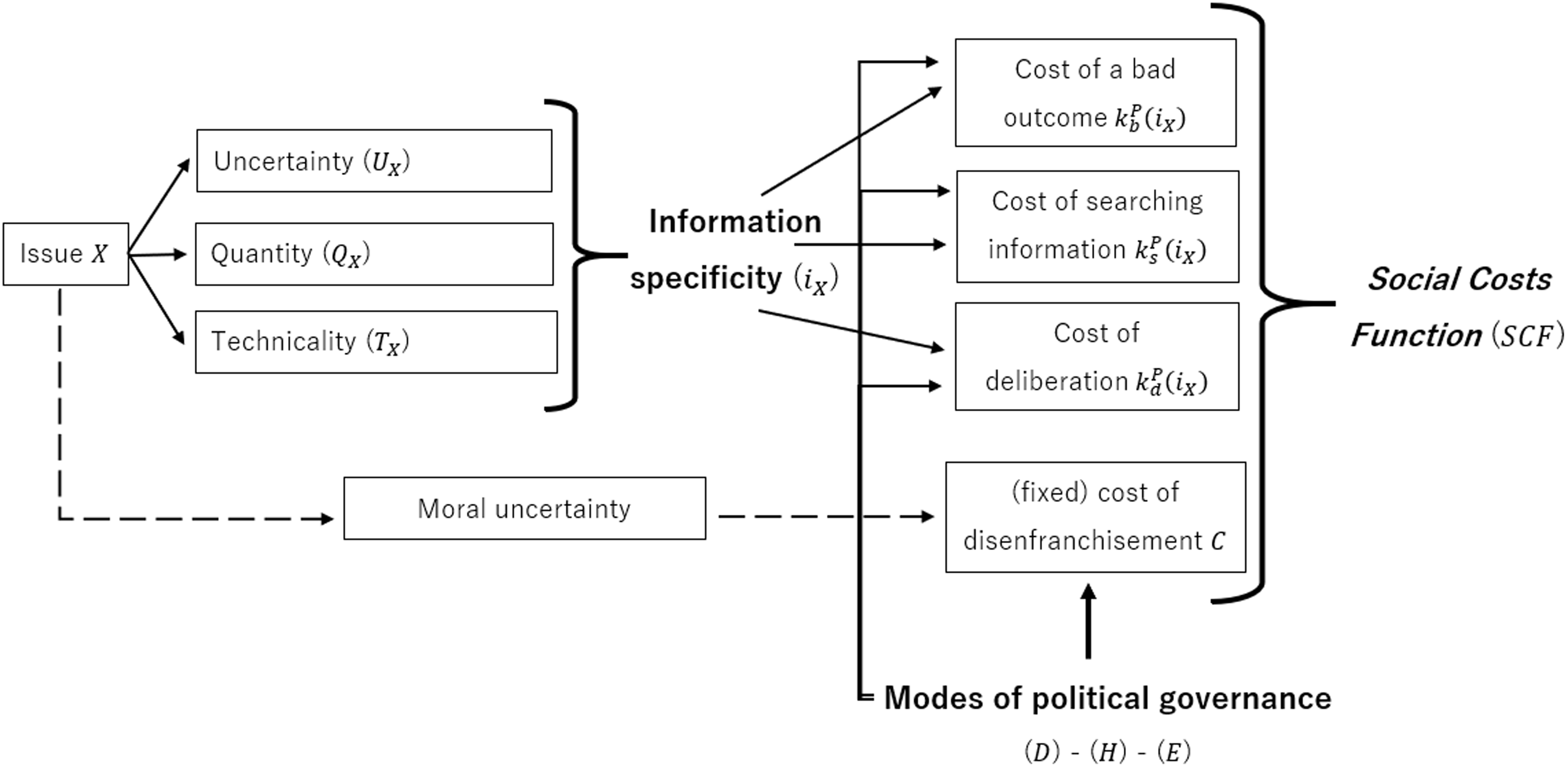
The main logic of the model is the following one (Figure 1): an issue X has a degree of information specificity (i X ) that determines costs of political governance, which are combined in a Social Costs Function (SCF). Therefore, the model enables to compare the relative efficiency between democratic (D), hybrid (H), and epistocratic (E) modes of political governance. Section Literature review‘ provides the literature review. Section Modes of political governance‘ characterizes Democracy and Epistocracy as alternative modes of political governance and then defines hybrid ones. Section Information specificity‘ provides an original definition of information specificity. Section The Social Costs Function‘ defines the concept of political governance costs and formalizes the social costs function associated with each mode of political governance. Section ‘Results‘ demonstrates the main result of the model. Section Applications‘ provides an application. Section Extension‘ extends the baseline model. Section Conclusion‘ concludes.
Flowchart of the baseline model.

The main theoretical contribution of the paper consists in disaggregating the equivocal concepts of information as well as costs of political governance. The parsimony of the formal model we then build enables to provide a benchmark to address the epistemic challenge face by liberal democracies. This paper is only the first theoretical milestone towards more empirically grounded research. This implies specifying from the outset that its innovative dimension comes with limitations. First, the analysis is limited to idealized characterizations of democracy, hybrid regimes, and epistocracy, rather than their real-world implementations. Second, we reason within a quasi-institutional vacuum to construct the baseline model, while progressively integrating several institutional variables in extensions. Third, we consider information as exogenous, in the sense that we neglect the way political institutions determine the production and allocation of information within society. Fourth, while the concept of information specificity enriches the simplistic vision proposed in the democracy versus epistocracy debate, this paper does not offer direct empirical operationalization.
Literature review
Many 21st century works emphasize how Western liberal democracies face challenges undermining the prevailing institutional order, particularly epistemic institutions (Rauch, Reference Rauch2021). This fragility expresses the polarization of preferences, beliefs, and opinions over public policies on a range of issues: climate change, globalization, immigration, or identity politics. It also manifests in declining trust in representative democracy institutions and rising populist parties (Guriev and Papaioannou, Reference Guriev and Papaioannou2022). Regardless of their ideological leanings, populist parties claim to revitalize democracies allegedly captured by vested interests (Müller, Reference Muller2016). This lack of ‘minimal democratic consensus’ (Chirat and Hédoin, Reference Chirat and Hédoin2025) legitimizes research on the efficiency of political modes of governance.
The paper engages with the Democracy versus Epistocracy debate. Following the ‘epistemic turn’ in deliberative democracy (Landemore, Reference Landemore2017), political theorists increasingly emphasize that democratic legitimacy depends on its epistemic properties, especially producing collective judgements tracking the ‘truth’. (Estlund, Reference Estlund2009; Landemore, Reference Landemore2012). However, this claim is confronted by a literature emphasizing the epistemic defects of democracy stemming from biased and uninformed voters (Achen and Bartels, Reference Achen and Bartels2017; Brennan, Reference Brennan2016; Caplan, Reference Caplan2007). The fact that democracy may not meet desirable epistemic requirements has encouraged some to consider alternative political regimes more appropriate to make collective choices with an uninformed and incompetent electorate. Epistocracy appears as the main alternative in this context.
Strikingly, many public controversies share the stake of this debate, since the quarrels over the arguments specific to an issue X are regularly coupled with quarrels on the best way to reach a collective decision on X. The discussion generally moved from ‘what to do?’ to ‘who should decide?’: the people, their representatives, a citizens’ convention or experts. In such situations, the advocates of democratic decision-making procedures express some kind of ‘epistemic populism’ (Bellolio, Reference Bellolio2024), that is, the idea that citizens have sufficient common sense to decide. They face the defenders of epistocracy, who insist on the technical and legal dimensions of the issue at stake that call for expert decision-making. These arguments appear reasonably admissible. So, how could we cut the Gordian knot?
We claim it is of practical political importance to study the costs generated by the choice of the decision-making procedure itself. Hence, this paper is related to the problem of social choice (Arrow, Reference Arrow1963), especially in its relationship with the social welfare literature (Igersheim, Reference Igersheim2019). Since we are interested in the costs of decision-making procedures, we reason, as is standard in public economics, as if a Bergson–Samuelson Social Welfare Function (BSWF) exists, and then study the costs of political governance, meaning the costs generated by political decision-making to reach the ends satisfying the preference of society. Crucially, the Social Cost Function (SCF) we construct is compatible with any BSWF, which need not be known by individual agents. Expressed in social choice terms, our SCF allows us to arbitrate between three ‘social choice rules’ (democratic, hybrid, and epistocratic). The crucial difference from social choice literature is that these rules are considered not as an aggregation mechanism of individual preferences in order to obtain a social ordering of states of the world. They are considered as methods for choosing which policies to implement. Hence, the label ‘decision-making procedures’ is used rather than ‘aggregation procedures’.
Because of its ‘cost approach’ to find social decision-making procedures that minimize social decision costs, our framework bears some similarity with Buchanan and Tullock’s analysis of constitutional choice (Reference Buchanan and Tullock1962). Following them, we consider that a cost approach is more relevant for comparative evaluation of different modes of governance (Reference Buchanan and Tullock1962, 43–46). There are three major differences, though. First, we do not directly account for external costs that the use of a procedure may impose on individuals who disagree with the decision made. Second, we rather emphasize informational problems in political decision-making. Third, we identified a greater number of costs with more diverse origins than in Buchanan and Tullock’s analysis, where they are only a function of the proportion of individuals needed to make a decision.
Due to its objective, this paper echoes political economy models that address the ‘How to decide who has to decide’ question. The debate between ‘the Chicago School’ and the ‘Virginia School’ has focused on the relationship between political competition and democratic efficiency (Wittman, Reference Wittman1989). The comparison between direct and representative democracy has emphasized the role of information asymmetries (Kessler, Reference Kessler2005). The literature on the delegation of collective choices to either politicians or bureaucrats has concentrated on the behavioural consequences of differential motivations, either intrinsic (Maskin and Tirole, Reference Maskin and Tirole2004) or extrinsic (Alesina and Tabellini, Reference Alesina and Tabellini2007). Here, we put the emphasis on the epistemic rather than behavioural stakes of political governance.
Lastly, the model is tributary to Oliver Williamson’s transaction cost economics, even if it does not replicate its framework. To answer the fundamental question ‘what is the best collective decision-making procedure?’, we have reasoned by analogy with Williamson’s (Reference Williamson1985, Reference Williamson1991) answer to its research question ‘what is the best coordination process?’. That is why the substantial logic of the model echoes Oliver Williamson’s one. As a reminder, he argues that the specificity of assets and the frequency of transactions determines the relative efficiency of the market, hierarchy, and hybrid modes of coordination. Here, we argue that information specificity determines the relative efficiency between democratic, hybrid, and epistocratic modes of political governance.
Modes of political governance
For the sake of simplicity and following the core of the Democracy versus Epistocracy debate, we consider three collective decision-making procedures. Democracy (D), Hybrid (H), and Epistocracy (E) are considered as decision-making procedures to implement collective choices. It means that they are distinct modes of political governance. Democracy and Epistocracy are considered as opposite. Democracy refers to ‘the rule by the people’, while epistocracy refers to ‘the rule of the wise’. As a mode of political governance defined in opposition to democracy, epistocracy hinges on the disenfranchisement of part of the electorate on epistemic grounds. The archetypal form of epistocracy is any form of restricted electorate, where only those judged as sufficiently informed and competent can express their voices.Footnote 3 Between Democracy and Epistocracy, there are various collective decision-making procedures that could be considered as ‘hybrid’. We use the terms hybrid for two reasons. First, these modes mix democratic and epistocratic components.Footnote 4 Second, the logic of the model is analogous to Williamson’s analysis, in which there are hybrid modes between market coordination and hierarchy.
In the baseline model, Democracy is considered as a unique procedure of decision-making to reach collective choice. But one may like to distinguish subtypes, for instance, between direct democracy and representative government (Manin, Reference Manin1997). Such distinction between direct and indirect democracy could be introduced later. But the mere existence of various democratic procedures entails determining which of these is better than the other. The same question applies to discriminating between various hybrid or epistocratic designs. We argue that these questions cannot appeal to an absolute answer, meaning independent of the political issue at stake. However, defining an optimal or good procedure requires a criterion. In this paper, such criterion is the minimization of political costs of governance. These costs, which are combined in our SCF, vary according to information specificity (i X ). The model then helps to determine whether Democracy (D), Hybrid (H), and Epistocracy (E) are more efficient by comparing their respective SCF.
Comparative studies of political regimes can easily be biased. It would not make sense to compare the functioning of current democratic regimes to an idealized epistocracy, or vice versa. Since this article aims to establish a theoretical framework for comparative analysis to choose between different modes of political governance, we consider them all in their idealized form. What does this mean? For democracy, it implies that we reason as if it produces decision-making that perfectly represents citizens’ preferences. For epistocracy, it implies that disenfranchisement genuinely operates based on epistemic competence. In other words, members of the decision-making body in an epistocracy have greater command of information and knowledge compared to those in a democracy. By the generic term ‘decision-making body’, we refer to enfranchised individuals. For democracy, this means that all members of the decision-making body – either all citizens with the right to vote (direct democracy) or all parliamentarians (representative democracy) – participate in decision-making.
Information specificity
The information specificity i X of an issue X impacts the trade-off between the three modes of political governance since it impacts the Social Cost Function of Democracy (SCF D ), Hybrid (SCF H ), and Epistocracy (SCF E ). Information specificity is a function of three variables related to the issue X at stake. The first one is the degree of uncertainty (U X ). The second one is the quantity of information (Q X ). The third one is the technicality of information (T X ). These three dimensions of information specificity are strictly independent, commensurable, and continuous. Formally, for each X: ${i_X} = f\left( {{U_X},{Q_X},{T_X}} \right)\;\,\,{\rm{with}}\,\,\,\,{i_X}:\,] \!\;{0,1}] \times \left[ {0,1} \right] \times \left[ {0,1} \right] \to \left[ {0,1} \right].$
This section presents and justifies the form taken by each of the variables determining the specificity of the information i X associated with an issue X.
Uncertainty
The first component of information specificity is uncertainty. The concept of uncertainty is equivocal in economics. Following Simon (Reference Simon1955) and Downs (Reference Downs1957), we define (epistemic) uncertainty as incomplete information. In this sense, uncertainty is a measure of our ignorance. But such ignorance cannot be reduced by information or knowledge acquisition. This variable, labelled uncertainty, enables us to integrate into the model the quantity of information the decision-making body can have at best on an issue. In other words, it characterizes the informational basis available within the theoretically infinite space of information.
Formally, we assume that uncertainty is a continuous variable on ]0, 1], that is, there is a varying degree of uncertainty. Theoretically, uncertainty runs from full uncertainty (U X = 1) to the limit world of complete information of standard neoclassical economics (U X = 0).Footnote 5 However, we deliberately exclude complete information (U X =0). We do not want the choice between alternative modes of political governance to be plagued by the assumption that all information on all the past, present, and future states of the world is known. Therefore, U X ∈ [0, 1].
We assume that the relationship between U X and i X is inverse. Indeed, the more uncertainty, the lower the information specificity, since, by definition, the available informational basis is reduced, that is, information is lacking. Formally, this implies that: ${U_X} \in \left[ {0,1} \right]\,{\rm{and}}\;{{\partial f\left( {{U_X},{Q_X},{T_X}} \right)\;} \over {\partial {U_X}\;}} \lt 0$
The quantity of information
While uncertainty refers to the quantity of information the decision-making body can have at best on an issue X, the variable Q X represents the quantity of available information that decision-making agents must have on an issue X to be considered as an informed decision-maker. Hence, it represents the epistemic threshold, specific to each issue at stake, to be considered as worth enfranchised. The relationship between Q X and i X is positive. The more information to be mastered is required to be worth enfranchised, the higher the information specificity of the issue X. Formally, this implies: $\;{Q_X} \in \left[ {0,1} \right]\,{\rm{and}}\;{{\partial f\left( {{U_X},{Q_X},{T_X}} \right)\;} \over {\partial {Q_X}\;}} \gt 0.$
Formally, U X and Q X are assumed to be independent. This means that the epistemic threshold to be considered worth enfranchised is independent of the available informational basis. Q X can be viewed as a percentage of the informational basis available U X . To illustrate this idea with an example related to government spending, consider two decisions Y (allocating the budget between ministries) and Z (setting the level of the public budget) with the same degree of uncertainty U Y = U Z . It could reasonably be argued that it requires more information (among the available informational basis captured by U X ) on the state of a national economy and public administrations to decide how to allocate the resources between ministries rather than to decide whether to raise or cut the overall public budget. In this example, U Y = U Z and Q Y > Q Z .
The technicality of information
U X and Q X , respectively, capture the quantity of information a decision-making body can have at best on an issue X and the quantity of available information a decision-maker must have to be considered as sufficiently informed to be worth enfranchised. In addition to these ‘quantitative’ characterizations of i X , a qualitative characterization is required (yet formally amenable to quantification). That is why the model integrates a variable related to the technicality of information (T X ), to distinguish information from knowledge (Downs, Reference Downs1957).
Lack of knowledge refers to the fact that an agent may be partially or fully ignorant of the relevant mechanisms and relations between variables that account for well-identified phenomena. For instance, citizens generally have partial knowledge of the mechanisms of money creation and the relevant issues related to monetary policy. In contrast, lack of information corresponds to a lack of data that makes one unable to assess the actual value of some variables. For instance, a citizen may be ignorant of the current central bank’s interest rates. Lack of knowledge requires education to be reduced, since it entails mastering the technical dimension of an issue X. That is why we assume that the more technical an issue X is, the more specific the information is. Hence, there is a positive relationship between T X and i X . Formally, this implies that: $\;{T_X} \in \left[ {0,1} \right]\,{\rm{and}}\;{{\partial f\left( {{U_X},{Q_X},{T_X}} \right)\;} \over {\partial {T_X}\;}} \gt 0.$
Summary
Having presented each of the three components of information specificity, we can sum up its characterization: ${i}_X = f(U_X, Q_X, T_X) \; {\rm and}\; {i}_X :\, ]\;\! 0,1] \times [0,1] \times [0,1] \to [0,1],$ ${\partial f\left(U_{X},Q_{X},T_{X}\right) \over \partial U_{X} }\lt 0,$ ${\partial f\left(U_{X},Q_{X},T_{X}\right) \over \partial Q_{X} } \gt 0,$ ${\partial f\left(U_{X},Q_{X},T_{X}\right) \over \partial T_{X} } \gt 0.$
An existence proof is available in Appendix 1 in the Web appendix.
The social costs function
The first crucial question is on whom the political costs of governance we identified are falling. Theoretically, there are two possibilities. Either (1) the costs are assumed to be supported by individuals, eventually unequally, or (2) the costs are assumed to be supported by ‘society’ as a whole. From an economic perspective, (1) has the advantage to identify precisely who is supporting the costs and what kind of costs. That is why we retain this option to build the SCF of each mode of political governance.
As a reminder, we consider three modes of political governance: (D), (H), and (E). The relation between them regarding the scope of disenfranchisement is always transitive. More citizens are enfranchised within Democracy compared to Hybrid compared to Epistocracy.Footnote 6 This relation directly impacts the fixed cost of disenfranchisement. Each of these decision-making procedures is also subject to the same variable costs, which depends on information specificity (Figure 1). Yet, the level of each of these costs, for a given i X , varies according to each mode of political governance.
Thus, for each political mode of governance, the SCF relates political costs of governance to information specificity and enables 1) identification of the individuals supporting costs, 2) identification of what kinds of costs they are supporting, and 3) aggregation of these costs. The costs included in the model are heterogeneous in their nature and unequally distributed among citizens, according to both their individual preferences and material conditions of living. However, we assume that the political governance costs are theoretically commensurable, since quantifiable in monetary terms, so that we can define an aggregate SCF for Democracy, Hybrid, and Epistocracy.
The SCF should not be confused with a Social Welfare Function (SWF). As stated in the introduction, we assume that a Bergson–Samuelson Social Welfare Function exists, no matter how it came from. The model aims at determining which collective decision-making procedure minimize political governance costs according to information specificity. It does not aim to propose a theory of justice, that is, ‘an ordering of alternative social states’ that is ‘formally analogous to the individual’s ordering of alternative social states’ (Arrow Reference Arrow1973, 14). That is why we design a model that is theoretically compatible with any SWF. It does not provide an arbitration between various SWF, but an arbitrage between decision-making procedures. It means that the SCF of (D), (H), and (E) does not depend on the SWF that the decision-making body would take as a guide. More precisely, the SCF measures the welfare loss caused by the opportunity costs of political governance compared to a hypothetical situation where no costs of political governance are considered so that the ends defined by the SWF are supposed to be reached without cost.
Formally, the SCF of decision-making procedure (P) labelled SCF P (i X ) is composed of three terms: a fixed cost C P ; the sum of three variable costs k P (i X ); and an ‘error term’ ϵ. The error term defines an area of viability rather than an optimal frontier in order to be consistent with the uncertainty assumption (Simon, Reference Simon1955). The bundle of variable costs k P (i X ) includes the cost of a bad outcome k b P (i X ), the cost of searching information k s P (i X ), and the cost of deliberation k d P (i X ).
Hence, for i X ∈ [0,1]: $SCF^{P}(i_{X})= C^{P}+ k^{P}(i_{X})+\varepsilon,$ $k^{P}(i_{X})={k}_{b}^{P}(i_{X})+ {k}_{s}^{P}(i_{X})+{k}_{d}^{P}(i_{X}).$
In addition, we assume that: $ k^{P\prime}(i_{X})\gt 0 \;{\rm and}\; k^{P\prime\prime}(i_{X})\gt 0,$ $k^{D\prime}(i_{X})\gt k^{H\prime}(i_{X})\gt k^{E\prime}(i_{X})\gt 0,$ $0 \lt C^{D}\lt C^{H}\lt C^{E}.$
These assumptions and the formal consistency of conditions are justified below.
The cost of disenfranchisement
First, the SCF includes the cost of disenfranchising part of the electorate. This cost, which bears on disfranchised citizens, is unrelated to information specificity, that is, a fixed cost. Disenfranchisement – either through a lottery, an epistemic test, or any other devices – means that some persons cannot express their preferences. Disenfranchisement (no matter the size of the electorate concerned) breaks formal equality and runs counter a moral egalitarian account of democracy. Such moral egalitarianism has nonetheless been challenged by the ‘lottery objection’Footnote 7 and ‘no impact objection’.Footnote 8 However, advocates of democracy argue against these claims that democracy at least enables citizens to equally exert ‘basic autonomy’ (Jacob, Reference Jacob2015). Therefore, the cost of disenfranchisement assumed in the model is derived from the assumption that humans have a preference for autonomy, that is, taking part in decision-making. Such preference might obviously be empirically distributed with various intensities throughout the electorate and according to the issues at stake.Footnote 9
We take for granted that such a cost of disenfranchisement is significant for citizens. Depending on what the precise underlying political philosophy calls for, this cost could be considered either (1) a subjective psychological cost induced by the lack of respect that person who are disenfranchised bear or (2) an objective well-being cost related to the fact that their ideas and interests are disregarded. In the model, we assume that this cost affects the well-being of any disenfranchised individual. Assuming that the intensity of citizens’ preference for expressing their voice is not related to the criteria by which disenfranchisement occurs, the more disenfranchised citizens, the higher the cost of disenfranchisement. Yet, since the more epistocratic a procedure is, the greater the number of disenfranchised citizens. Hence, C D < C H < C E . In addition, even in democracy, some citizens are disenfranchised. Hence, C D > 0 and, by transitivity, C H > 0 and C E > 0.
The transitive relationship between C D < C H < C E has direct implications on the result of the model (section Results‘). Thus, the gap between C D , C H , and C E matters. If the cost of disenfranchisement is assumed to be independent of i X , it is not independent of the issue X itself (Figure 1). We assume that the more morally uncertain the issue at stake is, the greater the cost of being disenfranchised. Therefore, the gap between C D and C H , C E increase with moral uncertainty. The notion of moral uncertainty captures the fact that for some issues, there is uncertainty about the validity or relevance of different moral principles (MacAskill et al., Reference MacAskill, Bykvist and Ord2020). In such cases, determining on the basis of which principles the decision should be made might be difficult. Moral uncertainty is more likely (though not exclusively) to be significant in issues fostering genuine values conflicts rather than epistemic ones only. In such cases, a clear and legitimate epistemic criterion to implement a disenfranchisement procedure is lacking.
Moral uncertainty also encompasses subjective attitudes (i.e., preferences) towards risk and time. With respect to many issues, individuals may radically differ regarding the degree of risk they are willing to support or the value they give to future benefits and harms compared to immediate ones. In many cases, there is just no fact of the matter that determines what the justified risk and time preferences are. Thus, a large range of preferences cannot be easily discarded on epistemic grounds. In those cases where moral uncertainty is high because it is impossible to reject outright conflicting attitudes towards risk and time, it is very plausible that disenfranchisement is individually more costly as it prevents the judgements of some individuals from weighing in collective choices without legitimate justification. Therefore, for such morally uncertain issues, there is, ceteris paribus, a presumption in favour of democracy – as soon as the cost of disenfranchisement is not disregarded (see section Applications‘ and Extension‘).
The expected cost of a bad outcome
Second, the SCF includes a cost of reaching a collective decision that led to a ‘bad outcome’, labelled k b (i X ). Considering an outcome as ‘bad’ does not require to define a particular SWF to assess the relative worth of potential outcomes. In this model, a bad outcome means that the decision taken by the decision-making body does not produce the desired outcome in terms of well-being effects because of informational failures. In other words, another decision would have been better without such informational failures for given preferences of society. Consequently, this cost does not depend on the SWF that the decision-making body would take as a guide.
We assume that the likelihood of a bad outcome because of informational failures is negatively related to (epistemic) uncertainty, since, by definition, high uncertainty means a restricted available informational basis. On the contrary, the expected cost of a bad outcome is positively related to the two other components of information specificity. Indeed, if an issue X requires high quantity of information (Q) which is technical (T), then a bad outcome caused by informational failures is more likely to happen. This implies that the expected cost of a bad outcome is positively related to i X . Therefore, formally, since k b (i X )= k b (f(U X , Q X ,T X )): ${\partial k_{b}(f(U_{X}, Q_{X},T_{X}) ) \over \partial U_{X}}\lt 0,$ ${\partial k_{b}(f(U_{X}, Q_{X},T_{X}) ) \over \partial Q_{X}} \gt 0,$ ${\partial k_{b}(f(U_{X}, Q_{X},T_{X}) ) \over \partial T_{X}} \gt 0,$ ${\partial k_{b}\left(i_{X}\right) \over \partial i_{X}}\gt 0.$
The conditions (10) to (13) are mutually consistent as well as consistent with the constraints imposed before (Proof in Appendix 2).
Since the likelihood of bad outcomes is related to information failures, we assume that the expected marginal cost of a bad outcome is increasing with information specificity. Besides, when those mastering information and knowledge on the issue at stake – let’s call them ‘experts’ – are numerous among members of the decision-making body, the likelihood of a bad outcome is inferior compared to the case in which everybody has an equal voice. Hence, the more disenfranchisement occurs through true competence requirements (i.e., an ideal epistocracy), the more expert the decision-making body is. Therefore, the expected marginal cost of a bad outcome is higher for Democracy compared to Hybrid compared to Epistocracy. Formally: $ {\partial ^{2}k_{b} \over \partial {i_{X}}^{2}}\gt 0,$ ${\partial k_{b} \over \partial i_{X}}^{D}\gt {\partial k_{b} \over \partial i_{X}}^{H}\gt {\partial k_{b} \over \partial i_{X}}^{E}.$
This proposition runs counter to well-known formal results put forward by epistemic democrats that, to the contrary, indicate that a democratic decision-making procedure is likely to lessen the cost of a bad outcome compared to an alternative regime. The Jury Theorem, the ‘Miracle of Aggregation’ theorem, and the ‘Diversity Trumps Ability Theorem’ all point towards the same lesson: number is more relevant than competence to ‘track the truth’. Because a democratic system favours the number over the competence and epistocracy the reverse, these formal results should downplay our confidence that the expected cost of bad outcomes decreases with the degree of expertise of the decision-making body. Doubts about the conditions for the validity of these theorems as well as their interpretation nevertheless lead us to maintain our alternative proposition (see Appendix 5 for a detailed discussion).
The cost of searching for information
Because of uncertainty (U), searching for information is a costly activity (Downs, Reference Downs1957; Simon, Reference Simon1956). The cost of information search k s (i X ) corresponds to the value of time and resources required to gather the relevant information and knowledge to make an informed decision. Such a cost is amenable to monetary measure, can be expressed in terms of well-being, and is borne by the member of the decision-making body. The higher the information specificity, the greater the cost of search, since more information sources are available (low U), more information is required to be worth enfranchised (high Q), which is more technical (high T). Formally: ${{\partial {k_s}\left( {f\left( {{U_X},{\rm{\;}}{Q_X},{T_X}} \right){\rm{\;}}} \right){\rm{\;}}} \over {\partial {U_X}}} \lt 0,$ ${{\partial {k_s}\left( {f\left( {{U_X},{\rm{\;}}{Q_X},{T_X}} \right){\rm{\;}}} \right){\rm{\;}}} \over {\partial {Q_X}}}\; \gt 0,$ ${{\partial {k_s}(f({U_X},\;{Q_X},{T_X})\;)\;} \over {\partial {T_X}}}\; \gt 0$ ${{\partial {k_s}\left( {{i_X}} \right)} \over {\partial {i_X}}} \gt 0.$
The conditions (16) to (19) are mutually consistent as well as consistent with the constraints imposed before (Appendix 2).
We assume in addition that the return on search is decreasing. Two arguments might be advanced. First, the more the information space has already been explored, the higher the opportunity cost of continuing to explore it. Second, individuals begin to search for information in areas where they are most comfortable in epistemic terms. We assume that these mechanisms offset potential learning effects. Besides, by definition the Hybrid mode of political governance selects fewer and better-informed agents than Democracy; and Epistocracy selects fewer and better-informed agents than Hybrid and, by transitivity, Democracy. Hence, for a given level of information specificity, the cost of searching for an additional piece of information is superior for (D) compared to (H) and, by transitivity, (E). Formally: ${\partial ^{2}k_{s} \over \partial {i_{X}}^{2}}\gt 0,$ ${\partial k_{s} \over \partial i_{X}}^{D}\gt {\partial k_{s} \over \partial i_{X}}^{H}\gt {\partial k_{s} \over \partial i_{X}}^{E}.$
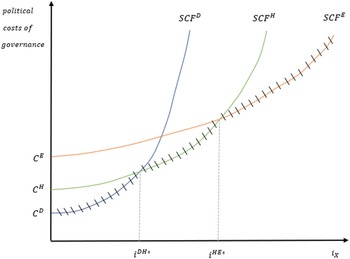
To be consistent with the definition of uncertainty, we borrow from Herbert Simon (Reference Simon1955; Reference Simon1956), we endorse his view on information search rather than George Stigler’s (Reference Stigler1961). The consequence is straightforward: we add an ‘error term’ ϵ to the SCF. Endorsing the logic behind Simon’s (Reference Simon1955) behavioural model of rational choice indeed implies that, when facing uncertainty, the decision-making body would search for a satisficing quantity of information, rather than an ‘optimal’ one, to reach a ‘satisfying’, rather than ‘optimal’, decision. Without such an error term, the SCF enables us to determine the optimality frontier between D, H, and E. With such an error term, we refer to an area of viability around the optimality frontier (see Figure 2, section Results’).
Social costs function of democracy, hybrid, and epistocracy.

The cost of deliberation
The third variable cost considered is related to deliberation. It is similar in nature to the cost of searching for information, that is, it is amenable to monetary measure and expressed in terms of well-being. It is above all supported not only by the persons deliberating but also by every individual expecting that a decision be made. We assume that the more information specificity, the more costly deliberation is. Since more information is available (low U), more is required (high Q), which is more technical (high T), the available informational basis and knowledge involved in deliberation are indeed greater. Formally, ${\partial k_{d}(f(U_{X}, Q_{X},T_{X}) ) \over \partial U_{X}}\lt 0,$ ${\partial k_{d}(f(U_{X}, Q_{X},T_{X}) ) \over \partial Q_{X}} \gt 0,$ ${\partial k_{d}(f(U_{X}, Q_{X},T_{X}) ) \over \partial T_{X}} \gt 0,$ ${\partial k_{d}\left(i_{X}\right) \over \partial i_{X}}\gt 0.$
The conditions (22) to (25) are mutually consistent as well as consistent with the constraints imposed before (Appendix 2).
In addition, we assume that the marginal cost of deliberation is increasing, since the longer the process, the higher the costs supported by both individuals belonging to the decision-making body and citizens waiting for a decision. Besides, one could argue that deliberation does not occur in the same manner in democratic settings compared to hybrid or epistocratic ones. Even within the bundle of democratic decision-making procedures, deliberation might differ, for instance, between direct democracy and indirect democracy. But since we investigate only the role of information specificity on political costs of governance among democracy, hybrid and epistocracy considered as ideals rather than in their actual settings, we assume an identical deliberation process at this stage. Concretely, this means that the composition and size of the decision-making body do not affect the way its members deliberate: public debate, rational arguments, emotional arguments, and information provision by experts and by lobbies. If deliberation costs are assumed to be independent of the type of decision-making process, then they only depend on the number of persons involved in the decision-making body. Formally: ${\partial ^{2}k_{d} \over \partial {i_{X}}^{2}}\gt 0,$ ${\partial k_{d} \over \partial i_{X}}^{D}\gt {\partial k_{d} \over \partial i_{X}}^{H}\gt {\partial k_{d} \over \partial i_{X}}^{E}.$
Summary
As a reminder, the Social Costs Function for a regime P is formally described by Equation (5), and the variable costs by Equation (6): $SCF^{P}(i_{X})= C^{P}+ k^{P}(i_{X})+\varepsilon.$ $k^{P}(i_{X})={k}_{b}^{P}(i_{X})+ {k}_{s}^{P}(i_{X})+{k}_{d}^{P}(i_{X}).$
From (6), we know that: $k^{P\prime}(i_{X})={k}_{b}^{P\prime}(i_{X})+ {k}_{s}^{P\prime}(i_{X})+{k}_{d}^{P\prime}(i_{X}).$ $k^{P\prime\prime}(i_{X})={k}_{b}^{P\prime\prime}(i_{X})+ {k}_{s}^{P\prime\prime}(i_{X})+{k}_{d}^{P\prime\prime}(i_{X}).$
It follows from (13), (19), and (25) that k P′(i X ) > 0.
It follows from (14), (20), and (26) that k P′′(i X ) > 0.
Hence, condition (7) is verified, that is, k P′(i X ) > 0 and k P′′(i X ) > 0
The transitive relations (15), (21), and (27) guarantee the validity of condition (8), that is, k D′(i X ) > k H′(i X ) > k E′(i X ) > 0.
Results
As a reminder, the core of the baseline model is characterized by the five following equations: $i_{X}=f(U_{X},Q_{X},T_{X}),$ $SCF^{P}(i_{X})= C^{P}+ k^{P}(i_{X})+\varepsilon,$ $k^{P\prime}(i_{X})\gt 0\; {\rm and}\; k^{P\prime\prime}(i_{X})\gt 0,$ $k^{D\prime}(i_{X})\gt k^{H'}(i_{X})\gt k^{E'}(i_{X})\gt 0,$ $0\lt C^{D}\lt C^{H}\lt C^{E}.$
A proof of the existence of a SCF P (i X ) is provided in Appendix 3 through one very simple example, in which variable costs are supposed to be represented by an identical functional form. Here, we focus on the general results of the model.
The results of the model aim to answer the following question: for a given information specificity of the issue at stake, which collective decision-making procedure minimizes political costs of governance? The modelling strategy we propose enables us to compare SCF D with SCF H and SCF E (5) according to information specificity (1). Whatever the issue at stake, the (fixed) cost of disenfranchisement included in the SCF is inferior for democratic compared to hybrid and epistocratic decision-making (9). In addition, variable costs increase with the specificity of information at an increasing rate, that is, the SCF is convex (7). Lastly, the marginal cost of Democracy is superior to that of Hybrid, which is superior to that of Epistocracy (8).
These conditions lead to a crucial, even though formally trivial, result (see Appendix 4 for a numerical example). There exists for any issue a pivotal value of information specificity i DH* below which Democracy (D) is better than Hybrid (and by transitivity Epistocracy) to minimize political governance costs. Also, there exists for any issue X, a pivotal value i HE* from which Epistocracy is better than Hybrid (and by transitivity Democracy) to minimize political governance costs.Footnote 10 Hence:
Proposition 1. The higher the information specificity, the more efficient epistocracy (i.e., disenfranchisement occurring on the basis of competence) compared to democracy and hybrid modes of governance. The reverse result holds: the lower the information specificity, the more efficient democracy compared to epistocracy and hybrid modes of governance.
Corollary. The larger the informational basis (low uncertainty), the more information is required to be competent, and the more technical the knowledge is, the more efficient epistocracy is compared to democracy and hybrid modes.
We provide a simple diagrammatic illustration of one possible formalization of the choice between these three modes of political governance. It represents the SCF of each mode. The optimality frontier is distinctly identifiable, and the area of viability of each mode of governance is shaded to take into account, as uncertainty required, the error term ϵ of the SCF.
In case the information specificity of an issue is equivalent to one of the two equilibrium points, another criterion is required. We argue that the frequency of decisions, analogous to the frequency of transactions in Williamson’s model (Reference Williamson1991), can play that role. Assume two issues Y and Z with the same level of information specificity, that is, i Y = i z ≈ i DH*. Y and Z are situated at the pivotal point from which Hybrid becomes more efficient than Democracy (see Figure A6 in the Appendix). If Y requires very regular decisions compared to Z, then Hybrid will be preferred for Y and Democracy for Z. The main argument lies in the fact that Hybrid is less costly in terms of deliberation costs for members of the decision-making body. The same line of argument applies to i Y = i z ≈ i HE*.
Applications
In this section, we illustrate the applicability of our model through three cases.
Case #1: Nuclear energy
Consider first the case of ‘energy transition’, and more precisely the share of nuclear energy in an energy mix that can be collectively chosen. One option is to not build new nuclear power plants and progressively reduce this share until it falls to zero. Another option is to maintain the share of nuclear energy, or even to increase it by building new plants. The relevant considerations for this collective choice are that, in the short run, nuclear energy allows us to maintain energy consumption while decreasing carbon emissions. On the other hand, the use of nuclear energy is associated with high risks and presents society with the issue of dealing with nuclear waste.
We consider first the degree of information specificity along the three variables. Uncertainty (U) here mostly refers to the informational basis available related to the evaluation of risks and knowledge of future consequences entailed by the use (or not) of nuclear energy. For instance, what are the probabilities of the different possible kinds of accidents and what is their degree of seriousness? What are the long-term environmental impacts and economic consequences of the energy mix? Uncertainty can therefore reasonably be assessed here as ranging from moderate to high. The quantity of information (Q) needed to make an informed choice can be assessed as moderate to high and its technicality (T) is evaluated as high. Knowledge related to nuclear energy is indeed highly complex. For instance, the assessment of consequences generated by the choice of an energetic mix depends on detailed technical knowledge about energetic production process but also the impacts of this energetic mix on the whole socio-economic system.
The high level of T and the quite high level of Q militate for the adoption of an epistocratic procedure. But the fact that U is not low implies that the information specificity involved in this decision-making is overall moderate. In addition, the issue of nuclear energy is to some extent morally uncertain since it depends on individual preferences towards risk and time. Hence, there is a quite significant gap between C D, C H and C E , which militates for a democratic procedure. Since overall, the specificity of information is moderate and the cost of disenfranchisement significant, the model recommends taking a decision on nuclear energy through a hybrid mode of governance to minimize political governance costs. Once the decision-making body would be enfranchised, it should be noted that the final choice to use nuclear energy will be fundamentally affected by the preferences of its members with respect to risk and time. But the legitimacy of the decision would be greater compared to a purely epistocratic one.
Case #2: The death penalty
Consider now the case of the death penalty. As of December 2022, according to Amnesty International, it was legally maintained in 55 countries around the world, while 109 countries have completely abolished it. In most countries, the abolition of the death penalty has resulted from a vote of the parliament, that is, indirect democracy. The decision to abolish or not abolish the death penalty is a clear case where the political cost of governance seems to be minimized by a democratic decision-making procedure. Though scientific evidence exists, in particular about the deterrent nature of capital punishment, Q and T are fairly low on this issue. On the other hand, it may be viewed as displaying a moderate or high degree of U, at least at the time the decision is made. In addition to high epistemic uncertainty, the case of the death penalty also involves significant moral uncertainty. Hence, the fixed costs of disenfranchisement will be very high. Disenfranchising citizens means barring them from having their judgements weighed in the collective choice, while there are only weak reasons to consider that these judgements are mistaken. The attitudes with respect to the death penalty are essentially subjective, and it might be difficult to assess them in terms of their truth value.
To summarize, low Q and T and a moderate or high U entail that information specificity is low. Moreover, the significant costs of disenfranchisement contribute to an increase in the gap between the SCF of hybrid and epistocratic modes of governance compared to a democratic one. Therefore, the political costs of governance in the case of the death penalty are very likely to be minimized with democracy (see Figure A7).
Case #3: Monetary policy
As our third application, we consider the case of monetary policy. This is a standard example discussed in economics to illustrate the legitimacy of expert decision-making within a democratic regime. Monetary policy indeed has a number of interesting features. First, monetary mechanisms have long been studied by macroeconomists and a large range of theories and models are available to account for their functioning. Second, specialized knowledge with respect to monetary history is also abundant. These two elements indicate that both the quantity Q and the technicality T of the information involved in monetary policy decision-making are relatively high. On the other hand, U is rather low – so as moral uncertainty. In particular, the set of all expected consequences, that is, the available informational basis, of a monetary policy decision, is generally well known. Hence, insofar as monetary policy is given widely agreed objectives, the level of information specificity is high.
If we grant these judgements on the value of the components of information specificity, the political cost of governance is minimized with epistocracy, that is, a regime of collective decision-making where power is only granted to some experts’ citizens (see Figure A8). Besides, macroeconomists generally agree that the effectiveness of monetary policy depends on expectations and consequently its ‘credibility’, that is, whether it can be rationally expected that the policy announced will be maintained in the future. Hence, many economists’ claims in favour of not only expert but also independent management of monetary policy. This conclusion must nonetheless be moderated once we consider that the scope of monetary policy includes not only the management of monetary policy but also the choice of its objectives. It might be argued that information specificity is lower with respect to the choice of objectives because of more epistemic uncertainty. In addition, there is a higher moral uncertainty regarding the objectives of monetary policy compared to its implementation, so the costs of disenfranchisement are higher.
Extension
Back to disenfranchisement
The proposition derived from this baseline model according to which ‘the lower information specificity, the more efficient democracy compared to epistocracy and hybrid modes of governance’ is directly dependent on taking into account a cost of disenfranchisement, the gap of which is all the more significant across decision-making procedures when moral uncertainty is high. For defenders of epistocracy, and even some epistemic democrats, the fact that citizens may have a preference for autonomy that generates this disenfranchisement cost does not legitimate treating it as a relevant factor in the trade-off between modes of governance.
Let us assume then that this cost equals zero. Consequently, for any non-zero information specificity level, epistocracy is more efficient than hybrid and democratic modes. And the efficiency of epistocracy is all the higher as information specificity tends towards 1. Two key lessons should be retained: 1) for an individual to assert that epistocracy is always superior to democracy from the standpoint of epistemic efficiency, she must necessarily consider the cost of disenfranchisement either as null or irrelevant from a normative standpoint and 2) in our framework, the epistemic defence of democracy, if it does not rest on taking into account the cost of disenfranchisement, must necessarily demonstrate that at least one of the variable costs increases sufficiently less rapidly in a democratic decision-making procedure compared to a hybrid or epistocratic one so as to offset the effect of the others.Footnote 11
Let us assume now that this cost of disenfranchisement is greater than zero, meaning it is subjectively perceived by individuals, but that it is considered irrelevant from a normative standpoint. Two questions remain.
First, how could epistocracy lead to good or optimal decisions, or simply better decisions than democracy, if it leads to decisions deemed illegitimate by individuals because of the cost of disenfranchisement they experience? We want to emphasize that considering the cost of disenfranchisement in the model is not grounded in the normative claim that citizens hold ‘a fundamental right to a democratic say’ (Arneson, Reference Arneson, Christiano and Christman2009). It only emphasizes the question of the (il)legitimacy of political decisions, not in the eyes of a third party or scholars, but in the eyes of citizens themselves. The rationale behind this modelling choice is that perceived illegitimacy is a real political cost, which is largely neglected in the literature on the epistemic merits of political modes of governance.
Second, how can one assert that epistocracy leads to better decisions independently of individuals’ points of view? A good decision procedure, from the standpoint of both an epistocrat and an epistemic democrat, is one that maximizes the chances of ‘tracking the truth’. Although contributing to the Democracy versus Epistocracy debates, our contribution clearly distinguishes itself from such a vision of political decision-making. As mentioned before, assuming radical epistemic uncertainty entails that political decision-making cannot be reduced to truth-tracking. This is why, in such a second-best world, the criterion of minimizing the costs of political governance, including the minimization of the cost of a bad outcome, has been adopted. Moreover, by taking moral uncertainty into account, we highlight the difference between the activity of problem-solving, a problem of the order of science or engineering, and the activity of decision-making, a problem of political order. This necessary distinction between the problem-solver and the decision-maker echoes Max Weber’s distinction between the objective study of determinisms by the man of science, and the introduction of novelty into determinism by the man of action, who necessarily asserts value judgements (whether or not they are informed by quality knowledge produced by the man of science).
Political, cultural, and epistemic institutions
The baseline model we presented has aimed to highlight the existence of political governance costs that increase with information specificity and differentially according to the decision-making procedure. For this first approximation, we reasoned with minimal reference to the institutional matrix in which these political procedures are embedded. However, understood in the conventional sense as ‘system[s] of socially embedded rules and norms’ (Hodgson, Reference Hodgson2025, 1), institutions influence individuals’ habits of thought and action. Therefore, for the world of the model proposed in this article to lead to relevant applications in the real world, the next step is to integrate institutional parameters that impact its outcome.
First, a country’s political institutions and its democratic capital, which Persson and Tabellini (Reference Persson and Tabellini2009, 89) define as the ‘slow accumulation of a stock of civic and social assets’, are determinants of individuals’ subjective evaluation of political governance costs. Even maintaining the assumption that the composition and size of the decision-making body do not affect the way its members deliberate, we can assert that between two democratic countries with different political cultures, for instance, one more agonistic than the other, the cost of deliberation will be higher in the former than in the latter for an identical level of information specificity.
Similarly, the cost of disenfranchisement would vary not only according to the issues at stake, particularly its moral uncertainty, but also depending on a society’s political institutions as well as the cultural and historical factors that shaped them. Indeed, the more consolidated a country’s democratic regime and democratic culture are over time, the higher citizens’ evaluation of the cost of disenfranchisement is likely to be, ceteris paribus, compared to citizens in a transition democracy. Subjective assessments of the disenfranchisement cost are likely to be tied to normative views about conditions of political legitimacy. In turn, these views are affected by prevailing social and political norms. Therefore, a society’s political culture and social morality, such as internalized norms of gender (in)equality, are determinants of what individuals consider as fair and justified regarding procedures of collective decision-making. If this claim proves correct, it means that for an issue X, the decision-making procedure that minimizes the SCF will not necessarily be the same in two countries with different political cultures and social moralities, even for an identical assessment of information specificity.
Taking cultural institutions into account in the analysis, particularly religions, leads to an identical conclusion. Moral uncertainty regarding cultural issues such as abortion and the death penalty can be considered high in secularized liberal societies relative to societies where a system of religious beliefs governing these questions establishes rules, either formal or informal, that are commonly transmitted and agreed. Cultural differences may even directly impact the evaluation of information specificity or the assessment of epistemic criteria deemed relevant for implementing disenfranchisement. Between a culture where ‘folk knowledge’ is systematically devalued relative to ‘literacy knowledge’ (Boulding, Reference Boulding1966), and a culture where the relationship is reversed, the epistemic tests deemed legitimate for implementing disenfranchisement will be different.
The conditions governing the trade-off between the governance modes considered in this model are also impacted by epistemic institutions and their interactions with political and cultural institutions. First, the way in which information and knowledge are produced on the one hand, and disseminated on the other, depends on the incentives created by educational, scientific, and media institutions, which therefore have an impact on the quantity and quality of the informational basis available within society. The cost of a bad outcome as defined in the model is thus directly impacted by epistemic institutions. For example, an identical decision-making procedure for an identical issue and identical preferences of the decision-making body would generate costs due to informational failures that would vary depending on the epistemic institutions.
All these institutional considerations argue in favour of not limiting the Democracy versus Epistocracy debate to the static analysis offered by our baseline model, all the more if one wishes to operationalize the idea of allocating issues between political modes of governance according to their information specificity. Introducing a dynamic dimension into the conceptual framework we built is possible. Yet, it raises a new set of questions that our simplified formal model does not allow us to address in its current state. The implications of recognizing the endogenous nature of information with respect to the mode of political governance, as well as citizens’ preferences, might belong to the most important set to explore.
Polycentricity
Our model focuses on three ideal typical forms of monocentric governance. Monocentricity refers to the fact that the decision-making procedures we are considering produce social decisions that are imposed to the whole population. Hence, in a monocentric governance system, there is a one overarching collective decision centre that has the monopoly to enforce collective choices on everyone, using coercion if needed. However, few governance systems are purely monocentric. At the other end of the spectrum, there are polycentric governance systems that are characterized by a multiplicity of partially autonomous and overlapping decision centres. Decision centres are engaged in various forms of evolutionary competition to attract individuals and to achieve various ends. This competition takes place within a system of rules that ascribe various competencies to decision centres and organize horizontal and vertical interactions between them (Aligica and Tarko, Reference Aligica and Tarko2012). Regarding political national governance, monocentrism is largely tied to the Weberian conception of the state, while polycentricity mostly refers to the federal state where functions and competencies are distributed across territorial jurisdictions (Paniagua and Pourmand Reference Paniagua, Pourvand, Thunder and Paniagua2024).
The concept of polycentricity has proved useful to study a great diversity of governance systems, from science and the market economy (Polanyi, Reference Polanyi1951) to municipal governance (Ostrom et al., Reference Ostrom, Tiebout and Warren1961) and common-pool resources (Ostrom, Reference Ostrom1990). Even when governance systems do not qualify as fully polycentric (e.g., a Weberian state still has the ultimate control of legitimate coercion), they most of the time have the polycentric features of autonomous decision-making and rule-based competition between decision-makers. Therefore, we can ask whether and how our model of collective decision-making procedures in monocentric governance systems can be extended to account collective decision-making in more polycentric governance systems.
First, while polycentric governance cannot be integrated directly into the model alongside our three monocentric procedures, we can imagine a society where decision centres using different decision-making procedures are in competition to implement social choices on the same set of issues. This is one attractive feature of polycentricity: it allows for social and political experiments while diminishing the risks that costs are disseminated in case of failure (Paniagua and Pourmand Reference Paniagua, Pourvand, Thunder and Paniagua2024). Hence, a polycentric governance system may allow individuals who volunteer to experiment with various social decision-making procedures, while circumscribing most of the costs to them (Hédoin, Reference Hédoin2026). In our model, this is especially relevant for the costs of bad outcomes which ex ante assessment may be delicate. This applies also for other costs that may be assessed differently by individuals depending on their preferences. For instance, epistocratic collective decision-making procedures may raise legitimate epistemic and ethical concerns that translate into disenfranchisement costs. As noted in section ‘Back to disenfranchisement’, these costs are subjective. A polycentric system would permit individuals willing to bear them to associate voluntarily without imposing the costs of the epistocratic procedures on others. In this sense, polycentricity can be conceived as a way to organize the competition between collective decision-making procedures typical of monocentric governance.
This leads to a second crucial point. Our model shows how the choice of collective decision-making procedures can be associated with costs of political governance that are themselves function of the specificity of the information involved in the issue at stakes. While we provide a template to determine the origins of these costs, we do not offer any method to evaluate them in any concrete situation. This is not surprising. The evaluation of these costs, through their elicitation and measurement, is a source of disagreement and controversy. In most real-world cases, we may expect that social cost functions are partially indeterminate.Footnote 12 Therefore, the threshold values of information specificity at which the cost-minimizing procedure changes are not precisely defined. Polycentricity, through the organization of an evolutionary competition between decision centres, can act as a cost-revealing mechanism. Under the assumptions of a stable environment and an exhaustive account by our model of all the relevant criteria for choosing a decision-making procedure, then a polycentric governance system will gradually converge towards an allocation of issues, according to their information specificity, to the procedures that minimize social decision costs.
Third, polycentricity can turn information into a public good. Polycentric competition can increase the informational basis of decision-making, both for specific issues and for the choice of a decision-making procedure. Regarding the latter, as we have suggested, polycentricity is likely to produce information about decision costs. The competition between different decision-making procedures can reveal which one leads to best or good outcomes (this minimizing costs of bad decisions). It may also help to assess the costs of deliberation and of information search. As Müller (Reference Müller2019) argues, the ‘polycentric paradigm’ provides an effective and, very often, superior alternative to expert deliberation to solve complex issues because competition creates additional information and knowledge. For a given degree of information specificity, a polycentric political organization is likely to lower costs of deliberation and of information search because the relevant information is partially made available thanks to previous experiments. What remains unclear is to what extent this effect is the same for all decision-making procedures, all the more that the functional relationship between information specificity and the various costs is endogenous to the political institutions of a society.
Conclusion
This paper aims to provide a theoretical framework by clarifying the concept of information specificity and building a formal model capable of identifying the mode of political governance that minimizes governance costs. We arrive at a strong conclusion. Even when considering an ideal epistocracy compared to an ideal democracy, and even when accounting for the governance costs generated by epistemic failures, epistocracy is not always the best mode of governance. As with any formal model, this result is driven by assumptions. In particular, the hypothesis that the cost of disenfranchisement increases with rising moral uncertainty explains why a democratic regime can minimize governance costs, even when a high level of information and knowledge is required for members of the decision-making body. This result is significant in two respects. First, unlike an epistemic defence of democracy, it considers the legitimacy of political decisions, which is one aspect that is at the roots of the current crisis of liberal democracy. Second, assuming radical uncertainty, it rejects the idea, shared by both camps of the Democracy versus Epistocracy debate, that political decision-making can be reduced to the track of truth.
This baseline model calls for theoretical refinements and empirical operationalization. At the theoretical level, the model can be augmented by behavioural components, in particular to address the trade-off between indirect democracy and direct democracy, which lies at the heart of principal–agent-based political economy models. Second, further investigation should be carried out on the various functional forms that could be given to the Social Costs Function. Third, the framework can also be enhanced by incorporating more institutional variations into the analysis of Social Costs Functions of each mode of political governance. Fourth, the theoretical framework can be applied to compare real decision-making mechanisms rather than ideal ones. Fifth, the model currently relies on very strict assumptions, such as that political deliberation operates identically regardless of the decision-making procedure. Introducing theoretical complexity into these processes should lead to a renewed perspective on the analysis of the different costs considered in the model.
At the empirical level, operationalization of the model raises several issues. To avoid an infinite regression problem, we intentionally left aside the following question: who decides the level of information specificity? But it is crucial to keep in mind that the evaluation of information specificity, like the evaluation of costs, can be a source of deep disagreement. Therefore, a prerequisite before implementing the model to allocate issues between modes of governance is to study the consequences of various methods for evaluating information specificity. Comparing the results of opinion polls, Nominal Groups technique or Delphi Technique, for instance on the issue of nuclear energy, death penalty and monetary policy, would be informative in two respects. First, are the applications of the model we proposed consistent with these possible forms of empirical assessment of information specificity? Second, does the assessment method used to evaluate information specificity systematically skew the results in favour of one mode of governance over another, regardless of the issue at stake?

 Open access

