


Introduction
While the global population recently had to learn how to navigate a pandemic, epidemics were old—albeit unwelcome—acquaintances for the populace of Early Modern Europe (AD 1500–1750). By this period, the ‘plague’—an appellation applied to numerous infectious diseases but most associated with the Yersinia pestis bacterium—had been ravaging the continent regularly for centuries, claiming large numbers of lives (Alfani & Murphy Reference Alfani and Murphy2017). In recent years, these epidemics have been the subject of archaeo(bio)logical and palaeogenetic studies, from the so-called Justinianic Plague in the sixth century (Keller et al. Reference Keller2019) to the pestilences of the Early Modern period (Eaton et al. Reference Eaton2023).
The city of Basel (Switzerland) played an important, though inglorious, role during the various plague epidemics. To secure trade and thus the city’s income, the council repeatedly refused to close the city gates, thus facilitating the spread of disease (Hatje Reference Hatje1992: 75–82). Many Early Modern pestilences are presumed to have entered Switzerland via Basel and then continued to Italy along the trade routes (Burghartz Reference Burghartz, Arlettaz and Kreis2014). City archives also offer a wealth of historical medical sources on the course of the various epidemics. The city physician Felix Platter (1536–1614), who experienced seven plague epidemics in his lifetime, left a detailed report on the number of deaths and recoveries during the epidemic of 1610/1611, including residential addresses (Lötscher Reference Lötscher1987). Records of the city’s Bürgerspital (municipal hospital), founded prior to 1265 (Flatscher & Rindlisbacher Reference Flatscher, Rindlisbacher, Schneller and Lassau2021), contain data on sick and deceased persons for each year of operation.
Recent excavations in the centre of Basel uncovered multiple burials from the Early Modern period, including a group of graves with a possible link to the last outbreak of pestilence recorded in Switzerland in 1665–1670 (Flatscher & Rindlisbacher Reference Flatscher, Rindlisbacher, Schneller and Lassau2021), providing an invaluable opportunity to directly compare osteoarchaeological and archival evidence on the effects of an epidemic on the populace of an Early Modern city. Using the individuals from these graves as a case study and integrating ancient pathogenomic and dietary analyses, we investigate whether socioeconomic status affected mortality during an epidemic.
From monastery to hospital and cemetery
In 2016–2017, excavations in the Stadtcasino concert hall uncovered the remains of the so-called Barfüsserkloster (Franciscan) monastery, founded in AD 1250 (Bernasconi & Graber Reference Bernasconi and Graber2017). After the Reformation and the resulting abandonment of the complex in 1529, the monastery cloister and the monks’ hermitages were repurposed as an early ‘asylum’ by the neighbouring hospital to house people who—according to the city council and hospital doctors—needed special supervision (Rindlisbacher et al. Reference Rindlisbacher, Flatscher, Pichler, Veling, Lätzer-Lasar, Schreiber and Tollkühnin press), at times also serving as a plague hospital (Roth Reference Roth, Bodenforschung and Basel-Stadt2020). The buildings themselves were finally demolished in 1843 (Bernasconi & Graber Reference Bernasconi and Graber2017).
Inside the former cloister garden, the burials of 279 individuals dating to the post-Reformation period were discovered (Figure 1; Flatscher & Rindlisbacher Reference Flatscher, Rindlisbacher, Schneller and Lassau2021). An older phase of east–west-oriented graves mainly comprised multiple burials (group A). In this phase, the dead were wrapped in shrouds and laid to rest in simple earthen pits, which occasionally yielded components of clothing, knives, sewing rings or needles. A later, north–south-oriented phase comprised both multiple (group B) and single burials (group C). Iron nails in many of the graves give evidence of coffin burials, and there were numerous finds of personal items such as clay pipes, coins and amulets (Flatscher & Rindlisbacher Reference Flatscher, Rindlisbacher, Schneller and Lassau2021).
Map of the cemetery at the Basel ‘Barfüsser’ monastery highlighting burial groups A, B & C; top-right rectangle marks investigated plural burials (figure © Archäologische Bodenforschung Basel-Stadt; figure by P. von Holzen).

Burial activity in this area likely began well before 1600; preliminary numismatic analysis and radiocarbon dates from group B burials place the later phase in the seventeenth and early eighteenth centuries, with a probable interval from 1575 to 1625 separating the phases (Fortunato Reference Fortunato2021: 30–32). The differences in orientation and mortuary practice suggest that the burial area underwent changes in utilisation and that at times it may have been used as an epidemic or emergency cemetery, particularly given the presence of graves containing up to seven simultaneously buried individuals. In this article, we focus on a group of these plural burials from group B (for the comprehensive osteological analysis of the Stadtcasino sample see Flatscher and Rindlisbacher (Reference Flatscher, Rindlisbacher, Schneller and Lassau2021) and Rindlisbacher (Reference Rindlisbacher, Flatscher, Pichler, Veling, Lätzer-Lasar, Schreiber and Tollkühnin press).
Plural burials: graves 229 to 232
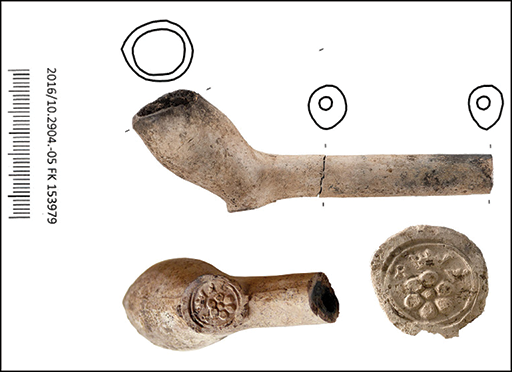
The four north–south/south–north oriented graves (nos. 229, 230, 231 and 232) that form the focal case study for this article contained a total of 15 individuals, some of whom were interred in coffins. Located in the northern part of the excavation area, the burials were partially disturbed by the construction of a nineteenth-century cellar (Figure 2). A clay pipe made of white earthenware (type Duco BT2) was found at the hip of individual 229.2 (Figure 3). Traces of soot confirm its use and the pipe maker’s stamp on the heel, showing a crowned rose and the monogram RW, can be attributed to Reichard West, who was noted as a pipe maker in council minutes from Mannheim (Germany) between 1673 and 1675 and died around 1675/1676 (Flatscher & Rindlisbacher Reference Flatscher, Rindlisbacher, Schneller and Lassau2024). Reichard’s production of clay pipes in Mannheim can be assumed to have started around or after 1650. Due to their fragility, clay pipes have a short lifespan (typically less than three years) and this piece was probably buried with its owner shortly after it was purchased, thus providing both a terminus post quem and a terminus ante quem for burial 229.2—and by extension burial group 229–232.
From left to right, graves 229, 230, 231 and 232 during excavation, upmost layer (figure © Archäologische Bodenforschung Basel-Stadt; photographs by A. Jost).

Clay pipe from grave 229 with pipe maker’s stamp attributed to Reichard West (Mannheim, Germany) (figure © Archäologische Bodenforschung Basel-Stadt; photographs by P. Saurbeck, section drawings by E. Flatscher).

The plague in Basel in 1610/1611 and 1667/1668
A qualitative review of historical documents, including the hospital records held in the Basel State Archives (StABS), provides valuable information on the waves of plague that ravaged the city. The records of the Basler Bürgerspital bear witness to several epidemics, though some received relatively little attention. The approximate beginning of such an outbreak in 1610 is only noted in a short addition to a register entry dated 22 June: “NB: ungefohrlichen umb dißer Zeit hat die Pest angefangen grassiren” (at about this time, the plague started to spread; StABS Spital V 7.1–4). Subsequently, only a few entries explicitly noted that patients suffered from the plague. Besides a notable increase in mortality, cases of recovery were also recorded. An addendum dated 18 March 1611 notes: “Ungefohrlichen biß an diße obstehende Persohn hat die Pest grassirt, zumaßen die vorbeschribenen Persohnen vast alle es seye dan die anderen Kranckheiten sonders dabey benambst an der pest verstorben […]” (Translated as “Until about [the death of] the person listed above, the plague was raging, to the point that the persons listed previously all died of the plague, unless other illnesses are explicitly noted.”) However, plague deaths were still recorded until the summer of 1611.
The Bürgerspital’s records of annual expenditure (StABS Spital F 12, Ausgabenbücher) show that there were 10–60 burials in ‘ordinary’ years in the sixteenth and seventeenth centuries. In contrast, 270 burials were recorded in 1610, and in the autumn and winter of that year frequent entries indicate the simultaneous burial of up to 11 deceased (StABS Spital F 12, Ausgabenbücher, 1610). For the last outbreak of the plague in Basel (1667–1668), a peak of 76 burials was reached in 1667 (StABS Spital F 12, Ausgabenbücher 1667). While multiple sources document a lower mortality rate during this outbreak (Lötscher Reference Lötscher1987: 78–74), it should be noted that the Bürgerspital accepted only patients with full citizenship status from either the city or the surrounding Landschaft, or those who had the financial backing of an employer (Burghartz Reference Burghartz, Mooser and Wenger2011). Some sources, however, indicate that domestic servants—even those originating from the Landschaft—were expelled from the city if they fell sick (Schluchter Reference Schluchter1987). The impact of such social givens must be considered when interpreting the suspected plague victims from group B (see online supplementary material (OSM) section S1).
Methods
Osteological assessment
Biological age, sex and stature were assessed using an established canon of osteological methods (Mitchell & Brickley Reference Mitchell and Brickley2018; see OSM section S2.1). Pathological lesions were recorded qualitatively (Buikstra Reference Buikstra2019; see OSM section S2.2), supplemented by an assessment of spondyloarthrosis deformans—a degenerative condition that affects the intervertebral joints of the spine—in all age groups. To evaluate these data a modified Index of Skeletal Frailty (ISF; Marklein et al. Reference Marklein, Leahy and Crews2016) was employed (see OSM section S2.2). The assembled data were used to generate individual biological profiles, allowing a direct comparison of subadult and adult individuals.
Stable carbon and nitrogen isotope analyses
The analysis of stable isotopes from human skeletal remains can provide information on diet, physiological and health status (Reitsema & Holder Reference Reitsema and Holder2018). Bone remodels throughout an individual’s lifetime, with ribs exhibiting the fastest turnover; these bones therefore provide information about nutrition and physiological stress in the final few years of life (Fahy et al. Reference Fahy, Deter, Pitfield, Miszkiewicz and Mahoney2017). Stable carbon and nitrogen isotope analyses were carried out on ribs from 11 of the 15 individuals (Table S1). The samples were analysed using the modified Longin method (Doppler et al. Reference Doppler2017) on an Integra 2 EA-IRMS (Sercon Ltd, Crewe, UK) at the Aquatic and Isotope Biogeochemistry research unit, University of Basel (see OSM section S2.3).
Detection of ancient pathogens
The study of metagenomes has greatly enhanced our understanding of the presence and impact of pathogens in historical populations. In recent years genomic analysis has provided insights into the spread of Yersinia pestis and the evolution of its virulence (Susat et al. Reference Susat, Bonczarowska, Pētersone-Gordina, Immel, Nebel, Gerhards and Krause-Kyora2020).
Eleven teeth were sampled from 10 individuals. Ancient DNA (aDNA) was extracted following established protocols, and high-throughput sequencing libraries were prepared (Krause-Kyora et al. Reference Krause-Kyora2018). All libraries underwent shotgun sequencing on Illumina HiSeq4000 (2×75bp). The resulting pathogenomic sequencing data were analysed to identify sequences specific to Y. pestis using the alignment tool MALT (Herbig et al. Reference Herbig, Maixner, Bos, Zink, Krause and Huson2016). Additionally, genome-wide data were generated for one of the five positive samples (229.2) to produce in-depth information on the bacterial component. These data were used for phylogenetic classification alongside existing data (228 modern and 38 ancient strains and Y. pseudotuberculosis) to calculate a maximum likelihood tree for the Basel strain (Susat et al. Reference Susat2021; see OSM section S2.4).
Results
Demography, stature and health status
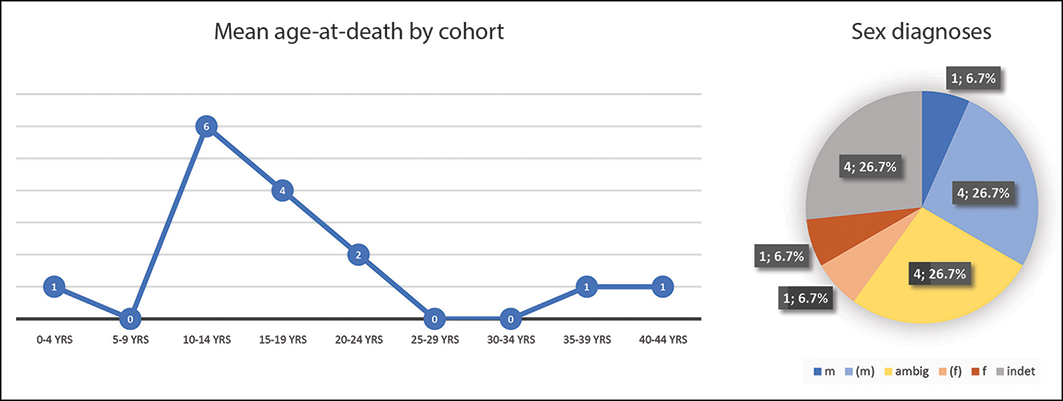
The 15 individuals in graves 229–232 range in age from young children to older adults (Table S1). The average age at death among the group is 17.7 years, with the youngest (229.4) having died aged 3–4 years and only four individuals having survived beyond 20 years (Figure 4). Due to the high proportion of subadults, osteological sex assessment was not possible for eight of the 15 individuals (ambiguous: n = 4; indet: n = 4). Of the remainder, five individuals were assigned a male and two a female sex. The stature of three adult individuals with sufficiently preserved longbones varied between 1.55 and 1.68m (Table S1).
Age and sex assessment of the 15 individuals in grave group 229–232 (sex diagnoses: number of individuals; percentage) (figure by L. Rindlisbacher).

Despite the low average age at death, the individuals from this grave group exhibit a large number of pathological conditions (see OSM section S3), including degenerative lesions, which is also reflected in a high average ISF value of 3.3 (n = 10, Table S3.1). Teeth were available for assessment for 11 individuals, all of whom display at least one carious lesion. Of the 310 teeth available, 64 are affected. Caries frequency in the group was 100 per cent, caries intensity 21 per cent. Four individuals (230.2, 230.3, 230.4 & 231.6) suffered from antemortem tooth loss as well as exhibiting active dental abscesses or cysts. Evidence for severe periodontal disease is only observed in the two eldest individuals (230.4 and 231.6). Transverse bands of decreased enamel thickness and/or pitting (enamel hypoplasia) are observable in 11 individuals, with 61 per cent of teeth affected. In addition, two individuals (229.2 & 231.6) show dental wear indicative of habitual use of the teeth as tools.
Only two individuals (231.2, 231.6) have osteological indications of active or chronic infections at the time of death. All individuals, however, show signs of non-specific physiological stress, both as acute or chronic processes as well as healed lesions. Seven individuals display porosity of the upper orbits (cribra orbitalia, 2 active) or the femoral neck (cribra femoralis, 3 active).
Spondyloarthrosis deformans occurs in all individuals; those under 15 years of age show light expressions, those between 15 and 25 years old mainly show ‘medium’ stages. A total of seven traumatic lesions are observed in four individuals, all antemortem healed fractures (of a clavicle, a femur, four ribs and one tooth). Congenital changes were found in two individuals: individual 229.5 exhibits a cleft palate and individual 231.5 shows an idiopathic scoliosis of the thoracic spine.
Nutrition
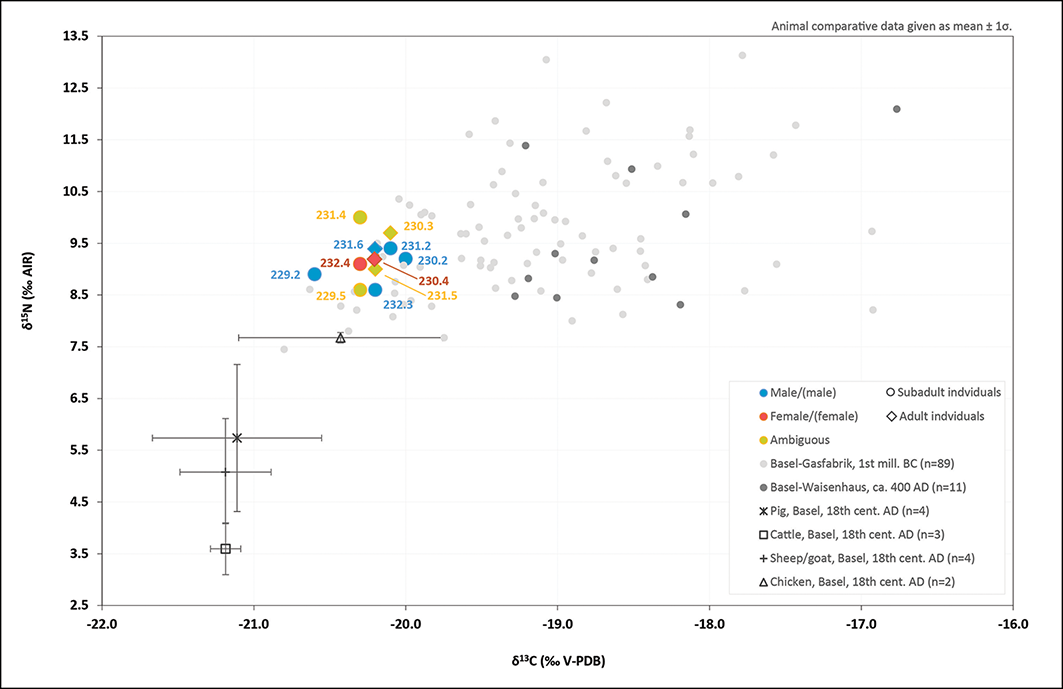
Stable carbon (δ13C) and nitrogen (δ15N) isotope data are listed in Table S1. The collagen preservation of all sampled bones met the quality criteria (Ambrose Reference Ambrose1990; van Klinken Reference van Klinken1999). Variation in isotopic values is small, with most samples (n = 6) clustering between δ13C -20.3 and -20.0‰ and δ15N 9.0 and 9.4‰. Mean values of subadults (n = 7) and adults (n = 4) show no significant differences (δ13C -20.3±0.2‰ versus -20.2±0.1‰ and δ15N 9.1±0.4‰ versus 9.3±0.3‰). Similarly, no differences were identified between (leaning) male (n = 5; δ13C -20.2±0.2‰, δ15N 9.1±0.3‰) and (leaning) female (n = 2; δ13C -20.3±0.1‰, δ15N 9.2±0.1‰) individuals (Figure 5).
Stable isotope data of the individuals in grave group 229–232. The comparative data are not categorised by age (subadult or adult) (figure by C. Gerling).

Compared with a reference dataset of faunal material from eleventh to thirteenth (Depaermentier et al. Reference Depaermentier2023) and eighteenth century contexts in Basel (Table S4.2), and also incorporating animals and plants from the first century BC Basel-Gasfabrik site (Knipper et al. Reference Knipper2017), the Early Modern individuals discussed in this article shared similar diets dominated by C3 plants and C3 plant-consuming herbivores, in particular sheep/goat and pig. The low δ13C values indicate that C4 plants (such as millet) were consumed only in small quantities, if at all. This contrasts with preceding Late Iron Age (late first century BC) and Late Antique/early medieval (c. AD 400) diets, where single individuals with more positive δ13C values are attested (Knipper et al. Reference Knipper2017; Depaermentier et al. Reference Depaermentier2023). The low δ15N values exclude suckling animals, chicken and salmonids as significant food resources. The Stadtcasino individuals plot at the lower end of the δ15N distribution for Basel-Gasfabrik (late first century BC) and Basel-Waisenhaus (c. 400 AD) (Figure 5), yet these values are still enriched by one trophic level compared with eighteenth-century fauna, indicating the consumption of animal protein.
Pathogen analysis
DNA was successfully isolated and shotgun sequenced from all 11 samples, generating between 8 and 40 million raw reads per sample. Pathogen screening revealed five samples positive for Y. pestis. Among the screened samples, four yielded low read counts, ranging from two to 359 reads. In contrast, sample 229.2 exhibited a higher number of pathogen-associated reads (1046, see Table S1) and was submitted for deeper sequencing, resulting in a total of 2 121 086 775 raw reads. The merged dataset was aligned to the Y. pestis reference genome (CO92, NC_003143.1), successfully covering 89 per cent of the chromosome and between 81 and 94 per cent of the three plasmids (Table S4.1). Analysis of terminal deamination patterns demonstrates damage profiles characteristic of authentic ancient DNA (see OSM section S2.4).
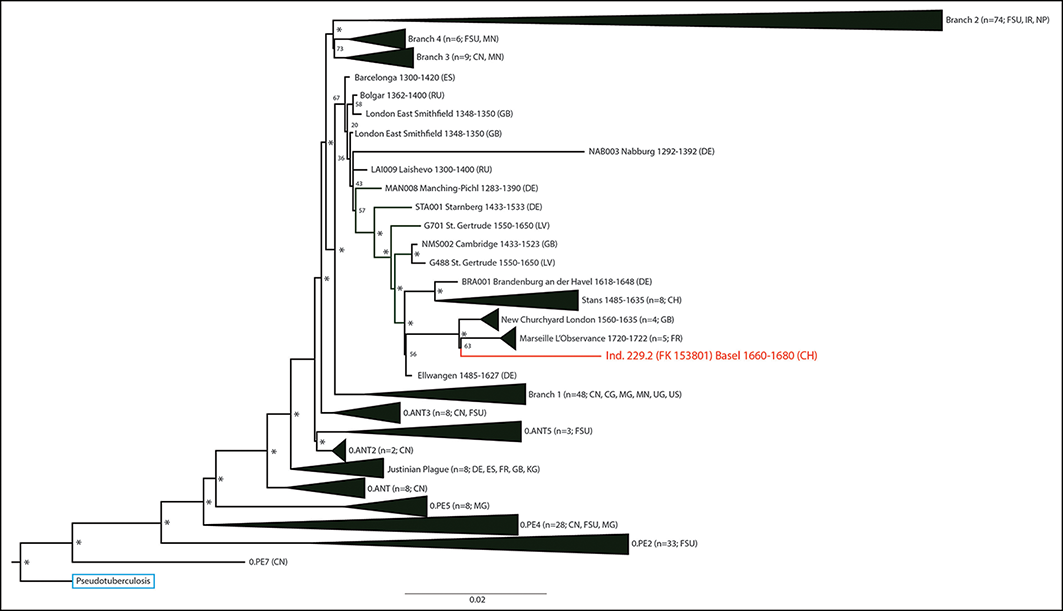
Comparative analysis with modern and ancient Y. pestis strains reveals that the strain in individual 229.2 clusters with strains identified in individuals who died during the plague epidemics in London (1560–1635) and Marseille (1720–1722) (Figure 6). The analysed strain exhibits a marked reduction in coverage within the pla gene region (NC_003132.1:6428-8530), which encodes a hypothetical protein possibly involved in regulating transcription, situated on the pPCP1 plasmid. Depletion of the pla region has previously been observed in post-Black Death strains (i.e. after 1353) (Susat et al. Reference Susat, Bonczarowska, Pētersone-Gordina, Immel, Nebel, Gerhards and Krause-Kyora2020).
Maximum likelihood tree for the Y. pestis genome from individual 229.2 (figure by authors).

Discussion
Osteological evidence for a catastrophic mortality event
The simultaneous burial of several bodies observed in graves 229–232 strongly suggests a significant mortality event. In addition to the high proportion of under-20-year-olds, the number of 12- to 19-year-olds is striking, as this age group shows a low mortality rate in non-catastrophic death samples (Figure 4; Chamberlain Reference Chamberlain2006). The surplus of males among the individuals for whom osteological sex could be assigned is also conspicuous, although sex is ambiguous or indeterminable for eight individuals, making a conclusive assessment of the sex ratio challenging.
In a burial community representative of natural attrition within a population, a high proportion of subadults, especially of young children below the age of six, is indicative of population growth, as a high birth rate will be accompanied by more child deaths (Bocquet-Appel Reference Bocquet-Appel2008). In the present case, however, the demographic structure within the grave group does not fit such an explanation. A peak in the mortality of young males is also often associated with warfare (Chamberlain Reference Chamberlain2006: 123–25) but the absence of perimortem injuries rules out this possibility here. Relatively few pathological lesions were active around the time of death among the investigated group, even compared with other burial communities from this period (e.g. Molleson et al. Reference Molleson, Cox, Waldron and Whittaker1993; Ulrich-Bochsler et al. Reference Ulrich-Bochsler, Cooper and Baeriswyl2016). Together with the mortality profile, this observation suggests an epidemic event.
The plague pathogen
The pathogenomic data indicate that at least five individuals from burial group B (one-third) were infected with Y. pestis and quite possibly died from the infection. This evidence supports the hypothesis that the former cloister garden was occasionally used as an emergency cemetery, here possibly linked to the last plague outbreak of 1665–1670 in Switzerland. The clay pipe associated with burial 229.2, which also yielded the best preserved Y. pestis DNA, supports this temporal link.
Reconstruction and analysis of the Y. pestis genome from burial 229.2 suggests that the bacterium is most closely related to strains obtained from individuals buried in plague contexts in London and Marseille (Spyrou et al. Reference Spyrou2019). All three strains have a depletion in the pla region characteristic of post-Black Death strains (Susat et al. Reference Susat, Bonczarowska, Pētersone-Gordina, Immel, Nebel, Gerhards and Krause-Kyora2020). This depletion may have reduced transmission and infection rates, contributing to varied disease outcomes. However, the disease was likely fatal in the five identified cases (229.2, 231.2, 231.4, 231.5, 231.6).
Plague demographics
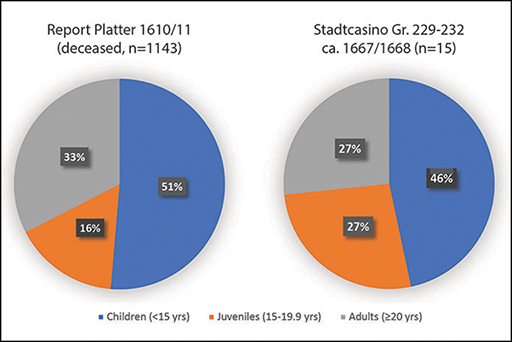
The low average age at death (17.7 years), the high proportion of non-adult individuals and over-representation of males are all consistent with observations from other plague contexts of the Early Modern period (Kahlow Reference Kahlow2007; Castex & Kacki Reference Castex and Kacki2016). In a transcription of the report left by town physician Felix Platter, Lötscher (Reference Lötscher1987) undertook a detailed evaluation of the plague numbers in the five Basel Vorstädte (the suburbs surrounding the city centre), distinguishing between men, women, Jungmänner, Döchteren (both sexes aged 15–20) and children up to the age of 14. At 77 per cent, the high proportion of children who fell ill and died in the Vorstädte in 1610/1611 is striking (Table S5.1). Women seem to have had the best chance of surviving infection (approximately 50%), while men showed a lethality rate of 62 per cent. Overall, around 60 per cent of those infected were under 20 years old, and they made up roughly the same proportion of those who died. For the Jungmänner, Döchteren and children in the Basel suburbs, a lethality rate of around 72 per cent can be observed, while the adults had a lower lethality rate of 54 per cent. These demographic patterns are reflected in the individuals from grave group 229–232 (Figure 7).
Comparison of the age composition of the Felix Platter data for the 1610/1611 plague and grave group 229–232 (figure by L. Rindlisbacher).

Working with an estimated population size of around 12 600 for Basel, a mortality rate of approximately 30 per cent is assumed for the outbreak of 1610/1611, with a morbidity rate of 50 per cent and a lethality rate of 62 per cent (Lötscher Reference Lötscher1987: 38). However, this outbreak was particularly severe and no comparable reports are available for the outbreak of 1667/1668. The fact that the death toll at the Bürgerspital was relatively low compared with earlier epidemics may be an indication of reduced lethality in this later outbreak. Overall, a particular demographic pattern seems to be associated with the plague in the Early Modern period, not only in Basel but also in various locations in France: an increased mortality of juvenile age groups is observed in the sixteenth and seventeenth centuries compared with outbreaks of the Black Death in the fourteenth century (Castex & Kacki Reference Castex and Kacki2016).
Who lives and who dies during plague?
Several plague cemeteries are recorded for Early Modern Basel, including the Elisabethenfriedhof (Steiner Reference Steiner2019) but not the site in the former Barfüsser monastery (Roth Reference Roth, Bodenforschung and Basel-Stadt2020). Proximity to the hospital does, however, suggest a connection and bioarchaeological characterisation of the sample provides information on the socioeconomic background of the buried individuals (Rindlisbacher et al. Reference Rindlisbacher, Flatscher, Pichler, Veling, Lätzer-Lasar, Schreiber and Tollkühnin press; Rindlisbacher Reference Rindlisbacher, Flatscher, Pichler, Veling, Lätzer-Lasar, Schreiber and Tollkühnin press).
Use of the ISF enables a comparison of the proportions of different pathological conditions within the burial group without overemphasis of the state of health at the time of death, thus following a life-history approach. Despite the low average age at death, the ISF in the burial group is high; monastic and non-monastic medieval burials from London yield an ISF of 2.09 for 18- to 25-year-olds (Marklein & Crews Reference Marklein and Crews2017: tab. 9), while the same age group from the analysed burials have an ISF of 3.67. Due to the canon of characteristics included in the ISF, indices should rise with increasing age as degenerative changes and trauma accumulate over the course of a lifetime. This is true for the analysed individuals from Basel (Figure S3.1) but a diachronic comparison reveals that the Stadtcasino individuals have a higher proportion of enamel hypoplasia, parodontal disease, healed trauma and degenerative processes than the individuals from medieval Britain.
Evidence of non-specific stress in childhood may be seen in the presence of transverse enamel hypoplasia, found in all scored individuals in the Stadtcasino group (Table S3.5). In an Early Modern context (or any setting pre-dating the twentieth century), hypoplasia that formed between 3 and 6 years of age (judged by the position of the band on the tooth crown) are likely social indicators; by this age, children were actively integrated into family work activities and were therefore also exposed to diverse pathogens and stress factors (Röder Reference Röder, Kory and Masanz2015: 280–81). How early and, above all, how strenuous and what types of work (younger) children performed depended not only on a society’s understanding of childhood (Röder Reference Röder, Kory and Masanz2015) but also on the socioeconomic status of their parents (Lewis Reference Lewis2016: 140). Members of the poorer, lower social classes, in particular, performed physically demanding work (Jütte Reference Jütte2000: 56–57; Redfern Reference Redfern2017: 120) and the resultant strain can manifest in the skeleton both in degenerative lesions and in musculoskeletal stress markers (Vilotte et al. Reference Vilotte, Churchill, Dutour and Henry-Gambier2010). Considering the low individual ages at death observed among the group, the number of individuals showing activity-related degenerative spinal or shoulder lesions is striking (Figure S3.7). A higher percentage of joint and spine lesions are observed in adolescents (aged 14–25 years) from urban areas than from rural contexts in medieval England (Lewis Reference Lewis2016); although individual socioeconomic status is not considered, apprenticeship and work migration may be contributing factors and parallels may be drawn with Early Modern Switzerland (Simon-Muscheid Reference Simon-Muscheid2010).
Socioeconomic background also dictates access to food and nutrients, which in turn may be inferred from stable isotope data. Although primarily used to provide information on dietary composition (Pollard et al. Reference Pollard, Armitage and Makarewicz2023), carbon and nitrogen isotopic ratios can also be influenced by aspects of individual health (Richards & Montgomery Reference Richards, Montgomery, Buikstra and Roberts2012; Reitsema & Holder Reference Reitsema and Holder2018). Individuals from grave group 229–232 have broadly similar isotopic values but slight outliers may be demonstrative. Individuals 229.5 (cleft palate) and 232.3 have lower δ15N values; 229.2 (plague, teeth-as-tool use) has a lower δ13C value; while 231.4 (plague) and 230.3 (inflammation, degenerative lesions) have (slightly) elevated δ15N values. Except 230.3, all outliers are subadults. In this context, it seems plausible that these differences are disease-related rather than reflecting different diets. Low δ13C values are, for example, observed in syphilis patients (Olsen et al. Reference Olsen, White, Longstaffe, von Heyking, McGlynn, Grupe and Rühli2014), and metabolic stress during pregnancy, hunger episodes and inflammatory diseases can lead to fluctuations in δ15N ratios in body tissues (D’Ortenzio et al. Reference D’Ortenzio, Brickley, Schwarcz and Prowse2015; Walter et al. Reference Walter, DeWitte, Dupras and Beaumont2020).
The ability to recover normal physiological functioning following overexertion or illness is not the same for every individual and this ability is heavily influenced by social status. If a person cannot ensure their basic needs are met without working constantly, healing or recovery is often foregone (Redfern Reference Redfern2017: 77–78). Studies on the modern ‘presentism’ phenomenon (going to work while sick) identify financial stress as a decisive factor behind this behaviour (Callen et al. Reference Callen, Lindley and Niederhauser2013). From an osteological point of view, this means that people living in precarious circumstances are more likely to experience chronic overexertion and are therefore more likely to show osteological markers of stress. These skeletal manifestations have been linked to socially mediated health inequalities in both modern clinical and archaeological contexts and have in recent years also been the topic of various osteoarchaeological studies (e.g. Larsen Reference Larsen2015; further details in OSM section S5). During the Early Modern period, a large proportion of Basel’s population lived under precarious economic conditions, covering a spectrum from low-income work and occasional begging to the most profound poverty (Burghartz Reference Burghartz, Mooser and Wenger2011).
During a crisis or epidemic, social status has a decisive influence on mortality, with access to essential goods or institutions and overall social cohesion determining the probability with which groups of people fall ill, need care or die (DeWitte Reference DeWitte2020; Galanaud et al. Reference Galanaud, Galanaud, Giraudoux and Labesse2020). The degree of physiological, physical or dietary stress experienced during childhood, often directly related to social status, also influences vulnerability during an epidemic (Primeau et al. Reference Primeau, Homøe and Lynnerup2018). As is evident from plague burials in Basel and elsewhere, the intersectionality influencing the social status—and related social participation (Rindlisbacher in press)—of the members of the middle and lower classes affected the health status of individuals in many ways, including their susceptibility and resilience to the plague.
In the light of these various observations drawn from the different analyses the interpretation of burial group 229–232 as lower-class individuals, maybe even some non-citizens (see S1), seems highly plausible. Furthermore, such observations hold true for the other individuals from the Stadtcasino site (for the comprehensive study see Rindlisbacher in press). These patterns underline the influence of health inequalities which often intensify in times of crisis in Basel and elsewhere.
Conclusion
Detection of the plague pathogen Yersinia pestis in grave group 229–232 from the Stadtcasino site in Basel not only corroborates the catastrophic mortality profile of the 15 buried individuals, but the recovery of a stamped clay pipe from grave 229 permits both the precise dating of the burials and the identification of the specific bacterial strain responsible for the 1667/1668 Basel outbreak. Combined with the rich historical sources on plague epidemics in Basel and patient records from the Bürgerspital, the Stadtcasino site offers an extraordinary opportunity to examine the differential mortality of one of the later plague outbreaks. The recent Covid-19 pandemic demonstrated how deeply socioeconomic status influences the vulnerability of specific social groups, but this is not a new phenomenon; this article adds another case study underlining the opportunities for gaining differentiated sociohistorical insights offered by the implementation of interdisciplinary approaches in archaeology. Comparison of the different burial groups across the wider Stadtcasino site will highlight the diversity of the experiences of groups often monolithically addressed as the ‘lower classes’ (Rindlisbacher in press) and thus enable new and more nuanced narratives of Early Modern Basel and life during a historic pandemic.
Acknowledgements
The authors would like to thank Peter Roth (historical analysis, transcriptions), Rahel Ackermann (numismatics), Norbert Spichtig, Marco Bernasconi (project management ABBS), Philippe Saurbeck, Peter von Holzen (photography and illustrations), the whole team of the 2016–2017 excavations, Moritz Lehmann and Thomas Kuhn (MS analysis), Barbara Stopp (animal species determination) and Julian Susat (aDNA lab work) for their contributions.
Funding statement
This project was supported by the Archäologische Bodenforschung Basel-Stadt, the Freiwillige Akademische Gesellschaft and the Department of Environmental Sciences, University of Basel.
Online supplementary material (OSM)
To view supplementary material for this article, please visit https://doi.org/10.15184/aqy.2026.10297 and select the supplementary materials tab.
Author Contributions: using CRediT categories
Laura Rindlisbacher: Conceptualization-Lead, Data curation-Equal, Formal analysis-Equal, Funding acquisition-Lead, Investigation-Equal, Methodology-Equal, Visualization-Equal, Writing - original draft-Lead. Elias Flatscher: Formal analysis-Equal, Investigation-Equal, Visualization-Equal, Writing - original draft-Equal. Claudia Gerling: Formal analysis-Equal, Investigation-Equal, Methodology-Equal, Visualization-Equal, Writing - original draft-Supporting. Ben Krause-Kyora: Data curation-Equal, Formal analysis-Equal, Methodology-Equal, Visualization-Equal, Writing - original draft-Supporting. Sandra L. Pichler: Conceptualization-Lead, Funding acquisition-Lead, Investigation-Equal, Methodology-Equal, Project administration-Lead, Supervision-Lead, Writing - original draft-Equal.




 Open access

