


coda: Période musicale, vive et brillante, qui termine un morceau.
coda: see cauda.
cauda or (low) coda: a tail. … caudam trahere, i.e. to be mocked, coda illa Verrina. – The privy member.
cado: to fall, fall down, descend.
coda: an implement for driving horses, goad or whip, … animating, inspiring … exalted by the inspiring.
Invited to write something as a finale to this extraordinary collection of essays, I was unsure what to call it. “Conclusion” was clearly wrong: the essays did not invite conclusion, but its opposite, opening up a new world of thought. I tried “Envoi” – was I not sending these essays forth? – but Peter Goodrich, as coeditor, gently nixed that idea: “Envoi” was already taken, he noted, and surely secondhand Derrida at this late date was a bad idea. It suddenly struck me: “Coda”! Since my musical education had ended when I was eight (about the same time as my mathematical education), I wasn’t too sure what a coda was. So I decided to look it up. When I found it in the Trésor de la langue française, I was delighted: “Période musicale, vive et brillante, qui termine un morceau.”Footnote 1 My termination would be lively! Brilliant! Musical! Of course, all that Italian sprezzatura might need a bit of Latin gravitas. So I turned to T. Lewis Charlton’s Elementary Latin Dictionary. There, under “coda,” I read: the “low” (vulgar) form of cauda: a tail; also “the privy member” (as Charlton delicately puts it); and, in the locution caudam trahere, “to be mocked” (literally, to drag one’s tail).Footnote 2 Oh, what a falling off was here!Footnote 3 Not just a tail, but a dragging “privy member” subject to mockery! Before my eyes, the vowels were rearranging themselves, anagrammatically, into the word “cado”: I descend … I fall.
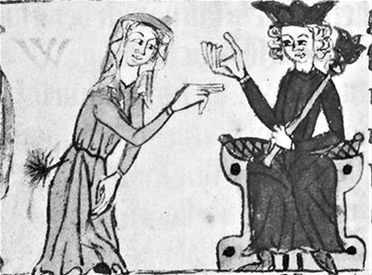
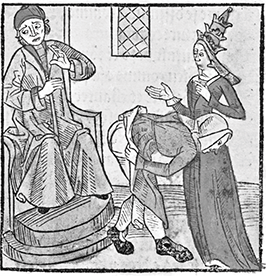
Then I remembered Calefurnia’s cauda. It appears in a pair of images at roughly the center of my book: apparently the most popular part of the book, so I take the liberty of reproducing the images here (in the hope of boosting sales) (Figures 13.1 and 13.2).Footnote 4 In the first image, which comes from a c.1295–1304 illustrated manuscript of the thirteenth-century code of laws called the Sachsenspiegel, a brush-like tail protrudes from Calefurnia’s backside. Here, one might say with Shakespeare’s Touchstone, thereby hangs a tale.Footnote 5 For the image of her tail in fact comes with a tale explaining a legal rule: Calefurnia was angry “because her demands could not proceed without a spokesman,” and so, “in a fit of rage,” she “misbehaved before the emperor” (the judge in the case). She thus “forfeited [for] all [women]” the right to bring a suit or plead in court. A later commentary concludes that this “misbehavior” took the form we see in the second image: there, she turns her back to the judge, bends over, lifts her skirts, and – as Başak Ertür puts it – “bar[es] her ass to the judge.” (Ertür envisions this as a pop-up.)Footnote 6 Mooning the judge, embracing her fallen condition, Calefurnia seems to declare (with that prolific author Anonymous), “the law is an ass.”
Calefurnia (tail exposed) tells her tale to the judge in an illustrated manuscript of the Sachsenspiegel (ca.1295–1304). Heidelberg University Library, Cod. Pal. germ. 164.
Calefurnia moons the judge in an edition of Martin le Franc’s profeminist Champion of Women [Champion des dames] (1488). Sig. s8r. Newberry Library, Chicago, Special Collections.

Calefurnia (and her creators) may be innocent of etymological tales. But, turning tail on the law while goading the judge, she nonetheless expresses the origin of the origin of the word cauda in the Sanskrit coda, which signifies (according to Sir Monier Monier-Williams’s Sanskrit-English Dictionary) “an implement for driving horses, goad or whip.”Footnote 7 (Presumably for driving asses too.) The Latin cauda (“coda” in the vulgar form) clearly emerged from the Sanskrit, in one of those frequent metonymic transfers between subject (whip) and object (tail). The two in fact continued to merge in English penal metaphors, for instance in the cat-o-nine-tails (a tail that whips tails) or “whipping at the cart’s tail” (using a tail to whip a tail hitched to a tail). One can see (again thanks to Sir Monier Monier) that the ambiguity of the Sanskrit adjectival forms – “animating,” “inspiring,” “exalted by the inspiring” – similarly merge subject and object. For the coda is both a goad that inspires and the thing inspired.
It may appear that I am simply chasing my tail here, but what precedes has in fact led me, however dizzily, to some of the things I would like to say. First, this thing I am calling a coda is both mine and that of the marvelous contributions here that have inspired it. They are the exalted subject – the consciousness – of which this is the mere object, coming to life only because their ideas have animated my words, as I have tried to think alongside them. Second, the essays in this collection offer radically new ways of thinking about the conjunction of law and performance: that is, they are not the tail (appended to my book); I am the tail appended to theirs. Third, I have treated these essays as an invitation to “attempt a self-criticism” (to paraphrase Nietzsche).Footnote 8 In taking up this invitation, I may be fated to caudam trahere: to drag my tail or, like Calefurnia, expose myself, in defiance of my own dignity. But if in this I fall (cado) from the heights to which I aspire, it is, I think, a Fortunate Fall, and the occasion for it – these essays – a great gift: a cadeau.
The Revenge of the Ontological Id, or the Methodological Über-Ich Unbound
Among the central things these essays have helped me see anew are the methodological rules I laid down for myself in writing my book. The aim of these rules – a set of strict prohibitions – was to keep my eye on a sharply defined topic: law as performance; “law itself” as a performance practice. It seemed to me that these prohibitions would allow me to say something very specific: not merely that law is performative, or that performances can influence law, but that “showing doing” is central to law in a very concrete institutional way. I wanted to show the centrality of sensory, kinesthetic, embodied, enacted expression to law as an institution, law’s modes of self-expression. These prohibitions were clearly self-imposed, but they seemed to come to me in the stentorian voice of a scholarly Über-Ich. No stage plays or other modes of extralegal performance, even if their subject was law! No mere verbal rulings, even if their subject was performance! No attention to legal words alone (however “performative” those words)! That would be cheating.
But, a confession: while I tried not to, I did sometimes cheat, rebelling against my scholarly superego. No fiction allowed, and yet I couldn’t resist Calefurnia, a creature of wild fantasy with only the faintest resemblance to her origins in the first-century BCE plebeian Caia Afrania. My last chapter ended with the “Trial of the Sorcerer” at the Gray’s Inn revels in 1594, featuring the Sorcerer and the Prince of Purpoole.Footnote 9 Those moments of rebellion were symptoms, pointing to the tension between my methodological boundaries and the book’s central claims. For instance, if I tried to separate fictional texts from “the things real people did in real legal arenas” (to focus solely on the latter), I also insisted that “[l]aw and its aesthetic representation are not always radically distinct kinds of things.”Footnote 10 If I tried to segregate the extralegal from the legal, I also insisted that “real law” could not be hermetically sealed off from theatrics, or anything else. If I tried to sideline texts to focus on performance, my sources were of course mostly texts: texts whose lively textuality I treated as key to how people viewed and understood legal performance. My central claims – which sought to deconstruct the false ontological boundaries separating fiction from the real, law from not law, text from performance – were in fact deconstructing my methodological boundaries. Ontology was at war with methodology, surging up like a primal drive from the book’s depths to flout its prohibitions. Just as, in the image, Calefurnia wags her cauda defiantly at the law, so did my ontological Id wag itself defiantly at my methodological prohibitions.
In his essay, Jesús Velasco generously likens me – methodologically speaking – to a physicist: “as a physicist would set aside air resistance to produce an experiment,” so Law as Performance set aside texts, fictions, the “extralegal” (he implies) in order to test its central hypothesis (120). True, I tried to be scientific, but (as he also suggests) marvelous things happen when one opens the window, lets the air flow back in over the barriers, and watches ideas free themselves, take flight, and soar. That is what the essays in this collection do: something like what Velasco describes as the museum at night, when at dusk objects come to life and begin to “d[o] all sorts of things and kee[p] all sorts of conversations while we sleep, … mixed up, and … in our dreams … shap[ing] some of the ways we will think at sunrise” (129).
What follows is my attempt to describe all the things that have come to life in this collection, while registering the ways that the essays here shake loose the distinctions that sustained my methodological strictures, unbinding the rigid dichotomies on which they depended. In this animated museum that is also a legal dreamscape, we have the hetaira Phryne, her breasts bared for the jury; beer-belching judges; a modern-day Little Red Riding Hood; an oath-taking legislator with a giant yellow umbrella and an X through the laws; “Naked Athena” the ballerina; Lady Rhetorica as a courtesan (meretrix); “the oscillating twitch of [law’s] wax nose.”Footnote 11 We have assize circuits modeled on the cosmos, open-air moothills and courts of piepowder, the scripting of visible affect and courtroom tears, chironomia and indigitation and dactylograms, legal didascalia, silence and laughter, and the “mute eloquence” of the letter.Footnote 12
The Play of the Text, or the Word Unbound
[P]erformance [is] a distinctive form of expression, palpably different from … textual expression. [8]
If the letter of the law is mutely eloquent, it also actively mutes eloquence. As Derek Miller puts it, “legal writing seems designed to leave performance out” (116). The “all too human escapades” that law strives to master, writes Goodrich, “the corporeography of adversity, the verbal and gestural articulations of advocacy, … the happy hum of order, the capriole and merry dance” (and, let it be said, also the toll of the bell and the death march) “are later redacted to the monochrome regimentations of the page” (198). In Lorna Hutson’s description, “once codified or assimilated to the body of knowledge called law,” legal decisions “are promptly abstracted and insulated from th[e] crowd-pleasing compromises of their origins,” that is, from the “[a]uditory and sensory reactions and distractions” that shaped them (36). The legal severing of performance and text is not a natural occurrence but an act of force: looking at the history of legal performance, notes Ertür, one realizes “just how much ink and sweat has been spent in trying to subdue [it]” (221).
Miller offers us a concrete critical program for seeing where text has suppressed performance: seeing between the lines of “the legal performances” that texts “encode or anticipate.” “By searching for dialogue, speech prefixes, stage directions, paratext, and didascalia,” he writes, “we will find some of law’s essential performances – sometimes concealed, sometimes hiding in plain sight,” showing us “what legal texts prioritize and exclude, … the slippages between legal texts and legal performances” (102). He vividly illustrates such slippage in his evocation of a scene from the film My Cousin Vinny (114). A college student named Bill believes the police have arrested him for accidentally stealing a can of tuna from a convenience store, but in fact they have arrested him for the murder of the convenience store clerk. After Bill admits to taking the tuna, the sheriff asks him: “At what point did you shoot the clerk?” Bill repeats with increasing incredulity: “I shot the clerk, … I shot the clerk. … ” In court, the sheriff reads Bill’s “statement” as a confession to murder: “He said, ‘I shot the clerk. I shot the clerk.’” As Miller points out, it is very hard to render this tonal slippage in a purely textual medium: You would have to hear it (115), or, better, to see it.
So too would you have to hear and see the tonal slippage in the Hong Kong legislator’s oath-taking ceremony that Marco Wan discusses. In his account, dissident legislators used the oath-taking ceremony as an opportunity to protest Beijing’s political control and the slow disintegration of democratic governance. Their protest took the form not only of visible theatrics but of aural effects meant to estrange the words of the oath: ironic tones, extreme pauses. Nathan Law, for instance, adopted a “‘distinct rising tone’ of mockery whenever he pronounced the Chinese character for ‘country’” (244). Veteran legislator Leung Kwok-hung “read out the oath loudly and aggressively [and] inserted dramatic pauses at unexpected moments” (244). Lau Siu-lai paused for six seconds between each of the words as she read. All of the protestors lost their cases and were barred from taking office.
In both of these cases, law works retroactively: in My Cousin Vinny, its transcription takes control of oral meaning; in the Hong Kong cases, it crushes tonal insubordination. But law also proactively scripts performance, as Miller suggests. If “[a]nima lex” is “lex loquens” (speaking law), lex loquens often consists in “the scripted performance of the dead letters of the parchment rules” (Goodrich 202). One can see such scripted performance at work in the confessional and inquisitorial dialogues Velasco describes. Working “algorithmically” (as he writes), they may appear to instantiate a legal “I-thou”: the interrogator’s follow-up questions depend on the answers of the penitent or the accused. But they are in fact coercive catechisms: “scripted strophe-antistrophe[s]” that “forc[e] the translation of the vernacular into orthodox legal language” in order to “produce an archivable object that can be used as proof”: a text that constitutes legal “truth” (121).
Nevertheless, all that “ink and sweat” spent “trying to subdue [performance]” ultimately fails. As in the Hong Kong ceremonies, the extempore thrusts itself into the scripted scene, disrupting the text. “[O]n one side, enter the formalization and regulation of dialogue,” writes Velasco, “and, on the other side ente[r] improvisation, unscripted action, unpredictable affect,” which “may undo the script” (121). If “legal writing seems designed to leave performance out,” it cannot. For law restlessly “move[s] between texts and acts,” as Miller writes (97).Footnote 13 In My Cousin Vinny, the tonal slippage is not merely from performance to text, but from performance to text to performance: from the police station, where Bill’s words are “redacted to the monochrome regimentations of the page”; to the courtroom, where the sheriff’s voice invests those “monochrome regimentations” with new meaning, transforming incredulity into confession. What these instances remind us is that the dichotomy between text on the page and embodied performance is a false one: law consists in both the textualization of performance and the performance of the text, and the textualization of the performance of the text (and so on, in a never-to-be-disentangled set of transferences). Is performance “a distinctive form of expression, palpably different from … textual expression”? I’m not so sure.
The idea that text and performance can be severed becomes especially doubtful when one looks at the centrality of the performed word in the rhetorical tradition. Both when memorizing their speeches and when preparing to improvise, legal orators drew on a set of established techniques, as Lorna Hutson reminds us: a repertoire of both verbal and performance devices guided by long-standing rhetorical principles. Quintilian may have admired Demosthenes’s response when asked to name the three most important elements of oratory (“Delivery, … delivery, … delivery”). But, as she points out, Quintilian’s discussions of delivery look like a sideline, when set beside his elaborate discussions of inventio, dispositio, elocutio, status, proofs, narrative, and other verbal skills. Hutson rightly insists that we not elide “the contribution of rhetoric as inventio with its contribution as performative technique” (55). She also reminds us that, in the law court, the script – wrought through inventio, dispositio, elocutio (and so on) – could not be severed from performance. If the art of the orator lay in verbal and narrative technique, verbal and narrative technique was performance technique.
This never ceased to be true, as we can see in the eighteenth- and nineteenth-century guides to cross-examination that Simon Stern discusses. In The Advocate: His Training, Practice, Rights and Duties (published serially in the 1830s), Edward William Cox explains that the advocate must at once “be a good actor” and a master of narrative manipulation:
[G]o at once to the marrow of the story he has told, as if you were not afraid of it; make him repeat it; then, carry him away to some distant and collateral topic, and try his memory upon that, so as to divert his thoughts from the main object of your inquiry, and prevent his seeing the connection between the tale he has told and the questions you are about to put to him. Then, by slow approaches, bring him back to the main circumstances, by the investigation of which it is that you purpose to show the falsity of the story. (Stern 158)
For Thomas Erskine – lawyer for a tailor-plaintiff who demanded payment of his bill (from a perhaps improvident client) – the key was not only to trap the witness but to get a rise out of the audience. As Stern tells the story, the witness “testified that a coat had been poorly made, with one sleeve longer than the other.” The dialogue that followed went something like this:
Erskine: You will swear that one of the sleeves was longer than the other?
Witness: Yes. …
Erskine: Now, sir, will you swear that one of them was not shorter than the other?
Witness: Yes.Footnote 14
Erskine won the case.
The Manifolds of Space and Time, or Performance and Law Unbound
I have tried to keep my eye squarely on performance in legal arenas. … [Historical legal records] describe events in the world at large, [but] are frustratingly silent on … how events in specifically legal arenas looked, sounded, felt; … in short, performance by and before the law. [21]
Accounts of moments like Erskine’s trap have the structure of theatrical peripeteia: emotional, narrative, and performative concentration; recognition, reversal, and a moment of awe. We could take the trial as the paradigmatic legal performance, envisioning it as akin to theatre (in its normative institutional setting): a roughly two-hour spectacle in a fixed location with a beginning, middle, and end. Certainly, both rhetorical theorists and contemporary commentators often encourage us to think of trials as having that structure: both Cicero and Quintilian have theatre in mind as a model. But trials have their own temporality, far longer and more temporally and spatially diffuse than theatre’s. They partake of a more expansive mode of performance: not delimited in space and time or governed by the human visual and auditory sensorium. In this, we might pay heed to Subha Mukherji’s warning that we must not “essentialise” performance (71). For performance appears in this collection as a kaleidoscopically mutable thing. For instance, the assize trials Piyel Haldar describes may have been “theatrical and even melodramatic events,” as he writes, but “the performance of law took place on a wider stage than those [stages] provided by the assize courts themselves” (Haldar 83). What is it “to keep [one’s] eye squarely on performance in [specifically] legal arenas, … performance by and before the law”? What counts as performance and where are the boundaries of legal arenas? I am not sure.
Haldar’s account of the assize circuits as performance spaces stands as a particularly helpful challenge, given the importance of the circuits to Anglo-American law. “[A]ssize trials and the court buildings in which they were held were no more than nodal points in [an] organized network of communication that extended over the entire social and geographic terrain,” writes Haldar. “[I]t was the itinerancy of the regional circuits themselves,” the “paths and routes between shires and assize towns,” that “provided a larger, more significant, stage for the presentation of law” (83). Certainly, the nineteenth-century lawyer-novelist-archivist John Cordy Jeaffreson envisioned the assize judges’ processions from town to town as a magnificent spectacle for the entertainment of the populace:
When they moved, crimson and gold, burnished steel and floating ancient [pennants] gladdened the eye: [and] the ear was addressed by the blare of trumpets. (Haldar 85, quoting Jeaffreson)
At the same time, as Haldar shows, the circuits called upon a larger, more mystical spatial, visual, and auditory imaginary. Providing choreographic direction, the Crown acted as “an all-seeing mechanism, a primum mobile in a Pythagorean/heliocentric system, that set the whole mechanism of the circuits in motion,” following the era’s “Pythagorean poetics” (Haldar 83). Haldar quotes Sir Francis Bacon:
You that are Judges of the Circuits are as it were the planets of the Kingdom. … Do therefore as they do; move always and be carried with the motion of your first mover, which is your sovereign. (Haldar 83)
As Haldar reminds us, material and symbolic space cannot be disaggregated. “In their circuits and revolutions,” he writes, “microcosm resembled macrocosm and revealed the greater order of the universe” (83).
While the assize circuits had a spatial and temporal form that was entirely different from that of the piepowder courts Haldar discusses, both had a profound relationship to the land that was at once material and symbolic. The circuits traveled “paths wired into the landscape.” The piepowder courts, held in marketplaces during market fairs, located law in the earthiness of the marketplace, a fact registered in their name: the pye-poudre, or curia pedis pulverizati. According to Blackstone, that name derived from the dusty feet (the “pied poudré”) of the suitors to the court: the “travelling merchants, itinerant chapmen, shepherds vagabonds and drovers” who “by their motion raise pulverem vel lutum (dust and mud)” (Haldar 90).
It is not only in Haldar’s essay that we can see legal performance as something far more spatially and temporally fluid than the normative model of theatre would suggest. In Anna Jayne Kimmel’s “Naked Athena,” for instance, legal performance takes place in the space of the political demonstration: a space of ceaselessly shifting boundaries, as the conflict between protestors and police unfolds. There, we can see the time of the event as similarly mutable, expanding space as time expands. Does the legal performance take place in the moment the photographer captures the protester, arms and legs spread wide, seemingly suspended in air? Or does it take place in the more extended time of the police crackdown, or of the protest itself? Or does it take place in the time of the transmission of the photograph and its manifold interpretations (its “beautiful futures” [276])? Or is its time (as Kimmel seems to argue) that of the long history of representations of the naked and the nude, the primitive and the civilized, – of “racialized interpretations of the lewd, the indecent, and the obscene” (262)? The time of performance moves as it moves in us, expanding and collapsing, crossing planes of experience, its speed ever-changing (a high-speed train one moment, then the slow and steady rhythm of a heart). So does legal time, which is not, of course, only the time of the trial or execution or the endless-seeming time of prison, but the time (as Velasco puts it) of “memories being activated, living voices becoming dead voice becoming living voices again by dint of remembrance,” those “snippets of memory” that register “the true duration of the legal proceeding” (145).
The central question here is: should we view the photograph Kimmel shows us as outside the frame of law? To place a “cordon sanitaire” around law (to use Velasco’s phrase [128]) – treating some things as inside law, and others as outside law – is to replicate law’s own historic project of erecting a wall around its domain, attempting to preserve a hermetic space in which law can retain its institutional purity. We find an expression of that project in the Siete Partidas’ insistence that “the language of the law must be understood according to its technical characteristics” (Velasco 139): technical legal language is itself a technique for sealing law off from the vernacular world. But, as Velasco suggests, the “juridification of the world” means that “there is nothing” outside of “the affective universe of the law” (131). Law violates its own boundaries, seeps “under the lintel, [across] the threshold,” travels through the latticework of the confessional (Velasco 133). It works not only through action but through inaction, as Kimmel points out: not only when it raises allegations but when “allegations [are] not raised” (Kimmel 260). It is there in its own “palpable silences”: in “time lost in translation; all the time that has fallen between the folds” (Velasco 142).
The Veritas Falsa, or The Real Unbound
[I]n the temptation to interpret the politics and poetics of [fictional] text[s], it is very easy to lose sight of the things real people did in real legal arenas. [22]
If law is everywhere – if we cannot separate the legal from the extralegal – the distinction between “the things real people did in real legal arenas” and fictional texts representing law begins to collapse. The “real” of law is a fiction, as the etymology of “fiction” reminds us (fictio, a making or fashioning): law is eternally in the process of being fabricated. The legal subject is an imaginary subject, created simultaneously by law and by the media representations that (as Jisha Menon writes) “rela[y] and consolidat[e] pernicious narratives” (the “repetition [of] cultural imagery”) (168). Even courts of law are “artificial, fabricated, fictionalized, just as all artifices of truth are fictionalized” (Velasco 130). Law’s scenes and personages are as “fantasmatic” as those of the theatre.
This recognition is central to Hutson’s account of the parallel formation of legal and theatrical rhetoric in the early modern period. Discussing Ludovico Ariosto’s 1509 play, I Suppositi (The Supposes), Hutson argues that both law and early modern theatre developed rhetorical supposition as a crucial means of fabricating realities beyond the immediately visible world (44). Both lawyers and playwrights asked listeners to imagine worlds elsewhere, outside of the immediately perceptible scene, “to infer, from characters’ uses of probable arguments, all the backstories, motives and hidden truths of [a] play’s story” (44). Such inferential logic was key to “the newly illusionistic power of theatre to make audiences think they have seen things they haven’t seen, and to infer and imagine the fictional world of the play,” creating the kinds of expansive and yet coherent fictional worlds on which our experience of fiction still depends today (48).
Subha Mukherji similarly insists on the parallel between legal and theatrical fictionality in what she describes as a “provocation against [the] assumption of a fundamental difference between the fiction of the theatre and the truth and reality of the law court” (63). Mukherji seeks to replace hierarchy (the treatment of “real” law as superior to theatrical fiction) with “a horizontal placement of legal and theatrical engagements” (64). Paradoxically, the distinction between theatre and law is necessary to her deconstruction of that distinction. To explore the “pain and pleasure of the scaenius of law,” she writes, we “need the scaenius of the theatre” (76). Theatre – in its difference from law – turns out to be ideally suited to revealing the fictionality of law. It is uniquely capable of “tuning into the fiction, construction, and the affective realties underpinning ‘real’ trials.” It “can mine this dimension of the ontology of law the more freely because it does not share institutional law’s investment in factual truth or its veridical telos” (64). It is “at home in hypokrisis,” and can thus make visible “[t]he epistemic yearning” to expose the hypokrisis that “structur[es] judicial encounters, the proficiency of legal representation at playing to it, the semiotic remit of subject-positions” (76).
We can see this yearning to expose judicial hypokrisis in early modern plays like King Lear, in which (writes Mukherji) “the fantastic nature of the trial [on the heath] lays bare the performative insides of the legal machine, its fictive ontology” (64), while “tuning into the fiction, construction, and the affective realties underpinning ‘real’ trials” (64). And we can see it in contemporary plays like those Menon discusses: David Farr’s 2019 adaptation of The Hunt and Steven Fechter’s 2000 The Woodsman. Both plays show how theatre – in providing an alternative legal-affective space – may alert us to the affective realties underpinning trials today, and specifically to the emotional realities of “criminalized people we may not otherwise encounter in life.” Both highlight the ways in which relations of power shape the social subjection that is “the ground for the emergence of legal subjecthood” (176): subjecthood that often appears hardened into binaries (criminal / victim, child abuser / savior).
The Woodsman’s “specters, doubles, and doppelgangers” offer a challenge to such binaries, revealing what Menon (following Emmanuel Levinas) calls “the internal antagonism of these characters” (186). “[O]nly partially in possession of their own motives and desires,” characters are “infiltrated by the presence of real and spectral others”: they “waver, shuttle, and oscillate between subject positions,” somehow “elud[ing] the binary categories of criminal law” (188). Reading these plays through Levinas and Judith Butler, Menon suggests how attention to “vulnerability” might “move us beyond the antinomies enshrined in criminal law” (177). “Thinking with vulnerability” may allow us “to rethink the foundations of our social contract in ways that acknowledge both our precariousness and the sovereign violence that holds us in its thrall” (177). “If for Hobbes human vulnerability is the precondition that legitimates a powerful carceral state,” she writes,
for Emmanuel Levinas, vulnerability heightens our awareness of the intersubjective constitution of our subjectivity. Preceding our entry into language, this intersubjective, embodied encounter with others ensures that the trace of another is constitutive of the self.
Vulnerability and resistance are not antonyms. For (writes Menon) vulnerability “gestures [toward] a broader condition of interdependency” that reveals interdependency as “an agentic mode of political action” (179).
Pointing to the ways that theatrical fictions reveal the fictionality of law, Menon and Mukherji implicitly invoke the age-old claim about the paradoxical truths of fiction, which we find (via Goodrich) in the third question in Jean de Coras’s dialogue between Hadrian and Epictetus: “[Q]uid est pictura? Veritas falsa – what is a painting? A false truth” (196). Similarly, “[Q]uid est fabula[?]” (asks the pedagogue Joseph de Jouvancy). In Goodrich’s translation (which helpfully renders fabula as “drama”):
Drama is a discourse that figures the truth, that is to say that it is false and fictive but, under the cover and artifice of words, traces a truth and a useful sense.
Theatrical fictions figure truth, revealing the fictionality of law, its vera falsitas (true falsehood). So the fictionality of law reveals the truth of theatrical fictions, its veritas falsa (false truth). It is tempting to reverse these: for after all, theatre is really true even in its supposed falsehood, and law false even in its supposed truth. Both (as Hutson shows us) depend on “supposes,” hypotheticals, counterfactuals, falsehoods that may be true or truths that may be false. As Goodrich writes: “The theatrical characteristics of the legal process” produce a “performative image of law as enigmatically true and simultaneously false” (197). In this enigmatic image, law is “a performance, a play, a fantasm which ironically shows law in actu, and as legis actio” (in the act, as legal action) (197), fabricating the real. As Marco Wan puts it, in law, “the performative masquerades as the constative, bringing a new order into being.”Footnote 15
The Last Laugh: The Coda-Cauda as a “Minor Jurisprudence of Refusal”Footnote 16
In the courtroom in Marleen Gorris’s 1982 film, A Question of Silence, three women laugh. In Başak Ertür’s account, they have committed a horrific and seemingly unmotivated murder, shown in a slow flashback in which the women “improvise weapons to torture, mutilate and kill [a] boutique owner” (232). They “all readily and in good humour admit their responsibility” (215). During the trial, when the prosecutor says that the case would be no different if the killers were men or if the shopkeeper were a woman, one of the defendants begins to laugh. The four witnesses begin to laugh, then the other defendants, and finally the female lawyer for the defense. The laughter is wild, contagious, and lasts for nearly three minutes on screen (time it, and you will see how long three minutes is: a three-minute laugh violates all narrative-cinematic norms). They are laughing at what Goodrich describes as “the costumed animal, the monkey in a toga, and the cacchinnating coifed codpiece clothed, codex conspiring judge” (198). They are laughing at us.
Ertür points out that “[i]n classic rhetoric, laughter is considered a forensic weapon.” Rhetoricians “have sought to engineer its tamed and disciplined versions for timely deployment against an opponent whose ridicule may well tip the scales in one’s favor” (225). We can see this use of laughter – timely deployment of ridicule against an opponent – in Simon Stern’s evocation of slick lawyer Thomas Erskine’s humiliation of the witness in the case of the tailor, as well as in an anecdote Stern tells us about Chief Justice John Roberts. An alleged stalker was on trial for sending more than a thousand text messages to his victim, including some with threats, for instance “Don’t need you,” “Die.” But Roberts, who was determined to cast the victim as a hysterical woman threatening male prerogative, chose to read one message aloud during oral arguments: “Staying in cyber life is going to kill you. Come out for coffee. You have my number.” He then remarked, “I can’t promise I haven’t said that”: laughter. (According to Stern, he was so pleased that he read the message three times) (162). In our pleasure in Erskine’s one-upmanship, it’s easy to forget that this is a nasty legal trick. Harder in Roberts’s case if you’ve ever been stalked. Being funny isn’t always funny.
But the laughter that Ertür finds in Gorris’s film is of an entirely different kind. It is more like what Anca Parvulescu describes in her account of the film’s key scene:
Slowly, laughter dislocates itself from its object, the gender-blind court of law, and, by extension, the law itself. It is a laughter that has its own raison d’être, apart from any specific laughable object. And laughter reproduces itself, laughter asks for more laughter. It not only interrupts, but repeats itself and spreads.
Ertür helps us to a better understanding of the views that Goodrich reports: Bishop Bossuet’s claim that “peals of laughter (les éclats de rire) make one forget the presence of God” (208); or that of the Roman priest who (according to Joseph Addison) “laid it down as a Point of Doctrine, that Laughter was the Effect of Original Sin and that Adam could not laugh before the Fall” (206). Cado, ergo rideo (I fall, therefore I laugh). As Goodrich writes, “[l]aughter is in effect sacrilegious” (208).
In A Question of Silence, the women forget the presence of God the Father, eat the apple, refuse Adam’s dominion. They turn “palpable silences” into resounding refusal: registered not in the language of the so-called civilization that has silenced them (words, or Cicero’s elegant “eloquence of the body,” or the balletic posture attributed to “Naked Athena”) but in hyperbolic, raucous cacophony. Here we have a feminist version of Foucault’s “illégalismes populaires.”Footnote 17 We might be tempted to think of this zone of laughter as utopian, suggests Ertür, but utopia is always in the future, remaining “unspoken of and uninhabited” (235). What if “that zone is not so much a utopia [as] a heterotopia?” she asks (drawing on Bonnie Honig):
a space and time of rehearsal, a space for prefigurative practices towards another way of living? … both very here/now and elsewhere at once, much in the way desire desires? … ‘spaces or times of rehearsal where alternative forms of life can be tried out and explored.’
Such heterotopias are “wild zone[s],” creating an arena that is at once its own place and “a no-place” (Ertür 235). Citing Barthes’s S/Z, Mukherji describes how a text may hold back “‘one last meaning … whose place it keeps free and signifying’”: This holding back of meaning is how “‘law’s subjects’” turn subjection around into irreducible subjecthood, acutest at its vanishing point (69).Footnote 18 In the courtroom in A Question of Silence, subjection becomes irreducible subjecthood, vanishing into the heterotopia of laughter.
Here, I return to my coda, or rather, to Calefurnia’s cauda. Citing Hélène Cixous (via Parvulescu), Ertür notes that there is a “‘special relation’ between exposed female genitals, the revolution and laughter.” In Freud’s reading of the myth of Medusa, the “Medusa’s severed and petrified head ‘takes the place of a representation of the female genitals’” (Ertür 222). As Ertür writes, “Cixous’s twist is simple and precise: ‘You only have to look at the Medusa straight on to see her. And she’s not deadly. She’s beautiful and she’s laughing’” (222). “Let the priests tremble,” writes Cixous, “we’re going to show them our sexts!” (Ertür 222).
Calefurnia’s cauda does not change the law prohibiting women from bringing their own cases. And Gorris’s laughing murderesses do not escape law’s vengeance. And Wan’s wildly theatrical oath-takers? They too lost their cases, tempting one to say: not all performatives that masquerade as constatives succeed in their masquerades. Not all bring a new order into being. For Wan the “oath-taking saga” – which showed how law “stages its own formal existence” by “expurgat[ing] performance” (257) – clearly failed. But law changes. Who is to say what “uncanny encounter[s]” (257) – what moments of fantasmatic legal poetics help it to do so? And – as the other “uncanny encounter[s]” of recent years make us wonder – who is to say which ones will bring good, and which will bring evil?

 Open access