


Introduction
Nearly half of the Antarctic shoreline consists of floating ice shelves. The mass balance of the ice shelves is determined by inflow from the land-based ice sheets, calving of icebergs at the ice-shelf edge, surface accumulation and melting, and mass exchange with the ocean at the ice-shelf base. All of these processes are likely to be affected by large-scale atmospheric and oceanic changes due to natural variability or anthropogenic changes. An atmospheric warming of 2.5°C during the last 50 years is the presumed cause of the disintegration of the northern Färsen Ice Shelf at the east coast of the Antarctic Peninsula (Reference Vaughan and DoakeVaughan and Doake, 1996). Another important factor is the access of warm waters, with respect to the in situ freezing point, to the ice-shelf cavity. This situation prevails along the Bellingshausen and Amundsen Seas east of the Antarctic Peninsula. Circumpolar Deep Water (CDW) of more than 1°C temperature that reaches the narrow continental shelf prevents the formation of large ice shelves and causes high basal melting (Reference Hellmer, Jacobs, A. Jenkins, Jacobs and WeissHellmer and others, 1998). On the other hand, increased precipitation rates due to a gradual increase of atmospheric carbon dioxide, as in the coupled ocean atmosphere model of Reference Manabe, Spelman and StoufferManabe and others (1992), can cause higher accumulât ion rates at the surface. Larger precipitation and the associated increase in stratification and in sea-ice cover can affect the ice shelf due to changes in water-mass formation and oceanic circulation. The interaction of ice shelf and ocean produces Ice ShelfWater (ISW), an important component of bottom water in the ocean (Reference Foldvik, Gammelsrød, Tørresen and JacobsFoldvik and others, 1985a, b).To properly estimate the sensitivity of the Antarctic ice sheet to climatic changes is therefore of major importance.
The Filchner-Ronne Ice Shelf in the southern Weddell Sea is the second largest ice shelf by area and the largest by volume. It comprises nearly 450 000 km2 (Reference Fox and CooperFox and Cooper, 1994) and, together with the Ross Ice Shelf, drains the main part of the West Antarctic ice sheet and parts of the East Antarctic ice sheet. The Filchner Ice Shelf is the strongest source of ISW known in Antarctica (Gammelsrod and others, 1994) and therefore is an excellent area for studying the sensitivity to environmental changes of the ocean regime. Results for the Filchner Ice Shelf from two-dimen-sional thermohaline modelling (Hellmer and Olbers, 1991) showed a sensitivity of the circulation on both the salinity and the chosen (low path. Seasonal variability of source waters seems to modify the circulation and the depth and magnitude of ISW outflows. Xicholls (1997) has analyzed time series from moorings beneath the eastern Ronne Ice Shelf. The results of these measurements, namely, a reduced basal melt rate in summer, are in turn argued to be an analogue fora climate-warming scenario.
The circulation beneath ice shelves has been studied with a number of models of different complexity. Reference Williams, Jenkins, Determann, Jacobs and WeissWilliams and others (1998) give a comprehensive overview ofthese modelling efforts. To simulate the response of the ocean-ice-shelf system to environmental changes a model must be general enough not to be constrained by parameterizations and assumptions that are tuned for current conditions and might not be valid under different climate regimes. Grosfeld and others (1997) introduced a three-dimensional model of the ocean beneath an ice shelf and the adjacent open ocean that avoids additional assumptions on flow paths and conditions at the ice-shelf edge. While Grosfeld and others investigate the flow regimes for different idealized configurations, the model is here adapted for a realistic representation of the Filchner Trough beneath and in front of the Filchner Ice Shelf. We present results from a control run representative of recent conditions and from experiments that address two possible scenarios for a large-scale warming in Antarctica. The control run is integrated until a quasi-cquilibrium is reached, and the experiments continue for 5 years from that stale. The first experiment explores the access of warmer waters into the ice-shelf cavity, while the second considers a shut-down of High Salinity Shelf Water (HSSW) production on the shallow shelf north of Berkner Island. Both scenarios are possible, given the experience from climate models and recent observations of the disintegration of certain ice shelves.
Model Set-Up
The ocean model is described in detail by Grosfeld and others (1997). It uses the Boussinesq, hydrostatic and anelastic approximations. Horizontal velocity components, potential temperature and salinity are the prognostic variables. Density is calculated as a function of potential temperature, salinity and depth according to Reference MellorMellor (1991). The model is formulated on an s-coordinate grid (Gerdes, 1993) where sea bottom and ice-shelf base are coordinate surfaces. Diffusion and friction are formulated as harmonic mixing along s-surfaces for tracers ( ) and momentum (
 ). Vertical mixing coefficients are
  for momentum and
  for tracers. A convective adjustment scheme removes hydrostatic instability with in the water column.
The model is forced by an idealized wind-stress field, matched to European Centre for Medium-range Weather Forecasts annual mean conditions (Kotlmeier and Sell-mann, 1996). A simple diagnostic sea-ice model is used which estimates the heat flux across the sea surface from the difference between sea-surface temperature, fixed at the sea-surface freezing point, and the uppermost ocean layer. Atmospheric coupling and heat conduction through the ice is neglected. Melt and freeze rates and associated buoyancy fluxes for the ocean are calculated from latent-heat fluxes (for further details see Grosfeld and others (1997)). in the case of no sea ice, temperature and salinity of the ocean surface is restored towards -1.9°C and 34.4, respectively. Since the model includes neither an atmospherically forced seasonal cycle nor sea-ice transports, it cannot reproduce the formation of HSSW, which results from brine rejection due to strong sea-ice production during winter. This process is most effective in coastal polynyas that are due to offshore winds. A realistic representation of HSSW formation, therefore, needs a complex dynamic/ thermodynamic sea-ice model which has not yet been coupled to our ocean model. Formation of HSSW is incorporated in our model in a parameterized form, according to observations and measurements. One major area of HSSW production is the shallow Berkner Bank, north of Berkner Island (Foldvik and others, 1985b; Reference SchröderSchröder and others, 1997). South of 76°30'S, salinities are adjusted towards a profile increasing from 34.55 at the surface to 34.68 at the bottom, according to these measurements. Temperatures are restored towards a constant value of -1.9°C. The adjustment time-scale for both tracers is 30 clays. The conditions south of Berkner Island are restored to salinities found in the model of Reference Determann, Grosfeld, Gerdes, Hinze and OerterDetermann and others (1994) to prevent desalination due to melting in that area and to incorporate exchanges with the Ronne Ice Shelf cavity.
The circulation in the sub-ice-shclf cavity is forced by buoyancy fluxes across the interface between the cavity and the open ocean and by melting and freezing at the ice-shelf base. The freezing point of sea water depends on pressine and varies from 1.9°C at the ocean surface to about 2.7°C at 1000 m depth. The temperature difference between the cold ice-shelf base and the ambient ocean water drives the “ice-pump” mechanism (Reference Lewis and PerkinLewis and Perkin, 1986). Cold waters are produced near the deep grounding line by melting of Glaciol ice. The subsequent rise along the ice-shelf base yields supercooled water, which releases ice crystals that accumulate at the ice-shelf base (Reference Jenkins and BomboschJenkins and Bombosch, 1995). This fresh-water extraction increases salinity and temperature in the ocean. in the model this process is parameterized in the form of a simple bulk formulation for the turbulent-heat exchange between the ice-shelf base and the adjacent ocean layer, following Determann and Gerdes (1994).
The model domain is limited to the west by a closed boundary along 47°30' wand the coastline of Berkner Island, and to the east by the Coats Land coast. The model domain coversi he Filchner Ice Shelf from 82° to 78°8' Sand extends up to the shelf break at about 75° S. The northern boundary of the model is closed. This allows us to prescribe boundary values (as in scenario (a) below) at the boundary without the need to simulate the changes in the open ocean explicitly. The closed boundary represents no restriction for the model results; the control run reproduces the main fea-tures of the recent regime in the Filehner Trough.
he domain is discretized onto a rectangular grid with grid distances of 0.1° in latitude and 0.3° in longitude. The vertical grid contains 10 s-layers in the cavity, varying from 2.4% of water-column thickness for the uppermost layers to about 25% for the bottom layer. Four additional layers of constant depth (40 m) are added in the upper part of the open ocean. These layers end at the ice-shelf edge. The data base for bedrock topography is taken from the digital Institut für Angewandte Geodäsie map (Vaughan and others, 1994); ice-shelf draft is derived from surface elevation data (Wing-ham and others, 1997) using hydrostatic arguments. The ice edge is chosen constant along 78°18'S, according to the situation after the calving of the three giant icebergs in 1986 (Reference Ferrigno and GouldFerrigno and Gould, 1987). Initially the potential temperature is 1.9°C in the open ocean and decreases by 0.1°C/° lat. south of the ice edge to avoid high melt rates during spin-up. Initial salinity is constant (34.60) on all levels. Integration starts from the ocean at rest and continues until a quasi-steady state is reached after about 10 years.
Results
Control run
The stream function for the vertically integrated mass transport in the control run (Fig. 1) shows a cyclonic gyre in the trough in front of the ice shelf. The southward flow of about 1.6 Sv (1 Sv = 106 m3 s−1) from the sill along the eastern flank of llie Filchner Trough brings water from the shelf break to the sub-ice-shelf cavity. The main gyre is located in the interior of the depression and increases to about 2.5 Sv, while the circulation on the shelves along Coats Land and in front of Berkner Island is less intense. A small sub-gyre (0.3 Sv) forms a weak westward flow on the northern Bcrkncr Bank. Experiments with a domain including the open ocean beyond the shelf break show the same pattern of a gyre in the Filchner Depression with a small outflow across the sill at 32° wwith a ratio of about 1:2 between the overflow and the recirculation in the depression. This value indicates good agreement between the gyre flow in the present model (~2Sv in the northern Filchner Trough) and the transport measurements of 1 Sv in the overflow plume at the continental slope by Foldvik and others (1985a).
Stream function for the vertically integrated mass transport (Sv) in the control run. The main gyre rotates in a clockwise fashion (cyclonic).

In front of the ice shelf at 78° 18'S the vertically integrated flow abruptly turns westward due to the sudden decrease in water-column depth, which blocks barotropic flow across the ice edge (Grosfeld and others, 1997). About 0.4—0.6 Sv enters the cavity west of the steepest bottom slope, which is in good agreement with the estimates of Carmack and Foster (1975). Because of the 1200 m depth of the Filchner Trough in front of the ice edge, the reduction of the water-column thickness is only ~40%. Hence, the barotropic flow is not as completely blocked as it has been found to be over large parts of the eastern Ronne Ice Shelf edge in other model experiments (Determann and others, 1994). The main gyre reaches south to about 80°30' S in the sub-icc-shelf cavity. The eastern part of the cavity is decoupled from the main circulation system beneath the ice shelf, because of the shallow water-column depths of 100-300 m, compared to about 600-800 m in the main trough.
A meridional transect along 41°30' wpresents the hydrographie situation in the Filchner Trough as simulated by the model (Fig. 2). This transect contains both information from the inflowing water mass as it ventilates the cavity from the open ocean, and the impact of ice-shclf-ocean interaction (nicking and freezing processes at the ice-shelf base) on the stratification in the cavity. The potential tem-perature distribution (fig. 2a) shows a shallow thermocline in the deep part of the cavity with lowest temperatures of -2.52°C at the ice-shelf base. The lower part of the water column (2.15 to 2.20 C) is less stratified. The temperature increases from south to north due to the admixture of inflowing warmer waters from the east. The ice-shelf cavity is depleted in salinity (fig. 2b) due to melting of ice and the corresponding fresh-water gain. Near the ice edge, basal freezing and associated salt release destabilize the stratification. However, salinity does not reach its original value, because of net melting of ice over the ice-shelf area. The main outflow of ISW occurs between the bottom and intermediate depth, and is only partly included in a vertical ice pump, which rises up to the surface and causes strong sea-ice formation, evidenced by vertical homogeneity in the salinity distribution (fig. 2b). Steered by the topography, ISW flows along the western fiank of the trough, where it mixes with HSSW from the Berkncr Bank. Further on (not shown), the water recirculates in the deep trough, where it is enriched in salinity and temperature by entrainment, before it re-enters the deep cavity. The signal of the inflowing HSSW is clearly discernible in Figure 2 as the salinity maximum at the bottom near the northern boundary.
(a) Potential temperature in °C, and (b) salinity along a meridional transect 41°30'W through the Filchner Trough for the control run.

The interaction of the ocean with the ice-shelf base causes melting and freezing patterns which are an important factor in the mass balance of the ice shelf. Since the
Melting and freezing rates for Filchner Ice Shelf under different oceanic conditions
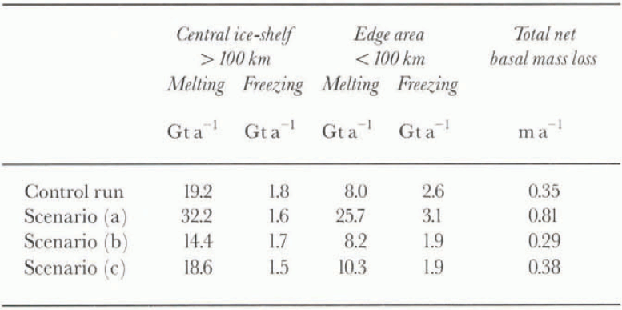
results of this ocean model are discussed in detail by Grosfeld and others (1998) with respect to marine ice formation beneath the ice shelf, we restrict ourselves to the net basal mass balance (Table 1). The interaction between the open ocean and the ice-shelf cavity is greatest in the seaward 100 km. Therefore, we distinguish in our calculation between the edge area (<100 km from the ice edge) and the central ice shelf. The calculated melt rate in the ice-edge area might be underestimated since tidal motions are not included in the model. Nevertheless, downwelling of surface waters as a consequence of Ekman pumping increases melting and thus water-mass exchange in the edge area. For the control run, 8.0 Gt a−1 of melting and 2.6 Gt a−1 of freezing in the coastal area, and 19.2 Gta−1 of melting and 1.8 Gta−1 of freezing in the central ice shelf have been estimated. This results in a mean net basal melt rate of 0.35 m a−1 over the whole ice shelf. The high proportion of freezing in the edge area is perhaps surprising, as one would expect a strong melting zone along the whole ice-shelf edge, as discussed by Reference Jacobs, Hellmer, Doake, Jenkins and FrolichJacobs and others (1992). However, this result reflects the special situation of the Filchner Ice Shelf domain, where the deep trough between Berkner Island and Coats Land enables an almost closed horizontal circulation system rather than vertical overturning processes. This leads to a pattern with melting along the eastern part, the inflow of the main gyre, and freezing along the western part, the recirculation and outflowing branch of the gyre.
(a) Impact of warmer waters accessing the ice-shelf cavity
As stated in the introduction, flooding of warm waters onto continental-shelf regions and further south into the Filchner-Ronne Ice Shelf cavity is a potential source of increased erosion and destabilization of the ice shelf. To study (his effect for the Filchner Ice Shelf cavity, we increase the temperature at the northern boundary of our model to simulate an increase in the temperature of Warm Deep Water (WDW), the Weddell Sea's modified CDW Since the width of the southern Weddell Sea continental shelf is a natural barrier to the direct access of WDW to the Filchner Ronnc Ice Shelf complex, only its derivative Modified Warm Deep Water (MWDW), a mixture of WDW and Winter Water, is able to penetrate further south. Whether warming of the Southern Ocean would lead to a similar increase in MWDW temperatures is unclear. We therefore fix the temperature to -l.3°C, the temperature of MWDW found on the southern Weddell Sea shelf (Schröder and others, 1997). This corresponds to a 0.6°C temperature increase of the accessing water mass in the model.
(a) Potential temperature in°C, and (b) salinity along a meridional transect 41°30' Wthrough the Filchner Trough for increased water temperatures in the open ocean (scenario (a)).

The main gyre in the central Filchner Trough decreases to about 1.8 Sv, while the circulation in the ice-shelf cavity remains nearly the same. The gyre spreads in the zonal direction. Potential temperature (fig. 3a) and salinity (fig. 3b) along 41°30'W depict the influence of the temperature increase. The deep cavity is ventilated with waters more than 0.05°C warmer than in the control run. Increased melting reduces the salinity of the outflow, and the Filchner Trough fills up with less saline and warmer ISW. The change in ISW properties could influence the overflow at the continental sill, deep and bottom water formation in the Weddell Sea and eventually the global ocean.
In the deep cavity the mass loss due to melting increases to 32.2Gta−1 while freezing is only 1.6Gta−1. in the edge area, melting amounts to 25.7 Gta−1 and freezing to 3.1 Gta−1. Although increasing in the edge area, freezing cannot compensate the dramatically increased overall melt-ing. The calculated mean basal mass balance for the whole ice-shelf area is 0.81 ma−1; net melting in the central ice shelf is 0.61 m a−1 and in the edge area 1.45 ma−1.
(b) Impact of reduced HSSW production
HSSW forms in the coastal polynya, and especially on the shallow continental shelf north of Bcrkner Island, due to brine rejection during wintertime sea-ice formation (Fold-vik and others, 1985b). The control run shows this saline water mass (S ≥ 34.58 in fig. 2b) ventilating the ice-shelf cavity. Increased precipitation and less sea-ice production due to thicker ice cover, as in the gradual CO2-increase simulation of Manabe and others (1992), could suppress HSSW production. A compact ice cover insulates the ocean against the cold atmosphere and suppresses sea-ice formation and brine rejection.
Such a situation was recently observed in front of the Filchner Ice Shelfafter calving of the giant icebergs in 1986. Due to the grounding of the icebergs on the shallow Berkner Bank, sea ice accumulated east of these icebergs instead of being advected further westwards. A fast ice tongue formed and the polynya in front of the Filchner ice edge did not occur. It has been observed (Schröder and others, 1997) that HSSW production in the Filchner Trough and over the Berkner Bank was reduced after this event.To investigate the influence of reduced HSSW production on the Berkner Bank, we switched off HSSW restoring for 5 years after a steady state was reached during the control run.
The vertically integrated mass transport decreases to ~2.0 Sv in the open-ocean part of the central depression and to ~0.4 Sv in the cavity. The gyre penetrates only to the shallower parts of the cavity. Correspondingly, the outflow of ISW reduces and the production of sea ice in front of the ice shelf due to upwelling ISW decreases. However, due to the reduced transport of waters at surface freezing-point temperature into the cavity, the temperature in the cavity decreases and an outflow of colder ISW can be observed (fig. 4a). The deep trough fills up with ISW that is less saline because the flux of HSSW off the Berkner Bank into the depression disappears (fig. 4b). The water in the deep cavity becomes colder and less saline. This leads to a reduced melting rate of 14.4Gta−1, while freezing changes very little (1.7 Gt a−1), and thus has stabilizing effect on the whole ice shelf. The resulting net basal melt rate for the whole ice shell is 0.29 m a−1 , where 0.40 m a−1 of net melting occurs in the edge area and only 0.25 ma−1 in the central ice-shelf area. Nevertheless, outflow and upwelling of ISW continues, establishing a vertical ice pump which supplies sea-ice production in front of the ice shelf (fig. 4b). This is evidenced in the vertical mixed-salinity profile with, however, clearly reduced salinity compared to the control run (fig. 2b).
Discussion and Conclusion
We have applied a three-dimensional ocean model to the Filchner Ice Shelf domain in the southern Weddell Sea to study the sensitivity of the ice-shelf-ocean system to changes in the oceanic environment. The control run which was designed to represent the recent situation in the Filchner Trough exhibits a cyclonic gyre in the deep trough in front of the ice shelf. A reduced flow of about 0.4-0.6 Sv enters the cavity with southward inflow along the Coats Land coast and northward outflow along the east coast of Berkner Island. The circulation system features a mainly horizontal circulation instead of the often-discussed vertical overturning with deep inflow and shallow outflow in ice-shelf cavities. The calculated mean basal mass balance accounts for 0.35 ma−1 of melting over the whole ice shelf.
(a) Potential temperature in °C. and (b) salinity along a meridional transect 41°30' wthrough the Filchner Trough for reduced HSSWon Berkner Bank (scenario (b)).

Two sensitivity studies were performed to investigate the response of the icc-shclf-ocean system to changed hydro-graphic conditions in the adjacent ocean. The warming scenario (a) depicts an expected increase in basal erosion due to the ventilation of the ice-shelf cavity with waters warmer than in the control run. Scenario (b) yields a different result: reducing or switching off the source of dense water on the Berkner Bank leads to a decreased ventilation of the deep ice-shelf cavity. The smaller heat transport into the deep cavity reduces basal melting beneath the thick glaciers near the grounding line. Consequently, stabilization, rather than disintegration of the ice shelf is a possibility.
This result contrasts with the findings of Reference MacAyealMacAyeal (1984), who pointed out that ablation beneath ice shelves is less sensitive to climate changes, as the main driving water mass for the thermohaline circulation, the HSSW, is fixed at surface freezing point. Changes in production rate and pathways of HSSW were, however, not considered by Mac-Ayeal. A similar result to ours has been obtained by Reference NichollsNicholls (1997) from mooring data beneath the Rönne Ice Shelf. He found that the seasonal reduction in HSSW production during summer yields thinner HSSW layers beneath the ice shelf and thus a smaller heat source for melting than during winter. Nicholls transferred his results to a climate-warming scenario and concludes that the initial response would be a thickening of ice shelves instead of their decline.
The dynamic response of an ice shelf to such a development is much more difficult to predict. Two time-scales have to be distinguished in the discussion of the impact of climate warming on the ice-shelf cavity circulation. From scenario (a) we can conclude that a general warming of accessing waters to an ice-shelf cavity will in any case lead to increased melting at the ice-shelf base and will therefore contribute to ice-shelf decline. This process comprises a long time-scale, because warming of MWDW is a result of the mixing of Winter Water and warmed WDW. The latter depends very much on changed sea-ice conditions in the Weddell Sea and the access of warmed CDW to the Weddell Gyre.
On shorter time-scales, however, climate warming might increase the sea-ice cover in the Weddell Sea, which yields reduced basal erosion of the ice shelf and has a stabilizing effect after scenario (b). Modification of MWDW within this time-scale is expected to be very small. A combination of both effects appears to be most realistic for a greenhouse warming scenario for medium time-scales. A model experiment with a moderate MWDW warming (0.1°C) and a simultaneous shut-down of HSSW production leads to a ~10% increase in the overall basal mass loss (Table 1, scenario (c)). Detailed analysis of the experiment shows thai melting in the ice-edge area increases, while melting in the central ice-shelf area decreases, thus stabilizing the ice shelf.
Since the huge Filchner-Ronne and Ross Ice Shelves are sheltered from the direct access of CDW by wide and shallow shelf areas, the influence of climate warming on these areas is more likely to derive from a change in sea-ice conditions in front of the ice shelves than from warmer ocean temperai tires. Reinforcement of the Filchner-Rorme Ice Shelf, rather than destabilization and eventual disintegration, is therefore the likely prospect for the near future.
Acknowledgement
Travel funding by the Deutsche Forschungsgemeinschaft is gratefully acknowledged. This is contribution No. 1326 of the Alfrcd-Wegener-Institut für Polar- und Meeresforschung.



