





Non-technical Summary
Most species exhibit little change (stasis) in form following speciation, and this is a key feature of the concept of punctuated equilibria. Stasis results in species often having durations that span millions of years. Durational data are fundamental to many types of paleobiological analyses and are ideally based on occurrence data represented by specimens in museum collections. Often, however, durational data are presented without supporting information about voucher specimens that document stratigraphic ranges, including first and last appearances. We use the iconic Devonian trilobite Eldredgeops rana to demonstrate that durational data can be challenging to determine at multiple taxonomic levels. Further, we show that different datasets derived from the published literature and museum collections give different results concerning the first and last appearances of species in the fossil record. We argue that paleontologists should adopt two general best practices to help address these problems. First, paleontologists should clearly identify voucher specimens that represent stratigraphic occurrences of species. Second, we recommend that high-quality photographs of occurrence vouchers be placed in open access websites and be assigned public domain licensing before being paywalled by journals. Such voucher images also have a role to play in training artificial intelligence (AI) systems that will be applied to future paleobiological questions.
What Every Paleontologist Knows, Revisited
The radical insight of Eldredge and Gould’s (Reference Eldredge, Gould and Schopf1972) concept of punctuated equilibria is not that morphological change is rapid on geological timescales, but rather that the forms of most species tend not to change much following speciation (see also Gould and Eldredge Reference Gould and Eldredge1977; Gould Reference Gould2002). That is, speciation does not tend to be characterized by a series of intermediate forms that link an ancestral species to its descendants (phyletic gradualism). Instead, morphological change typically occurs in a geological instant at the time of speciation (consistent with the allopatric model of Mayr Reference Mayr1963; see also Eldredge Reference Eldredge1971) and this is often followed by subsequent morphological stability or stasis. This stability in form is one reason we can consider species as being analogous to organisms and having finite individuality (Hull Reference Hull1980): they have a birth (speciation), a life span (duration), and a death (extinction). These features collectively make species the fundamental units of the study of macroevolution (Lieberman and Eldredge Reference Lieberman and Eldredge2014).
The general stability of species over their life spans has practical utility and is the foundation of the science of biostratigraphy. Every biostratigraphic chart is an argument for the utility of species-level stasis for assigning ages to rocks. Eldredge and Gould (Reference Eldredge, Gould, Kauffman, Hazel and Heffernan1977) recognized this and noted that “by the mere recognition of any nontrivial stratigraphic range of any morphologically defined taxon at near specific rank, we are necessarily implying a stability or stasis in species-specific differentia” (p. 29, italics in original). Gould (Reference Gould2002) characterized this as “What Every Paleontologist Knows” (p. 745) in a heading at the beginning of chapter 9 of his opus, explaining that “paleontologists have always recognized the longterm stability of most species, but we had become more than a bit ashamed by this strong and literal signal” (p. 749).
Our purpose here is not to review the strong evidence and general support for stasis, which has been provided elsewhere (e.g., Gould [Reference Gould2002] and Eldredge et al. [Reference Eldredge, Thompson, Brakefield, Gavrilets, Jablonski, Jackson, Lenski, Lieberman, McPeek and Miller2005] and papers cited therein). Instead, we focus on the underlying data from specimens that support all accounts of species durations and examples of stasis. We are fundamentally interested in how durational data are generated in many modern analyses and present some suggestions for best practices in the future. If embraced, we think that these changes will facilitate prospecting for more examples of stasis in the age of “big data.”
Durational Data in Paleontology
Because of stasis, species often have long durations, sometimes spanning millions of years. Estimates vary considerably across different taxonomic groups and tend to be extrapolations from higher-level taxonomic data (Lamkin and Miller Reference Lamkin and Miller2016). For example, Cambrian trilobites (1.5 Myr; Foote Reference Foote1988), Mesozoic ammonoids (1–2 Myr; Kennedy Reference Kennedy and Hallam1977), and Cenozoic terrestrial mammals (1–2 Myr [Vrba Reference Vrba1985]; 2.4 Myr [Prothero and Heaton Reference Prothero and Heaton1996]) have relatively shorter durations on geological timescales, although still tremendously long with respect to the predictions of phyletic gradualism. Animal groups with relatively longer durations on geological timescales include Devonian invertebrates from the Appalachian Basin (3–7 Myr; Brett et al. Reference Brett, Ivany and Schopf1996) and Cenozoic bivalves (10 Myr; Raup and Stanley Reference Raup and Stanley1978: p. 323). Reported durations of some microfossil groups are sometimes much greater. For example, Buzas and Culver (Reference Buzas and Culver1984) reported benthic foraminifera durations of 16–26 Myr (see also Strotz and Allen Reference Strotz and Allen2013). For additional summaries of typical species durations across other taxonomic groups, see Stanley (Reference Stanley1979), Raup (Reference Raup1991), and May (Reference May2002). A general rule of thumb, however, is that “the average life span of a species in the fossil record … is typically a few million years” (May Reference May2002: p. 1328).
Such species durations are fundamental data in many paleobiological studies. This includes analyses conducted at the genus level (or above), because the geological duration of a genus reflects the combined durations of all its constituent species (Hendricks et al. Reference Hendricks, Saupe, Myers, Hermsen and Allmon2014). A duration is determined by the first and last appearance of a species in the fossil record, and net stasis is demonstrated by minimal overall morphological change between those two end points, even if there are some oscillations in form in between. Quantitative examples of this were demonstrated in two Devonian brachiopods—Athyris spiriferoides (Eaton, Reference Eaton1831) and Mediospirifer audaculus (Conrad, Reference Conrad1842)—by Lieberman et al. (Reference Lieberman, Brett and Eldredge1995).
Durational data are fundamental to much of analytical paleobiology. For example, there is a general interest in the typical life spans of species from varied clades (see earlier examples), as knowing this is key to calculating extinction rates. Durational data are also essential to the development of diversity curves across geological time, for example, the iconic depiction of Phanerozoic marine diversity presented by Sepkoski (Reference Sepkoski1981: fig. 5). Such studies of past biodiversity have allowed paleontologists to quantify the scale of ancient extinction events and provide context for understanding modern biodiversity loss (e.g., Barnosky et al. Reference Barnosky, Matzke, Tomiya, Wogan, Swartz, Quental and Marshall2011; Kiessling et al. Reference Kiessling, Raja, Roden, Turvey and Saupe2019). Among other uses, durational data have also been used to investigate whether taxon attributes like geographic range confer resistance to extinction, resulting in longer durations (Jablonski and Hunt Reference Jablonski and Hunt2006; Payne and Finnegan Reference Payne and Finnegan2007).
Ultimately, durational data are derived from fossil specimens, ideally housed in museum drawers that are accessible to paleontologists. In practice, however, durational data are usually presented without reference to voucher specimens and instead rely on earlier tabulations and summaries that may or may not be tied to actual vouchers. We illustrate this below with the example of the phacopid (Bault et al. Reference Bault, Crônier, Monnet, Balseiro, Serra, Waisfeld, Bignon and Rustán2023) trilobite Eldredgeops rana (Green, Reference Green1832) (formerly Phacops rana; Fig. 1), which featured prominently in Eldredge and Gould’s (Reference Eldredge, Gould and Schopf1972) initial example of punctuated equilibria. Focusing mostly on purported first and last occurrences, we demonstrate that durational data can be challenging to pin down at multiple taxonomic levels, even for this classic example of morphological stasis.
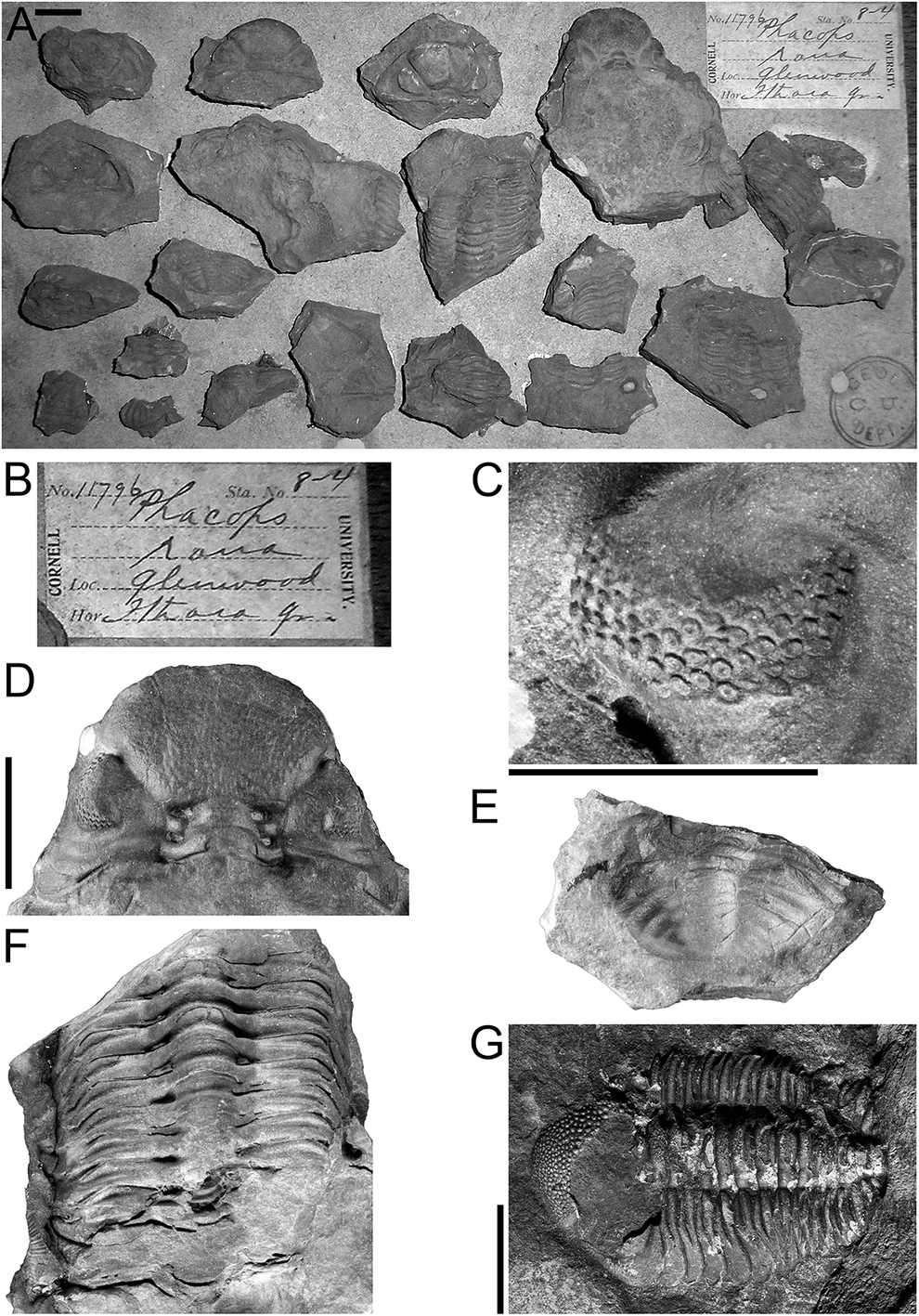
A–F, Specimens of Frasnian (likely Ithaca Formation) Eldredgeops rana from Tompkins County, New York (PRI 57222). A, Original sample from Kindle (Reference Kindle1896) (originally catalogued as Cornell University 11796); scale bar, 1 cm; sample card is lost; image captured in 2006 provided by J. Zambito. B, Magnified view of label in A. C, D, Cephalon and magnified view of eye of one (specimen to left of label in A); scale bar below C pertains to that image and equals 5 mm. E, Pygidium of specimen on third row of card, second from the left. F, Thorax of specimen on second row of card, third from the left. Scale to left of D pertains to images D–F and equals 1 cm. G, Specimen of E. rana from the Pecksport Mbr. of the Oatka Creek Fm. (lower Givetian) Madison County, New York (KUMIP 419279); scale bar, 1 cm.

The Example of Eldredgeops rana (Trilobita: Phacopidae)
Specimens of the “frog-eyed” phacopid trilobite Eldredgeops rana are very common in the Devonian Hamilton Group of New York State (Bartholomew and Ver Straeten Reference Bartholomew, Ver Straeten, Ver Straeten, Over and Woodrow2023; Brett et al. Reference Brett, Baird, Zambito, Bartholomew, Ver Straeten, Over and Woodrow2023) and are much sought after by collectors, resulting in substantial representation of the species in museum collections, and undoubtedly even more in avocational collections. The most important systematic treatment of E. rana remains the monograph of Eldredge (Reference Eldredge1972), which provided the fundamental data in support of stasis in this species that was published by Eldredge and Gould (Reference Eldredge, Gould and Schopf1972) the same year. The species is thus an apt subject for evaluating how durational data are underpinned in paleontological research. We consider this support at the family, genus, and species levels using data from the literature and online databases, with a focus on several large datasets (Sepkoski, Reference Sepkoski1982, Reference Sepkoski2002; Paleobiology Database [PBDB], https://paleobiodb.org) and museum collections (Integrated Digitized Biocollections [iDigBio] https://www.idigbio.org) that have provided key insights into the evolution of life. Given that most published and museum records of E. rana are attributed to P. rana, we included both genera in our investigation. Our attention is on how first and last appearances are underpinned and represented in these databases, as they determine total fossil durations in analyses.
Institutional Abbreviations
AMNH: American Museum of Natural History, New York; FHSM: Fort Hays State Museum (Sternberg Museum), Fort Hays, Kansas; HM: Hunterian Museum, London; KUMIP: Division of Invertebrate Paleontology, Biodiversity Institute, University of Kansas, Lawrence, Kansas; MNHN: Muséum National d’Histoire Naturelle, Paris; PRI: Paleontological Research Institution, Ithaca, New York; SDSM: South Dakota School of Mines, Rapid City, South Dakota; SMF: Senckenberg Museum Frankfurt, Germany; UF: Florida Museum of Natural History Division of Invertebrate Paleontology, University of Florida, Gainesville, Florida; YPM: Yale Peabody Museum, New Haven, Connecticut.
Family Phacopidae
Sepkoski Database
The underlying family-level durational data analyzed by Sepkoski (Reference Sepkoski1981) are largely derived from the Treatise on Invertebrate Paleontology (numerous volumes and authors), Harland et al. (Reference Harland, Holland, House, Hughes, Reynolds, Rudwick, Satterthwaite, Tarlo and Willey1967), and Romer (Reference Romer1966). This database was published by Sepkoski (Reference Sepkoski1982) and consists of times (mostly stage level) of first and last appearances for each family. Sepkoski (Reference Sepkoski1982) reported, based on Harland et al. (Reference Harland, Holland, House, Hughes, Reynolds, Rudwick, Satterthwaite, Tarlo and Willey1967), that the trilobite family Phacopidae Hawle and Corda, Reference Hawle and Corda1847 first appeared in the lower Silurian (Llandoverian Series) and last appeared in the Upper Devonian (Famennian). The record in Harland et al. (Reference Harland, Holland, House, Hughes, Reynolds, Rudwick, Satterthwaite, Tarlo and Willey1967: p. 491) for Phacopidae presents a first occurrence in the Ordovician Ashgillian (contra Sepkoski Reference Sepkoski1982) based on Cooper’s (Reference Cooper1930) record of Phacops primaevus Clarke, Reference Clarke1908 from the Upper Ordovician of Percé, Quebec, Canada (as Portlockia primaeva (Clarke) in Cooper; this species has also been assigned to Eophacops Delo, Reference Delo1935 and Acernaspis Campbell, Reference Campbell1967, both phacopids). This record is supported by figured specimens in the collection of the YPM (see White and Lieberman Reference White and Lieberman1998). The last occurrence of Phacopidae, according to Harland et al. (Reference Harland, Holland, House, Hughes, Reynolds, Rudwick, Satterthwaite, Tarlo and Willey1967), is based on Devonian Famennian occurrences of Cryphops Richter and Richter, Reference Richter and Richter1926, Dianops Richter and Richter, Reference Richter and Richter1923, and species of Phacops Emmrich, Reference Emmrich1839, including Phacops accipitrinus (Phillips, Reference Phillips1841) from Europe. Harland et al. (Reference Harland, Holland, House, Hughes, Reynolds, Rudwick, Satterthwaite, Tarlo and Willey1967) cited Richter and Richter (Reference Richter and Richter1926, Reference Richter and Richter1951) and Goldring (Reference Goldring1955) in support of the Famennian occurrences of P. accipitrinus, although Richter and Richter (Reference Richter and Richter1926, Reference Richter and Richter1951) do not mention it and Goldring (Reference Goldring1955) did not figure or refer to any specimens of it.
PBDB Records
We downloaded all PBDB records assigned to Phacopidae, resulting in 1283 occurrences (Supplementary Table 1; accessed 4 January 2024). The oldest record of Phacopidae is assigned to the Middle Ordovician for an occurrence (PBDB 3414) of Phacopidae indet. reported in an unpublished Ph.D. dissertation by Parker (Reference Parker1983). We could find no reference, however, to Phacopidae or its constituent taxa in Parker’s dissertation. The youngest record of Phacopidae is assigned to the beginning of the Carboniferous for an occurrence (PBDB 402531) of Phacops (Omegops Struve, Reference Struve1976) sp. attributed to Brauckmann et al. (Reference Brauckmann, Chlupáč and Feist1993). However, Brauckmann et al. (Reference Brauckmann, Chlupáč and Feist1993) note (p. 513) that “the local overlap of Ph. (Omegops) in the lowest Carboniferous bed at La Serre (Flajs and Feist, Reference Flajs and Feist1988) is exceptional and possibly caused by transport and redeposition from the older beds.” Flajs and Feist (Reference Flajs and Feist1988) did figure (plate 11, fig. 15) the “fragmentary cephalon” (p. 76) that is the ultimate basis of this record (SMF 49449).
iDigBio Records
We downloaded all iDigBio specimen records assigned to Phacopidae, resulting in records for 4866 lots, 917 of which have associated photographs (Supplementary Table 2; accessed 8 January 2024). Of these, 4131 are attributed to the Devonian Period. The two oldest lots are assigned to the Cambrian Period and are represented by SDSM 2658 (purportedly Phacops rana from Millard County, Utah, which we presume is a misidentification or other type of error) and MNHN A44830 (“Lamanaspis nyx” from Seville, Spain, although this taxon name may not be available). The youngest records (13 lots) are attributed to the Pleistocene (all P. rana), which we presume are a result of data entry error.
Genera Phacops and Eldredgeops
Sepkoski Database
Sepkoski’s “A Compendium of Fossil Marine Animal Genera” was published posthumously in 2002 (edited by D. Jablonski and M. Foote) and provided the underlying data for his earlier tabulation of genus-level marine animal diversity (Sepkoski Reference Sepkoski1997: fig. 1.1). Sepkoski (Reference Sepkoski2002: p. 192) reported the first occurrence of Phacops as Siegenian (now Pragian, Lower Devonian) and last appearance as Famennian (Upper Devonian), supported by Harland et al. (Reference Harland, Holland, House, Hughes, Reynolds, Rudwick, Satterthwaite, Tarlo and Willey1967) and Chlupáč (Reference Chlupáč1994). The supporting records from Harland et al. (Reference Harland, Holland, House, Hughes, Reynolds, Rudwick, Satterthwaite, Tarlo and Willey1967) are those presented earlier for the family Phacopidae. Chlupáč (Reference Chlupáč1994) reported lower Emsian (Zlíchovian; Lower Devonian) Phacops degener Barrande, Reference Barrande1852 as “the first known link” of the lineage of large-eyed phacopids and Famennian Phacops granulatus Münster, Reference Münster1840 and P. accipitrinus as among the last lineages of Phacops; Chlupáč (Reference Chlupáč1994) did not provide information about voucher specimens for these earliest and latest records of Phacops.
Sepkoski (Reference Sepkoski2002: p. 191) reported the first occurrence of Eldredgeops Struve, Reference Struve1990 as occurring in the Eifelian (Middle Devonian) and last occurrence in the varcus-cristatus Zones of the Givetian (Middle Devonian), both derived from Struve (Reference Struve1992). Struve (Reference Struve1992) reported Eldredgeops as ranging from the “Eifelium bis Ober-Givetium” (p. 532; Eifelian to upper Givetian, Middle Devonian), but did not provide information about voucher specimens.
PBDB Records
We downloaded all PBDB records assigned to Phacops, resulting in 362 occurrences (Supplementary Table 3; accessed 18 January 2024). Of these, 1 is assigned to the Ordovician, 19 to the Silurian, 341 to the Devonian, and 1 to the Mississippian. The oldest record (PBDB 725769) is Phacops (Calliops) jukesi Salter, Reference Salter1853 from the Burrellian (Middle to Upper Ordovician) Balclatchie Beds of Girvan, derived from Reed’s (Reference Reed1945) variety Phacops (Calliops) jukesi var. vicina. Clarkson and Tripp (Reference Clarkson and Tripp1982) synonymized this record (HM A 5370) with Calyptaulax brongniartii (Portlock, Reference Portlock1843), negating its relevance as a first occurrence of Phacops. The youngest record (PBDB 402531) is from the Hastarian (Lower Mississippian) and comes from the report by Brauckmann et al. (Reference Brauckmann, Chlupáč and Feist1993) of Phacops (Omegops) sp. discussed earlier for the youngest record of Phacopidae, which, as mentioned, may be a reworked, older specimen.
There are 241 PBDB records assigned to Eldredgeops, and all but one are assigned to the Middle Devonian (Supplementary Table 4; accessed 18 January 2024). The oldest record (PBDB 414107) comes from a Lower Devonian record from the Stooping River Formation of Ontario published by Sanford and Norris (Reference Sanford and Norris1975) as “Phacops cf. P. rana Green”; this record is based on a taxon list in Sanford and Norris (Reference Sanford and Norris1975) and no voucher specimen is identified. Numerous published references in the PBDB dataset support last occurrences of Eldredgeops during the Givetian (Middle Devonian), all represented by E. rana or its subspecies.
iDigBio Records
We downloaded all iDigBio specimen records assigned to Phacops, resulting in records for 3666 lots, 533 of which have associated photographs (Supplementary Table 5; accessed 19 January 2024). The oldest record is SDSM 2658, identified as P. rana, from the Middle Cambrian of Utah; this same record is the basis of the oldest occurrence of Phacopidae in the iDigBio database (see “Family Phacopidae”). The iDigBio dataset includes other Cambrian records, however, including specimens identified as Phacops enceutra [sic] (= eucentra) Angelin, Reference Angelin1851 from the Upper Cambrian of Sweden (YPM 74803–74808); see remarks by Temple (Reference Temple1952) concerning the problematic nature of this taxon, which may be an Upper Ordovician dalmanitid trilobite. Records of Phacops from the Ordovician and Silurian are also present. The youngest records for Phacops in the iDigBio dataset are from the Pleistocene (FHSM collection).
Surveying iDigBio for Eldredgeops resulted in records for 495 lots, 350 of which have associated photographs (Supplementary Table 6; accessed 19 January 2024). All lots with age determinations (n = 451) are assigned to either the Devonian or Middle Devonian.
Species Phacops/Eldredgeops rana
PBDB Records
We downloaded all PBDB records assigned to P. rana/E. rana, resulting in 241 occurrences (Supplementary Tables 7, 8, which contain the same records; accessed 19 January 2024). The oldest is the Early Devonian record of Sanford and Norris (Reference Sanford and Norris1975) addressed earlier. Numerous published references supported a latest occurrence of this species in the Givetian (Middle Devonian). Among records from New York State, the youngest specimens come from the Geneseo Formation of Chenango County, supported by data obtained from the Thayer Collection at the YPM (PBDB collection 86241). We note that an earlier download of this PBDB dataset (accessed 15 August 2022) included a Frasnian (Upper Devonian) record of P. rana (PBDB occurrence 1197130, part of collection 154838) published by Clarke and Swartz (Reference Clarke, Swartz, Prosser and Swartz1913) that is no longer in the PBDB. Clarke and Swartz briefly described (p. 699) and figured (plate 72, fig. 8) a partial cephalon and pygidium from the “Jennings Fm.” (abandoned) of Allegany County, Maryland.
iDigBio Records
We downloaded all 1077 records of P. rana (Supplementary Table 9; accessed 19 January 2024) and 480 records of E. rana (Supplementary Table 10; accessed 19 January 2024) from iDigBio; 782 of these have associated photographs. The oldest (middle Cambrian) and youngest (Quaternary) records are the same as those described earlier at the genus level. Among records from New York State, the oldest are from the Silurian Niagara Formation of Niagara County and are represented by SDSM 423 and SDSM 424; we presume that these are misidentifications. The youngest records are from the Frasnian (Upper Devonian) Ithaca Formation of Tompkins County and are represented by PRI 57221 and PRI 57222; see additional discussion of one of these lots in “Species Phacops/Eldredgeops rana.”
Summary
Our purpose here is not to provide a definitive accounting of the first and last appearances of E. rana and its parent genus and family ranks. The data we present are based solely on the literature- and specimen-based datasets that we analyzed and do not include unpublished or undigitized museum records. We anticipate that additional records may become available that will impact the durations that we have presented. Instead, our goal here is to demonstrate that our understanding of the duration of the species-, genus-, and family-level taxonomic ranks associated with E. rana is little connected to tangible specimen-based support and that different datasets give inconsistent results.
Family Phacopidae
The literature tree associated with the Sepkoski (Reference Sepkoski1982) family-level database supports a first appearance in the Upper Ordovician based on specimens published in Cooper (Reference Cooper1930) of Phacops primaevus; the last appearance during the Upper Devonian is not supported by specimen evidence in the cited references. The PBDB dataset suggests a first appearance of Phacopidae in the Middle Ordovician, but this is not supported by the underlying reference; the last appearance at the beginning of the Carboniferous is supported by specimen data, but may be a result of redeposited sediments. The iDigBio dataset suggests a first appearance in the Cambrian and a last appearance in the Pleistocene, both of which are likely a result of specimen misidentification or data entry error.
Genera Phacops and Eldredgeops
The reference trees associated with Sepkoski’s (Reference Sepkoski2002) genus-level database for Phacops (Lower to Upper Devonian) do not provide specimen support for reported durations; this is also the case for Eldredgeops (Middle Devonian). The PBDB supports a Middle/Upper Ordovician to Mississippian range for Phacops, with both end points associated with published specimens (although the supporting record for the Middle/Upper Ordovician is no longer attributed to Phacops); a suggested first appearance of Eldredgeops in the Lower Devonian is not supported by specimen data, and numerous references support a Middle Devonian last appearance. Specimen data from iDigBio suggest a first appearance of Phacops in the Cambrian and a last appearance in the Pleistocene, both of which are doubtful; Eldredgeops specimens with age determinations are all assigned to the Devonian or Middle Devonian.
Species Phacops/Eldredgeops rana
Setting aside the conferred record of Sanford and Norris (Reference Sanford and Norris1975), data from the PBDB suggest that E. rana is restricted to the Givetian (Middle Devonian). iDigBio records, taken at face value, suggest that E. rana spans most of the Phanerozoic; this is, of course, incorrect and most iDigBio records support a Middle Devonian fossil record.
While robust, the PBDB and iDigBio databases are not comprehensive and many literature sources and most museum collections have not yet been entered into them. What do published sources beyond those included in the PBDB suggest about the fossil record of E. rana? Eldredge (Reference Eldredge1972) reported E. rana as coming from “the ‘Hamilton’ (comprising the Marcellus, Skaneateles, Ludlowville, and Moscow formations …) and the overlying Tully and ‘Chemung’ formations and their lateral equivalents” (p. 53) and the oldest occurrences of E. rana from the Cardiff Formation of New York, now recognized as a member of the Oatka Creek Formation (Givetian) (see Ver Straeten et al. Reference Ver Straeten, Brett, Baird, Bartholomew, Over, Ver Straeten, Over and Woodrow2023); however, supporting specimens were not identified. That said, additional specimens from the similarly aged Pecksport Member of the Oatka Creek Formation that were collected by Eldredge are reposited in the collections of the KUMIP (KUMIP 419280, KUMIP 419281, and KUMIP 419279 [Fig. 1G]; originally labeled as Solsville Mbr., but the Swamp Road locality in Madison County, New York—where they were collected—is now known to instead expose the overlying Pecksport Mbr.; see Ver Straeten et al. Reference Ver Straeten, Ver Straeten, Over and Woodrow2023). The youngest occurrence of E. rana reported by Eldredge (Reference Eldredge1972) may be of “Chemung age” and was supported in part by a “poorly preserved” specimen (AMNH 496911). The stratigraphic meaning of “Chemung” is nebulous but is applied to a sequence of Frasnian rocks in New York (see text-fig. 1 in Ver Straeten [Reference Ver Straeten, Ver Straeten, Over and Woodrow2023] and text-fig. 1 in Over et al. [Reference Over, Baird, Kirchgasser, Ver Straeten, Over and Woodrow2023]). Did E. rana indeed persist from the Givetian into the Frasnian? Crônier and François (Reference Crônier and François2014), citing a personal communication, stated that Eldredgeops (presumably related to records of E. rana) did survive into the Frasnian in “Northeast America” (p. 14). Feist and Klapper (Reference Feist and Klapper2022) criticized the “Chemung” occurrence of Eldredge (Reference Eldredge1972), noting that it is probably from “the Ithaca Sandstone” and “led to the assumption that Eldredgeops persisted into the Late Devonian” (p. 3). They further noted that the Chemung specimens were “neither figured nor described” and thus the record “remains doubtful and it is not considered here” (p. 3).
Contrary to Feist and Klapper (Reference Feist and Klapper2022), there is acceptable, if sparse, evidence that E. rana survived the Givetian into Frasnian time. Kindle (Reference Kindle1896) described a section of “Ithaca Group” strata at a section exposed at Glenwood Creek, on the western shore of Cayuga Lake in Tompkins County, New York (Kindle station 8-4, “360 feet above the lake,” p. 30). Kindle remarked that “this station is above the Ithaca shale in the lower part of the Ithaca group. It is remarkable for the great abundance of the species which occur in the sandy shales, and for the presence of Phacops rana in abundance in a single layer” (p. 30). He described E. rana as “abundant” at station 8-4 (p. 46) and notes the significance of E. rana (as well as several other species) as “recurrent Hamilton fossils” (p. 48; see also Williams Reference Williams1913). The stratigraphic samples collected by Kindle (Reference Kindle1896) reside in the PRI collections and include 19 specimens of E. rana collected at station 8-4 (PRI 57222; Fig. 1A–F). Exposures at Glenwood Creek (42.495°N, 76.543°W) are important reference sections for the Sherburne (Givetian) and Renwick (Frasnian) formations (see Over et al. Reference Over, Baird, Kirchgasser, Ver Straeten, Over and Woodrow2023). Kindle (Reference Kindle1896) reported “the upper Spirifer laevis zone” at 210 feet in the Glenwood Creek section at station 8-4 (p. 30). The abundant occurrence of this brachiopod, now recognized as Warrenella laevis (Hall, Reference Hall1843), indicates the base of the Renwick Formation (Cornell Member) (see Zambito et al. Reference Zambito, Baird, Brett, Bartholomew and McRoberts2007, Reference Zambito, Baird, Brett, Bartholomew and Over2009; Over et al. Reference Over, Baird, Kirchgasser, Ver Straeten, Over and Woodrow2023). De Witt and Colton (Reference de Witt and Colton1978: plate 3) published a section (I-1) for Glenwood Creek that reported a 25–30 ft thickness for the Renwick. The presence of E. rana 150 feet higher yet in the section strongly suggests that it is from the overlying Ithaca Formation and leaves no doubt about its Frasnian assignment. Frasnian occurrences are also supported by records in Williams (Reference Williams1913), although these were not associated with specimens.
Based on this evidence, we agree with Eldredge (Reference Eldredge1972) that E. rana persisted into the Frasnian and aberrant records past the Givetian “simply represent a greatly diminished population near extinction” (p. 93). We conclude, based on cataloged specimens, that E. rana persisted in stasis for 6 Myr or more—from ca. 386 Ma (near the top of the Oatka Creek Fm.) to ca. 380 Ma (base Ithaca Fm.) (ages from text-fig. 1 in Ver Straeten Reference Ver Straeten, Ver Straeten, Over and Woodrow2023)—and perhaps even longer if the “Chemung” occurrences are truly from higher in the sequence than the Ithaca Formation specimens. The establishment of E. rana in the Frasnian also confirms the persistence of Eldredgeops as well into the Late Devonian.
Toward a Systematic Paleontology
Linnaean taxonomy is underpinned by the concept of voucher types: species are tied to type specimens, genera to type species, and families to type genera. Species may shift between higher taxa according to the whims of systematists, but concepts and definitions of higher taxa—as well as their properties—are ultimately circumscribed by the features of real specimens (see also Hendricks et al. Reference Hendricks, Saupe, Myers, Hermsen and Allmon2014). However, the properties of ancient taxa that are of greatest interest in studies of macroevolution—especially duration over geological time, but also including geographic range and morphological trait data—tend not to be explicitly tied to voucher specimens. This makes verification impossible and contributes to the inconsistency of results, including for taxa as well sampled and documented as Eldredgeops rana.
The PBDB has facilitated important contributions to our understanding of ancient life and has made it simple for anyone to attain durational data for species and higher taxa, democratizing a process that previously required years of research in the library (e.g., Sepkoski Reference Sepkoski1993). The records in the PBDB, which is largely built from the literature, are often estranged from specimens in museum collections. Verifying stratigraphic occurrences for individual taxa often leads one down a proverbial rabbit hole, sometimes with no cataloged specimen at the end of the tunnel. When durational data are not tied to corresponding specimen data, users of these data have limited means to verify taxonomic assignments or independently evaluate reported durations or stasis. The iDigBio database provides the opposite: all records are inherently tied to cataloged museum specimens, but taxa may be misidentified, or there may be data entry errors that distort temporal and geographic occurrences. Obvious errors are simple to recognize and discard from downloaded datasets (e.g., Pleistocene records of E. rana). But what about records that are not altogether unreasonable? Would someone who does not have expertise on phacopid trilobites immediately discard Lower Devonian or Lower Mississippian records of E. rana? In general, as is almost certainly the case for E. rana, establishment of voucher specimens will have the likely effect of reducing durations of taxa relative to reports or data compilations that have not been critically evaluated.
For the sake of verification, quality of analysis, and reproducibility of results, paleontology needs a better way to document occurrences and tie such records to voucher specimens, just as it needs a better system for recognizing the scientists who make these associations (Smith et al. Reference Smith, Raja, Clements, Dimitrijević, Dowding, Dunne and Gee2023). We have two general recommendations to address this issue. First, as a matter of best practice, systematists should publish museum catalog numbers for voucher specimens that represent stratigraphic occurrences when they summarize the durations of species, whether newly described, revised, or comprehensively monographed. First and last appearances are especially important to document, because they set the boundaries for studies of morphological evolution (or stasis) in the fossil record, as well as provide core data for biostratigraphic analysis. It is also useful to directly document with vouchers all of the stratigraphic units (formations or members) from which a species has been found. This is simple for a taxonomist to do in the systematics portions of a manuscript. For example, where Hendricks (Reference Hendricks2009) reported the occurrence of Conus marylandicus Green, Reference Green1830 (now Conasprella (Ximeniconus) marylandica (Green), n. comb.) as “Virginia (Yorktown Formation), North Carolina (Duplin Formation), and Florida (Tamiami and Jackson Bluff formations)” (p. 23), it would have been better practice to present this as “Virginia (Yorktown Formation; PRI 52915), North Carolina (Duplin Formation; PRI 82912), and Florida (Tamiami [PRI 53183] and Jackson Bluff formations [UF 78488]).” Although our focus is on documentation of stratigraphic occurrences, vouchers are also useful for formally documenting specimens found at extremes of a geographic range or representing morphological end-members. In addition to being formally recognized in the literature, established voucher specimens should also be incorporated into online databases like the PBDB. Occurrences that are supported by taxonomist-approved vouchers should be clearly identified as such. It is also critical that—just like type specimens—occurrence voucher specimens be reposited in museum collections where they can be accessed and evaluated by the research community.
Our second recommendation is that high-quality photographs of occurrence voucher specimens be placed in established open access websites (e.g., GBIF, MorphoSource, or FigShare) and be assigned public domain licensing. This should be done before publication so that images of significant specimens (including future types, but also occurrence vouchers) cannot become “paywalled” later by journal copyright restrictions. To our knowledge, no study has investigated the number of fossil species whose type specimens (as well as descriptions) are only represented by single images locked behind journal paywalls, but we anticipate that it is a significant percentage; the same likely applies to extant taxa. Organizations such as the Biodiversity Heritage Library have commendably liberated such data from articles whose copyrights have expired, as well as through partnerships with society journals that have made the decision to make available some or most of their holdings. But, much literature—including from the Paleontological Society’s own flagship systematics journal—remains “paywalled” and this is ultimately a detriment to the advancement of our understanding of ancient life, especially for researchers who do not have access to large academic research libraries. (Note that the Treatise on Invertebrate Paleontology, which contains numerous images of invertebrate fossil type specimens, is now open access.) Fortunately, authors now have much more control over the scientific content that they generate and how it is shared. Releasing images of important specimens into the public domain before copyright is transferred to a journal removes barriers for future workers. If such images are assigned their own stable web addresses (e.g., a digital object identifier, or DOI), it also becomes possible to link them to other online records, for example, in the PBDB. Depending on journal requirements, an alternative approach is to place images of stratigraphic voucher specimens in supplementary material associated with a paper, although such repositories are not always easy to find or can be overlooked.
Novel methodological approaches, for example, ecological niche modeling in combination with newly digitized specimens, have renewed the importance of museum collections for addressing questions that are broader than systematic studies of individual species or clades (e.g., Lieberman and Kimmig Reference Lieberman, Kimmig, Rosenberg and Clary2018). Further, it is likely that the millions of specimens that reside in museum collections—once digitized—will provide the fuel for paleontology’s big data future (e.g., Allmon et al. Reference Allmon, Dietl, Hendricks, Ross, Rosenberg and Clary2018). The success of these approaches rests upon the underlying data being sound, and we have argued here that the establishment of expert-vetted voucher specimens is important for both modern and future workers. We have no doubt that artificial intelligence (AI) will soon play a role in taxonomic work in ways that have yet to be determined (or perhaps even imagined). Such AI systems will need to be trained, however, and voucher specimens will and should play an important part in this process. Paleontologists should not fear or delay this future, for it will allow us to prospect for stasis and other features of macroevolutionary history in new ways, as well as spur the research questions that will occupy our field for the next 50 years.
Acknowledgments
We thank the data entry volunteers and museum professionals who have contributed their time to the development of the Paleobiology Database and iDigBio, as well as all of the professional and avocational paleontologists whose identifications of material have provided the underlying systematic data contained in these databases. J. Zambito provided helpful discussions regarding Devonian stratigraphy, assisted with locating literature, and provided photographs. G. Dietl and L. Skibinski assisted with PRI specimens. We thank N. López Carranza for providing photographs of KUMIP trilobite specimens. We also acknowledge the library staff at Cornell University who helped us to obtain access to some of the older publications cited herein. Finally, we thank W. Allmon, B. Anderson, S. Mayer, and R. Ross for helpful discussions and C. Brett, M. Yacobucci, and an anonymous reviewer for constructive reviews of this article. This material is based upon work supported by the National Science Foundation under Award No. 2225014 to J.R.H. and 2225011 to B.S.L.
Competing Interests
The authors declare no conflicts of interest.
Data Availability Statement
Supplementary Tables 1–10 are available on Zenodo at https://doi.org/10.5281/zenodo.13921856.

 Open access

