





Introduction and background
It is nearly a century since 2 French scientists, Chatton and Poisson (Reference Chatton and Poisson1931), recorded a novel protistan endoparasite in both shore crab (Carcinus maenas) and harbour crab (Liocarcinus depurator) haemolymph but at low prevalence (<1%). They named this parasite Hematodinium perezi after Professor Charles Pérez who had first observed it in shore crabs in 1905 and the drawings accompanying their paper showed several morphological forms including multinucleate elongate plasmodia with characteristic dino-mitotic chromosomes as seen in other dinoflagellates (Gornik et al., Reference Gornik, Hu, Lassadi and Waller2019). Some 40 plus years later, the presence of Hematodinium sp. was reported in blue crabs, Callinectes sapidus, collected from several locations in North America but at a much higher prevalence (ca. 30%) at least in 1 site (Newman and Johnson, Reference Newman and Johnson1975). A second species of this parasite was identified in 1994 in Moreton Bay, Australia by Hudson and Shields (Reference Hudson and Shields1994) in the sand crab, Portunus pelagicus and, based on its different morphology to the type species, it was named Hematodinium australis. Since these initial reports, over 45 species of marine decapod crustaceans from across the globe have been recorded as hosts to these parasites (see Alimin et al., Reference Alimin, Yusoff, Kadriah, Anshary, Abdullah, Jabir, Susianingsih and Hassan2024; Small and Li, Reference Small and Li2025 for maps of their geographic location). There are no known control measures or treatments to combat the effect of infections caused by Hematodinium spp. (Coates and Rowley, Reference Coates and Rowley2022; Small and Li, Reference Small and Li2025).
Hematodinium spp. belong to the eukaryotic phylum Dinoflagellata and members of this assemblage are found in both marine and freshwater environments. Most of the ca. 2400 representatives of this monophyletic group are free living plankton and are either photosynthetic autotrophs, mixotrophs or heterotrophs (Gómez, Reference Gómez2012). However, ca. 150 are ecto- or endo-parasites of a range of hosts including ciliates, invertebrates, vertebrates and other dinoflagellates (Coats, Reference Coats1999). These parasitic forms include Syndinium turbo an endoparasite of various marine copepods (Skovgaard et al., Reference Skovgaard, Massana, Balagué and Saiz2005) and the ectoparasitic Amyloodinium ocellatum found on various marine and brackish water fish where the trophont stage feeds on gill epithelia resulting in damage and inflammation (Rückert, Reference Rückert, Smit and Sures2025). The nucleus of dinoflagellates contains unusual DNA where the chromosomes are constantly condensed during interphase and this gives Hematodinium its characteristic nuclear morphology observed in live and fixed, stained preparations (Figure. 1A–D) making it relatively easy to identify these parasites in either haemolymph or solid tissues. The genome of many dinoflagellates is extremely large ranging from 1 to 250 Gbp (Lin, Reference Lin2024) and in Hematodinium it is 4.8 Gbp (Gornik et al., Reference Gornik, Ford, Mulhern, Bacic, McFadden and Waller2012), but the reason for this evolutionary expansion of the dinoflagellate genome is unclear (Talbert and Henikoff, Reference Talbert and Henikoff2012). A second unusual feature of the nuclear material of Hematodinium and many other dinoflagellates, is the apparent lack of histone proteins and their ‘replacement’ with novel DNA binding proteins christened dinoflagellate/viral nucleoproteins (Gornik et al., 2011).
Examples of the variable morphology of life history stages of Hematodinium. (A) Characteristic condensed chromatin in individual trophonts in the hepatopancreas. (B) Trophonts in the connective muscle between muscle fibres. (C) Phase contrast view of live trophonts in the haemolymph showing condensed chromatin (arrow). (D) Multinucleate plasmodia (arrows) attached to the inner margin of gill lamella. Images A, B, and D, H&E-stained sections. Scale bars = 10 µm.

Many commercially important decapods from fisheries and aquaculture sectors are subject to parasitization by Hematodinium spp. including Norway lobsters (langoustines), Nephrops norvegicus (e.g. Field and Appleton, Reference Field and Appleton1995; Appleton and Vickerman, Reference Appleton and Vickerman1998; Small et al., Reference Small, Neil, Taylor, Atkinson and Coombs2006; Molto-Martin et al., Reference Molto-Martin, Neil, Coates, MacKenzie, Bass, Stentiford and Albalat2024; Martin et al., Reference Martin, Elsheshtawy, Clokie, Mackenzie, Bateman, Bass, Stentiford and Albalat2025) and edible crabs, Cancer pagurus (Ní Chualáin et al., Reference Ní Chualáin, Hayes, Allen and Robinson2009; Ní Chualáin and Robinson, Reference Ní Chualáin and Robinson2011; Smith et al., Reference Smith, Hirschle, Vogan and Rowley2015) in Northern Europe, invasive blue crabs C. sapidus in the Mediterranean (Patrizia and Giorgio, Reference Patrizia and Giorgio2018; Lattos et al., Reference Lattos, Papadopoulos, Giantsis, Stamelos and Karagiannis2024) and in their native range (Messick and Shields, Reference Messick and Shields2000; Small et al., Reference Small, Huchin-Mian, Reece, Pagenkopp Lohan, Butler and Shields2019), Tanner, Chionoecetes bairdi (Meyers et al., Reference Meyers, Koeneman, Botelho and Short1987; Wheeler et al., Reference Wheeler, Shields and Taylor2007; Siddeek et al., Reference Siddeek, Zheng, Morado, Kruse and Bechtol2010), and snow crabs, Chionoecetes opilio (Taylor and Khan, Reference Taylor and Khan1995; Pestal et al., Reference Pestal, Taylor, Hoenig, Shields and Pickavance2003; Shields et al., Reference Shields, Taylor, Sutton, O’Keefe, Ings and Pardy2005, Reference Shields, Taylor, O’Keefe, Colbourne and Hynick2007; Fedewa et al., Reference Fedewa, Jensen, Small, Litzow, Malick, Zacher, Long and Kotwicki2025) in North America, and Chinese swimming crabs, Portunus trituberculatus (Li et al., Reference Li, Song, Liu and Chen2013; Wang et al., Reference Wang, Li, Xaio, Xu and Li2017), mud crabs, Scylla paramamosain (Li et al., Reference Li, Xia, Wu, Liu and Lin2008), giant tiger prawns, Penaeus monodon (Wang et al., Reference Wang, Li, Xaio, Xu and Li2017), Ridgetail white prawns, Exopalaemon carinicauda (Xu et al., Reference Xu, Xie, Shi and Li2010), Asian bush-clawed crabs, Hemigrapsus takanoi (Gong et al., Reference Gong, Xie, Wang, Li, Li, Wan, Huang, Shi, Zhang and Huang2023) and mudflat crabs, Helice tientsinensis (Huang et al., Reference Huang, Li, Wang and Li2019) in China. The effect of disease by Hematodinium spp. on these populations can be profound and it is often fatal. In some, infections are enzootic within crustacean populations and apart from seasonal change in their occurrence, differ little from year to year in their presence. Such infections include those of langoustines in the Clyde Sea Area, Scotland, UK (Molto-Martin et al., Reference Molto-Martin, Neil, Coates, MacKenzie, Bass, Stentiford and Albalat2024) and edible crabs in South Wales, UK (Smith et al., Reference Smith, Hirschle, Vogan and Rowley2015). In others, including Tanner and snow crabs, environmental changes including increased water temperatures, appear to drive higher levels of infections both in terms of prevalence and severity (Table 1). Such epizootic outbreaks can alone result in population declines or exacerbate these caused by other factors such as overfishing and climate change. These can result in the closure of the fishery, economic loss due to the death of infected crabs, and to the loss of marketability, because of the bitter taste of the infected muscle in some crabs (hence the disease is sometimes referred to as bitter crab disease) (Balstad et al., Reference Balstad, Fedewa and Szuwalski2024).
Examples of outbreaks of infections caused by Hematodinium in crustaceans of commercial importance

The rationale for this review is not to simply update the existing excellent and comprehensive reviews of Hematodinium spp. published over the last 20 years (e.g. Stentiford and Shields, Reference Stentiford and Shields2005; Small, Reference Small2012; Li et al., Reference Li, Li and Huang2021a; Alimin et al., Reference Alimin, Yusoff, Kadriah, Anshary, Abdullah, Jabir, Susianingsih and Hassan2024) but to examine in depth some of the areas where our understanding of these infections is still uncertain. These include (1) an exploration of how these parasites can flourish in the tissues of so many different hosts apparently free of a cellular immune response, (2) the consequences of inadequate approaches to the detection of infected crustaceans of relevance to fisheries science and aquaculture development and (3) a reappraisal of infection dynamics and the involvement of secondary infections in the pathogenesis of these parasites taking into account the diversity of different parasite genotypes.
How many species of Hematodinium are there?
While only 2 distinct species of Hematodinium have been described (H. australis and H. perezi) there is known diversity in the ITS region of rDNA within H. perezi. As reviewed by Small (Reference Small2012), Li et al., (Reference Li, Li and Huang2021a) and Small and Li (Reference Small and Li2025), there are 3 genotypes (I, II and III) in this latter species with differing host ranges and geographic locations. Genotype I, found mainly in Northern Europe, infects L. depurator and the shore crab, Carcinus maenas (Small and Li, Reference Small and Li2025), while genotype II is chiefly restricted to China in a variety of crabs and shrimp (Xiao et al., Reference Xiao, Miao, Li, Xu, Zhang and Wang2016; Li et al., Reference Li, Li and Huang2021a). H. perezi genotype III is found in North America in a wide range of crustaceans including C. sapidus (Pagenkopp Lohan et al., Reference Pagenkopp Lohan, Reece, Miller, Wheeler, Small and Shields2012, Reference Pagenkopp Lohan, Small, Shields, Place and Reece2013; Small and Li, Reference Small and Li2025). Whether crustaceans are susceptible to infections with more than 1 genotype (i.e. infected simultaneously with several genotypes) is unknown.
What is the host range of Hematodinium spp.?
There are still increasing numbers of reports year on year of new hosts shown to be subject to infections by Hematodinium spp. For instance, since a recent review in 2021 by Li and co-authors (Li et al., Reference Li, Li and Huang2021a), several new hosts have been reported including Asian bush-clawed crabs, Hemigrapsus takanoi (Gong et al., Reference Gong, Xie, Wang, Li, Li, Wan, Huang, Shi, Zhang and Huang2023) the marine crab, Macrophthalmus abbreviatus (Liu et al., Reference Liu, Xie, Wang, Li, Wan, Li, Zhou, Shi, Zhang and Huang2024) and the Chinese mitten crab, Eriocheir sinesis (Kerr et al., Reference Kerr, Small, Bass, Al Arimi, Ross, Pevsner, Williams, van Aerle, Stentiford and Bateman2025). This continued increase in host range suggests that all true (brachyuran) crabs in the marine environment are susceptible to this host-generalist parasite. Outside of these true crabs, king crabs (Ryazanova et al., Reference Ryazanova, Eliseikina, Kukhlevsky and Kharlamenko2010, Reference Ryazanova, Eliseikina and Kukhlevsky2021) of the family Lithodidae, some penaeid shrimp (Wang et al., Reference Wang, Li, Xaio, Xu and Li2017), the homarid, N. norvegicus (Field and Appleton, Reference Field and Appleton1995; Small et al., Reference Small, Neil, Taylor, Atkinson and Coombs2006; Molto-Martin et al., Reference Molto-Martin, Neil, Coates, MacKenzie, Bass, Stentiford and Albalat2024; Martin et al., Reference Martin, Elsheshtawy, Clokie, Mackenzie, Bateman, Bass, Stentiford and Albalat2025), the anomuran hermit crab, Pagurus bernardus (Hamilton et al., Reference Hamilton, Shaw and Morritt2009) and possibly some amphipods (Pagenkopp Lohan et al., Reference Pagenkopp Lohan, Reece, Miller, Wheeler, Small and Shields2012) are hosts. Notable by their absence as hosts are the commercially important clawed lobsters, Homarus americanus and H. gammarus found in North America and northern Europe, respectively. These 2 species have been subject to extensive investigations of their parasites and pathogens over the last few decades (see reviews by Davies and Wootton, Reference Davies and Wootton2018; Cawthorn, Reference Cawthorn2011 for details) yet no reports exist on the presence of Hematodinium or Hematodinium-like parasites in their tissues. A preliminary trial to infect juvenile H. gammarus with trophonts of Hematodinium sp. (probably H. perezi genotype I) from an infected edible crab, C. pagurus donor, failed to find any evidence of ensuing infection (Davies and Rowley, Reference Davies and Rowley2015). Therefore, it can be concluded that while all brachyuran crabs living in high-salinity environments are probably susceptible, this is not the case for all homarids. This lack of susceptibility in the latter group deserves further exploration to determine the mechanisms of resistance. Such an approach may shed light on how Hematodinium avoids detection and elimination in susceptible hosts.
Both the European shore (= green) crab, C. maenas and the blue crab, C. sapidus are recognized as ‘successful’ invasive non-native species. The ‘natural’ range of shore crabs is in northern Europe but they have spread to the Americas, Africa and Australia over the last 200 years (Ens et al., Reference Ens, Harvey, Davies, Thomson, Meyers, Yakimishyn, Lee, McCord and Gerwing2022). Similarly, blue crabs, native to the Western Atlantic, appeared in the Mediterranean by the 1940s and the Atlantic coast off Morocco in 2019 (Oussellam et al., Reference Oussellam, Benhoussa, Pariselle, Rahmouni, Salmi, Agnèse, Selfati, El Ouamari and Bazairi2023). When these non-native species relocate to new regions they can either bring parasites, such as Hematodinium, with them or act as novel hosts by spillback. There are reports of shore crabs infected with Hematodinium along their invasion route in the Faroe Isles but not in Nova Scotia in Canada (Bojko et al., Reference Bojko, Stebbing, Dunn, Bateman, Clark, Kerr, Stewart-Clark, Johannesen and Stentiford2018). Similarly, infected blue crabs have been recorded in the Mediterranean (Lattos et al., Reference Lattos, Papadopoulos, Giantsis, Stamelos and Karagiannis2024) and off Morocco in the Atlantic Ocean (Lamkhalkhal et al., Reference Lamkhalkhal, Rahmouni, Selfati, Hamid, Kmentová, Vanhove and Bazairi2024). Whether these infections were carried by infected crabs during these invasions or acquired from other native crabs once in their new locations, is unclear but this gives the potential for mixing of Hematodinium spp. genotypes as already described. The form of this parasite in blue crabs in the Mediterranean appears to be distinct to the H. perezi genotype III found in this species back in its native range in America (Lattos et al., Reference Lattos, Papadopoulos, Giantsis, Stamelos and Karagiannis2024; Small and Li, Reference Small and Li2025) suggesting its acquisition from other decapods in its new environment. Similarly, the recent observation of H. perezi genotype 1 in non-native Chinese swimming crabs, Eriocheir sinensis in the River Thames, UK, suggests that it has become an accidental host for this parasite in its new habitat (i.e. by spillback) (Kerr et al., Reference Kerr, Small, Bass, Al Arimi, Ross, Pevsner, Williams, van Aerle, Stentiford and Bateman2025).
How are Hematodinium infections identified?
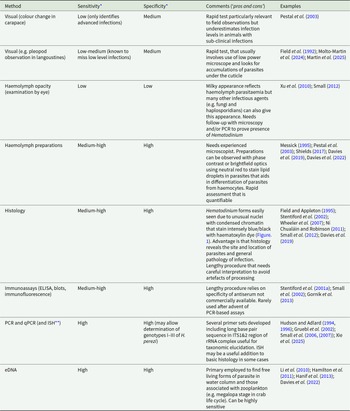
There are several approaches to the detection of Hematodinium that vary in terms of their practicality, cost, sensitivity and specificity (Table 2). Visual approaches, such as those carried out onboard survey vessels or in the field, while lending themselves to rapid assessment, are not sensitive enough and only identify heavily affected animals in the later stages of infection (e.g. Beevers et al., Reference Beevers, Kilbride, Atkinson and Neil2012; Fedewa et al., Reference Fedewa, Jensen, Small, Litzow, Malick, Zacher, Long and Kotwicki2025; Martin et al., Reference Martin, Elsheshtawy, Clokie, Mackenzie, Bateman, Bass, Stentiford and Albalat2025). These approaches include the pleopod method used with langoustines (e.g. Field et al., Reference Field, Chapman, Taylor, Neil and Vickerman1992; Field and Appleton, Reference Field and Appleton1995; Albalat et al., Reference Albalat, Collard, Brucem, Coates and Fox2016; Molto-Martin et al., Reference Molto-Martin, Neil, Coates, MacKenzie, Bass, Stentiford and Albalat2024; Martin et al., Reference Martin, Elsheshtawy, Clokie, Mackenzie, Bateman, Bass, Stentiford and Albalat2025) and colour/opacity changes in the appearance of the ventral carapace (e.g. Pestal et al., Reference Pestal, Taylor, Hoenig, Shields and Pickavance2003; Martin et al., Reference Martin, Elsheshtawy, Clokie, Mackenzie, Bateman, Bass, Stentiford and Albalat2025) that can be subjective to the investigator. Indeed, a recent re-evaluation of seasonal prevalence data from the east Bering Sea in snow and Tanner crabs compared prevalence data of disease between a macroscopic assessment based of carapace colour change compared with the more sensitive PCR-based method (Fedewa et al., Reference Fedewa, Jensen, Small, Litzow, Malick, Zacher, Long and Kotwicki2025). Not only did the visual method fail to identify 93% of infected individuals but the study demonstrates a rapid rise in the prevalence of disease from just ca. 10% in 2015 to 40% by 2017 lending weight to the concept that Hematodinium infections are a major driver in population declines of these crabs (Tables 1 and 2).
A comparison of the methods commonly used to determine the presence of Hematodinium in decapods and environmental samples

* Low/medium/high.
** In situ hybridization.
An increasing number of studies have deployed a comprehensive range of approaches to assess the importance of Hematodinium in their hosts. Some include histology that has the advantage of revealing changes in host tissues as these parasites multiply in the haemolymph but dealing with large numbers of samples for histology necessary to adequately monitor changes in seasonal prevalence and severity of infection, can be challenging. Using this approach, together with PCR-based methods, gives the researcher a full picture of this condition that PCR-based methods alone cannot accomplish. For instance, Davies et al., (Reference Davies, Batista, Malkin, Thomas, Bryan, Crocombe, Coates and Rowley2019) carried out a large-scale survey of Hematodinium infections in the shore crab, C. maenas in South Wales, UK, over a 12-month period involving ∼1200 crabs. These were all initially examined with live haemolymph preparations to determine if crabs were infected followed up with histological analysis. All crabs regardless of infection status were also checked for Hematodinium using several sets of PCR primers (Small et al., Reference Small, Shields, Hudson and Reece(2007); Gruebl et al., Reference Gruebl, Frischer, Sheppard, Neumann, Maurer and Lee2002) specific for this parasite. Those crabs found to be positive by PCR but apparently negative by histology and microscopic examination of haemolymph, were re-reviewed by histology. This approach confirmed that histology alone correctly identified over 95% of all crabs with clinical and sub patent infections.
How are Hematodinium spp. transmitted?
Late-stage infections in some crustaceans have been shown to generate a motile stage termed the dinospore (Figure. 2A,B) that develops in the haemolymph and is thought to be responsible for transmission of the disease (Chen et al., Reference Chen, Reece and Shields2023; Zhang et al., Reference Zhang, Huang, Li, Zhang, Song and Li2025b). Two forms of dinospore have been described, termed micro- and macro- at least in some hosts (e.g. Appleton and Vickerman, Reference Appleton and Vickerman1998; Huchin-Mian et al., Reference Huchin-Mian, Small and Shields2017; Zhang et al., Reference Zhang, Huang, Li, Zhang, Song and Li2025b). Microdinospores appear to be faster swimmers than the macro forms (Huchin-Mian et al., Reference Huchin-Mian, Small and Shields2017; Zhang et al., Reference Zhang, Huang, Li, Zhang, Song and Li2025b). Therefore, macrospores may be less infectious because of their lower swimming activity (Chen et al., Reference Chen, Reece and Shields2023). Whether the dinospores of different genotypes of H. perezi have divergent abilities to swim and infect is unknown.
Dinospore formation and release in the Norway lobster, Nephrops norvegicus. (A) Aquarium-based release of clouds of dinospores from N. Norvegicus, note cloudy appearance of water post-release. (B) Appearance of flagellated (unlabelled arrows) dinospores using interference microscopy. Scale bar = 10 µm. Images courtesy of I. Molto-Martin and A. Albalat.

As there may be several species of susceptible decapods in the vicinity when a ‘cloud’ of dinospores is released from the gills, there is chance for the condition to be spread into other adjacent populations. The dinospore stage is relatively short-lived (>a few hours) and it is not tolerant of low salinity environments (Coffey et al., Reference Coffey, Li and Shields2012; Zhang et al., Reference Zhang, Huang, Li, Zhang, Song and Li2025b). Its production is also stimulated by high water temperatures (Chen et al., Reference Chen, Reece and Shields2023). How dinospores gain access to the internal tissues of their hosts is unknown. Possible routes of entry include across the gut wall, via the gills with their thin outer epithelium and acellular cuticle, or across the main cuticle perhaps where there are injuries (Rowley and Coates, Reference Rowley and Coates2023). Transmission via cannibalism of infected animals has not been proven (Li et al., Reference Li, Wheeler and Shields2011) probably because the stages of parasite observed in tissues (i.e. trophonts and filamentous trophonts/plasmodia) are not the natural invasive stage. However, intrahaemocoelic injection of trophonts taken from infected decapods will develop in naïve hosts and this has formed the basis of experimental infections aimed to investigate how these parasites develop in their hosts (e.g. Messick and Shields, Reference Messick and Shields2000; Smith and Rowley, Reference Smith and Rowley2015). Natural transmission of infections between co-inhabitants have been observed under aquarium conditions using juvenile blue crabs (Callinectes sapidus) as experimental hosts (Chen et al., Reference Chen, Reece and Shields2023). Changes in temperature and high temperatures (25 ºC) were reported to favour dinospore production and transmission, and this was found to correlate with sea temperatures during peak transmission of the disease as found in the late summer – early autumn months in the USA. In contrast, peak transmission of Hematodinium sp. (probably H. perezi genotype I) in C. pagurus and C. maenas occurs in the winter months at low sea water temperatures (Smith et al., Reference Smith, Hirschle, Vogan and Rowley2015; Davies et al., Reference Davies, Batista, Malkin, Thomas, Bryan, Crocombe, Coates and Rowley2019) perhaps reflecting differences in the triggers for dinospore generation of H. perezi genotype III in the USA with genotype I in northern Europe.
What are the effects of parasitization of crustaceans by Hematodinium spp.?
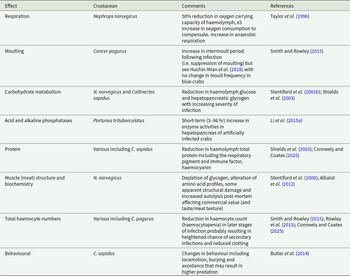
While it is widely reported that decapods parasitized by Hematodinium die probably because of the release of dinospores causing damage to the gills and metabolic exhaustion, the timescale of this from initial infection through to death varies widely between host, parasite genotype and their geographic location. Generally, crustaceans in warmer waters appear to succumb to parasitization quicker than those in colder waters probably because multiplication of Hematodinium is temperature dependent (e.g. Huchin-Mian et al., Reference Huchin-Mian, Small and Shields2018; Shields, Reference Shields2019) and so changes in sea water temperature caused by climate change may in future affect the distribution and importance of these parasites in some locations (Byers, Reference Byers2020; Rowley et al., Reference Rowley, Baker-Austin, Boerlage, Caillon, Davies, Duperret, Martin, Mitta, Pernet, Pratoomyot, Shields, Shinn, Songsungthong, Srijuntongsiri, Sritunyalucksana, Vidal-Dupiol, Uren Webster, Taengchaiyaphum, Wongwaradechkul and Coates2024). Physiological and biochemical studies reveal that infected hosts have reduced glycogen reserves in the hepatopancreas, and glucose and protein in their haemolymph (Table 3 and references therein). Moulting is inhibited by an unknown mechanism hence increasing the intermoult period at least in some crabs (Smith and Rowley, Reference Smith and Rowley2015). A major change of significance to immune responsiveness and haemolymph clotting is the marked reduction in the number of circulating haemocytes (termed haemocytopenia) in several host species (Conneely and Coates, Reference Conneely and Coates2025). The cause of this rapid reduction in haemocyte numbers is unknown but could result from a targeting of haemopoiesis or simply due to metabolic exhaustion resulting in shifts in energy resources away from haemocyte production. In edible crabs (C. pagurus) where the time from first infection to death under aquarium conditions is lengthy (93–378 days post-challenge in C. pagurus; Smith and Rowley, Reference Smith and Rowley2015), there appears to be 2 phases in haemocytopenia (Figure. 3A–C). Initially, the numbers of haemocytes in infected crabs are relatively unchanged but as the parasites in the tissues quickly develop in warmer months, haemocyte numbers can rapidly decline at least in some infected animals (Smith and Rowley, Reference Smith and Rowley2015). This terminal decline in haemocyte numbers leaves edible crabs susceptible to secondary infections including that caused by the fungus, Ophiocordyceps (Stentiford et al., Reference Stentiford, Evans, Bateman and Feist2003; Smith et al., Reference Smith, Hamilton, Hirschle, Wootton, Vogan, Pope, Eastwood and Rowley2013) such that these animals may die from a combination of metabolic exhaustion, the production and release of dinospores via the gills and/or secondary infections. It is important to stress that to the author’s knowledge, such secondary infections have not been described in other susceptible decapods, particularly those where the parasite’s life cycle within the host is shortened, such as blue crabs where mortality occurs >35 days post exposure (Messick and Shields, Reference Messick and Shields2000).
Schematic of infection dynamics of Hematodinium sp. (probably H. perezi genotype I) in the edible crab, Cancer pagurus based on the results in Smith et al. (Reference Smith, Hirschle, Vogan and Rowley2015) and Smith and Rowley (Reference Smith and Rowley2015). (A) Change in prevalence of infection. (B) Seasonal changes in numbers of haemocytes and Hematodinium sp. (C) Phase contrast micrographs of low to high grade infections (left to right panels) in the haemolymph with Hematodinium sp. (P). Note adherent haemocytes (Ha) in low grade infection and their absence in high grade infection in the right-hand panel. This model of infection dynamics may differ in the other genotypes of H. perezi II and III and the prevailing environmental conditions including temperature and salinity.

Examples of effects of Hematodinium infection on physiological and behavioural processes

Histological studies only show modest changes in the integrity of affected tissues. Both trophonts and filamentous plasmodia are found in most tissues (Figure. 1A–D) simply because these are bathed in haemolymph. This latter form of the parasite is rarely seen in the haemolymph because it appears to be attached to cells in solid tissues including the gills (Figure. 1D) and hepatopancreas (Figure. 4). While subtle changes in muscle fibres have been reported (e.g. Stentiford et al., Reference Stentiford, Neil and Coombs2000) these are modest and rarely observed histologically. The main change is the swelling of the spaces between the tubules of the hepatopancreas caused by the large increase in the number of circulating parasites but there is little evidence of their active penetration by the parasites although on rare occasions trophonts have been seen in the lumen of hepatopancreatic tubules (Figure. 4). Finally, changes in the gills including swelling and potential damage to the outer epithelia during dinospore proliferation in the gill lamellae have been observed (Wheeler et al., Reference Wheeler, Shields and Taylor2007). Post-mortem changes such as cellular necrosis, particularly in the hepatopancreas, rapidly ensue following the death of hosts with accompanying bacterial multiplication in the cadavers (Smith and Rowley, Reference Smith and Rowley2015).
Histological section of the hepatopancreas of the shore crab, Carcinus maenas showing the presence of trophonts of Hematodinium sp. In the tubule lumen (unlabelled arrow). Note apparent integrity of the tubule cells and presence of filamentous plasmodia attached to the adjacent tubules (red arrows).

There is increasing evidence of the importance of dysbiotic changes in the microbiome during disease episodes in crustaceans (e.g. Bass et al., Reference Bass, Stentiford, Wang, Koskella and Tyler2019; Holt et al., Reference Holt, Bass, Stentiford and van der Giezen2021; Hernández-Pérez et al., Reference Hernández-Pérez, Zamora-Briseño, Söderhäll and Söderhäll2022; Lorgen-Ritchie et al., Reference Lorgen-Ritchie, Uren Webster, McMurtrie, Bass, Tyler, Rowley and Martin2023). Changes in microbial diversity and community composition accompany diseases regardless of their causation. Examples include diseases of cultured shrimp such as those causing major economic effects highlighting the importance of determining how microbiomes change in response to disease (e.g. Boopathi et al., Reference Boopathi, Meenatchi, Brindangnanam, Sudhakaran, Coumar and Arockiaraj2023; Jatuyosporn et al., Reference Jatuyosporn, Laohawutthichai, Romo, Gallardo-Becerra, Lopez, Tassanakajon, Ochoa-Leyva and Krusong2023) and environmental change that potentiates disease (e.g. Cornejo-Granados et al., Reference Cornejo-Granados, Gallardo-Becerra, Leonardo-Reza, Ochoa-Romo and Ochoa-Leyva2018). In the case of parasitization caused by Hematodinium spp., both haemolymph and gut microbiomes are altered in the Norway lobster, N. norvegicus (Martin et al., Reference Martin, Elsheshtawy, Clokie, Mackenzie, Bateman, Bass, Stentiford and Albalat2025). In lobsters with sub-patent infections (i.e. those that are PCR positive but negative using the less sensitive body colour and pleopod methods – see Table 2), bacterial species richness in the haemolymph is significantly reduced. The authors suggested that this effect could be significant in advancing the susceptibility to secondary infections in such animals. Furthermore, as microbial dysbiosis has been found to result in changes to immune competence in several disease conditions in crustaceans (e.g. Zhou et al., Reference Zhou, Liu, Yao, Vasta, Wang and Wang2025) this may be of importance in this disease.
The crustacean immune system – a brief overview
This section aims to give a brief overview of how crustaceans deal with infectious agents such as Hematodinium spp. that penetrate their internal tissues with reference to how they defend against such micro-parasites. Because this is purposely a succinct overview, the reader is also referred to several recent reviews for greater detail (e.g. Coates et al., Reference Coates, Rowley, Smith, Whitten, Rowley, Coates and Whitten2022; Rowley, Reference Rowley2026).
The cells at the centre of the immune system of crustaceans are the circulating blood cells termed haemocytes. These cells are formed in discreet haemopoietic tissues (Söderhäll and Söderhäll, Reference Söderhäll and Söderhäll2022). There are 3 main types of haemocytes in crustaceans, namely hyaline cells, semi-granular haemocytes (= semi-granulocytes) and granular haemocytes (= granulocytes). These 3 types are morphologically distinct based on the number and size of granular inclusions in the cytoplasm. Each cell type has a distinct role in defence and haemostasis including phagocytosis, nodule/capsule formation, coagulation and wound healing. For instance, hyaline cells are actively phagocytic and are found in the flattened sheath of cells surrounding nodules (Rowley, Reference Rowley2026) while granular haemocytes are highly unstable and quickly respond to injury by bringing about blood clotting and the triggering of the prophenoloxidase activating system. Recent approaches looking at the biological properties of individual haemocytes have revealed further diversity in these 3 cell types (Söderhäll et al., Reference Söderhäll, Fasterius, Ekblom and Söderhäll2022; Xin and Zhang, Reference Xin and Zhang2023; Cui et al., Reference Cui, Tang, Xing, Sheng, Chi and Zhan2024) suggesting the presence of a series of sub-populations or different stages in the ontogeny of such cells.
Crustacean haemocytes, together with other cell types, also synthesize a range of immune-active molecules involved in the recognition and killing of extra- and intra-cellular pathogens and parasites. These include factors produced by the prophenoloxidase activating system (Cerenius and Söderhäll, Reference Cerenius and Söderhäll2021), various lectins (Sanchez-Salgado et al., Reference Sanchez-Salgado, Pereyra, Agundis, Vivanco-Rojas, Sierra-Castillo, Alpuche-Osorno and Edgar2017) and antimicrobial peptides including crustins (Barreto et al., Reference Barreto, Matos and Rosa2022) and penaeidins (Destoumieux et al., Reference Destoumieux, Munoz, Bulet and Bachère2000) to name just a few. A terminal product of the prophenoloxidase activating system is the dark pigment, melanin, that is a useful marker of immune reactivity seen following cuticular damage and in the nodules and capsules surrounding parasites, pathogens and damaged tissues within the haemocoel.
Of importance to our understanding of the interaction between host and its parasites and pathogens, is how the crustacean immune system deals with these insults. For example, injection of microbes into the haemocoel of shore crabs (Carcinus maenas) results in their rapid clearance from circulation by a combination of phagocytosis and nodule formation (Smith and Ratcliffe, Reference Smith and Ratcliffe1980). This latter process forms nodules that consist of a melanized core containing the invaders together with the remnants of degranulated granular haemocytes surrounded by a multicellular flattened sheath of hyaline and semi-granular cells (Smith and Ratcliffe, Reference Smith and Ratcliffe1980; Ratcliffe et al., Reference Ratcliffe, Rowley, Fitzgerald and Rhodes1985). In the case of microbial pathogens of crabs, including some fungi, they are sequestered into nodules (i.e. recognized and dealt with as ‘foreign’) but they are resistant to the killing mechanisms, and they multiply within the melanotic cores and in the phagosomes of haemocytes, to escape and cause a fatal septicaemia (Smith et al., Reference Smith, Hamilton, Hirschle, Wootton, Vogan, Pope, Eastwood and Rowley2013). Non-pathogens and avirulent strains of pathogens are usually sequestered within nodules and their soluble breakdown products stored within nephrocytes in gills (Smith and Ratcliffe, Reference Smith and Ratcliffe1981). While the methods of recognition of microbial agents such as viruses, bacteria and fungi are known, the equivalent process with eukaryotic micro- and macro-parasites has not been studied. Similarly, knowledge of how the immune system kills or inhibits the development of micro- and macro-parasites is wanting.
How do Hematodinium spp. avoid or circumvent the immune response of crustaceans?
A fundamental observation made from examining haemolymph preparations and tissues via histology is that Hematodinium is neither phagocytosed nor incorporated into nodules (Rowley et al., Reference Rowley, Smith and Davies2015; Smith et al., Reference Smith, Hirschle, Vogan and Rowley2015; Davies et al., Reference Davies, Batista, Malkin, Thomas, Bryan, Crocombe, Coates and Rowley2019, Reference Davies, Thomas, Malkin, Batista, Rowley and Coates2022; Martin et al., Reference Martin, Elsheshtawy, Clokie, Mackenzie, Bateman, Bass, Stentiford and Albalat2025) and this supports the concept that this parasite is not recognized as ‘foreign’ by the crustacean immune system (Rowley et al., Reference Rowley, Smith and Davies2015).
There are several ways in which parasites and pathogens can inhibit and/or avoid the immune response of animals, so that they can invade, reproduce or reside in their tissues unmolested. These include:
1. Mimicking host tissues and hence being ‘invisible’ to the immune system (i.e. they do not appear to elicit a cellular immune response)
2. Residing in locations that avoid immune activation (e.g. ‘hiding’ inside host cells)
3. Having mechanisms that defeat the immune response allowing them to replicate in host tissues (e.g. pathogenic fungal infections of crabs [e.g. Smith et al., Reference Smith, Hamilton, Hirschle, Wootton, Vogan, Pope, Eastwood and Rowley2013] as already described)
Molecular mimicry
Molecular mimicry is a mechanism utilized by parasites and pathogens, such as viruses, to avoid eliciting an immune response. They achieve this by displaying antigens on their surfaces that resemble those of the host and hence they do not either elicit an immune response or only a limited response ensues. Examples of this phenomenon that have received in-depth study within invertebrates are few, but a notable exception is how the parasitic helminth, Schistosoma mansoni, survives during its development in the molluscan intermediate host, Biomphalaria glabrata (see Hambrook and Hanington, Reference Hambrook and Hanington2021 for a review). By using resistant and susceptible strains of B. glabrata, it has been possible to tease-out the determinants that influence the interaction between host and parasite. These approaches have identified several mechanisms utilized by different stages of the parasite while associated with snails. These include molecules containing glycan epitopes shared between the host’s haemocytes and larval schistosomes (Yoshino et al., Reference Yoshino, Wu, Gonzalez and Hokke2013). It should be stressed, however, that schistosomes have other mechanisms to circumvent/suppress the host’s immune system showing that molecular mimicry alone does not fully explain how these parasites survive when in their molluscan host (Hambrook and Hanington, Reference Hambrook and Hanington2021). Extrapolating from this host-parasite interaction, it is possible that Hematodinium and host haemocytes of susceptible crustaceans share common antigens but to date, this has not been explored. It would also seem likely that these parasites rely on a variety of methods other than just molecular mimicry.
Other potential mechanisms of immune suppression
Although observations fail to reveal a cellular (i.e. phagocytosis or nodule formation) response in both natural and experimental infections with Hematodinium, several studies suggest these parasites employ a variety of immune suppressive activities affecting the generation of recognition and killing factors (Li et al., Reference Li, Wang, Song and Li2015a, Reference Li, Wang, Song and Li2016, Reference Li, Huang, Wang and Li2018, Reference Li, Huang, Lv, Small and Li2022). These observations have been made in the Chinese swimming (= gazami) crab, P. trituberculatus following its artificial infection with trophonts of H. perezi genotype II. The dynamics of these changes appear to indicate a short term, rather than a sustained effect post-challenge, and different investigative approaches utilized by these authors have given contradictory results. For example, phenoloxidase enzyme activity in haemocytes, as measured spectrophotometrically, has been found to rapidly decline over a 16-day period post-challenge with Hematodinium (Li et al., Reference Li, Huang, Lv, Small and Li2022) but the gene expression of prophenoloxidase (proPO) over an 8 day period in the same host shows both elevation and inhibition at different time periods (Li et al., Reference Li, Li, Wang and Song2015b), and the same enzyme activity in the hepatopancreas is consistently raised from 3 hr to 8 days post-infection (Li et al., Reference Li, Wang, Song and Li2015a). Whether the products of the phenoloxidase activating system interact with this parasite is also unknown and so these contradictory observations may not be of direct relevance to its development in the host. Similarly, Li et al., (Reference Li, Wang, Song and Li2016) reported changes in the enzyme, nitric oxide synthase, post-challenge with Hematodinium. The product of this enzyme, nitric oxide, is an important factor in the intracellular killing of parasites and pathogens within professional phagocytes, but as Hematodinium spp. do not reside within such cells, it is unclear what significance this could have in the pathogenesis of this parasite.
Exosomes and crustacean diseases including those caused by Hematodinium
Some recent developments may provide a new approach to study the interaction of parasites and pathogens including Hematodinium spp. and their crustacean hosts. These have investigated the potential role of extracellular vesicles (e.g. exosomes and microvesicles) in the pathogenesis of various diseases. Extracellular vesicles are heterogeneous in size but generally small (>200 nm) membrane-bound structures that can transport proteins (e.g. growth factors, enzymes), lipids and nucleic acids (DNA, mRNA and miRNA) between host cells, and pathogen/parasite and host. They are produced by a wide range of organisms including animals, plants and bacteria and play a role in intercellular communication (Liu and Wang, Reference Liu and Wang2023) and host-disease interactions (Shetty and Upadhya, Reference Shetty and Upadhya2021; Yates et al., Reference Yates, Pink, Erdbrügger, Siljander, Dellar, Pantazi, Akbar, Cooke, Vatish, Dias-Neto, Anthony and Couch2022). One of the first reports showing the importance of exosomes in crustacean diseases came from an investigation of tremor disease caused by Spiroplasma eriocheris (Ma et al., Reference Ma, Yao, Meng, Fu, Li, L, Liu, Liu, Gu, Hou and Meng2024). This is an important pathogen of freshwater crustaceans including the Chinese mitten crab, Eriocheir sinensis (Wang et al., Reference Wang, Wen, Gasparich, Zhu, Rong, Chen and Xu2004; Coates and Rowley, Reference Coates and Rowley2022). S. eriocheris is an intracellular pathogen that can develop within the host’s haemocytes resulting in death. Ma et al. (Reference Ma, Yao, Meng, Fu, Li, L, Liu, Liu, Gu, Hou and Meng2024) found that exosomes released by haemocytes from spiroplasma-infected crabs contained immune-active molecules including prophenoloxidase, lectins and tetraspasnin. These exosomes were found to be important in aiding the host defences of crabs by inducing the phagocytic and apoptotic activities of haemocytes and the tetraspasnin cargo of these exosomes appears to be of importance in this protective activity.
Two recent studies have investigated the potential role of exosomes in the parasitization of crabs by Hematodinium spp. (Coates et al., Reference Coates, Kraev, Rowley and Lange2023; Zhang et al., Reference Zhang, Small, Li, Huang, Hu, Xue, Wang and Li2025a). Coates et al. (Reference Coates, Kraev, Rowley and Lange2023) found a reduction in the number of extracellular vesicles in the haemolymph of shore crabs (C. maenas) naturally infected with Hematodinium sp. (probably H. perezi genotype I). Their study also observed the post-translational modification of immune factors in infected crabs by deamination including actin, non-inducible nitric oxide synthase and the tail-less form of Down syndrome cellular adhesion molecule. This latter molecule has been identified as a multivariant recognition factor that is involved in the internalization of various microbes by professional phagocytes in arthropods including crustaceans (Ng and Kurtz, Reference Ng and Kurtz2020; Rowley, Reference Rowley2026) but its potential interaction with Hematodinium is unknown. The second of these studies gives further and detailed insight into how exosomes may influence the immune response to Hematodinium (Zhang et al., Reference Zhang, Small, Li, Huang, Hu, Xue, Wang and Li2025a). This study observed that H. perezi genotype II release exosomes that come to reside in the peri-nuclear region of the host’s (P. trituberculatus) haemocytes. The cargo of these exosomes includes miRNAs that suppress part of the Toll pathway that is important in the recognition of some bacteria and fungi resulting in their internalization by haemocytes and switching on the production of antimicrobial peptides (Habib and Zhang, Reference Habib and Zhang2020; Rowley, Reference Rowley2026). Of note was the finding that the in vitro phagocytosis of test bacteria (E. coli) by haemocytes from Hematodinium infected crabs was inhibited and this was linked to the gene rictor that is a target of the parasite-delivered miRNAs (Zhang et al., Reference Zhang, Small, Li, Huang, Hu, Xue, Wang and Li2025a). While it should be remembered that Hematodinium spp. are not phagocytosed by crustacean haemocytes, this inhibition could leave such animals with reduced ability to deal with secondary infections caused by bacteria and some fungi.
Are there explanations of contrasting viewpoints on how Hematodinium circumvents the host’s immune system?
There are potentially conflicting viewpoints of how Hematodinium spp. survive and replicate in the haemolymph of susceptible hosts apparently unmolested. For instance, Rowley et al., (Reference Rowley, Smith and Davies2015) showed that the dynamics of bacterial clearance (a marker of phagocytosis and nodule formation) in Hematodinium infected vs. non-infected edible crabs did not differ. This implies a mechanism of action that does not compromise how the immune system deals with other invaders (i.e. general immune suppression). However, others have demonstrated changes in the antimicrobial armoury and recognition pathways in Hematodinium infected crabs (Li et al., Reference Li, Wang, Song and Li2015a, Reference Li, Li, Wang and Song2015b, Reference Li, Wang, Song and Li2016, Reference Li, Huang, Wang and Li2018, Reference Li, Huang, Lv, Small and Li2022) that would be expected to result in a reduction in the ability of such animals to remove any invaders from circulation. These apparent differences may be explained by the diversity of model hosts, parasite genotypes and the severity of infections in these studies. Rowley et al., (Reference Rowley, Smith and Davies2015) used edible crabs (C. pagurus) in their study while others (Li et al., Reference Li, Wang, Song and Li2015a, Reference Li, Wang, Song and Li2016, Reference Li, Huang, Wang and Li2018, Reference Li, Huang, Lv, Small and Li2022) made use of the Chinese swimming crab, P. trituberculatus as a model species where the dynamics of infection with Hematodinium spp. differ. Depending on the genotype investigated, studies on parasite and haemocyte number both in naturally and artificially infected edible crabs reveal that the replication of the parasite is initially very slow, especially in genotype I, and that it is only in the late phase several months post-infection when haemocyte numbers rapidly decline and trophonts mass in the haemolymph (Figure. 3). The preliminary experiments described in Rowley et al., (Reference Rowley, Smith and Davies2015) and Smith and Rowley (Reference Smith and Rowley2015) used crabs with only modest infections where the haemocyte numbers were unaffected by parasitization. Clearly, when the haemocyte numbers decline in late-stage infections this must leave crustaceans vulnerable to secondary infections such as those caused by fungi (Smith et al., Reference Smith, Hamilton, Hirschle, Wootton, Vogan, Pope, Eastwood and Rowley2013). In P. trituberculatus, however, post-challenge with trophonts of H. perezi genotype II, there is a rapid increase in parasite number over just a few days with ensuing mortality and the rapid changes in the capacity of the immune system in terms of haemocyte number alone would be more pressing.
Taken together, these studies with both C. pagurus and P. trituberculatus probably demonstrate that Hematodinium spp. (i.e. H. perezi genotypes I and II respectively) are utilizing a range of mechanisms to allow these parasites to develop unmolested in the tissues but there is still uncertainty about whether molecular mimicry plays an important role in these events and the relevance of immune molecules such as phenoloxidase that produce products that may not directly or indirectly kill these parasites. While the histopathology of infections caused by genotypes I–III are all remarkably similar, the dynamics and outcomes of infections appear to differ markedly. For instance, the aquarium-based infection studies of edible crabs (C. pagurus) by Smith and Rowley (Reference Smith and Rowley2015) imply that natural infections in cool waters in northern Europe by this genotype of H. perezi (genotype I?) may take several months to establish themselves and that at least some of the mortality observed is caused by other infections rather than from this parasite alone. In contrast, crustaceans in warmer waters, such as P. trituberculatus infected with H. perezi genotype II in China, succumb to rapidly developing infections (Li et al., Reference Li, Huang, Lv, Song and Li2021b) apparently without the participation of other infectious agents. Indeed, the same genotype of H. perezi (II), can cause death of mudflat crabs (H. tientsinensis) in only 4 weeks post-challenge (Zhang et al., Reference Zhang, Huang, Li, Zhang, Song and Li2025b). It would be interesting to determine if the outcome of such infections is attributable to differences in the 3 genotypes of H. perezi. For instance, if susceptible crabs held in standardized temperature conditions are artificially infected with each of the different genotypes does the speed and outcome of such challenges differ? This would answer the relative importance of genetic makeup of the parasite vs. environmental and/or host parameters in determining the outcome of infections and interaction with the host’s immune system.
Conclusions and future directions
In the ensuing century since the initial discovery of Hematodinium in northern Europe, this endoparasite has been recognized as a serious threat to many species of decapod crustaceans as it has been found to have resulted in high levels of prevalence in some populations. The recent observation of H. perezi genotype II in crabs under cultivation in polyculture systems in parts of China, where reservoirs of infection can occur in adjacent wild crabs, is of concern because such systems have a poor prospect of applying any of the principles of biosecurity to limit their spread. Commercially fished populations, including Tanner and snow crabs in cold waters in north Americas, are also at future risk with changes in the sea water temperature particularly in the winter months that can limit the development of these parasites.
There have been significant advances in the understanding of the effects of this parasite on its hosts and the methods that allow the accurate identification of Hematodinium spp. but key questions remain unanswered. These include:
1. Are all hosts killed by infections caused by Hematodinium spp.? (i.e. are there latent infections as considered by Eigmann et al., Reference Eigmann, Burmeister and Skovgaard2010?).
2. Do the 3 genotypes of H. perezi have differing infection dynamics and severity resulting in varying rates of mortality? (i.e. are some genotypes more virulent than others regardless of water temperature?).
3. Why are some species of homarids (clawed lobsters) apparently not naturally infected by Hematodinium spp.?
4. Do the 3 genotypes (I–III) of H. perezi each have distinct host ranges that are independent of geographic location?
5. What risks will change in sea water temperature in the future pose to the viability of some commercial fisheries in the presence of some parasites such as Hematodinium spp.?
6. Is molecular mimicry a driver of the success of these parasites facilitating their multiplication in the host’s tissues and an explanation of their wide host range?
7. How important are parasite-derived exosomes in the development of Hematodinium spp. in their hosts?
8. How do dinospores of Hematodinium spp. gain entry to the tissues of their hosts? and
9. What are the triggers and mechanism(s) for parasite release from the host?
Acknowledgements
The author is especially grateful to Dr Irene Molto-Martin and Professor Amaya Albalat (Institute of Aquaculture, University of Stirling, Scotland, UK) for their generous provision of the images in Figure 2. Dr Christopher Coates (University of Galway, Ireland) is also thanked for his critical comments on an early version of this review and to present and previous colleagues and co-investigators including Drs Christopher Coates, Amanda Smith, Charlotte Davies, Jessica Thomas, Tara Miller (née Thrupp) and Ms Sophie Malkin for allowing their micrographs to be used in this review. I wish to thank the 2 anonymous referees for their insightful comments that improved this review. Finally, I thank Professor Luca Börger (Biosciences, Swansea University) for the provision of office space that assisted in the production of this review.
Author contributions
AFR conceived and wrote this article.
Financial support
This review was not directly funded but previous studies of the author supported by the EU ERDF Ireland-Wales programme (Susfish and Bluefish) and UKRI (GR BB/P017215/1) informed this publication.
Competing interests
The author declares no conflicts of interest.
Ethical standards
Not relevant to this review.






 Open access

