




Introduction
The tombstone of Ruben Um Nyobè stands amid encroaching grasses in a small cemetery in Éséka, Cameroon. Leader and co-founder of the Union des populations du Cameroun (UPC) political party, Um Nyobè was a central nationalist figure, indefatigable in the struggle for independence from France. The party, established in 1948, quickly amassed a following for its nationalist platform and opposition to the French colonisation. The UPC was banned in 1955, and its members – known as upécistes – were hunted down by state forces. Many upécistes entered the maquis, the underground liberation struggle and armed resistance that lasted from 1956 to 1971.Footnote 1
The conflict was replete with torture, executions, forced population displacements and indiscriminate violence. Media access during the violence was heavily regulated by French authorities, limiting international awareness of the covert or hidden war (Deltombe et al. Reference Deltombe, Domergue and Tatsitsa2011: 371–5; Rechniewski Reference Rechniewski, Keene and Rechniewski2018: 234). The UPC lost, and state actors generated publicly hegemonic narratives of conflict that reframed upécistes as threats to Cameroon. Counterhegemonic narratives, meanwhile, were confined to private spaces.
For many, upécistes were heroes. The sacrifices they made in service to the liberation struggle are a source of pride. The history of the UPC reverberates in the present, legitimising grievances and mobilising actions. For others, upécistes were terrorists who preyed upon civilians and threatened the nascent Cameroonian state. For them, the UPC conjures images of brutal violence within communities and families. Rather than motivate, history conveys the costs of political engagement.
The diversity of discursive practices around the hidden war reflects a trend of contradictory findings in the literature on legacies of political violence. In some instances, exposure to violence mobilises victimised individuals. Violence is linked to more frequent political engagement and more intense political attitudes. In other instances, violence is associated with declines in engagement and weakened attitudes. Why is violence associated with both political mobilisation and demobilisation?
To answer this question, I explore the intergenerational reproduction of perceptions and attitudes concerning conflict by focusing on socialisation, specifically the narrativisation of historic violence. Narratives serve as conduits for the transmission of knowledge, norms and analytical frameworks. I centre the role of what I refer to as necro-narratives, or narratives that [re]construct social and political meaning out of death.
Methodologically, I analyse narratives collected during a series of interviews that I conducted in 2022–23. In former UPC strongholds, narratives often link individual deaths to nationalism, liberation and the importance of carrying on the political work of the upécistes. Conversely, in villages where political cleavages fragmented local society, narratives often prioritise the intracommunal intimacy of violence while de-emphasising the political goals factions sought to achieve through conflict.
By examining the relationships between local political cleavages, perceptions of conflict and narratives, I provide contributions along two research fronts. First, I build on existing scholarship of counterhegemonic narratives that develop in liminal spaces – narratives that may emerge as challenges to historically intolerant regimes (Baba and Freire 2019; Kuppens and Langer Reference Kuppens and Langer2023; Reim Reference Reim2023; Zuern Reference Zuern2012). Cracks in the façade of the memory regime in Cameroon are showing, and along with them, the questions of state stability raised by authors in different contexts become increasingly pressing. Second, by drawing on trauma and resiliency literature, I link individual narrative practices with meso-level community dynamics.
In the next section, I situate my theory of local political cleavages and narratives within the legacies of violence literature. I then discuss the liberation struggle and the post-conflict sociopolitical environment. Subsequently, I describe my interview methodology before shifting to an analysis of narratives. In the penultimate section, I discuss research concerns. I conclude with the implications of this research.
The [de]mobilising legacies of violence
Exposure to violence triggers political mobilisation. Victimisation is associated with increases in the rates and intensity of sociopolitical practices and attitudes. Regarding practices, violence exposure is tied to increased rates of low-cost forms of engagement, such as voting (Bellows and Miguel Reference Bellows and Miguel2009; Blattman Reference Blattman2009; Lupu and Peisakhin Reference Lupu and Peisakhin2017). Furthermore, victimised individuals participate in higher-cost forms of engagement more often than their non-victimised analogues. For instance, exposure is linked to higher rates of involvement in collective action efforts, such as protesting (Berman et al. Reference Berman, Clarke and Majed2024; Grosjean Reference Grosjean2014; Pearlman Reference Pearlman2013; Rozenas and Zhukov Reference Rozenas and Zhukov2019). These gains are evident locally as well, with individuals exhibiting greater activity in community organisations (Barceló Reference Barceló2021; Bauer et al. Reference Bauer, Blattman, Chytilová, Henrich, Miguel and Mitts2016; Wood Reference Wood2003).
Concerning attitudes, violence exposure is linked to altruism and tolerance towards outgroup members. For example, Liberians exposed to civil war violence are more accepting of refugees (Hartman and Morse Reference Hartman and Morse2018; see also Wayne and Zhukov Reference Wayne and Zhukov2022). Exposure also strengthens attachment to one’s ingroup, which may facilitate collective coping and augment security (Besley and Reynal-Querol Reference Besley and Reynal-Querol2014; Dragojević Reference Dragojević2013; Glaurdić and Vuković Reference Glaurdić and Vuković2016; Hadzic et al. Reference Hadzic, Carlson and Tavits2020).
Exposure to political violence demobilises as well. Victimisation is linked to declines in voting (Alacevich and Zejcirovic Reference Alacevich and Zejcirovic2020; Zhukov and Talibova Reference Zhukov and Talibova2018), collective action (Kilavuz et al. Reference Kilavuz, Grewal and Kubinec2023; Wang Reference Wang2021) and community engagement (Whitt Reference Whitt2021). Attitudinally, violence is also associated with the hardening of ethnic and national boundaries (Beber et al. Reference Beber, Roessler and Scacco2014; Lupu and Peisakhin Reference Lupu and Peisakhin2017), declines in outgroup acceptance (Balcells Reference Balcells2012; Canetti et al. Reference Canetti, Hall, Rapaport and Wayne2013) and weaker ingroup attachment (Cassar et al. Reference Cassar, Grosjean and Whitt2013; Hager et al. Reference Hager, Krakowski and Schaub2019; Komisarchik et al. Reference Komisarchik, Sen and Velez2022).
As the gap between trajectories of mobilisation and demobilisation has grown, several studies have provided insights into these divergent legacies. Pearlman (Reference Pearlman2013) argues that emotional reactions to state repression may be dispiriting – characterised by fear and shame – or emboldening, such as anger and hope. In turn, these emotional microfoundations influence the likelihood of mobilisation. Krakowski (Reference Krakowski2020) identifies the difference between guerilla and conventional military violence as a key determinant in post-conflict community cohesion, with unconventional warfare eroding cohesion and conventional warfare fortifying it. Critically, Villamil (Reference Villamil2021) demonstrates the importance of social networks and collective memory: where networks remain intact following intrastate conflict, they reproduce historical narratives and leverage them to mobilise communities during the post-war period. Where these networks are destroyed, no such mobilisation occurs. These studies demonstrate that violence enacts change heterogeneously between communities and that, nested within the community level, individual reactions to similar violent experiences differ.
A separate literature on trauma and resilience elucidates the link between social networks and individual responses to violence. Though in part an individual attribute, post-conflict resilience is fundamentally shaped by interactions between a victimised individual, their family and their broader community (Ungar Reference Ungar and Ungar2012; see also Raghavan and Sandanapitchai Reference Raghavan and Sandanapitchai2024). Family cohesion and support are consistently cited by survivors of political violence as protective resources that contribute to post-traumatic resilience (Elsass and Phuntsok Reference Elsass and Phuntsok2009; Sousa et al. Reference Sousa, Haj-Yahia, Feldman and Lee2013). By contrast, individual expectations of post-conflict social and economic growth decline when victims are excluded from their family units (Dixon Reference Dixon2021).
Resilience is shaped by one’s relationships within their broader community as well. Material and emotional support proffered to victimised individuals contributes to a sense of solidarity that generates resilience (Farwell Reference Farwell2001; see also Hernandez et al. Reference Hernandez, Gangsei and Engstrom2007). Crucially, by providing a political coping mechanism, commitment to a broadly shared struggle – such as a nationalist liberation movement – may also foster post-traumatic resilience (Elsass and Phuntsok Reference Elsass and Phuntsok2009). Thus, across groups affected by political violence, family and community relationships profoundly shape individual sociopolitical practices (Braga et al. Reference Braga, Feijó and Fiks2012; Lykes et al. Reference Lykes, Beristain and Pérez-Armiñan2007).
The trauma and resilience literature also draws attention to vicarious and intergenerational dimensions of transmission. Traumatic experiences alter perceptions, attitudes and behaviour. These changes are communicated throughout an individual’s network. Parents may explicitly transmit conflict narratives to their children as a means of conveying family history, expectations of behaviour, warnings, etc. Legacies may be unintentionally reproduced as well, as through marked silence regarding victimisation. Though traumatised individuals may seek to spare their descendants the weight of their experiences through reticence, this leaves substantial gaps in historical understanding for younger generations (Braga et al. Reference Braga, Feijó and Fiks2012). Descendants may internalise the fears of older generations, find themselves alienated in their own relationships, and perpetuate the silences modelled for them by their ancestors (Lin et al. Reference Lin, Suyemoto and Kiang2009). In a general sense, the network dynamics identified by scholars of vicarious and intergenerational trauma inform our understanding of the ways in which families and communities generate fertile or hostile conditions for translating conflict exposure into a potential mobilising resource.
Theorising local responses to national conflict
I build on these threads of mobilising effects, demobilising effects and contingent [de]mobilising effects by centring the interaction between national conflict and local dynamics. Far from being homogenous microcosms replicating an overarching political conflict, communities within theatres of conflict vary in their levels of support for state and non-state factions. To borrow from Kalyvas’s lexicon, violence committed at the local level may reflect the ‘master cleavage’, or the cleavage that motivates conflict and violence at the highest level. A community may reproduce the master cleavage in that political factions at the local level oppose one another along the same rift. Conversely, one side of the master cleavage may present as locally dominant (Kalyvas Reference Kalyvas2003).
I theorise that cleavage [mis]alignment substantially influences the materialisation of local violence at the level of the community, namely if violence is enacted upon members of a community by co-members (intracommunal) or identifiable outsiders (intergroup).Footnote 2 This character of the local experience may then crystallise as a collective memory resource for fostering mobilising attitudes or a barrier to community cohesion that discourages the formation and transmission of mobilising attitudes. For the purposes of this research, a sense of political engagement as positive, helpful, productive, essential, etc., is an attitude of mobilisation. By contrast, a demobilising attitude is a sense that such engagement is futile, dangerous, unnecessary, etc.
I focus on political cleavages, understood as ‘alliances in conflicts over policies and value commitments within the larger body politic’ (Lipset and Rokkan Reference Lipset, Rokkan, Lipset and Rokkan1967). Political cleavages may not only find their expression through party politics but also include social, religious or economic cleavages when they are used to influence the master cleavage. In conjunction with the motivations undergirding conflict in the abstract, local divisions – exacerbated and concretised through violence – shape the meaning of conflict.
Where the master cleavage resonates with a local cleavage, violence of the overarching political conflict is likely to materialise with an intracommunal character. Post-conflict, the public emergence and employment of counterhegemonic narratives to spur political engagement becomes less likely as this risks reinvigorating local wartime divisions and negatively impacting practical aspects of quotidian life. Initial political action antedating a violent conflict may be perceived as responsible for deepening and bloodying intracommunal cleavages by localising the master cleavage. In turn, the intimacy of violence and the cost of political engagement may become the dominant facets of conflict memories. This inhibits the translation of conflict exposure into a potential mobilising resource.
Alternatively, local cleavages may be orthogonal to the overarching conflict. One side of the master cleavage may achieve local dominance. In this instance, intracommunal violence linked to the overarching conflict is less likely. When victimisation occurs, it is more likely to result from violence perpetrated by members of outgroups aligned with the opposing side of the master cleavage. Rather than a wedge, violence engenders a shared experience and a viable base for strengthening an ingroup identity, framing grievances and encouraging sociopolitical engagement. Subsequently, the [de]mobilising legacies resulting from direct exposure are reproduced intergenerationally through familial and communal socialisation.
Socialisation, intergenerational transmission and the role of narratives
Socialisation is a critical mechanism for reproducing the effects of victimisation over time. Both community-level and family socialisation serve as conduits through which the outcomes of initial, direct exposure to violence are transmitted to younger generations (Charnysh and Peisakhin Reference Charnysh and Peisakhin2022; Komisarchik et al. Reference Komisarchik, Sen and Velez2022; Lupu and Peisakhin Reference Lupu and Peisakhin2017; Wang Reference Wang2021; Wayne and Zhukov Reference Wayne and Zhukov2022).
I explore narratives as an observable medium of socialisation. Narratives of past conflict accomplish two goals: they embed localised episodes of victimisation within a group-centric discursive framework, and they serve as a lens through which individuals analyse and respond to social and political pursuits in novel contexts. First, discursive frameworks play an essential role for individuals interpreting conflict. Violence and victimisation do not translate to collective trauma without the memory politics work done by group members. Discursive frameworks and narratives are necessary to contextualise victimisation (Alexander Reference Alexander, Alexander, Eyerman, Giesen, Smelser and Sztompka2004) and [re]construct the meaning of contemporary and ancestral deaths. Such narratives – which I define as necro-narratives – relocate the atomised experiences of violence and death among individuals during conflict within an ideologically coherent constellation, thereby lending those experiences social and political meaning.
Second, it is through this sense-making role that necro-narratives link historic victimisation with contemporary social and political goals. Memories of the dead may be used to legitimise grievances and spur collective action (Gurr Reference Gurr1993; Horowitz Reference Horowitz2001). Conversely, narratives may be used to discourage political engagement by linking the costs of past violence to political action. These narratives de-emphasise the temporal distance between the master conflict and the present while clarifying spatial and social proximity. Narratives of death anchor abstract political conflict by localising violence and instantiating victimisation through close connections, often ancestral in nature. Discursive practices surrounding Cameroon’s liberation struggle render these concepts concrete.
The UPC and Cameroon’s liberation struggle
With the defeat of the Second Reich in WWI, the German colony of Kamerun was broken up into two United Nations trust territories administered separately by France (the focus of the present study) and Britain. Within the framework of the trustee system, French administrators were responsible for preparing Cameroon for self-governance and independence. Instead of cultivating institutions oriented towards autonomy, the French administration subverted Cameroonian political development through representative bodies disproportionately favouring French settler-colonisers and imposing the indigénat – a legal regime that codified the lower status of colonised peoples through harsh and arbitrary punishments, forced labour, etc. (Joseph Reference Joseph1977: 26, 54, 74–5; Le Vine Reference Le Vine1964: 252–4).
Emerging in this authoritarian context, the UPC championed reunification with British Cameroons and independence while integrating diverse subnational socioeconomic grievances (Eyinga Reference Eyinga1991: 25; Mintoogue Reference Mintoogue2020). Within a few years of its establishment in 1948, upécistes built an effective political machine and promulgated a nationalist, anticolonial platform. The UPC’s influence was greatest in the Littoral, West, South and Centre regions, particularly the Sanaga-Maritime, Mungo and Grassfields areas. French attempts to stymie the movement included election fraud, harassment, surveillance, arrests and lawfare (Deltombe et al. Reference Deltombe, Domergue and Tatsitsa2011: 113–28). Fearing the increasing popularity of the UPC despite these measures, the French administration banned the party from electoral competition in July 1955.
The relationship between the UPC and colonial administration reflected an essential cleavage between factions of Cameroonian society that sought immediate independence and those that sought autonomy within the French empire or delayed independence. Upécistes refined this cleavage by popularising independence without delay and framing Cameroonian sociopolitical development in dichotomous terms: Cameroonians who supported upéciste-style nationalism were patriots, while those who sided with the colonisers were dikokoñ – traitors to the cause (Noumbou Tetam Reference Noumbou Tetam2023: 111).
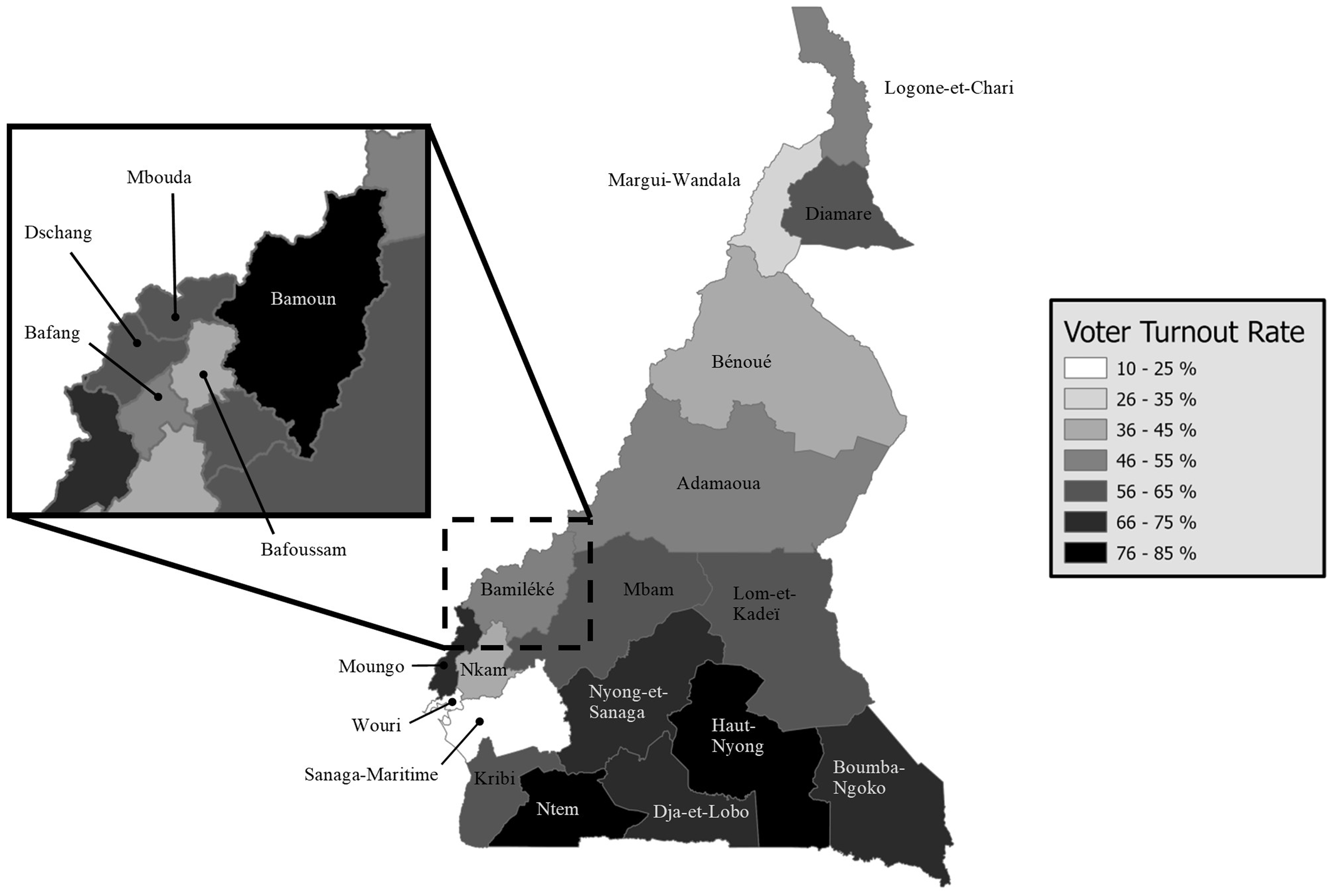
For many, the liberation struggle was a Manichean conflict between coloniser and colonised. Push down to the local level, however, and the political topography quickly transformed into a byzantine terrain. Prior to the closure of legal political channels, the UPC party established strongholds throughout the Sanaga-Maritime. To illustrate, the UPC called for voters to boycott the December 1956 elections for the Cameroon Territorial Assembly (ATCAM). These were the first major elections since the UPC was banned roughly 18 months prior. Nationally, over 40% of eligible voters participated, while in the Sanaga-Maritime, only 12% voted (Le Vine Reference Le Vine1964: 249; O’Sullivan Reference O’Sullivan1972: 66). In many places, however, the UPC competed with contending forces along not only political but social dimensions as well.
Politically, relatively moderate options, such as Paul Soppo Priso’s Union nationale and Ahmadou Ahidjo’s Union camerounaise parties, integrated elements of the UPC platform while maintaining legal standing, offering avenues to support some upéciste demands without invoking repression and harassment (Joseph Reference Joseph1977: 436–7). These state-sanctioned parties proliferated while the UPC was condemned as a communist movement by French administrators, a claim that was reinforced by the influential Catholic Church. Clergy insisted that their flocks disassociate from the party (Deltombe et al. Reference Deltombe, Domergue and Tatsitsa2011: 121–3; Joseph Reference Joseph1977: 259–60), creating an additional politico-religious barrier for the party.
Socially, though the party made overtures to traditional authorities, an alliance between conservative chieftaincies and a nationalising, modernising movement was not always obvious. Besides ideological barriers, supporting the anticolonial movement meant risking deposition (Bayart Reference Bayart1979: 64) or sacrificing lucrative collaborations (Firmin-Sellers Reference Firmin-Sellers2021: 51; Geschiere Reference Geschiere1993; Mamdani Reference Mamdani1996). When traditional authorities publicly opposed the UPC, citizens within the chieftaincy were compelled to prioritise either traditional, local, ancestral ties or the nationalist movement. Bamiléké communities may have been particularly vulnerable to fission along this dimension. Whereas Bassa sociopolitical institutions were historically organised at the village level (Joseph Reference Joseph1977: 223; Pouka Reference Pouka1950), Bamiléké kingdoms were more hierarchical and extended well beyond single or small sets of villages (Firmin-Sellers Reference Firmin-Sellers2021). While the UPC did enlist the support of powerful royals like Mathias Djoumessi and Kamdem Ninyim, the Kumsze, a representative body of Bamiléké traditional authorities, grew to oppose the UPC (Bayart Reference Bayart1979: 32, 42; Deltombe et al. Reference Deltombe, Domergue and Tatsitsa2011: 175–6).Footnote 3
After their exclusion from legal party politics, upécistes shifted operations underground and launched an armed struggle in December 1956. Disrupting Territorial Assembly elections, the opening salvo targeted voting locations, ballot boxes, pro-French candidates and infrastructure in the Sanaga-Maritime (Deltombe et al. Reference Deltombe, Domergue and Tatsitsa2016: 113). This clandestine phase of the liberation struggle and guerilla war was referred to as the maquis; those who joined the guerilla effort were known as maquisards.
The conflict unfolded in two areas: the Bassa maquis, located in the greater historic Sanaga-Maritime and concentrated in the Zone de pacification (ZOPAC), and the Bamiléké maquis, spread across the Mungo department in Littoral and the Grassfields of West. The Bassa and Bamiléké ethnic groups formed the two primary wings of the UPC and associated guerilla organisations. Armed struggle in the Sanaga-Maritime declined precipitously following the September 1958 killing of co-ethnic Bassa and UPC ideological leader Ruben Um Nyobè. Violence continued in the Bamiléké maquis up until the capture and execution of Ernest Ouandié in January 1971.
The war was brutal. State forces comprising French, Cameroonian and African soldiers drawn from surrounding colonies enacted violence indiscriminately while dehumanising guerillas and targeting non-combatants in the effort to defeat the maquisards militarily and erode popular support for the nationalist movement. Incendiary rounds were used to destroy villages, urban neighbourhoods and the forests that lent refuge to guerillas (Deltombe et al. Reference Deltombe, Domergue and Tatsitsa2011: 423; Niorthe Reference Niorthe2012; Terretta Reference Terretta2013: 178). Non-combatants were beaten by state forces to elicit denouncements of upéciste neighbours (Meyomesse Reference Meyomesse2016: 77). Populations living within the conflict zones were subjected to regroupement, the uprooting of communities and their resettlement in fortified villages where the state could better observe and control movement (Deltombe et al. Reference Deltombe, Domergue and Tatsitsa2011: 265–7). Individuals found outside of these villages after curfew were subject to summary execution (Mbembe Reference Mbembe1996: 351). Torture of captured maquisards was commonplace (Verschave Reference Verschave1998: 103). Public executions followed for many, but death was scarcely the end. The state would regularly decapitate maquisards and exhibit their heads in heavily trafficked spaces – markets, village squares, etc. – as part and parcel of ‘psychological warfare’ (Deltombe et al. Reference Deltombe, Domergue and Tatsitsa2011: 447–8; Meyomesse Reference Meyomesse2016: 79).
The methods employed by French state forces should be understood within a broader imperial context. Successive military defeats first by the Nazi regime during WWII and then by the Việt Minh during the French-Indochina War were perceived as national humiliations in France (Cooney Reference Cooney2023: 179; Garrett Reference Garrett1967: 303–4). As their forces withdrew from Indochina, France became embroiled in a decolonisation war with the Front de libération nationale in Algeria. To stem the disintegration of their empire, the beleaguered Fourth Republic paired political reforms, characterised by the introduction of the relatively liberalising loi-cadre (Smith Reference Smith2014), with revised military approaches to conflict.
The military focus on civilians evident during the UPC conflict was an expression of the doctrine de la guerre révolutionnaire (DGR; revolutionary-war theory) elaborated by French strategists in the years preceding the outbreak of violence in Cameroon (Mendl Reference Mendl1966: 140–3). Evaluating their defeat in Indochina, French strategists identified civilian populations as sources of social and physical revitalisation for guerillas. Consequently, French forces sought to recruit and control civilian populations. This reorientation towards civilians as targets of politico-military action, shaped by a sense of national shame and imperial decline, motivated the adoption of psychological warfare. Inspired by the experiences of soldiers in Indochina and reformulated for French purposes in Algeria, psychological warfare included propaganda, re-education and torture intended to alter the relationship between civilians and guerillas from one of support to hostility (Aggoun Reference Aggoun, Alexander, Evans and Keiger2002: 194–7; Lazreg Reference Lazreg2008: 67–72). The effects in Algeria, as in Cameroon, were devastating: ‘Ironically, the doctrine sought to win the hearts and minds of the people all the while advocating the destruction of their physical and social environment, and the remaking of their selves through torture and psychological warfare’ (Lazreg Reference Lazreg2008: 16).
Maquisards, for their part, were known for their uncompromising position and swift action against the valets and colons – Cameroonian collaborators and French settler-colonisers, respectively. Like state forces, maquisards were known to torture and execute captives (Mbembe Reference Mbembe1996: 348). Property as well as the lives of civilians were subject to aggression. Maquisards often burned down the homes of valets, frequently targeting the compounds of French-aligned chiefs (Terretta Reference Terretta2013: 181–2).
While communities in both the Bassa and Bamiléké maquis were exposed to violence, distinct historical dynamics shaped political and conflict trajectories. The UPC consolidated political messaging around socioeconomic grievances among Bassa and Bamiléké communities alike, for instance, but in distinct ways. Joseph notes that ‘It was among the Bassa people that contradictions resulting from colonial rule were most acute’ (Reference Joseph1977: 431). Prior to the war, French administrators invested in the development of the timber, energy and aluminium industries in Bassa country. Despite averaging relatively high educational attainment, Bassa individuals rarely profited from these development initiatives (431–2). Surrounded by highly visible extractive and industrial projects yet reaping no benefits, the UPC rapidly recruited and organised Bassa adherents in opposition to French exploitation.
Referred to as Mpodol – spokesperson – by his supporters, Um Nyobè lent structure and voice to grievances. The events surrounding his discovery and execution by state forces in the forests near Boumnyébel precipitated suspicion among upécistes that an informant acted from within his retinue. Consequently, alongside the motif of regime collaborators as traitors to the nationalist cause, an acute moment of betrayal emerged as a powerful theme in Bassa post-war discourse (Abwa Reference Abwa2010: 276; Mbembe Reference Mbembe1996: 382).
Socioeconomic grievances were also politicised by the UPC in Bamiléké country, but they were complicated by inter-ethnic competition and intra-ethnic social strife. As France developed cash crop agricultural sectors in southern Cameroon, administrators encouraged the migration of labourers from the Bamiléké kingdoms of West to the Mungo area. These labour migrations stressed relations between the relative newcomers and pre-existing Duala and Mungo ethnic communities (Terretta Reference Terretta2013: 69–75). Importantly, these migrations were both impelled by burgeoning economic opportunities and propelled by intergenerational social problems (Eckert Reference Eckert1997).
Hierarchical and gerontocratic dimensions of traditional Bamiléké kingdoms limited social and economic mobility (Warnier Reference Warnier1989, Reference Warnier2007: 233–53). Exit through labour migration, missionary schooling and employment with colonial administrators were key ways in which many Bamiléké men altered their prospects. These were avenues by which men could generate wealth and prestige outside of the purview of traditional Bamiléké authorities. When those who achieved success returned to their ancestral homelands, their arrivals could threaten the status quo. A critical period of disruption predated French colonialism, when tapentas – young men associated with German colonisers in the late-20th century – pushed back against local institutions (Beuvier Reference Beuvier2014: 15–22). Often equipped with European-style educations and weaponry, tapentas rebuffed traditional authority while enacting violence: ‘pledging allegiance to no chiefdom and threatening structures of authority wherever they went’ (Argenti Reference Argenti2007: 164–5).
When the maquis took root in Bamiléké country, many cities and villages had previously experienced intracommunal tension and violence. The social strains engendered by traditional gerontocratic hierarchies that underlaid previous cycles of violence materialised during the UPC conflict. Accordingly, social elements interacted with the nationalist-collaborationist master cleavage in Bamiléké communities differently than in Bassa communities.
Furthermore, the robust organisational cohesion achieved by the Comité national d’organisation, the military organ of the UPC operating in the Bassa maquis (Deltombe et al. Reference Deltombe, Domergue and Tatsitsa2011: 291–4), was not replicated within the Sinistre de la défense nationale du Kamerun analogue operating in the Bamiléké maquis.Footnote 4 Rather, the guerilla effort in the latter maquis was challenged by elite fissions (Fotso et al. Reference Fotso and Tchoumboué2010: 304–12) and poor coordination between units operating in discontinuous territories (Anafak Reference Anafak L2024: 44–6; Johnson Reference Johnson1970: 356–8). Banditry, civilian targeting and personal vendettas proliferated (Johnson Reference Johnson1970: 358; Kamé Reference Kamé2008: 55–6). Attacks – often enacted upon French-aligned traditional chieftaincies – contributed to a climate of fear and weakened relationships between the UPC and the surrounding populations (Anafak Reference Anafak L2024: 51–2, 59; Terretta Reference Terretta2013: 180–3). Violence in the Bamiléké theatre also extended well beyond independence, which was achieved in 1960 under Cameroon’s first president, Ahmadou Ahidjo. Upécistes adjusted from their struggle against colonialism to one against neocolonialism, Ahidjo’s puppet regime and false independence (Anafak Reference Anafak L2024: 44; Eckert Reference Eckert1997: 219; Fotso et al. Reference Fotso and Tchoumboué2010: 245–6). This further strained the support of local publics, who expected a decline in violence following independence and reunification with the southern British Cameroons.
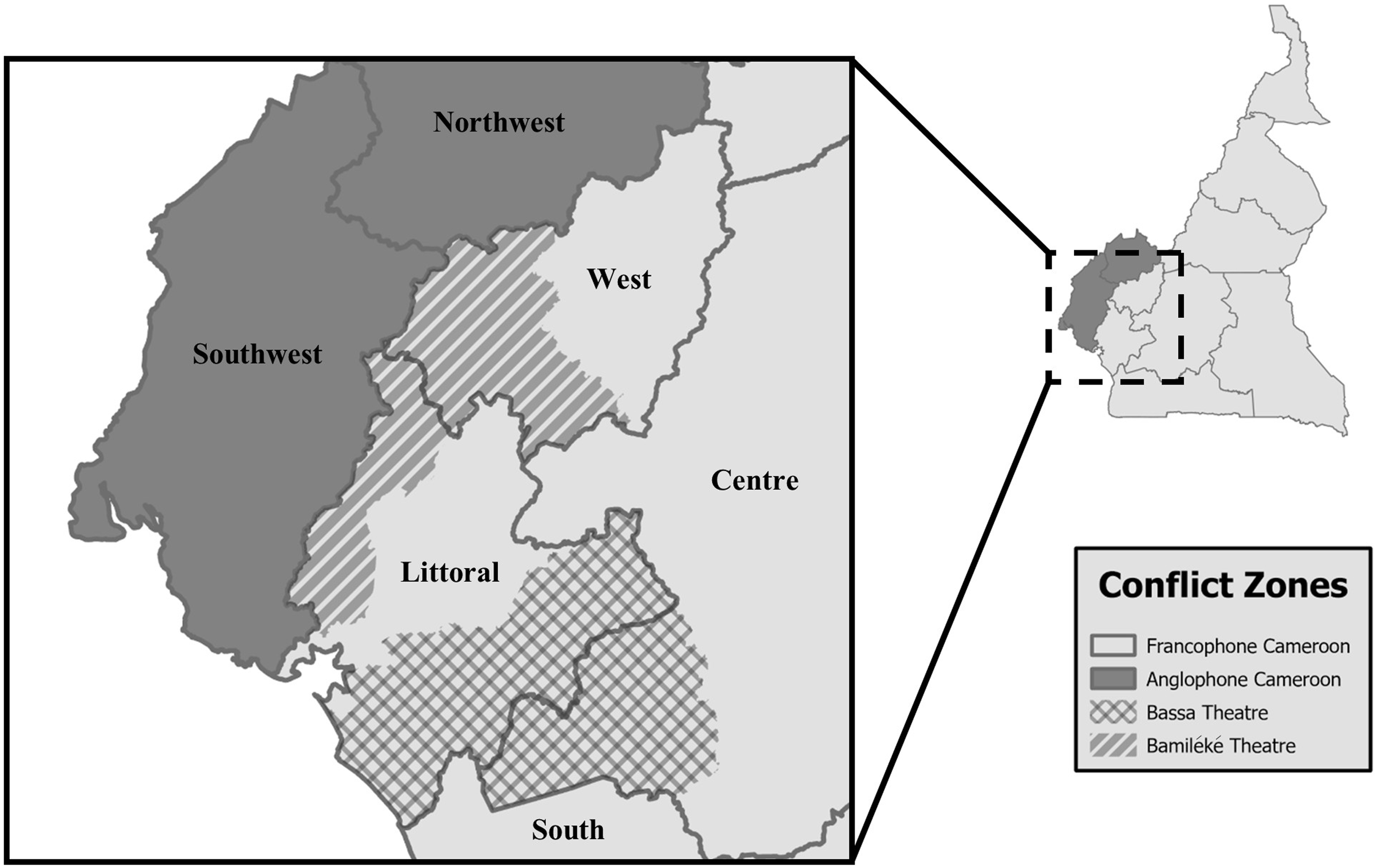
A key manifestation of difference across the Bamiléké and Bassa theatres of conflict was the rate of establishment of village self-defence groups, which were civilian militias organised by local elites to protect lives and property from maquisard violence. While historical records of the spatial distribution of these groups are incomplete, a survey across southern Cameroon in March of 2024 indicates that while 78% of respondents in the departments most heavily affected by violence in the primary Bamiléké theatre reported the presence of a village defence group during the conflict, only 48% recalled their existence in the most heavily affected departments in the primary Bassa theatre (compared with 22% outside the areas demarcated in Figure 1; n = 418).Footnote 5 Furthermore, the civilian auxiliary to state forces – the garde civique – took on a more consistent, active and institutionalised role in the Bamiléké theatre (Kouékam Reference Kouékam2023).

Independence era discursive constraints and state narrative hegemony
In the years following independence, the Ahidjo regime curated messaging on the liberation struggle and the UPC. Narratives decoupled upécistes from Cameroonian liberation while attributing national progress to Ahidjo (Deltombe et al. Reference Deltombe, Domergue and Tatsitsa2011: 734; Mbembe Reference Mbembe1986: 40). In official discourse, upécistes were referred to as terrorists, bandits and pillagers (Noumbou Tetam and Kouékam Reference Noumbou Tetam and Kouékam2022: 239). Simultaneously, at both the elite and mass levels, the regime closed spaces for public narrative contestation (Mbembe Reference Mbembe and Um Nyobè1989: 12).
At the elite level, Ahidjo centralised political power through a single-party regime, creating an unwelcoming environment for dissent. This facilitated indefinite approval to exercise wide-reaching emergency powers throughout and beyond the regions affected by UPC violence.Footnote 6 These powers were articulated through a muscular security apparatus that cast a wide net, ensnaring guerillas and suspected civilian affiliates alike (Takougang Reference Takougang1993: 277–9). This led many Bamiléké individuals – sympathetic to the UPC or not – to seek protection by remaining silent (Eckert Reference Eckert1997: 222). Even so, some security personnel perceived anything short of reporting on UPC activities as tacit support for upécistes (Kouékam Reference Kouékam2023: 11).
State pressures from above pervaded horizontal relationships. The regime encouraged individuals to inform on one another if they suspected someone was maintaining links to the UPC (Meyomesse Reference Meyomesse2016: 77). Whether to root out upécistes, settle personal vendettas or otherwise disrupt community life, informing on neighbours was common. Some informed on immediate family members, further minimising available spaces for counterhegemonic discourses. The word of an informant was typically enough to land the accused in a detainment centre run by the Brigade mixte mobile, a state paramilitary institution known for its use of inhumane methods of information extraction (Terretta Reference Terretta2013: 221–31).
Despite the challenges, counterhegemonic narratives persisted. The interviews I conducted demonstrate that the intergenerational transmission of conflict narratives continued despite the closure of public and many private discursive spaces. Furthermore, scholars including Anafak (Reference Anafak L2024), Doho (Reference Doho2007), Mbembe (Reference Mbembe1996) and Noumbou Tetam (Reference Noumbou Tetam2023) have explored ways in which naming practices, poetry and music have contributed to memory transmission.
Paul Biya, Ahidjo’s successor, brought about limited political liberalisation. New spaces opened for the revisitation of the liberation struggle. However, Biya’s regime remains invested in the state narrative. Maquisards are equated with terrorists (Amin Reference Amin2020) and material that celebrates the UPC or otherwise departs from regime messaging risks censorship (Mbembe Reference Mbembe1990; Takougang Reference Takougang1993: 292). Thus, while real, these spaces do remain constrained by the continued threat of negative state reactions (see Bassomb Reference Bassomb1992). Direct challenges to regime stability are not tolerated.
Interviews: hidden war, subterranean narratives
I conducted a series of interviews to better understand the legacies of the liberation struggle in contemporary Cameroon. These interviews centred on narratives of political and violent conflict. I examine narratives because they oftentimes situate elements within a perceived causal relationship. They provide an interpretation of the past and a logic for political [de]mobilisation in the present.
While narratives are observables that indicate the process by which legacies of violence are generated and reproduced, they are dynamic and curated. They are expressions and objects of collective memory that explain conflict, attribute responsibility and translate violent exposure into victimisation (Kuppens and Langer Reference Kuppens and Langer2023: 407). Narratives are influenced by the environment in which they are shared and may not align with the historical record (Fujii Reference Fujii2010; Kuppens and Langer Reference Kuppens and Langer2023: 408–9). Circumstances may incentivise individuals to invent elements or disincentivise them from sharing anything (Fujii Reference Fujii2010). My position as a visiting researcher influenced my conversations. However, departures from the historical record are not corruptions of data per se. They help us understand how people interpret and respond to events.
During two trips in 2022 and 2023, I conducted 41 interviews across the francophone regions in Cameroon most affected by violence: Littoral, Centre, West and South. These interviews took place in urban and rural areas. The mean interviewee age was 50 years old (median = 47). The range was 22–78. Thirty-four interviewees were male; 7 were female. In rural areas, interviewees often reported mixed income with farming central to extra-household activity. Educators made up another large group. Several were traditional authorities. In urban areas, I interviewed university faculty, graduate students, historians, educators and political activists.
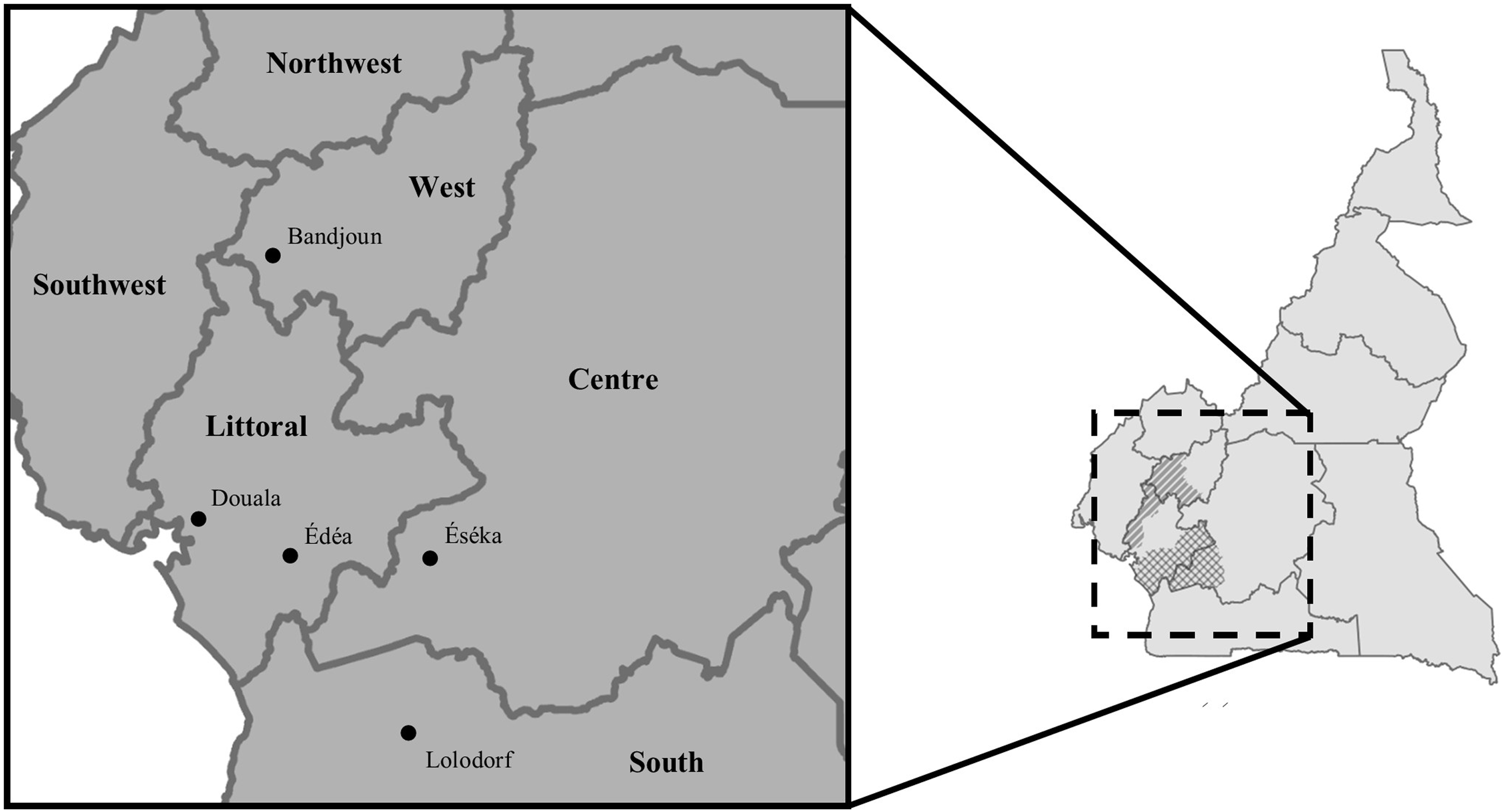
Figure 3 reports select field sites. Here, I document only urban areas to ensure the anonymity of interviewees from small villages. In both maquis, I incorporated interviews from communities removed from violence and those exposed to significant state and guerilla violence.
I interviewed across UPC fiefs and competitive locales, that is, UPC strongholds and mixed support communities, both exposed to differing levels of violence. The Éséka and Édéa areas were important regional headquarters for the party and comprised dense networks of local UPC committees (Mbembe Reference Mbembe1996: 336). Both were historically located within the Sanaga-Maritime administrative division under French colonial administration, one of two areas of very low voter turnout in 1956 due to a UPC boycott (see Figure 2 above). Lolodorf, in the South region, along with sites in the West, were sites of greater political competition.Footnote 7
Map of the regions within Cameroon most heavily affected by conflict.
Strictly speaking, the ZOPAC boundaries were contained within rather than coterminous with the Sanaga-Maritime and Nyong-et-Kéllé departments. See Deltombe et al. (2011).

Map of urban centres from which fieldwork was based.

It is important to note that researching legacies of violence inherently brings up sensitive and controversial facets of the past. Though the physical violence of the conflict ended more than fifty years ago, discussing the subject may retraumatise individuals. In addition to Institutional Review Board (IRB) approval, I conveyed the topics that the discussion would address to potential interviewees. I offered reminders that topics were optional. Two individuals refused interviews, though the reasons given related to political optics. Names have been altered in the following excerpts to ensure the privacy of interviewees.
‘The UPC is in my blood’: Conversations in Bassa country
Célestin is a man in his late 50s, brimming with energy. We spoke outside his home, situated deep in Bassa country. His friend, sitting just across, donned a deep red tee with a black crab – the flag of the UPC.
Célestin is the son of a upéciste, and a member of his family was tortured at the hands of the state. The depravity of the French in terms of physical violence and colonialism more broadly was a recurrent theme during the conversation. Célestin conveyed that the French bucked their responsibility to shepherd Cameroon towards independence, instead colonising it.
The liberation struggle brought new forms of violence. Célestin echoed the men and women of both former maquis when he detailed the indiscriminate use of incendiaries by French forces. He equated the policy of regroupement with the corralling of cattle. To this narrative of violence was added the single most reiterated form of barbarity: decapitation. Célestin’s narrative was the one that prioritised displacement of people, scorching of forests and villages, and desecration of corpses.
Along with many whom I would speak with in the greater Sanaga-Maritime, Célestin was quick to recite the tenets of the UPC. Célestin employed the history of the liberation struggle as a framework for structuring grievances. The dilapidated condition of local infrastructure reflects a neglect in the distribution of state resources that Célestin sees as continued retribution for Bassa involvement in the liberation struggle. His village is not simply languishing; life is worse off today than at independence.
For Célestin, both the liberation struggle and the UPC are active, dynamic forces rather than ghosts of a historical moment. Célestin understands Cameroon’s independence as incomplete, beleaguered with neocolonial ties to France. The UPC of Um Nyobè is still relevant: its unrealised potential and failed struggle are explanations for local regress; its platform is a roadmap for progress.
Célestin was not alone in the weight he placed on the history of the UPC, nor the potential of its practical impact. Enoh, a teacher in his mid 30s from another part of Bassa country, recognised the brutality of both the maquisards and state forces. Despite this, he sees narratives of the UPC struggle as mechanisms through which citizens might develop a heightened awareness of poor political leadership in contemporary Cameroon:
Understand that Cameroon’s only fight is for development. Cameroonians accept their place because of the politicians who manipulate. They manipulate ethnic groups. When we let ourselves be manipulated, we do not benefit from anything. The ones who do are those close to the regime. So, I prefer to let myself be influenced by [stories of the UPC] to shape, to orient my vision vis-à-vis the state, vis-à-vis this country, vis-à-vis my brethren (Enoh 2023 int.).
Enoh and Célestin both perceive continuities in the regime. President Biya’s party, the Rassemblement démocratique du peuple camerounais (RDPC), is a descendant of former president Ahidjo’s Union camerounaise. Enoh’s friend Thomas addressed this continuity directly:
These links [between past and present politics] remain the same. There are people who were marked by the brutality, by the brutality of the French, how they killed people like [the history professor]Footnote 8 explained to you. They removed their fingernails, they cut fingers off. This still remains today, so even in contemporary political life, the same practices exist. That is to say that we are from the same party – as we are here – and the government comes to separate us (Thomas 2023 int.).
Enoh and Thomas both touched on the divisive tactics of the regime, inhibiting collective political action today as they did during the time of the UPC. Thomas’s comment, alluding to the dominance of the UPC historically and presently, echoed a statement offered by Célestin: ‘For me, the UPC is in my blood. I may adhere to other political persuasions out of opportunism, but out of conviction I am upéciste and nothing can change that’ (Célestin 2023 int.).
In doing so, Célestin identified his intergenerational roots and many upécistes like him from the former ZOPAC while also drawing attention to the continued risks of publicly valorising the UPC.
‘Let the past lie’: Conversations in Bamiléké country
I spoke with three men on one rainy morning in March. Paul is the oldest, in his late 70s, while Antoine is 71 and Cabrel is 60. Paul moved from the city to a village in the highlands of Bamiléké country when he married. He recalled the sounds of gunfire in the brush, as well as the fires that raged in the villages on occasion. State forces, he recalled, were more likely to steal and burn than fight maquisards.
Antoine focused instead on the violence of the maquisards, conveying that ‘they would come and take you out of your house and kill you. They would cut off your head for nothing’. In contrast to Célestin, Antoine suggested that the UPC ‘destroyed the country’, and it was the Union camerounaise that ‘brought people to reason’.
Cabrel is the son of upécistes and maquisards. His mother had been a powerful mystic and influential activist. He spoke often with his parents about the origins of the UPC and noted that his father was imprisoned for his association with the party.
Each individual presented different orientations towards the UPC. Paul emphasised the violence of state forces and the fear that characterised the conflict era. Antoine recounted the destructive and wanton behaviour of the maquisards. Cabrel lent pride of place to his familial connections to the UPC. Yet, crucially, all three imparted that it is best to inhibit the transmission of narratives of the liberation struggle. Paul first: ‘It is better to let the past lie because, if you continue to think about it, there will continue to be hatred. I am going to let it lie. Even God wants that because when we die, it dies with us’ (Paul 2023 int.).
Antoine concurred, adding that it is more important to let people be at ease, as life in Cameroon is difficult enough due to economic hardship. Cabrel agreed that discussion of the struggle is unhelpful. He suggested that reproducing narratives of the conflict would reinvite the intrafamilial strife that plagued the village during the war: ‘[If we discuss the past] you are going to say that it was you who killed my father, you did it’. He continued a minute later: ‘If you focus on the past, you cannot get along well with your brother. You are always going to think about the past, how it was’ (Antoine 2023 int.).
Key for each of the three men was the intimate nature of the violence. Rather than providing a lens through which contemporary politics might be interpreted, narratives of the liberation struggle risked reviving old divisions. These divisions were not conceptualised in nationalistic and political terms, as they often were in Bassa country, but rather in personal, familial and communal terms. The UPC did not serve as a model for progress, but a spectre with the potential to rend families if lent new life through narrative transmission.
I spoke later with Samuel (late 50s) and William (mid 30s), both employed in the education system. On separate occasions, both interviewees advanced the notion that a legacy of fear is apparent among communities located in the former Bamiléké maquis. Sometimes explicit, sometimes couched in the language of a psychosis, Samuel linked this fear to inaction: ‘I also said in passing that this phenomenon has created a psychosis in Cameroon. Yes, yes, the Cameroonian does not like war, because they know where it goes. Many families have lost. Lost and lost material possessions as well as human lives’. He returned to this later in the conversation: ‘Really our country with this war situation has created a psychosis. The Cameroonian no longer kills. The Cameroonian prefers even to see nothing, but to live in peace’ (Samuel 2023 int.).
William, originally from an anglophone region of Cameroon, reflected upon the comportment of individuals from his home region and those of the West. He shared that:
…they act differently because those of the Northwest, what they believe in, they go in for and they are not afraid of threats. That’s why when you see those joining a party like the [Social Democratic Front], they believe in everything and they cannot easily be threatened. But when I look at what is happening in this direction, many people like to be with the party in power. When you come up with any political party, they are afraid to talk of it. It’s just like if you identify with [another] political party, when the authorities talk to you, you are afraid and you change back [to the RDPC]. So, there is a fear that exists here that is not observed in the Northwest region. And as you can see in the Northwest region and in the Southwest, other political parties are doing well, but when it comes to this area, it’s difficult (William 2023 int.).
Samuel and William, while expressing a belief that the history of the liberation struggle, the UPC, and the maquis should be taught to younger generations, both recognised a legacy of silence marked by the inhibition of narrative transmission.
Narrative elements and transmission
The vignettes above demonstrate that exposure to violence alone does not indicate which form a legacy of political violence will take. The interviewees exhibited a familiarity with – if not a personal connection to – the physical violence of the maquis and broader liberation struggle. Furthermore, narratives across the former Bassa and Bamiléké maquis shared critical elements. The two primary shared elements pertained to political goals and wartime conduct.
First, most individuals interviewed incorporated the core goals of the UPC. Second, remarks about the brutality of war were evident throughout each interview. Torture, fire and decapitation were often brought up. If the discourse did not immediately open with reference to death and the defiling of corpses, it quickly landed there and maintained the centrality of loss of life, conveying meaning through necro-narratives.
However, the interviews also demonstrate the range of reactions to violence. This is evident in both narrative framing and transmission. Some interviewees structured discourse in terms of nationalism, economic progress (or stagnation) and liberty. Upéciste figures – Um Nyobè and Ouandié specifically – were invoked, their deaths juxtaposed with the depravity of colonialism and neocolonial ties. These narratives encouraged mobilisation of some form and stressed awakening the consciousness of apolitical citizens.
Meanwhile, others imparted narratives that were devoid of nationalist sentiment, instead structuring discourse around the intimate nature of the conflict. While the former used narratives of the UPC, maquis and liberation struggle to frame contemporary grievances, the latter used narratives to convey the intracommunal character of the past violence. These narratives were demobilising, shifting focus from the political struggles of the past and encouraging concentration on meeting apolitical daily needs.
Concerning narrative reproduction, individuals who understood these historical narratives to have practical implications for current political, social and economic goals were in support of transmitting those narratives. Conversely, those who conveyed narratives that focused on the intimacy of violence often explicitly rejected transmitting narratives over concerns that this would reopen wounds that were created during the war. Families turned adversaries continue to live in the same communities. The revitalisation of historic enmity would have consequences in quotidian life.
Divergences in narrative content and transmission introduced by the interview excerpts are reflected as trends within subsamples. Though not intended to be statistically representative, I note that over 90% of individuals from former UPC fiefs incorporated elements of political mobilisation in their interviews compared with 33% in historically competitive locales. 28% of interviewees in competitive areas incorporated demobilising narrative elements while these elements were absent in former fiefs. Intuitively, nearly everyone in UPC strongholds noted support for the transmission of UPC narratives to younger generations (again over 90%). When brought up, opinions in competitive locales are divided more evenly between those who find narrative transmission important and those who find transmission problematic (both nearly 45%).
Though narrative continuities and divergences are the objects of the current analysis, the lenses I employ distil the complexity of discursive practices. However, the narratives shared are neither static nor exhaustive. The same individual may also encounter both demobilising and mobilising narratives. Pascal, a Bamiléké teacher in his early 30s, recounted two phases of awareness concerning conflict discourses. In his youth, Pascal noted that before he conducted research on the UPC, he ‘discussed the maquis in an unconscious manner’, noting that early on he understood maquis-related terms as insults: ‘For example, if I was violent against my brother, my mother would call me a maquisard’. It was later, after beginning a research agenda around the history of the UPC, that Pascal came back to his family to discuss the local maquis and link the work of the UPC with contemporary politics.
Identifying disparate intergenerational trends, Pascal observed that ‘The elders identify more with the maquis in Bassa country than in Bamiléké country. In Bamiléké country, people identify less with the maquis, less with the maquisard’. Later, Pascal would go on to mention that ‘memory is everywhere, but no one speaks’ (Pascal 2023 int.). This contrasts with Enoh’s experience, where he finds that his generation is less fearful of speaking publicly about the UPC. Pascal and Enoh’s generational reflections indicate the dynamism of narratives while complicating the effort to interpret discursive practices through a limited set of registers.
Concerns
Counterhegemonic narratives are difficult to convey openly within the current sociopolitical context. The regime exhibits only minimal tolerance for public dissent. Rather, coded discourse that problematises regime actions is more common. In word and deed, the regime contributes to structural and personal violence. Practices rooted in colonial-era repression are still employed against the general public (Mintoogue Reference Mintoogue2004; Orock Reference Orock2019) while citizens continue to utilise the fate of fallen upécistes as a cautionary tale for neighbours who draw attention through their dissent. This is evident even among those far removed from the UPC conflict. To this point, one interviewee raised in the East region, Alain, recalled the invocation of maquisards as symbols of a failed effort. Concerning actions taken against the RDPC, Alain stated that supporters of the party:
‘…speak of war. When you ask questions they will tell you “You heard of the maquisards. You heard what was done during the UPC [war]. So we better eat our bread than oppose the ruling party”. This is something villagers in the east say to each other. ‘We better eat our bread than to oppose the ruling party’ (Alain 2023 int.).
The active threat the regime poses to dissidents undoubtedly influences the degrees of openness that interviewees exhibit. State violence likely contributes to the discursive veil individuals maintain between private and public spaces. This selective opacity presents a challenge to data collection, one that is likely complicated further by my status as a foreigner. However, the supposition that the threat of violent state coercion dissuades individuals from sharing counterhegemonic narratives also suggests that those who choose to transmit such narratives are willing to engage in higher-cost political behaviour. In other words, reproducing necro-narratives with counterhegemonic or mobilising elements is both a means of socialising younger generations as well as a political act in itself.
A potential concern with site selection is that respondents are primarily Bassa or Bamiléké, raising the question of maquis association as proxy for ethnic politics. I address this by analysing geocoded Afrobarometer data. Respondents in the former Bassa and Bamiléké maquis report heightened perceptions of ethnic group discrimination, but this translates into higher cost political behaviour only among those in Bassa country. When ethnic Bassa and Bamiléké respondents are removed, the results are weakened but generally hold. In other words, political [de]mobilisation is associated with the two former maquis apart from correlation with ethnicity. This analysis can be found in the appendix (A2-A15).
Another possibility is that attitudes towards political engagement can be explained by post-war politics rather than legacies of conflict. These are not mutually exclusive. However, I test for a link between political engagement and attitudes towards the dominant RDPC party, a proxy for approval of the post-conflict status quo.
There is no statistically significant interaction effect between support for the RDPC and either of the former maquis. In other words, orientations towards the RDPC do not explain demobilisation in the former Bamiléké maquis, where higher cost political engagement is lower relative to the national average. Nor does it explain mobilisation in the former Bassa maquis, where that engagement is higher. Full regression results are reported in the appendix (B2).
Conclusion
This exploration of Cameroon’s hidden war provides evidence that local political cleavage structures act as conditions for the production of mobilising and demobilising attitudes. National conflicts are interpreted differently in part based on one’s community orientation towards the political factions generating conflict.
Each community experienced the UPC war differently. In some villages, political cleavages created gaps between neighbours and within families. Those gaps were reinforced by social and religious pressures, then solidified through intracommunal violence. The abstract – upéciste, maquisard, police and military – was embodied by the familiar: brother, father, sister and mother. In other villages, political cohesion contributed to clearly delineated battle lines: upécistes taking up the armed liberation struggle against French colonisers and their collaborators. The violence may have been equally terrifying, but who exacted that violence was critical.
Necro-narratives illustrate how exposure to violence can be both a mobilising resource and a demobilising barrier. For those in communities with political and social fractures in the pre-war period, the intimate nature of violence that was visited upon the community often became the focal point of discourse. The necro-narratives produced conveyed fear of the regime and lent greater weight to satisfying apolitical, daily needs – if they were transmitted in the first place. The dead were a warning. Their invocation alone could reinvigorate sleeping enmity.
For those in UPC fiefs, necro-narratives served several purposes. Death was a sacrifice made by true nationalists who gave their lives in hopes that Cameroon would be unified and liberated. The narratives connected people living in former UPC strongholds today with the heroism and commitment of those upécistes and maquisards who struggled before them. Necro-narratives also structured contemporary grievances. The price paid by the early nationalists has not been redeemed. The struggle continues.
Supplementary material
The supplementary material for this article can be found at https://doi.org/10.1017/S0022278X25101006
Acknowledgements
This research was supported in part by the Qualitative and Interpretive Research Institute at Cornell University. I am deeply grateful for the insights shared by my colleagues at Cornell University and the University of Douala. Tom Pepinsky, Nic van de Walle, Emily Dunlop, Alex Dyzenhaus, Ernest Messina Mvogo and Amadou Souleymanou have each provided essential guidance during the fieldwork and writing processes. Innumerable discussions with Gildas Igor Noumbou Tetam have profoundly shaped this paper. I would like to acknowledge the associates of the Centre de Recherche sur les Dynamiques des Mondes contemporains, many of whom have generously volunteered their time and energy throughout my fieldwork. I would also like to thank the editorial and referee team at the Journal of Modern African Studies for their comments.


 Open access

