




This article critically examines how the concept of ‘Africanness’ in musical composition shapes the creative output of composers originating or with ancestry from the African continent. I start by investigating the complexities surrounding the term ‘African composer’, what the usage of the term means for Africans in their creative process, and ultimately, how it shapes their approach to composing.
The term ‘African composer’, in this article, should be understood in its simplest form: a composer from either Black Africa (a term used to distinguish sub-Saharan Africans who are generally dark-skinned) or Northern Africa (predominantly light-skinned, though some scholars such as Cheikh Anta Diop have made convincing arguments that even Ancient Egyptians in the North were originally dark-skinned).Footnote 1 The associative relationship of the ‘African composer’ with a geographical location highlights the first major misconception about ‘Blackness’ in African musical composition: a misunderstanding that assumes a homogeneous cultural outlook and compositional output closely associated with a particular cultural image of Africa and its music. The image stems from an assumption that presupposes that Africa is a continent of dark-skinned peopleFootnote 2 whose music is ‘primitive’ yet rhythmically complex.Footnote 3
The earliest writings on Africa, dating back to the eleventh century,Footnote 4 give an image of a particular type of people, namely dark-skinned sub-Saharans.Footnote 5 Though not explicitly voiced, these writings give an illusion of a unified cultural background based on skin colour. Later writing about Africa by both colonizers and colonized divides the continent into two areas, Black Africa and Northern Africa, based on skin colour and the most substantial religious and cultural influences to dominate the areas. Sub-Saharan Black Africa was strongly dominated by Christianity, while Northern Africa was heavily influenced by Islam.Footnote 6 Religion had a substantial impact on the culture and the music produced in those areas, providing us with the first notable diversity experienced in African musical composition.
In many parts of Africa, religion was part of colonialism: Africans were expected to abandon their cultures in favor of Westernized forms of civilization.Footnote 7 This was also true with music and music-making. Missionaries had a strong hand in developing choir music in Africa, and South Africa was no exception. In the context of South Africa, the term ‘African composer’ (a term which only came to prominent usage in the mid-twentieth century) became synonymous with ‘choral composer’. This term was (and continues to be) used to acknowledge Black African composers (often thought to be uneducated and not worthy of the title ‘composer’ without the qualifying prefix ‘choral’) but also to distance them from the ‘real’ composers (composers without a prefix), a classification limited to white male composers or university-educated Black composers. So, the term ‘African composer’ comes with much historical baggage, which further complicates the understanding of the term and its effect on the creations of African musicians.
Since the end of the apartheid regime, which barred Blacks from studying music at the university level, we have seen an increase in Black South African composers who are now recognized as ‘just’ composers. This increased recognition is interesting because it brings up further divisions: particularly class division, a byproduct of colonialism and a false notion of civilization, achieved by abandoning African heritage in favor of Western values and ways of life. The false sense of class division observed between the so-called ‘choral composers’ (Black African composers) and the so-called ‘composers’ (university-educated Black African composers) highlights another issue with the concept of the African composer, based not on skin colour but on class, and further undermining the sense of unity implied by the term. The division of class also affects how composers engage with the idea of what it means to be African. Both ‘choral composers’ and university-educated Black African composers are often expected to simulate ‘pre-colonial’ (African Renaissance) music. In general, the understanding of what the African composer is (or ought to be) seems closely linked to neocolonial history, which continues to try to understand African musicians according to how they conform or do not conform to established notions of African music, which are often based on a caricaturized version of Africa imagined by the outside world.
Colonialism created numerous texts that reimagined Africa, shaping the contemporary understanding of African history. These narratives also shape the way Africans are seen and see themselves today.Footnote 8 They present, in general, two perspectives: 1) a view of Africa originating from outside the continent, and 2) an understanding of Africa free from outside influence. These two perspectives form a central divide in understanding what ‘Africanness’ means in the music created by composers from the continent.
This article proposes that it is through our neocolonial history that we developed different understandings of Blackness: first as a reflection of how others perceive Africanness in us (as Africans); second, how we perceive the notion of Africanness as an inward-looking action (self-reflection among Africans). The article then considers how these two viewpoints project different approaches to how we engage with our art as African composers, based on shifting spaces and contexts. I propose that some of the compositional techniques I use in my work project an act of looking inward, but also reflect perceptions from outside. In my compositional reflections I ask: What would a colourless African look like? An African not bound by a particular historical perception of place that comes from an imported illusion of self, but rather rooted in a self-regulated perception of self? A self that is always defined by the now and not how it used to be?
This article, then, presents situations which define contemporary African composers today, using primarily my own music as a case study. While this will offer only a small window into the many different aesthetic directions and compositional voices found in Africa today, we (African creators) all seem to have a similar critical starting question: how do our compositions represent who we (as Africans) are? In addressing this question, we must engage with the historical context that shaped our multiple ways of understanding Africanness and that will define the future definitions and projections of African composers.
In establishing the context within which I will present my own understanding of what shapes the work of African composers today, particularly in South Africa, I would like to start by quoting an excerpt from an exceptional poem called ‘black trial’ by South African poet Ingoapele Madingoane.Footnote 9 The poem is taken from his book Africa My Beginning, published in 1979 (although some of its critical poems were already in circulation and had been presented orally as far back as 1976).
had i known the fruits of being
black as i am
i would have chosen to be
human
so as to avoid the chains of this
black trial
Africa My Beginning expresses the daily lived challenges experienced by a Black African in South Africa during the height of the apartheid regime. Within the context of South Africa, ‘Black’ referred to ‘people of colour (blacks, Indians, coloured or mixed race)’.Footnote 10 This Blackness was further divided by the lightness of the skin tone (different shades of Blackness). The lighter the skin you had, the more chances you had of enjoying the advantages not afforded to Blacks: for example, attending good schools, accessing well-paying jobs later, and therefore being classified as a ‘good Black’. This logic, of course, amplified another layer of division within the Black community: the concept of social class.
Madingoane's understanding of Blackness goes beyond the shades of Blackness and class division enforced in South Africa. His understanding assumes that those living in Africa, though diverse, share the same struggle in their fight against colonialism as well as an ancestral spirit connecting them beyond the dividing borders of ethnicity, social class, and ‘race’, as created by colonialism. At times he encourages Africans to fight colonialism, and at other times, he warns Africans of what Ngugi wa Thiong'o called ‘the colonization of the mind’, which makes you a slave even when slavery has long been abolished.Footnote 11 Madingoane compares this colonization of the mind to a state of being frozen in time, where everything moves around you, but you (as Black) seem to be stuck in the same spot: a moment of hardship that lasts your entire life. Being Black seems like a painful burden that you did not have a choice to take on or carry, but that lasts your whole life. Anne Walmsley describes the above excerpt from the poem ‘black trial’ as follows:
‘Being’ is poised between a state of capable of fruitfulness, and the barrenness of blackness; to be human is the longed-for alternative. If man allows bitterness or hate to overtake him, he will be still further degraded, destroyed. Such denial of man's real nature results from adopting ‘the fake romance of self’.Footnote 12
Madingoane urges fellow Africans to be the script writers and directors, in his words, of their own fate, and not to allow their Blackness to be defined by others on their behalf. To do so would be fatal, a state worse than death itself. This idea of fighting for a new definition of self as an African is critical in today's world, where Black artists are often judged to belong in a particular box or category and assumed to possess only a particular kind of knowledge, and therefore expected to produce creative work that speaks to that knowledge. In other words, African creators suffer from what people view as an African musical aesthetic, with which they can rubberstamp your work as either a betrayal or a confirmation of Africanness.
Assumptions about African composers
As a Black composer from Africa, I have had numerous encounters which I found to be passively offensive. While in Germany for my studies in composition, many fellow students assumed I was African American. Given that for a long time I was the only Black person studying at the Staatliche Hochschule für Musik und darstellende Kunst Stuttgart (the State University of Music and Performing Arts Stuttgart), an institution which is highly rated and selective based on previous education and training, my presence at the institution seemed to confirm or provoke their assumptions that I must have come from a ‘first-world’ country, such as the United States, and not from a ‘third-world’ country like South Africa.
The majority of media reporting portrays Africa as a poor continent,Footnote 13 and this kind of reporting amplifies the temptation to assume that all Africans are poor and cannot afford to study at an institution such as the Hochschule: one which is expensive. The institution is costly, not so much in tuition fees, which remain relatively affordable compared to other international universities, but rather in the high living expenses, travel costs, and unfavorable exchange rate. Its demanding entrance examinations and predominantly elite student body further reinforce its exclusivity. I have to acknowledge, however, that these kinds of assumptions in part described my experience. I grew up poor and was not able to attend expensive schools. However, I can also say with firm assurance that these circumstances did not wholly define me. Though I was poor and struggled with finances as a student, I was determined to not allow that to define who I was. The support I received in the form of scholarships, including one from the city of Stuttgart, helped me to manage my studies. Like most students, I also worked during the holidays to cover living costs. Having now lived on three continents and engaged with students from different parts of the world, I can say that my struggles were not unique. Many students struggle with finances irrespective of their origins. Poverty is a disease that infiltrates the whole world and has no preference when it comes to skin colour. The media depict Africa as a place where no one, particularly among the Black population, has sufficient training to attend such an institution of higher education, and so it was perhaps unsurprising for fellow students to see my presence with scepticism.
For many, I did not fit the social class usually associated with such an institution. Social class was just one of the many layers which added to my inferiority complex, my sense that I did not belong there. The other layer of confusion was that I was studying not jazz composition (a genre often associated with Blackness or Black people) but contemporary music composition (Neue Musik), which seemed to be viewed as music for the elite. While I am not sure I agree with that assumption about contemporary music, this idea dominates the widespread understanding of ‘contemporary music’ or ‘art music’ (a term often used in South Africa and generally across Africa).
I remember when in 2016 or 2017, I was invited to be part of a now-dissolved organization called the Composers’ Association of South Africa (CASA). I was to provide a bridge between composers of popular music and composers of art music. A colleague introduced me to the board as a composer of art music. One of the founding members of the organization (who was a white colleague) joked, saying, ‘Ah, you are one of those who write music which is highly intellectual but (economically) poor.’ In saying this he implied a music for the elite, but also a music that does not bring in financial profit. I laughed, but the comment stayed with me. It taught me how some people view what we composers of so-called ‘African Art Music’ do, and that there is a division amongst African composers. The term ‘African composer’ comes, this shows, with different connotations: one can't simply assume a single, shared understanding of the term.
Many people even in Africa assume that true composers are only those writing classical music (which tends to be well represented in higher education and cultural organizations), which is why this organization of composers (CASA) was established to represent the voices of the often-silenced composers of popular music, ‘African traditional music’, gospel music, and so on. My own invitation to the committee was thus already met with mixed feelings and assumptions. In this context, the statement about intellectual music directed towards me was in fact a warning that I should not think of African composers as intellectually inferior – which of course, I did not, otherwise I would have not accepted the invitation to be part of the board – but instead to think of these musicians as composers, with the same respect given to the so-called ‘African art music composers’. Of course, I recognized and understood their deeper assumption. In South Africa, the idea that composers are only those who are educated and write academic music or art music has a long history. During apartheid, Black students were barred from universities offering music programs, leading to the deliberate reservation of the title ‘composer’ for white male artists. Their works were celebrated as intellectually complex and aligned with ‘high art’.Footnote 14 These exclusions stemmed from a broader cultural politics,Footnote 15 where race and gender influenced who could claim authorship. This system not only silenced Black composers but also erased white women from acknowledgment,Footnote 16 reinforcing the double dominance of apartheid's racial hierarchy and the patriarchal Western art music canon. As Agawu has noted elsewhere, this exclusion was normalized under the guise of musical universality.Footnote 17 The racial limitations to gaining access to higher education changed after 1994, but the image of what a composer is, in Africa, still has a long way to go before it can mirror the kind of changes we would like to see in our society, towards a future where people are not defined by social class, skin colour, gender, or education.
The concept of an African composer is therefore complex and cannot be generalized, particularly in South Africa, where racial politics, class politics, and musical ideologies play a critical role in how people define a composer. This is why, right from the beginning of this article, I made the disclaimer that the current situation of the African composer I am presenting here is a personal one. I am focusing on my own experiences and how they have shaped the way I approach composition. I hope that sharing my experiences can offer a small window into understanding the complexities of contemporary African music today, and the various levels of creative influence imposed on African composers by the context in which they work, which is often rooted in historical race politics.
In South Africa, the term ‘art music’ was introduced to distinguish music produced by university-educated Black Africans or white Africans from compositions produced by Black African composers who are either self-taught or learned composing through informal mentorship. Music written by those who composed music without studying at the university (a system to which Black composers did not have access during apartheid) was considered inferior. The term ‘art music’ is therefore problematic as it indirectly implies an Other music (for example, African choral music), which is of lower intellectual quality. I thus view the usage of the term ‘art music’ as a means of political and social discrimination against music produced by mainly Black African composers. It is for this reason that I will be using the term ‘contemporary music’ rather than ‘art music’. The distinction in terminology is critical in understanding the class division embedded in the term. The class implication of this terminology is observed in other countries too, where this division is used alongside aesthetical preference as a descriptor of quality.
In December 2021, I met with colleagues from Germany working in the pop music industry to discuss a possible collaboration. At one point, a colleague remarked – almost dismissively – that his and his students’ approach was not like that of the ‘Darmstadt crew’, by which he meant the tradition of Neue Musik associated with the Darmstadt Summer Courses. His comment underscored a persistent perception: Darmstadt remains linked to the intellectual aura of serialism shaped by Karlheinz Stockhausen and Pierre Boulez, whose methodical approaches once defined its cultural authority.Footnote 18 Although the course has since diversified, the legacy of exclusivity persists, reinforcing the notion that contemporary music is the preserve of an educated elite. Popular music, by contrast, is imagined not as mathematically rigorous but as socially embedded – valued for emotional immediacy, participation, and accessibility rather than intellectual abstraction.Footnote 19 This dichotomy reproduces hierarchies of class and cultural value, framing Neue Musik as superior to other genres, a position that I would argue is historically contingent rather than inherent.
The question of the target audience was also raised in the discussion after a virtual presentation I gave on August 18, 2021 for a Rhodes University seminar. In the discussion, Dr. Thokozani Mhlambi questioned the relevance of this ‘kind of music’ for a South African audience, implying my music was only for the elite and that it was questionable whether there were people listening to my music or following a similar musical direction. I do think that this question of audience is important and can be discussed further, as it serves as an impetus in our quest to understand the current context of an African composer. Who does she write for? How does she make a living? And how do all these questions shape her approach to composing?
Returning to my early days in Stuttgart (the early 2000s) studying contemporary composition, I can understand why some students were shocked that I was from Africa and studying and writing this kind of music. As observed earlier, due to the media's portrayal of Africa, Europeans tend to assume that Africa is a place of extreme poverty and low educational quality, and that studying composition was a luxury that Black Africans could not afford. I have to say that while people made these assumptions about me, students and staff treated me with absolute dignity and respect, just like every other person in the institution during and after my studies in Stuttgart. This provides me with fond memories of my time there. What I appreciated even then was that, once people understood what I was trying to do, they often changed their judgements and were happy to work with me on many projects, including performing my compositions. Through some of these collaborations with performers I developed friendships which are still alive even today, twenty years later. The whole experience demonstrated to me the importance of learning not to assume and generalize. It also reinforced how visibility and access to correct information can change people's assumptions. One of the major challenges facing African composers today is the systemic silencing of their voices resulting from a misrepresentation of African music and stereotypes about the music expected from an African composer.
Anonymity as a compositional resource
I have fond memories of Stuttgart because it helped me shape my composing and grasp many things about African music which I already knew in a practical sense but never completely understood theoretically, such as spectral composition. This timbre-focused approach to composition forms the foundation of music-making by the amaXhosa people of South Africa, a feature which is often neglected when people talk about African music. I will elaborate on this topic later, as it is central to my music and the way I have applied what I learned in Stuttgart about European (and particularly French) spectralism to create what I call ‘Nguni spectralism’.
While I would not claim I experienced any overt race-based confrontation in Germany, it was clear to me that my presence was often questioned. I had a fear of being stopped by the police, having them find something wrong with my papers, and getting deported. I had this anxiety even though I knew my papers were in order. My passport was checked, for example, at least three to four times a week. I became used to the police checking my passport. On days when I had forgotten my passport I would panic, and that affected my emotional stability. Over the years, I learned to deal with this fear and understand that I (as a Black person) have a particular profile in the society, one which always makes authorities (the police) suspicious of my presence.
The Stuttgart police profiled Blacks as criminals (having lived in the United States, I can attest that profiling of Black people exists there too), and so their focus was on controlling Black people, particularly around the main station (Hauptbahnhof), which I used daily as a transit between my home and the university. This experience of being controlled by police triggered fear in me because it resembled the behavior of police during apartheid in South Africa, when Blacks needed permission to be in the city center or white neighborhoods, without which they would be punished or jailed. During apartheid, I remember that police would at times come to school and physically abuse students or throw tear gas at them. We learned very early on to fear police. And so, I look at police behavior with a critical eye, even if their activities are ostensibly meant to protect me as a member of the community. These experiences with the police did affect my psychological state, and that influenced the way I thought about music and approached composition at this time.
That said, these issues of skin colour and discrimination were secondary. The primary battle I faced in Stuttgart was internal, and revolved around this question: how can I prove that I am equally capable of studying and writing good music in an environment that assumes that I do not belong, that I am not a good citizen? I felt that it was important to strip my music of all that could be considered superficial in the definition of African music, and to produce music that assumes its own identity. Perhaps, even, to produce music that assumes a global identity: music that can carry traces of anywhere in the world. This was important for me because it put the focus on the music (the artwork itself), and not the geographical origins of the creator.
One of the early works that I created in Stuttgart was a trio for flute, cello, and piano called ISO[R] (2004), which was commissioned by the Southern African Music Rights Organization (SAMRO). SAMRO is an institution which collects royalties for performances of works by their members. However, it also played an important role at the time as one of the only institutions which was motivated to support new works of contemporary music and to support emerging Black African composers. A large portion of works written by Black South African composers were commissioned by SAMRO. Included as part of the commission was the funding of the performance of these works. ISO[R] benefited directly from this program.
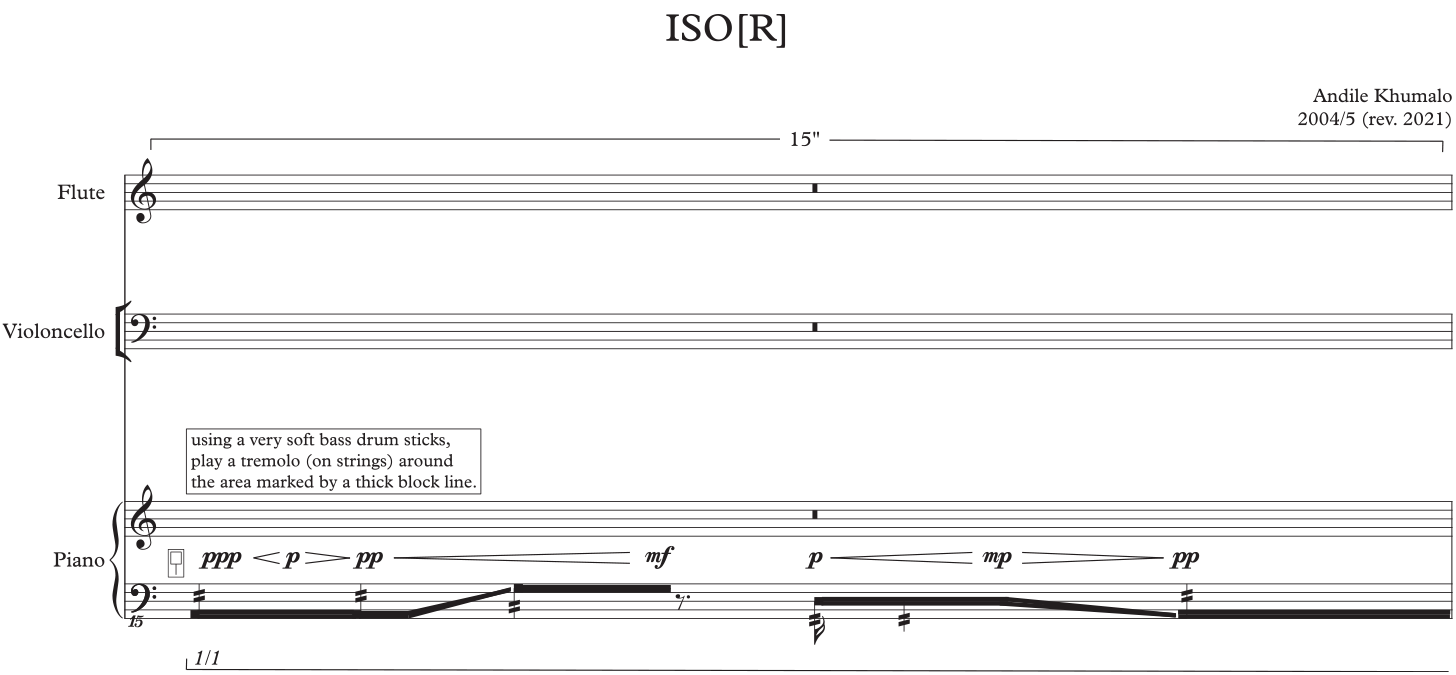
ISO[R] revolves around a mysterious spectral sound object (see Example 1), produced by playing a soft tremolo on the lower strings of the piano with a bass drum beater, which is sustained with the pedal. The pedal, which is used to sustain the sound even when the register is changing, creates a sense of sonic density. As the dynamics increase and the register changes, the performer's playing position – which is unusual because she has to stretch for the pedal with her right foot and simultaneously play inside the piano with her right hand (which she is instructed to use for the physical concept of the work) – creates a sense of vulnerability and uncertainty. This makes it difficult for the performer to keep the tremolo strictly regular, so at times some overtones and pitches come to the foreground more than others before disappearing again. At times, there are unexpected accents, which I welcome, as the idea was to create a mysterious atmosphere, within which sounds are present, but at the same time are unrecognizable in terms of the instrument producing the sound. These sounds are almost invisible in the singular: i.e., as melody. Such mysterious sounds change our perception of their instrumental source. For a few minutes, at the beginning of the piece, we lose the identity of the instrument, and our focus is channeled on the sound itself.
Excerpt from ISO[R] (2004), b. 1.

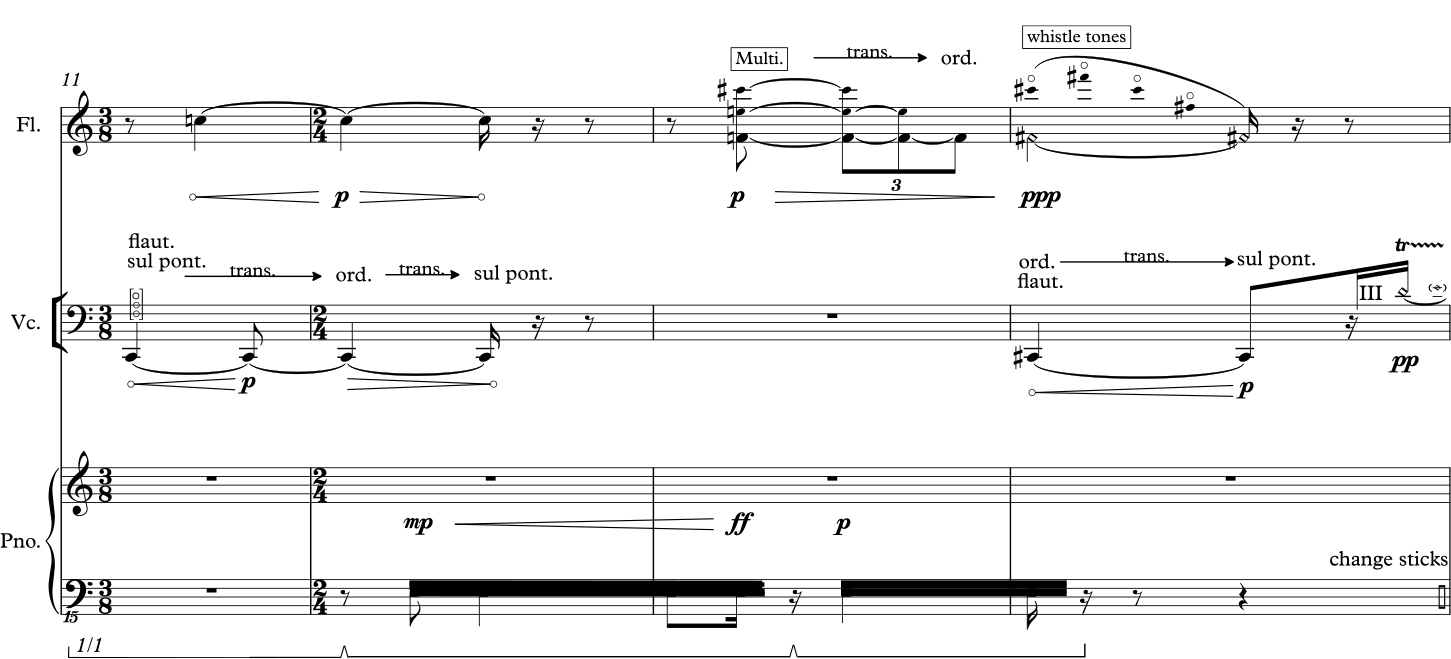
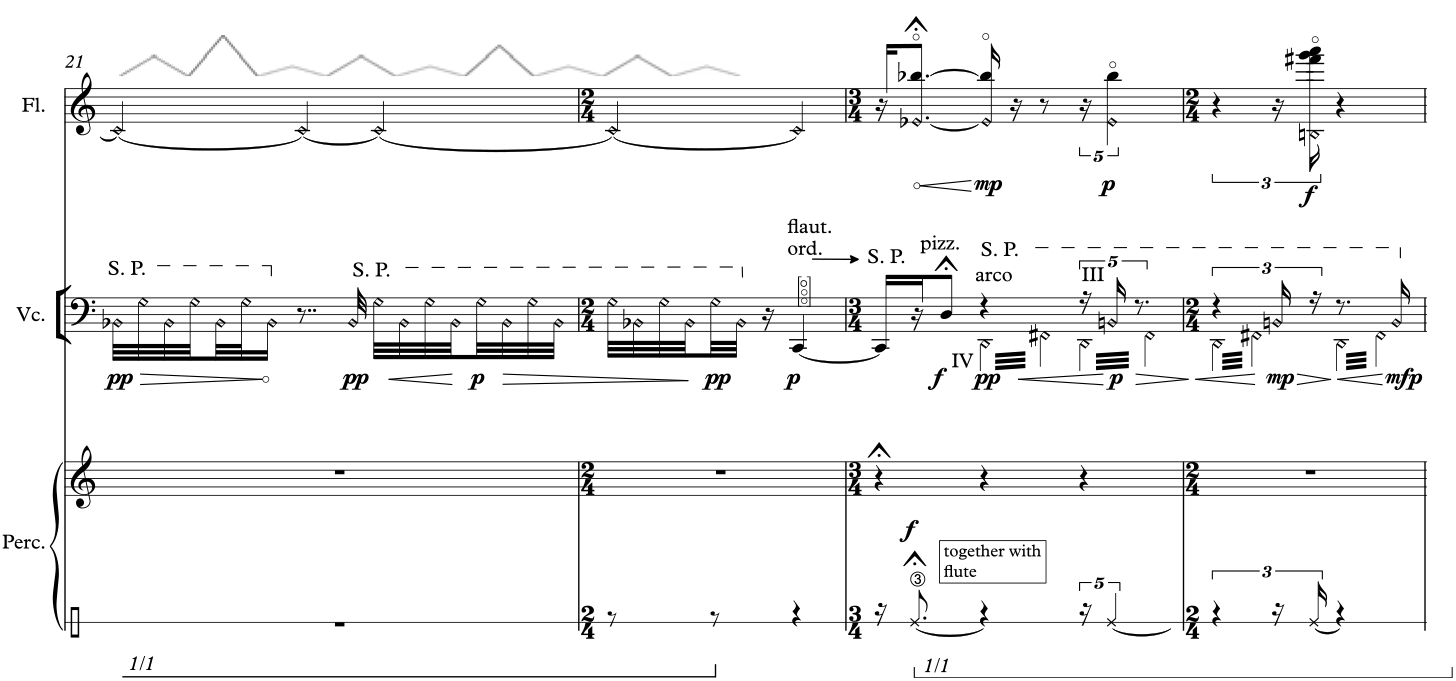
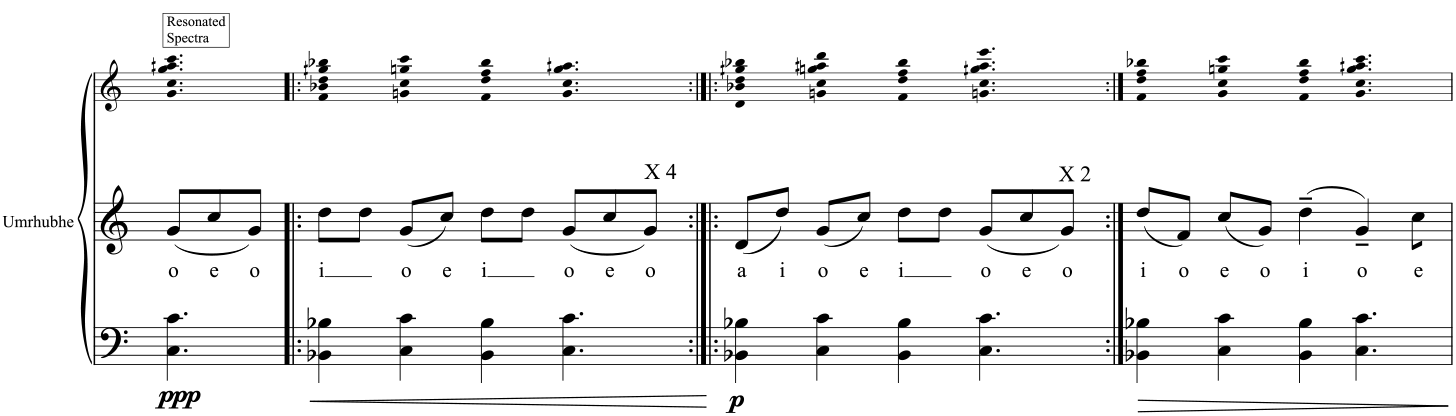
As the piece proceeds, the pedal is sometimes used as a spectral filter of the sound object. Depending on how far the sustain pedal is depressed, some overtones will speak more than others, as if they are emerging out of the overall sound object. As the flute and cello are introduced, they amplify the characteristics of the sound object presented in the first ninety seconds of the piece (Examples 2 and 3). The flute and cello are perceived as if amplifying the inner voice of the piano through filtered overtones and exaggerated accents which trigger a change in the resonating spectra. This idea comes out of my study of amaXhosa bow music, in which the melody is developed out of the filtered spectra of the bow instrument (see Example 5, discussed below).
Excerpt from ISO[R], bb. 11–14.

Excerpt from ISO[R], bb. 21–24.

With ISO[R], I feel I managed a few things. The first was to produce a work that could stand on its own as an artwork without the associations that come with assumptions about African music. The second achievement was a certain vulnerability, one which expressed my state of mind at the time. I was in a new country, with a new language, new culture, unstable finances, new musical studies, and a new aesthetic direction – all of which created an interesting experience, surely, but one which was at times unsettling. However, I viewed this experience in a positive light, as it forced me to engage aggressively with the question of identity. By ‘identity’, I mean not identity as a Black person but identity as an individual, one whose identity includes Blackness but is not exclusively defined by Blackness. The third achievement of this piece is perhaps the most important one, which is that the compositional approach focuses intensively on sound and timbre. I interpret the title of the piece, ISO[R], in two ways. Firstly, in the isiZulu language, which is my mother tongue, iso means an eye. For AmaZulu, this word is used in a metaphorical way to imply thinking deeply about or investigating something, but more importantly, it can also imply looking ahead or projecting a vision of the future. For the next several years, I focused on timbre in my work. The second meaning of the title comes from the Greek word isos, meaning equal. This was important to me because I thought of the instruments of the trio as equal members of the ‘sound object’. They all blended to produce a unified musical object, rather than being heard as individual instruments alternating between lead (foreground) and support (background) roles. Instead, they interlock to produce a complex musical object developing from the piano sound we hear at the beginning of the piece.
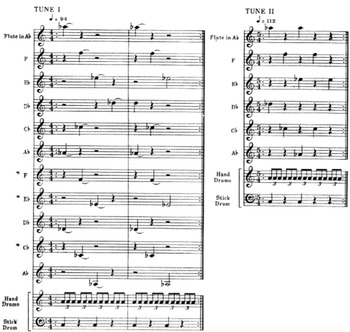
In much traditional African music, the individual voices interlock to produce one unified whole: for example, a melody. Each voice is treated as an equal partner, whose presence is critical to the functioning of the whole. Example 4 shows the rough organization of a traditional reed flute and drum ensemble (Tshikona dances performed by the Venda people of South Africa) performing two different songs. Note that each flute can only perform a single note, so to make a melody they must interlock, which is to say alternate or give each other a turn. What is important in this example for me is the philosophy embedded in the practice. This philosophy is rooted in seeing all members of the ensemble as a society, with each equally important to the whole. There is the whole – a resultant, single melody perceived by the listener – comprised of diversity, wherein each part plays a different pitch and rhythmic structure. The melody is what unites them all. We can observe this in a number of examples of South African music.
Excerpt from Kirby's transcription of Tshikona dances (Venda people of South Africa), performed on reed flutes and drums.Footnote 20

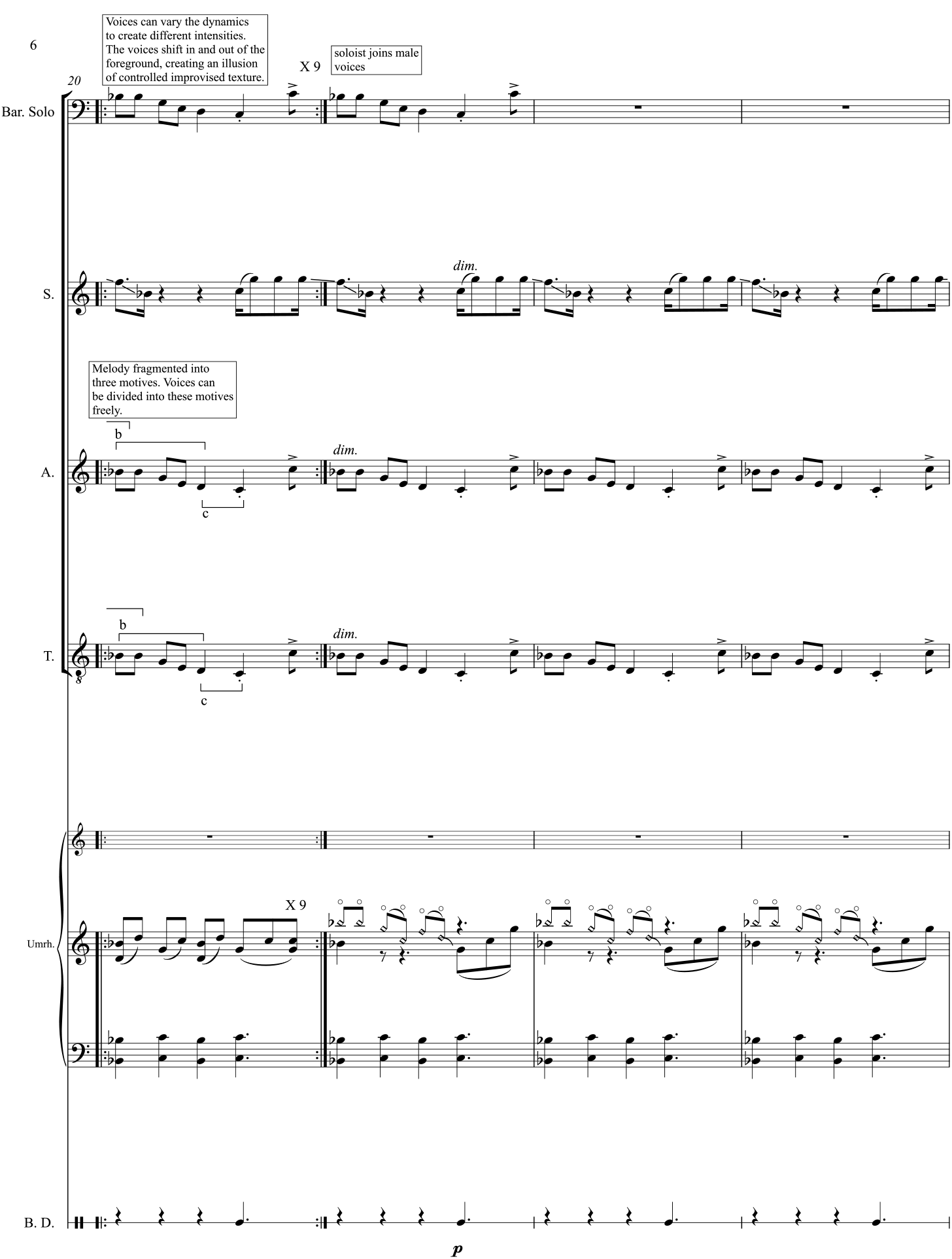
In bar 20 of Example 5, my transcription of ‘Modokali’ by Latozi ‘Madosini’ Mphahleni, we can observe a similar process whereby the melody is the foundation, but it is fragmented into smaller segments distributed amongst the ensemble members.Footnote 21 In this case, the segments include more than one single pitch per musical voice. The effect is that of a Klangfarbenmelodie, but one executed differently than the European approaches seen in Webern or even Beethoven. In ‘Modokali’, the voices can use any fixed segment of the melody.Footnote 22 Each member has a slightly different timbre, and as a result interlocking (indicated above with small letters for each overlapping segment) brings out a rainbow-like approach to a fixed melody. This Klangfarbenmelodie focuses our attention not on a single voice or instrument but on a collective sound distributed in space.
Excerpt of ‘Modokali’ by Latozi ‘Madosini’ Mphahleni, transcribed by the author.

Example 6, from my piece Bells Die Out (2013), was modeled on an analysis of a glass falling and breaking into pieces. The instruments support the emergence of a musical object through a remodeling of both the action and sound of a falling glass, as opposed to being heard as individual elements. We thus hear a musical object with three parts: 1) an upbeat, like a wet glass slipping through the fingers; 2) the impact of the glass on the floor; and 3) the shattering of the glass. Remodeling is used to create a musical object with which to work. The idea is not that listeners really hear a glass falling, but rather that they hear something breaking apart. In this example, we lose the identity of any single instrument against other instruments, and instead we focus on sound as an object in space.
Excerpt from Bells Die Out (2013), bb. 1–6.

Fractured equilibrium
Several parameters influence our perception of sound in space and determine our experience of sound objects. If segments overlap and are written roughly in the same register, the ear strongly picks up these relationships within the melodic structure. In such a scenario, we are likely to perceive the melody as closer, louder, and denser. Bar 20 in Example 5 (‘Modokali’ by Madosini, already discussed above) demonstrates this. The speed at which the melody moves can also influence our perception of its coherence. However, if the melody is portioned into smaller cells which are distributed across a wider space and move at a faster speed, the ear shifts its focus from a local to a global view—in other words, hearing the whole rather than each connection from one cell to another. At this point we have a complex musical texture, and we have managed to deform the melody in such a way that we can hear bits of it, but all perceived as sounding from a distance. When this happens, I usually keep the space resonating with the same harmony, which ties everything together. The illusion that results is that of a fractured equilibrium. So long as the harmony is stable, the instability or complexity in rhythm and changes of register and instrumental colour will sound sparse and fragmentary but nonetheless balanced in space.
My approach to using spectral analysis and my focus on timbre are not only based on the overtone series but also involve remodeling the physical actions associated with a particular sound production and other characters which define the sound. What fascinates me is the possibility of creating the illusion of something that is perceptible but physically not there. We hear a composite sound, which is the result of blending the ensemble, but lose the dominance or visibility of any single voice.
In the cultural and social domain, this situation of being present but not visible is something which has become amplified in recent years. Black African composers within contemporary music exist, but are not visible to the public. In other words, their existence is silenced. The most obvious way this systemic silencing happens is through programming.
Systemic censorship of Black voices
One of the most obvious assumptions made about Black composers is that they are likely African American and working in the jazz idiom. While in Stuttgart, I would often get questions about jazz musicians, most of whom I knew but some I did not. The assumption seemed to be that I should know them because I am Black and that is my culture. Though these assumptions were never intended as racial stereotyping, it often felt that way. Luckily, I grew up with a jazz musician/composer as my mentor, Dr. Brian Thusi (a well-known jazz trumpeter in South Africa), and I played in a big band at the University of KwaZulu-Natal in Durban. I was lucky to do my undergraduate degree in an institution where I could take courses in both jazz and classical music. This was not the same for many music students in South Africa, as jazz was not offered at all institutions as a subject or an area of study in which one could obtain a qualification. My later studies with George Lewis at Columbia University reinforced my love for jazz in ways I did not know were possible. From what George Lewis, Steve Lehman, and others in the New York scene were doing, I recognized many synergies with my own practice, so there was no reason jazz couldn't form part of my musical world.
So, it turned out I had an idea or two about jazz because of my circumstances, but not because of my Blackness. Or was it? In many ways, this kind of assumption can influence how Blacks produce their art, and at times it shifts artists from trying to find their individual voices (i.e., identities) to conforming to what society wants from them. In order for Black composers to get performances and to have opportunities for audiences to hear their voices, they need to go through multiple gatekeepers.
In the centres of contemporary music in Europe and North America, composers gain recognition through winning composition competitions that often come with commissions for a new work to be premiered at a big festival. When a composer is featured in a number of these yearly festivals, their name is slowly accepted as part of the new generation of composers. In other words, the competition route remains one of the strongest, most ‘democratic’ ways in which younger composers can garner visibility.
In South Africa we do not have the same opportunities. Due to the lack of funding, composition competitions are limited. The Southern African Music Rights Organisation (SAMRO) used to have a scholarship competition for classical and jazz music composition held every four years (though I hasten to add the classical category was never won by a Black composer). The last competition for composers was held in 2018. The competition has since been dissolved, in favour of other ways of supporting the development of artists and music creators of all genres that are more inclusive. The competition strongly favoured jazz (mainly won by Black composers) and classical (almost exclusively won by white composers). The Fulbright scholarship is another competitive source of funding for composers seeking to study overseas. Though a number of Black scholars have benefited from the scholarship, none of them have been composers.
Competitions are not a viable way for Black composers to make their voices heard in South Africa. Instead, young composers depend on the goodwill of ‘famous’ composers to put their names forward so an opportunity can come for a new orchestral work or film score. These composers are often professors (most now retired) at institutions of higher learning, mostly populated by white professors, most of whom were lecturers of composition during apartheid. They possess a vast network of connections within the cultural sector, and they remain a strong force even after their retirement from academic positions. Their confirmation of a composer's abilities can either open or close doors for one's career in South Africa. A few years ago, I had a lunch meeting with a former colleague of mine who was excited about my work. At least, that's what I thought. In the meeting, she told me that there was an opportunity for me to apply for a lucrative composition award which would be perfect for me (and good for their organization as a sign of transformation). She continued to say that she knew a few people who sit on the committee, and that I had a strong chance of winning the award and therefore funding. Before I got excited about this, she continued by saying, ‘Andile, but your music has to sound more African, you know what I mean?’ After a brief moment of asking myself what she meant by ‘my music has to sound more African’, I respectfully turned down the opportunity.
Another colleague, known across the globe as the son of a famous composer who successfully merged African and Western musics, wrote a review of a concert held in New York as part of the UBUNTU festival.Footnote 23 Lukas Ligeti's review critiqued the programming as consisting of works that were not authentically African, pointing out my music as one of the examples. This view was supported by a respected white composition professor from South Africa.Footnote 24 He argued that festival organizer Joel Sachs of the Juilliard School had chosen ‘a small clique of pseudo avant-gardists whose work doesn't merit much attention in South Africa’. This statement demonstrates the kind of gatekeeping I referred to above when I spoke of programming and the networks at play within the South African music scene. The younger generation whose work was performed during UBUNTU festival included Bongani Ndodana-Breen (hugely successful in both North America and Europe), Clare Loveday (a white South African woman who has a strong presence in Europe), and myself, just to name a few.
In a 2020 interview, Louis Heyneman, Chief Executive of the Cape Town Philharmonic Orchestra, responded to a published interview with Etienne VivierFootnote 25 that discussed the shortage of music by Black composers performed by South African orchestras:
Thirty percent of our running costs are spent on training (lots of it in the townships!). And yes, we play a lot of music from dead, white composers because that's what our audiences want to hear […] After all, we have to try to be a sustainable business and our audiences obviously pay for their tickets!
My only real objection is against his [Dr Viviers’] ‘lack of imagination’ statement that orchestras should play more music from township musicians. Really? I wish it was practically possible. Where are these musicians, where are their compositions, and who orchestrates kwaito (to name just one example) for a symphony orchestra? Unlike most symphony orchestras in the rest of the world, we often play unconventional and experimental works, but get expert musicologists to process to arrange, for example, Hugh Masekela's music (which is not notated) for orchestra. There are many reasons why there are almost no black composers who can orchestrate their own music for symphony orchestra, but that problem cannot be laid before us. We have worked with other genres several times, but this is not our first priority. Our priority and responsibility is to create a musical platform of substance for musicians with a preference for Western classical music.Footnote 26
In short, the argument that Heyneman makes is that the orchestra does its part by familiarizing township Black children with European classical music. He claims that Western classical music is what the orchestra's audiences want to hear. But the counterargument is not to eradicate European classical music, but to be more inclusive. According to Heyneman, there are no Black composers equipped enough to handle writing for a symphonic orchestra, hence they do not program African composers. Sadly, this view seems to be held by different stakeholders within the industry, including people of colour who have been in leadership positions of different orchestras.
In 2011, Shadrack Bokaba (the former CEO of the Johannesburg Philharmonic Orchestra) also argued that the focus of orchestras should be investing money to teach young people classical music.Footnote 27 This was in response to an article published by composer Mokale KoapengFootnote 28 that questioned the level of inclusivity and transformation in musical institutions such as orchestras. Koapeng argued that while orchestras’ use of part of their funding from the national government towards outreach teaching projects has been useful, he remains sceptical of their willingness to transform when it comes to programming and helping young Black conductors and composers from South Africa. Unfortunately, this remains a sad reality today. In response to these claims, Bokaba argued that they do commission new compositions, but failed to address the question of how many of these commissions are from Black composers. His reasoning was that it is too expensive to commission Black composers, because for each commission a white composer would have to be hired to help orchestrate the composition. This is a fate suffered by composers such as Todd Matshikiza, Mzilikazi Khumalo, Phelelani Mnomiya, and many more, who were systematically forced to team up with white composers to receive a commission to write for and be performed by a South African orchestra.
In South Africa, orchestral programming continues to reflect deep historical exclusions: the works of Black composers and of women composers remain almost absent from concert stages. This marginalization stands in stark contrast to the reception of South African composers abroad, where the music of Black South African composers and women composers has received recognition and institutional support from concert halls and festivals in Europe and North America.Footnote 29 This disparity underscores the persistence of systemic biases in local programming practices, where the canon remains overwhelmingly shaped by Eurocentric traditions and patriarchal norms.Footnote 30 Musa Nkuna's Friedensfanfare (2022) was performed in Germany as part of a concert organized by the Province of Nordrhein-Westfalen. Bongani Ndodana-Breen, who has composed a number of operas such as Winnie, the Opera (2011), has had performances in North America and Europe by ensembles including Ensemble Recherche, the Vancouver Opera Orchestra, the Belgian National Orchestra, New York City's Vox Vocal Ensemble, and the Avalon String Quartet. Ndodana-Breen has worked very hard to raise funding to support performances of some of his work in South Africa. He is the only Black composer who has been performed more than twice by the KwaZulu-Natal Philharmonic Orchestra and the Cape Town Philharmonic Orchestra.Footnote 31
South African women composers, such as Clare Loveday, have received significant recognition abroad, with Loveday's saxophone quartets and other works being performed in the United Kingdom and incorporated into examination programs at institutions like the Royal Birmingham Conservatoire. Similarly, younger voices, such as Monthati Masebe, are emerging as part of a new generation of African women composers from South Africa, gaining visibility through programming at major international festivals, such as the Wittener Tage für neue Kammermusik in Germany, and collaborations with renowned ensembles like Ensemble Recherche.Footnote 32 Yet, despite this international support, the programming of their works within South Africa itself remains strikingly rare.Footnote 33
I have been fortunate to receive international recognition: Invisible Self was premiered by Ensemble Modern (Germany, 2020; Holland, 2022; France, 2023),Footnote 34 while The Broken Mirrors of Time was presented by Klangforum Wien in Norway and Germany (2021)Footnote 35 and later by Argento Ensemble in the United States of America (2022).Footnote 36 My string quartet, Voices from the Ancestors, was premiered at ECLAT in Stuttgart and later presented at Wien Modern by the Mivos Quartet.Footnote 37 In 2021 (Chicago) and 2023 (Washington, D.C.), Ensemble Dal Niente dedicated portrait concerts to my work.Footnote 38 Against this backdrop, it is difficult to accept the claim made by a South African orchestra leader that Black composers struggle to write for orchestra or large ensembles.
The real issue is visibility. Today, YouTube helps, but for decades, Black African male and female composers of contemporary music were rendered invisible; orchestras rarely commissioned or programmed their works, in South Africa or elsewhere. During apartheid, Black composers were excluded entirely, with only occasional performances of African American jazz.Footnote 39 The assumption that they did not exist was widespread. When I lectured at the University of Free State (as a guest lecturer, 2017–2018), I asked students to name three Black South African composers. Most could name only one.Footnote 40 This exercise was not to embarrass them, but to reveal how systemic erasure shapes perceptions. By challenging such silences, we can begin to recognize the global contributions of contemporary Black African male and female composers.Footnote 41
Black composers in South Africa are silenced by not being programmed. This is not an oversight. Rather it is a systemic exclusion of the presence of Black voices in such spaces. One of the solutions to this problem is for composers to work more with international performers for performances outside of South Africa, thus bypassing the gatekeepers of contemporary cultural heritage in South Africa. This approach has shaken the institutions in many ways and caused cracks in the old system.
Music at the threshold of silence and sound
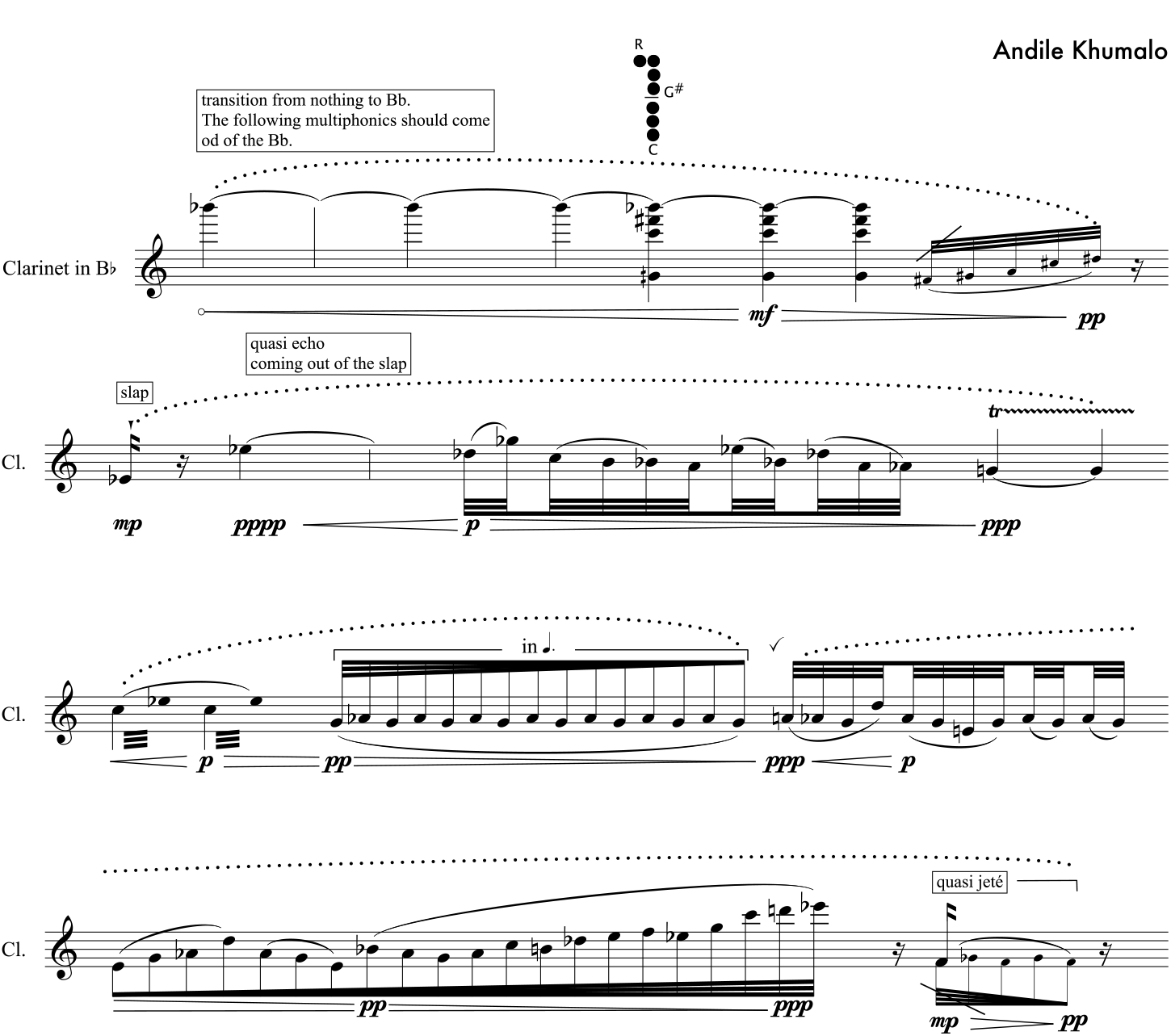
This idea of systemic silencing has inspired some of my music, which I consider to exist in the cracks (spaces) between silence and sound. An example can be seen in my 2013 composition for solo clarinet called Tracing Hollow traces. This piece, which focuses on using silence and the space between silence and sound, forces both the listener and the performer to listen attentively to how sound speaks in space.Footnote 42 The sounds are delicate and unstable, with long musical phrases that push the breathing skills of the performer. The delicate transformation from silence to echo-like sounds and finally multiphonics, right at the start of the piece (Example 7), lays down the foundation for the rest of the form. When the sound is in the region that I classify as ‘echo-like’, it dissolves in space. We hear it, but cannot completely classify it – it is unclear, for example, what instrument is playing – and so we are forced to listen to this sound in space or space in sound. This experience brings the listener closer to the sound and creates a more intimate lived experience with the sound. The piece is to be performed in the dark, to encourage the listener to focus on the sound rather than the action of the performer. The silence or invisibility is disrupted by explosive, sparse attacks, which act like sparkles of light in the dark and give us a glimpse of the inner sound, making it visible to us.
Excerpt from Tracing Hollow traces (2013), bb. 1–11.

This concept of playing with surfaces that are situated at the borders of sound and silence, giving an illusion of sound in space or space in sound, is further elaborated in my piano composition Schau-fe[r]n-ster II (2014) for piano solo. The composition is dedicated to the Japanese pianist Junko Yamamoto, who premiered it in 2014 in South Africa. Yamamoto also gave my trio ISO[R] its 2004 German premiere in Stuttgart. In this piece we experience a very concentrated relationship between sound, space, and silence. In fact, the ‘silence’ is perceived as part of the musical expression: the silence is transformed into another musical voice, an extra musical layer. This use of silence as a kind of ‘negative space’ is reminiscent of figure-ground illusions like the famous Rubin's vase. The inclusion of silence as part of the musical surface creates an ambiguous perception between sounds and shades of sounds, sounds evolving out of shadows, and foreshadowings (as in a spectral filter). The spectral filter in this context refers to the performer's use of the sustain pedal and silently depressed keys to shape which partials of the sound are foregrounded. By varying the degree of pedal resonance or activating sympathetic vibrations from silently pressed notes, the performer creates the illusion of layered ‘shadows of sound’. In this way, the instrument itself becomes a filter, selectively amplifying or concealing aspects of the overtone spectrum. The piece encourages listeners to hear the sounds in space, which they too are a part of, and by so doing blurs the division between the performer, music, and listener.
Schau-fe[r]n-ster II uses the sustain pedal sensitively to create different filters of the resonating spectra resulting from the attacks themselves (Example 8). Attacks in my music are significant not only as triggers of something new or as breaks in the silence, but as metaphors of aggression and the oppressive, qualitative opinions I often receive about my music: particularly the criticism that my music is questionable in its African authenticity. I find the question particularly problematic when considered in relation to the person who is empowered to ask it, given the race and class divisions I presented at the start of this article.
Excerpt from Schau-fe[r]n-ster II (2014), bb. 1–20.

While there seems to be a clear ‘unwritten’ understanding of what African music ought not to be – namely, structurally complex, acoustically rich, and multi-dimensional in terms of pitch organizationFootnote 43 – there is never a clear enough answer to my follow-up questions: if my music betrays ‘Africanness’, in what way does it do so, and what exactly is African music today? These questions are intriguing for me, because I would certainly claim that in my music one can recognize ‘Africanness’, but also ‘Western’ contemporary influences and, in some compositions, traces of jazz.
All of these aspects define who I am: an individual whose past has helped shape his present. In isiZulu, we say, ‘Indlela ibuzwa kwabaphambili’ (we learn from those ahead of us). In other words, we learn to understand the present through history, shaping the ‘new’ direction forward based on the experiences of those who have gone before. My education has taken place on three different continents with different cultural backgrounds, and of course, part of who I am today is shaped by those experiences. I do not agree with the assumption that in order to conform to Africanness, I (as an African) must compose music that reflects pre-colonial times (what is often described as primitive) or reject ‘Western’ education altogether.Footnote 44 In the wake of movements such as #FeesMustFall, #RhodesMustFall, and #BlackLivesMatter, there has been a growing mobilization towards correcting the unjust representation of knowledge at institutions which have for many years ignored local and regional knowledge, silencing the voices of people among whom the very same institutions are situated.
A number of books have been written promoting the idea of decolonialization in education, particularly in South Africa. For some, this means recognizing and bringing in more regional knowledge to complement the current ‘global’ forms of knowledge, while others feel that some global names should be removed completely. Some go to the extreme of completely rejecting ‘Western’ knowledge, which in my view is neither realistic nor forward thinking. In my own teaching and work, I have argued for an environment where diversity of knowledge is welcomed and encouraged, rather than vouching for an exclusivity of knowledge.
Ambiguity
My music is a blend of different influences, ranging from Afrological music (including the Afrodiasporic tradition of jazz) to Eurological music.Footnote 45 However, my music does not try to imitate these influences; instead, I learn from them and use them as the foundation to forge new expressions of the multiplicities (threads) and ambiguous spaces (cracks) we find in African music in the twenty-first century. The cracks I am referring to are not a symbol of breaking or destruction; rather, the cracks are a symbol of expansion. These cracks expand the way in which we understand both European contemporary (art) music and African contemporary music. My music challenges institutional structures through the use of deconstruction. Hence the musical fragmentation of the same recurring object, which metaphorically shows reflections of the same object from different angles. This can be observed in my ensemble pieces Bells Die Out and Shades of Words. The deconstruction found in my music situates my music in the spaces within the cracks. At times, the foundation, or structural thinking, is situated in principles that guide African music, while at the same time, the surface level of the music projects traces of European modernity. This gives an illusion of music that is ambiguous, that does not completely fit the expectations of either European modernity or African traditional music. As an example, I would like to refer to my short piece for piano solo called Colour Me In (2016).
Colour Me In is one of the movements in a piano cycle called Snapshots. It was written in dedication to Jurgen Brauninger, my undergraduate professor in Durban, who sadly passed away a few years ago. Brauninger was German but lived in South Africa for over thirty years. One of his major projects during and after the apartheid regime was to find ways to collaborate with artists of all races and backgrounds, and by so doing, to undermine the divisions that existed between Blacks and whites. Though he was German, he strongly felt at home in South Africa: he once said that he felt more at home in Africa than in Germany. Strangely enough, I would say, there was a point in my own life when I felt more at home in Germany than when I was in South Africa. This raises the idea of how we define home. Is it a place of birth or a place where one feels at peace, welcomed, safe, and happy? I felt that this idea of ambiguity was interesting and in line with my philosophical approach to composing. In Colour Me In, I wrote a piece that takes ambiguity as the central compositional idea.
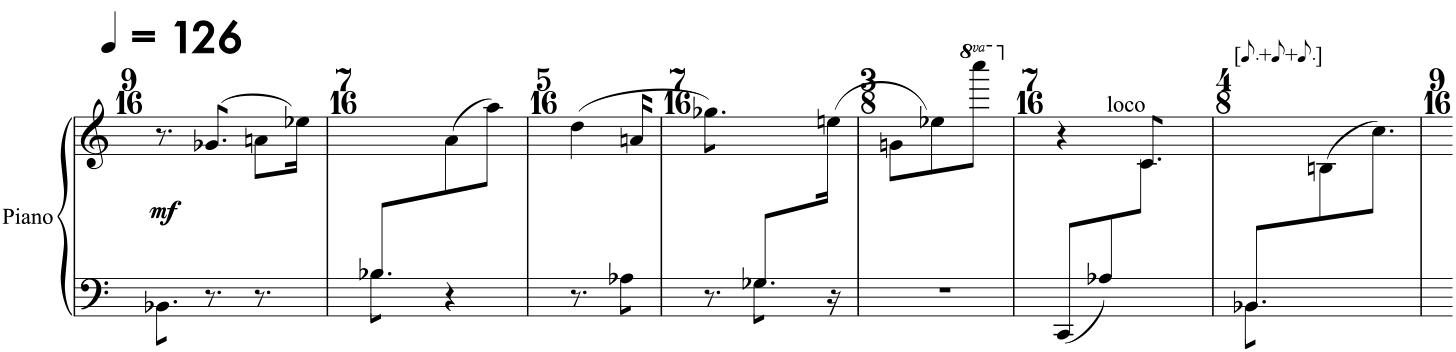
Example 9 is a transcription of an introduction to the traditional amaXhosa composition ‘Modokali’ performed by Madosini and transcribed by myself (also discussed in Example 5 above).Footnote 46 Though it is written in 9/8 it is not grouped like a traditional 9/8 meter. Rather it presents repeating groups of unequal beats ordered as 2 + 2 + 2 + 3, an asymmetrical aksak rhythm (a term originating in Ottoman musical theory but now applied broadly to a wide variety of rhythms combining units of 2 and 3). This cyclic rhythmic cell is fixed and repeated throughout the piece. A similar rhythmic cell in my 2015 composition Colour Me In is closely modelled on the rhythmic structure observed in the excerpt from ‘Modokali’. The aksak rhythmic cell of Colour Me In (3 + 2 + 3) is recurring, forming part of the fundamental musical object from which the piece is developed (Example 10, b. 7).
Introduction to ‘Modokali’, transcribed by the author.

Excerpt from Colour Me In (2015), bb. 1–7.

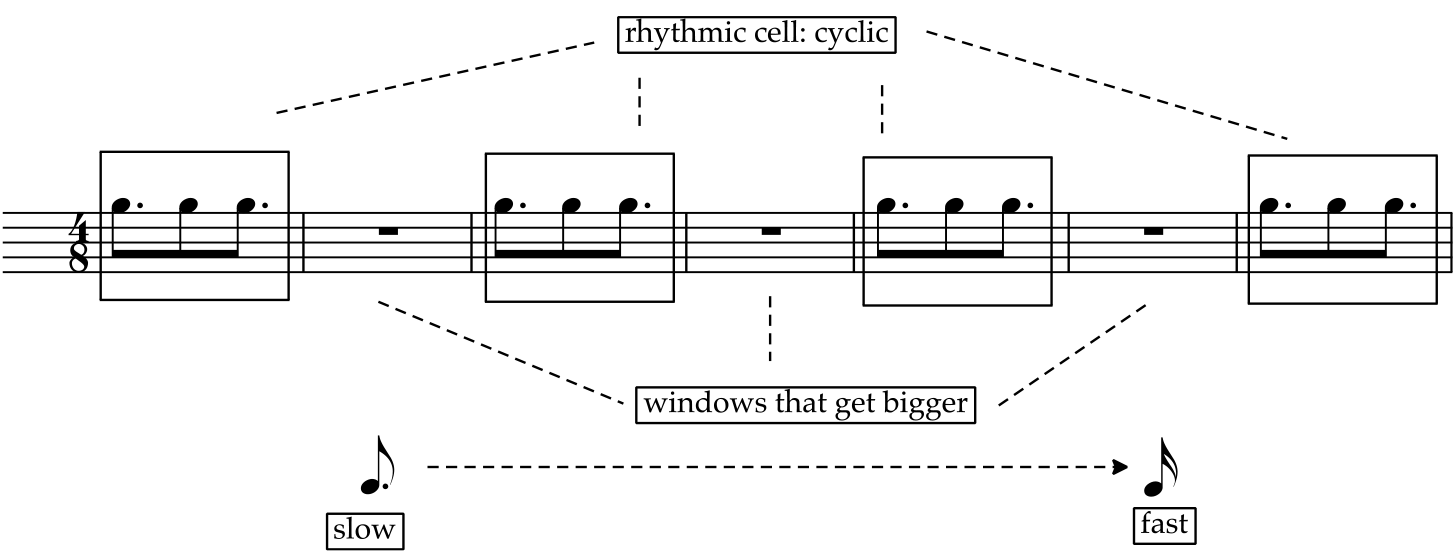
A second feature of this piece that is also critical for African music is the fast, unchanging underlying pulse, which brings rhythmic drive to the music. My basic idea was to create a composition that is inspired by this rhythmic structure (aksak) but that does not try to directly simulate the rhythmic patterns or the music from which the rhythms come. To make a reference to African traditional music without imitating it, I introduced the idea of fragmentation (Example 11). The aksak rhythm returns throughout the piece, giving a sense of a cyclic form, but is interrupted by the introduction of diverse rhythmic patterns. This interruption starts with small windows that are filled with slower pulses in the form of dotted eighth notes. As the piece continues, the spaces between the aksak cells get bigger. These spaces are then filled with faster pulses, in the form of sixteenth notes. This process gives the impression of what I call ‘shades’ of the aksak rhythmic pattern. In other words, the unpredictability of when the pattern comes and the fact that it always moves so quickly means that we perceive it but cannot fully grasp it. More generally, this means that we can recognize a fleeting and unpredictable feeling of African music that does not cross over into assimilation or imitation of the music that influenced my composition. The same idea of an oblique African reference is applied in the tonal space, which at times shifts around pentatonic moments.
Fragmentation of the rhythmic cells in Colour Me In.

This concept of a fleeting allusion to references is also applied to European influences. The piece is structured in a quasi-aleatoric way, which takes it still further away from the African space in which it started. The instrumental writing (wide and quick, with big intervallic leaps) references the European sound world of the 1950s – a time when Europe was seeking to develop a new cultural environment that was not tainted by the horrible history of the Nazis and their abuse of music as a cultural weapon – but at the same time keeps its distance.
The idea of the aleatory is suggested by the use of wide intervals on the piano, giving an impression of quasi-distorted melodic writing that breaks linearity through leaps. What was interesting for me in doing this, though, was to give the illusion of multiple voices running at the same time. Each register has its own timbre. The division between the registers and the speed at which the music moves allows the ear to perceive the sounds in each register as independent voices. The idea of space and timbre (register) is thus a critical element of the piece. The music gives an impression that the voices are moving parallel to each other in an interlocking way. The use of interlocking, as discussed above in relation to Example 4, is a compositional technique prominent in African traditional music, bringing the aleatoric soundworld of the European avant-garde into dialogue with an African musical practice.
Conclusion
The idea of creating a musical illusion of multiple voices or threads running at the same time is a good metaphor for the situation of an African composer of contemporary music – if we understand, that is, ‘contemporary’ to be a reflection of what is happening in our time. That said, it is impossible to imagine Africa in the twenty-first century without taking into account its colonial history, which is still in many ways palpable in our daily lives. We cannot assume that an African composer without knowledge from the global north would write music untainted by the globalization that pervades our world today. Globalization has made it easier for people to move, and as they travel and encounter other cultures they inevitably become influenced by those cultures. The result of that cultural mix expands our experience of the world and that can only be positive.
In this article, I have tried to show that there are many factors that influence creators of music in Africa, and that all of these are deeply rooted in historical and cultural contexts. These influences result in different approaches to composition and different understandings of what the term ‘African composer’ means. I suggest that it is fruitful to acknowledge this diversity as an enrichment of our society rather than insisting on a narrow understanding of ‘African’, which results in a colonization of both mind and music.
Funding statements
This work was financially supported by the European Union's Horizon 2020 research and innovation programme under the Marie Skłodowska-Curie grant agreement No. 101027828 (project ONTOMUSIC), the Schulich School of Music of McGill University and the Canada Research Chair in Music and Politics at the Université de Montréal Faculty of Music. The funding bodies played no role in the development of this article, which reflects only the author's view.



 Open access

