

Hostname: page-component-77f85d65b8-8v9h9 Total loading time: 0 Render date: 2026-03-28T12:47:42.876Z Has data issue: false hasContentIssue false

Mapping the properties of wake-induced vibration on a circular cylinder

Published online by Cambridge University Press:  13 December 2024

Ke Lin
Affiliation:
Department of Engineering Mechanics, School of Ocean and Civil Engineering, Shanghai Jiao Tong University, Shanghai 200240, PR China
Yuankun Sun
Affiliation:
Ocean University of China, College of Engineering, Qingdao 266100, PR China
Hongyuan Liu
Affiliation:
Zhejiang University-Westlake University Joint Training, Zhejiang University, Hangzhou 310027, PR China Key Laboratory of Coastal Environment and Resources of Zhejiang Province, School of Engineering, Westlake University, Hangzhou, Zhejiang 310030, PR China
Yunpeng Zhu
Affiliation:
Zhejiang University-Westlake University Joint Training, Zhejiang University, Hangzhou 310027, PR China Key Laboratory of Coastal Environment and Resources of Zhejiang Province, School of Engineering, Westlake University, Hangzhou, Zhejiang 310030, PR China
Jiasong Wang*
Affiliation:
Department of Engineering Mechanics, School of Ocean and Civil Engineering, Shanghai Jiao Tong University, Shanghai 200240, PR China Key Laboratory of Hydrodynamics of Ministry of Education, Shanghai Jiao Tong University, Shanghai 200240, PR China
Michael S. Triantafyllou
Affiliation:
Department of Mechanical Engineering, Massachusetts Institute Technology, Cambridge, MA 02139, USA
Dixia Fan*
Affiliation:
Key Laboratory of Coastal Environment and Resources of Zhejiang Province, School of Engineering, Westlake University, Hangzhou, Zhejiang 310030, PR China Institute of Advanced Technology, Westlake Institute for Advanced Study, Hangzhou, Zhejiang 310024, PR China
*
Email addresses for correspondence: jswang@sjtu.edu.cn, fandixia@westlake.edu.cn

Abstract

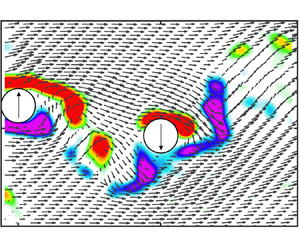
This study conducts experimental investigations into wake-induced vibration (WIV) of a circular cylinder placed downstream of an oscillating cylinder. Surprisingly, it is observed that the previously identified WIV phenomenon, characterized by a sustained increase in amplitude at higher reduced velocities, does not occur when the upstream cylinder oscillates at large amplitudes. Instead, a different phenomenon, which we refer to as the ‘wake-captured vibration’, becomes dominant. The experiments reveal a negative correlation between the vortex-induced vibration amplitude response of the upstream cylinder and the WIV amplitude response of the downstream cylinder. Through a quasi-steady and linear instability analysis, the study demonstrates that the previously proposed wake-displacement mechanism may not be applicable for predicting the cylinder WIV response in the wake of an oscillating body. This is because the lift force gradients across the wake, measured through stationary cylinder experiments, decrease significantly when the upstream cylinder vibrates at higher amplitudes. Consequently, actively controlled vibration experiments are conducted to systematically map the hydrodynamic properties of the downstream cylinder vibrating in the wake of an oscillating cylinder. The findings align with observations from free-vibration experiments, and help to explain the amplitude and frequency response of WIV. Additionally, wake visualization through particle image velocimetry is conducted to provide further insights into the complex wake and vortex–body interactions.

Information

Type
JFM Papers
Copyright
© The Author(s), 2024. Published by Cambridge University Press

Access options

Get access to the full version of this content by using one of the access options below. (Log in options will check for institutional or personal access. Content may require purchase if you do not have access.)

Article purchase

Temporarily unavailable