


Recent research on fruit and vegetable (F&V) intakes among 11-year-olds in nine European countries revealed that intakes were below recommended levels in all countries(Reference Yngve, Wolf and Poortvliet1). Recent reviews suggest that parental and family social–environmental factors such as family socio-economic status, parental modelling and home availability may be relevant mediators of intakes and should therefore be taken into account in intervention development(Reference Rasmussen, Krølner, Klepp, Lytle, Brug, Bere and Due2–Reference Van Der Horst, Kremers, Ferreira, Singh, Oenema and Brug4). Other studies on potential determinants of health behaviour in children and adolescents suggested that general parenting styles are also important(Reference Hughes, Power, Fisher, Mueller and Nicklas5–Reference Kremers, Brug, de Vries and Engels7).
Parental style refers to the general patterns of parenting relevant for a broad range of topics and captures two important elements: parental involvement and parental strictness(Reference Maccoby and Martin8). In general, authoritative parenting characterized by high parental strictness and involvement has been found to be associated with more healthful behaviour in children(Reference Baumrind9, Reference Baumrind10). Despite the current consensus on the importance of family involvement in eating habits in children and adolescents, very few studies have investigated these general parenting styles in relation to nutrition in general or F&V intake in particular. In the review of Rasmussen et al.(Reference Rasmussen, Krølner, Klepp, Lytle, Brug, Bere and Due2) six papers were identified investigating F&V intake and some aspects of general parenting styles. While three papers showed no significant relationships(Reference Lien, Jacobs and Klepp11–Reference De Bourdeaudhuij and Van Oost13), some evidence was found for highest F&V intake levels in authoritative parents (or mothers), who combined high responsiveness with high demand in the interaction with their children(Reference Kremers, Brug, de Vries and Engels7, Reference Lytle, Varnell, Murray, Story, Perry, Birnbaum and Kubik14, Reference Young and Fors15). The authoritative parenting style was also found to be superior to other styles in studies on social competence, psychosocial functioning, problem behaviour and substance abuse(Reference Baumrind9, Reference Baumrind10). If this is also true for eating behaviours such as F&V consumption in children, this would open possibilities for designing broader intervention strategies, targeting different aspects of children’s behaviour and functioning at a time by focusing on general parenting competences.
Baumrind’s(Reference Baumrind9, Reference Baumrind10) parenting style concept was developed and used initially in the USA. As mentioned before, some European studies also used these general parenting styles in their research. However, several authors have drawn attention to cultural or ethnic differences in parenting style studies which may be due to differences in social context, parenting practices, or the cultural meaning of specific dimensions of parenting style(Reference Chao16, Reference Darling and Steinberg17). To date it is unclear whether parenting in European countries, and especially the assessment of general parenting styles, is similar or different from that in the USA. More specifically, cultural differences in the meaning of specific dimensions of parenting styles may exist even within different countries in Europe. As a consequence, interaction between parenting styles and country has to be taken into account.
The aim of the present study was to investigate whether F&V intake in 11-year-olds, and social–environmental correlates of F&V intake such as modelling, encouragement, family food rules and home availability, differ according to general parenting styles and whether this difference is dependent on country (Belgium, The Netherlands, Portugal and Spain).
Methods
Procedure and participants
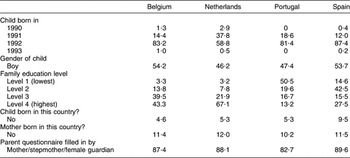
Data were derived from the cross-sectional study of the Pro Children project(Reference Klepp, Pérez-Rodrigo and De Bourdeaudhuij18). Data were collected during October–December 2003 in nine European countries among children and their parents. Schools constituted the sampling unit, and from each country random samples of at least twenty schools and a minimum of 1300 11-year-old eligible children were recruited. Four of the nine countries agreed to include an optional measure on parenting styles in the parent questionnaire: Belgium, The Netherlands, Portugal and Spain. Pupils completed a questionnaire in the classroom and took a questionnaire home to be completed by one of their parents. The sample sizes were 1180 for Belgium, 883 for The Netherlands, 1515 for Portugal and 977 for Spain (total sample size 4555; 49·3 % boys). Parental response rates ranged from 67·8 % in The Netherlands to 83·4 % in Portugal(Reference Wolf, Yngve and Elmadfa19). Background information on the sample is reported in Table 1.
Background characteristics (%) of the samples in the four countries: data derived from the cross-sectional study of the Pro Children project, October–December 2003
Ethical approval was obtained from all relevant ethics committees in all countries and written informed consent forms were signed by parents of all participating children. A detailed description of the Pro Children project, including the sampling and data collection procedure, is given elsewhere(Reference Yngve, Wolf and Poortvliet1, Reference Klepp, Pérez-Rodrigo and De Bourdeaudhuij18).
Measures
A self-report questionnaire for the children was developed and pre-tested to measure fruit intake and vegetable intake, and possible correlates, based on a social–ecological framework, a literature review and interviews with children, parents and school staff(Reference De Bourdeaudhuij, Klepp, Due, Rodrigo, de Almeida, Wind, Krølner, Sandvik and Brug20, Reference Wind, Bobelijn, De Bourdeaudhuij, Klepp and Brug21).
Usual intakes of fruit and vegetables were assessed using an FFQ. Children were asked how often they usually eat fresh fruit, salad or grated vegetables, other raw vegetables and cooked vegetables. Response categories were: (i) never; (ii) less than one day per week; (iii) one day per week; (iv) 2–4 days per week; (v) 5–6 days per week; (vi) every day, once daily; (vii) every day, twice daily; and (viii) every day, more than twice daily. A separate study was executed to test the reliability and validity of these intake measures in six countries. Results showed good test–retest reliability (Spearman r from 0·45 to 0·77) and adequate validity comparing the food-frequency questions with 7 d food records (Spearman r from 0·38 to 0·53). Frequencies were re-coded into portions per day(Reference Haraldsdóttir, Thórsdóttir, De Almeida, Maes, Pérez Rodrigo, Elmadfa and Frost Andersen22).
The child questionnaire also included personal factors, social factors and environmental factors as potential correlates of fruit intake and vegetable intake. These constructs were analogous for fruit and vegetable intakes. Six social–environmental constructs were included here for their relevance to parenting styles: (i) modelling (mother/father/best friend eats fruit/vegetables); (ii) active parental encouragement (mother/father encourages); (iii) family rules – demands (parents demand to eat fruit/vegetables); (iv) family rules – allowances (allowed to eat as much fruit/vegetables as you like); (v) parental facilitation (cut fruit/vegetables for child); and (vi) home availability (different fruits/vegetables, fruit/vegetables that you like, if you like it will be bought). These constructs were assessed with one to three items, and for each construct a composite score was calculated as the mean of the relevant item scores. Responses were given on 5-point scales ranging from −2 (fully disagree/never) to +2 (fully agree/always). An overview of the items, constructs and scaling is given elsewhere(Reference De Bourdeaudhuij, Klepp, Due, Rodrigo, de Almeida, Wind, Krølner, Sandvik and Brug20, Reference Sandvik, De Bourdeaudhuij and Due23). A separate study in five countries showed sufficient internal consistency for composite scores (values of α between 0·65 and 0·89; not computed for family rules as they consisted of only one item), good to very good test–retest reliability (most intra-class correlations >0·60; all >0·50) and moderate predictive validity (Spearman r ranging from 0·05 to 0·38 for social and environmental factors) compared with other studies(Reference De Bourdeaudhuij, Klepp, Due, Rodrigo, de Almeida, Wind, Krølner, Sandvik and Brug20).
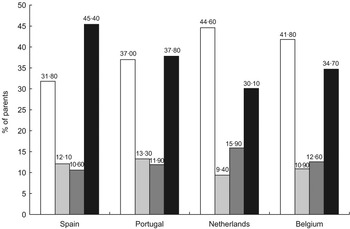
Parenting styles were included in the parent questionnaire based on the Steinberg instrument. This instrument is considered one of the best measurement tools available to measure parenting styles and has been used extensively in the USA(Reference Steinberg, Elmen and Mounts24). Four parenting styles were computed based on two parenting style dimensions: strictness and involvement(Reference Steinberg, Elmen and Mounts24–Reference Sessa26). The involvement and strictness scales included nine and seven items respectively, and parents answered on a 5-point scale ranging from completely untrue to completely true. Internal consistencies were α = 0·76 for the involvement scale and α = 0·75 for the strictness scale. Based on the median value of both scales, parents were categorized as authoritative (high on involvement and high on strictness), authoritarian (high on strictness, low on involvement), indulgent (high on involvement, low on strictness) or neglectful (low on involvement and low on strictness). Figure 1 shows the distribution of the four parenting styles over the four participating countries.
Percentages of parents in the four categories of parenting styles (␣, authoritative; ░, authoritarian; ▒, indulgent; ▪, neglectful) in the four countries. Data were derived from the cross-sectional study of the Pro Children project, October–December 2003
Family educational level was assessed in the parents’ questionnaire. The highest level of education reported by either parent was used as an estimate of family educational level. In the analyses this variable was entered as a categorical variable with four categories based on years of education.
All protocols and questionnaires of the Pro Children study can be accessed at http://www.prochildren.org.
Statistical analyses
Two-way ANOVA were used to investigate whether fruit intake, vegetable intake and social–environmental correlates of fruit and vegetable intakes differed between the four parenting styles and between the four countries. For each analysis, the main effect of parenting style, the main effect of country and the interaction between both are reported. Differences between the four countries are reported only for reasons of completeness, but are not the main research question of the present work. Differences between countries were reported previously(Reference Yngve, Wolf and Poortvliet1, Reference Wolf, Yngve and Elmadfa19, Reference De Bourdeaudhuij, te Velde and Brug27).
Post hoc tests were used to detail specific group differences and are reported in the text. All ANOVA were controlled for gender, age and family education level. Although the pupils were all recruited from the same grade, some age variability was observed (range 9–12 years) arguing for the inclusion of age as a covariate. Observed mean values and F statistics are reported in the tables. The significance level was set at P < 0·01 to adjust for multiple statistical testing.
Results
Two-way ANOVA showed predominantly significant differences in fruit intake and in social–environmental correlates between the four countries. Highest levels of fruit intake were found in Portugal (P < 0·001), followed by Spain (P < 0·001), compared with lower levels in Belgium and The Netherlands (Table 2). Social–environmental correlates reflected the same trend. More modelling, parental encouragement, demand and home availability of fruit were found in Portugal and Spain than in Belgium and The Netherlands (P < 0·001). Differences between parenting styles were not significant for fruit intake, but were significant for active parental encouragement, demand family rule and home availability of fruit. Children of parents with an authoritarian parenting style reported more active parental encouragement and more demands to eat fruit compared with children of parents with an indulgent or neglectful parenting style (P < 0·01). In addition, children of parents with an authoritative parenting style reported more home availability of fruit than children of parents with a neglectful style (P < 0·001). The significant interaction effect for modelling showed that children of parents with an indulgent style reported most modelling of fruit intake in Portugal, while in Belgium and The Netherlands, most modelling of fruit intake was reported by children of parents with an authoritarian style.
Differences in fruit intake and social–environmental correlates of fruit intake between parenting style groups and the four countries (results of two-way ANOVA): data derived from the cross-sectional study of the Pro Children project, October–December 2003
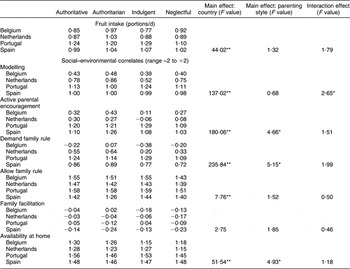
All analyses were controlled for gender, age and family education level.
Significance of effect: *P < 0·01, **P < 0·001.
Table 3 shows that significance differences were also found between countries for vegetable intake and related correlates. Children in Portugal reported higher vegetable intake (P < 0·001), those in Spain lower intake (P < 0·001). Children in Portugal also reported most parental encouragement to eat vegetables, demands to eat vegetables, facilitation and home availability of vegetables, while children in Portugal and The Netherlands reported most modelling (all P < 0·001). Table 3 shows that no differences in vegetable intake related to parenting styles were found. Along the same line, very few differences across parenting styles were found in social–environmental correlates related to vegetable intake. Only for home availability of vegetables was a significant difference across parenting styles found. Children of parents with an authoritative parenting style reported more availability compared with children of parents with a neglectful style (P = 0·01).
Differences in vegetable intake and social–environmental correlates of vegetable intake between parenting style groups and the four countries (results of two-way ANOVA): data derived from the cross-sectional study of the Pro Children project, October–December 2003
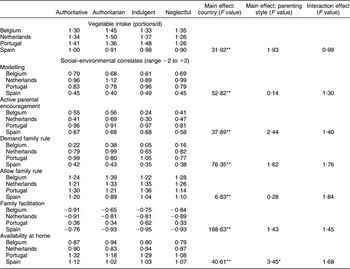
All analyses were controlled for gender, age and family education level.
Significance of effect: *P < 0·01, **P < 0·001.
Discussion
No evidence was found in the present study for consistent differences in F&V intakes or social–environmental correlates according to parenting style. Results showed no differences in F&V intake across parenting styles and only very few significant differences in social–environmental correlates.
The authoritarian (more parental encouragement and more demands to eat fruit) and the authoritative (more availability of fruit and vegetables) parenting styles resulted in more favourable correlates. Previous studies have already shown highest F&V intake levels in authoritative parents (or mothers), who combined high responsiveness with high demand in the interaction with their children(Reference Kremers, Brug, de Vries and Engels7, Reference Lytle, Varnell, Murray, Story, Perry, Birnbaum and Kubik14, Reference Young and Fors15). The authoritative parenting style was also found to be superior to other styles in studies on social competence, psychosocial functioning, problem behaviour and substance abuse(Reference Baumrind9, Reference Baumrind10). In contrast, a positive effect of an authoritarian parenting style was not expected in the present study. However, it is possible that authoritarian parenting, which goes together with encouraging, obliging or demanding that children eat fruit every day, may have a positive effect on fruit intake. Previous studies also showed that less permissiveness, more food rules and more restrictiveness were related to less fat, sweets, snacks and soft drinks and more healthy food choices in adolescents(Reference Van Der Horst, Kremers, Ferreira, Singh, Oenema and Brug4, Reference De Bourdeaudhuij and Van Oost13, Reference De Bourdeaudhuij28). However, the results in the present study are very weak as parenting styles did not seem to affect the intake of F&V and had a relationship with only some of the social–environmental correlates.
The present study showed clear differences between the four countries in the percentages of parents in the different parenting style categories. Cultural differences could be assumed between both southern European countries and both central European countries. In Portugal and Spain, higher percentages of parents were categorized within the neglectful parenting style. In Belgium and The Netherlands, highest percentages were found for the authoritative parenting style. Because of these differences the country was included as a factor in the analyses. However, almost no interaction effects were found. Several authors have already drawn attention to cultural or ethnic differences in parenting style studies which may be due to differences in social context, parenting practices, or the cultural meaning of specific dimensions of parenting style(Reference Chao16, Reference Darling and Steinberg17).
The present study indicated that general parenting styles are of low relevance for F&V intake. Other studies, including the Pro Children study, indicated that more specific diet and nutrition-related parenting practices are of greater importance in promoting healthful eating habits among youth(Reference De Bourdeaudhuij, te Velde and Brug27). However, Kremers et al.(Reference Kremers, Brug, de Vries and Engels7) did find that adolescents who were raised in authoritative homes showed the healthiest behaviour as well as cognitions. A major difference with the study by Kremers et al.(Reference Kremers, Brug, de Vries and Engels7) is that the adolescents themselves completed the parenting questions in their study. Previous studies have shown that there are perception differences in the general picture adolescents and their parents have about the functioning of their families. Adolescents were found to report less emotional bonding, a less open and accepting relationship between parents and children, and more decision-making power and flexibility in rules, roles and power structure, in comparison with their parents(Reference De Bourdeaudhuij and Van Oost13, Reference De Bourdeaudhuij28, Reference Noller29).
Significant differences in F&V intake levels and in related social–environmental correlates were found between the four countries. These differences were beyond the scope of the present manuscript and were reported previously(Reference Yngve, Wolf and Poortvliet1, Reference Wolf, Yngve and Elmadfa19, Reference De Bourdeaudhuij, te Velde and Brug27). The present analyses additionally showed that these country differences in intake and correlates were not related to parenting styles.
Important strengths of the study are its large international sample and the use of a standardized, validated instrument to measure fruit intake and vegetable intake and their potential psychosocial and physical environmental correlates across diverse food-related cultural settings. Country samples are representative, total sample size is large and we obtained a high participation rate.
A weakness of the study is its cross-sectional nature, neither allowing prediction nor conclusions about directionality. In addition, the parenting style concept presumes only a unidirectional influence of parents on their children. Previous research, however, suggests that parents believe they are reactive rather than prescriptive in terms of their children’s feeding practices(Reference Wardle, Carnell and Cooke30). More general, recent family research reacts upon this unidirectional paradigm and tries to disentangle the mutual and continuous influence of each party within the parent–child relationship(Reference Crouter and Booth31). It would be worthwhile to also include the influence children exert on parents’ parenting styles and practices in future longitudinal studies on health behaviours. A second weakness is the lack of clarity about the way in which parents in different countries and in different cultures complete or understand the parenting style questionnaires. In southern European countries, social norms do not prescribe parents’ responsiveness as strongly as in central European countries. In the Nordic countries, the parenting style questionnaire had to be removed from the final parent questionnaire in the Pro Children study, as the pre-test showed that parents were reluctant to complete the questionnaire. Focus groups with parents in Norway, Sweden and Denmark revealed that cultural norms put high pressure on responsiveness to children and ‘good parenting’ in general, which makes the parenting questionnaire highly sensitive to complete.
In conclusion, the present study showed no support for the hypothesis that authoritative parenting is related to more F&V intake or is related to more favourable correlates of F&V intake in 11-year-olds. In general, no differences in F&V intake and very few in related correlates were found across parenting styles, suggesting that focusing on general parenting will not be sufficient or adequate to change F&V intake levels or related correlates. More specific food-related factors were found to be stronger determinants of F&V intake in the Pro Children study(Reference De Bourdeaudhuij, te Velde and Brug27). This means that an intervention strategy focusing on increasing knowledge of the national recommendations, positive self-efficacy, positive liking and preference, parental modelling and demand, and bringing fruit to school would be more promising than focusing on general parenting styles.
Acknowledgements
The project ‘Promoting and Sustaining Health through Increased Vegetable and Fruit Consumption among European Schoolchildren’ (Pro Children) is funded under the Fifth Framework Programme of the European Commission, Thematic Programme ‘Quality of Life and Management of Living Resources’, Key Action ‘Food, Nutrition and Health’ (QLK1-CT-2001-00547). The Pro Children consortium consists of the following partners: Knut-Inge Klepp (Coordinator), Department of Nutrition, Faculty of Medicine, University of Oslo, Norway; Carmen Pérez-Rodrigo, Unidad de Nutricion Comunitaria, Bilbao, Spain; Inga Thorsdottir, Unit for Nutrition Research, Landspitali University Hospital, Reykjavik, Iceland; Pernille Due, Department of Social Medicine, University of Copenhagen, Denmark; Maria Daniel Vaz de Almeida, Faculdade de Ciências da Nutrição e Alimentação da Universidade do Porto, Portugal; Ibrahim Elmadfa, Institute of Nutrition, University of Vienna, Austria; Jóhanna Haraldsdóttir, Research Department of Human Nutrition, Royal Veterinary and Agricultural University, Copenhagen, Denmark; Johannes Brug, Erasmus Medical Center Rotterdam, Department of Public Health, The Netherlands; Michael Sjöström and Agneta Yngve, Unit for Preventive Nutrition, Karolinska Institutet, Stockholm, Sweden; Ilse De Bourdeaudhuij, Department of Movement and Sport Sciences, Ghent University, Belgium. There is no conflict of interest for any of the authors of this manuscript. All authors contributed in setting up the study, data gathering, analyses, writing (parts of) the manuscript, and gave comments.



