



High red and processed meat intake has been linked to chronic diseases such as CVD, type 2 diabetes( Reference Micha, Wallace and Mozaffarian 1 ), cancer( 2 ), weight gain and stroke( Reference Cosgrove, Flynn and Kiely 3 – Reference Vergnaud, Norat and Romaguera 5 ). Recently, the International Agency for Research on Cancer Working Group from the WHO considered more than 800 studies that have investigated the association between red or processed meat and many types of cancer in several countries and populations( Reference Bouvard, Loomis and Guyton 6 ). The Agency concluded that red meat is probably carcinogenic to humans, and processed meat is carcinogenic to humans( 7 ).
The World Cancer Research Fund (WCRF) also considers that the relationship between red and processed meat and cancer is convincing, and recommends as a public health goal to limit the intake of red meat and to avoid processed meat. The WCRF also recommends that the population mean intake of red meat to be no more than 300 g (cooked weight)/week, very little, if any, of which to be processed meat, as part of a healthy and balanced diet( 2 ).
Besides the negative effects of excessive meat intake on human health, beef production also causes an important environmental impact. Livestock production already controls 30 % of the world’s useable land area, and causes a major impact on the environment due to deforestation for livestock grazing, emission of greenhouse gases from animals, water pollution and loss of biodiversity( Reference Steinfeld, Gerber and Wassenaar 8 , Reference McMichael, Powles and Butler 9 ). In the Amazon, the largest rainforest on Earth, the levels of deforestation for livestock and soya production are decreasing; however, they are still quite high, reaching 5843 km2 in 2013( Reference Nepstad, McGrath and Stickler 10 ).
Although excessive meat intake has been reported in some cities in Brazil( Reference Schlindwein and Kassouf 11 – Reference Carvalho, Miranda and Santos 15 ), estimates on diet for the entire country are lacking, especially for usual meat intake and greenhouse gas emissions from beef intake.
In the present study, we aimed to verify the proportion of the population that consumed more red and processed meat than the WCRF dietary recommendation, as well as to estimate the environmental impact of beef intake. We also calculated the possible reduction in greenhouse gas emissions if the dietary recommendation was followed.
Methods
Study population and data collection
The data were derived from a cross-sectional, population-based survey entitled the National Dietary Survey, which corresponded to one module of the 2008–2009 Household Budget Survey (HBS), which was carried out by the Brazilian Institute of Geography and Statistics (IBGE).
The IBGE calculated the HBS sample to be representative according to cities, rural and urban areas and income from the householder. In brief, the 2008–2009 HBS used a two-stage, cluster sampling design. In the first stage, the census primary sampling units were drawn using probability proportional to the number of households in each tract according to the 2000 Demographic Census. In the second stage, the sample units were permanent and privately owned households selected using random sampling without replacement. The 2008–2009 HBS selected 68 373 households, and from this sampling a sub sample of 25 % of the households was drawn to participate in the Nutrition Dietary Survey (16 764 residences were sampled and 13 569 households answered the study). The survey response rate was 81 %, and a total of 34 003 individuals aged 10–104 years completed the data survey on food and/or drink intakes. To keep the Nutrition Dietary Survey sample representative, the IBGE calculated sampling weight considering non-response rate and calibrated it based on the number of people according to sex, age, and rural and urban areas. More details of the procedure are described elsewhere( Reference Fisberg, Marchioni and Castro 16 ).
Assessment of dietary intake
The data for individual food intake were obtained by two food records completed on 2 non-consecutive days. Each participant received guidelines to estimate the correct portion sizes, times, place of meals and detailed description of all food and drinks consumed, including cooking methods and ingredients. The participants also received photographs of utensils used for serving food and beverages to assist the documentation of intake, and all records were reviewed during a personal interview at the participant’s house. Details about the pre-test, training, validation of data collection documentation and the data input are described elsewhere( 17 ).
To convert the reported food and drink data into grams, we used a Brazilian portion size table( 18 ), and to convert grams into kilocalories and nutrients we used the Nutrition Data System for Research, version 2005( 19 ), along with the Brazilian Table of Food Composition( 20 ).
We followed the WCRF classification system( 2 ), which considers red meat as beef, pork and lamb, processed meat as meat preserved by smoking, curing or salting or addition of chemical preservatives, such as ham, bacon, pastrami, sausages and hot dogs, and total meat as red meat, processed meat and poultry.
We also considered the WCRF recommendation that the mean intake of red meat should be no more than 300 g (cooked weight)/week (or 43 g/d), very little, if any, of which should be processed meat.
Socio-demographic and environmental measures
Socio-demographic data were obtained from a specific questionnaire from the 2008–2009 HBS. Age was categorised as follows: adolescents (10–19 years), adults (20–59 years) and older adults (60–104 years). The per capita monthly family income (in US dollars) was categorised into quartiles: $0·00–126·05, $126·06–237·47, $237·48–446·25 and $446·26 and above. The regions of the country (north, north-east, central-west, south and south-east) where the participants lived were also considered.
Height and weight were measured at the participants’ homes. Participants were classified as normal or overweight based on proposed BMI cut-off points by Cole et al. ( Reference Cole, Flegal and Nicholls 21 ) for adolescents, the World Health Organisation( 22 ) for adults and Nutrition Screening Initiative( 23 ) for the older adults.
To evaluate the environmental impact caused by beef intake, greenhouse gas emissions were estimated, knowing that the production of 1 kg of Brazilian beef generates 44 kg of CO2 equivalents – the same amount CO2 equivalents for a car travelling 235 km( Reference Cedeberg, Persson and Neovius 24 , Reference Carlsson-Kanyama and González 25 ). The value of CO2 equivalents was used because it is a summary measure of various greenhouse gases considering their global warming potential. On the basis of this measurement, beef intake was considered as a proxy for beef production, and the mean daily amount of beef consumed was multiplied by both CO2 equivalents/kg of beef intake and 365 d of the year for the entire country population in 2008 (n 190 755 799, Census 2010)( 26 ).
We also calculated the amount of CO2 equivalents produced when each person consumed 300 g of beef/week, equivalents to 43 g of beef/d. The difference in CO2 equivalents produced between the current intake and the hypothetical intake was calculated to estimate the reduction on the environmental impact, provided that the dietary recommendation was followed.
Statistical methods
The usual intakes of red meat, processed meat and poultry were estimated based on two food records using the multiple source method – a statistical modelling technique that had three steps( Reference Haubrock, Nöthlings and Volatier 27 , Reference Harttig, Haubrock and Knüppel 28 ): first, the probability of eating food on a random day for each individual was estimated by a logistic regression model; second, the usual amount of food intake was estimated by a linear regression model; and, finally, the resulting numbers from steps one and two were multiplied by each other to estimate the usual daily intake for each individual.
The population was dichotomised as high red and processed meat consumers (consumed≥300 g of red and processed/week) and non-high meat consumers (<300 g of red and processed/week). The proportions of high red and processed meat consumers are shown according to anthropometric and demographic characteristics, such as sex, age group, BMI and urban or rural areas. The differences were analysed using the χ 2 test.
The analyses were conducted using weighting variables (primary sampling unit, stratum and sampling weight) to account for the complex survey design. Data were analysed separately by country region. For all the analyses, Stata® statistical software package, version 12, was used( 29 ), and results with P<0·05 were considered to be statistically significant.
For research involving human issues, the ethical questions are in accordance with the Brazilian resolution no. 196/96.
Results
The sample comprised a total of 34 003 people, consisting of 22 % adolescents, 65 % adults and 13 % older adults: 46 % male, 54 % female and 41 % overweight and obese individuals.
The mean total meat intake was 127 g/d, the mean red and processed meat intake was 88 g/d, representing 70 % of the total meat intake, and poultry intake was 39 g/d. Processed meat represented 12 % of total meat intake, and people who lived in south-eastern Brazil were the largest processed meat consumers (17 g/d). The people who lived in central-west were the largest red meat consumers (88 g/d). More than 80 % of the Brazilian population consumed more meat than the WCRF recommendation (Table 1).
Mean usual kinds of meat intake by the Brazilian population (g/d) and percentage of people who consumed more than the World Cancer Research Fund (WCRF) dietary recommendationFootnote *, according to the country regions (Mean values and 95 % confidence intervals)

* 300 g of red and processed meat/week.
† Total meat: red meats, processed meats and poultry.
‡ Red meat: beef, pork and lamb.
§ Processed meat: meat preserved by smoking, curing or salting or addition of chemical preservatives.
All analysed socio-demographic characteristics were significantly related to high red and processed meat consumers (P<0·05) (Table 2). Despite the significant differences, all categories (men, women, adolescents, adults, older adults, lean, overweight, family income categories, rural and urban area) showed high prevalence of red and processed meat intake (>75 %) (Table 2).
Percentage of people who consumed more than the World Cancer Research Fund dietary recommendationFootnote †, according to socio-demographic characteristics
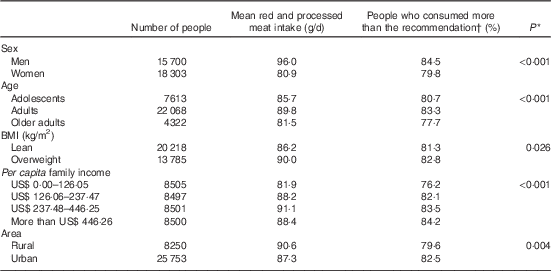
* χ 2 Test.
† 300 g of red and processed meat/week.
Beef was the most commonly consumed meat in Brazil, reaching 49 %. The central-west region was the largest consumer of beef at 59 %. For the entire country, the mean beef intake was 63 g/d (Table 3).
Usual beef intake and estimate of CO2 equivalents from beef intake (Mean values, 95 % confidence intervals and percentages)
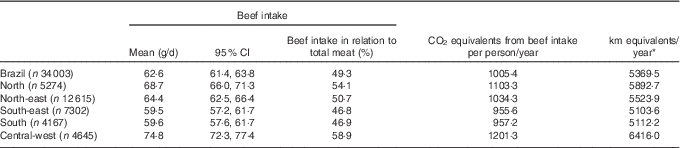
* Production of 1 kg beef emits the same amount of CO2 equivalents as a car travelling 235 km.
In 2008, beef intake for each Brazilian citizen was estimated to contribute 1005 kg of CO2 equivalents, the same quantity of CO2 produced if a car travelled a distance between the extreme north and south of Brazil (5370 km) (Table 3). The entire Brazilian population in 2008 contributed 191 777 487 tons of CO2 equivalents. If the population had consumed 43 g of beef/d, CO2 emissions could have been reduced to 131 732 140 tons of CO2 equivalents (31 % less), especially in the north-east and south-east regions (Fig. 1).
Estimation of CO2 equivalents from beef intake and the possible reduction in CO2 equivalents, provided the dietary recommendation was followed.

Discussion
We found that red and processed meat intake was high, contributing to 70 % of total meat intake, in Brazil. We also found that greenhouse gas emissions from beef intake was similar to each Brazilian citizen travelling more than 5000 km by car, which could have been significantly reduced if the population had followed the WCRF dietary recommendation.
Red and processed meat intake has been linked to an increased risk for chronic diseases such as CVD and cancer( 2 , Reference Pham, Mizoue and Tanaka 30 – Reference Pan, Sun and Bernstein 32 ). Previous studies have reported that people who consumed higher amounts of red meat had higher relative risk for colon cancer( Reference Pham, Mizoue and Tanaka 30 ), for mortality( Reference Larsson and Orsini 31 ) and for CVD mortality( Reference Pan, Sun and Bernstein 32 ). In the present study, more than 80 % of the population had a considerably high red and processed meat intake. Since the recent and substantial evidence that red meat is probably carcinogenic to humans and processed meat is carcinogenic to humans( Reference Bouvard, Loomis and Guyton 6 , 7 ), our findings raise concern in a public health point of view.
Our data agreed with that of Carvalho et al. ( Reference Carvalho, Cesar and Fisberg 13 ), who reported that approximately 410 000 tons of meat have been consumed by the city of São Paulo in south-eastern Brazil, and emitted more than 18 million tons of CO2 equivalents from beef in 2003. In the present study, people who lived in the central-west region had the highest mean beef intake, whereas the south-east region contributed more to CO2 equivalent emission due to the high density of population. These results are relevant, because livestock production has caused major impact on the environment due to greenhouse gas emissions from animals, water pollution and loss of biodiversity( Reference McMichael, Powles and Butler 9 ), and has been a major cause of deforestation for grazing in Amazon( Reference Prado and Ribeiro 33 ).
Some previous studies have already highlighted polices to reduce beef intake, important to food sustainability( 34 – Reference Smith and Gregory 36 ), and to minimise the environmental impact, especially the greenhouse gas emissions( Reference McMichael, Powles and Butler 9 , Reference Carisson-Kanyama and González 37 , Reference Lock, Smith and Dangour 38 ). As excessive red and processed meat intake has been related to poor diet quality and risk of chronic disease, meat reduction should improve dietary quality( Reference Cosgrove, Flynn and Kiely 3 , Reference Carvalho, Cesar and Fisberg 13 ). Furthermore, meat reduction could be financially beneficial for consumers, as the production of plant food is less expensive than livestock( Reference Macdiarmid, Kyle and Horgan 35 ).
This study has some limitations. Limited lifestyle covariates were collected and beef intake was used as a proxy for beef production, which might have underestimated the environmental impact (difference between meat production output and consumption).
However, this study is novel in that, to our knowledge, this is the first population-based study estimating meat intake with two individual food records and greenhouse gas emissions from beef intake for Brazil. These results provide relevant evidence for the implementation of public health policies concerning red and processed meat reduction.
More than 80 % of the Brazilian population had high red and processed meat intake, especially beef, which might negatively impact on health and the environment. More importantly, following WCRF dietary recommendation may reduce CO2 equivalent emissions by approximately 31 %, and may possibly improve diet quality, contributing to a healthy and sustainable diet.
Acknowledgements
The authors thank all the participants of the study.
The survey was supported by the Ministry of Health of Brazil (agreement no. 4652/2005; grant no. 25000.202044/2005-16). A. M. C. and A. M. M. received scholarships from the São Paulo Research Foundation (grant nos. 2014/04607-0 and 2014/04540-2, respectively). D. M. M. received research productivity scholarship from the Brazilian National Council for Scientific and Technological Development (grant no. 306029/2011-1). All funding agencies had no role in the design, analysis or writing of this article.
A. M. C. formulated the research question, carried out the study and data analyses, and drafted and wrote the manuscript; S. S. C. S. participated in data analyses and drafted and wrote the manuscript; A. M. M. participated in data analyses and drafted and wrote the manuscript; D. M. M. formulated the research question, carried out the study and drafted and wrote the manuscript.
The authors declare that there are no conflicts of interest.



