

The debate around the personality disorders (PDs), from the Diagnostic and Statistical Manual of Mental Disorders (4th ed., DSM-IV; American Psychiatric Association [APA], 1994) to DSM-5, was long, complicated, and is still not settled. Various PDs disappeared and others appeared in the manuals over the years, and there have even been debates over the value of retaining the PD diagnostic system at all (Huprich, Reference Huprich2015). Further, it has been suggested that the continued use of outmoded labels, models, and categorisations of mental illnesses may inadvertently add to ignorance and discrimination (Pescosolido, Reference Pescosolido2013). There is, however, an extensive and fast growing literature on the ‘dark side’ of personality, driven by the work of Hogan (Reference Hogan and Hogan2007), which conceives of these potentially derailing characteristics in terms of the PD category scheme of DSM-III (Hogan & Hogan, Reference Hogan and Hogan2009; Harms, Spain, & Hannah, Reference Harms, Spain and Hannah2011).
However, one feature of the recent debate was an attempt to define characteristics that were true of all the PDs. Various researchers suggested two features or criteria were common to all the personality disorders (however classified): interpersonal behaviour and self-awareness (Morey, Skodol, & Oldham, Reference Morey, Skodol and Oldham2014; Morey, Benson, Busch, & Skodol, Reference Morey, Benson, Busch and Skodol2015; Skodol, Reference Skodol2014).
It has been suggested that those with PDs tend to have problems with establishing and maintaining healthy, happy relationships for two reasons: they are largely unempathic (i.e., unappreciative of others experiences, intolerant of others’ perspectives, unappreciative of the effect of their behaviour on others) and have problems with intimacy and closeness (mutuality of regard for others). Another factor is that they are unable to pursue important life goals, part of which are successful interpersonal relationships (Krueger, Skodol, Livesley, Shrout, & Huan, Reference Krueger, Skodol, Livesley, Shrout and Huang2007).
Second, they tend to have low self-awareness because of identity problems (boundaries between self and others, instability of self-esteem and appraisal, poor at regulating emotional experience) and self-direction (unstable and unclear life goals, unclear internal standards of behaviour, and poor at self-reflection).
This alternative model of personality functioning that appears in the DSM-5 suggests that irrespective of the particular PD, diagnosed individuals would experience both acute and chronic relationship problems. However, many contemporary studies have pointed out that, paradoxically, some disorders are associated more with work and life success than failure. Thus, Ullrich, Farrington, and Cold (Reference Ullrich, Farrington and Cold2007) found those with evidence of avoidant, obsessive-compulsive and narcissistic disorder were associated with life-success measures labelled ‘status and wealth’. Similarly, in a number of studies, Furnham and colleagues found subclinical disorders, especially narcissist, psychopath and schizotypal, were associated with a range of measures of success at work, such as speed of promotion (Furnham, Trickey, & Hyde, Reference Furnham, Trickey and Hyde2012; Furnham, Crump, & Ritchie, Reference Furnham, Crump and Ritchie2013; Furnham, Hyde, & Trickey, Reference Furnham, Hyde and Trickey2014).
There is now also more recognition of the spectrum hypothesis, which rejects the categorical approach to PDs (people either have or do not have a PD) to a dimensional approach that accepts there are degrees of the disorder from subclinical through clinical to severe (Skodol, Reference Skodol2014). Most previous recognition studies have looked at clinical manifestations of the PDs, but in this study the vignettes will be of subclinical classifications (Paris, Reference Paris2015).
Mental Health Literacy
The term ‘mental health literacy’ (MHL) was defined as ‘. . . knowledge and beliefs about mental disorders which aid recognition, management or prevention’ (Jorm et al., Reference Jorm, Korten, Jacomb, Christensen, Rodgers and Pollitt1997, p. 182). This includes the ability to recognise specific disorders, knowledge about the causes and risk factors, and knowledge of the help available.
Much of the research regarding psychiatric literacy has focused on schizophrenia and depression. Results of studies investigating these disorders are varied, but laypeople appear to have considerable difficulty understanding some, but not all, psychiatric terms and correctly labelling disorders (Jorm, Reference Jorm2000, Reference Jorm2012). Lay people are accurate in identifying and labelling depression universally, but much less clear about schizophrenia or the PDs. However, Furnham, Daoud, and Swami (Reference Furnham, Daoud and Swami2009) asked participants to identify psychopathy (antisocial personality disorder). It was found that 97% of participants could accurately name depression, 61% recognised schizophrenia, but only 39% identified psychopathy.
This literature is fast expanding, and there have been many reviews (e.g., Furnham & Hamid, Reference Furnham and Hamid2014). There have been a few studies concerning MHL with respect to the PDs, some concentrating almost exclusively on psychiatric literacy concerning a specific disorder like psychopathy (anti-social personality disorder; Furnham et al., Reference Furnham, Daoud and Swami2009), borderline disorder (Furnham & Dadabehoy, Reference Furnham and Dadabehoy2012), or the conduct disorders (Furnham & Carter Leno, Reference Furnham and Carter Leno2012). Others have looked at more than one PD, such as the study of Furnham, Kirkby, and McClelland (Reference Furnham, Kirkby and McClelland2011), which looked at non-experts’ knowledge of paranoid, narcissistic, and obsessive-compulsive disorders. It seems young people use the web to find information about various mental disorders (Horgan & Sweeney, Reference Horgan and Sweeney2010). Others have confirmed sex differences in findings regarding the identification of anxiety-related personality disorders (Gibbons et al., Reference Gibbons, Thompson, Scott, Schauble, Mooney, Thompson and Crits-Christoph2012). There have also been methodological studies that have devised multiple choice tests of mental illnesses including personality disorders (Compton, Hankerson-Dyson, & Broussard, Reference Compton, Hankerson-Dyson and Broussard2011).
Two more recent studies looked at the ability of lay people to identify all the disorders (Furnham, Cook, Martin, & Batey, Reference Furnham, Cook, Martin and Batey2011). Furnham, Abajian, and McClelland (Reference Furnham, Abajian and McClelland2011) found, contrary to predictions, obsessive-compulsive disorder was identified as a PD by only 41% of the participants whereas schizotypal was identified as a disorder by 65% of participants and borderline by 86% of participants. They predicted that a high proportion of participants would be able to recognise that a psychological problem existed, but that a much smaller number would be able to label it correctly— which was also found to be the case. Paranoid personality disorder was correctly identified by 29% of participants and obsessive-compulsive disorder by 25%; but fewer than 10% could correctly identify the remaining disorders. They also found that the likelihood of judging a problem would correlate negatively with how well adjusted the individual in question would be perceived to be.
Personality Disorders
Over the past 20 years a number of popular books have appeared that have attempted to describe and explain the personality disorders in popular terms. One of the first attempts was by Oldham and Morris (Reference Oldham and Morris2000), whose book became a bestseller and has been updated and revised. Other books have attempted similar aims, such as Miller (Reference Miller2008) and De Haan and Kazosi (Reference De Haan and Kasozi2014). All these writers have changed the disorder terms to make them more ‘understandable’ to the layman (see Table 1)
Different Labels for the Personality Disorders

These personality disorders were grouped along different axes or different clusters. When clustering the disorders, three groups are usually formed: A: Odd/ Eccentric (Paranoid, Schizoid, Schizotypal); B: Dramatic/Emotional/Erratic (antisocial, borderline, histrionic, narcissistic) and C: Anxious/Fearful (avoidant, dependent and obsessive-compulsive). These three clusters have also been described as Moving Away from (excitable, cautious, skeptical, reserved, leisurely), Moving Against (bold, mischievous, colourful, imaginative), and Moving Toward (diligent, dutiful) others (Hogan & Hogan, Reference Hogan and Hogan1997).
Recent reviewers of the PD literature have noted that all them are characterised by the inability to form and maintain healthy and happy relationships (Skodol, Reference Skodol2014). While it may occur for various different reasons (extreme introversion, low agreeableness), a marker of the PDs is a history of poor social relationships both in the workplace and outside it. This study is concerned with whether ordinary people perceive this.
This Study
In this study we used vignettes derived from a book designed to help people understand the personality disorders (Oldham & Morris, Reference Oldham and Morris2000). Each vignette described a particular PD. Rather than attempt a diagnosis or labelling though the vignette, this study looked at what people think of the described person's quality of relationships. It was predicted that Cluster C (Moving Toward) personalities (dependent, avoidant and obsessive-compulsive) would be rated with higher scores on all questions. On the other hand, it was expected that Cluster A (Moving Away) and Cluster B (Moving Against) candidates would be perceived as less able to create and maintain satisfying relationships (Hypothesis 1). Next, of the various disorders it was predicted that the person with schizoid disorder would be seen to be least successful in initiating and maintaining happy relationships (Hypothesis 2). It was also predicted that for the dependent PD, they would be rated as successful in relationships because of their devoted nature, dedication to others, and their eagerness to please (Hypothesis 3). The study also examined individual difference predictors of these ratings, but no hypotheses were formulated.
Method
Participants
There were 230 participants, 83 of whom were female. Their mean age was 34.41 years (SD = 10.44), from 21 to 74 years. Of these, 197 (93%) were employed or retired, 3 (1%) were students and 13 (6%) were unemployed. Demographic information showed that 79% of the participants had a university degree in some field. Because of the way the sample was primarily recruited, namely through university-based websites and subject panels, these participants were much better educated than the average population sample, which inevitable affects the results. In this sense, it is an ‘intelligent lay-person’ sample.
Questionnaire
The descriptions of the 14 candidates were created using Oldham and Morris’ (Reference Oldham and Morris2000) book New Personality Self-Portrait: Why You Think, Work, Love and Act the Way You Do. This book includes 14 personality styles that represent the non-clinical versions of 14 personality disorders. Each chapter has a detailed description of how each type sees themselves, experiences emotions, and behaves at work and in interpersonal relationships. They offer tips for those who work with and have a personal relationship with each type and include a section called ‘making the most of your style’, which is aimed at those who self-diagnose or classify themselves. The book is an attempt to educate and tries hard not to patronise or pathologise those with PDs. Our vignettes paraphrased the basic characteristics that Oldham and Morris attribute to each personality style. The vignettes designed by the second author were shown to two clinicians with the task of identifying the PD. A few changes were made at this point, as a few were less clear than others. They did differ in length, which could be a problem, though studies have shown that it is the nature of the details rather than the number (i.e., length) that most influences the diagnosis (Sai & Furnham, Reference Sai and Furnham2013).
The two examples are:
Candidate C (dependent). This candidate is thoroughly dedicated to the relationships in his life. He places the highest value on sustained relationships and works hard to keep his relationships together. He prefers the company of one or more people to being alone. He would rather follow than lead. He is cooperative and respectful of authority and institutions. He easily relies on others and takes direction well. When making decisions, he is happy to seek out others’ opinions and to follow their advice. He is careful to promote good feelings between himself and the important people in his life. To promote harmony, he is polite, agreeable, and tactful. He is thoughtful of others and good at pleasing them. Relationships provide life's meaning for him.
Candidate J (schizoid). This candidate has small need of companionship and is most comfortable alone. He is self-contained and does not require interaction with others in order to enjoy his experiences or to get on in life. He is even-tempered, calm, dispassionate, unsentimental, and unflappable. He displays an apparent indifference to pain and pleasure. He is not driven by sexual needs. He is unswayed by either praise or criticism and can confidently come to terms with his own behaviour.
Table 2 explicitly demonstrates which candidate represents which style from the book and the personality disorder it is associated with.
Associations of Candidates With Personality Styles and Disorders

After each vignette the participants were asked the following questions:
-
1. In general, how happy do you think this person is?
-
2. In general, how satisfying do you think their personal relationships are?
-
3. How similar to them does this person want their partners to be?
-
4. How likely do you believe this person is to have more than 6 very close friends?
-
5. How stable do you believe this person's social relationships are?
-
6. How easy do you believe it would be to be in any type of relationship with this person?
Each question was rated on a 7-point scale: 1 = not at all to 7= extremely. Thus, the higher the score, the more the participant believed the vignette person could and had established healthy relationships.
Procedure
After acquiring ethical approval by the university's Committee of Ethics, participants were sent a link to complete the questionnaire online using Qualtrics software, or were given a hard copy of the questionnaire to fill. Instructions were given on the questionnaire as well as the suggested time it required (25 minutes). The sample was contacted via various education groups known to the authors and used in other studies. The questionnaire with the candidate descriptions was first; the demographic information from the participants included questions about their own job title and position at work. At the end, participants were encouraged to send any questions regarding the study to the researchers.
Results
A preliminary analysis using a multivariate analysis of variance (MANOVA) showed no significant differences between those who had completed the questionnaire on paper versus online, F(14,198) = 0.92, p > .5, partial eta square .005.
MANOVAs and ANOVAs
First, a MANOVA was computed for the six questions over the 14 disorders. This set out to determine whether participants saw differences between the different disorders on each question/criterion. This was significant, F(8.93,78) = 1780.00, p < .001, partial eta square .04). The analysis for each question proved significant: Q1 (13, 2968) = 13.57, p < .001, partial eta square .06; Q2 (13, 2968) = 19.34, p < .001, partial eta square .08; Q3 (13, 2968)= 8.09, p < .001, partial eta square .04; Q4 F(13, 2968) = 25.14, p < .001, partial eta square .10; Q5 (13, 2968) = 17.30, p < .001, partial eta square .07; Q6, F(13, 2968) = 17.07, p < .001, partial eta square .07). Thus the effect sizes were small to medium.
Sheffe post-hoc comparisons were run for each question. These are shown in Table 3. The dependent and the schizoid candidates received the highest and lowest scores respectively, for five out of six questions. The depressive candidate, however, received the lowest score on the question regarding perceived happiness. On the other hand, the obsessive-compulsive candidate was rated as the one who would want their partner to share the most similarities with them.
Post-Hoc Results for All the Questions

Note: Means of items sharing the same superscript (e.g., a,b,c,d,) in each column are not significantly different from each other (p > .05). Bold type indicates the highest and lowest mean score in each question.
The PDs were then classified into the accepted three clusters (A, B, C) of the DSM III and DSM IV and the mean score calculated. The analysis was then repeated and shown in Table 4 (for details contact author). For each question, those in cluster C were given the highest scores, indicating that they were judged to have better relationships and be happier. Equally, those in cluster A were given the lowest scores on each dimension.
Post-Hoc Results for Clusters (Excluding the Passive-Aggressive, Self-Defeating, Sadistic, Depressive Candidates)

Note: Items sharing one or more superscripts in each column are not significantly different from each other (p > .05).
Factor Analysis
There was a concern that the six ratings would be significantly intercorrelated. Bivariate correlations showed this to be the case, with the range being r = .55 to r = .88. A principal components analysis showed that there was just one factor. The KMO was .89, and Bartlett's test significant, χ2(1,42) = 1325.94, p < .001. All six items loaded >.61. Thereafter, a QUARTIMAX rotated factor analysis was computed on the six questions. They all loaded on one factor (eigenvalue 4.70; variance 78.41), which suggested they were all tapping into the same underlying issue. Therefore, a total scale score was computed.
A MANOVA across the 14 vignettes and the total rating score was significant, F(1755.903.01) = 1.66, p < .001, partial eta square .03. Thereafter, two further ANOVAs were calculated using the totalled rating scale: the first across all 14 PDs and the second across the three clusters. Scheffe post hoc analyses were then done.
Table 5 shows the analysis of the total score: the dependent PD was judged highest followed by the borderline PD vignette. Those judged least adjusted were schizoid and schizotypal.
Post-Hoc Results for Each Candidate for Total Mean of All Questions)

Note: Items sharing one or more superscripts (a,b,c) in each column are not significantly different (p < .05).
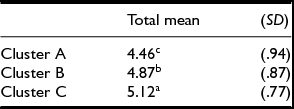
Table 6 shows the results of the higher order clusters. Those in Cluster C were judged as best, and those in Cluster A worst at establishing and maintaining good social relationships. Comparing these three groups using Cohen's d and calculating the effect sizes showed modest differences: thus, Cluster A versus B, Cohen's d = .45, effect size .22; Cluster A versus C, Cohen's d =.77, effect size .36; Cluster B versus C, Cohen's d = .30, effect .15. Thus, although these differences were significant, the effect sizes indicated they were small to medium, even in the biggest difference between Clusters A and C.
Post-Hoc Results for Clusters for Total Score (Excluding Self-Defeating, Sadistic and Depressive)
Note: Items sharing one or more superscripts (a,b,c) in each column are not significantly different (p < .05).
Demographic Differences
In order to investigate demographic differences in the ratings, a MANOVA was first performed on sex differences on the totalled score of the 14 ratings. This was not significant, F(14,198) = 1.81, ns. Thereafter, a bivariate correlation were calculated between participant age and the ratings. Half were significant at p < .001, but only two were greater than r = .30. Further, they were all negative, indicating that older people tended to believe the vignette characters were better adjusted than younger people. Next, a MANOVA was run comparing those with higher education (a degree) with those without. This was marginally significant, F(14, 198) = 2.52, p < .01) and of the univariate ANOVAs, only two were significant at p < 01. The final analysis was then rerun, covarying age and education, but the differences were minimal.
Discussion
There is a large literature that demonstrates the relationship between ‘bright-side’, normal personality traits and the quality and quantity of interpersonal relationships (Holland & Roisman, Reference Holland and Roisman2008). This study looked at ‘dark-side’ factors and the perception of those relationships.
All three hypotheses were confirmed and effect sizes were small to medium. People in Cluster C (Moving Towards People) were seen to have better relationships than those in the other two clusters, particularly A (Moving Away from People). In this study, four of the six questions were concerned with the vignette characters personal relationships and they tended to yield similar findings. Overall, those with subclinical dependent PD were judged to have the best relationships and those with schizoid PD the worst. Presumably, people see the selflessness of the dependent PD positively and the poor emotional intelligence of the schizoid PD negatively. These results may be easier to understand if the vignettes are studied more closely (see examples in the Method section)
Inevitably, there are issues with all vignette studies (Sai & Furnham, Reference Sai and Furnham2013). In our study, we had experts match the vignette with the label, which they were able to do. However, some may object that the vignettes were descriptions of subclinical PDs, despite the fact that we followed the Oldham and Morris (Reference Oldham and Morris2000) book carefully. Clearly, had we given DSM-IV or DSM-5 criteria, the results may have been very different. That is, had we used the clinical criteria set out in the various DSM versions, it is possible that different results will have occurred. More importantly, it could be argued that basing our vignettes on the old DSM-III may seriously misrepresent the extent to which there appears to be a lack of MHL. While all the PDs in DSM-IV were retained in DSM-5, there was a new model based on the hybrid methodology that retained only six personality disorder types: borderline, obsessive-compulsive, avoidant, schizotypal, antisocial, and narcissistic, three of which are from Cluster B. It could be argued that a contemporary analysis of the MHL of the PDs should be concerned with these alone.
Indeed, the diagnosis of (real as opposed to vignette) people with the PDs remains a problem, as they are often unreliable and many psychiatrists rely on the comorbid diagnosis, suggesting that people can often have signs of more than one PD at the same time.
It is clear that people correctly identify subclinical schizoid people as ‘cold fish’, unwilling or unable to establish and maintain close relationships. They also correctly identified others with similar problems, particularly the depressive, avoidant, and schizotypal types. One of the more obvious and debilitating characteristics of the clinical schizoid condition is the interpretation and display of affect.
The participants were correct to identify the schizoid PD as least successful at relationships, as the data suggests that they neither desire nor enjoy close relationships at work, including being part of a family. They usually choose the solitary activities, feeling uncomfortable even in informal gathering. They can seem joyless, passionless, and emotionless. They lack close friends or confidantes, other than first-degree relatives. They appear indifferent to the praise or criticism of others. Absolutely nothing seems to get them going. They show emotional coldness, detachment, or flattened emotionality (Furnham, Reference Furnham2015).
Oldham and Morris (Reference Oldham and Morris2000) note that they have little need of companionship and are most comfortable alone. They are self-contained and do not require interaction with others in order to enjoy life. They are even-tempered, calm, dispassionate, unsentimental, and unflappable and appear not driven by sexual needs. They are unswayed by either praise or criticism and can confidently come to terms with their own behaviour.
What is perhaps more surprising is the perception of the success of the dependent type as well as to some extent the borderline PD. Those with dependent PD are usually more heavily reliant on other people for support or guidance than most. Dependents are often carers: most happy helping others be happy. Others give meaning to their lives. They find contentment in attachment and define themselves by others. They are not good at giving (or receiving) criticism and negative feedback. At work they are cooperative, supportive, caring, and encouraging. They do well in jobs like nursing, social work, and voluntary organisations.
Oldham and Morris (Reference Oldham and Morris2000) note seven typical characteristics of what they call the Devoted style. They are thoroughly dedicated to the relationships in their lives. They place the highest value on sustained relationships and they respect the institution of marriage as well as unofficial avowals of commitment. They prefer the company of one or more people to being alone and would rather follow than lead. They are cooperative and respectful of authority and institutions, and easily rely on others and take direction well and make decisions. They are nearly always careful to promote good feelings between themselves and the important people in their lives. To promote harmony, they tend to be polite, agreeable, and tactful. They will endure personal discomfort to do a good turn for the key people in their lives.
This finding is likely to derive from one of the major strengths of our study, which was the fact that participants were not told that the candidates described in the vignettes had any personality disorder or a particular problem. Therefore, labelling did not have an effect on participants’ judgment. Previous studies, such as the one by Furnham and Winceslaus (Reference Furnham and Winceslaus2011), have shown that lay people rate candidates as not successful at work when told that they suffered from a PD. This is an effect of labelling, which is a major issue in the study of not only personality, but also mental disorders.
Nevertheless, this study also had its limitations. There are many problems concerned with vignette studies, including keeping the length of different vignettes roughly consistent. Further, all the candidates were described as male, using ‘he’. Consequently, assuming that all candidates were male might have actually caused some biases other than those we tried to prevent in the final ratings. Nevertheless, this study demonstrated overall the MHL of the participants. We also had a highly educated sample, which may mean a more representative sample would have been less good at identifying the relationship issues of these vignette characters.
Unlike many other MHL studies, we did not ask participants to offer a diagnosis or label for the vignette character. Studies that did this found that overall people are poorly informed about the PDs when confronted by a clinical vignette. This study showed that when people are given subclinical vignettes, they seem to have a good idea about those who struggle most and least with social relationships. Further work with different vignettes is recommended.
One implication of this research is for those interested in the PDs to try to discover why people with a particular PD have a relationship problem and how they might help them establish better relationships. Given the acknowledged benefit of good long-term social relationships, this may be an important focus of any therapeutic intervention.



