




Non-technical Summary
Understanding food chains in ancient ecosystems is one of the goals of paleoecology. Direct evidence for these interactions is rare and includes fossils with stomach contents and bite/tooth marks. We document a rare occurrence of a bite mark to the neck vertebra of a juvenile fossil specimen of a giant pterosaur from the Cretaceous of Alberta, Canada, 76 million years ago. Based on the size and shape of the tooth mark, and comparison with modern animals, we suggest that a crocodylian bit the pterosaur, but we were unable to determine whether this was active predation or scavenging. Feeding traces on giant pterosaurs are rare, so this provides novel details on how they fit into this ancient ecosystem.
Introduction
Pterosaurs, a highly diverse and cosmopolitan clade of flying archosaurs, are nevertheless frequently underrepresented in many Cretaceous terrestrial ecosystems, in which taphonomic biases against small and/or delicate bones limit the probability of their preservation (e.g., Brown et al., Reference Brown, Evans, Campione, O'Brien and Eberth2013, Reference Brown, Campione, Mantilla and Evans2022b). In western Canada, the Campanian Dinosaur Park Formation at Dinosaur Provincial Park (Alberta) is considered a model system for the study of Late Cretaceous terrestrial vertebrates, in particular their evolution, turnover, paleobiology, and paleoecology (Currie and Koppelhus, Reference Currie and Koppelhus2005). Because of the exceptional abundance of bones in Dinosaur Provincial Park, a significant number of interactions relating to feeding behavior and possible agonistic encounters have been reported, most frequently between theropods and ornithischian dinosaurs (Jacobsen, Reference Jacobsen1998; Jacobsen and Bromley, Reference Jacobsen and Bromley2009; Hone et al., Reference Hone, Tanke and Brown2018a; Brown et al., Reference Brown, Tanke and Hone2021), but also between species of theropods (Tanke and Currie, Reference Tanke and Currie1998; Jacobsen, Reference Jacobsen, Tanke and Carpenter2001; Bell and Currie, Reference Bell and Currie2010; Hone and Tanke, Reference Hone and Tanke2015; Brown et al., Reference Brown, Currie and Therrien2022a; Therrien et al., Reference Therrien, Zelenitsky, Tanaka, Voris, Erickson, Currie, DeBuhr and Kobayashi2023), and in one case, between a small theropod and an azhdarchid pterosaur (Currie and Jacobsen, Reference Currie and Jacobsen1995). Mammalian gnawing-like behavior has also been described on a range of dinosaur, champsosaur, and mammalian bones (Longrich and Ryan, Reference Longrich and Ryan2010). Such evidence comes typically from bite-marked bone but also rarely, embedded teeth.
Isolated pterosaur bones are nevertheless extremely rare in the Dinosaur Park Formation, and so far, only a single associated skeleton has been found (TMP 1992.083.0001–0007) (Russell, Reference Russell1972; Currie and Russell, Reference Currie and Russell1982; Currie and Padian, Reference Currie and Padian1983; Currie and Jacobsen, Reference Currie and Jacobsen1995; Godfrey and Currie, Reference Godfrey, Currie, Currie and Koppelhus2005). Hone et al. (Reference Hone, Habib and Therrien2019) erected the name Cryodrakon boreas Hone, Habib, and Therrien, Reference Hone, Habib and Therrien2019 to encompass TMP 1992.083.0001–0007 along with all isolated azhdarchid material from Dinosaur Provincial Park. Although rare, azhdarchids are ubiquitous to many Late Cretaceous terrestrial ecosystems, but how they fit within local food webs is poorly understood. With an estimated wingspan equivalent to some of the largest azhdarchids (e.g., Quetzalcoatlus Lawson, Reference Lawson1975; 10 m, Lawson, Reference Lawson1975), Cryodrakon Hone, Habib, and Therrien, Reference Hone, Habib and Therrien2019 and other large-bodied azhdarchids were probably substantial terrestrial foragers (e.g., Witton and Naish, Reference Witton and Naish2008) although alternative hypotheses also exist. Bite marks, embedded teeth, and stomach contents indicate that azhdarchid pterosaurs were fed upon by velociraptorine theropods (Currie and Jacobsen, Reference Currie and Jacobsen1995; Hone et al., Reference Hone, Tsuihiji, Watabe and Tsogtbaatr2012) and crocodylomorphs (Vremir et al., Reference Vremir, Kellner, Naish and Dyke2013).
Here we describe a small azhdarchid cervical vertebra recovered from the Dinosaur Park Formation with a perforation that we identify as a bite mark. We discuss the likely origin of the bite mark and its maker as crocodilian, which evidences a novel trophic interaction and provides new paleoecological information on the role of azhdarchid pterosaurs in Late Cretaceous food webs.
Geological setting
TMP 2023.012.0237 was found isolated (i.e., disarticulated) but in situ during systematic excavations in 2023 of a multitaxic bonebed (Bonebed 10, aka the ‘Cathedral Bonebed’), within the Dinosaur Park Formation at Dinosaur Provincial Park, Alberta, Canada. Bonebed 10 occurs ~22 m above the contact with the underlying Oldman Formation, placing the bonebed in the lower part of the Dinosaur Park Formation within the Cranwellia rumseyensis-Translucentipolis plicatilis Palynomorph Biozone (Braman, Reference Braman2018) and the Corythosaurus-Centrosaurus apertus Dinosaur Assemblage Biozone (Ryan and Evans, Reference Ryan, Evans, Currie and Koppelhus2005; Mallon et al., Reference Mallon, Evans, Ryan and Anderson2013). Bonebed 10 is bracketed by the well-constrained, radiometrically dated bentonites of the Jackson Coulee Bentonite (76.354 ± 0.057 Ma), 20.75 m below, and the Plateau Tuff (75.639 ± 0.025 Ma), 14 m above, providing an approximate age of the Bonebed 10 assemblage (Eberth et al., Reference Eberth, Evans, Ramezani, Kamo, Brown, Currie and Braman2023). The Dinosaur Park Formation in the area of Bonebed 10 consists of stacked sandstones and mudstones interpreted as rivers, oxbow lakes, and overbank deposits that formed on a vegetated alluvial floodplain close to the Western Interior Seaway, which lay to the east of present-day Dinosaur Provincial Park (Eberth, Reference Eberth, Currie and Koppelhus2005), with Bonebed 10 itself interpreted as a channel-base lag deposit (Wood et al., Reference Wood, Thomas and Visser1988). For more detailed analysis of the depositional setting and taphonomy of Bonebed 10, see Wood et al. (Reference Wood, Thomas and Visser1988). Excavation (as opposed to surface collection and/or screen washing) of Bonebed 10 in the 2022 and 2023 field seasons has so far produced a rich assemblage of disarticulated remains, both macrovertebrate and microvertebrate, primarily from the Reptilia (Ornithischia, Theropoda, Testudines, Choristodira, Crocodilia, with one specimen each from Pterosauria and Squamata) along with Actinopterygii, the guitarfish Myledaphus bipartitus Cope, Reference Cope1876a, Amphibia (Caudata), and one specimen from Mammalia.
Materials and methods
Minimal preparation of the specimen was required and consisted of removing a small amount of matrix from the bone surface using a small pin-vice with an insect pin. No adhesives or consolidants were applied. Photographs were taken with a Canon EOS 6D digital SLR camera using a 180 mm [1:3.5] macrolens. Photographs were modified (i.e., removing backgrounds) using Adobe Photoshop (v. 23.0.6) and figures were created using Adobe Illustrator (v. 23.0.6). Ammonium chloride powder coating was used, following the ‘dry method’ sensu Parsley et al. (Reference Parsley, Lawson and Pojeta2018), to enhance the surface texture while homogenizing bone color for photography. Measurements were taken using digital calipers to 0.1 mm. The specimen was micro- computed tomography (CT) scanned using a Bruker SkyScan 1173 at the University of Calgary Foothills Campus on 22 November 2023. The specimen was scanned under 130 kV using a 0.25 mm brass filer, at a distance of 143.25 mm for a resulting image resolution of 39.11 μm. Images were converted to .tiff files and compiled and visualised using 3D Slicer v. 5.6.0 (https://www.slicer.org/).
Repository and institutional abbreviation
The specimen examined in this study is deposited at the Royal Tyrrell Museum of Palaeontology (TMP), Drumheller, Alberta, Canada.
Description
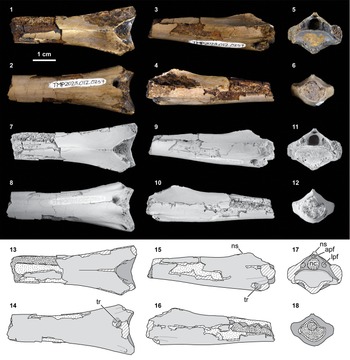
TMP 2023.012.0237 consists of the anterior portion (two-thirds to three-fifths) of an elongate pterosaur cervical vertebra (Figs. 1, 2.1). The preserved (i.e., incomplete) length of the specimen is 58.2 mm. The estimated total (i.e., complete) length of the vertebra is ~94 mm (Fig. 2.1). The transverse width of the vertebra (at the estimated midpoint) is 12.7 mm. Given these proportions, the vertebra has a length to width ratio of ~7.4, but could be slightly larger.
TMP 2023.012.0237 in dorsal (1, 7, 13), ventral (2, 8, 14), right lateral (3, 9, 15), left lateral (4, 10, 16), anterior (5, 11, 17), and posterior (6, 12, 18) views. Upper images (1–6) show bone surface color, middle images (7–12) are ammonium chloride powder-coated, lower images (13–18) are schematic line drawings. For the line drawings (13–18), light and medium gray indicates bone surface, hatches indicate broken bone surface, light stipples indicate matrix infill creating natural internal mold, and dark stipples indicate matrix infill with no specific form. apf, accessory pneumatic foramen; lpf, lateral pneumatic foramen; nc, neural canal; ns, neural spine; tr, trace (i.e., feeding trace/tooth mark).

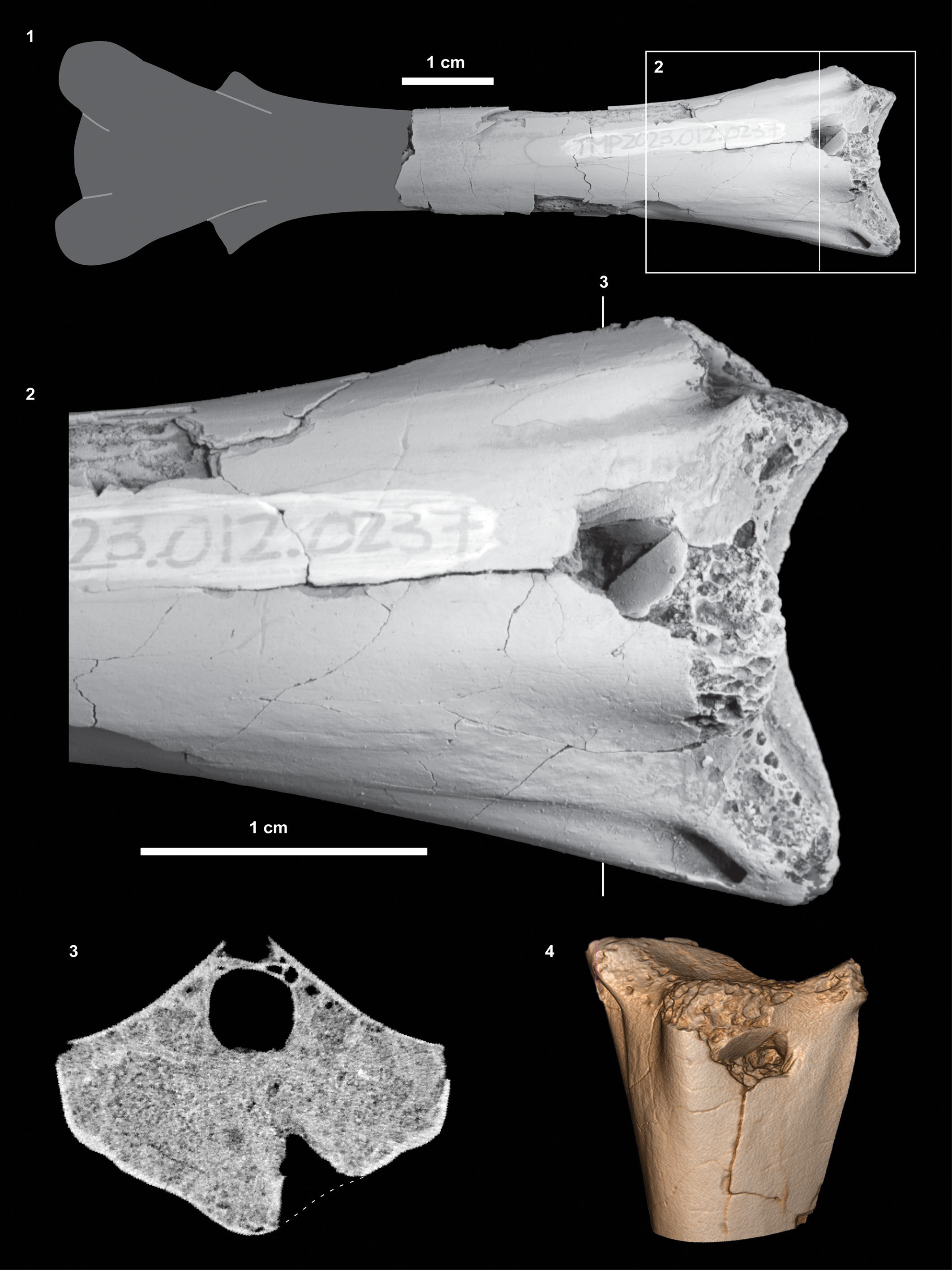
Ammonium chloride coated images (1, 2), CT-scan slice (3), and digital render (4) of TMP 2023.012.0237: (1) entire element in ventral view (anterior at right), with gray area approximating the missing portion; (2) detail of anterior end with tooth mark; (3, 4) outputs of CT-scan data: (3) two-dimensional slice through the tooth mark at plane indicated in 2.3; (4) solid three-dimensional render of the element. Solid vertical lines in (1, 2) show plane of slice in (3). Dashed lines in (3) show missing extent of bone surface at the point of the trace.
As with other pterosaur material from the Dinosaur Park Formation (Russell, Reference Russell1972; Currie and Russell, Reference Currie and Russell1982; Godfrey and Currie, Reference Godfrey, Currie, Currie and Koppelhus2005; Hone et al., Reference Hone, Habib and Therrien2019), the specimen is characterized by exceedingly thin bone that is completely infilled with well-cemented matrix (both the medullary cavity of the bone and the neural canal), forming a natural internal mold (i.e., endocast; Fig. 1). It is likely that this infill, an iron-rich, highly cemented, medium-grained sandstone in this case, as much as the bone itself, is responsible for the preservation the specimen. The specimen is preserved in three dimensions, with the only discernible crushing or compaction restricted to the right dorsal aspect near the midpoint, as well as the perforative bite mark (see below). In many areas, the thin cortical bone flaked away, and the matrix infill preserved natural molds of the internal bone surface, including the medullary cavity of the bone and the neural canal.
The bone shows a moderate degree of abrasion with nearly all extremities showing wear that compromises the bone cortex (Fig. 1). These areas where the cortical bone is abraded away include the apex of the anterior neural spine, both prezygopophyses, the ventral rim of the articular facet of the centrum, and the lateral ridge along the centrum. Posteriorly, the element is truncated sharply just past the estimated midpoint of the vertebra. Because TMP 2023.012.0237 was found in situ during the excavations of Bonebed 10, this truncation evidently occurred prior to the time of deposition. The sharp truncation reveals the internal natural mold and shows a distinction between the infill of the circular neural canal and that within the larger bone medullary cavity (Fig. 1.6, 1.12, 1.18). These two internal molds are separated by an exceedingly thin bony tube (< 0.1 mm thick), the remnant of the bone wall of the neural canal. The midpoint of the centrum is cylindrical (transverse diameter 12.7 mm), although slight crushing to the dorsal right margin, and missing bone cortex on the dorsal left margin make the exact shape of the dorsal margin uncertain. There is no neural spine along the midpart of the vertebra (Fig. 1.3, 1.4, 1.9, 1.10, 1.15, 1.16). Along the cylindrical midshaft of the vertebra, the cortical bone is ~0.6 mm thick. Anteriorly, the cylindrical cross-sectional shape of the vertebra is lost because the element flares laterally to form the prezygopophyses, and develops a slight midline keel dorsally, which, further anteriorly, develops into the thin, short neural spine. The ventral margin remains smoothly convex throughout. Both prezygopopheses are incomplete, with the left more complete than the right. The anterior margin is characterized by a large, concave articular facet of the vertebral condyle, which is wider (16.2 mm) than tall (7.6 mm) (Fig. 1.5, 1.11, 1.17). In anterior view, the condyle facet is ovoid dorsally, but shows paired ventrolateral invaginations and a round ventromedial expansion forming a subtle hypapophysis. The anterior condyle facet is bounded laterally by the prezygopophyeses, the surfaces of which are both abraded away. The condyle facet and prezygopophyeses are separated by a shallow, narrow groove that extends posteriorly to the transverse foramen (vertebrocostal canal), which is complete on the left but truncated on the right side. Dorsal to the condyle facet, the neural arch is triangular in anterior view and set back from the anterior extreme of the element. The nearly circular neural canal is positioned centrally within the neural arch and is bounded laterally by two small, circular lateral pneumatic foramina. The ventral margins of the foramina are approximately level with the ventral margin of the neural canal. A single accessory pneumatic foramen occurs just dorsal to the neural canal. The accessory pneumatic foramen is wider than tall, and all three pneumatic foramina are approximately equal in transverse diameter. At the anteriormost extreme of the neural arch, the slight dorsal midline ridge develops into a short, thin, low neural spine. The dorsal margin of the neural spine is abraded, but its height likely did not extend far beyond the preserved margin.
Trace
The smooth, slightly convex surface of the ventral margin of the centrum is interrupted by a prominent circular puncture (Figs. 1.2, 1.3, 1.8, 1.9, 1.14, 1.15, 2.2). The puncture is located on the right side, just off of the ventral midline (3.6 mm from ventral midline to center of puncture) and near the anterior extreme for the element (7.9 mm from anterior margin to center of puncture). The puncture is nearly circular with an anteroposterior diameter of 4.4 mm at the external (ventral) surface of the bone and a transverse diameter of 4.3 mm. The depth is 3.7 mm. The posterior and posteromedial rims of the puncture show sharp, jagged breaks. In contrast, the lateral and anterior margins are formed by two fragments of cortical bone, which are broken from the ventral surface of the vertebra and their medial and posterior edges, respectively, pushed dorsally into the center of the puncture (Fig. 2.2–2.4). As a result, these fragments form sloped margins along the anterior and lateral walls of the puncture. The margins of the puncture show no evidence of remodeled bone or healing. The cementation of the deflected and infolded fragment of compact bone to the internal infill, and the matrix that was removed from the puncture and exterior surface of this fragment, confirm that the puncture occurred prior to burial, and was not caused by recent action such as a preparatory tool mark.
Three dimensionally, the puncture is best described as conical in form. The puncture does not occur on a raised surface of the bone, those areas subject to abrasion above, but is located in a shallow longitudinal groove formed between the base of the prezygopophysis and the midline swelling, occurring ventral to the condyle facet (Fig. 2.3, 2.4).
Other than the single conical puncture described above, there are no other marks (i.e., scratches, pits, or punctures) on any other part of the element.
Discussion
TMP 2023.012.0237 can be assigned to Azhdarchidae based on a series of anatomical features, including a low centrum, a neural spine that is greatly reduced and restricted to anterior and posterior segments (i.e., bifid), prominent pneumatic foramina lateral to the neural canal, and anteroposterior elongation of the cervical vertebra (e.g., Kellner, Reference Kellner, Bufferaut and Mazin2003; Naish and Witton, Reference Naish and Witton2017). Furthermore, the specimen shows lateral pneumatic foramina (in anterior view) that are positioned ventrally, so that their ventral margins are approximately level with the ventral floor of the neural canal. This was identified as a diagnostic feature of the azhdarchid Cryodrakon boreas from the Dinosaur Park Formation (Hone et al., Reference Hone, Habib and Therrien2019). The specimen also shows an accessory pneumatic foramen located dorsal to the neural canal, which is a feature shared with other cervical vertebrae of Cryodrakon boreas.
Although some authors have suggested that there might be multiple azhdarchid species preserved in the Dinosaur Park Formation (Fowler and Sullivan, Reference Fowler, Sullivan, Sullivan, Lucas and Spielmann2011; Vremir et al., Reference Vremir, Kellner, Naish and Dyke2013), the most recent review of the Dinosaur Park Formation pterosaur material suggests that all of this material is assignable to one taxon, Cryodrakon boreas (see Hone et al., Reference Hone, Habib and Therrien2019). The holotype of Cryodrakon boreas (TMP 1992.083.0001–0007) is from the lower Dinosaur Park Formation (Quarry no. 207, 2 m above the Oldman contact), ~20 m lower than TMP 2023.012.0237, but within the same palynomorph and dinosaur assemblage zones. Taken together, TMP 2023.012.0237 is here referred to Cryodrakon boreas.
The small size of TMP 2023.012.0237 is likely indicative of its juvenile status. Fusion between the neural arch and the centrum, which is commonly used as an indicator of relative age in other archosaurs (Brochu, Reference Brochu1996), is completed at a very early age in azhdarchids for which both juveniles and adults are known (Averianov, Reference Averianov2010). Therefore, the complete closure of the suture between these elements in TMP 2023.012.0237 cannot be interpreted as evidence of its relative maturity (Hone et al., Reference Hone, Habib and Therrien2019). TMP 2023.012.0237 is only slightly larger and nearly identical in morphology to TMP 1996.012.0369, a small but nearly complete azhdarchid cervical vertebra referred to Cryodrakon boreas (Table 1). At 80.8 mm long (incorrectly reported as 10.6 mm by Hone et al., Reference Hone, Habib and Therrien2019) and 10.3 wide at the midpoint, TMP 1996.012.0369 is slightly smaller (~81%) than TMP 2023.012.0237. The neural canal of TMP 2023.012.0237 is both absolutely and relatively larger than that of TMP 1996.012.0369. The lateral pneumatic foramina are also larger, and placed slightly more medially, although both show the ventral alignment characteristic of Cryodrakon boreas. Other than these subtle differences, the two vertebrae have nearly identical morphology and likely represent both the same taxon and element. Based on the elongate shape and severely reduced midpoint of the neural spine, TMP 1996.012.0369 was identified by Hone et al. (Reference Hone, Habib and Therrien2019) as a fifth cervical vertebra (CV). The small size of TMP 1996.012.0369 was regarded by Hone et al. (Reference Hone, Habib and Therrien2019) to be due to it being an immature individual, specifically a juvenile with an estimated wingspan of ~2 m. Given the near identical morphology and size, TMP 2023.012.0237 is here further identified as a fifth cervical from a juvenile individual of Cryodrakon boreas with an estimated wingspan of ~2 m.
Comparative size measurements between TMP 2023.012.0237 and other Dinosaur Park Formation azhdarchid cervical vertebrae. All measurements in mm. * = estimate; inc. = measurement incompletely preserved.

It is worth noting that in addition to TMP 2023.012.0237, Bonebed 10 was also the site that yielded one of the first pterosaur bones discovered from the Dinosaur Park Formation (at the time referred to as the Oldman Formation) in 1979—TMP 1979.014.0247, a partial distal tibia from a small-bodied animal (Currie and Padian, Reference Currie and Padian1983), more recently identified as a distal metacarpal IV (Averianov, Reference Averianov2010). This previous specimen was recovered at the northern extreme of the Bonebed 10 outcrop, ~101 m north-northwest of the excavated area of Bonebed 10 that yielded TMP 2023.012.0237. Although both specimens are from small-bodied animals, wing spans estimates of just over 1 m for TMP 1979.014.0247 (Currie and Russell, Reference Currie and Russell1982; Currie and Padian, Reference Currie and Padian1983) and ~2 m for 2023.012.0237, given the distance between the specimens, and the large abundance of fossil bones, we consider it unlikely that they are from the same individual.
Trace
Potential makers of the bite mark in TMP 2023.012.0237 in the Dinosaur Park Formation (i.e., carnivores with teeth that are circular in cross section, and large enough to match the mark) are limited to champsosaurs, crocodilians, and potentially the canines of mammals. All known theropod carnivores from the Dinosaur Park Formation have teeth that are laterally compressed and blade-like (i.e., Dromaeosauridae, Troodontidae), or D-shaped to oval in cross section (i.e., Tyrannosauridae) (Currie et al., Reference Currie, Rigby, Sloan, Carpenter and Currie1990; Sankey et al., Reference Sankey, Brinkman, Guenther and Currie2002; Jacobsen, Reference Jacobsen2003). Theropod dinosaurs with teeth round in cross section (e.g., spinosaurids) are unknown from the Upper Cretaceous of Alberta, therefore we consider a theropod trace maker unlikely in this case.
The champsosaur Champsosaurus Cope, Reference Cope1876b (Choristodera) is a common component in the Dinosaur Park fauna, including the Bonebed 10 assemblage where TMP 2023.012.0237 was collected. Champsosaurus is represented by at least two species in the Dinosaur Park Formation, including Champsosaurus natator Parks, Reference Parks1933 and Champsosaurus lindoei Gao and Fox, Reference Gao and Fox1998 (Gao and Brinkman, Reference Gao, Brinkman, Currie and Koppelhus2005). Both species are characterized by a narrow longirostrine snout and small conical teeth similar to those of extant Gavialis Oppel, Reference Oppel1811 and Tomistoma Müller, Reference Müller1846. Ecomorphology of the snout and preliminary biomechanical studies suggest that Champsosaurus was a small-prey specialist probably best suited for taking fish (Katsura, Reference Katsura2004; James, Reference James2010; Piras et al., Reference Piras, Buscalioni, Teresi, Raia, Sansalone, Kotsakis and Cubo2014; Drumheller and Wilberg, Reference Drumheller and Wilberg2020). Although the largest in situ Champsosaurus teeth from the Dinosaur Park Formation (e.g., TMP 1988.116.0048, 1995.002.0027, 1996.142.0009) do approach (or meet) the diameter of the tooth mark in TMP 2023.012.0237, they are more slender and not a match for the depth of the puncture. Champsosauridae is not considered to be the most likely trace maker based on their presumed feeding preferences, slender teeth, and relatively low bite force (compared to more platyrostrine forms). However, we cannot rule them out entirely because pterosaur bones are thin-walled and can be subject to damage from weaker bites.
A diverse mammal fauna is known from the Dinosaur Park Formation, with the largest, and best mammalian candidate for the trace being a stagodontid, e.g., Eodelphis Matthew, Reference Matthew1916 (Fox, Reference Fox, Currie and Koppelhus2005). Complete canines of Eodephis have yet to be documented (Fox and Naylor, Reference Fox and Naylor2006; Scott and Fox, Reference Scott and Fox2015), but based on the closely related, larger, Maastrichtian taxon, Didelphodon vorax Marsh, Reference Marsh1889 (Wilson et al., Reference Wilson, Ekdale, Hoganson, Calede and Vander Linden2016), the upper and lower canine teeth of Eodephis would likely have been conical and prominent. Given that the canines of large D. vorax specimens exceed the size of the trace seen in TMP 2023.012.0237 (Wilson et al., Reference Wilson, Ekdale, Hoganson, Calede and Vander Linden2016) it is possible, though currently not testable, that the canines of the smaller-bodied Eodephis were more size-appropriate for this trace. Additionally, Scott and Fox (Reference Scott and Fox2015) also documented the possible occurrence of Didelphodon Marsh, 1889 in the Dinosaur Park Formation. Didelphodon would have had a powerful bite (~218 Newtons) capable of piercing bone, might have been durophagous, and could potentially have taken prey larger than itself (Wilson et al., Reference Wilson, Ekdale, Hoganson, Calede and Vander Linden2016). A similar durophagous diet has also been suggested for Eodelphis (Brannick and Wilson, Reference Brannick and Wilson2020). The circular puncture of TMP 2023.012.0237 is broadly consistent with puncture marks attributed to mammal bites in fossil contexts (Boessenecker and Perry, Reference Boessenecker and Perry2011), as well as known canine punctures documented in extant taphonomic contexts (Parkinson et al., Reference Parkinson, Plummer and Hartstone-Rose2015; Brugal and Fourvel, Reference Brugal and Fourvel2024). As a result, a mammalian trace maker is possible, and cannot be excluded; however, given the little relevant published material from the Dinosaur Park Formation (i.e., no canines of Eodelphis) limited comprehensive comparison to the trace seen on TMP 2023.012.0237 can be made.
Crocodilians from the Dinosaur Park Formation include the basal alligatoroid Leidyosuchus canadensis Lambe, Reference Lambe1907, as well as the globidontid Albertochampsa langstoni Erickson, Reference Erickson1972 and a ‘Stangerochampsa’-like taxon (Wu, Reference Wu, Currie and Koppelhus2005). Each of these taxa had sharp, conical, piercing teeth in at least some parts of the jaw (Wu, Reference Wu, Currie and Koppelhus2005), generally in the anterior portion of the tooth row. Given the variation in tooth size and shape with the jaws of these animals, as well as the range of body size exhibited by each species through its ontogeny, it is not possible to distinguish between these taxa from perforative bite marks alone. Nevertheless, all Dinosaur Park crocodilians had platyrostral skulls that were better suited to crushing and piercing bone than longirostrine choristoderes (Piras et al., Reference Piras, Buscalioni, Teresi, Raia, Sansalone, Kotsakis and Cubo2014; Drumheller and Wilberg, Reference Drumheller and Wilberg2020). Furthermore, both extant and extinct crocodilians are known to take flighted prey including birds, bats, and insects (Platt et al., Reference Platt, Rainwater, Finger, Thorbjarnarson, Anderson and Mcmurry2006; Wallace and Leslie, Reference Wallace and Leslie2008; Shirley et al., Reference Shirley, Burtner, Oslisly, Sebag and Testa2017), and, among Cretaceous forms, pterosaurs (Vremir et al., Reference Vremir, Kellner, Naish and Dyke2013). The range of sizes and tooth morphologies (i.e., acuteness) seen in both in situ and isolated crocodilian teeth from the Dinosaur Park Formation (e.g., TMP 1988.116.0002, 1990.036.0439, 1992.036.0412, 1998.093.0180, 1999.055.0351, 2006.012.0223), broadly overlap the conical puncture seen in TMP 2023.012.0237. The puncture mark in TMP 2023.012.0237 is consistent with the circular punctures made by modern crocodilians as well as unequivocal feeding traces of extinct crocodylomorphs (e.g., Njau and Blumenschine, Reference Njau and Blumenschine2006; Boyd et al., Reference Boyd, Drumheller and Gates2013; Drumheller and Brochu, Reference Drumheller and Brochu2016; White et al., Reference White, Bell, Campione, Sansalone and Birch2022).
Based on the above indicators, we therefore consider a crocodilian to be the most likely candidate for the bite mark in TMP 2023.012.0237, although we cannot exclude Champsosaurus or a stagodonid mammal, e.g., Eodelphis. The lack of additional tooth traces, either adjacent to the documented trace or on the opposing surface, is somewhat surprising. One would expect that given the multiple teeth in the tooth row, a bite with sufficient force to penetrate one side of the bone would leave notable traces either from neighboring or opposing teeth. One potential explanation for this, for opposing teeth, is that the neck might not have been the only portion of the animal bitten at that time, with another part of the body between the dorsal surface of the neck and the opposing tooth row. Similarly, a combination of differential tooth height (i.e., heterodonty), missing teeth, and the thin silhouette of the element could explain the lack of marks from neighboring teeth.
Bite-marked or tooth-marked bone and, more rarely, preserved abdominal contents show that pterosaurs were eaten by a wide range of animals including large and small theropod dinosaurs (Currie and Jacobsen, Reference Currie and Jacobsen1995; Buffetaut et al., Reference Buffetaut, Martill and Escuillié2004; Hone et al., Reference Hone, Tsuihiji, Watabe and Tsogtbaatr2012), crocodylomorphs (Vremir et al., Reference Vremir, Kellner, Naish and Dyke2013), sharks (Hone et al., Reference Hone, Witton and Habib2018b; Mull and Bennett, Reference Mull and Bennett2023) and other fishes (Frey and Tischlinger, Reference Frey and Tischlinger2012; Mull and Bennett, Reference Mull and Bennett2023), and other unidentified vertebrates (Kellner et al., Reference Kellner, Rich, Costa, Vickers-Rich, Kear, Walters and Kool2010) in Mesozoic terrestrial and marine ecosystems. Feeding interactions involving bitten or ingested azhdarchid pterosaurs have been documented previously. In addition to TMP 2023.012.0237 described here, the Dinosaur Park Formation has also yielded an azhdarchid tibia with a broken tooth of the velociraptorine Saurornitholestes Sues, Reference Sues1978 still embedded within the shaft and multiple tooth traces preserved on the bone surface (Currie and Jacobsen, Reference Currie and Jacobsen1995). A partial azhdarchid long bone was found in the abdominal cavity of Velociraptor Osborn, Reference Osborn1924 from the Djadokhta Formation of Mongolia (Hone et al., Reference Hone, Tsuihiji, Watabe and Tsogtbaatr2012). Finally, Vremir et al. (Reference Vremir, Kellner, Naish and Dyke2013) described conical tooth marks in the cervical vertebrae of the holotype of Eurazhdarcho langendorfensis Vremir et al., Reference Vremir, Kellner, Naish and Dyke2013 from the Sebeş Formation in Romania, which they attributed to a small crocodylomorph. Collectively, these findings indicate that azhdarchids and other pterosaurs were potential food items for a broad range of carnivores in the Cretaceous.
Ecological interpretations that can be made on a single bite mark are obviously limited. Although lack of healing or remodeled bone indicates that the bite was not a failed predation attempt, it is also unclear whether the mark is a result of a successful predation event (perimortem) or scavenging (postmortem). It is also worth noting that modern species of crocodilians are both active predators and opportunistic scavengers, with carrion making up an important component of their diets (Pérez-Higareda et al., Reference Pérez-Higareda, Rangel-Rangel, Smith and Chiszar1989; Pooley, Reference Pooley and Ross1989; Webb and Manolis, Reference Webb and Manolis1989; Njau and Blumenschine, Reference Njau and Blumenschine2006; Fish et al., Reference Fish, Bostic, Nicastro and Beneski2007). The alligatoroids from the Dinosaur Park Formation might have had a similar feeding ecology to modern crocodilians. Therefore, any assertions on the lifestyle of extinct forms must be viewed cautiously. Although direct evidence for feeding on azhdarchids is rare, at least one other instance is also attributed to a crocodylomorph (Vremir et al., Reference Vremir, Kellner, Naish and Dyke2013). If these feeding traces do represent predation, they likely indicate the taking of an azhdarchid while the pterosaur was near the water interface, perhaps drinking or hunting for aquatic prey.
The ecology of Azhdarchidae has seen various interpretations, from terrestrial carrion feeder (Lawson, Reference Lawson1975), to aquatic invertebrate prober (Langston, Reference Langston1981; Lehman, Reference Lehman2021), ariel skimmer and piscivore (Nessov, Reference Nessov1984; Kellner and Langston, Reference Kellner and Langston1996; Prieto, Reference Prieto1998), and terrestrial or wading forager that preyed on aquatic and terrestrial vertebrates and invertebrates (Chatterjee and Templin, Reference Chatterjee and Templin2004; Witton, Reference Witton2007; Witton and Naish, Reference Witton and Naish2008). Although azhdarchids were likely more terrestrial than most other pterosaurs, their feeding strategy might still have relied heavily on aquatic prey, which also put them at risk from aquatic predators such as crocodyliforms. If additional specimens showing similar interactions are found, it could indicate a more common ecological interaction between these animals.
Acknowledgments
TMP 2023.012.0237 was collected by P. Neuberger and identified by D. Tanke (RTMP). Special thanks to C. Organ (Montana State University) and everyone who assisted with excavations at Bonebed 10 in 2023: C. Martin, I. Walker, S. Hurst, S. Ashby, E. Hughes, J. Holley, T. Cox, B. Parsons, and S. Barry. Fieldwork was conducted under Research and Collection Permit 23-365 and Permit to Excavate Palaeontological Resources 23-030 (Alberta Culture). J. Blacklaws, S. Deschamps, and other Alberta Parks staff provided logistical support for fieldwork. J. Sanchez (RTMP) prepared TMP 2023.012.0237. D. Brinkman and C. Scott provided useful discussion regarding potential trace makers. J. Anderson (University of Calgary) provided access to equipment and assistance with micro-CT scanning of TMP 2023.012.0237. J. Mallon and an anonymous reviewer, as well as J. Calede and M. Langer (editors), provided useful feedback that improved this paper. The work of the Royal Tyrrell Museum takes place throughout the province that is known as Alberta. We gratefully recognize and honour Indigenous peoples’ long-standing connections to these lands. Funding and support were provided by the University of Reading and the Royal Tyrrell Museum of Palaeontology. This is the first paper arising from the International Palaeoecology Field School led by BJP, CMB, and PRB.
Declaration of competing interests
The authors declare that they have no known competing financial interests or personal relationships that could appear to influence the work reported in this paper.
Data availability statement
Supplemental data associated with the paper are the micro-CT scan data. Data available from the Dryad Digital Repository: https://doi.org/10.5061/dryad.d51c5b09m.


 Open access

