





Introduction
By the first half of the sixteenth century, the Ottoman empire had consolidated its southward expansion into the Red Sea basin, bringing the littoral zones surrounding the sea under imperial control and transforming the Red Sea into an internal sea.Footnote 1 Scholarly examinations of the Red Sea during this highly transformative period have primarily focused on its position within the global commercial system following the discovery of the Cape route.Footnote 2 Ottomanist historiography, by contrast, has sought to uncover the core drivers of Sultan Selīm’s (r. 1512–20) campaign against the Mamluks. While recent scholarship has highlighted the Mamluk failure to defend Mecca and Medina against Portuguese naval power, some historians have linked the Ottoman elimination of the Mamluk sultanate to intra-Islamic rivalries and the economic appeal of the Red Sea trade route.Footnote 3
This article is more concerned with Ottoman Red Sea policy following the full incorporation of the region into the empire, as well as with the maritime boundaries established for European powers in the area. From the outset, this policy was shaped by a combination of strategic, commercial, and ideological considerations, particularly the perceived need to regulate foreign access to waters closely associated with the protection of the Holy Cities. In practice, during the sixteenth century, the Red Sea became a mare clausum (closed sea) for the Portuguese, the only power to pose a direct threat to the sultan.Footnote 4 Having barred Portuguese ships from entering the Red Sea, the Ottomans nevertheless maintained open access for Asian merchants (regardless of religion or ethnicity) via Bab al-Mandab. Indeed, the latter’s presence was essential to the functioning of Red Sea trade. Gujarati merchants, in particular, played a crucial role in shaping the region’s Ottoman commercial system as traders of spices, pepper, and other goods from India and the Indian Ocean islands.Footnote 5
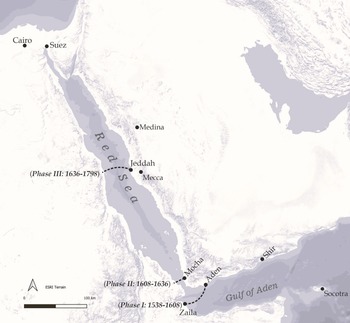
Under the terms of Ottoman ‘capitulations’,Footnote 6 English and Dutch merchants were entitled to trade in Ottoman ports across the Mediterranean. In the 1610s, these merchants invoked that privilege in requesting access to the Red Sea. At the time, Sultan Aḥmed I (r. 1603–17) maintained a general policy of closing the Red Sea to all European nations, including allies— a stance that gave rise to certain legal and political debates. However, having considered the dynamics of international relations, the fiscal difficulties of the southern provinces, and growing domestic demand for Indian goods, the Ottoman administration eventually agreed to open the southernmost ports of its Red Sea domain to merchants from friendly European states. These rights-bearers were recognised under the capitulations as ‘protected foreigners’ (müsteʾmin).Footnote 7 Thus, in 1611, Mocha, and after 1636, Jeddah, were opened to müsteʾmin vessels, initiating a period of what this article will term ‘controlled openness’. The northern Red Sea, however, remained a mare clausum to European powers until 1798. Accordingly, the maritime boundaries set for foreigners in the Red Sea shifted over time in connection with the changing policies of the imperial centre. In this context, the Red Sea’s maritime boundaries are examined here in three distinct phases: a Portuguese-driven closed sea (mare clausum) period (1517–1608); a turbulent period of conflict and negotiation with emergent European actors (1608–36); and a period of ‘controlled openness’ (1636–1798), characterised by pragmatic access concessions for protected foreigners under Ottoman-issued capitulations (see Figure 1).
Maritime boundaries established for European powers in the Red Sea.

As emphasised in the South-East Asian context by Eric Tagliacozzo, maritime boundaries often function less as rigid inter-state demarcations and more as ‘porous borders’ of interaction, defined by smuggling, trade, and everyday diplomacy.Footnote 8 Tagliacozzo’s conceptualisation of ‘porous borders’ resonates with this article’s central argument: that Ottoman Red Sea policy, while articulated as closed in official discourse, was, in practice, flexible and subject to negotiation. The selective tolerance extended to friendly European merchants at Mocha and Jeddah reveals how Ottoman boundary rhetoric could bend under the weight of local interests and pressures from international trade. This casts the Ottomans not only as boundary-setters, but also as boundary-managers and redefiners. Accordingly, the present study thus seeks to rethink the classical mare clausum doctrine in light of the evolving and adaptive conceptions of ‘frontier’ within Ottoman political practice.
In line with recent methodological critiques within global history, particularly those concerning the field’s tacit directionality toward continuously increasing global integration, this study adopts a perspective that emphasises contingency and change in maritime boundary regimes.Footnote 9 Within this analytical frame, it engages with debates in global legal history that conceptualise imperial authority not as a fixed or uniformly imposed legal order, but as an ongoing process shaped through negotiation, selective enforcement, and situated practices. Rather than treating maritime sovereignty as the outcome of top-down legal imposition, this approach foregrounds the ways in which legal and spatial orders at sea emerged through contingent accommodation involving local actors, intermediaries, and everyday interactions.Footnote 10 Approaching Ottoman Red Sea policy through this lens allows maritime boundaries to be understood less as stable legal demarcations than as provisional arrangements that were continually reaffirmed, adjusted, or contested in practice.
By analysing the Ottoman Red Sea policy through the aforementioned three distinct phases, this article challenges the notion of a unilinear progression toward global commercial integration. Instead, it demonstrates that maritime boundaries were fluid and negotiable, marked by historical reversals and political choices (such as the shift from mare clausum to controlled access). This perspective offers an empirical case study that underscores the heterodox nature of early modern global processes, thereby contributing to the critical project of writing a global history that moves beyond linear, teleological assumptions.
The formation of Ottoman policies in the Red Sea
Relocating the centre of Ottoman naval power in the Red Sea to Southern Arabian ports like Mocha or Aden, and deploying patrol fleets in the Indian Ocean, could have created a secure maritime corridor for Ottoman commercial vessels operating between Indian Ocean ports, as well as for foreign ships transporting goods through the Red Sea. Such a strategy would likely have enhanced commercial efficiency and maximised customs revenues. However, instead of advancing their naval presence southward, the Ottomans opted to maintain a defensive posture centred on their Suez base. This decision was shaped by various factors: the inability of Ottoman viziers to devise a long-term naval strategy, the technical and financial challenges of shipbuilding in the Red Sea, and the administrative problems posed by disobedient bureaucrats in the empire’s distant southern provinces. The most fundamental determinant of this policy, however, was the state’s economic rationale and political priorities.
Archival records make clear that a substantial proportion of the imperial orders sent from the capital to the provinces of Egypt and Jeddah in the early modern period concerned the provisioning of Istanbul, Mecca, and Medina with essential foodstuffs such as grain, coffee, and spices. At first glance, this emphasis appears consistent with the ‘provisionism’ paradigm formulated by Mehmet Genç to explain the economic priorities of the Ottoman central administration.Footnote 11 Yet an important point must be stressed: these orders relate primarily to the transport of provisions carried aboard state-owned ships or ships chartered by the government. They offer only limited insight into the commercial practices of independent merchants operating in the Red Sea. While this state-directed provisioning system undoubtedly constituted a significant component of Red Sea commerce, it would be misleading to infer from it a provisionist logic governing Red Sea trade as a whole, particularly if the activities of merchants outside this system are overlooked. Moreover, the policy of restricting access to European ships—vessels capable of transporting large volumes of goods to Ottoman ports—constitutes another element that fundamentally contradicts the assumptions of the provisionism paradigm.Footnote 12
The Ottoman capital closely monitored the provisioning of the Holy Cities, both for ideological reasons and due to the geographical constraints of the region. While Medina and its hinterland sustained agricultural production, the region was unable to produce grain in quantities sufficient to supply its growing population and the seasonal influx of pilgrims. This made the regular provisioning of Mecca and Medina a persistent administrative and logistical responsibility for the imperial government.Footnote 13 Thus, ensuring a steady flow of essential foodstuffs was regarded as crucial for maintaining both political legitimacy and social stability. Although overland pilgrimage caravans, protected by military units from Cairo and Damascus, transported limited quantities of provisions, harsh climatic conditions and periodic Bedouin raids rendered this route costly and unreliable. For this reason, the Suez–Jeddah maritime corridor, which carried the produce of the fertile Nile Valley to Mecca and Medina, constituted the backbone of the Ottoman provisioning system in the region. Grain arriving in Jeddah was transported on state-owned vessels, ships belonging to the Awqāf al-ḥaramayn, and commercial vessels sailing from various Indian ports.Footnote 14 On their return journey, these ships typically carried coffee, pepper, spices, and textiles northwards to Suez. In this manner, the Ottomans established a circulation cycle in the northern Red Sea in which provisioning and commercial transport operated in tandem and were largely shaped by state direction. Yet this cycle reflected primarily the provisioning priorities of the central administration rather than the full range of commercial activity taking place in the region.
In this light, the provisioning concerns visible in Red Sea policy should be understood less as the application of a fixed economic doctrine than as one among several tendencies attributed to the Ottoman central administration. Provincial dynamics in Egypt, Jeddah, and Yemen, evolving patterns of interaction with foreign merchants, and the pragmatic practices of imperial officials all shaped policy outcomes in ways that went beyond any single economic logic.Footnote 15 This flexibility facilitated the use of trade as a political asset. For example, the strict exclusion of Europeans from the Red Sea gradually transformed into a policy of ‘controlled openness’ following diplomatic negotiations with English and Dutch ambassadors in Istanbul during the 1610s. Sultans granting capitulations permitting trade in Ottoman Mediterranean ports by friendly and allied European states likewise offered a similar, though more limited, privilege in respect of Red Sea access. These facts can be seen to support the argument that the early decades of the seventeenth century saw the Ottomans open the gates of Mocha to friendly European nations in a bid to weaken the rival, albeit declining, participation of their Portuguese competitors in Asian trade.
Phase I (1517–1608): Establishing a maritime frontier
After Selīm I’s rapid conquests in Eastern Anatolia, Syria, and Egypt, the Ottomans established sovereignty over the Holy Cities of Mecca, Medina, and Jerusalem. This elevated their religious and political legitimacy in the Islamic world, reinforced by titles like ‘servant of the two sacred cities’, ‘shadow of God’, and ‘master of the conjunction’.Footnote 16 At the same time, the Portuguese, motivated by both economic and religious ambition, expanded their naval presence across the Indian Ocean. Under Manuel I (r. 1495–1521) and his viceroy Afonso de Albuquerque, Portugal sought to control the Red Sea.Footnote 17 It was in this context that the geopolitical interests of two rapidly expanding empires began to collide in the north-western Indian Ocean and the Red Sea. Thus, the first phase of Ottoman control over the Red Sea witnessed prolonged military and commercial confrontation with the Portuguese. Historians have described the wide-ranging conflicts between Ottoman Suez and Portuguese Goa as a sixteenth-century world war.Footnote 18 According to D’Alòs-Moner, thirty-two Portuguese fleets of varying sizes sailed into the Gulf of Aden and the Red Sea between 1507 and 1586.Footnote 19 In this climate of conflict, the greatest harm was suffered not by the imperial fleets themselves, but by local traders navigating the Red Sea under constant threat from Portuguese patrols along Arabia’s southern coast.Footnote 20
After decades of inconclusive conflict, the two powers began to acknowledge each other’s spheres of influence, paving the way for negotiations aimed at stabilising trade across the Indian Ocean. As early as 1540, the Ottomans and the Portuguese engaged in peace talks encompassing the volume of pepper to be exported from India to Ottoman ports. The latter proposed delivering 2,500 to 3,000 quintals of Indian spices annually to Basra using Portuguese ships, in exchange for 10,000 moios of wheat purchased from the Ottomans. The Portuguese also demanded permission for their fleets to access the port of Jeddah and requested that the Ottomans refrain from constructing galleons capable of oceanic navigation. In response, in 1541 Suleymān (r. 1520–66) made a counter-proposal: to import 4,000 quintals of pepper using Ottoman vessels departing from Calicut, and the demarcation of a maritime frontier between Aden and Zaila, along the African coast, as a mutually recognised boundary between the two empires.Footnote 21
While the commercial terms outlined in both proposals could potentially have been reconciled through negotiation, their respective political and military demands made a peace agreement impossible. The Portuguese sought free navigation of the Red Sea in return for authorising the pepper trade—a demand that amounted to an attempt to assert control over Red Sea commerce. The sultan, however, would not tolerate the presence of Portuguese ships in those waters. As clearly indicated by his proposal, the Ottoman administration sought to designate the Red Sea as a mare clausum to Portuguese vessels, marking the Aden–Zaila line as the boundary of this restricted zone. By enforcing this boundary, the Ottomans hoped to purge the Red Sea entirely of enemy threats. Nevertheless, the very act of engaging in negotiation—and the mutual willingness to offer concessions—signalled that political and commercial conditions in the region were beginning to shift.
Following the conquest of Aden, the Ottoman rulers did not establish a state-run merchant fleet to increase trade with India. Nor did it offer incentives to its subjects to engage in long-distance commerce. Even so, the consolidation of its authority over Aden marked a turning point that rendered the southern Arabian coast safer than before, and a modest revival in the Red Sea’s spice trade began after 1538.Footnote 22 The Portuguese contributed to this revival by issuing cartaz permits, documents guaranteeing protection from Portuguese attacks, to Indian rulers and merchants seeking to conduct business in the Red Sea.Footnote 23 Records show that during the 1540s, merchants from Surat, Begaum, and Cannanore shipped goods to Suez and Jeddah. The rulers of Calicut, Tanur, and Chale on the Malabar coast began dispatching ships to the Red Sea after obtaining cartaz permits from Portuguese Viceroy Afonso de Noronha (1550–54). In 1563, the Adil Shah of Bijapur and the Nizam Shah of Ahmadnagar each sent three ships. Over time, these permits became routine. Beginning in 1568, the Zamorin of Calicut sent 300 bhars of pepper annually to Mecca. From the reign of Akbar the Great (r. 1556–1605) onward, the Mughal emperors were granted cartaz permits free of charge for their Red Sea-bound fleets.Footnote 24
By the 1560s, a fleet of galleys had been making regular shipments of pepper from Yemen to Egypt on behalf of the Ottoman government. During the grand vizierate of Semiz ʿAlī Paşa (1561–64), a former governor of Egypt, the potential value of Indian trade was fully realised. Unlike his predecessor, Rüstem Paşa, who maintained a cautious stance towards foreigners, ʿAlī Paşa adopted a more open diplomatic approach that created favourable conditions for the expansion of foreign commerce.Footnote 25 In 1565 alone, five ships arrived at Jeddah from Sumatra and twenty from Indian ports; in the following year, some 24,000 cantara of pepper arrived from Aceh and Batticaloa.Footnote 26 The overall volume of spices reaching the Mediterranean during this period is telling: Fernand Braudel estimates that in 1565, between 30,000 and 40,000 quintals of spices and black pepper reached the Mediterranean via the Red Sea—roughly equal to the volume received in Lisbon. Consular reports from Cairo dating to 1560–64 record that Venice alone purchased some 12,000 quintals annually.Footnote 27
By this time, merchants from various ports in India and Sumatra were increasingly able to ship pepper and spices to Yemeni ports without Portuguese interference. While this new phase was commercially advantageous for the Ottomans, the imperial administration remained unwilling to relax its strict security policy in the Red Sea. In an imperial letter dated April 1568, Selīm II (r. 1566–74) issued a stern warning to the sharif of Mecca:
The conquest and subjugation of the province of Yemen was not undertaken solely for the purpose of revenue collection. God forbid, it would be incompatible with zeal and commitment to the noble religion were the Portuguese infidels to become a scourge upon the Muslims and seize control of that province. Especially since the protection of the Kaʿba, the site of circumambulation for the peoples of the world and the qibla of the earth, is acknowledged to be the foremost of significant duties and among the totality of religious obligations and requirements.Footnote 28
Despite the passage of nearly thirty years since Yemen had come under full Ottoman rule, the sultan still regarded the Portuguese as a serious threat to Islam, expressing concern that provincial governors might compromise security in pursuit of profit. In such circumstances, Red Sea commerce continued to be conducted primarily by Ottoman subjects and merchants tied to Indian rulers with close relations to Istanbul. Although Ottoman records from the period contain limited data concerning Indian merchants, a series of imperial orders issued by Sultan Meḥmed III (r. 1595–1603) offer some insight into the empire’s attitude toward Indian traders in the 1590s. In 1596, Agha Muhammed arrived in Istanbul as an envoy of Burhan Nizam Shah II (d. 1596), ruler of the Ahmadnagar sultanate. He requested permission for one of Nizam Shah’s agents to reside in Jeddah. In response, the sultan granted permission for the agent, Sayyid Hatim, to reside in the city, assigning him a daily stipend of ten silver akçes and an adequate grain allowance.Footnote 29 Two years later, additional orders instructed the governor of Yemen, Hasan Paşa, to cover Sayyid Hatim’s provisions from the provincial treasury.Footnote 30 While the imperial orders do not elaborate on Sayyid Hatim’s duties, it is not difficult to infer that he served as a commercial agent.
Throughout the sixteenth century, which was characterised by threats from Portugal, Ottoman Red Sea policy took the form of a defensive and tightly controlled commercial strategy that aligned closely with the empire’s religious responsibilities. At the dawn of the new century, however, Portuguese influence in the Indian Ocean significantly waned and new European actors, such as England and the Dutch Republic, began to fill the power vacuum, altering the regional balance of power. These developments precipitated a shift in Ottoman policy: diplomatic engagement now started to see the opening of certain Red Sea ports—heretofore entirely closed to outside commerce—to friendly European merchants. This transformation was driven not only by changes in foreign relations, but also by the internal dynamics and fiscal challenges of the empire’s southern provinces. This new phase marked the beginning of a transition in the status of the southern half of the Red Sea from a mere zone of defence to a carefully monitored international space, redefined by international diplomacy.
Phase II (1608–1636): European entry and Ottoman resistance
The English East India Company (EIC) was established in 1600 with exclusive rights to trade east of the Cape of Good Hope. Following the relative success of its early expeditions in the Indian Ocean, the company sought to expand its commercial presence in the region.Footnote 31 In this context, the Red Sea, ruled by a power friendly to England, emerged as a viable opportunity for expansion. The cordial ties between Queen Elizabeth I (r. 1558–1603) and the Ottoman sultans encouraged company officials to consider the Red Sea as a feasible target for their trade ambitions, notwithstanding the Ottoman policy of restricting European access.Footnote 32
These commercial objectives were underpinned by a broader convergence in Ottoman–English relations that had taken shape since the late sixteenth century. Following the defeat of the Ottomans at Lepanto in 1571, strategic considerations, most notably the shared rivalry with Catholic Spain, fostered closer ties between the two powers.Footnote 33 In 1580, Sultan Murād III (r. 1574–95) granted English merchants a capitulation permitting trade in Ottoman ports, formulated in general terms as ‘any of our ports’.Footnote 34 Although this language appeared expansive in suggesting unrestricted access to Ottoman ports, English merchants would soon discover that certain regions of the empire, including the Red Sea, were treated as exceptional zones lying beyond the routine application of capitulatory privileges.
Uncertainty over whether existing capitulations extended to the Red Sea, however, led company directors to pursue a more formal solution. In November 1608, the EIC resolved to petition the Ottoman sultan for explicit authorisation, requesting that the English ambassador in Istanbul secure a permit allowing English ships to navigate and trade freely in the Red Sea ports of Yemen.Footnote 35
More than two years later, the English ambassador in Istanbul, Thomas Glover, succeeded in securing such permission from Sultan Aḥmed I (r. 1603–17). The imperial order, dated 28 February 1611, was addressed to local governors, judges, and port officials. It reaffirmed the long-standing friendship between both countries and cited the earlier capitulation asserting that English merchants were entitled to trade within Ottoman territories. The imperial order further specified that English subjects were allowed to travel, trade, and reside in Yemen, Aden, Mocha, and neighbouring ports, warning that any violation of these rights would be punished as an example to others.Footnote 36 This imperial order effectively acted as an addendum to the English capitulation that was in force at the time, repeating its legal foundations and commercial rights while explicitly extending these privileges to the Red Sea ports.Footnote 37
Thomas Glover had thus succeeded in securing a written authorisation for English ships to enter the Red Sea. However, by the time he obtained it, the company’s fourth and sixth voyage fleets had already departed. Both expeditions intended to call at ports in the Red Sea, but lacked any official sultanic permit to present to local Ottoman authorities. In typical trial-and-error fashion, the English traders had made certain assumptions about unfamiliar ports. One of these assumptions was likely that the existing capitulation would guarantee safe passage in the Red Sea. Unfortunately, this proved to be a costly misjudgement, resulting in ship losses, imprisonment, crew mutinies, and commercial failure.Footnote 38
The fourth EIC voyage, commanded by Captain Sharpeigh, arrived off the port of Aden with the ships Ascension and Union on 7 April 1609. The following day, Ottoman officials came aboard and invited the English ashore, assuring them that they would be well treated and charged only a 5 per cent customs duty on their goods. True to this promise, the merchants were warmly received, provided with accommodation and assigned an interpreter. However, when some traders requested to return to their ships anchored offshore, they were informed that they could not do so until a response was received from the governor of Yemen, Caʿfer Paşa, in Sanaʿa.Footnote 39 Lacking prior experience with English visitors, the local governor of Aden, Receb Agha, had lured them ashore under false pretences while he sent a messenger to the provincial capital seeking instructions.Footnote 40
On 28 April, Caʿfer Paşa’s messenger arrived in Aden with orders to treat the English respectfully and to purchase tin and 500 covedos of cloth from them.Footnote 41 While the governor’s response gave the English hope for establishing trade, Receb Agha’s inconsistent and arbitrary behaviour disrupted these plans. Upon learning that Captain Sharpeigh had sent two men to Mocha to assess commercial prospects—and that they had reported Mocha to be far superior to Aden—Receb Agha grew increasingly uneasy.Footnote 42 Mocha was a rising rival to Aden, and if EIC ships began frequenting it instead, Aden’s customs revenues would decline. In an effort to obstruct their departure, the Agha demanded customs payments on all goods and money held aboard the ships. Frustrated by this duplicity, Captain Sharpeigh resolved to bypass local authorities and negotiate directly with the governor of Yemen. Two company representatives, John Jourdain and Phillipp Glascocke, set out for Sanaʿa, while the EIC fleet continued on to Mocha.Footnote 43
After a fifteen-day journey, the two Englishmen reached Sanaʿa on 10 June and were received by Caʿfer Paşa the following day. Presenting the capitulatory document granted by the sultan, they requested permission to establish a permanent factory in Yemen. In response, the Paşa referred to an incident during his time in the imperial court, in which a European had requested a licence to trade in the Red Sea. The sultan, he explained, had rejected the request on the grounds that the Red Sea was in close proximity to Mecca. He made it clear that the existing capitulation was not sufficient for entry into the Red Sea, but he would gladly accept a trade mission if they returned with a special permission from the sultan.Footnote 44
It was in this way that the English merchants learned first-hand from the governor of Yemen that the capitulation they held did not extend to the Red Sea. When the original 1580 capitulation was issued, England had not yet begun trading in the Indian Ocean and the EIC had not been founded. Although the treaty had been renewed and expanded by 1601, it contained no clause explicitly authorising entry into the Red Sea from the Cape route.Footnote 45 Acting on his own initiative, Caʿfer Paşa nevertheless permitted them to conduct trade at Yemeni ports on this single occasion, subject to a 10 per cent customs duty and a warning that they should not return without proper authorisation. The fourth voyage, having failed to secure profitable trade, departed Mocha on 26 July 1609.Footnote 46
The East India Company’s early attempts to enter the Red Sea reveal how limited information, improvised decision-making, and local administrative discretion could turn commercial initiative into diplomatic crisis, as exemplified by Sir Henry Middeleton’s sixth voyage (1610–11), the final English expedition to push into the Red Sea without a sultanic permit.Footnote 47 Expecting trade at Mocha and relying on assurances from local intermediaries, Middleton and several of his men went ashore and were arrested on the grounds that Christian access to the region was forbidden.Footnote 48 After being held in captivity for several months following his arrest ashore, Middleton eventually secured release not through formal authorisation but through mediated negotiation and bribery—an episode that underscores how, in Yemen, the enforcement of the ‘closed sea’ principle depended less on a uniform legal regime than on contingent local practice.Footnote 49 In May 1611 Middleton returned to Mocha and attempted to obtain compensation through coercive pressure at sea, including the detention of Indian shipping.Footnote 50 The episode exposed both the vulnerability of long-distance commerce to ad hoc provincial enforcement and the limited capacity of Ottoman naval forces in the southern Red Sea to regulate confrontations once they escalated.
Still, however, the English East India Company’s first commercial ventures in the Red Sea ended in disappointment due to a lack of knowledge regarding the region’s political, commercial, and navigational realities. Confusion and corruption among local Ottoman officials also played a part; upon encountering Christians claiming to be the sultan’s allies for the first time in Aden, local functionaries had been unsure how to respond. During this period, EIC voyages that encompassed Yemen invariably listed Aden as their first port of call. However, a once prominent medieval port, Aden had by that time lost much of its former commercial appeal. After the onset of Ottoman–Portuguese hostilities, the port of Mocha—located several hundred miles to the west and just north of the Bab al-Mandab Strait—had emerged as a more secure and prosperous hub. While one might speculate that the English deliberately avoided entering the Red Sea, records from their voyages to Aden reveal that they actually were unaware that the Ottomans considered the Red Sea a special maritime zone.Footnote 51 Jason White’s detailed study of early English initiatives in the Red Sea highlights how the merchants’ limited understanding of the Hijaz region and disregard for the sensitivities of its sacred geography frequently led to tensions with Ottoman authorities. As White emphasises, relations between Ottoman officials and English companies were often conducted through negotiations involving bribery, mediation, and diplomatic representation.Footnote 52
Dutch engagement with Yemen followed a broadly similar pattern, shaped by commercial opportunity but limited by unclear and overlapping jurisdictions, though it evolved further into a deliberate attempt to secure a formal place within Red Sea commerce. The inclusion of Red Sea ports within Dutch East India Company (VOC) routes owed much to the initiative of Pieter van den Broecke. After recognising Yemen’s commercial potential during his travels in 1613–14, he pressed the Company to authorise an exploratory mission. When the Nassau reached Aden in 1614, Van den Broecke presented himself emphatically as a peaceful merchant, explicitly distancing his enterprise from the earlier English disturbances, and sought to rent a house, signalling an ambition to establish a standing commercial presence. Local authorities initially responded favourably but soon insisted that any permanent factory required written authorisation from Istanbul. This reversal was shaped in part by pressure from Indian merchants operating in Mocha, who viewed European participation in intra-Asian circuits as a threat to their existing commercial privileges.Footnote 53
Van den Broecke returned in 1616 and shifted his attention from Aden to Mocha, the more attractive market at the Bab al-Mandab threshold. There, officials again drew a distinction between permanent settlement and seasonal tolerance. Caʿfer Paşa maintained that he could not authorise a permanent VOC factory in Mocha without a sultanic order. At the same time, he permitted the Dutch to trade for the season, but only under conditions that restricted their movement and kept the northern Red Sea beyond their reach.Footnote 54 This was not merely bureaucratic formalism: it exemplifies the operational grammar of Ottoman maritime sovereignty as a boundary-management practice—one that could accommodate profitable commerce while preserving the ideological claim of restriction. The resulting arrangement resembles, in miniature, what the English had encountered. In both cases, access to Red Sea commerce was not determined by formal rules alone, but emerged through negotiated, situational settlements shaped by revenue imperatives, local intermediaries, and the wider commercial ecology of the port. Yet, there was also an emerging difference. Whereas the English repeatedly tested the boundary through trial-and-error navigation and subsequent coercive tactics, the Dutch pushed more consistently towards a written settlement, embedding commercial access within a diplomatic register designed to stabilise expectations across seasons.
That diplomatic strategy culminated in the imperial order of 1618 granting VOC merchants and their representatives the right to enter and trade at Yemen’s ports, opening a formal channel of access that the English had struggled to translate into durable practice.Footnote 55 The establishment of a VOC factory at Mocha in 1621 appeared to confirm that Red Sea access could be regularised through imperial authorisation. In practice, however, the promise of ‘opening’ ran up against the same structural constraints that had limited English success: intensified competition among Asian merchants, the fragility of provincial governance, and the insecurity of maritime commerce in a region increasingly shaped by local power struggles and predatory activity around the Bab al-Mandab. The Dutch experience illustrates this gap with particular clarity. Even after formal permission and the creation of a factory, trading conditions could deteriorate rapidly; commercial frustration encouraged recourse to coercion at sea, which in turn provoked Ottoman retaliation, detention, and seizure—outcomes that undermined the very legal settlement the company had sought.Footnote 56 By the 1630s, as Yemen’s rebellions deepened and Ottoman authority further weakened (culminating in the withdrawal of imperial forces in 1636), the southern Red Sea increasingly operated as a multi-actor commercial zone in which formal permissions mattered less than the capacity of local regimes to guarantee security and predictable exchange.
Phase III (1636–1798): Commercial flexibility under imperial boundaries
Although the EIC and the VOC had both obtained permissions to establish a factory in Mocha during the 1610s, neither achieved the commercial success they had envisioned in the Red Sea. In the 1620s, a series of uprisings led by the Zaydi’s against Ottoman rule in Yemen disrupted public order. This prompted European companies to suspend their trade initiatives in the region. In 1636, the Ottoman governor, along with any remaining imperial troops, withdrew from Yemen.Footnote 57 With Yemen now under the independent rule of the Zaydi’s, the southern Red Sea ceased to be a region where the Ottoman policy of ‘controlled openness’ could be effectively implemented. Although the Yemeni rulers welcomed foreign trade, instability and piracy limited English activity in Mocha to sporadic and low-volume ventures. In 1675, the EIC eventually abandoned its operations in Mocha.Footnote 58 By the 1690s, piracy by European vessels sailing from Madagascar had become a systemic problem in the Red Sea. Yet this period also coincided with the emergence of coffee as a high-demand global commodity, prompting renewed interest in Yemen among European companies.Footnote 59 Around the turn of the eighteenth century, European trading companies began to take more active steps to suppress piracy and secure maritime routes to the Red Sea. In the years that followed, trade in Mocha resumed and these merchants extended their activities northward to the ports of Hudaydah and Luhayyah.Footnote 60
As Mocha continued to rise as a key commercial hub in the southern Red Sea, Jeddah now gained new prominence as the Ottoman empire’s principal gateway for Yemeni and Indian commodities. It was also the seat of the Ottoman governor responsible for administering the Hijaz and Habesh (Abyssinia). Goods imported for the Ottoman domestic market—and re-exported to Europe via Egypt—now entered the Empire primarily through Jeddah.Footnote 61 The city’s strategic significance thus was further enhanced by its function as the port of Mecca.
For English merchants who had previously obtained special permission to enter the Red Sea but had not ventured north of Mocha, trading in Jeddah presented a new challenge. From the perspective of the Ottoman central administration, ensuring that sufficient numbers of ships called at Jeddah was essential for maintaining a steady supply of key commodities—particularly grain, spices, and coffee—for the domestic market, as well as for securing the regular transport of provisions to the Holy Cities during the pilgrimage season. Additionally, customs duties collected from Indian and European ships, along with those levied on jalbasFootnote 62 carrying Yemeni coffee, constituted the principal source of revenue for the province of Jeddah. By law, these revenues were divided equally between the governor and the sharif of Mecca to finance their administrative expenditures. In years when Indian ships removed Jeddah from their itineraries due to commercial or seasonal factors, the province faced serious budget deficits and was forced to request financial aid from the imperial centre.Footnote 63 As a result, the Ottoman government was compelled to shift the boundary of permitted European navigation northward from Mocha to Jeddah at the beginning of the eighteenth century—marking the start of a new phase in the definition of Ottoman maritime boundaries in the Red Sea.
This new phase represents the period that most vividly illustrates the transformation of the Ottoman maritime boundary and trade regime in the early modern Red Sea. With the loss of Yemen in 1636, the geopolitics of the Red Sea were reshaped, producing unexpected consequences that shifted the limits of European navigation from Mocha in the south to Jeddah in the north. The developments of this period reinforce the argument that Ottoman maritime sovereignty in the region was exercised not through absolute control, but through a flexible and negotiable mode of governance that balanced ideological commitments with economic pragmatism. The historical cases examined below demonstrate that Ottoman administration in the Red Sea was not determined by a one-way flow of imperial decrees from the centre in Istanbul to the periphery, but rather by a continuous process of negotiation between imperial directives and local realities.
One of the earliest documented incidents suggesting that the port of Jeddah had been opened to the English, albeit hesitantly, occurred in 1700 when Ottoman authorities seized an EIC ship, Diamond, which had arrived in Jeddah from Bengal and dropped anchor in March. Invited ashore by Yusuf Bey, a Jeddah official, the captain and traders disembarked. However, Yusuf Bey went on to accuse them of piracy, arresting the English crew and confiscating the ship along with its cargo. In response, Queen Anne of England sent letters to Sultan Muṣṭafā II (r. 1695–1703) and his grand vizier via her ambassador in Istanbul, Sir Robert Sutton (d. 1746).Footnote 64 She demanded compensation for the losses and punishment of those responsible. In her letter, the queen protested the mistreatment of English merchants who had entered Jeddah by formal invitation and emphasised that cordial treatment of English traders was in the interests of both states. Allowing the EIC to send more ships and merchandise to Jeddah, she argued, would directly benefit the province’s economy. Indeed, before being seized, the Diamond had already paid 16,844 Spanish reals in customs duties—a sum of considerable significance to the province’s finances.Footnote 65
Roughly two years later, in November 1702, Sultan Muṣṭafā II issued an imperial order addressing the governor of Jeddah. The sultan stated that European trading ships had never traditionally ventured into the ‘Sea of Suez’,Footnote 66 which encompassed Jeddah and the coasts of Africa. Nevertheless, he noted, greed had recently driven local administrators in Jeddah to begin admitting European vessels to the region in violation of established norms. The sultan condemned such practices, issuing a stern warning to the governor: ‘Since the Sea of Suez is the corridor of the two noble sanctuaries, and since you are the governor therein, henceforth no European ship shall enter the Sea of Suez.’Footnote 67 This imperial order clearly indicated that the security of the Holy Cities remained a central concern in the rhetoric of the imperial government. At the same time, fiscal realities in the province required that the port admit more foreign traders, including Christians.Footnote 68 Queen Anne’s proposal was thus ultimately accepted, and English ships continued to call at Jeddah in subsequent years.Footnote 69
As customs revenues from Jeddah remained insufficient to cover the expenses of both the provincial administration and the sharifate of Mecca, tensions between the two authorities intensified, leading to administrative dysfunction. In 1722, the sharif of Mecca sought to increase revenues by beginning to extort merchants and even confiscate their goods. As a result, no Indian ships visited Jeddah the following year, and the number of Yemeni jalbas bringing coffee declined sharply. Deprived of its main source of revenue, the governor of Jeddah, ʿAlī Paşa, appealed to Istanbul for financial assistance.Footnote 70 To ease the province’s fiscal strain, he adopted a set of measures designed to attract foreign merchants. Records from an EIC-related case in 1727 illuminate the content of these measures. According to an account by John Fullerton, purser of the ship Prince George, which had arrived in Jeddah from Bengal in 1727, ʿAlī Paşa had issued invitations to EIC merchants operating in India. The Prince George responded positively, launching annual voyages from Bengal to Jeddah starting in 1723. His successor, Ebubekir Paşa, renewed this invitation by sending a circular letter to BritishFootnote 71 traders throughout India in 1726. Pleased with their earlier reception, the EIC responded to the new invitation by dispatching a second ship, Margaret, alongside Prince George, in 1727.Footnote 72
On 14 April, both EIC ships anchored off the coast of Jeddah. After receiving formal guarantees of protection from the governor and the sharif of Mecca, they began unloading their cargo. However, on 6 June, just as the British were wrapping up their commercial activities, they became the target of a violent local uprising, which involved the Janissaries stationed in Jeddah. The uprising was sparked by a series of incidents that occurred after the arrival of the two ships. First, a dispute between the British ships and a local fishing boat resulted in the sinking of the latter. Then, the deaths of several Muslim sailors aboard the Margaret caused unrest and suspicion among the townspeople. These men were not locals recruited in Jeddah but regular members of the ship’s crew. On the day of the riot, the British handed over the body of a Muslim sailor who they claimed had drowned. During preparations for the funeral, the crowd discovered that the man’s eyes had been burned with hot iron and that his body bore multiple wounds. Enraged, the townspeople stormed the British merchants’ lodgings. Three Portuguese sailors from the Prince George were killed in the attack, and goods along with 61,988 Spanish reals in cash were looted from the warehouses.Footnote 73
Governor Ebubekir Paşa and his officials attempted to intervene, but their efforts to calm the mob were unsuccessful. The next day, the Paşa convened a major meeting with military commanders, local notables, and scholars. The scholars, when consulted, ruled that looting the property of müsteʾmin merchants—who had entered the city by invitation—was unlawful. Following this decision, the governor issued a proclamation via public criers: those who returned the stolen goods and money would be rewarded with 10 per cent of the value, while those who disobeyed the order would face execution. Fearing further violence, the local authorities also proposed that the British ships transfer their remaining goods and treasure to the Fortress of Jeddah for safekeeping until order was restored. The captains accepted this proposal, and an inventory was prepared as the items were transferred to the citadel. Thanks to Ebubekir Paşa’s efforts, the looters returned 36,000 Spanish reals and sixteen chests of merchandise. These, along with the items safeguarded in the fortress, were eventually restored to the British, who were then permitted to depart the port.Footnote 74
In contrast to events in Mocha in 1612, Ebubekir Paşa, as an Ottoman governor, did everything in his power to protect the British merchants and prevent the anti-British uprising in the city from developing into a diplomatic dispute between the two empires. The reports he sent to the Ottoman court regarding the incident were also shared with the British embassy in Istanbul. The Ottomans also granted the embassy’s request to send a translator to Jeddah to facilitate the restitution of the goods. Despite the casualties and material losses, the British ultimately concluded that the Ottoman authorities in both Jeddah and Istanbul had acted in a manner befitting mutual friendship, and came to regard the incident as an act of divine providence.Footnote 75 The peaceful resolution of the Jeddah incident reflected the shared interest of both sides in avoiding economic disruption to Red Sea trade. In an imperial order sent to Governor Ebubekir Paşa, the Ottoman Council stressed that merchants who entered Jeddah with the approval of the governor and sharif, paid customs duties, and contributed to the local economy must be safeguarded to ensure the prosperity of the region.Footnote 76 These statements reveal that the Ottoman central authority no longer viewed the presence of müsteʾmin merchants in the Hijaz with suspicion. On the British side, the East India Company also valued its trade with Jeddah and sought to prevent similar incidents in future. A memorandum submitted to the Ottoman court conveyed that the king had instructed naval officers in the Indian Ocean not to retaliate against Muslim vessels and had pledged to ensure the continuity of commercial relations with Jeddah.Footnote 77
The 1727 Jeddah incident directly contributes to understanding the local commercial realities and regional dynamics of long-distance East–West trade that are often overlooked in the general historiography of the early modern period. This episode allows us to move away from teleological narratives that portray the European presence in the Indian Ocean as a one-sided imperial intervention leading inevitably to Western ascendancy.Footnote 78 On the contrary, the complex nature of the Red Sea reveals a sphere of mutual dependence and negotiation among multiple actors. In this context, the governors of Jeddah, seeking to generate revenue for the provincial budget and to provide additional provisions for the Holy Cities, invited British merchants operating in the Indian Ocean to their ports—at times risking contradiction of imperial decrees issued from the centre. For British merchants, conducting voyages from Bengal to Jeddah under the status of müsteʾmin provided a safer and more economical alternative to longer and costlier routes involving return voyages to Europe. This reciprocal alignment of interests ensured that, despite prohibitive ideological orders such as Sultan Muṣṭafā II’s imperial decree of 1702, Jeddah remained open to commercial access. Thus, during this period, Jeddah functioned not as a passive ‘stopover’ on the maritime route from India to the Mediterranean, but as an active ‘porous border’ zone with its own internal dynamics—demonstrating that Ottoman maritime sovereignty in the Red Sea was exercised through a flexible and negotiable mode of boundary management rather than through the rigid and absolutist control often implied in the Ottoman imperial discourse as well as in classical readings of the mare clausum doctrine.
Ebubekir Paşa was again forced to report financial difficulties for Jeddah the following year due to the absence of Indian and British ships; nevertheless, trade resumed in the years that followed.Footnote 79 The vessel Compton visited the port in 1729, followed by the London and Harrison in 1730.Footnote 80 European proximity to the Holy Cities was no longer seen as a serious cause for concern, and a British presence in Jeddah had become routine. In fact, during this period, Muslim merchants arriving from India were charged a customs duty 2 per cent higher than that imposed on the müsteʾmin British traders, prompting complaints to Istanbul. In response, the Ottoman government reminded the governor of Jeddah and the sharif of Mecca that the customs duty should be uniformly set at 3 per cent for all merchants, as it had been previously.Footnote 81
Over the following decades, EIC ships sailing from Bengal continued to call at Jeddah at irregular intervals, sometimes in pairs and sometimes alone. However, the city increasingly came to be seen by the Company as an unstable and unreliable trading post due to jurisdictional disputes between the governor and the sharif, inconsistent tax practices, and the greed of local customs officials. As a result, the Company decided to limit its involvement with ports north of Mocha and adhered to this policy for a long time. In the 1760s, Red Sea trade returned to the Company’s agenda. This time, however, the plan was not to expand commerce at Jeddah, but rather to establish a direct trading link between India and Suez at the northernmost tip of the Red Sea. The commercial prospects of this ‘untried channel of trade’ were discussed during a Bengal Public Consultation on 18 November 1773. Yet because the EIC had never previously navigated beyond Jeddah, it lacked information about sailing conditions in the northern Red Sea. The Consultation consequently resolved to allocate a small vessel to survey the region and employ a qualified crew for the task. The Cuddalore, a local schooner, was subsequently assigned for this mission.Footnote 82
The five-year war that erupted between Iran and the Ottomans in 1774 disrupted the EIC’s trade via the Persian Gulf, and prompted Muslim, British, and Armenian merchants in Bengal to assign greater value to the Red Sea route. At the time, British traders in Jeddah were suffering from illegal taxation and confiscation of goods. In 1776, Captain R. Scott, having incurred losses due to unexpected levies after selling his cargo, attempted to negotiate a solution with local authorities. He submitted a draft commercial agreement outlining the residency rights, customs duties, and protections for British merchants in Jeddah. The agreement required the approval of the sharif of Mecca to enter into effect. Scott, frustrated with the lack of security, warned that unless a formal agreement was reached, the British might shift their operations from Jeddah to Suez.Footnote 83
News of Britain’s plans to explore trade via Suez and send a vessel north of Jeddah quickly reached Istanbul. Through Sir Robert Ainslie (d. 1812), the British ambassador in Istanbul, the Porte conveyed its disapproval to the British crown. The letter stated that no European trading ship had ever ventured into the Gulf of Suez, a region considered vital to the security of the Hijaz. The Ottoman authorities regarded Britain’s new initiative as a breach of the traditional friendship between the two powers. The letter laid out three reasons for restricting access to Suez. First, allowing ships from India and Yemen to bypass Jeddah and enter Suez would deprive the province, and by extension Mecca and Medina, of essential customs revenue. Second, the security risk posed by Bedouin tribes along the northern Red Sea coast meant that any vessel grounding or anchoring there might face looting. Third, the presence of Christian ships near the holy sites could provoke unrest among Muslims.Footnote 84
From an internal political perspective, the incident was further complicated by the rebellion of ʿAlī Bey, who had defied the sultan’s authority and negotiated trade agreements with European powers without the approval of Istanbul.Footnote 85 After his death, the Ottoman court issued an imperial order to the governor and grandees of Egypt. The Porte accused local officials who had permitted European entry into Suez of greed, incompetence, and ignorance of history. For the Ottoman sultan and his ministers, trade was merely a façade for European geopolitical ambitions. The imperial order invoked the capture of Jerusalem by Europeans in the twelfth century and the Dutch seizure of Indian ports as historical warnings, arguing that trade served as a tool for European powers to take possession of Muslim lands. Accordingly, it ordered that anyone who had allowed Christian ships to enter Suez or settle a factory there be identified and punished.Footnote 86 News of these developments was forwarded to EIC traders in Bengal in a letter dated 4 July 1777. It confirmed that while trade at Mocha and Jeddah would be allowed to continue, the entry of ships into Suez was strictly prohibited. The Ottoman government warned that any British vessel violating this order would be treated as a pirate: its goods confiscated and its crew imprisoned.Footnote 87
Conclusion
This study has argued that Ottoman maritime sovereignty in the early modern Red Sea was exercised not through absolute control but through a flexible and negotiable regime that balanced ideological commitments with economic pragmatism. The dual character of the Red Sea, as both a religious frontier safeguarding the Holy Cities and a strategic maritime corridor embedded in global commercial networks, generated a persistent tension that prevented Ottoman policy from remaining static.
By tracing this evolution across three phases, this analysis intervenes in ongoing debates on maritime legal geography and imperial border-making. Whereas classical interpretations of the mare clausum doctrine have often been read as expressions of rigid sovereign exclusion, the Ottoman case demonstrates that ‘closed sea’ rhetoric operated as a contingent and adaptable political instrument. In this respect, the findings both align with and extend Lauren Benton’s conception of imperial authority as a process of negotiated and selectively enforced jurisdiction rather than a uniformly imposed legal order. At the same time, the Red Sea evidence complicates the broader applicability of Mehmet Genç’s ‘provisionism’ paradigm in maritime contexts. The selective exclusion of European vessels—despite their capacity to increase supply—indicates that Ottoman economic reasoning in the region cannot be reduced to a simple logic of provisioning. Instead, fiscal considerations were continually balanced against concerns of ideological legitimacy and boundary management.
Finally, viewing the Red Sea as a site of layered interactions between local conditions and the wider global system reveals a boundary regime defined by contingency rather than steady progression. The shifts and reversals observed across the three phases reinforce a heterodox reading of global history—one that resists teleological narratives of ever-increasing global integration. What emerges instead is a more intricate form of governance, in which empires sustained legitimacy and continuity by continually negotiating between ideological claims and economic necessity.
Acknowledgements
I would like to thank Aysel Yıldız for her careful reading of earlier versions of this article and for her constructive comments. I am also grateful to Guido van Meersbergen for his insightful editorial suggestions.
Financial support
None to declare.
Competing interests
The author declares none.
Abdulmennan M. Altıntaş is a postdoctoral researcher at the Foundation for Research & Technology–Hellas, Institute for Mediterranean Studies (FORTH-IMS). He received his PhD from Istanbul University and specialises in maritime history, with a particular focus on the Red Sea and the Eastern Mediterranean.

 Open access

