




It was March 1925 in the Uganda Protectorate in East Africa, and Yakobo (Jacob) Kalule was on the run. The former district luwalo inspector (DLI) was under a cloud of suspicion for allegedly misappropriating public funds in the course of his duties in Toro (Kabarole) District in Western Province.Footnote 1 The inquisitor, the Toro district commissioner (DC), Lancelot Knollys, attempted to track down the Muganda inspector, but to no avail. Kalule, who was related through marriage to the formidable katikiro (prime minister) of Buganda Kingdom, Apolo Kaggwa, might have caught wind of the DC’s inquiry into his alleged malfeasance and had already fled to the neighboring Eastern Province, and his whereabouts were unknown.Footnote 2 At this point, Knollys refrained from pressing forward until completing a thorough audit of the financial accounts of the Toro Kingdom’s rukurato (chief’s council).
Although Knollys’s probe eventually faded into obscurity in the Tooro Kingdom Archives, this historical vignette has survived as an artifact of the contestations over the use of “traditional,” unpaid, forced labor in colonial Africa and the role of African intermediaries. Intermediaries, like Kalule, often worked in the lower levels of colonial bureaucracies as interpreters, clerks, soldiers, chiefs and, in this case, inspectors. They were brokers who bridged the divide between colonial policy and implementation in the African reserve areas.Footnote 3 However, as Domenico Cristofaro argues, they had to negotiate an unstable position within the colonial administrative hierarchy.Footnote 4 Similar to other Baganda agents employed in different parts of the Uganda Protectorate, Kalule was acting in a supervisory role in Toro District, as a conduit between African tradition and colonial rule.Footnote 5 As an agent of the British administration, he was monitoring the application of a type of “traditional” labor, called rubu, that was controlled by chiefs and had its roots in the neighboring Kingdom of Buganda.
“Traditional labor” was a pervasive form of unpaid, compulsory labor required of Africans residing in rural areas in all the colonial territories, though under different names.Footnote 6 Justified as a continuation of African village collective work, the customary origins of unpaid traditional labor were often illusory or too vague. In the guise of tradition, domestic relations were retained within the purview of indirect rule.Footnote 7 First articulated during the Nigerian colonial experience, indirect rule involved ruling through the preexisting, or invented, traditional authorities.Footnote 8 Subject to the legal authority of the Native Authority Ordinance, tribal chiefs were the core of the colonial administration in the African reserve areas.Footnote 9
The work regimen for traditional labor typically involved road maintenance and construction, human porterage, plus labor on various agricultural betterment schemes. Both men and women performed the annual labor obligation throughout the year. Ultimately, this unpaid work was at the intersection of the dual colonial labor market of subsistence and wage work.Footnote 10
Britain moved away from private-sector forced labor after the 1920–21 forced labor crisis in Kenya Colony and relied more on “traditional” labor as the primary coercive labor practice in its territories.Footnote 11 By way of contrast to other European colonial powers in Africa, France abolished forced labor in its colonies in 1946, while Portugal followed suit in 1961. The passage of the International Labour Organization’s (ILO) Convention 29 in 1930 (the Forced Labour Convention) forbade private sector forced labor, among signatory states, and called for the abolition of government-forced labor, but exempted “traditional” labor (labeled minor communal services) from the definition of forced labor under Article 2.Footnote 12 Though it called for progressive abolition, it also permitted forced labor controlled by traditional authorities under Article 10, which mainly involved supervision of public infrastructure projects.Footnote 13
Traditional labor was ubiquitous during the colonial era in Africa, but scholars of forced labor have given it little attention.Footnote 14 This has led to the development of certain lacunae regarding the nature of the work. First, the purported traditional basis of this labor is seldom explored beyond legalistic definitions. For example, the historian Holger Hansen described luwalo traditional labor in Uganda as “sanctioned by long tradition.”Footnote 15 However, as the example of rubu in the Uganda Protectorate shows, the development of traditional labor was more a case of colonial “invention of tradition.”Footnote 16 The traditional work lacked a clear precolonial precedence, but was nevertheless reinforced by traditional authorities and the colonial administration. In addition, viewed rigidly as an extension of customary duties, the commodification of traditional labor is seldom investigated.Footnote 17
Studies on colonial-era forced labor have also tended to focus more on European administrators and African chiefs as agents. Less attention has been given to the role of nontraditional African intermediaries in the functioning of coercive labor practices.Footnote 18 In Toro District, African chiefs supervised the rubu labor, but European administrators counterbalanced their power by using DLIs to monitor both the work and the chiefs. The use of DLIs, all hailing from Buganda Province, contributed to uncertainty over control of rubu. Moreover, this significant Baganda political influence—an important facet of early colonial rule in Uganda—was the core component of the phenomenon of “sub-imperialism.”Footnote 19 Nonetheless, as outsiders, luwalo inspectors in Toro District were also alienated from the core of power. Intermediaries could potentially wield more power due to their greater understanding of the African languages and customs.Footnote 20 This was not the case with the DLIs in Toro. On the other hand, luwalo inspectors could also be critical of the unpaid forced labor system and exercise their own agency, as Kalule’s flight showed.
This paper conceptualizes the interplay between forced labor practices, the manipulation of African tradition, and the use of intermediaries. The colonial administration in the Uganda Protectorate employed ideas of African collective work customs to legitimize rubu unpaid forced labor in Toro District. However, the traditional roots of the work are debatable since the labor practice emanated from Buganda Province. Chiefs controlled the labor on the ground, but the administration counterbalanced their traditional authority by interposing another intermediary layer of luwalo inspectors to surveil the work. Luwalo inspectors lacked traditional powers but attempted to negotiate the parameters of their position. Beyond the customary veneer, traditional labor was also commodified.Footnote 21 The expansion of the colonial economy prior to 1930 increased opportunities for cash commutation of the labor, which added significant revenue to the district. The rising level of commutations later undermined the available rubu labor pool, however, leading to tensions between the traditional authorities and the British administrators over labor and revenue, ultimately unmasking the facade of tradition.
The first section of this paper discusses the early development of the colonial labor market and the use of certain African political and collective work traditions, associated with the Kingdom of Buganda, to legitimize coercive labor practices in the Uganda Protectorate. Afterward, the paper examines the multifaceted tensions and negotiations over the control and use of rubu forced labor in Toro District that ultimately revealed the commodification of the work.
The Political Economy of Coercion and Tradition: The Labor Market
Initially, under the aegis of the Imperial British East Africa Company (IBEAC), the British made strategic political alliances with the Kingdom of Buganda in the conquest of territory that would eventually encompass the Uganda Protectorate in 1894.Footnote 22 The 1900 Buganda Agreement enshrined the constitutional and legal relationship with the protectorate.Footnote 23 The Kabaka (traditional leader) Daudi Cwa stated in 1927, “although Buganda is part of the Uganda Protectorate…in its internal administration the Protectorate Government has to respect its constitution solemnly guaranteed in the Agreement.”Footnote 24 The incipient projection of imperial power involved the extension of Baganda political culture, or the “Ganda Model,” into different parts of the Uganda Protectorate as a facet of indirect rule.Footnote 25 Excepting ivory and slave trading, prior to colonial inception, there was no preexisting export market for cash crops like cotton or coffee.Footnote 26 With a constrained budget model, a cash-strapped colonial administration developed the export infrastructure and concomitant labor market through regressive direct taxes and coercive labor practices.Footnote 27 Like neighboring Tanganyika, government-forced labor was more significant and developed according to the needs of the administration and traditional authorities.Footnote 28 The colonial administration harnessed a framework of the political and work traditions of the Kingdom of Buganda to provide an ideological template for coercive production and labor practices.Footnote 29
The completion of the Uganda Railway in 1902 magnified the economic viability of the protectorate by making it easier to transport goods to Mombasa in coastal Kenya.Footnote 30 The administration introduced cotton production in 1903, followed by robusta coffee in 1907, though Africans were not permitted to grow coffee until the early 1920s. As Michiel de Haas has shown, by the 1920s there was also increasing labor migration from the Belgian colony of Ruanda-Urundi, which further stimulated cash crop production.Footnote 31 The colonial administration also supported a dual economic policy predicated upon European plantation agriculture, though it collapsed in 1922 due to the impact of a worldwide slump in commodity prices and the end of forced recruitment of African laborers.Footnote 32
Uganda was never destined to be a “Night Watchman” state.Footnote 33 These models were typified by colonies in British West Africa, like the Gold Coast, and tended to have lower-levels of direct taxation while generating more revenue from customs duties. Conversely, in the Uganda Protectorate various extra-market and coercive practices accompanied the introduction of cash crops. Peasants were required to plant a certain percentage of acreage toward cotton. Failure to do so resulted in fines and, occasionally, corporal punishment.Footnote 34 After the signing of the Buganda Agreement, the traditional services and tribute required of peasants by landowners in Buganda, called busulu and nvujo, were paid in cash and cotton.Footnote 35
Beyond production, the colonial administration faced a burgeoning need for workers to construct roads, bridges, and other types of infrastructure. The Public Works Department was the largest employer but paid below-market rates for unskilled African labor, which made it less competitive in the labor market.Footnote 36 Between 1900 and 1909, to overcome African objections about what constituted reasonable work expectations, the administration introduced hut and poll taxes that were levied on African males.Footnote 37 Men had to pay taxes in cash, which forced them to seek employment in the labor market. However, there were limits to the effectiveness of taxation as a means of forcing African males into the labor market. Men could default on their tax, and Africans with the means could increase production and avoid the labor market.
Faced with this constraint, the administration turned to forced labor cloaked in tradition. Under Section 14 of the Buganda Agreement, saza (county) African chiefs were required to maintain public roads in their districts by requisitioning forced labor for up to one month per year.Footnote 38 Luwalo, as it was called, meant “in turns,” in the sense of “the peasant doing his bit for the native state.”Footnote 39 Deployed from 1900 to 1945, luwalo required African males aged fifteen to forty-five in the rural areas to work on roads, bridges, building chiefs’ camps, and other assorted projects.Footnote 40 Despite an assertion by a governor of Uganda that the work was “quite cheerfully borne,” failure to turn out for the labor summons could result in fines, corporal punishment, and imprisonment.Footnote 41
The British viewed luwalo as an outgrowth of the collective work traditions of the Baganda people.Footnote 42 As Governor William Gowers articulated in the latter half of the 1920s, luwalo was “forced labour based on tribal custom and tradition.”Footnote 43 In essence, the British administration conceded that chiefs enforced customary law and wielded a degree of autonomy.Footnote 44 However, the administration attempted to rein in the power of chiefs through the use of luwalo inspectors and the power of dismissal. Unlike chiefs, the legitimacy of the luwalo inspectors arose not from the Buganda Agreement, or amorphous tradition, but the colonial state. The colonial administration in the Uganda Protectorate defined luwalo under Article 10 labor in its Forced Labour Convention annual reports.Footnote 45
With the expansion of colonial rule, chiefs eventually exploited luwalo in all four provinces of the Uganda Protectorate under the legal authority of the 1919 Native Authority Ordinance. Significantly, the Buganda Kingdom was the only region that retained its own separate Luwalo Law (1920), which was based upon the Buganda Agreement.Footnote 46 Section 2 of the Buganda Luwalo Law clearly stated that “‘luwalo’ means the customary free labour of 30 days in every year, which every native of Buganda gives to the Native Government.”Footnote 47 The Buganda Luwalo Law also allowed cash commutation of the labor for the first time in the Uganda Protectorate.
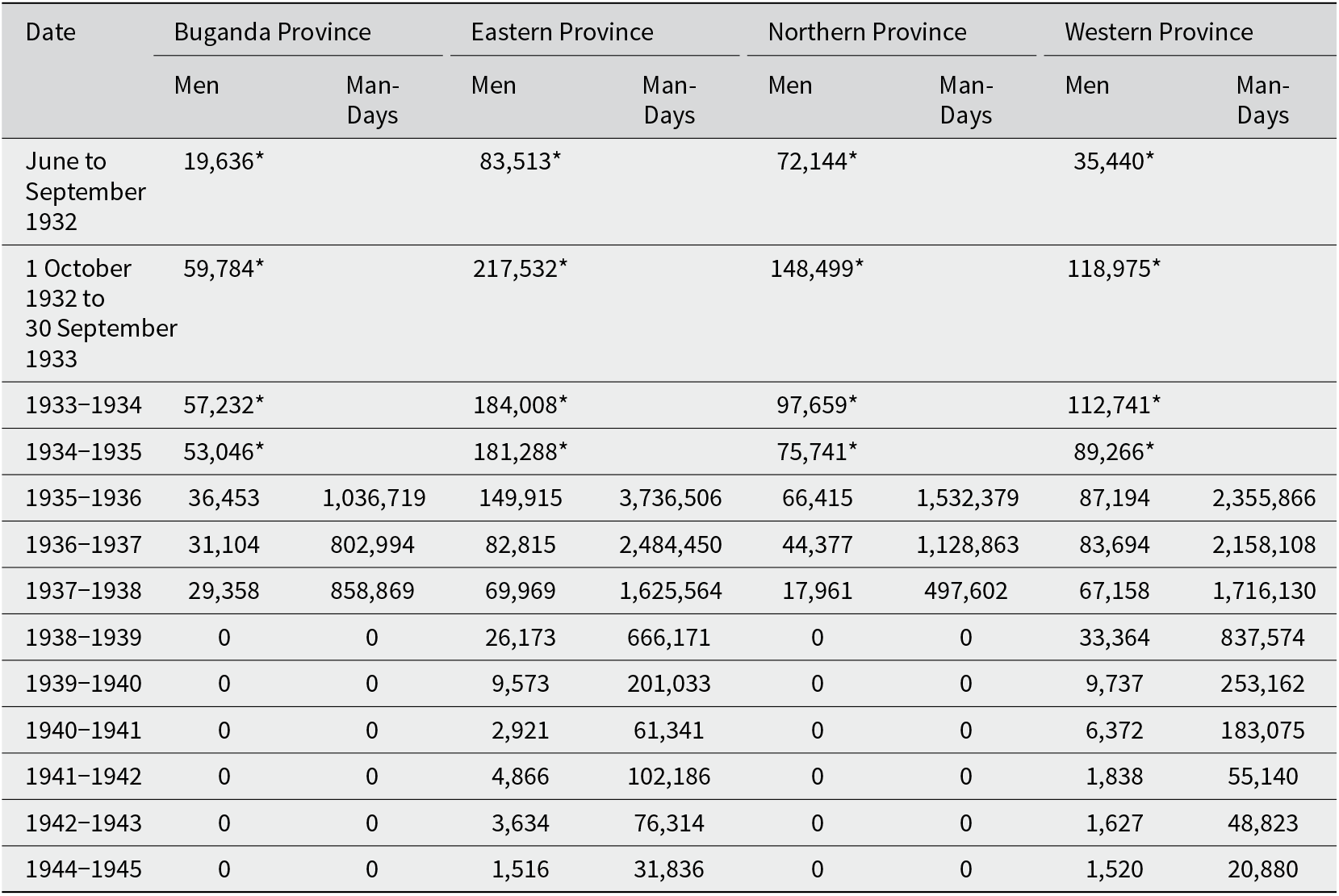
As evidenced in Table 1 (below), with the expansion of luwalo outside Buganda Province, this “traditional” labor became more prominent in Western and Eastern provinces. Beyond Buganda Province, the extension of luwalo labor was more illusory as an artifact of tradition among communities that lacked a centralized political heritage and adequate labor surplus.Footnote 48 In 1918, a disillusioned DC in Eastern Province postulated that many of the duties associated with luwalo were “not really native custom but have been imposed upon the natives by us.”Footnote 49 On the other hand, in the territories that had traditions of centralized political authority and bureaucracy, like Toro Kingdom, there were preexisting collective labor responsibilities that peasants would have owed to their community or sovereign ruler, such as being responsible for the upkeep of sections of a road.Footnote 50 But this did not necessarily imply that these traditions were consistent with the colonial use of luwalo.
Labor called out under Article 10. Enacted by chiefs who perform administrative functions (luwalo)

Table 1 Long description
The table reports annual counts of men called out and, where available, total men-days of work under Article 10 labor across Buganda, Eastern, Northern, and Western provinces from mid-1932 to 1944–45. From 1932–33 through 1934–35 only men counts are listed, with Eastern consistently highest, reaching 217,532 men in 1932–33, while Buganda, Northern, and Western are lower but still substantial. In 1935–36, when men-days begin, Eastern again leads with 149,915 men and 3,736,506 men-days; Western records 87,194 men and 2,355,866 men-days; Buganda records 36,453 men and 1,036,719 men-days; Northern records 66,415 men and 1,532,379 men-days. Across 1935–36 to 1937–38, all provinces show declines in both men and men-days, with Northern dropping especially sharply by 1937–38. From 1938–39 through 1942–43, Buganda and Northern are recorded as zero for both measures, while Eastern and Western continue at much lower levels that keep falling year by year. The row for 1943–44 is blank, and by 1944–45 Eastern and Western remain low at 1,516 men with 31,836 men-days and 1,520 men with 20,880 men-days, while Buganda and Northern are again zero. Interpret with caution because early years do not distinguish men from men-days, and later zeros may reflect reporting or policy changes as well as actual labor use.
Source: ILO, Forced Labour Convention, 1930 (No. 29), D 614/3002/25, “Returns from British Colonies, 1932–1963.”
Note: *From 1932–35, the administration did not make a clear distinction between the number of men called out and the number of man days worked.
Rubu Labor in Toro District
In Toro District, the British administration grafted luwalo onto the existing customary collective labor system called rubu, or orubu, which traditionally involved organizing nonbinding communal labor during harvest season. As was the case in Buganda Province, the application of what we will now call luwalo/rubu—since both African and European administrative officials in Toro District often used the words interchangeably—reflected tensions and negotiations between the British and Batoro elites. Batoro traditional authorities attempted to shape how they used the labor and controlled commutation fees while British administrators chafed at the power chiefs wielded and tried to rein them in through the use of intermediaries. Ultimately, the functioning of rubu in Toro District revealed how chiefs and administrative officers manipulated tradition to conform to the political and economic dictates of colonial rule.
Though ostensibly rooted in Batoro tradition, rubu was a colonial invention, much like Toro Kingdom itself.Footnote 51 The small principality briefly existed in the early nineteenth century as an offshoot of the Kingdom of Bunyoro. However, its tenuous existence abruptly came to an end in 1873 when it was conquered and reabsorbed by its more powerful neighbor. After the subsequent defeat of Bunyoro and the eventual establishment of the Uganda Protectorate in 1894, Toro Kingdom was one of the three kingdoms, including Buganda and Ankole (1901), that supposedly retained the viability of their political institutions and traditions through the signing of political agreements with the British.Footnote 52 Since it had resisted British colonialism through warfare, Bunyoro Kingdom would sign its political agreement later in 1933.
The 1900 Toro Agreement was a scaled-down version of the Buganda Agreement.Footnote 53 It recognized Toro as both a kingdom and a district within the Uganda Protectorate, headed by its traditional leader, the mukama (king or lord), and rukurato.Footnote 54 At the time of the agreement, Mukama Daudi Kasagama was the ruler of Toro proper—the central core of the old kingdom but not the outlying areas. These areas were populated by different ethnic groups, like the Bakonzo and Bamba, that were acephalous and had histories, languages, and cultures that differed from those of the Batoro. Nonetheless, from 1901 to 1904, Kasagama skillfully maneuvered to incorporate these areas as counties in his kingdom.
Unlike the Buganda Agreement, the Toro Agreement lacked a specific article dictating a forced road-work requirement. Later, Kasagama rectified this omission by inserting a forced labor requirement into the King’s Law Book—a compilation of case laws written in 1905.Footnote 55 This series of case laws mainly addressed various social problems, like adultery, marriage complications, and bridewealth, and became known as the “Laws of the King.” Law No. 1 in Section 3, “Roads in the Main Counties,” required chiefs to requisition men for road work.Footnote 56 However, this law did not term this labor as rubu.
Before the reconstitution of his kingdom, Kasagama had spent time in exile in Buganda and might have introduced the Baganda political system into Toro.Footnote 57 Toro District was demarcated into Baganda administrative divisions—sazas (counties), gombololas (sub-counties), and mirukas (parishes)—with Baganda agents in political roles, essentially as chiefs, up to the 1920s.Footnote 58 The export of the “Ganda Model” also involved various forms of reinvented coercive labor practices.
In 1923, the Toro District administration articulated a set of labor requirements, initially termed “Rubo [sic] Labour,” that were issued under the legal authority of the 1919 Native Authority Ordinance.Footnote 59 Section 8 of the ordinance empowered chiefs to force “male Africans between the ages of eighteen and forty-five…to work in the making or maintaining of any work of a public nature…for the benefit of the community.”Footnote 60 The “Rubo [sic] Labour” directives instructed chiefs on deploying the labor, while also defining exemptions and commutation from the work, which we will return to later.Footnote 61
In Toro District rubu had a similar etymology to luwalo and, generally, meant “in turns,” in the sense of people contributing their labor to a collective work project, like communal harvesting.Footnote 62 In the Western region of Uganda, among the Batoro, Banyankole, Bakiga, and Banyoro, rubu was a general reference to the traditional, nonbinding, collective labor known as rubaro. It was distinguished from the word oburonde, which was the name for coercive forced labor wielded by political authorities.Footnote 63
Although rubu was inspired by amorphous traditional collective work, the actual labor practice in Toro District resembled colonial luwalo. The “work of a public nature” spanned thirty days per year of unpaid infrastructure work, mostly road repair.Footnote 64 Men were usually identified according to tax rolls, and their work was recorded on special cards that were similar to labor tickets issued to plantation workers, which marked the monthly days worked.Footnote 65 Africans who were liable for luwalo/rubu labor but failed to show up or absconded from work could be fined, imprisoned, flogged, or have their rubu/luwalo labor requirements extended by two months.Footnote 66
The lack of reference to rubu in Toro’s own political agreement with the protectorate undermined its legitimacy as a customary relic. Compounding this issue, as mentioned earlier, the legal authority for rubu resided in the Native Authority Ordinance.
Traditional Legitimacy
In a display of colonial cooptation, the rubu rules were formulated in a resolution from Toro Kingdom’s rukurato (parliament or council). The imprimatur of traditional authorities could not, however, imbue rubu with traditional legitimacy. Indeed, the widely perceived illegitimacy of this so-called traditional labor practice proved to be an ongoing problem for how it functioned in this context.
As an example, in 1927 a harried DLI, Y. Kidza, pushed back against a DC’s criticism of his work by asserting that he had no “proper law to the Luwalo Labour” and had “never seen any rubu regulations.”Footnote 67 In 1925, there was an attempt by the district commissioner for Toro to publish a rubu law code.Footnote 68 Casting doubt on the traditional relevance of rubu, however, the provincial commissioner (PC) for Western Province rebuffed this effort by asserting that “no native law can be made except on matters which were in existence prior to British occupation.”Footnote 69
The PC’s views on rubu were in stark contrast to those of the 1920 Uganda Development Commission, which viewed luwalo as “the practice in the Buganda Province from time immemorial; the national obligation to work for the common weal is recognised by custom and the Agreement.”Footnote 70 Perhaps, as Brett Shadle has shown in the case of neighboring colonial Kenya, the lack of codification was in keeping with colonial “custom” among colonial administrators and allowed a more flexible interpretation of traditional practices.Footnote 71 The uncertainty over the traditional legitimacy of rubu planted a seed of tension over control of the work.
Chiefs
As organic intermediaries, the different levels of chiefs, from the county to the sub-county and parish, all had monthly access to varying amounts of rubu labor for their work. However, British administration officials were also clear that “no chief is allowed to use Luhalo [sic] men without first obtaining permission from the District Commissioner.”Footnote 72 Political competition thus created further tensions over control of rubu.
In the early period of colonial rule, the British administration viewed Toro as a potential model district that could be shaped free from the supposedly problematic influence of an entrenched hierarchy of chiefs.Footnote 73 This hopeful vision for Toro was due to the earlier British experience in Buganda. In 1922, the British central administration belatedly abolished a type of paid forced labor, also rooted in tradition, called kasanvu. This occurred in part due to African resistance, but also as a result of acute political pressure from saza chiefs and the Buganda Lukiko (parliament), which unilaterally abolished the forced labor regime even though the action lacked legal standing.Footnote 74 In the aftermath, the PC of Western Province asserted that Baganda chiefs and the Lukiko exercised too much control over luwalo, which led to “mistakes that…occurred in Buganda by such a policy” in the supervision of the work and the collection of commutation fees.Footnote 75
In Toro, as a result, the administration jealously guarded control over rubu. In 1922, just prior to the promulgation of the Rubu Rules, the DC for Toro specifically wrote, “I do not propose to allow the Chiefs to control the luwalo labour at all, and they will only be permitted to employ such as is authorised by me.”Footnote 76
Despite the DC’s self-assurance, if rubu was a cow, chiefs led it by the nose. Beyond public-use road maintenance and construction, the various levels of chiefs—from the sub-parish, parish, sub-county, county, up to the mukama, katikiro, and rukurato—all had access to between two and ten rubu laborers per month for work restricted to their offices. This work could include multifarious duties like the upkeep of official homes, prison labor, porterage, messenger services, camp construction for officials on tour, and other duties.Footnote 77 It was impractical for DCs to issue orders in all of these varying circumstances.
The wide latitude of control over rubu shadowed abuses. Chiefs were often accused of physically assaulting men who refused the summons to work.Footnote 78 They also routinely dragooned women and children into rubu work on road maintenance even though the Native Authority Ordinance and the “Orubu Regulations” clearly restricted the work to men.Footnote 79 As the PC for Western Province articulated to one of his subordinates, “no law will be passed which calls upon women to work on public works, and we have for many years tried to stop women being employed.”Footnote 80 Regardless of this attestation, in practice, administration officers permitted chiefs to force children aged twelve to seventeen to perform roadwork if they were not attending school. In addition, prior to 1928, men required to do rubu were allowed to send substitutes, often children or female relatives.Footnote 81
It was also fairly easy for chiefs to broaden the scope of rubu labor for their personal benefit.Footnote 82 In 1936, the DC in Toro accused parish chiefs of redirecting rubu for work on their personal coffee plantations or private homes and attempted to stop the practice. However, in response to the DC’s claims, the katikiro of Toro contended that the maligned miruka (parish) chiefs were the lowest-paid chiefs and were often given appointments some distance from their traditional homes, which necessitated the construction of new domiciles.Footnote 83 Perhaps in an attempt to appeal to the DC’s paternalistic vanity, the katikiro added that miruka chiefs needed “better houses” to serve as upstanding examples to their people.Footnote 84 The district commissioner partially relented, allowing rubu labor to be used, but only for preexisting official chiefs’ houses. Footnote 85
The power of colonial chiefs in Africa has been described as being “like a clenched fist.”Footnote 86 Chiefs did exercise a lot of power, but they also could be prosecuted and imprisoned for up to six months or fined for misusing luwalo/rubu labor for their personal benefit.Footnote 87 Careless chiefs also ran the risk of being sacked or prosecuted for not sufficiently monitoring luwalo/rubu labor under their charge.Footnote 88 In 1937, the DC in Toro harangued all county chiefs in a circular letter for “the disgraceful wastage of rubu labour…caused usually by chiefs not supervising and organizing it properly.”Footnote 89 He ended his letter by reemphasizing that “this is a final warning to all chiefs…anybody who has not sufficient intelligence to carry out my orders will find himself no longer a chief.”Footnote 90
Chiefs were clearly not irresistible forces. Batoro men with means could evade the luwalo/rubu obligation through bribes to clerks in exchange for counterfeit rubu tickets attesting to the completion of the work obligation.Footnote 91 Batoro men also resisted luwalo/rubu by migrating to neighboring areas like Ankole District.Footnote 92
Chiefs consistently complained about the difficulty of finding men to work. In 1927, an exasperated chief responded helplessly to a labor request from an impatient katikiro that “I have not labourers at all.”Footnote 93 In 1937, construction on a new wall for the rukurato parliamentary building was delayed due to the anemic supply of rubu labor.Footnote 94 The chiefs’ inability to find enough men reflected the limitations of their power. The insertion of other colonial functionaries like DLIs represented another perimeter around chiefly power.
Luwalo Inspectors
In April 1927, Kidza, the aforementioned DLI, had several pressing issues on his mind that he wished to take up with the Western Province PC, Arthur Weatherhead. The thrust of Kidza’s displeasure was with the outgoing Toro DC, G. Maitland-Warne. According to Kidza, Maitland-Warne had unfairly issued “bad reports against my name,” in which he accused the DLI of dereliction of duty by failing to ensure that several African males residing on European plantations had fulfilled their annual rubu obligation.Footnote 95 Specifically, Kidza took issue with the notion that he had any control over this aspect of rubu labor. This was a chief’s job. He countered that “it is not my duty to order Gombolola Chiefs for using people…all Rubu authority is in the hands of the District Commissioners.”Footnote 96 Moreover, Kidza contended that he was hamstrung by the fact that there was no “proper law to the Luwalo labour how the people can be dealt with from the day when I became District Luwalo Inspector.”Footnote 97 Weatherhead contacted the local district officer in Toro who, although admitting that there was a need for a Rubu law in Toro, nonetheless contended that Kidza did not tour enough of Toro District to ensure rubu compliance and was ultimately “not a person of sufficient efficiency and training.”Footnote 98 Afterward, Kidza’s rubu reports showed a dramatic increase in detail concerning the areas that he visited and the mileage he logged.Footnote 99
With the introduction of rubu in 1923, the British administration also deployed a DLI in Toro District to monitor rubu labor in each county in the district. Luwalo inspectors were responsible for reviewing luwalo registers, surveilling the work, compiling reports, and collecting commutation fees, which were handed over to the rukurato fund.Footnote 100 The inspectors were salaried on payscales equivalent to low-level chiefs and were normally provided with housing. A DLI typically had command of English, and some were also conversant in Kiswahili. The position was viewed as a stepping-stone to a more lucrative posting in the colonial administration.
Toro District luwalo inspectors were also expected to monitor the chiefs to ensure that they did not exceed their yearly allotment of labor and to report chiefs who used luwalo/rubu for their personal benefit.Footnote 101 As the Toro DC warned Yakobo Kalule in his initial instructions, chiefs were “very foolish,” so he would have to adhere to strict record-keeping to stay abreast of their luwalo/rubu usage.Footnote 102 Dutifully, in his reports, Kalule criticized chiefs for not monitoring labor under their control while calling for the repeal of the sections of the “Orubu Rules” that gave chiefs control over luwalo/rubu for their offices.Footnote 103 His successor, Kidza, often criticized recalcitrant Batoro chiefs for not supplying enough labor for porterage and failing to collect luwalo commutation fees.Footnote 104 He contended that the “Orubu Rules” had to be strengthened.
Despite the wide range of responsibilities, the luwalo inspectors did not possess the actual legal authority to force men to do luwalo/rubu labor or to obligate chiefs to comply with the rules.Footnote 105 Compounding this legal impotence, the nature of their work required DLIs to travel frequently to the six counties in Toro District, which undermined their efficiency. In the course of his duties, Kidza claimed to have traveled over 100 miles carrying out rubu inspections at various work sites.Footnote 106 During his term as DLI, Kalule eventually bought a bicycle, which still proved to be insufficient.Footnote 107 Both Kalule and his successor, Krispo Kyomya, complained about the difficulty of bicycle travel and begged for motorcycles.Footnote 108 The DC declined Kyomya’s request due to a desire to see an improvement in the payment of the luwalo commutation fees.Footnote 109
The administration recruited DLIs from Buganda to ensure that they would not have attachments to local traditional authorities in Toro. As one district officer noted, “our account’s clerks, District Luhalo inspector, etc. are not hereditary Office-holders; in fact, the present holders of these positions are not even ‘natives of the District.’”Footnote 110 The reasoning for this was the deeper fear that a local Batoro inspector would be more “subservient to the chiefs,” which would then compromise their “complete loyalty to the District Commissioner.”Footnote 111 Kalule had previously worked as a DLI in Buganda and plainly admitted that he knew “very little about [B]atoro customs.”Footnote 112 Kalule’s successor, Kyomya, was described as “quite trustworthy and of almost average capacity.”Footnote 113 Hence, he and the other DLIs were more reliant upon the British administration in Toro.
DLIs were also sub-imperialists in Toro and espoused some of the same racialistic beliefs as their colonial bosses. For example, Kalule referred to the Batoro men as “naturally lazy” and their homes as “simply disgusting.”Footnote 114 His language often conveyed the impression that he saw himself as part of the civilizing mission in Western Uganda. Disparaging the Batoro, Kalule asserted that “an English officer or a Muganda officer” could not have any real confidence in Batoro chiefs who were keen to “delay any real progress and that the advancement of their country is far from their ideas.”Footnote 115
But perhaps British fears about the loyalty of the luwalo inspectors were not misplaced. Kalule resigned his position under a cloud of suspicion of purloining money from the rukurato fund after almost two years of service. On the other hand, the DLIs could also be conscientious in their reports about luwalo/rubu usage. In the course of his duties, Kalule came to the—at the time—radical conclusion that the administration should replace luwalo/rubu labor with paid labor for road maintenance.Footnote 116 He also meekly brought attention to labor abuses by proposing that elderly people be allowed to fulfill their luwalo/rubu obligations close to home.Footnote 117
Commutations and Commodification
The exemptions and commutations for luwalo/rubu distributed to certain classes of African male workers were another area of negotiation over tradition. The British administration approved exemptions and commutations but feared the loss of potential labor available for the actual rubu/luwalo work. Batoro elites in the chiefly class attempted to redefine eligibility for exemptions and commutations to their advantage. As commutations grew, the fees became an important source of local government revenue, but also a source of tension between local authorities and the central administration due to the loss of labor.
Under the Orubu Regulations, the family and friends of chiefs, clergy, salaried teachers, school masters, salt staff, district luwalo inspectors, rukurato police, and military personnel were normally exempt from performing the labor.Footnote 118 Exemptions were granted only by the PC of Western Province. The number of yearly exemptions was small and did not adversely affect the labor pool available for rubu. Nonetheless, traditional authorities did occasionally attempt to widen the scope of exemptions.Footnote 119
In contrast, the scale of commutations was much greater, and had the potential to undermine the rubu labor pool. It also could greatly increase local revenue. Under the Orubu Regulations, certain classes of African men were allowed to commute their labor obligation through an annual payment of sh. 6.Footnote 120 Africans in regular wage employment—“bona fide” shopkeepers, hawkers, cattle traders, licensed fishermen, all members of the mukama’s personal entourage, and Bahima and Bairu who owned at least five head of cattle—were allowed to commute.Footnote 121 Even African squatters on European-owned land could expect to receive the right to commutation through the plantation owners.Footnote 122
The commutation fees went into the rukurato fund, alongside court fines and other sundry fees. The fund financed various local government expenses in Toro District. A committee consisting of the DC, as chairman, the mukama, katikiro and three other elected members administered the fund.Footnote 123
The Toro Kingdom rukurato had some control over the allocation of funds and expenditures, and the stated goal was “the advancement of executive power by the Native Governments.”Footnote 124 However, this goal was, as the PC for Western Province P. Cooper stated, “subject to the supervision and advice of the British Government.”Footnote 125 The PC had veto power.
The DC determined the commutation amount, but he was supposed to confer with the finance committee of the rukurato before taking action. The British administration granted commutation and considered it to be a “privilege.” Cooper suggested to his subordinates, regarding the rukurato, that “it may be necessary to withhold this privilege, save to those in permanent employ, should the commutation be likely to affect the labour supply for necessary works of the Native Governments.”Footnote 126 This became another source of tension between the rukurato and the British administration.Footnote 127
By the mid-1920s the luwalo/rubu labor supply was becoming more uneven due to increasing commutations.Footnote 128 In July 1924, Knollys issued a circular letter to all chiefs requiring all men liable for luwalo to “work with their hands,” unless they could prove they were engaged in wage employment.Footnote 129 He asserted that the rising level of commutations made it difficult to acquire enough laborers for regular luwalo road work.Footnote 130
The following year, Knollys again requested that the rukurato raise the commutation amount from sh. 6 to sh. 7, which was the approximate monthly wage for unskilled labor.Footnote 131 At this point, Knollys overreached. Appealing to the PC, the rukurato refused to agree to the new commutation fee because “people are still poor and there is no way to get money.”Footnote 132 However, Knollys was unconvinced by this line of reasoning. As he stated, “the cry of ‘too poor’ can never be sustained as long as European planters cry out for labor… The trouble is not poverty but laziness.”Footnote 133 The following year, the increasing number of commutations in Toro District caused the administration to again advise the rukurato to restrict access to commutations due to anxiety over the depleting labor pool.Footnote 134
With these disagreements over commutation fees, in 1925 the Toro rukurato sought to gain more control over the allocation of funds and luwalo/rubu by requesting that the mukama become chairman of the fund, as was the case in Buganda Province. The PC for Western Province demurred, pointing out that “it would be detrimental to the good Government of the Country.”Footnote 135
In 1927, the administration and the rukurato flipped positions when the Toro DC lowered the commutation fee from sh. 10 to sh. 6 for Bwamba location in Toro District. The lower fee was due to the larger number of men in that location who could not afford the commutation fee but who were also unable to acquire wage employment due to the less developed labor market in that area.Footnote 136
However, the reduction in commutation fees from Bwamba also reduced the amount of money going into the rukurato fund. This unilateral action led to a sharp response from the mukama of Toro, who complained most about the lack of consultation.Footnote 137 Bwamba was mainly populated by the Bamba people, who were exploited for labor by Batoro chiefs and viewed as socially inferior.Footnote 138 In an earlier open letter to the Moravian Missionary Society, Kasagama referred to the Bamba and Bakonzo as “heathen nations” living in “darkness” who needed to be saved.Footnote 139
By the mid-1930s, almost half of African male workers eligible for luwalo in Western Province were commuting the labor obligation with a cash payment.Footnote 140 The large number of men engaged in migrant labor outside the district and working on European plantations undermined the available rubu labor pool, but also provided cash for the rubu commutation.Footnote 141 The annual payment was not an inconsequential amount of money for African men.Footnote 142 However, the rising commutations ensured that more workers remained in continuous employment.Footnote 143 This pointed to the commodification of rubu and the economic importance of the fees.
In 1928, the commutation fees of £3,257 allowed the Toro administration to balance a budget deficit.Footnote 144 In 1929, the annual monetary value of the work was estimated to range from £12,470 to £22,000, which was almost consistent with the poll tax revenue for that year.Footnote 145 In 1938, luwalo/rubu commutation fees of £5,897 comprised 34 percent of total revenue, behind only poll taxes.Footnote 146
The rising commutation fees made abolition a possibility since the annual payment had been essentially transformed into another tax.Footnote 147 In 1933, the Uganda Protectorate chief secretary asserted that “it is the general policy in accordance with the terms of the International Labour convention gradually to abolish Luwalo as a form of forced labor.”Footnote 148 After 1939, a new Native Administration Tax, equal in value to the defunct commutation fees, gradually replaced luwalo.Footnote 149
After the cessation of luwalo/rubu, the African administration employed a form of unpaid collective work known as bulungi bwansi (“good for the country” in the Luganda language) until independence in 1962.Footnote 150 The continuance of bulungi bwansi pointed to the intractable demand for unpaid labor by political authorities throughout the territory.Footnote 151
Conclusion
The colonial administration in Western Province of the Uganda Protectorate described rubu unpaid and forced labor by invoking the language of tradition. This paper has highlighted how this justification operated on invention, with the local tradition of collective labor coercion dating only to the colonial period and borrowed from the political and collective labor traditions of the Baganda people. Rubu was, ultimately, a novel form of labor exploitation and a revenue generator for the state. Nonetheless, once the so-called tradition was established, African elites in Toro District negotiated and reinterpreted it in their attempts to gain more control over commutation revenue. The British administration countered by utilizing nontraditional intermediaries like the luwalo inspectors to monitor the rubu work regimen and curtail the power of chiefs. The work of these sub-imperialists revealed the complexity of interactions and tensions that occurred in linking the economic base and political structure under colonial rule.
Acknowledgements
The research for this article utilizes the Kabarole District Archives located at Mountains of the Moon University in Fort Portal, Uganda. Special thanks to Moses Akugizibwe, the coordinator of the archives. This article has benefited from the reorganization and preservation of the Tooro Kingdom Archives in 2013–14 by a team led by Professor Derek Peterson at the University of Michigan, including Dr. Evarist Ngabirano, Moses Akugizibwe, Adolph Kimbugwe, Sylvester Musinguzi, and Anna Baryabuza at Mountains of the Moon University. An earlier draft of this paper was originally composed during a stay as an International Fellow at the Institute for the Advanced Study in the Humanities (KWI) in Essen, Germany in 2025. The evolution of this paper has also benefited tremendously from the perceptive criticisms of the anonymous readers and editors of The Journal of African History.

 Open access

