

Nations around the globe are increasingly divided by the growing rift between the political right and left (e.g., Pew Research Center, 2014, 2016, 2017; Reiljan, Reference Reiljan2019). Research seeking to understand this divide has identified several factors that can lead a person to gravitate toward a more conservative/right-wing versus a liberal/left-wing ideology. These factors include personality (e.g., conscientiousness versus openness; Gerber et al., Reference Gerber, Huber, Doherty, Dowling and Ha2010), values (e.g., traditionalism versus universalism; Schwartz et al., Reference Schwartz, Caprara and Vecchione2010), psychological needs and motivations (e.g., needs for safety and security versus a need for uniqueness; Jost et al., Reference Jost, Glaser, Kruglanski and Sulloway2003; Stern et al., Reference Stern, West and Schmitt2014), and basic cognitive traits (e.g., greater negativity bias; Hibbing et al., Reference Hibbing, Smith and Alford2014).
More recently, however, research has begun to suggest that the underpinnings of political ideology may go even deeper, perhaps even being rooted in more basic biological differences between individuals (Hatemi et al., Reference Hatemi, Medland, Klemmensen, Oskarsson, Littvay, Dawes and Christensen2014). For example, two recent lines of research identified ideological differences in sensory processing—specifically, in the domains of gustation (taste) and olfaction (smell). Friesen and colleagues (Friesen et al., Reference Friesen, Gruszczynski, Smith and Alford2020) found that people who were more sensitive to androstenone—a chemical substance found in sweat and saliva that is closely related to testosterone—tended to identify as more politically conservative, particularly on issues related to social order. Similarly, Ruisch and colleagues (Ruisch, Anderson et al., Reference Ruisch, Anderson, Inbar and Pizarro2021) found that individuals with more sensitive senses of taste (as indexed by PROP sensitivity and fungiform papilla density) were more socially conservative—a relation that was partially mediated by disgust sensitivity. Particularly given that sensitivity to taste and androstenone are largely genetically determined (Barbarossa et al., Reference Barbarossa, Melis, Mattes, Calò, Muroni, Crnjar and Tepper2015; Knaapila et al., Reference Knaapila, Tuorila, Silventoinen, Wright, Kyvik, Cherkas, Keskitalo, Hansen, Martin, Spector, Kaprio and Perola2008), this work provides intriguing initial evidence that sensory processing may shape a person’s ideology. However, this research is still in its infancy, and numerous questions remain.
The research on the relation between sensory sensitivity and political ideology so far has been limited to taste and smell, two external, or “exteroceptive,” senses, which transmit sensory information emanating the world around us. This mirrors the focus of the broader body of scientific research on sensation and perception, which has tended to disproportionately examine the five “primary” exteroceptive senses—sight (vision), hearing (audition), taste (gustation), smell (olfaction), and touch (somatosensation) (Kleckner et al., Reference Kleckner, Zhang, Touroutoglou, Chanes, Xia, Simmons and Barrett2017). Importantly, however, there is a second broad domain of sensory perception that has increasingly attracted the attention of researchers in recent years and may also have implications for political ideology: interoception.
Interoceptive sensitivity
Interoception refers to sensations arising from the internal states and processes of one’s own body (Sherrington, Reference Sherrington1948). It encompasses several dimensions, including physiological arousal, pain, hunger, thirst, respiration, and digestion (Murphy et al., Reference Murphy, Brewer, Plans, Khalsa, Catmur and Bird2020). Research has revealed that—as is the case with the exteroceptive senses—there are meaningful individual differences in people’s degree of interoceptive sensitivity (e.g., Critchley & Garfinkel, Reference Critchley and Garfinkel2017). This work shows that, generally speaking, some individuals are more attuned to and/or accurate in identifying their internal physiological states (e.g., their level of physiological arousal).
Interoceptive sensitivity is typically measured through heartbeat perception tasks (Critchley & Garfinkel, Reference Critchley and Garfinkel2017; Kleckner et al., Reference Kleckner, Wormwood, Simmons, Barrett and Quigley2015). In these tasks, participants’ heartbeats are measured (e.g., with an unobtrusive wrist-based sensor; Zamariola et al., Reference Zamariola, Maurage, Luminet and Corneille2018), and accuracy in recognizing or reporting one’s own heart rate is assessed. (When measured through such behavioral means, the term “interoceptive accuracy” is increasingly preferred over “interoceptive sensitivity” to highlight these measures’ more objective nature; Garfinkel et al., Reference Garfinkel, Seth, Barrett, Suzuki and Critchley2015). These tasks typically fall into one of two categories: those employing the mental tracking method (e.g., Schandry, Reference Schandry1981) and those employing the heartbeat detection method (e.g., Whitehead & Drescher, Reference Whitehead and Drescher1980).
In the mental tracking method, participants are asked to sit silently and count their heartbeats over several fixed intervals (usually 25–55 seconds; Kleckner et al., Reference Kleckner, Wormwood, Simmons, Barrett and Quigley2015), without placing a finger on their pulse. Meanwhile, participants’ actual heartbeat is recorded by a physiological measurement device. Afterward, accuracy is assessed by calculating the difference between participants’ counted and actual heartbeats. It is important to note, however, that while the mental tracking method has the advantages of being easy to implement and having been most widely used in past research, in recent years, scholars have pointed out certain weaknesses of the method—in particular, that a person’s performance, and thus “accuracy,” in the task can be influenced by their beliefs about the average human resting heart rate (Phillips et al., Reference Phillips, Jones, Rieger and Snell1999). However, the task can nonetheless yield a reliable measure of interoceptive accuracy if researchers adjust for certain potential confounds, such as knowledge of resting heart rate (Murphy et al., Reference Murphy, Brewer, Hobson, Catmur and Bird2018).
The second type of task is that employing the heartbeat detection method. As with the mental tracking method, participants’ heartbeats are recorded using physiological measurement tools. However, in this measure, participants’ heartbeats are transformed into a series of auditory tones, which are then played back to participants through headphones or computer speakers. The tones are presented with varying degrees of delay, and participants are asked to identify which sets of tones are synchronous, and which are asynchronous, with their own heartbeats. In the most commonly used version of the task, tones are played either at a 200-millisecond (ms) delay (which is generally subjectively perceived as being in sync with one’s actual heartbeat; Wiens & Palmer, Reference Wiens and Palmer2001) or at a 500-millisecond delay (which is generally subjectively perceived to be out of sync; Wiens & Palmer, Reference Wiens and Palmer2001). The proportion of correctly identified trials provides an index of interoceptive accuracy (Kleckner et al., Reference Kleckner, Wormwood, Simmons, Barrett and Quigley2015).
Because a person’s accuracy in detecting their heartbeats also tends to correlate with other dimensions of interoceptive sensitivity (e.g., sensitivity to respiratory and visceral processes; Harver et al., Reference Harver, Katkin and Bloch1993; Herbert et al., Reference Herbert, Muth, Pollatos and Herbert2012; Whitehead & Drescher, Reference Whitehead and Drescher1980), these heartbeat perception tasks serve as relatively rapid, unobtrusive, and effective means of assessing general interoceptive sensitivity (Critchley & Garfinkel, Reference Critchley and Garfinkel2017).
Intriguingly, some recent research has suggested that interoceptive sensitivity may have consequences for other aspects of cognition and behavior. For example, greater interoceptive sensitivity has been shown to be associated with visuospatial perspective-taking ability (Erle, Reference Erle2019), intensity of emotional experience (Wiens et al., Reference Wiens, Mezzacappa and Katkin2000), and certain forms of risk aversion (Sokol-Hessner et al., Reference Sokol-Hessner, Hartley, Hamilton and Phelps2015). Despite these promising initial findings, the question of whether interoceptive sensitivity may relate to higher-level attitude and belief systems like political ideology remains unknown. This question is the primary focus of this research.
Faith in intuition as a possible link between interoception and ideology
A close examination of the literature suggests a possible pathway by which interoceptive sensitivity may influence political attitudes: via faith in intuition. First, research suggests that interoceptive sensitivity may shape the degree to which an individual’s judgment and decision-making are influenced by intuition and other “gut feelings” (e.g., physiological arousal, implicit affect/impressions). For example, Dunn and colleagues (Reference Dunn, Galton, Morgan, Evans, Oliver, Meyer and Dalgleish2010) found that more interoceptively sensitive individuals tend to show a greater correspondence between their physiological arousal and subjectively experienced/reported arousal, indicating that sensations and signals arising from internal bodily states may have a more direct influence on those who are more interoceptively sensitive. The interoception-intuition association has also been documented through performance in laboratory-based tasks (e.g., the Iowa gambling task) for which deliberative cognition and intuitive responding lead to divergent outcomes: those who are higher in interoceptive sensitivity can exhibit better (e.g., Werner et al., Reference Werner, Jung, Duschek and Schandry2009) or worse (Dunn et al., Reference Dunn, Galton, Morgan, Evans, Oliver, Meyer and Dalgleish2010) performance on such tasks, depending on the design of the task and the direction in which intuition (versus deliberation) leads. Considered together, this work provides an initial suggestion that more interoceptively sensitive individuals may be more attuned to their internal physiological states, and this attunement can lead these internal states to exert a greater influence on their subjective experience, cognition, and behavior.
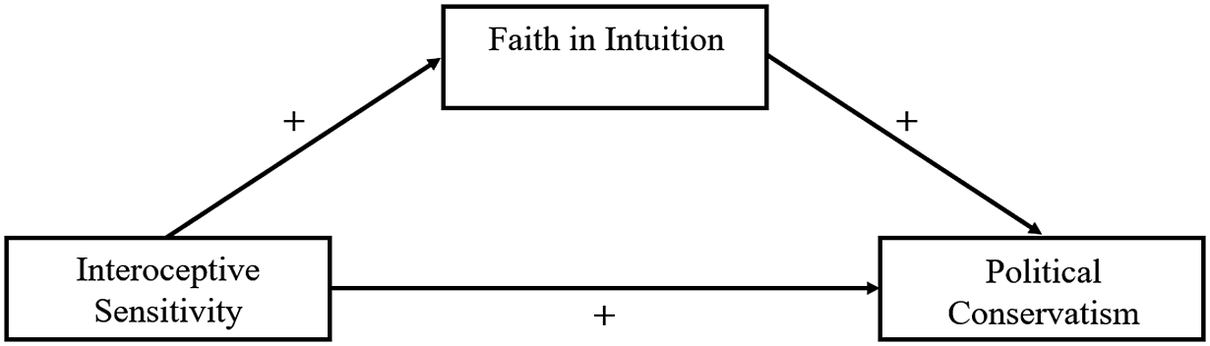
Research in social and political psychology has suggested that an individual’s degree of faith in intuition may, in turn, shape their political cognition and behavior, leading them to endorse more conservative political positions, particularly on social and cultural issues. For example, conservatives (particularly social conservatives) routinely score higher on measures of faith in intuition (e.g., Sterling et al., Reference Sterling, Jost and Pennycook2016) and closely conceptually related traits such as need for closure (a desire for a rapid answer to a question or problem, versus extended deliberation; Webster & Kruglanski, Reference Webster and Kruglanski1994) and lower on antonymous traits like need for cognition (for a review, see Jost, Reference Jost2017). Similarly, situational factors and experimental manipulations that lead an individual to rely more on intuition (versus deliberative cognition)—such as time pressure, cognitive load, and alcohol intoxication—have all been shown to lead people to endorse more conservative political positions (e.g., Eidelman et al., Reference Eidelman, Crandall, Goodman and Blanchar2012). Taken together, this research demonstrates that greater faith in intuition can lead an individual toward greater conservatism. Thus, integrating these findings with the foregoing lines of work suggests a potential pathway from interoceptive sensitivity to trust in intuition and, in turn, to greater conservatism (see Figure 1).
Hypothesized relations between interoceptive sensitivity, faith in intuition, and political conservatism.
Convergent evidence for faith in intuition as a possible mechanism for the proposed interoception-ideology relation comes from the body of research on sensitivity to disgust. First, past work provides reasons to expect that greater interoceptive sensitivity may be associated with greater disgust sensitivity. Support for such a connection comes from research demonstrating that the brain regions most frequently implicated in the experience of disgust (in particular, the anterior insula; Vytal & Hamann, Reference Vytal and Hamann2010) are also intimately involved in interoception (Duquette, Reference Duquette2017), and the emotion of disgust appears to arise in part from interoceptive signals originating in the gut and stomach (Critchley & Harrison, Reference Critchley and Harrison2013). Accordingly, greater attunement to interoceptive signals—or greater trust or reliance on these internal signals (i.e., greater faith in intuition)—may be expected to heighten the emotional experience of disgust. Thus, although the full nature of the interrelations between these factors remains a subject of ongoing research, there are reasons to anticipate predict that greater interoceptive sensitivity and/or greater faith in intuition may additionally be associated with a heightened propensity to experience disgust.
Disgust, in turn, plays an important role in political cognition. Greater disgust sensitivity is reliably correlated with greater political conservatism, particularly on social and cultural issues (Terrizzi et al., Reference Terrizzi, Shook and McDaniel2013). This association has been found to manifest across a variety of measures and methodologies, including self-reported disgust sensitivity (e.g., Inbar et al., Reference Inbar, Pizarro and Bloom2009), physiological responding (Oxley et al., Reference Oxley, Smith, Alford, Hibbing, Miller, Scalora and Hibbing2008; Smith et al., Reference Smith, Oxley, Hibbing, Alford and Hibbing2011; though see also Bakker et al., Reference Bakker, Schumacher, Gothreau and Arceneaux2020), and neurobiological measures such as fMRI (Ahn et al., Reference Ahn, Kishida, Gu, Lohrenz, Harvey, Alford and Montague2014). Further, there is some evidence that experimental manipulations that induce disgust (e.g., Adams et al., Reference Adams, Stewart and Blanchar2014; for a review, see Kiss et al., Reference Kiss, Morrison and Morrison2020) or reduce disgust (e.g., Feinberg et al., Reference Feinberg, Antonenko, Willer, Horberg and John2014) can lead, respectively, to either more or less conservative positions on certain political issues, such as support for same-sex marriage.
Although the exact reasons for the association between disgust sensitivity and political conservatism have been a matter of debate (e.g., Shook et al., Reference Shook, Terrizzi, Clay and Oosterhoff2015; Tybur et al., Reference Tybur, Inbar, Güler and Molho2015a, Reference Tybur, Inbar, Güler and Molho2015b), research suggests that much of this relationship centers on adherence to social norms and traditional sexuality. Specifically, research suggests that more disgust-sensitive individuals tend to place greater value on adherence to social norms (Tybur et al., Reference Tybur, Inbar, Aarøe, Barclay, Barlow, De Barra and Consedine2016), which often evolve culturally to limit pathogen transmission (Billing & Sherman, Reference Billing and Sherman1998; Murray et al., Reference Murray, Trudeau and Schaller2011), and to adopt more monogamous (versus promiscuous) mating strategies (Tybur et al., Reference Tybur, Inbar, Güler and Molho2015a), which can also serve to limit pathogen transmission (e.g., Nunn et al., Reference Nunn, Gittleman and Antonovics2000; Schaller & Murray, Reference Schaller and Murray2008). Because political conservatism (particularly social conservatism) tends to align with these concerns—for example, through harsher punishment of norm violators and promotion of traditional sexuality (Jost et al., Reference Jost, Glaser, Kruglanski and Sulloway2003; Wilson, Reference Wilson1973)—this leads more disgust-sensitive individuals to tend to adopt more politically conservative ideologies.
In sum, whatever the precise direction and causal nature of these interrelations, this work, taken together, provides convergent evidence for a possible relation between interoceptive sensitivity and political conservatism. Specifically, it suggests that interoceptive sensitivity and/or faith in intuition are associated with the propensity to experience disgust—which, in turn, appears to lead to greater political conservatism (see Figure 2).
Possible relations of disgust sensitivity with interoceptive sensitivity, faith in intuition, and political conservatism, to be examined in exploratory analyses.

Integrating the diverse bodies of research discussed earlier led us to our present predictions: namely, that interoceptive sensitivity may increase a person’s degree of political conservatism—in particular, by increasing reliance on intuitive (versus deliberative) cognition, and, perhaps, by heightening sensitivity to disgust. We test these hypotheses in this proposed research.
Pilot study
In preparation for this proposed research, we conducted a pilot study (N = 100 undergraduate students) to provide preliminary insight into these questions. (Data, syntax, and materials are available at https://osf.io/ygrjc.) In this study, we assessed political ideology using both a 9-point self-placement scale and an issue-based scale (Everett, Reference Everett2013). We also assessed both faith in intuition (using a six-item version of the Rational-Experiential Inventory; α = .82; Pacini & Epstein, Reference Pacini and Epstein1999) and disgust sensitivity (using both the 25-item Disgust Scale-Revised (α = .85; Haidt et al., Reference Haidt, McCauley and Rozin1994; Olatunji et al., Reference Olatunji, Williams, Tolin, Abramowitz, Sawchuk, Lohr and Elwood2007) and participants’ ratings of several disgusting images).
To assess interoceptive sensitivity, we used two subscales of the Multi-Dimensional Assessment of Interoceptive Awareness (“Noticing” and “Emotional Awareness”; α = .77) that assess attunement and accuracy in identifying one’s internal physiological states (Mehling et al., Reference Mehling, Acree, Stewart, Silas and Jones2018).Footnote 1 While this self-report-based measure is not a direct measure of interoceptive accuracy (unlike, e.g., the heartbeat perception tasks used in most research), it has been validated in past work as accurately distinguishing between those of higher and lower interoceptive sensitivity (Mehling et al., Reference Mehling, Acree, Stewart, Silas and Jones2018), and therefore it can provide initial insight into whether interoceptive sensitivity may shape political ideology.
Supporting our predictions, we found that self-reported interoceptive sensitivity was significantly associated with political ideology (β = .23, t(98) = 2.28, p = .025; see Figure 3), such that more conservative individuals reported greater attunement to internal states and processes. We also found that greater self-reported interoceptive sensitivity significantly predicted greater faith in intuition (β = .38, t(98) = 4.06, p < .001) and greater disgust sensitivity (β = .23, t(98) = 2.31, p = .023).Footnote 2 (Given power limitations, however, we do not report possible mediation effects.) Thus, although these findings rely on a self-reported interoception measure, they provide tentative evidence in support of the proposed relation between interoceptive sensitivity and political ideology. Additionally, they support the hypothesized connections between interoceptive sensitivity and both faith in intuition and sensitivity to disgust—and, in doing so, suggest a possible psychological mechanism for the interoception-ideology relation.
The relations between self-reported interoceptive sensitivity and political ideology (top), faith in intuition (bottom left), and disgust sensitivity (bottom right).

Registered report studies
For this registered report, we conducted two preregistered studies to build on our pilot research and assess the questions posed earlier. Both studies employed direct measures of interoceptive accuracy—heartbeat perception tasks—to better understand the interrelations between interoceptive sensitivity, ideology, and our hypothesized mediator faith in intuition. We tested the following three hypotheses:
H1: Interoceptive sensitivity will be associated with greater faith in intuition.
H2: Interoceptive sensitivity will be associated with greater political conservatism.
H3: The relation between interoceptive sensitivity and political conservatism will be mediated by faith in intuition, such that the positive association between interoception and faith in intuition will statistically account for the interoception-ideology relation.
In exploratory analyses, we also examined the interrelations between these factors and sensitivity to disgust.
Method
Ethics
All procedures and materials received approval from the appropriate university ethics bodies (University of Kent Ethics ID #202216595175327856; Leiden University Protocol 2022-02-08-D.T. Scheepers-V2-3731; Ohio State University IRB #2019B0398) before data collection began. All participants provided informed consent before participating.
Sample size and characteristics
Sample sizes for both studies were determined using a priori power analyses for a t-test for linear bivariate regression (one group, size of slope). To determine the sample size for Study 1, we conducted a power analysis for 80% power (alpha = 0.05) using G*Power (Faul et al., Reference Faul, Erdfelder, Buchner and Lang2009), based on an effect of r = .23 (one-tailed test), the effect size of the interoception-conservatism relation in our pilot study. This power analysis recommended a sample size of 113 participants, which we increased by 5% to 119 to account for possible missing data. Because of a scheduling error, we exceeded our target sample by four participants, resulting in a total sample of 123. (We note, however, that the results are unchanged if these final four participants are excluded from analyses.)
Ninety-two participants (74.7%) identified as women, 28 (22.8%) identified as men, and three (2.4% identified as nonbinary). Participants ranged in age from 18 to 70, with a mean age of 25.91 (SD = 12.86). Participants’ highest level of education was as follows: 2 (1.6%) had completed VMBO (preparatory secondary vocational education), 11 (8.9%) had completed HAVO (senior secondary vocational education), 58 (47.2%) had completed VWO (pre-university education), 2 (1.6%) had completed MBO level 1 or 2 (secondary vocational education), 6 (4.9%) had completed MBO level 3 or 4, 5 (4.1%) had completed HBO (professional/occupational bachelor’s degree), and 39 (31.7%) had completed WO (academic bachelor’s degree). Regarding nationality/ethnicity, 96 participants (78%) reported that both of their parents were born in the Netherlands, while the remaining 27 participants reported having at least one foreign-born parent. Of the latter 27 participants, 13 reported having one foreign-born parent—3 from Indonesia, 2 from Germany, 2 from South Africa, and 1 each from Cameroon, Denmark, Israel, Poland, Spain, and the United States. The remaining 10 participants reported having two foreign-born parents, with one pair of parents each from Belgium, China, Germany, India, Indonesia, Suriname, Turkey, and the United States; one participant had parents from Greece and Germany, and one participant had parents from Suriname and India. (Four participants did not specify the origins of their foreign-born parent[s].)
For Study 2, we leveraged an online recruitment method to allow us to increase power to 99% to detect an effect of r = .23 (one-tailed test). This resulted in a required sample size of 284 participants. We further increased this sample size by 5% to 298 to account for possible attention check exclusions and missing data. We received 299 responses.
One hundred and forty-six (48.8%) participants identified as women, 150 (50.2%) identified as men, and three (1%) identified as nonbinary. Participants ranged in age from 19 to 78, with a mean age of 39.28 (SD = 11.37). Regarding highest level of education completed, 1 participant (0.3%) did not complete high school, 28 (9.4%) reported having a high school diploma of equivalent, 53 (17.7%) attended some college but did not receive a degree, 29 (9.7%) had an associate’s degree, 130 (43.5%) had a bachelor’s degree, 46 (15.4%) had a master’s degree, and 12 (4.0%) had a professional degree (JD, MD, or PhD). Regarding race/ethnicity, 216 participants (72.2%) identified as White, 31 (10.4%) identified as Black or African American, 18 (6.0%) identified as Asian, 14 (4.7%) identified as Latino, 18 (6.0%) identified as mixed race, and 2 (0.6%) identified as another race or ethnicity.
Sampling frame
For Study 1, we recruited participants from Leiden University and the surrounding community in Leiden in the Netherlands. Participants were compensated at the university’s standard rate of €7.50 per hour.
For Study 2, we used an innovative webcam-based measure of interoceptive accuracy to recruit a large national sample of Americans online. Specifically, we used CloudResearch’s online platform (Litman et al., Reference Litman, Robinson and Abberbock2017) to recruit participants from Amazon Mechanical Turk (MTurk), a crowdworking website where people can complete short tasks online for pay (see Buhrmester et al., Reference Buhrmester, Kwang and Gosling2011). Importantly, although MTurk samples are not nationally representative, participants from MTurk have been shown to perform similar to nationally representative samples across a range of psychological tasks and measures, including questions relating to political attitudes (Berinsky et al., Reference Berinsky, Huber and Lenz2012; Clifford et al., Reference Clifford, Jewell and Waggoner2015).
Participants were eligible to participate if they (1) were based in the United States, (2) had a working webcam, and (3) had previously passed CloudResearch’s standard attention checks. Additionally, because Mechanical Turk samples tend to skew more politically liberal (Berinsky et al., Reference Berinsky, Huber and Lenz2012), to help ensure a more balanced ideological distribution, 15% of our total sample (45 participants) was recruited based on having previously identified as politically conservative in CloudResearch’s prescreening questions. Participants were compensated at a rate of $0.15 per expected minute of participation.
Materials and procedure
Interoceptive accuracy
Study 1 employed the heartbeat detection method, the current gold standard in the literature (Kleckner et al., Reference Kleckner, Wormwood, Simmons, Barrett and Quigley2015; Ring & Brener Reference Ring and Brener2018), using an auditory tone-based task to assess participants’ ability to recognize their own heartbeats (Whitehead & Drescher, Reference Whitehead and Drescher1980). In this task, participants were seated in front of a computer and small electrodes were placed on their right wrist and left and right ankles (processed through Biopac’s ECG100c module) to detect each heartbeat (specifically, the R-wave, which indicates the peak of ventricular depolarization). The heartbeats were transformed into auditory tones and played back to participants—either in sync with their own heartbeats or with varying degrees of delay (33ms, 100ms, 200ms, 300ms, 400ms, 500ms). For each trial of 10 tones (120 trials in total, presented in random order), participants were asked to press a button on their computer keyboard to judge whether the tones were synchronous or asynchronous with their own heartbeats. We assessed interoceptive accuracy following the recommendations of Ring and Brener (Reference Ring and Brener2018): by calculating the interquartile range (IQR) of the trials that were judged to be in sync. A narrower IQR indicates greater interoceptive accuracy (e.g., Ring & Brener, Reference Ring and Brener2018).
In Study 2, we assessed interoceptive accuracy using an online, webcam-based measure employing an adapted version the mental tracking method (Schandry, Reference Schandry1981). This approach also allowed us to extend our investigation to a larger and more diverse group of participants than that used in Study 1.
Participants completed the study on their home computers. They were first instructed to turn on their webcams and ensure that their workspace was well lit and a clear image was being obtained. After verifying that their webcams were working properly, they were asked to sit quietly and “mentally track” their heartbeats over six fixed intervals (two 25-second trials, two 35-second trials, and two 40-second trials), without placing a finger on their pulse. The computer program signaled the beginning and end of each trial. After each trial, participants entered the number of heartbeats they counted into a blank text box on the screen.
During each of these intervals, the participant’s actual heart rate was measured via their webcams using remote photoplethysmography (rPPG), a technique that algorithmically extracts an individual’s heartbeats from pixel changes recorded in video images, such as those recorded by consumer-grade RGB webcams (Di Lernia e tal., Reference Di Lernia, Finotti, Tsakiris, Riva and Naber2022; van der Kooij & Naber, Reference van der Kooij and Naber2019). Specifically, the software program detects subtle changes in color and ambient light signaling cycles of oxygenated and deoxygenated blood that correspond to each heartbeat. (Additional information on the program and analysis procedure can be found in van der Kooij & Naber, Reference van der Kooij and Naber2019, and at www.github.com/marnixnaber/rPPG. For use of this rPPG algorithm to measure interoceptive accuracy, see Arslanova et al., Reference Arslanova, Galvez-Pol, Kilner, Finotti and Tsakiris2022.)
Following the task, each participant’s perceived and actual heartrate was compared to assess their degree of accuracy in the task. Interoceptive accuracy on the heartbeat tracking task was scored using the following equation: Σ(1 – (|Actual number of heartbeats – participant’s estimate|/Actual number of heartbeats)) × 100 (Murphy et al., Reference Murphy, Brewer, Plans, Khalsa, Catmur and Bird2020; Shah et al., Reference Shah, Hall, Catmur and Bird2016). Importantly, based on recent critiques and best-practice recommendations, we also collected several control variables—knowledge of average human resting heart rate, exercise level, body mass index (BMI), resting heart rate, and performance in a time estimation task—to ensure the validity of this measure (see Murphy et al., Reference Murphy, Brewer, Hobson, Catmur and Bird2018; Murphy et al., Reference Murphy, Brewer, Plans, Khalsa, Catmur and Bird2020).
Dependent measures and mediators
Following the interoception task, participants in both studies completed measures assessing both our dependent and mediator variables. These measures were programmed and presented using the survey platforms Qualtrics (www.qualtrics.com) and Gorilla Experiment Builder (www.gorilla.sc).
Political ideology. The two previous lines of research that have documented associations between sensory sensitivity and political ideology have used either symbolic measures of ideology (Ruisch, Anderson, et al., Reference Ruisch, Anderson, Inbar and Pizarro2021) or operational measures of ideology (Friesen et al., Reference Friesen, Gruszczynski, Smith and Alford2020). Because we did not have strong a priori predictions regarding which type of measure should show stronger associations with interoceptive accuracy, our measure of political ideology encompassed both of these conceptualizations. Moreover, given the research reviewed earlier suggesting that we may find stronger relations with social (versus economic) ideology, we explicitly incorporated both of these dimensions as well.
Specifically, we assessed political orientation using four measures. This included the two measures used in our pilot study: the 9-point (symbolic) self-placement item (MS1 = 3.50; MS2 = 4.41) and the 100-point (operational) scale assessing positions on both social and economic issues (MS1 = 41.52; MS2 = 56.61) Additionally, we included two further single-item self-reported measures of symbolic ideology, one assessing social conservatism (“In terms of social and cultural issues, how liberal or conservative are you?”; MS1 = 2.91; MS2 = 4.01) and one assessing economic conservatism (“In terms of economic issues, how liberal or conservative are you?”; MS1 = 4.20; MS2 = 4.76), each measured on a 9-point scale from “extremely conservative” to “extremely liberal.”
For our primary analyses, we created a single composite measure of political ideology by first calculating the mean of the three symbolic self-report items and then z-scoring and averaging this measure with participants’ scores on the operational issue-based ideology measure. For our preregistered exploratory analyses testing for divergent effects for social and economic ideology, we also calculated separate measures for each of these two dimensions: our measure of social ideology was calculated by taking the average of participants’ scores on (1) the symbolic self-report item assessing social liberalism-conservatism and (2) the social/cultural issues from the issue-based scale. Similarly, our measure of economic ideology was calculated by taking the average of participants’ scores on (1) the symbolic self-report item assessing economic liberalism-conservatism and (2) scores on the economic issues from the issue-based scale.
Importantly, to account for cultural and political differences between our two samples, we made two adjustments to our ideology measures for the study conducted in the Netherlands. First, we replaced the terms “liberal” and “conservative” with the analogous terms “right” and “left” (for economic issues) and “progressive” and “conservative” (for social issues). Second, we removed one item from our issue-based scale—gun ownership—that is irrelevant in Dutch politics.
Faith in intuition. Faith in intuition was measured with the Experiential Engagement subscale of the Rational-Experiential Inventory (Pacini & Epstein, Reference Pacini and Epstein1999), which assesses the degree to which an individual relies on intuition when making judgments (e.g., “I like to rely on my intuitive impressions”; “I tend to use my heart as a guide for my actions”). Participants rated each item on a scale from “definitely not true of myself” to “definitely true of myself.”
Disgust sensitivity. Disgust sensitivity was assessed with two measures. First, we used the 21-item Three-Domain Disgust Scale (TDDS; Tybur et al., Reference Tybur, Lieberman and Griskevicius2009). We used this scale (rather than the 25-item DS-R used in our pilot study) because it is allowed for a more systematic investigation of the three principal evolutionarily based domains of disgust: pathogen, sexual, and moral disgust (Tybur et al., Reference Tybur, Lieberman and Griskevicius2009). Participants rated each item on a scale from “not at all disgusting” to “extremely disgusting.”
Additionally, we assessed disgust sensitivity through participants’ ratings of 10 disgusting images, as in our pilot study. We included this image-based measure to help circumvent potential issues associated with the exclusive use of vignette-based self-report measures (e.g., that liberal-conservative differences may be exaggerated by ideological differences in self-presentational strategies or self-beliefs, rather than differences in the underlying construct of interest per se; cf. Ruisch, Boggs, et al., Reference Ruisch, Boggs, Moore, Samayoa, Ladanyi, Steinert and Fazio2021; Taber & Young, Reference Taber, Young, Huddy, Sears and Levy2013; Van Hiel et al., Reference Van Hiel, Onraet and De Pauw2010). The images were taken from Culpepper et al. (Reference Culpepper, Havlíček, Leongómez and Roberts2018), selected to span their four broad elicitors of disgust. (Specifically, we used images 1, 2, 3, 6, 7, 8, 11, 12, 16, and 17.) Participants rated each image on a scale from “not at all disgusting” to “extremely disgusting.”
For our primary analyses, created a composite measure of disgust sensitivity by standardizing and combining participants’ ratings of the disgusting images, then averaging this score with their scores on the TDDS.
Control variables
As noted earlier, in Study 2, we included several control variables to ensure the validity of the mental tracking-based heartbeat perception task (see Murphy et al., Reference Murphy, Brewer, Hobson, Catmur and Bird2018; Murphy et al., Reference Murphy, Brewer, Plans, Khalsa, Catmur and Bird2020).
Body mass index. Participants were asked to report their current height and weight. BMI was then calculated using the following formula: BMI = kg/m2, where kg is a person’s weight in kilograms and m2 is their height in meters squared.
Exercise/activity level. Participants responded to the following question, adapted from Milton, Bull, and Bauman (Reference Milton, Bull and Bauman2011): “On average, how many days per week do you perform a total of 30 minutes or more of physical activity, which is enough to raise your breathing rate? (This may include sport, exercise, and brisk walking or cycling for recreation or to get to and from places).”
Time estimation task. As an additional control variable, participants completed a time estimation task, following the recommendations of Murphy and colleagues (Reference Murphy, Brewer, Plans, Khalsa, Catmur and Bird2020). This task mirrored the heartbeat tracking task, but rather than counting heartbeats, participants were asked to count seconds. Participants completed three trials of this task, lasting 23, 40, and 56 seconds. Accuracy scores were calculated using a formula analogous to that used for heart rate detection accuracy: Σ(1 – (|Actual number of seconds – participant’s estimate|/Actual number of seconds)) × 100.
Resting heart rate. Resting heart rate was extracted from the rPPG algorithm.
Heart rate variability. We had additionally intended to calculate heart rate variability in Study 2 from participants’ video recordings. However, the rPPG algorithm that we used did not allow for this value to be calculated, and therefore it could not be included as a control variable.
Attention check
Following recent best-practice recommendations for online studies (e.g., Robinson, Rosenzweig, Moss, & Litman, Reference Robinson, Rosenzweig, Moss and Litman2019), Study 2 also included an attention check to ensure adequate data quality. This attention check stated “Please select ‘Satisfied’ on the scale (second from the left): This item is for verification purposes,” and presented response options ranging from “1 very satisfied” to “5 not at all satisfied.”
Demographic factors
In both studies we collected information about participants’ demographic characteristics: age, gender, race/ethnicity, income, and education.
Exploratory measures
We also included several additional measures for exploratory purposes, including a measure of ideological identification: “How strongly do you identify as a [liberal/conservative]” (measured on a scale from “not at all” to “very strongly”) and a measure of religiosity: “How important is religion in your life?” (measured on a scale from “not important at all” to “very important”). A list of these exploratory measures can be found on the Open Science Framework page at https://osf.io/ygrjc/.
Results
All analyses were conducted following our preregistered analysis plan as closely as possible (see https://osf.io/28dt5). All exploratory analyses are explicitly designated as such, and any deviations from our analysis plan, however minor, are noted. All p-values are based on two-tailed tests. All data are publicly available on the Open Science Framework at https://osf.io/ygrjc/.
Exclusions
All participants from Study 1 were included in analyses.
In Study 2, as preregistered, we excluded six participants (2%) who failed our included attention check by not selecting the appropriate response (“satisfied” from the scale). Additionally, we excluded five participants who “cheated” in the heartbeat-counting task by taking their pulse. (We note, however, that none of our results are meaningfully altered if these participants are included in analyses.)
Beyond these exclusions, all complete data were included in analyses. However, there were 88 individual heartbeat-counting trials (4.9% of the 1,794 total trials) with missing data because the rPPG algorithm was unable to return a heartbeat value (either because the webcam was turned off and no video was recorded or because the video was of sufficiently poor quality that no face was detected). A further 11 participants (3.7%) were entirely unable to be included in analyses because they had no usable heartbeat-counting trials.
Faith in intuition
We first tested the hypothesis that interoceptive accuracy would be associated with greater faith in intuition. At odds with our prediction and the existing literature, we found no relation between interoceptive accuracy and faith in intuition in either sample (Dutch sample: β = –.002, t(121) = –0.02, p = .98; American sample: β = –.03, t(276) = –0.58, p = .56).
Political ideology
We then turned to examining political ideology, beginning with the American sample. Here, we found a significant association between interoceptive accuracy and political ideology—however, the nature of this association was in the opposite direction from what we predicted: Greater interoceptive accuracy predicted greater political liberalism (β = –.12, t(276) = –2.02, p = .04; see Figure 4). Critically, this association remained significant (and virtually unchanged) after adding our preregistered control variables of body mass index, activity/exercise level, resting heart rate, accuracy in the time estimation task, and the signal-to-noise ratio of the rPPG measure (β = –.12, t(265) = –2.04, p = .04).
The relation between interoceptive accuracy and political ideology in the American sample (Study 4).

Descriptively, this association was somewhat stronger for liberalism on social issues (β = –.14, t(276) = –2.51, p = .01) than on economic issues (β = –.07, t(276) = –1.16, p = .25). The association was also somewhat stronger for symbolic political ideology (β = –.14, t(276) = –2.41, p = .02) than for operational ideology (β = –.08, t(276) = –1.43, p = .15).
In the Dutch sample, there was no significant association between interoceptive accuracy and our composite measure of political orientation (β = –.06, t(121) = –0.63, p = .53). Examining the individual dimensions of political ideology, however, we found a marginally significant association between interoceptive accuracy and greater liberalism on specific policy issues (i.e., operational political ideology; β = –.16, t(121) = –1.78, p = .08). Further, we found a weak directional association between interoceptive accuracy and liberalism on social and cultural issues (β = –.14, t(121) = –1.60, p = .11). Notably, although neither of these two associations were statistically significant, both were of a similar magnitude to those observed in the United States. However, interoceptive accuracy was not associated with economic ideology (β = .002, t(121) = 0.02, p = .98) or symbolic political ideology (β = .06, t(121) = 0.72, p = .48).
In preregistered exploratory analyses, we tested for possible suppression effects between social and economic conservatism by adding both measures to the model simultaneously (cf. Costello & Lilienfeld, Reference Costello and Lilienfeld2021). In the Dutch sample, when both social ideology and economic ideology were simultaneously added as predictors of interoceptive accuracy, the relationship between interoceptive accuracy and social conservatism became descriptively somewhat stronger and was marginally significant (β = –.19, t(120) = –1.82, p = .07), while the direction of the relation with economic ideology was the opposite of that observed with social ideology: Greater interoceptive accuracy was (nonsignificantly) associated with less economic liberalism/greater economic conservatism (β = .09, t(120) = 0.88, p = .38).
A similar pattern of results was observed in the United States. When both social and economic ideology were simultaneously added to the model as predictors of interoceptive accuracy, the relation between interoception and social liberalism became stronger (β = –.26, t(275) = –2.62, p = .009), while the relation between interoception and economic ideology was again trending in the opposite direction, such that greater interoceptive accuracy was (nonsignificantly) associated with greater economic conservatism (β = .13, t(275) = 1.39, p = .17). (Mediation analyses revealed a significant suppression effect of social conservatism on the interoception-economic ideology relation in the American sample; abcs = –.20, 95% CI [–.36, –.06] and a marginal suppression effect in the Dutch sample; abcs = –.09, 95% CI [–.19, .01].)
On the whole, then, the latter set of analyses highlighted the uniquely robust association between interoceptive accuracy and the social and cultural dimension of ideology while providing tentative evidence of possible suppressor effects. Social and economic ideology, although positively correlated in both samples, appeared to exhibit opposing relations with interoceptive accuracy: while greater interoceptive accuracy predicted greater social liberalism, in the domain of economic issues no such association existed—and, if anything, greater interoceptive accuracy may be more reliably associated with greater economic conservatism.
Discussion
The results of these studies did not support our three a priori hypotheses (Table 1). Taken together, however, the findings nonetheless present an intriguing picture. Although we originally predicted, based on past research, that greater interoceptive accuracy would be associated with greater political conservatism, the associations that we observed were in fact the precise opposite: it was liberals—at least in the American sample—who exhibited greater interoceptive accuracy. While this association did not reach statistical significance in our Dutch sample and should therefore be interpreted with caution, our findings nonetheless tentatively suggest that interoceptive sensitivity may indeed play a role in political cognition—although not in the way that we had anticipated.
List of preregistered hypotheses and whether each hypothesis was supported.

This work makes several contributions to the literature, while identifying promising new directions for future research. First, these studies document a novel dimension of ideological differences in physiological processing: interoceptive sensitivity. Although the nature and causal direction of this association remain to be established, given that it appears unlikely that one’s political attitudes would shape one’s interoceptive processing, our findings may suggest that interoceptive sensitivity is a factor that might predispose an individual toward adopting a more politically liberal ideology, particularly on social and cultural issues.
Another intriguing question for future research concerns the psychological mechanisms that might underlie the interoception-liberalism relation. At odds with our predictions and those of past research, our findings suggested that neither faith in intuition nor disgust sensitivity account for the relation between interoceptive sensitivity and political attitudes. However, past research has identified numerous domains of psychological differences between liberals and conservatives (see, e.g., Jost et al., Reference Jost, Glaser, Kruglanski and Sulloway2003; Ruisch, Moore et al., Reference Ruisch, Moore, Granados Samayoa, Boggs, Ladanyi and Fazio2021), some of which may help to explain the association between interoceptive sensitivity and political liberalism.
For example, one potential mechanism relates to empathic concern and perspective taking. Research has suggested that greater interoceptive sensitivity may be associated with certain facets of empathy, including accurately recognizing the emotional experiences of others (Terasawa et al., Reference Terasawa, Moriguchi, Tochizawa and Umeda2014). Research from political psychology, in turn, has documented ideological differences in empathic concern (e.g., Ruisch, Moore et al., Reference Ruisch, Moore, Granados Samayoa, Boggs, Ladanyi and Fazio2021; Waytz et al., Reference Waytz, Iyer, Young, Haidt and Graham2019), with liberals tending to score higher on certain dimensions of empathy. Indeed, these differences in empathy have been theorized to explain core elements of ideology itself—particularly liberals’ greater concern for individuals belonging to social out-groups (Waytz et al., Reference Waytz, Iyer, Young, Haidt and Graham2019). Empathic concern, then, may be a fruitful avenue of exploration for research seeking to understand the relation between interoception and liberalism.
More generally, our findings suggest a potential pathway toward developing a comprehensive theoretical understanding of how sensitivity in different sensory domains influences political attitudes. As noted earlier, the two previous lines of research that have examined the relations between sensory sensitivity and political ideology have focused on two exteroceptive sensory domains—taste and smell—which are oriented toward collecting and transmitting information from the outside world. In both of these past lines of work, individuals who were more sensitive in these exteroceptive domains tended to be more politically conservative.
Conversely, in this research, we examined interoceptive sensitivity—a broad class of “inwardly oriented” sensory processes that collect and transmit information about the current state and functioning of one’s own physiological body. At odds with the aforementioned research on exteroceptive sensitivities, here we instead found that greater sensitivity was associated with greater political liberalism.
Considered together, these three lines of research suggest an intriguing, although still highly speculative, possibility: that sensitivity in exteroceptive domains (i.e., taste, smell, touch, sight, hearing) may predispose an individual toward greater political conservatism, while sensitivity in interoceptive domains may predispose one toward greater political liberalism. Future researchers may wish to further explore this possibility—as well as test the mechanisms underlying such effects, should they exist.
Self-reported interoceptive sensitivity versus objective interoceptive accuracy
Another interesting remaining question concerns the seemingly divergent pattern of effects that we found in our pilot study using the self-report measure of interoceptive sensitivity (measuring one’s beliefs about one’s own accuracy in identifying internal states) and those observed with the more objective heartbeat-detection-based measure of interoceptive accuracy in Study 2. Although it is possible that the divergent results were simply due to particularities of the samples we examined, the pattern of results appears to suggest that although American conservatives in fact exhibited lower interoceptive accuracy than liberals, they nonetheless believed that they were more accurate. Or, viewed from another angle, although liberals tended to score higher than conservatives in interoceptive accuracy, they nonetheless believed that they were less accurate. Although unexpected, this pattern of results appears broadly consistent with recent research showing that conservatives may simply be more confident in their skills and abilities across the board—even when they do not objectively perform better—while liberals tend to be more cautious and underconfident (Ruisch & Stern, Reference Ruisch and Stern2021). Future research will be needed to understand why conservatives’ and liberals’ beliefs about their own degree of interoceptive sensitivity diverge so markedly from their objective interoceptive abilities—as well as the possible downstream implications of this belief-ability gap for cognition and behavior.
More generally, the observed divergence between self-reported interoceptive sensitivity and measured interoceptive accuracy appears consistent with past work showing that people’s self-reported emotional responses to stimuli often do not cohere with their physiological responses (e.g., Balzer & Jacobs, Reference Balzer and Jacobs2011; Friesen et al., Reference Friesen, Smith and Hibbing2017). Considered alongside the present findings, this past work underscores the need for caution in selecting appropriate measures of interoceptive sensitivity and related processes, while highlighting that there are numerous concerns and motivations (e.g., gender-based roles and expectations, social desirability motivations; Balzer & Jacobs, Reference Balzer and Jacobs2011; Friesen et al., Reference Friesen, Smith and Hibbing2017) that can systematically bias people’s self-reports of their internal states and physiological processes. Researchers seeking to deepen our understanding of the relation between interoception and political attitudes will likely benefit from simultaneously assessing both subjective perceptions of interoceptive sensitivity and objective interoceptive accuracy, as well as considering the traits and motivations that might drive the apparent disconnect between these different dimensions.
Social versus economic ideology
Another crucial finding of the present research concerns the divergent pattern of results observed with social and economic conservatism. Across both our Dutch and American samples, the association between interoceptive accuracy and political ideology was stronger for social than for economic liberalism. We also found some evidence of suppression effects, with greater interoceptive accuracy directionally predicting less economic liberalism (or greater economic conservatism) after adjusting for social ideology.
Although the specific directions of these associations were not as expected, the stronger association that we documented with social (versus economic) conservatism was very much in line with our predictions. Indeed, past research has shown that social and economic ideologies are associated with distinct—and sometimes opposing—psychological traits and motivations (Johnston & Ollerenshaw, Reference Johnston and Ollerenshaw2020; Malka et al., Reference Malka, Lelkes and Soto2019; Malka & Soto, Reference Malka and Soto2015), and past research on the physiological underpinnings of political ideology has typically found stronger associations between physiology and social ideology (e.g., Aarøe et al., Reference Aarøe, Petersen and Arceneaux2017; Balzer & Jacobs, Reference Balzer and Jacobs2011; Friesen et al., Reference Friesen, Smith and Hibbing2017; Friesen et al., Reference Friesen, Gruszczynski, Smith and Alford2020; Oxley et al., Reference Oxley, Smith, Alford, Hibbing, Miller, Scalora and Hibbing2008; for reviews, see Hibbing et al., Reference Hibbing, Smith and Alford2014 and Smith & Warren, Reference Smith and Warren2020).
Importantly, however, although this past research on the psychology of political ideology provides reasons to anticipate somewhat stronger relations with social ideology, it does not provide a clear rationale for why the direction of this relation appeared to reverse entirely for economic ideology. Should this pattern of associations prove to be reliable, future research will need to determine why greater interoceptive sensitivity might predispose an individual toward adopting a more politically liberal social ideology, but a more politically conservative economic ideology.
Recent theoretical perspectives that challenge the field’s long-held assumptions regarding the psychological underpinnings of economic ideology may provide some guidance. For example, Malka and colleagues (Malka et al., Reference Malka, Lelkes and Soto2019; Malka & Soto, Reference Malka and Soto2015) have argued that while traits such as threat sensitivity may predispose an individual toward greater social and cultural conservatism (insofar as this set of views offers social order, security, and cultural protection), greater sensitivity to threat may in fact be more naturally associated with more liberal economic positions (insofar as liberal economic policies such as welfare provide protection against risk and material loss). According to these perspectives, it is the relatively greater importance of social and cultural attitudes (e.g., Crawford et al., Reference Crawford, Brandt, Inbar, Chambers and Motyl2017)—combined with the structural and situational features of certain sociopolitical contexts (e.g., in the United States, a polarized two-party system and an elite political rhetoric that frequently aligns social and economic ideologies)—that leads to the often statistically significant, although ultimately artificial, positive associations between threat sensitivity and economic conservatism in many nations. (Though statistical techniques such as suppression analyses can nonetheless reveal the opposing psychological underpinnings of economic and social ideologies even in these contexts; Costello & Lilienfeld, Reference Costello and Lilienfeld2021.) However, expanding the field of investigation to include other (especially non-U.S.) nations where this particular set of structural and situational factors are less prevalent reveals the more common—and arguably more natural—association between threat sensitivity and economic liberalism.
By the same token, our results may suggest that while interoceptive sensitivity tends to predispose an individual toward greater social liberalism, it is at the same time more naturally associated with greater economic conservatism. Uncovering the psychological mechanisms underlying each of these divergent associations will allow us to test this possibility.
The role of sociopolitical context
Relatedly, a final set of critical questions for future research concerns whether, how, and why the nature of the relation between interoceptive sensitivity and political ideology may differ across different sociopolitical contexts. In our research, we found that the relation between interoception and our composite measure of political ideology was primarily limited to the United States: although the Dutch sample exhibited a marginally significant association between interoceptive accuracy and operational liberalism, as well as a directional trend with social/cultural liberalism, there was little evidence that interoceptive sensitivity was associated with general political ideology in the Netherlands. While it is, of course, possible that the null results that we obtained in the Dutch sample stemmed from methodological or sample-related factors (e.g., the smaller N, the predominately student-based sample, or the interoception task used), an alternative interpretation is simply that the relation between interoception and ideology is weaker in the Netherlands.
Indeed, there are several differences between the American and Dutch sociopolitical landscapes that might be expected to contribute to such divergent effects. In particular, the modern United States features a highly polarized two-party political system, while the Netherlands has a less polarized multiparty political system that has been lauded as being among the top democracies for fostering consensus (Adams et al., Reference Adams, De Vries and Leiter2012; Lijphart, Reference Lijphart2012; Reiljan, Reference Reiljan2019). Consistent with the rationale outlined earlier, it may be that the particularly divisive nature of social issues in the United States, coupled with the tight alignment of social and economic ideologies, gives rise to an overall association between interoceptive sensitivity and political liberalism. In the Netherlands, however, with lower levels of polarization around social issues and a multiparty system that allows economic and social ideologies to vary more freely, this association between interoceptive sensitivity and overall political ideology does not emerge. (Although, as noted, the association between interoceptive sensitivity and social liberalism is still of a roughly equal magnitude.) Additional replications in other national contexts will be necessary to answer these questions and assess the generalizability of these effects.
More generally, it is notable that the pattern of effects that we documented—with a significant association between interoception and ideology emerging in the United States but not the Netherlands—appears to align with the literature on physiological processing and political ideology writ large. Indeed, past research that has uncovered relations between political ideology and lower-level biological and physiological traits has tended to disproportionately come from American research samples (e.g., Friesen et al., Reference Friesen, Gruszczynski, Smith and Alford2020; Oxley et al., Reference Oxley, Smith, Alford, Hibbing, Miller, Scalora and Hibbing2008; Ruisch, Anderson et al., Reference Ruisch, Anderson, Inbar and Pizarro2021), with few significant associations having been documented in other nations. Moreover, attempts to replicate key findings in this research area (e.g., the association between physiological threat sensitivity and political conservatism) have typically been more successful in the United States compared to other nations (e.g., Denmark; Osmundsen et al., Reference Osmundsen, Hendry, Laustsen, Smith and Petersen2022; though see also Bakker et al., Reference Bakker, Schumacher, Gothreau and Arceneaux2020, for failures to replicate this effect in the United States as well). Taken together, this pattern of effects suggests that the associations between physiological processing and political ideology—including the associations documented here concerning interoceptive sensitivity—may emerge more reliably in the United States. Further research will be needed to understand the features of the American sociopolitical context that lead to this seemingly more direct association between physiological traits and political ideologies, as well as whether there may be other nations and sociopolitical contexts in which similar effects can be observed.
Concluding remarks
In this registered report, we set out to test the hypothesis that heightened interoceptive sensitivity would be associated with greater political conservatism. Although we did uncover evidence of a relation between interoceptive sensitivity and political ideology, this relation was the polar opposite of that which we predicted: it was liberals, not conservatives, who exhibited greater interoceptive accuracy. Although many questions remain regarding the nature, causal direction, and psychological mechanisms of this association—as well as the degree to which it extends beyond the United States to other nations and sociopolitical contexts—this research provides intriguing new insights into the factors that shape our political attitudes. We hope that these findings will prove generative for future research and theory on the physiological underpinnings of political ideology.
Acknowledgments
We wish to thank the following individuals for their assistance with data collection: Nicolas Kurtenbach, Elisabeth Achteresch, Linda Bomm, Lara Dinç, Satu Koivusaari, Alessandro Palumbo, Pia Marie Schmidt, and Britta van den Bergh Weerman.
Funding
This project received funding from the European Union’s Horizon 2020 program under Marie Skłodowska-Curie grant no. #897440 and the Association for Politics and the Life Sciences.
Competing interests statement
All authors confirm that they have no competing interests.
Data availability statement
This article earned Open Data, Open Materials, and Preregistration badges for open scientific practices. The materials, data, and preregistration that support the findings of this study and the award of these badges are openly available at https://osf.io/ygrjc/.


 Open access

