

1. INTRODUCTION
The languages of the world are known to differ in their degree of transparency, i.e. in the extent to which they show one-to-one meaning-to-form mappings (Leufkens Reference Leufkens2015, Hengeveld & Leufkens Reference Hengeveld and Leufkens2017). Thus, whereas some languages display many transparent one-to-one relations, others contain more opaque characteristics. The present study investigates how such differences between languages may be explained, focusing on the influence of language contact. Previous literature on linguistic complexity that has addressed lack of transparency as one of the main components of complexity proposes that extensive but short-term language contact with adult outsiders tends to cause languages to show increasing transparency (Kusters Reference Kusters2003:62; Wray & Grace Reference Wray and Grace2007:550; Lupyan & Dale Reference Lupyan and Dale2010:2; Trudgill Reference Trudgill2011:40, 95). Without much contact exposure, by contrast, languages are expected to maintain or even further develop opaque or complex characteristics (McWhorter Reference McWhorter2007:4–5; Wray & Grace Reference Wray and Grace2007:550; Trudgill Reference Trudgill2011:64; Leufkens Reference Leufkens2015:44). It may thus be hypothesized that languages that have undergone intensive, recurrent contact with foreign adults generally show a higher degree of transparency than languages that have developed in a relatively isolated setting.
Important support for this predicted relation between language contact and transparency comes from Leufkens (Reference Leufkens2013), who demonstrates that creoles, which are young languages that have emerged through large-scale language contact between adults, are indeed more transparent than their sub- and superstrate languages. However, the hypothesis regarding language contact and transparency also predicts that transparency differences can be found between related languages which have developed very similarly genealogically that however have experienced different degrees of language contact. The present study therefore investigates the connection between language contact and transparency by comparing Icelandic and Norwegian (Bokmål) on their degree of transparency.
Icelandic and Norwegian are both descendants of Old Norse, and hence in many ways highly similar, but differ in the degree of contact that they have been exposed to. Whereas Icelandic has been used in a highly isolated setting, Norwegian has over the centuries undergone extensive contact with adult outsiders speaking Low German and Danish (Haugen Reference Haugen1976:64–65; Trudgill Reference Trudgill and Jahr2000:71, Reference Trudgill2011:6; Kusters Reference Kusters2003:179). It may therefore be predicted that modern Norwegian shows more transparent features than present-day Icelandic. The common observation that Norwegian has changed considerably from Old Norse, whereas Icelandic has grammatically been relatively stable (Haugen Reference Haugen1976:32; Thráinsson Reference Thráinsson, König and van der Auwera1994:142; Askedal Reference Askedal and Bandle2005a:1872; Trudgill Reference Trudgill2011:4) supports this prediction, suggesting that Norwegian has acquired more transparent characteristics, whereas Icelandic has been more conservative and still shows opaque features that were already present in Old Norse.
The present study evaluates the degree of transparency of the two languages from a Functional Discourse Grammar perspective (Hengeveld & Mackenzie Reference Hengeveld and Mackenzie2008). The Functional Discourse Grammar framework, presented in detail in Section 2.1, distinguishes four levels of linguistic organization, i.e. an Interpersonal, Representational, Morphosyntactic and Phonological Level, which describe linguistic utterances in terms of their pragmatic, semantic, morphosyntactic and phonological characteristics respectively. Transparency is then defined as a one-to-one relation between units at each of these levels (Leufkens Reference Leufkens2015:13; Hengeveld & Leufkens Reference Hengeveld and Leufkens2017). Based on this transparency definition, Leufkens (Reference Leufkens2015) formulates a set of opacity features which all violate transparency in a different way. Languages that show a large number of these features are considered less transparent than languages that display only few such features. The present paper uses these opacity features to compare the degree of transparency of Norwegian and Icelandic.
The outline of the paper is as follows. Section 2 first describes the definition of transparency and the opacity features proposed in Functional Discourse Grammar, which are used in the present study. Subsequently, Section 3 discusses the notions transparency and complexity and their hypothesized relation to language contact. Section 4 then addresses the genealogical relationship between Norwegian and Icelandic and their history as regards their exposure to language contact, showing that these languages can indeed be used to test the hypothesized relation between language contact and transparency. The method used in investigating the degree of transparency of Icelandic and Norwegian is described in Section 5, and Section 6 contains the results of this investigation. Finally, Section 7 discusses the findings and concludes whether the Norwegian and Icelandic data support the hypothesis that languages that have experienced extensive contact with adult outsiders become more transparent than languages that have been more isolated.
2. TRANSPARENCY IN FUNCTIONAL DISCOURSE GRAMMAR
2.1 Defining transparency in Functional Discourse Grammar
Functional Discourse Grammar (FDG) is a functional linguistic theory that investigates linguistic forms in terms of their communicative functions (Hengeveld & Mackenzie Reference Hengeveld and Mackenzie2008). The framework makes use of a top–down approach in which language production starts with a communicative intention and ends with the articulation of an utterance. The communicative intention is formed in the pre-grammatical Conceptual Component. This intention is then passed on to the Grammatical Component, which consists of four linguistic levels. The first two levels, the Interpersonal Level (IL) and the Representational Level (RL), take care of the Formulation of the utterance. At the Interpersonal Level the pragmatic units of the utterance, such as illocutions and acts of reference, are accounted for, while the semantic units of the utterance, e.g. propositions and predications, are selected at the Representational Level. Subsequently, Encoding of the utterance takes place at the Morphosyntactic Level (ML) and the Phonological Level (PL), where the utterance is expressed in morphosyntactic and phonological units, such as morphosyntactic and phonological phrases and words. Both Formulation and Encoding may make use of information about the discourse setting and the preceding utterances, kept in the Contextual Component. In this way, the correct use of for instance anaphora and reflexives can be explained. Finally, the utterance proceeds to the Output Component, where it is converted to spoken, signed or written language.
On the basis of the four levels in the Grammatical Component, FDG allows for a very precise definition of transparency (Leufkens Reference Leufkens2015:13; Hengeveld & Leufkens Reference Hengeveld and Leufkens2017). An utterance is completely transparent if every unit at each level matches exactly one unit at each of the other levels, i.e. when every pragmatic unit corresponds to exactly one semantic unit, which is then encoded as exactly one morphosyntactic and one phonological unit. Figure 1 exemplifies transparent relations between IL and RL on the basis of the utterance the girl reads. This utterance contains an act of reference, the girl, and an act of ascription, reads, at IL, which transparently match an individual, the girl, and a predicate, reads, at RL.
Transparent IL–RL relations.

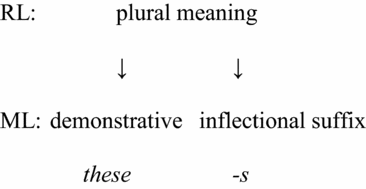
However, the four grammatical levels distinguished in the Grammatical Component are in principle independent of each other, i.e. there is not necessarily a one-to-one relation between units at IL, RL, ML and PL (Hengeveld & Mackenzie Reference Hengeveld and Mackenzie2008:16–18). In this way, FDG captures the occurrence of opacity in languages as the lack of an exact one-to-one correspondence between units at any two levels, i.e. at the IL–RL, IL–ML, IL–PL, RL–ML, RL–PL or ML–PL interface (Leufkens Reference Leufkens2015:13). For instance, opacity in the form of a one-to-many RL–ML relation occurs in the utterance these houses, in which the semantic plural unit at RL is expressed twice at ML, both by the plural form of the demonstrative and by the plural nominal inflection, as displayed in Figure 2.
A one-to-many RL–ML relation, showing an example of an opaque utterance.
By including relations between both pragmatic, semantic, morphosyntactic and phonological characteristics of languages in its definition of transparency, FDG aims to enable one to study the overall degree of transparency of a grammar as a whole, i.e. the degree of global transparency, rather than the degree of local transparency, which would involve studying only one aspect of a grammar, such as its phonology or syntax (compare global vs. local complexity, as discussed by Miestamo Reference Miestamo, Sinnemäki and Karlsson2008:30). The opacity features formulated by Leufkens (Reference Leufkens2015), to be introduced in Section 2.2, moreover include all mismatches between IL, RL, ML and PL that are recognized in FDG (Leufkens Reference Leufkens2015:4), such that all types of grammatical opacity that are possible in the theory are represented. Note however that the FDG approach focuses on grammatical transparency only, i.e. semantic or lexical opacity, such as homonymy, polysemy and non-compositionality in compounds and derivations, is not included (Leufkens Reference Leufkens2015:15).
2.2 Opacity features
Opacity thus obtains when the one-to-one relation between units at different grammatical levels is violated. Several types of transparency violations can be identified, and each type can take the form of various opacity features (Leufkens Reference Leufkens2015). In this section these opacity features are briefly defined and exemplified. More extensive exemplification follows in Section 6, which studies the manifestation of the features in Norwegian and Icelandic.
The first type of transparency violations is redundancy, which involves one unit of meaning corresponding to more than one unit of form, i.e. a one-to-many relation between two levels (Leufkens Reference Leufkens2015:18). In general, redundancy obtains when one semantic unit is copied onto another element such that it is formally represented more than once. The present study investigates all redundancy features formulated in FDG, except for the features that Leufkens (Reference Leufkens2015:50–63, 137) assumes to be (almost) universal or practically immeasurable and thus seem unsuitable for a comparison of languages’ degree of transparency.Footnote 1 The investigated features are shown in Table 1.
Redundancy features in FDG (Leufkens Reference Leufkens2015) investigated in the present study.

Secondly, non-transparency may take the form of discontinuity (Leufkens Reference Leufkens2015:19). In this case, two units that belong together at one level are separated from each other at another level, leading to a one-to-fragments relation. Table 2 presents the four discontinuity features distinguished in FDG.
Discontinuity features in FDG (Leufkens Reference Leufkens2015).

a Leufkens (Reference Leufkens2015) does not include this feature in her typological study as it is generally not measurable on the basis of reference grammars. However, as enough data were available for Norwegian and Icelandic, this feature is nevertheless included in the present study.
A third type of opacity, called fusion, involves a many-to-one relation between levels, i.e. one formal element expresses more than one meaning (Leufkens Reference Leufkens2015:19). Table 3 presents the fusion features recognized in FDG.
Fusion features in FDG (Leufkens Reference Leufkens2015).

Fourthly, opacity may be due to a null-to-one relation between two levels (Leufkens Reference Leufkens2015:17–18). This type of non-transparency is called form-based form, as it typically involves the presence of a morphosyntactic or phonological unit that does not correspond to any pragmatic or semantic unit, such that a particular grammatical form or distinction is only formally required. Table 4 shows the FDG form-based form features.
Form-based form features in FDG (Leufkens Reference Leufkens2015).

a Note that the term head-marking here concerns marking of semantic units on the head of a phrase in contrast to marking on the phrase as a whole. This opacity feature thus concerns a distinction between head- and phrase-marking and does not deal with the distinction between head- and dependent-marking as discussed by Nichols (Reference Nichols1986).
A final logically possible violation of the one-to-one principle involves one-to-null relations, in which a unit of meaning is present without being encoded at the Morphosyntactic or Phonological Level (Leufkens Reference Leufkens2015:17). Although this type of relation is certainly non-transparent, it cannot be used to diagnose opacity in languages, as it is not possible to prove the presence of a pragmatic or semantic unit without any formal evidence for it (Leufkens Reference Leufkens2015:17). For instance, some models assume the existence of non-overt arguments, but it always remains uncertain whether a clause contains a non-overt argument or whether its verb uses an alternative argument structure with one less argument. One-to-null relations are therefore not included in the set of opacity features.
Note that the FDG types of opacity described in this section partly overlap with the non-transparency classifications by Kusters (Reference Kusters2003:26–30) and Miestamo (Reference Miestamo and Miestamo2008:34–36), who recognize syntagmatic and paradigmatic one-to-many and many-to-one meaning-to-form relations as violations of transparency. Syntagmatic one-to-many relations, syntagmatic many-to-one relations, and paradigmatic one-to-many relations correspond to redundancy and discontinuity, fusion, and form-based form respectively. However, paradigmatic many-to-one relations are excluded from the FDG approach as they, in contrast to the other types of opacity discussed, often relate to the lexicon rather than to the grammar, while the FDG approach concerns grammatical rather than lexical transparency (Leufkens Reference Leufkens2015:15, 31).
2.3 Varying degrees of transparency
The opacity features described in Section 2.2 can be used to determine the degree of transparency of a language by evaluating for each feature whether or not it is present in the language under consideration (see Section 5 for a discussion of this method). On the basis of a typological study Leufkens (Reference Leufkens2015) shows that languages vary greatly in the number of opacity features that they show and thus in their degree of transparency. However, Leufkens (Reference Leufkens2015:127) also demonstrates that this variation between languages is not random but can instead be described by an implicational hierarchy, represented in Figure 3.Footnote 2 This hierarchy is implicational in that features higher on the hierarchy are predicted to occur in languages only if they also show all features lower on the hierarchy. In Leufkens’ study of 22 languages only one counterexample to this hierarchy is attested: Samoan shows irregular stem formation without displaying predominant head-marking, although the latter feature is ranked lower (Leufkens Reference Leufkens2015:131).
Implicational hierarchy of opacity features (Leufkens Reference Leufkens2015:127).

Not all features discussed in Section 2.2 appear in the hierarchy in Figure 3, as the distribution of some features does not seem to show a cross-linguistic pattern. Interestingly, all discontinuity features are absent from the hierarchy, as the presence of discontinuity does not appear to be related to the overall degree of transparency of a language (Leufkens Reference Leufkens2015:136). For the other types of opacity, Leufkens (Reference Leufkens2015:132, 140–141) notes that those features that involve a high degree of syntacticity, i.e. syntactic structure that does not reflect semantic or pragmatic motivations, appear least frequently in languages. By contrast, features involving phonology tend to occur low on the hierarchy (Leufkens Reference Leufkens2015:141), and phonological transparency thus seems to be violated relatively easily.
3. COMPLEXITY, TRANSPARENCY AND LANGUAGE CONTACT
The investigation of transparency is closely intertwined with the study of linguistic complexity, which has been the topic of an increasing body of literature (e.g. Kusters Reference Kusters2003, Dahl Reference Dahl2004, McWhorter Reference McWhorter2007, Miestamo, Sinnemäki & Karlsson Reference Miestamo, Sinnemäki and Karlsson2008, Sampson, Gil & Trudgill Reference Sampson, Gil and Trudgill2009, Kortmann & Szmrecsanyi Reference Kortmann and Szmrecsanyi2012, Newmeyer & Preston Reference Newmeyer and Preston2014). While defining and measuring complexity can be problematic (McWhorter Reference McWhorter2001:133; Miestamo Reference Miestamo and Miestamo2008:30), many scholars assume that one central characteristic of complexity is a low degree of transparency, that is, a low proportion of one-to-one meaning-to-form correspondences in linguistic structures (Kusters Reference Kusters2003; Miestamo Reference Miestamo and Miestamo2008; Sinnemäki Reference Sinnemäki and Miestamo2008, Reference Sampson, Gil and Trudgill2009; Trudgill Reference Trudgill2011), and the present research follows this assumption. Complexity may both be regarded as an absolute notion, i.e. as an objective concept that captures the complexity of a grammatical system, and as a relative notion, i.e. as the difficulty of a language for particular language users as regards acquisition and processing (Dahl Reference Dahl2004:39; Miestamo Reference Miestamo and Miestamo2008:24). Relative complexity, i.e. difficulty, is often defined with reference to adult second language (L2) learners (Kusters Reference Kusters2003; Szmrecsanyi & Kortmann Reference Szmrecsanyi, Kortmann and Sampson2009:65; Trudgill Reference Trudgill2011). Transparency, being a component of complexity, may also be investigated both from an absolute and from a relative perspective. On the one hand, transparency can be measured objectively (Dahl Reference Dahl2004, McWhorter Reference McWhorter2007, Miestamo Reference Miestamo and Miestamo2008), and the FDG opacity features discussed in Section 2.2 allow for such a measurement. On the other hand, transparency has been considered a part of relative complexity in terms of difficulty for adult L2 learners, as a low degree of transparency has been argued to make languages more difficult for them to acquire (Kusters Reference Kusters2003:55–56; Sinnemäki Reference Sinnemäki and Sampson2009:128; Housen & Simoens Reference Housen and Simoens2016:168), while increasing transparency has been proposed to make a language easier for such learners (Wray & Grace Reference Wray and Grace2007:551; Trudgill Reference Trudgill2011:41).
Languages have been shown to differ in their degree of transparency, and one may wonder how such differences arise. One of the possibly relevant factors with respect to this issue is language contact, which has also been investigated as a cause of complexity in general by for instance McWhorter (Reference McWhorter2001), Kusters (Reference Kusters2003), Sinnemäki (Reference Sinnemäki and Sampson2009), Szmrecsanyi & Kortmann (Reference Szmrecsanyi, Kortmann and Sampson2009) and Trudgill (Reference Trudgill2011). Since transparency has been argued to facilitate adult L2 learning, in contact settings with many adult L2 learners transparency may be preferred. More specifically, Kusters (Reference Kusters2003:62), McWhorter (Reference McWhorter2007:4–5), Wray & Grace (Reference Wray and Grace2007:557), Trudgill (Reference Trudgill2011:40–41) and Maitz & Németh (Reference Maitz and Németh2014:3) hypothesize that in settings with extensive language contact with large numbers of adult L2 learners that are generally only in contact with L1 speakers during a short time in which the L1 speakers and L2 learners simply focus on understanding each other rather than on perfect learning, simplification in the form of increasing transparency tends to take place, especially when there is no strict adherence to norms in the language involved (Maitz & Németh Reference Maitz and Németh2014:21–22). By contrast, languages that have not experienced much contact are expected to retain or even increase their degree of complexity, including opacity (McWhorter Reference McWhorter2007:4–5; Wray & Grace Reference Wray and Grace2007:550; Trudgill Reference Trudgill2011:64; Leufkens Reference Leufkens2015:44). Of course, languages in the relevant contact settings do not necessarily become fully transparent. For instance, highly complex, irregular forms may remain complex due to their high token frequency, which also facilitates L2 learning (Ellis & Schmidt Reference Ellis and Schmidt1997). Nevertheless, the expectation is that these languages overall show increasing transparency. The most extreme examples of such settings can give rise to creoles (Trudgill Reference Trudgill2001), which have been argued to consistently display a high degree of simplicity (McWhorter Reference McWhorter2001) or, more specifically, transparency (Leufkens Reference Leufkens2013).
Importantly, although dialect contact, i.e. contact between genealogically closely related and typically mutually intelligible languages, and contact between non-related languages may generally have very different results, simplification and increasing transparency may occur in contexts with either type of contact (Jahr Reference Jahr and Jahr1999:131; Duke Reference Duke, Dammel, Kürschner and Nübling2010:649–650; Trudgill Reference Trudgill2011:68). Note, however, that the type of contact setting seems decisive, as language contact may also lead to complexification, including an increase in opacity. This type of language change is predicted to occur in stable, long-term contact settings with a high degree of bilingualism and many child learners (Trudgill Reference Trudgill2011:34).
4. ICELANDIC AND NORWEGIAN AND LANGUAGE CONTACT
4.1 The North Germanic languages
Icelandic and Norwegian belong to the Northern branch of the Germanic languages, which are part of the Indo-European family (Vikør Reference Vikør2001:32; Torp Reference Torp and Stampe Sletten2004:25). The North Germanic languages can be further divided into a West and an East Scandinavian group, which emerged in the seventh century, when the dialects spoken in Scandinavia split into two as a consequence of a number of sound changes (Faarlund Reference Faarlund, König and van der Auwera1994:38; Vikør Reference Vikør2001:33, 37–38; Torp Reference Torp and Stampe Sletten2004:30, 56). These groups are shown in Figure 4. The West Scandinavian language or dialect group is usually called Old Norse and was spoken in Norway (Faarlund Reference Faarlund, König and van der Auwera1994:38; Vikør Reference Vikør2001:37). As the first settlers of Iceland and the Faroe Islands, who arrived around the year 900, came from Norway, the Old Norse language also reached these countries (Vikør Reference Vikør2001:57, 61).
The North Germanic languages, divided into a West and an East Scandinavian group (based on Torp Reference Torp and Stampe Sletten2004:30).

Modern Norwegian and modern Icelandic both descended from Old Norse and are thus very closely related (Torp Reference Torp and Stampe Sletten2004:30). Nevertheless, present-day Norwegian seems much more similar to Swedish and Danish, i.e. the East Scandinavian languages, than to Icelandic (Torp Reference Torp and Stampe Sletten2004:30; Husby Reference Husby2007:8). On the basis of the current status of the Scandinavian languages it is therefore more useful to divide them into Insular Scandinavian (Icelandic, Faroese) and Mainland Scandinavian (Norwegian, Danish and Swedish) (Vikør Reference Vikør2001:45; Torp Reference Torp and Stampe Sletten2004:45), as in Figure 5.
The North Germanic languages, divided into Insular Scandinavian and Mainland Scandinavian (based on Torp Reference Torp and Stampe Sletten2004:45).

4.2 Language contact in Norwegian
Over the centuries, the Norwegian language has clearly been affected by language contact (Haugen Reference Haugen1976:64–65; Kusters Reference Kusters2003:191; Jahr Reference Jahr, Wiggen, Bull and Nielsen2008:247). In the first place, during the late Middle Ages, intensive trade with the Hansa League led to language contact with Low German (Haugen Reference Haugen1976:65; Vikør Reference Vikør2001:42; Kusters Reference Kusters2003:192). Large numbers of German adult men came to Norway, who typically did not settle permanently but rather stayed for a short period, without becoming fluent in Norwegian (Trudgill Reference Trudgill and Jahr2000:75, Reference Trudgill2011:57; Kusters Reference Kusters2003:192; Jahr Reference Jahr, Wiggen, Bull and Nielsen2008:250). Learning Norwegian was not necessary, as the Germans and Norwegians only needed to communicate in order to facilitate trade and their languages were probably to a considerable extent mutually intelligible (Skard Reference Skard1976:132; Braunmüller Reference Braunmüller1997:367; Kusters Reference Kusters2003:192; Mæhlum Reference Mæhlum and Bandle2005:1910; Jahr Reference Jahr, Wiggen, Bull and Nielsen2008:250; Trudgill Reference Trudgill2011:25). Moreover, Low German was considered a highly prestigious language, and as variation was normal due to the lack of a linguistic standard, Norwegians were relatively willing to adapt to Low German (Braunmüller Reference Braunmüller1997:371–372; Vikør Reference Vikør2001:42; Kusters Reference Kusters2003:192–193; Mæhlum Reference Mæhlum and Bandle2005:1910).
This contact with Low German has been argued to have had a great impact on the Norwegian language. Not only were large numbers of words and derivational affixes borrowed from Low German into Norwegian (Vikør Reference Vikør2001:42–43; Mæhlum Reference Mæhlum and Bandle2005:1910; Jahr Reference Jahr, Wiggen, Bull and Nielsen2008:246), but it has also been suggested that this contact has been a major factor in the simplification that much of the Norwegian inflection has undergone since the Old Norse period (Haugen Reference Haugen1976:65; Vikør Reference Vikør2001:44; Kusters Reference Kusters2003). The language contact with Low German also seems to be the primary reason that classifications of the North Germanic languages focusing on synchronic similarity and mutual intelligibility distinguish Insular and Mainland rather than West and East Scandinavian, as Low German has greatly affected Swedish, Danish and Norwegian whereas it has only marginally influenced Icelandic and Faroese (Vikør Reference Vikør2001:42–44, Reference Vikør2010:12; Kusters Reference Kusters2003:181).
Secondly, Norwegian has experienced extensive language contact with the Danish language, which has also been claimed to have played a role in the observed inflectional simplification in Norwegian (Kusters Reference Kusters2003). In the 14th century Norway became included in a union state with Denmark and Sweden, and while Sweden left the union in 1523, Norway continued to be part of the Danish kingdom until 1814 (Vikør Reference Vikør2001:25; Otnes & Aamotsbakken Reference Otnes and Aamotsbakken2012:69–70). From the beginning Norway was the weakest part of the union state, which was at least partly due to the disastrous effects of the Black Death in 1349–1350, which reduced the Norwegian population by at least fifty per cent and had a greater impact in Norway than in the other Scandinavian countries (Vikør Reference Vikør2001:25; Kusters Reference Kusters2003:194; Mæhlum Reference Mæhlum and Bandle2005:1910; Husby Reference Husby2007:8; Otnes & Aamotsbakken Reference Otnes and Aamotsbakken2012:68).Footnote 3 Most of the Norwegian nobility and clergy died during the plague and became replaced by Danes (Skard Reference Skard1972:15, Reference Skard1976:128–129; Sandøy Reference Sandøy and Almenningen1981:37; Otnes & Aamotsbakken Reference Otnes and Aamotsbakken2012:68). Importantly, as these high class Norwegians had been the only ones able to write, with their death the Norwegian written language also disappeared (Sandøy Reference Sandøy and Almenningen1981:37; Torp & Vikør Reference Torp and Vikør1994:117; Kusters Reference Kusters2003:194; Husby Reference Husby2007:8). During the Reformation in 1536 Danish replaced Latin as the language of the church, and soon Danish bishops and priests were recruited and a Danish Bible translation, published in 1550, came in use (Skard Reference Skard1972:13–14; Vinje Reference Vinje1978:15, 27; Otnes & Aamotsbakken Reference Otnes and Aamotsbakken2012:97). At the same time, the Norwegian council (Riksrådet), which soon after the Black Death already had many Danish members, was abolished (Skard Reference Skard1972:12; Torp & Vikør Reference Torp and Vikør1994:117; Mæhlum Reference Mæhlum and Bandle2005:1914; Otnes & Aamotsbakken Reference Otnes and Aamotsbakken2012:70, 96), and Norway officially became a province of Denmark, with Danish as the only language of administration (Skard Reference Skard1972:15; Roksvold Reference Roksvold and Almenningen1981:46, 48; Otnes & Aamotsbakken Reference Otnes and Aamotsbakken2012:96). Through the Danish church services, catechesis in Danish, and schooling, which became obligatory in 1739, in Danish, the Danish language also reached the common people (Skard Reference Skard1972:13, 61; Roksvold Reference Roksvold and Almenningen1981:51; Mæhlum Reference Mæhlum and Bandle2005:1914–1915).
The contact with Danish does not seem to have led to widespread bilingualism, but rather to Norwegians adapting their language use (Vinje Reference Vinje1978:27; Mæhlum Reference Mæhlum and Bandle2005:1913–1914; Otnes & Aamotsbakken Reference Otnes and Aamotsbakken2012:106). This accommodation was probably easily possible because Norwegian and Danish were highly similar, such that Norwegians and Danish could typically understand each other (Vikør Reference Vikør2001:59–60; Mæhlum Reference Mæhlum and Bandle2005:1913–1914). Only after 1775 did Danish become a subject in school (Otnes & Aamotsbakken Reference Otnes and Aamotsbakken2012:113). Moreover, Danish became a prestige language, such that people copied Danish elements, and especially urban and high class Norwegians used a Danish-like Norwegian, based primarily on written Danish (Roksvold Reference Roksvold and Almenningen1981:48, 52; Torp & Vikør Reference Torp and Vikør1994:118; Vikør Reference Vikør2001:54). The influence of Danish on Norwegian was further facilitated by the dialect variation and lack of prescriptive linguistic norms in Norway in general, which made the Norwegian language relatively flexible (Skard Reference Skard1972:32; Torp & Vikør Reference Torp and Vikør1994:116). Furthermore, until around 1800 the Danish written form was not fixed either (Roksvold Reference Roksvold and Almenningen1981:51; Otnes & Aamotsbakken Reference Otnes and Aamotsbakken2012:119), such that mixing of Norwegian and Danish elements in writing was also easily possible (Vinje Reference Vinje1978:40; Torp & Vikør Reference Torp and Vikør1994:117).
The influence of Danish is still clearly visible today. In the 19th century, when the union with Denmark had been dissolved, two separate written forms of Norwegian developed (Bull Reference Bull and Bandle2005:1468–1473; Husby Reference Husby2007:9; Vikør Reference Vikør2010:20–23). Whereas Bokmål was formed on the basis of Danish and urban language use by gradually replacing Danish characteristics by Norwegian ones, Nynorsk was based on Norwegian rural dialects. Consequently, especially in Bokmål and the spoken variants closely resembling it, which are the most widely used and the most prestigious (Vikør Reference Vikør2001:57; Kusters Reference Kusters2003:195; Mæhlum Reference Mæhlum and Bandle2005:1921), influence from Danish can be found. Moreover, present-day Norwegian is still characterized by a widespread use of dialects and relatively low linguistic normativity (Vikør Reference Vikør2001:211–212; Kusters Reference Kusters2003:195; Mæhlum Reference Mæhlum and Bandle2005:1912; Husby Reference Husby2007:9), which may at least partly be due to the long-term Danish supremacy and the consequent late development of Norwegian standardized forms (Vikør Reference Vikør2001:211). Modern Norwegian also shows clear examples of change through dialect contact (Vikør Reference Vikør2001:212). For instance, in several Norwegian towns that experienced extensive immigration from other parts of the country in the last century koine dialects developed, which typically show simplification (Røyneland Reference Røyneland, Mæhlum, Akselberg, Røyneland and Sandøy2003:57–58).
4.3 Language contact in Icelandic
Icelandic is usually argued to be the most conservative Scandinavian language and especially its morphology and syntax have changed relatively little over the centuries (Haugen Reference Haugen1976:32; Thráinsson Reference Thráinsson, König and van der Auwera1994:142; Torp Reference Torp and Stampe Sletten2004:59). Probably one of the primary reasons for this conservatism is the isolated development of the language (Haugen Reference Haugen1976:32–33; Sandøy Reference Sandøy, Gunnarsson, Bergström, Eklund, Fridell, Hansen, Karstadt, Nordberg, Sundgrenand and Thelander2004:61). First of all, Iceland's location has naturally led to isolation (Kusters Reference Kusters2003:182). Consequently, the country was for instance never really integrated in the Hansa network (Vikør Reference Vikør2010:12). Even though some Low German words have entered the Icelandic language, the contact with this language was relatively limited.
Secondly, although Iceland became part of the Danish kingdom around 1400, just like Norway, contact with the Danish language was never very extensive (Kusters Reference Kusters2003:183). Despite the Danish supremacy, the Icelanders were relatively free to use their own language (Vikør Reference Vikør2001:59). The Icelandic written language, which had been used for several centuries and in which the well-known saga literature was written, remained in use (Vikør Reference Vikør2001:59). In 1584 an Icelandic Bible translation was published and Icelandic became the language of the church (Vikør Reference Vikør2001:59). Another important factor was that Icelandic differed much more from Danish than Norwegian did. Thus, the Icelanders did not adapt to Danish as easily as the Norwegians (Vikør Reference Vikør2001:59–60).
The lack of contact-induced language change has also been related to the fact that Icelandic has always been a remarkably uniform language with relatively few dialectal differences (Thráinsson Reference Thráinsson, König and van der Auwera1994:142; Karlsson Reference Karlsson2004:64; Leonard Reference Leonard2011:169). Proposed reasons for this situation are the relatively homogeneous language of the first settlers (Leonard Reference Leonard2011:175), the pattern of settlement of the people on isolated farms (Sandøy Reference Sandøy, Gunnarsson, Bergström, Eklund, Fridell, Hansen, Karstadt, Nordberg, Sundgrenand and Thelander2004:61), and the widespread literary tradition (Haugen Reference Haugen1976:33; Karlsson Reference Karlsson2004:64; Leonard Reference Leonard2011:179). Icelandic has thus always been a unified language, which may have helped the language to resist external influences.
Finally, with respect to the present-day language climate in Iceland it may be noted that there is an active and widely supported policy of language purism (Karlsson Reference Karlsson2004:66; Vikør Reference Vikør2010:23). Thus, even today influence from other languages is relatively limited.
5. METHOD
On the basis of the hypothesis concerning language contact and transparency, formulated in Section 3, and the degree and type of contact that Norwegian and Icelandic have experienced, discussed in Section 4, it is predicted that Norwegian shows a higher degree of transparency than Icelandic.
The research follows the method used by Leufkens (Reference Leufkens2015) in investigating the occurrence of the opacity features described in Section 2.2 and 2.3 in these two languages. Correspondingly, the study in principle assumes that a language that shows more opaque characteristics than another language is more opaque than that language. On the other hand, it has been argued that complex characteristics do not necessarily all contribute equally to complexity (Miestamo Reference Miestamo and Miestamo2008:30; Deutscher Reference Deutscher and Sampson2009:249), and the same may hold for opaque characteristics and opacity, such that one cannot compare the overall degree of opacity of two languages by simply counting the opacity features. However, since Norwegian and Icelandic are closely related and, as the results will show, the transparency differences between these languages point almost all in the same direction, it nevertheless seems possible to make a comparison (compare Dammel & Kürschner Reference Dammel, Kürschner and Miestamo2008:258–259; Miestamo Reference Miestamo and Miestamo2008:30–31; Deutscher Reference Deutscher and Sampson2009:250).
Additionally, information about the cross-linguistic frequency of an opacity feature may help to determine the contribution of that feature to overall opacity. As more transparent features are likely to be easier to learn, they can be assumed to be more frequent (Miestamo Reference Miestamo and Miestamo2008:37–38). Thus, the features lowest on the hierarchy in Figure 3, which are the most frequent, may be hypothesized to be the easiest and as such the least severe violations of transparency. Features low on the hierarchy may therefore be assumed to contribute less to the overall degree of opacity of a language than features high on the hierarchy. The present study therefore also takes into account the features’ position on the hierarchy in the comparison of Norwegian and Icelandic. Note, however, that the high frequency of a feature may also be caused by other characteristics than only minor violation of transparency, such that a feature's position on the hierarchy is not an absolute indication of how much it contributes to opacity.
Furthermore, as transparency is a gradual rather than a binary notion (Leufkens Reference Leufkens2015:14), the study investigates for each opacity feature not only whether or not it occurs in the languages, but also, if it occurs in both, to which extent it appears. This method is especially useful as the present study involves two highly similar languages, such that differences in transparency may lie in the extent to which particular features occur rather than in the presence vs. absence of features.
Finally, regarding Norwegian, the present study only investigates Bokmål. This is the written form that is used most in Norway today (Vikør Reference Vikør2001:56–57; Husby Reference Husby2007:9). Bokmål also seems most interesting with respect to the hypothesis, as it is likely to reflect possible contact influence best, being based on urban Norwegian, which has experienced most contact with Danish and Low German.
6. OPACITY FEATURES IN ICELANDIC AND NORWEGIAN
In this section, the opacity features in Norwegian and Icelandic are presented. The full set of data and examples can be found in the Transparency in language – online dataset at http://transparency.humanities.uva.nl.
6.1 Redundancy
6.1.1 Clausal agreement
Both Icelandic and Norwegian show the redundancy feature clausal agreement. Icelandic clausal agreement involves nominative arguments, which are usually subjects, and their verbal and adjectival predicates, and objects and their adjectival predicates (Thráinsson Reference Thráinsson2007:2, 8).Footnote 4 Icelandic verbal predicates show agreement in number and person, as in (1), while Icelandic adjectival predicates show agreement in number, gender and case, as in (2) and (3):Footnote 5
-
(1)

-
(2)
-
(3)



In Norwegian, by contrast, clausal agreement is limited to subjects and their adjectival predicates, as in (4), and objects and their adjectival predicates, as in (5), as there is no agreement on verbs (Faarlund, Lie & Vannebo Reference Faarlund, Lie and Vannebo1997:386–387, 468):
-
(4)
-
(5)


Note, moreover, that the Norwegian predicative adjectives only agree with their subject and object in number and gender (Faarlund et al. Reference Faarlund, Lie and Vannebo1997:764), and not in case, as Norwegian nouns and adjectives do not show case marking (Faarlund et al. Reference Faarlund, Lie and Vannebo1997:316), apart from optional and relatively rare use of dative case-marking by older speakers of a number of dialects (Garbacz Reference Garbacz2014). Furthermore, in Norwegian the agreement on predicative adjectives is not always applied consistently: in some styles and genres and in several dialects the agreement may simply be left out, while in other cases the form of the adjective depends on the semantic rather than the grammatical gender of the subject or object (Faarlund et al. Reference Faarlund, Lie and Vannebo1997:765).
Since Norwegian clausal agreement is limited to number and gender on adjectival predicates, and this agreement is not even always applied, while Icelandic has a much more extensive agreement system, Norwegian may be considered more transparent with respect to this feature than Icelandic.
6.1.2 Phrasal agreement
Norwegian and Icelandic show phrasal agreement between nouns and their articles, possessives, demonstratives, quantifiers and adjectives. In Norwegian, all these elements, except for adjectives that combine with a definite noun, show number and gender agreement (Faarlund et al. Reference Faarlund, Lie and Vannebo1997:202, 366), as shown in (6), whereas Icelandic additionally displays case agreement in all phrasal elements (Einarsson Reference Einarsson1949:48–50, 65, 69–73), as in (7):
-
(6)
-
(7)


Moreover, in Norwegian gender agreement is not always applied consistently, as some dialects allow feminine words to show feminine agreement on the definite article but masculine agreement on the indefinite article (Faarlund et al. Reference Faarlund, Lie and Vannebo1997:151–152).
As in both languages the same types of elements are involved in phrasal agreement and the agreement expresses number and gender, but Norwegian does not show gender agreement consistently, and Icelandic additionally shows phrasal agreement in case, Norwegian is slightly more transparent with respect to phrasal agreement than Icelandic.
6.1.3 Tense copying
Tense copying is also present in both Norwegian and Icelandic (Askedal Reference Askedal, König and van der Auwera1994:238; Thráinsson Reference Thráinsson, König and van der Auwera1994:183). Norwegian shows tense copying in all embedded clauses. For instance, the embedded verb in the Norwegian example in (8) occurs in the past tense simply because the verb in the main clause is also in the past tense:
-
(8)

Icelandic, on the other hand, only shows tense copying in embedded clauses with subjunctive verbs, which generally follow main clauses with non-factive verbs (Thráinsson Reference Thráinsson, König and van der Auwera1994:183, Reference Thráinsson, Angantýsson, Svavarsdóttir, Eythórsson and Jónsson2007:395, 397). Thus, in example (9), which shows a main clause with a past tense verb sagði ‘said’, the subjunctive verb in the embedded clause must be the past tense form væri, while the present tense form sé is ungrammatical:
-
(9)

By contrast, Icelandic main clauses with (semi-)factive verbs combine with embedded clauses with indicative verbs, which do not show tense copying (Thráinsson Reference Thráinsson, König and van der Auwera1994:183, Reference Thráinsson2007:397):
-
(10)

In (10), both a present tense and a past tense verb may occur in the embedded clause, depending on the intended meaning.
Since Norwegian uses tense copying in all its embedded clauses, while Icelandic only shows this feature in a subset of its embedded clauses, Norwegian may be argued to be more opaque regarding tense copying than Icelandic. However, Norwegian may also be considered more transparent than Icelandic in that tense copying is applied more regularly in Norwegian. In contrast to Icelandic and Old Norse, Norwegian does not productively form subjunctive verbs, such that the subjunctive is only used in a small number of fixed expressions (Faarlund et al. Reference Faarlund, Lie and Vannebo1997:468–469) and embedded clauses always take indicative verbs. As a consequence, Norwegian has generalized the tense copying rule to all its embedded clauses. Because tense copying thus occurs less frequently in Icelandic but is more regular in Norwegian, the languages are considered equally transparent with respect to the feature tense copying.
6.2 Discontinuity
6.2.1 Extraposition and extraction
Both Norwegian and Icelandic show extraposition of various modifying elements from the noun phrase. In Norwegian relative clauses, prepositional phrases and infinitival constructions can be extraposed (Faarlund et al. Reference Faarlund, Lie and Vannebo1997:277–278), whereas in Icelandic extraposition of relative clauses, prepositional phrases and embedded clauses can be found (Thráinsson Reference Thráinsson2007:362). An example of an extraposed prepositional phrase in Norwegian is shown in (11), while an example of an Icelandic extraposed relative clause appears in (12):
-
(11)
-
(12)


The two languages also show extraction of prepositional phrases from the noun phrase (Faarlund et al. Reference Faarlund, Lie and Vannebo1997:278; Jónsson Reference Jónsson, Barbiers, Koeneman, Lekakou and van der Ham2008:406). However, only in Icelandic can some adverbs that modify adjectives be extracted from noun phrases as well (Thráinsson Reference Thráinsson2007:347). Thus, the adverb ofsalega ‘extremely’ may be extracted from the noun phrase ofsalega góður kennari ‘extremely good teacher’:
-
(13)

As both languages seem to display three types of extraposition, but Icelandic shows one more type of extracted modifiers than Norwegian, Icelandic appears to be slightly more opaque than Norwegian with respect to the feature extraposition and extraction.
6.2.2 Raising
Raising of embedded clause subjects to main clause subject and main clause object positions occurs in both Icelandic and Norwegian (Faarlund et al. Reference Faarlund, Lie and Vannebo1997:1027, 1029; Thráinsson Reference Thráinsson2007:164, 413). In Norwegian, embedded clause objects can also easily become main clause subjects (Faarlund et al. Reference Faarlund, Lie and Vannebo1997:1029). An example is shown in (14):
-
(14)

By contrast, raising of embedded clause objects to main clause subject positions seems to occur only marginally in Icelandic and is accepted by only few, mainly elderly, speakers (Comrie Reference Comrie, Eliasson and Jahr1997:315; Thráinsson et al. Reference Thráinsson, Angantýsson, Svavarsdóttir, Eythórsson and Jónsson2007:105):
-
(15)

As Icelandic is somewhat limited with respect to this last type of raising while Norwegian is not, Icelandic seems to be slightly more transparent than Norwegian with regard to this opacity feature.
6.2.3 Circumfixes and infixes
Neither Norwegian nor Icelandic shows circumfixes or infixes. The only affixes described for the two languages are suffixes and prefixes (Einarsson Reference Einarsson1949, Faarlund et al. Reference Faarlund, Lie and Vannebo1997). With respect to circumfixes and infixes the languages are thus equally transparent.
6.2.4 Non-parallel alignment
Both Norwegian and Icelandic show non-parallel alignment. Firstly, in both languages clitics occur, which are morphosyntactically independent words but phonologically part of another word (Kristoffersen Reference Kristoffersen2000:331; Árnason Reference Árnason2011:263). A Norwegian example is the negation word ikke, which may become cliticized to an inflected verb as -ke, such that the negation and the verb constitute a single phonological word, as evidenced by the single stressed syllable:
-
(16)

Thus, words at the Morphosyntactic Level do not always correspond directly to words at the Phonological Level in Norwegian and Icelandic.
A second type of non-parallel alignment in Norwegian involves tonal accents, which apply to ‘Accent Phrases’ (Kristoffersen Reference Kristoffersen2000:240). These Phrases start with a primary stressed syllable and contain all following non-stressed syllables before the next primary stressed syllable, which forms the beginning of a new Accent Phrase. Consequently, when the first syllable of a morphosyntactic word does not carry primary stress, this syllable belongs to the Accent Phrase of the preceding morphosyntactic word, which may even be part of the preceding morphosyntactic phrase. In this way, Accent Phrases, i.e. phonological phrases, do not always match morphosyntactic words or phrases.
In Icelandic, another type of non-parallel alignment can be found. Icelandic phonological words usually have main stress on their first syllable, but a few prefixes cannot be stressed (Árnason Reference Árnason2011:151, 274). Consequently, when the first syllable of a morphosyntactic word is such a prefix, it cannot be the first syllable of a phonological word, since it does not carry main stress. Instead, it is phonologically part of the previous word, and the morphosyntactic and phonological word do thus not correspond. An example of a morphosyntactic word with such an unstressed prefix appears in (17):
-
(17)

Since both Norwegian and Icelandic show at least two types of non-parallel alignment, they seem equally non-transparent regarding this feature.
6.3 Fusion
6.3.1 Cumulation of tense/aspect/mood/evidentiality (TAME) and case
Icelandic and Norwegian both display cumulation of case, number and, in some forms, gender in pronouns. However, while the Norwegian pronouns only show a nominative vs. accusative distinction (Faarlund et al. Reference Faarlund, Lie and Vannebo1997:316), as the dative has disappeared almost completely from the language (Garbacz Reference Garbacz2014) and the genitive has become a frozen clitic =s (Askedal Reference Askedal and Bandle2005a:231), Icelandic still systematically marks a dative and a genitive case in addition to the nominative and accusative (Einarsson Reference Einarsson1949:68). Moreover, while both languages express gender in third person singular pronouns, only Icelandic shows gender distinctions in third person plural pronouns as well.
Icelandic additionally displays cumulation of case, number and gender in full nouns, adjectives, determiners and quantifiers, as shown in example (7) above, leading for instance to a high number of nominal plural allomorphs in this language (Dammel & Kürschner Reference Dammel, Kürschner and Miestamo2008:247–248). By contrast, Norwegian does not demonstrate cumulation in any other nominal elements.
Furthermore, Icelandic shows cumulation of mood and person and number of the nominative subject in weak verbs, in which the suffixes both distinguish indicative and subjunctive mood and express person and number of the subject (Thráinsson Reference Thráinsson2007:8–9). Norwegian, on the other hand, does not show cumulation of TAME and another category.
Since Icelandic shows more widespread cumulation of case and other categories than Norwegian and also displays cumulation of TAME and person and number, while Norwegian lacks this type of cumulation, Icelandic can be considered less transparent with respect to this feature than Norwegian.
6.3.2 Suppletion
Norwegian and Icelandic are equal in transparency regarding suppletion, as both show this feature only in the verb ‘to be’ (Einarsson Reference Einarsson1949:104; Strandskogen & Strandskogen Reference Strandskogen and Strandskogen1980:33).
6.3.3 Irregular stem formation
Strong verbs mark their past tense by an irregular stem with a different vowel (ablaut) in both Norwegian (18) and Icelandic (19) (Einarsson Reference Einarsson1949:30, 74; Faarlund et al. Reference Faarlund, Lie and Vannebo1997:479):
-
(18)
-
(19)


In Icelandic vowel alternations occur both in the indicative and in the subjunctive mood, while the Norwegian alternation is only relevant in the indicative mood, as Norwegian does not show a productive subjunctive mood.
In addition, a number of Icelandic nouns show irregular vowel alternations to mark the plural number, as in (20):
-
(20)

Such vowel alternations indicating plural number occur in Norwegian as well, but Faarlund et al. (Reference Faarlund, Lie and Vannebo1997:165–166) mention only two nouns that undergo such alternations: mann ‘man’ with plural menn and gås ‘goose’ with plural gjess. All other examples of plural nouns with vowel alternations additionally show a regular plural morpheme, and thus display morphophonologically conditioned stem alternations rather than irregular stem formation (see Section 6.4.6). By contrast, irregular stem formations in plural nouns in the form of vowel alternations appear to be much more frequent in Icelandic, which displays at least 16 such examples (Einarsson Reference Einarsson1949:37, 40, 41, 45; Jónsson Reference Jónsson1984:25–32). Also Dammel & Kürschner (Reference Dammel, Kürschner and Miestamo2008:248–250) show that Icelandic has a high number of nouns that form their plural by changing the quality of the stem vowel.
As irregular stem formation is thus more widespread in Icelandic than in Norwegian, Icelandic seems to be more opaque regarding this feature than Norwegian.
6.4 Form-based form
6.4.1 Grammatical gender
Grammatical gender systems are seen as opaque as they involve groupings of nouns that are grammatically rather than semantically or pragmatically based, in contrast to semantic gender systems, which are relatively transparent (Audring Reference Audring2014:10–11) and as such not included as an opacity feature in FDG (Leufkens Reference Leufkens2015). Following Audring (Reference Audring2014:7), the present study assumes that the opacity of a grammatical gender system is dependent on the number of grammatical genders distinguished, as more gender classes entails more form-based form distinctions. Although the amount and types of gender agreement may also affect gender complexity (Audring Reference Audring2014:11–13) and gender opacity, these are not dealt with in the feature grammatical gender as such agreement is considered separately through the feature phrasal agreement (see Section 6.1.2).
Icelandic and Norwegian both use a grammatical gender system with three genders, i.e. masculine, feminine and neuter (Faarlund et al. Reference Faarlund, Lie and Vannebo1997:149; Thráinsson Reference Thráinsson2007:2), which surface through agreement between nouns and their articles, determiners, possessives, quantifiers and adjectives. However, in addition to the three-gender system, Norwegian also has a two-gender system, used in several dialects, in which the masculine and feminine gender form one common gender (Faarlund et al. Reference Faarlund, Lie and Vannebo1997:149–151). As Norwegian allows this more transparent gender system while Icelandic does not, Norwegian seems slightly more transparent with respect to grammatical gender than Icelandic.
6.4.2 Nominal expletives
Norwegian and Icelandic show nominal expletives in weather predicates and some other clauses without a semantic subject. Both Norwegian, in (21), and Icelandic, in (22), use the third person neuter nominative pronoun as nominal expletive (Thráinsson Reference Thráinsson, König and van der Auwera1994:170; Faarlund et al. Reference Faarlund, Lie and Vannebo1997:679–680):
-
(21)
-
(22)


Norwegian uses nominal expletives in all clauses without a semantic subject (Faarlund et al. Reference Faarlund, Lie and Vannebo1997:679), i.e. det ‘it’ functions to avoid subjectless clauses. By contrast, Icelandic nominal expletives only occur clause-initially (Thráinsson Reference Thráinsson2007:480–481). The Icelandic nominal expletives thus function to fill the first position in the clause, when this position would otherwise remain empty.
Since both Norwegian and Icelandic obligatorily use the nominal expletive in their relevant contexts, i.e. in clauses without a subject and in clauses with an empty first position respectively, the two languages are equally opaque with respect to nominal expletives.
6.4.3 Syntactic functions
Following Leufkens (Reference Leufkens2015:84), a language is argued to show the feature syntactic functions if it displays neutralization of semantic and pragmatic roles in the arguments of intransitive predicates and/or if it uses a passive construction in which semantic roles are neutralized. In both phenomena, syntactic considerations rather than pragmatic or semantic ones determine the marking of arguments. Both Norwegian and Icelandic are opaque in their marking of arguments of intransitive predicates. In Norwegian, the argument of an intransitive predicate occurs in the first position of the clause, independent of its semantic or pragmatic function, unless another constituent is fronted to this position and the argument appears as the first nominal after the inflected verb, which always takes the second position (Faarlund et al. Reference Faarlund, Lie and Vannebo1997:674, 859; Enger & Kristoffersen Reference Enger and Kristoffersen2000:238). In addition, Norwegian arguments of intransitive predicates do not take any formal marking to distinguish semantic or pragmatic roles. It must be noted, however, that such formal marking usually consists of case marking, which is generally almost absent in Norwegian, which only shows a nominative vs. accusative distinction in pronouns (Faarlund et al. Reference Faarlund, Lie and Vannebo1997:316). On the other hand, pronominal arguments of intransitive predicates do not reflect pragmatic or semantic roles through case marking either. Thus, both agent and patient pronominal arguments, seen in (23) and (24), respectively, appear in the nominative case:
-
(23)
-
(24)


Thus, in Norwegian marking of arguments of intransitive predicates is syntactically determined.
In Icelandic, by contrast, arguments of intransitive predicates can have nominative, accusative, dative or genitive case (Jónsson Reference Jónsson, Brandner and Zinsmeister2003:130; Thráinsson Reference Thráinsson2007:159). To a considerable extent, the choice of case depends on the semantic function of the argument (Jónsson Reference Jónsson, Brandner and Zinsmeister2003:129). Thus, the theme argument in (25) takes accusative case, whereas the experiencer argument in (26) is in the dative case:
-
(25)
-
(26)


Nevertheless, the case of the argument of an intransitive predicate is not completely predictable on the basis of its semantic function, as nominative arguments do not necessarily function as agents and also the other cases can express several semantic functions (Thráinsson Reference Thráinsson2007:206). Thus, the Icelandic alignment system is not completely semantic either. Moreover, the Icelandic system is very unpredictable, as one can neither fully depend on semantic nor on syntactic characteristics of arguments for their marking. Norwegian, on the other hand, is very systematic in using syntactic alignment only. Consequently, both Norwegian, which uses a syntactic alignment system, and Icelandic, which has a very irregular alignment system, are highly opaque regarding the marking of arguments of intransitive predicates.
With respect to the passive, Norwegian and Icelandic are similar in using a periphrastic construction consisting of an auxiliary and the past participle (Faarlund et al. Reference Faarlund, Lie and Vannebo1997:515; Thráinsson Reference Thráinsson2007:251). However, Norwegian additionally shows a synthetic passive with the middle marker -s, which evolved from the Old Norse middle marker -sk, related to the reflexive pronoun sik (Kemmer Reference Kemmer1993:185):
-
(27)

The Icelandic middle marker -st with the same origin has a passive-like use too (Thráinsson Reference Thráinsson2007:284). However, the Icelandic construction with -st does not allow the agent of the verb to be expressed in a ‘by’-phrase, while the Norwegian synthetic passive does (Åfarli & Sakshaug Reference Åfarli and Sakshaug2006:98; Thráinsson Reference Thráinsson2007:306). The Icelandic construction does thus not really show neutralization of semantic roles, but rather loss of the agent role (Leufkens Reference Leufkens2015:84). As such it does not count as evidence for syntactic functions. The same holds for some other passive-like constructions in Icelandic (Thráinsson Reference Thráinsson2007:282).
Norwegian and Icelandic are thus both opaque in that they use syntactic functions, but as Icelandic has only one opaque passive construction, whereas Norwegian has two, Icelandic is slightly more transparent concerning this feature than Norwegian.
6.4.4 Complexity determines constituent order/heavy shift
Norwegian and Icelandic are alike in showing different positions for heavy and light objects: light objects, such as unstressed pronouns, have to precede adverbials, whereas heavy objects, i.e. full noun phrases, can also follow them (Faarlund et al. Reference Faarlund, Lie and Vannebo1997:898; Thráinsson Reference Thráinsson2007:31–32). Norwegian examples are shown in (28) and (29), while Icelandic ones are included in (30):
-
(28)
-
(29)
-
(30)


Similarly, in both languages subjects show different positions depending on their weight: heavy subjects, such as noun phrases with many and/or complex modifiers, preferably occur somewhat later in the clause (Faarlund et al. Reference Faarlund, Lie and Vannebo1997:880; Thráinsson Reference Thráinsson2007:361). As the weight of constituents seems to influence their position in the same way in Norwegian and Icelandic, the languages thus seem to be equally transparent with respect to this feature.
6.4.5 Predominant head-marking
Although Icelandic makes use of phrase-markers such as conjunctions (Einarsson Reference Einarsson1949:175–177) and the negation word ekki (Thráinsson Reference Thráinsson2007:18), most function-marking takes the form of suffixes, i.e. head-marking. Examples are the nominal suffixes for case, gender and number on nouns and adjectives (Einarsson Reference Einarsson1949:47, 56), the suffixed articles (Einarsson Reference Einarsson1949:48–49), and the suffixes marking tense, person and number on verbs (Einarsson Reference Einarsson1949:96–99).
Norwegian too mainly shows head-markers, although phrase-marking is very frequent as well. Verbal categories such as present and past tense are generally expressed by suffixes and also participles, some passives and the infinitive take a suffix (Faarlund et al. Reference Faarlund, Lie and Vannebo1997:469–474), while conjunctions (Faarlund et al. Reference Faarlund, Lie and Vannebo1997:1116), prepositions (Faarlund et al. Reference Faarlund, Lie and Vannebo1997:441), clitics, such as the indefinite articles, and the negation particle ikke are examples of phrase-markers.
Icelandic and Norwegian are thus both opaque because they show predominant head-marking, but as Norwegian, showing less inflection in general (Vikør Reference Vikør2001:40), displays head-marking less frequently than Icelandic, Norwegian seems to be slightly more transparent with regard to this feature than Icelandic.
6.4.6 Morphophonologically conditioned stem alternation
Both Norwegian (31) and Icelandic (32) show morphophonologically conditioned stem alternations in past participles of strong verbs, under influence of the past participle suffix:
-
(31)
-
(32)


In addition, in both languages morphophonologically conditioned stem alternations appear in noun stems that are combined with a particular inflectional suffix. For instance, the Norwegian example in (33) and the Icelandic example in (34) show nouns that display stem alternations due to the presence of a plural suffix:
-
(33)
-
(34)


Finally, both Norwegian (35) and Icelandic (36) display morphophonologically conditioned stem alternations in various comparative and superlative forms of adjectives:
-
(35)
-
(36)


Both languages thus display morphophonologically conditioned stem alternations in exactly the same domains, due to the inheritance of these alternations from the Old Norse language, in which some of them were, however, regular, phonological alternations rather than morphophonologically conditioned ones (Haugen Reference Haugen1993:112–135, 141, 182–191; Faarlund Reference Faarlund2004:24–31, 53). Nevertheless, the occurrence of the alternations is much more limited in Norwegian than in Icelandic. Firstly, Faarlund et al. (Reference Faarlund, Lie and Vannebo1997:162–175) mention 36 Norwegian nouns with morphophonologically conditioned stem alternations, whereas Icelandic, according to Einarsson (Reference Einarsson1949:33–45), includes 96 such nouns. Dammel & Kürschner (Reference Dammel, Kürschner and Miestamo2008:250) also note that Icelandic shows a high number of plural nouns with both a plural suffix and a stem alternation compared to other Germanic languages. Secondly, based on Faarlund et al. (Reference Faarlund, Lie and Vannebo1997:353–356) and Einarsson (Reference Einarsson1949:58–59), more comparative and superlative forms with morphophonologically conditioned stem alternations seem to occur in Icelandic than in Norwegian. Thus, Norwegian is somewhat more transparent than Icelandic with respect to this feature.
6.4.7 Morphologically conditioned affix alternation (conjugation/declension)
Norwegian and Icelandic both have two conjugation classes: weak and strong verbs (Einarsson Reference Einarsson1949:74; Faarlund et al. Reference Faarlund, Lie and Vannebo1997:479). While weak verbs use a suffix to mark the past tense, as in the Norwegian example in (37) and the Icelandic example in (38), strong verbs show irregular stem formation, as shown in (18) for Norwegian and in (19) for Icelandic in Section 6.3.3 above.
-
(37)
-
(38)


By contrast, declension classes for nouns can only be recognized in Icelandic. This language distinguishes a strong declension class with genitive singular suffixes ending in a consonant, as in (39), and a weak declension class with genitive singular suffixes ending in a vowel, as in (40) (Einarsson Reference Einarsson1949:32):
-
(39)
-
(40)


Although Norwegian nouns may be divided into classes based on their plural affixes, the choice between these affixes is partly phonologically conditioned (Faarlund et al. Reference Faarlund, Lie and Vannebo1997:163, 171, see Section 6.4.8), such that they do not reflect morphologically conditioned declension classes. As Norwegian and Icelandic show the same number of conjugation classes, but Icelandic in addition makes use of declension classes, Icelandic may be seen as more opaque in its morphologically conditioned affix alternations than Norwegian.
6.4.8 Morphophonologically conditioned affix alternation
Both Norwegian and Icelandic show morphophonologically conditioned affix alternations. Norwegian and Icelandic weak verbs take past tense affixes which alternate between four different forms, depending on the phonological form of the weak verb (Einarsson Reference Einarsson1949:74, 82; Faarlund et al. Reference Faarlund, Lie and Vannebo1997:482–483). Both languages also display morphophonologically conditioned affix alternations in the nominal domain. However, while Icelandic shows several such alternations, such as the nominative plural affix alternating between -ar and -ir in the strong masculine declension and between -ar, -ir and -ur in the strong feminine declension (Thráinsson Reference Thráinsson, König and van der Auwera1994:153), and the dative singular suffix alternating between -Ø, -u and -i in the strong feminine declension (Einarsson Reference Einarsson1949:38), in Norwegian only the choice of the plural zero suffix instead of the regular plural suffix -er with neuter nouns of only one syllable, exemplified in (41), can be called a morphophonologically conditioned alternation:
-
(41)

Since the morphophonologically conditioned affix alternations are more widespread in Icelandic, this language can be said to be somewhat more opaque with respect to this feature than Norwegian.
6.4.9 Phonologically conditioned stem alternation
Norwegian and Icelandic display several phonologically conditioned stem alternations. An example in Norwegian is cluster simplification, which involves the loss of one or two stem-final consonants when a sonorant + obstruent + obstruent cluster arises through affixation (Kristoffersen Reference Kristoffersen2000:109), as in (42):
-
(42)

In addition, Norwegian shows nasal assimilation, a process in which a stem-final /n/ adapts its place of articulation to a following stop (Kristoffersen Reference Kristoffersen2000:321).
Icelandic phonologically conditioned stem alternations are, for instance, devoicing of stem-final sonorants before /p, t, k, s/, shown in (43), and fricativization of stem-final /p, k/ preceded by a vowel and followed by /t/, exemplified in (44) (Thráinsson Reference Thráinsson, König and van der Auwera1994:151):
-
(43)
-
(44)


As both Norwegian and Icelandic show several types of phonologically conditioned stem alternations, the languages seem to be equal in transparency regarding this feature.
6.4.10 Phonologically conditioned affix alternation
Norwegian and Icelandic also both have affixes that display phonologically conditioned alternations. Norwegian examples are the plural and definite agreement suffixes on adjectives, both unstressed -e, which become -Ø when they attach to a stem that ends in -e:
-
(45)

Through this alternation a sequence of two unstressed vowels is avoided, and also the occurrence of two vowels of the same quality in a single syllable, which does not exist in Norwegian phonology (Kristoffersen Reference Kristoffersen2008:30), is prevented. Other examples are the neuter agreement affix -t on adjectives and the past participle affix -t, which both change into -Ø when they attach to a stem that ends in -t, such that there is no geminate at the end of a syllable (Kristoffersen Reference Kristoffersen2000:214).
In Icelandic the singular definite article suffixes alternate between a variant with and without a vowel, depending on the form of the noun that they attach to: suffixes with a vowel attach to inflected nouns ending in a consonant, whereas suffixes without a vowel combine with inflected nouns that end in a vowel (Einarsson Reference Einarsson1949:49–50), as shown in (46):
-
(46)

In addition, the Icelandic masculine suffix -ur, used both for nominal and adjectival nominative singular, alternates with -r. The suffix -ur is used when the stem ends in a consonant, whereas the suffix -r is used with nouns ending in a vowel (Einarsson Reference Einarsson1949:33, 51):
-
(47)

Since these examples show that both Norwegian and Icelandic display several phonologically conditioned affix alternations, both languages can be considered opaque with respect to this feature.
7. DISCUSSION AND CONCLUSION
An overview of the opacity features in Norwegian and Icelandic is now presented in Table 5.
Opacity features in Norwegian and Icelandic.

Symbols: – indicates the absence of a feature, + indicates the presence of a feature, ↑ indicates that a feature is clearly more prominent in one language compared to the other language
As can be seen in this table, Norwegian and Icelandic both appear to be highly opaque, showing 19 of the 20 opacity features investigated. Note, moreover, that they display all of the features included in the implicational hierarchy in Figure 3. A comparison of these results and those presented in Leufkens (Reference Leufkens2015) suggests that Icelandic and Norwegian belong to the most opaque languages of the world. The only feature that Icelandic and Norwegian both lack is the feature infixes/circumfixes. The presence or absence of this feature, being a discontinuity feature, is however not related to the general degree of opacity of a language, and this feature is therefore not included in the hierarchy, as discussed in Section 2.3. The absence of infixes and circumfixes in Icelandic and Norwegian is thus not inconsistent with their overall opacity. Since both languages display all features that are part of the hierarchy, they cannot be used to further test the implicational hierarchy that Leufkens (Reference Leufkens2015) proposes or to test Leufkens’ conclusion that features violating phonological transparency are violated more easily than features that involve syntacticity.
Although the two languages are identical in the types of opacity and the set of opacity features that they show, differences in the degree to which the various features are present in both languages can be found. While Icelandic and Norwegian exhibit many of the features to an equal extent, even more features appear to be more frequent and widespread in Icelandic than in Norwegian. Consequently, as predicted on the basis of the language contact that the two languages have experienced, Norwegian seems to be more transparent than Icelandic.
This difference between the two languages seems largely due to an increase in transparency with respect to a number of features in Norwegian compared to Old Norse. While Old Norse showed clausal agreement with both verbal and adjectival predicates (Haugen Reference Haugen1993:254–255), Norwegian does no longer display agreement on verbs. Similarly, phrasal agreement is more limited in Norwegian compared to Old Norse, which also had agreement in case (Faarlund Reference Faarlund2004:16), which Norwegian lacks. Additionally, Old Norse displayed cumulation of case and person and number in all nominal elements (Haugen Reference Haugen1993:157, 167; Faarlund Reference Faarlund2004:68, 74) and cumulation of mood and person and number of the subject in verbs (Faarlund Reference Faarlund2004:49–50), while in Norwegian cumulation is restricted to pronouns. Moreover, Norwegian seems to be in the process of losing one of the three genders that were present in Old Norse (Haugen Reference Haugen1993:94). Finally, nominal declensions occurred in Old Norse (Faarlund Reference Faarlund2004:23), but are no longer present in Norwegian. Over the centuries, Norwegian has thus increased its transparency with respect to several features. Icelandic, by contrast, still shows these opacity features to the same extent as Old Norse did.
Note that the above findings are only based on Bokmål; Nynorsk seems to be somewhat more similar to Old Norse and Icelandic than Bokmål with respect to many features and may thus be more opaque than Bokmål. For example, Nynorsk shows clausal agreement with adjectival predicates more consistently than Bokmål (Faarlund et al. Reference Faarlund, Lie and Vannebo1997:765), uses always three and not two grammatical genders (Faarlund et al. Reference Faarlund, Lie and Vannebo1997:150–151), and still shows some nominal declensions, at least in the more conservative varieties (Faarlund et al. Reference Faarlund, Lie and Vannebo1997:193; Vikør Reference Vikør2001:207). However, a thorough study of transparency in Nynorsk is necessary before any conclusions regarding the differences between Bokmål and Nynorsk can be drawn.
Importantly, many of the changes towards transparency in Norwegian Bokmål seem to be related to an overall simplification of inflection that has taken place in the language (Haugen Reference Haugen1976:65; Vikør Reference Vikør2001:44; Askedal Reference Askedal and Bandle2005a:1872; Jahr Reference Jahr, Wiggen, Bull and Nielsen2008:246). For instance, the great reduction in the use of case marking seems to be responsible for the higher degree of transparency with respect to phrasal agreement, cumulation of case and another semantic category, and some morphophonologically conditioned affix alternations. Similarly, the loss of verbal morphology is involved in the disappearance of clausal agreement on verbs and the cumulation of mood and person and number of the subject. Crucially, it has often been argued that this inflectional simplification is largely due to language contact, especially with Low German (Haugen Reference Haugen1976:65; Trudgill Reference Trudgill and Jahr2000; Vikør Reference Vikør2001:44; Jahr Reference Jahr, Wiggen, Bull and Nielsen2008:246–247). In this way, the increasing transparency in Norwegian seems to be directly connected to language contact.Footnote 6
The decrease in transparency in Norwegian generally seems to involve contextual and not inherent inflection. For instance, much of the agreement morphology is lost, whereas tense inflection on verbs and number inflection on nouns has been retained. This observation corresponds to Roberts & Bresnan's finding that in pidginization contextual inflection rather than inherent inflection disappears, which they argue may be explained by the higher semantic relevance of inherent inflection (Roberts & Bresnan Reference Roberts and Bresnan2008:292). With respect to transparency, contextual inflection, reflecting already present syntactic information (Booij Reference Booij, Booij and van Marle1993:30), tends to lead to redundancy and form-based form. Furthermore, Kusters (Reference Kusters2003:51) notes that inherent inflectional categories are generally the easiest inflectional categories for L2 learners, which may further explain the loss of contextual rather than inherent inflection.
Although the study overall shows that Norwegian, a language that has experienced much language contact of the type that is hypothesized to lead to increasing transparency, is more transparent than the more isolated language Icelandic, the results also contain two counterexamples to this general tendency. Firstly, Icelandic seems slightly more transparent than Norwegian with respect to raising, as not all speakers accept raising of embedded clause objects, whereas this type of raising is common in Norwegian. Interestingly, Old Norse did show raising of embedded clause objects (Faarlund Reference Faarlund2004:103), which means that Icelandic has become more transparent whereas Norwegian has kept the same degree of opacity as Old Norse with respect to this feature. However, the feature raising is not included in the implicational hierarchy of opacity features, since it, like all discontinuity features, does not correlate with the general degree of transparency of a language (Leufkens Reference Leufkens2015:136). In this way, the higher degree of transparency of Icelandic with respect to this feature is not too unexpected.
Secondly, Norwegian is somewhat more opaque than Icelandic with respect to syntactic functions, in that Norwegian shows two different passive constructions whereas Icelandic has only one passive construction. Relevant here is that Norwegian has extended the use of its middle marker -s to real passive functions, whereas the Icelandic middle marker -st with the same origin has not, as it does not allow agents to be expressed in a ‘by’-phrase. This difference corresponds to the general observation that Norwegian over the centuries has been more innovative than Icelandic. It may further be noted that the feature syntactic functions is lowest on the implicational hierarchy of opacity features in Figure 3, i.e. it is highly frequent, which may be because it provides a relatively small contribution to overall opacity. Moreover, with respect to the marking of arguments of intransitive predicates, which is also involved in the feature syntactic functions, both Norwegian and Icelandic are highly opaque, such that the difference between the two languages with respect to the feature may be argued to be rather small. Therefore, the counterexample concerning syntactic functions does not weaken the general tendency that Norwegian is more transparent than Icelandic too seriously either.
Despite the two counterexamples, the findings generally show that Norwegian has increased its transparency whereas Icelandic has not. In addition, it appears that the growing transparency in Norwegian is indeed likely to have been due to the language contact that the language has experienced. The study thus supports the hypothesis that extensive but short-term language contact with adult outsiders may lead to an increase in transparency. In this way, the results add to the research on the relation between transparency and language contact, showing that such a relation does not only hold for creole languages, but may also lead to differences between languages with a highly similar genealogical background.
ACKNOWLEDGEMENTS
I would like to thank Kees Hengeveld, Luisa Seguin, Maud Westendorp, three anonymous NJL reviewers and NJL editor Matti Miestamo for their constructive feedback. I am also grateful to the participants of IC-FDG-2016 for valuable comments.



