1. Introduction
It is well known that granular materials are ubiquitous in nature and play an important role in many industrial processes, such as those involving pharmaceutical, agricultural or construction products, among others. The fact that these materials are widely used in industry is likely one of the main reasons why their understanding has attracted the attention of physicists and engineers in the past few years. Apart from their practical interest, their study is interesting by itself since they behave differently depending on the external conditions to which they are subjected. For instance, grains contained in a jar will behave as a solid, liquid or gas depending on how they are shaken. Even when the motion of grains is quite similar to the random motion of atoms or molecules of a molecular fluid (rapid flow conditions), granular flows differ from conventional fluid flows since the size of grains is macroscopic and hence, their collisions are inelastic.
In the dilute regime, rapid flow conditions can be achieved when the energy dissipated by collisions is compensated for by the energy supplied to the system from external excitations. In this regime, kinetic theory (which can be considered as a mesoscopic description intermediate between statistical mechanics and hydrodynamics), conveniently adapted to account for dissipative dynamics, has been employed in the past few years as the starting point to derive hydrodynamic equations with explicit forms of the transport coefficients. Usually, a simple model has been considered in the granular literature: a gas of smooth hard spheres where the inelasticity in collisions is accounted for via a (positive) constant coefficient of normal restitution  $e\leq 1$. The inelastic versions of the classical Boltzmann and Enskog kinetic equations for dilute and moderate dense gases, respectively, have been proposed to determine the dynamic properties of granular gases (Garzó Reference Garzó2019). However, technical difficulties in the analysis of the above equations entailed approximations that limited the applicability of the first attempts (Lun et al. Reference Lun, Savage, Jeffrey and Chepurniy1984; Jenkins & Richman Reference Jenkins and Richman1985) to weakly dissipative granular flows ($e\lesssim 1$). Years later, Garzó & Dufty (Reference Garzó and Dufty1999) (GD theory) solved the Enskog equation by means of the Chapman–Enskog method and obtained expressions for the Navier–Stokes transport coefficients for the whole range of values of the coefficient of restitution $e$.
Although grains in nature are usually surrounded by a fluid like water or air, all the above models (Lun et al. Reference Lun, Savage, Jeffrey and Chepurniy1984; Jenkins & Richman Reference Jenkins and Richman1985; Garzó & Dufty Reference Garzó and Dufty1999) neglect the effect of the interstitial fluid on the dynamics of grains. Needless to say, understanding the flow of solid particles immersed in one or more fluid phases is a very intricate problem. Among the different types of multiphase flows, a particularly interesting set corresponds to the so-called particle-laden suspensions, in which small, immiscible, and typically dilute particles are immersed in a carrier fluid (for instance, fine aerosol particles in air) (Subramaniam Reference Subramaniam2020). When the dynamics of grains is essentially dominated by collisions among them, kinetic theory is again a convenient tool to describe this type of flow. Due to complexity of the problem, a coarse-grained approach is usually adopted, where the effect of the background fluid on grains is accounted for through an effective fluid–solid force. In some situations (Tsao & Koch Reference Tsao and Koch1995), only a viscous drag force (proportional to the instantaneous particle velocity) is considered, while other more realistic models (Garzó et al. Reference Garzó, Tenneti, Subramaniam and Hrenya2012; Gómez González & Garzó Reference Gómez González and Garzó2019) also incorporate a stochastic Langevin-like term defined in terms of the background temperature $T_{b}$.
However, for dense granular flows, kinetic theory has been so far incapable of describing this type of regime. These type of flows are generally described with the so-called $\mu (I)$ rheology (Forterre & Pouliquen Reference Forterre and Pouliquen2008), where a phenomenological law (obtained by fitting experimental and discrete simulation data) relates the stress rate $\mu$ to the inertial number $I$. Although this phenomenological theory gives good predictions in the dense regime, it fails for dilute systems.
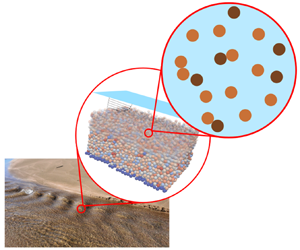
A recent paper by Chassagne, Bonamy & Chauchat (Reference Chassagne, Bonamy and Chauchat2023) proposes a frictional-collisional two-fluid model based on kinetic theory for modelling bedload transport. The proposed model (which employs the GD frictionless kinetic theory as a baseline) covers dilute and dense regimes, and exhibits a good agreement with discrete element method (DEM) simulations and experiments (Ni & Capart Reference Ni and Capart2018).
2. Overview
To mitigate the discrepancies observed between the theoretical predictions of the frictionless GD theory with those obtained in DEM simulations, Chassagne et al. (Reference Chassagne, Bonamy and Chauchat2023) (CBC theory) corrects the above kinetic theory in the following ways. First, since the GD theory neglects the effect of the surrounding fluid, a drag force term between the fluid and particle phases is introduced. This drag force leads to a dissipation term in the balance equation for the granular temperature due to fluctuating particle motion. Second, given that simulations clearly show that interparticle friction adds another source of energy dissipation different from that of inelasticity, an effective restitution coefficient $e_{eff}$ (Jenkins & Zhang Reference Jenkins and Zhang2002) is introduced in the expression of the rate of dissipation of granular temperature. The effective coefficient $e_{eff}(\mu ^p)$ is smaller than the (constant) coefficient of restitution $e$ and depends on the friction coefficient $\mu ^p$. In addition, since interparticle friction also affects the geometrical packing structure of the granular flow, they modify the usual form of the radial distribution function $g_0$ (which takes into account spatial correlations) by adding a $\mu ^p$-dependent term adjusted to reproduce the discrete simulations. A third modification to the GD theory refers to the saltation regime observed at the top of the bed, where the volume fraction is small. Since this regime is essentially dominated by the fluid drag force, it cannot be reproduced by the GD theory. Although in most of the previous works, saltation is treated as a boundary condition, in the model of Chassagne et al. (Reference Chassagne, Bonamy and Chauchat2023), saltation is treated in a continuum framework. While the saltation contribution $\eta ^{{salt}}$ to the shear viscosity $\eta$ was obtained in previous works (Jenkins, Cantat & Valance Reference Jenkins, Cantat and Valance2010), Chassagne et al. (Reference Chassagne, Bonamy and Chauchat2023) propose that the saltation contribution $\kappa ^{{salt}}$ to the thermal conductivity $\kappa$ is simply given by $\kappa ^{{salt}}=\eta ^{{salt}}/\sigma$, where $\sigma =0.5$ is an empirical constant found by fitting to the DEM simulations.
To put the results in a proper context, it is interesting to compare the predictions for the Navier–Stokes transport coefficients obtained from the GD theory, the CBC theory and the GG theory (Gómez González & Garzó Reference Gómez González and Garzó2019). While the former theory is for a dry (no fluid phase) granular gas, the latter two take into account the impact of the fluid phase on grains. To perform a clean comparison between the CBC and GG theories, the fluid drag force coefficient $K$ appearing in Chassagne et al. (Reference Chassagne, Bonamy and Chauchat2023) may be related to the Stokes drift coefficient $\gamma$ of the GG theory by the relation $\gamma =(1-\phi )K/\rho ^p$, where $\phi$ is the solid volume fraction, $\rho ^p=m/({{\rm \pi} }d^3/6)$ is the particle density, $m$ is the particle mass and $d$ is the diameter of the sphere. In terms of the granular temperature $T$, the transport coefficients can be written as $\eta =d\rho ^p \sqrt {T/m}\ \eta ^*$, $\kappa =d\rho ^p \sqrt {T/m^3}\ \kappa ^*$ and $\kappa _\phi =T^{3/2}/(d^2 \phi \sqrt {m})\kappa _\phi ^*$. Here, $\kappa _\phi$ is the transport coefficient linking the heat flux to the solid volume fraction gradient. This contribution (which vanishes for elastic collisions) to the heat flux was neglected by Chassagne et al. (Reference Chassagne, Bonamy and Chauchat2023). Figure 1 shows the dependence of the dimensionless coefficients $\eta ^*(e)/\eta ^*(1)$, $\kappa ^*(e)/\kappa ^*(1)$ and $\kappa _\phi ^*(e)$ on $e$, as given by the three theories. For this moderate value of the solid volume fraction ($\phi =0.2$), we observe that the predictions of the (frictionless) GG theory for the coefficients $\eta ^*$ and $\kappa ^*$ agree well (especially in the case of the shear viscosity) with those obtained from the CBC theory, even for quite strong inelasticities ($e\gtrsim 0.5$). This is likely due to the fact that while the effect of the friction coefficient $\mu ^p$ on $g_0$ is relatively small, the impact of the fluid phase on transport is quite important. This latter aspect is not considered in the GD theory and hence, it exhibits differences with the CBC theory which are much more significant than those found with the GG theory. Another interesting conclusion of the GG theory is the negligible impact of the coefficient $\kappa _\phi ^*$ on the heat transport (see figure 1c); this result clearly differs from that obtained in the GD model (where $\kappa _\phi ^*$ can be even larger than the thermal conductivity coefficient $\kappa ^*$ in a frictionless dry granular fluid) but agrees with the simulation data of Chassagne et al. (Reference Chassagne, Bonamy and Chauchat2023).
One of the weaknesses of kinetic theory is its inability to predict dense granular flows. However, the results derived from the CBC theory (based on the combination of kinetic theory with a frictional model) reproduces the $\mu (I)$ rheology in the dense regime. Although recent attempts to model dense granular flows with kinetic theory have been based on the introduction of a correlation length in the dissipation term, the results obtained by Chassagne et al. (Reference Chassagne, Bonamy and Chauchat2023) suggest that dense granular flows are essentially dominated by the competition between elastic-frictional and kinetic-collisional stresses rather than the development of velocity correlations (breakdown of molecular chaos hypothesis) for high densities.
Finally, a comparison with experiments (Ni & Capart Reference Ni and Capart2018) of the two-fluid model proposed by Chassagne et al. (Reference Chassagne, Bonamy and Chauchat2023), when turbulence is negligible, has also shown a good agreement. In this sense, the present model can be taken as a starting point which may be adapted for the study of more complex configurations.
3. Future
The paper by Chassagne et al. (Reference Chassagne, Bonamy and Chauchat2023) shows the potentiality of kinetic theory to accurately describe bedload transport. Their results suggest that a complicated extension of the GD frictionless kinetic theory to account for the combined effect of the coefficients of friction and normal restitution on the transport coefficients may not be necessary to capture the behaviour of granular flows in both dilute and dense regimes. As a potential extension of the CBC theory to account for the effect of interparticle friction on transport in a more rigorous way, one could consider a granular gas of inelastic rough hard spheres, where a constant coefficient of tangential restitution characterizes the ratio between the magnitude of the tangential component of the relative velocity before and after collision. In this context, as a first step, one should extend the results derived by Kremer, Santos & Garzó (Reference Kremer, Santos and Garzó2014) to moderate densities and consider this theory as a baseline to account for the saltation regime in the continuum framework, as made by Chassagne et al. (Reference Chassagne, Bonamy and Chauchat2023).






1. Introduction
It is well known that granular materials are ubiquitous in nature and play an important role in many industrial processes, such as those involving pharmaceutical, agricultural or construction products, among others. The fact that these materials are widely used in industry is likely one of the main reasons why their understanding has attracted the attention of physicists and engineers in the past few years. Apart from their practical interest, their study is interesting by itself since they behave differently depending on the external conditions to which they are subjected. For instance, grains contained in a jar will behave as a solid, liquid or gas depending on how they are shaken. Even when the motion of grains is quite similar to the random motion of atoms or molecules of a molecular fluid (rapid flow conditions), granular flows differ from conventional fluid flows since the size of grains is macroscopic and hence, their collisions are inelastic.
In the dilute regime, rapid flow conditions can be achieved when the energy dissipated by collisions is compensated for by the energy supplied to the system from external excitations. In this regime, kinetic theory (which can be considered as a mesoscopic description intermediate between statistical mechanics and hydrodynamics), conveniently adapted to account for dissipative dynamics, has been employed in the past few years as the starting point to derive hydrodynamic equations with explicit forms of the transport coefficients. Usually, a simple model has been considered in the granular literature: a gas of smooth hard spheres where the inelasticity in collisions is accounted for via a (positive) constant coefficient of normal restitution $e\leq 1$. The inelastic versions of the classical Boltzmann and Enskog kinetic equations for dilute and moderate dense gases, respectively, have been proposed to determine the dynamic properties of granular gases (Garzó Reference Garzó2019). However, technical difficulties in the analysis of the above equations entailed approximations that limited the applicability of the first attempts (Lun et al. Reference Lun, Savage, Jeffrey and Chepurniy1984; Jenkins & Richman Reference Jenkins and Richman1985) to weakly dissipative granular flows ( $e\lesssim 1$). Years later, Garzó & Dufty (Reference Garzó and Dufty1999) (GD theory) solved the Enskog equation by means of the Chapman–Enskog method and obtained expressions for the Navier–Stokes transport coefficients for the whole range of values of the coefficient of restitution $e$.
$e$.
Although grains in nature are usually surrounded by a fluid like water or air, all the above models (Lun et al. Reference Lun, Savage, Jeffrey and Chepurniy1984; Jenkins & Richman Reference Jenkins and Richman1985; Garzó & Dufty Reference Garzó and Dufty1999) neglect the effect of the interstitial fluid on the dynamics of grains. Needless to say, understanding the flow of solid particles immersed in one or more fluid phases is a very intricate problem. Among the different types of multiphase flows, a particularly interesting set corresponds to the so-called particle-laden suspensions, in which small, immiscible, and typically dilute particles are immersed in a carrier fluid (for instance, fine aerosol particles in air) (Subramaniam Reference Subramaniam2020). When the dynamics of grains is essentially dominated by collisions among them, kinetic theory is again a convenient tool to describe this type of flow. Due to complexity of the problem, a coarse-grained approach is usually adopted, where the effect of the background fluid on grains is accounted for through an effective fluid–solid force. In some situations (Tsao & Koch Reference Tsao and Koch1995), only a viscous drag force (proportional to the instantaneous particle velocity) is considered, while other more realistic models (Garzó et al. Reference Garzó, Tenneti, Subramaniam and Hrenya2012; Gómez González & Garzó Reference Gómez González and Garzó2019) also incorporate a stochastic Langevin-like term defined in terms of the background temperature $T_{b}$.
However, for dense granular flows, kinetic theory has been so far incapable of describing this type of regime. These type of flows are generally described with the so-called $\mu (I)$ rheology (Forterre & Pouliquen Reference Forterre and Pouliquen2008), where a phenomenological law (obtained by fitting experimental and discrete simulation data) relates the stress rate $\mu$ to the inertial number $I$. Although this phenomenological theory gives good predictions in the dense regime, it fails for dilute systems.
A recent paper by Chassagne, Bonamy & Chauchat (Reference Chassagne, Bonamy and Chauchat2023) proposes a frictional-collisional two-fluid model based on kinetic theory for modelling bedload transport. The proposed model (which employs the GD frictionless kinetic theory as a baseline) covers dilute and dense regimes, and exhibits a good agreement with discrete element method (DEM) simulations and experiments (Ni & Capart Reference Ni and Capart2018).
2. Overview
To mitigate the discrepancies observed between the theoretical predictions of the frictionless GD theory with those obtained in DEM simulations, Chassagne et al. (Reference Chassagne, Bonamy and Chauchat2023) (CBC theory) corrects the above kinetic theory in the following ways. First, since the GD theory neglects the effect of the surrounding fluid, a drag force term between the fluid and particle phases is introduced. This drag force leads to a dissipation term in the balance equation for the granular temperature due to fluctuating particle motion. Second, given that simulations clearly show that interparticle friction adds another source of energy dissipation different from that of inelasticity, an effective restitution coefficient $e_{eff}$ (Jenkins & Zhang Reference Jenkins and Zhang2002) is introduced in the expression of the rate of dissipation of granular temperature. The effective coefficient $e_{eff}(\mu ^p)$ is smaller than the (constant) coefficient of restitution $e$ and depends on the friction coefficient $\mu ^p$. In addition, since interparticle friction also affects the geometrical packing structure of the granular flow, they modify the usual form of the radial distribution function $g_0$ (which takes into account spatial correlations) by adding a $\mu ^p$-dependent term adjusted to reproduce the discrete simulations. A third modification to the GD theory refers to the saltation regime observed at the top of the bed, where the volume fraction is small. Since this regime is essentially dominated by the fluid drag force, it cannot be reproduced by the GD theory. Although in most of the previous works, saltation is treated as a boundary condition, in the model of Chassagne et al. (Reference Chassagne, Bonamy and Chauchat2023), saltation is treated in a continuum framework. While the saltation contribution $\eta ^{{salt}}$ to the shear viscosity $\eta$ was obtained in previous works (Jenkins, Cantat & Valance Reference Jenkins, Cantat and Valance2010), Chassagne et al. (Reference Chassagne, Bonamy and Chauchat2023) propose that the saltation contribution $\kappa ^{{salt}}$ to the thermal conductivity $\kappa$ is simply given by $\kappa ^{{salt}}=\eta ^{{salt}}/\sigma$, where $\sigma =0.5$ is an empirical constant found by fitting to the DEM simulations.
To put the results in a proper context, it is interesting to compare the predictions for the Navier–Stokes transport coefficients obtained from the GD theory, the CBC theory and the GG theory (Gómez González & Garzó Reference Gómez González and Garzó2019). While the former theory is for a dry (no fluid phase) granular gas, the latter two take into account the impact of the fluid phase on grains. To perform a clean comparison between the CBC and GG theories, the fluid drag force coefficient $K$ appearing in Chassagne et al. (Reference Chassagne, Bonamy and Chauchat2023) may be related to the Stokes drift coefficient $\gamma$ of the GG theory by the relation $\gamma =(1-\phi )K/\rho ^p$, where $\phi$ is the solid volume fraction, $\rho ^p=m/({{\rm \pi} }d^3/6)$ is the particle density, $m$ is the particle mass and $d$ is the diameter of the sphere. In terms of the granular temperature $T$, the transport coefficients can be written as $\eta =d\rho ^p \sqrt {T/m}\ \eta ^*$, $\kappa =d\rho ^p \sqrt {T/m^3}\ \kappa ^*$ and $\kappa _\phi =T^{3/2}/(d^2 \phi \sqrt {m})\kappa _\phi ^*$. Here, $\kappa _\phi$ is the transport coefficient linking the heat flux to the solid volume fraction gradient. This contribution (which vanishes for elastic collisions) to the heat flux was neglected by Chassagne et al. (Reference Chassagne, Bonamy and Chauchat2023). Figure 1 shows the dependence of the dimensionless coefficients $\eta ^*(e)/\eta ^*(1)$, $\kappa ^*(e)/\kappa ^*(1)$ and $\kappa _\phi ^*(e)$ on $e$, as given by the three theories. For this moderate value of the solid volume fraction ( $\phi =0.2$), we observe that the predictions of the (frictionless) GG theory for the coefficients $\eta ^*$ and $\kappa ^*$ agree well (especially in the case of the shear viscosity) with those obtained from the CBC theory, even for quite strong inelasticities ( $e\gtrsim 0.5$). This is likely due to the fact that while the effect of the friction coefficient $\mu ^p$ on $g_0$ is relatively small, the impact of the fluid phase on transport is quite important. This latter aspect is not considered in the GD theory and hence, it exhibits differences with the CBC theory which are much more significant than those found with the GG theory. Another interesting conclusion of the GG theory is the negligible impact of the coefficient $\kappa _\phi ^*$ on the heat transport (see figure 1c); this result clearly differs from that obtained in the GD model (where $\kappa _\phi ^*$ can be even larger than the thermal conductivity coefficient $\kappa ^*$ in a frictionless dry granular fluid) but agrees with the simulation data of Chassagne et al. (Reference Chassagne, Bonamy and Chauchat2023).
Plot of the (reduced) coefficients $\eta ^*(e)/\eta ^*(1)$, $\kappa ^*(e)/\kappa ^*(1)$ and $\kappa _\phi ^*(e)$ versus the coefficient of restitution $e$ for $\mu ^p=0.8$ and $T_{b}^*=T_{b}/m d^2 \gamma ^2=1$. In the case of the coefficients $\eta ^*(e)/\eta ^*(1)$ and $\kappa ^*(e)/\kappa ^*(1)$ in panels (a,b), the lines (i), (ii) and (iii) correspond to the results obtained from the CBC-theory, the GG-theory and the GD-theory, respectively, for $\phi =0.2$. In the case of the coefficient $\kappa _\phi ^*$ in panel (c), the solid (dash–dotted) lines refer to the results obtained from the (i) GG theory and (ii) GD theory for $\phi =0.1$ ( $\phi =0.2$).
One of the weaknesses of kinetic theory is its inability to predict dense granular flows. However, the results derived from the CBC theory (based on the combination of kinetic theory with a frictional model) reproduces the $\mu (I)$ rheology in the dense regime. Although recent attempts to model dense granular flows with kinetic theory have been based on the introduction of a correlation length in the dissipation term, the results obtained by Chassagne et al. (Reference Chassagne, Bonamy and Chauchat2023) suggest that dense granular flows are essentially dominated by the competition between elastic-frictional and kinetic-collisional stresses rather than the development of velocity correlations (breakdown of molecular chaos hypothesis) for high densities.
Finally, a comparison with experiments (Ni & Capart Reference Ni and Capart2018) of the two-fluid model proposed by Chassagne et al. (Reference Chassagne, Bonamy and Chauchat2023), when turbulence is negligible, has also shown a good agreement. In this sense, the present model can be taken as a starting point which may be adapted for the study of more complex configurations.
3. Future
The paper by Chassagne et al. (Reference Chassagne, Bonamy and Chauchat2023) shows the potentiality of kinetic theory to accurately describe bedload transport. Their results suggest that a complicated extension of the GD frictionless kinetic theory to account for the combined effect of the coefficients of friction and normal restitution on the transport coefficients may not be necessary to capture the behaviour of granular flows in both dilute and dense regimes. As a potential extension of the CBC theory to account for the effect of interparticle friction on transport in a more rigorous way, one could consider a granular gas of inelastic rough hard spheres, where a constant coefficient of tangential restitution characterizes the ratio between the magnitude of the tangential component of the relative velocity before and after collision. In this context, as a first step, one should extend the results derived by Kremer, Santos & Garzó (Reference Kremer, Santos and Garzó2014) to moderate densities and consider this theory as a baseline to account for the saltation regime in the continuum framework, as made by Chassagne et al. (Reference Chassagne, Bonamy and Chauchat2023).
Funding
Financial support from grant PID2020-112936GB-I00 and from grant IB20079 funded by Junta de Extremadura (Spain) and by European Regional Development Fund: ‘A way of making Europe’ is acknowledged.
Declaration of interests
The author reports no conflict of interest.