





Introduction
Introduced into North America as a potential fiber crop in the mid-1700s, velvetleaf (Abutilon theophrasti Medik.) was planted by growers for more than a century in the United States. The popularity of A. threophrasti as a viable new fiber source subsided due to a lack of proper machinery to clean the fiber. In the late 1800s, A. threophrasti was beginning to be recognized as a troublesome weed in Illinois cornfields (Spencer Reference Spencer1984). Abutilon threophrasti continues to be regarded as a troublesome broadleaf weed (Spencer Reference Spencer1984), causing grain yield losses in corn (Zea mays L.), soybean [Glycine max (L.) Merr.], sorghum [Sorghum bicolor (L.) Moench], and cotton (Gossypium hirsutum L.) (Behrens Reference Behrens and Hafliger1979; Colton and Einhellig Reference Colton and Einhellig1980; Eaton et al. Reference Eaton, Russ and Feltner1976; Hagood et al. Reference Hagood, Bauman, Williams and Schreiber1980; Higgins et al. Reference Higgins, Pedigo and Staniforth1984; Oliver Reference Oliver1979; Spencer Reference Spencer1984; USDA 1970). A growers’ survey conducted in 2005 to 2006 reported A. threophrasti as one of the three most problematic weeds in glyphosate-resistant corn- and soybean-cropping systems in the Midwest (Kruger et al. Reference Kruger, Johnson, Weller, Owen, Shaw, Wilcut, Jordan, Wilson, Bernards and Young2009). A statewide survey of Nebraska stakeholders in 2015 found that A. threophrasti ranked as the fourth most difficult to control weed in corn and soybean production fields (Sarangi and Jhala Reference Sarangi and Jhala2018).
Abutilon threophrasti characteristics contribute to its success as a weed, including rapid root growth and the ability to produce sugar at a relatively efficient rate in low sunlight, allowing growth under partially shaded crop canopies (Roeth Reference Roeth1987). Abutilon threophrasti produces 700 to 17,000 seeds plant−1 that have high viability and can persist in the soil up to 50 yr (Anderson et al. Reference Anderson, Menges and Conn1985; Chandler and Dale Reference Chandler and Dale1974; Khedir and Roeth Reference Khedir and Roeth1981). In addition, A. threophrasti has a sporadic and continuous germination pattern (Burnside et al. Reference Burnside, Fenster, Evetts and Muvom1981; Roeth Reference Roeth1987), robust seedling vigor (Hartgerink and Bazzaz Reference Hartgerink and Bazzaz1984), and allelopathic effects (Bhowmik and Doll Reference Bhowmik and Doll1982; Colton and Einhellig Reference Colton and Einhellig1980; Elmore Reference Elmore1980; Gressel and Holm Reference Gressel and Holm1964; Sterling and Putman Reference Sterling and Putnam1987; Sterling et al. Reference Sterling, Houtz and Putman1987); is a host to several crop pests and pathogens (Hepperley et al. Reference Hepperley, Kirkpatrick and Sinclair1980; Jacques and Peters Reference Jacques and Peters1971); and has reduced susceptibility to certain herbicides used in corn and soybean production (Jhala et al. Reference Jhala, Norsworthy, Ganie, Sosnoskie, Beckie, Mallory-Smith, Liu, Wei, Wang and Stoltenberg2021), such as dicamba (de Sanctis and Jhala Reference de Sanctis and Jhala2021).
Throughout Nebraska’s agricultural history, natural disasters such as drought have had an adverse effect on crop yields and the economy (USDA 2020; Wu et al. Reference Wu, Qu, Hao and Xiong2013). In the early mid-2000s and in 2012, Nebraska dealt with severe drought resulting in reduced crop yields (Wu et al. Reference Wu, Qu, Hao and Xiong2013). More recently, in August of 2020, Nebraska began experiencing drought conditions, and by October of 2020, 34 counties in Nebraska were eligible for emergency loans for drought relief (USDA 2020). Recognition of drought periods is important, because weed species such as A. threophrasti compete with crops for a variety of environmental resources, including water, which is one of the most limiting factors for optimum crop production (Benjamin and Nielsen Reference Benjamin and Nielsen2006). Water stress can negatively affect the growth and productivity of crops and associated weed species, though the outcomes of competition for water depend on the crop and weed species’ abilities to survive under water-stress conditions (Begg and Turner Reference Begg and Turner1976; Patterson Reference Patterson1995). Compared with C4 weed species such as Palmer amaranth (Amaranthus palmeri S. Watson) and common purslane (Portulaca oleracea L.) that have water-stress resistance mechanisms (e.g., drought avoidance, drought tolerance, drought recovery, or drought escape), C3 weed species such as A. threophrasti are not able to maintain the same level of growth and development under water-stress conditions (Kumar et al. Reference Kumar, Saraswathy and Das1984; Pearcy and Ehleringer Reference Pearcy and Ehleringer1984; Sung and Krieg Reference Sung and Krieg1979; Ward et al. Reference Ward, Tissue, Thomas and Strain2001). Hinz and Owen (Reference Hinz and Owen1994) found that water-stress conditions caused leaf water and osmotic potential to decrease linearly over time in A. threophrasti. Munger et al. (Reference Munger, Chandler and Cothren1987a, Reference Munger, Chandler, Cothren and Hons1987b) indicated that as leaf water potential decreased in A. threophrasti plants, stomatal conductance, photosynthetic, and transpiration rates decreased.
In addition to growth and development, seed germination is an important component of weed establishment and is influenced by environmental factors such as water availability, water temperature, light quality, and light duration during seed development (Baskin and Baskin Reference Baskin and Baskin1998; Fenner Reference Fenner1991). Abutilon threophrasti seed germination is sensitive to varying degrees of water stress and was completely inhibited by an osmotic potential of −600 kPa (Sadeghloo et al. Reference Sadeghloo, Asghari and Ghaderi-Far2013; Xiong et al. Reference Xiong, Ma, Wu, Jiang and Ma2018). Despite these findings, scientific literature is not available on the effects of water stress on growth and fecundity throughout A. threophrasti’s growth period. Bathke et al. (Reference Bathke, Oglesby, Rowe and Wilhite2014) projected a 5% to 10% decrease in soil moisture for Nebraska under a high emissions scenario, indicating the potential for increased water stress and plant water competition in Nebraska plant populations. Despite projected increases in precipitation events in the eastern Great Plains, soil moisture is expected to decrease most near the soil surface due to evaporative loss from warmer temperatures (Bathke et al. Reference Bathke, Oglesby, Rowe and Wilhite2014; Berg et al. Reference Berg, Sheffield and Milly2016). While some plant developmental processes in leaves, roots, and reproductive structures are conserved across species, most plant responses are variable within and between species and are dependent on the developmental stage (Gray and Brady Reference Gray and Brady2016).
Research evaluating a plant’s response to water stress is typically performed under greenhouse or controlled environment conditions. The plants are often grown in pots to maintain certain water-stress levels or soil field capacity (FC) for a limited growth period or until the plant has reached maturity. A common method for maintaining desired FC in similar studies has been to weigh pots regularly to determine water lost from the soil and then add the appropriate amount of water (Chandi et al. Reference Chandi, Jordan, York, Burton, Milla-Lewis, Spears, Whitaker and Wells2013; Chauhan Reference Chauhan2013; Chauhan and Johnson Reference Chauhan and Johnson2010; Earl Reference Earl2003; Sarangi et al. Reference Sarangi, Irmak, Lindquist, Knezevic and Jhala2015). However, it is not possible to determine the weight of the plant and pot separately using this method, resulting in inaccurate soil water content (Chahal et al. Reference Chahal, Irmak, Jugulam and Jhala2018). This could result in errors when adding water, especially as plants accumulate more biomass. Moreover, this approach is time-consuming and labor intensive, because the pots must be lifted and weighed at regular intervals until completion of the study. The labor required to weigh and add water to pots can be reduced by incorporating soil moisture sensors such as Meter Group 5TM sensors (METER Group, 2365 NE Hopkins Court, Pullman, WA 99163, USA). The Meter Group 5TM sensor is a frequency-domain reflectometry sensor that measures soil water content directly as percent volume, determining soil moisture stress in real time with increased accuracy (Chahal et al. Reference Chahal, Irmak, Jugulam and Jhala2018). Soil moisture sensors allow researchers to measure soil water content more frequently and maintain FC within a narrow, predetermined range (Irmak et al. Reference Irmak, Payero, VanDeWalle, Rees, Zoubek, Martin, Kranz, Eisenhauer and Leininger2016) in loam and silt-loam soils (Paudel et al. Reference Paudel, Grantz, Vu and Shrestha2016; Zhu et al. Reference Zhu, Irmak, Jhala, Vuran and Diotto2019). Thus, the objective of this study was to determine the effect of degree of water stress on growth and fecundity of A. threophrasti using soil moisture sensors.
Materials and Methods
Plant Materials
Abutilon threophrasti seeds were collected from fields under corn–soybean rotation at the South Central Agricultural Laboratory near Clay Center in Clay County, Nebraska (40.57°N, 98.14°W). The seeds were stored in a refrigerator at 5 C until used in this study. The study was conducted in greenhouse at the University of Nebraska–Lincoln with six replications and repeated once. Abutilon threophrasti seeds were planted in germination trays in early May of 2019 (for the first study) and late January of 2020 (for the second study) and watered uniformly once a day to initiate plant growth. Germination trays were filled with silty clay loam soil with a particle size distribution of 53% silt, 28% clay, 19% sand, and 2% organic matter content and a pH of 6.7. The soil used in this study was collected from a field near Lincoln, NE, with no herbicide use in the last 10 yr. Germination trays were kept under greenhouse conditions at the University of Nebraska–Lincoln maintained at 27/21 C day/night temperatures. Overhead metal-halide lamps with 600 mmol photon m−2 s−1 light intensity were used to provide supplemental light in the greenhouse to maintain a 16-h photoperiod. Abutilon threophrasti seedlings 6 to 8 cm in height were transplanted into round, free-draining pots (20-cm diameter and 30-cm height) containing 10 kg of the same soil used in the germination trays, with pots already at the desired water-stress level of 100%, 75%, 50%, and 25% FC. One A. threophrasti plant per pot was transplanted on May 28 in 2019 and February 4 in 2020. Treatments were arranged in a completely randomized design with six replications.
Soil Water Content
The soil used in this study had a permanent wilting point and saturation point of 17.7% and 34.7% volumetric, respectively. The soil had a bulk density of 1.4 g cm−3 and a volumetric FC of 39.2% based on soil test reports (American Agricultural Laboratory, 700 W D Street, McCook, NE 69001, USA). Gravimetric FC was 28% and was calculated using the following equation (Hillel Reference Hillel1998): ${\rm{\rm {\theta}}}g{\rm{\;}} = {\rm{\;\theta }}v/{{\rm{\rho}}_b}$
where θg is the percent gravimetric soil water content, θv is the percent volumetric soil water content, and ρ b is the soil bulk density in grams per cubic centimeter.
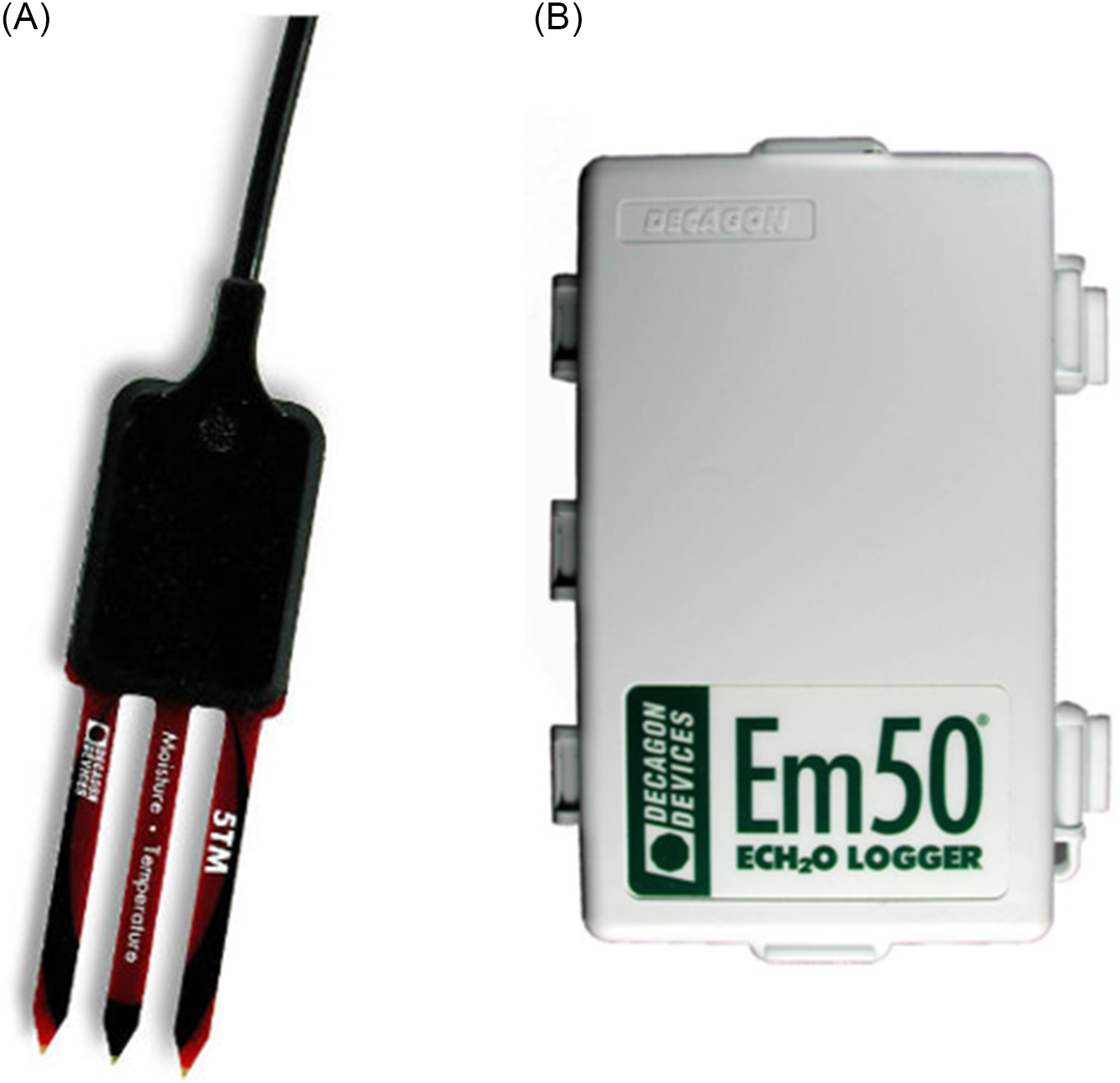
The study included four soil water-stress treatments: 100%, 75%, 50%, and 25% of the soil FC, corresponding to no, light, moderate, and high water-stress levels, respectively (Chahal et al. Reference Chahal, Irmak, Jugulam and Jhala2018; Sarangi et al. Reference Sarangi, Irmak, Lindquist, Knezevic and Jhala2015). Soil water content in the pots was measured using Meter Group 5TM soil moisture sensors and Em50 data loggers (Figure 1). The sensors were installed at a 45° angle at a 15-cm depth in each pot. To ensure adequate soil moisture distribution to plant roots, soil moisture sensors were installed directly beneath A. threophrasti roots and monitored after each water application for increases in soil moisture. Because the soil had a gravimetric FC of 28%, 2.8 L of water (28% of 10 kg soil) was added to 100% gravimetric FC treatments at 12 and 4 d before transplanting in 2019 and 2020, respectively. Likewise, 2.3 L (75% of 2.8 L), 1.6 L (50% of 2.8 L), and 0.9 L (25% of 2.8 L) of water were added to maintain 75%, 50%, and 25% gravimetric FC treatments, respectively, with a range of ±2% actual volumetric water content set for water-stress treatments. Soil moisture data from data loggers were recorded once a day, and the required amount of water was added one time each afternoon to maintain treatment soil FC where the sensor was installed. Water was delivered directly to the A. threophrasti plant for maximum water uptake, resulting in soil moisture distribution near the plant roots and soil moisture sensor of 75%, 50%, and 25% FC. For the 100% FC, soil moisture was distributed throughout the whole pot, as evidenced by the moist soil visible at the bottom of the pots.
Soil moisture content in pots was measured using (A) Meter Group 5TM moisture sensors and (B) Em50 data loggers to determine degree of water stress on Abutilon threophrasti in a greenhouse study conducted at the University of Nebraska–Lincoln.
Data Collection
Abutilon threophrasti height, number of leaves per plant, and growth index were determined at 7-d intervals beginning 7 d after transplanting (DATr) until plants were harvested upon maturity at 84 DATr during both years. Growth index can be defined as a quantitative indicator of plant growth rate used to compare plants grown under different soil water conditions and was calculated using the following equation (Irmak et al. Reference Irmak, Haman, Irmak, Jones, Campbell and Crisman2004; Sarangi et al. Reference Sarangi, Irmak, Lindquist, Knezevic and Jhala2015): ${\rm{GI\;}}\left( {{\rm{c}}{{\rm{m}}^3}} \right){\rm{\;}} = \;{\rm{\pi }}\; \times \;{(w/2)^2}\; \times \;{\rm{h}}$
where w is the width of the plant calculated as an average of two widths, one measured at the widest point and another at 90° to the first; and h is the plant height measured from the soil surface to the shoot apical meristem (Sarangi et al. Reference Sarangi, Irmak, Lindquist, Knezevic and Jhala2015). Upon maturity, leaves were counted and removed from each stem to measure the total leaf area for each plant using a leaf area meter (LI-3100C Area Meter, Li-Cor, Lincoln, NE).
During harvest, plant stems were clipped at the soil surface and roots were removed from the pots; stems and roots were washed with water in a container and air-dried for 24 h. The leaves, shoots, and roots from each plant were stored separately in paper bags and oven-dried at 65 C for 7 d to obtain dry biomass values. Seed heads were collected, and the number of seeds per plant was counted; seeds were then weighed and stored in the dark at room temperature until being used in germination tests. Seed dormancy was interrupted in A. threophrasti seeds by soaking them in boiling water for 5 s (Sadeghloo et al. Reference Sadeghloo, Asghari and Ghaderi-Far2013). Fifty seeds from each plant were placed on a piece of moist Whatman No. 4 filter paper (GE Healthcare UK, Amersham Place, Little Chalfont, Buckinghamshire HP7 9NA, UK) in a petri dish. Petri dishes were stored for 21 d in a growth chamber maintained at 35/28 C day/night temperatures with a 16-h photoperiod, and an appropriate amount of water was added each day to keep the filter paper wet. Fluorescent bulbs were used to produce a light intensity of 85 mmol m−2 s −1. The total number of germinated seeds was counted and converted to percent germination based on the total seed number in each petri dish.
Statistical Analysis
Three parameter log-logistic models were fit to A. threophrasti height, leaf number per plant, and growth index using the drc package in R (R Foundation for Statistical Computing, Vienna, Austria) (Knezevic et al. Reference Knezevic, Streibig and Ritz2007): $Y = \left\{ \displaystyle{{d \over {1 + {\rm{exp}}\left[ {b\left( {{\rm{log\;}}x{\rm{\;}} - {\rm{\;log\;}}e} \right)} \right]}}} \right\}$
where Y is plant height, leaf number per plant, or growth index; x is days after transplanting; d is the estimated maximum plant height, leaf number per plant, or growth index; e is the time taken to achieve 50% of plant height, leaf number per plant, or growth index; and b represents the relative slope around the parameter e. An independent t-test was used to determine significant differences in maximum plant height, leaf number per plant, or growth index; rate of change of plant height, leaf number per plant, or growth index; and time taken to achieve 50% of plant height, leaf number per plant, or growth index between two water-stress treatments. Abutilon threophrasti stem, leaf, and root biomass per plant (g), total leaf area per plant (cm2), seed number per plant, and percent seed germination were subjected to ANOVA and LSD tests using the agricolae and LSD procedures in R, respectively. Experimental year and replication were considered fixed effects to determine whether A. threophrasti stem, leaf, aboveground and root biomasses, total leaf area, seed number, and percent seed germination were significant by year or replication, and whether there was a year by replication interaction. Abutilon threophrasti stem, aboveground, and root biomass were significant by year, so ANOVA and LSD tests were performed for these parameters by year, while leaf biomass, total leaf area, seed number, and percent seed germination were grouped together by year. Where the ANOVA indicated treatment effects were significant, means were separated at P ≤ 0.05.
Results and Discussion
Leaf Number
Abutilon threophrasti responded to increasing water stress by senescing the oldest leaves, resulting in a reduced number of leaves with increasing water-stress level (Table 1). Abutilon threophrasti maintained at 25% FC did not survive more than 77 DATr during both years; therefore, leaf number data of A. threophrasti at 25% FC are not included. Similarly, Schmidt et al. (Reference Schmidt, Blankenship and Lindquist2011) reported senescence of older leaves in A. threophrasti under drought conditions. Abutilon threophrasti maintained at 100% FC had a maximum of 28 leaves plant−1, followed by 21 and 15 leaves plant−1 at 75% and 50% FC, respectively (Table 1; Figure 2A). Chadha et al. (Reference Chadha, Florentine, Chauhan, Long and Jayasundera2019) reported similar results in prickly lettuce (Lactuca serriola L.), in which leaf numbers were higher at 100% (52 leaves plant−1) and 75% FC (49 leaves plant−1) compared with 50% FC (41 leaves plant−1). In contrast, Mahajan et al. (Reference Mahajan, George-Jaeggli, Walsh and Chauhan2018) reported a similar leaf number per plant in two African turnip (Sisymbrium thellungii O.E. Schulz) weed biotypes at 100%, 75%, and 50% FC. Kaur et al. (Reference Kaur, Aulakh and Jhala2016) also reported a similar number of leaves per plant in giant ragweed (Ambrosia trifida L.) at 100%, 75%, and 50% FC. Significant reductions in leaf number were reported in S. thellungii (Mahajan et al. Reference Mahajan, George-Jaeggli, Walsh and Chauhan2018) and A. trifida (Kaur et al. Reference Kaur, Aulakh and Jhala2016) at 25% FC, similar to the results of the present study, in which A. threophrasti plants maintained at 25% FC had a maximum of 7 leaves plant−1 before plant death (Figure 2A). The log-logistic model estimated that A. threophrasti grown at 100%, 75%, and 50% FC took a similar amount of time (3.3 to 4.3 wk after transplanting [WATr]) to achieve 50% of maximum leaf number. Similarly, there was no difference in the time it took for A. trifida to achieve 50% of maximum leaf number at 100%, 75%, and 50% FC (6 to 9 WATr) (Kaur et al. Reference Kaur, Aulakh and Jhala2016).
Parameter estimates and test of lack of fit at 95% level for the three-parameter log-logistic function fit to Abutilon threophrasti leaves per plant, plant height, and growth index under differing degrees of water stress at 84 d after transplanting (DATr) in a greenhouse study at University of Nebraska–Lincoln. a

a Y={d/1 + exp[b(log x – log e)]}, where Y is the leaves per plant, plant height, or growth index; x is days after transplanting; d is the estimated maximum leaves per plant, plant height, or growth index; e is the time taken to achieve 50% of leaves per plant, plant height, or growth index; and b is the relative slope around parameter e.
b Abbreviation: FC, field capacity.
c Only one A. threophrasti plant maintained at 25% soil FC survived more than 77 DATr, and the three-parameter log-logistic model did not provide a good fit for leaves per plant, plant height, or growth index; therefore, data are not presented.
d Means within columns with no common letter(s) are significantly different at P ≤ 0.05.
e A test of lack of fit at the 95% level was not significant for any of the curves tested for the water-stress treatments, indicating that the fitted model was correct.
f Growth index = π * (w/2)2 * h, where w is the width of the plant calculated as an average of two widths; and h is the plant height measured from the soil surface to the apical meristem.
Effect of degree of water stress on (A) leaves per plant, (B) plant height, and (C) growth index of Abutilon threophrasti after 84 d after transplanting (DATr) during both years. The 100%, 75%, 50%, and 25% field capacity (FC) treatments correspond to no, light, moderate, and high water stress, respectively. Only one A. threophrasti plant maintained at 25% FC survived more than 77 DATr during both years, and the three-parameter log-logistic model did not provide a good fit for leaves per plant, plant height, or growth index; therefore, curves are presented for 25% FC, although only for visual reference.

Plant Height
Abutilon threophrasti maintained at 100% and 75% FC achieved heights of 108 cm and 123 cm, respectively, compared with a height of 83 cm at 50% FC (Table 1; Figure 2B). Abutilon threophrasti maintained at 25% FC did not survive more than 77 DATr during both years; therefore, plant height data of A. threophrasti at 25% FC are not included. Results suggest that available soil moisture at ≥75% FC is sufficient to achieve maximum A. threophrasti height and that a visible decrease in plant height at 50% FC could be a result of reduced cell enlargement due to low turgor pressure at 50% FC water-stress level (Farooq et al. Reference Farooq, Wahid, Kobayashi, Fujita, Basra, Lichtfouse, Navarrete, Debaeke, Veronique and Alberola2009; Jaleel et al. Reference Jaleel, Manivannan, Wahid, Farooq, Al-Juburi, Somasundaram and Panneerselvam2009). Similar results were reported by Chadha et al. (Reference Chadha, Florentine, Chauhan, Long and Jayasundera2019), who noted that L. serriola had the greatest plant heights at 75% FC (115 cm) and 100% FC (104 cm) compared with 77 cm at 50% FC. Kaur et al. (Reference Kaur, Aulakh and Jhala2016) reported that A. trifida had the greatest plant heights at 75% FC (140 cm) and 100% FC (125 cm) compared with 112 cm at 50% FC. In contrast, Mahajan et al. (Reference Mahajan, George-Jaeggli, Walsh and Chauhan2018) reported the greatest plant height at 50% FC (65 cm) compared with 75% FC (53 cm) and 100% FC (56 cm) of the St George biotype of S. thellungii. Karimi et al. (Reference Karimi, Ahmadi, Hashemi, Abbasi, Tavarini, Guglielminetti and Angelini2015) reported the greatest plant height in sweetleaf [Stevia rebaudiana (Bertoni) Bertoni] at 90% FC, and decreased height with increasing water stress up to 45% FC. The model estimated that A. threophrasti grown at 100%, 75%, and 50% FC took a similar amount of time (5.7 to 6.2 WATr) to achieve 50% of maximum plant height. Similarly, Kaur et al. (Reference Kaur, Aulakh and Jhala2016) reported that A. trifida grown at 100%, 75%, and 50% FC took 6 WATr to reach 50% of maximum plant height.
Plant Growth Index
Abutilon threophrasti maintained at 75% FC had the greatest growth index (79,907 cm3) compared with growth indices of 72,197 cm3 at 100% FC and 64,256 cm3 at 50% FC (Table 1; Figure 2C). Abutilon threophrasti maintained at 25% FC did not survive more than 77 DATr during both years; therefore, growth index data of A. threophrasti at 25% FC are not included. Results suggest that available soil moisture at 75% FC is sufficient for maximum growth of A. threophrasti and that available soil moisture at 100% FC might actually hinder plant growth due to root saturation (Ashraf Reference Ashraf2012). Similarly, Kaur et al. (Reference Kaur, Aulakh and Jhala2016) reported that A. trifida maintained at 75% FC had the greatest growth index (588 cm3), followed by 416 cm3 at 100% FC and 274 cm3 at 50% FC. The time to achieve 50% of maximum growth index was similar across water-stress levels (4.6 to 5.7 WATr) (Table 1). In contrast, Kaur et al. (Reference Kaur, Aulakh and Jhala2016) reported that the time for A. trifida to achieve 50% of maximum growth index was longer at 75% FC (6 WATr) compared with 100% and 50% FC (4 WATr).
Although A. threophrasti maintained at 25% FC did not survive more than 77 DATr during both years, one plant produced a small number of seeds; therefore, root, leaf, and stem biomass, total leaf area, number of seeds per plant, and percent seed germination are presented (Table 2). The permanent wilting point of soil used in this study was 17.7% by volume, corresponding to 45.2% FC. The soil water available to A. threophrasti plants at 25% FC was below the permanent wilting point and resulted in plant death.
Effect of degree of water stress on Abutilon threophrasti biomass, seed production, and seed germination at 84 d after transplanting (DATr) in a greenhouse study at University of Nebraska–Lincoln using soil moisture sensors. a

a Means within columns with no common letter(s) are significantly different at P ≤ 0.05.
b Abbreviation: FC, field capacity.
Plant Stem and Root Biomass
Year by treatment interactions were significant for stem and root biomass; therefore, data were separated (Table 2). Abutilon threophrasti plants maintained at 75% FC were the tallest; however, they resulted in root, stem, and leaf biomass similar to 100% FC during both years. In 2019, stem biomass was similar (10 to 14 g plant−1) at 100%, 75%, and 50% FC, and root biomass was reduced at 100% FC (1.5 g plant−1) and 25% FC (0.08 g plant−1) compared with 2.4 to 3.4 g plant−1 at 75% and 50% FC. Similarly, no differences were reported in A. trifida (Kaur et al. Reference Kaur, Aulakh and Jhala2016) and S. thellungii (Mahajan et al. Reference Mahajan, George-Jaeggli, Walsh and Chauhan2018) stem biomass at 100%, 75%, and 50% FC. Other studies reported that A. threophrasti (Vaughn et al. Reference Vaughn, Bernards, Arkebauer and Lindquist2016) and stevia (Karimi et al. Reference Karimi, Ahmadi, Hashemi, Abbasi, Tavarini, Guglielminetti and Angelini2015) aboveground biomass increased as water supply increased and was generally greatest at full transpiration and 90% FC, respectively. Studies also reported that A. threophrasti (Vaughn et al. Reference Vaughn, Bernards, Arkebauer and Lindquist2016) and A. trifida (Kaur et al. Reference Kaur, Aulakh and Jhala2016) root biomass was greatest at full transpiration and 100% FC, respectively, but that was not the case in this study, as root biomass was reduced at 100% FC in 2019. Root biomass at 100% FC was likely reduced due to waterlogging of the soil, inhibiting root system elongation and potentially leading to adventitious root formation (Ashraf Reference Ashraf2012; Steffens and Rasmussen Reference Steffens and Rasmussen2016). In 2020, stem biomass (0.05 to 0.3 g plant−1) and root biomass (0.01 to 0.07 g plant−1) were reduced at 50% and 25% FC compared with stem biomass (1.2 to 1.3 g plant−1) and root biomass (0.16 to 0.17 g plant−1) at 100% and 75% FC. Chadha et al. (Reference Chadha, Florentine, Chauhan, Long and Jayasundera2019) reported similar results, in which aboveground biomass of L. serriola was greatest at 100% and 75% FC (19.4 to 22.4 g plant−1) compared with 50% and 25% FC (17.2 to 17.5 g plant−1). In contrast, Karkanis et al. (Reference Karkanis, Bilalis and Efthimiadou2011) reported no effect on root biomass due to water stress.
Total Leaf Area
Total leaf area values were statistically similar across 100%, 75%, and 50% FC (56 to 86.7 cm2 plant−1) and were statistically lower at 25% FC (5.5 cm2 plant−1) (Table 2). In contrast, Chadha et al. (Reference Chadha, Florentine, Chauhan, Long and Jayasundera2019) reported the greatest leaf area of L. serriola at 75% FC, followed by 50%, 100%, and 25% FC. Vaughn et al. (Reference Vaughn, Bernards, Arkebauer and Lindquist2016) and Manivannan et al. (Reference Manivannan, Jaleel, Sankar, Kishorekumar, Somasundaram, Lakshmanan and Panneerselvam2007) reported reduced total leaf area with decreased water availability in A. threophrasti and sunflower (Helianthus annuus L.).
Seed Production
Water stress influenced the number of A. threophrasti seeds produced per plant. Abutilon threophrasti at 75% FC produced the highest number of seeds (453 seeds plant−1), followed by 100% (406 seeds plant−1), 50% (288 seeds plant−1), and 25% FC (2 seeds plant−1) (Table 2). Results suggest that although A. threophrasti plant growth may be reduced by 50% FC, a considerable number of seeds are still produced. Thus, early-season control of A. threophrasti is crucial for avoiding a large infestation later in the growing season. Similarly, Kaur et al. (Reference Kaur, Aulakh and Jhala2016) reported that seed production of A. trifida was influenced by degree of water stress, with the highest number of seeds produced at 75% FC, followed by 100%, 50%, and 25% FC. In contrast, Chadha et al. (Reference Chadha, Florentine, Chauhan, Long and Jayasundera2019), Chahal et al. (Reference Chahal, Irmak, Jugulam and Jhala2018), Mahajan et al. (Reference Mahajan, George-Jaeggli, Walsh and Chauhan2018), and Sarangi et al. (Reference Sarangi, Irmak, Lindquist, Knezevic and Jhala2015) reported decreased seed production with increased water stress in L. serriola, S. thellungii, waterhemp [Amaranthus tuberculatus (Moq.) Sauer], and A. palmeri, respectively, indicating their sensitivity to water stress compared with A. threophrasti.
Seed Germination
Abutilon threophrasti seed germination was similar (96% to 100%) at 100%, 75%, and 50% FC compared with 20% germination at 25% FC. Similarly, Chahal et al. (Reference Chahal, Irmak, Jugulam and Jhala2018) reported no difference in A. palmeri seed germination at 100%, 75%, and 50% FC, and no seeds were produced at 25% FC, signifying that A. palmeri seed production is more sensitive to water stress than A. threophrasti. In contrast, Chadha et al. (Reference Chadha, Florentine, Chauhan, Long and Jayasundera2019) reported no difference in the germination ability of L. serriola seeds produced under water-stress conditions, demonstrating a higher tolerance to water stress compared with A. threophrasti. These findings imply that A. threophrasti can survive and produce viable offspring at water-stress levels as low as 50% FC, prompting the need for early-season control.
Practical Implications
This is the first study that evaluates the response of A. threophrasti to the degree of water stress using soil moisture sensors to more frequently and accurately maintain a precise level of water stress throughout the growth period. Plant height and leaf number per plant were more sensitive to water stress than total leaf area; stem, leaf, and root biomass; seed production; and seed germination. Seeds of A. threophrasti used in this study were collected from a field under continuous corn–soybean rotation in Clay County, Nebraska, USA. The growth characteristics of A. threophrasti observed in this study could vary if A. threophrasti biotypes were collected from different cropping systems or rotations. Waselkov et al. (Reference Waselkov, Regenold, Lum and Olsen2020) found that agriculturally prevalent A. tuberculatus from the Mississippi Valley and Plains regions had higher relative performance compared with A. tuberculatus from the Northeast region, where A. tuberculatus is less of an agricultural weed.
The results of this study could vary under field conditions, because A. threophrasti plants were not able to grow to their full potential due to limited pot size and pest infestation under greenhouse conditions. In 2020, stem and root biomass were lower compared with 2019, likely due to white fly (Aleyrodidae) infestation. In addition, a single A. threophrasti plant was grown in each pot without inter- or intraspecific competition; thus, plants growing with crops might produce flowers earlier or later in the growing season depending on the competitive nature of the crop, resulting in higher or lower seed formation. Water-stress treatments were imposed throughout the growth period in this study, while duration of water stress can also play an important role in determining A. threophrasti’s growth response. Therefore, it is expected that A. threophrasti grown under field conditions will have a better chance of survival and higher seed production due to possibly limited periods of water stress because of rain/irrigation compared with the continuous water-stress conditions imposed in this study.
Water stress may also influence the duration of the critical weed-free period for various crops. Light to moderate water stress (75% to 50% FC) is unlikely to impact the critical weed-free period of A. threophrasti in crops, although high water stress (25% FC) might reduce the critical weed-free period of A. threophrasti compared with saturated conditions (Coble et al. Reference Coble, Williams and Ritter1981; Jackson et al. Reference Jackson, Kapusta and Schutte Mason1985). Abutilon threophrasti is a temperate climate species and is typically absent from environments where dry climate and high evapotranspiration rates restrict growth. Munger et al. (Reference Munger, Chandler and Cothren1987a) and Vaughn et al. (Reference Vaughn, Bernards, Arkebauer and Lindquist2016) have shown that crops such as soybean and corn, respectively, have higher transpiration efficiency (TE) compared with A. threophrasti under short-term water-stress conditions. The higher TE of soybean and corn is likely due to earlier leaf senescence in A. threophrasti during short-term water stress; however, the A. threophrasti response to long-term water stress may be advantageous, where early conservation of available soil moisture and early leaf senescence could result in maintaining enough water for transpiration later and potentially producing seeds (Schmidt et al. Reference Schmidt, Blankenship and Lindquist2011). Hagood et al. (Reference Hagood, Bauman, Williams and Schreiber1980) reported a greater reduction in soybean growth due to A. threophrasti competition during a dry year compared with a wet year, indicating potential competition for moisture. The growth characteristics of A. threophrasti at ≤75% FC in this study could indicate its competitive ability under long-term water-stress conditions. For these reasons, this information could be useful for evaluating weed–crop interaction using competition models, as well as for developing climate simulation models to understand the effect of drought, rising atmospheric CO2 concentrations, rising global temperatures, reductions in annual soil and groundwater recharge, and increasing frequency of extreme weather events on crop and weed species.
Acknowledgments
The authors gratefully acknowledge Adam Leise and Murtaza Nalwala for their assistance on this project. No conflicts of interest have been declared.


 Open access

